Top US Republican lawmakers have again called for further American actions against Syria, including the bombing of its air bases, leading a multi-nation invasion of the country and sending lethal weapons to anti-Damascus militant gangs.
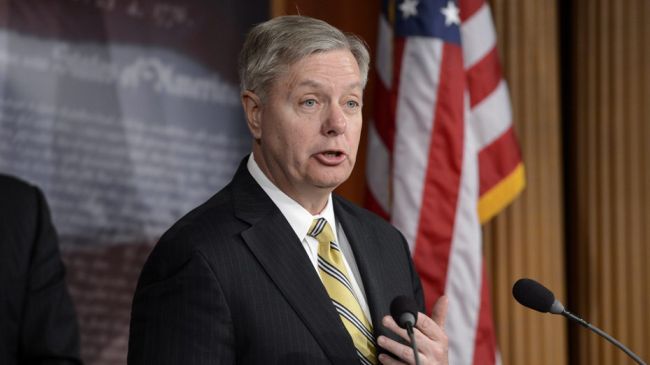
Fervently pro-Israeli Senators John McCain of Arizona and Lindsey Graham of South Carolina further cited widely challenged claims by the Israeli regime of chemical weapons use in Syria to urge swift Washington action to “secure” chemical arms arsenals in the Arab country in efforts to prevent al-Qaeda-linked militants from gaining access to such weapons, US press reports said on Sunday and Monday.
The two lawmakers, however, did not explain how American forces would secure the alleged cache of Syrian chemical weaponry.
Graham went as far as warning that if the US does not intervene in Syria the next terrorist bombing in American soil will include chemical agents.
“The chemical weapons (in Syria)… are going to be compromised and fall into wrong hands and the next bomb that goes off in America may not have nails and glasses in it,” said Graham during a televised interview with major US network CBS on Sunday.
The senior member of US Senate’s Armed Services Committee also expressed serious concerns about the potential fall of Jordan’s dictator King Abdullah II if Washington did not intervene quickly enough to stop the growing flow of Syrian refugees into his country.
Describing the Jordanian ruler as “a moderating influence and a good [US] ally,” Graham predicted that his regime will fall if the “flood” of Syrian refugees into Jordan continued.
He also predicted a US war with Iran if the Obama administration does not intervene in Syria on the grounds that Tehran would doubt Washington’s resolve in taking action against their nuclear energy program.
The American senator went on to urge the US military to “bomb Syrian air bases with cruise missiles in a bid to “neutralize” the government’s air advantage over the foreign-backed militant gangs and turn the “tide of battle pretty quickly” in favor of the anti-Damascus insurgents.
Moreover, Senator McCain said the US should move into Syria as part of an “international force” to secure the country’s chemical weapons, but did not elaborate on how such international military force would be established and which countries would be involved.
Syria has been faced with a foreign-sponsored armed insurgency since 2011. Thousands of people in the country, including a large number of security forces, have been killed in the unrest with many foreign nationals infiltrating the key Arab state in a bid to destabilize the government of President Bashar al-Assad.
Let us be clear. The United States can verify absolutely nothing about the use of chemical weapons (CWs) in Syria. Any suggestion to the contrary is entirely false.
Don’t take it from me – here is what US officials have to say about the subject:
A mere 24 hours after Washington heavyweights from the White House, Pentagon, and State Department brushed aside Israeli allegations of chemical weapons use in Syria, US Secretary of Defense Chuck Hagel and the White House changed their minds. They now believe “with varying degrees of confidence” that CWs have been used “on a small scale” inside Syria.
For the uninitiated, “varying degrees of confidence” can mean anything from “no confidence whatsoever” to “the Israelis told us” – which, translated, also means “no confidence whatsoever.”
Too cavalier? I don’t think so. The White House introduced another important caveat in its detailed briefing on Thursday:
“This assessment is based in part on physiological samples. Our standard of evidence must build on these intelligence assessments as we seek to establish credible and corroborated facts. For example the chain of custody is not clear so we cannot confirm how the exposure occurred and under what conditions.”
“The chain of custody is not clear.” That is the single most important phrase in this whole exercise. It is the only phrase that journalists need consider – everything else is conjecture of WMDs-in-Iraq proportions.
I asked a State Department spokesperson the following: “Does it mean you don’t know who has had access to the sample before it reached you? Or that the sample has not been contaminated along the way?”
He responded: “It could mean both.”
Chuck Hagel expands on that jaw-dropping admission: “We cannot confirm the origin of these weapons.” Although he goes on to conclude anyway: “but we do believe that any use of chemical weapons in Syria would very likely have originated with the Assad regime.”
Four-year-olds shouldn’t have confidence in the US intelligence community at this point. Yet we are supposed to believe that the Syrian government must be behind a chemical weapons attack because Hagel says so.
Let’s consider the facts. The Syrian government has clearly stated it would not use chemical weapons during the crisis “regardless of the developments” unless “Syria faces external aggression.”
The US and other western states have warned for more than a year now that as the government of Bashar al-Assad begins to “topple,” the likelihood of using CWs as a desperate last measure will increase.
The White House reiterated this point yesterday: “Given our concern that as the situation deteriorated and the regime became more desperate, they may use some of their significant stockpiles of chemical weapons.”
Assad’s government is clearly not on its last leg. If anything, the Syrian army has made tremendous gains in the past few weeks by thwarting rebel plans to storm Damascus, pushing them out of key surrounding suburbs, and cutting off their supply lines in different parts of the country.
This recent reversal of fortunes tends to validate the observations of those who have met with Assad and say the president remains confident that he can repel rebel forces whenever and wherever he chooses to do so.
Which frankly removes a major “motive” from any calculation by the Syrian government to use chemical weapons against civilians.
The constant reference to CWs in this conflict is suspect – there is no conceivable military advantage to be gained from the use of these munitions. Writing for Foreign Policy in December, Charles Blair says using CWs against rebels makes no tactical or strategic sense:
“The regime would risk losing Russian and Chinese support, legitimizing foreign military intervention, and, ultimately, hastening its own end. As one Syrian official said, ‘We would not commit suicide.’”
In fact, there is plenty of evidence that the government has calibrated its military responses throughout this conflict to avoid scenarios that would create a pretext for foreign military intervention on “humanitarian grounds.”
Just as there is evidence aplenty that rebel forces will go to great lengths to create a pretext for foreign intervention that would help them oust Assad.
On March 19, a suspected chemical weapons attack near Aleppo prompted the Syrian government to ask the United Nations to launch an investigation. Witnesses reported the “smell of chlorine in the air,” which led to speculation that this could have been a rebel-led attack given that opposition militias had seized Syria’s only chlorine gas bottling plant, east of Aleppo, that August.
The use of chlorine gas-based explosives by insurgents was seen not so long ago in Iraq, where attacks against both authorities and civilians are traceable to 2006. US military spokespeople, at the time, claimed that insurgent tactics had become deadlier, seeking to draw maximum attention and impose widespread suffering.
The Iraq connection and insurgent tactics there are important to the Syrian conflict because of the influx of jihadist rebels flooding over the Iraqi border, bringing with them experience and know-how from fighting the US occupation. That border also allegedly hosts training camps for groups in both countries allied with al-Qaeda – a development that has come to light since a recent announcement linking al-Nusra Front to al-Qaeda’s central group.
The White House’s allegations on Thursday specified a sarin gas connection to at least one other suspected chemical weapons attack in Syria. Even if this were true, a clear-cut connection linking the use of a CW explosive to the Syrian government is not at all inevitable. In 2004, an IED roadside bomb – a common insurgent tactic – containing the nerve agent was detonated in Iraq. There are no guarantees whatsoever that chemical munitions have not found their way into the hands of rogue elements – or in fact that they are not producing them in small quantities themselves.
At this point, almost everything being discussed in relation to chemical weapons inside Syria is conjecture – and to be honest – highly suspect.
The Times of London (which is behind a paywall so I cannot link to it) just published a detailed and timely “investigation” of an alleged CW attack in Aleppo, claiming: “the Syrian regime prefers to gas its opponents in this small-scale way, testing the elasticity of President Obama’s ‘red line.’”
The article then goes on to describe the harrowing account of what appears to be a sarin gas attack from a victim, witnesses, and medical staff. But experts are now questioning these accounts, saying that the evidence is “far from conclusive.”
In reference to the video of the alleged CW attack referenced by The Times, Jean Pascal Zanders, a senior researcher at the European Union Institute for Security Studies, tells McClatchy News that there are red flags in the footage.
“Why only one person?” he said, referring to the video showing one patient it said was a victim. “Why do I find the hospital setting, again, unlike what I would expect in a case of chemical exposure? Why is the guy ‘foaming’ in the hospital, considering the rapid action of sarin.” Zanders explained that without an antidote, death is possible within one minute after exposure to sarin.”
The Times article then gets even stranger. To quote:
“In the chaos of Syria’s civil war, no hospital in the rebel-held areas has the facilities to test which gas was used. Yet medical sources in northern Syria have told The Times that in the immediate aftermath of the attack a team from “an American medical agency” arrived at the hospital in Afrin. They took hair samples from the casualties for testing at ‘an American laboratory.’
It is likely that these samples formed part of the evidence cited by the US Defence Secretary yesterday.”
Really? A CW attack takes place in the middle of the night in Aleppo, and in its “immediate aftermath” an “American medical agency” arrives to collect samples for testing?
There’s more…
In an interview with CNN’s Christiane Amanpour, Free Syrian Army Chief of Staff General Salim Idriss says that Israel is knowledgeable about the Syrian government’s use of CWs, because the Mossad has agents in the country: “Israel has this information because there are many, many members of security services who are now very active in Syria.”
Idriss is, of course, referencing the statements by Israel this week that kicked off all the recent speculation on Syrian CWs:
Israeli army intelligence analyst Brig. Gen. Itai Brun has been quoted far and wide on this issue, mainly referencing the April Aleppo incident highlighted by The Times and debunked by experts.
It is likely that all the speculation in the past few days revolves around an incident that is looking more and more like the “false flag” operations anti-rebel Syrians have been warning about this past year. Given where the “evidence” is coming from, and the alleged presence of a western or American “medical agency” present on the ground, it is quite remarkable that Washington went full-press on this.
It is almost as bad as the account in 2011 of a middle-aged, Iranian-American, ex-car dealer who, by virtue of some familial relationship with a member of Iran’s Revolutionary Guard, decided to collude with a Mexican drug cartel to plot the assassination of the Saudi ambassador in Washington at a popular DC eatery.
Having just passed the ten year anniversary of an Iraqi invasion and occupation based entirely on false and falsified data on Weapons of Mass Destruction, western media needs not to be asking about “red lines” as much as for iron-clad evidence.
Sharmine Narwani is a commentary writer and political analyst covering the Middle East. You can follow Sharmine on twitter @snarwani.
Israel is one of several countries that maintain a significant intelligence presence inside Syria, according to the top commander of the Syrian rebel forces.
General Salim Idriss, Chief of Staff for the Free Syrian Army, told CNN’s Christiane Amanpour that the Jewish state has “many, many” intelligence officers in various parts of Syria. The Arab country has been rocked since 2011 by a violent civil war, which has cost the lives of at least 60,000 people.
Idriss was responding to comments made earlier this week by Brigadier General Itai Brun, senior intelligence analyst for the Israel Defense Forces (IDF). Brun, who heads the Division for Research and Analysis of the IDF’s Military Intelligence Directorate, was speaking at a conference hosted in Tel Aviv, Israel, by the Institute for National Security Studies. He told an audience of intelligence experts that the IDF was “quite certain” that the Syrian government headed by President Bashar al-Assad had resorted to the use of chemical weapons against rebel forces on at least one instance.
According to Brun, footage obtained by the IDF of rebel casualties from a March 19 attack by Syrian government forces, pointed to the use of sarin nerve gas. He referred to evidence such as the victims’ dilated pupils and “the foam coming out of their mouths” as strong proof of the use of weaponized sarin nerve gas in the battlefield.
Responding to Brun’s allegations, General Idriss suggested that Syrian government forces had used chemical weapons repeatedly in a variety of locations, including Aleppo, Homs, and the outskirts of capital Damascus. He added that rebel forces had collected “some samples of soil and blood” and surrendered it to outside “observers” of the civil war —though he refused to identify these observers. After some pressure from Amanpour, Idriss said it made sense for the IDF to know that sarin nerve gas had been used by the Syrian government, since Israel was one of several countries that had “many, many” intelligence officers inside Syria. Asked by Amanpour whether he was referring to Israeli covert-action agency Mossad, Idriss responded “yes”.
In response to Brun’s comments, White House Press Secretary Jay Carney told reporters on Tuesday that Washington was “looking for conclusive evidence, if it exists, if there was use of chemical weapons”.
The Syrian Foreign Ministry issued a statement on Wednesday criticizing UN-Arab League special envoy to Syria Lakhdar Brahimi, saying he lacks neutrality.
The statement said Damascus would stop cooperating with Brahimi unless he severs his ties with the Arab League. “Brahimi’s report (on April 19) to the United Nations Security Council was marked by (a tone of) interference in Syria’s internal affairs and a lack of the neutrality required by his mission as international mediator,” the statement said.
Brahimi said at a closed-door session of the Security Council that Syrian President Bashar al-Assad does not have the right to run for president in the upcoming election scheduled for next year.
“Syria has cooperated and will cooperate with Brahimi only as UN envoy, because the Arab League is complicit in the conspiracy against Syria,” the statement read.
“If Brahimi wants his mission to succeed, we expect him to start working to stop the violence and terrorism along with the parties concerned, and to expose the roles played by France, Britain, Turkey, Qatar and Saudi Arabia, which finance and arm Al-Nusra Front’s terrorists,” it added.
Hezbollah has never been shy about declaring its support for the Syrian regime. Since the launch of a Western and Arab campaign against the Resistance in 2005 – which only intensified after the July 2006 war – the party has never been reluctant in repeatedly confirming its close affinity to Damascus.
When the crisis in Syria erupted, Hezbollah sought to distinguish between what it saw as legitimate demands by the Syrian people for reforms that would end one-party rule and attempts by foreign power to seize the opportunity to topple President Bashar al-Assad.
For a year or so after the outbreak of the Syrian crisis, the party did not deem it necessary to intervene in the conflict, until military operations came close to areas of concern to Hezbollah on many levels.
Gradually, its role in Syria grew until the party became responsible for protecting a large number of Lebanese living in Syria – in addition to some Syrians, as well – who are under threat of being expelled from their lands by armed opposition groups backed by foreign powers.
Another area of concern for Hezbollah was the increasing role Israeli intelligence, backed by the West, began to play in the conflict, particularly in targeting people and places of concern to the Resistance.
The party did not stop at simply protecting its supporters in order to prevent their displacement, but took a further step of giving them the wherewithal to defend themselves from any attacks. It did this openly before the eyes of the public and in coordination with the regime, losing several of its fighters in the process.
The days will come when the details of Hezbollah’s role in Syria will be revealed, exaggerating the party’s involvement to such an extent as to suggest that it was the key factor in saving the regime, or to frame its largely defensive military activities as a crusade against the Sunnis of Syria.
Many of Hezbollah’s supporters in Lebanon and the Arab world are certainly not comfortable with its involvement in Syria, prompting party leaders to come up with convincing explanations to justify their actions. But if it is willing to give so much life and blood for the sake of the resistance, losing some of its popularity in defending what it considers to be a key ally in the struggle is not such a terrible sacrifice.
On the other side, those very same parties that threw themselves into the Syrian crisis from day one, supporting the armed opposition, do not let a day pass without attacking Hezbollah for fighting in Syria, while at the same time keeping quiet about the ugliest crimes being committed by the armed groups.
They raise empty slogans about Syria’s national unity despite the fact that 1.5 million Syrians from the country’s various minorities have been displaced at the hands of jihadi groups, who by all accounts have become the dominant current among the opposition forces.
With every denunciation of the Resistance for its role in Syria, the ground is slowly being prepared for war against the party under the banner of solidarity with the Syrian revolutionaries.
This is as Lebanon’s new guardian, Saudi Arabia, is doing its best to impose a government similar to that of Fouad Siniora in 2005, which spared no effort to undermine the Resistance even in the midst of the Israeli assault in 2006 and its aftermath.
This is yet another sign that there are preparations underway for a total war in the region. It could erupt due to a miscalculation by a particular side or as a result of a bloody explosion somewhere. And all we can do in this situation is sit and wait.
At a Press Conference with his Russian counterpart Vladimir Putin, Egypt´s President Mohammed Morsi stated, that Egypt was committed to finding a peaceful and legal solution to the crisis in Syria. Today, the official Egyptian State Information Service states, that Egypt has said no to a loan from the International Monetary Fond, IMF, because the IMF´s conditions were unacceptable. Earlier this year, prior to a state visit in India, Morsi pronounced that Egypt has aspirations for joining the BRICS.
Since the discontinuation of the Soviet Union, the bilateral relations between Cairo and Moscow have slowly degraded. The main talking points on the agenda at the talks between Morsi and Putin were the revival of trade, commerce and economic cooperation between the two countries as well as the instability that has swept over Northern Africa and the Middle East since 2011.
Earlier this year, prior to a planned state visit to India, Morsi stated, that Egypt has aspirations of becoming a member of the BRICS, leading to speculations, whether Egypt is planning to assume a similar role as it had during the 1950s and 1960s, where the country walked a tightrope between alignment with Moscow and Washington. As a member of the non-aligned movement, Egypt may very well try to reassert its role as a regional power broker.
A closer alignment of Egypt with Moscow would make the country less dependent on US foreign policy and could, at least to a certain degree, counter the strong influence the USA is asserting over the Arab League through Qatar.
The little Gulf Kingdom has since 2007 grown into a veritable regional political superpower, which has stood and is standing behind many of the sweeping changes which have cast northern Africa and the Middle East into turmoil since 2011. Qatar and the USA are the primary powers behind the attempted subversion of Syria.
The question one may ask is, whether Morsi´s statement, that Egypt is committed to finding a peaceful and legal solution to the crisis in Syria is indicative of a more self-confident Egypt, and an Egyptian president who is aware of the fact that an alignment with the USA and Qatar, without playing the Moscow card, makes him as easily disposable as his predecessor Hosni Mubarak.
There are also other signs which indicate that Morsi may be trying to reassert Egypt´s role as regional power and greater independence from Washington. Morsi´s ambitions to have Egypt become the “E” in something that could become the BRICS+E was one indication. Prior to his visit to India, Morsi also stated, that Egypt is planning to increase its relations with eastern and Asian countries.
Today´s rejection of the IMF´s loan, following talks with the Russian President in Sochi, are lending additional credibility to those who are arguing for an Egyptian realignment to the middle, and the recent signals from the BRICS, that it will create a BRICS development bank, are indicative that Morsi may have substance behind the possible dream of a course change.
Asked about the reasons for turning down the IMF, Mosi said, “We seek to carry out clear changes in the government´s economic program to receive the loan and we are keen on the interests of the Egyptian citizens”. On of the greatest points of critique against Morsi, other than oppression of his political opponents were, that Morsi “already sold out Egypt and its people to the IMF and World Bank, before he even was elected”. With backup from Russia and the other BRICS members however, Morsi would be less dependent on Washington´s and the IMF´s economic dictates. With the World Bank and IMF systems, as some analysts have it, close to exploding into an international scandal which could spell the beginning of the end of the Bretton Woods gentleman´s agreement, Morsi may be making a very wise decision.
Morsi showed true statesmanship when he said, that he is “seeking real investments in Egypt” and that “loans don´t solve problems and are just temporary solutions”. During his interview with Al-Jazeera Morsi also reiterated the importance of maintaining the integrity of Egyptian territory, stating, that “Egypt´s lands are not for sale and are prohibited for non-Egyptians”.
While increased Egyptian self-confidence and increased assertiveness in the Arab League as well as Egypt´s possible influence for finding a political solution to the crisis in Syria may be plausible and welcome, he may still have to tackle internal problems. Consolidating the continuity and stability of the Egyptian government in times of sudden and comprehensive unrest and change may have made sweeping power grabs a tempting solution. As a long-term strategy however, a semi-dictatorial, Muslim Brotherhood influenced Egyptian government is as counter productive to the stability of Egypt´s society and government, as loans are counterproductive as a long-term strategy for economic growth.
During an interview with Al-Jazeera, Morsi also stressed that Egypt is maintaining good relations with Iran and that Egypt´s relations with Iran are not directed against anyone. Morsi reiterated, the importance of Iran´s role with regard to finding a peaceful resolution to the crisis in Syria.
The renewed ties between Cairo and Moscow may also indicate that Russia is planning to play a more active role throughout the Middle East, and that the Russian government is planning to reassert some of the influence Moscow has lost in the region during the last years of the Soviet era and the early 1990s.
A Russian fleet, composed of the anti-submarine destroyer Admiral Panteleyev and the two logistic warships Peresvet and Novelskoy, with a total number of 712 crew have entered the Iranian Army´s first naval zone in Bandar Abbas.
The three vessel´s visit is aiming at consolidating the relations between Iran and Russia and the expansion of interactions between the two countries in the field of naval security. The three Russian warships have left their home port Vladivostok for duty in the world oceans and are visiting Bandar Abbas en route to their operational destinations. The Russian Ministry of Defense has announced, that Russia has begun forming a separate Mediterranean squadron.
The visit of Egypt´s President Morsi to Sochi and the talks with Russian President Putin, Egypt´s interest in joining the BRICS, the rejection of the IMF loan, Morsi´s commitment to finding a peaceful solution to the crisis in Syria while stressing the importance of Iran´s role as part of the solution, and Russian commitment to a stronger naval presence in the Mediterranean indicate that Egypt could be playing a key role in limiting the current US Middle East and Northern Africa Pivot. The rejection of the IMF loan and indications to more commitment to democracy could indicate, that Russian influence also has inspired the Muslim Brotherhood led government to bring its own house in order while considering to assume a greater regional role.
As part of their escalatory steps against Turkish interests in Lebanon, families of the Lebanese abductees in Syria protested Thursday near the Turkish airlines in Beirut.
The abductees’ kin cut the road near the Turkish airlines in downtown Beirut, and assured they will take further steps to close Turkish centers and stop the work of Turkish airlines.
Spokesman of the abductees’ families, Adham Zgheib, stated that “we have exhausted all peaceful efforts, and each day we will take more actions,” and indicated that “we will reach our voice with our blood. This has become close, and the country brought us to this point.”
Zgheib further said that “Parliament members are required to give priority to the abductees’ case,” adding: “We will vote with our shoes in the coming elections to these PMs who have not recognized us.”
Addressing PM Nabih Berri, Zgheib said “we have met with you before and proposed our case, and you should take action,” considering that “the Lebanese state is pushing us to kidnap Turkish citizens, and as we said before, this is not what we want.”
Syrian Information Minister Omran al-Zoubi has dismissed as unfounded London’s claim that a soil sample smuggled out of the country proves the use of chemical weapons there saying only sampling by international authorities by Damascus’s authorization is valid.
Media reports said on Saturday that British military scientists have examined soil smuggled back to Britain by the British spy agency MI6 that contains evidence of chemical weapons use.
“The testing of Syrian soil, if not performed by an official and international organization and done without the consent of the Syrian government, has no political or legal value,” Syrian Minister for Information Omran al-Zoubi said.
The Times said on Saturday that soil samples from an area near Damascus holds evidence of chemical weapons use by Syrian militia or government forces.
Zoubi, however, said Turkey, Britain and France are behind the use of chemical weapons in Syria by arming the militia groups.
“Where did those who brought the rockets into Khan al-Assal get them from? Where did they get the chemical weapons from? They should ask Turkey, Britain, France and the other states about the source of these chemical weapons,” Zoubi said.
This comes as the United Nations said on Thursday that Western governments have “hard evidence” of chemical weapons use at least once in Syria but did not point to the details.
In an October 21, 2001, speech before the convention of the American Jewish Congress, Daniel Pipes stated: “I worry very much from the Jewish point of view that the presence, and increased stature, and affluence, and enfranchisement of American Muslims…will present true dangers to American Jews.”
Daniel Pipes Supports Internment of Japanese-Americans:
“Yes, I do support the internment of Japanese Americans in World War II.” From Daniel Pipes’ website, 12/28/04
The United Nations General Assembly vote on regulation of the international arms trade purports to be a modest step away from violence in the world, but is in fact the very opposite. The newly approved Arms Trade Treaty is conceived and designed as a facilitator of war by its main sponsor, the United States.
At the core of the treaty is a ban on arms exports to countries that are under U.N. embargoes, or that are accused of promoting genocide, crimes against humanity and war crimes. But such language is only a tool of war in the hands of the U.S. The cold fact is that, since the establishment of the United Nations to this very day, the United States and its allies, clients and proxies have been the worst perpetrators of crimes against humanity. From Vietnam to East Timor to Guatemala to Iraq to Somalia and to Congo, the U.S. has caused the deaths of well over ten million people over the past 60 years.
In the 21st century, in a cruel joke on humanity, the mass murderers in Washington put on their “human rights” hats and declared themselves to be the international community’s protectors against so-called “rogue” nations. The doctrine of “humanitarian military intervention” was inflicted on the world. It was not coincidental that each of those nations designated as rogue violators of human rights were also at the top of Washington’s hit list for regime change. Haiti was attacked and occupied, its sovereignty stolen under the auspices of the UN, for supposedly “humanitarian” reasons. Libya was bombed for seven months and plunged into a race war, under the “humanitarian” umbrella. The Democratic Republic of Congo has lost six million people at the hands of U.S. humanitarian policy. Let us one day be saved from the fatal embrace of the humanitarian superpower, who has made human rights a weapon of mass destruction.
The newly minted international Arms Trade Treaty, like humanitarian warfare and that racist mockery of an International Criminal Court, is simply another device to strip nations targeted for U.S. attack of the ability to defend themselves.The immediate targets are Syria, Iran, and North Korea, which is why they voted against the treaty. Twenty-three other countries abstained, including Russia, China and India. They understand that this treaty is not about limiting warfare, but about making nations into outlaws, to be more easily subdued by the United States. In a stroke of supreme cynicism, America and its allies argued that non-state actors – like their jihadist proxies waging a war of terror against Syria – should not be subject to the treaty, because “national liberation movements” should be able to protect themselves. What shameless hypocrisy! The U.S. and Europe now sing the praises of national liberation movements, after having killed tens of millions to stifle the national aspirations of most of the world’s people.
But, that is no more insane than Washington posing as a force for peace. Not only is the U.S. the top arms exporter in the world, but 8 of the top 10 war-profiteering corporations on the planet are American. On the lips of U.S. presidents, arms control is bogus, human rights is a sham, and words of peace are actually weapons of war.
Following the Lebanese prime minister’s resignation, Saudi Arabia has been working behind the scenes to boost its presence in Lebanon. Here’s a look at how the kingdom views a future Lebanese government.
During the two-year tenure of Najib Mikati’s government, Saudi Arabia, to some extent, kept its distance from Lebanese affairs. Yet one question remained largely unanswered: Did Mikati take office with a green light from Saudi?
Throughout the lifespan of the previous Lebanese government, all attempts by Sunni Lebanese leaders to get answers failed miserably. Today, as the country searches for a new government to replace Mikati’s outgoing cabinet, Lebanon is once again a hot topic in Saudi Arabia’s corridors of power.
Despite all the reported affirmations that Saudi will let Future head Saad Hariri name a candidate for the post, Arab and Lebanese sources say that Riyadh has a special agenda.
As part of that agenda, Saudi has resolved to make a comeback in Lebanon, in accordance with a formula that mimics the former role of Syria. In other words, the kingdom would not act as a party to the internal conflict, but rather as a “referee,” managing and helping resolve crises among Lebanese factions.
According to the sources, it is possible that in the coming days Lebanese figures from different sects will visit Saudi to discuss solutions to the present crisis. The same sources maintain that though it was Riyadh – in addition to Washington – that instructed Mikati to resign, Saudi Arabia is in favor of him returning to preside over the future government. The goal, the sources claim, is to form another government led by Mikati, but under a different set of alliances and conditions.
In short, Riyadh wants Mikati to return to lead a government not dominated by the March 8 coalition, especially with the Free Patriotic Movement controlling the lion’s share of cabinet portfolios. From the Saudi point of view, Mikati would help safeguard the moderate-centrist ground in the political spectrum.
Designating Mikati to form a cabinet again would also alleviate the March 8 and 14 polarization. This would produce a “moderate” and religiously diverse bloc, bridging the gap between Hezbollah and the Future Movement – the source of most Sunni-Shia tension.
To successfully see its bid through, Riyadh is betting, among other things, on President Michel Suleiman adopting a strong stance in favor of its scheme. Furthermore, Riyadh is acting based on the assumption that Hezbollah wishes to defuse Sunni-Shia tension.
While leaving the door open to discussions, Saudi prefers to see Mikati form a government that is neutral in appearance. In this vein, Suleiman reportedly intends to stand his ground on several issues, like holding the 2013 general election within the constitutional deadlines.
Behind closed doors, Suleiman shares Riyadh’s view that Mikati is the best choice for prime minister, as he has shown an ability to manage the political game despite its complexities.
Another item on the Saudi agenda, which also happens to be Mikati’s signature stroke, is the dissociation policy over the conflict in Syria. The policy remains desirable internationally, despite recent reservations.
More than ever, Riyadh is enthusiastic about Lebanon’s dissociation approach. For one thing, Saudi is rumored to be planning a gradual withdrawal from the quagmire in Syria. The same sources reckon that Damascus is aware of this recent shift in Saudi attitudes, but that it remains cautious.
It is worth noting that Riyadh, throughout the previous phase, had postponed tackling the situation in Lebanon, waiting instead for the dust to settle in Damascus. But the sources believe that Saudi has finally decided to stop putting its Lebanon policy on hold.
It is now nearly three decades since the Unites States adopted the policy of dual containment of Iran and Iraq. While much has been written about the containment of Iraq, there has been very little in-depth analysis of this policy when it comes to Iran. In a book that is going to be released on March 31, 2008, entitled The United States and Iran: Sanctions, Wars and the Policy of Dual Containment (Routledge), I attempt to address this shortcoming by investigating when and why the US policy of containment of Iran came about, how it evolved, and where it stands today.[1] To the extent that Israel has been involved in US policy making, the study will also include the role that Israel has played in the containment of Iran. Also, since the fate of Iran has been inextricably linked to that of Iraq, occasionally the investigation will overlap with the containment of Iraq.
The policy of dual containment of Iran and Iraq originated during the Carter Administration, but it was not until the Clinton Administration that the expression “dual containment” became popular. … continue
This site is provided as a research and reference tool. Although we make every reasonable effort to ensure that the information and data provided at this site are useful, accurate, and current, we cannot guarantee that the information and data provided here will be error-free. By using this site, you assume all responsibility for and risk arising from your use of and reliance upon the contents of this site.
This site and the information available through it do not, and are not intended to constitute legal advice. Should you require legal advice, you should consult your own attorney.
Nothing within this site or linked to by this site constitutes investment advice or medical advice.
Materials accessible from or added to this site by third parties, such as comments posted, are strictly the responsibility of the third party who added such materials or made them accessible and we neither endorse nor undertake to control, monitor, edit or assume responsibility for any such third-party material.
The posting of stories, commentaries, reports, documents and links (embedded or otherwise) on this site does not in any way, shape or form, implied or otherwise, necessarily express or suggest endorsement or support of any of such posted material or parts therein.
The word “alleged” is deemed to occur before the word “fraud.” Since the rule of law still applies. To peasants, at least.
Fair Use
This site contains copyrighted material the use of which has not always been specifically authorized by the copyright owner. We are making such material available in our efforts to advance understanding of environmental, political, human rights, economic, democracy, scientific, and social justice issues, etc. We believe this constitutes a ‘fair use’ of any such copyrighted material as provided for in section 107 of the US Copyright Law. In accordance with Title 17 U.S.C. Section 107, the material on this site is distributed without profit to those who have expressed a prior interest in receiving the included information for research and educational purposes. For more info go to: http://www.law.cornell.edu/uscode/17/107.shtml. If you wish to use copyrighted material from this site for purposes of your own that go beyond ‘fair use’, you must obtain permission from the copyright owner.
DMCA Contact
This is information for anyone that wishes to challenge our “fair use” of copyrighted material.
If you are a legal copyright holder or a designated agent for such and you believe that content residing on or accessible through our website infringes a copyright and falls outside the boundaries of “Fair Use”, please send a notice of infringement by contacting atheonews@gmail.com.
We will respond and take necessary action immediately.
If notice is given of an alleged copyright violation we will act expeditiously to remove or disable access to the material(s) in question.
All 3rd party material posted on this website is copyright the respective owners / authors. Aletho News makes no claim of copyright on such material.
 Aletho News
