Stop the War to hold two London rallies

Press TV – October 3, 2012
British anti-war campaigners, the Stop the War Coalition, have organized two protest rallies for next week against the war in Afghanistan and the threats on Iran and Syria.
The Sunday rally in London’s Trafalgar Square will be held on the 11th anniversary of the start of the war in Afghanistan to commemorate those killed in an event dubbed Naming of the Dead.
The protest will also call for an end to the British government’s involvement in the “unjustified and futile war” and bring the troops home by Christmas.
Paul Flynn who was recently sacked from the British parliament for saying the government has been lying about Afghanistan will be among the participants in the event.
Also on Tuesday, the Stop the War Coalition will hold a rally at the University of London Union against the “western intervention in Syria” and the threats of military action against Iran.
The Stop the War Coalition’s core idea of a joint rally against the intervention in Syria and the threats on Iran is that Syria is only an excuse for an attack on Iran.
“An attack on Iran remains the ultimate goal for the US. Intervention in Syria is a stepping stone toward that goal,” the group said in a statement on its website.
The group is also warning that any intervention will have “huge regional and global consequences” and will at best “deny the Syrian people the right to determine their own future.”
“It will place the opposition leadership in the hands of the western powers and their allies, who will act in their own interests,” the group said.
The rallies come amid sporadic reports and confirmations by British officials including Foreign Secretary William Hague that London is helping Syrian terrorists with military equipment and intelligence supplies.
Related articles
- Tutu: Try Blair and Bush for war crimes (morningstaronline.co.uk)
- Ending the Violence in Syria (alethonews.wordpress.com)
- | MP ejected from parliament for saying UK Govt lying about Afghan War! (truthaholics.wordpress.com)
Turkish parliament authorizes cross-border military operations in Syria
RT | October 4, 2012
Turkey’s parliament has authorized cross-border military operations into Syria ‘when necessary.’ The move follows a cross-border mortar-shelling into Turkey which Damascus has apologized for.
Parliament voted 320-129 in favor of the bill, though the government was quick to eliminate the perception the country is preparing for a unilateral military assault.
“The bill is not for war… It has deterrent qualities,” Turkish Deputy Prime Minister Besir Atalay told reporters after the vote on Thursday.
He stressed that Turkey’s priority was to act in conjunction with “international institutions” on Syria. Atalay further said the Syrian government has admitted what it did and apologized. The deputy premier added that Syria had given its assurances “such an incident would not be repeated.”
The Turkish army has been shelling Syrian military positions since Wednesday in retaliation for shelling conducted from Syrian territory that killed five civilians.
The government-initiated debates in the Turkish parliament took place behind closed doors. The cabinet of Turkish Prime Minister Tayyip Erdogan claimed the Syrian military had launched an act of aggression against Turkey.
MP Muharrem Ince from the opposition Republican People’s party said the motion was dangerous as it had no clearly defined limits.
“You can wage a world war with [this motion],” Hürriyet Daily News cites him as saying.
Ince also lambasted the fact that the session took place behind closed doors.
“Why would you hide this from the people? Will it be your children that go to war? People are not going to know why they have sent their children to war,” he said.
On Wednesday at least three mortar bombs fired from Syria killed five civilians and wounded at least eight in the Turkish town of Akcakale. It was the second such mortar attack on the Turkish town since last Friday. Foreign Minister Davutoglu warned he would take action if there were a repeat in the wake of the shelling.
After a heated debate an urgent parliamentary session has opted to apply the new law.
Originally the bill targeted militants of the Kurdistan Workers Party (PKK) fighting for independent Kurd state for the last three decades. The Kurds have bases in northern Iraq, de-facto not controlled by the government in Baghdad. The Turkish military has conducted a number of air and ground assaults on Kurdish positions in Iraq, most of them considered successful.
The debates around the move have sparked sharp negative reaction among the Turkish population. While a small group of anti-war protesters rallied outside the Turkish parliament in Ankara, a real anti-war storm has been initiated by Turkish and foreign activists on social networks both inside and outside of Turkey. The hashtag #savasahayir (no to war) quickly spread beyond Turkish borders into global social networking.
Related articles
- Turkish Army continues shelling positions in Syria (alethonews.wordpress.com)
Turkish Army continues shelling positions in Syria
Press TV – October 4, 2012
Turkish forces continue shelling targets in Syria following a deadly cross-border attack on a town in southeast Turkey amid escalating tensions between the two neighbors.
Ankara said the attacks were in retaliation for a Syrian mortar strike that killed five people in Turkey’s southeastern town of Akcakale in Sanliurfa province earlier on Wednesday.
In a letter to the UN Security Council, Ankara condemned the shelling as “a flagrant violation of international law,” and asked the world body to take action to stop such “acts of aggression.”
The Turkish parliament is due on Thursday to discuss a motion for cross-border military operations inside Syria “when deemed necessary.”
NATO ambassadors also held an emergency late-night meeting in Brussels to discuss the Syrian shelling and the Turkish backfire.
The alliance blamed Syria for the incident and demanded Damascus end what it called aggressive acts against member-nation Turkey.
Meanwhile in a phone conversation, US Secretary of State Hillary Clinton assured Turkish Foreign Minister Ahmet Davutoglu of Washington’s full backing for Ankara at NATO and the UN, the Turkish Foreign Ministry said in a statement.
Separately, White House spokesman Tommy Vietor said, “We stand with our Turkish ally and are continuing to consult closely on the path forward.”
The remarks came despite the Syrian government’s gesture to offer condolences to Turkish people over the deadly mortar attack and to launch an investigation into the source of the shelling.
Damascus also called for an end to the transfer of terrorists into Syria, which has been plagued by more than a year of deadly unrest.
Syria accuses certain Western and regional countries, including Saudi Arabia, Qatar, and Turkey, of arming and funding insurgents fighting against the government of Syrian President Bashar al-Assad.
Ending the Violence in Syria
By Jeremy Salt | Palestine Chronicle | October 3, 2012
Ankara – It would seem to be quite simple. All that has to happen for the fighting to end in Syria is for those with guns in their hands to put them down. So why isn’t it happening?
Again the answer is simple and not just seemingly. Outside governments supporting the armed groups do not want them to put their weapons down. It has been deliberately locked into a cycle of violence which its enemies hope will end in its destruction. This strategy is the prime cause of the death and devastation over which the sponsors of this violence have been wringing their hands before the UN General Assembly.
Agendas vary slightly but the prime goal of Qatar, Saudi Arabia and the governments of the US, Britain and France is not political reform but the destruction of Iran’s best friend in the region. Syria is the central arch in a strategic relationship between Hezbollah, Syria and Iran. The fall of that central arch would give western governments one of their greatest strategic victories in the modern history of the Middle East.
Syria is frequently described as collapsing or bleeding or plunging into ‘civil war’. None is correct. Syria is being collapsed, being bled and being plunged into devastation as the direct consequence of decisions taken outside Syria. The collective calling itself ‘The Friends of the Syrian People’ has deliberately brought Syria to where it is now. There are no small mercies in this situation but it could have been even worse, if these ‘friends’ had been able to launch an aerial assault under the aegis of the Security Council. Had Russia and China not blocked them, Syria would be now be a total ruin, with an infinitely greater number of dead than the 20,000 or so already killed. Their fallback position was the war of attrition being waged by their armed protégés.
Few countries could withstand the battering Syria has taken in the past 18 months. In the name of ‘regime change’ horror has followed horror. Aleppo has been turned into a replica of Beirut at the height of the civil war, with a large part of the medieval souk now burnt to the ground. Yet the government has not collapsed and neither has the army disintegrated. The message from this is that Syria has a government and not a ‘regime’ and an army – in which the ordinary soldiers are mostly Sunni Muslim – and not ‘Assad loyalists’.
Military defections have been few. So have defections from the ranks of government despite the large amounts of money on offer. Foreign Minister Walid Muallim was offered $100 million by the ruler of Qatar if he would defect but turned it down and went public with the bribe. One of the last known of cases was the $20,000 a month for the next 20 years and a home in Doha offered to the Syrian consul in Mauritania. He also refused. Bashar al Assad was totally correct when he said a few days ago that the rulers of Saudi Arabia and Qatar think they can buy anyone. If there is anywhere where ‘regime change’ is needed it is surely in these gulf states.
One of the last defectors was the head of security in Aleppo. Before his departure and untimely end (he was assassinated a few kilometers short of the Turkish border by persons unknown) he had arranged for the infiltration of thousands of jihadis into the city. Many are not even Syrian. They have come to fight the jihad from all corners of the Muslim world. There are Chechens, Afghans, Pakistanis, Tajiks, Tunisians, Egyptians, Libyans (lots of Libyans), Saudis and Iraqis. Aleppo has been targeted because it is close to the Turkish border, and the hope is that it can be turned into a ‘rebel’ capital in a ‘liberated’ zone stretching up to the Turkish border. This could be done only over the dead bodies and against the wishes of the people of the city.
Whether inside the cells fighting in the name of the so-called Free Syrian Army (FSA) or operating independently, the salafi jihadis inside Syria are tactically cooperating against the common enemy. The FSA is little more than a convenient trademark. Most of the armed groups have their own command structure and take no notice of the FSA. Recently Riad al Assad crossed the border from Turkey to direct the struggle from inside Syria, only to stay a day and a night before going back because there was no point in him staying. The political arm of the FSA is the so-called Syrian National Council, touted as an alternative government but dysfunctional from the start and now recognized as such even by its sponsors. Put these two hard realities together and you have the formula for complete chaos. There is no alternative government in sight. There is no rational end in sight. The armed groups cannot overthrow the government without the direct intervention of their outside sponsors and that possibility seems to be receding although Qatar is still trying to talk it up. All that lies ahead of Syria unless the violence can be ended and negotiations begun is more chaos, more destruction and more loss of life.
Not that chaos is to be discarded as an end in itself. It will take Syria decades to recover from the damage already done whoever governs in Damascus. If the decision is finally taken to attack Iran, Syria would probably be too stricken to come to its aid even if the government has not been overthrown; if Syria cannot help, then Hezbollah might have to stay on the sidelines as well, releasing Israel from the fear of a second front opening in the north. This is how the governments orchestrating the campaign against Syria want the dominoes to fall. The implications for the Palestinians are clear. Any gain for Israel is a loss for them and the overthrow of the Syrian government, followed by the collapse of the strategic relationship between Hezbollah, Syria and Iran, would be an enormous gain for Israel, releasing pressure on one front and giving it more time to complete its absorption of Jerusalem and the West Bank.
What most Syrians want is to be left alone to sort out their own affairs. They want change but not at any cost. They don’t want the west sticking its nose in their affairs and they don’t want armed gangs running amok in their country. The west might have forgotten its own bloody record in the Middle East dating back to the beginning of the 19th century but Syrians have not. They know how disastrously western intervention always ends in the Middle East. Heads of governments who have been fueling the armed opposition have been lining up at the UN General Assembly to call for an end to the violence. If they mean what they say, they would be throwing their weight behind the attempts of the non-violent domestic opposition to bring a mediated end to this conflict. But they don’t and therefore must be seen for what they are – hypocrites who are pushing their own agenda at massive cost to Syria and its people.
– Jeremy Salt is an associate professor of Middle Eastern history and politics at Bilkent University in Ankara, Turkey.
Related articles
- ‘West wants end of Syria as a functioning independent state’ (alethonews.wordpress.com)
National Pentagon Radio (NPR) Watch
By John V. Walsh | Dissident Voice | October 1, 2012
Friday brought another report of the civil war in Syria by Kelly McEvers of NPR’s Morning Edition.
The opening summary tells us that rebels “captured a third major border crossing between Syria and Turkey. The rebels are trying to restore services to a recently liberated town.”
Let’s hold on right there. “Liberated town”? According to Miriam Webster’s online dictionary, the first definition of “liberate,” is to set at liberty: free.; specifically : to free (as a country) from domination by a foreign power.” (The phrase “domination by a foreign power” is more than a touch ironic, given the role of the U.S., Turkey, Israel and the Gulf Cooperation Council in bankrolling and supplying the rebels. )
One need not even probe into the connotations of “liberate” which by its very denotation tells us that liberation is the work of the “good guys.” Right there in a subtle, or not so subtle, way, National Pentagon Radio is taking sides. And it is not too far into the reportage before journalist ace Kelly McEvers repeats the formulation: “Inside the building, we sit down with Abu Azzam, one of the rebel commanders who helped liberate the border crossing (with Turkey, Jw) and the town beyond.”
So what kind of “liberation” has come to this town of about 20,000 people called Tal Abyad? As we get deeper into the story, the “liberation” becomes ever stranger. McEvers reports:
Once inside the town, the only civilians we see are a handful of people in a pickup truck, and they’re on their way out. The bakeries have reopened, but apparently just to make bread for the fighters. One of two functioning stores clearly caters to the rebels, too. Otherwise, the town is almost completely empty…. Our guide, Abu Yazen, shows us the blackened, pockmarked government buildings that were taken by the rebels. We ask Abu Yazen why the town is so empty. He says it’s because 80 percent of the people in town actually sided with the government, not with the rebels (emphasis, jw)…. What happens when those 80 percent of the people come back and they want their houses back? What’s going to happen to them?….
The guide Yazen replies and McEvers offers the translation, “Those who have blood on their hands will be tried, he says. The others will come back and help us build a new country.” Hardly a reassuring invitation to those who have fled from the “liberation” of their town.
McEvers hastily concludes her piece:
Someone rushes in to tell us they’ve spotted a column of trucks with mounted machine guns that belong to the regime’s army. (Soundbite of truck motor) We have to hurry out of town before we know the end of the story.
The operative term this time is “regime.” The routine usage on NPR is that official enemies have “regimes,” so both Iran and Syria routinely have regimes but Israel, for example, has a “government.” Here we must look at the connotation of the word; and as Wikipedia informs us under “modern usage,”: “While the word regime originates as a synonym for any form of government, modern usage often gives the term a negative connotation…” (There was a time when the antiwar movement referred to the “Bush regime,” but that usage has gone missing with the ascension of Obama, the candidate of the “progressive” Democrats.)
This sort of vocabulary is not trivial as George Orwell long ago pointed out. It is usage which, repeated endlessly, reinforces the idea of who the good guys are and who the bad guys are. Such propaganda molds opinions and is preparation for war and conflict.
If you have examples of such biased reports or discussions from NPR, please send them to me at moc.liamg@rawdnE.nhoJ . Besides Morning Edition and All Things Considered, Neal Conan’s Talk of the Nation, which reaches millions, appears to offer plenty of low hanging fruit. I am interested not only in bias based on word choice, but also outright falsification and coverage of only one side of an issue, often using two guests who, in fact, agree on basics which go unquestioned, a very effective form of propaganda. China bashing, Russia bashing, Iran bashing and Muslim bashing are especially worth being on the lookout for.
Egypt not mulling Arab intervention in Syria: Morsi spokesman
Ahram Online | September 30, 2012
Presidential spokesman Yasser Ali on Sunday denied media reports that Egypt had agreed to Arab military intervention in violence-wracked Syria.
Earlier on Sunday, Seif Abdel-Fattah, an aide to Egyptian President Mohamed Morsi, reportedly told the Turkish Anadoul news agency that Egypt was considering a Qatari proposal for Arab military intervention in Syria aimed at ending the 18-month-long conflict there.
Abdel-Fattah was also quoted as saying that Egyptian and Qatari officials were expected to discuss the proposal “soon,” adding that non-Arab Turkey might also be involved in the initiative.
According to Anadoul, the presidential aide went on to say that Morsi, during his current visit to Turkey, was attempting to drum up support for the Qatari scheme with his Turkish interlocutors.
Yet Ali insisted that Arab intervention in Syria remained “out of the question.” He added that Egypt’s rejection of military involvement in Syria remained unchanged, stressing that statements made by anyone other than the president or his official spokesman did not reflect Egypt’s official policy.
On Sunday, Morsi visited Turkey for the first time in his capacity as Egypt’s president, where he delivered an address at the annual meeting of Turkey’s ruling Justice and Development Party.
Related articles
- Egypt may join Arab intervention in Syria (alethonews.wordpress.com)
- Qatari in Egypt: Buying Foreign Policy (alethonews.wordpress.com)
‘West wants end of Syria as a functioning independent state’
RT | September 30, 2012
The Syrian insurgency will never win its war because its means are unsupported even among the opposition, political analyst Dan Glazebrook told RT. But thanks to a flood of weapons from the West, they will continue to destabilize the country.
Syria, Glazebrook says, is the only link keeping Western powers from dominating the region, which is why the anti-Assad coalition is sending weapons and funding the “proxy war” through Saudi Arabia and Qatar.
Western governments, he says, support the rebels because once Syria falls, they hope to “roll out the program of a final solution” for the Palestinians, Southern Lebanon and Iran.
RT: Russia has reiterated calls for what it calls a balanced solution to the Syrian conflict – why aren’t more countries supporting Moscow’s proposals?
Dan Glazebrook: Well, it is a good question. In fact it is not only Moscow that is making these proposals. A week ago in Damascus, the National Coordination Committee, which is the main organization behind the initial outbreak of peaceful protests in Syria, actually had their own conference where they also called for a cease fire on both sides. They’ve criticized the militarization of the conflict. They’ve criticized the countries that have been arming the rebels.
We see how the Western-trained and sponsored militia on the ground in Syria has responded. They’ve responded with a wave of bomb attacks over two days in Damascus. The crucial point is that the West does not want to see a peaceful resolution to this conflict. It wants to destabilize, that is the name of the game. They do not want a peaceful resolution.
They don’t want any compromise, because what are their main strategic aims? Remember, their main strategic aim is to destroy Syria as a functioning independent state, because at the moment Syria is part of the alliance with Iran and Hezbollah. Now, Hezbollah’s independent existence, which was shown by Hezbollah’s defeat of Israel in 2006, that is the one thing protecting the Palestinians from Israel just unilaterally imposing some kind of once-and-for-all ‘peace deals’ on the Palestinians that would condemn them forever to living in little cantons in a sea of Israeli settlements – the one thing preventing Israel from doing that is the existence of Hezbollah, the arming of Hezbollah by Iran and Syria. Nasrallah, the leader of Hezbollah himself, said that Syria was crucial in the 2006 victory by Hezbollah against Israel.
So the West is determined to keep this war going, to destabilize Syria, to make sure that they cannot any longer play the role that it has been playing in supporting the Palestinians and preventing a successful Israeli attack on the Palestinians, on Lebanon and on Iran. Once Syria falls, the hope is for the West and for the Zionists that they will then have a free hand to go and implement, to go ahead and roll out, that program of a final solution for the Palestinians, destruction of Southern Lebanon, destruction of Iran. Syria is a kind of link that so far is preventing that. They do not want a peaceful solution.
RT: With Washington now pledging $45 million worth of extra support to the rebels, how much longer can the opposition keep up the fight without direct foreign intervention?
DZ: We have to get over the idea that there is no foreign direct intervention. There is a foreign direct intervention already now – and there has been for many, many months. There were groups on the ground calling themselves part of the Free Syrian Army, but there are entire units made up of Libyans, of Lebanese, of people from Jordan, of people from Saudi Arabia. They have been armed and also equipped and trained by the SAS and by the CIA, at camps in Turkey.
In fact if the situation in Libya – the war in Libya last year – is anything to go on, from what we know happened there, they were probably under the direct command of British and US Army officers. So I do not think it’s true to say that the current situation is one without direct foreign intervention.
The other thing to bear in mind, the $45 million of aid from the US is just the tip of the iceberg. Most of the weapons and the funding for the West’s proxy war against Syria is being channeled through Saudi Arabia and through Qatar. Now, just Britain alone for example, last year provided £1.75 billion worth of weapons to Saudi Arabia, and much of it is now ending up in the hands of these proxy militias. So that $45 million figure is actually just the tip of the iceberg.
And it is very tricky that the US and Britain, and Britain in particular, often says it is just providing non-lethal equipment: communications equipment, night vision goggles, this kind of thing. But it is providing weapons, but it’s just doing it through third parties.
The question of how long this war can go on is a good question. It is not clear. They can’t really win these rebel groups, because they don’t have the support of even most of the anti-Assad forces. As I have mentioned, the main peaceful opposition group does not really support the strategy of the Free Syrian Army, does not support the Syrian National Council and in the key cities of Aleppo and Damascus, which is where more than half of the Syrian population live. Most of the population is behind the government, supports the government. A couple of weeks ago, a Free Syrian Army Officer admitted it himself, saying that ‘the problem for us here in Aleppo is that 70 per cent of the population supports Assad,’ and it has always been that way. So they can’t win with that lack of popular support.
Unfortunately, because they’re getting this huge flood of weapons from the outside, they can continue to destabilize. That is, unfortunately, they may be able to keep the war going for some time. It does not mean that they’re actually going to be able to win.
Related articles
- Syrian opposition provokes Hezbollah (english.ruvr.ru)
Egypt may join Arab intervention in Syria
Al Akhbar | September 30, 2012
Egypt may take part in an Arab military intervention in Syria, provided this does not open the door to Western intervention, a political adviser to Egyptian President Mohammed Mursi told Turkey’s Anadolu news agency Saturday.
“We are in principle ready for an Arab intervention in Syria after the limits, goals and features of that intervention are made clear,” said Saif Abdel Fattah.
In a speech before the UN General Assembly Tuesday, Qatari Emir Sheikh Hamad bin Khalifa al-Thani called on Arab states to intervene militarily in Syria, citing an Arab-league backed intervention during Lebanon’s civil war as an “effective and useful” precedent.
Analysts have since warned that such a move could trigger a counter-intervention from Iran, sparking an even wider regional conflict.
Abdel Fattah went on to say that Egypt may pressure Turkey to put the Qatari proposal into effect. He added that Mursi would be discussing the issue with Turkish prime minister Recep Tayyip Erdogan during his visit to Turkey Sunday.
Turkey is an ardent supporter of military intervention in Syria, and has pushed the UN Security Council to impose a no-fly zone over the country. The proposals have been repeatedly shot down by China and Russia.
Related articles
- Collaboration Loans (Al Akhbar)
Press TV correspondent killed in Syrian capital
Press TV – September 26, 2012
 Insurgents in the Syrian capital Damascus have attacked Press TV staff, killing the Iranian English-language news network’s correspondent Maya Naser, and injuring its Damascus Bureau Chief Hossein Morteza.
Naser came under attack while reporting on air just hours ago. He was shot and killed by a sniper.
Press TV and Al-Alam Damascus Bureau Chief Hossein Morteza also came under attack and was injured.
The two were covering twin blasts in Damascus and the ensuing fighting.
“We hold Turkey, Saudi Arabia and Qatar, who provide weapons and militants to kill civilians, military personnel and journalists, responsible for killing Maya,” Press TV’s News Room Director Hamid Reza Emadi said.
“Press TV will pursue the matter of the murder of Maya and would not let those who killed the correspondent feel like they can kill the media people and get away with it,” he emphasized.
Syria has been experiencing unrest since March 2011. Damascus says outlaws, saboteurs, and armed terrorists are behind the unrest, but the opposition accuses the security forces of being behind the violence.
The Syrian government says that the chaos is being orchestrated from outside the country, and there are reports that a very large number of the armed militants are foreign nationals.
Related articles
- French journalist killed by Syrian opposition: Report (alethonews.wordpress.com)
Syria Opposition Figures Meet in Damascus, Reject Foreign Interference
Al-Manar | September 23, 2012
As they called for regime change in Syria, some 15 opposition parties rejected foreign interference in the ongoing crisis in the country.
During the “National Conference for Rescuing Syria” which was held on Sunday in the capital, opposition figures discussed peaceful ways to end the conflict and help unite the fragmented opposition.
Sunday’s meeting at a hotel in Damascus was held under tight security and on the initiative of the National Coordination Committee for Democratic Changes in Syria.
The ambassadors of Russia, China, Iran and some Arab states that have maintained their diplomatic presence in Syria were also attending the forum.
The conference’s main aim is to secure an “immediate ceasefire” by the conflicting parties and “transfer the armed conflict between the authorities and the opposition into a peaceful political process,” Russian Ambassador to Damascus Azamat Kulmukhametov said in his address to the forum’s participants.
“We are convinced that a dialog without preconditions is the sole way out of the current crisis whose continuation bodes no good either for Syria or for the region as a whole,” he said.
The Arab media have reported the opposition conference will discuss a change of the current Syrian regime, a transition to a civil democratic state and the dangers of the forceful scenario in the country.
The Damascus conference is being held amid disagreements inside the Syrian opposition, with some opposition activists and groups boycotting its work.
For its part, the so-called “Free Syrian Army” (FSA) has not recognized the conference, saying its participants do not “represent a true opposition and are only another face of the Syrian regime.”
Related articles
Featured Video
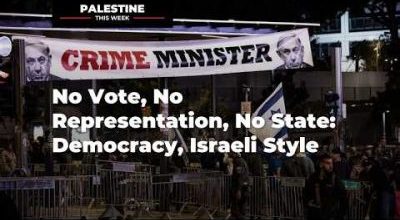
No Vote, No Representation, No State: Democracy, Israeli Style
or go to
Aletho News Archives – Video-Images
From the Archives
Sanctions, War and the Policy of Dual Containment
By SASAN FAYAZMANESH | March 17, 2008
It is now nearly three decades since the Unites States adopted the policy of dual containment of Iran and Iraq. While much has been written about the containment of Iraq, there has been very little in-depth analysis of this policy when it comes to Iran. In a book that is going to be released on March 31, 2008, entitled The United States and Iran: Sanctions, Wars and the Policy of Dual Containment (Routledge), I attempt to address this shortcoming by investigating when and why the US policy of containment of Iran came about, how it evolved, and where it stands today.[1] To the extent that Israel has been involved in US policy making, the study will also include the role that Israel has played in the containment of Iran. Also, since the fate of Iran has been inextricably linked to that of Iraq, occasionally the investigation will overlap with the containment of Iraq.
The policy of dual containment of Iran and Iraq originated during the Carter Administration, but it was not until the Clinton Administration that the expression “dual containment” became popular. … continue
Blog Roll
 Aletho News
- Elmo Sold mRNA Jabs to Your Toddler. Now They Are “Off-Label.”
- British state targets Palestine Action with yet another crooked trial
- Americans are paying the price to preserve Israel’s nuclear hegemony
- Resistance factions are necessary to ensure a permanent US Iraq withdrawal
- How Israel destabilizes the Middle East: Denying sovereignty and the right to exist
- Europe’s Establishment Is Embracing War – and Losing Voters
- NATO chief advocates war of aggression
- No Vote, No Representation, No State: Democracy, Israeli Style
- Zionist Bought Senate Blocks Information About American Citizens Killed By Israel
- While Gaza dominates the UN, these are the people keeping it alive
- If Americans Knew
- Israeli Soldiers Abduct At Least 22 Across Occupied West Bank
- Eight Palestinians Killed in Israeli Attacks on Gaza
- Israeli former leaders and security chiefs threaten legal action over ‘Jewish terrorism’
- Israel map in LA Times ad includes all land from the river to the sea
- Inside Lebanon’s 200-page dossier on Israeli war crimes
- Flydubai, genocide, settler violence, Trump abuse of power to deport – Daily Update
- Counting Antisemitic Incidents: What the ADL Audit Reveals — and Obscures
- Mamdani releases plan to combat antisemitism and hate crimes in New York City
- Iran’s Revolutionary Guards Publish Letter to the American People
- DMFI launches $1 million ad campaign supporting Virginia’s Elaine Luria
- No Tricks Zone
- Green Energy Debacle: German Expert Professor Fritz Vahrenholt Warns Of Severe Economic And Social Consequences
- Two More Paleo Reconstructions Affirm Meters-Higher Sea Levels Across Ireland, Brazil 7000-6000 Years Ago
- New Study: Earth And Venus Surface Warmth Largely Explained By Convection And Lapse Rate, Not CO2 Or Radiation
- 2025 Nature Paper Claiming Worsening Global Drought Gets RETRACTED …Heavily Flawed
- New Study: ‘Global Drought Shows No Detectable Recent Acceleration Under Climate Warming’
- Economic Masterminds: German Socialists Suggest Taxing Productivity Gains Stemming From Using AI
- The South China Sea Has Not Been Cooperating With The Climate Change Narrative
- Energy Crisis: Germany Enters Heating Season With Historically Low Gas Reserve Fill Levels
- New Study: The Antarctic Ice Sheet Gained Mass From 2020-2024 Due To Staggering Snow And Ice Accumulation
- Study: Ocean Heating Rates From Thousands Of Years Ago ‘Dwarf’ Modern Ocean Heating Rates

