No weapons on Syrian plane grounded by Turkey – Lavrov
RT | October 12, 2012
Russian Foreign Minister Sergey Lavrov said that no weapons were carried by the Syrian passenger plane Turkey diverted on Wednesday over suspicions it was transporting non-civilian cargo.
Lavrov claimed the Airbus A-320 was carrying radar parts, and that transporting such items by civil aircraft does not violate international law.
“We have no secrets,” Foreign Minister Sergei Lavrov told reporters. “There were, of course, no weapons on the plane and could not have been any. There was a cargo on the plane that a legal Russian supplier was sending in a legal way to a legal customer.”
Lavrov said the the supplier will demand the cargo be returned which is their property.
“We are awaiting an official reply why our diplomats were not allowed to meet the Russian passengers on board,” stressed the Russian FM.
The announcement came in response to a Thursday statement made by Turkish PM Recep Tayyip Erdogan alleging that the Syrian Air jet was transporting Russian-made munitions for the Syrian Defense Ministry.
“It is absolutely clear who sent the cargo and who was going to receive it. This was munitions from the Russian equivalent of our Mechanical and Chemical Industry Corporation being sent to the Syrian Defense Ministry,” Ergodan said.
Turkey diverted the passenger plane en route from Moscow to Damascus on Wednesday as it entered Turkish airspace, and forced it to land in Ankara and open its cargo to inspection. After around nine hours, some items from the cargo were seized and the plane was allowed to depart.
Syria labeled the incident “air piracy,” and insisted there was nothing illegal on board the plane.
Moscow criticized Turkey for endangering the lives of the flight’s 35 passengers by dispatching F-16s fighter jets to force the plane to land, and demanded to know why Russian diplomats and doctors were not allowed to meet the 17 Russian nationals on board the plane.
Related articles
- Turkey Releases Syrian Plane after Detention (alethonews.wordpress.com)
Hezbollah confirms sending drone into Israeli airspace
Press TV – October 11, 2012
Hezbollah Secretary-General Seyyed Hassan Nasrallah confirms the Lebanese resistance movement has sent a drone deep into the Israeli airspace evading radar systems.
The operation code-named Hussein Ayub saw Hezbollah’s drone fly hundreds of kilometers into the Israeli airspace and getting very close to Dimona nuclear plant without being detected by advanced Israeli and US radars, Nasrallah said during a televised speech late on Thursday.
“This is only part of our capabilities,” he stressed, adding that Israelis have admitted to their security failure despite being provided with the latest technologies by Western powers.
Hezbollah secretary-general stated that Hezbollah’s drones are made in Iran but assembled by the resistance movement.
Hezbollah plans to send more drones over Israel in the future, he added, adding that the operation shows the resistance movement is ready to defend Lebanon.
The resistance leader further dismissed Western accusations of Hezbollah’s intervention in the Syrian unrest, describing the allegation as “sheer lie.”
“Hezbollah has not fought alongside Syrian forces…. It is not true that Hezbollah is going to take some land from Syria,” Nasrallah stated.
Hezbollah’s leader also rejected allegations that Abu Abbas was the movement’s commander in Syria, and condemned insurgents in Syria for threatening Lebanon.
“Threatening Hezbollah is of no use,” he emphasized.
Turkey endangered lives of Russians on Syria-bound plane – Foreign Ministry
RT | October 11, 2012
Ankara endangered Russians by diverting a flight from Moscow to Damascus, Russia’s Foreign Ministry said. Moscow expressed anger at not being informed that Russians were involved in the incident, and that their diplomats were denied access to them.
“We are troubled that the lives of the passengers aboard the plane, including 17 Russian citizens were put at risk by this inappropriate act. Turkey did not inform Russia that Russian citizens were among those detained on the plane. We found this out through the press,” Russian Foreign Ministry spokesperson Aleksandr Lukashevich said.
The Russian embassy in Turkey demanded access to the Russian citizens and dispatched consular officers and doctors to the Ankara airport. Turkish authorities, however, denied the Russian diplomats access to the passengers, in violation of the 1963 Vienna Convention on Consular Relations. The Russian nationals were detained in the airport for eight hours.
The Russian Foreign Ministry has demanded an explanation from Turkish authorities, and that Ankara take steps to prevent future such incidents.
Turkey defended the move by claiming that the plane could have carried “non-civilian cargo.”
“There were no arms and military equipment aboard the civilian aircraft – and could not be,” a source in Russia’s military industry told Interfax news agency.
Russia has maintained its military-technical cooperation with Syria, and that any arms or military equipment sales to Damascus are conducted according to established practice. The current law expressly forbids arms sales facilitated by civilian aircraft.
‘Air piracy’
Syrian transport minister Mahoumd Said said that Turkey’s detention of the passenger aircraft is tantamount to “air piracy,” and violates civil aviation treaties, Lebanon’s al-Manar TV channel reported.
Tensions between Turkey and Syria rose after a Syrian shell killed five civilians in the border town of Akcakale last week. Turkey returned fire and said it would retaliate against any future provocation originating in Syria. NATO supported Turkey’s move and pledged to defend the country should the Syrian conflict spill across the border.
Related articles
- NATO mortar ‘gift’ from Turkey to Syrian rebels – Turkish newspaper (alethonews.wordpress.com)
Turkey Releases Syrian Plane after Detention
Al-Manar | October 10, 2012
Ankara has allowed a Syrian passenger plane to leave, hours after forcing it to land, saying it had suspected the plane might be carrying “non-civilian cargo.”
Earlier on Wednesday, Turkish F16 fighter jets intercepted the Airbus A-320 airliner as it passed through Turkish airspace while flying from Moscow to Damascus with 35 passengers and two crew-members on board.
Turkish fighter jets forced the plane to land at the Esenboga airport in Ankara for security checks.
Foreign Minister Ahmet Davutoglu said Turkey seized “objectionable cargo” from the plane. Anatolia news agency quoted officials as saying they suspected the aircraft was carrying arms.
“There is illegal cargo on the plane that should have been reported” in line with civil aviation regulations, Davutoglu was quoted as saying by Anatolia.
“There are elements on board that can be considered objectionable,” he said, adding that Turkey would hold on to the cargo for further investigation but declining to elaborate on the contents.
MOSCOW SAYS PLANE DID NOT CONTAIN ARMS
Meanwhile, the Interfax news agency reported on Thursday, citing an arms exporting source, that the passenger plane did not contain any arms or military equipment on board.
“Neither weapons nor any systems or assembly parts for military equipment were or could have been on board the passenger plane,” the unidentified high-ranking source from one of Russia’s arms exporting agencies told Interfax.
“If there were a need to deliver military equipment or armaments to Syria, it would be done in a routine way rather than illegally, let alone by using a passenger plane,” the source was quoted as saying.
Related articles
- NATO mortar ‘gift’ from Turkey to Syrian rebels – Turkish newspaper (alethonews.wordpress.com)
Why Hugo Chavez’s Re-Election Matters to the Arab World
By Jody McIntyre | Al Akhbar | October 10, 2012
Caracas – As crowds occupied the streets of Caracas, Venezuela on the evening of Sunday, October 7, to celebrate the successful re-election of President Hugo Chavez, a Lebanese flag was held aloft. As they poured into the grounds of Miraflores to hear him speak from the balcony of the Presidential palace, later that night, a Palestinian flag was also visible as it was waved above our heads. These symbols were not without meaning; the re-election of Chavez with 55 percent of ballots cast – eleven points ahead of his opponent, Henrique Radonski – will have repercussions not only across the continent of South America, but also in the Arab world.
On Tuesday, just two days after his electoral victory, Chavez reiterated his support for the Syrian government, about which he has been characteristically vocal over the last year. It is a far cry from the pre-election promises of Capriles, who was seen by many in Venezuela as the candidate of the United States and had pledged to develop “closer relations with Israel,” as well as re-thinking several areas of foreign policy. Chavez, on the other hand, took the step of expelling the Israeli ambassador in January 2009, during the bombing campaign of Operation Cast Lead in Gaza. It was not the first time he had taken such action, having ordered the US ambassador to leave in September 2008.
From the evidence of his first press conference since being re-elected, and particularly in regard to the Arab world, it is clear that re-thinking foreign policy is the last thing on Chavez’s mind. He described Assad’s as the “only legitimate government” of Syria, before continuing:
“[He] has made a huge effort to make concessions, constitutional changes, [and has] called for elections, but none of that is true for those who want to overthrow [the regime].”
Whilst speaking from the “People’s Balcony” of Miraflores at just before midnight on Sunday, Chavez called for reconciliation with the opposition at home. But he knows that his victory, although down from the 26 percent margin he won by in 2006, would be considered a landslide in many other countries and gives him a strong democratic mandate for the next six years of government. Foreign policy has often been a talking point during the last fourteen years of Chavez’s government, and his popularity, so pervasive amongst the poorest sections of Venezuelan society, has also spread as far as occupied Palestine, the south of Lebanon, and many parts of the Arab world.
Chavez vehemently denounced the NATO bombing of Libya earlier this year, which he described at the time as “imperial cynicism,” a “massacre” and a “madness” that had “destroyed” the country. On Tuesday, Chavez took the opportunity to mention former Libyan President Colonel Gaddafi, saying that “the way he died was a barbarity.”
Some western commentators have criticised Chavez’s support for what they see as dictatorial governments in Libya and now Syria, whilst recognising the democratic credentials of Venezuela itself. However, Chavez is particularly aware of what demonization of political leaders who challenge or question the dominant narrative – once referred to as the “Washington Consensus” but now struggling to retain one hand, let alone a “consensus” in Latin America – can lead to. The April 2002 coup d’etat against his government, which resulted in huge demonstrations and the re-instatement of Chavez after just forty-eight hours, was preceded by much hysterical commentary in both the US and in the privately-owned Venezuelan media, which routinely referred to Chavez as an “autocrat,” a “monkey” or even “Venezuela’s Hitler.”
Chavez is of the view that, whilst undoubtedly embroiled in turmoil, there are more forces at work in Syria than usually portrayed in the mainstream media. On Tuesday, he repeated his opinion in regards to Syria that “the US government is largely responsible for this disaster.”
There is no doubt that Chavez’s presence will be continue to be felt in the Arab world over the next six years. With a wave of pro-poor, anti-imperialist governments continuing to enjoy widespread popularity in Latin America – Rafael Correa in Ecuador, Evo Morales in Bolivia and Cristina Fernandez de Kirchner in Argentina – the question remains as to how Arab people will respond to this example of resisting subservience to foreign interests. Indeed, in a speech following his decision to expel the Israeli ambassador, Hugo Chavez made a proposal of his own:
“Every day, Latin America will be more united and more free. I hope that one day, Arabs will be the same way; united. United or dominated, you decide!”
Jody McIntyre is a journalist and political activist. Follow him on Twitter @jodymcintyre.
Related articles
- Chavez Wins Venezuelan Presidential Election with 54% of the Vote (alethonews.wordpress.com)
Confirmed: Pentagon deploys special forces to Jordan-Syria border
RT | October 10, 2012
US Secretary of Defense Leon Panetta has confirmed that US troops have been dispatched to the Jordan-Syrian border to help bolster the former’s military capabilities in case violence escalates in the volatile region.
”We have a group of our forces there working to help build a headquarters there and to insure that we make the relationship between the United States and Jordan a strong one so that we can deal with all the possible consequences of what’s happening in Syria,” Panetta said.
Panetta’s comments came during a NATO conference of defense ministers in Brussels, where he said the US had been working with Jordan to monitor chemical and biological weapons sites in Syria and help the country deal with Syrian refugees crossing over the border.
The US has previously used Jordan as a base for other Syria-related military activities. In May of this year, Washington held military drills in Jordan dubbed ‘Operation Eager Lion,’ which saw around 12,000 troops from several nations participate in undisclosed training exercises.
The Obama administration denied accusations in the Syrian media that the exercises were a threat against President Assad, and maintained that the action focused on the treatment of refugees, anti-terrorism tactics and naval interception of smuggling vessels.
Following the operation, a small US contingent stayed behind to establish the center in Amman, paving the way for the arrival of more personnel.
“We have been working closely with our Jordanian partners on a variety of issues related to Syria for some time now,” Pentagon Press Secretary George Little said. Citing Washington’s concern over Syria’s stockpiles of chemical and biological weapons, he said that the US has been planning “various contingencies, both unilaterally and with our regional partners.”
The Syrian conflict took an unexpected turn last week when mortar fire struck across the border at neighboring Turkey, sparking outcry from the Turkish government which subsequently returned fire. Turkey deployed 25 new F-16 fighter jets to reinforce its borders this week as NATO pledged support if the conflict spills into the country again.
Since uprisings against the embattled President Assad began last year, the UN estimated that more than 20,000 people were killed in the conflict and some 700,000 fled Syria to seek refuge in neighboring countries.
Terrorists kill Syrian TV cameraman in Deir al-Zour
Press TV – October 10, 2012
Foreign-backed insurgents in Syria have killed a cameraman working for Syrian state TV al-Ikhbariya in the eastern province of Deir al-Zour.
Mohammad al-Ashmar was killed on Wednesday while covering clashes between Syrian troops and armed groups, the official SANA news agency reported.
Several journalists have so far been killed in Syria since the unrest erupted in the country in March 2011.
On September 26, insurgents in the capital Damascus attacked the Press TV staff, killing the Iranian English-language news network’s correspondent, Maya Naser, and injuring Press TV and Al-Alam Damascus Bureau Chief Hosein Mortada.
Naser was shot and killed by a sniper, while Mortada, a Lebanese national, was shot in the back. The two were covering twin bomb attacks that targeted the military command building in the capital and killed at least four Syrian security forces.
Many people, including large numbers of security forces, have been killed in the turmoil in Syria.
The Syrian government says that the chaos is being orchestrated from outside the country, and there are reports that a very large number of the armed militants are foreign nationals.
Related articles
- Press TV correspondent killed in Syrian capital (alethonews.wordpress.com)
NATO mortar ‘gift’ from Turkey to Syrian rebels – Turkish newspaper
RT | October 9, 2012
The mortar used to attack the Turkish town of Akcakale is a design specific to NATO and was given to Syrian rebels by Ankara, according to Turkey’s Yurt newspaper. The mortar killed one adult and four children from the same family on Wednesday.
An article by the paper’s Editor-in-Chief, Merdan Yanardag, states that the newspaper received information from a reliable source, which claimed that Turkey itself sent the mortars to rebels in the so-called “free army.”
“Turkey is a longtime member of the North Atlantic Treaty Organization and they’re going to act in conjunction with other NATO powers, so it’s unsurprising that this has happened,” editor of the Pan-African news wire, Abayomi Azikiwe, told RT.
NATO has so far shunned any military involvement in the conflict, but Azikiwe says the alliance is deeply involved in every decision that Turkey makes.
“Ankara isn’t taking any military actions or contemplating any type of military strategy without being in full cooperation with NATO forces,” he said.
Turkey retaliated at Syria for a sixth consecutive day on Monday, after a mortar from Syria landed in Turkey’s Hatay province.
And as Turkey fights to defend its border towns, the country’s president says the country’s military will take any action necessary.
“The worst-case scenarios are taking place right now in Syria … Our government is in constant consultation with the Turkish military. Whatever is needed is being done immediately as you see, and it will continue to be done,” President Abdullah Gul said in a statement on Monday.
But it’s not only leaders within Turkey that are stating their opinions on the conflict.
Earlier on Monday, UN Secretary General Ban Ki-moon warned of the consequences that the conflict could bring to the region.
“The escalation of the conflict along the Syrian-Turkish border and the impact of the crisis on Lebanon are extremely dangerous,” Ban said at the opening of the World Forum for Democracy in Strasbourg, France.
The exchange of fire began last Wednesday, when Syrian mortar shells killed a woman and four children from the same family in Akcakale.
Many fear the situation will lead to regional conflict, with political analyst Dan Glazebrook, saying that Ankara aims to drag NATO into a war with Syria.
“On the one hand the [Turks] are trying to give cover to the rebels to continue their fight, as they know that the rebels are getting defeated on the ground so they are bombarding Syria as a way to help the rebels not lose too many of their positions,” Glazebrook told RT. “But I think also they may be hoping that they can somehow nudge, provoke NATO into taking action as well, into prompting a kind of blitzkrieg that is actually the only thing really that would enable the rebels to win now at this state.”
Related articles
- usually the FSA mortars are described as russian-made and stolen from the syrian army (niqnaq.wordpress.com)
- Nato has ‘plans in place’ to back Turkey in Syrian war (morningstaronline.co.uk)
German state TV reports: Syrian rebels claim responsibility for attack on Turkey
By R. Teichmann | Global Research News | October 05, 2012
On Oct. 4th, the German state TV channel ZDF reported on the attack on Turkey several times.
In its “Mittagsmagazin” at 1300 hours it reports as follows:
02:06 – 02:32
German:
“Raketen- und Granatfeuer. Die Türkei übt Vergeltung für einen Angriff von syrischer Seite. Gestern Nachmittag hatten syrische Rebellen einen türkischen Ort in Grenznähe beschossen. Seit Wochen schon warnt Ankara davor, die Türkei zu provozieren. Inzwischen haben sich die syrischen Rebellen ganz offiziell zu der Provokation bekannt.”
Translation: (emphasis added)
“Rocket and mortar fire. Turkey takes revenge after an attack from the Syrian side. Yesterday afternoon Syrian rebels fired on a Turkish village close to the border. For weeks Ankara had warned against provoking Turkey. Meanwhile Syrian rebels officially claimed responsibility for the provocation.”
Only 3 hours later in its “Heute in Europa” at 1600 hours it reports:
01:40 – 01:52
German:
“Raketen und Granatfeuer. Vergangene Nacht übte die Türkei Vergeltung für einen Angriff von syrischer Seite. Gestern Nachmittag hatten Rebellen einen türkischen Ort in Grenznähe beschossen.”
Translation:
“Rocket and mortar fire. Last night Turkey took revenge for an attack from the Syrian side. Yesterday afternoon rebels fired on a Turkish village close to the border.”
0220 – 0227
German:
“Aussage eines Einheimischen (Türke): „Die syrischen Rebellen versuchen, uns in ihren Konflikt zu verwickeln. Wir müssen da sehr vorsichtig sein.”
Translation:
Testimony of a local Turk: “The Syrian rebels try to draw us into their conflict. We have to be very careful here.”
In their main evening news “Heute” at 1900 hours they report:
01:40 – 01:53
German:
„Raketen- und Granatfeuer. Vergangene Nacht übte die Türkei Vergeltung. Gestern Nachmittag hatten die Syrer einen Ort in Grenznähe beschossen. Die Spannungen zwischen den Nachbarn waren eskaliert – Ankara schlug zurück.“
Translation:
“Rocket and mortar fire. Last night Turkey took revenge. Yesterday afternoon the Syrians fired on a Turkish village close to the border. The tensions between the neighbours had escalated – Ankara retaliated.”
In the late evening news “Heute Journal” at 2300 hours they reported:
0154 – 0205
German:
“Raketen und Granatfeuer. Vergangene Nacht übte die Türkei Vergeltung. Gestern Nachmittag war von syrischer Seite ein Ort in Grenznähe beschossen worden. Die Spannung eskalierte. Ankara schlug zurück.”
Translation:
“Rocket and mortar fire. Last night Turkey took revenge. Yesterday afternoon a village close to the border had been fired upon from the Syrian side. The tension escalated – Ankara retaliated.”
0235 – 0242
German:
“Zerschossene Häuser und menschenleere Straßen. Noch ist nicht einmal klar, wer eigentlich geschossen hat, die syrische Armee oder die Rebellen.”
Translation:
“Houses shot to pieces and streets devoid of people. It is not even clear yet who really fired, the Syrian army or the rebels.”
The first victim of war is the truth
The first report clearly states that the rebels officially claimed responsibility for the attack on Turkey.
It is telling to see how the pressure on this TV station worked. They had to back-paddle:
At 1300 it was the Syrian Rebels officially claiming responsibility.
In the main evening news at 1900 it was the Syrians (suggesting the Syrian army). This is a prime example of how the first and probably most authentic and truthful report is turned and twisted by the spin doctors to come to the desired result. In these times of Orwellian double speak we have to give credit to the ZDF that they did not stick with “The Syrians did it” but at least ended with a question mark – in the late evening they leave it open who was responsible.
Supporting the original ZDF report that the rebels are responsible for the attack is another video (Source: Syria News) which shows that the rebels have the equipment to carry out such an attack.
These mortar shells are Russian-made, at least, the armed Western-backed fighters state this in this video on YouTube. It seems that they use ammunition that they got by attacks of arms depots of the Syrian Arab Army.
The author is a member of Awaken Ireland and a frequent contributor to this blog. He can be contacted via brtirl@eircom.net
Syria opposes escalation of violence with Turkey
TREND | October 5, 2012
Syria’s UN envoy said Thursday his government is not seeking any escalation of violence with Turkey and wants to maintain good neighborly relations, Today’s Zaman reported.
Ambassador Bashar Ja’afari said the government hasn’t apologized for the shelling from Syria that killed five Turkish civilians because it is waiting for the outcome of an investigation on the source of the firing.
He read reporters a letter he delivered to the deeply divided UN Security Council that sent Syria’s “deepest condolences” to the families of the victims “and to the friendly and brotherly people of Turkey.”
It urged Turkey and its other neighbors to “act wisely, rationally and responsibly” and to prevent cross-border infiltration of “terrorists and insurgents” and the smuggling of arms.
The Security Council has so far failed to respond to Wednesday’s deadly attack from Syria.
The US and its Western allies are seeking a strong statement condemning the attack on Turkey but Russia, Syria’s most important ally, is opposed and is seeking much weaker language that the West says is unacceptable, UN diplomats said, speaking on condition of anonymity because talks have been private.
US Ambassador Susan Rice said the original draft, proposed by Azerbaijan and backed by the Turkish government, “adequately reflected the key points that need to be made.” But diplomats said many council members objected to Russia’s proposed amendments watering down the text. So council experts were meeting to see if they could bridge the differences.
“This sort of cross-border military activity is very destabilizing and must be stopped,” Rice said. “While I think it’s too early to say what will be the result of those negotiations, we think it’s very important that the council speak clearly and swiftly to condemn this shelling.”
The border violence has added a dangerous new dimension to Syria’s civil war, dragging Syria’s neighbors deeper into a conflict that activists say has already killed 30,000 people since an uprising against President Bashar Assad’s regime began in March 2011.
UN Secretary-General Ban Ki-moon expressed alarm Thursday at the escalating border tensions and warned that the risks of regional conflict and the threat to international peace is increasing, UN spokesman Martin Nesirky said.
The UN chief called on all parties “to abandon the use of violence, exercise maximum restraint and exert all efforts to move toward a political solution,” he said.
Nesirky said Lakhdar Brahimi, the UN-Arab League envoy, has been in contact with Turkish and Syrian officials “in order to encourage an easing of tensions.”
Syria’s Ja’afari said the “Syrian government is keenly interested in maintaining good neighborly relations with Turkey.”
“The Syrian government is not seeking any escalation with any of its neighbors, including Turkey,” he stressed.
But he said Syria wants to explain to the Turkish people that their government’s policies supporting the opposition “are wrong and have been wrong since the beginning of the crisis.”
Ja’afari said Turkey responded to the incident by launching artillery shells into Syria starting at 7 p.m. local time Wednesday and stopping at midnight. Turkish troops then resumed artillery shelling Thursday morning until 7 a.m., injuring two Syrian army officers, he said.
“Our forces practiced self-restraint and did not respond to this Turkish artillery shelling,” Ja’afari said.
The Syrian ambassador said he delivered another letter to the Security Council seeking its condemnation for four suicide bombings in the country’s largest city and commercial capital, Aleppo, which killed scores of innocent civilians and took place about the same time Wednesday as the cross-border shelling.
But he said the council once again has been unable to condemn “these suicide terrorist attacks.”
Ja’afari urged the Turkish government to show “the same kind of sympathy” to the hundreds of innocent Syrian civilians killed in the suicide bombings as the Syrian government showed to the Turkish victims.
Featured Video
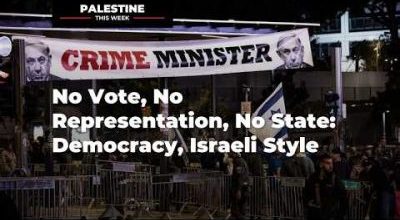
No Vote, No Representation, No State: Democracy, Israeli Style
or go to
Aletho News Archives – Video-Images
From the Archives
Sanctions, War and the Policy of Dual Containment
By SASAN FAYAZMANESH | March 17, 2008
It is now nearly three decades since the Unites States adopted the policy of dual containment of Iran and Iraq. While much has been written about the containment of Iraq, there has been very little in-depth analysis of this policy when it comes to Iran. In a book that is going to be released on March 31, 2008, entitled The United States and Iran: Sanctions, Wars and the Policy of Dual Containment (Routledge), I attempt to address this shortcoming by investigating when and why the US policy of containment of Iran came about, how it evolved, and where it stands today.[1] To the extent that Israel has been involved in US policy making, the study will also include the role that Israel has played in the containment of Iran. Also, since the fate of Iran has been inextricably linked to that of Iraq, occasionally the investigation will overlap with the containment of Iraq.
The policy of dual containment of Iran and Iraq originated during the Carter Administration, but it was not until the Clinton Administration that the expression “dual containment” became popular. … continue
Blog Roll
 Aletho News
- Elmo Sold mRNA Jabs to Your Toddler. Now They Are “Off-Label.”
- British state targets Palestine Action with yet another crooked trial
- Americans are paying the price to preserve Israel’s nuclear hegemony
- Resistance factions are necessary to ensure a permanent US Iraq withdrawal
- How Israel destabilizes the Middle East: Denying sovereignty and the right to exist
- Europe’s Establishment Is Embracing War – and Losing Voters
- NATO chief advocates war of aggression
- No Vote, No Representation, No State: Democracy, Israeli Style
- Zionist Bought Senate Blocks Information About American Citizens Killed By Israel
- While Gaza dominates the UN, these are the people keeping it alive
- If Americans Knew
- Israeli Soldiers Abduct At Least 22 Across Occupied West Bank
- Eight Palestinians Killed in Israeli Attacks on Gaza
- Israeli former leaders and security chiefs threaten legal action over ‘Jewish terrorism’
- Israel map in LA Times ad includes all land from the river to the sea
- Inside Lebanon’s 200-page dossier on Israeli war crimes
- Flydubai, genocide, settler violence, Trump abuse of power to deport – Daily Update
- Counting Antisemitic Incidents: What the ADL Audit Reveals — and Obscures
- Mamdani releases plan to combat antisemitism and hate crimes in New York City
- Iran’s Revolutionary Guards Publish Letter to the American People
- DMFI launches $1 million ad campaign supporting Virginia’s Elaine Luria
- No Tricks Zone
- Green Energy Debacle: German Expert Professor Fritz Vahrenholt Warns Of Severe Economic And Social Consequences
- Two More Paleo Reconstructions Affirm Meters-Higher Sea Levels Across Ireland, Brazil 7000-6000 Years Ago
- New Study: Earth And Venus Surface Warmth Largely Explained By Convection And Lapse Rate, Not CO2 Or Radiation
- 2025 Nature Paper Claiming Worsening Global Drought Gets RETRACTED …Heavily Flawed
- New Study: ‘Global Drought Shows No Detectable Recent Acceleration Under Climate Warming’
- Economic Masterminds: German Socialists Suggest Taxing Productivity Gains Stemming From Using AI
- The South China Sea Has Not Been Cooperating With The Climate Change Narrative
- Energy Crisis: Germany Enters Heating Season With Historically Low Gas Reserve Fill Levels
- New Study: The Antarctic Ice Sheet Gained Mass From 2020-2024 Due To Staggering Snow And Ice Accumulation
- Study: Ocean Heating Rates From Thousands Of Years Ago ‘Dwarf’ Modern Ocean Heating Rates

