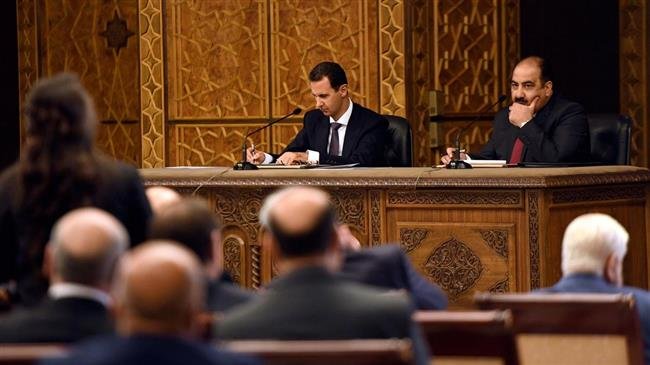
Syrian President Assad grants amnesty to army deserters
RT | October 9, 2018
Syrian President Bashar Assad has granted general amnesty to army deserters both within Syria and those outside the country.
A decree published by state media on Tuesday says the amnesty doesn’t include “criminals” and those on the run unless they turn themselves in to authorities. Deserters in Syria have four months to do so; those abroad have six months.
The amnesty could help boost the return of refugees, some of whom have not been able to go back home because they were blacklisted, AP reported.
Government forces have managed over the past year to capture wide areas once held by insurgents, including in southern Syria and the eastern suburbs of the capital, Damascus. The flashpoint is now Syria’s northwestern province of Idlib.
Druze Gather in Israeli-Occupied Golan Heights to Mark Support for Assad
© REUTERS / Ammar Awad
Sputnik – 06.10.2018
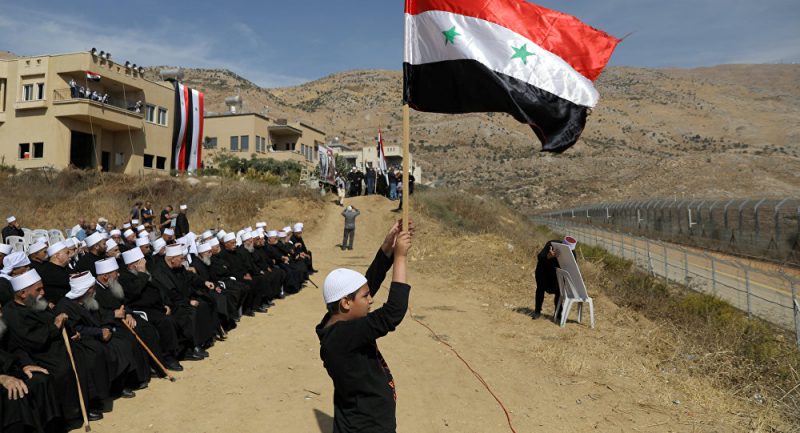
Gathering along a fence separating them from the Syrian-controlled side of the Golan Heights, Druze commemorated the anniversary of the start of the 1973 Arab Israeli War while celebrating Syria’s successes in its recent war against the terrorists.
Carrying Syrian flags, portraits of President Bashar Assad, binoculars and megaphones, the Druze community in the village of Massade chanted loyalty to the Syrian government, with troops and civilians on the other side of the border shouting and waving back.
Local resident Emil Masoud told Reuters that the rally was meant to “celebrate the final stages of the war… and to celebrate with our people in Syria the final stage of victory.”
The village of Massade, part of Syria’s Quneitra District, has been under Israeli occupation since the Arab-Israeli War of 1967.
Israel occupied 1,200 square kilometers of the 1,800 square-kilometer Golan Heights during the Six-Day War, and formally annexed it in 1981. The UN Security Council condemned the decision and called the move to impose Israeli “laws, jurisdiction and administration” over the territory “null and void and without international legal effect.”
During the conflict in Syria, much of southern Syria, including the Syrian-controlled portion of the Golan Heights, was occupied by Islamist militants, including Daesh (ISIS), a terrorist group outlawed in Russia and many other countries. This summer, Syrian forces won back control of their southern border areas from the terrorists.
Last week, Syrian Foreign Minister Walid Muallem called on the international community to compel Israel to abide by UN Security Council resolutions, including the one on the Golan Heights, and stressed Damascus’ determination to fully liberate the Golan Heights, “just as we liberated southern Syria from terrorists.”
The Lies of our (Financial) Times
By James Petras | Dissident Voice | October 4, 2018
The leading financial publications have misled their political and investor subscribers of emerging crises and military defeats which have precipitated catastrophic political and economic losses.
The most egregious example is the Financial Times (FT) a publication which is widely read by the business and financial elite.
In this essay we will proceed by outlining the larger political context that sets the framework for the transformation of the FT from a relatively objective purveyor of world news into a propagator of wars and failed economic policies.
In part two we will discuss several case studies which illustrate the dramatic shifts from a prudent business publication to a rabid military advocate, from a well-researched analyst of economic policies to an ideologue of the worst speculative investors.
The decay of the quality of its reportage is accompanied by the bastardization of language. Concepts are distorted; meanings are emptied of their cognitive sense; and vitriol covers crimes and misdemeanors.
We will conclude by discussing how and why the ‘respectable’ media have affected real world political and market outcomes for citizens and investors.
Political and Economic Context
The decay of the FT cannot be separated from the global political and economic transformations in which it publishes and circulates. The demise of the Soviet Union, the pillage of Russia’s economy throughout the 1990s and the US declaration of a unipolar world were celebrated by the FT as great success stories for ‘western values’. The US and EU annexation of Eastern Europe, the Balkan and Baltic states led to the deep corruption and decay of journalistic narratives.
The FT willingly embraced every violation of the Gorbachev-Reagan agreements and NATO’s march to the borders of Russia. The militarization of US foreign policy was accompanied by the FT conversion to a military interpreter of what it dubbed the ‘transition to democratization’.
The language of the FT reportage combined democratic rhetoric with an embrace of military practices. This became the hallmark for all future coverage and editorializing. The FT military policies extended from Europe to the Middle East, the Caucasus, North Africa and the Gulf States.
The FT joined the yellow press in describing military power grabs, including the overthrow of political adversaries, as ‘transitions to democracy’ and the creation of ‘open societies’.
The unanimity of the liberal and right-wing publications in support of western imperialism precluded any understanding of the enormous political and economic costs which ensued.
To protect itself from its most egregious ideological foibles, the FT included ‘insurance clauses’, to cover for catastrophic authoritarian outcomes. For example they advised western political leaders to promote military interventions and, by the way, with ‘democratic transitions’.
When it became evident that US-NATO wars did not lead to happy endings but turned into prolonged insurgencies, or when western clients turned into corrupt tyrants, the FT claimed that this was not what they meant by a ‘democratic transition’ – this was not their version of “free markets and free votes”.
The Financial and Military Times (?)
The militarization of the FT led it to embrace a military definition of political reality. The human and especially the economic costs, the lost markets, investments and resources were subordinated to the military outcomes of ‘wars against terrorism’ and ‘Russian authoritarianism’.
Each and every Financial Times report and editorial promoting western military interventions over the past two decades resulted in large scale, long-term economic losses.
The FT supported the US war against Iraq which led to the ending of important billion-dollar oil deals (oil for food) signed off with President Saddam Hussein. The subsequent US occupation precluded a subsequent revival of the oil industry. The US appointed client regime pillaged the multi-billion dollar reconstruction programs – costing US and EU taxpayers and depriving Iraqis of basic necessities.
Insurgent militias, including ISIS, gained control over half the country and precluded the entry of any new investment.
The US and FT backed western client regimes organized rigged election outcomes and looted the treasury of oil revenues, arousing the wrath of the population lacking electricity, potable water and other necessities.
The FT backed war, occupation and control of Iraq was an unmitigated disaster.
Similar outcomes resulted from the FT support for the invasions of Afghanistan, Libya, Syria and Yemen.
For example the FT propagated the story that the Taliban was providing sanctuary for bin Laden’s planning the terror assault in the US (9/11).
In fact, the Afghan leaders offered to turn over the US suspect, if they were offered evidence. Washington rejected the offer, invaded Kabul and the FT joined the chorus backing the so-called ‘war on terrorism which led to an unending, one trillion-dollar war.
Libya signed off to a disarmament and multi-billion-dollar oil agreement with the US in 2003. In 2011 the US and its western allies bombed Libya, murdered Gaddafi, totally destroyed civil society and undermined the US/EU oil agreements. The FT backed the war but decried the outcome. The FT followed a familiar ploy; promoting military invasions and then, after the fact, criticizing the economic disasters.
The FT led the media charge in favor of the western proxy war against Syria: savaging the legitimate government and praising the mercenary terrorists, which it dubbed ‘rebels’ and ‘militants’ – dubious terms for US and EU financed operatives.
Millions of refugees, resulting from western wars in Libya, Syria, Afghanistan and Iraq fled to Europe seeking refuge. FT described the imperial holocaust – the ‘dilemmas of Europe’. The FT bemoaned the rise of the anti-immigrant parties but never assumed responsibility for the wars which forced the millions to flee to the west.
The FT columnists prattle about ‘western values’ and criticize the ‘far right’ but abjured any sustained attack of Israel’s daily massacre of Palestinians. Instead readers get a dose of weekly puff pieces concerning Israeli politics with nary a mention of Zionist power over US foreign policy.
FT: Sanctions, Plots and Crises — Russia, China and Iran
The FT like all the prestigious media propaganda sheets have taken a leading role in US conflicts with Russia, China and Iran.
For years the scribes in the FT stable have discovered (or invented) “crises” in China’s economy- always claiming it was on the verge of an economic doomsday. Contrary to the FT, China has been growing at four times the rate of the US; ignoring the critics it built a global infrastructure system instead of the multi-wars backed by the journalist war mongers.
When China innovates, the FT harps on techno theft — ignoring US economic decline.
The FT boasts it writes “without fear and without favor” which translates into serving imperial powers voluntarily.
When the US sanctions China we are told by the FT that Washington is correcting China’s abusive statist policies. Because China does not impose military outposts to match the eight hundred US military bases on five continents, the FT invents what it calls ‘debt colonialism” apparently describing Beijing’s financing large-scale productive infrastructure projects.
The perverse logic of the FT extends to Russia. To cover up for the US financed coup in the Ukraine it converted a separatist movement in Donbass into a Russian land grab. In the same way a free election in Crimea is described as Kremlin annexation.
The FT provides the language of the declining western imperial empires.
Independent, democratic Russia, free of western pillage and electoral meddling is labelled “authoritarian”; social welfare which serves to decrease inequality is denigrated as ‘populism’ —linked to the far right. Without evidence or independent verification, the FT fabricates Putinesque poison plots in England and Bashar Assad poison gas conspiracies in Syria.
Conclusion
The FT has chosen to adopt a military line which has led to a long series of financially disastrous wars. The FT support of sanctions has cost oil companies billions of dollars, euros and pounds. The sanctions, it backed, have broken global networks.
The FT has adopted ideological postures that threaten supply chains between the West, China, Iran and Russia. The FT writes in many tongues but it has failed to inform its financial readers that it bears some responsibility for markets which are under siege.
There is unquestionably a need to overhaul the name and purpose of the FT. One journalist who was close to the editors suggests it should be called the “Military Times” – the voice of a declining empire.
Showdown at Tanf
Sic Semper Tyrannus | October 3, 2018
The reconciliation process initiated by the Russians in Syria has saved countless lives of soldiers, civilians and even jihadists. It also preserved SAA fighting strength, brought a lot of Syrian territory back under the control of Damascus. It brought former jihadists back into the fight on the side of the SAA. This process may appear to be tedious and without the glorious satisfaction of annihilating jihadis in a costly series of rapid offensives, but I firmly believe the reconciliation process is the right way for Syria. This strategy is now being brought to bear at Tanf.
The first evidence of this was the mid-September agreement for the removal of the US trained and backed al-Qaryatayn Martyrs Brigade and 5,000 civilians from the Rukban refugee camp to the Euphrates Shield-held area in northern Aleppo. This was the work of the Russian Reconciliation Center. More recently, tribal leaders from Damascus have met tribal leaders at the refugee camp to discuss their situation. A list of refugees wanting to engage in the reconciliation process is being prepared. Many of those not reconciling with Damascus will be shipped north to join the al-Qaryatayn Martyrs Brigade and their families. The camp evacuations are already underway. Next week the Russians will escort a UN aid convoy into the Rukban Refugee Camp.
Although the US has apparently acquiesced to the Russian plan to depopulate the Rukban Refugee Camp, I believe Russia has cleverly outmaneuvered the US. The SAA is steadily destroying the remaining jihadis on the al-Safa plateau. I believe the US forces at Tanf will soon be left alone without jihadis to control, or even any remaining jihadis to fight. The “fighting ISIS” rationale will disappear and the real reason for remaining at Tanf will become clear. At Israel’s behest, we are blocking the Teheran-Baghdad-Damascus highway.
TTG
https://southfront.org/us-backed-militant-group-in-al-tanaf-accepts-evacuation-agreement-report/
The US Military-Industrial Complex’s Worst Nightmare: The S-300 May Destroy and Expose the F-35
By Federico Pieraccini | American Herald Tribune | September 30, 2018
The tragic episode that caused the death of 15 Russian air force personnel has had immediate repercussions on the situation in Syria and the Middle East. On September 24, Russian Defense Minister Sergei Shoigu informed allies and opponents that the delivery of the S-300 air-defense systems to the Syrian Arab Republic had been approved by President Vladimir Putin. The delivery had been delayed and then suspended as a result of Israeli pressure back in 2013.
In one sense, the delivery of S-300 batteries to Syria is cause for concern more for Washington than for Tel Aviv. Israel has several F-35 and has claimed to have used them in Syria to strike alleged Iranian weapons transfers to Hezbollah. With the S-300 systems deployed in an updated version and incorporated into the Russian command, control and communications (C3) system, there is a serious risk (for Washington) that Israel, now incapable of changing the course of events in Syria, could attempt a desperate maneuver.
It is no secret that Greece purchased S-300s from Russia years ago, and that NATO and Israel have trained numerous times against the Russian air-defense system. Senior IDF officials have often insisted that they are capable taking out the S-300s, having apparently discovered their weaknesses.
Tel Aviv’s warning that it will attack and destroy the S-300 battery should not be taken as an idle threat. It is enough to look at the recent downing of Russia’s Il-20 surveillance aircraft to understand how reckless a desperate Israel is prepared to be. Moreover, more than one IDF commander has over the years reiterated that a Syrian S-300 would be considered a legitimate target if threatening Israeli aircraft.
At this point, it is necessary to add some additional information and clarify some points. Greece’s S-300s are old, out of maintenance, and have not had their electronics updated. Such modern and complex systems as the S-300s and S-400s require maintenance, upgrades, and often replacement of parts to improve hardware. All this is missing from the Greek batteries. Secondly, it is the operator who uses the system (using radar, targeting, aiming, locking and so forth) that often makes the difference in terms of overall effectiveness. Furthermore, the system is fully integrated into the Russian C3 system, something that renders useless any previous experience gleaned from wargaming the Greek S-300s. No Western country knows the real capabilities and capacity of Syrian air defense when augmented and integrated with Russian systems. This is a secret that Damascus and Moscow will continue to keep well guarded. Yet two years ago, during the operations to free Aleppo, a senior Russian military officer warned (presumably alluding to fifth-generation stealth aircraft like the F-35 and F-22) that the range and effectiveness of the Russian systems may come as a surprise.
The following are the words of Russian defense minister Sergei Shoigu concerning the deployment of the S-300 to Syria and its integration with other Russian systems:
“Russia will jam satellite navigation, onboard radars and communication systems of combat aircraft, which attack targets in the Syrian territory, in the Mediterranean Sea bordering with Syria. We are convinced that the implementation of these measures will cool hotheads and prevent ill-considered actions threatening our servicemen. Otherwise, we will respond in line with the current situation. Syrian troops and military air defense units will be equipped with automatic control systems, which have been supplied to the Russian Armed Forces. This will ensure the centralized management of the Syrian air defense forces and facilities, monitoring the situation in the airspace and prompt target designation. Most importantly, it will be used to identify the Russian aircraft by the Syrian air defense forces.”
If the Israelis will follow through with their reckless attempts to eliminate the S-300 (if they can find them in the first place, given that they are mobile), they will risk their F-35s being brought down. The US military-industrial complex would suffer irreparable damage. This would also explain why Israel (and probably the US) has for more than five years put enormous pressure on Moscow not to deliver the S-300 to Syria and Iran. The US State Department’s reaction over the future purchase by Turkey and India of the S-400 confirms the anxiety that US senior officials as well as generals are experiencing over the prospect of allies opting for the Russian systems. This would allow for a comparison with weapons these allies purchased from the US, leading to the discovery of vulnerabilities and the realization of the US weapons’ relative inferiority.
Given Tel Aviv’s tendency to place its own interests above all others, it would not be surprising to find them using the possibility of attacking the S-300 with their F-35s as a weapon to blackmail Washington into getting more involved in the conflict. For the United States, there are two scenarios to avoid. The first is a direct involvement in the conflict with Russia in Syria, which is now unthinkable and impractical. The second – much more worrying for military planners – concerns the possibility of the F-35’s capabilities and secrets being compromised or even being shown not to be a match against air-defense systems nearly half a century old.
An illuminating example of how the United States operates its most advanced aircraft in the region was given in eastern Syria around Deir ez-Zor. In this part of Syria, there is no threat from any advanced air-defense systems, so the US is often free to employ its F-22 in certain circumstances. The Russian military has repeatedly shown radar evidence that unequivocally shows that when Russian Su-35s appear in the same skies as the F-22, the US Air Force simply avoids any confrontation and quickly withdraws such fifth-generation assets as the F-22. The F-35 is not even ready in its naval variant, and has yet to be deployed on a US aircraft carrier near the Middle Eastern theater or the Persian Gulf; nor is it present in any US military base in the region. The US simply does not even consider using the F-35 in Syria, nor would it risk its use against Russian air defenses. Israel is the only country that so far may have already used these aircraft in Syria; but this was before the S-300 came onto the scene.
The F-35 program has already cost hundreds of billions of dollars and will soon reach the exorbitant and surreal figure of over 1 trillion dollars. It has already been sold to dozens of countries bound by decades-long agreements. The F-35 has been developed as a multi-role fighter and is expected to be the future backbone of NATO and her allies. Its development began more than 10 years ago and, despite the countless problems that still exist, it is already airborne and combat-ready, as the Israelis insist. From the US point of view, its employment in operations is played down and otherwise concealed. The less data available to opponents, the better; though the real reason may lie in a strong fear of any revelation of potential weaknesses of the aircraft damaging future sales. At this time, the Pentagon’s marketing of the F-35 is based on the evaluations provided by Lockheed Martin, the manufacturer, and on the tests carried out by the military who commissioned it to Lockheed Martin. Obviously, both Lockheed Martin and the US Air Force have no interest in revealing any weaknesses or shortcomings, especially publicly. Corruption is a big thing in Washington, contrary to common assumptions.
The combination of Israel’s ego, its inability to change the course of events in Syria, coupled with the loss of its ability to fly throughout the Middle East with impunity due to Syria now being equipped with a superior air defense – all these factors could push Israel into acting desperately by using the F-35 to take out the S-300 battery. Washington finds itself in the unenviable position of probably having no leverage with Israel over the matter ever since losing any ability to steer events in Syria.
With the Russian air-defense systems potentially being spread out to the four corners of the world, including China, India, Saudi Arabia, Qatar, and who knows how many other countries waiting in the queue, Russia continues to increase its export capacity and military prestige as it demonstrates its control of most of the Syria’s skies. With the introduction of the the S-500 pending, one can imagine the sleepless nights being spent by those in the Pentagon and Lockheed Martin’s headquarters worrying about the possibility of an F-35 being taken down by an S-300 system manufactured in 1969.
Syrian FM Accuses Israel of Supporting Terrorists in Country’s South
Sputnik – 30.09.2018
UNITED NATIONS – Israel supported terrorist groups in southern Syria through “direct military intervention” and repeated attacks against the Arab republic, Syrian Foreign Minister Walid Muallem said on Saturday.
“Israel even supported terrorist groups that operated in southern Syria protecting them through direct military intervention and launching repeated attacks on Syrian territories,” Muallem said, addressing the 73rd UN General Assembly.
During his speech, he also reiterated Damascus’ determination to fully liberate the Israel-occupied Golan Heights up to the line of June 4, 1967, “just as we liberated southern Syria from terrorists.”
Muallem called on the international community to compel Israel to abide by UN Security Council resolutions, including the one on the Golan Heights.
The diplomat also urged the international community to “help the Palestinian people establish their own independent state with Jerusalem as its capital and facilitate the return of Palestinian refugees to their land.”
He also characterized as null and void Israel’s “racist” nation state law and the US decision to relocate its embassy from Tel Aviv to Jerusalem.
Israel took control of the Golan Heights during the Six-Day War of 1967, while the Israeli parliament later announced that the territory belonged to Israel. However, the United Nations urged Israel to leave the land. Some of the territory was later returned to Syria.
‘US & UK Funded White Helmets Because They Served Their Interests’ – David Icke
Sputnik – September 27, 2018
The UK government has started resettling White Helmets activists and their families to the UK and the group is reportedly working closely with UNHCR, the UN Refugee Agency. This comes amid reports that the Netherlands has decided to cut off funding for the group due to alleged links between members of the White Helmets and terrorist organizations.
Sputnik discussed London’s decision to resettle the White Helmets activists and their families in the UK with David Icke, a political commentator.
Sputnik: What can you say about the recent news that we’re getting, very contradicting news, on the one hand we have the Netherlands that has decided to cut funding to the White Helmets over their alleged links to terrorism, on the other hand, we have the UK welcoming members of the White Helmets and their families to the country, what are your thoughts on this?
David Icke: To understand the White Helmets is to understand that we live in an incredibly inverted world where everything is upside down. We have terrorists who are called moderate rebels, we have a United States government that says it fights terrorism when Washington is the global epicenter of state-sponsored terrorism, we have Silicon Valley giants saying they’re going to stop the influence of US elections, when through their censorship and their search engines they’re absolutely influencing the US elections.
At the same theme, the White Helmets are called brave volunteers and true modern day heroes when they are fundamentally connected to the proxy army of terrorists that have been ultimately controlled by the US and, of course, the UK. That’s why the UK was so happy to launch the so-called resettlement of the White Helmets when in fact it’s an evacuation of people who have been now pushed into this enclave of Idlib thanks to Syria and Russian intervention, and basically they have nowhere else to go. There are those that have been caught in other enclaves; there was an example recently, where the US, the UK and Israel combined to get them out through the Golan Heights.
It’s all gone pear-shaped, basically, because the drip, drip, drip of the alternative media and the alternative view has basically accumulatively combined to show the people of the world what the White Helmets really are, and so repatriating them is what you would expect. Also, of course, they want to keep control of what these people say, because there’s so much that these White Helmets, from their experience, could actually tell the world about what they were actually doing and who was really funding them. Of course from the UK angle, we should not forget that the White Helmets were actually created by a British army officer and mercenary called James Le Mesurier, who is very much involved in military intelligence, and as soon as he created them in Turkey in 2013, suddenly, just by coincidence, about $125 million of aid from the US, UK and other countries started heading the way of the White Helmets.
There is a quote by a UK admiral, a guy called Sir Philip Jones, he is Chief of Naval Staff; he wasn’t talking about the White Helmets but he captured (the essence of the situation) in one sentence, when he said about military techniques: “The hard punch of military power is often delivered inside the kid glove of humanitarian relief.” The White Helmets are an absolutely fundamental example of this, and this is why people like George Soros and his Open Society foundation NGOs, using humanitarian excuses, are politically manipulating country after country; it’s an old technique.
Sputnik: Do you think there’s a risk involved to UK citizens in the resettling of the White Helmets? Is there any chance that there could actually be people with very radical, dangerously radical sentiments?
David Icke: Well let’s put it this way, you have a situation where people are being repatriated to the UK and resettled, as they call it, who have been involved in the movie rescues exploiting children, pulling them from behind rubble, saving them from Assad’s bombs, when actually the child has no dust on them and they’re holding a pristine rag doll that is straight out of the packaging. You have the White Helmets who have faked chemical attacks to justify US missile attacks on Assad, so you’re not dealing with a rational people, you’re dealing with deeply disturbed people, you have only to go on the Internet to see footage of the White Helmets absolutely working together with ISIS at the time of people being shot and all the rest of it, so they’re very, very disturbed people.
But we should not forget this, the UK has an horrendous record, like the US, of sponsoring terrorism and using terrorists for its own ends. I mean the Prime Minister who is overseeing this White Helmets resettlement, Theresa May, was Home Secretary when people from UK-based Libyan families were allowed to move between Libya and the US without question when they were seeking, which was of course the plan of the UK, the US and NATO removal of Gaddafi. One of the people from those families involved in that was later blamed for the Manchester Arena bombing in 2017, which killed 23 people and wounded 139, half of them children, so when you do mess with very disturbed people for your own ends, then there is a kickback potential, very much so.
Sputnik: The Netherlands has decided to cut the funding, to what extent do you think the true nature of the White Helmets has become known and to what part of the world? How many people, how many countries have actually acknowledged or understand their true nature?David Icke: I think the United States and the United Kingdom have understood the true nature of what they are from the start, that’s why they were funding them, because they were serving their interests in trying to unseat Assad in Syria, but I think those that were not in it from the start, they are beginning to see more and more that there’s a hoax going on here.
50,000 Syrians returned home from Lebanon this year – official
RT | September 26, 2018
Fifty thousand Syrians have returned home from Lebanon so far in 2018, a top Lebanese official said Tuesday.
The number could reach 200,000 in a year’s time if it continues at this rate, according to Abbas Ibrahim, head of Lebanon’s General Security agency. It had organized the return of 25,000 Syrians in coordination with Damascus, and another 25,000 had made their own way home, Reuters reports.
Lebanon is hosting 976,000 registered Syrian refugees, according to UN refugee agency UNHCR.
The government says the total number of Syrians in the country is around 1.5 million.
The Path to World War III
Risky Israeli behavior threatens everyone
By Philip Giraldi • Unz Review • September 25, 2018
The minimal U.S. press coverage accorded to last Monday’s shooting down of a Russian intelligence plane off the coast of Syria is, of course, a reflection both of lack of interest and of Israel’s involvement in the incident. If one had read the New York Times or the Washington Post on the morning after the shoot-down or watched the morning network news it would have been easy to miss the story altogether. The corporate media’s desire to sustain established foreign policy narratives while also protecting Israel at all costs is as much a feature of American television news as are the once every five minutes commercials from big pharma urging the public to take medications for diseases that no one has ever heard of.
Israel is, of course, claiming innocence, that it was the Syrians who shot down the Russian aircraft while the Israeli jets were legitimately targeting a Syrian army facility “from which weapons-manufacturing systems were supposed to be transferred to Iran and Hezbollah.” Seeking to undo some of the damage caused, Israeli Prime Minister Benjamin Netanyahu quickly telephoned Russian President Vladimir Putin to express his condolences. He also sent his air force chief to Russia on Thursday to provide a detailed report on what had occurred from the Israeli perspective.
But that story, however it will be spun, is inevitably only part of the tale. The narrative of what occurred is by now well established. The Russian aircraft was returning to base after a mission over the Mediterranean off the Syrian coast monitoring the activities of a French warship and at least one British RAF plane. As a large and relatively slow propeller driven aircraft on a routine intelligence gathering mission, the Ilyushin 20 had no reason to conceal its presence. It was apparently preparing to land at its airbase at Khmeimim in Syria when the incident took place. It may or may not have had its transponder on, which would signal to the Syrian air defenses that it was a “friendly.”
Syrian air defenses were on high alert because Israel had attacked targets near Damascus on the previous day. On that occasion a Boeing 747 on the ground that Israel claimed was transporting weapons was the target. One should note in passing that Israeli claims about what it is targeting in Syria are never independently verifiable.
The Israelis for their part were using four F-16 fighter bombers to stage a surprise night attack on several sites near Latakia, close to the airbase being used by the Russians. They came in from the Mediterranean Sea and clearly were using the Russian plane to mask their approach as the Ilyushin 20 would have presented a much larger radar profile for the air defenses. The radar systems on the F-16s would also have clearly seen the Russian plane.
The Israelis might have been expecting that the Syrians would not fire at all at the incoming planes knowing that one of them at least was being flown by their Russian allies. If that was the expectation, it proved wrong and it was indeed a Syrian S-200 ground to air missile directed by its guidance system to the larger target that brought down the plane and killed its fourteen crew members. The Israelis completed their bombing run and flew back home. There were also reports that the French frigate offshore fired several missiles during the exchange, but they have not been confirmed while the British plane was also reportedly circling out of range though within the general area.
There was also a back story. The Israelis and Russian military had established a hotline, similar to the one that is used with the U.S. command in Syria, precisely intended to avoid incidents like the Ilyushin shoot-down that might escalate into a more major conflict. Israel reportedly used the line but only one minute before the incident took place, leaving no time for the Russian plane to take evasive action.
The Russian Ministry of Defense was irate. It saw the exploitation of the intelligence plane by the Israelis as a deliberate high-risk initiative. It warned “We consider these provocative actions by Israel as hostile. Fifteen Russian military service members have died because of the irresponsible actions of the Israeli military. This is absolutely contrary to the spirit of the Russian-Israeli partnership. We reserve the right for an adequate response.”
Russian President Vladimir Putin was more conciliatory, saying the incident was a “chain of tragic circumstances.” He contrasted it with the Turkish shoot-down of a Russian warplane in 2015, which was planned and deliberate, noting that Israel had not actually attacked the Ilyushin. Though the Putin comments clearly recognize that his country’s relationship with Israel is delicate to say the least, that does not mean that he will do nothing.
Many Israelis are emigres from Russia and there are close ties between the two countries, but their views on Syria diverge considerably. As much as Putin might like to strike back at Israel in a hard, substantive way, he will likely only upgrade and strengthen the air defenses around Russian troop concentrations and warn that another “surprise” attack will be resisted. Unfortunately, he knows that he is substantially outgunned locally by the U.S., France, Britain and Israel, not to mention Turkey, and a violent response that would escalate the conflict is not in his interest. He has similarly, in cooperation with his Syrian allies, delayed a major attempt to retake terrorist controlled Idlib province, as he works out a formula with Ankara to prevent heavy handed Turkish intervention.
But there is another dimension to the story that the international media has largely chosen to ignore. And that is that Israel is now carrying out almost daily air attacks on Syria, over 200 in the past 18 months, a country with which it is not at war and which has not attacked it or threatened it in any way. It justifies the attacks by claiming that they are directed against Iran or Hezbollah, not at Syria itself. Prime Minister Benjamin Netanyahu has insisted that any peace settlement in Syria include the complete removal of Iranians, a demand that has also been repeated by the United States, which is also calling for the end to the Bashar al-Assad government and its replacement by something more “democratic.”
Aggressive war directed at a non-threatening country is the ultimate war crime as defined by the Nuremberg Tribunals that followed after the Second World War, yet the United States and its poodles Britain and France have not so much as squeaked when Israel kills civilians and soldiers in its surprise attacks against targets that it alone frequently claims to be linked to the Iranians. Washington would not be in much of a position to cast the first stone anyway, as it is in Syria illegally, bombs targets regularly, to include two major cruise missile strikes, and, on at least one occasion, set a trap that reportedly succeeded in killing a large number of Russian mercenaries fighting on the Syrian government side.
And then there is the other dimension of Israeli interference with its neighbors, the secret wars in which it supports the terrorist groups operating in Syria as well as in Iran. The Netanyahu government has armed the terrorists operating in Syria and even treated them in Israeli hospitals when they get wounded. On one occasion when ISIS accidentally fired into Israeli-held territory on the Golan Heights it subsequently apologized. So, if you ask who is supporting terrorism the answer first and foremost should be Israel, but Israel pays no price for doing so because of the protection afforded by Washington, which, by the way, is also protecting terrorists.
There is, of course, an alternative explanation for the Israeli action. Netanyahu might have considered it all a win-win either way, with the Russian plane masking and enabling the Israeli attack without consequence for Israel or, perversely, producing an incident inviting retaliation from Moscow, which would likely lead to a shooting war with the United States after it inevitably steps in to support Israel’s government. In either case, the chaos in Syria that Israel desires would continue and even worsen but there would also be the potential danger of a possible expansion of the war as a consequence, making it regional or even broader.
It’s the same old story. Israel does risky things like attacking its neighbors because it knows it will pay no price due to Washington’s support. The downing of the Russian plane through Israeli contrivance created a situation that could easily have escalated into a war involving Moscow and Washington. What Israel is really thinking when it seeks to create anarchy all around its borders is anyone’s guess, but it is, to be sure, in no one’s interest to allow the process to continue. It is past time for Donald Trump to fulfill his campaign promise to pull the plug on American engagement in Syria and terminate the seemingly endless cycle of wars in the Middle East.
Philip M. Giraldi, Ph.D., is Executive Director of the Council for the National Interest, a 501(c)3 tax deductible educational foundation that seeks a more interests-based U.S. foreign policy in the Middle East. Website is www.councilforthenationalinterest.org, address is P.O. Box 2157, Purcellville VA 20134 and its email is inform@cnionline.org.
Featured Video
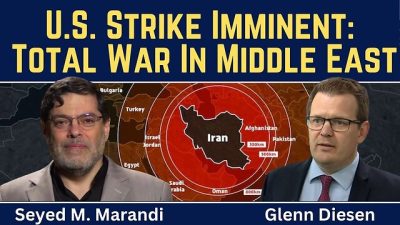
Seyed M. Marandi: Toward Total War in the Middle East
or go to
Aletho News Archives – Video-Images
From the Archives
The Geopolitics behind the War in Yemen (I)
By Mahdi Darius NAZEMROAYA | Strategic Culture Foundation | 30.03.2015
The United States and the Kingdom of Saudi Arabia became very uneasy when the Yemenese or Yemenite movement of the Houthi or Ansarallah (meaning the supporters of God in Arabic) gained control of Yemen’s capital, Sanaa/Sana, in September 2014. The US-supported Yemenite President Abd-Rabbuh Manṣour Al-Hadi was humiliatingly forced to share power with the Houthis and the coalition of northern Yemenese tribes that had helped them enter Sana. Al-Hadi declared that negotiations for a Yemeni national unity government would take place and his allies the US and Saudi Arabia tried to use a new national dialogue and mediated talks to co-opt and pacify the Houthis.
The truth has been turned on its head about the war in Yemen. The war and ousting of President Abd-Rabbuh Manṣour Al-Hadi in Yemen are not the results of «Houthi coup» in Yemen. It is the opposite. Al-Hadi was ousted, because with Saudi and US support he tried to backtrack on the power sharing agreements he had made and return Yemen to authoritarian rule. The ousting of President Al-Hadi by the Houthis and their political allies was an unexpected reaction to the takeover Al-Hadi was planning with Washington and the House of Saudi. … continue
Blog Roll
 Aletho News
- Israeli lobby seeks to bind US fate to ‘Israel’: Araghchi
- Pakistan-Iran talks secure LNG shipment to Islamabad through Hormuz
- Black Sea grain crisis puts global wheat supplies under pressure
- IRGC air defenses destroy another US MQ-1 drone over Strait of Hormuz
- Imran Khan’s entire immediate family detained in Pakistan ahead of mass protest demanding his release
- EU nation detains former presidential frontrunner
- Leaked: Britain’s Sham Conviction Of Hashim Thaci
- Seyed M. Marandi: U.S. Strike Imminent – Toward Total War in the Middle East
- Russia Voted Under Fire. Washington Is Loading the Tankers.
- 12 Things Your Oncologist Was Trained Not to Tell You
- If Americans Knew
- Israeli Attacks in Gaza Kill at Least Seven Palestinians Over Three Days, including Woman and Child
- Trump’s militarization of Washington DC as he pursues Israel’s war against Iran
- Why Israel Fears This Searing New Documentary
- Huckabee aide solicited cash gifts from Israelis
- This isn’t sci-fi, AI is already killing people
- ‘The Most Brutal Thing’: Investigation Reveals Execution of Elderly Woman in Rafah
- Inside Israel’s ‘soft’ ethnic cleansing plan for Gaza through the eyes of its victims
- New online database tracks pro-Israel political donations in the United States
- Israeli president pardons soldier convicted for killing wounded Palestinian
- Singer Ed Sheeran says his ‘heart broken’ by Gaza devastation, addresses Macklemore controversy
- No Tricks Zone
- 2025 Nature Paper Claiming Worsening Global Drought Gets RETRACTED …Heavily Flawed
- New Study: ‘Global Drought Shows No Detectable Recent Acceleration Under Climate Warming’
- Economic Masterminds: German Socialists Suggest Taxing Productivity Gains Stemming From Using AI
- The South China Sea Has Not Been Cooperating With The Climate Change Narrative
- Energy Crisis: Germany Enters Heating Season With Historically Low Gas Reserve Fill Levels
- New Study: The Antarctic Ice Sheet Gained Mass From 2020-2024 Due To Staggering Snow And Ice Accumulation
- Study: Ocean Heating Rates From Thousands Of Years Ago ‘Dwarf’ Modern Ocean Heating Rates
- Climate Extremists Target, Attack Large-Scale Power Grid Infrastructure In Germany!
- New Study: Antarctic Ice Melt Has Contributed Less Than 1 Centimeter To Sea Level Rise In The Last 30 Years
- Fear Of Debate: Alarmist German Climate Scientist Calls On Mainstream Media To Discredit Skeptic Voices
 Aletho News