Erdogan: Turkey, US at odds over Syria safe zone
Press TV – September 8, 2019
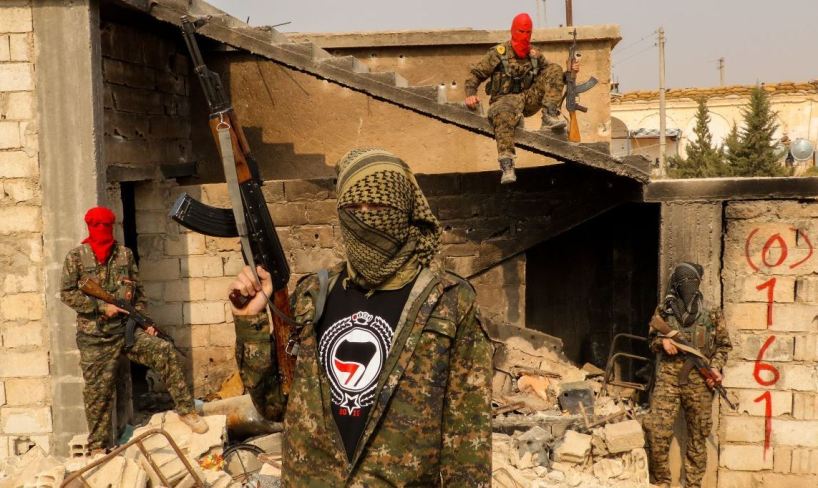
Turkish President Tayyip Erdogan says Ankara and Washington do not see eye to eye regarding a planned “safe zone” in northern Syria, where an alliance of Kurdish and Arab militants opposed by Turkey enjoy the United States’ support in their alleged fight against terrorism.
Speaking hours after joint US-Turkey patrols began in Syria’s north on Sunday, the Turkish president strongly criticized the US for protecting a “terrorist group” operating in the region.
“We are negotiating with the US for the safe zone, but we see at every step that what we want and what they have in mind is not the same thing,” Erdogan said. “It seems that our ally is looking for a safe zone for the terrorist organization, not for us. We reject such understanding.”
Earlier, media reports said six Turkish armored vehicles had crossed into Syria to join US troops. Two helicopters overflew the area as the Turkish vehicles drove through an opening in the concrete wall erected between the countries.
“If we don’t actually begin establishing a safe zone in the east of Euphrates with our own soldiers by the end of September, we will have no other option left but to follow our path. This is not something to be done with three or five helicopter flights, five or ten rounds of ground patrols, and ostensible presence of a few hundreds of soldiers in the region,” the Turkish president said.
Last month, the US and Turkey agreed to set up the buffer zone to the east of the Euphrates River between the Turkish border and Syrian areas controlled by US-backed Kurdish militias, which Ankara views as terrorists affiliated with the homegrown Kurdistan Workers Party (PKK) militant group.
Washington’s support for the Kurdish militants in Syria has long been a source of tension between the two NATO allies. Turkey has launched two military operations in Syria against those militants and threatened a third if Washington fails to keep them away from the Turkish border.
The Syrian government — which has authorized neither the Turkish nor the US military activities on its soil — has slammed the US-Turkish agreement, labeling it as a violation of Syria’s sovereignty and territorial integrity as well as international law.
Another Syrian Victory – and West’s Telling Silence
Strategic Culture Foundation | August 30, 2019
The liberation of Khan Sheikhoun in Idlib Province by the Syrian army and its Russian ally marks another important victory towards ending the eight-year war in Syria.
Last week saw the return to relative normalcy in the northwestern town which had been held under siege by al Qaeda-affiliated militants for over five years. Situated south of Aleppo on the road to the capital Damascus, Khan Sheikhoun was officially declared under the control of Syrian state forces on August 21 after a hard-fought battle against militants.
International journalists from Italy, Bulgaria, Greece and Russia witnessed the return of residents and efforts to resume electricity services and reopening of schools. Khan Sheikhoun was ransacked by the routed jihadi terror groups, with the typical depravity that had been seen in other liberated areas. But despite the devastation, residents were relieved to begin the task of restoration of what was previously a town renowned for its culture and beauty before the war erupted in March 2011.
The remnants left behind by the defeated militants as well as the identity of dead fighters testified to their terrorist affiliation. Many of them were foreign mercenaries. Khan Sheikhoun was a stronghold for the Hayat Tahrir al-Sham group which was formerly known as Al Nusra Front. Notwithstanding the chameleonic name, they are part of the jihadi Al Qaeda terror network which is internationally proscribed and which Western governments are officially opposed to.
The capture of the town again demonstrates the vile nature of the Syrian war as being one of foreign-sponsored aggression for regime change. In particular, the United States government and its NATO allies, Britain, France, Turkey, and others, are now known to be fully complicit in covert sponsorship of these terrorists.
Khan Sheikhoun is of particular significance because on April 4, 2017, it was dramatically reported by Western news media as being the site of a Sarin chemical weapon attack, allegedly carried out by the Syrian state forces. Three days later, on April 7, the US, Britain and France launched over 100 airstrikes on Syria in what was claimed to be “revenge” against the “Syrian regime” for allegedly committing an atrocity with chemical weapons. Syrian authorities and Russia asserted the alleged Sarin attack at Khan Sheikhoun was a false-flag provocation, fabricated by the militants with the aim of eliciting a military strike on Syria by the US and its NATO allies.
Clearly, after the liberation of the town this month, it is evident that it was a den of terrorist groups which held residents under a reign of terror. Yet for years, the Western news media had proclaimed that these fighters were “rebels” who deserved support from Western intervention. Even as Syrian forces were launching their assault on Idlib Province in recent months, the Western media were animated by shrill reports of “rebels” and civilians being killed by indiscriminate “regime” air strikes.
Tellingly, the momentous victory at Khan Sheikhoun was met with an astonishing silence among Western governments and news media.
The same duplicitous pattern has been seen before when the Syrian army and its Russian ally liberated Douma, Ghouta, Daraa, Aleppo, Maaloula and many other areas besieged by the so-called “rebels” so lionized in Western media. Syrian residents have been invariably relieved and overjoyed to have their freedom and dignity restored by the Syrian army and Russian forces. Their stories of the horror they endured under captivity are shocking from the depravity and cruelty meted out by Western-backed “rebels”.
That is why the liberation of Khan Sheikhoun, as with other locations in Syria, has had to be studiously ignored by the Western news media. Because if they really performed normal journalistic duty what the Western public would learn is that their governments and media have been complicit in huge war crimes against the Syrian nation.
It is all the more despicable therefore that the US is shifting its efforts to block the reconstruction of war-torn Syria. This week, the country is to hold the annual Damascus International Trade Fair. Delegates from some 40 nations are attending and exploring ways to regenerate the Syrian economy and to meet the challenge of reconstruction. Some estimates put minimal repair of infrastructure at a cost of $388 billion. The true figure could be in trillions of dollars.
That bill should be assigned to Washington, London, Paris, Ankara, Riyadh, Doha and Tel Aviv for the criminal aggression they collectively and stealthily inflicted on Syria.
Ahead of the Damascus trade fair, the US was warning prospective foreign investors that they could face sanctions if they did business with Syria. Russia’s foreign ministry condemned the American effort to sabotage Syria’s reconstruction.
As Russian lawmaker Valery Rashkin, who was in Syria this week, put it, the US is trying to destroy Syria through economic warfare after losing its dirty-war military agenda.
The European Union also stands condemned for continuing to impose economic sanctions on Syria. The war is over and it has been exposed as Western-backed criminal aggression. All past accusations against the Syrian state are null and void as malign propaganda. Thus, sanctions on Syria are a contemptible attack on the country by nations whose criminal complicity should actually be a matter of prosecution.
We can only wish the people of Syria well. With international solidarity from Russia, China, Iran and others, Syria will recover its former strength and pride. Syria has won a tremendous victory. The losers are the Western governments and media who have been exposed for the corrupt charlatans they are.
Turkey’s Syria Convoy Stopped in Its Tracks
By Jeremy Salt | American Herald Tribune | August 23, 2019
On August 19 Turkey sent a military convoy across the border in the direction of Khan Shaikhun, in southern Idlib province. It informed Russia beforehand of what it intended to do. From what followed, it can be assumed that Russia warned Turkey not to go ahead, but it did and suffered the consequences.
South of the town of Ma’arrat al Nu’man, 20 kilometres north of Khan Shaikhun, the lead vehicle in the convoy was destroyed from the air in a Syrian missile strike. The action had the clear support of the Russian government. The destruction of the lead vehicle was a warning that if the convoy went any further it also would be bombed. It was brought to a halt and remains parked somewhere north of Khan Shaikhun.
The convoy included tanks being carried on transporters, ammunition and personnel carriers as well as an unknown number of soldiers. Turkey claimed that three civilians were killed in the attack. In fact, from reports, the ‘civilians’ in the destroyed vehicle included the commander of Faylaq al Sham, a faction integrated into the Turkish-backed ‘National Liberation Front.’
Syrian military units were already infiltrating Khan Shaikhun, held since 2014 by Hayat Tahrir al Sham (HTS), formerly Jabhat al Nusra, formerly Al Qaida in Syria, and by August 21 they had fully liberated the city. Turkey said the convoy was bound for its military observation post near the town of Murek. Syria claims the weaponry was being sent to the beleaguered takfiris in Khan Shaikhun.
As the M5 highway runs through Murek all the way from Aleppo to Damascus, Turkey’s access to its observation post is now cut off and can only be restored through Russian mediation. The M5 runs north to Saraqib before branching off to Idlib city, which has been occupied by HTS since 2015.
Turkey has another observation post near Ma’arrat al Nu’man, which it claims has come under harassing fire from the Syrian army. It insists, however, that all its 12 observation posts in Idlib will remain open.
Further Syrian advances south of Khan Shaikhun have scattered takfiris from northern Hama, which borders southern Idlib. Others remain trapped. The Syrian military has opened a humanitarian corridor around the village of Suran for civilians to leave the region. Many are already pouring out of Idlib and northern Hama.
Turkey claims the attack on the convoy breached the understanding it had reached with Russia and Iran on the ‘de-escalation’ of conflict in Idlib, which it was supposed to manage. However, as Vladimir Putin pointed out after the aerial attack, when Turkey signed the ‘de-escalation’ agreement in August, 2018, HTS controlled 50 per cent of Idlib but within months it had taken control of 90 per cent.
Even by the US and Turkey HTS is designated as a terrorist group. Nevertheless, in the fighting for Khan Shaikhun, units from the ‘National Liberation Front’ and the ‘National Army’, founded in January, 2018, and also backed by Turkey, formed a common front with HTS against the Syrian army’s advance.
The liberation of Khan Shaikhun has been a major victory for the Syrian army, which is now positioned for an offensive north towards Ma’arrat al Nu’man, held by the ‘Syrian Liberation Army’ (SLF), originally an amalgam of two terrorist groups, Ahrar al Sham and Nur al Din Zinki, but eventually expanded to include numerous other takfiri factions.
Early in 2018 heavy fighting between the SLF and HTS took the lives of hundreds of takfiris, but the SLF captured Ma’arrat al Nu’man and has held it ever since. In August, 2018, the SLF joined the ‘National Front for Liberation,’ which is also backed by the Turkish government.
While the Syrian army is now positioned to move rapidly northwards from Khan Shaikhun, its advances in the past have been frequently stymied by ceasefires called as part of the chess game played under the heading of ‘diplomacy.’
Russia has yet to respond to Turkey’s request for a ceasefire in Idlib but this time, with its air base at Khmeimim coming under frequent attack and with Putin remarking that the takfiris in Idlib are spreading out globally, it may prefer to see the province cleared without any further delay.
The compartmentalization of interests on both sides suggest that neither Russia nor Turkey will allow developments in Idlib, including the attack on the military convoy, to jeopardize the overall relationship. Apart from diplomatic and trade considerations, Turkey is now purchasing Russian weaponry, with the delivery of the second batch of S400 missiles expected in September. On September 18 Putin, Rouhani and Erdogan will discuss Syria at a conference in Ankara.
Nevertheless, however many twists and turns ‘diplomacy’ takes, Russia stands firmly behind the Syrian government in its drive to liberate Idlib and restore its authority over all territory held by the takfiris and foreign forces, Turkish in the northwest and American in the northeast.
At odds over the status of the Syrian Kurds, Turkey and the US have now agreed to cooperate in the establishment of a ‘safe zone’ along the Syrian side of the Syrian-Turkish border. Erdogan wanted to establish a ‘safe’ or ‘buffer’ zone inside Syria from the moment he decided to intervene in 2011 by supporting the so-called Syrian National Council and the so-called Free Syrian Army against the Syrian government.
The decision to intervene in Syria is unprecedented in the history of the Turkish republic. While a Turkish government intervened in Cyprus in 1974 to forestall the annexation of the island by the Greek military junta, and while the Turkish military has frequently campaigned against the PKK (Kurdistan Workers’ Party) in northern Iraq, no Turkish government has ever actively intervened to bring about the downfall of another government, let alone one in a neighboring country, let alone one with which it had good ‘brotherly’ relations at the very moment it decided to intervene.
Apart from other dire consequences, the destruction of the Syrian government’s authority in the north created the very problem which Erdogan is now determined to solve, the perceived ‘national security’ threat from the YPG (People’s Protection Units), the Kurdish militia.
Before 2011 the Syrian government had supported Turkish military action against the Kurds in northern Iraq. It had also cracked down on the YPG’s parent political organization, the PYD (Democratic Union Party), breaking up demonstrations and sending leading activists for trial before security courts. Syria was just as strongly opposed to Kurdish separatism as the government of Turkey.
It was the US, Turkey’s partner in the collective calling itself ‘The Friends of the Syrian People,’ which enhanced opportunities for the Syrian Kurds, irrespective of Turkey’s interests. It established military bases in the predominantly Kurdish northeast and created a largely Kurdish militia, the Syrian Democratic Forces. It refused to accept Turkey’s designation of the YPG as a ‘terrorist’ group and by all of its actions, it fostered Kurdish attempts to set up autonomous enclaves along the Turkish border. Had the Syrian government not come under such a ferocious attack from 2011, none of this would have happened.
Apart from the widespread destruction in Syria caused by foreign intervention, the consequences for Turkey have included an influx of 3.6 million refugees. According to opinion polls, the Turkish public now regards their presence as a problem second only to the faltering state of the economy.
The ‘safe zone’ or ‘peace corridor’ as it is now being called allows Turkey to aim at two targets simultaneously. One is the YPG, whose presence Turkey is determined to remove from the border area. The second is rising public disquiet inside Turkey at the visible presence of so many Syrians, the cost of maintaining them and their impact on daily life. According to press reports, large numbers of the refugees will now be resettled in this ‘safe zone’, easing domestic pressure on the Turkish government. Whether Syrians who come from other parts of their country will want to stay, if conditions in their home towns and villages are safe, is doubtful. The influx of so many Syrian Arabs into this strip of territory would water down the Kurdish population and inevitably lead to accusations of demographic engineering.
How Turkey and the US will ‘police’ this safe zone is far from clear. They have been wrangling over it for months. The ‘safe zone’ would run from Jarabulus in the west to the Iraqi border. Turkey wants (or wanted) a zone 32 kms deep, while the US argued for 14 kms, the first five kilometres a DMZ, patrolled jointly by Turkish and US forces, the remaining nine kilometres only to be cleared of heavy weaponry and not necessarily the YPG. The two sides say they have now agreed and have launched the first phase of this operation but no details apart from air coordination are known.
Joint patrols would take Turkish troops deep into the Syrian Kurdish heartland, just across the border from the Kurdish heartland in Turkey’s southeast and not far from Kurdish northern Iraq. This latest initiative is fraught with many dangers, including the likelihood of Kurdish resistance to the Turkish presence. How the US intends to balance out its strategic support for the Kurds against its strategic relationship with Turkey is only one of many unknowns.
In the domestic Turkish background the ruling Justice and Development Party (AKP) suffered a major blow in the March local elections when it lost control of Istanbul and Ankara as well as other major cities. Its situation since then has only deteriorated. Senior figures in the party, including former Foreign Minister and Prime Minister Ahmet Davutoglu and Ali Babacan, a co-founder of the AKP and former Economy Minister and Deputy Prime Minister, have broken away and are forming their own political parties. These are certain to make inroads into the AKP inside and outside parliament. In short, Tayyip Erdogan’s domestic base, for the first time in 18 years, is beginning to fracture.
The recent dismissal of Kurdish mayors in the southeast – the latest in a long line of such dismissals – and their replacement by government trustees has attracted widespread public criticism, well beyond the ranks of the predominantly Kurdish People’s Democracy Party (HDP). The domestic political climate is changing rapidly and the arrests are being openly criticized as further blows to an already severely weakened democratic base. The opposition Republican People’s Party (CHP) is totally opposed to Turkey’s intervention in Syria, where the Syrian army is now encircling Turkey’s observation posts in Idlib, heightening the danger of direct clashes.
Were the CHP to take government, it could be counted on to withdraw from Syria without delay. However, elections are not due until 2023 and while there have been unfavourable shifts on the domestic landscape, Erdogan is wily and resilient and perfectly capable of reversing these setbacks. Syria is a different picture. It is full of dangerous variables which he can neither avert nor necessarily control but it is not his style to back off. Rather, he is more likely to double down and seek victory in his public’s eyes, whatever the risks this will involve.
Jeremy Salt has taught at the University of Melbourne, Bosporus University (Istanbul) and Bilkent University (Ankara), specialising in the modern history of the Middle East. His most recent book is “The Unmaking of the Middle East. A History of Western Disorder in Arab Lands” (Berkeley: University of California Press, 2008.)
BBC Admits ‘Syrian’ Airstrike in Recent Story on Scarred Boy Turned Out to Be Turkish
Sputnik – August 22, 2019
The BBC has corrected its August 19 news story about a Syrian boy who was severely wounded in a 2018 airstrike, which the broadcasting company first said was carried out by Syrian forces but later admitted could be blamed on Turkey.
Some Twitter users posted screenshots showing that the BBC had actually redacted its text several times.
The headline of the short story, featuring a video about the life of a four-year-old Syrian boy whose face was scarred in the airstrike, originally referred to the incident as “a Syrian airstrike.” The mention of Syria was then deleted with an indication that it was “not clear who was responsible for the attack.” Now the headline refers to it as just “an airstrike,” and the article clarifies that “evidence indicates that Turkey carried out the airstrike.”
Last January, Turkish forces launched airstrikes on Kurdish fighters in Afrin, a city located in northern Syria, as part of a military operation dubbed Olive Branch. The boy, named Jouma, and his family were fleeing their home in Syria when an airstrike hit the bus they were on.
Jenan Moussa, a reporter for Arabic Al Aan TV, wrote on Twitter that Tolin Hassan, a close friend of the wounded boy’s family, told her that Jouma’s relatives “mentioned over and over to BBC-journo that the car was hit by a Turkish strike after escaping Afrin.”
Turkey, US agree to launch 1st phase of so-called safe zone plan in northern Syria
Press TV – August 22, 2019
Turkey and the United States have reached an agreement to immediately launch the first phase of a so-called safe zone plan in northern Syria, irrespective of the Damascus government’s strong opposition that the scheme amounts to “blatant aggression” against Syria’s territorial integrity.
Turkish Defense Minister Hulusi Akar and his US counterpart Mark Esper discussed the plan during a telephone conversation late on Wednesday, and decided to implement the measure from Thursday.
The two defense chiefs also agreed that military delegations from the two countries will meet in Ankara soon to discuss next stages of the plan.
Akar said the safe zone east of the Euphrates River in Syria should be established within the framework of the principles set out in the calendar without losing time, according to a Turkish Defense Ministry statement.
On August 7, Turkey and the US reached an agreement on the establishment of a joint operation center in the northern part of Syria, in the wake of Ankara’s threats to launch an operation against Kurdish militants from the People’s Protection Units (YPG) to push them away from the Turkish border.
Turkey views the YPG as the Syria branch of the homegrown Kurdistan Workers’ Party (PKK) militant group, which has been seeking an autonomous Kurdish region in Turkey since 1984.
Turkey expects the creation of a 32-kilometer (20-mile) safe zone in northern Syria, and has stressed that it wants the YPG cleared from the region.
An unnamed source at the Syrian Ministry of Foreign Affairs and Expatriates told the official SANA news agency on August 8 that the US-Turkey agreement over the establishment of a so-called safe zone in Syria amounted to “blatant aggression” against the Arab country’s territorial integrity and was a “flagrant violation” of international law and the UN Charter.
“This agreement has very clearly exposed the US-Turkish partnership in the aggression against Syria, which serves the interest of the Israeli occupation entity and the Turkish expansionist ambitions,” the source said.
He also urged Kurdish militants to reconsider their position and stand by the Syrians in defending their country.
“Syria calls on the international community and the UN to condemn the US-Turkish flagrant aggression which constitutes a dangerous escalation and poses a threat to peace and security in the region and the world and hinders all positive efforts for finding a solution to the crisis in Syria,” he said.
Michael Lane, founder of the American Institute for Foreign Policy, told Press TV on August 13 that the US plan to set up a joint command center with Turkey to coordinate a so-called safe zone in Syria is aimed at blocking the Syrian army’s advances on the battlefield against foreign-backed militants.
“The United States is trying to disrupt the consolidation of the Syrian government over its country so that it keeps it distracted by that particular task,” and prevent it from working with its allies, namely Iran and Russia, in the battle against terrorism, he said.
“The United States purpose or vision is to keep Syria from becoming part of a triangle of Iran, Russia and Syria,” Lane commented.
The Saker Interviews Professor Marandi

The Saker • Unz Review • August 22, 2019
Introduction: first, several friends recently suggested that that I should interview Professor Seyed Mohammad Marandi; then I read this most interesting text on Moon of Alabama and I decided to ask Professor Marandi to share his views of the current situation in Iran, the Persian Gulf and the rest of the Middle-East who very kindly agreed to reply to my question in spite of his most hectic and busy schedule. I am most grateful to Prof. Marandi for his time and replies. Crucially, Prof. Marandi debunks the silly notion that Russia and Israel are allies or working together. He also debunks that other canard about Russia and Iran having some major differences over Syria. Prof. Marandi, who is currently in Iran, is superbly connected and informed, and I hope that with this interview some of the more outlandish rumors which were recently circulated will finally be seen for what they are: utter, total, nonsense. Enjoy the interview!
The Saker: It is often said that there is an “axis of resistance” which comprises Syrian, Hezbollah, Iran, Russia and China. Sometimes, Venezuela, Cuba or the DPRK are added to this list. Do you believe that there is such an “axis of resistance” and, if yes, how would you characterize the nature of this informal alliance? Do you think that this informal alliance can ever grow into a formal political or military alliance or a collective security treaty?
Professor Marandi: I definitely believe there is an Axis of Resistance that currently includes Iran, Syria, Iraq, Gaza, Lebanon, parts of Afghanistan, and Yemen. I do not think that we can include the DPRK in any way or form. I believe that Russia could be considered to a certain degree as aligned or affiliated to this resistance, but that this is not something many would feel the need to acknowledge. At certain levels, there is a lot of overlap between Russian and Chinese policy and the policies of the countries and movements in this region that are affiliated to this Axis of Resistance. The same is true with countries such as Venezuela, Bolivia, and Cuba, which I do not consider to be similar to North Korea at all. Just as almost everywhere else, American policy in the Korean Peninsula is ugly, hegemonic and malevolence, but the nature of the DPRK government is fundamentally different from that of Venezuela or Cuba, whether the Americans or Europeans like to acknowledge that or not. Others can interpret the Axis of Resistance to include or exclude certain countries, but it is pretty clear that Iran and Russia have similar policy objectives when it comes to certain key issues. Nevertheless, Russia has a close relationship with the Israeli regime whereas Iran considers it to be an apartheid state, almost identical to that of apartheid South Africa. Or for example the Syrian government position regarding Israel is different from that of Iran’s. The official Syrian position is that the West Bank and Gaza Strip must be returned to the Palestinians, in accordance with UN Security Council resolutions, and that the occupied Golan Heights have to be handed back to the Syrian people, which are legitimate demands. But the Iranian position is different, Iran firmly believes that Israel is a colonial and apartheid regime and that it is morally unacceptable for it to exist in its present form. Therefore, at least officially, there are substantial differences. So people can interpret the Axis of Resistance in different ways. It is important to keep in mind that despite Syria, Iran, Turkey and Qatar are also moving closer together partially thanks to US, Saudi, and UAE hostility towards the Muslim Brotherhood. What is important is that there is a growing consensus about key issues in this region and what the major problems are, and I think that as time goes on this loose alliance of countries and movements is growing more influential and more powerful. I cannot say whether there will be a formal or open collective security treaty or military alliance created by any of these countries in the near or foreseeable future and I do not see such a necessity. However, I think this convergence of ideas is very important and I think that the formal and informal links that exist between these countries is in many ways more important and more significant than formal political or military alliances or security treaties.
The Saker: In recent months a number of observers have stated that Russia and Israel are working hand in hand and some have gone as far as to say that Putin is basically a pawn of Netanyahu and that Russia is loyal to Israel and Zionists interests. Do you agree with this point of view? How do Iranian officials view the Russian contacts with the Israelis, does that worry them or do they believe that these contacts can be beneficial for the future of the region?
Professor Marandi: That is nonsense. The US and Israeli regimes are culturally and ideologically bound to one another, whereas the Americans have a deep antipathy towards Russia. That is why the Russians have a very different position on Syria than do the Americans and Israelis. The Israelis alongside the US, the EU, the Saudis, and some of Syria’s neighboring countries, supported ISIS, Al Qaeda, and other extremist entities and attempted to tear Syria apart. As explained earlier, the Russian view of Israel is different from Iran. There are many Russian Jewish immigrants in Israel and they constitute a large segment of the colonists in Palestine and they are largely utilized for the further subjugation of the Palestinian people and ethnic cleansing. Generally speaking, Russian interests are in sharp conflict with those of the United States, Israel’s strongest ally. In addition, Russia’s close relationship with Syria dates back to the cold war and the relentless US pressure on China and Russia has also acted as a strong catalyst to quicken their convergence with one another as well as with Iran on key issues. The Chinese and Russians know quite well that the United States, the Europeans, and regional countries have extensively used extremists in Syria to undermine the state and that those forces could later be used to undermine security in Central Asia, Russia, and China. A large number of Russian, Chinese, and Central Asians have been trained to fight in Syria, and this is a major threat to their collective security. The United States could use these and other extremists in an attempt to impede the potential success of the Belt and Road Initiative or other plans for Asian integration. Thus, there is a sharp and growing conflict between the Russians and the Americans.
The Israeli regime constantly tells the Russians and the Chinese that they are the gateway to Washington and that if they maintain strong ties with Israel, the Israelis can help them solve their problems with the United States. I do not think there is much truth to that, because this growing conflict is about the fate of US global dominance and there is nothing the Israelis can do to change that. Nevertheless, this has been used as an incentive for the Russians and the Chinese to maintain better relations with the Israeli regime.
In any case, Russia does not have to maintain identical views with Iran, Syria, Hezbollah, Lebanon, Iraq, or Yemen. Differences exist, but strong relationships exist nevertheless. All of these countries recognize that if the Americans are able to undermine any of them, whether it is Syria, Iran, Russia, or China, then that would only encourage the United States to be more aggressive towards the remaining countries that impede US foreign policy objectives or exist as potential rivals whether regionally or globally. So even though their political structures are different, even though their foreign policies are different, the similarities that exist are quite striking as well as the common threats. Again, to a large degree this coalition is a result of US and Western foreign policy, which has strong undercurrents of Eurocentricism, tribalism, and racism.
Not only has this pressure brought these countries and movements closer to one another, but it has also created a deeper understanding among them. The Russians understand Iran better today than they did 5 years ago, partially as a result of their cooperation in Syria. This greater understanding enhances the relationship, and helps to dispel many of the misunderstandings or myths that may exist about one another due to Eurocentric narratives and orientalism.
Hence, Iran is not concerned about Russian-Israeli relations. Obviously, in an ideal world Iran would like Russia to break relations with the Israeli regime for its apartheid nature. But reality is reality, and Iranian relations with Russia are very good and at times I am sure the Iranians send certain warnings to the Israelis through the Russians.
The Saker: How is Russia viewed in Iran? Are most Iranians still suspicious of Russia or do they believe that they have a viable and honest partner in Russia? What are the main reservations/concerns of patriotic Iranians when they think of Russia?
Professor Marandi: Historically, the Iranians have had serious problems with the Russians. The Russians and the Soviet Union interfered extensively in Iranian internal affairs and they undermined Iran’s sovereignty. But ever since the collapse of the Soviet Union the image of Russia has changed. Especially since Russia began fighting alongside Iran in Syria in 2015, Russia’s image has improved significantly. When we look at polls, Russia’s image is pretty good compared to Western countries.
Western governments own or fund dozens of Persian language media outlets These outlets, such as VOA and BBC Persian among others, are constantly spouting anti-Russian propaganda. Obviously they have an impact and that couples with historical Iranian concerns about Russia, but despite all that, the Russian image is relatively favorable and that says a lot.
The Saker: How about Turkey? Iran and Turkey have had a complex relationship in the past, yet in the case of the AngloZionist war against Syria, the two states have worked together (and with Russia) – does that mean that Turkey is seen as a viable and honest partner in Iran?
Professor Marandi: Iran’s relationship with the Turkish government is complicated, especially, because of the constant policy changes that have occurred IN TURKEY over the past few years. This has made the government seem unreliable in the eyes of many. Having said that, Turkey is very different from Wahhabi influenced regimes in the Arabian Peninsula. Turkish Islamic tradition has striking similarities with Iran’s Islamic culture and because of its strong Sufi tradition, Turkey is much closer to Iran than it is to, for example,Wahhabi Saudi Arabia.
The global Wahhabi menace has grown as a result of Saudi financial support, as well as the support of other countries in the Persian Gulf region. Turkish society has been more resistant, although ever since the military conflict in Syria and due to extensive funding from the Persian Gulf, there has been growing concern about growing sectarianism in Turkey, not unlike what happened in Pakistan in the 1980s.
Ironically, before the conflict in Syria President Erdogan had a closer personal relationship with President Assad than did the Iranians. They and their families would spend vacations together.
In any case, Turkey has a very strong economic, political, and cultural relationship with Iran, and some of the rising anti-Shia and takfiri sentiments that have been on the rise in Turkey were stunted by the Saudi and Emirati support for the attempted coup in Turkey. Subsequently, their open antagonism towards the Muslim Brotherhood and Qatar, their support for the coup in Egypt, their policies in Sudan and Libya, and of course the murder of Jamal Khashoggi, have all had a beneficial impact on Iranian-Turkish relations. As a result, Turkey has grown much more distant from Iran’s regional antagonists, while Turkish support for the Palestinian cause is another element that brings Iran and Turkey closer together. American support for PKK terrorists in Syria has also angered the Turks adding push to Turkish-Iranian convergence. Even Turkish policy towards Syria is evolving, although it is impossible for the government to make a radical change, because of years of attempts at regime change.
The Saker: Next, turning to Iraq, how would you characterize the “balance of influence” of Iran and the USA in Iraq? Should we view the Iraqi government as allied to Iran, allied to the USA or independent? If the Empire attacks Iran, what will happen in Iraq?
Professor Marandi: The relationship between Iraq and Iran is significantly more important than the relationship between Iraq and the United States. Iran and Iraq are allies, but this alliance does not contradict the notion of Iraqi independence. Iraq’s regional policy is not identical to Iran’s. But the two countries have very similar interests, a very close relationship, many Iraqi leaders have spent years in Iran, and the bulk of the Iraqi population lives close to the shared border of over 1,200 km between the two countries. So trade, pilgrimage, and tourism are key to both countries. The religious similarities and the holy sites that exist in Iran and Iraq are a huge incentive for interaction between the two countries. There are many Iraqi students studying in Iran and many Iranian’s working in Iraq. The fact that Iranians made many sacrifices when fighting ISIS in Iraq and many Iraqis were martyred in the war against ISIS and Al Qaeda in Syria is a strong indication of where things stand despite US pressure.
The Arba’een pilgrimage that takes place every year where millions of Iranians and Iraqis make the walk towards Karbala, side by side, with tens of thousands of Iraqi and Iranian volunteers helping pilgrims along the way is, I think, a further sign of the close relationship.
While the U.S presence in Iraq continues to be hegemonic, Iran has not sought to prevent Iraq from having normal relationships with other countries. However, the U.S continues to seek control over Iraq through the world’s largest embassy, its military presence, and its influence over the bureaucracy. The United States continues to have much say over how the country’s oil wealth is spent.
Still, despite the US colonial behavior, its continued theft of Iraqi oil wealth, and its thuggish behavior, the Iraqis have been able to assert a great deal of independence. In the long run, this continued US behavior is only going to create further resentment among Iraqis. The empire rarely takes these realities into account, they seek to accumulate influence and wealth through brute force, but in the long term it creates deep-rooted anger and hostility which, at some point, will create great problems for the empire, especially as this anger and unrest is growing across the region, if not across the globe.
It is highly unlikely that the regime in Washington will attack Iran, if it does it will bring about a regional war, which will drive the United States out of Iraq, Afghanistan, Lebanon, and Syria. Saudi Arabia and the Emirates would, swiftly collapse and the price of oil and natural gas would go through the roof, leading to a global economic meltdown even as millions of people will be streaming towards Europe.
The Saker: It is often said that Russia and Iran have fundamentally different goals in Syria and that the two countries regularly have tensions flaring up between them because of these disagreements. Is that true? In your opinion, how are Russian and Iranian goals in Syria different?
Professor Marandi: The news that we sometimes hear about serious tensions existing between the Iranians and the Russians in Syria is often nonsense. There are clear reasons for people to exaggerate small incidents or to fabricate them altogether, but the relationship is quite good. Iran does not intend to have any military bases in Syria, whereas the Russians do feel the need to preserve their military presence in Syria through long-term agreements.
But ultimately, Iran would like to help enable Syria to acquire the military capability to retake the occupied Golan Heights. Iran does not intend to initiate any conflict with the Israeli regime inside Palestine. That is not an objective in Lebanon and that is not an objective in Syria. As in Lebanon, where the Iranians supported Hezbollah to restore the country’s sovereignty and to drive out the Israeli aggressors and occupiers, the Iranians have the same agenda in Syria. They want to support the Syrians so that they will be able to restore full sovereignty. I don’t believe the Golan Heights is a priority for the Russians.
The Saker: For a while, Iran let the Russian Aerospace Forces use an Iranian military airfield, then when this became public knowledge, the Russians were asked to leave. I have heard rumors that while the IRGC was in favor of allowing Russian Aerospace Forces to use an Iranian military airfield, the regular armed forces were opposed to this. Is it true that there are such differences between the IRGC and the regular armed forces and do you think that Iran will ever allow the Russian military to have a permanent presence in Iran?
Professor Marandi: That is a myth. The Russians were not asked to leave. There were no differences between the IRGC and any other part of the armed forces. This was a decision made by the Supreme National Security Council and the President and all the major commanders in the military were involved in this decision. Actually, the airbase does not belong to the guards it belongs to the air force and a part of the base was used for Russian strategic bombers that were flying to Syria to bomb the extremists. This cooperation ended when the Russians were able to station adequate numbers of aircraft in Syria, because the flights over Iran were long and expensive, whereas the air campaign launched from bases inside Syria was much less expensive and much more effective. Iran was very open about its relationship with the Russians, and openly permitted the Russians to fire missiles over Iranian airspace. There were those who were opposed to the Russian presence in the Iranian airbase. A small segment of Iranian society that is pro-Western and pro-American complained about it in their media outlets, but they had absolutely no impact on the decision-making process. According to polls, an overwhelming majority of Iranians supported Iran’s activities in Syria, and the Supreme National Security Council was under no pressure to its decision. However, Iran does not plan to allow any country to have permanent bases in the country and that is in accordance with the constitution of the Islamic Republic of Iran. The revolution in Iran was about independence, dignity, sovereignty and indigenous values, and the removal of American hegemony over Iran was very much a part of that. The Iranians will not give any bases to foreign powers in future, and neither the Russians nor the Chinese have ever made such requests. There are absolutely no differences regarding Iran’s regional policies between the IRGC and the rest of the military, both were a part of the decision-making process when the Russians were allowed to fire missiles over Iranian territory and both were part of the process in allowing Russian aircraft to use Iranian airspace. The Russian bombers were providing air support for Iranian troops and Iranian affiliated troops on the ground.
The Saker: Both Ayatollah Ali Khamenei and Hezbollah Secretary General Hassan Nasrallah have made repeated statements that the days of the racist ZioApartheid regime in occupied are numbered. Do you agree with their point of view and, if yes, how do you see such a regime change actually happening? Which of the One State solution or a Two State solution do you believe to be more realistic?
Professor Marandi: I do not believe the two-state solution is possible because the Israeli regime has colonized too much of the West Bank. Actually, through acts of selfishness and petty short-term gain, the regime has damaged itself enormously. As a result of the colonization of the West Bank, even the European elites and diplomats who would privately admit that the Israeli regime pursues apartheid policies and who would always speak of hope for a two-state solution, admit that the two state solution is dead. All Palestinians are treated as sub humans, whether they reside in the West Bank or not. They are a subjugated nation, whether they are Israeli citizens or not. However, there is no longer any hope that those who live in the occupied West Bank will gain freedom, even though we predicted the Israelis would never voluntarily relinquish the West bank. This is the most important challenge that the regime faces in the future. By colonizing the West Bank and despite official western media and government narratives, it is increasingly seen by the international community as the apartheid regime that it is. It is delegitimizing itself in the eyes of larger numbers of people.
In addition to that, it can no longer behave with impunity. The 2006 war in Lebanon where the Israeli armed forces were defeated by Hizbullah was a turning point. Before then, the Israelis had created an image that they were invincible. But now even in Gaza, they are unable to carry out their objectives when they periodically attack the territory and its civilians. The Israelis are now more easily contained especially since the Syrian government has been able to restore order and expel ISIS and al-Qaeda from areas neighboring Israeli forces on the occupied Golan Heights, despite the Israelis supporting the extremists. The Israelis have been contained regionally, at home they are increasingly seen as an apartheid regime. Its regional allies are also on the decline and regionally. Saudi Arabia and the UAE are the only countries that can be considered as effective allies and they are facing a potential terminal decline. Therefore, regionally the regime is becoming more isolated. I do not believe that under such circumstances, the Israeli regime can last for very long. Just as the apartheid regime in South Africa collapsed under the burden of its own immoral existence, the Israeli regime will not last. There will be no two-state solution, the only realistic and moral solution is for Palestine to be united and for the indigenous population to have its rights restored, whether they are Palestinians, Jews or Christians or anyone else who is indigenous to the land.
The Saker: Iran is an Islamic Republic. It is also a majority Shia country. Some observers accuse Iran of wanting to export its political model to other countries. What do you make of that accusation? Do Iranian Islamic scholars believe that the Iranian Islamic Republic model can be exported to other countries, including Sunni countries?
Professor Marandi: I do not think that there is any validity to that accusation. Iran has a very excellent relationship with Iraq, but it has not imposed its model on the country. In fact, Iran helped create the current constitution of that country. The same is true for Lebanon and Yemen. Iran is constantly accused by its antagonists, but in the most inconsistent ways. Elsewhere they claim that Iran is afraid of their model being exported because they are fearful of rivals. Iran has always been attacked from all sides often using self-contradictory arguments. On the one hand, the so-called regime is allegedly immensely unpopular, it is corrupt, it is falling apart, and it is incapable of proper governance. Yet on the other hand, Iran is a growing threat to the region and even the world. This is paradoxical, how can Iran be incompetent and collapsing on the one hand, yet a growing threat to the whole world on the other hand? This simply does not make sense. Nevertheless, I have seen no evidence that Iran has tried to impose its model on other countries or on movements that are close to it. If it was not for Iran’s support, ISIS and al-Qaeda would have overthrown Syria with its secular government and secular constitution. Iranians firmly believed that the terrorist forces supported by Western intelligence services as well as regional regimes were the worst case scenario for the Syrian people. Did they impose their model?
The Saker: thank you for all your answers!
Turkey faces quagmire in Syria
By M. K. BHADRAKUMAR | Indian Punchline | August 20, 2019
The three-year old Russian-Turkish tango in Syria has been incisive, exciting and provocative, but the inability of the two partners to trust each other or surrender to the care and needs of the other has deprived the relationship of the energies to work symbiotically.
If tango serves as a metaphor of relationship, an overall imbalance of energy on both sides is apparent in the Russian-Turkish moves on the Syrian turf.
There was always the suspicion that the endgame being played out in Idlib province in northwest Syria on the Turkish border would ultimately put to test the mettle of the Russian-Turkish axis in Syria. That is happening.
The major Russian-backed offensive by the Syrian government forces last week to recover the strategic town of Khan Sheikhoun that has been in rebel hands since 2014 and is the opposition’s last major stronghold has prompted Turkey to come to the aid of the rebel forces supported by it.
A Turkish military convoy sent to keep open supply routes for the opposition fighters was halted by an air attack on Monday by Syrian and Russian war planes. According to Iranian reports, the Turkish convoy comprised 28 military vehicles, including tanks and trucks carrying weapons and military equipment destined for Tahrir al-Sham al-Hay’at (read the Al-Nusra Front affiliated with al-Qaeda) terrorists holed up in Khan Sheikhoun.
A war of words has erupted. The Defence Ministry in Ankara squarely blamed Russia in a statement on Monday. Foreign Minister Mevlut Cavusoglu warned today at a press conference in Ankara that Damascus is “playing with fire.”
Turkey argues that the convoy was only ferrying supplies for its military observation post in Idlib, which was established in terms of an agreement with Russia last September.
The crux of the matter is that the September agreement obliged Turkey to neutralise the extremist groups ensconced in Idlib but in reality the terrorists since expanded their presence in the province and began attacking the Russian base nearby and the Syrian forces in the vicinity.
Russia put up with Turkey’s doublespeak for a year but patience has run out, especially as its Hmeymim air base is facing constant threat from terrorist attacks.
As for Damascus, capturing Khan Sheikhoun is an important gain in military terms not only for President Assad’s bid to recover “every inch” of Syria, but also since a highway running through that town connects Aleppo city.
Moscow has snubbed the Turks. While on a visit to France on Monday, President Putin said at a press conference that Russia supports the Syrian government forces’ on-going campaign against terrorists in Idlib.
Putin repeated that before the establishment of a demilitarised zone in Idlib by Turkey, the terrorists had controlled fifty percent of the province’s territory, but now 90% of Idlib’s territory is under the terrorist groups’ control.
Turkey has overreached in Syria. But then, there is more to it. To be sure, Turkey is paying a high price for its wrong policies. It should never have got involved with the US-led project to overthrow the regime in Syria; its dalliance with terrorist groups was (and continues to be) incomprehensible; its projection of power into Syria is violative of international law; and worst of all, it is still unwilling to reconcile with the established government in Damascus although it is clear that the Assad regime will remain in power for the foreseeable future.
Meanwhile, the deterioration of relations with the US is hitting Turkey hard. Washington is not in a mood to accommodate Turkey’s concerns and vital interests vis-a-vis the Kurdish issue.
Things have come to a point where, paradoxically, a US-Russia tacit understanding seems to exist in regard of northeast Syria.
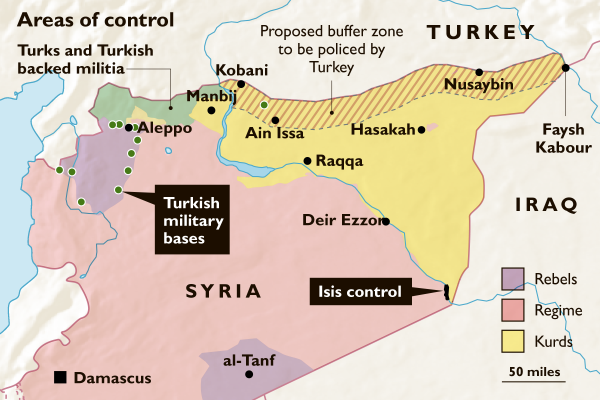
There is a growing perception that the US and Russia are acting on an overall consensus in Syria, with Moscow having the say largely over the area on the western part of the Euphrates River, while the eastern side of the river where the Kurdish forces are present remains under US control. That is to say, the US retains its presence to the east of Euphrates, while the territories to the west of Euphrates come under Russian ‘sphere of influence.’
Conceivably, there could be a Russian-American congruence to keep Turkey out of northeastern Syria. The Iranian media reported on Monday that for the first time, Russian infantry units are being deployed in Bukamal region in Eastern Deir Ezzur province near the Iraqi border where Russia plans “to build military centres”.
On the other hand, Turkey’s partnership with Russia has become increasingly one-sided. Turkey cannot afford to antagonise Russia anymore, whereas, Russia no longer has to wear kid gloves while dealing with Ankara, although Turkey still is a NATO power.
In November 2015, when Turkey shot down a Russian Sukhoi Su-24M attack aircraft, Moscow was ultra-sensitive while reacting. But there is no apology for Monday’s air attack on the Turkish military convoy in Idlib.
The Russian Foreign Minister Sergey Lavrov asserted today that any attacks carried out by Islamist militant groups (which Turkey harbours) in the de-escalation zone in Idlib will be “forcefully suppressed”.
All in all, Russia has concluded that this is an opportune moment to clean up Idlib. Turkey’s proposal to establish a safe zone in northern Syria isn’t getting anywhere. The Turkish demand — a 30 to 40 kilometre deep safe zone stretching 430 kilometres all along the border up to Iraq — is not going to be acceptable to the US. But the US keeps Turkey engaged in talks to buy time while the US-backed Kurdish militia will retain their control of northeast Syria bordering Turkey.
In essence, Turkey risks a quagmire with two fronts — Idlib, where the Syrian offensive backed by Russia will trigger a massive refugee flow into Turkey, and a border with Syria that is dominated by well-armed, battle-hardened Kurdish groups.
US, Turkey must end illegal military presence on Syria soil: Damascus envoy to UN
Press TV – August 21, 2019
Syria’s UN Ambassador Bashar al-Ja’afari has called on the United States and Turkey to end their “illegal military presence” in the Arab country and crimes against civilians.
Speaking at a United Nations Security Council (UNSC) session on Middle East peace and security challenges in New York on Tuesday, Ja’afari urged Washington and Ankara to respect the UN Charter’s principle of non-interference in the internal affairs of other countries and refrain from using force against them.
“The United States and its allies, including the Turkish occupation forces, must be obliged to end their illegal military presence on Syrian territory and to stop their aggressive practices in support of terrorism and their crimes against Syrians, civilian installations and infrastructure,” he said.
He also criticized Turkey for sending a military convoy carrying ammunition into Syria’s Idlib Province in support of the militants holed up in the embattled region.
The Syrian envoy further highlighted the need for the world body to stay focused on the real root causes of the Middle East conflict, including occupation, acts of aggression and destructive interventions in countries’ domestic affairs — such as those aimed at overthrowing governments by force, investing in terrorism and fabricating crises.
“Success in dealing with the challenges facing the region requires upholding the principles of international law and the provisions of the UN Charter and stopping attempts to distort and manipulate its provisions,” he said.
Ja’afari also described Israel’s occupation of Arab territories as the main reason for the crisis in the region.
“The main cause of the conflicts in the Middle East and the inability to achieve peace and stability has been and continues to be the Israeli occupation of Arab territories, including the occupied Syrian Golan,” he said.
Ja’afari further expressed concerns about Israel’s accumulation of weapons of mass destruction, saying the regime should join the Non-Proliferation Treaty (NPT) without delay and subject its facilities to the International Atomic Energy Agency (IAEA)’s safeguards regime.
US demands that Turkey should cease all activity in Cyprus waters
MEMO | August 20, 2019
The US State Department has called on the Turkish authorities to remove its drilling vessels from the territorial waters around Cyprus and to cease immediately any “unlawful activities”.
The demand comes as Turkey has established a significant presence in the waters off the Mediterranean island; Turkey’s Yavuz, Fatih and Barbaros research vessels are drilling in search of natural gas and energy reserves. Yesterday, Turkish Foreign Minister Mevlut Cavusoglu announced that a fourth Turkish ship, the Oruc Reis research vessel, is en route to the area.
In response to questions from the Greek-language news outlets Hellas Journal and Cyprus News Agency, the State Department said that, “This provocative step raises tensions,” and that only the government of Southern Cyprus can consent to the drilling and any other activities within its Exclusive Economic Zone (EEZ). Turkey claims that the EEZ also belongs to the northern administration of the island, the Turkish Republic of Northern Cyprus (TRNC), which it supports.
The State Department added that the development of natural resources in the Mediterranean should promote cooperation and lay the foundation for sustainable economic prosperity and energy security. The comments echo those made by the US Ambassador to Cyprus, Judith Garber, in early June, in which she expressed her deep concerns over Turkey’s drilling operations and urged it to halt the exploration for energy reserves in the surrounding waters. “Resources should be equitably shared between both communities in the context of an overall settlement,” the ambassador insisted. “It is our earnest hope that such resources will soon benefit a united Cyprus.”
The US demand follows increasing tensions in the eastern Mediterranean region over the past couple of months, after the Turkish vessels were sent in retaliation for a deal struck by Greece, Southern Cyprus and Israel in early June, in which the three states agreed to build a pipeline harnessing the reserves of natural gas off the southern shores of the island. The “EastMed” pipeline, which is estimated will produce a profit of $9 billion over eighteen years, will supply gas from the eastern Mediterranean region all the way to countries in Europe.
The tripartite deal, backed by the US, angered Turkey and prompted it to demand equal access to the resources, a share of the reserves for itself and the TRNC, and a stake in the deal, which was rejected. Turkey then insisted that it will continue its drilling activities off the shores of Cyprus until its offer has been accepted, and that it is determined to protect the rights of the island’s Turkish population and northern Cypriots.
Since Turkey’s seizure of the northern part of Cyprus in 1974 for the protection of its Turkish inhabitants, the two sides have faced disputes and tensions, as well as an attempt to hold talks. In 2017, these talks collapsed but, despite this, the Greek Cypriot side has continued to explore energy resources around the island.
READ:
Turkey to establish naval and air bases in Northern Cyprus
The EastMed pipeline is another front in the encirclement of Turkey
Turkey fuming after Syrian airstrike on convoy in Islamist-held Idlib province
RT | August 19, 2019
The Turkish Defense Ministry has condemned Syria for attacking its convoy in the Syrian province of Idlib. Damascus said the vehicles were transporting weapons and ammo to “terrorist forces.”
Ankara said three people were killed and 12 others injured on Monday after the Syrian airstrike, which targeted a Turkish military convoy travelling between two observation points in northern Syria. The statement said all victims were civilians, without explaining how they were involved in a military operation.
Ankara said the attack violated the agreement between Russia, Turkey and Iran, which paved the way to a relative de-escalation in the protracted war in Syria, the Turkish news agency Anadolu reported.
Idlib province is the last major part of Syria largely controlled by various armed groups, some of them hardcore jihadists. On request from Russia, the Syrian government agreed not to use force to retake the region to avoid casualties among civilians, who have blood ties with Turkey.
Ankara is supposed to prevent hostilities from reigniting, with a series of observation posts spread along the provincial border to monitor the situation. The plan however never fully worked, with regular flare-ups happening between various armed groups and the Syrian Arab Army.
The nature of the attacked convoy is perceived differently by the Syrian side, however. The Syrian news agency SANA said it was carrying weapons and ammunition to “terrorist forces” in the town of Khan Sheikhoun. It’s located in the southern part of Idlib province on a highway connecting the cities of Aleppo and Hama.
Lately there has been heavy fighting near Khan Sheikhoun between Damascus forces and the group controlling the city, predominantly the Islamist group Hayat Tahrir al-Sham (HTC), formerly known as Nusra Front.
Turkey, Iran resume train service after four years

Press TV – August 13, 2019
Turkey and Iran have restarted a train service between Ankara and Tehran after a four-year hiatus, in a further blow to US sanctions.
The Trans Asia Express, carrying passengers and freight, left Tehran railway station for the Turkish capital on Wednesday during a ceremony attended by senior officials.
Head of the Islamic Republic of Iran Railways (IRIR) Saeed Rasouli flagged off the first train service which will run on a weekly basis every Wednesday.
According to Mehr news agency, the five-car train carrying 200 passengers took about 60 hours to arrive in Ankara on Saturday.
The decision to resume the service came in May after meetings between Iranian and Turkish officials. Trains between the eastern Turkish city of Van near the Iranian border and Tehran resumed in late June.
The new service involves two train travel segments and a ferry journey. The IRIR train leaving Tehran will have a layover in the Iranian city of Tabriz before heading to Lake Van in eastern Turkey.
Passengers will then ride a ferry across the lake before taking a train operated by Turkey’s state railway agency to Ankara.
The service marks yet another milestone in burgeoning trade ties between Iran and Turkey whose leaders have dismissed unilateral American sanctions on the Islamic Republic.
Washington has been tightening the screws on Tehran’s main source of income, aiming to cut Iran’s oil sales to zero, after President Donald Trump reimposed sanctions on the Islamic Republic in November.
According to data released by Tehran Chamber of Commerce Industries Mines and Agriculture on Monday, Turkey imported $2.2 billion worth of goods and services from Iran in the first quarter of the Iranian year which began in March.
The figure marked a five-fold jump compared to the similar period in 2018, it said.
Tehran and Ankara have repeatedly reiterated their resolve to increase annual trade to a target of 30 billion dollar, around triple current levels.
Earlier this year, Iranian deputy industry minister Mohsen Salehinia said Iran and Turkey were negotiating the possibility of setting up joint industrial parks.
“The Turks are demanding cheap Iranian energy for joint production and in case we manage to reach a conclusion with the ministry of energy, a joint town will be set up,” he told a news conference in Tehran.
On Sunday, President Hassan Rouhani of Iran and his Turkish counterpart Recep Tayyip Erdogan called for expansion of cooperation in various areas in a phone conversation.
Iran is one of the biggest oil suppliers for Turkey, which is almost completely reliant on imports to meet its energy needs. It also imports natural gas from Iran, the country’s second largest supplier after Russia.
Turkey has said it is looking into establishing new trade mechanisms with Iran, like the Instex system set up by European countries to avoid US sanctions reimposed last year on exports of Iranian oil.
President Erdogan has previously slammed the sanctions, saying they are destabilizing for the region.
His country is also facing US sanctions over Ankara’s purchase of Russian S-400 missile defense systems, which has seriously strained relations between the NATO allies.
Syria warns US-Turkey safe zone deal is a plot for “expansionist ambitions”
By Sara Abed | August 11, 2019
After three days of intense negotiations in Ankara, US and Turkish officials reached an agreement on Wednesday to create a joint operations center and set up a safe zone east of the Euphrates in north eastern Syria. Deal details have not yet been disclosed.
This last minute deal between Washington and Ankara is in response to Turkish President Recep Tayyip Erdogan’s announcement on Sunday that Turkey was prepared to carry out a unilateral cross-border operation to push back Kurdish militias on the Syrian Turkish border east of the Euphrates river, if Washington didn’t cut ties with the Kurdish militias and create a safe zone in northern Syria.
The two NATO allies agreed that the Turkish based joint operations center would be created as soon as possible to address Turkey’s security concerns. The safe zone would become a “peace corridor”, and efforts would be made so that Syrian refugees could return home.
However, wanting peace is just a front for Erdogan’s true motives. The Syrian government categorically rejects the deal as a blatant attack on Syria’s territorial sovereignty and warns of Erdogan’s real reasons for establishing a so-called safe-zone on Syrian soil.
The Syrian Foreign Ministry said “The agreement constitutes a partnership between the US and Turkey over aggression against Syria that would serve the interest of the Israeli occupation entity. It also reflects how evasive and misleading the policies of the Turkish regime are.”
On Thursday an official Syrian source at the Ministry of Foreign Affairs told SANA “Syria expresses categorical rejection of the agreement announced by the US and Turkish occupations on establishing the so-called [safe zone] which constitutes a blatant aggression against the sovereignty and territorial integrity of the Syrian Arab Republic and a flagrant violation of the principles of international law and the UN Charter.”
Turkey is using the excuse of protecting its borders against the US-backed Kurdish People’s Protection Units (YPG) and the Syrian Democratic Forces (SDF) who Turkey views as the Syrian branch of the Kurdistan Workers’ Party (PKK), to fulfill its long-term mission of expanding its territory by invading and balkanizing its sovereign neighbor.
Many nations including the United States, who designated the PKK as a terrorist group in 1997, and Turkey who has been in conflict with the PKK since their inception in 1984, consider them to be a terrorist organization.
Another Turkish goal is to replace the indigenous diverse ethnic population in northern Syrian with extremists that are sympathetic to Erdogan, like we have seen in Afrin and other towns on Turkey’s border in northern Syria.
Erdogan’s plans for invasion and annexation will put Christian minorities in danger, some of whom can trace their lineage back to the original inhabitants of this land. However, Kurdish militias have also targeted them by using forced conscription and other Daesh-like intimidation tactics. The Kurdish Connection: Israel, ISIS And U.S. Efforts To Destabilize Iran explains more about how Kurdish militias have been used by the US to achieve their own objectives in the Middle East.
A statement issued by the Syrian Ministry of Foreign Affairs states “This agreement has very clearly exposed the US-Turkish partnership in the aggression against Syria which serves the interest of the Israeli occupation entity and the Turkish expansionist ambitions and it unequivocally exposed the misleading and evasiveness which govern the policies of the Turkish regime.”
“Syria calls on the Arab people to be aware of the dangers of the expansionist ambitions of the Turkish regime which is spreading the killing and chaos in different parts of the Arab world from Syria to Libya and the Sudan and it will not stop till it will satisfy its illusions on reviving the Ottoman Sultanate,” the source said.
The Syrian Ministry of Foreign Affairs representative concluded by saying that “Syria calls on the international community and the UN to condemn the US-Turkish flagrant aggression which constitutes a dangerous escalation and poses a threat to peace and security in the region and the world and hinders all positive efforts for finding a solution to the crisis in Syria.”
All the major players involved in the proxy war in Syria, including Turkey, Russia, and Iran want the US to leave, except of course the US-backed Kurdish SDF which are just a rebranding of the YPG.
US President Donald Trump has expressed interest multiple times in a swift troop withdrawal, and to let the local regional players figure things out. However, the war hawks surrounding him in Washington, along with the Pentagon have derailed his plans since last December. They have stressed that US interests need to be protected by having a long-term presence in the oil-rich, agriculturally rich, breadbasket of Syria, to keep an eye on Iran while protecting their ally, Israel.
As I have stated previously establishing an independent Kurdish state in Syria is just part of the decades-long Israeli-American plan to weaken and divide all the nations neighboring Israel.
Although it might seem like Russia has been uncharacteristically quiet this week regarding the latest developments with Turkey and the US in north eastern Syria, Russia has consistently stood by the Syrian government’s right to protect its territorial integrity and sovereignty.
Whether its occupation and annexation by the Kurds or Turks, Kurdification or Turkification, the Syrian government and military categorically reject any infringement on their land, and have adamantly stated they will take back every inch of Syrian territory from terrorists or occupiers.
Featured Video
Iran spent $1 million to wipe out $30 billion in data center plans, and take down Amazon in the ME
or go to
Aletho News Archives – Video-Images
From the Archives
Clash of Civilization, Iran Part II
By Jamal Kanj – Intifada-Palestine.com – January 14, 2011
Israel’s survival kit is: perpetuate conflict, insecurity to rationalize collective hate and finally playing victim.
Devoid of conflict, Israel implodes internally; without hate, Zionism loses its justification; and playing eternal victim to continue blackmailing the West. Absence of this holy trinity, Israel ceases to exist. … continue
Blog Roll
 Aletho News
- China Rejects Outside Pressure on Trade Ties After New US Russia Sanctions Bill
- Houthis Keep Advancing as the Red Sea Crisis Deepens
- Iran spent $1 million to wipe out $30 billion in data center plans, and take down Amazon in the ME
- Zionist billionaire pressure to silence Macklemore sparks exodus from Ed Sheeran tour
- House Votes to End Iran War for Third Time
- North Korea Slams US Plan for ‘AUKUS 2.0’ with South Korea and Japan
- Prolonging US-Iran Conflict Not Meeting Interests of Int’l Community – China’s Wang Yi
- EU bans former Zelensky aide from parliament
- NATO-backed Kosovo separatist ‘responsible for war crimes’
- US destroying international space law
- If Americans Knew
- U.S. Makes, Israel Takes: The Real Story of U.S.-Israeli Military Cooperation
- Night raids rise in Palestine
- Tucker Carlson interviews Norman Finkelstein about Gaza
- Groups urge Americans to support Van Hollen legislation on Israel’s killing of Americans & Palestinians
- Trump administration plans to send 40,000 tons of bombs to Israel: report
- Sanctions Target Iran’s Government, But Kill Hospitalized 23-Year-Old Woman
- An alternative view on the book “Israel’s Lobby: America in the Grip of a Foreign Power”
- Ed Sheeran’s band Beoga, other opening acts quit tour after Macklemore was dropped over his pro-Palestinian comments
- The assassination attempt on President Trump in Butler and the various Israeli connections to it
- “We Want That the Whole Land Be Jewish”
- No Tricks Zone
- New Study: ‘Global Drought Shows No Detectable Recent Acceleration Under Climate Warming’
- Economic Masterminds: German Socialists Suggest Taxing Productivity Gains Stemming From Using AI
- The South China Sea Has Not Been Cooperating With The Climate Change Narrative
- Energy Crisis: Germany Enters Heating Season With Historically Low Gas Reserve Fill Levels
- New Study: The Antarctic Ice Sheet Gained Mass From 2020-2024 Due To Staggering Snow And Ice Accumulation
- Study: Ocean Heating Rates From Thousands Of Years Ago ‘Dwarf’ Modern Ocean Heating Rates
- Climate Extremists Target, Attack Large-Scale Power Grid Infrastructure In Germany!
- New Study: Antarctic Ice Melt Has Contributed Less Than 1 Centimeter To Sea Level Rise In The Last 30 Years
- Fear Of Debate: Alarmist German Climate Scientist Calls On Mainstream Media To Discredit Skeptic Voices
- End-Of-August Arctic Sea Ice Extent Hasn’t Fallen In 20 Years, Official Data Show!
 Aletho News