Turkey gave Syria militants anti-tank missiles: Report
Press TV – April 28, 2014
Turkey’s National Intelligence Organization (MIT) provided foreign-backed militants in Syria with US-made anti-tank missiles, a local daily reports.
The Turkish daily Aydinlik said in a report that the former commander of the so-called Free Syrian Army (FSA), Salim Idris, acted as a middleman in the transfer of the TOW anti-tank missiles from Turkey to the militants in Syria.
About a dozen militants have been trained in Turkey on how to use the weapons, the report said.
The decision for the transfer of the missiles reportedly came after a meeting between Idris and US Republican Senator John McCain last year.
Militants fighting against the Syrian government are also seeking to recruit new militants in the Turkish city of Istanbul.
On March 30, Syrian Information Minister Omran al-Zoubi said the Turkish government was facilitating the entry of foreign militants into the Christian town of Kasab in northwestern Syria near the Turkish border.
Zoubi added that Ankara’s move was in violation of international resolutions as it constitutes involvement in terrorism.
Earlier in March, an audio recording uploaded on YouTube revealed a plot by top Turkish officials to conduct a false-flag attack as a pretext to invade Syria.
The recording contained the voices of Turkey’s intelligence chief Hakan Fidan, Foreign Minister Ahmet Davutoglu, Deputy Chief of Military Staff Yasar Guler and other senior officials discussing the possible assault.
False flag scandal rocks Turkey
By Dr. Kevin Barrett | Press TV | March 30, 2014
Did Turkish leaders plot a false flag attack designed to trigger a Turkish invasion of Syria?
According to USA Today, “An audio recording leaked on YouTube appears to reveal that top Turkey officials were plotting to fake an attack against their own country…” The recording features Turkish Intelligence Chief Hakan Fidan saying: “I’ll make up a cause of war by ordering a missile attack on Turkey.”
The Turkish government has confirmed the recording’s authenticity, according to the BBC, which quoted Turkish President Erdogan: “They even leaked a national security meeting. This is villainous, this is dishonesty. … Who are you serving by doing audio surveillance of such an important meeting?” The Turkish government immediately blocked Youtube in an apparent effort to stop the story from spreading.
The leaked tape reveals top Turkish leaders including intelligence chief Fidan, Army official Yasar Guler, Foreign Minister Ahmet Davutoglu and Foreign Ministry official Feridun Sinirlioglu discussing how to attack their own country to create a pretext for invading Syria. They discuss sending Turkish military units into Syria to fire missiles at Turkey, and even staging a false-flag attack on the tomb of Turkish hero Suleyman Shah. They also expressed hope that their false-flag deceptions might convince NATO to impose a no-fly zone over Syria – a euphemism for the kind of massive aerial bombardment NATO used to overthrow the government of Libya.
The false flag scandal is the latest crisis to rock Erdogan’s government, which has been locked in a power struggle with CIA-backed cleric Fethullah Gulen. Turkish sources say Gulen’s organization, which dominates the Turkish National Police, probably recorded and leaked the false-flag tape with CIA assistance.
Why is the CIA destabilizing Turkey and sabotaging Erdogan, who has been obeying Western orders by helping the NATO-Saudi-Zionist war on Syria?
The CIA and its Zionist partners are concerned by Turkey’s trajectory towards becoming a powerful, prosperous, independent Islamic democracy. An increasingly powerful and independent Turkey would no longer be a reliable US-NATO client state. And it would not continue to kowtow to Israel.
Turkey’s stirrings toward independence were already visible in 2003 when the Turkish parliament refused to cooperate with the US war on Iraq. They were even more visible in May 2010, when the Israeli massacre of peaceful protestors aboard the Mavi Marmara triggered a strong Turkish reaction including the threat to go to war against Israel by using the Turkish Navy to end the genocidal blockade of Gaza. That was when the CIA ordered its asset Gulen to start destabilizing Erdogan, who has been struggling for his political life ever since.
If the West can keep Turkey weak, it can continue to dominate that strategically crucial country. So it is employing a divide-and-conquer strategy by splitting Turkey’s democratic Islamic movement between CIA stooge Gulen and the slightly more independent Erdogan.
By exposing the Turkish false-flag plot, the CIA-Gulen crowd is risking significant blowback. First, the Turkish public may react less by turning against Erdogan than by demanding an end to Turkish support for the war on Syria. If Erdogan were to announce that he was taking full responsibility for the scandal and then fire the malefactors – as President John F. Kennedy did after the Bay of Pigs disaster in 1961 – he might survive unscathed… especially if he used the incident as an excuse to end Turkey’s unpopular involvement in the Syrian war and restore the “no problems with neighbors” policy that served Turkey so well.
Another source of potential blowback is the spread of the false flag meme. The CIA and its Israeli friends are the world’s worst false flag culprits. If the people of the world ever wake up and understand that national leaders routinely attack their own countries as a pretext for going to war, the top echelon of leaders in the US and Israel will spend the rest of their lives in prison for their crimes against humanity on September 11th, 2001.
The Zionists and Operation Mockingbird agents who dominate the American mainstream media are terrified that Americans will learn about false flag attacks. So they have blacked out the Turkish false flag story in order to suppress false flag awareness among the American people.
The USA Today article quoted above is the only major US media story that mentions the Turkish false-flag plot. According to Paul Joseph Watson of Infowars.com, the mainstream US and European media (with the sole exception of USA Today ) has conspired to cover up the Turkish false flag plot. Watson notes that Reuters, a European wire service owned by the Rothschilds, along with the BBC and all of the top American mainstream outlets including CNN, the Washington Post, and the LA Times suppressed the false flag plot from their coverage. Instead, they obfuscated the false flag plotting – the heart of the Turkish scandal – with polite euphemisms or even outright lies. For example, the Rothschilds’ Reuters story claimed the Turks were plotting to “secure the tomb of Suleyman Shah” rather than conduct a false-flag attack on it.
The New York Times – the flagship publication of America’s Zionist elite – also played down the false flag story. The Times did report that the Turkish tape included discussions of “a plot to establish a justification for military strikes in Syria. One option that is said to have been discussed was orchestrating an attack on the Tomb of Suleyman Shah…” But the New York Times coverage did not mention the term “false flag” nor did it clearly lay out the nature of the plot. The Times characterized the tape as suggesting “that Turkey was looking to provoke an attack to justify a Turkish military operation.” That, of course, is a lie. The Turkish leaders were not looking to provoke an attack; they were looking to carry out the attack themselves.
But the New York Times, and the rest of the Mockingbird media, is afraid to inform its audience that national leaders routinely conspire to attack their own nations. If the American people discovered false flags, they might learn about Operation Northwoods – a 1962 plan signed off on by every member of the US Joint Chiefs of Staff to mass murder Americans in phony terrorist attacks in order to provoke war with Cuba. They might learn about Operation Gladio – a Cold War era program of false flag bombings and shootings in Europe conducted by US military assets and attributed to “leftists.” And, worst of all, they might learn the truth about 9/11.
The CIA, by destabilizing Turkey through leaking its leaders’ false flag plots, is playing with fire.

US warship in Black Sea as Ukraine’s Crimea readies for referendum
RT | March 8, 2014
US Navy destroyer, the USS Truxtun, has crossed Turkey’s Bosphorus and entered the Black Sea. With the Crimea Peninsula getting ready to hold a referendum on independence from Ukraine in a week, the US is ramping up its military presence in the region.
USS Truxton is heading to “previously planned” training exercises with the Bulgarian and Romanian navies, AFP reported earlier. At the same time, Fox News declared that NATO’s bolstering presence in the Black Sea is a “defensive” measure to counter “Russian military aggression” in Ukraine.
The situation in Ukraine is close to financial and humanitarian catastrophe, urging mass protests in eastern regional centers against self-proclaimed government in Kiev. The autonomous Crimea region is preparing to hold a March-16 referendum on whether it wants to remain part of Ukraine or join Russia, after ousted President Viktor Yanukovich fled the country and the opposition imposed a central government.
Subsequently, Russia’s upper chamber of the parliament approved the possibility of Moscow deploying troops to Ukraine and particularly to Crimea – but only to protect ethnic Russians in Crimea.
On Friday night, Vladimir Putin’s Press Secretary, Dmitry Peskov, warned of possible ethnic cleansing of the Russians in Crimea if the people who seized power in Kiev also grasp autonomy.
Peskov stressed that Russians in Crimea and eastern Ukraine are “scared and are asking for help from Russia”.
“We fully understand the fears that now prevail in the East [of Ukraine,” Peskov acknowledged.
However, the US State Department doesn’t see any possible danger to millions of ethnic Russians.
Russians make up well over 17 percent of Ukraine’s 45 million population, whereas in Crimea Russians are over 58 percent of the autonomy’s nearly two million population.
“There are no confirmed reports of threats to ethnic Russians,” Eric Rubin said, testifying before the House Foreign Affairs Committee. Mr Rubin is a Deputy Assistant Secretary of State in the Bureau of European and Eurasian Affairs.
USS Truxton, with a crew of about 300, is an Arleigh Burke class destroyer equipped with the Aegis combat system, which integrates the ship’s radar, sensors and missile weapons to engage anti-ship missile threats. The warship is part of the USS George W. Bush Carrier Strike Group currently stationed in Greece. The carrier is not expected to move into the Black Sea in respect of the Montreux Convention of 1936, which closed Turkish Bosphorus and Dardanelles for ships with deadweight over 45,000 tons. With its 97,000 tons, the USS George W. Bush is the world’s largest warship.
USS Truxton has taken up the baton of American military presence in the region from frigate USS Taylor, which ran aground in the Turkish port of Samsun in the Black Sea last month, with a broken propeller hub and blades. On Friday, a tugboat began to tow the damaged warship to Greece’s island of Crete, where it will be repaired at the US Navy base in Souda Bay.
USS Truxton will reportedly stay in the Black Sea till mid-March. The Montreux Convention allows a warship of any non-Black Sea country to stay in the region for 21 days only.
During the military conflict between Russia and Georgia in August 2008, an American ship was also present in the Black Sea with reconnaissance and an officially proclaimed humanitarian mission. In September 2008, the US costal guard ship, Dallas, docked at Sevastopol harbor with a secret mission and had to leave in haste because of mass local protest.
Given the present conditions, an American battleship is highly unlikely to get anywhere near the Crimea shores, let alone Sevastopol, without a risk of repeating a hasty exit from the past.
On February 12, 1988, a Ticonderoga-class cruiser, the USS Yorktown, and a Spruance-class destroyer, the USS Caron, had to flee from Soviet territorial waters off the Crimean Peninsula. After the two American warships ignored the Soviet Navy’s demands to leave country’s territorial waters immediately, the Soviet frigate, Bezzavetny, simply rammed both American ships, forcing them to comply with international maritime rules.
USA declares war on democracy
By Dr. Kevin Barrett | Press TV | February 26, 2014
Atlanta, February 26, 2014 – Since the days of President Woodrow Wilson – that is, for roughly 100 years – the USA has been on a self-styled crusade to “make the world safe for democracy.”
Colossal wars, hot and cold, were fought against German kaisers and fuhrers, Russian communists, and Third World nationalists. The American people were told they were “defending democracy.”
Americans slaughtered 3.5 million Vietnamese, and nearly another million Cambodians, to “defend democracy” in Southeast Asia.
They murdered millions of Iraqis through wars and sanctions to “defend democracy” in the Middle East.
According to André Vltchek and Noam Chomsky’s book On Western Terrorism, the US government has murdered between 55 and 60 million people since World War II in wars and interventions all over the world. If we believe the imperial propagandists, this American Holocaust has been one big defense of democracy.
But now, on the eve of the 100th anniversary of World War I, the US has embarked on a new crusade – to make the world UNSAFE for democracy.
In Ukraine, Venezuela, and Thailand, the US is spending billions of dollars to unconstitutionally eject democratically-elected governments. In Palestine, the US has been trying to overthrow the democratically-elected Hamas government ever since it came to power. In Egypt, the US – under Zionist pressure – recently overthrew the only genuinely democratic government in 5,000 years of recorded history. In Syria, the US insists that the people must not be given the opportunity to re-elect Assad, no matter how many international observers and safeguards ensure honest elections. And in Turkey, the US is undermining the democratically-elected Prime Minister Erdogan in favor of CIA puppet Fethullah Gulen.
Taking the long view, the US is working patiently to destroy democracy in Iran, Russia, and Latin America.
Why does the US government hate democracy?
Because the international bankers who own the US government and run the US empire cannot always buy enough votes to impose their will on every country. So democracy is fine – as long as voters elect the New World Order candidate. But if they vote for a candidate who doesn’t suit the oligarchs, get ready for a coup!
The banksters will overthrow any government that stands up to them – even in the USA. The “termination with extreme prejudice” of the presidency of John F. Kennedy sent a message to all future US presidents.
Mayer Rothschild famously said “Give me control of a nation’s money and I care not who makes its laws.” But that was an exaggeration. The New World Order banksters seek to overthrow democratically-elected governments all over the world precisely because they DO care who makes and enforces the laws.
The NWO banksters are destroying Ukraine as a geostrategic move against Russia, where Putin has reined in the Russian-Zionist oligarchs and put a major roadblock in the path of the banksters’ world government project. Yes, Ukrainian President Yanukovich won a free and fair democratic election. But democracy means nothing to the psychopathic pharaohs of finance and their Neocon hired guns.
The banksters (and the Western governments they control) are also trying to overthrow President Nicolas Maduro of Venezuela, who took office after the CIA assassinated Hugo Chavez. President Maduro overcame the banksters’ attempts to defeat him in last year’s elections; he is now the constitutional, democratically-elected President of Venezuela. But that hasn’t stopped the banksters from trying to overthrow him in a pseudo-populist coup.
In Thailand, the banksters and their local kleptocracy are trying to overthrow the democratically-elected government of Prime Minister Shinawatra. Apparently Shinawatra’s attempts to fund education, medical care, and infrastructure, and institute a minimum wage, offended the oligarchs.
In Ukraine, Venezuela, and Thailand, as in Syria and Egypt before them, the banksters are adding violence to their “color revolution” game plan for destroying democracy. This may seem incongruous, since the NWO intellectual hired gun Gene Sharp, the so-called “Machiavelli of non-violence,” designed the original color revolutions as purportedly peaceful and democratic uprisings.
But Sharp’s so-called color revolutions, beginning with Georgia’s Rose Revolution of 2003 and Ukraine’s Orange Revolution of 2004, were never genuine people’s revolutions. They were bankster takeover attempts from the beginning. George Soros would funnel Rothschild money to ambitious, power-hungry apparatchiks, who would inundate their target countries with propaganda and hire rent-a-mobs to dress in a particular color and make a spectacle of themselves in the public square, in hopes of duping naive young people into joining the “revolution” – whose real goal is always to install a NWO puppet leader.
But now the pretense of nonviolence and democracy has evaporated. The New World Order’s smiling Mickey Mouse mask has fallen away, revealing the bloodthirsty grin of satanic banksters bent on establishing an Orwellian one-world dictatorship.
In Syria, the “peaceful uprising” of March 2011 became a pretext for sending in heavily armed thugs and terrorists on a destabilization mission. In Egypt, the bankster-generated “uprising” last summer was a manufactured excuse for a violent coup d’état. In Thailand, Venezuela and Ukraine, the banksters are paying hooligans to stage violent protests, destroy public property, fight police, and incite mayhem – in hopes of violently overthrowing democratically-elected governments.
This is pure fascism.
Fascism is fake populism. Self-styled fascist “revolutionaries” are paid to dress up in colors or uniforms, goose-step around the public square, overthrow democratically-elected governments… and institute a veiled dictatorship of the rich, in which corporate and governmental power merge.
That is what Mussolini did in 1922. It is what Hitler did in 1933. And it is what the neoconservatives, and their bankster sponsors, are doing today… all over the world. The 9/11 Reichstag Fire, which turned the world’s sole superpower decisively toward total fascism, was the gunshot that set off the avalanche.
The end-game: A global fascist dictatorship that would make the Third Reich look like a walk in the park.
There is only one way to defeat these monsters. All great fortunes, beginning with the trillion-dollar treasure hordes of the Rothschilds and their friends, must be confiscated and returned to the public treasury. All of the big banks must be nationalized, and their operations must be made completely transparent. All major financial transactions must be taxed and closely regulated. And all of the biggest corporations, starting with those that own the mainstream media, must be broken into small pieces by anti-trust action.
This revolution – the overthrow of the global oligarchy – is the only revolution that matters.
Turkish police use tear gas to disperse protest against new internet controls
RT | February 8, 2014
Turkish police have fired tear gas and water cannons to disperse crowds of protesters rallying against “draconian” internet laws approved by parliament.
Police approached the crowd along Istanbul’s Istiklal Avenue and fired water cannons from behind armored vehicles as protesters tried to march to the city’s main square.
“Everywhere is bribery, everywhere is corruption,” protesters chanted.
As riot police fired water cannons at protesters, some of them responded by throwing stones or setting off fireworks aimed at law enforcement officers.
The new bill was passed late Wednesday by the parliament dominated by the Erdogan’s AKP party.
If the president approves the legislation, it would give authorities the power to block web pages without a court order within just hours.
It would also require internet service providers (ISPs) to store data on their clients’ online activities for two years and provide it to the authorities on request.
However, Prime Minister Recep Tayyip Erdogan rejected any possibility that the regulations would allow authorities to have access to internet users’ personal information.
“Never. It is out of the question that people’s private data will be recorded,” he said in Istanbul on Saturday.
The opposition says the move is part of a government bid to stifle a corruption scandal and accuses the government of limiting Internet freedoms.
Erdogan denies accusations of censorship, saying the legislation would make the internet “more safe and free.”
“These regulations do not impose any censorship at all on the Internet … On the contrary, they make it safer and freer,” he said.
Prepared by the Ministry of Family and Social Policy, the bill provoked mass rallies in mid-January, shortly after it was announced. The protest was dispersed by riot police who used water cannons and tear gas against hundreds of opponents of the bill.
The bill amends Law No. 5651, widely known as Turkey’s Internet Law that came into effect in July 2007.
President Bashar al-Assad’s interview with Agence France Presse
SANA | January 21, 2014
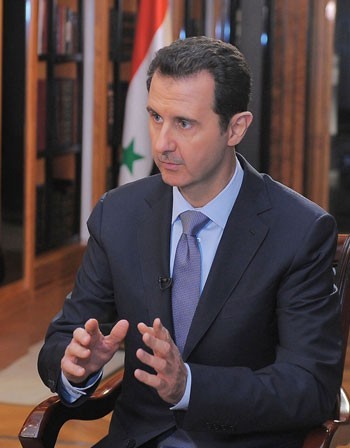 Damascus – President Bashar al-Assad gave an interview to Agence France Presse. Following is the full text of the interview:
Mr. President, what do you expect from the Geneva conference?
President Assad: The most basic element, which we continuously refer to, is that the Geneva Conference should produce clear results with regard to the fight against terrorism in Syria. In particular, it needs to put pressure on countries that are exporting terrorism, – by sending terrorists, money and weapons to terrorist organisations, – especially Saudi Arabia and Turkey, and of course the Western countries that provide political cover for these terrorist organisations. This is the most important decision or result that the Geneva Conference could produce. Any political solution that is reached without fighting terrorism has no value. There can be no political action when there is terrorism everywhere, not only in Syria but in neighbouring countries as well. From the political side, it is possible for Geneva to contribute to a process of dialogue between Syrians. There has to be a Syrian process within Syria and whilst Geneva could support this, it cannot be a substitute for it.
AFP: After nearly three years of devastating war and the big challenge of reconstruction in the country, is it likely that you will not be a candidate for the presidency?
President Assad: This depends on two things: It depends on personal aspirations or a personal decision, on the one hand, and on public opinion in Syria, on the other. As far as I am concerned, I see no reason why I shouldn’t stand; as for Syrian public opinion, there is still around four months before the election date is announced. If in that time, there is public desire and a public opinion in favour of my candidacy, I will not hesitate for a second to run for election. In short, we can say that the chances for my candidacy are significant.
AFP: In these past years, have you thought for a moment about losing the battle, and have you thought of an alternative scenario for you and your family?
President Assad: In any battle, there is always the possibility of winning and losing; but when you’re defending your country, it’s obvious that the only choice is to win. Should Syria lose this battle that would mean the spread of chaos throughout the Middle East. This battle is not confined to Syria and is not, as Western propaganda portrays, a popular uprising against a regime suppressing its people and a revolution calling for democracy and freedom. These lies have now become clear to people. A popular revolution doesn’t last for three years only to fail; moreover, a national revolution cannot have a foreign agenda. As for the scenarios that I have considered, of course these types of battles will have numerous scenarios – 1st, 2nd, 3rd……tenth, but they are all focused on defending the country not on running away from it. Fleeing is not an option in these circumstances. I must be at the forefront of those defending this country and this has been the case from day one.
AFP: Do you think you are winning this war?
President Assad: This war is not mine to win; it’s our war as Syrians. I think this war has, if you will, two phases. The first phase, which took the form of plans drawn up at the beginning, was the overthrow of the Syrian state in a matter of weeks or months. Now, three years on, we can safely say that this has failed, and that the Syrian people have won. There were countries that not only wanted to overthrow the state, but that also wanted to partition the country into several ‘mini-states;’ of course this phase failed, and hence the win for the Syrian people. The other phase of the battle is the fight against terrorism, which we are living on a daily basis. As you know, this phase isn’t over yet, so we can’t talk about having won before we eliminate the terrorists. What we can say is that we are making progress and moving forward. This doesn’t mean that victory is near at hand; these kinds of battles are complicated, difficult and they need a lot of time. However, as I said, and I reiterate, we are making progress, but have not yet achieved a victory.
AFP: Returning to Geneva, do you support a call from the conference for all foreign fighters to leave Syria, including Hezbollah?
President Assad: Clearly the job of defending Syria is responsibility of the Syrian people, the Syrian institutions, and in particular the Syrian Army. So, there would be no reason for any non-Syrian fighters to get involved had there not been foreign fighters from dozens of countries attacking civilians and Hezbollah especially on the Syrian-Lebanese border. When we talk about fighters leaving Syria, this would need to be part of a larger package that would see all the foreign fighters leave, and for all armed men – including Syrians – to hand over their weapons to the Syrian state, which would consequently achieve stability. So naturally, yes, one element of the solution in Syria – I wouldn’t say the objective – is for all non-Syrian fighters to leave Syria.
AFP: In addition to the prisoner exchange and a ceasefire in Aleppo, what initiatives are you ready to present at Geneva II?
President Assad: The Syrian initiative was put forward exactly a year ago, in January of last year. It’s a complete initiative that covers both political and security aspects and other dimensions that would lead to stability. All of these details are part of the initiative that Syria previously put forward. However, any initiative, whether this one or any other, must be the result of a dialogue between Syrians. The essence of anything that is proposed, whether it’s the crisis itself, fighting terrorism, or the future political vision and political system for Syria, requires the approval of Syrians. Our initiative was based on a process to facilitate this dialogue rather than a process to express the government’s point of view. It has always been our view that any initiative must be collective and produced by both the political actors in Syria and the Syrian people in general.
AFP: The opposition that will participate in Geneva is divided and many factions on the ground don’t believe it represents them. If an agreement is reached, how can it be implemented on the ground?
President Assad: This is the same question that we are asking as a government: when I negotiate, who am I negotiating with? There are expected to be many sides at Geneva, we don’t know yet who will come, but there will be various parties, including the Syrian government. It is clear to everyone that some of the groups, which might attend the conference, didn’t exist until very recently; in fact they were created during the crisis by foreign intelligence agencies whether in Qatar, Saudi Arabia, France, the United States or other countries. So when we sit down with these groups, we are in fact negotiating with those countries. So, is it logical that France should be a part of the Syrian solution? Or Qatar, or America, or Saudi Arabia, or Turkey? This doesn’t make any sense. Therefore, when we negotiate with these parties, we’re in fact negotiating with the countries that are behind them and that support terrorism in Syria. There are other opposition forces in Syria that have a national agenda; these are parties that we can negotiate with. On the issue of the vision for Syria’s future, we are open for these parties to participate in governing the Syrian state, in the government and in other institutions. But as I mentioned earlier, anything that is agreed with any party, whether in Geneva or in Syria, must be subject to people’s endorsement, through a referendum put to Syrian citizens.
AFP: In this context, could the ceasefire agreements that have been started in Moadimiya and Barzeh be an alternative to Geneva?
President Assad: The truth is that these initiatives may be more important than Geneva, because the majority of those fighting and carrying out terrorist operations on the ground have no political agenda. Some of them have become professional armed robbers, and others, as you know, are takfiri organisations fighting for an extremist Islamic emirate and things of that kind. Geneva means nothing for these groups. For this reason, the direct action and the models that have been achieved in Moadamiyeh, in Barzeh and other places in Syria has proven to be very effective. But this is separate from the political process, which is about the political future of Syria. These reconciliations have helped stability and have eased the bloodshed in Syria, both of which help pave the way for the political dialogue I mentioned earlier.
AFP: Are you prepared to have a prime minister from the opposition in a future government?
President Assad: That depends on who this opposition represents. When it represents a majority, let’s say in parliament, naturally it should lead the government. But to appoint a prime minister from the opposition without having a majority doesn’t make any political sense in any country in the world. In your country, for example, or in Britain or elsewhere, you can’t have a prime minister from a parliamentary minority. This will all depend on the next elections, which we discussed in the Syrian initiative; they will reveal the real size of support for the various opposition forces. As to participation as a principle, we support it, of course it is a good thing.
AFP: Are you prepared to have, for example, Ahmed Jarba or Moaz Khatib, be your next prime minister?
President Assad: This takes us back to the previous question. Do any of these people represent the Syrian people, or even a portion of the Syrian people? Do they even represent themselves, or are they just representatives of the states that created them? This brings us back to what I mentioned earlier: every one of these groups represents the country that created them. The participation of each of these individuals means the participation of each of those states in the Syrian government! This is the first point. Second, let’s assume that we agreed to the participation of these individuals in the government. Do you think that they would dare to come to Syria to take part in the government? Of course they wouldn’t. Last year, they claimed that they had control of 70% of Syria, yet they didn’t even dare to come to the areas that they had supposed control of. They did come to the border for a 30-minute photo opportunity and then they fled. How can they be ministers in the government? Can a foreigner become a Syrian minister? That’s why these propositions are totally unrealistic, but they do make a good joke!
AFP: Mr. President, you said that it depends on the results of the elections, but how can you hold these kinds of elections if part of Syria’s territory is in the hands of insurgents?
President Assad: During this crisis, and after the unrest started in Syria, we have conducted elections twice: the first was municipal elections and the second was parliamentary elections. Of course, the elections cannot be conducted in the same way they are conducted in normal circumstances, but the roads between Syrian regions are open, and people area able to move freely between different regions. Those who live in difficult areas can go to neighbouring areas and participate in the elections. There will be difficulties, but it is not an impossible process.
AFP: Now that opposition fighters are battling jihadists, do you see any difference between the two?
President Assad: The answer I would have given you at the beginning of the events or during its various phases, is completely different to the answer today. Today, there are no longer two opposition groups. We all know that during the past few months the extremist terrorist groups fighting in Syria have wiped out the last remaining positions that were held by the forces the West portrays as moderates, calling them the moderate or secular forces, or the Free Syrian Army. These forces no longer exist. We are now dealing with one extremist group made up of various factions. As to the fighters that used to belong to what the West calls ‘moderate forces,’ these have mostly joined these extremist factions, either for fear or voluntarily through financial incentives. In short, regardless of the labels you read in the Western media, we are now fighting one extremist terrorist group comprising of various factions.
AFP: Would it be possible for the army and the opposition to fight against the jihadists side by side?
President Assad: We cooperate with any party that wants to join the army in fighting terrorists, and this has happened before. There are many militants who have left these organisations and joined the army to fight with it. So this is possible, but these are individual cases. This is not an alliance between ‘moderate’ forces and the army against terrorists. That depiction is false and is an illusion that is used by the West only to justify its support for terrorism in Syria. It supports terrorism under the pretext that it is backing moderation against extremist terrorism, and that is both illogical and false.
AFP: The state accuses the rebels of using civilians as human shields in areas under their control, but when the army shells these areas, do you not think this kills innocent people?
President Assad: The army does not shell neighbourhoods. The army strikes areas where there are terrorists. In most cases, terrorists enter particular areas and force out the civilians. Why do you think we have so many displaced people? Most of the millions of displaced people in Syria have fled their homes because terrorists forcefully entered their neighbourhoods. If there are civilians among these armed groups, why do we have so many displaced people? The army is fighting armed terrorists, and in some cases, terrorists have used civilians as human shields. Civilian casualties are unfortunately the consequences of any war. There is no such thing as a clean war in which there are no innocent civilian victims. This is the unfortunate nature of war, and that is why the only solution is to put an end to it.
AFP: Mr. President, some international organisations have accused the government and the opposition of committing abuses. After this war ends, would you be ready for there to be an investigation into these abuses?
President Assad: There is no logic to this claim made by these organisations. How can the Syrian state be killing its own people, and yet it is still standing three years on, despite the fact that there are dozens of countries working against it. Had the Syrian state been killing its people, they would have revolted against it long ago. Such a state could not survive for more than a few months; the fact that it has resisted for three years means that it has popular support. Such talk is more than illogical: it is unnatural. What these organizations are saying is either a reflection of their ignorance of the situation in Syria, or, in some cases, it shows they are following the political agenda of particular states. The Syrian state has always defended its civilians; it is well documented, through all the videos and the photos circulating, that it is the terrorists who are committing massacres and killing civilians everywhere. From the beginning of this crisis, up until today, these organizations do not have a single document to prove that the Syrian government has committed a massacre against civilians anywhere.
AFP: Mr. President, we know of foreign journalists who were kidnapped by the terrorist groups. Are there any foreign journalists in state prisons?
President Assad: It would be best for you to ask the relevant, specialised agencies on this issue. They would be able to give you an answer.
AFP: Would a reconciliation be possible, one day, between Syria on the one hand, and Saudi Arabia, Qatar and Turkey on the other?
President Assad: Politics changes constantly, but this change depends on two factors: principles and interests. We share no common principles with the states you mention; these states support terrorism and they have contributed to the bloodshed in Syria. As for interests, we need to ask ourselves: will the Syrian people agree to shared interests with these countries after everything that has happened and all the bloodshed in Syria? I don’t want to answer on behalf of the Syrian people. If the people believe they share interests with these states, and if these states change their policy on supporting terrorism, it is plausible that the Syrian people might agree to restore relations. I can’t individually as President, answer on behalf of all the Syrian people at such a time. This is a decision for the people.
AFP: Mr. President, you were welcomed on the occasion of July 14 (Bastille Day) in the Elysee Palace in Paris. Are you now surprised by France’s position, and do you think France may one day play some kind of role in Syria?
President Assad: No, I am not surprised, because when that reception took place, it was during the period – 2008 to 2011 – where there was an attempt to contain Syria’s role and Syria’s policy. France was charged with this role by the United States when Sarkozy became president. There was an agreement between France and the Bush administration over this, since France is an old friend of the Arabs and of Syria and as such it is better suited to play the role. The requirement at that time was to use Syria against Iran and Hezbollah, and to pull it away from supporting resistance organisations in the region. This French policy failed, because its goal was blatantly obvious. Then the so-called Arab Spring began, and France turned against Syria after it had failed to honour the pledge it had made to the United States. This is the reason behind the French position during that period why it changed in 2011.
As for France’s role in future, let’s talk frankly. Ever since 2001 and the terrorist attacks on New York, there has been no European policy-making to speak of (and that’s if we don’t look back even further to the 1990s). In the West, there is only an American policy, which is implemented by some European countries. This has been the case on all the issues in our region in the past decade.
Today, we see the same thing: either European policy is formulated with American blessing, or American policy is adopted by the Europeans as their own. So, I don’t believe that Europe, and particularly France, which used to lead the European policy in the past, is capable of playing any role in the future of Syria, or in neighbouring countries. There is another reason too, and that is that Western officials have lost their credibility. They no longer have double standards; they have triple and quadruple standards. They have all kinds of standards for every political situation. They have lost their credibility; they have sold their principles in return for interests, and therefore it is impossible to build a consistent policy with them. Tomorrow, they might do the exact opposite of what they are doing today. Because of this, I don’t think that France will play a role in the immediate future, unless it changes its policy completely and from its core and returns to the politically independent state it once was.
AFP: How long do you think Syria needs to rid itself completely of its chemical weapons stockpiles?
President Assad: This depends on the extent to which the Organisation for the Prohibition of Chemical Weapons (OPCW) will provide Syria with the necessary equipment to carry out the process. So far, the process of making this equipment available has been quite slow. On the other hand, as you know dismantling and neutralizing the chemical materials is not taking place inside Syria nor by the Syrian state. A number of countries in different parts of the world have accepted to carry out that process; some have agreed to deal with the less dangerous materials, whilst others have refused completely. Since, the time-frame is dependent on these two factors – the role of the OPCW and the countries that accept to neutralize the materials on their territories – it is not for Syria to determine a time-frame on this issue. Syria has honoured its part by preparing and collecting data and providing access to inspectors who verified this data and inspected the chemical agents. The rest, as I said, is up to the other parties.
AFP: Mr. President, what has changed in your and your family’s daily, personal lives? Do your children understand what has happened? Do you talk to them about this?
President Assad: There are a few things that haven’t changed. I go to work as usual, and we live in the same house as before, and the children go to school; these things haven’t changed. On the other hand, there are things which have affected every Syrian household, including mine: the sadness which lives with us every day – all the time, because of what we see and experience, because of the pain, because of the fallen victims everywhere and the destruction of the infrastructure and the economy. This has affected every family in Syria, including my own. There is no doubt that children are affected more deeply than adults in these circumstances. This generation will probably grow up too early and mature much faster as a result of the crisis. There are questions put to you by children about the causes of what’s happening, that you don’t usually deal with in normal circumstances. Why are there such evil people? Why are there victims? It’s not easy to explain these things to children, but they remain persistent daily questions and a subject of discussion in every family, including my own.
AFP: Through these years, what was the most difficult situation you went through?
President Assad: It’s not necessarily a particular situation but rather group of elements. There are several things that were hard to come to terms with, and they are still difficult. The first, I believe, is terrorism; the degree of savagery and inhumanity that the terrorists have reached reminds us of what happened in the Middle Ages in Europe over 500 years ago. In more recent modern times, it reminds us of the massacres perpetrated by the Ottomans against the Armenians when they killed a million and a half Armenians and half a million Orthodox Syriacs in Syria and in Turkish territory. The other aspect that is difficult to understand is the extent of Western officials’ superficiality in their failure to understand what happened in this region, and their subsequent inability to have a vision for the present or for the future. They are always very late in realizing things, sometimes even after the situation has been overtaken by a new reality that is completely different. The third thing that is difficult to understand is the extent of influence of petrodollars in changing roles on the international arena. For instance, how Qatar was transformed from a marginal state to a powerful one, while France has become a proxy state implementing Qatari policies. This is also what we see happening now between France and Saudi Arabia. How can petrodollars make western officials, particularly in France, sell their principles and sell the principles of the French Revolution in return for a few billion dollars? These are only a few things, among others, which are difficult for one to understand and accept.
AFP: The trial of those accused of the assassination of former Lebanese Prime Minister Rafic Hariri has begun. Do you think it will be a fair trial?
President Assad: Nine years have passed since the beginning of this trial. Has justice been served? Every accusation was made for political reasons. Even in the past few days, we have not seen any tangible proof put forward against the parties involved in the case. The real question should be: why the timing? Why now? This court was set up nine years ago. Have the things produced in the last few days been uncovered only now? I believe that the whole thing is politicized and is intended to put pressure on Hezbollah in Lebanon in the same way that it aimed at putting pressure on Syria in the beginning, immediately after al-Hariri’s assassination.
AFP: You have said the war will end when terrorism is eradicated. But the Syrians and everyone else want to know when this war will end. Within months? After a year? In years to come?
President Assad: We hope that the Geneva conference will be able to provide an answer to part of this by exercising pressure on these countries. This aspect has nothing to do with Syria; otherwise we would have put pressure on these states from the beginning and prevented terrorism from entering Syria. From our side, when this terrorism stops coming in, ending the war will not take more than a few months.
AFP: It appears Western intelligence agencies want to re-open channels of communication with Damascus, in order to ask you for help fighting terrorism. Are you ready for that?
President Assad: There have been meetings with several intelligence agencies from a number of countries. Our response has been that security cooperation cannot be separated from political cooperation, and political cooperation cannot be achieved while these states adopt anti-Syrian policies. This was our answer, brief and clear.
AFP: You have said in the past that the state has made mistakes. In your view, what were the mistakes that could have been avoided?
President Assad: I have said that mistakes can be made in any situation. I did not specify what those mistakes were because this cannot be done objectively until the crisis is behind us and we can assess our experience. Evaluating them whilst we are in the middle of the crisis will only yield limited results.
AFP: Mr. President, without Russia, China and Iran’s help, would you have been able to resist in the face of the wars declared against you?
President Assad: This is a hypothetical question, which I cannot answer, because we haven’t experienced the alternative. Reality has shown that Russian, Chinese and Iranian support has been important and has contributed to Syria’s steadfastness. Without this support, things probably would have been much more difficult. How? It is difficult to draw a hypothetical picture at this stage.
AFP: After all that has happened, can you imagine another president rebuilding Syria?
President Assad: If this is what the Syrian people want, I don’t have a problem with it. I am not the kind of person who clings to power. In any case, should the Syrian people not want me to be president, obviously there will be somebody else. I don’t have a personal problem with this issue.
Thank you very much Mr. President.
Turkey signs law ‘criminalizing’ medical first aid without govt permit
RT | January 19, 2014
A medical bill has been signed into law in Turkey that requires doctors to obtain government permission before administering emergency first aid. Critics have blasted the bill as a crackdown on doctors who treat activists injured during protests.
The bill, which was drawn up by the ruling Justice and Development Party (AKP), punishes health care professionals with up to three years in prison or a fine of almost $1 million if they administer emergency first aid without government authorization.
It also bans doctors from practicing outside state medical institutions and aims to stop them from opening private clinics.
President Abdullah Gul signed the legislation into law Friday. It has prompted a flurry of accusations from rights groups, condemning it as an attempt to criminalize emergency health care and deter doctors from treating protesters.
The US-based Physicians for Human Rights (PHR) attacked the legislation as an attempt to quash dissent in Turkey, following last year’s violent protests.
“Passing a bill that criminalizes emergency care and punishes those who care for injured protesters is part of the Turkish government’s relentless effort to silence any opposing voices,” PHR senior medical adviser Vincent Iacopino said in a statement on the PHR website.
Describing the bill as “repugnant,” Iacopino said the legislation not only puts everyone’s health at risk, but also conflicts with the Turkish constitution and “must be blocked through Turkey’s constitutional court.”
The PHR says the bill will also put the medical community at odds with their ethical and professional responsibility to care for the sick and wounded.
The UN has implored the Turkish government to rethink the bill because it will have “chilling effect on the availability and accessibility of emergency medical care in a country prone to natural disasters and a democracy that is not immune from demonstrations.”
In last year’s wave of protests against Prime Minister Tayyip Erdogan, six people were killed and over 8,000 were injured across the country.
The government was accused of cracking down on medical professionals when the Turkish Health Ministry launched a probe into those doctors treating protesters in June. They asked the Turkish Medical Association (TBB) to hand over the names of the doctors and their patients.
“Recently we were inspected by the Ministry of Health, they said what we were doing here is wrong. But there could be no punishment for those who are helping people. There is no such religion or law that could discriminate against us,” Abtullah Cengiz, spokesman for the Gezi Park doctors, told RT in June.
Turkish police fire water cannon at rally against ‘Internet censorship’ law
RT | January 18, 2014
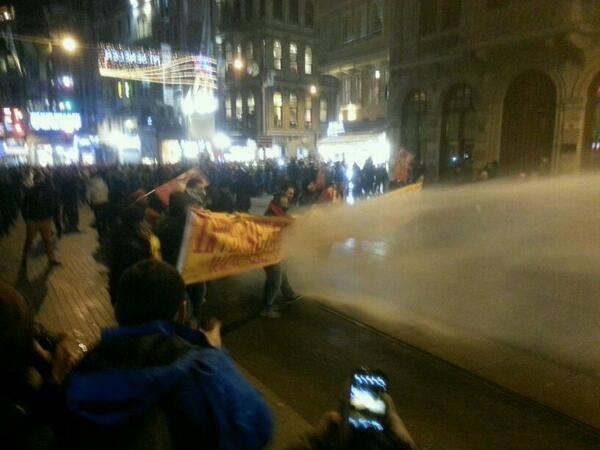
Police used water cannon and fired teargas to disperse hundreds of protesters that gathered in Istanbul’s central Taksim Square on Saturday for a rally calling against a bill that would tighten government control over the Internet.
Protesters ran to the side streets to escape the water cannons and teargas that police used on the peaceful demonstration.
Smaller rallies have been held around Turkey including the capital Ankara and coastal city of Izmir.
In Ankara about 300 protesters gathered chanting slogans opposing the government and the internet bill, calling the Turkish prime minister ‘a dictator.’
Activists have called for protests against the law further limiting the use of the Internet and social media. The campaign is circulating the internet with the hashtag #sansüredurde (#StopInternetCensorshipinTurkey).
The bill that includes the controversial law was adopted on Thursday. It gives the courts power to remove material that “violates individual rights” from the internet. People will be able to apply to the state Telecommunications Directorate (TIB) as well as the courts to block any websites.
Under the new law 26 government officials in Turkey can also block access to information online by a personal decree. These include the Prime Minister Recep Tayyip Erdoğan, his cabinet and other officials.
Critics argued that the law will enhance monitoring internet user’s activities and will allow officials to limit keywords, local Hurriyet daily reported. The newspaper added that the head of TİB will now be given enough authority to directly limit access, pending a court ruling.
Related article
Turkey slaps 36 protesters with terrorist charges
Press TV – January 3, 2014
Prosecutors in Turkey have charged 36 people with terrorism in connection with massive anti-government protests that rocked the country last year.
According to the indictment published on Friday, the suspects face a range of charges including membership in a terrorist organization, illegal possession of hazardous material, and terrorist propaganda.
“Protests that began in May went beyond a democratic reaction and turned into propaganda and demonstration outlets of terrorist organizations with the guidance of marginal groups,” read the document.
“As a result, public property was destroyed, civil servants were incapacitated and security forces were injured,” it added.
The defendants will face up to 58 years in prison if convicted.
In December 2013, more than 250 other protesters were indicted with similar charges.
Anti-government demonstrations erupted in late May 2013, when people in Istanbul protested against the planned destruction of Gezi Park, in the city’s Taksim Square.
However, the protests soon spread across the country and snowballed into a nationwide outburst of anger against Prime Minister Recep Tayyip Erdogan’s rule.
Greece intercepts mystery ship with 20,000 Kalashnikovs on board
RT | November 10, 2013
The Greek Coastguard has intercepted a Sierra Leone-flagged cargo ship with around 20,000 Kalashnikov assault rifles on board. The intended destination of the vessel, halted near the Imia islets in the eastern Aegean, remains unknown.
The cargo ship Nour M, intercepted on Thursday night, was taken to the island of Symi the following morning under the escort of Coastguard vessels, where it was soon thereafter led to the island of Rhodes.
The vessel’s Turkish captain and seven crew members, two of whom were Turkish and five of whom were Indian, were placed under arrest, coastguard sources told the Athens-Macedonian News Agency (ANA-MPA).
The cargo was both larger than that declared on the ship’s manifest, and the ship did not have the proper UN documents to deliver cargo to a conflict zone. The Greek Coastguard issued a statement saying attempts to catalogue the firearms and munitions on board were ongoing.
“The exact destination of the arms and ammunition has yet to be verified,” the coastguard statement read. Apart from the large quantity of firearms, the ship was also allegedly carrying a “large” quantity of explosives. A probe determined the ship had previously been used for drug trafficking.
Sources told ANA-MPA that the vessel had set sail from Ukraine, although the ship’s final destination remains unclear. Although the ports of Tartus in Syria and Tripoli in Libya had both been declared as destination ports to marine traffic systems, the Turkish Mediterranean port city of Iskenderun was declared as the destination port by the ship’s captain.
Ukraine’s Foreign Ministry said they are attempting to determine if the Nour departed from the country.
Maritime expert Mikhail Voitenko told Ukraine’s Vesti that the ship likely picked up its cargo in Istanbul.
“I think it was there for no other purpose than to get the weapons. It is also strange that it took the ship two weeks to get from Nikolaev [Ukraine] to Greece when the trip takes a maximum of five days. What it was doing and where it was doing it at the time: that is the question.”
Voitenko said the vessel was likely detained as the result of a tip-off.
“That we have this ship sailing through the Black Sea is strange, but through Greek [territorial] waters it went in a straight line, so police had no reason to detain the ship,” he said.
Turkish patrol seizes over a ton of chemicals from smugglers attempting to enter Syria
RT | November 4, 2013
Turkish border guards seized three vehicles loaded with over 1,000 kg of chemicals as they tried to illegally cross the border into Syria. One of the smugglers was arrested, while others managed to escape.
The Turkish General Staff reported that the chemicals were seized after a convoy of three vehicles refused to stop and attempted to illegally cross the border near the southeastern Turkish town of Reyhanli on Saturday.
Paramilitary police were ordered to shoot out the tires of the vehicles to stop them. As the tires caught on fire, the three drivers jumped out and fled in the direction of Syria. One of them was arrested.
The vehicles contained 20 bags of sulphur, weighing about 50 kg each, and eight sealed barrels. Their contents were not immediately known.
Republican People’s Party (CHP) chairman Faruk Logoglu said in a statement on Monday that the barrels are suspected to contain chemical material. “Traffic was from Turkey to Syria,” he added.
The arrested suspect’s nationality has not been made public. He was taken into custody after interrogation by the Reyhanli district gendarmerie headquarters and is to be sent to the prosecutor’s office.
Chemical, biological, radiological, and nuclear defense (CBRN) units from the Disaster and Emergency Management Presidency have started examining the seized material, Logoglu’s statement said.
The Republican People’s Party has also criticized the release of a primary suspect in a similar case, saying that closing the investigation would be “a shame for Turkey,” Hurriyet newspaper reported, citing CHP’s deputy.
In May 2013, Turkish police seized a group of people after being informed that Syrian rebel groups were looking to obtain materials that could be used to produce chemical weapons.
A two -kilogram cylinder with what initially was suggested to be sarin gas was seized while searching the homes of Syrian militants from the Al-Qaeda-linked Jabhat al-Nusra Front following their detention.
Some of the suspects accused of establishing a connection with a network in Turkey to convey chemical materials were released after lab tests proved that the seized chemicals were not sarin gas.
The alleged use of sarin – considered one of the world’s most dangerous chemical warfare agents – in a Damascus suburb on August 21 provoked an international outcry which nearly led to a US military strike against the Syrian regime, as Western countries assumed it was the Assad government who used the chemical weapons.
However, while a UN investigation proved that sarin was used near Damascus, it did not say who was behind the attack. At the same time, Russia also analyzed samples taken in the Syrian town of Aleppo, where chemical weapons were allegedly used in March. Experts concluded that rebels – not the army – were behind the Aleppo sarin attack.
In September, Syria agreed to comply with Moscow’s offer to put its chemical weapons under international control for subsequent destruction, in order to avert a possible military strike. Damascus declared the possession of 1,300 tons of chemicals and precursors needed for chemical weapons production, as well as over 1,200 empty chemical munitions.
On Thursday, the Organisation for the Prohibition of Chemical Weapons (OPCW) said that Syria’s entire declared stock of chemical weapons has been placed under seal.
The organization acknowledged that Damascus has complied with the watchdog’s requirement, adopted on September 27, for the complete elimination of chemical weapons and production units in Syria before November 1.
The process of eliminating Syria’s chemical weapons stocks has a target finish date of mid-2014.
Russian-Turkish talks on Syrian crisis to be held at the end of next month
MEMO | October 22, 2013
The Turkish newspaper, Hurriyet, reported that Turkish Prime Minister, Recep Tayyip Erdogan, will meet Russian President, Vladimir Putin, in Moscow at the end of November, when discussions will focus on the Syrian crisis.
Hurriyet noted that Erdogan will visit the Russian capital where he will head a delegation of a large number of ministers and will preside over the meeting of the joint ministerial committee of the Turkish-Russian Cooperation Council during 21st to the 22nd November. The meeting will discuss several political, trade and investment issues between the two countries.
Deputy Russian foreign minister, Alexei Meshkv, said that the two sides will address several regional and international issues of mutual interest and will discuss ways to develop bilateral relations. In an exclusive interview with the Turkish newspaper Meshkov asserted that Russian-Turkish relations are evolving in several areas, especially in the energy field. The two sides are also cooperating on the construction of the Mersin Nuclear Power and the South Stream natural gas pipeline project, which will pass through the Black Sea.
Featured Video
Deep Dive Intel Briefing 6/20/2026 Lt Col Daniel Davis
or go to
Aletho News Archives – Video-Images
From the Archives
As Hillary Clinton kisses up to Henry Kissinger, RT looks at 4 of his most heinous acts
RT | September 3, 2016
… While Clinton retains the ultimate warmongering seal, RT examines some of Kissinger’s most memorable acts… Read full article
Blog Roll
 Aletho News
- UK Speech Regulator’s Telegram Questions Point Toward Private Chats
- Cuban FM blasts Rubio for ‘chronically lying’ about US fuel blockade
- Al-Jazeera demands punishment for Israeli officials following latest assassination of cameraman
- Iran opens hundreds of legal cases over US, Israeli aggression: Prosecutor general
- Iran delegation protests Trump’s threat at Switzerland talks, weighs ‘proper’ response: Source
- Terms of US capitulation to Iran presage new era for the region
- Strategic Oil Reserve Nears Collapse… US Must Choose: Guns or Butter
- The Story the Media — and the Government — Don’t Want You to Hear
- Deep Dive Intel Briefing 6/20/2026 Lt Col Daniel Davis
- The Targeted Assassination of Studies Showing Vaccines Cause Injury
- If Americans Knew
- JNS Policy Summit to kick off in Israel
- Fatalities From Israel’s Vast Gaza Genocide Deliberately Undercounted
- ‘Reproductive genocide’ in Gaza; death toll in Lebanon tops 4,000 (during a ceasefire) – Daily Update
- Israelis Invaded Lebanon And Then Cried Victim When Their Soldiers Got Killed
- FARA Docs: Israel is Spying On Millions Of Christian Americans In Their Churches
- Why US presidents from both parties end up cursing Benjamin Netanyahu
- Israel Asked Facebook to Censor Iran War Content, Internal Documents Show
- Deaths in Gaza undercounted, possibly by 100s of thousands; “Psychopath” Ben-Gvir talks trash – Daily Update
- UNICEF: “Trauma is woven into the very fabric of childhood in Gaza”
- 15 articles a day: The extent of the Israeli army’s media interference
- No Tricks Zone
- THE TRANSCEIVER PARADOX: Why Organoid Intelligence (OI) Could Become Our Ultimate Alien Predator
- German Wind Turbines Face Regulatory Shutdown Due To Excessive Noise
- New Study: Chile’s Relative Sea Level Was 3.2 Meters Higher Than Today During The Mid-Holocene
- Beyond The Pitch: Why FIFA’s World Cup Is One Of Humanity’s Best Investments
- Climate Alarmists Now Using Natural Phenomena To Support Their Claims
- New Study: Significant CO2 Fluxes From Non-Volcanic Sources Are Largely Neglected In Carbon Budgets
- Women Climate Scientists Being Harassed, Insulted By Skeptics, Claims Berkeley Earth Researcher
- Germany’s Longterm Spring Climate Data Show “No Climate Trend”
- New Study: Solar Photovoltaic, Wind Power Fail To Meet Annual Energy Demands 62% Of The Time
- Germany’s Die Welt: “Too Much Is Too Much” … Green Energies Are Cannabalizing Each Other!
 Aletho News