Melting ice brings Chinese threat closer, warns Armed Forces chief
By Paul Homewood | Not A Lot Of People Know That | December 15, 2022

Melting ice caps will enable China’s military forces to “reach into the Atlantic”, the Chief of the Defence Staff has warned.
At an address on Wednesday, Admiral Sir Tony Radakin urged people to consider what effect climate change would have on the security of the nation.
In his annual Royal United Services Institute address, Sir Tony said: “We also need to consider the melting of the ice caps in the coming decades, which will: unleash a difficult new competition for minerals and resources; halve the time it takes for shipping to travel between Asia and Europe; and surely China’s military forces will start to reach into the Atlantic?”
The High North becoming more open and accessible due to melting ice caps has been worrying military figures for some time.
As the former first sea lord, Sir Tony previously warned that, as the transit time between Europe and Asia inevitably shortens, so too can the West expect to see China sailing its “growing navy” through the shorter route.
Chinese ships may be able to sail through the Northeast Passage for a couple of weeks weeks in summer, but would have a job getting back home again through two meter ice:
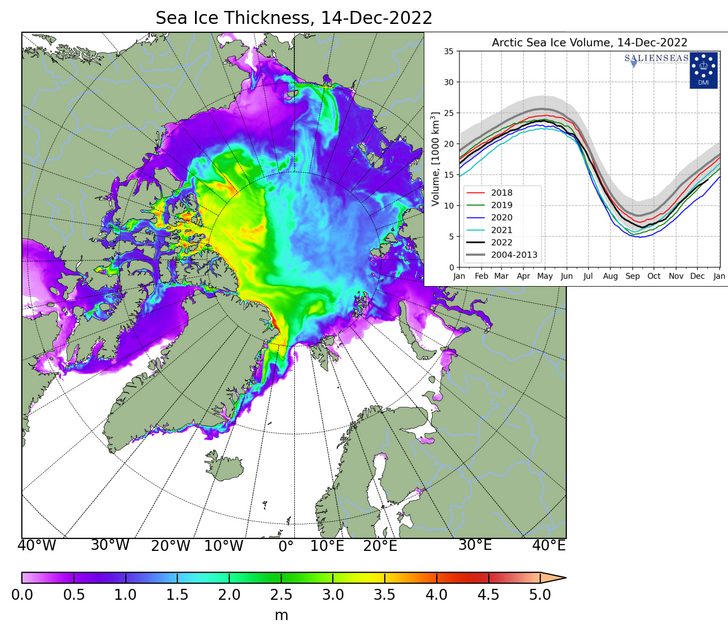
https://ocean.dmi.dk/arctic/icethickness/thk.uk.php
In fact this year the Passage was still blocked as late as mid August, and was blocked again by October.
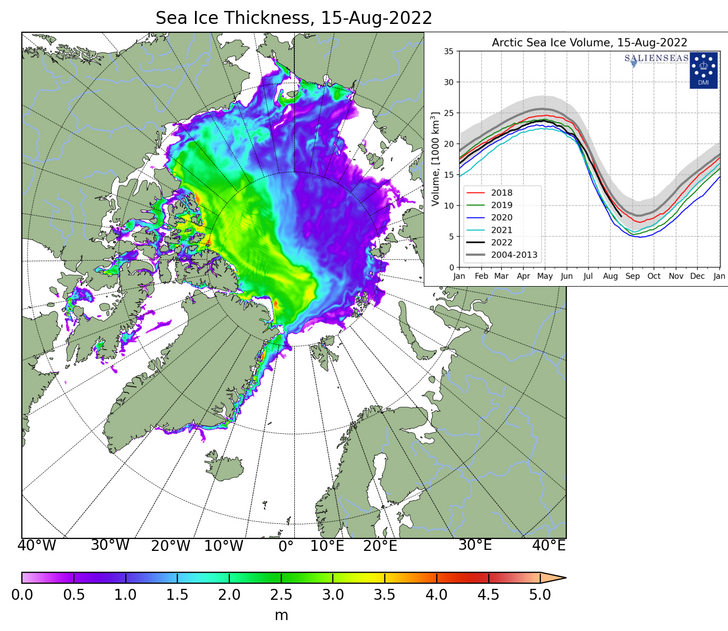
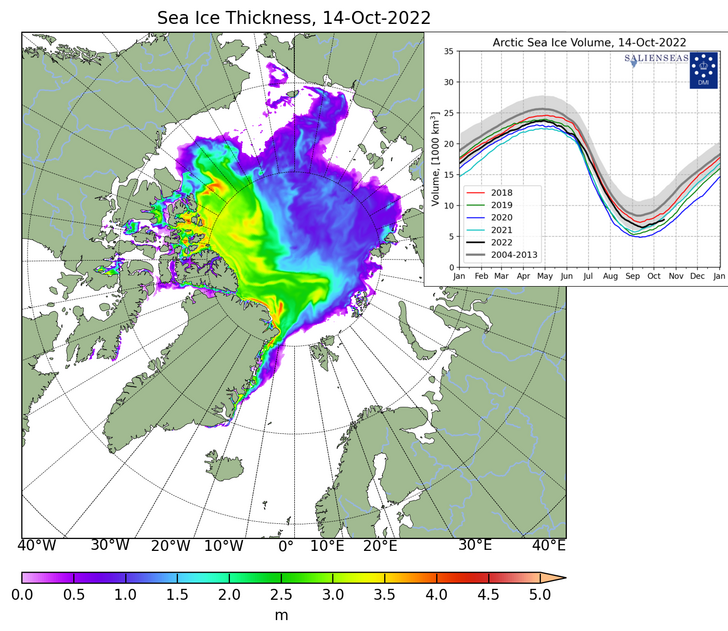
And none of this is going to change for one very good reason. By autumn the sun in the Arctic is already going down over the horizon. And without the sun, the sea quickly refreezes.
It is absurd to believe that China or any other country would send its navy out into the Arctic Ocean in these circumstances.
Which leads to the question why Tony Radakin is making a fool of himself. The only conclusion I can come to is that he is under orders to play the climate card, so as to scare the public.
US playing ‘dangerous game’ in Yemen, insists on aggression: Ansarullah
Press TV – December 14, 2022
Yemen’s popular resistance Ansarullah movement has warned against the United States’ military presence in the country, saying Washington is playing a “dangerous game” as it insists on pursuing a policy of aggression while impeding the national peace process.
Ali al-Qahoum, a member of Ansarullah’s Political Bureau, made the remarks during an exclusive interview with Lebanon’s al-Mayadeen television network on Tuesday night.
“The presence of US troops in the Bab al-Mandab and off the coast of Yemen poses a serious threat to maritime navigation,” he said, adding that it further proves Washington’s aggressive policy against the impoverished country.
He went on to say that Saudi Arabia’s war and blockade against Yemen over the past eight years has been fully coordinated by the US, noting that “Riyadh is nothing but a tool in the hands of Washington to execute its policy of aggression with the participation of Israel, the UK and France.”
The Ansarullah official further noted that “the US and UK’s tendencies to keep the conflict ongoing and impose more embargo on Yemen, demand the utmost national responsibility of enhancing steadfastness.”
“If the Americans insist on aggression and blockade, the response will be in a way that achieves the required effect and sufficient pressure on the aggressor, whoever it may be,” he added.
Al-Qahoum further stated that our message to the Saudi-led coalition is that “elusiveness, gaining time, changing tools, and all the aspects of aggression and conspiracies are unacceptable.”
“We tell the aggressor countries not to rely on time and not to count on the deceptiveness of the United Nations and the US envoys as the overall equation is changing and the reality is different,” he added.
He further pointed out that “the only guarantor for the return of the ceasefire is that the demands of the Yemeni people and their rights be respected, which will open the prospects for peace, and there is no way to achieve this through deception.”
The UN-brokered truce between the Saudi-led coalition and Yemen first came into effect in April and has been extended twice since.
In mid-October Yemeni Foreign Minister Hisham Sharaf said there would be no talks about the extension of the six-month truce which expired on October 2 unless the nation’s legitimate demands were fully met.
Saudi Arabia launched the devastating war on Yemen in March 2015. The objective was to reinstall the Riyadh-friendly regime of Abd Rabbuh Mansour Hadi and crush the popular Ansarullah resistance movement, which has been running state affairs in the absence of a functional government in Yemen.
While the Saudi-led coalition has failed to meet any of its objectives, the war has killed hundreds of thousands of Yemenis and spawned the world’s worst humanitarian crisis.
Washington and London have been providing the coalition with direct arms, logistical, and political support, including through outfitting it with precision-guided ammunition that the Saudi-led forces have been using amply against Yemen’s civilian population.
UK admits it sent troops to Ukraine
RT | December 13, 2022
British Royal Marines conducted high-risk operations in Ukraine in April, Lieutenant General Robert Magowan wrote in the force’s official journal. Before Magowan’s admission, Russia’s claims that NATO troops were active in Ukraine had been dismissed by Western analysts and media.
Members of 45 Commando Group of the Royal Marines left Ukraine in January after evacuating the British embassy in Kiev to Poland. However, some 300 members of the elite unit were sent back into the country in April to reestablish the British mission in Kiev, before going on to conduct “other discreet operations,” Magowan wrote in the force’s magazine, according to a report by The Times on Tuesday.
These operations took place “in a hugely sensitive environment and with a high level of political and military risk,” Magowan, who formerly served as commandant general of the Royal Marines and is now deputy chief of Defense Staff at the Ministry of Defense, stated.
While Magowan did not elaborate on what kind of missions the commandos carried out, his statement marks the first time that the UK has admitted its troops conducted special operations in Ukraine. The Ministry of Defense refused to confirm earlier accounts of British special forces training Ukrainian troops in Kiev in April.
Russian President Vladimir Putin has described the conflict in Ukraine as one between Russia and the “entire Western military machine,” and claimed in September that there are entire military units in Ukraine “under the de-facto command of Western advisers.”
Putin’s words were rejected by Western media outlets. “There is no evidence of NATO ground forces participating in Ukraine,” Edward Arnold of the Royal United Services Institute think tank told the BBC at the time. “Nor of NATO commanders directing Ukrainian units on the battlefield. There is also a very low likelihood of this happening in the future as Nato seeks to mitigate escalation risks.”
Magowan’s admission proves Arnold incorrect, but the UK is not the only NATO country to acknowledge the presence of its forces in Ukraine. An unnamed Pentagon official told reporters in October that an unspecified number of US troops were inspecting American arms shipments somewhere within Ukraine.
Moscow’s response to oil price cap revealed
RT | December 13, 2022
The Russian authorities have “generally agreed” on a response to a Western coalition’s price cap on the country’s seaborne oil that took effect last week, the newspaper Vedomosti reported on Tuesday.
Moscow will ban oil sales under contracts that specify a price cap, according to the report, which cites government sources. Also, exports will be banned to countries that demand the price cap as a condition in their supply contracts, or if their reference prices are fixed at the cap price level of $60 per barrel.
A decree describing the mechanism is currently being finalized by the president’s administration, sources said. It will take effect immediately upon being issued and will be valid until July 1, 2023, with the possibility of extension. On Monday, Kremlin spokesman Dmitry Peskov said the decree would be announced “in the next few days.”
The document will also reportedly contain a clause that allows buyers to bypass the restrictions if granted government approval. The measures will not apply to contracts that were concluded prior to December 5, the date when the price cap took effect. One of the sources said the final draft of the decree might include a provision on the marginal discount for Russian oil relative to international grades.
The price cap was introduced by the EU, G7 countries and Australia on December 5. The mechanism prohibits Western companies from providing shipping, insurance, and other services to tankers carrying Russian oil, unless the cargo is bought at or below the price limit.
UK government asked Twitter and Facebook to “tweak” algorithms during Covid
By Cindy Harper | Reclaim The Net | December 12, 2022
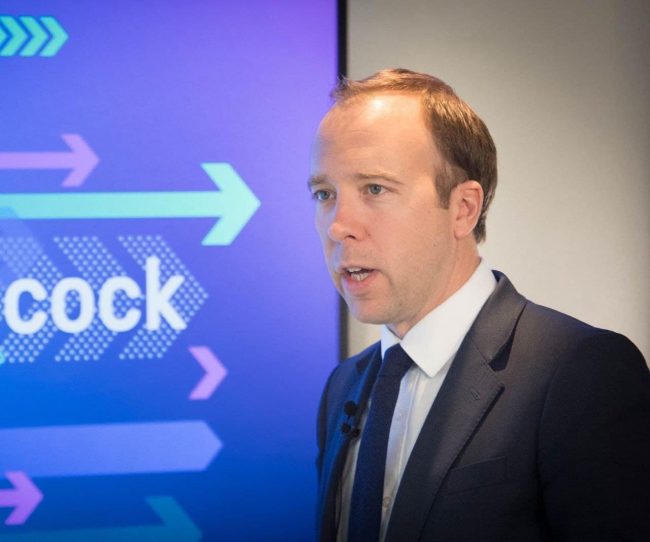
Former United Kingdom Health Secretary Matt Hancock, self-styled as an official who was at the forefront of Britain’s battle against Covid, didn’t seem to feel like he had done enough in 2020 and 2021, so he felt compelled to milk the pandemic cow by writing a book about that “battle.”
But he wasn’t laboring alone, since he had a co-author, Isabel Oakeshott, who reports say is actually opposed to Hancock’s policies and is a lockdown skeptic.
And now, Oakeshott, who had access to official records and Hancock’s notes exchanged with “all the key players in Britain’s Covid-19 story” – as the book’s blurb states – has penned her own “story,” an article based on the collaboration published by the Spectator, whose content draws from the material used for the book.
Oakeshott writes about the “key lessons” that include revelations about the details of UK’s vaccine and mask policies, but also the mechanisms to deal with dissenters, particularly online.
 According to the journalist, Hancock genuinely considered those who disagreed with him on how to handle the situation as “mad and dangerous” and more importantly, as persons that “needed to be shut down.”
Judging by the article, his “response” to online skepticism effectively came even before pandemic restrictions themselves. Hancock had no problem revealing that in January 2020, his special adviser was already in conversation with Twitter about the ways to “tweak” the platform’s algorithms.
Another social media giant was co-opted somewhat later, and by Hancock personally, when he got in touch with former British PM and politician Nick Clegg – now president for global affairs at Meta.
Clegg, who was at the time Facebook’s VP of global affairs and communications, was reportedly “happy to oblige.”
And according to Oakeshott, Hancock’s department together with the Cabinet Office (PM and government), “harnessed the full power of the state to crush individuals and groups whose views were seen as a threat to public acceptance of official messages and policy.”
The Cabinet Office enlisted the help of a unit that previously worked on stifling the influence of Islamic State (ISIS) to now deal with “anti-vaxxers,” she writes, and notes that the policy of zero tolerance did not spare doctors, scientists, and academics, such as those behind the Great Barrington Declaration.
Even then PM Boris Johnson was not as ardent a “dissent suppressor” as Hancock, Oakeshott’s writing suggests.
Russia categorically rejects UK foreign secretary’s claim of military deal with Iran
Press TV – December 12, 2022
The Russian embassy in London has roundly dismissed the “inappropriate statements” of British Foreign Secretary James Cleverly, who spuriously claimed Iran was sending armament and munitions to Russia for its military campaign in neighboring Ukraine.
“We categorically reject recent comments by Cleverly, who followed in the footsteps of US authorities and accused the Russian Federation and Iran of some ‘sordid’ deals concerning the Ukraine crisis. The United Kingdom is well aware of the fact that the allegations about Iran’s military supplies to Russia lack any factual basis,” the diplomatic mission said in a statement released on Monday.
“Russia, unlike certain Western governments, is invariably committed to compliance with national legislations as well as international principles as regards its cooperation with third countries,” it added.
The Russian embassy also emphasized that the top British diplomat should be reminded of London’s and its Western allies’ massive military, technical, financial and propaganda assistance to Ukraine when talking about “sordid” transactions between Moscow and Tehran.
The embassy underlined that supplying Ukraine with Western weapons, which is taking place in clear breach of fundamental norms of export control, only led to prolongation of hostilities and an increase in civilian casualties as Ukrainian army forces used the military equipment to launch “de-facto terrorist strikes against civilian targets” on Russian territory.
“We are carefully recording all cases of London’s and its Western allies’ financial and military supplies to the Kiev regime, as well as planned military operations against Russian facilities and military personnel. Such criminal acts will naturally have specific legal consequences for all those involved,” the statement said.
The embassy also drew attention to Cleverly’s “utterly unfounded speculations” that Tehran violated UN Security Council Resolution 2231, which endorses the 2015 Iran nuclear deal – officially known as the Joint Comprehensive Plan of Action (JCPOA).
“If London is really concerned about implementation of the resolution, British authorities should pay meticulous attention to its true violator, the United States, whose unilateral withdrawal from the nuclear deal [in May 2018] has created serious challenges for global security,” the statement added.
Earlier this month, Iranian Foreign Minister Hossein Amir-Abdollahian rejected claims about the Islamic Republic’s arms sales to Russia to be used in the ongoing war against Ukraine, saying such allegations are aimed at legitimizing the West’s military assistance to Kiev.
In a phone conversation with Secretary General of the United Nations Antonio Guterres on December 2, Amir-Abdollahian said the ongoing conflict between Russia and Ukraine is rooted in the wrong policies of the North Atlantic Treaty Organization (NATO), namely its expansion toward the east.
The top diplomat reiterated Iran’s opposition to the dispatch of weapons to the parties involved in the war which he said would only increase human losses and financial costs for both sides.
He said Tehran would continue its efforts to stop the war and promote lasting peace in Europe.
Both Iran and Russia have repeatedly denied claims that Tehran has provided Moscow with drones to be used in the war in Ukraine.
The anti-Iran claims first emerged in July, with US National Security Advisor Jake Sullivan alleging that Washington had received “information” indicating that the Islamic Republic was preparing to provide Russia with “up to several hundred drones, including weapons-capable UAVs on an expedited timeline” for use in the war.
What are these vaccines doing to the nation’s children and where is the benefit?
Latest approvals from MHRA

Health Advisory & Recovery Team | December 11, 2022
This week over one hundred health professionals wrote to the MHRA regarding Moderna’s application for a conditional marketing authorisation for Spikevax for babies from 6 months upwards. This baby dose has already been approved in the US and added to their routine immunisation schedule, thus removing any distinction between a novel technology gene-based vaccine rushed to market under the pretext of an ‘EMERGENCY’ and standard vaccines. Maintaining this distinction is vitally important, as there are still major unanswered questions about the long-term safety of mRNA products, which HART has discussed recently.
Meanwhile, in the UK, Pfizer’s Cominarty was quietly given full marketing authorisation for 5-11 and 12-adults, an event not announced by the MSM but instead ferreted out by the persistence of Sir Christopher Chope via a parliamentary question. The response to how the conditions had been met was chilling – basically, we’ve already given so many doses that we know it is ‘Safe & Effective’.
But most worrying of all is the fact that the MHRA have now given full authorisation to Pfizer’s 0-4s jab. They state that they have “authorised the vaccine in this new age group after it has been found to meet the UK regulator’s standards of safety, quality and effectiveness, with no new safety concerns identified. This decision has been endorsed by the Commission on Human Medicines, after a careful review of the evidence.” But the Pfizer trial for this age-group was a total shambles. They originally planned for 2 groups; one in which subjects received two 3mcg doses of the vaccine, and the other placebo. However, as with other trials, they very quickly went ahead and offered the vaccines to the placebo recipients. Thus by the time they realised this low dose was ineffective and they wanted to proceed to a third dose, they had to recruit more children to the placebo group in an attempt to create a valid comparator group. The report is thus very muddled and difficult to read.
The efficacy studies were based largely on so-called ‘immunobridging’ (essentially merely confirming that antibodies are created, without any need for testing clinically relevant endpoints). Even antibody testing, however, showed reduced titres against omicron variants (see table 18). In the only data that has been made public, clinical infections occurred after the third dose in only 10 of 1341 children whether active or placebo, nine of whom had been seronegative at trial entry, the 10th with unknown status (see p37). Thus, there were no clinical infections in children who already had naturally-acquired immunity. Moreover, “Seven cases in participants 2-4 years of age met the criteria for severe COVID-19: 6 in the BNT162b2 group, of which 2 cases occurred post unblinding, and 1 in the placebo group.”
(p38) This hardly suggests efficacy, and it could even represent antibody-dependent enhancement (ADE). Twelve children had multiple episodes: all were vaccinated. As for safety, “the median duration of blinded follow-up for participants 6-23 months of age after Dose 3 was 35 days”.
The most extraordinary quote (remember this has been licenced!) on page 59 is :
“The uncertainties associated with benefits of the Pfizer-BioNTech COVID-19 vaccine when used in children 6 months through 4 years of age include the following:
- Duration of vaccine effectiveness: the blinded, placebo-controlled evaluation period for descriptive efficacy analyses was limited, and waning of protection following a primary series has been observed in older age groups.
- Need for a booster dose: based on experience with adults, it is likely that a booster dose will be needed in addition to the three-dose primary series to increase robustness, breadth, and duration of protection
- Benefits in individuals previously infected with SARS-CoV-2: descriptive post-Dose 3 efficacy analyses do not include cases in previously infected participants
- Effectiveness in preventing post-acute sequelae of COVID-19: available data are not conclusive
- Future vaccine effectiveness as influenced by characteristics of the pandemic, including emergence of new variants
- Vaccine effectiveness against asymptomatic infection and transmission…Available data also do not indicate high-level or durable effectiveness against transmission.
So what exactly is the purpose of this vaccine? An email has been sent to all members of the JCVI to ask them exactly that.
“It is hard to believe how far we have come from your deliberations in July 2021 when you said the benefit risk balance was too close for a vaccine for healthy under 18s. We are now in a situation where 99% of preschoolers have been infected, omicron variants are clearly much milder, the vaccine efficacy is poor and more and more evidence is coming to light about potential harms.
On behalf of myself and the 100 plus health professionals who have signed this letter, I beseech all of you to read our letter with an open mind and ask yourselves if this is what is needed for the children of the UK.”
Read the full letter here and please share it widely.
An initial reply has been received
“Thank you for your email and the copy of the letter that you sent to MHRA.
Following the emergence of Omicron in November 2021, population immunity has increased markedly across many age groups. As you observe, the vast majority of children have now had experience of SARS-CoV-2 infection.
JCVI will be taking these factors into account in any advice provided in relation to children aged 6 months to 4 years.
Best wishes, JCVI Secretariat”
Will the JCVI for once do the right thing and refuse to endorse vaccination of infants and toddlers? And how does the statement above fit with the ongoing vaccination of any healthy children? Maybe the toddler here has the right idea and may even make you smile!
Peak Demands For Natural Gas
By Paul Homewood | Not A Lot Of People Know That | December 11, 2022
Natural gas accounts for 43% of the UK’s primary energy consumption. In comparison, renewable energy only supplies 4%.
Our reliance on gas though is much greater in winter months:

https://www.gov.uk/government/statistics/total-energy-section-1-energy-trends
And if you look at hour-by-hour data, the peaks are greater still, as the National Grid chart below shows:

https://mip-prd-web.azurewebsites.net/
This graph is for yesterday, Dec 10th. Demand for gas ramps up from around 310 mcm at night to 430 mcm in the early evening. One mcm = approximately 11 GWh.
So a rate of 430 mcm/day equates to 4730 GWh, or 197 GWh per hour.
While supply remains relatively constant, these peaks in demand are met by reducing what is known as the linepack – effectively the amount of gas within the gas distribution network. This, of course, is something that the electricity grid cannot do.
In comparison with the daily peaks and troughs of gas, electricity storage is miniscule. Pumped storage capacity is 2.8 GW, with the biggest, Dinorwig, rated at 1.7 GW with storage of 9.1 GWh. Battery storage is much tinier still.
Based on the decline in linepack, we would need about 70 mcm each day to top up at peak demand – that is 770 GWh.
In any event, all of the electricity storage we have will all be needed just to balance peaks in electricity demand.
Yet our policymakers continue down the road of electrification, seemingly oblivious to the realities.
HoHoHo… UK’s New Stealth War Machine to Warm Hearts of Poor and Freezing Britons
By Finian Cunningham | Strategic Culture Foundation | December 11, 2022
Poor and freezing Britons will no doubt be cheered by the BBC’s report that Britain is to build a new stealth fighter jet. How cozy to know the skies above are being protected while you and your children are huddled under dank blankets with ice on the inside of windows.
It’s surreal what people are being insulted with these days. The term “stealth jet” is well-named. The stealth of robbing people with a ridiculous boondoggle.
Rishi Sunak, the British prime minister, announced the “good news” while visiting an RAF base as if it was an early Christmas gift to the nation.
The state-owned BBC was on hand like a helpful elf to lend some gloss to the news.
“The prime minister says the joint venture aims to create thousands of UK jobs and strengthen security ties,” chirruped the Beeb, adding, “It is hoped the new Tempest jet will carry the latest weapons.”
Why would any sane person “hope” for the “latest weapons”?
The new fighter jet is planned to phase out the existing Typhoon plane by the mid-2030s. The latter seems perfectly adequate at killing people, so why the need for improvement?
The newer killing machine will cost tens of billions of pounds to develop with private arms maker British Aerospace taking a lead role. British workers squeezed for more taxes can look forward to filling the coffers of already rich corporate capitalists and their investors. HoHoHo in reverse!
It is not explained why the existing Typhoon must be phased out or why more of them are simply not produced if there is an onerous need to “keep Britain secure”.
And if it is all about “creating thousands of jobs” then why doesn’t Premier Sunak invest tens of billions into building hospitals and schools? Now we would be talking about real social security, as opposed to fantasies, and that is why such talk must be eviscerated by the BBC.
The news of the fighter jet delivery – which the BBC gushes to tell us will have “artificial intelligence” on board (I mean, WTF!) – comes as British charities warn of a crisis in “fuel poverty” among Britons. Up to 7 million people (nearly one-tenth of the population) cannot afford to heat their homes this winter. Desperate parents are having to choose between feeding their children and heating houses.
This is also while workers across Britain are taking strike action every day this month to combat record levels of poverty and inflation. Teachers, nurses, rail and postal workers are all taking to the streets to condemn a crisis in living costs. And in sinister response to the rising protests, the Conservative government of Rishi Sunak is preparing “emergency legislation” that will criminalize industrial strikes while readying plans to have armed forces take over running essential public services like ambulance vehicles and power generation. If that sounds like creeping fascism it’s because it is.
Image and reality in Britain – as in many other Western states – are increasingly coming apart at the seams.
Sunak (42) became the “young and dashing” prime minister at the end of October. He is the first British premier of Indian heritage and photo ops were aplenty when he lit Diwali lights in Downing Streets to celebrate the Hindu festival for peace and goodwill. Oh, how diverse and liberal Britain is! This is the usual superficial and inane liberalism of Western states.
Sunak is a multimillionaire whose Indian wife doesn’t pay taxes in Britain for her family’s global business empire.
How exactly lighting Diwali lights fit with a new fighter jet armed with the latest weapons is not explained by Sunak or the BBC.
“The security of the United Kingdom, both today and for future generations, will always be of paramount importance to this government,” intoned Sunak as if he is the most patriotic Santa. “That’s why we need to stay at the cutting edge of advancements in defence technology – outpacing and out-manoeuvring those who seek to do us harm.”
Here is where Sunak sheds the Santa Claus image and takes up the role of telling spooky stories to frighten the public.
Who are those villains who “seek to do us harm”? Well of course there is Russia and Vladimir Putin’s “regime” whom Sunak tried to sound all gung-ho and tough against while at the G20 summit in Indonesia last month. Perhaps if Britain didn’t arm a NeoNazi regime in Ukraine and didn’t blow up Russian gas pipelines then international relations would be a bit more harmonious and Britons would not be freezing in their homes from extortionate fuel bills.
Britain’s new Tempest fighter jet will be built in a joint venture with Italian company Leonardo and Japan’s Mitsubishi.
“The international partnership we have announced today with Italy and Japan aims to do just that, underlining that the security of the Euro-Atlantic and Indo-Pacific regions are indivisible,” said Sunak.
“The next-generation of combat aircraft we design will protect us and our allies around the world by harnessing the strength of our world-beating defence industry – creating jobs while saving lives.”
Here we go again: creating jobs and saving lives… while striving to start wars.
The significance of Japan’s involvement is the geopolitical marker given to China as a target.
Sunak has read the script from the British establishment that relations with China must be aggravated. Hence last week he declared that a “golden era” of presumed friendly business relations between Britain and China was over. (The arrogance of Britain to presume any such thing!)
Sunak, the BBC, and British media generally are infiltrating the public mind with notions of hostility towards China in the same process of gaslighting against Russia.
So while British families are hungry and cold they are being extorted for more money to make British fat cats even fatter because building a new fighter jet is going to “keep us safe from those who want to do us harm”.
When image and reality are so divergent then perhaps the only thing that fills the void is total social collapse and popular rebellion. There is no longer any middle ground to meet on.
UK-Israel Tech Hub facilitates Zionists’ penetration into British governance
Press TV – December 11, 2022
A leading British academic has depicted the integration of the UK-Israeli tech industry as a tool of Zionist “operatives” to infiltrate into the “very fabric” of the British governance.
David Miller, a former professor at Bristol University and a scholarly critic of Israel, made the comments on Press TV’s Palestine Declassified aired on Saturday, clarifying on the UK Israel Tech Hub’s true mission.
The UK Israel Tech Hub is based in the British Embassy in the occupied Palestine and is funded directly by the British taxpayer.
The organization, committed to Israel’s economic and tech interests, receives its financial resources through the British Foreign Office along with departments for Trade and Media.
The UK Israel Tech Hub, Miller said, is there to encourage integration between the tech industry in the UK and Israel, which is already happening and “on many occasions, we are seeing a penetration essentially into the very fabric of British governance by operatives of the Zionist regime.”
“A large number of people have gone straight from working for the Zionist entity into effectively working for the British taxpayer,” Miller said.
Indeed, when glancing at the employees of this organization who sit inside the British Embassy, the picture of state capture becomes clearer.
Haim Shani, the chairman of the UK Israel Tech Hub, previously served as director general of the Israeli ministry of finance. The director of this suspicious organization is Keren Shurkin, who started in the liaison department of the Israeli military.
The deputy director of the UK Israel Tech Hub is Ella Caplan, who claims to have been directly behind all interactions between a specific foreign army and the Israel military during her time in the liaison department.
Avital Levitsky went from working in Israeli military intelligence to the cyber security sector lead at the UK Israel Tech Hub in the British Embassy. And the list goes on.
Miller also added that the tech contracts between the UK and the Zionist regime are being used simply as a sort of data grab for the Israeli intelligence, citing Benjamin Netanyahu’s previous efforts to send people from Israeli intelligence organizations, in particular the signals intelligence Unit 8200, into the tech startups.
“These are people who are intended by the regime to carry the interests of Israel into the startups that they are engaged in,” he said.
Meanwhile, Mick Napier, a co-founder of the Scottish Palestine Solidarity Campaign, also described the UK Israel Tech Hub a “job creation program” for Israelis and a part of “100 percent full spectrum complicity” between the UK and Israel.
Napier stated that such projects “clearly” aim to defeat the Boycott, Divestment, Sanctions (BDS) campaign “as far as it possibly can.”
It is worth mentioning that BDS works to end international support for Israel’s oppression of Palestinians and pressure Israel to comply with international law.
Israeli firms infiltrate NHS
It is “very worrying that Israeli tech firms, staffed by people from former Israeli intelligence agencies, are able to get access to data in the British National Health Service (NHS),” Miller said of the Israeli tech industry penetration into the UK NHS.
The British Embassy-backed project, UK Israel Tech Hub, has been integral to the signing of a memorandum of understanding between Israel and the Northern Health Services Alliance (NHSA) to facilitate the expansion of the Israeli tech industry into the NHS.
Accordingly, the UK-Israel Tech Gateway, established through the tech hub, is set to grant the access of vast swathes of British citizens’ health data to Israeli tech companies.
Napier also voiced concerns over Israel’s access to British citizens’ health data saying that it allows “all sorts of blackmail” and “force people to collaborate and change their political behavior.”
Miller termed the extensive digital collaboration between Britain and Israel as “melding” rather than integration which is not merely limited to business activities but have an “intelligence component or interest.”
“There is integration increasingly between the interests of the Israelis and parts of the [UK] government apparatus, there are many other examples of people who are effectively operating for the interests of the Israelis inside the governmental apparatus in the [Palace of] Whitehall at Westminster,” Miller concluded.
In another episode of Palestine Declassified aired on November 26, Huda Ammori, a Palestinian activist and co-founder of the direct action network Palestine Action said that tech companies including Amazon and Google, are working with the Israeli military, and aiding in human rights violations and the colonization of the Palestinian people.
Ammori was making a reference to the notorious Project Nimbus Google’s $1.2bn artificial intelligence and surveillance contract with Amazon and the Israeli military.
Featured Video

The Truth About the Trump Shootings with Ken Silva
or go to
Aletho News Archives – Video-Images
From the Archives
Trans ‘milk’ as good as the real thing – NHS
RT | February 18, 2024
The drug-induced nipple secretions of trans women are as good as mothers’ breast milk for babies, the University of Sussex Hospitals NHS Trust claimed in a letter to campaigners made public in a report by British think tank the Policy Exchange on Sunday.
The healthcare trust’s medical director, Rachel James, argued that the off-label prescription drug cocktail men transitioning to female take in order to produce milk was “similar to the natural hormones which encourage lactation to develop when the baby is newly born.”
“The evidence which is available demonstrates that the milk is comparable to that produced following the birth of a baby,” James wrote in the letter, sent to Children of Transitioners last August.
Biological men who wish to lactate must first take hormones to grow milk glands and then take high doses of either domperidone or metoclopramide to stimulate milk production. Neither drug is approved for this use, though they are occasionally prescribed off-label to biological women who have trouble lactating.
However, domperidone’s own manufacturer, Janssen, warns patients the drug “may cause unwanted side effects affecting the heart in a breastfed baby” and “should be used during breastfeeding only if your physician considers this clearly necessary.” … continue
Blog Roll
 Aletho News
- Seyed M. Marandi: U.S. Strike Imminent – Toward Total War in the Middle East
- Russia Voted Under Fire. Washington Is Loading the Tankers.
- 12 Things Your Oncologist Was Trained Not to Tell You
- Anthrax Attacks Paved Way for COVID-Era ‘Junk Drugs and Vaccines’
- How Real Is the Impact of Western Sanctions on Israel?
- France, You Are Guilty: How Paris Turned Western Sahara into the Maghreb’s Powder Keg
- 2025 Nature Paper Claiming Worsening Global Drought Gets RETRACTED …Heavily Flawed
- Your Milk Is Not the Problem
- The Truth About the Trump Shootings with Ken Silva
- ARE PATIENTS BEING PROPERLY INFORMED ABOUT OZEMPIC?
- If Americans Knew
- Salah Sarsour’s Legal Team Says DHS Has Not Met Its Burden to Prove He Is Deportable
- An analysis of tax forms by The Intercept show Kraft’s charity and LLC have donated to Friends of the IDF and AIPAC’s super PAC.
- Israeli attacks kill four Palestinians in Gaza – Daily Update
- Inside Gaza’s death trap of collapsing, bombed-out buildings
- The everyday items Israel bans from Gaza every day
- Inside the siege, the ruined buildings of Gaza – Daily Update
- Debunking The Claim That Macklemore Has A “History Of Antisemitism”
- CPJ demands release of arrested Palestinian-US journalist near Bethlehem
- Robert Kraft: The Billionaire Friend of Netanyahu Pulling The Strings Behind the Macklemore/Ed Sheeran Blow Up
- Columbia Administered Fund Gives Big Money to Pro-Israel Groups
- No Tricks Zone
- 2025 Nature Paper Claiming Worsening Global Drought Gets RETRACTED …Heavily Flawed
- New Study: ‘Global Drought Shows No Detectable Recent Acceleration Under Climate Warming’
- Economic Masterminds: German Socialists Suggest Taxing Productivity Gains Stemming From Using AI
- The South China Sea Has Not Been Cooperating With The Climate Change Narrative
- Energy Crisis: Germany Enters Heating Season With Historically Low Gas Reserve Fill Levels
- New Study: The Antarctic Ice Sheet Gained Mass From 2020-2024 Due To Staggering Snow And Ice Accumulation
- Study: Ocean Heating Rates From Thousands Of Years Ago ‘Dwarf’ Modern Ocean Heating Rates
- Climate Extremists Target, Attack Large-Scale Power Grid Infrastructure In Germany!
- New Study: Antarctic Ice Melt Has Contributed Less Than 1 Centimeter To Sea Level Rise In The Last 30 Years
- Fear Of Debate: Alarmist German Climate Scientist Calls On Mainstream Media To Discredit Skeptic Voices
 Aletho News