Eighteen UK doctors speak out about covid vaccine concerns
Doctors for Patients UK | December 21, 2022
Doctors for Patients UK (DFPUK) was launched in September 2022 and has become a fast-growing group of UK doctors who are dedicated to practising ethical, evidence-based, patient-centred medicine. Our group was borne out of increasing concerns that core principles of medical ethics are being disregarded, such as the oath to “First do no harm”, respect for individual bodily autonomy and the need to obtain full and informed consent for all medical interventions.
Many doctors, in the UK and internationally, have become increasingly concerned about the safety profile of Covid-19 vaccines and the continued rollout of these products to the public, including pregnant women and children. Several doctors in DFPUK have submitted multiple Yellow Card reports of adverse events to the MHRA, and have signed letters to the JCVI, MHRA, the RCOG, Prime Minister and others to express their concerns, but have seen little or no response or action taken.
They have, therefore, now compiled the video above in which they share their individual perspectives, clinical experiences and serious ethical concerns, in the hope that urgent action will finally be taken by the authorities.
This fulfils their duty, as outlined by the General Medical Council, for doctors to take prompt action when they see that patient safety is being compromised.
For any enquiries about DFPUK or the video please contact doctorsforpatientsuk@proton.me Please review the information under our resources page for further information and presentations on this issue.
The (Covid) Law is an Ass – No Jab, No Job
The Naked Emperor’s Newsletter | December 28, 2022
As I suggested in my article yesterday, 2023 will be the year of the excuse. One of those excuses will be that the vaccine may have caused some harm but it saved many more people.
A similar excuse of “we had to do these things to save lives” can be seen in a recent and terrible employment tribunal decision concerning care home staff.
Barchester Healthcare is one of the largest care home providers in the UK with over 250 care homes. In January 2021 it created a new vaccine policy whereby new staff would need to be vaccinated against Covid-19. Furthermore, existing staff wouldn’t be promoted or paid bonuses if they refused vaccination.
Shortly afterwards, in February of that year, it made vaccination a condition of employment for all of its 17,000 employees. Workers who weren’t exempt were told that by the end of April 2021 they could be dismissed if not jabbed. They were told it was part of their ‘moral and ethical duty to do the right thing’ and it was to be considered as a privilege to be vaccinated before the rest of the general population.
Between 11 November 2021 and 15 March 2022 it became mandatory for care home workers in the UK to be vaccinated. As a result up to 60,000 workers lost their jobs. However, vaccination was not mandatory when Barchester started firing it’s staff.
Five of the dismissed employees brought a claim of unfair dismissal against their former employer. One of their arguments was that the dismissal breached Article 8 of the European Convention on Human Rights which concerns the right to respect for private and family life. Two of the claimants also argued that their right to freedom of religion or belief (Article 9) had also been breached.
The decision, which was published on 8 December 2022, found in favour of Barchester Healthcare. The tribunal decided that the reason for the claimants’ dismissal was genuine and undertaken fairly. Furthermore, firing the unvaccinated workers was done in order to protect the clinically vulnerable and was therefore fine.
Barchester said it needed to protect people because 10% of its residents and six staff members died “with Covid” in 2020.
When dealing with the issue of freedom of religion, this was dismissed due to the number of Christians and Muslims that had been vaccinated.
The Judge, who clearly sounded biased in his views, said “[Barchester] of course never proposed, for instance, vaccination by force.” Well that’s ok then, no one was tied down and vaccinated, case closed!
“Whilst they would not have judged it as free choice given the obvious implications of a loss of employment, it was a choice they had.”
He went on: “It was at pains, throughout the introduction of the policy, to reaffirm that it recognised vaccines could not be mandated, that vaccination was the choice of the individual, that consent had to be given freely and consent to future vaccination could be withdrawn at any stage.” It sounds like the Judge is actually Barchester’s representation!
Naturally, Barchester was thrilled:
“We welcome the ruling of the employment tribunal who found our vaccine policy to be reasonable, and accepted the introduction of our policy to reduce the risk of spread of Covid infection in our homes and hospitals. However we do respect personal choice and the decision of those who didn’t want the vaccine and we wish those staff well.”
The caring-times, who also reported on this case, quoted Sejal Raja a Partner at Weightmans law firm.
“This is a significant and welcome ruling, that will have direct implications for those employers in the care industry, who may face similar claims in the future.
The tribunal recognised the principle, enshrined in law, that people must be allowed to hold, and act, in line with their personal beliefs. But the ruling highlighted that the law also permits difficult but essential decisions to be taken where these rights interfere in order to protect others’ inviolable rights – specifically the right to life.
This judgement will give care home management teams that acted responsibly, with due process and with the safety of their residents front of mind, confidence in their decisions.”
The legal system has kicked off 2023 – the year of the excuse, with an extension of the excuse I reported on yesterday – “these things are necessary (and now legal) to save lives”.
Whilst Sejal Raja welcomes the decision, in reality it is a worrying and dangerous one. It sets the precedent that you can be sacked from your job if you don’t get vaccinated from the latest thing. No matter if there is no legal basis for the vaccination (which would also be wrong but anyway). And no need to show any data that supports your opinion that it protects people. If I read a headline on the BBC that says that the Science has found that the latest thing protects others from the latest thing then your human rights can be trampled on. And this latest judgement has just made you being trampled on in the future, legal and far more likely.
Iran arrests agents linked to British intelligence
By Lucas Leiroz | December 27, 2022
Since the beginning of the mass protests in Iran, many suspicions have arisen that this could be another attempt of color revolution. In fact, the existence of foreign agents interested in promoting a regime change operation in the country seems increasingly clear. Recently, Iranian authorities arrested subversive agents linked to British intelligence. The case shows once again that the demonstrations are not really focused on guaranteeing women’s rights, but on attacking the West’s geopolitical enemies.
Members of the Iran’s Islamic Revolution Guards Corps (IRGC) announced on December 25th the arrest of seven leaders of a dissident group involved in the protests that have hit the country in recent months. According to the Guard authorities the criminals were involved with British intelligence agencies, and supposedly interested in destabilizing the Iranian political situation, making a regime change operation possible.
Although the arrest has happened now, when the suspects were finally identified and located, the investigation about the dissident group they were part of is old. The organization is called “Zagros” and would be, according to Iranian intelligence, creating a wide network of “counterrevolutionary elements” inside and outside Iran – receiving support from the British in order to foment social chaos in the Persian country. The seven leaders were found in Kerman province, where they were in constant contact with foreign agents. According to the Iranian police, the British agents have also been identified.
“An organized group called Zagros, which was led by agents from the UK and created a team of active counterrevolutionary elements inside and outside the country to lead subversive activities, especially during recent protests, has been identified as a result of a successful operation”, the Guard’s spokespeople informed Iranian media in a statement.
As well known, Iran has been the target of a drastic mutiny since September. Apparently, the reason for the start of the protests would be the alleged “murder” of Masha Amini, a 22-year-old woman who died when she was in the custody of the Iranian police after being detained for breaking some Islamic moral norms.
Iranian authorities have denied any involvement in Amini’s death, stating that the woman died of natural causes while in custody. In fact, images taken by prison cameras show that Amini was fine, healthy and without any injuries until minutes before she died, which contradicts the Western narrative that she was tortured and beaten to death.
However, even so, mass protests erupted across the country, leading to utter chaos. Quickly, the demonstrations ceased to be peaceful, and the protesters adopted extremely violent methods, resorting to acts of vandalism, sacrilege and beatings. Mosques were destroyed, religious leaders attacked, and government facilities vandalized. Later, the violence escalated to the open use of firearms by the protesters, who murdered several police officers in the streets of the country. Between late October and early November there were also two terrorist attacks, with attackers bombing civilian and military facilities.
The government implemented some counterterrorism measures to neutralize the rebellion. Several protesters were arrested, and investigations gradually progressed to find possible signs of connections between the protesters and foreign groups. Since the beginning of the unrest, the Iranian authorities made it clear that they suspected the existence of an intelligence operation to incite chaos and start a color revolution. The suspicions were corroborated by several geopolitical experts around the world. Now, with the arrest of these Iranian agents at the service of British intelligence, the veracity of suspicions of foreign involvement is even more evident.
Indeed, Iran, regardless of any criticisms that may be made about the local government, is a revolutionary regime safeguarded by broad popular support. Even during the recent demonstrations, there was a great movement of response from the masses supporting the Shia theocracy, who also took to the streets to fight the dissidents. Also, despite maintaining strict moral rules in respect of the traditional Islamic religion, the country has a progressive stance towards women, having high rates of female representation in universities and in high level jobs.
This makes it at least difficult to believe that protests of this magnitude could have developed “naturally” in the country, without incitement to riot by destabilizing groups. What is happening in Iran is something very similar to what happened in several emerging countries during the 2010s, when mass demonstrations evolved into armed clashes and civil wars, resulting in regime change attempts in enemy nations of the West.
But Iran has managed the situation well and seems to have avoided the possibility of a civil war.
Lucas Leiroz is a researcher in Social Sciences at the Rural Federal University of Rio de Janeiro; geopolitical consultant.
Steve Kirsch interview with UK cardiologist Aseem Malhotra
stkirsch – December 21, 2022
My 80-minute interview with famous UK cardiologist Aseem Malhotra. He went from pro-vax to anti-vax. He noted that “No cardiologist that you know of is getting any more COVID jabs. That’s information that’s been shared with me since my publication.” Guess what? The mainstream UK press is NOT covering that.
In one year, the UK has gone from nearly all the UK cardiologists getting jabbed to all of them refusing to get any more. That’s a pretty dramatic shift in opinion in 1 year. The narrative cannot be maintained much longer. How many years will it be before the mainstream media reports this?
We covered a lot of ground in the 80 minute interview which I recorded using Squadcast.fm for crystal clarity of the video, then I imported into Davinci Resolve to assemble the two videos and normalize the sound levels.
Topics covered (but not in this order):
- WHO says that patients should be fully informed of side effects but for the vaccine the rule doesn’t apply
- Is there a scientific reason that vaccines should have liability protection? What happened when India refused to offer it? [Kudos to India for being smarter than the rest of the world health authorities ]
- When does the nonsense stop in the UK?
- Will anyone debate you? Why do they all refuse?
- Is the vaccine helpful for anyone?
- C, D, Zinc + nasal rinses: far better than vaccines for COVID?
- 8% needed to seek medical attention after the vax (per v-safe, rasmussen, and my surveys). Is that “safe”? Or ridiculously unsafe? What should it be?
- How many red-pilled cardiologists are there in the UK? It went from 5% against to 100% against in just one year!
- What are the death and disability rates from the vax?
- Is there enough evidence now to stop the vaccines? So why aren’t they?
- Does the vax do anything good? or is it all net bad?
- Did the press cover your paper? WTF?!!? Why not? They covered all your other papers!
- You got the vax. Have you screened yourself for subclinical myocarditis?
- How confident are you that your dad died suddenly due to the vaccine?
- Nobody wanted to see the Israeli safety data. Ever heard of that before?
- What do you think of the embalmer clots?
- How are they trying to discredit you? Have people accused you of being a grifter? motivations?
- Has anyone published a rebuttal to your paper? With the entire world against you (at least publicly), it seems odd nobody is challenging your papers on COVID.
Aseem’s patreon account has various levels if you would like to support his work.
IRGC arrests seven riot leaders linked with UK intelligence services
The Cradle | December 26, 2022
Seven individuals active during the recent riots in Iran’s Kerman Province with ties to the United Kingdom were detained by Iran’s Islamic Revolutionary Guard Corps (IRGC) on 25 December, Tasnim news agency reported.
According to information released on 26 December by the IRGC’s Tharallah base in the Kerman Province of central Iran, seven individuals of a network with ties to UK intelligence services were detained. Those arrested had allegedly been leading riots and were in charge of recent disturbances in the area.
The network, which went by the name “Zagros,” collected anti-revolutionary agents from inside and outside the nation to carry out plots against the Islamic Republic in an attempt to destablize the government, particularly during the most recent unrest, IRNA reported.
According to the information released by the IRGC’s Tharallah base, among those detained were dual nationals who had been trying to flee the country.
The British foreign ministry stated that it was requesting more information from Iranian officials in response to claims that dual citizens of Iran and the United Kingdom had been detained there.
On 1 December, the head of the IRGC’S Basij forces was quoted as saying that the ‘enemies’ of the Islamic Republic have been using “hybrid warfare” against the country throughout the recent unrest, and that 47 foreign intelligence agencies are involved.
Last month, a number of French intelligence agents were also detained in Iran in relation to the unrest gripping the country, Interior Minister Ahmad Vahidi told state TV on 16 November.
“People of other nationalities were arrested in the riots, some of whom played a big role. There were elements from the French intelligence agency and they will be dealt with according to the law,” Vahidi said.
The interior minister did not specify the number of agents detained nor where they were discovered.
Several Mossad agents have also been arrested in Iran over recent months, who were allegedly planning to carry out sabotage operations and assassinations targeting security personnel.
On 22 December, Iran’s security forces identified and arrested members of four Mossad-affiliated operational teams, according to a statement disclosed by Tehran’s Intelligence Ministry.
The statement elaborated on how the Israeli intelligence agency planned to exploit Iran’s current instability in recent weeks, which began due to nationwide riots instigated by the alleged murder of Mahsa Amini while in the custody of Iran’s Gasht-e-Ershad, also known as the morality police.
The Intelligence Ministry further added that it obtained “clues” about a Mossad ringleader based in Europe, disclosing that information regarding the investigation will be revealed upon completion.
A few days prior, in a similar incident, the Intelligence Ministry disclosed that it arrested several members of the Mossad group who were allegedly planning to sabotage Tehran’s defense industry.
“Silent Majority” of Car Industry is Concerned About Electric Vehicles
BY WILL JONES | THE DAILY SCEPTIC | DECEMBER 20, 2022
A “silent majority” of car companies is concerned that electric vehicles will not alone be able to end reliance on fossil fuels, according to a senior Toyota executive. The Telegraph has more.
Akio Toyoda, the company’s president and grandson of its founder Kiichiro Toyoda, said that many concerned senior figures are reluctant to say what they really think because of the pressure to go green.
It comes as the industry struggles to ditch petrol and diesel, in the face of materials shortages and complex processes that have kept the cost of building electric cars high.
In comments on a visit to Thailand first reported by the Wall Street Journal, Mr Toyoda said: “People involved in the auto industry are largely a silent majority.
“That silent majority is wondering whether EVs [electric vehicles] are really OK to have as a single option. But they think it’s the trend so they can’t speak out loudly.”
Meanwhile, MPs on the parliamentary Science and Technology Committee have warned that plans to require that all new boilers are able to run on hydrogen within a few years are unrealistic and the gas is likely to play a limited role in the future energy system, given the practical challenges of producing and handling it cleanly at large scale. From the Telegraph:
They argue huge questions still need to be answered about the potential deployment of the gas, and highlight “conflicting views” on the role it could play in domestic heating, given the merits of electric heat pumps instead.
Hydrogen is currently a niche product used in chemical production and oil refining, but politicians around the world hope it can replace fossil fuels in uses ranging from heating to transport, as it does not produce emissions when burned.
However, the committee argued that in practice this was likely to be limited to uses where other options are unsuitable, or in areas which are close to hydrogen production hubs.
“It seems likely that any future use of hydrogen will be limited rather than universal,” they said. “This limited – rather than universal – use of hydrogen should inform Government decisions. For example, we disagree with the Climate Change Committee’s recommendation that the Government should mandate new domestic boilers to be hydrogen-ready from 2025.”
Why the Net Zero Policy is Illogical
BY NICK MACLEOD | THE DAILY SCEPTIC | DECEMBER 17, 2022
The U.K. Net Zero Carbon policy (UK NZC) is a Government policy offered as a solution to a problem that involves a range of academic disciplines. As well as being complex, the science of anthropogenic carbon-based global warming is controversial. Although some climate scientists insist that it is ‘settled’, there are many dissenters, as an internet search or a trip to a good bookshop will confirm.
The multi-disciplinary nature of climate science coupled with differing views among experts makes it almost impossible for a layman to follow the arguments, let alone assess the evidence and come to an informed opinion. Despite these apparent difficulties, I’ll argue that it is possible to establish a simple framework that can clarify complex questions – in this case, “How likely is it that UK NZC will be an effective response to global warming? – without requiring specialist knowledge. I also show how the approach can be used to identify, measure and illustrate differences of opinion.
Start from a small number of statements that make up the Net Zero commitment.
- The Earth must actually be warming.
- The warming must pose a genuine and serious threat to life on Earth.
- The warming must be man-made. Specifically, it must be caused by excess carbon dioxide in the atmosphere arising from human activity.
- The U.K.’s NZC policy must bring about a meaningful global reduction of atmospheric carbon. That is, it must either make a significant reduction in its own right, or it must set an example that persuades other countries to reduce their own carbon emissions, to a degree sufficient to stop the warming.
For UK NZC to be effective, statements 1-4 must all be correct. If any one of them is false, the policy will fail, either because it doesn’t lead to sufficient carbon reduction, or because the policy wasn’t necessary in the first place.
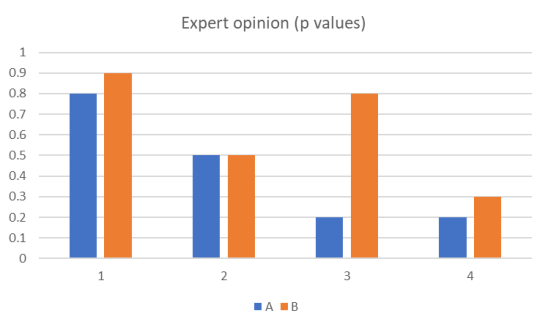
The next step is to define a view (with respect to statements 1-4) as a set of probabilities p1, p2, p3, p4, which represent the respective degrees of belief placed in those statements. For example, the view of a particular climate scientist, Expert A, might be expressed as:
(p1, p2, p3, p4)= (0.8, 0.5, 0.2, 0.2), which means that Expert A is:
- 80% sure that statement 1 – the Earth is warming – is true;
- 50% sure that the warming is life-threatening (statement 2);
- 20% sure that statement 3 is correct – warming is the result of human activity;
- 20% sure that UK NZC will bring about a meaningful global reduction of atmospheric carbon one way or another.
Expert A rates the likelihood of all four statements being correct, i.e., UK NZC being effective, as:
P=p1 × p2 × p3 × p4 = 0.8 × 0.5 × 0.2 × 0.2 = 0.016.
If the view of a second expert, Expert B, with respect to statements 1-4, is:
(q1, q2, q3, q4) = (0.9, 0.5, 0.8, 0.3)
then a comparison with Expert A’s view shows that:
- Expert B has a stronger overall belief than Expert A that UK NZC will be effective (Q=q1 × q2 × q3 × q4 = 0.9 × 0.5 × 0.8 × 0.2 = 0.108, versus P=0.016;
- Both A and B agree that the Earth is warming (p1=0.8; q1=0.9);
- Both of them are equally unsure whether that poses a significant threat to life on Earth (p2=0.5; q2=0.5);
- They differ on the cause of the warming. Expert A doubts that it is man-made, whereas Expert B believes strongly that it is (p3=0.2; q3=0.8);
- Both experts are fairly sceptical that UK NZC will lead to a significant reduction in global atmospheric carbon (p4=0.2; q4=0.3).
Neither expert is all that confident that UK NZC will achieve its aims, with Expert A being particularly pessimistic, seeing the likelihood as just 1.6% compared to 10.8% for Expert B. The main reason is that both of them are doubtful that unilateral U.K. action will have much influence on the choices of other countries.
The chart below represents the view of each expert on each requirement, and highlights statement 3, the one area of significant disagreement.
Summary:
- Defining a view with respect to a set of statements in terms of the respective degrees of confidence associated with each individual statement provides a convenient means of summarising, comparing and illustrating a variety of opinions on the subject to which the statements refer. It also serves as a natural starting point for a cost-benefit analysis of any proposed action.
- It isn’t necessary to be an expert (in this case on climate science) to make a reasonable assessment of the conditions that must apply if an argument or an assertion (such as “There is no alternative to UK NZC”) is to be persuasive.
- It isn’t too much to expect someone – expert or otherwise – who advocates a particular course of action to be able to give rough estimates of the likelihood that the conditions essential to the success of that action will be met.
- Long chains of necessary conditions lead quickly to low probabilities of overall success. The longer the set of plausible conditions that must hold if an assertion is to be true, the less likely the truth of that assertion. With 15 independent requirements, each of which has a 95% probability of success, for example, the probability of overall success is less than 50%. Complex policy issues like those associated with climate change typically have many requirements and much uncertainty.
If Being Frozen To Death Doesn’t Work, Being Starved To Death Comes Next
By Patrick Clarke | December 14, 2022
First we were placed under virtual house arrest. Now we are being frozen by soaring fuel bills and energy supply shortages in those same homes. Coming next, we are to be starved. All in pursuit of one of the Net Zero cults: Covid or carbon emissions. Too bleak a picture? We have only to look across the North Sea to one of our nearest neighbours, the Netherlands.
Surprisingly for such a small country (it is only about twice the size of Wales), the Netherlands is the second largest food exporter in the world, second only to the United States. It is Europe’s largest meat exporter. Four million cows, 13 million pigs and 104 million chickens are reared annually. It provides vegetables to many of its Western European neighbours.
One would assume this success story would be widely cherished, especially in an era of increasing food insecurity and shortages, with other key sources such as Ukraine under serious threat due to the continuing conflict there.
Remarkably, and many would say sinisterly, the polar opposite is the case. The supposed crime of the Dutch farmers? They have fallen foul of the ‘Zero Carbon’ fixation of the Climate Change Cultists who control so much of the current political and economic agenda.
One of that agenda’s chief targets is agriculture, particularly the use of nitrogen. The Dutch are at the top of the tree for nitrogen use per hectare of cultivated land, at nearly twice the European average.
The European Commission has given strict guidelines to EU member states to reduce their use of nitrogen. To comply with this the Dutch Government introduced laws to enforce a reduction of 50 per cent in nitrogen emissions by 2030. Such draconian targets can only come with draconian enforcement measures.
Dutch farming is being strangled through an assortment of regulations, including new flood prevention regulations, bizarrely given the success of the Dutch in preventing flooding over the centuries despite the fact that large parts of the country are below sea level, having been reclaimed from the sea.
Perhaps worst of all, one of the Government’s new laws bans the children of farmers from inheriting the farm when their parents retire or die. Once a farmer stops farming, their entire family becomes banned from farming in the Netherlands again. A whole way of life plus decades, sometimes even centuries, of experience is being gratuitously thrown away.
Where regulation fails, mandatory purchasing of land by the state is feared to be the next step as farmers have so far shown little interest in selling any of their land. Around 300,000 hectares of farmland is earmarked to be converted into nature conservation areas between now and 2040. More than 1,000 farms face forcible closure.
Nor is it just the Dutch Government that the farmers are battling. A panoply of NGOs are on the case too, using the courts to pursue any part of the government at national or provincial level deemed to be faltering in enforcing these objectives.
Those of us in the UK, long weary of seeing how political charities and activist lawyers run rings round attempts to enforce curbs on immigration, will be familiar with the process.
It’s worth pointing out too that, despite Brexit, Northern Ireland still has to implement these same EU directives as part of the Northern Ireland protocol. Thanks for that one, Theresa May, Boris Johnson and Rishi Sunak. So while today it is Dutch farming under siege from its own government, tomorrow it will be farming in Northern Ireland that is compelled to go through the same pain.
Interestingly, no one has yet stepped forward with a credible plan for how these vital lost sources of food are going to be replaced. The Dutch Government hopes that it will come from artificially created meat from laboratories and is investing in this technology, though how it can be sufficiently scaled up remains to be seen. Given what is already widely known about the harmful effects of eating too many processed foods instead of natural foods, such as the triggering of obesity and potential heart disease, it has to be asked whether this is a desirable course, or indeed what the further health implications for users may be.
Some would say the whole agenda is a straight forward grab by bad actors intent on taking control of the world’s food resources, for whom Net Zero objectives provide a convenient camouflage for their own lust for power, control and yet more wealth than they already have. The usual suspects certainly spring to mind.
Others argue that out-of-control digital technocrats are so conditioned to assuming they can control anything, however complex, that they can’t accept that some things remain beyond human control, such as airborne viruses and the climate.
Each failure to learn that simple lesson is leading to ever more intensive efforts to achieve that control, control that must be achieved at all costs. Either way, vicious cycles of more authoritarianism, human misery arising from absurd and seriously harmful measures, plus more setbacks in failing to reach unobtainable goals lie ahead. Unless we can shake off the grip of these technocrats on our societies and the political institutions in thrall to them, the prospect of starving to death will become our grim reality in an increasingly tyrannical world.
Think that couldn’t happen here? Just look at Sri Lanka, though as with the Dutch farmers, most of the media and nearly every politician would prefer you not to!
Brits struggling to keep warm at home – survey
RT | December 17, 2022
A quarter of British adults are struggling to keep warm in their homes as they cut back on energy use in the face of soaring costs, according to a new survey by the Office for National Statistics (ONS).
The report, which was published on Thursday, shows that 23% of adults were occasionally, hardly ever, or never able to keep comfortably warm in their living room over the past two weeks.
The ONS data indicated that 63% of adults were using less gas and electricity because of increases in the cost of living, and 96% of those adults were using less heating.
When asked about the measures they were taking to keep warm this winter, 82% of respondents said they were using more clothing or blankets, 46% were only heating rooms they use, 31% were using hot-water bottles or microwave warmers, while 27% were going to bed earlier.
Other measures included cutting back on the use of tumble dryers and washing machines, as well as bathing or showering less.
According to the ONS, many households have already cut back on their energy usage, with 34% of the polled adults saying that reducing heating has negatively affected their health or wellbeing as a result.
The ONS research on the “impact of winter pressures” also found that 16% of adults are worried their food will run out before they have money to buy more, and 19% have cut back on their portion size. The study showed 17% are eating food which is past its use-by date.
The survey of nearly 5,000 British households comes as the nation’s inflation hit 10.7% in November, which is slightly down from the 11.1% in the previous month but still well above the 2% rate targeted by the Bank of England.
Andrew Bridgen MP, a brave voice in the vaccine wilderness

By Kathy Gyngell | TCW Defending Freedom | December 17, 2022
As I sat down to write a report of Conservative MP Andrew Bridgen’s remarkable speech in Parliament this week to an all-but-empty chamber, I lighted upon this email from TCW reader Michael Carr:
‘It’s not often (never these days) that you can put the words “brave” and “UK MP” in the same sentence. But have we just witnessed one brave MP speaking out about the unprecedented human harm done by the mRNA Covid vaccine, and his call to have it halted immediately? It seems that MP Andrew Bridgen is just such a guy.
‘Notice the virtually empty chamber when he brings this subject up. Cowardly MPs decided they didn’t even want to be present when Andrew delivered his scathing attack on what the political, medical and mainstream media establishment had pushed (or kept silent) over the last two and a half years.’
I couldn’t have expressed it better. But what was the response? Despite the empty chamber did this remarkable speech prompt the MSM into reporting him and the great unspoken issue of the year, vaccine injury? The tragedy is that it did not. Bridgen’s calls for an immediate halt to the Covid vaccines have been, to date, ignored by all newspapers bar the Express. And their report, couched in terms of Bridgen’s ‘use of’ Parliamentary privilege to make ‘a bombshell allegation’ that a senior member of the British Heart Foundation had covered up a report showing ‘the mRNA Covid vaccine increases inflammation of the heart arteries’, was not exactly on point.
It shifted the focus from the main thrust of his adjournment debate which he intended to highlight the important issue of Covid vaccine harms, and his belief, unlike that of most of his colleagues, that the debate about vaccine harms should be based on data rather than fear.
It was in anticipation of media queries that Bridgen, the Conservative member for North West Leicestershire, forwarded in advance a comprehensive list of the data on which his speech is drawn to the mainstream media. No one can say he had not done his homework. It is just a crying shame – a disgrace, in fact – that no journalists bothered to do theirs. I know because I was sent by his office an extensive and comprehensive list of references. These included the government’s own evidence of serious adverse reactions affecting nearly half a million people; evidence showing that in the past vaccines have been completely withdrawn from use for a much lower incidence of serious harm – for example, the swine flu vaccine was withdrawn in 1976 for causing Guillain Barré syndrome in 1 in 100,000 adults and in 1999 the rotavirus vaccine was withdrawn for causing a form of bowel obstruction in children affecting 1 in 10,000; reference to the 25 per cent increase in heart attack and cardiac arrest calls in 16-to-39-year-olds in Israel associated with the first and second doses of vaccine and not associated with Covid infection, findings replicated in Florida; and to UK reports of an extra 14,000 out-of-hospital cardiac arrests in 2021 compared with 2020 following the vaccine rollout.
Nor did Bridgen stop there. He pointed up the MHRA’s huge financial conflict of interest receiving 86 per cent of its funding from the pharmaceutical industry it is supposed to regulate, as well as details of members of the Joint Committee for Vaccination and Immunisation’s financial links to the Bill and Melinda Gates Foundation totalling a billion dollars.
Nor did he omit evidence about children in his list of source references, alerting journalists to a report by the Journal of American Medical Association on the effect of the Covid-19 mRNA vaccination on children under five years of age, which showed one in 200 had adverse events which resulted in hospitalisation, and symptoms that lasted longer than 90 days.
In conclusion he said: ‘As the data clearly shows to anyone who wants to look at it, the mRNA vaccines are not safe, not effective and not necessary. I implore the Government to halt their use immediately. As I have demonstrated and as the data clearly shows, the Government’s current policy on the mRNA vaccines is on the wrong side of medical ethics, it is on the wrong side of scientific data, and ultimately it will be on the wrong side of history.’
His speech was remarkable, not because his oratory was remarkable but because his bravery and independence of mind was. He is one of those rare amongst men and even rarer amongst MPs, a man with moral courage. To stand out as one man against the crowd, in defiance of received wisdom and judgment, is the most difficult thing any human being is called on to do. Andrew Bridgen did it.
You can watch the full speech or the snippet below. Please note the supportive intervention by one of the two other MPs to have clearly stuck his head above the parapet on this all-important issue, Danny Kruger (Conservative, Devizes); the other being that great warrior for truth Sir Christopher Chope (Conservative, Christchurch).
Featured Video

The Truth About the Trump Shootings with Ken Silva
or go to
Aletho News Archives – Video-Images
From the Archives
Trans ‘milk’ as good as the real thing – NHS
RT | February 18, 2024
The drug-induced nipple secretions of trans women are as good as mothers’ breast milk for babies, the University of Sussex Hospitals NHS Trust claimed in a letter to campaigners made public in a report by British think tank the Policy Exchange on Sunday.
The healthcare trust’s medical director, Rachel James, argued that the off-label prescription drug cocktail men transitioning to female take in order to produce milk was “similar to the natural hormones which encourage lactation to develop when the baby is newly born.”
“The evidence which is available demonstrates that the milk is comparable to that produced following the birth of a baby,” James wrote in the letter, sent to Children of Transitioners last August.
Biological men who wish to lactate must first take hormones to grow milk glands and then take high doses of either domperidone or metoclopramide to stimulate milk production. Neither drug is approved for this use, though they are occasionally prescribed off-label to biological women who have trouble lactating.
However, domperidone’s own manufacturer, Janssen, warns patients the drug “may cause unwanted side effects affecting the heart in a breastfed baby” and “should be used during breastfeeding only if your physician considers this clearly necessary.” … continue
Blog Roll
 Aletho News
- Seyed M. Marandi: U.S. Strike Imminent – Toward Total War in the Middle East
- Russia Voted Under Fire. Washington Is Loading the Tankers.
- 12 Things Your Oncologist Was Trained Not to Tell You
- Anthrax Attacks Paved Way for COVID-Era ‘Junk Drugs and Vaccines’
- How Real Is the Impact of Western Sanctions on Israel?
- France, You Are Guilty: How Paris Turned Western Sahara into the Maghreb’s Powder Keg
- 2025 Nature Paper Claiming Worsening Global Drought Gets RETRACTED …Heavily Flawed
- Your Milk Is Not the Problem
- The Truth About the Trump Shootings with Ken Silva
- ARE PATIENTS BEING PROPERLY INFORMED ABOUT OZEMPIC?
- If Americans Knew
- Salah Sarsour’s Legal Team Says DHS Has Not Met Its Burden to Prove He Is Deportable
- An analysis of tax forms by The Intercept show Kraft’s charity and LLC have donated to Friends of the IDF and AIPAC’s super PAC.
- Israeli attacks kill four Palestinians in Gaza – Daily Update
- Inside Gaza’s death trap of collapsing, bombed-out buildings
- The everyday items Israel bans from Gaza every day
- Inside the siege, the ruined buildings of Gaza – Daily Update
- Debunking The Claim That Macklemore Has A “History Of Antisemitism”
- CPJ demands release of arrested Palestinian-US journalist near Bethlehem
- Robert Kraft: The Billionaire Friend of Netanyahu Pulling The Strings Behind the Macklemore/Ed Sheeran Blow Up
- Columbia Administered Fund Gives Big Money to Pro-Israel Groups
- No Tricks Zone
- 2025 Nature Paper Claiming Worsening Global Drought Gets RETRACTED …Heavily Flawed
- New Study: ‘Global Drought Shows No Detectable Recent Acceleration Under Climate Warming’
- Economic Masterminds: German Socialists Suggest Taxing Productivity Gains Stemming From Using AI
- The South China Sea Has Not Been Cooperating With The Climate Change Narrative
- Energy Crisis: Germany Enters Heating Season With Historically Low Gas Reserve Fill Levels
- New Study: The Antarctic Ice Sheet Gained Mass From 2020-2024 Due To Staggering Snow And Ice Accumulation
- Study: Ocean Heating Rates From Thousands Of Years Ago ‘Dwarf’ Modern Ocean Heating Rates
- Climate Extremists Target, Attack Large-Scale Power Grid Infrastructure In Germany!
- New Study: Antarctic Ice Melt Has Contributed Less Than 1 Centimeter To Sea Level Rise In The Last 30 Years
- Fear Of Debate: Alarmist German Climate Scientist Calls On Mainstream Media To Discredit Skeptic Voices
 Aletho News