Health officials in the U.K. this month identified the country’s first polio outbreak in 40 years, and believe the outbreak was caused by a strain of polio found in the oral polio vaccine.
Health officials in Britain warned parents on June 22 to ensure their children have been vaccinated against polio after multiple closely related versions of the virus that cause the disease were found in sewage water at the London Beckton Sewage Treatment Works — the largest water treatment plant in the U.K.
“The Global Polio Laboratory Network has confirmed the isolation of type 2 vaccine-derived poliovirus (VDPV2) from environmental samples in London, United Kingdom, which were detected as part of ongoing disease surveillance,” the World Health Organization (WHO) states on its website.
The U.K. Health Security Agency (UKHSA) said it believes the virus was “vaccine-derived,” meaning it came from someone who received the live polio vaccine. That person then passed the virus to individuals in London, who shed the virus into their feces.
The viruses’ genetic sequences suggest “there has been some spread between closely linked individuals in north and east London,” the UKHSA said.
The virus was isolated from environmental samples collected between February and May, and no related cases of paralysis have been detected, the WHO said. “Additional sewage samples collected upstream from the main waste-water treatment plant’s inlet are being analyzed.”
People vaccinated with the live oral polio vaccine (OPV) shed traces of the virus in their stool — which eventually end up in sewage wastewater, NPR reported. Scientists believe a person brought the virus into London and then spread it to others who were unvaccinated.
“We are urgently investigating to better understand the extent of this transmission,” Vanessa Saliba, an epidemiologist who consults for the UKHSA, said in the statement.
The risk to the general public is thought to be “extremely low” but the agency encourages anyone not fully vaccinated to receive a polio vaccine.
WHO approves Gates’ oral polio vaccine for emergency use
The WHO on Nov. 13, 2020, granted Emergency Use Listing (EUL) to a new novel oral polio vaccine called nOPV2, designed to treat the type of polio outbreak occurring in the U.K.
Based on the WHO’s review of data and research available on nOPV2, the Strategic Advisory Group of Experts on Immunization (SAGE) recommended Gates’ nOPV2 become the “vaccine of choice” for responding to type 2 polio outbreaks caused by OPV.
“The Bill & Melinda Gates Foundation has funded all development and clinical trials of nOPV2 to date, working closely with GPEI partners throughout the process to ensure resources are going toward a tool that could prove critical to helping end all forms of polio.
“Based on promising data from clinical trials, and the public health emergency that cVDPV2 [vaccine-derived poliovirus type 2] constitutes, the Foundation is funding at-risk production of 160 million doses of nOPV2 to ensure it can be deployed immediately following the issuance of WHO’s interim Emergency Use Listing (EUL) recommendation for use.”
“The emergency use listing, or EUL, is the first of its kind for a vaccine” designed to “pave the way for potential listing of COVID-19 vaccines,” the WHO said on its website.
On December 31, 2020, the WHO issued its first EUL listing for a COVID-19 vaccine. According to the WHO, the agency granted the listing for the Pfizer Comirnaty vaccine.
The EUL is a regulatory pathway that allows the WHO — whose second-largest financial donor is the Gates Foundation — to distribute an unlicensed product for a “Public Health Emergency of International Concern,” which the organization claims polio has been since 2014.
The EUL allows vaccines and medicines to be made available more quickly to address health emergencies, without long-term phase 3 data, and is the same mechanism used for distribution of Zika, Ebola and COVID-19 vaccines.
According to the WHO, in “very rare cases,” the administration of OPV results in vaccine-associated paralytic polio associated with a “reversion of the vaccine strains to the more neurovirulent profile of wild poliovirus.”
In addition to causing vaccine-associated paralytic polio, vaccine strains have the capacity to cause disease of the nervous system and to transmit from person to person resulting in infectious poliomyelitis.
Based on the WHO’s review of data and research available on nOPV2, the Strategic Advisory Group of Experts on Immunization (SAGE) recommended Gates’ nOPV2 become the “vaccine of choice” for responding to type 2 polio outbreaks caused by OPV.
According to the Global Polio Eradication Initiative (GPEI), the nOPV2 was developed to address vaccine-derived poliovirus type 2 outbreaks, which “can emerge when the weakened strain of the vaccine virus circulates in under-immunized populations and, with time, can genetically revert into a form that causes paralysis.”
In other words, “under-immunized” populations — not the OPV — are to blame for the vaccine-related polio strains.
“Once again, Big Pharma, fueled by the Gates Foundation, has created a huge problem that only they can solve. The introduction of the new OPV in the U.K. has predictably led to polio virus in the sewage (i.e., where poliovirus propagates) and now the “only solution” is to inject U.K. citizens with the nPOV2 to prevent the spread of OPV-induced polio. If this isn’t a scam, I don’t know what is!”
The U.K.’s Medicines and Regulatory Health Products Agency (MHRA) on June 17 said in a tweet: “An exciting new global study, co-authored by our lead scientist Javier Martin, shows that new polio vaccine nOPV2 is an effective tool in reducing the risk of Vaccine-Derived Polio Viruses.“
The tweet linked to a study published by the Centers for Disease Control and Prevention (CDC) advocating for the use of Gates’ nOPV2 vaccine.
Between the launch of nOPV2 in March 2021 and late May 2022, more than 350 million doses had been administered across 18 countries.
The GPEI confirmed, as of May 30, 16 other countries are “ready to use nOPV2” and an additional 17 are in the midst of preparations.
WHO, GPEI and other organizations pushing Gates-funded vaccine
According to UNICEF, the GPEI is a public-private partnership led by national governments with six core partners: Rotary International, the WHO, the CDC, UNICEF, the Gates Foundation and Gavi, the Vaccine Alliance.
The entity in charge of monitoring vaccine adverse events following administraton of nPOV2 is the WHO’s own Global Advisory Committee on Vaccine Safety (GACVS).
“The GACVS Sub-Committee on nOPV2 Safety will advise WHO and its Member States on safety outcomes following the use of initially pre-licensed type 2 novel oral poliovirus vaccine, during the EUL period, prior to the availability of Phase III clinical trial results,” according to GPEI.
In essence, the Gates Foundation funded the creation, development and clinical trials for the new nPOV2 polio vaccine, funds the organizations that administered millions of doses to be given under EUL without any long-term data, funds the organizations implementing its roll-out and surveillance and funds the entity monitoring adverse events associated with nPOV2’s use.
The Gates Foundation is also a funder of NPR and NPR’s blog, which have published numerous articles on VDPV2 and paved the way for Gates’ nPOV2 vaccine as the solution.
Oral polio v. inactivated polio vaccines
According to the WHO, the original OPV uses a mixture of “live attenuated poliovirus strains of each of the three serotypes,” selected for their ability to mimic the immune system’s response following infection with wild polioviruses, but with a reduced chance of spreading to the central nervous system.
To achieve the desired immune response, three or more doses of OPV are required spaced out over a period of time.
The U.S. and some western countries use an inactivated (killed) polio vaccine (IPV) developed by Dr. Jonas Salk and first used in 1955.
Scientists claim the inactivated virus poses no risk of spread, although the Vaccine Adverse Event Reporting system shows two reported cases of poliomyelitis reported following vaccination with IPV.
The U.S. stopped using OPV in 2000 because it caused paralytic polio.
According to NPR, countries in Africa, the Middle East and parts of Asia are experiencing a rise in cases of vaccine-derived polio. These countries mostly use the OPV developed by Albert Sabin and first used in 1961.
Gates’ nOPV2 vaccine is a modified version of Sabin’s existing OPV vaccine.
“The spread of vaccine-derived polio virus from OPV vaccine in multiple countries throughout Africa and Asia resulted in 1,612 cases of paralytic polio from 2017 through 2020,” Dr. Liz Mumper, pediatrician and former medical director of the Autism Research Institute told The Defender.
“Since these polio virus samples are in wastewater in a developed country, those who have access to clean water should not be at risk,” Mumper said. “However, the media is raising alarms. This is a setback for the Global Polio Eradication Initiative.”
According to the CDC, three cases of paralytic polio caused by the OPV vaccine have been reported in the U.S. since the vaccine was discontinued in 2000.
The CDC’s Vaccine Adverse Event Reporting System, or VAERS, shows 66 reports of polio following administration of the OPV.
WITH all eyes on the dramatic ‘return of polio’ headlines of last Wednesday and Thursday, a far more significant piece of news was slipped out. It was announced that the Government was partnering with Moderna to open a large research and manufacturing centre in Britain which ‘will develop cutting-edge mRNA vaccines for a wide range of respiratory diseases, including Covid-19 vaccines that can protect against multiple variants, helping to future-proof the UK against potential emerging health threats’.
Lucky NHS patients are to have access to the ‘next generation’ of mRNA vaccines and treatments. ‘The centre will be able to scale up production rapidly in the event of a health emergency, significantly boosting the UK’s ability to respond to future pandemics.’
This worrying press release requires careful reading. It reveals an astonishing gung-ho and uncritical approach to mRNA Covid vaccines in view of their now proven limited or even zero efficacy, and the high rate of recorded adverse events, injuries and deaths associated with them and in particular with the Moderna brand.
It does not tell us how much the Government is investing in this planned ‘mRNA Innovation and Technology Centre’ or where all the money is coming from. From the Centre for Epidemic Preparedness and Innovation (CEPI), the organisation which put up the money for Moderna’s fast-tracked Covid vaccine, that the UK already pays into? Or will some of the billions Moderna has made on the back of their ‘gene therapy’ covid vaccines be invested?
Something was to be gleaned from an interview with the Health Secretary on Wednesday’s BBC Radio 4 PM programme. Evan Davis asked Sajid Javid what Moderna would get in return for their billion-pound investment. ‘Well,’ said Javid, ‘the government’s agreed to buy Moderna’s vaccines, the mRNA ones, for the next decade’. (My italics)
Why, as already touched on, would the government be making such a huge commitment to the producer of the vaccine that gets by far the highest Yellow Card adverse reaction reporting rate in the UK? (The official figures are: Pfizer – 1 in 157 people impacted, AstraZeneca – 1 in 101 people impacted, Moderna – 1 in 43 people impacted.) These represent the immediate risks recipients are exposed to but the technology is so new that there remains a complete absence of understanding of any long-term risks, and apparently no follow-up mechanism to study them.
In this interview we also learnt that it was, in Javid’s words, ‘a huge deal’, and that yes, what Moderna got out of it was a captive and secure market for pretty much whatever vaccines they choose to produce.
‘We all saw during the pandemic the power of vaccines, the difference that they can make. And in particular, with this new technology called mRNA, this platform, we saw how it has literally saved millions of lives during the pandemic. And this technology is transformational. And under this deal, what will be happening is that Moderna will be opening both a global R&D centre here in the UK, carrying out lots of the clinical trials. But also they’ll be building a manufacturing facility here in the UK for vaccines, that will be their largest outside of the United States. So it’s over a . . . well over a billion pounds of investment. It’s a huge vote of confidence in our life sciences industry. But how it matters most of all to me as the Health Secretary is that it will mean that we in the UK, NHS patients, will have guaranteed access to future vaccines and treatments from this exciting mRNA platform. And what that means, it’s more than just Covid or flu, it means that the future sort of health needs in terms of cancer and dementia, cardiovascular disease, you know, these are all things that hold huge potential from this investment’.
When Davis pressed: ‘I’m interested in what they get out of it, because you say obviously our regulators would have to approve any vaccine that we buy from them . . . but we have guaranteed purchases, haven’t we?’ Javid agreed: ‘Yeah, let me explain that. So what we will do is we’ll sign a contract with them which will say, basically, that if you create drugs that our regulator approves and that we actually want for our health system, then we will buy those drugs. And in return what we get in the UK is, is this huge investment and guaranteed access.’
His economic sense appeared to have gone quite astray at this point. What favour Moderna would be doing us if they are to be provided with a promised captive market? Of course we will have ‘guaranteed access’! And why the UK when Europe represents a much bigger market and we no longer have access to the EU single market?
Unfortunately Davis did not ask to whom the £395 million government investment mentioned in the press release ‘to secure and scale up the UK’s vaccine manufacturing capabilities’ has gone to or goes to. To Moderna?
Looking at the updates to Moderna’s confidentiality agreements released to Axios, they appear to be trying to diversify into the existing market for childhood vaccines and are gearing up to roll out mRNA vaccines for measles and mumps and perhaps now polio and other viruses.
The very real fear is that the MHRA will follow the US Food and Drug Administration’s approach of rapid rubberstamping for new products deemed to be ‘biosimilar’ to existing products authorised on that ‘platform’. Thus minimal testing will be required, the products will get MHRA approval more easily than traditional vaccines, and our children risk being guinea pigs again. The regulatory safeguards for these products that industry sees as ‘red tape’ have been built up over decades to protect users but are now being set aside. Additionally US pharmaceutical companies have absolute protection under US law for liability for defectively designed children’s vaccines. Will the UK now give them the same indemnities?
Mr Johnson’s and Mr Javid’s shared enthusiasm for this novel technology is in direct conflict with the precautionary principle. Either they have not caught up with or are in denial about the extent of the health issues surrounding mRNA vaccination.
If Johnson’s and Javid’s naivete can be excused, Sir Patrick Vallance, the Government Chief Scientific Adviser, must know better. Yet here he is in the press release cheering on the project: ‘The establishment of the Moderna mRNA Innovation and Technology Centre is great news for the UK’s research and development activities and future capabilities. Rapid cutting-edge vaccines were vital in the response to the Covid-19 pandemic. Developing the next generation of mRNA vaccines will be crucial in boosting our ability to prevent and respond to a wide range of diseases in the future.’
Not so fast, Sir Patrick and Mr Javid. This is not what the latest mRNA vaccine research evidence suggests at all. A study which summarises the current literature on mRNA and its effects published this month concludes that ‘the many alterations in the vaccine mRNA hide the mRNA from cellular defences and promote a longer biological half-life and high production of spike protein’ causing innate immune suppression. The research paper presents evidence that vaccination induces a profound impairment in type I interferon signalling, which has diverse adverse consequences to human health and says: ‘We believe a comprehensive risk/benefit assessment of the mRNA vaccines questions them as positive contributors to public health.’
The cynic might say that what the next generation of mRNA vaccines will be crucial in is weakening our natural immunity, compromising our ability to combat disease ourselves while subjecting us and the next generation of children with reckless indifference to unknown health risks.
Moscow settled interest payments in rubles, after sanctions blocked it from foreign currency transactions
Samizdat | June 27, 2022
As the grace periods on two Russian eurobond coupons expired on Sunday night, multiple Western media outlets rushed to announce that Moscow was now in a state of default on its foreign currency-denominated debt for the first time in over a century.
Bloomberg called it a “a grim marker in the country’s rapid transformation into an economic, financial and political outcast,” while the BBC called it a “major blow to the nation’s prestige.”
The Wall Street Journal even invoked a spectre of the “Bolshevik Revolution when Vladimir Lenin, the newly installed communist leader, repudiated the debt of the Russian Empire.”
The bond holders themselves have yet to declare a default or start any proceedings, and the publications admitted that the label is “mostly symbolic for now” while the situation is “expected to pose unique legal challenges,” because “Russia has the money and intent to pay.”
Moscow repeatedly accused Washington of trying to engineer an artificial default in recent months, as the country has enough funds and willingness to pay its debts – but was intentionally cut off from foreign currency payment mechanisms. After the Russian central bank’s foreign reserves were frozen, Moscow continued to service its sovereign debt with new cash it receives from energy and other exports, so last month Washington ended a bond payments waiver.
Russia’s Finance Ministry announced on Thursday that it settled two issues of dollar-denominated Eurobonds maturing in 2027 and 2047 “in full” by sending 12.51 billion rubles ($234.5 million) in coupon payments to the National Settlement Depository, under a new mechanism.
Investors will now need to open a ruble account to receive the funds, and deal with any Western sanctions that might prevent them from moving the money out of Russia by themselves, the ministry explained. “Thus, obligations on servicing the state securities of the Russian Federation were fulfilled by the Finance Ministry in full,” the statement said.
President Vladimir Putin signed a decree on this temporary procedure for Eurobond payments on Wednesday. The document states that Moscow will now consider its obligations completed “if they are fulfilled in rubles in an amount equivalent to the value of obligations in foreign currency” at the exchange rate on the day the funds are transferred to the central depository (NSD), through which they will be paid to creditors.
ACCORDING TO the Cambridge Dictionary, a sanction is ‘a strong action taken in order to make people obey a law or rule, or a punishment given when they do not obey’. The purpose is pretty obvious, to try to deter an action that is not deemed by the sanctioner as acceptable.
A child thus may be sanctioned for poor behaviour with no sweets for a week. A country is equally sanctioned in some way deemed to harm the errant country and not those giving the sanction. Russia has been sanctioned by primarily the US, UK and EU in an unprecedented fashion due to the war in Ukraine. But who is it hurting?
This article is not about the morality of the situation in Ukraine. It is simply about whether the sanctions have been effective, or have they actually been counter-productive? At the most basic level, has applying sanctions made it more, or less likely, that UK policy goals will be achieved?
A third of a year into war, the only conclusion one can sanely draw so far is that the West’s sanctions have been an unmitigated disaster in self-harm undermining domestic prosperity while causing serious inflationary and monetary dislocation.
There is very little evidence that Western sanctions have materially harmed Russia’s ability to prosecute war or (as much as we can judge) diminish Russian domestic support for it. Far from Government’s expectations that it would cripple the Russian economy and perhaps lead to regime change, if anything it is Western economies that are in desperate trouble. It seems that US, UK and EU sanctions are proving to be a lose-lose trade.
A simple test – what currency traders would say
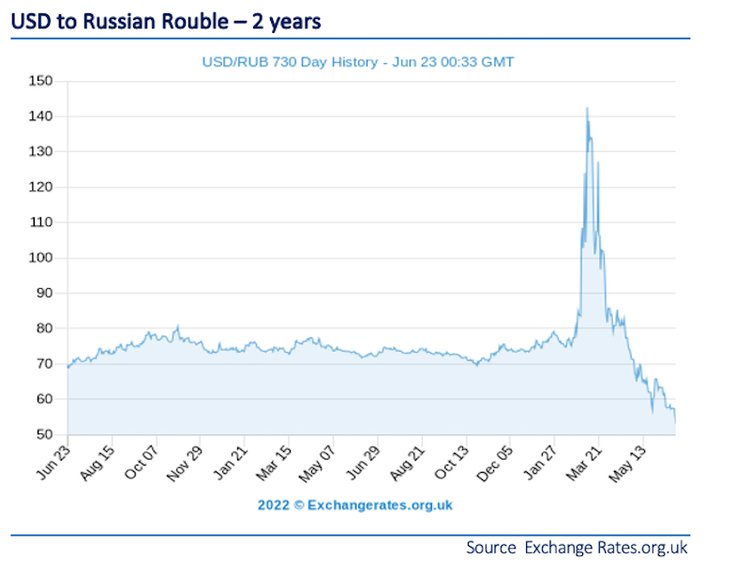
We were told sanctions were going to cripple the Russian economy and stop its war machine. For around two weeks, judging by the currency market’s reaction to a then collapsing rouble, that superficially seemed right.
Initially the rouble halved from a pre-war 75 to the USD to a low of 140 as the West confiscated over $300billion of Russia’s sovereign assets held in the West. This, coupled with a wholesale withdrawal of Western companies, from BP to McDonald’s, and a tightening of oil and gas sanctions, resulted in currency collapse.
Such a collapse, if prolonged, would have been very dangerous for Russia’s stability as it simply destroys its terms of trade, potentially resulting in material inflation as the cost of importing goods rises significantly.
But Western policy makers did not think through the second derivative which is coming back to bite. Economically Russia to an extent is the polar opposite of the West.
The West undoubtedly has significant technological and soft power advantage over Russia. However, most Western economies have growing and inefficient public sectors and weak central banking systems impeded by the Global Financial Crisis (GFC) and particularly lockdowns, with substantial growing public debt and debased monetary systems through a new-found belief in Modern Monetary Theory (MMT) – accompanied by all the associated Quantitative Easing over the last decade. Britain and the US also run substantial trade deficits.
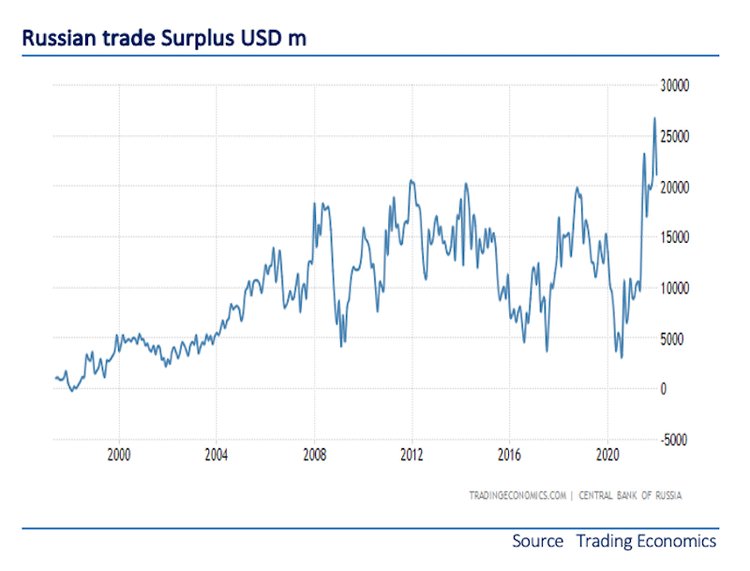
Russia, on the other hand, is a commodity- and primary products-led export economy running a substantial trade surplus, with weak technology and service sector exports and soft power. Its public finances are very strong with low public debt, low taxes (14 per cent flat rate income tax) and substantial cash reserves even after half were sanctioned.
This asymmetry of strategic advantage between Russia and the West has profound implications if sanctions are applied. Thus quite quickly currency traders realised what extraordinarily almost none of our current crop of virtue signalling politicians dare to say – that the sanctions were potentially more of a threat to the West (UK and EU in particular) as the impact of ‘cancelling’ Russian carbon was highly inflationary.
There are no cheap short or medium term substitutes. Much of the West is dependent on Russian primary products, while only some Russians might be upset the Prada store in Moscow had closed (but the back door from China remained wide open). An inconvenience, sure; a game changer, probably not.
Thus the rouble strengthened materially and at the time of writing is 55 to the USD, almost 30 per cent stronger than before the conflict in Ukraine. If one compares the sterling- rouble exchange rate, sterling’s underperformance is even starker.
It is quite simple. Cancel Russian oil (13 per cent global production) and India joyfully buys the discarded stock at a discount while the global price goes up as the West scrambles to find new supply. Worse, cancel Russian gas and the EU has a major crisis, as does the UK given the UK’s foolish decade-plus de-emphasising of carbon, including the closure of strategic gas storage facilities. The list goes on well beyond carbon – from titanium to fertiliser, from wheat to cod.
But it is oil and gas that are so critical as power is essential to the manufacture, to a greater or lesser extent, of most things. The irony is that as well as Saudi, Iran and Venezuela, the greatest beneficiary of soaring hydrocarbon prices is Russia. Putin’s Russia has run consistent trade surpluses but the current surplus is a record, as a direct result of sanctions, taking the spot price of oil from a pre-war $80 a barrel to $120 today.
While the rouble strengthens and the Russian trade surplus expands, the effect on Western economies has been devastating. In fairness the West had been severely undermining its own advantage for many years prior to the invasion of Ukraine, fuelled by Governmental policies based on a double fallacy: that monetary policy could solve all ills, and that centralised decision-making and excessive public spending could solve all ills.
Both fallacies are now coming with a substantial price, but to multiply that with an ill-thought-out sanctions regime that is achieving none of its underlying goals and is harming Western economies is frankly hard to fathom.
The West, particularly the EU and UK, is now in a pickle. This pickle has the potential to be calamitous as Governments remain in denial at the scale of the challenge they are facing.
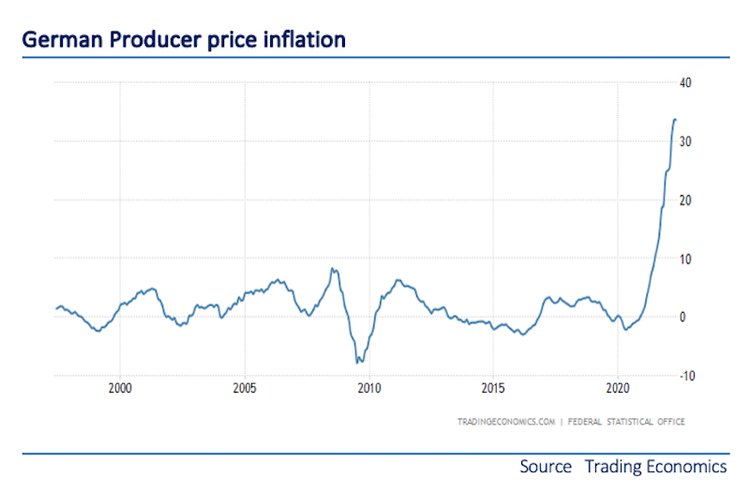
We are in a situation where the inflationary surge, given supply chains, is in its embryo stage, not close to its conclusion. Sure, the price rise at the pumps is immediate, but domestic energy prices are set to increase by a further 40 per cent in September when the price cap comes off. As a warning, German producer price inflation (see chart below) is over 30 per cent, a rate not seen since post-war ruination in 1946.
I sincerely hope I am wrong but this has the potential to get very nasty. Rishi Sunak said on Wednesday: ‘We are using all the tools at our disposal to bring inflation down and combat rising prices. We can build a stronger economy through independent monetary policy, responsible fiscal policy which doesn’t add to inflationary pressures, and by boosting our long-term productivity and growth.’ That says to me he hasn’t a clue about the scale of the challenge or indeed the underlying causes.
The reality is unfortunately that both the Bank of England and the ECB are so far behind the curve as to make you weep. Interest rates of 1.25 per cent when RPI is 11 per cent are so far off-kilter while the ECB, with arguably an even greater inflation headache given German industrial reliance on Russian gas, is only now coming off negative rates.
Moreover, expanding a wantonly inefficient public sector to around half the entire economy coupled with an unprecedented regulatory stranglehold can only spell a productivity disaster. It is throwing money at the bad, paid for by the good.
Where this will end remains uncertain, so many unknowns are there. What we can predict is that this is the beginning not the end of the maelstrom. Governments do not like short-term pain as elections approach and we risk yet another debt-funded stimulus papering over the ever-wider cracks. How credible would that really be when inflation is 11 per cent? Would they dare print money again in such circumstance? I fear they would.
This country and indeed Europe generally is enduring enormous self-harm. Sanctions have backfired but the cocktail of sanctions, massive public sector expansion, delusional monetary policy and delusional energy policy risk an economic disaster of immense proportion.
There is no easy fix but unless we wish to become a northern version of Argentina, with a debased currency, constant crisis and missed opportunity, we need to understand the scale and multiple layers of our challenge.
It’s too late to avoid prolonged and meaningful inflation, and in time recession, but it’s not too late to start to rectify policy error. I can’t see the current crop of politicians analysing forensically the impact of sanctions but a great start would be to toss away the gateway drug to our delusions, the strange idea that Modern Monetary Theory works and governments can print and spend their way out of a crisis. Frankly they can’t and with that acceptance perhaps we can start the process of an appropriately balanced economy focused on private activity, not state direction. Government got us in this mess, only the people can free us from it.
Why was there no democracy in Hong Kong under British colonial rule? And why democracy can be developed in an orderly manner in Hong Kong only on the premise of firmly implementing the policy of “One Country, Two Systems” and the Basic Law of the HKSAR. Einar Tangen, our current affairs commentator, tells more.
According to a recent study by the World Bank, published in the journal Nature, lockdowns and the response to Covid-19 have pushed an additional 75 million people into extreme poverty, living on less than US $1.90 a day.
In the typical Walter Duranty style that’s become a kind of twisted journalistic norm since March 2020, the World Bank and Nature of course blame this on “the pandemic” rather than lockdowns. I remain baffled as to how seemingly well-meaning people are able to sleep at night repeating such nonsense—are they somehow blind to the role of their own sycophancy in perpetuating these policies?
Nonetheless, there are signs that the political mainstream is starting to realize lockdowns were a disaster. Today, the Wall Street Journal published an excellent piece titled The Revenge of the Locked-Down Voters, noting the growing political backlash against lockdown politicians from voters at the lower end of the income scale.
This comes shortly after the New York Timesquietly acknowledged a study showing that Covid lockdowns and mandates led to over 170,000 excess deaths among young Americans.
And, as in America, this comes shortly after the London Times, the UK’s centre-left newspaper of record, published a cautiously-introspective piece on its support for lockdowns.
These are promising indications that the political mainstream, especially on the right, is coming around to the fact that lockdowns were a policy catastrophe more quickly than some might have worried.
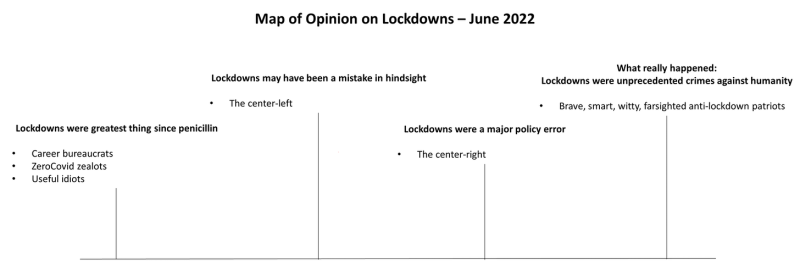
Still, there’s much more to be done. Currently, the mainstream left and right are starting to realize lockdowns were a big mistake, while many career bureaucrats are still stuck pretending lockdowns were the greatest medical breakthrough since penicillin. There really needs to be a bipartisan consensus that lockdowns were an unprecedented policy catastrophe before we can start to see justice and have undue foreign and financial influence taken seriously.
In recent weeks, I have received a number of complimentary emails from readers of my essays who took note of what they consider my even-handed approach to the ongoing Russian-Ukrainian military conflict which is at variance with the fired-up Russophile and Russophobe positions that we find daily in alternative and mainstream media respectively. Some have gone on to say that they have profited from my reporting on the content and changing views aired on Russian political talk shows these past few months, all of which is rarely featured in mainstream Western news and analysis. My intent in such reporting was to ensure that at least some people here understand what Ukraine and its Western backers are up against, so as to better understand the course of the fighting on the ground and who may be winning.
In this context, I announce with sadness that the job of even-handed reporting has just become much more difficult as a result of Eutelsat’s implementation yesterday of a policy decision announced just over a month ago, but which went unnoticed by most everyone, myself included.
I quote from Google Search:
“Eutelsat to remove banned Russian channels. Eutelsat ready to immediately stop the rebroadcasting of the Russian channels RTR Planeta and Rossiya 24 on its satellites on June 25. 13 May 2022”
Indeed, the main state news channels of the Russian Federation can now no longer be received via satellite antennas here in Belgium or elsewhere on the Continent. They are partially and sporadically accessible on the internet via www.smotrim.ru but the level of interference from Western censors makes such viewing a dismal exercise. “Freezing” of frames seems to be most common with respect to the talk shows “Sixty Minutes” and “Evening with Solovyov,” two programs which I had been following and reporting on most regularly. However, it also is applied against Russian shows which might be characterized as being simply entertainment, such as the currently running historical serial about the life and times of the 18th century tsarina Elizabeth. I dare anyone to get more than a minute or two into the broadcast before the curtain comes down, so to speak.
The curtain in question is an updated Iron Curtain, which this time has been dropped on our heads by the powers that be in Washington. After all, it is Washington that pressured the French controlled Eutelsat rebroadcaster of television channels that dominates the European and other global markets to throw out the Russians.
The argument behind that demand was to exclude “Russian propaganda” from the airwaves.
In the spirit of fairmindedness with which I opened this essay, I agree that Russian state television is practicing propagandistic methods insofar as it withholds certain information from viewers while promoting other information favorable to its paymasters. For example, on Russian state television news you will not find a word about the civilian casualties and damage to residential buildings of Russian artillery and rocket attacks on Kharkov. You are shown only the civilian casualties and damage to residential buildings in Donetsk and towns of the Donbas caused by Ukrainian artillery and rocket strikes.
On the other hand, however, European and U.S. newscasts feature the damage caused by Russian strikes on Ukrainian towns while saying not a word about the sufferings of the Donbas population from military assaults by Ukrainian forces. Just as they have been entirely silent about such suffering and death among the Donbas population that Kiev has inflicted on them for the past eight years, since the outbreak of the civil war in 2014.
Each side in the Ukrainian conflict accuses the other side of using cluster bombs and other internationally prohibited weapons against civilian populations. These accusations are put on air by Russian and Western news programs only as they are set out by their favored respective side.
My point is very simple: by silencing the so-called Russian propagandists, Western propagandists have the field to themselves here in Belgium, in the broader European Union and in North America. The possibilities for the public to form an independent view of what is going on are choked off, and with that there is no basis for informed policy discussion in the expert community. As The Washington Post so nicely puts it: democracy dies in darkness.
And what about the Russian side? Are they also cut off and ignorant as my remarks on coverage of casualties above might suggest? I commented on this question in my travel report on my six week stay in Petersburg that began in May: Western news channels have been removed from the cable television distributors in the city. For this I blame not Russian government prohibitions but the commercial decisions of Western content providers who terminated their contracts with Russian distributors just as did the Hollywood studios. Meanwhile, Western stations remain accessible on the internet without interference and they remain accessible on satellite television.
At my dacha, I had no difficulty receiving the BBC and Bloomberg for free courtesy of my parabolic antenna. How long this will be the case given the tit-for-tat nature of the relationship between the West and Russia generally I cannot say. But if someone does pull the plug on Western ‘propaganda’ in Russia, it will be in response to the West’s dropping the Iron Curtain on Russia, not the other way around.
It is sad that Western leaders are destroying with their own hands the underpinnings of democracy at home through this censorship. The only likely result will be total shock and surprise throughout the Western world when the Russians complete their liberation of Donbas, take the Ukrainian Black Sea coast including Odessa and declare victory over what will by then be an utterly destroyed Ukrainian army.
In the meantime, under greatly constrained conditions, I will try my best to follow the Russian side of the story on talk shows, on news reports of Russian war correspondents embedded with their forces on the front lines, and to share with readers what appears to be afoot on the other side of the barricades.
The West needs to keep arming Ukraine instead of seeking a peaceful resolution to the conflict between Kiev and Moscow, UK Prime Minister Boris Johnson told French President Emmanuel Macron, according to Downing Street. Any attempt to resolve the conflict peacefully will lead to global instability, he said at a meeting on the sidelines of the G7 Summit on Sunday.
The military action in Ukraine is at a “critical moment,” the two leaders agreed, but there is still “an opportunity to turn the tide.” According to the statement, Johnson and Macron have agreed to continue supporting Kiev militarily to “strengthen their hand in both the war and any future negotiations.”
The prime minister also cautioned the French leader against seeking alternatives to resolving the conflict.
The Prime Minister stressed any attempt to settle the conflict now will only cause enduring instability and give Putin licence to manipulate both sovereign countries and international markets in perpetuity.
Johnson took a similar stance at a meeting with Canadian Prime Minister Justin Trudeau on Sunday. “Ukraine is on a knife-edge and we need to tip the balance of the war in their favor. That means providing Ukraine with the defensive capabilities, training and intelligence they need to repel the Russian advance,” a statement from Downing Street read.
On Sunday, Johnson tweeted that Ukraine’s “security is our security, and their freedom is our freedom.”
Ahead of the summit, London pledged an additional £429 million ($525 million) in guarantees for World Bank loans in 2022 as a form of financial assistance to Kiev. According to Downing Street, the UK’s total financial support for Ukraine, including loan guarantees, amounted to £1.3 billion ($1.5 billion) and the combined UK economic and humanitarian support for Ukraine amounted to £1.5 billion ($1.8 billion) this year.
Johnson has been one of Kiev’s most ardent supporters after Russia’s military operation in Ukraine began in late February. He has visited Kiev twice since then and repeatedly called on Western nations to provide more weapons. The UK is one of Kiev’s major arms suppliers, including heavy weaponry.
In June, Johnson warned that the West must brace for a long war between Kiev and Moscow. On Saturday, he said he would consider resigning if he has to abandon Ukraine at some point.
The Allies suffered over 100,000 casualties during pointless fighting in Africa when they could have invaded Sicily. Some believe the US Army lacked the experience to fight a major war and fighting confused Frenchmen in Africa provided that. However, most of the American generals, colonels and senior sergeants had fought in World War I. There were no German ground combat troops in Sicily in late 1942 and not many Italian. The best Italian units and equipment were dedicated to fighting the British in Egypt and there were little preparations to defend Sicily, which only had five second-rate infantry divisions with dispersed units providing security at key points. A November 1942 invasion of Sicily would have been bloody, but losses would be far less than the 100,000 casualties suffered fighting in Africa plus the 25,000 lost invading Sicily in July 1943 after it had been fortified.
“Major Convoy Operation to Malta, 10-15 August 1942 (Operation Pedestal)”; Milan Vego; Naval War College Review; 2010; https://digital-commons.usnwc.edu/cgi…
Events of the past few days suggest British journalism – the so-called Fourth Estate – is not what it purports to be: a watchdog monitoring the centers of state power. It is quite the opposite.
The pretensions of the establishment media took a severe battering this month as the defamation trial of Guardian columnist Carole Cadwalladr reached its conclusion and the hacked emails of Paul Mason, a long-time stalwart of the BBC, Channel 4 and the Guardian, were published online.
Both of these celebrated journalists have found themselves outed as recruits – in their differing ways – to a covert information war being waged by Western intelligence agencies.
Had they been honest about it, that collusion might not matter so much. After all, few journalists are as neutral or as dispassionate as the profession likes to pretend. But as have many of their colleagues, Cadwalladr and Mason have broken what should be a core principle of journalism: transparency.
The role of serious journalists is to bring matters of import into the public space for debate and scrutiny. Journalists thinking critically aspire to hold those who wield power – primarily state agencies – to account on the principle that, without scrutiny, power quickly corrupts.
The purpose of real journalism – as opposed to the gossip, entertainment and national-security stenography that usually passes for journalism – is to hit up, not down.
And yet, each of these journalists, we now know, was actively colluding, or seeking to collude, with state actors who prefer to operate in the shadows, out of sight. Both journalists were coopted to advance the aims of the intelligence services.
And worse, each of them either sought to become a conduit for, or actively assist in, covert smear campaigns run by Western intelligence services against other journalists.
What they were doing – along with so many other establishment journalists – is the very antithesis of journalism. They were helping to conceal the operation of power to make it harder to scrutinize. And not only that. In the process, they were trying to weaken already marginalized journalists fighting to hold state power to account.
RUSSIAN COLLUSION?
Cadwalladr’s cooperation with the intelligence services has been highlighted only because of a court case. She was sued for defamation by Arron Banks, a businessman and major donor to the successful Brexit campaign for Britain to leave the European Union.
In a kind of transatlantic extension of the Russiagate hysteria in the United States following Donald Trump’s election as president in 2016, Cadwalladr accused Banks of lying about his ties to the Russian state. According to the court, she also suggested he broke election funding laws by receiving Russian money in the run-up to the Brexit vote, also in 2016.
That year serves as a kind of ground zero for liberals fearful about the future of “Western democracy” – supposedly under threat from modern “barbarians at the gate,” such as Russia and China – and the ability of Western states to defend their primacy through neo-colonial wars of aggression around the globe.
The implication is Russia masterminded a double subversion in 2016: on one side of the Atlantic, Trump was elected U.S. president; and, on the other, Britons were gulled into shooting themselves in the foot – and undermining Europe – by voting to leave the EU.
Faced with the court case, Cadwalladr could not support her allegations against Banks as true. Nonetheless, the judge ruled against Banks’ libel action – on the basis that the claims had not sufficiently harmed his reputation.
The judge also decided, perversely in a British defamation action, that Cadwalladr had “reasonable grounds” to publish claims that Banks received “sweetheart deals” from Russia, even though “she had seen no evidence he had entered into any such deals.” An investigation by the National Crime Agency ultimately found no evidence either.
So given those circumstances, what was the basis for her accusations against Banks?
Cadwalladr’s journalistic modus operandi, in her long-running efforts to suggest widespread Russian meddling in British politics, is highlighted in her witness statement to the court.
In it, she refers to another of her Russiagate-style stories: one from 2017 that tried to connect the Kremlin with Nigel Farage, a former pro-Brexit politician with the UKIP Party and close associate of Banks, and WikiLeaks founder Julian Assange, who has been a political prisoner in the U.K. for more than a decade.
At that time, Assange was confined to a single room in the Ecuadorian Embassy after its government offered him political asylum. He had sought sanctuary there, fearing he would be extradited to the U.S. following publication by WikiLeaks of revelations that the U.S. and U.K. had committed war crimes in Iraq and Afghanistan.
WikiLeaks had also deeply embarrassed the CIA by following up with the publication of leaked documents, known as Vault 7, exposing the agency’s own crimes.
Last week the U.K.’s Home Secretary, Priti Patel, approved the very extradition to the U.S. that Assange feared and that drove him into the Ecuadorian embassy. Once in the U.S., he faces up to 175 years in complete isolation in a supermax jail.
ASSASSINATION PLOT
We now know, courtesy of a Yahoo News investigation, that through 2017 the CIA hatched various schemes to either assassinate Assange or kidnap him in one of its illegal “extraordinary rendition” operations, so he could be permanently locked up in the U.S., out of public view.
We can surmise that the CIA also believed it needed to prepare the ground for such a rogue operation by bringing the public on board. According to Yahoo’s investigation, the CIA believed Assange’s seizure might require a gun battle on the streets of London.
It was at this point, it seems, that Cadwalladr and the Guardian were encouraged to add their own weight to the cause of further turning public opinion against Assange.
According to her witness statement, “a confidential source in [the] U.S.” suggested – at the very time the CIA was mulling over these various plots – that she write about a supposed visit by Farage to Assange in the embassy. The story ran in the Guardian under the headline “When Nigel Farage met Julian Assange.”
In the article, Cadwalladr offers a strong hint as to who had been treating her as a confidant: the one source mentioned in the piece is “a highly placed contact with links to U.S. intelligence.” In other words, the CIA almost certainly fed her the agency’s angle on the story.
In the piece, Cadwalladr threads together her and the CIA’s claims of “a political alignment between WikiLeaks’ ideology, UKIP’s ideology and Trump’s ideology.” Behind the scenes, she suggests, was the hidden hand of the Kremlin, guiding them all in a malign plot to fatally undermine British democracy.
She quotes her “highly placed contact” claiming that Farage and Assange’s alleged face-to-face meeting was necessary to pass information of their nefarious plot “in ways and places that cannot be monitored.”
Except of course, as her “highly placed contact” knew – and as we now know, thanks to exposes by the Grayzone website – that was a lie. In tandem with its plot to kill or kidnap Assange, the CIA illegally installed cameras inside, as well as outside, the embassy. His every move in the embassy was monitored – even in the toilet block.
The reality was that the CIA was bugging and videoing Assange’s every conversation in the embassy, even the face-to-face ones. If the CIA actually had a recording of Assange and Farage meeting and discussing a Kremlin-inspired plot, it would have found a way to make it public by now.
Far more plausible is what Farage and WikiLeaks say: that such a meeting never happened. Farage visited the embassy to try to interview Assange for his LBC radio show but was denied access. That can be easily confirmed because by then the Ecuadorian embassy was allying with the U.S. and refusing Assange any contact with visitors apart from his lawyers.
Nonetheless, Cadwalladr concludes: “In the perfect storm of fake news, disinformation and social media in which we now live, WikiLeaks is, in many ways, the swirling vortex at the centre of everything.”
‘SWIRLING VORTEX’
The Farage-Assange meeting story shows how the CIA and Cadwalladr’s agendas perfectly coincided in their very own “swirling vortex” of fake news and disinformation.
She wanted to tie the Brexit campaign to Russia and suggest that anyone who wished to challenge the liberal pieties that provide cover for the crimes committed by Western states must necessarily belong to a network of conspirators, on the left and the right, masterminded from Moscow.
The CIA and other Western intelligence agencies, meanwhile, wanted to deepen the public’s impression that Assange was a Kremlin agent – and that WikiLeaks’ exposure of the crimes committed by those same agencies was not in the public interest but actually an assault on Western democracy.
Assange’s character assassination had already been largely achieved with the American public in the Russiagate campaign in the U.S. The intelligence services, along with the Democratic Party leadership, had crafted a narrative designed to obscure WikiLeaks’ revelations of election-fixing by Hillary Clinton’s camp in 2016 to prevent Bernie Sanders from winning the party’s presidential nomination. Instead they refocused the public’s attention on evidence-free claims that Russia had “hacked” the emails.
For Cadwalladr and the CIA, the fake-news story of Farage meeting Assange could be spun as further proof that both the “far left” and “far right” were colluding with Russia. Their message was clear: only centrists – and the national security state – could be trusted to defend democracy.
FABRICATED STORY
Cadwalladr’s smear of Assange is entirely of a piece with the vilification campaign of WikiLeaks led by liberal media outlets to which she belongs. Her paper, the Guardian, has had Assange in its sights since its falling out with him over their joint publication of the Iraq and Afghanistan war logs in 2010.
A year after Cadwalladr’s smear piece, the Guardian would continue its cooperation with the intelligence services’ demonization of Assange by running an equally fabricated story – this time about a senior aide of Trump’s, Paul Manafort, and various unidentified “Russians” secretly meeting Assange in the embassy.
The story was so improbable it was ridiculed even at the time of publication. Again, the CIA’s illegal spying operation inside and outside the embassy meant there was no way Manafort or any “Russians” could have secretly visited Assange without those meetings being recorded. Nonetheless, the Guardian has never retracted the smear.
One of the authors of the article, Luke Harding, has been at the forefront of both the Guardian’s Russiagate claims and its efforts to defame Assange. In doing so, he appears to have relied heavily on Western intelligence services for his stories and has proven incapable of defending them when challenged.
Harding, like the Guardian, has an added investment in discrediting Assange. He and a Guardian colleague, David Leigh, published a Guardian-imprint book that included a secret password to a WikiLeaks’ cache of leaked documents, thereby providing security services around the world with access to the material.
The CIA’s claim that the release of those documents endangered its informants – a claim that even U.S. officials have been forced to concede is not true – has been laid at Assange’s door to vilify him and justify his imprisonment. But if anyone is to blame, it is not Assange but Harding, Leigh and the Guardian.
EFFORT TO DEPLATFORM
The case of Paul Mason, who worked for many years as a senior BBC journalist, is even more revealing. Emails passed to the Grayzone website show the veteran, self-described “left-wing” journalist secretly conspiring with figures aligned with British intelligence services to build a network of journalists and academics to smear and censor independent media outlets that challenge the narratives of the Western intelligence agencies.
Mason’s concerns about left-wing influence on public opinion have intensified the more he has faced criticism from the left over his demands for fervent, uncritical support of NATO and as he has lobbied for greater Western interference in Ukraine. Both are aims he shares with Western intelligence services.
Along with the establishment media, Mason has called for sending advanced weaponry to Kyiv, likely to raise the death toll on both sides of the war and risk a nuclear confrontation between the West and Russia.
In the published emails, Mason suggests the harming and “relentless deplatforming” of independent investigative media sites – such as the Grayzone, Consortium News and Mint Press – that host non-establishment journalists. He and his correspondents also debate whether to include Declassified UK and OpenDemocracy. One of his co-conspirators suggests a “full nuclear legal to squeeze them financially.”
Mason himself proposes starving these websites of income by secretly pressuring Paypal to stop readers from being able to make donations to support their work.
It should be noted that, in the wake of Mason’s correspondence, PayPal did indeed launch just such a crackdown, including against Consortium News and MintPress, after earlier targeting WikiLeaks.
Mason’s email correspondents include two figures intimately tied to British intelligence: Amil Khan is described by the Grayzone as “a shadowy intelligence contractor” with ties to the U.K.’s National Security Council. He founded Valent Projects, establishing his credentials in a dirty propaganda war in support of head-chopping jihadist groups trying to bring down the Russian-supported Syrian government.
CLANDESTINE ‘CLUSTERS’
The other intelligence operative is someone Mason refers to as a “friend”: Andy Pryce, the head of the Foreign Office’s shadowy Counter Disinformation and Media Development (CDMD) unit, founded in 2016 to “counter-strike against Russian propaganda.” Mason and Pryce spend much of their correspondence discussing when to meet up in London pubs for a drink, according to the Grayzone.
The Foreign Office managed to keep the CDMD unit’s existence secret for two years. The U.K. government has refused to disclose basic information about the CDMD on grounds of national security, although it is now known that it is overseen by the National Security Council.
The CDMD’s existence came to light because of leaks about another covert information warfare operation, the Integrity Initiative.
Notably, the Integrity Initiative was run on the basis of clandestine “clusters,” in North America and Europe, of journalists, academics, politicians and security officials advancing narratives shared with Western intelligence agencies to discredit Russia, China, Julian Assange, and Jeremy Corbyn, the former, left-wing leader of the Labor Party.
Cadwalladr was named in the British cluster, along with other prominent journalists: David Aaronovitch and Dominic Kennedy of the Times; the Guardian’s Natalie Nougayrede and Paul Canning; Jonathan Marcus of the BBC; the Financial Times’ Neil Buckley; the Economist’s Edward Lucas; and Sky News’ Deborah Haynes.
In his emails, Mason appears to want to renew this type of work but to direct its energies more specifically at damaging independent, dissident media – with his number one target the Grayzone, which played a critical role in exposing the Integrity Initiative.
Mason’s “friend” – the CDMD’s head, Andy Pryce – “featured prominently” in documents relating to the Integrity Initiative, the Grayzone observes.
This background is not lost on Mason. He notes in his correspondence the danger that his plot to “deplatform” independent media could “end up with the same problem as Statecraft” – a reference to the Institute of Statecraft, the Integrity Initiative’s parent charity, which the Grayzone and others exposed. He cautions: “The opposition are not stupid, they can spot an info op – so the more this is designed to be organic the better.”
Pryce and Mason discuss creating an astroturf civil-society organization that would lead their “information war” as part of an operation they brand the “International Information Brigade”.
Mason suggests the suspension of the libel laws for what he calls “foreign agents” – presumably meaning that the Information Brigade would be able to defame independent journalists as Russian agents, echoing the establishment media’s treatment of Assange, without fear of legal action that would show these were evidence-free smears.
‘PUTIN INFOSPHERE’
Another correspondent, Emma Briant, an academic who claims to specialize in Russian disinformation, offers an insight into how she defines the presumed enemy within: those “close to WikiLeaks,” anyone “trolling Carole [Cadwalladr],” and outlets “discouraging people from reading the Guardian.”
Mason himself produces an eye-popping, self-drawn, spider’s web chart of the supposedly “pro-Putin infosphere” in the U.K., embracing much of the left, including Corbyn, the Stop the War movement, as well as the Black and Muslim communities. Several media sites are mentioned, including Mint Press and Novara Media, an independent British website sympathetic to Corbyn.
Khan and Mason consider how they can help trigger a British government investigation of independent outlets so that they can be labeled as “Russian-state affiliated media” to further remove them from visibility on social media.
Mason states that the goal is to prevent the emergence of a “left anti-imperialist identity,” which, he fears, “will be attractive because liberalism doesn’t know how to counter it” – a telling admission that he believes genuine left-wing critiques of Western foreign policy cannot be dealt with through public refutation but only through secret disinformation campaigns.
He urges efforts to crack down not only on independent media and “rogue” academics but on left-wing political activism. He identifies as a particular threat Corbyn, who was earlier harmed through a series of disinformation campaigns, including entirely evidence-free claims that the Labour Party during his tenure became a hotbed of antisemitism. Mason fears Corbyn might set up a new, independent left-wing party. It is important, Mason notes, to “quarantine” and “stigmatize” any such ideology.
In short, rather than use journalism to win the argument and the battle for public opinion, Mason wishes to use the dark arts of the security state to damage independent media, as well as dissident academics and left-wing political activism. He wants no influences on the public that are not tightly aligned with the core foreign policy goals of the national security state.
Mason’s correspondence hints at the reality behind Cadwalladr’s claim that Assange was the “swirling vortex at the centre of everything.” Assange symbolizes that “swirling vortex” to intelligence-aligned establishment journalists only because WikiLeaks has published plenty of insider information that exposes Western claims to global moral leadership as a complete charade – and the journalists who amplify those claims as utter charlatans.
In part two, we will examine why journalists like Mason and Cadwalladr prosper in the establishment media; the long history of collusion between Western intelligence agencies and the establishment media; and how that mutually beneficial collusion is becoming ever more important to each of them.
Russia’s special operation in Ukraine may cause a two-year global food crisis even if the standoff ends tomorrow, The Telegraph claims, citing Western officials. They insist that exporting grain “trapped” in Ukraine is the remedy, while remaining mute about West’s sanctions paralyzing larger food exports from Russia to third-world countries.
“We are very clear that this grain crisis is urgent, that it needs to be solved within the next month otherwise we could see devastating consequences,” UK Foreign Secretary Liz Truss told the press on June 23.
The ongoing conflict has disrupted production, “causing global food prices to soar to record levels,” claims The Telegraph. In particular, wheat prices increased to an average of 56.2% in May, 2022 above their value last year, according to the UN Food and Agriculture Organization (FAO).
The newspaper’s source says that the British officials see current efforts to move Ukrainian grain over land and road as “far below” what is needed. They insist that the commodity needs to be exported by sea, accusing Russia of blocking Ukraine’s food supplies from leaving Ukraine’s Black Sea ports. According to UK Prime Minister Boris Johnson, Moscow was trying to hold the world “ransom.”
The newspaper also cites “newly declassified US intelligence” claiming that the Russian navy “has been given orders to lay mines” in Odessa and Ochakov and “mined” the Dnieper River “as part of its blockade of Ukrainian grain exports.” According to BoJo, the UK is helping Ukraine “at a technical level to help demine Odessa.”
Western Press Remain Mute About Russia’s Black Sea Corridors
Russia denounced the US and the UK claims, stressing that the Ukrainian military mined their own ports during the retreat. Furthermore, Ukraine continues to stampede Russo-Turkish efforts to demine the area and ensure the safe passage of ships from the country’s territorial waters.
On June 2, Russia’s Permanent Representative to the UN Vasily Nebenzya made it clear that Russia is ready to provide safe corridors for Ukrainian ships carrying 20 million tons of grain if Kiev demines the water area surrounding its ports.
In late May, the Russian Ministry of Defense announced that the Russian Navy had created safe zones in the Black and Azov Seas for ships leaving Ukraine along humanitarian corridors. The corridors with a length of 139 miles and 3 miles wide are operating daily from 8:00 am to 7:00 pm (GMT+3) in the Black Sea for vessels stationed in the ports of Kherson, Nikolaev, Chernomorsk, Ochakov, Odessa and Yuzhny.
Nevertheless, the Kiev authorities “continue to do everything possible to evade interaction with representatives of foreign states and ship-owning companies in resolving the issue of ensuring the safe exit of blocked ships,” according to the MoD.
Turkey, which has worked with Russia in demining the Black Sea and providing safe passage to vessels, echoes Moscow’s concerns. Turkish Foreign Minister Cavusoglu told Anadolu Agency last month that the two major obstacles hindering grain exports are mines placed by the Ukrainian military in the Odessa water area as well as Western sanctions slapped on Russian ships in terms of insurance and the provision of services at international ports.
Ukraine’s Role in Food Crisis Largely Overestimated
The Western press is shying away from discussing how anti-Russian sanctions, imposed on the country’s trade, finance, transportation and crucial agricultural commodities have backfired on the global food market sending prices high.
Senegalese President and African Union chief Macky Sall raised the alarm earlier this month over Western restrictions preventing Russia’s grain and fertilizers exports to Africa.
“Sanctions against Russia have aggravated the situation with the supply of grains and fertilizers to African countries. We no longer have access to them, and this poses a serious threat to food security on the continent,” Sall warned on 3 June during an official visit to Russia.
Together Ukraine and Russia produce about a third of the wheat traded in global markets, according to the Washington-based International Food Policy Research Institute (IFPRI). Still, Russia is the world’s largest exporter of wheat, providing more than 17% of all wheat sold in the global market while Ukraine’s share amounts to roughly 10%.
For comparison’s sake, Russia exported 44.64 million tons of wheat in 2018, while Ukraine provided the global market with 16.91 tons of the commodity the same year, according to FAO.
Ukraine’s role as a food commodity exporter is deliberately overestimated by the West, Russian President Vladimir Putin said in a June interview with Rossiya-1.
“The world produces about 800 million tons of grain and wheat per year. Now we are told that Ukraine is ready to export 20 million tons. 20 million tons compared to the 800 million tons the world makes is 2.5% of that figure. But if we proceed from the fact that wheat makes up only 20% of the total food supply (and this is the reality, these are not our figures but those of the UN) this means that these 20 million tons of Ukrainian wheat make up 0.5 percent,” the Russian president told the broadcaster.
Putin dismissed claims that Russia was supposedly trying to block the export of Ukrainian grain, calling the allegations a “bluff.” The Russian president stressed there were no obstacles to the export of grain from Ukraine. He stressed that ships carrying wheat could enter the Black Sea any time if Kiev clears ports of mines. World wheat prices have fallen by 10% after Putin signaled Russia’s readiness to ensure the transport of grain from Ukrainian ports.
G7 & NATO to Double Down on Further Isolating Russia
While the British government continues to castigate Russia’s special operation for the unfolding global food crisis, the British prime minister is calling for Europe to step up military aid to Ukraine.
In particular, BoJo came up with a new plan offering Ukraine a training campaign for its military personnel and urging Western leaders to provide “constant funding and technical help” to Ukraine to ensure Kiev’s longstanding resistance to Russia.
BoJo is expected to push France and Germany to strengthen their support for Ukraine during the G7 summit next week, “as he fears that [Ukrainian President] Volodymyr Zelensky could be bounced into agreeing a ‘s***y’ peace deal [with Russia],” according to the Telegraph.
For its part, Reuters projects that next week G7 and NATO leaders will work to “increase pressure” on Russia over its special operation in Ukraine, while seeking to further isolate the country from the global economy.
The UK government’s latest push to censor online speech, the 225 page Online Safety Bill, has been roundly criticized by rights groups and proponents who have branded it a “censor’s charter” and “an attack on free speech.”
UK Digital, Culture, Media, and Sport (DCMS) Secretary of State Nadine Dorries, one of the main proponents of the bill, has pushed back against this criticism by pointing to the bill’s “duties to protect free speech.”
However, these duties and the duties for platforms to protect user privacy are so weak that they have no impact when platforms comply with the bill’s obligations to tackle “harmful” content.
The bill pays lip-service to the idea that platforms should “have regard” to the importance of “protecting users’ right to freedom of expression within the law” and that they should be “protecting users from a breach of any statutory provision or rule of law concerning privacy.”
But if platforms comply with these over-reaching obligations to tackle this so-called “harmful but legal” speech as outlined in the bill, they will, by default, be at odds with the idea of protecting speech rights and privacy.
The bill itself is the biggest threat to free speech and privacy in living memory and Big Tech platforms have no history of protecting either.
Provisions for privacy should not mean social media monopolists acting as a guardian of user privacy; they should be in place to protect citizens’ data from the platforms themselves.
Not only does the bill have weak free speech protections but it also disproportionately impacts small, independent media outlets, harms privacy, and creates a dystopian censorship alliance between Big Tech companies and the UK government.
You can get a full overview of all the free speech and privacy threats posed by the Online Safety Bill here.
You can see a full copy of the full Online Safety Bill here.
The bill is currently making its way through Parliament and you can track its progress here.
By Mahdi Darius NAZEMROAYA | Strategic Culture Foundation | 30.03.2015
The United States and the Kingdom of Saudi Arabia became very uneasy when the Yemenese or Yemenite movement of the Houthi or Ansarallah (meaning the supporters of God in Arabic) gained control of Yemen’s capital, Sanaa/Sana, in September 2014. The US-supported Yemenite President Abd-Rabbuh Manṣour Al-Hadi was humiliatingly forced to share power with the Houthis and the coalition of northern Yemenese tribes that had helped them enter Sana. Al-Hadi declared that negotiations for a Yemeni national unity government would take place and his allies the US and Saudi Arabia tried to use a new national dialogue and mediated talks to co-opt and pacify the Houthis.
The truth has been turned on its head about the war in Yemen. The war and ousting of President Abd-Rabbuh Manṣour Al-Hadi in Yemen are not the results of «Houthi coup» in Yemen. It is the opposite. Al-Hadi was ousted, because with Saudi and US support he tried to backtrack on the power sharing agreements he had made and return Yemen to authoritarian rule. The ousting of President Al-Hadi by the Houthis and their political allies was an unexpected reaction to the takeover Al-Hadi was planning with Washington and the House of Saudi. … continue
This site is provided as a research and reference tool. Although we make every reasonable effort to ensure that the information and data provided at this site are useful, accurate, and current, we cannot guarantee that the information and data provided here will be error-free. By using this site, you assume all responsibility for and risk arising from your use of and reliance upon the contents of this site.
This site and the information available through it do not, and are not intended to constitute legal advice. Should you require legal advice, you should consult your own attorney.
Nothing within this site or linked to by this site constitutes investment advice or medical advice.
Materials accessible from or added to this site by third parties, such as comments posted, are strictly the responsibility of the third party who added such materials or made them accessible and we neither endorse nor undertake to control, monitor, edit or assume responsibility for any such third-party material.
The posting of stories, commentaries, reports, documents and links (embedded or otherwise) on this site does not in any way, shape or form, implied or otherwise, necessarily express or suggest endorsement or support of any of such posted material or parts therein.
The word “alleged” is deemed to occur before the word “fraud.” Since the rule of law still applies. To peasants, at least.
Fair Use
This site contains copyrighted material the use of which has not always been specifically authorized by the copyright owner. We are making such material available in our efforts to advance understanding of environmental, political, human rights, economic, democracy, scientific, and social justice issues, etc. We believe this constitutes a ‘fair use’ of any such copyrighted material as provided for in section 107 of the US Copyright Law. In accordance with Title 17 U.S.C. Section 107, the material on this site is distributed without profit to those who have expressed a prior interest in receiving the included information for research and educational purposes. For more info go to: http://www.law.cornell.edu/uscode/17/107.shtml. If you wish to use copyrighted material from this site for purposes of your own that go beyond ‘fair use’, you must obtain permission from the copyright owner.
DMCA Contact
This is information for anyone that wishes to challenge our “fair use” of copyrighted material.
If you are a legal copyright holder or a designated agent for such and you believe that content residing on or accessible through our website infringes a copyright and falls outside the boundaries of “Fair Use”, please send a notice of infringement by contacting atheonews@gmail.com.
We will respond and take necessary action immediately.
If notice is given of an alleged copyright violation we will act expeditiously to remove or disable access to the material(s) in question.
All 3rd party material posted on this website is copyright the respective owners / authors. Aletho News makes no claim of copyright on such material.



 Aletho News