Follow the Science or Follow the Evidence?
Comment on Lord Sumptions’s Times editorial
By Tom Jefferson and Carl Heneghan | Trust the Evidence | August 29, 2022
Throughout restrictions which Lord Sumption called a “catastrophe”, we were exposed to the mantra of “follow the science”. But unfortunately, the only “science” that seems to have been followed in the major decisions is that of modellers and government departments.
Models are akin to opinions. If they are science, the evidence they provide sits on the lowest rung of the ladder. Modellers are accountable to no one; most have never seen a patient in their lives as they have no clinical background, which impedes their understanding of how people behave. Individuals are not herds of buffalos. Some modellers have a consistent track record of getting their predictions dramatically wrong with (again) catastrophic consequences.
Since the start, we have looked at the evidence underpinning the fear-generating narrative pushed by the government, some politicians, the media and many Twitterati, who overnight forgot the principles of scientific investigation, equipoise or uncertainty and the work of many pioneers in respiratory virus epidemiology spanning a century.
The psychotic narrative rests on three legs of what we call the Covid narrative stool.
The first leg is the number of cases. We have shown that misuse of polymerase chain reaction based on a superficial understanding amplified the number of “cases” as many of these were not likely to be infectious at all.
The second leg was the hospital pressure theme. Here using data which should have been available (but is not), we have shown that up to 40% of hospital cases were infected, a phenomenon which shows no sign of abating.
The data from three devolved nations and our interpretation have been serialised on this website.
Finally deaths. A death in epidemiology is the one inevitable outcome you can observe and tally. The question is: what caused it? This is called attribution. Looking at the data from freedom of information requests made by an alert public and the response at times by patronising authorities, we counted 14 different ways of attributing deaths to Covid-19. The first prize for the most bizarre was the Care Quality Commission’s: they left it to the care provider to decide the cause of death. So it is possible that administrators decided what role SARS-CoV-2 played in your grandmother’s death. In one health authority’s case, deaths of people who tested “negative” were rolled into the Covid total.
So the catastrophe described by Lord Sumption was underpinned by very weak evidence; science was nowhere to be seen. Consequently, it remains impossible to separate the impact of SARS-CoV-2 from that of the policies designed to “combat” it.
As the usual sources start gearing up to call for a new round of interventions and restrictions, have these massive cracks in evidence gathering and interpretation been tackled?
Hands up, who’s got the answer?
Who Owns UK’s Offshore Wind Farms?
By Paul Homewood | Not A Lot Of People Know That | August 30, 2022
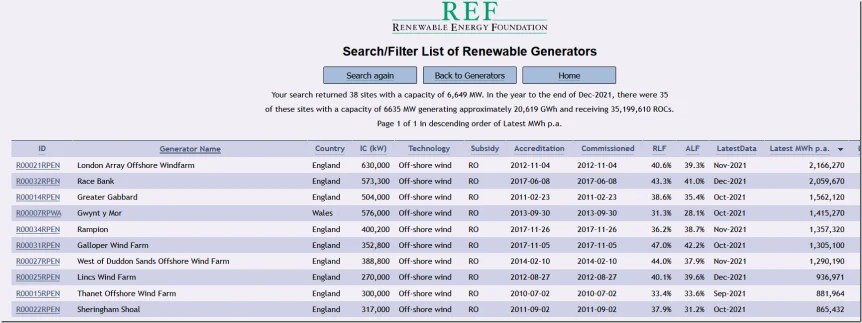
https://ref.org.uk/generators/search.php
I wrote yesterday about the ownership of the London Array offshore wind farm, To recap, London Array is jointly owned by the German owned RWE, the Canadian investor CDPQ, Orsted the Danish state owned energy company and he strategic investment company of the Government of Abu Dhabi, MASDAR. At current wholesale prices, London Array is making about £800 million a year more than they would have at 2019 prices.
None of the consortium are retail electricity suppliers in the UK, so would be shielded from any windfall tax on or nationalisation of energy suppliers, as has been suggested.
I thought I would look at some of the other big wind farms, which are subsidised by ROCs. The chart above is provided by the Renewable Energy Foundation, and I have listed below the owners of the eight other wind farms with capacity of 300 MW and over.
Race Bank – Macquarie, Orsted, Sumitomo Bank
Greater Gabbard – RWE Renewables, SSE Renewables
Gwynt y Mor – RWE Renewables, Stadtwerke Munchen, UK Green Investment Bank
Rampion – RWE Renewables, Enbridge, Offshore Wind Company
Galloper – RWE Renewables, Siemens, Macquarie, ESB, Spring Infrastructure
West Duddon – Scottish Power, Orsted
Thanet – Vattenfall
Sheringham – Equinor, Statkraft, UK Green Investment Bank
In short, they are nearly all wholly owned by a mix of foreign energy companies, banks and other infrastructure investors. As with the London Array, all of these wind farms/owners would be unaffected by taxes on energy retailers, with the exception of SSE and Scottish Power.
The combined output of these eight and London Array is about 16 TWh a year. At current prices of £375/MWh, the excess profit now being “earned” is around £5 billion a year.
Brits told to get used to drinking recycled sewage
By Thomas Lambert | The Counter Signal | August 29, 2022
British Environment Agency CEO James Bevan says that Brits should get used to the idea of having to drink recycled sewage in times of water uncertainty.
“We need to treat water as a precious resource, not a free good,” writes Bevan in The Sunday Times. “We will have to be more selective about what we use drinking water for. It makes no sense to use it to clean the car or water the lawn.”
“We will need to be less squeamish about where our drinking water comes from. Part of the solution will be to reprocess the water that results from sewage treatment and turn it back into drinking water — perfectly safe and healthy, but not something many people fancy.”
Bevan continues, explaining that, besides getting Brits to drink recycled sewer water, the government is specifically looking into ways to “help reduce personal water consumption” through measures such as “mandatory water-efficiency labelling for household goods.”
Bevan says that due to droughts and record low rainfall, rivers and reservoirs have fallen to dangerously low levels (not just in the UK but in several European nations), which the government has so far addressed by applying a hosepipe ban on millions along with several other restrictions.
As the UK struggles to keep up with the demand of its growing population — with most growth mainly being a result of immigration — and due to the impact of supposed climate change, he now expects that water security will be one of the government’s chief concerns over the coming years.
“Having enough water is at the heart of the climate emergency and an existential challenge,” Bevan writes. “If we don’t change gears and step up now, we will hit what I’ve called the “Jaws of Death.”
Johnson Predicts Harsh Months for UK Due to ‘Eye-Watering’ Energy Bills
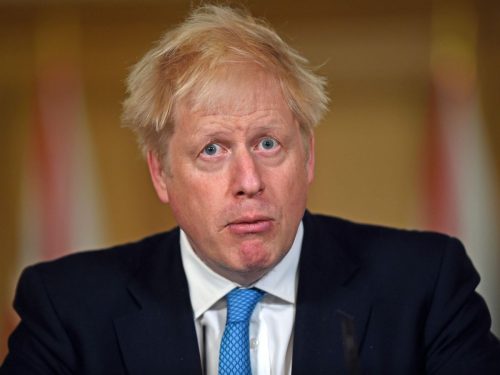
Samizdat – 28.08.2022
Outgoing UK Prime Minister Boris Johnson said in an op-ed that a few coming months will be tough for the British due to high energy prices.
“The months ahead are going to be tough, perhaps very tough,” Johnson wrote in an article, published by Daily Mail newspaper on Saturday. “Our energy bills are going to be eye-watering,” he said, adding “for many of us, the cost of heating our homes is already frightening.”
According to Johnson, the beginning of Russia’s special operation in Ukraine significantly affected the energy markets. However, he claims that the UK will emerge from the crisis stronger and more prosperous.
The UK prime minister said, referring to the confrontation with Russia, that “in this brutal arm-wrestle, the Ukrainian people can and will win. And so will Britain.”
The outgoing prime minister promised that whoever will be his successor, they will announce new measures of financial support for fellow citizens to tackle surging electricity prices.
On Friday, the UK energy regulator Ofgem announced an 80% increase in the energy price cap to 3,549 pounds ($4,194) per year starting October 1 due to rising global energy prices. Since its last revision in April, the energy price cap has stood at 1,971 pounds. In October 2021, the price cap was 1,277 pounds.
Ofgem chief executive Jonathan Brearley warned that energy prices are likely to continue to rise, and called on the country’s future prime minister to take new measures to tackle the problem.
Sanctions against Russia damage Western business
By Lucas Leiroz | August 26, 2022
The West itself appears to be the party most harmed by the sanctions it has chosen to impose against Russia. As well known, the US, UK and EU are facing a wave of inflation with all-time highs. And in the same sense, the business world is collapsing in Western countries. The business losses with the end of participation of some Western companies in the Russian market are extremely significant and are causing serious problems for the economy of many countries, with losses accumulating exorbitant amounts.
It is estimated that American, European, British, and Japanese companies have already lost more than 70 billion dollars since February. The losses are a consequence of the packages of sanctions imposed by Western countries on Moscow in response to the start of the special military operation in Ukraine. Many corporations withdrew from Russia or had their activities frozen, losing insertion in the powerful market of consumption, work and raw materials offered by Russia.
As expected, the most affected sector is the energy one, whose losses are estimated at almost 55 billion dollars, generating a series of problems for Western societies. Relations between Russia and Western Europe in the energy sector have always been a central strategic point in the international economic balance and now seem more threatened than ever. However, other sectors are also in similar situations.
Agricultural commodity, food and tobacco markets achieved losses of almost 8 billion dollars. In the same sense, in the technology and IT sector, 5 billion dollars of losses have already been accumulated. And there is also the vital banking sector, whose side effects of anti-Russian financial coercive measures have already led to a loss of 3,7 billion dollars – most of this amount belonging to Société Générale, the only banking group to have left Russia completely so far.
With regard specifically to the energy sector, the European and British companies most affected were BP, Linde, Uniper and Total Energies, whose billions of dollars in assets were harmed as a result of the suspension of the Nord Stream 2 gas pipeline and other Russian-European projects of cooperation. The process of disintegration of the Russian and European energy markets will not be so easily completed, as it is necessary to reverse a scenario of decades of cooperation, which will undoubtedly take time.
For example, BP, which announced its unconditional withdrawal from the Russian market in February, still remains one of Rosneft’s main partners, owning 19.75% of its shares. However, the process of disintegration has progressively advanced. BP itself revealed a loss of more than 25 billion dollars due to the freezing of its activities in Russia, pointing to a scenario that indicates a path towards the end of the cooperation in the near future.
American and Japanese energy companies are heading in the same direction. ExxonMobil, Mitsui & Co and Mitsubishi Corporation were some of the companies that had the most losses in recent months, mainly as a result of the effects that the coercive measures had on the Sakhalin-I and Sakhalin-II projects. Obviously, other energy companies were also affected by the packages of sanctions, albeit on a smaller scale, showing a scenario of generalized losses for this sector’s businesses.
For Russia, however, the deficits are much smaller and almost never imply real losses, but market restructurings. In energy, Russian oil and gas production remains strong and active, unaffected by the departure of some Western companies. The withdrawal of these companies makes room for other markets, such as the Chinese and Indian, which are the ones that have stood out in the search for Russian oil and gas in recent months. Meanwhile, Western companies lose important sources of supply that will not be easily resolved.
As for market sectors in which Russian consumption was of interest to Western companies, there are even fewer losses. The corporations that withdrew from Russia left their physical production structures there, which could be used by Moscow, generating employment for the Russian population, internal circulation of capital and economic progress.
For example, McDonald’s lost more than one billion dollars with its adherence to anti-Russian measures, but its withdrawal from the local market made room for the nationalization of the company’s production structures, and a Russian national company was created to sell fast food for Russian citizens. The same is currently happening with other Western companies that have left the Russian market. In short, the West lost a rich consumer market and handed over to Moscow all the necessary means for Russians themselves to supply their population with such goods and services.
In practice, all these facts simply mean damage to Western business. Entrepreneurs do not appear to have been consulted by heads of state on whether or not sanctions were in their best interest. The measures were simply imposed unilaterally to meet NATO’s geopolitical plans, without considering the opinion of companies that generate jobs for Western citizens. Currently, there are still plans to completely ban the entry of Russian citizens into Europe, which according to estimates will generate losses of more than 20 billion euros, harming the entire European market.
In fact, western sanctions, if not reversed, will lead the world into a global recession in which the most affected will be the western countries themselves. To avoid this, the business sector must mobilize to demand an end to sanctions.
Lucas Leiroz is a researcher in Social Sciences at the Rural Federal University of Rio de Janeiro; geopolitical consultant.
The latest on vaccination of 5-11 year-olds
When will the onslaught on children end?
Health Advisory & Recovery Team | August 23, 2022
In February 2022, the JCVI in their wisdom, made a ‘non-urgent offer’ of Covid-19 vaccination for healthy children aged 5-11, scheduled to begin in April. It is worth reading the full statement, which hardly makes a strong case. Here are a few quotes.
- In comparison to the rest of the population / older age groups, evidence indicates that children aged 5 to 11 are at the very lowest risk from COVID-19. Rates of hospitalisation, paediatric intensive care admission and death are lower in this age group than in all older age groups. In addition, the high level of prior infection in this age group of children can be expected to contribute towards their natural immunity against reinfection. There are some data to suggest that natural immunity may last longer than vaccine-induced immunity against non-severe infection.
- The impact of vaccination on school absences was indeterminate; the balance between school absences due to reactions following vaccination versus school absences avoided due to prevention of infection is highly influenced by the uncertain timing of any future wave of infection and of the vaccination programme.
- vaccine effectiveness against symptomatic infection due to Omicron (Pfizer-BioNTech vaccine) wanes over time from around 70% shortly after 2 vaccine doses to around 25% after 10 weeks and 10% after 20 weeks.
- [myocarditis] medium to long-term (months to years) prognosis remains less certain.
- It is estimated that over 85% of all children aged 5 to 11 will have had prior SARS-CoV-2 infection by the end of January 2022
This last point makes the programme for this age group even more ridiculous – the 85% estimate of January 2022 has now risen to 99%, and is perhaps the main reason why parents have not been clamouring to get their children vaccinated (10% to date). Despite this, the government is planning an enhanced programme this September to reach all the currently unvaccinated, in particular primary school children.
Cornwall and the Isles of Scilly (NHS Kernow) are leading the way with advertisements and pop up clinics because of ‘a rise in cases’. As previously, petting dogs have been enrolled, and advertisements such as the one pictured here, are falsely claiming that somehow vaccinating small children who are already immune, will magically protect their grandparents.

Legal challenges: Meanwhile, disappointingly though not surprisingly, the Court has thrown out the request for a judicial review of the MHRA, the JCVI, and Secretary of State’s decision to vaccinate this age group and for the 12-15s another judge likewise rejected the legal challenge. A member of the legal team involved has published his response to these judgements here but in effect both judges were saying that the MHRA, the JCVI and the CMOs are self-evidently “experts”, thus the Secretary of State is clearly acting correctly to accept their advice, irrespective of whether their advice is sound. This is a bad day for UK citizens since it appears that drug regulators are now unaccountable.
The political route: The Children’s Covid Vaccines Advisory Committee (CCVAC) who helped with these cases, have recently sent a summary of all their concerns to Stephen Barclay, the latest Secretary of State for Health & Social Care. A reply has been received giving the usual bland “Vaccines are now safer than ever before.” and quoting the same data presented by the JCVI a year ago, totally failing to grasp that the current data give a very different risk:benefit balance. The CCVAC team have also drafted a letter for the new Prime Minister and they are seeking health professionals to add their signatures ready to have a very large letter to deliver to the new incumbent of No 10 in early September. The letter calls on the Prime Minister to halt the vaccination of children pending a full and independent safety review. Is there any chance that the new British Prime Minister will follow the lead taken by several Scandinavian countries? The Director of Denmark’s Board of Health for example was recently on record saying that the vaccination of children had achieved nothing. Meanwhile a report from Iceland shows that in their ~60,000 child population, serious vaccine injuries (eleven) far outweighed Covid-19 hospital admissions (zero).
Readers are invited to share this letter with any health professionals they know, including staff at their local medical centre. Letter to incoming PM: apply the precautionary principle (childrensunion.org)
The media are (finally) admitting lockdown is worse than “Covid”… but why?
By Kit Knightly | OffGuardian | August 19, 2022
The latest figures from the UK’s Office of National Statistics (ONS) suggest that the knock-on effects of lockdown may be harming more people than “Covid” ever did, or so the press are saying anyway.
The ONS’s weekly data apparently shows over 10,000 more reported deaths than expected.
Since none of these excess deaths has been “linked with Covid”, the press is calling them the “true cost of lockdown”, with some papers suggesting lockdown is “killing more people than Covid”.
To which the only proper response is: “No shit.”
Even for those who still cling to the orthodoxy that “Covid” actually exists, the fact lockdown was going to do more damage than it prevented was obvious from the moment early mortality studies showed “Covid” had a 99.5% survival rate, back in the spring of 2020.
Many experts in economics, statistics, epidemiology and virology voiced this opinion, and were vilified and abused for their trouble.
And, really, anyone with the smallest shred of common sense could figure it out for themselves. Shutting down the health service and crashing the economy is never going to end well (unless you want to kill people, then it’s a great plan).
Even Dr David Nabarro, World Health Organization special envoy for Covid-19, described lockdowns as a “global catastrophe” in October 2020:
We in the World Health Organization do not advocate lockdowns as the primary means of control of the virus[…] it seems we may have a doubling of world poverty by next year. We may well have at least a doubling of child malnutrition […] This is a terrible, ghastly global catastrophe.”
So the question is not “Is lockdown worse than Covid?” The answer to that is “yes”, and we’ve known that for over two years.
The real question is: why are they finally admitting it?
It’s not just this week’s excess deaths either. Elsewhere the media is concerned about the mental health impacts of lockdowns, delays in cancer treatments, the “lockdown drinking”, the impact on children missing school, teenagers self-harming and so and so on.
Professor Karol Sikora – one of those vilified experts I mentioned earlier – has even been given space in the Telegraph to write a 2000 word “I told you so”.
Why?
Perhaps the answer to that lies not in what they’re talking about, but in what they are most pointedly not talking about.
The excess deaths are being very definitely laid at the feet of lockdowns, not the experimental “vaccines”.
Now, were the deaths really caused by the lockdown? Or by the “vaccines”? Or a mix of both? We don’t know, and can likely never know.
At this point our collective trust in institutions and official figures should be low enough to question if there were any excess deaths. Maybe they just made them up. They do that.
Regardless of the truth of it, the narrative is certainly shifting to highlight “the true cost of lockdowns”.
This could be about disguising the harm done by untested vaccines, admitting to potentially deleterious effects of lockdown to spare Pfizer’s blushes.
There’s a lot more invested in the vaccines than the lockdown – in every sense of the word – and if something has to be blamed it makes sense they would much rather it be lockdowns than jabs.
That’s a decent explanation, but I wouldn’t be surprised if there were more to it.
This narrative could be about setting up the public for the next “covid” wave or some new “pandemic”.
Consider how quickly the “true cost of lockdown” story could be parlayed into a new mainstream consensus that “Lockdown was so damaging, we must do whatever it takes to avoid another“.
Then consider how “Whatever it takes” could take the form of quarantine camps for the unvaccinated, vaccines mandates, enforced testing and surveillance…or whatever the hell else they want.
Is That True Or Did You Hear It On The BBC?
By Paul Homewood | Not A Lot Of People Know That | August 19, 2022
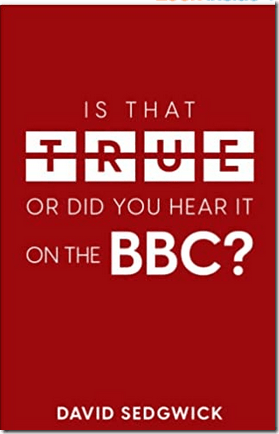 I have just bought this book, which includes some good stuff on the BBC’s climate lies and misinformation.
I have only read the first couple of chapters, but I would thoroughly recommend it.
This is the Amazon summary:
… not only does the BBC diligently protect power from scrutiny, it attacks and attempts to discredit those who dare to challenge the status quo.
Formed in 1922 by the British establishment, the BBC has always been a reliable ally of ultra-wealthy and powerful interests. Indeed, the broadcaster occupies a pivotal position within an international corporate-political alliance which promotes only those narratives which consolidate the ‘global order.’
Using multiple examples of BBC reporting, the author argues that the tax-payer funded broadcaster is a proxy which acts on behalf of a tiny, but very powerful clique – a role which compels it to pump out disinformation on an industrial scale, misleading all those who consume its content.
The book includes sections on:
- Climate Change
- Brexit
- COVID
- Trump
- NHS
Sedgwick’s premise is an interesting one that the BBC has always protected the establishment. One implication from this is that this same establishment has morphed over the years, from a reactionary one of the past to the left wing, big government, global world order one of today.
Europe decreasing support to Ukraine
Data shows that European countries did not offer new military aid to Kiev in July
By Lucas Leiroz | August 18, 2022
Apparently, European countries are understanding that the path to peace in Ukraine requires stopping military aid. Data show that in July the six major European powers abstained from making new military agreements with Kiev. It was the first month without European aid pledges to Ukraine since the beginning of the Russian special military operation, in February. In fact, this indicates that Western support is on decline, leaving only Kiev to decide whether or not to continue with the conflict.
The news was announced by the Kiel Institute for the World Economy – more specifically through Ukraine Support Tracker, which operates within the Institute. According to the researchers, European authorities have become unable to keep up with the speed with which the US, UK and Poland send military aid. This situation has led to a slow decline in the supply of money, weapons and equipment, resulting in July’s absolute absence of support contracts.
The decline has been occurring since April. Looking from a realistic point of view it is possible that the Russian advance may have discouraged European leaders from maintaining high spending on the conflict, considering it as simply “lost”. Also, the discouragement may have been intensified especially after the Russian victory at the battle of Azovstal in May, when Western analysts finally began to admit that Kiev is losing the conflict.
More than geopolitical realism, there is also the direct pragmatic factor: Europe cannot promise Kiev more than it currently promises simply because it cannot give Kiev more than it currently does. Americans, British and Poles are managing to fulfill their promises because they have taken the Ukrainian situation as a national emergency and are mobilizing their productive forces to meet this demand. However, the EU has many other priorities that make it impossible to give more help to Kiev. In other words: whatever is happening at the front, Europe is not promising Kiev any more aid simply because it can no longer help.
Obviously, the situation will not lead to an abrupt interruption of aid, but a gradual decline. Certainly, the end of support will not be definitive or linear, having expectations for modest resumptions and new interruptions again. For example, at the beginning of August, there was a meeting between European authorities in Copenhagen to re-discuss aid strategies. It was decided that an amount of 1.5 billion euros would be sent. Although the act somehow means that Europeans still “care” about Ukraine, the number is far lower than previous conferences’ packages.
Commenting on the topic, Christoph Trebesch, head of the team compiling the Ukraine Support Tracker, said: “Despite the war entering a critical phase, new aid initiatives have dried up. (…) When you compare the speed at which the checkbook came out and the size of the money that was delivered, compared to what is on offer for Ukraine, it is tiny in comparison (…) I would say [current European support is] surprisingly little considering what is at stake (…)“.
Trebesch believes that the correct European stance would be to invest in the Ukrainian conflict the same amount of money invested in overcoming previous events, such as the eurozone crisis and the new coronavirus pandemic. Trebesch’s opinion reiterates that of many other pro-Kiev activists, who believe that a Russian victory would be an absolute disaster for the entire Europe and lead to the bloc’s collapse, which is why every possible effort should be made now in order to prevent Moscow from reaching its goals.
And even though political realism is growing among Europeans, many authorities still think like Trebesch. For example, Latvian Defense Minister Artis Pabriks asked: “If we are wanting the war to end as soon as possible, they need to ask themselves, are they doing enough?”.
In fact, realism may overcome ideological or humanitarian arguments. The EU certainly has other priorities to address. The conflict itself brings with it many problems, such as the energy and food supply crisis. Thinking about solutions to problems that affect Europeans should be a priority over thinking about strategies to reverse the military scenario.
Furthermore, the argument that the current crisis should receive the same investment funds from previous crises is unfounded. The conflict in Ukraine, as much as it worries the EU, is a foreign matter and cannot be a priority now. If the US, UK and Poland keep Ukraine as a priority, it is because these countries maintain a geopolitical and ideological rivalry against Russia, which is not the case in Europe.
Lucas Leiroz is a researcher in Social Sciences at the Rural Federal University of Rio de Janeiro; geopolitical consultant.
Featured Video

Pravin Sawhney: Massive Escalation Pushes Every Side Toward the Brink
or go to
Aletho News Archives – Video-Images
From the Archives
UN declares war on ‘dangerous’ conspiracy theories
‘World is not secretly run by elites’
Free West Media | August 5, 2022
UNESCO says it is seriously concerned about the increase in “disinformation” and “conspiracy theories”. And they plan to put an end to it through a network of informants.
“Conspiracy theories can be dangerous,” the UN agency warned. “Often they ignore scientific evidence and polarize society with dire consequences. This has to stop.”
Unesco’s director-general warned that “conspiracy theories” could cause damage to people as well as to their health. “They reinforce misconceptions about the pandemic, reinforcing stereotypes that can fuel violence and violent, extremist ideologies,” said Audrey Azoulay.
The UN agency has launched a campaign to help people identify, debunk and report “conspiracy theories” to prevent them from spreading further.
This campaign is being carried out in collaboration with the European Commission, Twitter and the World Jewish Congress. The UN has created a toolkit to “debunk” such theories and smear anyone who dares to claim that governments are not fair and transparent.
The UN also warned that George Soros, the Rothschilds and Israel should not be linked to “alleged conspiracies”.
World events “are not secretly manipulated behind the scenes by powerful players with malicious intent,” the UN agency maintained.
And if anyone therefore comes across someone who believes that the world elite is plotting to consolidate power or direct events, then that person needs to take action. According to the UN agency, when meeting a “conspiracy theorist”, under no circumstances should one enter into a discussion. … continue
Blog Roll
 Aletho News
- Pravin Sawhney: Massive Escalation Pushes Every Side Toward the Brink
- UK High Court Upholds Speech Regulator Notices To Meta, WhatsApp, X, And TikTok
- Two working on US Senate candidate’s campaign registered as foreign agents for Israel: Report
- Greece bans protest over docking of Israeli cruise ship
- Israel elections: More Arab votes, same Zionist consensus
- Taking the Houthis at Their Word: The Bill Saudi Arabia Doesn’t Want to Read
- Trump claims he would have bombed Ho Chi Minh City to win Vietnam War
- Russia shows Europe that prolonging the Ukraine war is pointless
- There is cautious optimism about ending the Ukraine War – Part 2
- Ukrainian air alert app hacked with fake nuclear warnings
- If Americans Knew
- An error has occurred; the feed is probably down. Try again later.
- No Tricks Zone
- Germany’s Green Energy Transition Becoming Increasingly Expensive…Another 6 Trillion Euros!
- Sudden Stratospheric Warming, Powerful El Niño Combination May Lead To Extreme Europe Cold, Energy Crisis!
- Two New Studies Find Thwaites Glacier Melt Cannot Be Driven By Human Activity Or A Warming Ocean
- E-Cars Reduce CO2 Emissions By Only 41% Compared To Internal Combustion Engine Vehicles
- Predictions Made By Renowned Climate Professor Over Past Decades Have Been Proven To Be Poor
- New Study Suggests Large Regions Of The Pacific Ocean Have Been Cooling For The Last 80 Years
- Germany’s Green Energy Debacle: High Energy Costs Force Kahla Porzellan to Close After 182 Years!
- New Study: 50 Years Of The Most Aggressive ‘Net Zero’ Policies Can Only Affect The Global Climate By 0.03°C
- US September “Heat” Was No Record…Many Records Set Decades Ago
- Latest European Green Energy Debacle; Portugal’s Largest Flagship Solar Park Insolvent!

