Former colony resists direct UK rule

The acting premier of the British Virgin Islands, Dr. Natalio Wheatley.
Samizdat | May 1, 2022
The acting premier of the British Virgin Islands has voiced deep “concerns” over London’s plans to assume direct governance of the Caribbean territory, following the arrest of its leader in a US drug sting operation, and a highly-critical report into alleged systemic corruption.
On Friday, shortly before the premier of the British Virgin Islands, Andrew Fahie, appeared before a US judge on charges of cocaine smuggling and money laundering, a commission of inquiry led by Judge Sir Gary Hickinbottom hurriedly published its final report, urging the UK to dissolve the islands’ elected government, suspend their constitution, and impose direct rule for at least two years.
“What this would mean in real terms is that there would no longer be elected representatives who represent the people of the districts and the territory in the house of assembly where laws are made for our society,” said Natalio Wheatley, who assumed the post of acting premier after Fahie’s arrest.
London already dispatched a Foreign Office minister, Amanda Milling, to meet the territory’s Governor James Rankin and other senior figures and discuss the terms of direct rule, ahead of a formal decision expected next week.
The acting BVI premier acknowledged “very serious matters highlighted in the report, which spanned successive Administrations,” and did not question the British Crown representative’s authority and responsibility to maintain order – but said the proposed reforms “can be achieved without the partial or full suspension of the constitution,” under already existing emergency powers.
“I urge you the public to read the report with an objective eye in terms of strengthening our systems of Government under a democratic framework of governance, as opposed to draconian measures that would set back the historical constitutional progress we have made as a people.”
Hickinbottom’s commission was established in 2021, amid claims of corruption and wasteful government spending – as well as rumors that the island leadership was engaging in drug trafficking. According to The Guardian, the British government was aware of the US undercover investigation, and decided to “rush out” the 1,000-page Hickinbottom report after Fahie was arrested.
Named by Christopher Columbus, the Virgin Islands are divided between the UK, the US and the US territory of Puerto Rico. Some 35,000 BVI residents have been British citizens since 2002. While they enjoy a limited self-governance under a 2007 constitution, the string of islands is officially designated as one of the British overseas territories, called crown colonies prior to 1983.
Strike off the truth tellers? No, strike out Whitty & Co!

By Angus Dalgleish | TCW Defending Freedom | April 30, 2022
THE recent announcement from the General Medical Council that doctors face being struck off for spreading fake news on vaccines and lockdowns is somewhat frightening given the recent experience of Dr Sam White, a GP in Hampshire. It has a chilling Orwellian overtone to it.
It seems to imply that fake news is anything not approved by the Government and any of its agencies such as Public Health England and the NHS plus the mainstream media, who have been bribed throughout the pandemic with lucrative advertising contracts.
It assumes that ideas and speculation from discredited sources such as Neil Ferguson and Sage were correct and accepted by the senior medical officers such as Chris Whitty and Patrick Vallance, with all other inputs ignored or treated with contempt. Many of us suggested that as Covid was an airborne virus which affected mainly the old and those with other medical conditions it should be treated as such. This was based on knowledge accrued from years of treating such unknown upper respiratory tract infections (URTIs) which involves correcting the hideously low levels of vitamin D3 in the population and treating symptoms with regular gargling of aspirin and mouthwash and intranasal sprays. In short, vitamin D3 and topical anti-inflammatory medicines abort colds and flu when given early and frequently.
Why was this not made official policy? I observed severe Covid symptoms melt with such a regimen in many friends and colleagues.
Secondly, why were doctors not allowed to give dexamethasone, which is known to be life-saving in cases of lung inflammation? No, we had to wait for a trial to tell us it worked. A colleague calculated that 4,000 to 5,000 patients died unnecessarily through this decision, which the Chief Medical Officer has to own.
Also why did they stamp on any original idea such as ivermectin, which was dismissed as ‘worm treatment for horses’ when it clearly has some benefit in some Covid cases?
What I am driving at here is that common sense can be classified as fake news by the ever-increasingly power-crazed authorities. The greatest example of this ill-informed madness was the decision to enforce lockdowns not once but twice. It has been calculated that lockdown probably averted 200 Covid deaths but the advisers took no account of the effects on other conditions by denying screening and early treatment of cancer, heart attacks, strokes, not to mention the infliction of severe mental health problems and chronic stress (I personally know of four suicides, two of them medical colleagues). This is before we get on to the big picture – the destruction of young lives, education and the economy.
For what? Sweden refused to follow the lockdown route and not a single child lost a day’s education.
Our experts who felt entitled to tell us what to do and conspired to denigrate those of us with an alternative take such as Professor Sunetra Gupta, myself and other Great Barrington declarants. They cruelly derided Sweden’s state epidemiologist Anders Tegnell for refusing to back lockdown, with 2,000 of his own condemning him.
It has now been accepted by all bar the CCP in China that lockdown was an absolute and avoidable disaster. Yet those of us who were right would be persecuted and prosecuted and struck off by this new emanation from the GMC. Dr Sam White also thought that masks were a waste of time, something every one of the government advisers has agreed with at some time, but they were insisted upon by the Department of Fear, Intimidation and Control of the Population.
Next comes the ‘vaccine’ project. In spite of our warning that a good vaccine needs a powerful T-cell adjuvant, and that the 80 per cent of the spike which mimicked human sequences and was likely to induce side-effects should be omitted, we were dismissed as not important or eminent enough to heed. The vaccines that the establishment backed were experimental medicines designed to reduce morbidity and death in the older population and of course to save the NHS.
So why were they imposed on the whole population without testing to see if they were needed? Even the BCG vaccine was given only to non-tuberculin reactors after a test.
My colleagues started to see serious reactions especially in those below 55 years, which have now been accepted to be real, such as blood clots, strokes, heart inflammation and death. Our original report highlighted the sequence in the spike similar to a neurological protein and severe neurological damage has now been officially recognised. For pointing this out early we were accused of being anti-vaxxers. No, we were not! We were just trying to save people from serious side-effects from a disease with an 0.085 per cent fatality rate.
Presumably the GMC would now strike off anyone, such as Sam White, trying to do the best for their patients. No, they should be looking at the real culprits for this mayhem and whether they had the skills and experience to make these decisions (they did not).
Bizarrely, in this brave new world they were given knighthoods.
Vaccine Rollout Correlates With 25% Spike in Cardiac Arrest Emergency Calls for Young Adults, Study Finds
By Will Jones | The Daily Sceptic | April 29, 2022
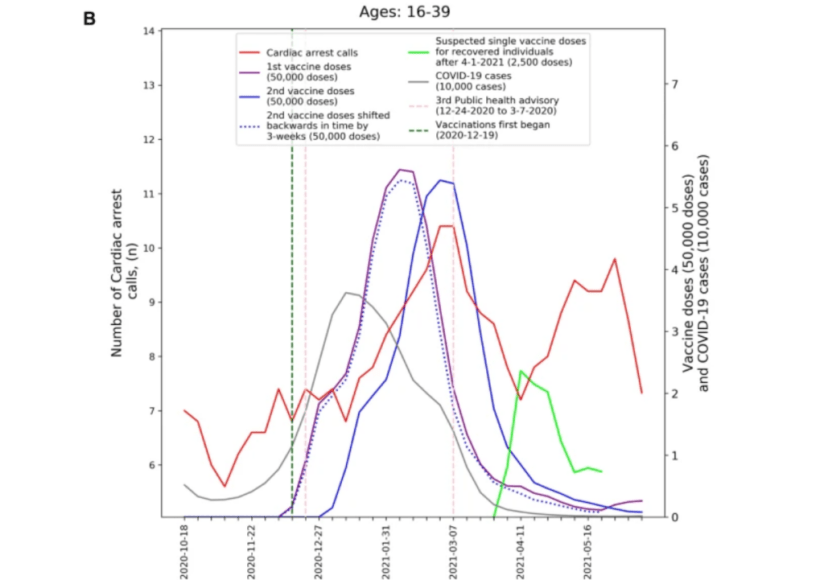
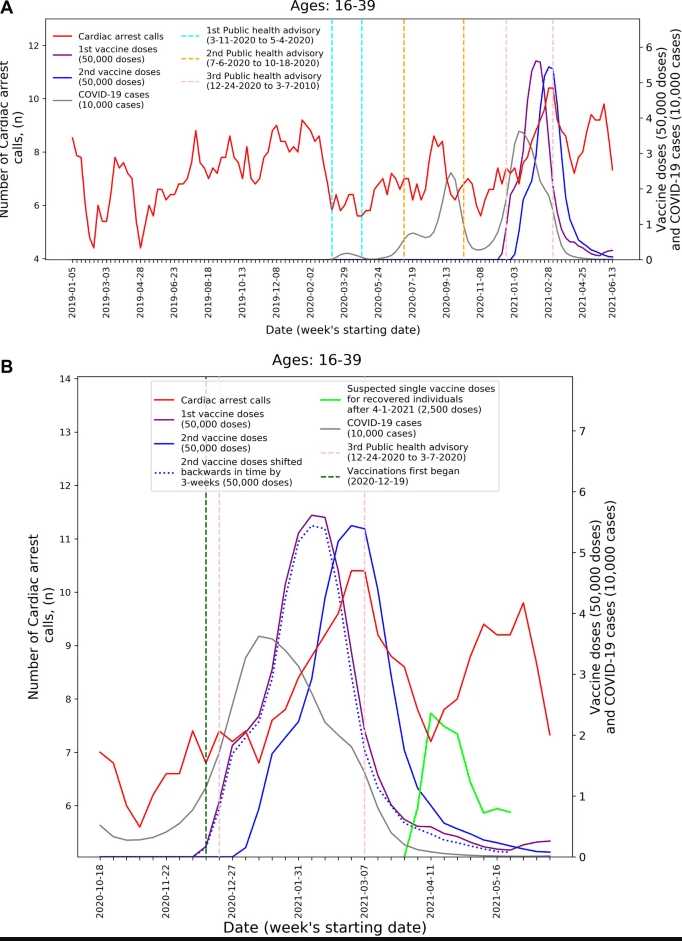
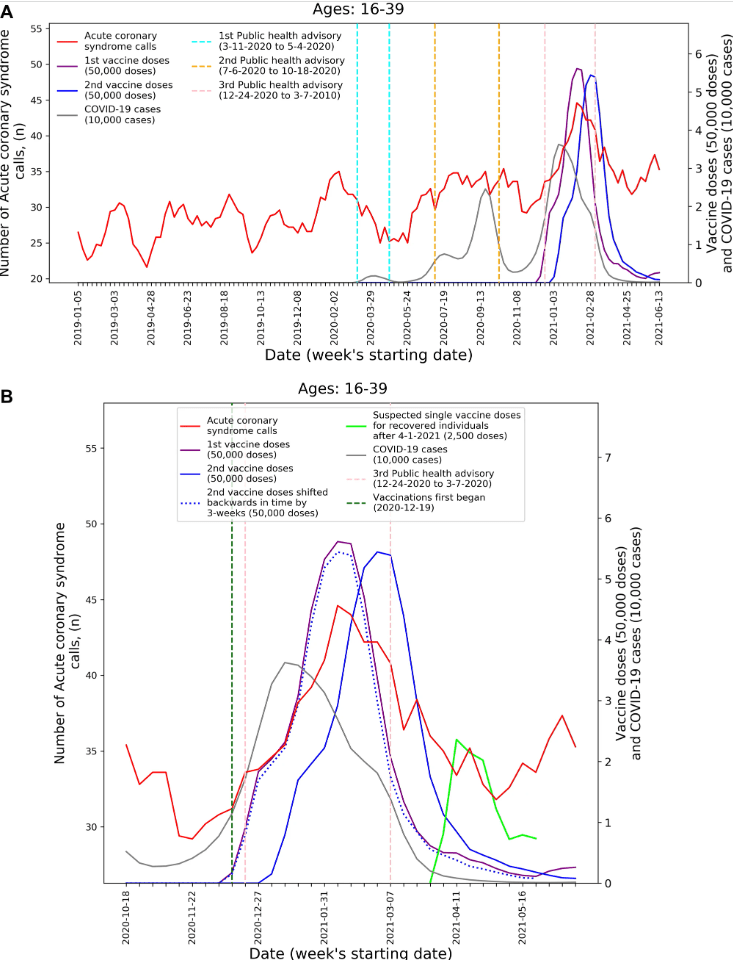
Emergency calls for cardiac arrest and acute coronary syndrome in young people in Israel were significantly associated with the vaccine rollout, both first and second doses, spiking 25% higher than in earlier years, but not with COVID-19 prevalence, a study in the Nature journal Scientific Reports has found.
Using data from the Israel National Emergency Medical Services (EMS) from 2019 to 2021, the study looked at the volume of cardiac arrest and acute coronary syndrome EMS calls in the 16-39 year-old population. It found an increase of over 25% in both call types during January-May 2021, compared with 2019-2020, but no significant increase in calls correlating with COVID-19 infection rates.
The main finding of this study concerns with increases of over 25% in both the number of CA [cardiac arrest] calls and ACS [acute coronary syndrome] calls of people in the 16-39 age group during the COVID-19 vaccination rollout in Israel (January-May, 2021), compared with the same period of time in prior years (2019 and 2020). Moreover, there is a robust and statistically significant association between the weekly CA and ACS call counts, and the rates of first and second vaccine doses administered to this age group. At the same time there is no observed statistically significant association between COVID-19 infection rates and the CA and ACS call counts. This result is aligned with previous findings which show increases in overall CA incidence were not always associated with higher COVID-19 infections rates at a population level, as well as the stability of hospitalisation rates related to myocardial infarction throughout the initial COVID-19 wave compared to pre-pandemic baselines in Israel. These results also are mirrored by a report of increased emergency department visits with cardiovascular complaints during the vaccination rollout in Germany as well as increased EMS calls for cardiac incidents in Scotland.
While several studies have found severe myocarditis to be a rare adverse effect of the vaccines, the study authors note that myocarditis is often missed, and in fact has been found to be likely responsible for 12-20% of unexpected deaths in adults under 40 in normal times.
Myocarditis is a particularly insidious disease with multiple reported manifestations. There is vast literature that highlights asymptomatic cases of myocarditis, which are often underdiagnosed, as well as cases in which myocarditis can possibly be misdiagnosed as acute coronary syndrome (ACS). Moreover, several comprehensive studies demonstrate that myocarditis is a major cause of sudden, unexpected deaths in adults less than 40 years of age, and assess that it is responsible for 12-20% of these deaths. Thus, it is a plausible concern that increased rates of myocarditis among young people could lead to an increase in other severe cardiovascular adverse events, such as cardiac arrest (CA) and ACS. Anecdotal evidence suggests that this might not be only a theoretical concern.
The results, shown visually in the following graphs, are unmistakable, with clear corresponding spikes in vaccination numbers and emergency calls.
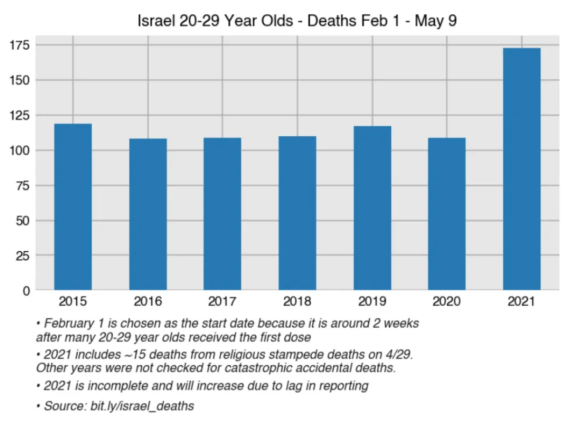
The study does not look at death rates in the age group, but data elsewhere show a clear spike in deaths during the period.
SPR/CBS
Surely it’s well past time these experimental vaccines (in Israel’s case, Pfizer), rushed to market in record time, are withdrawn for younger people.
Study: Lockdowns Drove 60,000 Children in UK to Clinical Depression
By Paul Joseph Watson | Summit News | April 28, 2022
A new study published in the Royal Society Open Science journal found that lockdowns in the UK caused around 60,000 children to suffer clinical depression.
Researchers detected a 27.1 per cent prevalence of depression amongst their sample, a number significantly higher than would have occurred without lockdowns.
According to a report by the Telegraph, the percentage equates to about 60,000 extra kids who suffered clinical depression thanks to COVID-19 restrictions.
“After controlling for baseline scores and several school and pupil-level characteristics, depressive symptoms were higher in the COVID-19 group,” the study found.
“These findings demonstrate that the COVID-19 pandemic increased adolescent depressive symptoms beyond what would have likely occurred under non-pandemic circumstances.”
Figures show that 400,000 British children were referred to mental health specialists last year for things like eating disorders and self-harm.
Once again, the study underscores how those who vehemently promoted lockdowns, while demanding voices of dissent be silenced, were on the wrong side of history.
As we previously highlighted, a shocking outbreak of hepatitis cases in children was likely caused by lockdowns and social distancing, which served to weaken immune systems, according to health experts.
Many infants are also suffering from cognitive developmental and speech disorders due to adults wearing face coverings during the pandemic.
According to speech therapists, mask wearing has caused a 364% increase in patient referrals of babies and toddlers.
A major study by Johns Hopkins University concluded that global lockdowns have had a much more detrimental impact on society than they have produced any benefit, with researchers urging that they “are ill-founded and should be rejected as a pandemic policy instrument.”
Doctors Could Be Struck Off For Questioning Government Line on Lockdowns and Vaccines Under New Guidance
By Will Jones | The Daily Sceptic | April 27, 2022
Doctors who criticise vaccines or lockdown policies on social media could face being struck off if regulators rule they are guilty of spreading ‘fake news’, according to new guidance from the GMC. The Telegraph has the story.
The core guidance for medics has been updated for the first time in almost a decade to cover media such as Twitter, Facebook and Instagram. The rules on use of social media include a duty to be “honest” and “not to mislead”, as well as to avoid abuse or bullying.
The draft regulations from the General Medical Council (GMC) – which the watchdog describes as a 21st-century version of the Hippocratic Oath – also say doctors must speak out if they encounter “toxic” workplace cultures that threaten patient safety. And they say medics must take action if they encounter workplace bullying, harassment or discrimination.
The watchdog regulates doctors, who can face a range of sanctions – including being struck off the medical register – if they are found to have failed in their duties.
Charlie Massey, the Chief Executive of the GMC, said… the fundamental principles of the guidance remained the same, but had been updated to reflect the modern world.
“We’ve had feedback that doctors want more clarity on using social media. We are already clear that doctors must be honest and trustworthy in their communications, and are now emphasising that this applies to all forms of communication. The principles remain the same whether the communication is written, spoken or via social media,” he said.
The use of social media by medics has become an increasingly vexed issue during the pandemic, the report adds.
In December a judge ruled that the GMC’s interim orders tribunal had made an “error of law” when it ordered a GP accused of spreading misinformation to stop discussing Covid on social media.
Dr. Samuel White, who was a partner at a practice in Hampshire, raised concerns about vaccines and claimed “masks do nothing” in a video posted last June.
The GMC’s Interim Orders Tribunal imposed restrictions on Dr. White’s registration as a result. But the High Court said this decision was “wrong” under human rights law.
He had claimed “lies” around the NHS and Government approach to the pandemic were “so vast” that he could no longer “stomach or tolerate” them.
In August, the tribunal concluded Dr. White’s way of sharing his views “may have a real impact on patient safety”. It found Dr. White allegedly shared information to a “wide and possibly uninformed audience” and did not give an opportunity for “a holistic consideration of COVID-19, its implications and possible treatments”.
But the GP’s barrister, Francis Hoar, argued the restrictions imposed on his client’s registration were a “severe imposition” on his freedom of expression.
The draft guidance says doctors can be held accountable for promoting misleading information or stepping outside areas of their expertise. They are told to “be honest and trustworthy … make clear the limits of your knowledge… [and to] make reasonable checks to make sure any information you give is not misleading.
“This applies to all forms of written, spoken and digital communication,” the draft guidance states. And doctors are warned that online rows and trolling could jeopardise their professional futures.
It is of course outrageous that medics should be at risk of losing their career for questioning on Twitter the Government line on its draconian public health interventions. If there’s one thing we were lacking during the pandemic it was not an excess of conformity amongst doctors. The right of medics to ‘informed dissent’ should be strengthened, as per the High Court ruling in favour of Dr. White, not weakened.
On the other hand, there are plenty of Government advisers I can think of who could do with being penalised for “stepping outside areas of their expertise”. Somehow I doubt anything similar will ever be applied to them, however.
Worth reading in full.
Stop Press: The GMC guidance is still the subject of a public consultation – and anyone can contribute. Click here to begin the process.
Political West mulls reshaping UN and what’s left of international law
By Drago Bosnic | April 27, 2022
In order to understand the prelude to World War 2, one cannot ignore the failures of the long-defunct League of Nations, which was a UN-like structure aimed at being a forum of countries resolving disputes through dialogue rather than war. Although just another noble idea before World War 1, in the immediate aftermath of the sheer death and destruction resulting from that conflict, it became an urgent necessity. The League of Nations was supposed to make sure nothing of sorts ever happened again.
Sadly, as we all know, it failed miserably, with an even worse conflict erupting less than 20 years after the Paris Peace Conference was completed. Now, nearly 80 years since the horrors of WW2, we have reached a hauntingly similar point as we realize the UN didn’t just inherit the League of Nations flag, but also many of the same faults which ultimately led the world into yet another disaster of global proportions, one which resonates to this very day.
The United Nations Security Council (UNSC) is the pillar of the UN and its veto power mechanism serves as a balancing tool which takes into account the interests of world powers and thus provides the UN with relevance which no other international organization or forum of sovereign nations in known history ever had. Currently, the five permanent members of UNSC (China, France, Russia, the UK and the US) can veto any resolution put forth by the body. The council’s other 10 rotating members do not have such powers.
This veto power has especially been a source of frustration for the United States, NATO and the EU. Due to their dominance in the UN General Assembly (UNGA), where there is a swarm of Western client states and statelets, many of which were created through deliberate and oftentimes forceful disintegration of larger and more sovereign nations (for instance, Yugoslavia was split into 6 states and one illegal state-like entity), the political West wants this UN body to be more prominent than the UN Security Council.
By pushing the UN General Assembly to the forefront of decision making, the West could then simply force these countless vassal states and statelets to vote in a way which would be beneficial to the US, EU or NATO and give these decisions a sort of “international community” touch which the political West needs in order to build what they see as a much-needed facade of “international legitimacy”.
Because of this, Western political elites and the mainstream media often try to portray the UNGA as a “more democratic” body than the UNSC. How truly democratic is up for debate, given the sheer amount of US pressure and arm-twisting used to coerce countries into voting not just in line with Western interests, but oftentimes at the expense of their own. And in terms of population distribution, we see that these states and statelets, despite oftentimes being the majority or close to a majority in the UNGA, actually represent less than 20 or even 15 percent of the world’s population. This also explains the Western obsession with forceful fragmentation of larger nations into smaller ones, echoing the ancient Roman policy of divide et impera.
To meet this goal, the UNGA is now considering introducing a provision that would require permanent members of the UN Security Council to justify their use of veto powers. It was tabled by Liechtenstein in mid-April and presented at a closed-door discussion panel last Tuesday. The discussion supposedly “turned out to be quite positive” and the initiative “received additional co-sponsors”, the mission of the microstate to the UN said after the meeting.
“We had a strong turnout and positive engagement on the Veto Initiative in open format this afternoon. We will continue our work to get the strongest possible political support for our text which now has 57 cosponsors,” it stated.
If adopted, the initiative would mandate convening the UNGA within 10 days after a permanent member of the UNSC uses their veto power. At the meeting, the state would have to justify its decision to use the veto. According to Liechtenstein, adopting the provision would “empower the General Assembly and strengthen multilateralism.”
Quite unsurprisingly, so far, the initiative has been openly supported only by one permanent member of the UNSC – the United States. Washington co-sponsored the provision, openly acknowledging the drive is aimed at Moscow and its use of the veto power to block a resolution on the ongoing Russian special military operation in Ukraine. Announcing the co-sponsorship, the US envoy to the UN Linda Thomas-Greenfield accused Moscow of “misusing” its veto powers.
“We are particularly concerned by Russia’s shameful pattern of abusing its veto privilege over the past two decades,” she stated, adding that, in the latest alleged abuse, Moscow had used the veto power to “protect President Putin from condemnation over his unprovoked and unjust war of choice against Ukraine.”
Of course, it would require an entirely separate analysis to dissect US envoy’s statements, which are filled with “liberal interpretation” of facts. But the statement does confirm the assertion that the political West, and the US in particular, are trying to reshape the UN to their liking, which would result in sidelining US competitors. In doing so, the US might be successful in turning the UN into another footnote of its belligerent foreign policy and even use it to justify sanctions and wars of aggression anywhere in the world.
However, even though this may seem like a victory to the aggressive planners in Washington DC, it may spell a disaster for world peace. By sidelining countries like Russia, China or even India, Brazil, South Africa and many others in the foreseeable future, the US is incentivizing these countries to ignore or even leave the UN, which would bring about the de facto end of international law.
At best, it would result in the creation of another UN-style organization led by those same sidelined countries, bringing about a deeply divided world where there would be at least two blocks – the political West (plus its vassals) and the rest of the world composed of sovereign nations. The last time such a division happened, the world suffered up to 80,000,000 dead in just 6 years.
Drago Bosnic is an independent geopolitical and military analyst.
5 signs they are CREATING a food crisis
By Kit Knightly | OffGuardian | April 25, 2022
It’s no secret that, according to politicians and the corporate press, “food shortages” and a “food supply crises” have been on the way for a while now. They have been regularly predicted for several years.
What’s really strange is that despite its near-constant incipience, the food shortage never seems to actually arrive and is always blamed on something new.
As long ago as 2012, “scientists” were predicting that climate change and a lack of clean water would create “food shortages” that would “turn the world vegetarian by 2050”.
In 2019, UN “experts” warned that “climate change was threatening the world’s food supply”.
Later the same year, the UK was warned that they could expect a food shortage as a result of “post-Brexit chaos”.
By early March 2020 supermarkets were already “warning” that the government had been too slow to act on the coronavirus outbreak, and they might run out of food. (They never actually did).
A month later, in April 2020 when the “pandemic” was less than three months old, “officials” warned Covid was going to create a global food crisis. Three months later it had ballooned into “the worst food crisis for 50 years”.
In the Summer of 2021 the British press was predicting the “worst food shortages since world war 2” and “rolling power cuts”, allegedly due to a lack of truck drivers blamed equally on Covid and Brexit (neither the shortages nor power cuts ever really materialised).
By September 2021, the UK was told the gas price spike would create a shortage of frozen food, and just a month later, that we may have to ration meat ahead of Christmas, due to the gas crisis. (There never was any rationing)
In January 2022, Australia saw “empty supermarket shelves” blamed on the Omicron variant crippling the supply chain, while the US had the same empty shelves blamed on bad winter weather.
Moving into the spring of 2022, the food crisis is still on its way…only now it’s because of the war in Ukraine, or China’s “Zero Covid” policies, or the bird flu outbreak.
You’d be forgiven for thinking that – since the food crisis is always expected but never arrives, and is always blamed on the current thing – that it doesn’t really exist. That it’s nothing but a psy-op designed to spread panic and give suppliers an excuse to jack up their prices in response to fake “scarcity” created by the press.
However, there are indications that this may be about to change.
In a Brussels press conference on March 25th of this year, Joe Biden said…
Regarding food shortages – yes, we did talk about shortages, and they’re going to be real.”
… which is a decidedly odd thing to say.
Most of the time the only reason to strongly affirm something is “going to be real” from now on, is that up to that point it was not.
Indeed, there are a few signs that the food supply is about to genuinely come under attack.
1. UKRAINE WAR & WESTERN SANCTIONS
It’s well documented that Russia’s “special operation” in Ukraine has driven up the prices of oil, gas and wheat. Partly due to disruption on the ground, but mostly due to Western sanctions.
Russia is the largest exporter of wheat and other grains in the world, and these products are used not just for making food for humans, but also as animal feed. Western nations boycotting Russian wheat will therefore potentially drive up the price of a huge variety of foodstuffs.
We have already seen rationing of sunflower oil (a major Ukrainian export), with reports that this could extend to all kinds of other products including sausages, chicken, pasta and beer.
This war did not need to happen, it could have been prevented (and could still be stopped) by a simple agreement on Ukrainian neutrality. Combine that with the sweeping nature of the anti-Russian sanctions – unmatched in recent history – and you can reason that the chaos on the ground and concomitant increase in food prices is part of a deliberate policy serving the Great Reset agenda.
2. INCREASING THE PRICE OF OIL
The increased price of oil has natural and obvious knock-on effects for every industrial sector – most especially transport, logistics and agriculture. Despite fears of a cost of living crisis, warnings of food shortages and Russia’s status as the largest exporter of oil and gas in the world, Western nations and their allies have made virtually zero effort to lower the cost of oil.
The high oil price has already seen the Russian ruble bounce back to pre-war strength, and yet Saudi Arabia has been increasing their prices, not flooding the market to tank the price as they did in 2014/15.
Keeping the cost of petroleum high is a deliberate policy decision, and one that shows the cost of living crisis – and any resultant food shortages – are being engineered on purpose.
3. BIRD FLU
The press is claiming there is a major bird flu outbreak going on. As we published last week, the dynamics of “bird flu” seem to be identical to Covid. Birds are tested for the virus using PCR tests, culled if they are “positive”, and these culls are then labelled “bird flu deaths”.
This process has already seen at least 27 million poultry birds destroyed in the US alone, the world’s largest exporter of both chicken and eggs. France, Canada and the UK have also culled millions of birds.
Bird flu has already (allegedly) caused the price of chicken and eggs to skyrocket.
(As a potentially important aside, a new report has also warned that pigs can pass “superbugs” to humans, so pigs may be for the chop sometime soon, too)
4. UK & US PAYING FARMERS TO STOP FARMING
Going back to last May, the Biden administration began pushing farmers to add agricultural land to the “conservation reserve program”, a federally funded program allegedly aimed at preserving the environment. The program is essentially paying farmers not to farm. A very odd policy decision, given the widely predicted food shortages.
A state-level plan in California is going to pay farmers to grow less, this time in the name of saving water.
Interestingly, the UK has a similar program going on for (again, allegedly) totally different reasons. Starting this past February, the British government is paying lump sums of up £100,000 to any farmers who want to retire from farming. Again, a strange policy during a period of geopolitical unrest impacting the food supply.
5. MANUFACTURED FERTILISER SHORTAGES
Russia and Belarus are two of the biggest exporters of fertiliser and fertiliser-related products in the world, accounting for around 10 billion dollars worth of trade manually. So, the war in Ukraine (and the sanctions) are already hitting the fertiliser market hard, with prices hitting new all-time highs in March.
China, the third biggest exporter of fertiliser in the world, has had a self-imposed export ban on the product since last summer, allegedly in an effort to keep domestic food prices low.
Given that, it is very strange that America’s Union Pacific Railway has suddenly placed a limit on the number of fertiliser deliveries it will make, informing fertiliser giant CF Industries they will need to cut their train car use by as much as 20%.
In their public response, CF Industries stated:
The timing of this action by Union Pacific could not come at a worse time for farmers…Not only will fertilizer be delayed by these shipping restrictions, but additional fertilizer needed to complete spring applications may be unable to reach farmers at all. By placing this arbitrary restriction on just a handful of shippers, Union Pacific is jeopardizing farmers’ harvests and increasing the cost of food for consumers.”
BONUS: FIRES AT FOOD PROCESSING PLANTS
This get’s a bonus slot, not an official spot, because of the multiple unknowns in this case.
In the strangest and most ephemeral story on the list, it seems there has been a rash of fires at food processing plants all over the United States in the last six months. Since August 2021 at least 16 major fires have broken out at food processing plants all across the country.
In September last year a meat processor in Nebraska burned down, impacting 5% of the country’s beef supply. In March of this year fire shut down a Nestle frozen food plant in Arkansas and a major potato processing site in Belfast, Maine was almost levelled by a huge fire.
The examples just keep on coming.
In just the last week two different single-engine planes have crashed into two different food plants, causing major fires. One at a potato processing plant in Idaho, another at a General Mills plant in Georgia.
Right now we can’t prove this is a deliberate campaign, or even statistically unusual, but it certainly warrants some further investigation.
There’s a good write-up on this story on Tim Pool’s website, and an in-depth twitter thread covering all the recent events from Dr Ben Braddock here.
*
In summary …
- A war which did not need to happen is driving up food and oil prices.
- Sanctions which did not need to be put in place are also driving up food and oil prices.
- Western allies are intentionally raising their oil prices.
- Despite warning of a food crisis, US and UK are paying farmers not to farm.
- A “bird flu epidemic” very much like the fake Covid “pandemic” is driving up the price of poultry and eggs.
- Western companies are actively making the fertiliser shortages worse.
- Bizarre fires are crippling large sections of the US food industry.
Taken individually maybe these points could all be seen as mistakes or coincidences, but when you put them all together it’s not hard to spot the pattern. The press may claim we are “sleepwalking” into a food crisis, but it looks more like they’re running head-first into it.
After years of saying there’s a food shortage on the way, it looks like they might be about to finally actually create one.
Sending heavy weapons to Ukraine in German interests?

By Lucas Leiroz | April 22, 2022
Political polarization in Germany continues to increase. Currently, there is strong pressure for German Chancellor Olaf Scholz to take a more incisive stance on the Ukrainian issue. The opposition insists on the need to send weapons to support Zelensky, endorsing the speech spread by NATO and the EU. It is evident that by refusing to take such positions, Scholz is trying to look for the interests of his country, but it remains to be seen whether he will be really strong enough to deal with the pressure coming both externally, from Brussels and London, and internally in Berlin.
Recently, Scholz met in London with his British counterpart Boris Johnson to discuss the Ukrainian conflict. During the conversation, Johnson clearly pressed Scholz to go along with the UK and the rest of the West in their stance of absolute opposition to Russia in the conflict. The Chancellor, however, avoided giving clear answers and maintained his ambiguous position on the possibility of supporting Kiev militarily, preventing from doing more incisive statements and preferring silence.
What happened next was even more remarkable and symbolic: the British prime minister traveled to Kiev to meet with Zelensky while Scholz returned to Germany in order to promote electoral campaign. The international mainstream media took advantage of the fact to intensify its pro-NATO propaganda, claiming that Scholz is concerned only with his internal political condition, ignoring the current international situation, while the Western world is supposedly “concerned” and takes the Ukrainian issue as a “humanitarian” priority.
In Germany, Scholz’s opponents are also increasingly agitated to criticize the chancellor, taking benefit of international pressure to intensify polarization and generate a crisis of legitimacy against him. Obviously, this was a predictable attitude on the part of opposition groups, but the main problem currently is that Scholz is losing support within his own coalition. The Free Democratic Party (FDP) and the Green Party are deeply dissatisfied with Germany’s unwillingness to send weapons to Kiev and use the case as a pretext to point to Scholz as a “big problem” to be solved through an electoral overthrow. And, in this sense, his situation is really worsening day after day.
In general, Scholz’s enemies demand that he takes a more active stance on the German role in the conflict. The chancellor is characterized by an extremely passive posture, avoiding making decisions until they become inevitable. Marie-Agnes Strack-Zimmermann, a member of the FDP and head of the Defense Committee in parliament, for example, recently commented that Scholz needs to “take the baton in his hand and set the rhythm.” In other words, opponents are asking Scholz to guarantee Germany a leading role on the European stage, as might be expected from the continent’s greatest economic power.
The central problem in this topic is that Scholz already seems to have realized that the most strategic thing for Germany is to remain as neutral as possible and away from any involvement in activities that harm the partnership with Russia, which is a very important commercial pillar for Germany. Scholz did not want to adhere to large-scale economic sanctions, especially regarding the SWIFT ban and the energy boycott. But he was forced to slowly accept such measures as other Western countries implemented them. This has been his typical behavior: postponing but, in the end, passively adhering to all Western measures when he finds himself “isolated”.
In this sense, the opposition is right on one point: Scholz has to change his attitudes and assume a leadership position, since this is what is expected from a country like Germany, which for years has consolidated itself as one of the “leaders” of the European bloc. The oppositionists’ problem is that they are pressuring Scholz to assume a leadership stance that is as damaging to German interests as his current indecision and passivity.
It is naive to think that sending heavy weapons to Ukraine benefits German interests in any way. On the contrary, it only extends the abyss between Moscow and Berlin even further, and with practically no benefit in return for the Germans: neither Ukraine will be sufficiently strengthened to win the conflict by receiving such heavy weaponry, nor will Germany reassume a supposed role of “leadership” in Europe.
It is not by chance that the greatest pressure on the Germans so far has been exerted precisely by Boris Johnson. The UK is not part of the EU and therefore does not care about the German role in the bloc, but, on the other hand, it is one of the most important members of NATO and tries to elevate its status in the military alliance as a way of boosting its international image in this post-Brexit context. In fulfilling British requests, Scholz would only be pursuing non-German and non-European interests.
It is obvious that there is also pressure within Europe and within Germany itself, but this pressure belongs to an outdated view of what the role of Germans and Europeans in the Western world should be. Scholz’s opponents apparently still expect a totally submissive stance on NATO from Berlin. This is also a very active thought in Brussels, with a strong tendency to see the entire European continent as a mere annex of the American military umbrella, ignoring that Europe has its own interests, which can often collide with those of the Western military alliance. That is why, in trying to prevent Germany from getting actively involved in the Ukrainian case, Scholz proves to be a really pragmatic politician who prioritizes the interests of his own country, but without the political force necessary to guarantee them.
In addition, there is a topic that needs to be mentioned, which is the German military passiveness of the last seventy years. Although it is active within NATO and has been trying to reform its defense forces in recent years, Berlin remains a virtual-demilitarized country, with an army of low offensive potential, outdated weaponry and a low-investment war industry.
In order to send heavy weapons to Ukraine, Germany would have to start a broad military industrial investment, which would cost it not only millions of euros, but a change in its international image, returning to being a nation of effective participation in international conflicts. Of course, improving its military status is a German right, but it must be taken into account in the name of what Berlin intends to do so. Would it really be strategic to break with seventy years of pacifism to defend the interests of the Maidan Junta in a conflict where Russian victory is highly predictable?
Scholz needs to be strong and active in defending German interests. His posture of passivity and silence demonstrates weakness and damages the image of both him and his country. But his stance must not be to subject Germany even more to foreign interests: on the contrary, he must assert what is in Berlin’s interests and pragmatically defend it, even if he has to clash with the NATO’s plans to do so. If Germany is interested in neutrality and maintaining good relations with Russia, Scholz must not only refrain from adhering to the new Western sanctions but also revoke those taken so far.
Lucas Leiroz is a researcher in Social Sciences at the Rural Federal University of Rio de Janeiro and a geopolitical consultant.
NATO seeks to punish Belgrade’s Ukraine War policy by arming Kosovo
By Paul Antonopoulos | April 21, 2022
After supplying equipment and emboldening a militarized Ukraine, Britain has now started arming Kosovo’s Albanians with Javelin and NLAW anti-tank missile systems. The British Embassy in Belgrade said that some Serbian media published fabricated claims of arms exports from the United Kingdom to Kosovo and claimed that there was no truth to those allegations. However, Serbian Minister of the Interior Aleksandar Vulin insists that the UK did transfer weapons to Kosovo, stating: “You are creating an army, arming them, giving them armored vehicles, anti-tank systems, drones, conducting training, we hear that you are sending them to trial courses in Turkey and Albania,” adding that the integration of Kosovo into NATO is only intended to “provoke Serbia.”
London seemingly wants to use the situation in Ukraine to increase pressure on the Serbs over the issues in Kosovo and Bosnia & Herzegovina (BiH). Before the Russian military operation commenced in Ukraine, Britain was already heavily involved in security issues in the Balkans. It is recalled that Boris Johnson warned of an extremely dangerous situation in the Balkans as early as December last year and appointed Air Marshal Sir Stuart Peach as the Prime Minister’s Special Envoy to the Western Balkans.
Following Brexit, the UK did everything it could to keep its presence in Europe, including in the Western Balkans where the roots of conflict already exist and threaten to boilover. The UK advocated for the maximum strengthening of Operation Althea (formally the European Union Force Bosnia and Herzegovina), the strengthening of the NATO contingent in the country, and even coordinated the unilateral arrival of British contingents and forces on the territory of BiH.
Such British (and NATO) militarization awakens anxieties and counters the security of both Serbia and the Balkans, with the violent wars of the 1990’s still fresh in the memory. The UK will likely continue to deliver equipment to the Balkans and also encourage other NATO members to strengthen anti-Serbian militaries in the region.
This comes as Montenegro seems synchronised in terms of Russophobia and pointing to Serbia as a disruptive factor in the region. This is ironic when considering Montenegro has no independence itself and follows the interests of the UK and US instead. Albania is also another key to Anglo designs over the Balkans, especially as they enthusiastically express their willingness to take practical steps to strengthen NATO forces in the Balkans.
The Western arming of Kosovo, bolstering of BiH, and encouragement for Montenegro and Albania to militarize is a warning to Serbia that it should not be so close to Russia, especially in the context of the Ukraine War.
The fact that foreign instructors are arriving with military systems in Kosovo is not a novelty because they have so far trained Kosovo Albanian soldiers in special forces, support units, telecommunications, anti-armour, PVO systems and more. However, this is likely just elementary training and an incomplete process with a future aim of fully equipping Kosovo’s forces with much more powerful weapon systems.
London is making such a decision to arm Kosovo even though there is no complete consensus in NATO regarding the status of the territory, with Greece, Romania, Slovakia and Spain refusing to recognize its illegally declared independence from Serbia. Despite a consensus not being reached, London and Washington are working timelessly to assist Pristina and construct some kind of Kosovo Army.
In effect, the Anglo Alliance are further radicalising Kosovo’s Albanians and encouraging destabilisation in the Balkans. Instead of punishing Kosovo’s de facto Prime Minister Albin Kurti for banning Kosovo Serbs from voting, they reward him with weapons and further integration into NATO.
Lightweight anti-missile and Javelin anti-tank systems, most commonly mentioned as part of a Western “support” package for the Ukrainian Armed Forces against Russia, have become part of the arsenal of Kosovo’s so-called security forces. The acquisition was agreed at a meeting between Albin Kurti and Boris Johnson in February this year, and according to Serbia but denied by the UK, the first contingent of 50 systems was delivered in April.
At the same time, the European Parliament’s foreign affairs committee will hold a session to discuss a draft resolution that will invite Serbia to harmonise with EU decisions in foreign and security policy, including sanctions on Russia. A draft resolution proposed by EP rapporteur for Serbia, Vladimir Bilczyk, expressed regret over the fact that Serbia failed to comply with EU sanctions following Russia’s military operation in Ukraine and urged Serbian authorities to show “a real commitment to EU values.”
The draft resolution reminds Serbian authorities that progress in the dialogue on normalising relations with Kosovo will determine the pace of EU accession negotiations. The proposed text is to be adopted by the European Parliament at a plenary session this year.
In effect, the EU and the Anglo Alliance are working in tandem to move Serbia away from Russia. The EU provides the carrot of bloc membership while the Anglo Alliance provides the stick by arming, training and militarizing Kosovo’s Albanians against Serbia. Given that Serbia has already experienced the full horrors of NATO and could do little as Europe divided the Serbian people by establishing new countries and not allowing them to be in the borders of Serbia, it is unlikely that Belgrade will be intimidated into abandoning its long, tried and tested relationship with Moscow.
Paul Antonopoulos is an independent geopolitical analyst.
The scandalous absence of child vaccine damage information
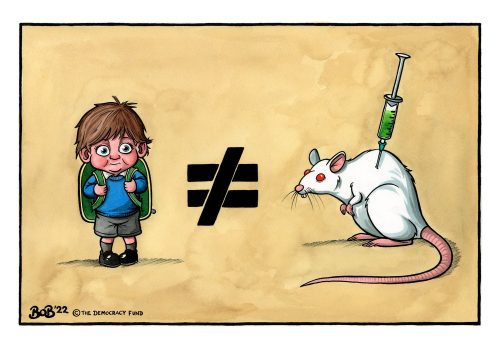
By Kathy Gyngell | TCW Defending Freedom | April 19, 2022
We have repeatedly referred at TCW to the studied silence of the mainstream media regarding the damage and fatalities associated with the Covid vaccines despite reported reactions (which may be only 10 per cent of the total), now standing at 1,480,307, and nearing the one and half million mark. Fatalities, too, continue their inexorable rise, a further sixteen deaths reported since the end of March, their total now 2,087. For full reports of vaccine adverse effects and events including 352 pages of specific reaction listings, see here.
What is worse, perhaps, than the MSM’s general state of denial is their unconcern about the shocking paucity of the child adverse reaction data published by the Medicines and Health products Regulatory Authority (MHRA). Yet under-18s have been actively encouraged to have the vaccine since the end of July 2021 in the absence of any long-term safety data and despite clear indications that younger ‘fertile’ age cohorts were proving more vulnerable in multiple respects to the vaccine. However no special monitoring system for children has been set up, or none that has been reported. Unlike its Yellow Card reporting involving adults, the MHRA does not break down the child numbers into specific adverse events, as though children were of less importance. As a result we have no way of knowing whether the reports relate to any major, life-changing side-effects such as Guillain-Barré syndrome (muscle weakness caused by the immune system attacking the body’s nerves) or Bell’s palsy (a type of facial paralysis) or to other serious side-effects reported by adults including seizures, nervous system disorders, deep vein thrombosis, menstrual disorders, and eye and ear disorders including blindness and deafness.
With the extension of the vaccine rollout to young children aged between five and 11 since the beginning of April, we have decided it is high time to highlight what is known and not known, what is reported and not reported, about the risk to children of this experimental gene therapy.
Nearly 3.5 million children (3,413,500) have already been injected, with a total dosage (1st, 2nd & boosters) of 5,626,100 jabs, and a total number of 3,735 adverse reaction Yellow Card reports. Data published by the MHRA on Thursday April 14 details:
· Pfizer – 3,400,000 children (1st doses) plus 2,000,000 second doses & 200,000 boosters resulting in 3,424 Yellow Cards
· AZ – 11,600 children (1st doses) plus 8,700 second doses & ‘extremely limited boosters’ resulting in 263 Yellow Cards – Reporting rate 1-in-44
Note: 1,500 doses (1,000 children – 1st doses) removed from last two weeks reporting
· Moderna – 1,900 children (1st doses) and 1,400 second doses and 2,500 boosters resulting in 24 Yellow Cards
Note: 200 children (1st doses) removed from last two weeks reporting
· Brand unspecified – 24 Yellow Cards
Unaccountably it appears that the number of 1st doses (1,000 for AZ and 200 for Moderna) and 2nd doses (500 for AZ) recorded has decreased since two weeks ago. Hence 1,200 children recorded as vaccinated two weeks ago are now missing. No explanation has been given for this. I understand that the MHRA is now on holiday for two weeks so we are unlikely to get any clarity on this until May.
Note too that AstraZeneca which is not recommended for under 18s appears to have been continued. MHRA reports to April 6 2022 show that 11,600 children (up from 11,496 last October) have received one or more doses of AstraZeneca, resulting in an increased Yellow Card adverse event reporting rate of 1 in 44 children (up from 1 in 49 last October). This, shockingly, is counter to the government’s own official guidance and evidence which has been available for patients and healthcare professionals, most recently updated on January 26 2022:
‘COVID-19 Vaccine AstraZeneca is not recommended for children aged below 18 years. No data are currently available on the use of COVID-19 Vaccine AstraZeneca in children and adolescents younger than 18 years of age.’ Yet the most recent MHRA publication says:
‘The safety and efficacy of COVID-19 Vaccine AstraZeneca in children and adolescents (aged <18 years old) have not yet been established. No data are available.’
So why and to which children were these doses given? To vulnerable children prior to the main rollout? And why second or booster doses? Furthermore, whoever they are, are the 263 adversely impacted children receiving adequate care and support? Are the other children who received the AZ vaccine being checked?
Myo/pericardial effects in children
The only specific adverse effects data that has been published for children is 73 cases of myocarditis and pericarditis (inflammation of the heart) in under-18s. This is worrying not least because of the rising and unexplained death toll in young men reported elsewhere in these pages, but also because it is now well-established that the likelihood of this reaction in young men is higher than their risk of myocarditis from Covid infection; a risk which the NHS has warned as being especially the case ‘in young men under the age of 40‘.
Other adverse effects
This still leaves the bulk of 3,735 Yellow Card Reports up to this week for under-18s uncategorised. Yet MHRA themselves state that ‘the experience reported in under-18s is similar to that identified in the general population’. If we take them at their word, extrapolating from the data published on suspected adverse effects in the adult population, children and young people, are experiencing a selection of the following:
· Lymph node pain and swelling
· Heart palpitations and fluttering
· Fever, chills, fatigue and malaise
· Ear pain, tinnitus and vertigo
· Nausea, vomiting and allergies
· Eye pain, swelling and photophobia
· Blurred vision and visual impairment
· Diarrhoea, abdominal pain and distension
· Lip, mouth and facial swelling
· Pain in arm, chest, bones and jaw
· Anaphylaxis
· Respiratory infection, influenza and herpes
· Joint and muscle pain, swelling and stiffness
· Muscle spasms and twitching
· Balance disorders and arthralgia
· Fainting and dizziness
· Facial palsy, headaches and migraines
· Skin sensations, burning and numbness
· Seizures and tremors
· Anxiety, depression and insomnia
· Confusion and disorientation
· Kidney pain and hair loss
· Breast pain and menstrual disorders
· Breathlessness, wheezing and coughing
· Sweating, blisters, rashes and itching
· Haemorrhages (all types) and nosebleeds
· Embolisms and thrombosis
Given the lack of information published as to the adverse effects experienced by the 3.4 million children injected thus far, we have to ask whether their consent was truly informed? The answer has to be no, it was not.
Worryingly there are a number of potential barriers to reporting adverse effects in children. These include:
· Child or parental failure to recognise symptoms as vaccine-related
· Fear of parents of not being believed or thought to be anti-vax or of ‘making a fuss’
· Lack of understanding of potential longer-term issues
· Healthcare professionals’ lack of awareness of vaccine adverse effects
· Young people not seeking help and support especially if they took the vaccine decision themselves
· Yellow Card system awareness and accessibility
Furthermore, if the 3,735 Yellow Card Reports for under 18s is less than 10 per cent of actual figures as the MHRA indicates may be the case, in the absence of long-term safety data, how can the child vaccine rollout possibly be justified, deemed safe or ethical? Why was post vaccine monitoring not insisted on?
This weekend the Sunday Times reported a scandal that Jeremy Hunt, the former Health Secretary, claimed to be worse than thalidomide. He was not however addressing the reckless child Covid vaccine rollout but a deeply shocking investigation into child deformities caused by an epilepsy drug still being given to pregnant women that should have been stopped years ago. Hunt said that while it was ‘never comfortable’ for governments to acknowledge such injustices, the state had a moral duty to the families. ‘It’s time the British state faced up to its responsibilities,’ he said. ‘Just as we eventually did to victims of the thalidomide scandal.’
These are words we need to hear him speak about the Covid vaccines.
I pray that he and this newspaper, which tenaciously and courageously fought for the victims of thalidomide, will not stay blind to the scandal that is happening on their watch; or let years go by before they retrospectively struggle to examine the multiplicity of harms, some of which we may not know till they reach maturity, that children have been needlessly subjected to by the experimental Covid vaccines.
Featured Video

The Truth About the Trump Shootings with Ken Silva
or go to
Aletho News Archives – Video-Images
From the Archives
The Geopolitics behind the War in Yemen (I)
By Mahdi Darius NAZEMROAYA | Strategic Culture Foundation | 30.03.2015
The United States and the Kingdom of Saudi Arabia became very uneasy when the Yemenese or Yemenite movement of the Houthi or Ansarallah (meaning the supporters of God in Arabic) gained control of Yemen’s capital, Sanaa/Sana, in September 2014. The US-supported Yemenite President Abd-Rabbuh Manṣour Al-Hadi was humiliatingly forced to share power with the Houthis and the coalition of northern Yemenese tribes that had helped them enter Sana. Al-Hadi declared that negotiations for a Yemeni national unity government would take place and his allies the US and Saudi Arabia tried to use a new national dialogue and mediated talks to co-opt and pacify the Houthis.
The truth has been turned on its head about the war in Yemen. The war and ousting of President Abd-Rabbuh Manṣour Al-Hadi in Yemen are not the results of «Houthi coup» in Yemen. It is the opposite. Al-Hadi was ousted, because with Saudi and US support he tried to backtrack on the power sharing agreements he had made and return Yemen to authoritarian rule. The ousting of President Al-Hadi by the Houthis and their political allies was an unexpected reaction to the takeover Al-Hadi was planning with Washington and the House of Saudi. … continue
Blog Roll
 Aletho News
- Pakistan-Iran talks secure LNG shipment to Islamabad through Hormuz
- Black Sea grain crisis puts global wheat supplies under pressure
- IRGC air defenses destroy another US MQ-1 drone over Strait of Hormuz
- Imran Khan’s entire immediate family detained in Pakistan ahead of mass protest demanding his release
- EU nation detains former presidential frontrunner
- Leaked: Britain’s Sham Conviction Of Hashim Thaci
- Seyed M. Marandi: U.S. Strike Imminent – Toward Total War in the Middle East
- Russia Voted Under Fire. Washington Is Loading the Tankers.
- 12 Things Your Oncologist Was Trained Not to Tell You
- Anthrax Attacks Paved Way for COVID-Era ‘Junk Drugs and Vaccines’
- If Americans Knew
- This isn’t sci-fi, AI is already killing people
- ‘The Most Brutal Thing’: Investigation Reveals Execution of Elderly Woman in Rafah
- Inside Israel’s ‘soft’ ethnic cleansing plan for Gaza through the eyes of its victims
- New online database tracks pro-Israel political donations in the United States
- Israeli president pardons soldier convicted for killing wounded Palestinian
- Singer Ed Sheeran says his ‘heart broken’ by Gaza devastation, addresses Macklemore controversy
- Israel Has Imprisoned Female Journalist Bushra Al-Tawil Without Trial Or Charge In Solitary Confinement For Past Month
- Israel poised to teach West Bank a lesson after one Israeli killed – Daily Update
- Salah Sarsour’s Legal Team Says DHS Has Not Met Its Burden to Prove He Is Deportable
- An analysis of tax forms by The Intercept show Kraft’s charity and LLC have donated to Friends of the IDF and AIPAC’s super PAC.
- No Tricks Zone
- 2025 Nature Paper Claiming Worsening Global Drought Gets RETRACTED …Heavily Flawed
- New Study: ‘Global Drought Shows No Detectable Recent Acceleration Under Climate Warming’
- Economic Masterminds: German Socialists Suggest Taxing Productivity Gains Stemming From Using AI
- The South China Sea Has Not Been Cooperating With The Climate Change Narrative
- Energy Crisis: Germany Enters Heating Season With Historically Low Gas Reserve Fill Levels
- New Study: The Antarctic Ice Sheet Gained Mass From 2020-2024 Due To Staggering Snow And Ice Accumulation
- Study: Ocean Heating Rates From Thousands Of Years Ago ‘Dwarf’ Modern Ocean Heating Rates
- Climate Extremists Target, Attack Large-Scale Power Grid Infrastructure In Germany!
- New Study: Antarctic Ice Melt Has Contributed Less Than 1 Centimeter To Sea Level Rise In The Last 30 Years
- Fear Of Debate: Alarmist German Climate Scientist Calls On Mainstream Media To Discredit Skeptic Voices
 Aletho News