Breaking the Spell
The Holocaust: Myth and Reality, Overview of the book by Dr. Nicholas Kollerstrom
BY ANTONY C. BLACK • UNZ REVIEW • APRIL 17, 2022
Heresy In the 21st Century
 Never in my long journalistic career have I ever hesitated to put pen to paper – until now. Indeed, I have delayed writing this overview of Dr. Kollerstrom’s remarkable book for going on six years.[1] Up until now no subject had been too controversial, too sensitive, too beyond the pale as to warrant more than a passing moment’s consideration of consequences. But this is different. In some sixteen countries in Europe one can be put in prison for doing what I am doing now, or even for expressing ‘holocaust denialism’ on social media. In Germany some fifteen thousand people are tried each year for Thought Crime, i.e., for so-called ‘right-wing extremism’. Here in North America it is somewhat better; one merely risks losing one’s job, friends and family – and possibly being blacklisted as a writer from virtually every venue one might have formerly been associated with. No small potatoes.
Dr. Kollerstrom, himself, stumbled rather more naively into this punitive quagmire in 2008 when, after merely reviewing a scientific paper analyzing samples taken from the walls of the alleged ‘gas chambers’ at Auschwitz, – a paper authored by one Germar Rudolf, a young scientist working at the time at the Max Planck Institute – he found himself summarily dismissed from his erstwhile position as historian and philosopher of science at University College, London (UCL), “the sole member of staff…ever to have been expelled for ideological reasons”. As he recounts,
“I became ethically damned, thrown out of polite, decent groups, banned from forums and denounced in newspapers…..I felt as if some Mark of Cain had been branded onto my forehead. I had done something so awful that we could not even discuss the matter. The Medieval crime of Heresy was back alive and well…”
Heresy, of course, implicates the notion of taboo, and what a society makes taboo is what it feels to be sacred, and what is sacred is beyond question. When dealing with the ‘Holocaust’, then, we are, Kollerstrom assures us, dealing not with historical science, but, essentially, with a religion; the Holo-religion. And as the author repeatedly points out, “There can be no science where doubt is prohibited.”
Of Soap and Lampshades
Before diving into the inky abyss of the various technical strands of argument involving documentary archives, archaeology, chemistry, etc., it behooves us first to take a bird’s eye view of the general evidentiary landscape, this both to assuage immediate curiosity, and to lend a certain clarity and coherence to the narrative.
But before even embarking on that perspectival journey, let me ask a question.
Do you, dear reader, believe that during the Second World War the Nazis plumbed the very depths of human depravity by rendering human fat into soap, of sewing human skin into lampshades and gloves and all manner of similar nightmare horrors? If you do, you would not be alone. Like many others, I believed it – and I confess, completely blindly – all of my life. But I was wrong. If you believe such, you would be wrong. It is not true. It never happened. You can take it to the bank, it is a total myth. And this conclusion is not just one reached by so-called ‘revisionist’ authors, but is rather a simple matter of documented fact admitted to and affirmed by the orthodox holo-historians themselves, e.g., the Yad Vashem Holocaust Museum in Israel.
It is true that during the Nuremberg Trials such alleged items were displayed, but over the years they were all systematically debunked, i.e., found to be made of non-human animal materials, such that, as I say, no orthodox holo-historian maintains the validity of any of them anymore. Now, a critical mind, a curious mind is then led ineluctably to the follow-up query: To wit, if that isn’t true, then what else might not be true that I have been told, and that I have believed, all of my life? And this is where Dr. Kollerstrom – amongst others, naturally – bids us listen to the contrarian general case. But, then, what exactly is that case?
In a nutshell, the author is arguing that the Nazi concentration camps (some in Germany itself, most of the rest in Poland) were slave labour camps – though some of them were, as we’ll see, only temporary transit camps – whose unfortunate inmates were used in the grim service of the German war effort.[2]
Auschwitz, for instance, was located right next door to the large Buna-Monowitz industrial plant run by I.G. Farben, and which produced (from coal) much of the Reich’s synthetic oil and rubber, and without which the German war machine would have ground to a screeching halt – and whose labor force was sourced from the Auschwitz concentration camp itself. Some of them (the Aktion Reinhardt camps) were also part and parcel of a general policy established at the infamous Wannsee conference in January 20, 1942 for the systematic deportation ‘to the east’ of populations of ‘undesirables’ including Jews, Roma, communists and so forth, who were to be deposited east of the Urals once the Soviet Union had been, as the Germans confidently expected, quickly vanquished by the, up until then, entirely successful German war machine. Thus, the term ‘Endlosung’, which has been tendentiously interpreted by the orthodox holo-historians to mean, ‘final solution’, really means ‘end’ or ‘goal’ – in this case, deportation to the east, but which action was thwarted by the unexpected resistance to, and, of course, eventual failure of Operation Barbarossa, i.e., the German invasion of the Soviet Union.
But what these camps were not, according to Kollerstrom, were monstrous extermination factories that took in train loads of human beings and simply ground them up into human corpses. This image, he maintains, is a brutal and inhuman legacy that has come to haunt the Western imagination and form the foundation of a demented sacred myth that has, along with ancillary myths, come to underpin a society based on UnTruth – we are, he says, the The People of the Lie – and which has also expediently come to serve American and Western imperial interests in their truly monstrous culture of ‘endless war’.
None of this, of course, is to condone or fail to recognize the horror and injustice of the systematic detainment of hundreds of thousands or even millions of people in slave labor camps where typhus and other diseases ran rampant, and where, if not systematic killings, then certainly sporadic brutalities would have taken place. But, again, they were not, as we have been assured all of our lives, mere factories for processing humans into corpses.
So there you have it, the ‘case’. But what of the evidence?
To begin with there is the, strangely, well-documented fact that there is no documentary evidence whatsoever of any ‘plan’ by the Nazis to systematically exterminate millions of human beings. Thus, of the vast corpus of surviving documents from the Third Reich, there is not one scrap of evidence indicating any such plan; no proclamations, orders, radio transcripts, memos, memoirs – nothing at all. As Kollerstrom says, we are left believing that the engineering and operation of this vast conspiracy was conducted entirely through some form of “telepathy”.
Moreover, and contrary to popular understanding, the Wannsee conference made no mention of any such plan. Holo-historians have, instead, been forced to ‘interpret’ certain ‘code words’ from the conference as meaning other than their dictionary meaning. (Here Kollerstrom reminds the reader that it is not for the historian to impose meaning on the data, but rather to let the data speak for themselves.) Nor is there even a snippet of evidence of either a plan or anything at all to do with ‘extermination’ from the recently released, voluminous diaries of both Himmler and Goebbels. Additionally, the British historian, David Irving in his book, ‘Hitler’s War’, based entirely on primary source material, concluded that Hitler, himself, knew of no such plan (a conclusion, amongst others, which landed Irving in the docket and, like Kollerstrom, condemned to eternal damnation throughout Western society, media and academia.)
Then there is the dean of orthodox holo-historians, Raul Hilberg, author of the supposedly-definitive, three volume history of the Holocaust, ‘The Destruction of the European Jews’, who was forced by defense counsel at the 1985 Ernst Zundel trial to admit under oath that there was no documentary evidence – not one iota – of any alleged gassings of human beings by the Nazis! The latter fact is also backed-up, as we shall see later, by the Bad Arolsen Archives (which comprise some thirty million documents to do with the camps and are considered the pre-eminent repository on these matters) whose curators released a statement in 2007 saying that they had no evidence – not one document – that suggested any deaths by gassing.
But, then, what of the physical structure of the ‘gas chambers’ themselves? Here, according to Kollerstrom, the evidence is definitive: they could not have been ‘gas chambers’ (i.e., they really were showers) both because their structures (many parts of which have been fraudulently reconstructed post-war) are ludicrously permeable, and because chemical analysis reveals there is no hydrogen cyanide in their walls – whereas the walls of the small delousing chambers used to disinfect the inmates’ clothes, and which everyone agrees were used for this purpose (despite the obvious contradiction of such in an ‘extermination’ camp), are chocker-block full of hydrogen cyanide.
But what of the ‘six million’? Merely a longstanding symbolic meme that represented the traditional number of Jews in Europe and for which references for go back at least a half century prior to the ‘Holocaust’. There were no systematic attempts made nor scientific surveys done at Nuremberg to determine the numbers who died in the camps during the war nor could there have been in the timeframe before which the trials began. Moreover, the Auschwitz Museum itself released a statement in 1989 downgrading the ‘four million’ supposedly killed at Auschwitz to ‘one million’, but which revelation was never factored even then into the official count. Later, as we shall see, the Soviet ‘Death Books’ for Auschwitz became available following the fall of the Soviet Union showing that only some seventy thousand people (approximately half of them Jews) had died at Auschwitz – almost all from typhus – a number which, just happens to coincide with the numbers in the Arolsen Archives.
But what about all the ‘pictures’? The iconic pictures of piles of corpses shown de rigueur in every textbook are from Bergen-Belsen and are known to be victims of typhus, i.e., they were not victims of ‘gas chambers’ – but which photos continue to be paraded to this day as ‘gassing’ victims despite this transparent and matter-of-public-record falsification of documented fact. What are also never shown are the many extant photographs of hail and hearty inmates taken when the camps were liberated by Soviet and Allied forces.
But certainly the ‘eyewitness’ accounts are definitive? Hardly. Most of the core ‘autobiographies’ have been shown to be fakes, and the rest are largely derivative from these accounts and/or based on mere hearsay and rumour. Moreover, there has arisen an entire cottage industry of fake ‘eyewitness’ accounts and which are part and parcel of a much larger enterprise. Not to put too fine a point on it, but the ‘Holocaust’ is big business. Indeed, there is strong evidence, as we shall see later, that even such famous holo-biographies as that of Elie Wiesel are completely fraudulent. There are also numerous accounts, again which we will soon examine, by quite renowned individuals countering the official ‘Holocaust’ narrative but which continue to be routinely and entirely ignored and suppressed.
Okay, but what about the ‘confession’ of Rudolf Hoss, the commandant of Auschwitz and the key witness for the prosecution at the Nuremberg Trials? We learn from Kollerstrom of evidence that came to light in the mid-1980s that Hoss had been “tortured for three days and nights by a British hit team” prior to his confession. And that, in any case, there are blatant contradictions in his tortured testimony that demonstrate that he was simply making up what his prosecutors / persecutors wanted to hear. Indeed, threats of either capital punishment or long prison sentences were the overarching context for the rest of the rank-and-file ‘confessions’ in a military tribunal by the victors that accepted as a pre-determined fact the reality of the ‘extermination’ thesis and denial of which could not only not be used as a defense position (a common feature, by the way, of today’s infamous international kangaroo courts / ‘war crimes tribunals’)[3] – but which legal tactic guaranteed one’s conviction! Accordingly, most defendants chose the pragmatic stance of accepting the prosecution ‘thesis’ which opened the door to a lenient plea bargain.
Anyways, enough of the cursory overview. Let’s get down to brass tacks.
The ‘Six Million’
A few months following the liberation and occupation of Auschwitz by the Soviets in January, 1945, the Soviet newspaper Pravda announced the staggering total of some four million people who had died in the camp. This figure was quickly integrated into the Nuremberg Trials without further ado. But then in 1989, the so-called ‘Death Books’ were released by Soviet President Gorbachev. These documents, which had been captured by the Soviets from Auschwitz, consisted of some 46 volumes cataloguing the individual death certificates of those who had died at Auschwitz – of some 69,000 individuals. Not four million, but sixty-nine thousand – and of whom about twenty-nine thousand were Jews, with the rest comprising a mixture of other ethnic groups and nationalities. We can only speculate as to the whys and wherefores relating to the initial, grossly exaggerated figures, though it hardly stretches the imagination to suppose that, having just lost upwards of twenty-seven million of their countrymen to the German invaders, the Soviets might not have been in a particularly objective, scientific mood, but rather in a propagandistic one.
Nevertheless, the ‘Death Books of Auschwitz’ constitute, en masse, a primary source document.
Another repository of primary source material are the Arolsen Archives, also known as the International Tracing Service, located in Bad Arolsen, in North Germany, and which are run by the International Red Cross. The latter comprises some thirty million files relating to sixteen of the camps in both Germany and Poland. These are considered the preeminent – and objective – data-base relating to the camps.
I say ‘objective’ as the rather more infamous Yad Vashem Museum archives in Israel are considerably less objective. Many of the deaths recorded there are simply taken from deportation lists and, to boot, include deaths before, during and even after the end of the war. Moreover, anyone can simply fill out a form online claiming to be a ‘victim of the Holocaust’ – a surviving victim obviously or perhaps a relative of such – without any documentation whatsoever. There is, thus, nothing to prevent multiple or fraudulent entries, and there is, as we shall comment on further in a bit, the ulterior motivational issue of filing so as to then make a claim for compensation against the German government. As such, the ‘archives’ from Yad Vashem are considered, at least by revisionist holo-historians, to be essentially worthless.
Returning to the Arolsen Archives. In the year 1979 the curators released a figure for the casualties from fifteen of the camps, and which amounted to a total of some 271,000 individuals. Then in 1984 they released a total mortality figure for sixteen of the camps which came to 282,000. These deaths represent all of the deaths in the camps excepting those of the Aktion Reinhardt camps (which comprise Treblinka, Sobibor and Belzec), which latter were considered to be mere transit camps – but which we shall discuss later on in relation to the archaeological controversy surrounding them. Both the ‘Death Books’ and the Arolsen archives largely agree on the number of Jews who died at Auschwitz, some 30,000 in all – representing less than half the total deaths. Needless to say, these sorts of figures did not go over well in a country, Germany, that had ruled holocaust denialism to be a criminal offense. Accordingly, and as Kollerstrom relates,
“No 21st century statement has ever come out of the Arolsen Archives concerning their total figures. It would just be too risky: the criminal offense of ‘Denying the Holocaust’ in Germany includes, ‘downplaying or trivializing the crimes of National-Socialism’. That law does not specify what exactly would constitute those crimes! Not surprisingly, the Arolsen managers have not dared to make any such statement. (It may also be the case that they have received orders not to make any tallies any more…)”
Nevertheless, in 2006 the managers did release a statement relating to the numbers of those who had died of gassing: there were none, or rather, they had no records of there being any victims of gassing – at all. The ensuing controversy was enough for them to beat a hasty retreat and no further statements have been forthcoming. (We will not be so reticent, but soon discuss the matter thoroughly under the section on ‘science’.)
The official figures for total mortality in each of the camps, however, continue to fluctuate – often wildly, depending on which ‘eyewitness’ account or official pronouncement is prominent at the moment – but mostly downwardly. Thus, whereas the figures for Dachau right after the war numbered some 238,000 deaths, the total today stands at 20,600. This lowering by a factor of ten seems to be heading in the direction indicated by the primary source archives. But what then of the ‘six million’ figure? Surely the initial ‘four million’ proffered by the Soviets at Nuremberg would have played into the grand total. But why exactly ‘six’? Why not seven or eight – or five? And here the author begs us take note of a very peculiar fact: To wit, the undeniable prior existence of a longstanding meme involving precisely the ‘six million’ figure. As Kollerstrom relates,
“So, whence came that totemic number? It began in America around 1900 as a fundraising stunt, and then kept pulsing through the twentieth century like some Hellish mantra. Here are some 166 references, 1900 – 1945. They are overwhelmingly American. At the dawn of the 20th century, the ‘suffering’ of six million Jews became an argument in favour of the new Zionist project…. It helped fundraising, with the number being cited as the total number of Jews in Europe. During World War I it was always six million Jews who were starving, in need of rescue, etc.”
And thence the author dutifully lists 166 references. It is worth taking a brief gander at a few of them, just to get the feel of the matter:
- 1906 – New York Times, 25 March 1906: “… the condition and future of Russia’s 6,000,000 Jews were made on March 12 in Berlin to the annual meeting of the Central Jewish Relief League of Germany by Dr. Paul Nathan… He left St. Petersburg with the firm conviction that the Russian Government’s studied policy for the “solution” of the Jewish question is systematic and murderous extermination.”
- 1913 – Fort Wayne Journal Gazette (Ind.), 18 October 1913, page 4: “There are six million Jews in Russia and the government is anxious to annihilate them by methods that provoke protests from the civilized world.”
- 1915 – New York Tribune, 14 October 1915: “What the Turks are doing to the Armenians is child’s play compared to what Russia is doing to six million Jews, her own subjects.”
- 1918 – New York Times, 18 October 1918: “Six million Souls Will Need Help to Resume Normal Life When War Is Ended… Committee of American Jews Lays Plans for the Greatest Humanitarian Task in History… 6,000,000 Jews Need Help.”
- 1919 – San Antonio Express, 9 April 1919, page 12: “At no other time in the history of the Jewish people has the need been so great as now. Six million of our brothers and sisters are dying of starvation. The entire race is threatened with extinction.”
- 1921 – New York Times, 20 July 1921, page 2: “BEGS AMERICA SAVE 6,000,000 IN RUSSIA. Russia’s 6,000,000 Jews are facing extermination by massacre.”
- 1926 – Encyclopedia Britannica, 13th Edition, Vol. 1, 1926, page 145: “While there remain in Russia and Romania over six millions of Jews who are being systematically degraded…”
- 1931 – The Montreal Gazette, 28 December 1931, page 25: “SIX MILLION JEWS FACE STARVATION,… FEARS CRISIS AT HAND… six million Jews in Eastern Europe face starvation, and even worse, during the coming winter.”
And so on and so forth, for 166 entries.
As mentioned earlier, no attempt was made at Nuremberg to factually determine the total number of people who had died in the camps during the war. Thus, as clearly affirmed by the French historian Vincent Reynouard, “At Nuremberg, no statistical survey was ever undertaken … to determine the number of missing Jews.” What the Trials did rely on (apart from Hoss’ testimony relating to Auschwitz only) was a statement given by SS agent Wilhelm Hottl who testified, on condition of his life being spared, that he had once heard such a story from Adolf Eichmann (attesting to the ‘six million’), in August 1944, but which Eichmann later denied. As Kollerstrom remarks, “That was all! And thereby the magic number came to infest all of our minds.”
We have briefly inspected two primary source documents, namely the ‘Auschwitz Death Books’ and the Arolsen Archives, but there are more.
In the mid-1990s the British Intelligence Decrypts from Bletchley Park were released. These documents comprise the radio intercepts from Auschwitz made possible by the famous breaking of the German Enigma code. The decrypts covered the crucial thirteen-month period from January, 1942 to the end of January, 1943. They record daily arrivals and departures of inmates, shipments of coal and coke etc. Expectant hands combed these priceless archives for what, it was thought, would undoubtedly reveal prima facie evidence of the great crime. It was, however, merely a great embarrassment when no such evidence was forthcoming. Not a crumb.
What these transcripts do speak to are the daily comings and goings of inmates to the giant Buna-Monowitz industrial plant just two miles east of Auschwitz. Thus, one entry records,
“The use of prisoners for war industries on a large scale is discussed below… the largest transference is the move of Jews to AUSCHWITZ for the synthetic rubber works. Another major movement is the transference of sick prisoners to DACHAU.”
They also mention a major outbreak of typhus in the summer of 1942 and measures to contain it. Thus, this quote from the January 1943 summary about Auschwitz,
“The Bunawerk is still employing 2210 men of whom 1100 are on the actual work. Jewish watchmakers are sent to SACHSENHAUSEN where they are urgently needed. Typhus cases continue to be reported although strenuous measures have been adopted and 36 cases were found among the new batch of prisoners on 22 Jan.”
But no evidence of mass killings.
Indeed, there is a fourth primary source archive, to do with the intact coke records from Auschwitz, but one which we shall cover in the next section.
Finally, the ‘six million’ number is not completely without import, as it does register, ironically, according to the author, as roughly the number of ‘holocaust survivors’ who have sued for indemnity claims from the German government post war. In fact, some 4.3 million claims have been paid out amounting to some one hundred billion deutschmarks. It is, then, worth noting at this point that, according to most revisionist authors, the number of Jews under German control in all of the occupied territories never numbered more than 4.5 million, though Kollerstrom sets the figure somewhat lower at 3.5 million.
Now, does this mean that the number of inmates who died in the camps was a ‘mere’ 300,000 or so? Not necessarily. The records from the Aktion Reinhardt camps, being mostly transit camps, have not been preserved and there would likely have been deaths that were not recorded. To give some further perspective on this matter and, possibly, to set some sort of upper bound to the numbers, I cite here yet another revisionist author, Peter Winter, who in his book, ‘The Six Million: Fact or Fiction’[4] cites a quote by Stephen F. Pinter, who served as a lawyer for the US State Department in the occupation forces in Germany for six years after the war, and who made this statement to the Catholic magazine Our Sunday Visitor, June 14th, 1959:
“I was in Dachau for 17 months after the war, as a US War Department Attorney, and can state that there was no gas chamber at Dachau. What was shown to visitors and sightseers there and erroneously described as a gas chamber was a crematory. Nor was there a gas chamber in any of the other concentration camps in Germany… From what I was able to determine during six postwar years in Germany and Austria, there were a number of Jews killed, but the figure of a million was certainly never reached. I interviewed thousands of Jews, former inmates of concentration camps in Germany and Austria, and consider myself as well qualified as any man on the subject.”
The mention of ‘crematory’ is, just in passing, significant as most of the camps had them – just as many hospitals and prisons have them to this day. Thus, the mere fact of having crematoria does not in any way whatsoever speak to the notion of ‘gas chambers’. Indeed, for a camp like Auschwitz, situated as it was on swampy ground with a very high water-table, the few that it did have would have been indispensable in disposing of anyone who died there – but only within certain very limited bounds as we’ll see in coming to terms with how much fuel, effort and time it takes to cremate a body.
As for the total numbers, for the moment I think that we need be circumspect and say that, with our present knowledge, these likely range somewhere between 300,000 to perhaps twice that – and which figures would include, of course, all inmates, not just Jews. It would be nice as Kollerstrom points out to be able to do further research on this matter, but given that access to the relevant archives is, effectively, prohibited, and where even attempting to do so is considered a crime or invites career suicide, the prospects for such are, at present, hardly sanguine.
Also, and to lend some perspective on this ‘numbers game’, I reference my own journalistic experience in researching and writing about more modern conflicts. Thus, one of my very first essays as a young, independent journalist was for the Toronto Star in which article I discussed the ‘killing fields’ of Cambodia and in which I demolished the official figure of ‘two million’ victims – which yet stands to this day – showing that it arose from just one Italian journalist who later recanted the figure! The true numbers were more likely in the 400,000 range with US propagandists having simply lumped onto the Khmer Rouge scorecard the numbers who died from starvation due to the US ‘secret bombing of Cambodia’ itself. But, again, no one really knows for certain. Just as no one really seems to know how many died in the Korean or Vietnam Wars, or the great US-backed Indonesian massacre of 1965 (the ‘year of living dangerously’ indeed). Figures routinely cited regarding those conflicts vary, depending on the source, literally over millions of human beings!
The same is true today regarding Iraq and other very recent, Western imperial conflicts (dare we all them ‘holocausts’?). It is certainly important to attempt to establish firm figures, both as these represent individual human lives lost, and as these figures are opportunistically used for ideological purposes. But we must, at the end of the day, remain humble before the task set us and, oft as not, be willing to live with uncertainty – whilst yet continuing to press our investigations further.
With that caveat, let us continue with our present inquiry.
In the introduction to ‘Breaking the Spell’, the author reminds us that the ‘Holocaust’ represents a “triune” thesis, i.e., involving a totemic number (the ‘six million’), a diabolical ‘plan’ (to deliberately exterminate an entire ethnic group, the Jews) – and a ruthless ‘methodology’ (‘gassing’ using the infamous ‘Zyklon B’). We have addressed the first two of these sub-theses, and it is to the third that we now turn our investigative attention.
Science Goes to Auschwitz
As Kollerstrom recounts, a turning point in the history of Holocaust Revisionism came in 1985 when the Canadian, Ernst Zundel, was charged with publishing the best-selling booklet, ‘Did Six Million Really Die?’. At his trial he was fortunate, according to the author, to be assisted by the ‘maestro of modern Revisionism’, Robert Faurisson, and together they sought the assistance of the, then, dean of American execution technology, Fred Leuchter, whose especial expertise was in gas chamber design.
In February of 1988, Leuchter was dispatched by Zundel to travel to Auschwitz/Birkenau (and Majdanek) where he, first, studied the archives of the Auschwitz Museum to learn exactly where the alleged ‘gas chambers’ were located; second, inspected the structures through the lens of his own expertise on gassing; and, finally, collected (illegally) thirty or so samples from the walls of the ‘gas chambers’ and from random ancillary structures at Auschwitz, and one sample from one of the much smaller delousing chambers. These samples were then submitted, upon his return, to a firm, Alpha Analytical Laboratories (who had no knowledge of where the samples had come from and who were horrified when they eventually found out), to be analyzed for traces of iron cyanide.
The latter compound is particularly relevant here as hydrogen cyanide is normally fairly short lived on surfaces – unless it happens to bind to iron whence it becomes very long lived, and which also, over time, turns into a bright, turquoise blue, also known as ‘iron blue’. Now, what is evident even to this day throughout many of the camps is the ‘iron blue’ colouring of many of the delousing chambers which is sufficiently dense enough as to, in many cases (where these chambers are made of brick), have permeated right through to the exterior walls and are, thus, clearly visible to the untutored eye. None of the alleged ‘gas chambers’ at Auschwitz/Birkenau, however, sport this ‘iron blue’, and true to this tell-tale sign (or rather lack of), none of the samples from the ‘gas chambers’ showed anything more than residual traces of cyanide – whereas the delousing chamber sample was chocker-block full of the stuff. Leuchter also wrote up his survey of the alleged gas chambers concluding that they could not, by any stretch of the imagination, have acted as such as they were spectacularly unsuited for the purpose being clearly and ridiculously leaky to gas.
This, the ‘Leuchter Report’, was published in May of 1988, and it shone the spotlight, for the first time, on the issue of the delousing chambers. As Kollerstrom remarks, “prior to Fred’s Report the human race had merely been disinformed that Zyklon gas = human mass murder.”
The author also comments on Leuchter’s fate regarding his foray into this controversial arena,
“Leuchter should have been knighted for his service to humanity: Sir Fred. But, instead, he had his career terminated, was thrown out of various places, was ethically damned, and he ended up driving a school bus – as he informed me.”
Nevertheless, in 1991 the Report caught the eye of a brilliant young chemist, Germar Rudolf, who was, at the time studying for his PhD at the Max Planck Institute in Germany. For Rudolf, the “thorn of doubt” planted in his mind upon reading the Report led he and two colleagues to creep over to Auschwitz and purloin another thirty or so samples from both the walls of the alleged ‘gas chambers’ and from the smaller delousing chambers (and along the way photographing exactly where, how and what they did). The results matched and confirmed those of Leuchter’s, there being a two-thousand-fold differential between the samples taken from the delousing chambers versus the ‘gas chambers’. (Just to note, that there was any ferrocyanide in the walls of the showers, aka ‘gas chambers’, at all – though generally less than 1 ppm – was due to the well-documented fact that many of the camp’s other rooms and enclosures were occasionally sprayed with Zyklon B as part of routine disinfection protocols, and which samples also showed the equal, if very low, levels of cyanide.)
Here Kollerstrom, himself an historian of science, emphasizes an important methodological point. To wit,
“Both the Leuchter and Rudolph reports had their weaknesses, and it is only by integrating the two together – which we can do because their methods were identical – that one attains a firm and clear basis for rational debate.”
The ensuing sequence of events following the publication, first in 1992 of a preliminary report, and then in 1993 of his historic 120-page document, the Rudolf Report, traced the per usual arc of personal ruination that we are, by now, all too familiar with. Rudolf had his career terminated and, eventually, in 2007, found himself, bound in chains, in a German court where he was duly sentenced to four years in prison. As Kollerstom intones once again, “Science cannot exist where doubt is prohibited, let’s be clear about that.”
As a follow-up to these investigations, a chemist-engineer, Dan Desjardins subsequently retraced both Leuchter’s and Rudolf’s steps through Auschwitz so that, as Kollerstrom says, we have good ‘corroboration as regards where the samples came from.’
It is further worth noting at this juncture – and here I tag-team once again with author Peter Winter – that, “The parallels between the real delousing station and the alleged ‘human gas chambers’ are so close that it is clear the homicidal gas chamber story was developed from the real clothing delousing system.”
Turning now to yet another primary source archive, one that I alluded to earlier, i.e., the intact coke records from Auschwitz/Birkenau (the latter camp, just by the by, and also known as Auschwitz II, being located in the immediate environs of Auschwitz I), we find that the amount of coke that would have been necessary to burn hundreds of thousands of bodies simply did not exist. Here Kollerstrom directs us to the dense tome, ‘Dissecting the Holocaust’,[5] edited by Germar Rudolf in which an essay by the meticulous investigator Carlo Mattogno reviews the matter.
Mattogno informs us that it “normally takes 88 to 110 lbs [of coke to cremate] a body.” After accounting for various factors (e.g., how many cremation furnaces are being fired together etc.) he concludes that these coke deliveries, “prove indisputably that only the bodies of the inmates who had died of natural causes could be cremated in the crematoria. Therefore, no mass murders took place in Auschwitz and Birkenau in the time from March to October 1943!”
According to Kollerstrom, Fred Leuchter’s Report also included a similar computation whilst arriving at the same conclusion. Leuchter further noted that the death count for Auschwitz peaked exactly ‘during the worst periods of the typhus epidemic in 1942 and 1943.’ The latter reference is important because it supports the argument – and all the evidence – that the infamous Zyklon B was deployed to the camps precisely to address the typhus outbreaks that began about this time. Additional argument that Zyklon B was not intended as a ‘extermination’ weapon, but merely as what the Nazis said it was for, i.e., disinfestation, is to be found in two related facts. To wit, the hydrogen cyanide concoction was sent to all of the camps, not just to those designated, today, as ‘extermination camps’ – the latter of which, by the way amount only to some six camps in total. Moreover, Zyklon B was discontinued in late 1944 to be replaced by the new-fangled delousing agent, DDT, and which, of course, no one has ever claimed was used for killing people. Kollerstrom notes additionally that microwave disinfestation technology was introduced by the Germans in the camps very late in the war – a technology which became the basis for the, now, ubiquitous microwave oven – though, to date, no ‘eyewitness’ account of being cooked to death by microwaves has been forthcoming.
To conclude this section, it is apropos to remark on the salient fact of the general reluctance by orthodox historiography to introduce such elementary forensic science to this subject. Indeed, that it is so riven with taboo testifies once more to the notion that, in dealing with the ‘Holocaust’, we are no longer in the realm of science, but of sacred myth and of religion. Nevertheless, let us continue our obdurate ways and conduct a brief review of the science as it pertains to some of the other concentration camps.
Of Archaeology, Diesel and Bonfires
In saying that there has been a decided reluctance to engage forensic science in the service of ‘proving’ the Holocaust does not mean that there have been no such attempts.
In 1999, at Treblinka, for example, a team of archaeological researchers led by Australian, Richard Krege, used ground-penetrating radar to try and locate the remains of the officially-estimated 800,000 bodies supposedly buried there. This should not have been difficult as the area in which these remains were allegedly contained covered a relatively miniscule area of just a few hectares. Instead, what the team found was – nothing at all. They found no evidence consistent with the burying of hundreds of thousands of bodies, and, indeed, no evidence of any soil disturbance whatsoever. Thus, as Krege said in a later report,
“From these scans we could clearly identify the largely undisturbed horizontal stratigraphic layering, better known as horizons, of the soil under the campsite. We know from scans of grave sites, and other sites with known soil disturbances, such as quarries, when this layering is massively disturbed or missing altogether.” He goes on to say,
“Historians say that the bodies were exhumed and cremated towards the end of the Treblinka’s camp’s use in 1943, but we found no indication that any mass graves ever existed.”
Naturally, this finding did not sit well with orthodoxy and so in 2010 another team led by Dr. Caroline Sturdy Colls from Staffordshire University conducted their own ground radar survey – and found nothing either. But that’s not what they concluded and later trumpeted to the BBC to whom they claimed to have found a few “pits”. No remains, no large-scale stratigraphic disturbance, just a few “pits”. As if not convinced by her own rhetoric on the matter, Colls returned to Treblinka in 2013 with colleague Ivar Shute where they proceeded to embarrass themselves – having had their findings broadcast on TV documentaries aired both by the BBC and by the Smithsonian channel in the US – by claiming (and here I reference Peter Winter’s work again) to have found a piece of porcelain with a Star of David on it, but which later turned out to be a ‘pierced mullet star’ that just happened to be the brand mark of a famous porcelain factory in Poland.
It is also noteworthy that these researchers, having found nothing more than a few bone fragments – which, without further ado, they claimed were part of “three mass graves” – and a few pieces from a wooden foundation, both items of which one might expect to find in a transit camp such as Treblinka was known to be, and having misidentified a ‘key piece of evidence’, were, nonetheless, given the royal treatment by the media and their work exalted as some sort of definitive proof of the case. Of course, it was nothing of the sort, but rather all puffery and nonsense. No bodies, no fragments of skeletons, no human ashes, no wood ashes and no ground irregularities whatsoever had been called forth by their investigations – investigations which, tellingly, involved no excavations at the site, as this, they lamely claimed, “would be a violation of Jewish law”.
But, then, the entire Treblinka ‘extermination’ thesis was terminally threadbare from the start. Thus, to begin with, the means proffered of killing hundreds of thousands at Treblinka was by steam (even the official account has no ‘gas chambers’ at Treblinka); they had all been ‘steamed like lobsters to their deaths’. According to Kollerstrom, “that phase of the narrative didn’t last too long, and soon the cause of death settled down to being diesel exhaust.” Now, the problem here is that it was first pointed out by Fritz Berg in 1983, and later affirmed in 1992 by Walter Luffl, the President of the Austrian Federal Chamber of Engineers, that mass murder by gassing with diesel fumes is a virtual impossibility. As such the amount of carbon monoxide in diesel fumes is very low (almost always much less than 1% and often no more than 0.1%) and that being subjected to diesel fumes in an enclosed room, even for a full hour, results, for most people, in merely a bad headache, though people with weak hearts might possibly succumb over the course of that timeframe. The key problem, however, is that all of the ‘eyewitness’ accounts – all of them – attest to the notion that death occurred within ten to twenty minutes.
The official narrative was beginning to strain at the seams, especially the failure to find any real prima facie evidence of bodies. No worries. As already mentioned, this part of the story was filled in by having all the bodies, all 800,000 of them, dug up, and burned. (One imagines this might have been a wee problem for the mere twenty or thirty SS administrative staff and one hundred or so Ukrainian guards stationed there, but perhaps they were uber-diligent.) Now it takes about 150 kg (over 300 lbs) of wood to burn just one body and a simple computation reckons the amount of wood needed to burn 800,000 bodies is, well, simply staggering. And, of course, no such wood ashes, even a remote trace of them, have ever been found at Treblinka. As Kollerstrom remarks at this point,
“Treblinka is the site of not one but two awesome Holo-miracles: the miraculous gassing of 800,000 Jews using a non-lethal gas, and then the miraculous burning of some 800,000 Jewish corpses in huge outdoor pyres, thereby igniting the Holo-caust (total-fiery) mythos with its inextinguishably hellish meaning. Dr. Caroline Sturdy Colls and her Birmingham science team were indeed treading on hallowed ground, with so many hundreds of thousands of Jews (not) buried there.”
Indeed, the same BBC program that featured Coll et al, ‘casually alluded to “Huge open burning pits of flesh” – the original Holo-hoax image!’ We will come to more such reminiscences of ‘burning and boiling blood’ in the next section. Suffice it to say for now that blood, and human bodies, do not simply burn by themselves, i.e., not without added fuel.
We could go on and look at similar holo-stories and similar demystifying encounters with science (including wildly fluctuating death counts, missing-in-action archaeological evidence, and yet ever more improbable killing methodologies) for many of the other camps including Sobibor, Chelmo, Majdanek, and Belzec. Time and space humble us however, and so we are led to the final strand of our investigation: the ever popular, always entertaining, ‘eyewitness’ testimony.
Fairy Tales From Hell
Let us begin here by reminding the reader of what was said at the outset about the infamous pictures from Bergen-Belsen – the ones that are taken as being symbolic of the entire Holocaust narrative itself; they are real, but they are, at the same time, misrepresentations.
Bergen-Belsen, located in northwestern Germany, was originally a prisoner of war camp that was turned into a concentration camp in 1943. The camp was liberated by British soldiers on April 15, 1945 who just happened to have been accompanied by a large contingent of journalists. It is likely due to the presence of these real eyewitnesses that it has never been claimed that there were ‘gas chambers’ at Bergen-Belsen. However, this did not stop subsequent Western media from portraying the pictures taken there of the thousands of emaciated bodies, of having been gassing victims. The latter’s deaths, it is pertinent to note, resulted from an outbreak of typhus in the closing stages of the war which itself was largely due to the Allied bombing that had fatally disrupted German infrastructure and which had prevented the re-supplying of both food and Zyklon B to many of the camps. [In fact, the camp was so infested with typhus that the British were eventually forced to burn it to the ground.]
Here we have the entire ‘extermination’ thesis seemingly turned on its head; a proposition that might at first blush seem outlandish did we not have yet another primary source document to support it. As Kollerstrom points out,
“Two and half million tons of US/UK bombs destroyed infrastructure and hope. The camps became death camps. We get a glimpse of the unfolding catastrophe from the Red Cross Report [published in 1948]… Thus the German authorities were at pains to relieve the dire situation as far as they were able. The Red Cross are quite explicit in stating that food supplies ceased at this time due to the Allied bombing… and in the interests of interned Jews they had protested on March 15th, 1944 against the ‘barbarous aerial warfare of the Allies’… In dealing with the Red Cross’ comprehensive three-volume Report, it is important to stress that the delegates of the International Red Cross found no evidence whatever at the camps in Axis-Europe of a deliberate policy to exterminate Jews. In all its 1,600 pages the Report never hints at any human gas chambers.”
And what I neglected to mention earlier in regard to the British Intel Decrypts was that, in August 1943, the head of the British Psychological Warfare Executive, Victor Cavendish-Bentick, sent a secret telegram from the Foreign Office to both Washington and Moscow saying, effectively, that despite the rumours they were hearing, there was not the slightest evidence to support the notion that gas chambers were being utilized to kill anyone let alone millions of people.
Also mentioned prior is the eyewitness testimony of Auschwitz commandant, Rudolf Hoss, whose torture-extracted testimony was a pillar for the prosecution at Nuremberg. Apart from the later evidence attesting to his torture, many key components of his testimony were, even at the time known to be falsified – or should have been for any other than a kangaroo court – as they contradicted known, contemporary facts regarding the camps themselves. Thus, Hoss gave affidavit to the court that he had visited Treblinka in June of 1941, where, he said, 80,000 Jews had been “liquidated” in the previous six months. The problem with all this is that Treblinka did not start receiving Jews until late July, 1942. In short, his ‘eyewitness’ account is a whole year and half too early! Indeed, none of the transit camps, including Sobibor and Belzec, even started up until May of 1942. To further complicate the lives of future orthodox holo-historians was Hoss’ insistence that diesel was used as the means of killing – and which, once such methodology was later discovered to be highly improbable if not impossible, was to bedevil the official narrative ever after as abandoning it meant abandoning Hoss’ testimony in its entirety.
Then there is the esteemed Professor Paul Rassinier, a French historian, socialist and anti-Nazi who later became a resistance fighter, but who was eventually captured and imprisoned at Buchenwald. Rassinier survived the war after which he began his lifelong career of debunking the claims of gassing by fellow ‘eyewitnesses’. Kollerstrom cites a quote from one of Rassinier’s published reports which concluded:
“With regard to the gas chambers, the almost endless procession of false witnesses and of falsified documents, to which I have drawn the reader’s attention during this study, proves, nevertheless, one thing: never at any moment did the responsible authorities of the Third Reich intend to order – or in fact order – the extermination of the Jews in this or in any other manner.”
And then there is witness-for-the-defense, the distinguished pathologist, Charles Larson, “sent over by the US army in 1945 to inspect the piled-up corpses in the German labour camps at Dachau, Belsen etc., [who] steadfastly refused to declare that he had seen a pink-coloured corpse killed by cyanide.”
Did I fail to mention? There is yet one more tell-tale piece of forensic evidence attesting to the complete fallaciousness of the gassing thesis. This is the well documented fact that there are no records whatsoever – of pink corpses. It turns out that dying from hydrogen cyanide poisoning turns the body a bright pink hue – and there is no evidence of such having been seen, by anyone, ever. Apparently, none of the ‘eyewitnesses’ were pathologists.
But, then, dear reader, perhaps these are not the sort of eyewitness reports you might have been expecting. So, without further ado, let us get to those, though as the cast of characters here are legion we will have to content ourselves with but a few examples in order simply to capture the flavour of the matter.
Likely the most prominent ‘eyewitness’ account is that of Elie Wiesel whose 1958 book, Night, has sold more than ten million copies, and which eventually led to his being awarded the Nobel Peace Prize in 1986. The problem with the book, apart from its patently hyperbolic narrative, is that it is almost certainly a completely fraudulent account. Thus, in 2009, a fellow Hungarian Jew, Nickolaus Gruner, after twenty years of researching the topic, issued this press release:
“Elie Wiesel A-7713 has never existed, and the man claiming himself to be ‘Elie Wiesel’ with the concentration camp number A-7713, knowing full well that this number belonged to someone else, is an imposter of the worst kind. For this statement, I, Nikolaus Gruner A-11104, have certified and written knowledge of.”
Gruner then went on to publish a book, ‘Stolen Identity A7713’, in which he provided detailed documentation obtained from the Auschwitz Museum archives which show that Lazar Wiesel, and whom Gruner knew, was the real bearer of that number. The former, according to Kollerstrom, was “born September 4, 1913, received the number and tattoo A-7713; as likewise his brother, Abraham, born Oct. 10, 1900, was given the adjacent number A-7712. That latter number is the one that Elie Wiesel claims belonged to his father Shlomo… No such registration records exist for Elie and his father: they are not there.”
Elie Wiesel refused to respond to a formal challenge by Gruner to appear before a Budapest court to combat these charges, just as he always refused to show anyone the alleged tattoo on his arms. But, then, one need only peruse some of the utterly fantastic claims in ‘Night’ to realize that something is seriously askew. As Kollerstrom relates,
“Having been written as early as 1958, Night does not feature any gas chambers! Instead of Zyklon, it has huge Moloch-type pits of burning babies… The wicked Nazis were unloading truckloads of little babies into the huge burning pits and the bodies were flammable. Human bodies are 70% water. They really don’t burn by themselves.”
Here it is worth quoting from Night itself just to experience the tenor of the narrative:
“Later, I learn from a witness that, for month after month, the ground never stopped trembling; and that, from time to time, geysers of blood spurted from it.”
It is worth reminding the reader at this point that it is these sorts of utterly fantastic statements that characterize much of the ‘eyewitness’ testimonials, but whose uncritical acceptance by generations of readers is, rather, mere testimony to the credulity of the true-believer. Let us move on to our next witness.
On the title page of his memoirs (published in 1946), Simon Wiesenthal, the famous Nazi hunter, featured an illustration purporting to be three Jewish inmates shot by the Nazis at Mauthausen. The picture shows the three prisoners tied to stakes and drooping in tragic, if highly dramatic poses, as they lay slumped and dead against the stakes. Wiesenthal claimed that he had “witnessed” the shootings. The problem here is that the tableaux portrayed was clearly lifted from a photograph from the June 11th 1945 edition of Life magazine where the exact same, and very unique, poses are shown of three German prisoners who had been executed as spies – this after having been caught wearing American uniforms whilst attempting to infiltrate Allied lines during the Battle of the Bulge. Once, again, we find a supposedly impeccable ‘eyewitness’ blatantly lying and committing overt fraud, and which lends serious credibility issues to anything else he has to say.
One particularly influential Holocaust potboiler is Philip Muller’s, ‘Eyewitness Auschwitz: Three Years in the Gas Chambers’, (1979) in which the hero claims to have been the ‘sole survivor of the murder operations’ at Auschwitz over three years. He too describes “the burning pits in which Jews were consumed”. This prize-winning best-seller is, according to Kollerstrom, ‘required reading in many Holocaust study courses’. The problem with it, however, is that it wasn’t written by Muller, but by ghost-writer Helmut Freitag who, in turn, had plagiarized it from an equally faked account by Miklos Nyiszli entitled, ‘Auschwitz: A Doctor’s Eyewitness Account’ (1947). In that book Nyiszli blithely states that Auschwitz killed 20,000 people per day, every day, from 1940 to 1944 – which adds up to a cool 29 million dead! But, then, who’s counting? Certainly not the dean of Holo-historians, Raul Hilberg, as his supposedly authoritative, ‘The Destruction of the European Jews’, repeatedly quotes from it.
Let us finish off with one final testimonial, ‘The Diary of Anne Frank’; though let me say at the outset here that this tiny deconstruction is meant in no way to impugn Anne herself. Rather the following is testament to just how far those who believe in the philosophy of the-ends-justify-the-means are willing to go.
To critical minds the ‘Diary’ was always somewhat suspect as there are passages, specifically those detailing a brief historical and political account of the German occupation of Holland, that are clearly not from the hand of a 13-year-old girl. This scepticism would later be borne out when it was shown, first in an Amsterdam court and then by a German criminal investigation, that Otto Frank, Anne’s father, had, in fact, been the author of substantial parts of the diary, and who had used a ball point pen (not available during the war) to write them. Indeed, Otto Frank – who was treated for typhus at the hospital[6] at Auschwitz and survived the war (dying in 1980) – had, apparently, first published the book as a work of, in his own words, “fiction”, under the title, ‘The Annex: Diary Notes’. The title, ‘Diary of Anne Frank’, was given to the book by its first English publishers.
It is, finally, worth noting, and here I quote from Peter Winter,
“… that Anne Frank died of typhus and was not ‘gassed’. It is one of the horrific ironies that Anne Frank died due to a lack of Zyklon-B at Bergen-Belsen – and this lack was caused directly by the Allied bombing campaign. The real story of Anne Frank is tragic enough, but the cruel exploitation, exaggeration and faking of her diary by the Holocaust storytellers is a scandal of epic proportions.”
Virtually all of the other core ‘autobiographies’ have, as I mentioned at the outset, been shown to be fakes or gross exaggerations, and the rest of the individual testimonies are largely derivative from these accounts and/or based on mere hearsay and rumour such that when confronted in a court of law by probing inquiry the ‘witnesses’ inevitably fall back on, ‘I heard’ or ‘someone told me’ or ‘It was common knowledge’ etc. It seems Professor Rassinier knew what he was about.
Final Thoughts
In writing a critique of this sort, that is, one that strikes at the heart of such a longstanding and sacred societal myth, such cannot help but conjure at some level, and at certain moments, a measure of doubt. Questions tickle the fancy. Am I wrong? Is the author wrong? Have we all just been seduced by a good story, a coherent but unknowingly flawed argument? And, indeed, if one is an honest person, the answer to those questions must be, ‘perhaps’.
Still, having crossed this bridge many times in my undistinguished muckraking career, I have settled upon a consolatory process of simply sitting back and reviewing the fundaments of the evidence and argument, their weight and measure, all rounded off and seasoned with a certain amount of intangible instinct – and coming to a reasoned decision. In the end, as Nietzsche was so fond of pointing out, we must act – on imperfect knowledge.
But I will confess that even were the Revisionist case eventually be proved to be wrong, and Orthodoxy prevail, I could only but smile and think of Ernst Mach who once said,
“Should these concepts turn out to be true, I shall not be ashamed to be the last one to believe.”
But if the Revisionist case is true, then it is not just the tragic victims of the camps themselves who have been so cynically used in a seventy-five- year game of Western and Zionist imperial propaganda; in a game of smoke and mirrors in the service of deflecting attention from many a real holocaust[7] – like Vietnam, or Indonesia or Iraq – under cover of a fake one; in a game of cruel irony where one historical fascism has been misrepresented and harnessed in the service of a future fascism. No, it is not just they, like Anne Frank herself, who have been so cruelly misused, but it is we, all of us, who have been played like suckers in one of the greatest swindles of all time; one that has warped our minds and souls not only into believing in fairy tale horrors that corrupt our very view of what it means to be human, but that has seduced us into a malignant and fatal self-righteousness where we have arrogantly come to believe that, as Carl Jung once wrote, “All evil lies just a few miles behind enemy lines.”
I hope at this juncture then, having become acquainted with some of the primary source documents, i.e., the Arolsen Archives, the Soviet ‘Death Books’, the Leuchter and Rudolf Reports, the three-volume 1948 Red Cross Report, the British Intel Decrypts, the counter-eyewitness testimony, the origins of the ‘six million’ meme etc., that any reasonable person would now entertain, at the very least, reasonable doubt on this subject. But, of course, in many parts of the world, reasonable doubt is not allowed. In much of Europe, doubt is prohibited by law. Here in North America doubt is not allowed by custom, by ingrained prejudice, and by enforced, widespread censorship.[8]
And perhaps, after all, this is the greatest outrage, for we have been told, yes, told – what we are to believe, and what we are not to believe, and that the matter is not open for discussion – at all. Case closed. Forever. No debate for you. As Dr. Kollerstrom pointedly asks,
“Who is in control of the past? Does somebody own it? Will they put you in jail if you disagree?”
Cast unto a dark, three-quarter century enchantment, the author enjoins us to wave the wand of reason, and break the spell.
Notes
[1] For those wishing to purchase and read the book, here is the link to the Castle Hill Publishing site (and which houses dozens of Revisionist works for those interested in pursuing this subject in more depth; the publishing company is run by Germar Rudolf himself): https://shop.codoh.com/book/breaking-the-spell-en/
[2] And which likely explains why the inmates were tattooed with numbers, as this would have made little sense if the latter were simply going to be killed.
[3] For a classic example of the such kangaroo tribunals see my article, ‘Hotel Propaganda: What Really Happened in Rwanda, circa 1994’ and which subsumes a discussion on the ICTR. Yet another is the similarly compromised, ICTY (the International Criminal Tribunal for Yugoslavia).
[4] For those wishing to read Winter’s version of matters – and which largely overlap with those found in Kollerstrom’s book – here is the link: https://thesixmillionfactorfiction.blogspot.com/ You can download this book for free as a PDF document.
[5] Here is the link to ‘Dissecting the Holocaust’, edited by Germar Rudolf (a rather weighty tome that includes a compendium of much more detailed essays by a dozen or so authors): https://shop.codoh.com/book/dissecting-the-holocaust-en/38/
[6] Not only did Auschwitz/Birkenau have a hospital with a dedicated surgical unit, but also a camp library with 45,000 volumes, six inmate orchestras, a kitchen and bakery, a theatre, a post office….and a swimming pool, the remains of which are clearly visible to this day.
[7] Indeed, there is substantive evidence that upwards of a million or so German prisoners of war died in the short few months at the end of the war at the hands of the Allies. The Canadian historian, James Bacque, investigates this in his book, ‘Other Losses’ (and which I may cover in a future essay). In particular, he proffers that in the vast open-air American prisoner of war camp alone, up to 900,000 died, and which deaths were covered up under the obscure bureaucratic heading of ‘other losses’. He further posits that, in this case, if not a ‘plan’, there is certainly evidence of a high-level policy of willful neglect that stemmed directly from Eisenhower himself.
[8] It is further worth noting here that none of these works are generally available either via conventional bookstores or through major online retailers. Indeed, Rudolph has written a small book on the subject entitled, ‘The Day Amazon Murdered History’, which recounts how, ‘in early 2017, a series of anonymous bomb threats against Jewish community centers occurred in the US fueling a campaign by Jewish groups to have all revisionist writings banned, falsely portraying them as anti-Semitic. Amazon complied and banned over a hundred works with dissenting viewpoints on the Holocaust. In April 2017 an Israeli Jew was arrested for having placed the false bomb threats, a paid “service” he had offered for years.’ Despite this revelation, the ban remains to this day.

Pro-lockdown Researcher Accuses Critic of “Libel”

By Noah Carl | The Daily Sceptic | April 17, 2022
A new pro-lockdown study has been doing the rounds on social media. In a Twitter thread, one of the authors claims that it “confirms the tragic consequences of delaying the UK’s first lockdown”. He argues that, if lockdown had started just one week earlier, there would have been up to “35k fewer deaths”.
Although the thread went viral (as many pro-lockdown threads do), the study was not without its critics. One of these was Philippe Lemoine, whose work I’ve discussed several times here on the Daily Sceptic.
In a Twitter thread of his own, Lemoine retorted that the study “doesn’t confirm jackshit” and merely exemplifies the “ridiculous methods that pass as counterfactual analysis in the field of epidemiology”. He went on to say that drawing strong conclusions about the “tragic consequences” of delaying lockdown is “intellectually dishonest”.
Profanity aside, the criticisms Lemoine proceeds to outline are well taken. As he points out, the latest pro-lockdown study is based – yet again – on the assumption that epidemics keep growing exponentially unless the government decides to do something. This assumption is not merely questionable, but false.
We know from examples like South Dakota – whose libertarian governor Kristi Noem did basically nothing – that infections start falling long before the herd immunity threshold is reached, even if there’s no lockdown. (There are at least eight other places where infections fell from a peak in the absence of both business closures and stay-at-home orders.)
Armed with the assumption that the only thing capable of arresting epidemic growth is lockdown, the authors conclude that Britain’s first lockdown had a large effect – one that would have been even larger if it had been imposed a week earlier.
Of course, there’s ample evidence to suggest this isn’t true: infections peaked around the same time in no-lockdown Sweden; reconstructions of Britain’s epidemic curve show cases peaking before the first lockdown; and Chris Whitty himself told MPs that “R went below one well before, or to some extent before, March 23”.
So, another pro-lockdown modelling study based on assumptions that we know are wrong. (Note: I’m not saying the lockdown had absolutely no effect; just that you can’t claim it had a large effect.) However, the story doesn’t end there.
The author of the original Twitter thread didn’t take kindly to Lemoine’s criticisms. After demanding to know “who specifically” Lemoine was accusing of intellectual dishonesty, he asked him to remove the “libellous” tweet and “desist from further public defamation”.
While Lemoine (a Frenchman) could have perhaps been politer, resorting to accusations of “libel” when faced with criticism isn’t a ‘good look’ for a scientist. It suggests you’re more concerned with social status than with finding out the truth. Why not just ignore the Twitter digs, and answer the man’s criticisms?
While this little dispute hardly matters, it doesn’t show ‘The Science’ of lockdown in a very favourable light.
‘British commandos return to Ukraine’
Samizdat | April 16, 2022
British SAS troops have trained Ukrainian forces for the first time since the Russian military offensive began, in February, Ukrainian commanders told The Times on Friday.
Instructors from the UK were previously withdrawn from the country, two months ago, when NATO member states were expecting a Russian assault.
The British have now returned to teach locals how to use NLAWs, UK-supplied shoulder-fired anti-tank missile launchers, the paper explained, citing Captain Yury Mironenko and two other Ukrainian commanders, identified only by their nicknames.
The units which received the training are stationed around the capital, Kiev, the report revealed.
“We have received huge military help from Britain,” Mironenko told the paper. “But the people who knew how to use NLAWs were in other places, so we had to go on YouTube to teach ourselves,” he said, adding that the British officers were in their unit two weeks ago.
The UK Defense Ministry refused to confirm whether British commandos had visited Ukraine. Armed Forces Minister James Heappey, however, said this week that a group of Ukrainian soldiers would travel to the UK for training.
London has been one of Kiev’s primary arms suppliers, sending weapons ranging from anti-tank and anti-aircraft missile systems to armored vehicles. Prime Minister Boris Johnson made a surprise visit to Kiev last week, where he met with Ukrainian President Volodymyr Zelensky and promised more support.
Why Biden and Johnson should be treated as War Criminals
By Dr Vernon Coleman | April 16, 2022
1 – On the surface, the sanctions imposed on Russia appear to be part of a new type of warfare – designed to punish innocent Russian people. Putin and his pals aren’t going to be hurt by sanctions but ordinary people will be. Politicians and journalists complain bitterly when civilians are bombed but don’t seem to care about civilians being impoverished or starved to death.
Nor do politicians or journalists care that the sanctions were also designed to bring in a global recession that will result in billions of deaths. The sanctions brought in by leaders around the world such as Johnson and Biden have caused massive price rises for fuel and food. The sanctions will cause most damage to the very poor in Africa and Asia. Huge numbers will die in Africa and Asia as a direct result of these sanctions which were designed by mad, bad, dangerous people. Why aren’t Biden, Johnson et al being treated as war criminals?
2 – Governments have created a perfect storm for travellers. Flights have been cancelled because of the millions of people unable to work because they have colds or think they have a disease called ‘long covid’ (which good research has shown is either malingering or hypochondria). The cost of fuel has risen to the highest price ever known, and motorists are unable or unwilling to buy enough fuel to take them more than a few miles from home.
Even when motorists can afford to buy fuel there may not be any available because refineries have been shut by insane and woefully ignorant and selfish protestors who want to make people as miserable as they are and to bring about economic ruin. (Curiously, the police seem unable to move the protestors very efficiently. I don’t know whether this is because the protestors are too fat to be moved without lifting equipment or because the police have been instructed to move only those protestors who are concerned with telling the truth about the covid fraud.)
Finally, the weather is colder and more miserable than ever. Coincidentally, there have been a good many chemtrails around recently. Oh, and anyone thinking of trying to go abroad needs to have their passport already because the Passport Office is advising travellers to allow ten weeks to get a new passport.
3 – Investment in oil and gas has crashed because banks and governments are too frightened to lend money to oil companies. The result is that discoveries of oil and gas are at the lowest for 75 years. We will run out of oil and gas very quickly. The consequences are described in my book `A Bigger Problem than Climate Change: The End of Oil’.
4 – The UK and Europe are now importing liquefied natural gas from the United States. The imported gas was produced using fracking. This will doubtless delight the cultists who believe that we should all keep warm by shivering.
5 – Sunak, the UK’s Chancellor of the Exchequer has been whingeing about criticisms of his wife’s financial affairs. With astonishing cheek, he’s been turning the story round to make himself and his family the victim! Most of the mainstream media supported his whingeing.
The Times noted that reporting his wife’s tax affairs is a potential criminal offence. With any luck Sunak will quickly disappear from public life. He has been a disastrous Chancellor and will not be missed. Even in the polluted waters of public life he is a disgrace.
6 – The French Government has paid private consultants 2.4 billion euros for advice since 2018. When the French were questioned about this, their defence was that the British Government spent around £100 billion on private consultants in the same period. If the army of highly paid civil servants did some of the work they’re paid to do, the British taxpayers would save £25 billion a year.
7 – Government officials who attended parties during the lockdown included Helen MacNamara, the former deputy cabinet secretary and Whitehall ethics chief (who provided a karaoke machine for a `gathering’) and Kate Josephs, who was the director general of the covid-19 task force and who wrote the regulations that made the gatherings illegal.
We don’t know if either of them had to pay a fine but if they were then the fines would have been no more than £50 (less than a parking fine round our way). Once again we see that the privileged few are treated differently. `Ordinary’ people who attended gatherings during lockdowns, and some who had a snowball fight in a park, were fined maximum amounts of £10,000.
8 – Bitcoin mining (possibly the most useless of all human activities) uses around 0.5% of global energy consumption.
9 – There is much talk among the loony lefties about free speech on social media – specifically Facebook, Twitter, YouTube and so on. The truth, of course, is that there is no free speech on any of these sites. They are all oppressive, faux communist platforms allowing only the fettered to speak. These sites belong to the enemy.
10 – The willingness and ability to break rules is what differentiates free men from slaves. And as many have said in the past, it is the duty of every free man and woman to speak out against bad laws and injustice. In the New World Order we won’t be told what we cannot do, but what we are allowed to do. There’s all the difference in the world.
11 – The global economy has been deliberately turned upside down, inside out and back to front. Investment companies and pension companies bought $18 trillion worth of sub-zero bonds. These are bonds with a negative interest rate – so the investors and pensioners who own them are paying governments and companies for the privilege of lending them money.
12 – A number of bankers at Goldman Sachs (frequently voted one of the world’s most evil companies by me) each received $30 million bonuses this year.
The worst of Covid advertising
The Naked Emperor’s Newsletter | April 16, 2022
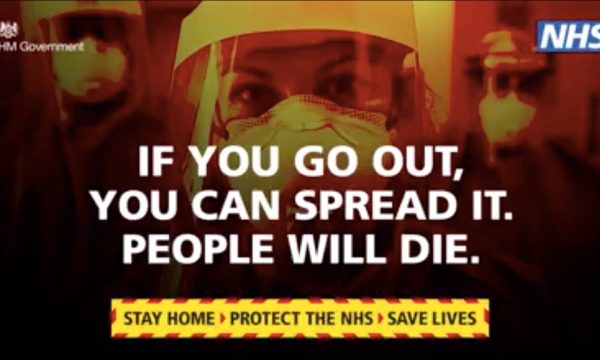
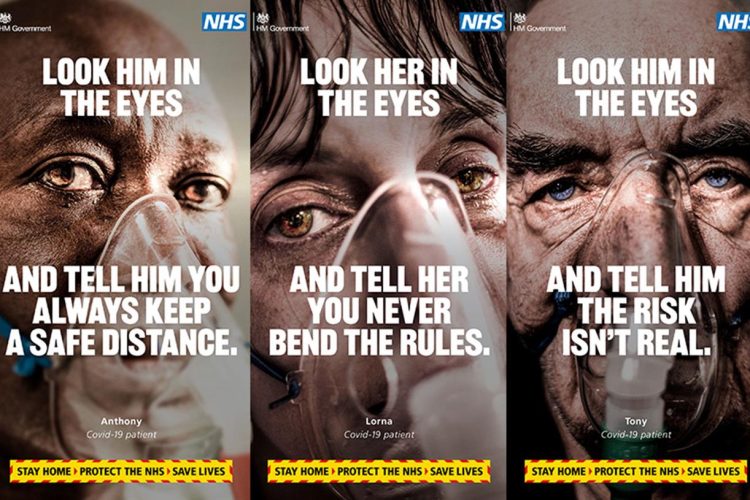
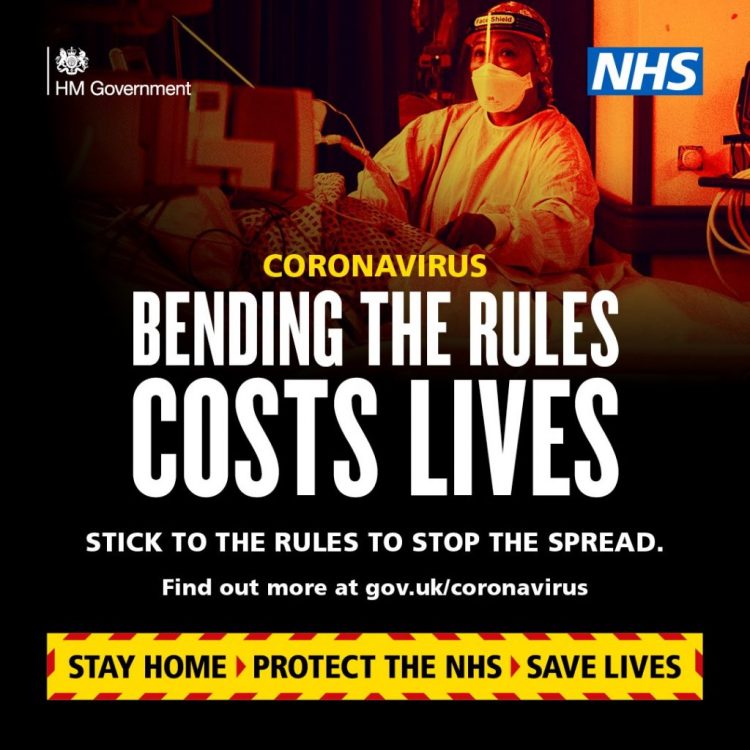
Advertising / propaganda played a massive part in keeping citizens compliant and afraid. Quite frankly, advertising companies should feel ashamed with the amount of societal manipulation they caused in exchange for government coin.
Early on in the pandemic, the Scientific Advisory Group for Emergencies (SAGE) in the UK called for an increase in the perceived threat of Covid by using hard-hitting emotional messages. However, it has since been revealed that government contracts and messages were in place weeks before lockdowns were even suggested.
These adverts were produced in collaboration with behavioural scientists, trying to nudge people to do what they wanted using tactics that operate below the level of awareness.
The UK spent over £240 million on these adverts in 2020 and up to £320 million in 2021. Obscene amounts of money. To put this in context, the government spent £46 million on advertising “Get Ready for Brexit” in 2019, the biggest spend since the second world war.
I have posted some of the worst images from the UK below. They made people feel guilty, ashamed, worried that they would kill people and angry against those who did not precisely follow the rules.

The UK is Trying to Drag the US into World War III
By Michael Tracey | April 14, 2022
There’s a chap called Tobias Ellwood who’s spent the past week doggedly promoting his latest idea to save Western civilization. “From a military perspective,” Ellwood explained during a recent speaking engagement, it’s never been more urgent to impose a “humanitarian sea corridor” off the coast of Ukraine. This would involve an outright naval intervention by NATO in the Black Sea — with the objective being to prevent Russia from seizing control of the strategically important city of Odesa. Perhaps upon commencement of this mission, Ellwood suggested, listless denizens of “The West” will finally come to appreciate the existential stakes of the conflict now before us, and “accept that we are actually in a 1938 period, but actually worse.” The double “actually” was presumably included for maximum emphasis.
Notably, Ellwood is not some random crank. He is “actually” a Member of Parliament in the United Kingdom, and the chairman of the impressively-titled Defence Select Committee. In that latter capacity, he seeks to exert influence over the Defence policy of Her Majesty’s Government, which is currently led by his Conservative Party colleague Boris Johnson.
During the private event, hosted by a Think Tank which unilaterally and hilariously decreed his comments “off the record,” Ellwood described the plan he envisaged for how this new phase of military intervention in Ukraine would unfold. It should be up to the UK to “create a coalition of the willing,” he declared — borrowing the terminology once used for countries that participated in the US invasion of Iraq, which memorably included the UK. Ellwood evidently detected no ignominy at all in this historical association.
On the subject of Ukraine, Ellwood’s view is that the UK and Europe must stop waiting around for the US to get its act together, and instead proactively initiate the kind of muscular, unapologetic military action that is currently needed against Russia. The lesson of last year’s Afghanistan withdrawal, Ellwood charged — as well as Joe Biden’s purported Ukraine-related dithering — has been to “expose America to be very, very hesitant indeed.” He explained: “I see the United States almost catching up with where, from a military perspective, a vanguard may actually go.”
Note that Ellwood’s plan certainly does not assume that the US would somehow just sit out whatever forthcoming war the UK may instigate. With the US as the real firepower behind NATO, that’s obviously not feasible. Instead, his idea would simply be for the UK to place itself at the “vanguard” of precipitating the new military action, after which the US would inevitably be engulfed as well. Time is of the essence, Ellwood contends, because China has ominously joined with Russia to set about “dismantling the liberal world order” — a development Ellwood believes will elevate the conflict to a magnitude on par with the Peloponnesian War of Greek antiquity. “China will exploit the war in Ukraine to hasten America’s inevitable decline,” he warned.
Out of these ashes, at least according to Ellwood’s apparent calculus, will rise the UK: “If we want Putin to fail,” Ellwood declared, “then we need to conclude this in months. We need to vow to press forward.” He added, “I underline how critical it is: if Odesa falls, then I’m afraid it’s going to be very, very difficult for us to turn this around.” (Note his use of the pronoun “us,” as though it should be understood that the UK is already an official combatant.)
In his quest to position the UK at the head of this new “vanguard” for greater military intervention, Ellwood is aided by a supportive clamor emanating from what some might regard as an unlikely quarter: the British Left. Broach the subject of Ukraine with prominent figures in the Labour Party, the trade unions, or the left-wing media, and you might be amazed to find that their critique of current Government policy is not that Boris Johnson has been too cavalier or militaristic with regard to Ukraine. Rather, it’s that Johnson hasn’t been cavalier or militaristic enough. Or in other words, what they’re really taking the Conservative Government to task for at the moment is its alleged unwillingness to escalate the war to their liking.
Adjust the ideological contours slightly, and this new Labour Party line is a mirror image of the Republican Party’s current critique of Joe Biden. According to the incessant shrieks of GOP elected officials, Biden is nothing but a wimpy appeaser — even though he’s escalating US involvement in new and exciting ways virtually every single day. Just this week, Biden rolled out something like a back-to-back escalatory special: on Tuesday he publicly accused Putin of committing “genocide,” and by Wednesday he was announcing yet another $800 million in arms shipments, with this latest tranche featuring heavier weaponry than ever before — including a fleet of attack helicopters. That coincided with a classified meeting held at the Pentagon, where the eight largest US defense contractors had been summoned “in preparation for a protracted conflict against Russia.”
But no matter how much Biden intensifies the military intervention, it’s never enough for the GOP, which constantly needs an angle of attack whereby they’re lambasting Biden for not being sufficiently “tough.” (In a heartwarming display of bipartisan unity, Donald Trump just went on Fox News and repeated Biden’s “genocide” accusation. The jury’s still out on whether Trump accused Putin of committing genocide only because he’s secretly conspiring with Putin: tune in tonight on MSNBC for the latest updates.)
This GOP-esque “never tough enough” oppositional dynamic is also evident in the UK, except with putatively left-wing opposition figures leading the charge. Addressing a pro-war rally in London last weekend was Alex Sobel, a Labour Party MP who serves in the Shadow Cabinet of Keir Starmer, the current Opposition Leader. When I asked Sobel to clarify his policy grievance against Boris Johnson, he told me: “There’s been a lack of military assistance. And there’s been a lack of support within NATO more broadly, in terms of military assistance.” This can be translated as: Boris Johnson, NATO, and the US have not been militarily aggressive enough in Ukraine! That’s the criticism!
Expressing his reluctance to countenance any kind of negotiated resolution to the war, Sobel told me: “The Russians only understand force, they do not understand peace.” This is a weirdly common allusion to a supposed genetic predisposition of Russians that makes them inherently… warlike? Sounds very similar to when James Clapper, the top Intelligence Official in the Obama Administration, would go around intoning that Russians were “almost genetically-driven to co-opt” and “penetrate.”
Much of the UK media shares the view that Boris Johnson has exhibited insufficient “force” in his dealings with Russia. This includes The Observer newspaper — understood to be the UK’s leading bastion of respectable left/liberal opinion — which threw caution to the wind last weekend and published an official unsigned editorial institutionally endorsing “direct intervention” in Ukraine by NATO. In particular, the editorial promoted the very same naval blockade plan touted by Tobias Ellwood — the aforementioned Conservative MP who might otherwise be considered the newspaper’s ideological foe. “Declare the unoccupied city of Odesa off-limits,” the Observer editorial demands of Johnson, “and warn Russia to cease coastal bombardments or face serious, unspecified consequences.” Wariness to start World War III has now turned into a timid “excuse” for inaction, the editorial writers allege.
So that’s the basic gist of the left/liberal position on Ukraine. In order to placate his political opponents, Boris Johnson would have to drastically escalate the UK’s existing military intervention. Jeremy Cliffe, a writer for the left-wing New Statesman magazine, confirmed as much to me directly:
https://twitter.com/JeremyCliffe/status/1512829899505082388
Also behold the recent activism of Owen Jones, the noted left-wing journalist whose “beat” appears to be a never-ending series of exhortatory instructions to some amorphous assemblage he calls “The Left.” Jones is now of the view, amazingly, that supporting the “armed struggle” of Ukraine is the only proper “anti-war” position. So here we have another “anti-war” leftist who happens to be in favor of provisioning tanks, fighter jets, missiles, and grenades into an active warzone, for the purpose of facilitating warfare. As is also the case in the US, these UK left/liberals often find it unpleasant to straightforwardly label themselves “pro-war” — so they have been forced to play word-games galore to avoid acknowledging reality. And the reality is that the policy action they’re advocating must necessarily be enacted by some combination of Boris Johnson, the US military-industrial complex, and NATO — all of whom have now been enlisted to carry out these leftists’ desired war aims.
The most vivid manifestation of this increasingly incoherent left-wing viewpoint could be observed a few days ago at the pro-war march and rally in Whitehall, the governmental corridor of Central London. I found out about the rally because it was endorsed and promoted by Owen Jones on Twitter. Upon arrival, I discovered that leading the march was another left-wing journalist, Paul Mason, who organized the action in concert with a strange Trotyskist faction called the Alliance for Workers’ Liberty. “We support Ukraine’s war and demand the West provides weapons,” the group’s pamphlet declares, along with a bitter condemnation of NATO for “steadfastly refusing to fight.”
Mason had many magical moments as rally leader, but his most comical interlude was when he stopped along the march route to bellow, via bullhorn, in the general direction of the UK Ministry of Defence — shouting for the workers inside to come out and join. I asked Mason if he reckoned this was the first “anti-war” and/or “left-wing” rally in British history for which the Ministry of Defence (of a Conservative government!) was considered a natural ally — but he caustically refused to talk, instead denouncing me as a “Putin shill.” (Direct quote.) Clever guy, that Paul. Supremely confident in his convictions, surely, and quick with the novel insult.
A former employee of the BBC and Channel 4, Mason offered up an inventive rationalization for his pro-war advocacy when it was his turn to clasp the microphone that afternoon. “In a war like this, our natural demand for peace — our natural fear of military action — has to take second place,” he proclaimed. Because don’t you know, according to Mason, this particular war is actually being waged on behalf of the vaunted “Working Class”!
“It is in the interest of working class people to support Ukraine in this war,” Mason beseeched from the rally pulpit, expressing his hope to mobilize the whole of the British Labor Movement behind the pro-war cause. “I know how hard that is for many of us, who’ve stood outside here in so many other wars and said — you know, screw your hypocrisy over Iraq, and Afghanistan, and the rest,” Mason acknowledged. “It’s hard. But the only way to get arms into the hands of the Ukrainian people right now… is to keep the pressure on the government.”
So there you have it, clear as day: the object of this left-wing “anti-war” rally was to “keep the pressure” on the ruling Conservative Government… to continue ramping up weapons shipments to Ukraine. For use in… intensifying warfare. As Mason barreled forward with his speech, the Ukraine flag shimmered triumphantly in the sunlight atop Boris Johnson’s Cabinet Office, located right across the street at 70 Whitehall — a moving symbol of cross-ideological unity.
I found that a very simple line of questioning posed to the assembled leftist demonstrators — merely asking them whether they viewed the event they were partaking in as a “pro-war” rally, or an “anti-war” rally — tended to elicit spells of bewildered anger. When asked this question, a number of the pamphleteers insisted to me that the rally was in fact “anti-war” in nature, even though they were distributing placards featuring the injunction to “Arm Ukraine” — a task which would necessarily have [to be] accomplished by the US, UK, and other governments, in conjunction with NATO. One of the chants fervently screamed on the march went as follows: “Put an end to Putin’s reign! Arm, arm, arm, Ukraine!” That’s the new mantra of the British anti-war movement! If nothing else, one has to appreciate this audacious innovation in the fluidity of language.
Another Labour MP, Nadia Whittome, also addressed the pro-war rally — naturally beginning her speech with a fulsome greeting to her fellow “Comrades.” As the youngest member of Parliament at age 25, she can hardly be accused of representing some stodgy old guard; she even had the presence of mind to tie the cause of battlefield victory for Ukraine with the cause of Palestinians. “Slava Ukraini!” Whittome cried. I would’ve asked her to expand upon her views, but at the time had been temporarily accosted by a duo of pro-war demonstrators who identified me based on my Twitter feed, and attempted (unsuccessfully) to kick me out of the rally. It was pretty funny.
At one point, a woman representing UNISON, one of the UK’s largest trade unions, read aloud a message she’d received from the head of the Federation of Trade Unions in Ukraine — purportedly some bold demonstration of organized labor solidarity. The only catch, at least for anyone who might not be so hot on the idea of World War III, was that this letter from the Ukrainian union leader included a demand to “secure our Ukrainian sky.” Which, of course, is another variation on the No Fly Zone demand that Zelensky and other Ukraine government officials have been lobbying for relentlessly over the past seven weeks. And that was the demand — for World War III, more or less — which was boldly read aloud at this reputedly left-wing “anti-war” rally. At times, you really just had to step back and appreciate the dark humor.
If there’s one figure on the British Left who’s still slightly reticent to support overt cataclysmic warfare, it’s Jeremy Corbyn, the former leader of the Labour Party. Though he immediately condemned Russia’s invasion after it was launched in February, Corbyn has also reiterated his longstanding skepticism about the utility of NATO — even “refuting” the idea that NATO is merely a “defensive alliance.” He has further opposed the massive US/UK/NATO arms-funneling operation in Ukraine, and instead indicated a preference for a negotiated resolution to the conflict — positions which put him on the radical fringe in both the UK and the US.
Alex Sobel, the Labour MP I interviewed, had previously served on Corbyn’s front bench in Parliament — so I asked him what he made of Corbyn’s position on Ukraine, which conflicted resolutely with the message being propounded at the left-wing pro-war rally. Sobel replied coldly: “I don’t know what his position is. He’s not a Labour MP.” (Corbyn was expelled from the parliamentary Party in 2020.)

“Arm Ukraine” ralliers in London on April 9, 2022
The left-wing tactic of characterizing overt escalation of warfare as #actually being “anti-war” is firmly in league with the chosen PR strategy of the Ukraine government — keenly aware that they must cater to the sensibilities of liberal Europeans and Americans, most of whom would probably prefer not to think of themselves as disreputable pro-war boors. After the slick visit paid by Boris Johnson to Kiev last weekend, wherein he strode around for the cameras with Zelensky, it was announced that the UK would deploy additional shipments of armored vehicles and missile systems to the warzone. An advisor to Zelenksy heralded the move as further evidence that “The UK is the leader… in the anti-war coalition.”
Has there ever been an “anti-war coalition” that so passionately and openly advocated literal warfare? It’s truly remarkable!
By the way, to any staunch advocates of military intervention who may be reading this: it would be more than possible for you to finally drop the phony “anti-war” pretense, and simply argue in favor of what you believe to be a “just war.” There’s a fairly healthy tradition of such arguments. And in that case, at least the terms of the debate could be clarified!
But, there’s a strong interest among these various factions to ensure that the terms of the debate are not clarified. An old saying goes that the Conservative Party and the Labour Party are really “two cheeks of the same backside.” On the subject of Ukraine, that’s eminently applicable. And you can throw in the Democrats and Republicans as well — another a pair of pimples on the same “arse.”
Whatever the UK’s ultimate designs for future military escalation, it’s very possible that the US won’t need very much cajoling after all. Last week, to conspicuously little fanfare, the US Senate unanimously revived the “lend-lease” program — originally created in 1941 to arm the UK in the Second World War — on behalf of Ukraine. Seems like a potential omen for what’s to come. And who knows what else Joe Biden, who’s already declared his intention to engineer regime change in Russia, has up his crusty old sleeve.
Nevertheless, Boris Johnson has every incentive to go full-steam-ahead and do exactly as he’s been enjoined to do by clamorers on both the Left and Right. Upon receiving a fine this week from the police for partying during COVID lockdown, and thus violating the rules he himself imposed — a scandal that not long ago had him teetering perilously close to being ousted as Prime Minister — Johnson delivered a statement that was really one for the ages. He said that his receipt of the fine now instilled in him an “even greater sense of obligation” to “ensure that Putin fails in Ukraine.” Really, that’s what he said.
It remains to be seen what form this “sense of obligation” will take. Perhaps it will culminate in fulfilling the wishes of Tobias Ellwood and The Observer, and a naval intervention in the Black Sea will be launched. Or perhaps some other plan is in store. Richard Shirreff, a retired British Army officer and former high-level NATO commander, has recently declared that either way, Britons “need to brace ourselves, prepare ourselves for war.” Whichever escalatory option Johnson may choose, it can be carried out with a certain satisfaction in knowing that left-wing activists will be marching right behind him, in unbridled support — apparently on behalf of the “working class.” You really couldn’t make it up.
Boris Johnson Supports Ukraine to the Detriment of the Brits
By Valery Kulikov – New Eastern Outlook – 15.04.2022
A highly sensationalist article by Bloomberg clearly shows that the British government left more than 5 million Britons without support in the current crisis in implementing its pronounced Russophobic policy!
As the publication emphasizes, a significant part of the British population feels the consequences of the cost of living crisis especially strongly, and this is due more to politics than to the economy. An increase in electricity bills and in the cost of food and loan rates has already become a difficult test for all the British without exception. Thus, since April 1, gas and electricity prices alone have increased by 54%! Prices for fruits and vegetables in Britain may soon rise by a third, which is already creating problems and a shortage of products on the shelves of British stores. At the same time, warehouses are already running out of sunflower oil, which jeopardizes the production of traditionally beloved British dishes, writes Daily Mail.
New statistics shows that food inflation in Britain has already increased by 5.3% year-on-year. The Bank of England warned last week that the incomes of many Britons will experience an “historic” shock after inflation jumped to a 30-year high last month, has already reached 6.2%, and, according to forecasts, may rise to 8% this spring, notes Daily Mail.
The independent Food Aid Network, which consists of more than 550 food banks from all over Britain, has sent a letter to Prime Minister Boris Johnson, writes The Independent, with a demand to take urgent measures, since the number of requests for help has increased enormously in recent weeks. This is due to high electricity bills, rising food prices and health insurance. For this very reason, many families are barely surviving, and in some food banks the number of requests has doubled since the end of 2021. Some food banks have already had to reduce the amount of food they provide.
Britain is witnessing the biggest decline in living standards since the 1950s, and many British families in such conditions have to wonder, “how to survive further”?
“Fuel poverty” has affected 88% of the British population, Sky News reports. As the British told the TV channel, against the background of rising energy prices, they are forced to go to bed earlier or take buses and trains all day to keep warm. At the same time, the country predicts that as energy prices continue to rise, it will be even more difficult for families already living on the brink.
However, instead of providing effective assistance to the residents of the kingdom and reducing unnecessary spending, at the expense of the British taxpayers, on “settling in and helping Ukraine,” the British government continues to take not just a wait-and-see stance, but one overtly contradicting the interests of its own people. Against this background, the “decision”, covered by The Sun, of the British company Octopus Energy to distribute blankets with electric heating to financially struggling customers in order to “help them survive a sharp rise in heating prices,” is perceived as a cruel joke on the impoverished Britons. This company did not even stop to think about how the British will pay bills for the use of electric blankets when they do not have enough money to pay for heating their homes! Do not forget that in early April, energy prices in the United Kingdom jumped by 54% due to a strong rise in wholesale gas prices. The rates increase has hit millions of households across the kingdom. Now the energy bill for the country’s residents will increase by an average of 700 pounds per year.
The results of a survey conducted by the National Statistical Service indicate that residents of the United Kingdom have to seriously reduce spending. More than half of respondents stated that they save on “non-essential” goods, 34% – on gas or electricity, and 31% – on food and essential goods.
On March 28, Chancellor of the Exchequer Rishi Sunak, speaking before the British Parliament, said that although rising costs have been hitting people across Europe in recent weeks, no major economy leaves its unemployed population in such a vulnerable position. There are 5.3 million people in Britain today who could work but depend solely on state aid, and more and more Britons are forced to resort to the services of food banks and apply for short-term cash loans at high interest rates. This number of disadvantaged Britons is approximately equal to the number of all residents of Scotland and accounts for a tenth of people of working age in the United Kingdom.
Against the background of the lack of financial assistance from the government to the catastrophically impoverished Britons, the inhabitants of the kingdom were perplexed at learning the results of the recent trip of the British Prime Minister to Kiev, where he arrived with a new package of financial and military assistance to this country. In particular, Boris Johnson said that Britain would supply Ukraine with an additional 120 armored vehicles and anti-ship complexes. In addition, Kiev will receive new loan guarantees from Britain worth USD 500 million through the World Bank, while the British Prime Minister expressed readiness to help in the restoration of Kiev and the Kiev region after the end of the Russian military operation.
This is causing new anti-government protests among Britons who are outraged by the sharp rise in the cost of living over the past couple of months and the failed government policies. Protest demonstrations took place across the country, including in Belfast, where the rally participants demanded that the government allocate an additional thousand pounds to each family in Northern Ireland to help the population reduce the rising costs of fuel and food. Similar actions took place in dozens of other cities across the kingdom. British households are telling the government that they are experiencing more blows to their finances amid an unprecedented crisis caused by the rising cost of living.
“The residents of Britain are facing difficult times due to anti-Russian sanctions, but the country’s authorities, apparently, do not realize the threat,” was the conclusion of retired General Jonathan Shaw made on the pages of The Independent. He is convinced that the Johnson government’s Russophobic policy of banning, in particular, imports of wheat and oil, will hit the standard of living of the population, which will become “much worse.” Shaw believes that many people in Britain, like the government, have “the wrong mentality” about the severity of the consequences of the “new cold war” with Russia.
Recall that in early March, the British government announced its intention to stop importing oil and petroleum products from Russia. After that, the cost of gasoline and diesel fuel at British gas stations went up sharply, breaking several records along the way.
Considering how much attention Boris Johnson pays to the sanctions policy against Russia, it is surprising how this Titanic still manages to stay afloat despite the widespread negative attitude towards it. At the same time, his criticism is growing every day, in proportion to the rate of decline in the standard of living of the population and the resolution of the issue of Scotland’s independence referendum.
In principle, it is already obvious to everyone today that the era of economic liberalism in its former form has come to an end. In fact, the current Western political elites openly follow the path of forming an ultratotalitarian supersystem, supranational hyperfascism, in which the former values of capitalism, free market and political freedoms of citizens have almost entirely lost their value. And the “welfare state” that the collective West was so proud of is already a thing of the past. And by trying to unleash an even more Russophobic sanctions policy, the rulers of Britain and some other parts of the West only accelerate the change of political power in their states.
The question MSM should be asking about Partygate

The Naked Emperor’s Newsletter | April 14, 2022
Partygate, as the name suggests, concerns parties and in particular parties in Downing Street during lockdowns. For those who don’t know no. 10 Downing Street is where the current Prime Minister works and resides, in this case, Boris Johnson. Rishi Sunak, the Chancellor of the Exchequer, lives and works next door at number 11. Number 10 may look small from the outside but actually comprises of more than 100 rooms.
From March 2020, the UK had a number of lockdowns and until recently some form of restrictions in place. As with most countries, many of these restrictions included who you could and couldn’t visit or numbers of people allowed indoors or outdoors.
It has since transpired that whilst authoring and implementing all of these draconian rules, along with the harsh penalties if the rules were broken, Boris, his wife Carrie, Rishi and other staff at Downing Street had at least 12 parties. At least 50 penalty notices are being handed out to Boris, Carrie, Rishi and others.
The MSM is focussing on Boris breaking the rules and lying when asked if he had broken them. However, the question they should be asking is:
Why was the government desperately trying to scare the public about Covid when they themselves weren’t scared in the slightest?
Were they so stressed and tired of it all that they were happy to risk their lives just to have a few parties or did they know, the whole time, that Covid would mainly kill the elderly and vulnerable so they themselves were perfectly safe. Or perhaps they knew of the potential dangers a lab made virus could pose but had access to an already prepared inhibitor which targeted the spike protein?
If the correct answer is that they knew Covid was not as deadly as being made out, then the MSM should be investigating why they continued to scare the public. Where did the idea come from? Why was it pushed so hard if they knew it was rubbish? Why was no cost/benefit analysis undertaken and if it was why did they continue to destroy the economy?
Another anomaly, which verges into conspiracy theory territory, is why was Boris Johnson partying after he came out of intensive care less than a month previously? Surely you would take it easy for a while after such a big scare? Even if Boris wasn’t bothered, staff would have been shell shocked and scared for their own safety? Politicians and Journalists voiced rumours at the time but they were quickly retracted.
Come on MSM, step up and ask the correct questions.
Leaked files expose Britain’s covert infiltration of Palestinian refugee camps
By Kit Klarenberg | The Cradle | April 13 2022
In February, Lebanese journalist Mohammed Shoaib was arrested on suspicion of collusion with Israel’s Mossad spy agency. The writer who worked for Al-Jaras, confessed that the notorious spy agency secretly paid him to author “dozens” of anti-Hezbollah articles, receiving a paltry $30 to $70 per article.
In particular, Shoaib was tasked with writing hit jobs on the “Iranian occupation” of Lebanon, and falsely linking Hezbollah with the August 2020 Beirut port blast, drug trafficking, and murder of political activists.
It is also alleged that Mossad specifically requested his work incite hostility towards Palestinian refugees in the country who number almost 300,000. In all, Lebanon hosts more than 1.7 million refugees and has the largest per capita population of refugees in the world.
Roughly half inhabit camps administered by the United Nations Relief and Works Agency (UNRWA), where they endure abysmal living conditions, overcrowding, poverty, unemployment, lack of access to justice, and other unspeakable hardships. The 11-year, foreign-backed crisis in neighboring Syria has also prompted Palestinian refugees there – and Syrian citizens – to seek sanctuary in Lebanon.
Given Israel’s track record of multifaceted crimes against the Palestinian people, that they are targeting an already vulnerable refugee population for propaganda purposes is hardly surprising. Nonetheless, Israel is not the only hostile foreign country resorting to these tactics.
Leaked files reviewed by The Cradle reveal the British Foreign Office has for many years secretly meddled in Lebanon’s refugee camps, courtesy of ARK, a shadowy intelligence cutout run by probable MI6 operative Alistair Harris. London’s agenda is rather different than Tel Aviv’s, however – it seeks to subtly stir up revolutionary fervor, and exploit them as unwitting foot soldiers in its ongoing clandestine war against Lebanon’s ruling elite.
‘Community Engagement’
The documents indicate ARK has been operating in all 12 camps since 2009, implementing British-funded “programming” of various kinds. This experience has granted the company “granular understanding” of their internal political, economic, ideological, religious and practical dynamics, and led to the establishment of a “diverse delivery team” and array of “local contacts” with “access throughout all camps and gatherings,” meaning community-level discussions and activities of residents can be spied upon and influenced.
This intimate, insidious insight is reinforced by “daily monitoring of neighborhood-level WhatsApp groups,” with “any new information, such as affiliation between a local group and a faction, or conflict between factions” documented by ARK’s in-house “stakeholder tracker.”
Typically, ARK has engaged in small-scale initiatives in the camps, including the restoration of streets and cemeteries, recycling initiatives, assisting in the launch of small businesses, providing income to disadvantaged and disabled residents, creating nurseries and daycare centers, and even launching a community hub, Sawa Coffeeshop. It serves to this day as “a popular place for youth to gather and promote civic engagement in their community and a shared Palestinian identity that bridges factional differences.”
In submissions to the Foreign Office dating to May 2019, ARK proposed ramping up these activities significantly. It pledged to create “Community Leadership Committees” in each camp, composed of hand-picked “stakeholders” – including NGOs, youth activists, women’s organizations, and representatives of neighborhood armed groups – to identify “quick impact projects” that could be implemented therein. These projects aim to “counter threats to social stability in the camps, create or improve livelihood opportunities, and provide better access to services.”
A social media platform created by ARK, Nastopia – which boasted 20,000 “highly invested” followers on Facebook at the time, a figure that has almost doubled since – was forecast to be fundamental to these efforts.
The page, run by a 24-strong team of ARK-trained “youth reporters”, would be used to recruit local participants, increase awareness and demand for “community engagement and improved conditions” among camp residents. Other activities include the promotion of Foreign Office-financed projects and to publicize “success stories” generated by them, while “promoting Palestinian culture and a sense of belonging, and tackling social injustice.”
Nastopia was “already [an] effective voice for connecting Palestinian communities, particularly youth” by that point. ARK cited a recent “Camps Films Festival” organized by the platform, covered by Al-Jazeera, which showcased “films portraying life in the camps and what it means to be Palestinian,” and in the process provided “positive examples of a shared identity.”
All along, the Nastopia page was to be monitored with “community feedback” on the assorted initiatives gauged to identify areas in which these activities “could be adapted to maximize impact.” Specialist training provided to its staff meant the platform could also serve “as a forum for online and offline discussion about social injustices [and] virtual space to talk about topics considered taboo in the camps,” allowing ARK to burrow even deeper inside the heads of refugees.
‘Active Citizenship’
If the obvious surveillance and manipulation dimensions of ARK’s project weren’t troubling enough, it takes on an acutely sinister character when one considers a key objective of “highlighting successful initiatives” in the camps was to “[enhance] the audience’s confidence in their own ability to contribute to social change.”
A Foreign Office-commissioned Target Audience Analysis conducted by ARK in March 2019 sought to pinpoint a segment of Lebanon’s population that could be mobilized to “affect positive social change,” and methods by which tensions between sectarian communities could be reduced, in order to unify them in opposition to the country’s ruling elite. Reading between the lines, it gives every appearance of a blueprint for the overthrow of the Lebanese government.
An ideal audience was duly identified, representing 12 percent of the population, who disavowed violence but did not reject “other forms of contentious politics,” and could be “influenced” to engage in “behaviors leading to positive social change,” such as protests and community initiatives.
The only questions for ARK were: “What might be done to enable other Lebanese to have similar confidence in their potential to contribute to positive social change?” and “how might this segment of the population … be grown to include a larger fraction of the public?”
The answer, ARK proposed, was to both covertly and overtly promote the message that “change is possible and ordinary citizens have a role to play in achieving change,” by way of propaganda campaigns and civil society initiatives “[highlighting] where change has been achieved or where threats to Lebanon’s stability have been countered.” This would demonstrate to the country’s diverse population that “barriers” to reform can be overcome, by taking matters into their own hands.
Providing evidence of “responsive government at local levels” was crucial for reinforcing “principles of active citizenship” among Lebanon’s population – and the analysis specifically cited Syrians and Palestinians, who are mostly Sunni Muslims, as representing an “important part” of the country’s demography, to be motivated in this manner.
In other words, Foreign Office activities in the refugee camps form just one fragment of a wider, clandestine, multi-channel assault on public perceptions in Lebanon that Britain has been waging against its democratically-elected government.
A mobilized force
One can judge these efforts by their fruits. In October 2019, seven months after ARK’s Target Audience Analysis was supplied to the Foreign Office, large-scale protests engulfed the streets of Beirut, which have ebbed and flowed ever since, and generated enormous amounts of western media coverage along the way.
The extent to which ARK’s Foreign Office-funded meddling in Lebanon influenced this incendiary unrest may never be fully quantifiable, but it may be significant that in July that year, thousands of refugees across several camps began demonstrating in unison, demanding the government immediately reform employment laws barring them as “foreign workers” from numerous professions.
This turmoil was arguably the spark that ignited the entire “October Revolution” – and in one of its Foreign Office submissions, ARK refers to how it “takes pride” in ensuring refugees recruited to its illicit schemes receive “annual leave, sick leave, and health insurance,” despite this not being “legally necessary” due to local legislation “discriminating against Palestinians.”
Who benefits?
The influence of ARK on Lebanon’s impending general election in May, the country’s first since the riots began, is even more unambiguous. Several news outlets have hailed the unprecedentedly high profusion of young candidates vying for office – 80 in total, many of them women.
A clandestine Foreign Office project influenced by the aforementioned Target Audience Analysis sought to enlist Lebanese youth as “agents of change”, fostering among them a culture of active political participation, in order that they could better “hold political institutions and individuals accountable,” and increase “electoral participation” in favor of opposition parties.
Under its auspices, ARK convened “boot camps” in “priority areas” of Lebanon, cultivated “a national group capable of pushing for greater change” composed of young women, and created social media assets and youth-focused websites featuring political interviews, question-and-answer sessions, coverage of boot camp meetings, “calls to action,” and “humorous messaging campaigns.” Activity on these assets was scheduled to ramp up ahead of the 2022 elections.
Clearly, irrespective of the outcome of the Lebanon May elections, the ultimate victors won’t be the parties and candidates that secure office, or the average Lebanese citizens who elected them, but Britain – for whatever form the next government takes, one way or another, it will serve London’s financial, ideological, military, and political interests.
Sweden Saw Second Smallest Increase in National Debt Out of All EU Countries
By Noah Carl | The Daily Sceptic | April 13, 2022
In 2020, the first year of the pandemic, almost every country in the world had a major recession. As this map from the IMF shows, most countries in Europe saw GDP decline by more than 3%, the only exception being Ireland (which in any case has an unusual way of counting GDP).
Despite this, unemployment in the EU only increased by a modest 1.2 percentage points, rising from 6.6% to 7.8% by the third quarter of 2020. One reason why unemployment didn’t rise more during months of lockdown is that governments spent unprecedented sums of money on furlough and other wage-support schemes.
In other words, they paid people to sit at home all day. For example, The U.K.’s Coronavirus Job Retention Scheme paid furloughed workers 80% of their previous salary, up to a cap of £2,500 a week.
While such wage-support schemes had the benefit of preventing large rises in unemployment, they had the cost of being extremely expensive. Data published by the ONS in January of this year show just how expensive.
The chart below shows change in general government gross debt (as a percentage of GDP) in percentage points from the fourth quarter of 2019 to the third quarter of 2021:
Many countries saw absolutely huge increases in debt. Over just seven quarters, Spain’s debt grew by 26 percentage points, Italy’s by 21 percentage points, and Greece’s by 20 percentage points. The UK wasn’t far behind, logging an increase of 18.7 percentage points.
At the other end of the spectrum, Ireland’s debt grew by less than one percentage point, while Sweden’s grew by only 1.2 percentage points. Of course, Sweden’s strong performance comes as no surprise, given it was the only major European country that didn’t lock down in the spring.
As I noted previously, The Economist ranked Sweden third in a league table of 23 rich countries for overall economic performance during the pandemic. And we know this didn’t come at the cost of Swedish lives – the country actually saw negative excess mortality between January of 2020 and June of 2021.
To compare European countries in a comprehensive way, I plotted change in general government gross debt against age-adjusted excess mortality. (Data were not available for Germany, Ireland, Norway and Switzerland.)
Taking into account both metrics, Sweden was one of the best overall performers in Europe, along with Luxembourg, Denmark and Finland. And it was by far the best performer among countries with a population over 10 million.
By contrast, Eastern European countries and large Western European countries – almost all of which had strict lockdowns – did poorly on both metrics. So lockdown was harmful to the public finances, with little corresponding benefit in terms of reduced mortality.
Western Dissent from US/NATO Policy on Ukraine is Small, Yet the Censorship Campaign is Extreme
Preventing us from asking who benefits from a protracted proxy war, and who pays the price, is paramount. A closed propaganda system achieves that.
By Glenn Greenwald | April 13, 2022
If one wishes to be exposed to news, information or perspective that contravenes the prevailing US/NATO view on the war in Ukraine, a rigorous search is required. And there is no guarantee that search will succeed. That is because the state/corporate censorship regime that has been imposed in the West with regard to this war is stunningly aggressive, rapid and comprehensive.
On a virtually daily basis, any off-key news agency, independent platform or individual citizen is liable to be banished from the internet. In early March, barely a week after Russia’s invasion of Ukraine, the twenty-seven nation European Union — citing “disinformation” and “public order and security” — officially banned the Russian state-news outlets RT and Sputnik from being heard anywhere in Europe. In what Reuters called “an unprecedented move,” all television and online platforms were barred by force of law from airing content from those two outlets. Even prior to that censorship order from the state, Facebook and Google were already banning those outlets, and Twitter immediately announced they would as well, in compliance with the new EU law.
But what was “unprecedented” just six weeks ago has now become commonplace, even normalized. Any platform devoted to offering inconvenient-to-NATO news or alternative perspectives is guaranteed a very short lifespan. Less than two weeks after the EU’s decree, Google announced that it was voluntarily banning all Russian-affiliated media worldwide, meaning Americans and all other non-Europeans were now blocked from viewing those channels on YouTube if they wished to. As so often happens with Big Tech censorship, much of the pressure on Google to more aggressively censor content about the war in Ukraine came from its own workforce: “Workers across Google had been urging YouTube to take additional punitive measures against Russian channels.”
So prolific and fast-moving is this censorship regime that it is virtually impossible to count how many platforms, agencies and individuals have been banished for the crime of expressing views deemed “pro-Russian.” On Tuesday, Twitter, with no explanation as usual, suddenly banned one of the most informative, reliable and careful dissident accounts, named “Russians With Attitude.” Created in late 2020 by two English-speaking Russians, the account exploded in popularity since the start of the war, from roughly 20,000 followers before the invasion to more than 125,000 followers at the time Twitter banned it. An accompanying podcast with the same name also exploded in popularity and, at least as of now, can still be heard on Patreon.
What makes this outburst of Western censorship so notable — and what is at least partially driving it — is that there is a clear, demonstrable hunger in the West for news and information that is banished by Western news sources, ones which loyally and unquestioningly mimic claims from the U.S. government, NATO, and Ukrainian officials. As The Washington Post acknowledged when reporting Big Tech’s “unprecedented” banning of RT, Sputnik and other Russian sources of news: “In the first four days of Russia’s invasion of Ukraine, viewership of more than a dozen Russian state-backed propaganda channels on YouTube spiked to unusually high levels.”
Note that this censorship regime is completely one-sided and, as usual, entirely aligned with U.S. foreign policy. Western news outlets and social media platforms have been flooded with pro-Ukrainian propaganda and outright lies from the start of the war. A New York Times article from early March put it very delicately in its headline: “Fact and Mythmaking Blend in Ukraine’s Information War.” Axios was similarly understated in recognizing this fact: “Ukraine misinformation is spreading — and not just from Russia.” Members of the U.S. Congress have gleefully spread fabrications that went viral to millions of people, with no action from censorship-happy Silicon Valley corporations. That is not a surprise: all participants in war use disinformation and propaganda to manipulate public opinion in their favor, and that certainly includes all direct and proxy-war belligerents in the war in Ukraine.
Yet there is little to no censorship — either by Western states or by Silicon Valley monopolies — of pro-Ukrainian disinformation, propaganda and lies. The censorship goes only in one direction: to silence any voices deemed “pro-Russian,” regardless of whether they spread disinformation. The “Russians With Attitude” Twitter account became popular in part because they sometimes criticized Russia, in part because they were more careful with facts and viral claims that most U.S. corporate media outlets, and in part because there is such a paucity of outlets that are willing to offer any information that undercuts what the U.S. Government and NATO want you to believe about the war.
Their crime, like the crime of so many other banished accounts, was not disinformation but skepticism about the US/NATO propaganda campaign. Put another way, it is not “disinformation” but rather viewpoint-error that is targeted for silencing. One can spread as many lies and as much disinformation as one wants provided that it is designed to advance the NATO agenda in Ukraine (just as one is free to spread disinformation provided that its purpose is to strengthen the Democratic Party, which wields its majoritarian power in Washington to demand greater censorship and commands the support of most of Silicon Valley). But what one cannot do is question the NATO/Ukrainian propaganda framework without running a very substantial risk of banishment.
It is unsurprising that Silicon Valley monopolies exercise their censorship power in full alignment with the foreign policy interests of the U.S. Government. Many of the key tech monopolies — such as Google and Amazon — routinely seek and obtain highly lucrative contracts with the U.S. security state, including both the CIA and NSA. Their top executives enjoy very close relationships with top Democratic Party officials. And Congressional Democrats have repeatedly hauled tech executives before their various Committees to explicitly threaten them with legal and regulatory reprisals if they do not censor more in accordance with the policy goals and political interests of that party.
But one question lingers: why is there so much urgency about silencing the small pockets of dissenting voices about the war in Ukraine? This war has united the establishment wings of both parties and virtually the entire corporate media with a lockstep consensus not seen since the days and weeks after the 9/11 attack. One can count on both hands the number of prominent political and media figures who have been willing to dissent even minimally from that bipartisan Washington consensus — dissent that instantly provokes vilification in the form of attacks on one’s patriotism and loyalties. Why is there such fear of allowing these isolated and demonized voices to be heard at all?
The answer seems clear. The benefits from this war for multiple key Washington power centers cannot be overstated. The billions of dollars in aid and weapons being sent by the U.S. to Ukraine are flying so fast and with such seeming randomness that it is difficult to track. “Biden approves $350 million in military aid for Ukraine,” Reuters said on February 26; “Biden announces $800 million in military aid for Ukraine,” announced The New York Times on March 16; on March 30, NBC’s headline read: “Ukraine to receive additional $500 million in aid from U.S., Biden announces”; on Tuesday, Reuters announced: “U.S. to announce $750 million more in weapons for Ukraine, officials say.” By design, these gigantic numbers have long ago lost any meaning and provoke barely a peep of questioning let alone objection.
It is not a mystery who is benefiting from this orgy of military spending. On Tuesday, Reuters reported that “the Pentagon will host leaders from the top eight U.S. weapons manufacturers on Wednesday to discuss the industry’s capacity to meet Ukraine’s weapons needs if the war with Russia lasts years.” Among those participating in this meeting about the need to increase weapons manufacturing to feed the proxy war in Ukraine is Raytheon, which is fortunate to have retired General Lloyd Austin as Defense Secretary, a position to which he ascended from the Raytheon Board of Directors. It is virtually impossible to imagine an event more favorable to the weapons manufacturer industry than this war in Ukraine:
Demand for weapons has shot up after Russia’s invasion on Feb. 24 spurred U.S. and allied weapons transfers to Ukraine. Resupplying as well as planning for a longer war is expected to be discussed at the meeting, the sources told Reuters on condition of anonymity. . .
Resupplying as well as planning for a longer war is expected to be discussed at the meeting. . . The White House said last week that it has provided more than $1.7 billion in security assistance to Ukraine since the invasion, including over 5,000 Javelins and more than 1,400 Stingers.
This permanent power faction is far from the only one to be reaping benefits from the war in Ukraine and to have its fortunes depend upon prolonging the war as long as possible. The union of the U.S. security state, Democratic Party neocons, and their media allies has not been riding this high since the glory days of 2002. One of MSNBC’s most vocal DNC boosters, Chris Hayes, gushed that the war in Ukraine has revitalized faith and trust in the CIA and intelligence community more than any event in recent memory — deservedly so, he said: “The last few weeks have been like the Iraq War in reverse for US intelligence.” One can barely read a mainstream newspaper or watch a corporate news outlet without seeing the nation’s most bloodthirsty warmongering band of neocons — David Frum, Bill Kristol, Liz Cheney, Wesley Clark, Anne Applebaum, Adam Kinzinger — being celebrated as wise experts and heroic warriors for freedom.
This war has been very good indeed for the permanent Washington political and media class. And although it was taboo for weeks to say so, it is now beyond clear that the only goal that the U.S. and its allies have when it comes to the war in Ukraine is to keep it dragging on for as long as possible. Not only are there no serious American diplomatic efforts to end the war, but the goal is to ensure that does not happen. They are now saying that explicitly, and it is not hard to understand why.
The benefits from endless quagmire in Ukraine are as immense as they are obvious. The military budget skyrockets. Punishment is imposed on the arch-nemesis of the Democratic Party — Russia and Putin — while they are bogged down in a war from which Ukrainians suffer most. The citizenry unites behind their leaders and is distracted.
Russia’s Ukraine operation has no deadline
BY M. K. BHADRAKUMAR | INDIAN PUNCHLINE | APRIL 13, 2022
In his first extended remarks in nearly a month about the conflict in Ukraine, Russian President Vladimir Putin said on Tuesday that peace talks had reached a “dead end” and pledged that Russia’s “military operation will continue until its full completion.”
Putin defined a more limited aim for the war, focusing on control of the Donbass — and not all of Ukraine. Putin reiterated that Russia’s actions so far in several regions of Ukraine were intended only to tie down enemy forces and carry out missile strikes with the purpose of destroying the Ukrainian military’s infrastructure, so as to “create conditions for more active operations on the territory of Donbass.”
In his words, “Our goal is to provide aid to the people of Donbass, who feel an unbreakable bond with Russia and have been the subjects of genocide for eight years.”
Asked why the operation cannot be speeded up, Putin told reporters: “I often get these questions, ‘can’t we hurry it up?’ We can. But it depends on the intensity of hostilities and, any way you put it, the intensity of hostilities is directly related to casualties.”
He made it clear that “our task is to achieve the set goals while minimising these losses. We will act rhythmically, calmly, and according to the plan that was initially proposed by the General Staff.” He added, “The operation is going according to plan.”
Clearly, Mariupol port city in the south of Donbass could have been conquered with brute force. But that would have caused horrific casualties. Instead, the enemy forces — Ukrainian military, neo-Nazi Azov battalion and foreign mercenaries — have been steadily cornered and entrapped in two main locations, namely, Azovstal steel mills and the city’s main port.
The Russian forces have gained control of the port, while in Azovstal, about 3000-strong enemy forces have been surrounded, who include possibly dozens or hundreds of military officers from the NATO countries — and, surprisingly, Sweden. The experts estimate that the fall of the city into Russian hands is imminent. The Russian Ministry of Defence announced on Wednesday that over 1,000 Ukrainian troops, including 162 officers, surrendered earlier in the day in Mariupol.
In retrospect, the main purpose behind the frantic diplomatic efforts by some of the NATO countries (France and Germany, in particular) to sponsor “humanitarian corridors” out of Mariupol had a nefarious agenda to exfiltrate the Western officers trapped in the city. The heart of the matter is, NATO forces are de facto deployed in Ukraine, as foreign volunteers or as military instructors, and, equipped with heavy military equipment, they are fighting the Russian Army.
A French journalist who managed to sneak in with French “volunteers” has since come out with a video showing that American military personnel coordinate the foreign military in Ukraine and are directly handling the training and enrolment of the foreign “volunteers” in the Ukrainian forces.
In such conditions, quite obviously, peace talks between Moscow and Kiev cannot progress. The big question is: Does the Biden administration want the conflict to end and a peace agreement to be negotiated? The answer seems ‘no’. In fact, the US is fuelling this conflict.
The US Senate has approved a draft law on lend-lease, which will greatly simplify supplies to Ukraine. The Wall Street Journal reported that the US will provide Ukraine with heavy equipment, including Soviet air defence systems. The Biden administration is said to be preparing to announce more than $700 million in additional military assistance to Ukraine, which is likely to include heavy ground artillery systems, helicopters and armoured vehicles. The US had provided more than $2.4 billion in military assistance to Ukraine during Biden’s presidency, including $1.7 billion since Russia began its special operation in Ukraine in late February.
Interestingly, Putin confirmed yesterday the reports that British intelligence had stage-managed the so-called Bucha killings to pillory Russian military and create an international ruckus. The Pentagon had ostentatiously distanced itself from the controversy riveted on what turned out to be fake news. Putin said:
“There is a lot of commotion, but they (EU and US) just needed to adopt a new package of sanctions, as we know very well. Today, we discussed their special operation, the psychological operation carried out by the British.
“If you want to know the addresses, the secret meeting places, the licence plate numbers, the brands of vehicles they used in Bucha, and how they did it, the FSB of Russia can provide this information. If not, we can help. We exposed that ugly, disgusting position of the West together with our Russian friends, in full and from the beginning to the end.”
The Russian and Ukrainian forces have been regrouping and strengthening their positions in Eastern Ukraine through the past fortnight in preparation for a decisive battle for the Donbass. The Russian forces are preparing to encircle a huge concentration of Ukrainian troops, estimated to be in the region of 100,000 servicemen drawn from the best units of the armed forces. Kiev is also transferring all available forces to the eastern front in order to stop the Russian offensive.
Putin’s remarks yesterday suggest that Russia is not looking for a quick victory at any cost. Putin said on Tuesday that Moscow “had no other choice” and that the operation aimed to protect people in parts of eastern Ukraine and to “ensure Russia’s own security”. He vowed it would “continue until its full completion and the fulfilment of the tasks that have been set.”
To be sure, fighting in eastern Ukraine will intensify over the next two to three weeks but the final outcome will take time. The Ukrainian forces and the foreign fighters who have flocked to the eastern region are well-equipped and will not only put up stiff resistance but may even carry the fight into Russian territory.
This grim scenario is fraught with the real danger that NATO may increasingly be finding itself at war with Russia in Ukraine. According to Western media reports, elite British and US special forces units are deployed in Ukraine, including servicemen of the British Special Air Service (SAS) and soldiers of the First Operational Unit of Special Forces “Delta” of the US Army.
There have been reports that the operations in Mariupol were under the command of an American general who attempted to escape by helicopter sent to rescue him a week ago, but was intercepted by the Donetsk militia involved in the operation alongside the Russian forces, and was taken into their custody. It is entirely conceivable that the Austrian Chancellor Karl Nehammer’s Moscow mission on Monday and his “very direct, open and tough” talks with Putin at a one-to-one meeting at the latter’s Novo-Ogaryovo residence near Moscow was in coordination with Washington. There has been no readout of the 75-minute meeting from the Kremlin.
Featured Video

The Truth About the Trump Shootings with Ken Silva
or go to
Aletho News Archives – Video-Images
From the Archives
The Geopolitics behind the War in Yemen (I)
By Mahdi Darius NAZEMROAYA | Strategic Culture Foundation | 30.03.2015
The United States and the Kingdom of Saudi Arabia became very uneasy when the Yemenese or Yemenite movement of the Houthi or Ansarallah (meaning the supporters of God in Arabic) gained control of Yemen’s capital, Sanaa/Sana, in September 2014. The US-supported Yemenite President Abd-Rabbuh Manṣour Al-Hadi was humiliatingly forced to share power with the Houthis and the coalition of northern Yemenese tribes that had helped them enter Sana. Al-Hadi declared that negotiations for a Yemeni national unity government would take place and his allies the US and Saudi Arabia tried to use a new national dialogue and mediated talks to co-opt and pacify the Houthis.
The truth has been turned on its head about the war in Yemen. The war and ousting of President Abd-Rabbuh Manṣour Al-Hadi in Yemen are not the results of «Houthi coup» in Yemen. It is the opposite. Al-Hadi was ousted, because with Saudi and US support he tried to backtrack on the power sharing agreements he had made and return Yemen to authoritarian rule. The ousting of President Al-Hadi by the Houthis and their political allies was an unexpected reaction to the takeover Al-Hadi was planning with Washington and the House of Saudi. … continue
Blog Roll
 Aletho News
- Pakistan-Iran talks secure LNG shipment to Islamabad through Hormuz
- Black Sea grain crisis puts global wheat supplies under pressure
- IRGC air defenses destroy another US MQ-1 drone over Strait of Hormuz
- Imran Khan’s entire immediate family detained in Pakistan ahead of mass protest demanding his release
- EU nation detains former presidential frontrunner
- Leaked: Britain’s Sham Conviction Of Hashim Thaci
- Seyed M. Marandi: U.S. Strike Imminent – Toward Total War in the Middle East
- Russia Voted Under Fire. Washington Is Loading the Tankers.
- 12 Things Your Oncologist Was Trained Not to Tell You
- Anthrax Attacks Paved Way for COVID-Era ‘Junk Drugs and Vaccines’
- If Americans Knew
- Huckabee aide solicited cash gifts from Israelis
- This isn’t sci-fi, AI is already killing people
- ‘The Most Brutal Thing’: Investigation Reveals Execution of Elderly Woman in Rafah
- Inside Israel’s ‘soft’ ethnic cleansing plan for Gaza through the eyes of its victims
- New online database tracks pro-Israel political donations in the United States
- Israeli president pardons soldier convicted for killing wounded Palestinian
- Singer Ed Sheeran says his ‘heart broken’ by Gaza devastation, addresses Macklemore controversy
- Israel Has Imprisoned Female Journalist Bushra Al-Tawil Without Trial Or Charge In Solitary Confinement For Past Month
- Israel poised to teach West Bank a lesson after one Israeli killed – Daily Update
- Salah Sarsour’s Legal Team Says DHS Has Not Met Its Burden to Prove He Is Deportable
- No Tricks Zone
- 2025 Nature Paper Claiming Worsening Global Drought Gets RETRACTED …Heavily Flawed
- New Study: ‘Global Drought Shows No Detectable Recent Acceleration Under Climate Warming’
- Economic Masterminds: German Socialists Suggest Taxing Productivity Gains Stemming From Using AI
- The South China Sea Has Not Been Cooperating With The Climate Change Narrative
- Energy Crisis: Germany Enters Heating Season With Historically Low Gas Reserve Fill Levels
- New Study: The Antarctic Ice Sheet Gained Mass From 2020-2024 Due To Staggering Snow And Ice Accumulation
- Study: Ocean Heating Rates From Thousands Of Years Ago ‘Dwarf’ Modern Ocean Heating Rates
- Climate Extremists Target, Attack Large-Scale Power Grid Infrastructure In Germany!
- New Study: Antarctic Ice Melt Has Contributed Less Than 1 Centimeter To Sea Level Rise In The Last 30 Years
- Fear Of Debate: Alarmist German Climate Scientist Calls On Mainstream Media To Discredit Skeptic Voices
 Aletho News