Chinese energy major quits West – report
Samizdat | April 13, 2022
China’s state-owned oil and gas corporation China National Offshore Oil Corporation (CNOOC) is reportedly preparing to exit from the US, UK and Canada due to mounting concerns about sanctions, regulations and rising costs.
Relations between China and Western countries have soured over the past several years. Beijing’s ties with Washington were shattered after former US President Donald Trump launched a large-scale trade war, hitting a wide range of Chinese goods with import levies. Tensions have been mounting recently after China refused to condemn Russia’s military operation in Ukraine.
CNOOC, China’s top offshore oil and gas producer, is currently seeking to leave the West by selling “marginal and hard to manage” assets in the three nations, according to unnamed industry sources quoted by Reuters.
The sources, who spoke on condition of anonymity because of the sensitivity of the issue, told the agency that the company’s top management found it “uncomfortable” to manage its Western assets because of regulations and high operating costs.
CNOOC, which entered the three countries by a $15 billion acquisition of Canadian energy major Nexen in 2013, was delisted from the New York Stock Exchange after Trump’s anti-China campaign was launched. Prior to that the company had been listed on the NYSE for two decades. Joe Biden’s administration removed the firm from the blacklist about a year ago.
In the US, the Chinese energy major owns onshore assets in the Eagle Ford and Niobrara shale basins and also has offshore stakes in the Stampede and Appomattox fields in the Gulf of Mexico. In Britain, the company operates three sites in northeast Scotland, and has oil sands and shale gas assets in Canada.
“Assets like Gulf of Mexico deepwater are technologically challenging and CNOOC really needed to work with partners to learn, but company executives were not even allowed to visit the US offices,” a senior industry source said, as quoted by media.
“It had been a pain all along these years and the Trump administration’s blacklisting of CNOOC made it worse,” he explained.
Moreover, the latest sanctions imposed by the US on Russia may hit CNOOC’s assets, the sources also said. The company, which is getting ready to list on the Shanghai stock exchange in April, is reportedly planning to purchase assets in Latin America and Africa.
CNOOC reportedly produced some 1.57 million barrels of oil equivalent per day in 2021, of which 62,000 were from sites in Canada and 80,000 were from sites elsewhere in North America. Altogether, its assets in the US, UK and Canada produce nearly 220,000 barrels of oil equivalent per day, according to Reuters’ calculations.
Britain’s military facilities being enhanced to host new US nukes: Report
Press TV – April 13, 2022
British underground military facilities are being upgraded for use in storing US nuclear weapons as part of an extensive nuclear arms modernization program pursued by Washington, US military budget documents show.
In the Biden administration’s 2023 military budget request, the UK was added to the list of countries where infrastructure investment is under way at “special weapons” storage sites, alongside Turkey, Belgium, Germany, Italy, and the Netherlands – all countries where the US stores an estimated 100 B61 atomic bombs, the UK-based The Guardian daily reported Tuesday.
The report cites Hans Kristensen, the director of the nuclear information project at the Federation of American Scientists (FAS), as saying that the British site being upgraded to host the nukes is the US airbase at RAF Lakenheath, located 100 kilometers northeast of London.
As part of the US nuclear arms modernization bid, the report says, “The B61 has been given a new lease of life with a guidance system, the B61-12 variant, due to go into full production in May.”
Washington’s 2023 budget request states that NATO “is wrapping up a 13-year, $384m infrastructure investment program at storage sites in Belgium, Germany, Italy, the Netherlands, the UK, and Turkey to upgrade security measures, communication systems, and facilities.”
This is while Britain has become anxious to assume a more assertive role when it comes to its own nuclear deterrent, according to the report, which noted that London announced last year that it would boost its own stockpile of Trident nuclear warheads by 40 percent to 260 – the first such increase since the end of the cold war.
It further cited British government sources as saying that the UK has “a clearer appreciation” of its role as a nuclear weapons state in a renewed era of state competition with Russia and China.
According to the daily, the British Defense Ministry did not comment on the upgrade mentioned in the US budget, though one official said, “We won’t provide anything on this as it relates to the storage of nuclear weapons.”
It then underlined that the development comes “just four months after the arrival in Lakenheath of the first of a new generation of nuclear-capable US combat aircraft, the F-35A Lightning II, the first such deployment in Europe.”
The report further cited Daryl Kimball, the executive director of the Arms Control Association, as saying that the upgrade of the British storage facilities is “an early sign that the US and NATO are preparing to engage in a protracted and maybe heightened standoff with Putin’s Russia.”
“The administration should provide some clarity about the military necessity and goals of possibly bringing nuclear weapons back to the UK,” Kimball emphasized.
The developments in Europe are part of a broader retreat from arms control, the daily also noted, adding that the Biden administration’s nuclear posture review – which has been sent to Congress but not yet declassified – reportedly do not include the changes the US president pledged during his campaign.
In 2020, Biden claimed he would formally declare the sole purpose of nuclear weapons to be deterrence of a nuclear attack against the US or its allies. But the review leaves open the option of using nuclear arms to respond to non-nuclear threats as well.
However, the nuclear disarmament group CND said the “quiet announcement” by the US amounted to more militarization at a time of growing risk and would add to the risks faced by the British public. CND’s General Secretary Kate Hudson said she feared it could lead to US warheads being redeployed in Britain, insisting, “Nuclear weapons don’t make us safe – they make us a target.”
The US withdrew its B61 munitions from Lakenheath in 2008, marking the end of more than half a century of maintaining a US nuclear stockpile in Britain. At the time of the withdrawal, the gravity bombs were widely considered as militarily obsolete and hopes were higher for further disarmament by major holders of nuclear weapons.
In the 1990s, RAF Lakenheath had 33 underground storage vaults, where 110 B61 bombs were stored, according to the FAS. Since their withdrawal, the vaults have been dormant. Kristensen said he believed the vaults are now being upgraded so the new B61-12 bombs can be stored there.
According to Kristensen, when the new B61-12 bombs are delivered – expected next year – they will replace older models already there, noting that the Lakenheath upgrade is intended to provide more flexibility to move the nuclear weapons around Europe.
“One of the things they have talked about is protecting the deterrent against Russia’s improved cruise missiles capabilities,” Kristensen asserted. “So they could be trying to beef up the readiness of more sites without them necessarily receiving nukes, so that they have the options to move things around in a contingency if they need to.”
UK censorship bill will impact small, independent media outlets while giving large media outlets a pass
By Tom Parker | Reclaim The Net | April 11, 2022
The UK government is currently pushing a sweeping online censorship bill, the Online Safety Bill, which will force tech giants to censor content based on the vague, subjective term “harm.”
One of the government’s main arguments when attempting to defend these controversial censorship requirements has been that “news content will be completely exempt from any regulation under the Bill.” However, the rules that govern these exemptions are written in a way that favors large media outlets and makes it difficult for small, independent outlets to qualify.
For starters, the state-funded media outlets the BBC and Sianel Pedwar Cymru (S4C) automatically qualify as “recognised news publishers” – the standard that determines whether a publisher is exempt from the bill’s regulations.
Other outlets need to either hold a license under the Broadcasting Act 1990 or 1996 or meet numerous conditions which include “publishing news-related material that is created by different persons,” having a registered office or business address in the UK, making the name and address of the outlet’s owner public, being subject to a standards code and editorial control, and having a complaints procedure.
Obtaining a license under the Broadcasting Act 1990 or 1996 creates additional costs for small outlets, such as the £2,500 ($3,300) license application fee and the minimum annual license fee of £1,000, ($1,320). It also gives Ofcom the power to decide which outlets can get a license.
The provision for news-related materials from non-license holders to be created by “different persons” also prevents individual journalists from qualifying as recognized news publishers. Furthermore, the requirement for non-license holders to make their name and address public shuts out anonymous or pseudonymous publishers from these recognized news publisher exemptions.
Additionally, these non-license holder conditions create additional compliance burdens which disproportionately impact smaller news outlets with fewer staff and resources.
The disproportionate impact this censorship bill has on small, independent media outlets is just one of the many areas of concern. The bill also includes proposals that will jail people whose posts cause “psychological harm” with “no reasonable excuse,” tasks Big Tech with deciding when something is “illegal” or “fraudulent,” and more.
…..
You can get a full overview of all the free speech and privacy threats posed by the Online Safety Bill here.
You can see a full copy of the full Online Safety Bill here.
The bill is currently making its way through Parliament and you can track its progress here.
SAS and Delta Force part of “secret war”: French intelligence source
Samizdat | April 11, 2022
Elite special forces from the UK and the US have been present in Ukraine since the beginning of hostilities with Russia in late February, a source in the French intelligence community reportedly told a Le Figaro reporter, last week.
The claim was reported by the newspaper’s senior international correspondent Georges Malbrunot on Saturday, the day when British Prime Minister Boris Johnson made his surprise visit to Kiev. The British leader was reportedly surrounded by guards from the elite SAS force, though this claim was not officially confirmed.
SAS units “have been present in Ukraine since the beginning of the war, as did [sic] the American Deltas,” Malbrunot tweeted citing a French intelligence source. He added that according to the source Russia was well aware of the “secret war” waged against its troops by foreign commandos. Le Figaro included his report in their updates on Ukraine.
The UK and the US have been among the most active military supporters of Kiev. Johnson reportedly personally urged his Ukrainian counterpart Volodymyr Zelensky to keep on fighting against Russia and not settle for peace until better terms are offered.
Western pro-fighting consensus was apparently confirmed last week by EU foreign policy chief Josep Borrell, who said on Saturday that the “war will be won on the battlefield” as he too was visiting Kiev.
British media earlier reported that dozens of “retired” SAS soldiers had gone or planned to go to Ukraine to contribute their expertise in reconnaissance and anti-tank warfare to Kiev’s cause. Their services were allegedly paid for by “a country in Europe, still to be named, via a private military company” rather than by the British government, according to the UK tabloid the Daily Mirror.
The Russian military reported action against what it described as “mercenaries” fighting for Ukraine on several occasions. One of the recent instances was on Saturday, just as Johnson and Borell were in Kiev.
The Russian defense ministry said Kiev attempted to use a civilian ship in its latest failed attempt to evacuate high-value personnel from the port city of Mariupol, which saw some of the most intensive fighting during the conflict. The individuals intended for evacuation were identified as leaders of the ultranationalist Azov battalion and foreign mercenaries. There are unconfirmed reports that hundreds of foreign nationals could be blocked in Mariupol along with several thousand Azov troops.
The US and the UK have publicly stated they had no plans to involve their troops in the fighting in Ukraine. Both are major suppliers of arms to Kiev and were training soldiers in Ukraine before the Russian offensive. The experts were reported pulled out of the country in the run-up to the hostilities.
Britain’s Defence Ministry banned active service members from traveling to Ukraine in early March, saying that violating the rule could result in prosecution. Kiev called on volunteers abroad to join the ranks of its newly-created “foreign legion” after the Russian attack.
UK growth falters amid historic cost-of-living surge
Samizdat | April 11, 2022
The UK is facing the biggest decline in living standards since comparable records began in the 1950s, according to an independent forecast.
The London-based Centre for Economics and Business Research (CEBR) released a report on Monday, saying that the “cost of living crisis” has “well and truly” arrived in the UK. CEBR cites the recent uprating of the energy price cap – reflecting the global rise in energy costs – as the reason, saying that average UK households will be paying a whopping 73% more for their energy bill than compared to a year ago. In addition, petrol prices are up by 30% on the year and diesel prices are 36% higher, the report says.
According to the consultancy, in the coming months the consumer price inflation will far outstrip wage growth, jumping by a further 2.5% from its February level of 6.2%, which was the highest in 30 years. While most forecasts expect the UK economy to grow in each quarter of 2022, the energy price crisis will still see the households notably worse off, CEBR notes.
The Bank of England warned in March that inflation in the country is set to hit a 40-year high of 8.7% at the end of the year due to a rise in global energy prices over the past few months. The governor of the Bank of England, Andrew Bailey, also said last month that Britain was heading for the biggest single shock from energy prices since the 1970s, with the economy set to suffer a growth slowdown.
If Hospitals Are Currently Under Pressure, They Only Have Themselves to Blame
By In-house doctor | The Daily Sceptic | April 10, 2022
There follows a guest post by our in-house doctor, a former senior NHS medic, who says the latest ‘perfect storm’ causing pressure on the health service in parts of the country is more a self-induced squall.
In the middle of last week, several NHS Trusts issued warnings about the acute strain their services were under. The South Central Ambulance Service went so far as to declare a critical incident – normally reserved for a situation in which demands on the service exceed the capacity to manage those demands. I was surprised that so many NHS bodies spread over a wide geographical area issued public warnings about their failure to cope at the same time. Statements referred to high demand on services (hardly news) and lacked any specific detail about critical capacity constraints. Accordingly, the Daily Sceptic asked me to interrogate the available data to work out the extent to which a Covid resurgence might be responsible for the latest ‘perfect storm’ to hit the NHS.
Graph 1 shows daily admissions of Covid positive patients from the community. Admissions have risen in the last few weeks, but seem to be tailing off. Data from Graph 1 have been the subject of hysterical articles in the mainstream press implying the latest Omicron BA.2 subvariant may be triggering a new wave of acute Covid infections. It’s not sensible to interpret Graph 1 as a stand-alone figure without considering contextual information from other datasets.
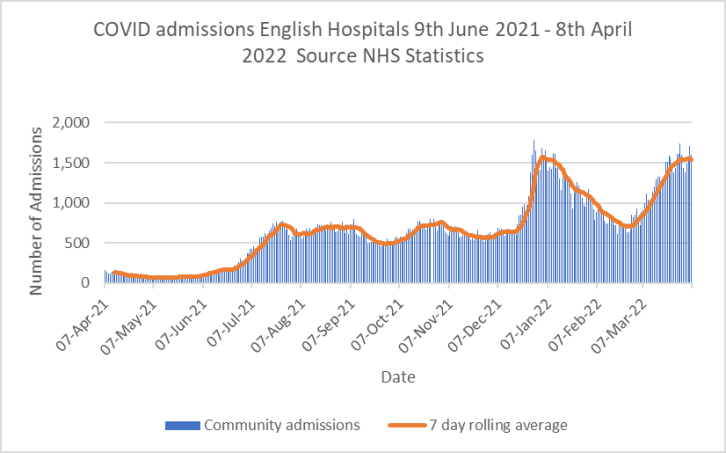
Graph 1
Graph 2 for example shows information from the Primary Diagnosis dataset. Regular readers will recall this set shows the numbers of patients admitted suffering from acute Covid compared to the patients testing positive for Covid but admitted for another condition. The grey line shows the ratio is gradually falling – in other words the headline figures in Graph 1 are misleading, because nearly 60% of those patients are not actually ill with Covid but admitted for other reasons.
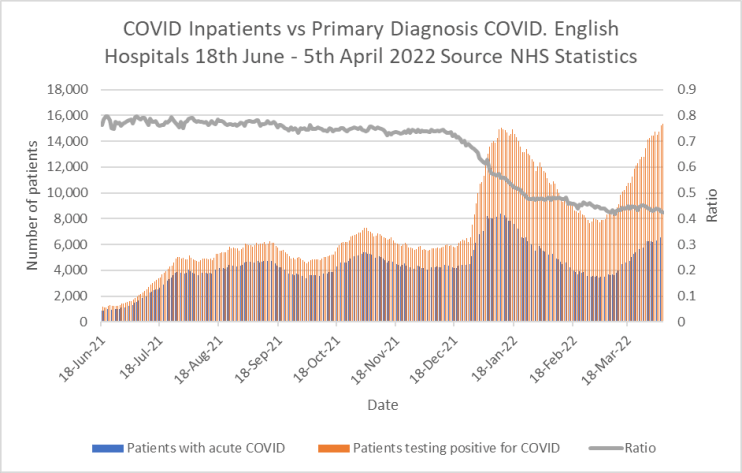
Graph 2
Graph 3 shows the numbers of patients testing positive for Covid in intensive care departments. The rise in cases seen in Graph 1 since the beginning of March 2022 is absent – so although there are more hospital inpatients testing positive for Covid than at the end of February, they are not ending up in critical care. Further, the data from the most recent ICNARC report reveal that the latest tranche of Covid ICU patients have lower oxygen requirements and better respiratory ratios than the cohort from this time last year – in other words, they are not as acutely ill.
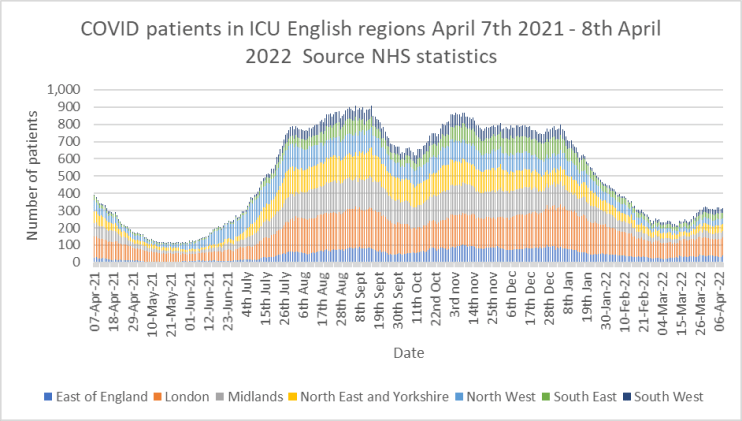
Graph 3
Graph 4 is very instructive. It shows the average length of stays of Covid patients up to the end of December 2021. This data was released in March and unfortunately is only complete up to the end of 2021, but it is reasonable to infer that current length of stay is unlikely to be worse now than in December of 2021, due to increased availability of new monoclonal antibody drugs which reduce disease severity for the highest risk patients. Graph 4 expresses average length of stay as the mean average (blue bars) and the median average (orange bars). Both these averages are steadily reducing with the median length of stay being down to four days by the end of December 2021. For the information of statistically curious readers, the median average in this case is probably more representative of the situation as the mean average can easily be skewed to the upside by a small number of very long-stay patients.
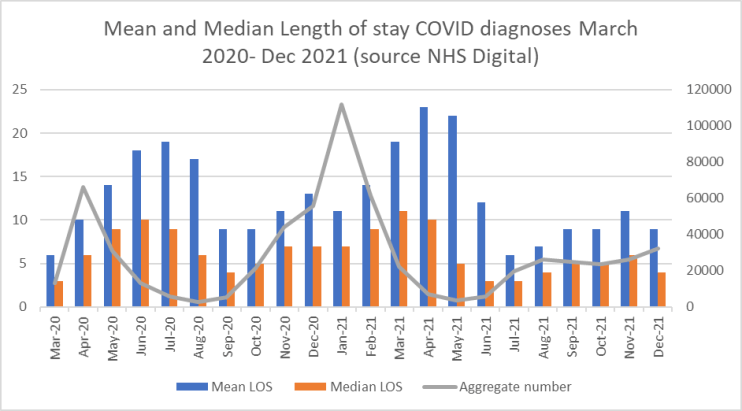
Graph 4
Overall, from the available Covid-specific patient data, we see a rise in total positive Covid tests on admission from the community, but fewer than half of these patients are symptomatic for Covid. Very few patients are ill enough to need ICU care and the length of stay for acutely ill Covid patients continues to fall. The vast majority require a few days of supplementary oxygen, intravenous steroids and monoclonal antibody infusion (or other adjunctive therapies) before being fit to discharge. So where is the problem?
Last week Saffron Cordery, deputy CEO of NHS providers, commented that staff absences played a part in the current crisis. Graph 5 shows the data for Covid related staff absences up to March 2nd (the latest figures released) – they don’t seem to have changed much lately and were on a downward trend since the turn of the year. It’s possible they may have started to increase again, but the figures are not yet released for public scrutiny.
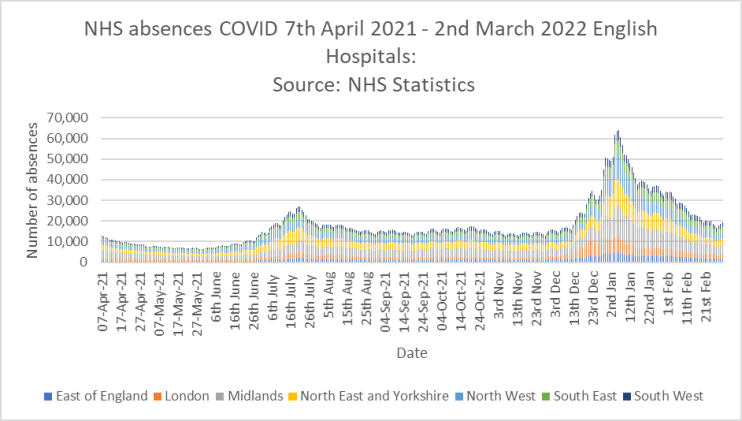
Graph 5
My personal suspicion is that Graph 6 shows the main issue causing trouble in hospitals. Graph 6 shows the number of patients in hospitals deemed medically fit for discharge. It is shown as a stacked bar chart, so the blue bar represents the patients who actually were discharged and the orange bar shows patients who were fit for discharge but had to remain in hospital for administrative reasons (often referred to as ‘bed blocking’). Readers will readily notice the ‘weekend effect’ in the figures, and that about 11,000 patients per day are in hospital when they are fit to be discharged – about 10% of the total NHS bed stock.
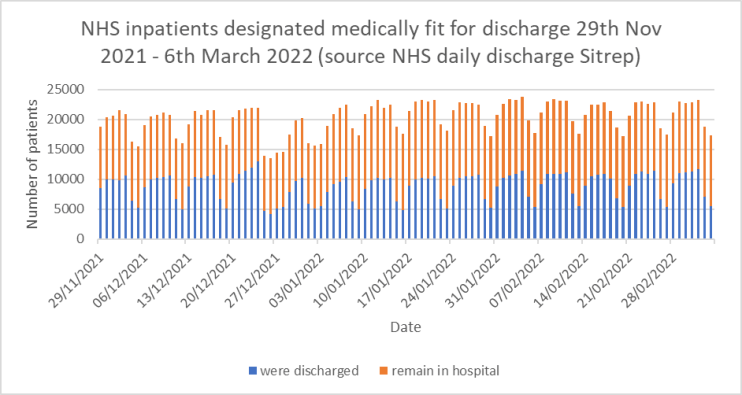
Graph 6
Over two years into the pandemic, the NHS does not yet seem to have solved fundamental administrative problems in relation to patient flow through the system. I am also aware from personal communication with colleagues that most NHS trusts are still imposing unnecessary Covid protocols which add to the time taken to complete basic episodes of care such as routine operations. This reduces efficiency still further in a healthcare system not renowned for operational efficiency in the first place.
Speaking about the latest crisis, Mark Ainsworth, Director of Operations at the South Central Ambulance Service, said declaring a critical incident meant it could focus its resources on the neediest patients.
Discharging medically fit patients from hospital and exercising a modicum of common sense when compiling Standard Operating procedures might achieve the same effect.
Unless FullFact.org Says So Then It’s Not True, The UK Government Advises
By Rhoda Wilson – The Exposé – April 7, 2022
Most of us are aware that it’s not only online but also things published by corporate media that aren’t always what they seem. However, a major difference between government or corporate media reports and independent or citizen reports shared online, is the latter allows for public discourse and open debate, providing they are not censored, while corporate media and their fact-checking services do not – they prefer a top-down “above all” approach.
Denying public debate negates the all-important diversity of thought in a liberal and democratic society. Silencing counterarguments that challenge their preferred storyline enables governments and corporate media to create a one-sided narrative. A narrative that, left unchallenged, moves further and further away from the truth. But here’s a fact that you will not find on either GOV.UK or Full Fact: a lie cannot become truth, no matter how often it is repeated.
The SHAREChecklist attempts to provide advice on what to share and what not to share apparently for the good of others. Information that does not originate from their sources could be “harmful to share with our friends and families,” the UK government claims.
It’s important to understand that we, the people, are in the midst of an information war. One which began in earnest at the start of 2020. A battle in the public space for complete and truthful information while governments and their advisors attempt to manipulate our perceptions and behaviours so we obey their instructions, without question, even when those instructions prove to be harmful.
Even the most trusting know that governments and politicians hide the truth, manipulate the truth and even outright lie – it’s merely the extent that varies. We know that governments use mass media – television, radio and online – as tools to roll out their narratives to the public en masse. Additional government tools include initiatives such as their SHAREChecklist campaign.
At the very least corporate media is biased but as they sink deeper into an ever-narrowing storyline it is becoming apparent that reports are being manufactured and that they are activists seeking to implement an agenda, they are not journalists.
Fact-checking services do not provide facts they provide opinions. Last year, Facebook admitted in court that its “fact checks” are nothing more than statements of opinion. Not experts’ opinions but those of the “fact-checkers.” And self-described “fact-checkers” are not independent. They are dependent on donations from large corporations, the same corporations that work to craft a narrative and silence public debate through censorship.
The SHAREChecklist
As we work through the checklist what will become apparent is that in no way does the government advise, or even so much as hint at encouraging: critical thinking, comparing a variety of sources, open dialogue or debate. The checklist leads readers along a path to following a narrative set by a centralised coterie – the government or whoever is “advising” them.

The Government’s first bit of advice is to “make sure information comes from a trusted source.” This is common sense and something we should all be doing, and most likely instinctively are. What each of us believes are “trusted sources” is decisive.
A source that has been proven to lie without remorse is not a source to be trusted. Any source that consistently and persistently promotes Covid injections as “safe and effective” and so roll up your sleeve for another shot, for example, is not to be trusted. Within these sources, the lies are pathological and systemic. Such a source – the BBC, SAGE or UK government, for example – does not suddenly and inexplicably switch from being wanton liars to being truthful.

The second bit of advice the Government has to offer is to read beyond the headline – yet more common sense. A headline cannot contain all the substantive information that an article contains.
Additionally, clickbait headlines, for example, are common practice in all forms of media. To avoid a knee jerk response to the attention-seeking text we should not take an article, or post online, at its headline. Corporate media, as with marketing agencies, are particularly adept at clickbait headlines, texts and thumbnails. And, of course, the UK government has SPI-B and the Nudge Unit to advise them on how to use psychology to maximise public “engagement” and “cooperation.” The checkmark or tick symbol incorporated into the SHAREChecklist logo is an example of typical Nudge Unit behavioural psychology.

Again, in its third bit of advice, the Government advises some additional common sense: “check the facts.” What is notable about this point is that, according to the UK government, there are a limited number of sources that provide these “facts.” Actually, there are only two: themselves, of course, and “fact-checkers,” namely Full Fact.
The BBC frequently and repeatedly tells its viewers that it is a trusted source, bringing you the all facts. Yet, SHAREChecklist does not recommend them as a source to “check the facts.” This may or may not be an indication of how the Government views BBC’s “fact-based” reporting or, possibly, recognition that the public has, by and large, lost its trust in the BBC.
Taking on board the first two bits of advice – “trusted source” and “read beyond the headline,” in this case the Government’s headline – we take a brief look at the Government recommended “fact-checker” Full Fact later in this article.

The fourth bit of the Government’s advice is as true for images and videos shared online as it is for images and videos shown on television. There have been many examples of dubious images and videos published by corporate media over the past two years that deserve to be questioned. There is no source of information, “official” or unofficial, that we should not test for accuracy and reliability. Stay sceptical. Criticism is not only legitimate, it is necessary.

The final bit of advice the Government gives is that typos could be an indication that the information is false. How are those with dyslexia or learning difficulties supposed to feel reading that? For those who find it hard to express their thoughts and ideas in writing, you’re in good company. While Albert Einstein loved mathematics and science, he disliked grammar and had problems with spelling.
After singling out typos, then comes the sneaky bit: “official guidance” – in other words, the Government’s or the centralised coterie’s guidance – has been “carefully checked” presumably for spelling and grammatical errors. So naturally, the Government’s typo-free publications must be true – of course! On that basis, if you want to avoid being censored download Grammarly now!
Who Is Full Fact?

Full Fact’s website states: “We’re developing world-leading technology and new research to spot repeated claims, and find out how bad information can be tackled at a global scale. And we campaign for change that will make bad information rarer and less harmful.”
Who are the people and organisations behind Full Fact? Who are they campaigning for? Who is determining what information is “bad”?
In 2012, UK Column published an article about Full Fact, ‘Faux Facts – The disturbing Truth About fullfact.org’, digging a little deeper into “this interesting little non-profit company, headed by Tory Party donor and Anne Freud Centre Chairman Michael Samuel.”
In 2019 Daily Mail wrote that Full Fact was at the centre of an election row with the Tories and was forced to defend its credibility after it stepped into a social media war after an election debate between Jeremy Corbyn and Boris Johnson. Daily Mail quoted Dominic Raab: “Who said Final Fact is the final arbiter of what the public gets to see as the truth? There’s no god-given right, set in law.”
“Foundations set up by eBay creator Pierre Omidyar and left-wing investor George Soros have also joined tech giants in giving six-figure sums to London-based Full Fact along with thousands of unnamed individual donors paying between £25 and £5,000 each,” Daily Mail reported.
A 2021 article published in The Critic noted the board of trustees included Labour peer Baroness Janet Royall, Lib-Dem peer Lord John Sharkey and former Conservative Party member Lord Richard Inglewood. These three peers are still trustees and Michael Samuel is still chairman.
The Critic article goes on to note that Full Fact is a charity with a small output of research compared to its size, funded primarily by big-tech and staffed to a large extent by former public sector workers or ex-reporters from left-wing media. “Full Fact’s website reports that they were paid £1.1 million by Facebook and £206,500 by Google in 2019, plus a monthly payment of £7,300 worth of free advertising by the search giant. The funding by big-tech in 2019 makes up roughly 70% of their declared funding for the year,” The Critic wrote.
As you can see for yourself in the table below Full Fact is still predominantly funded, and so their opinions are influenced, by the notorious online censor organisations – Facebook, which includes WhatsApp, and Google, which includes YouTube. In 2021, almost 40% of Full Fact’s “donations” came from Facebook and Google.

Full Fact Funders 2021
Full Fact does not pass the government’s SHAREChecklist test and, according to UK government advice, their articles may be “harmful” if shared with friends and families – do not share them.
| Full Fact Funding 2021 retrieved 6 April 2022 | ||
| £305,119.64 | Third Party Fact Checking programme | |
| £116,352.14 | Framework for collaboration during misinformation crises | |
| £59,634.83 | Health fellowship | |
| Hundreds of individual donors and gift aid | £370,148.00 | Core funding |
| Mohn Westlake Foundation | £250,000.00 | Core funding |
| Google AI for Good Impact Challenge | £235,222.77 | Automated fact checking |
| Nuffield Foundation | £100,000.00 | Fact checking and annual report |
| Luminate | £75,789.87 | Core funding |
| Esmée Fairbairn Foundation | £68,333.33 | Core funding |
| £61,809.84 | WhatsApp fact checking service | |
| International Fact Checking Network & WhatsApp | £53,737.20 | Vaccine Grant Program |
| Baillie Gifford | £50,000.00 | Core funding |
| John Ellerman Foundation | £50,000.00 | Core funding |
| Joseph Rowntree Charitable Trust | £50,000.00 | Core funding |
| The Buchanan Programme | £49,801.68 | Core funding |
| The Dulverton Trust | £35,000.00 | Core funding |
| Gill Family Foundation | £30,000.00 | Core funding |
| James Padolsey | £30,000.00 | Core funding |
| International Fact Checking Network & National Endowment for Democracy | £26,576.58 | Fact-Checkers Working Together Research Program |
| Colefax Charitable Trust | £25,000.00 | Core funding |
| The M J Samuel Charitable Trust | £17,500.00 | Core funding |
| International Fact Checking Network & YouTube | £17,064.56 | Fact Checking Development Grant |
| Highway One Trust | £10,000.00 | Policy team |
| William de Winton | £10,000.00 | Core funding |
| Reed Foundation | £9,000.00 | Core funding |
| Good Thinking Society | £8,000.00 | Core funding |
| Dorothy Bishop | £6,000.00 | Core funding |
| Cecil Pilkington Charitable Trust | £5,000.00 | Core funding |
| Tinsley Charitable Trust | £5,000.00 | Core funding |

Russia accuses Ukraine of ‘barbarism’ as UK provides $130 million in additional weapons
Samizdat | April 9, 2022
The Russian Foreign Ministry has called on Western nations to stop supplying Ukraine’s armed forces with weapons in the wake of a missile attack on a train station in the city of Kramatorsk that killed dozens of civilians on Friday.
The ministry has requested that the international community “make an unbiased assessment” of the actions of the Ukrainian forces and “stop supplying them with weapons, as well as urge Kiev to abandon unacceptable fighting methods.”
Earlier, Moscow accused the Ukrainians of being behind the attack that has claimed the lives of 50 people, including five children, according to the latest assessments provided by both sides. Western leaders have accepted Kiev’s position that Russia is to blame.
Kramatorsk is a city in the northern part of the Donetsk region and is claimed by the Donetsk People’s Republic as part of its territory. When hostilities broke out in eastern Ukraine in the wake of the 2014 Maidan, the city remained under Kiev’s control.
The Ukrainian army employs Tochka-U ballistic missiles, similar to the one that hit the central train station in Kramatorsk, the Foreign Ministry added, repeating the claims made earlier by the Russian Defense Ministry.
The Russian military also said earlier that it had pinpointed the location from which the missile had allegedly been launched. According to defense officials, it came from the town of Dobropole, which is located southwest of Kramatorsk and has been under the control of Ukrainian forces.
The Foreign Ministry has denounced the attack as a “barbaric act of aggression” and said that it only proves Russia had been right to launch its military operation to protect the two Donbass republics it had earlier recognized. The attack on Kramatorsk also closely resembles another missile strike that killed 17 people in the city of Donetsk in mid-March, it has added.
“We are convinced that the Kiev authorities will not escape justice,” the ministry’s statement said.
Kiev has accused Russia of being behind the strike in Kramatorsk, claiming it was a deliberate attack on civilians fleeing the conflict. President Volodymyr Zelensky has called it another example of Russia’s “evil” that “knows no boundaries.”
Some Ukrainian officials had initially claimed the station was hit by a Russian Iskander missile. However, images of a fragment of a Tochka-U were taken at the scene and later surfaced on social media.
Certain Western nations have already pledged more military support to Ukraine in the wake of the Kramatorsk attack. UK Prime Minister Boris Johnson announced on Friday that London would send Ukraine additional military aid worth $130 million, including more Starstreak anti-aircraft missiles and 800 anti-tank missiles.
Vaccinated Have Up To SIX Times the Infection Rate of Unvaccinated, NZ Government Data Show
By Amanuensis | The Daily Sceptic | April 9, 2022
New Zealand is a fascinating country – amazing geography, likeable population, and, unlike its neighbour Australia, most of its wildlife isn’t planning on killing you at the slightest opportunity. It is also fascinating with respect to Covid because its population has a very high vaccination rate across all age groups (well, down to five), but up until recently there has been negligible natural immunity to Covid. Because of these two factors, New Zealand was always going to be of interest as soon as Covid arrived properly, if only to see how its vaccination efforts had protected its population.
For those who missed it, since the end of last year New Zealand has had a succession of Covid waves. These started small, but in the most recent wave, taking place during February and March, infection rates were enormous – if we had these infection rates in the U.K. we’d have peaked at approximately 350,000 cases per day (rather than around 200,000). What’s more, it looks like New Zealand exceeded its testing capacity during that wave, suggesting that peak infections were probably even higher. It is relevant to note that during February and March, New Zealand had over 90% of all the cases it has ever had and most of the rest occurred in January – prior to 2022 New Zealand reported very few Covid infections.
So much for the Covid vaccines protecting against infection – but what do the data look like in detail?
Cases
New Zealand is somewhat helpful in that it does publish daily cases, hospitalisations and deaths by vaccine status; somewhat because it doesn’t allow easy access to anything other than the current day’s report. Thankfully, the Wayback Machine ensures that at least some web pages aren’t forever lost to history. These data were collated for dates since mid February 2022 and smoothed with a seven-day moving average to create a time series of Covid cases by vaccine status.
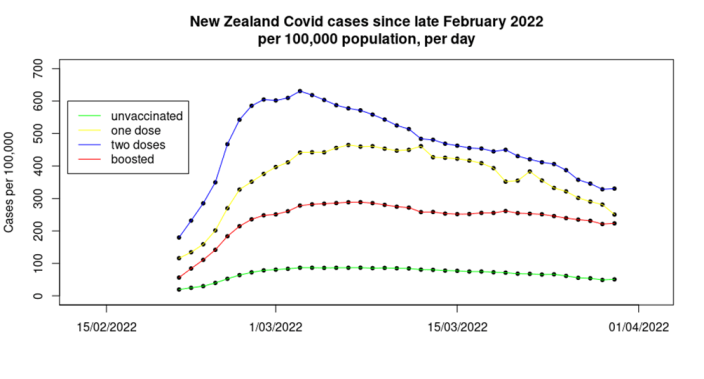
The first time the above graph popped up on my computer screen I had to go and double check all the data sources – and then I triple checked them. The data shown on the graph are notable for several reasons:
- Firstly the obvious one – during the most recent Covid wave there was a much lower infection rate in the unvaccinated, compared with those that had been given one, two or three doses of vaccine. What’s more, this isn’t a small effect – over the period shown approximately:
- 10% of the triple vaccinated in New Zealand were infected.
- 14% of the single vaccinated were infected.
- An astounding 18% of the double vaccinated were infected.
- Yet only 3% of the unvaccinated appear to have been infected.
- The order of the effect is unexpected – for some time in the U.K. the highest case rates have been found in the triple vaccinated, with case rates in the single and double jabbed much lower. In New Zealand the highest rates are seen in the double vaccinated.
- The data for cases in the double dosed appear to have an earlier peak than seen in the data for the unvaccinated, single jabbed and triple jabbed.
- The fall from peak cases to the most recent data point is also interesting. Case rates in the unvaccinated, single dosed and the double dosed have all fallen approximately 45% since their respective peaks, however, case rates in the triple vaccinated have only fallen approximately 20% since their peak. This is rather concerning, as it suggests that we might find that the boosted population maintain a viral reservoir for Covid, ensuring that case rates take much longer to fall to trivial levels and hindering attempts to get society back to a post-Covid normal.
The infections data from New Zealand allow us to estimate the vaccine effectiveness for the Covid vaccines in the absence of natural immunity.
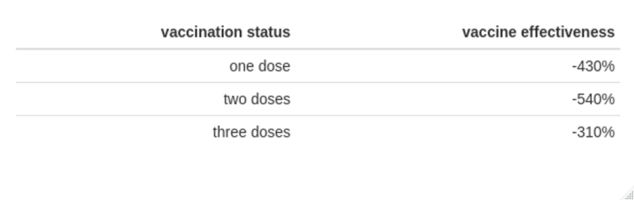
Unadjusted estimates of vaccine effectiveness against infection as at end of March 2022
These data are in contrast to recent data from the U.K., which show one and two doses of vaccine to have a VE of minus-50% to minus-100%, and the booster to have a VE of around minus-300%. While this sounds counterintuitive, it is possible that we’re seeing a complex interplay between a waning of the impact of the vaccine and the impact of additional vaccine doses:
- The U.K. vaccinated early, allowing for the impact of those early vaccine doses to have waned significantly for those choosing not to top-up their ‘protection’.
- The Covid vaccines appear to have a period of approximately two to three months where their impact on the immune system is different than in later periods; this is possibly due to the creation of short-lived IgA (mucosal) antibodies. In the U.K., booster vaccinations were given in autumn 2021, and thus most individuals will have been beyond this period when the Omicron variant’s first wave appeared in December.
In New Zealand, the timescales are very different: those given the booster dose will still be in the two-three month period where short-lived immune responses dominate; those given two doses will be in the proposed period of maximal vaccine negative impact; while those that chose not to accept the offer of a second vaccine dose will be in the period where vaccine effects are waning.
There’s one more point to add for cases in New Zealand, and it relates to the U.K. For months, the UKHSA has been telling us that one possible reason for us seeing far fewer cases in the unvaccinated compared with the vaccinated is because the unvaccinated have natural immunity following high infection rates previously (presumably because the unvaccinated are reckless and didn’t follow lockdown rules – I imagine that they also ride motorcycles too quickly, set off fireworks indoors and play with matches while filling up the car). These data from New Zealand, which at the time had very few individuals previously infected with Covid, show lower case rates in the unvaccinated without any significant levels of natural immunity, contradicting the claim of the UKHSA and eliminating one of its reasons for ignoring the alarming data.
Hospitalisations
Analysis of the hospitalisations data offered by the New Zealand authorities is made complex by there being no stratification of the hospitalisations by age group, and the lack of complete vaccinations data by age. However, U.K. data show that in recent weeks approximately 95% of hospitalisations were in those aged over 60; assuming that this will also hold true for the New Zealand population allows us to offer a indicative analysis of the likely impact for that age group of the vaccines on hospitalisations in the country.
The analysis is also hindered by the data on vaccine coverage for those aged over 60 not differentiating between those that have had only one dose of vaccine and those that are unvaccinated. This might in isolation from other data appear to be ‘sensible’ – after all, the single dosed have the ‘least protection’ as well as ‘the longest time for protection to wane’. However, the data shown in the previous section suggest that the unvaccinated and those having taken a single dose of vaccine are in no way comparable, and that considering them as a single group could lead to misleading conclusions. Nevertheless, that’s the hand that’s been dealt for us.
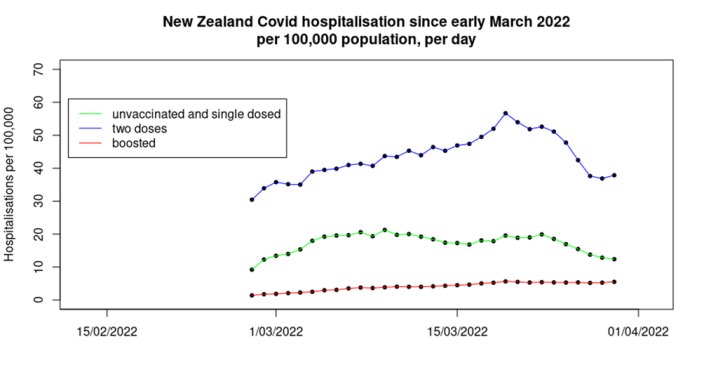
The data are somewhat surprising. While those given a booster dose of vaccine seem to have lower levels of hospitalisations than found in the group containing the unvaccinated and those given only one dose of vaccine – as might be expected – the double dosed have significantly higher hospitalisation rates.
Also interesting is the trend in the data:
- Hospitalisations in the unvaccinated/single-dosed appear to peak earliest – we have also seen this effect in U.K. data, usually in the form of dire warnings early in each Covid wave that the only people being hospitalised are the unvaccinated, only for the warnings to go quiet later in the Covid wave when the data move in the opposite direction.
- Hospitalisations in those given two doses of vaccine appear to peak towards the end of the period shown.
- Hospitalisations in the boosted population appear to show little signs of slowing down, let alone reducing, over the period in question. Note also that this group saw a fourfold increase over the time period shown, whereas the double dose and single-dose/unvaccinated group both saw a 25% increase, albeit with an intermediate period with higher hospitalisation rates.
It was not possible to properly disentangle the hospitalisations data for the unvaccinated, but the data suggest that in aggregate those having taken two or three doses of vaccine (when the two groups are put together) have approximately 45% lower risk of hospitalisation than the unvaccinated/single-dosed. It is worth noting that in the U.K. data we see higher hospitalisation rates in the single vaccinated in those aged over 60, compared with the unvaccinated. It is possible that the same pattern is found in New Zealand, only ‘covered up’ by the co-mingling of the data. If this is the case then the apparent protection offered by the vaccine in the two or three dose individuals will be somewhat lower than 45%.
Deaths
The mortality data from New Zealand are also complicated because the health authorities lump together into one group all the unvaccinated and those having taken a single dose of vaccine. Beyond that complication, deaths data can be tricky to analyse, because there are such huge differences in death rates from (or with) Covid by age. Fortunately, the mortality data offered by the New Zealand authorities do include deaths by age group, which allows a finer analysis than was possible with the infections and hospitalisations data.
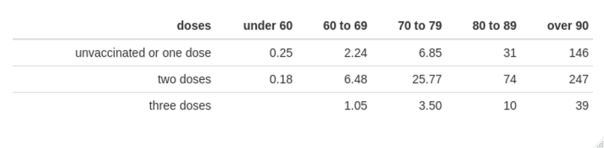
Covid mortality per 100,000 per week, by vaccination status and age
The above table suggests that while those given three doses of vaccine have a decreased risk of death from (or with) Covid compared with the mortality rate in the strange group called ‘unvaccinated or one dose’, the risk of death is greatest in those given two doses of vaccine.
However, it is possible that New Zealand’s data have a similar pattern to that seen in the U.K. (and elsewhere), where dose effects are complicated by the health of those given each vaccine, namely that those closest to death were spared a dose of vaccine, and thus concentrated deaths into the very small number left in the prior dose group. A comparison of the data for ‘unvaccinated or one dose’ with ‘two or three doses’ suggests that the vaccines do still protect against death, but only to a very low degree in younger age groups.
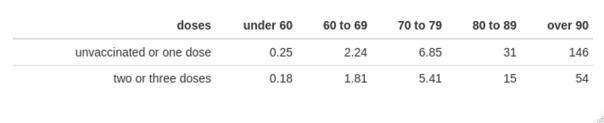
Covid mortality per 100,000 per week, by vaccination status and age
The data above support the use of vaccination to protect against death from (or with) Covid for those aged over 80. On the other hand, the mortality rate in those aged under 60 is very low, and the estimated vaccine effectiveness in protecting against death for those aged under 80 is only approximately 30% – once again, the real-world vaccine effectiveness estimate is rather low. It is also of note that these rather poor figures for the protection offered by the vaccines against mortality come from a country that started vaccination rather late (summer 2021) and where most of the population were only given their booster doses two to three months ago. These data suggest that the vaccines simply do not offer substantive protection against death for newer Covid variants, rather than it simply being a case of waning vaccine protection.
It is also important to note that the data on the benefits of the vaccine in protecting against death shown above should be treated with caution:
- Data on deaths in the unvaccinated and those given a single dose of vaccine are co-mingled; the New Zealand hospitalisation data suggest that death rates might be greater in the single-jabbed.
- The vaccinated appear to have significant increased risk of catching Covid, which contributes to overall risk of serious disease and death.
- These calculations do not include any consideration of the risk of side-effects and complications following vaccination.
Overall mortality
One other aspect of the data coming from New Zealand that is of interest relating to Covid is excess mortality. These data are of interest because New Zealand managed to keep itself more-or-less clear of Covid until the last few months of 2021, and even then case numbers were very low until 2022, with the result that Covid deaths were negligible prior to 2022. With that in mind, its excess death data between the start of 2020 and the end of 2021 are very interesting.
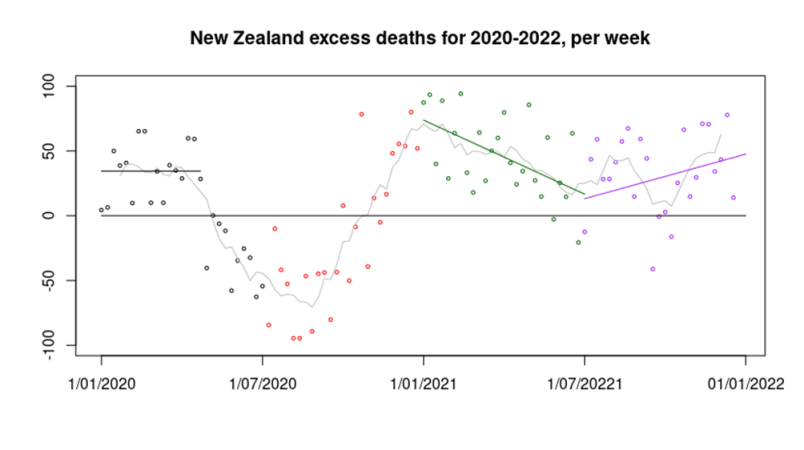
Many countries around the world had a peak in excess deaths in the first quarter of 2020, followed by a significant reduction in deaths into mid 2020. There has been speculation that this pattern was seen because Covid infections in early 2020 killed the most vulnerable, leaving a period in which there were fewer people left to die. However, New Zealand also has this pattern of excess deaths in the first half of 2020 (black data points in the graph above) without Covid infections, suggesting that the reduction in deaths seen in mid 2020 were a result of lockdown. The reason for the excess deaths in New Zealand in the first quarter of 2020 are not at all clear.
Most countries then saw an increase in deaths towards the end of 2020; this has been explained by a resurgence in Covid cases. However, New Zealand saw a similar pattern without Covid infections (red data points). It is possible that this increase was caused by the impact of the reduced healthcare provision during the extreme lockdown – though there are no data to support this supposition. There are reports that the New Zealand healthcare system experienced its busiest summer (January and February) on record with hospitals across the country reaching ‘crisis point’ and several emergency departments at capacity. The cause of this healthcare pressure is unclear, however.
Perhaps the most interesting data in the graph above are seen in 2021. During the first half of 2021 excess deaths slowly reduced from the high seen at the start of 2021 (green data points), perhaps a result of healthcare provision returning to normal. However, around mid-year the trend reversed and excess deaths started to climb again (purple data points). Again, it must be pointed out that there were very few Covid cases in New Zealand at this time, and negligible deaths. Just about the only unusual things occurring in the country at that time were a lack of international travel, restrictions in day-to-day activities for the population and an enormous mass vaccination campaign using novel, under-tested vaccines.
During 2020-2022, there were approximately 2,000 excess deaths in New Zealand, a significant number in a country with a population of five million. We don’t know the proportion that occurred because of lockdown, vaccines or something else; all that we do know is that they weren’t a result of Covid.
Note on data analysis methods. Infection, hospitalisation and mortality data were obtained from the New Zealand Ministry for Health (using Wayback Machine for historical data). Vaccination data were also obtained from the NZ Ministry for Health. Population data were obtained from Stats.govt.nz. Vaccination data were offset by seven days for the infections analysis to account for the Ministry for Health’s definition of vaccine status at infection. An additional seven days offset was applied for hospitalisation, and 14 days for death, to account for the typical timescales of disease progression.
Amanuensis is an ex-academic and senior Government scientist. He blogs at Bartram’s Folly.
The British are now officially hiding Covid vaccine data
… and they are lying about the reason why
By Alex Berenson | April 7, 2022
Until last week, the British government offered the best source of raw data on the efficacy of the Covid vaccines. Each Thursday, the UK Health Security Agency reported the number of new infections, hospitalizations, and deaths by vaccine status.
Since last fall, and especially since the Omicron variant hit, the reports have presented an increasingly dismal picture of vaccine efficacy. Last week’s report showed that in March, nearly 90 percent of adults hospitalized for Covid were vaccinated. And OVER 90 percent of deaths were in the vaccinated:
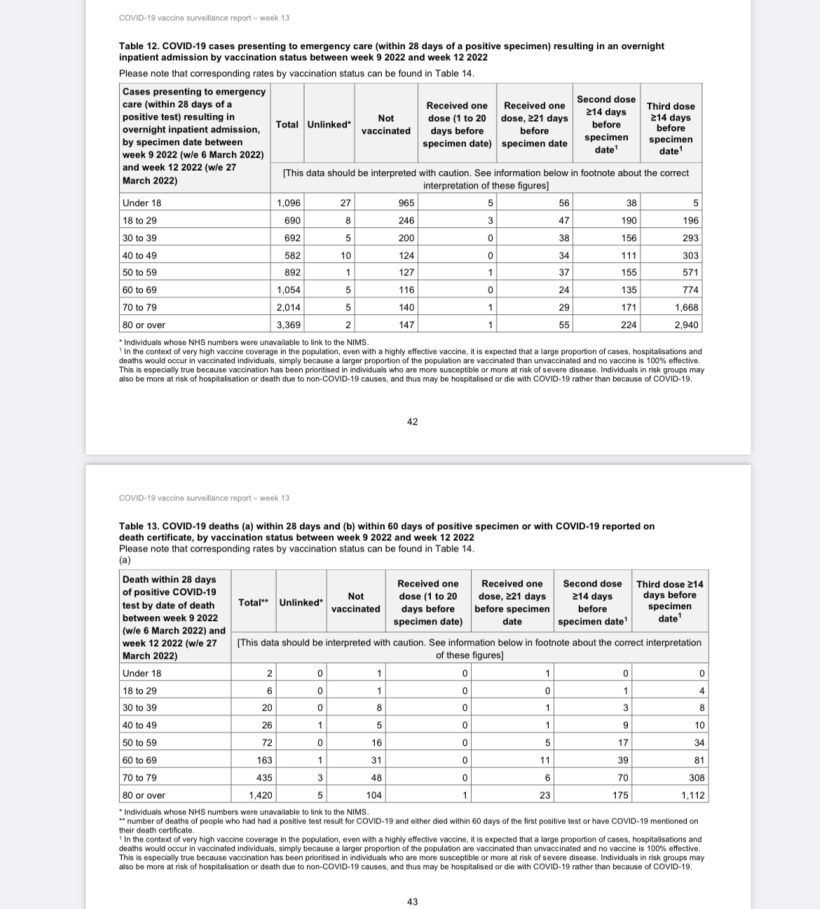
The importance of these reports is hard to overstate.
They were the single best source of raw data about how well the Covid vaccines were or were not working anywhere in the world. It was a long-running sequential series with clearly defined rules from a large country with high vaccine coverage.
Plus, because the British have national health insurance, the government could determine with near-certainty who had been vaccinated. As you can see, fewer than 1 percent of the people in the reports are called “unlinked” – meaning their vaccine status was undetermined.
AS OF THIS WEEK’S REPORT THE BRITISH GOVERNMENT IS NO LONGER PROVIDING THESE CHARTS.
The British government is offering the nonsensical excuse that it can no longer provide the figures because it has ended free universal testing for Covid: Such changes in testing policies affect the ability to robustly monitor COVID-19 cases by vaccination status, therefore, from the week 14 report onwards this section of the report will no longer be published.
The British government is lying.
Even if the end of free testing somehow affected its ability to provide “robust” data about infections, it would make no difference to the hospitalization or death figures, which are far more important. Unless Covid patients are going to be hospitalized anonymously, the Health Security Agency will still be able to match their names (and the names on death certificates) against vaccination records.
In fact the British government would be derelict not to continue to collect the data, and it surely will. But the public will no longer see it.
Why?
One reason and one reason only. Ever since I mentioned the existence of these reports to Joe Rogan in October, they have become an embarrassment. They are impossible to spin, and the clearest possible signal of vaccine failure.
But hiding the numbers won’t make the vaccines work better. It will just make people less likely to believe anything else public health authorities tell them about Covid and the vaccines – if that’s even possible at this point.
Featured Video

The Truth About the Trump Shootings with Ken Silva
or go to
Aletho News Archives – Video-Images
From the Archives
The Geopolitics behind the War in Yemen (I)
By Mahdi Darius NAZEMROAYA | Strategic Culture Foundation | 30.03.2015
The United States and the Kingdom of Saudi Arabia became very uneasy when the Yemenese or Yemenite movement of the Houthi or Ansarallah (meaning the supporters of God in Arabic) gained control of Yemen’s capital, Sanaa/Sana, in September 2014. The US-supported Yemenite President Abd-Rabbuh Manṣour Al-Hadi was humiliatingly forced to share power with the Houthis and the coalition of northern Yemenese tribes that had helped them enter Sana. Al-Hadi declared that negotiations for a Yemeni national unity government would take place and his allies the US and Saudi Arabia tried to use a new national dialogue and mediated talks to co-opt and pacify the Houthis.
The truth has been turned on its head about the war in Yemen. The war and ousting of President Abd-Rabbuh Manṣour Al-Hadi in Yemen are not the results of «Houthi coup» in Yemen. It is the opposite. Al-Hadi was ousted, because with Saudi and US support he tried to backtrack on the power sharing agreements he had made and return Yemen to authoritarian rule. The ousting of President Al-Hadi by the Houthis and their political allies was an unexpected reaction to the takeover Al-Hadi was planning with Washington and the House of Saudi. … continue
Blog Roll
 Aletho News
- Pakistan-Iran talks secure LNG shipment to Islamabad through Hormuz
- Black Sea grain crisis puts global wheat supplies under pressure
- IRGC air defenses destroy another US MQ-1 drone over Strait of Hormuz
- Imran Khan’s entire immediate family detained in Pakistan ahead of mass protest demanding his release
- EU nation detains former presidential frontrunner
- Leaked: Britain’s Sham Conviction Of Hashim Thaci
- Seyed M. Marandi: U.S. Strike Imminent – Toward Total War in the Middle East
- Russia Voted Under Fire. Washington Is Loading the Tankers.
- 12 Things Your Oncologist Was Trained Not to Tell You
- Anthrax Attacks Paved Way for COVID-Era ‘Junk Drugs and Vaccines’
- If Americans Knew
- Huckabee aide solicited cash gifts from Israelis
- This isn’t sci-fi, AI is already killing people
- ‘The Most Brutal Thing’: Investigation Reveals Execution of Elderly Woman in Rafah
- Inside Israel’s ‘soft’ ethnic cleansing plan for Gaza through the eyes of its victims
- New online database tracks pro-Israel political donations in the United States
- Israeli president pardons soldier convicted for killing wounded Palestinian
- Singer Ed Sheeran says his ‘heart broken’ by Gaza devastation, addresses Macklemore controversy
- Israel Has Imprisoned Female Journalist Bushra Al-Tawil Without Trial Or Charge In Solitary Confinement For Past Month
- Israel poised to teach West Bank a lesson after one Israeli killed – Daily Update
- Salah Sarsour’s Legal Team Says DHS Has Not Met Its Burden to Prove He Is Deportable
- No Tricks Zone
- 2025 Nature Paper Claiming Worsening Global Drought Gets RETRACTED …Heavily Flawed
- New Study: ‘Global Drought Shows No Detectable Recent Acceleration Under Climate Warming’
- Economic Masterminds: German Socialists Suggest Taxing Productivity Gains Stemming From Using AI
- The South China Sea Has Not Been Cooperating With The Climate Change Narrative
- Energy Crisis: Germany Enters Heating Season With Historically Low Gas Reserve Fill Levels
- New Study: The Antarctic Ice Sheet Gained Mass From 2020-2024 Due To Staggering Snow And Ice Accumulation
- Study: Ocean Heating Rates From Thousands Of Years Ago ‘Dwarf’ Modern Ocean Heating Rates
- Climate Extremists Target, Attack Large-Scale Power Grid Infrastructure In Germany!
- New Study: Antarctic Ice Melt Has Contributed Less Than 1 Centimeter To Sea Level Rise In The Last 30 Years
- Fear Of Debate: Alarmist German Climate Scientist Calls On Mainstream Media To Discredit Skeptic Voices
 Aletho News