UK Sleepwalking Into Food Crisis As Fresh Produce Set To Vanish From Supermarkets
By Tyler Durden | Zero Hedge | April 1, 2022
The National Farmers’ Union has warned the UK is sleepwalking into a food security crisis. Soaring energy and fertilizer costs have led to an unprecedented situation where growers’ margins have collapsed, forcing many to halt growing operations.
Reuters says because of the inclement weather in the UK. Farmers grow cumbers, plant peppers, aubergines, and tomatoes in vast greenhouses. Greenhouses use natural gas for heat, but after last year’s surge in gas prices exacerbated by Russia’s invasion of Ukraine last month, the crops have become uneconomical to produce.
Trade body British Growers said the average cost to produce a cucumber in Britain before the energy crisis was around 25 pence, which is now more than doubled and set to hit 70 pence when higher energy prices fully kick in.
“Gas prices being so sky-high, it’s a worrying time,” grower Tony Montalbano said.
“All the years of us working hard to get to where we are, and then one year it could just all finish,” Montalbano said.
He noted his 30,000 square meters of glasshouses at Green Acre Salads business, which supplies major supermarkets such as Tesco, Sainsbury’s, and Morrisons, are shuttered because costs outpace market prices. In fact, the farmer would be losing money if he were to grow.
Compared with this time last year, European gas prices are up a mindboggling 500%.

Fertilizer prices have tripled since last year, along with soaring prices for packaging, diesel, freight, labor, and everything related to running a grow operation.
“We are now in an unprecedented situation where the cost increases have far outstripped a grower’s ability to do anything about them,” said Jack Ward, head of British Growers.
With many greenhouses offline, this will inevitably push down the output of produce for supermarkets and result in persistent and or even higher food inflation when overall inflation is at historic levels.
To give an idea of just how bad the situation is, the Valley Growers Association, whose members produce about 75% of Britain’s cucumber and sweet pepper crop, said 90% of farmers didn’t plant in January. Others said they would not grow with elevated gas prices.
“There’s definitely going to be a lack of British produce in the supermarkets,” association secretary Lee Stiles said. “Whether there’s a lack of produce overall depends on where and how far away the retailers are prepared to source it from.”
The UK could increase imports of produce, but countries worldwide are implementing protectionism measures to keep farm goods domestically to mitigate shortages due to the Ukraine conflict disrupting the global food supply.
Like many other countries worldwide, the UK is sleepwalking into a food crisis.
US warns India not to help Russia undermine dollar
Samizdat | April 1, 2022
A top US national security official has called on India to scale back its economic and military ties with Russia, warning of “consequences” for any nation that helps Moscow avoid the recent wave of Western sanctions.
Speaking to reporters after meeting with Indian officials on Thursday, Washington’s deputy national security adviser for international economics, Daleep Singh, urged New Delhi not to boost Russian energy imports, and to avoid any moves that might “undermine” the US dollar.
“What we would not like to see is a rapid acceleration of India’s imports from Russia as it relates to energy or any other any other exports that are currently being prohibited by the US,” he said, adding that the United States is “very keen for all countries, especially our allies and partners, not to create mechanisms that prop up the ruble and that attempt to undermine the dollar-based financial system.”
While condemning Russia’s “needless war” on Ukraine, Singh said his visit to India was “in a spirit of friendship to explain the mechanisms of our sanctions,” but nonetheless warned that there would be “consequences [for] countries that actively attempt to circumvent or backfill” those penalties.
Asked what those consequences could entail, the adviser declined to elaborate, saying that was part of “private discussions that I’m not going to share publicly.”
Singh’s remarks followed reports that Moscow and New Delhi are currently working out a rupee-ruble payment system, which would allow the two nations to conduct bilateral trade in each others’ currencies. India also recently agreed to buy a quantity of Russian crude oil at a discount, an unpopular decision with the US and some allies, who have embarked on a punitive sanctions campaign designed to isolate Russia’s economy and wreck the ruble.
Russian Foreign Minister Sergey Lavrov also visited the Indian capital on Thursday, coinciding with official meetings with Singh as well as UK Foreign Secretary Liz Truss.
Though American, Australian and British officials have criticized India’s refusal to go along with the sanctions spree, US State Department spokesman Ned Price insisted that Washington is not “seeking to change” any nation’s “relationship with the Russian Federation,” citing India in particular.
“What we are seeking to do, whether it is in the context of India or other partners and allies around the world, is to do all we can” to ensure that “the international community is speaking in unison,” Price added in comments on Lavrov’s trip.
Often portrayed as the “architect” of the US sanctions regime on Moscow, Singh went on to cite growing ties between Russia and China, cautioning that their partnership could have major consequences for India, which has long been locked in a territorial dispute with Beijing along the Sino-Indian border.
“If you set that against the reality that China and Russia have now declared a no limits partnership, and that Russia has said that China is its most important strategic partner, by extension, that has real implications for India,” he said, claiming that Moscow would not “come running to India’s defense” in the event of a Chinese incursion.
UN reacts to UK’s censorship
Samizdat | March 31, 2022
British sanctions on Russian media, including RT, interfere with the right of journalists to work where they please, Stephane Dujarric, the spokesman for UN Secretary General Antonio Guterres, told journalists on Thursday.
“As a matter of principle, we very much do believe in the right of journalists to do their work everywhere,” Dujarric told reporters.
Hours earlier, UK Foreign Secretary Liz Truss announced a new tranche of sanctions targeting state-sponsored ANO TV-Novosti, which runs RT, and Rossiya Segodnya, which operates Sputnik News.
London described the two outlets as “Russian propagandists and state media who spread lies and deceit about Putin’s illegal invasion of Ukraine,” although no examples of falsehoods or deceitful statements from RT or Sputnik were given. Instead, the British government claimed that RT has “propagated pro-Kremlin narratives around the invasion of Ukraine, including that neo-Nazis are present in the country and that Ukrainian soldiers have committed war crimes.”
The presence of neo-Nazis in Ukraine has been reported by both RT and the Western media, members of the Ukrainian military have openly stated that they intend to commit war crimes, and footage allegedly detailing such crimes is currently being investigated.
General Mikhail Mizintsev, a senior Russian military planner, and Sergey Brilev, a Russian TV anchor, were also among the 14 names and entities sanctioned on Thursday.
Truss’ latest sanctions came several weeks after British media regulator Ofcom revoked the broadcasting licenses of Russian media outlets, claiming they weren’t in a position to cover the Ukraine crisis. Meanwhile, London’s own state-controlled BBC has covered all conflicts involving the UK in living memory, including the “weapons of mass destruction” pretense for the 2003 invasion of Iraq, which turned out to be false.
While UN Secretary General Antonio Guterres has condemned Russia’s military offensive against Ukraine, his office has not supported all of the west’s retaliatory measures. In a briefing on Tuesday, Dujarric said that Guterres does not support proposals by US lawmakers to exclude Russia from the UN Human Rights Council, and that such a move would set “a dangerous precedent.”
Is Russia the REAL target of Western sanctions?
Soaring oil prices, energy and food crises on the horizon… is it possible the REAL target of this economic war is us?
By Kit Knightly | OffGuardian | March 30, 2022
The first tweet I saw when I checked my timeline this morning was from foreign policy analyst Clint Ehlirch, pointing out that the Russian ruble has already started recovering from the dip created by Western sanctions, and is almost at pre-war levels.
Ehrlich states, “sanctions were designed to collapse the value of the Ruble, they have failed”.
… to which I can only respond, well “were they?”
… and perhaps more importantly, “have they?”
Because it doesn’t really look like it, does it?
If anything, the sanctions seem to be at best rather impotent, and at worst amazingly counterproductive.
It’s not like the US/EU/NATO don’t know how to cripple economies. They have had years of practice starving the people of Cuba, Iraq, Venezuela and too many others to list.
Now, you could argue that Russia is a larger, more developed economy than those countries, and that’s true, but the US and its allies have previously managed to hurt the Russian economy quite drastically.
As recently as 2014, following the “annexation” of Crimea, Western sanctions were tame compared to the recent unprecedented measures, but crucially the US massively increased its own oil production, then later that year (following a visit by US Secretary of State John Kerry) Saudi Arabia did the same.
Despite objections from other members of OPEC – Venezuela and Iran chiefly – the Saudis flooded the market with oil.
The result of these moves was the biggest fall in oil prices for decades – collapsing from $109 a barrel, in June 2014, to $44 by January 2015.
This kicked Russia into a full recession and saw Russia’s GDP shrink for the first time under Putin’s leadership.
Again, just two years ago, allegedly as part of competing with Russia for a share of the oil market, Saudi Arabia once more flooded the market with cheap oil.
So, the West does know how to hurt Russia if it really wants to – by increasing oil production, flooding the market and tanking the price.
But has the US increased its oil production this time round? Have they leant on their Gulf allies to do the same?
Not at all.
In fact, in a point of beautiful narrative synchronicity, the US claims it’s “unable” to increase its oil production due to “staff shortages” caused by that gift that keeps on giving – Covid.
Similarly, Saudi Arabia is not tanking the oil market, but deliberately increasing prices.
Yes, right now, with the Western allies locked in an alleged economic war with Russia the price of oil is soaring, and may continue to do so.
This is good news for the Russian economy, to the point it may even make up for the damage done by the brutal sanctions.
The high price of oil and need “not to rely on Putin’s gas” or “de-Russify” our energy supply will doubtless result in millions being poured into “green” technology.
Those Western sanctions are targeting other Russian exports too, including grains and food in general.
Russia is a net exporter of food, meaning they export more food than they import. Conversely, many countries in Western Europe rely on imported food, including the UK which imports over 48% of its food supply.
If Europe refuses to buy Russian food, the net effect is that Russia has food… and the West doesn’t.
And, just as with oil, increasing food prices will help rather than hinder the Russian economy.
Take wheat for example, of which Russia is the biggest exporter in the world. The vast majority of this wheat is not even sold to Western countries – but instead to China, Kazakhstan, Egypt, Nigeria and Pakistan – and so is not even subject to sanctions.
Nevertheless, the sanctions, and the war, have actually driven the price of wheat up almost 30%.
This is good for the Russian economy.
Meanwhile, according to CNN, the US is likely to enter a full-blown recession by 2023, France is considering food vouchers and countries all over the world are expected to begin rationing fuel.
So, the sweeping sanctions imposed against Russia by the West, allegedly in response to the invasion of Ukraine, are not having their stated aim – tanking the Russian economy – but they are driving up the price of oil, creating potential energy and food shortages in the West and exacerbating the “cost of living” crisis created by the “pandemic”.
You should always be wary of anybody – individual or institution – whose actions accidentally achieve the exact opposite of their stated aim. That’s a simple rule to live by.
Remember how Orwell described the evolution of the concept of war in 1984:
War, it will be seen, is now a purely internal affair. In the past, the ruling groups of all countries, although they might recognize their common interest and therefore limit the destructiveness of war, did fight against one another, and the victor always plundered the vanquished. In our own day they are not fighting against one another at all. The war is waged by each ruling group against its own subjects, and the object of the war is not to make or prevent conquests of territory, but to keep the structure of society intact.
Recall that “the worst food shortages for fifty years” were predicted as a result of Covid. But they never materialised.
Likewise, we were due to experience Covid-related energy disruptions and power cuts. Short of the UK’s damp squib of a “petrol crisis”, they never really arrived.
But now they are heading our way after all – because war and sanctions
Increased food prices, decreased use of fossil fuels, lowering standards of living, public money poured into “renewables”. This is all part of a very familiar agenda, isn’t it?
Regardless of what you feel about Putin, Zelensky, the war in general or Ukrainian Nazis, it’s time to confront the elephant in room.
We need to be asking: What exactly is the real aim of these sanctions? And how come they align so perfectly with the great reset?
UK refuses to pay for gas in rubles
Samizdat | March 30, 2022
The UK prime minister’s spokesman said on Wednesday the nation would not pay for Russian gas in rubles as Moscow demands. London is liaising with British companies who might be concerned about the issue or its impact on industries and manufacturers across Europe, he added.
The statement comes as the Kremlin indicated on Wednesday that all of Russia’s energy and commodity exports could soon be priced in rubles.
“[Business minister] Kwasi Kwarteng, working with his counterparts, have made clear that they won’t be paying in rubles,” Johnson’s spokesman told reporters, adding, “[The business ministry] is obviously in contact with any UK businesses that may have concerns.”
Unlike other countries in Europe, the UK is less dependent on Russian gas supply. Russia only provides around 5% of Britain’s gas imports. However, surging energy prices have been affecting the economy.
According to the Office for National Statistics, 51% of Britons currently spend less on non-essential goods due to rising energy costs, 34% are saving gas and electricity at home, while 31% spend less on food and essential goods. Overall, some 83% of those surveyed pointed to the growth of everyday expenses amid rising gas and electricity prices.
Rowlatt Facing Two Complaints Over Panorama
By Paul Homewood | Not A Lot Of People Know That | March 30, 2022
You will recall the Panorama edition last November, “Wild Weather- Our World Under Threat”. Presented by Justin Rowlatt, it attempted to show that the world’s weather was getting worse because of global warming:

https://www.bbc.co.uk/iplayer/episode/m00117h1/panorama-wild-weather-our-world-under-threat
The programme highlighted four weather disasters, yet failed to offer even the slightest evidence that they were either unusual or becoming worse.
One of the four concerned a drought in Madagascar, which Rowlatt described as “the world’s first climate change-induced famine.”
Shortly after the programme was aired, a scientific study proved that his claim was nonsense, and that equally severe droughts had occurred there in the past.
I filed a complaint about this, only to be fobbed off with the response that they had been told this by the World Meteorological Organisation,WMO. I have now escalated my complaint to the Executive Complaints Unit, ECU, pointing out that since this was a major segment of the programme, the failure to check the actual data, which is readily available, was extremely shoddy journalism. Regardless of their excuses, a full correction needed to be broadcast.
The Panorama edition also included this opening statement by Rowlatt:
“The world is getting warmer and our weather is getting ever more unpredictable and dangerous. The death toll is rising around the world”
This is another lie. According to the same WMO:
Deaths decreased almost threefold from 1970 to 2019. Death tolls fell from over 50 000 deaths in the 1970s to less than 20 000 in the 2010s. The 1970s and 1980s reported an average of 170 related deaths per day. In the 1990s, that average fell by one third to 90 related deaths per day, then continued to fall in the 2010s to 40 related deaths per day.
Another reader complained about this, and received this astonishing reply:
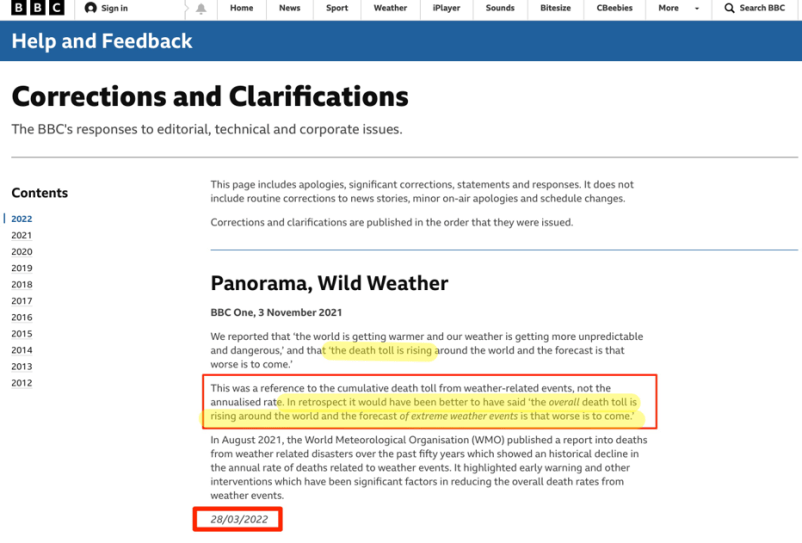
In other words, the BBC justify their claim because the cumulative number of deaths is rising!
Needless to say, he too has escalated to the ECU.
It is clear that Rowlatt is facing big problems here. He has already been rebuked by BBC News bosses about his lies regarding offshore wind costs last year. He is now facing two complaints over this flagship Panorama edition.
Regardless of the ECU decision, it is crystal clear that Rowlatt is far too emotionally attached to climate issues on a personal level to be able to report accurately and objectively.
He should be removed from the climate brief.
Red Alert: What seeing the war in Syria taught me about US/Western government and media propaganda
By Janice Kortkamp | Ron Paul Institute | March 29, 2022
The Syrian war was the first fully observed conflict on social-media and the ability to connect directly with Syrians real time as they were experiencing the crisis was unprecedented. This created a unique opportunity to get unfiltered information directly from all sides of the conflict to gain insights and understanding. The results have helped shake off the control by conventional news media over foreign events reporting and analysis. While this has created some chaos, valuable lessons have been (or should have been) learned.
I began researching Syria and the war there in late 2012, and have made seven extended journeys traveling around during the war from 2016 through 2019, meeting with hundreds of Syrians from different backgrounds, walks of life, and opinions as a 100 percent non-affiliated, unpaid, and self/crowd-funded, independent citizen-journalist.
It became clear that what’s been happening in Syria was not a spontaneous, organic, popular uprising against a tyrant, but a proxy regime-change attempt war in the works since the mid 2000’s against the quite popular Assad. This effort was spearheaded by the US, UK, France, and Israel, using Sunni violent fundamentalists and extremists (unpopular with the majority of Syria’s Sunni population as well as minority groups) armed and funded by the West and regional allies of Saudi Arabia, Turkey, and Qatar to start the violence and do the dirty work. The basic character of the rebel groups was apparent from the beginning: Syrian and non-Syrian fighters most Westerners would call terrorists and be screaming for their government to crush if the same heavily armed groups had taken over their cities, towns, and suburbs by massacring, beheading, torturing, kidnapping, and raping.
Syrians often remarked to me that before the war their country was “almost a paradise.” The middle class was the largest economic sector and growing. Religious harmony was the norm and Christians there were doing well. International investment was increasing as were the tourists. Women were equal or outnumbering men in the universities and present in leadership roles in nearly all aspects of society. Syria had made the “Top 5” list of the world’s most personally safe countries. President Assad had brought the Internet into the country and kept it open throughout the war and the people there knew all that was being said in the West about the crisis.
This doesn’t mean Syria was perfect and Assad beloved by all Syrians. There were and are many problems there which are directly attributed to the government with corruption always being number one on the list of grievances. These internal issues have been exacerbated by the war.
Now, after 11 years of war, 90 percent of Syrians are poor, many are starving; the economy is shattered. Between the fighting, US/Western sanctions, loss of production capability (though an impressive number of factories have been rebuilt), shortages of electricity and fuel, the black market and smuggling, dearth of employment opportunities, Covid-19, and the economic meltdown in Lebanon, the situation seems destined to remain desperate for the foreseeable future. The pressure by the US and most allies continues including increased sanctions, and three on-going illegal occupations: US has seized control over 1/3 of the country (the part with the richest oil fields); Turkey holds much of the north; and Israel is still occupying the Golan while making routine air strikes in Syria with no condemnation. There are numerous terrorist groups including ISIS cells and Hay’at Tahrir al-Sham (HTS, formerly Jabhat al-Nusra, the al Qaeda affiliate) to get rid of in the northeast and Idlib.
As for Russia’s role in Syria, I’ve watched it closely – including observing some Russian military operations personally in Deir Ezzor, Homs, and Palmyra. Russia and Iran are in Syria legally, asked to join in the fight against ISIS and al Nusra by the Syrian government.
From 2011 through 2015 the situation was dire. In 2012 the US resolution at the UN called for President Assad to step down and both Russia and China vetoed it. The US and UK responded with “fury” according to The Guardian, while Syrians were out in the streets cheering. When Russian troops came in September of 2015, the priority was to put a stop to ISIS operations in the northeast. Massive ISIS oil convoys were taking the stolen oil up to Turkey, bringing the terrorist army equally massive amounts of money to use for their rampages while, according to a leaked, verified audio tape of John Kerry speaking with the Syrian opposition, the US was “watching ISIS grow” hoping the pressure would get Assad to negotiate. Instead, an appeal was made to Putin and answered. Within a few months, the ISIS oil convoys had been reduced significantly, cutting that cash flow.
By the end of 2016 total chaos had been replaced with more established battle lines and though violence was still occurring everywhere, there was some order. Palmyra was liberated from ISIS in the spring of 2016, after which the Russians and Syrians put on an orchestra concert to rededicate the spectacular archaeological site to culture; Western governments and media were not enthusiastic. It fell again to ISIS and many of the most important buildings were destroyed by the terrorists. The battles for Palmyra would have been the perfect opportunity to actually use chemical weapons – to protect that prized site and with ISIS forces isolated in the desert, however the fighting raged with conventional weapons and casualties were very high. In December 2016, Aleppo was freed from the terrorist groups that had been holding the eastern half of the city for years by the Syrian Army and its allies – with the ones fighting the terrorists being treated as though they were worse than ISIS in western media. The terrorist groups backed by the US and allies included the likes of Nour al din al Zenki that grabbed the young boy, Abdullah Issa, out of hospital with the IV still in his arm and beheaded him in the back of a truck on video while laughing. Al Zenki had received advanced weapons and other support by the US.
By October of 2017 when I was in Palmyra, Deir Ezzor and al Mayadeen, most of that area was freshly liberated from ISIS by the combined Syrian, Russian, Iranian, Iraqi, and Hezbollah forces. ISIS was still all around but its backbone of cities down the Euphrates had been severed. In Homs, I observed the transportation of armed groups twice from the Al-Waer suburb, overseen by the Russians. In addition, Russian de-mining efforts have insured relative safety for civilians returning to their homes after areas have been liberated.
To summarize, in my experience the Russians have indeed been effective in the fight against ISIS and al Qaeda while displaying professionalism, precision, and minimizing civilian casualties. The US has been using ISIS as a pretext for its own completely illegal occupation of the entire northeast third of Syrian lands, and has often been helping or working directly on behalf of the al Qaeda affiliate and similar terrorist groups.
However, the US/Western media is still saying the same things they’ve said since 2012, if anything entrenching deeper in the assertions of the US and other western governments. All major articles and stories are still about “the tyrant Assad killing his own people”; and the great majority of the Syrian people who supported their leader and army were made invisible. That support ranged from total devotion to begrudging acceptance because the alternative, Syria falling to the terrorists promoted by the West, was unthinkable. Anyone offering evidence and opinion different from that of the accepted narratives isn’t just ignored – they’re treated as enemies and attacked by the media.
The Russian invasion of Ukraine is still in the early stages and although I’ve been tracking the situation since 2014, I certainly don’t to know all of what’s happening or will happen. To sort fact from fiction from all sides will be a painstakingly long process yet there is great urgency to avoid as much devastation as possible. War is painful, the most painful thing. It truly does hollow out souls as it lays waste to lands and lives and I hate it all, but I’ve seen the wall go up already which prohibits looking at the other side, hearing what their grievances and concerns are. That wall protects the easy to memorize, constantly repeated, approved talking points: “pre-meditated”, “unprovoked”, “unjustified” and that wall is already considerably taller, deeper, and wider than it’s been about Syria. For me, this is when the red light starts flashing, the alarm begins sounding, and I’m on full alert for more gross oversimplifications, exaggerations, unproven allegations, and outright falsehoods.
Copyright © 2022 by Ron Paul Institute
Sanctioning Russia could topple the West
A new Cold War would cripple the American empire
BY THOMAS FAZI | UnHerd | March 22, 2022
The West, following the lead of the United States, has reacted to Russia’s invasion of Ukraine by introducing a “crippling” regime of sanctions. It is a “total economic and financial war” aimed at “caus[ing] the collapse of the Russian economy”, the French finance minister Bruno Le Maire candidly admitted. And yet many of the current sanctions appear to be run-of-the-mill restrictions used against several countries in the past. A number of them — including export bans and the freezing of certain assets — have been imposed on Russia since its annexation of Crimea in 2014. Even the much-discussed exclusion of a number of Russian banks from the main international banking message system, SWIFT, is not new, having already been used against Iran, with mixed results.
The most controversial aspect of the new sanctions regime is without a doubt the freezing of Russia’s offshore gold and foreign-exchange reserves — about half of its overall reserves — but even this is not unprecedented: last year, the US froze foreign reserves held by Afghanistan’s central bank in order to prevent the Taliban from accessing its funds; the US has also previously frozen the foreign-exchange reserves of Iran, Syria, and Venezuela.
So, taken individually, these measures are not as exceptional as they’ve been portrayed. However, never before have so many sanctions been deployed at once: there are already 6,000 various Western sanctions imposed on Russia, which is more than those in existence against Iran, Syria and North Korea put together. Even more importantly, none of the previous targets of sanctions were remotely as powerful as Russia — a member of the G20, and the world’s largest nuclear power.
Likewise, none of the 63 central banks that are members of the Bank for International Settlements (BIS) in Basel — known as the central bank of central banks — has ever been the target of financial sanctions. The BIS itself has even joined in on the sanctions in order to prevent Russia’s access to its offshore reserves. This really is unprecedented: since its establishment in 1931, the BIS had never taken such a measure, not even during World War II.
So what should we expect from the sanctions? Western pundits and commentators have little doubt: the sanctions will hamstring the Russian economy, sow discontent among the Russian people and elites alike, and possibly even cause the downfall of the Putin regime. At the very least, we’re told, they will hinder Russia’s war efforts. But history suggests otherwise: see Iraq, or more recently Iran. Far more likely is that this turns out to be the latest Western strategic miscalculation in a long list of strategic blunders, of which the United States’ inglorious withdrawal from Afghanistan is just the most recent example.
After all, Russia has been preparing for this moment for quite some time. Following the first wave of Western sanctions, in 2014, and partly in retaliation against them, Putin embarked on what analysts have dubbed a “Fortress Russia” strategy, building up the country’s international reserves and diversifying them away from US dollars and British pounds, reducing its foreign exposure, boosting its economic cooperation with China, and pursuing import substitution strategies in several industries, including food, medicine and technology, in an effort to insulate Russia as much as possible from external shocks.
True, Putin made the mistake of leaving around half of those reserves parked in foreign central banks, resulting in these now being confiscated. But nonetheless Russia still has access to more than $300 billion in gold and foreign-exchange reserves — more than most countries in the world and more than enough to cushion any short-term fall in exports, or prop up the rouble (for a while).
Moreover, the Russian central bank reacted to the sanctions by stopping capital flows out of Russia and nationalising the foreign exchange earnings of major exporters, requiring Russian firms to convert 80% of their dollar and euro earnings into roubles. It also raised interest rates to 20% in an effort to attract foreign capital. These measures are aimed at bolstering the rouble’s value and providing a flow of foreign exchange into the country. They appear to be working: while the rouble is around 40% of its value since the start of the conflict, the Russian currency’s free-fall seems to have come to a halt for now, even registering an uptick over the past two weeks. For the time being, Russia’s financial account — the difference between the money flowing in and out of the country — is far from disastrous.
Let’s not forget that the main source of Russia’s foreign-exchange reserves — oil and gas exports — has been excluded from the sanctions, for obvious reasons: for most European countries, Russia accounts for a huge part of their oil and gas imports (and other staple commodities), and there’s simply no way of replacing those energy sources from one day to the next.
In short, Russia runs no risk, in the short term, of running out of reserves and not being able to pay for its imports. But even assuming that the West decided to put a stop to all its imports from Russia overnight, there’s no reason to believe that this would bring the Russian military machine to a halt. The notion that “we are financing Russia’s war by purchasing gas and oil”, as the Finnish prime minister recently stated, is fundamentally misplaced.
As the economist Dirk Ehnts has observed, the Russian military machine, for the most part, doesn’t rely on imports (if anything, Russia is an arms exporter). It is sourced domestically and, like the salaries of its soldiers, is paid for in roubles, which the Russian central bank can create in an unlimited quantity, just as the Bank of England does when it comes to pounds.
Equally unfounded are rumours of an impending Russian default. In recent years, the Russian government has taken steps to reduce its foreign liabilities: its foreign currency-denominated debt amounts today to about $40 billion — a tiny amount compared with the size of Russia’s yearly exports of more than $200 billion in oil and gas. Any decision to default would be entirely political. We mustn’t forget that the very creditors expecting to be paid back in dollars are the same that have just confiscated a good part of Russia’s dollars — if the latter were to default on their payments, it would be an even bigger problem for their Western creditors. As with Russia’s oil exports, hurting Russia inevitably means hurting ourselves as well.
Moreover, thanks to the Russian government’s successful efforts at boosting domestic agricultural production, domestic food production now accounts for more than 80% of retail sales, up from 60% in 2014. This means Russia is largely self-sufficient food-wise. So even if its export revenues were to plummet (which is unlikely), the country wouldn’t go hungry — unlike the rest of the world — and would most likely be able to continue to finance its war efforts.
Might a selective ban on exports of specific high-tech Western components, some of which are bound to be used in Russia’s defence industry, prove more effective? Possibly. But Russia has been reducing the dependence of its military-industrial apparatus on foreign components and technologies for years. More importantly, both hypotheses — that Russia’s economy and military can be brought to their knees through export and/or import bans — rest on the flawed assumption that the whole world is on board with the sanctions. But that is far from the case.
While most of the world’s nations — 143 out of 193 — voted for a resolution in the UN’s General Assembly condemning Russia, the 35 countries that abstained include China, India, Pakistan and South Africa, as well as several African and Latin American states. These and many more countries — including several that voted in favour of the resolution, such as Brazil — have strongly criticised the sanctions against Russia and can be expected to continue trading with Putin. It’s frankly very hard to call Russia isolated when some of the world’s largest economies have refused to support the West’s sanctions regime.
China, in particular, has been very vocal in its support of Russia. Beijing is already the Kremlin’s main trading partner, and it alone can absorb huge quantities of Russian energy and commodities, as well as provide Russia with basically any industrial and consumer goods that the latter currently imports from the West. China also operates an alternative to the Western-managed SWIFT system called CIPS to manage cross-border transactions in yuan, which could allow Russia to partially circumvent the West’s financial blockade. Even though the yuan still makes up a small percentage of international transactions, its role is bound to grow rapidly in the coming years (consider the news that Saudi Arabia may start pricing its oil sales to China in the latter’s currency). All this helps explain why even Western financial analysts, such as Goldman Sachs and JP Morgan, predict a year-on-year contraction for the Russian economy of about 7% — bad, but hardly catastrophic (Covid caused a much larger drop in GDP for most countries).
However, much will depend on the policy response of the Russian government. Obviously, the withdrawal of many foreign firms and decline in foreign investments will increase unemployment. But the Russian government can cushion the blow by resorting to a “Keynesian” expansionary fiscal policy aimed at boosting domestic investment and supporting incomes. If ever there were a time for Russia to abandon its historically ultra-tight fiscal policy, as several Russian economists have been arguing for some time, it is now.
Two weeks ago, I suggested that, in the short term at least, the US will benefit from the conflict in Ukraine. In the long term, however, it is slowly becoming clear that US-led global Western order will suffer. The West’s imposition of sanctions — involving not only governments, but also private companies and even allegedly apolitical organisations such as central banks — has sent a clear message to the countries of the world: the West will stop at nothing to punish countries that step out of line. If this can happen to Russia, a major power, it can happen to anyone. “We will [never again] be under the slightest illusion that the West could be a reliable partner,” the Russian foreign minister Sergey Lavrov has said. “We will do everything so as never, in any way, to be dependent on the West in those areas of our life which have a decisive significance for our people.”
Those words are bound to reverberate across the world, with dramatic implications for the West. As Wolfgang Münchau has warned: “For a central bank to freeze the accounts of another central bank is a really big deal… As a direct result of these decisions, we have turned the dollar and the euro, and everything that is denominated in those currencies, into de facto risky assets”. At the very least, it will inevitably push countries to diversify their reserves and increase their yuan holdings, in order to loosen the West’s grip on their economies and bolster their economic resilience and self-sufficiency. Even if it doesn’t push countries straight into Beijing’s arms, as is already happening with Russia, it will likely lead to the emergence of two increasingly insulated blocs: a US-dominated Western bloc and a China-dominated East-Eurasian one.
In this new pseudo-Cold War, “non-aligned” countries could find that they are in a better position to assert their sovereignty than they were under the American global empire. Forget “the collapse of the Russian economy” — this could be the result of the West’s new economic war.
Most Brits expect problems paying heating and energy bills
Samizdat | March 27, 2022
More than 67% of UK residents expect problems paying bills for heating and electricity, according to the latest poll carried out by Techne, a London-based market and data research company.
The survey, reported by the Sunday Express on Saturday, shows that the cost of living is the top concern for 58% of British citizens.
More than 80% of 1,642 surveyed individuals said they are going to avoid large purchases, while 55% are planning to decrease spending on leisure activities. Some 37% said they will try to save on clothes.
Meanwhile, only 31% of respondents cited Ukraine as a key reason for concern. Nearly a third of those surveyed said the crisis in the Eastern European country and Western anti-Russia sanctions will push back the date they can retire.
Only 7% of respondents were worried about climate change, and only 3% of respondents mentioned the coronavirus pandemic as a cause for concern.
Over the past six months, Europe has been struggling with an unprecedented energy crisis that has been sending prices for gas, petrol and electricity to record high levels.
The latest sanctions imposed on Russia over its military operation in Ukraine has worsened the situation as concerns over energy security in the region deepened as Russia remains the continent’s biggest energy supplier.
British intelligence operative’s involvement in Ukraine crisis signals false flag attacks ahead

BY KIT KLARENBERG · THE GRAYZONE · MARCH 24, 2022
Shadowy UK intel figure Hamish de Bretton-Gordon was at the forefront of chemical weapons deceptions in Syria. Now in Ukraine, he’s up to his old tricks again.
With Washington and its NATO allies forced to watch from the sidelines as Russia’s military advances across Eastern Ukraine and encircles Kiev, US and British officials have resorted to a troubling tactic that could trigger a massive escalation. Following similar claims by his Secretary of State and ambassador the United Nations, US President Joseph Biden has declared that Russia will pay a “severe price” if it uses chemical weapons in Ukraine.
The warnings emanating from the Biden administration contain chilling echoes of those issued by the administration of President Barack Obama throughout the US-led dirty war on Syria.
Almost as soon as Obama implemented his ill-fated “red line” policy vowing an American military response if the Syrian army attacked the Western-backed opposition with chemical weapons, Al Qaeda-aligned opposition factions came forth with claims of mass casualty sarin and chlorine bombings of civilians. The result was a series of US-UK missile strikes on Damascus and a prolonged crisis that nearly triggered the kind of disastrous regime change war that had destabilized Iraq and Libya.
In each major chemical weapons event, signs of staging and deception by the armed Syrian opposition were present. As a former US ambassador in the Middle East told journalist Charles Glass, “The ‘red line’ was an open invitation to a false-flag operation.”
Elements of deception were especially clear in the April 7, 2018 incident in the city of Douma, when an anti-government militia on the brink of defeat claimed civilians had been massacred in a chlorine attack by the Syrian army.
Veteran inspectors from the Organization for the Prohibition of Chemical Weapons (OPCW) found no evidence that the Syrian army had carried out any such attack, however, suggesting the entire incident had been staged to trigger Western intervention. Their report was subsequently censored by organization management, and the inspectors were subjected to a campaign of smears and intimidation.
Throughout the Syrian conflict, a self-proclaimed “chemical warrior” named Hamish de Bretton-Gordon was intimately involved in numerous chemical weapons deceptions that sustained the war and ratcheted up pressure for Western military intervention.
This February 24, just moments after Russia’s military entered Ukraine, de Bretton-Gordon surfaced again in British media to claim that Russia was preparing a chemical attack on Ukrainian civilians. He has since demanded that Ukrainians be provided with a guide he wrote called, “How To Survive A Chemical Attack.”
So who is de Bretton-Gordon, and does his sudden reappearance as an expert voice on the Russia-Ukraine war signal a return to the dangerous US-UK red line policy?
Hours after war erupts, a “chemical warrior” demands Western escalation
Following months of fevered speculation about an impending Russian invasion of Ukraine, when it finally came to pass on the early morning of February 24th, most were caught entirely by surprise. Media outlets and pundits scrambled to get their stories straight, while Western leaders rushed to construct a cohesive ‘response’.
By contrast, Hamish de Bretton-Gordon, a British army veteran identified by UK media as a “former spy,” was in no such muddle. Within just three hours, he had a fiery op-ed prepared for The Guardian, demanding the US and Europe “show their steel in the face of Putin’s aggression.” Warning that Vladimir Putin was “much more willing to face off with NATO” than before, de Bretton-Gordon charged that the West “stood back and watched in Syria,” and “it must not do the same in Ukraine.”
“Syria shows what happens when you turn a blind eye and are too heavily influenced by peaceniks,” de Bretton-Gordon fulminated. “Those of us involved in interventions in Iraq and Afghanistan over the past 30 years…we look at Syria and know we should have done better. That knowledge should inform our response to Putin’s aggression now.”
In reality, Washington and its allies did not stand back and watch in Syria; it waged a decade-long proxy war employing jihadist paramilitaries and airstrikes on Damascus, then occupied oil-producing portions of the country and subjected its citizens to crippling sanctions, which to this day deprive them of food, electricity and vital medical supplies.
Of all people, de Bretton-Gordon – whose Twitter profile once identified him as a member of 77th Brigade, the British Army’s official psychological warfare division – is uniquely placed to know of these horrors. After all, he played a pivotal role in promoting and extending the dirty war through the management of information surrounding chemical weapons incidents.
Manipulation, absurdities and obvious fraud
As The Grayzone has revealed, the involvement of de Bretton-Gordon in the Syrian conflict dates back to at least 2013, when by his own admission he was engaged in a covert effort to smuggle soil samples out of the opposition-occupied areas. This work would have inevitably placed him in extremely close quarters with jihadist elements raking in Western funding while benefiting from NATO training and weapons.
Contemporary media reports reveal the UK’s MI6 was engaged in a sample-gathering effort in the country at the very time time de Bretton-Gordon was inside Syria, strongly suggesting his linkage to the foreign intelligence agency. One article makes abundantly clear the purpose of the soil-sample exercise was to push the US into intervening by proving government culpability for alleged chemical weapons attacks.
Other forms of evidence were also collected on-the-ground by de Bretton-Gordon, and provided to a number of official investigations into chemical attacks. In at least one instance – an OPCW/UN Joint Investigative Mechanism (JIM) probe into a purported chemical strike in Talmenes, April 2014 – videos submitted by CBRN Taskforce, a shady organization he founded in Aleppo, were found to show clear signs of falsification.
De Bretton-Gordon threw his chemical weapons expertise into further doubt when he told British media that any common refrigerator could be transformed into a chemical weapon, falsely claiming that R22 refrigerant cylinders contained material for improvised chlorine bombs. “Somebody could go to a waste site where people chuck away fridges [in the UK] and get a whole bunch of those things and blow them up,” the supposed arms specialist claimed.
De Bretton Gordon has gone as far as claiming to a British tabloid that Russia could deploy missiles and hand grenades containing the highly deadly Soviet-era chemical agent Novichok “in any future war with the West.”
Such absurd commentary and subterfuge has done nothing to dent de Bretton-Gordon’s credibility, however. His mainstream profile has only grown over time, with outlets invariably presenting him as a courageous human rights defender risking his life to train local doctors and rescue workers.
On more than one occasion, however, de Bretton-Gordon has directly involved Western journalists in MI6’s soil gathering efforts. For instance, during a 2014 podcast interview with Wilton Park, an NGO funded by the UK Foreign Office, de Bretton-Gordon boasted of his responsibility for a story in the Times of London alleging a Syrian chemical attack in the town of Sheikh al-Maqsood.
“In March last year there was a reported sarin attack in Sheikh al-Maqsood and I helped the Times – chap called Anthony Lloyd who very sadly got shot two weeks ago – to cover this story and tried to get samples to the UK for analysis … I won’t go into the details of that,” he recalled.
Then-Prime Minister David Cameron invoked the Sheikh al-Maqsood incident to increase pressure on Damascus, citing “the picture as described to me by the Joint Intelligence Committee” as the basis for his assertion of a chemical attack against the town by the Syrian army.
Throughout the dirty war on Syria, de Bretton-Gordon routinely cropped up in the media attributing gas attacks and war crimes to Syrian and Russian forces, and fear-mongered about their implications for future conflicts with the West.
The latter role is one de Bretton-Gordon has enthusiastically resumed throughout the war in Ukraine, aggressively hyping the threat to Western countries. His messaging has tracked seamlessly with that of the US government, which initiated a program months before Russia’s military operation to prepare Ukraine’s security sector for an impending weapons of mass destruction attack.
Months before war, US trains Ukrainians in the threat of “targeted weapons of mass destruction attacks”
Back in May 2021, the State Department announced that Washington had conducted a “virtual training exercise” with “partners” in Kiev, including domestic security services, law enforcement, and first responders, to “identify, respond to, and investigate assassinations involving weapons of mass destruction,” due to “recent events in Europe” highlighting “the real threat of government-sanctioned, targeted weapons of mass destruction attacks.”
Along the way, Ukrainians were tutored in “[identifying] the medical symptoms that indicate WMD material use, the attack cycle involved in WMD assassination attempts, and the specific measures that enable safe and secure detection and response to WMD incidents.”
Quite why this instruction was given at this particular time is unclear, as was the “recent events in Europe” to which the press release referred. Perhaps the State Department was alluding to the alleged novichok poisoning of the Russian opposition figure Alexei Navalny in August 2020. On what grounds that failed assassination necessitated a grand, multi-agency training exercise in dealing with “targeted WMD attacks” is anyone’s guess.
Whatever the purpose of the US training program was, Ukrainian security personnel can now claim they have the training to identify the precise “medical symptoms that indicate WMD material.”
This is significant, because ever since the conflict began, Kiev has exhibited an endless enthusiasm for lying, having distorted or even outright concocted events and facts whole-cloth to advance its objectives on countless occasions.
The most dangerous claims advanced by Ukrainian propagandists have been reinforced by the supposed authority of de Bretton-Gordon, who has argued that Russian chemical strikes were absolutely inevitable, based his prediction on his opinion that Moscow “has no morals or scruples.”
The self-styled chemical weapons expert has even cautioned that Putin could deploy nuclear weapons or create a pandemic “more deadly than Covid” with an Ebola weapon. He has further speculated that Russian forces may unleash a deadly virus seized from one of several Pentagon-funded biolabs in Ukraine, then blame it on the US.
From Syria to Ukraine, it is happening again
In a typical media appearance, on March 10th, de Bretton Gordon told London’s LBC radio show that “nothing is off the table at this stage.” Among the horrors he forecast was the use of white phosphorous “to set towns and cities on fire.”
Justifying his certainty, de Bretton-Gordon forcefully asserted, “the only way to take a large city or town ultimately is to use chemical weapons.” He pointed to Syria to prove his point – but without referencing his own pivotal role in escalating that conflict through the manipulation of evidence and scientifically bereft fear-mongering in the media.
Now, de Bretton-Gordon has resurfaced at the center of the aggressive push for escalation with a nuclear armed Russia. If his role in Syria is any guide, a series of cynical deceptions could be on the way.
Featured Video

The Truth About the Trump Shootings with Ken Silva
or go to
Aletho News Archives – Video-Images
From the Archives
The Geopolitics behind the War in Yemen (I)
By Mahdi Darius NAZEMROAYA | Strategic Culture Foundation | 30.03.2015
The United States and the Kingdom of Saudi Arabia became very uneasy when the Yemenese or Yemenite movement of the Houthi or Ansarallah (meaning the supporters of God in Arabic) gained control of Yemen’s capital, Sanaa/Sana, in September 2014. The US-supported Yemenite President Abd-Rabbuh Manṣour Al-Hadi was humiliatingly forced to share power with the Houthis and the coalition of northern Yemenese tribes that had helped them enter Sana. Al-Hadi declared that negotiations for a Yemeni national unity government would take place and his allies the US and Saudi Arabia tried to use a new national dialogue and mediated talks to co-opt and pacify the Houthis.
The truth has been turned on its head about the war in Yemen. The war and ousting of President Abd-Rabbuh Manṣour Al-Hadi in Yemen are not the results of «Houthi coup» in Yemen. It is the opposite. Al-Hadi was ousted, because with Saudi and US support he tried to backtrack on the power sharing agreements he had made and return Yemen to authoritarian rule. The ousting of President Al-Hadi by the Houthis and their political allies was an unexpected reaction to the takeover Al-Hadi was planning with Washington and the House of Saudi. … continue
Blog Roll
 Aletho News
- Pakistan-Iran talks secure LNG shipment to Islamabad through Hormuz
- Black Sea grain crisis puts global wheat supplies under pressure
- IRGC air defenses destroy another US MQ-1 drone over Strait of Hormuz
- Imran Khan’s entire immediate family detained in Pakistan ahead of mass protest demanding his release
- EU nation detains former presidential frontrunner
- Leaked: Britain’s Sham Conviction Of Hashim Thaci
- Seyed M. Marandi: U.S. Strike Imminent – Toward Total War in the Middle East
- Russia Voted Under Fire. Washington Is Loading the Tankers.
- 12 Things Your Oncologist Was Trained Not to Tell You
- Anthrax Attacks Paved Way for COVID-Era ‘Junk Drugs and Vaccines’
- If Americans Knew
- Trump’s militarization of Washington DC as he pursues Israel’s war against Iran
- Why Israel Fears This Searing New Documentary
- Huckabee aide solicited cash gifts from Israelis
- This isn’t sci-fi, AI is already killing people
- ‘The Most Brutal Thing’: Investigation Reveals Execution of Elderly Woman in Rafah
- Inside Israel’s ‘soft’ ethnic cleansing plan for Gaza through the eyes of its victims
- New online database tracks pro-Israel political donations in the United States
- Israeli president pardons soldier convicted for killing wounded Palestinian
- Singer Ed Sheeran says his ‘heart broken’ by Gaza devastation, addresses Macklemore controversy
- Israel Has Imprisoned Female Journalist Bushra Al-Tawil Without Trial Or Charge In Solitary Confinement For Past Month
- No Tricks Zone
- 2025 Nature Paper Claiming Worsening Global Drought Gets RETRACTED …Heavily Flawed
- New Study: ‘Global Drought Shows No Detectable Recent Acceleration Under Climate Warming’
- Economic Masterminds: German Socialists Suggest Taxing Productivity Gains Stemming From Using AI
- The South China Sea Has Not Been Cooperating With The Climate Change Narrative
- Energy Crisis: Germany Enters Heating Season With Historically Low Gas Reserve Fill Levels
- New Study: The Antarctic Ice Sheet Gained Mass From 2020-2024 Due To Staggering Snow And Ice Accumulation
- Study: Ocean Heating Rates From Thousands Of Years Ago ‘Dwarf’ Modern Ocean Heating Rates
- Climate Extremists Target, Attack Large-Scale Power Grid Infrastructure In Germany!
- New Study: Antarctic Ice Melt Has Contributed Less Than 1 Centimeter To Sea Level Rise In The Last 30 Years
- Fear Of Debate: Alarmist German Climate Scientist Calls On Mainstream Media To Discredit Skeptic Voices
 Aletho News