Palestine Action Activists Found NOT GUILTY After Defacing Israeli Arms Company In UK
Palestine Action | December 6, 2021
Three Palestine Action activists, dubbed the ‘Elbit Three’, have today been found not guilty of criminal damage charges in a trial taking place at Newcastle-under-Lyme Magistrates Court. The trial, which commenced on Friday 3rd December, saw Elbit Systems and the Crown Prosecution Service attempt to criminalise individuals who took a stand against the manufacture of drones and drone parts. The products manufactured at the site of the protest, the UAV Engines factory in Shenstone, Staffordshire, are key components for a range of Elbit’s combat drones, used extensively by Israel for bombardments of Gazan civilians.
Elbit Systems are Israel’s largest private arms company, supplying 85% of Israel’s drone fleet. Their Hermes drones, manufactured with UK-made components, are regularly deployed in bombardments of Gaza, with Elbit also supplying a range of surveillance equipment, armaments, and specialist military technologies for the Israeli military and police. Palestine Action have undertaken a campaign of sustained direct action against Elbit Systems – across their 10 sites in the UK – with this action in Shenstone having occured in January 2021, six months since Palestine Action launched. Despite many dozens of actions taken, and over £15,000,000 in damages caused (according to police), this is the first time that activists had faced trial, with all previous charges having been dropped in the run-up to trial dates.
The presiding judge, Judge Waites, stated that the Crown had failed to prove that convicting the defendents would be proportionate with their freedom to protest. He stated further points which included: Palestine is an important issue, the arms trade is an important issue, the defendants believed in what they were doing, and the location was specifically chosen. These are the points that Palestine Action has long stated: through targetted and deliberate direct action, individuals can make a measured impact on the lives of civilians in Palestine by disrupting and undermining Israel’s arms trade.
This verdict represents a serious defeat for Elbit Systems, who have long maintained that their business is lawful and that they are therefore to be protected from such actions. This belief has been shared by the British state: the police have offered a round-the-clock rapid response and extensive protection to Elbit’s death factories, and the CPS have attempted to prosecute those who take a stand against Elbit’s business of bloodshed.
The defence, represented by Palestinian barrister Mira Hammad and Richard Brigden of Garden Court North (instructed by Kelly’s solicitors), presented their case that the action taken was to prevent a greater crime. An activist involved in the trial elaborated, stating that the action was taken to shut down the factory for one day in an attempt to stem the flow of drones and stop the bombings. They stated that Elbit provide 85% of Israel’s drones, with Elbit describing themselves as the ‘backbone’ of the Israeli airforce, adding that there is extensive documentation of the drones being used for attacks on the civil population of Gaza. They stated that this is not only during intensive military excursions, but also for extrajudicial killings and indescriminate bombings – with Elbit drones being linked directly to the killing of four children playing on a beach in Gaza in 2014.
Another activist, Sarah, later stated that:
“Throwing this paint may not protect Gaza. What protects Gaza is stopping the bombing. Elbit produce weapons, tanks and drones used to commit crimes against humanity, and this is what is unlawful. Export licenses should not be granted while Elbit continue to violate human rights. In the face of these crimes, you have to do something. If you do nothing, then Elbit continues to make its smart weaponry which enables Israel to kill efficiently. Elbit has no business being allowed to be in the UK. It has no values that are shared with humanity”. Following this, a standing ovation was given from the public gallery.
Coronavirus Fact-Check #13: “ICUs are filled with the unvaccinated”
OffGuardian | December 6, 2021
It’s become a common meme to refer to ICU’s being “filled” with the unvaccinated, but is there any truth to that?
A few days ago Dr Hillary Jones, whilst being interviewed on Lorraine Kelly, claimed:
90% of people in hospital are unvaccinated”.
Similarly, last week, Kevin Maguire claimed on Jeremy Vine’s show that:
The unvaccinated are filling hospital beds, they’re in ICUs taking up precious resources – there are hospital waiting lists going up because there are so many unvaccinated people in hospitals”
Television presenters and news headlines across the United Kingdom have commonly referred to hospitals being filled with unvaccinated covid19 patients.
As if it could ever be considered evidence of anything, an anonymous “doctor” wrote a piece for The Guardian, which he filled with nameless anecdotal evidence, and emotively headlined:
ICU is full of the unvaccinated – my patience with them is wearing thin
This claim is regularly used as an argument for vaccine mandates, and/or unvaxxed-only lockdowns.
But is it true?
In a word, no.
ICUs are not “full” of unvaccinated covid patients, they’re not even full of covid cases. In fact, they’re not even full at all.
As of last week, NHS England’s own bed statistics reported that England has 4330 available critical care beds, of which 894 (21%) are being used by Covid patients, 2608 (60%) non-Covid patients and 828 (19%) were empty.
So, England’s critical care beds are not even 90% full, let alone 90% full of unvaccinated covid patients.
But let’s be charitable and assume these people misspoke or communicated their point badly. Let’s assume they meant 90% of covid hospitalisations are unvaccinated.
That, at least, is true right? Wrong.
The actual number is 35.4%
According to the UK’s Health Security Agency data (page 31 of this document) 6639 patients were admitted to hospital “with Covid” in the weeks 44-47 of this year. Of those 6639, 2355 were unvaccinated.
So unvaccinated people do not even make up the majority of Covid cases, let alone the majority of ICU admissions in general.
So, even going by the official statistics – which we’ve previously shown are routinely inflated to make the “pandemic” appear frightening – the claim is incorrect.
And that doesn’t even account for the fact that, according to Public Health England, a “Covid hospitalisation” is anyone admitted to hospital for any reason within 28 days of a positive Covid test. This could include people who are admitted to hospital for something else and then happen to test positive while they are there.
We could also discuss the tiny number of hospital beds available in this country, which has more than halved since the 1980s, whilst the population has exploded in that time.
But that’s really an article for another day.
Official Data shows Deaths of male Children are up 54% since they were offered the Covid-19 Vaccine
THE EXPOSÉ | DECEMBER 4, 2021
An investigation of official ONS data has revealed that since the Covid-19 vaccine was offered and administered to kids in England and Wales there has been a 54% rise in deaths among male children compared to the same period in 2020.
The UK’s Medicine and Healthcare product Regulatory Agency (MHRA) have openly admitted that they suspect myocarditis and pericarditis are potential side effects of the Pfizer and Moderna Covid-19 vaccines, especially among young males. A suspicion that has been strong enough for the UK Medicine Regulator to officially add warnings about myocarditis and pericarditis to the safety labels of the Covid-19 vaccines.
Myocarditis is inflammation of the heart muscle, whereas pericarditis is inflammation of the protective sacs surrounding the heart. Both are extremely serious conditions due to the vital role the heart plays in keeping a person alive, and the fact that the heart muscle cannot regenerate. Serious myocarditis can lead to cardiac arrest and knock years off a persons life.

The UK Government have now also admitted in official documents that a high percentage of all hospitalised children are presenting to hospital with Myocarditis following Covid-19 vaccination.

Source
This fact adds greater concern for data published by Public Health England on the number of 999 calls made requesting an ambulance due to cardiac arrest. The stats show that they have skyrocketed against the expected average since young adults and teens began receiving the Covid-19 vaccine.

Chris Whitty advised the UK Government to roll-out the Pfizer Covid-19 vaccine to all children over the age of 12 in week 37 of 2021. Thanks to preparations already being made by the NHS to intrude on education in schools and administer the jab to children, the roll-out got underway the following week (week 38).
The 2020 edition of ‘Deaths registered weekly in England and Wales, which can be downloaded here, and accessed on the ONS website here shows the number of deaths registered weekly by age group.

Source
The ONS data shows that between September 18th and November 13th 2020 a total of 24 deaths occurred among male children aged between 10 and 14.
However, the 2021 edition of ‘Deaths registered weekly in England and Wales, which can be downloaded here, and accessed on the ONS website here, shows a significantly higher number of deaths have occurred among male children in 2021 following Chris Whitty’s decision to offer them the Covid-19 vaccine.
The data shows that between week 38 (week beginning 18th September) and week 46 (week ending 19th November) of 2021, a total of 37 deaths occurred among male children aged between 10 and 14.

This shows that since the Covid-19 vaccines began being given to kids over the age of 12, deaths among male children have increased by 54% compared to the same period in 2020.
We compiled the following graph on ONS figures so that we were able to easily compare the number of deaths per week among male children in 2020 and 2021.

The data is there now for the authorities to see, a 54% increase in deaths of male children compared to 2020 since they started to be given the Covid-19 vaccine, they must investigate this and cease the roll-out of the jabs to kids immediately.
UK surgeon remains suspended a year after saying governments are using Covid to control people
By Christina Maas | Reclaim The Net | December 4, 2021
Last year, the UK medical register suspended a consultant surgeon for 12 months pending an investigation by the General Medical Council (GMC) for posting on social media that Covid-19 was being used by elites to control the world.
Colleagues wrote to the organization arguing he should not have been suspended for his personal opinion.
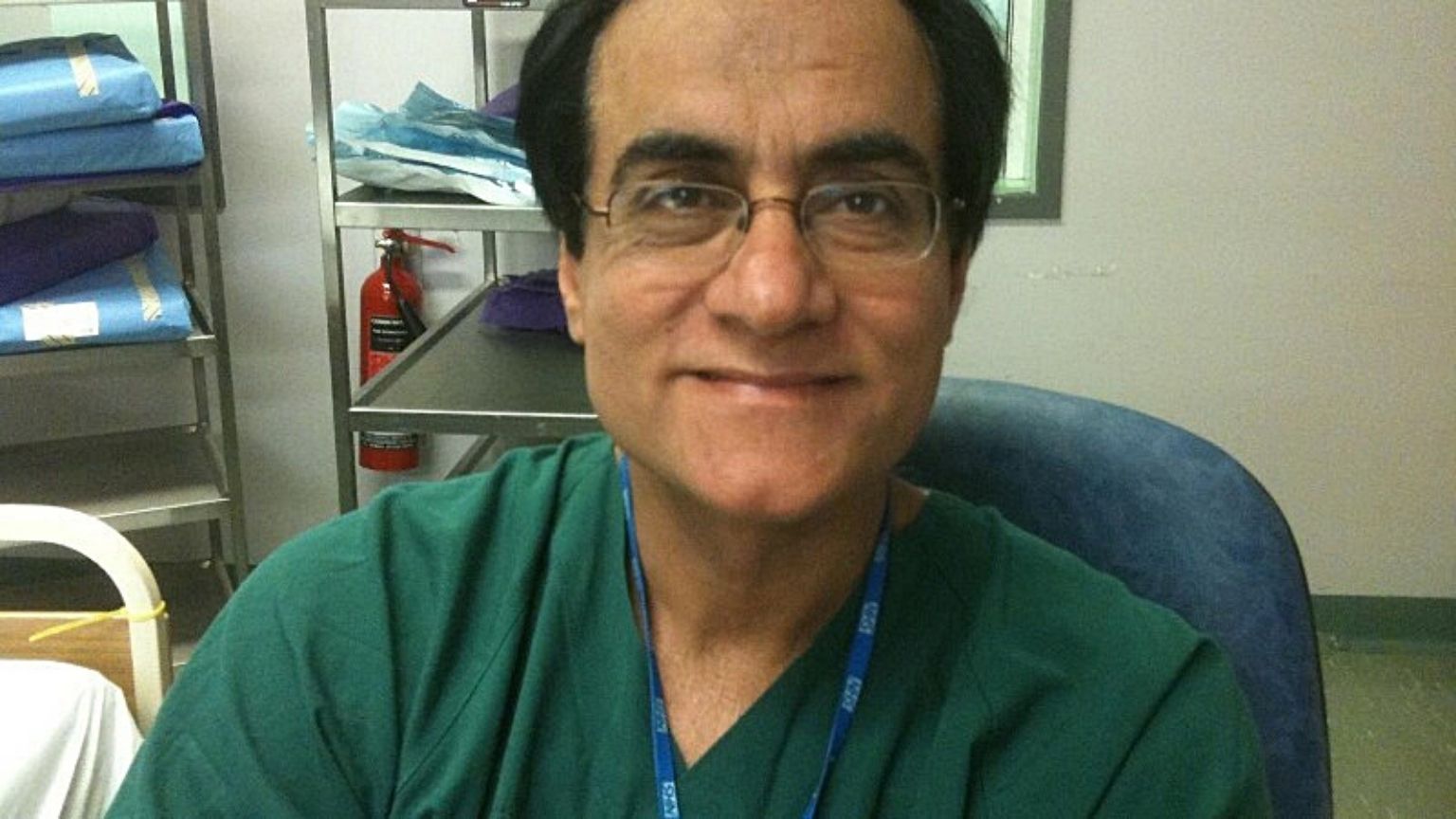
Mohammad Iqbal Adil, a Pakistan-born British doctor, has worked in the NHS for almost three decades. An interim orders tribunal suspended him for a year because of videos he posted on social media.
The doctor expressed “his point of view on the Covid-19 pandemic and the far-reaching effects of the lockdown on the economy, public health and wellbeing,” his campaign page states.
A spokesperson for the GMC at the time said: “The interim orders tribunal imposed an interim suspension on Dr Adil’s registration, following our referral, to protect patients and public confidence. This interim suspension remains in place while we consider concerns about Dr Adil’s fitness to practice.”
Some of his colleagues launched a petition on Change.org calling on the GMC to reinstate Dr. Adil. The petition argues that the GMC should have given him a chance to reflect on the videos “when the entire world is confused about the novel virus.”
The petition also noted that he had a family to support, adding, “UK needs doctors to work. It would not be in the best interest of the public and health system to lose [an] experienced and highly qualified surgeon like him.
“We, the doctors community within [the] UK and across the world, feel that it’s injustice to suspend Mr Adil on his personal point of view on the covid-19 without giving him [a] chance to reflect upon his video before enforcing suspension.
“We request to the GMC to revoke his unfair 12 months suspension . . . and allow him fair chance to work in this country [for the benefit of] the health system, communities, and medical graduates.”
“Dr Adil has been making a stand for freedom of speech for all doctors and nurses to speak their truth without fear of recrimination or persecution,” his campaign page states.
The chilling new ‘advice’ on vaccine heart risk for children
By Kathy Gyngell | TCW Defending Freedom | December 3, 2021
I HAVE just been alerted to the Government’s new Myocarditis and pericarditis after Covid 19 vaccination: guidance for healthcare professionals, published four days ago on Monday. It makes chilling reading.
You can read it here.
First, it is a clear admission of that myocarditis is a serious post-vaccine adverse reaction risk. Second, amongst the usual and increasingly implausible disclaimers like ‘it is a rare condition’ and ‘it is usually mild or stable and most patients typically recover fully without medical treatment’, comes the terrifying admission that ‘a high percentage of children admitted to hospital with myocarditis have significant left ventricular fibrosis and no follow-up data is available yet on hospitalised patients.’
So does it recommend halting the vaccine programme for children, given ‘that no follow-up data is available yet on hospitalised patients’?
No.
In complete defiance of any precautionary principle the subtext of this disturbing document is that these are reactions that are expected, not to be alarmed by and to be lived with as an inevitable consequence of the vaccination, giving what should be self-evident advice that though ‘the majority of cases appear to be mild and self-limiting; any acutely ill or unstable patients should be referred to hospital directly’. As though an acutely ill child was not normally treated as an emergency and rushed to hospital.
Furthermore, how they can claim to know at this stage that ‘ the majority of cases are mild and self-limiting’ in the absence of rigorous and systematic follow-up health checks on such children? It beggars belief and betrays an astonishingly cavalier attitude to children.
Even more chilling, if that were possible, is the publication of this document on the very same day that the JCVI decided to recommend second vaccine doses for 12-15s.
The opening few bullet points include these gems:
· Myocarditis – significant left ventricular (LV) fibrosis has been described in a high percentage of children admitted to hospital, with a small percentage of these having non-sustained ventricular tachycardia (VT);
· No follow-up data is available yet on hospitalised patients;
· The long-term consequences of this condition secondary to vaccination are yet unknown, so any screening recommendations need to be balanced against the frequency and severity of the disease with the aim to prevent complications, in particular of myocarditis (arrhythmias, long term myocardial damage or heart failure).
The question is also raised as to why would a GP not refer every child or youth with suspected myocarditis or pericarditis to the paediatric team for a full assessment, especially given this is a vaccine still under emergency use authorisation requiring proper post marketing surveillance? Perhaps the government doesn’t want to find too many cases?
Please, please do anything and everything you can to bring this to the attention of parents.
Some 80 per cent of school children* are estimated to have had Covid already and so have nothing to gain from vaccination, only the potential risk of harm.
*MRC Biostatistics Unit’s statistics on infections and deaths, which are updated once a week using ONS data, estimates that 5.53 million 5-14-year-olds in England have had Covid. This is of a total population of 6,975,037.
New law allows for warrantless spying on Australians – where next?
By Kit Klarenberg | RT | November 30, 2021
The Australian Signals Directorate, Canberra’s equivalent of Britain’s GCHQ or the US National Security Agency, will be granted sweeping new powers to spy on Australians for the first time since its November 1947 founding.
The move allows the agency to collect signals intelligence on individuals within the country without a warrant, although allegedly only in situations where there is an “imminent risk to life.” Domestic terror suspects are cited as a key target in the Directorate’s crosshairs, and it will also collect intelligence in conjunction with the Australian Defence Force for military operations, with ministerial authorization.
Rules governing the reform and protecting citizens’ privacy will be published on the agency’s website, and subject to review and scrutiny by the Australian parliament’s security and intelligence committee. While framed as sincerely concerned with keeping Australians safe, experts have expressed grave reservations about the development. Among them is John Blaxland, Professor of International Security and Intelligence Studies at the Australian National University, himself a military intelligence veteran, who warned the powers were ripe for abuse.
“I’m a former insider… I have a much greater appreciation of the need for checks and balances, because power tends to corrupt,” he cautioned. “My concern is the legislation we put forward is being drafted by insiders, it’s drafted with their own concerns in mind.”
Drafted by insiders, the legislation certainly was – it’s inspired by the findings of an extensive review by Dennis Richardson, former chief of Australian Security Intelligence Organisation, the country’s FBI, conducted in close consultation with Australia’s assorted intelligence services, in a manner akin to foxes being quizzed on how best to guard a henhouse.
Published in December 2020, his appraisal’s discussion of “authorisations” noted that these agencies can already conduct warrantless intelligence-gathering if they believe it to be “necessary, proportionate, reasonable and justified” in certain circumstances, and “would like the ability” to not only use various investigative techniques without official permission, but also with “protection from criminal liability” when doing so.
Leaked documents exposed by journalist Annika Smethurst in April 2018 showed that high-level plans for untrammeled domestic spying by the Australian Signals Directorate date back even further. They revealed how the respective heads of Australia’s Defence and Home Affairs ministries had discussed allowing the agency to access citizens’ emails, bank records and text messages without approval, or trace. A government source told Smethurst they were “horrified” by the proposals, given “there is no actual national security gap this is aiming to fill.”
Australian Federal Police raided both the alleged leaker of the files and Smethurst the next year. In a perverse irony, the charges against her were dropped in May 2020, as Australian High Court judges unanimously ruled that the warrant secured from a magistrate in relation to the raid was invalid, because it not only “misstated the terms of the offence” but was also ambiguous if not outright absurd.
“[The warrant] lacked the clarity required to fulfil its basic purposes of adequately informing Smethurst why the search was being conducted and providing the executing officer and those assisting in the execution of the warrant with reasonable guidance to decide which things came within the scope of the warrant,” the High Court damningly concluded.
In other words, it was impossible to know from the warrant’s wording what the investigation actually concerned, what evidence or information was sought, and what, if any, crime she may or may not have committed. That this baseless and broad investigative authorization was formally granted at all renders the Directorate’s newfound power to conduct warrantless surveillance all the more disquieting. If such procedural perversion can occur even with putative oversight, what abuses will be engaged-in without any meaningful supervision?
Misuse of these capabilities is almost inevitable. In 1973, the US Supreme Court ruled warrants were mandatory for domestic intelligence gathering. Two years later, a Senate investigation found that the NSA and other US intelligence agencies had nonetheless been engaged in unauthorized spying on American citizens, including anti-war protesters, civil rights activists, and political dissidents, monitoring all their private communications from telephone conversations to telegrams. This led to the 1978 Foreign Intelligence Surveillance Act, which made it a dedicated criminal offense to eavesdrop on American citizens without judicial oversight.
Yet,it was revealed in late 2005 that the NSA had all along continued illegally intercepting the phone calls and digital communications of US citizens, with the witting help of major telecoms giants, which passed copies of all emails, web browsing and other internet traffic to and from its customers at home and abroad to the agency, and its British counterpart GCHQ. Files disclosed in 2013 by whistleblower Edward Snowden confirmed this criminal dragnet was truly global in scale, and very much ongoing.
Key components of this international spying network, known as ‘Five Eyes,’ are situated in Australia, at the Pine Gap and Kojarena satellite surveillance bases. According to investigative legend Duncan Campbell, around 80% of the messages intercepted by the latter – which employs US and British staff in key posts – are sent automatically to GCHQ and the NSA. While every Five Eyes member can theoretically veto requests for such material, “when you’re a junior ally” like Canberra, “you never refuse,” Campbell records.
One can’t help but wonder if the Directorate’s new domestic purview is an experiment, gauging levels of backlash and controversy among the Australian public, before similar measures – provably or potentially already in operation – are openly codified across all Five Eyes member states. Ongoing legal battles against mass data collection in various jurisdictions clearly necessitate the practice being legalized and legitimized. If Canberra’s American and/or British friends politely requested they run such a pilot scheme, would or even could they decline?
Reinforcing this interpretation, mere days after the Directorate’s remit was expanded, the Australian government pledged to introduce new laws forcing social media giants to “unmask” anonymous users who post offensive comments, with hefty fines doled out to those companies which are unwilling or unable to do so. The reasons for Canberra’s haste are unclear, although it’s surely no coincidence that London and Washington have battled for many years to end online anonymity for good – it’s only due to intense domestic opposition that these efforts have so far failed.
Kit Klarenberg is an investigative journalist exploring the role of intelligence services in shaping politics and perceptions.
The English data on vaccines and mortality, revisited
By Alex Berenson | November 28, 2021
Last Saturday morning I posted a short post with a very simple chart – two lines in all.
One line tracked the number of weekly deaths per 100,000 vaccinated people aged 10-59 in England. The other tracked the number of deaths per 100,000 unvaccinated people in England. The chart showed that vaccinated people in this age group were dying overall at a higher rate than unvaccinated people.
I’m never exactly sure which posts will “land” – gain traction and go viral. This chart landed. Hard. Someone wrote me that it broke the Internet. It didn’t break the Internet, only Kim Kardashian’s ass can break the Internet, but it has rocketed around ever since. It has been seen over 800,000 times on this page alone and many millions more in screenshots and Twitter posts elsewhere.
Clearly, the reason the chart has gained so much attention is that it quickly and simply provides a way for people who are concerned about the vaccines to provide apparent visual proof that they are increasing all-cause mortality – overall death rates.
The chart has also engendered a fierce backlash from the usual fact-checkers and vaccine fanatics who say it is – wait for it – “misinformation.” (To be clear, I didn’t actually create the chart, but I checked the underlying British government report to make sure it accurately represents the report’s figures. It does, as everyone agrees.)
The “fact-checkers” have two primary complaints about the chart.
The first is that the vaccinated and unvaccinated groups are not exactly the same. A smaller percentage of teenagers than fifty-somethings are vaccinated, so the unvaccinated group overall skews somewhat younger than the older group. Since death rates rise with age, that difference may be enough to explain the gap between the two groups.
The second is that overall death rates in people over 60 (who are not covered in the chart) are much higher than those in the 10-59 range and appear to be lower in the vaccinated over the unvaccinated.
Another way to look at the objections: the first is that the chart doesn’t say what it seems to say, because of a hidden flaw in the data. The second is that it would be basically meaningless even if it did, because other more robust datasets contradict it.
—
Part of being on Team Reality is acknowledging reality, and acknowledging when your critics have a factually correct objection. So I want to acknowledge that, like the chart itself, these objections BOTH are valid and factually accurate, viewed individually.
What the fact-checkers and vaccine fanatics appear incapable of understanding is that the two objections effectively cancel each other out – and do nothing to address concerns over the long-term failure of Covid vaccines or their impact on all-cause mortality.
These folks think they are sophisticated thinkers who have blown up apparent evidence that the vaccines are dangerous. In fact, just as they have for the last several months, they are telling themselves what they want to hear instead of listening to what the data are saying – and, increasingly, shouting.
—
They have identified and latched on to ONE complication of using population-level data to judge vaccine effectiveness – the fact that differing rates of uptake by age may make the Covid vaccines seem less effective than they are.
But they – deliberately or out of ignorance – are ignoring another one, one that makes the vaccines seem MORE effective than they are.
The second problem is not a secret to epidemiologists.
It has been quietly discussed for flu vaccines for more than a decade, and I have written about it repeatedly in the last year. The problem is this: the popular belief that sick people are more likely to be vaccinated than healthy people is entirely wrong.
People who receive vaccines are healthier overall than those who do not. They care more about avoiding sickness, and they have the time and energy and money to find their way to a vaccination site. They are not healthier because they get vaccines; they get vaccines because they are healthier.
Older people who receive flu vaccines die – of both the flu and all causes – at much lower rates than unvaccinated people after they receive flu shots. But they also die at much lower rates BEFORE they receive the vaccines. The seminal study demonstrating this relationship is now more than 15 years old; it was published in the International Journal of Epidemiology in April 2006.
“The reductions in risk before influenza season indicate preferential receipt of vaccine by relatively healthy seniors,” the authors wrote.
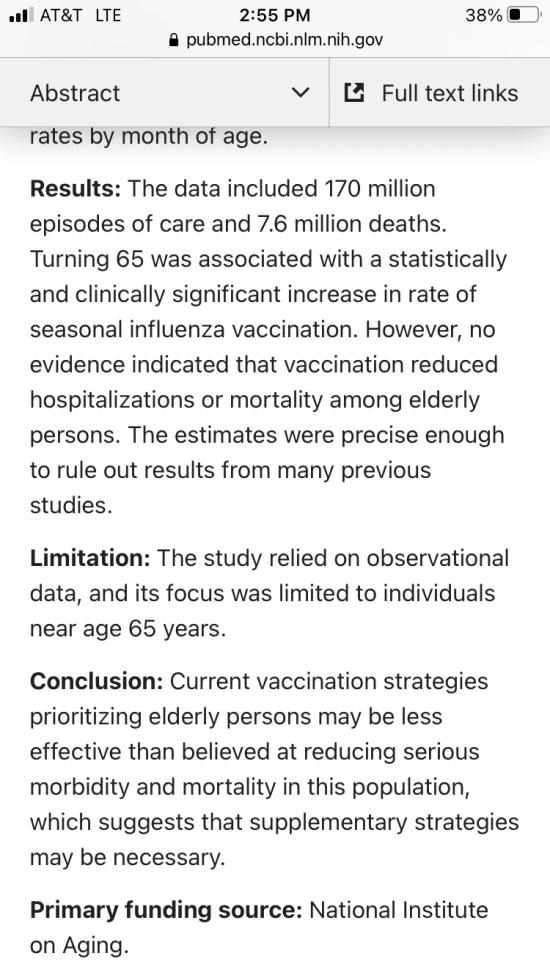
This paradox helps explain why a huge study of flu vaccines in the United Kingdom showed that increasing vaccination levels in older people did not reduce the number of hospitalizations or deaths from the flu.
The researchers took advantage of the fact that Britain prioritizes people 65 and older for vaccinations and that people are much more likely to get a shot when they are 65 or 66 than 64 or 63. Vaccination levels rose sharply as people turned 65, but the health of the people who received the shots did not improve.
(SOURCE: https://www.acpjournals.org/doi/10.7326/M19-3075?url_ver=Z39.88-2003&rfr_id=ori:rid:crossref.org&rfr_dat=cr_pub%20%200pubmed)
The same pattern is visible in the United States, where a massive increase in the number of flu vaccines in the last generation has made no apparent difference in the number of flu deaths. In fact, in 2005, researchers noted that although vaccinations had risen from 20 percent of elderly people in 1980 to 65 percent in 2001, “unexpectedly, estimates of influenza-related mortality in this age group also increased [emphasis added] during this period.”
In other words, influenza vaccines only seem to work. Any observational estimate that compares death rates in people who have gotten shots to those who have not will be inherently untrustworthy, no matter how hard researchers try to correct for the healthy recipient bias.
—
What is true for flu vaccines appears to be even more true for Covid vaccines.
The relentless vaccination push means that in many countries, more than 90 percent of elderly people are vaccinated. The split is even more stark in countries like England, where 2.44 million people 80 and over have been fully vaccinated, compared to 69,000 who are unvaccinated (and 24,000 who have received the first dose but not the second).
Look at those numbers again.
2,440,000 people in England 80 and over vaccinated. Almost 97 percent of the total number of elderly people.
69,000 80 and over unvaccinated. Less than 3 percent.
These two groups cannot remotely be compared.
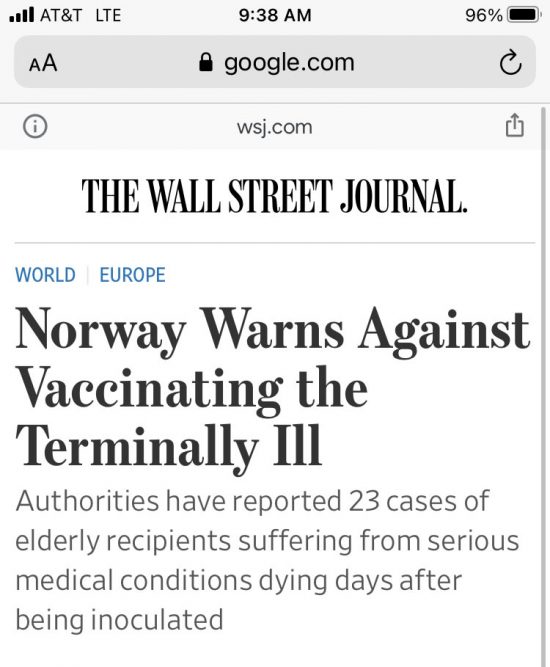
How do they differ? I can’t find any hard data, but we know that at least a fraction of the elderly unvaccinated are too ill to be vaccinated. Some are in hospice care. Norway recommended against giving people in hospice the Covid vaccine in January following deaths in terminally ill patients.
A paper published online in March in the Journal of Pain and Symptom Management noted that “communication from hospice organizations has primarily emphasized the vaccination of hospice staff without the same priority mention for patients” and called for hospices to do more to offer vaccines to patients.
The paper’s title was even starker:
A Shot at Inclusion: Reconsidering Categorical Exclusion of Hospice Patients from COVID Vaccine Allocation.
How many Covid deaths in unvaccinated elderly people are actually “with Covid” deaths in people dying in hospice? Again, we don’t know. But what we know is that even a small number of those deaths will hopelessly bias the relative risk ratio for unvaccinated to vaccinated Covid deaths, because the overall number of unvaccinated people is so small.
As of September, about 30 to 35 unvaccinated English people 80 and over died of or with Covid each week, compared to about 250 fully vaccinated people a week.
So trying to measure vaccine effectiveness by looking at the relative risks of the vaccinated and unvaccinated elderly is impossible. But that is exactly what the health authorities and their servants in the media do when they put out figures that seem to show the risk of death from Covid is much lower in elderly people who have been vaccinated.
They are lying with truthful data, and they (some of them, anyway, though probably not the reporters who are writing the stories) are smart enough to know exactly what they’re doing.
—
Meanwhile, they are ignoring a much more important indicator – trends in both Covid and all-cause mortality are very much going the wrong way in the vaccinated elderly population.
In the last four weeks for which British data are available, roughly coinciding with September, about 1,000 vaccinated English people 80 and over died from Covid and 16,000 from all causes.
Compare those numbers to four weeks in May, when fewer than 70 vaccinated English people 80 and over died from Covid and 13,000 from all causes.
Put another way, overall deaths rose more than 20 percent in the vaccinated elderly from May to September, and Covid deaths 15-fold. And this was not because many more people were vaccinated. The number of vaccinated elderly people rose only about 4 percent from May to September.
Compare that to the mortality trends in unvaccinated English people 80 and over.
About 800 died of all causes in four weeks in May (at the time, there were about 77,000 unvaccinated elderly people, compared to 69,000 in September). Fewer than 20 of those died of Covid.
In September, about 140 unvaccinated elderly people died of Covid – a eight-fold increase compared to the 15-fold increase in the vaccinated.
(All data from the British government:
See tables 3 and 4 in downloaded file.)
But that difference isn’t the striking part.
The striking part is that only 700 unvaccinated elderly English people died OF ALL CAUSES in those four weeks in September – FEWER than back in May. (The trend roughly tracked the overall drop in the elderly unvaccinated population. It appears that about 1 percent of those folks die a month, at least in warmer months.)
This trend is stunning for two reasons.
First, the fact that 100 more unvaccinated elderly people (supposedly) died of Covid in September yet 100 fewer of them died overall strongly suggests that many of those reported deaths are actually with and not from Covid.
Second, per capita all-cause mortality – not just Covid mortality, all-cause mortality – rose close to 20 percent in the very large group of the vaccinated elderly. Some of those extra deaths came from Covid. But most did not.
And though death rates are still somewhat higher in the unvaccinated – as they should be, given the fact that vaccine recipients are healthier – but that fact is far less relevant than the notable rise in the vaccinated.
What’s behind the rise in those deaths in the vaccinated elderly? We don’t know. But we’d better find out. Especially since we are now stuffing boosters into their arms.
—
All of this is somewhat complicated, I’ll admit. The data has lots of confounders and continues to evolve. And trying to explain relative changes in all-cause mortality in the context of healthy vaccine recipient bias using papers about flu vaccine – well, it’s not a soundbite.
Which comes back to the chart from last week.
The chart IS a soundbite.
It is a simple and factually accurate way to say:
Something is wrong. The promises that the health authorities have made over the last 12 months about the vaccines are not coming true. Despite near-complete levels of adult vaccination in Europe, many countries are seeing skyrocketing Covid cases and deaths. And worst of all, all-cause non-Covid mortality is running well above normal in country after country.
Not everyone is going to wade through this article. But everyone can read that chart from last week. It’s not perfect, but it uses real data to raise a crucial issue.
That’s why it landed. And that’s why the vaccine fanatics hate it so much.
Whatever You Do, Don’t Think of the Children

By Toby Young • The Daily Sceptic • November 29, 2021
Like most parents across the land, I received a letter from the local council’s Director of Public Health this morning (forwarded by the school in an email) explaining that they have “advised [sic] schools that parents/carers/other visitors are not invited” to nativity plays this year. Not the end of the world in the grand scheme of things, of course – just another depressing example in the long litany of examples of children’s priorities being cast under a bus due to adult panic during the course of this pandemic.
Much more concerning, because of what it said about the mindset of the Director of Public Health in question, was this alarmingly blithe justification for continued restrictions in schools, buried in the body of the letter:
Much as we would all like it to be, the pandemic is not over. Whilst it is clear that the vaccination programme is effective in preventing serious disease and deaths, the vaccine is never going to stop all transmission, and resultant harm, on its own. [Emphasis added]
You couldn’t get a starker admission than this that we long ago moved beyond “flattening the curve” or staving off a dire public health emergency in a once-in-a-lifetime, never-to- be-repeated year. No: we are now in a different place altogether – one in which we must stop transmission “and resultant harm” for its own sake, forever. For how else are we supposed to interpret this statement? On what grounds will parents ever be allowed back into schools to watch nativity plays (or even properly meet their children’s teachers), if the requirement is for “all transmission and resultant harm” to end? We will never be in that position. So in what circumstance does the Director of Public Health envisage there ever will be a return to normal schooling? Ought this not to be made clear to local parents?
More broadly, this incident raises the question of how it is that something so fundamental – children’s schooling – has ended up beholden to the whim of unelected, largely unaccountable, public officials such as this. The local Director of Public Health in any given local authority cannot be voted out. They are not challenged by probing interviews in prominent media outlets. The means by which they are appointed is entirely opaque. And their policy positions, political backgrounds, and motivations are subject to essentially no public scrutiny. Yet they possess the power, at the sweep of a pen, to disrupt the lives of literally tens of thousands of people within their bailiwicks, with the only possible avenue of challenge being a prohibitively expensive and time-consuming claim for judicial review. This ought to be intolerable in a free society. Yet it is the position in which we find ourselves.
Once again, the Covid pandemic and its response have shone a harsh light on British democracy, and revealed it to be in a dilapidated state indeed.
Higher Infection Rates in Vaccinated Not an Artefact of Wrong Population Data, New Analysis Shows
By Will Jones • The Daily Sceptic • November 26, 2021
Back in October, when the critics rounded on the UKHSA for publishing vaccine data that didn’t fit the narrative, front and centre of their complaints was the claim that they were using poor estimates of the size of the unvaccinated population, and thus underestimating the infection rate in the unvaccinated. Cambridge’s Professor David Speigelhalter didn’t hold back, writing on Twitter that it was “completely unacceptable” for the agency to “put out absurd statistics showing case-rates higher in vaxxed than non-vaxxed” when it is “just an artefact of using hopelessly biased NIMS population estimates”.
To the UKHSA’s credit, while it conceded other points, it never gave in on this one, sticking to its view that the National Immunisation Management System (NIMS) was the “gold standard” for these estimates. It pointed out that ONS population estimates have problems of their own, not least that for some age groups the ONS supposes there to be fewer people in the population than the Government counts as being vaccinated.
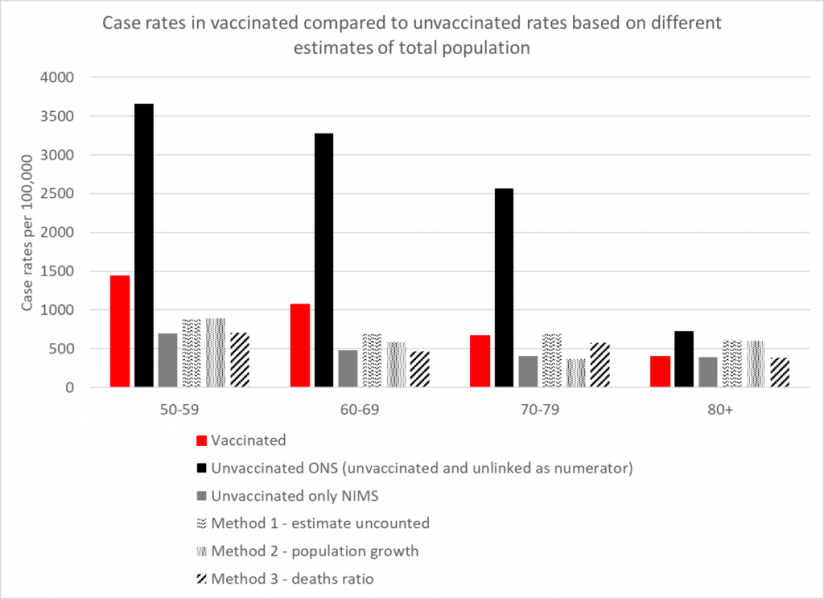
How can we know which estimates are more accurate? A group of experts has applied analytical techniques in order to estimate the size of the unvaccinated population independently of ONS and NIMS figures. Using three different methods, experts from HART found that estimates from all three methods were in broad agreement with the NIMS estimates, whereas the ONS estimate was a much lower outlier.
The first method involves recognising that people not within the NHS database system still catch Covid and still get tested. Assuming these people have the same infection rates per 100,000 people as the unvaccinated, you can calculate how many people there are outside of the database system and add these to the NIMS totals.
The second method involves looking at the rate of growth of people with an NHS number, which has been remarkably steady at around 2.9% per year. If you assume that people who are not yet registered in the NHS will sometimes become sick enough to seek healthcare, and thus a record will be created for them, applying this growth rate to the 2011 ONS population estimates give another figure for the total population.
The third method involves assuming that, in low-Covid weeks, deaths within an age bracket should occur at a similar rate in vaccinated and unvaccinated, allowing the size of the total population to be inferred from the percentage of deaths in the unvaccinated.
The results in terms of reported infection rates according to the five different estimates are depicted in the chart above. They show that the ONS is a clear outlier, its estimates sitting far too low, and NIMS is likely to be much more accurate. The ONS puts the unvaccinated population at around 4.59 million whereas NIMS puts it at 9.92 million, a difference of 5.33 million. That’s a lot of people not to be included in estimates, and suggests, among other things, that the ONS has not adequately estimated the magnitude of illegal immigration into the country.
As well as vindicating the UKHSA in its decision to stick with NIMS over ONS, HART’s analysis also indicates that, contrary to the assertions of Prof Spiegelhalter, the UKHSA data showing infection rates higher in the vaccinated compared to the unvaccinated is not a mere artefact of using the wrong population estimates. There may be other biases in it, but this is not one of them.
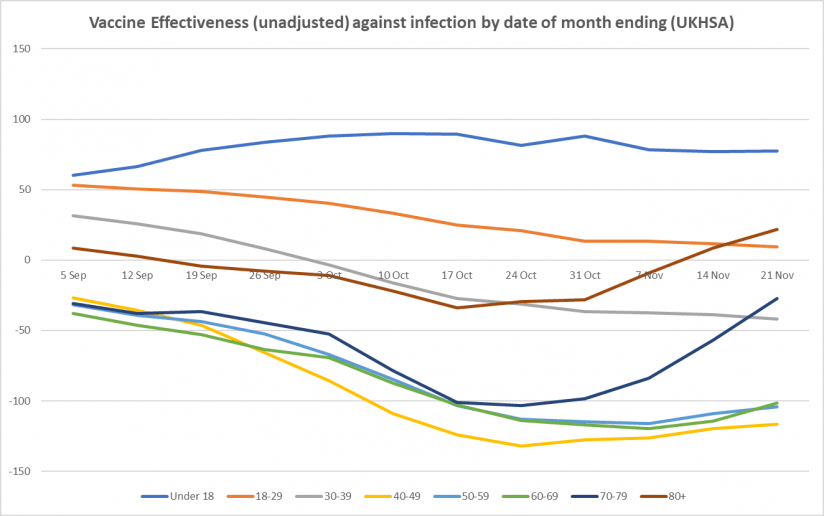
Here is the weekly update on unadjusted vaccine effectiveness based on the raw data in the UKHSA Vaccine Surveillance report. The unadjusted vaccine effectiveness estimates against infection have remained low in all adult age brackets this week, particularly in those aged 40-70, though there is little sign of further decline; in the older age groups (over 40), the recent vaccine effectiveness revival continues, possibly as a result of the third doses. There is also a sign of a rise in vaccine effectiveness against hospitalisation in the over-70s.



Vaccinated “No Less Infectious” Than Unvaccinated, CDC Study Finds
By Will Jones • The Daily Sceptic • November 24, 2021
A pre-print study out this week from the U.S. Government’s Covid Response Team at the Centers for Disease Control and Prevention (CDC) has found vaccinated people to be “no less infectious” than unvaccinated people.
The study tested inmates in a federal prison with high vaccination rates daily during a SARS-CoV-2 Delta variant outbreak.
The study was very thorough. Inmates who tested positive for SARS-CoV-2 were, where willing, PCR-tested for 10 consecutive days and reported symptoms via a questionnaire. The researchers performed whole genome sequencing and viral culture analysis on a high proportion of the 978 specimens collected, allowing them to assess the duration of PCR positivity and viral culture positivity.
There were 95 participants in total, of whom 78 (82%) were double vaccinated and 17 (18%) were not double vaccinated (two having received one dose and 15 having received none). No significant differences were found between double vaccinated and not double vaccinated either in duration of PCR positivity (13 days each) or in duration of culture positivity (five days each).
The authors conclude that “clinicians and public health practitioners should consider vaccinated persons who become infected with SARS-CoV-2 to be no less infectious than unvaccinated persons”.
This is in line with the findings of Public Health England and others.
While this sounds like more good news for countering vaccine passports, vaccine mandates and all other vaccine-based coercion and discrimination, it may be less good news for ending general restrictions and interventions. The authors state: “These findings are critically important, especially in congregate settings where viral transmission can lead to large outbreaks.” Which suggests they think the lack of efficacy against transmission is a reason to intervene more generally to prevent “large outbreaks” in “congregate settings”. It could be a long winter.
Featured Video

Seyed M. Marandi: Toward Total War in the Middle East
or go to
Aletho News Archives – Video-Images
From the Archives
The Geopolitics behind the War in Yemen (I)
By Mahdi Darius NAZEMROAYA | Strategic Culture Foundation | 30.03.2015
The United States and the Kingdom of Saudi Arabia became very uneasy when the Yemenese or Yemenite movement of the Houthi or Ansarallah (meaning the supporters of God in Arabic) gained control of Yemen’s capital, Sanaa/Sana, in September 2014. The US-supported Yemenite President Abd-Rabbuh Manṣour Al-Hadi was humiliatingly forced to share power with the Houthis and the coalition of northern Yemenese tribes that had helped them enter Sana. Al-Hadi declared that negotiations for a Yemeni national unity government would take place and his allies the US and Saudi Arabia tried to use a new national dialogue and mediated talks to co-opt and pacify the Houthis.
The truth has been turned on its head about the war in Yemen. The war and ousting of President Abd-Rabbuh Manṣour Al-Hadi in Yemen are not the results of «Houthi coup» in Yemen. It is the opposite. Al-Hadi was ousted, because with Saudi and US support he tried to backtrack on the power sharing agreements he had made and return Yemen to authoritarian rule. The ousting of President Al-Hadi by the Houthis and their political allies was an unexpected reaction to the takeover Al-Hadi was planning with Washington and the House of Saudi. … continue
Blog Roll
 Aletho News
- HE SAVED LIVES. NOW HE FACES PRISON.
- Israeli lobby seeks to bind US fate to ‘Israel’: Araghchi
- Pakistan-Iran talks secure LNG shipment to Islamabad through Hormuz
- Black Sea grain crisis puts global wheat supplies under pressure
- IRGC air defenses destroy another US MQ-1 drone over Strait of Hormuz
- Imran Khan’s entire immediate family detained in Pakistan ahead of mass protest demanding his release
- EU nation detains former presidential frontrunner
- Leaked: Britain’s Sham Conviction Of Hashim Thaci
- Seyed M. Marandi: U.S. Strike Imminent – Toward Total War in the Middle East
- Russia Voted Under Fire. Washington Is Loading the Tankers.
- If Americans Knew
- Israeli Attacks in Gaza Kill at Least Seven Palestinians Over Three Days, including Woman and Child
- Trump’s militarization of Washington DC as he pursues Israel’s war against Iran
- Why Israel Fears This Searing New Documentary
- Huckabee aide solicited cash gifts from Israelis
- This isn’t sci-fi, AI is already killing people
- ‘The Most Brutal Thing’: Investigation Reveals Execution of Elderly Woman in Rafah
- Inside Israel’s ‘soft’ ethnic cleansing plan for Gaza through the eyes of its victims
- New online database tracks pro-Israel political donations in the United States
- Israeli president pardons soldier convicted for killing wounded Palestinian
- Singer Ed Sheeran says his ‘heart broken’ by Gaza devastation, addresses Macklemore controversy
- No Tricks Zone
- 2025 Nature Paper Claiming Worsening Global Drought Gets RETRACTED …Heavily Flawed
- New Study: ‘Global Drought Shows No Detectable Recent Acceleration Under Climate Warming’
- Economic Masterminds: German Socialists Suggest Taxing Productivity Gains Stemming From Using AI
- The South China Sea Has Not Been Cooperating With The Climate Change Narrative
- Energy Crisis: Germany Enters Heating Season With Historically Low Gas Reserve Fill Levels
- New Study: The Antarctic Ice Sheet Gained Mass From 2020-2024 Due To Staggering Snow And Ice Accumulation
- Study: Ocean Heating Rates From Thousands Of Years Ago ‘Dwarf’ Modern Ocean Heating Rates
- Climate Extremists Target, Attack Large-Scale Power Grid Infrastructure In Germany!
- New Study: Antarctic Ice Melt Has Contributed Less Than 1 Centimeter To Sea Level Rise In The Last 30 Years
- Fear Of Debate: Alarmist German Climate Scientist Calls On Mainstream Media To Discredit Skeptic Voices
 Aletho News