Majority of Covid ICU Patients in October and November Were Vaccinated
By Will Jones – The Daily Sceptic – December 11, 2021
Contrary to the claims made by Dr Rachel Clarke and Professor Stephen Powis last month and used to blame the unvaccinated for the mounting troubles of the NHS, new data out this week shows that the majority of Covid ICU admissions in October and November were among the vaccinated, not the unvaccinated.
The latest report from ICNARC shows that of Covid ICU patients in England, Wales and Northern Ireland, 50.5% in October and 50.7% in November were double vaccinated. Add to that the 2.8% in October and 1.8% in November who were single-vaccinated and you get overall vaccinated proportions of 53.3% in October and 52.5% in November. That compares to 46.7% unvaccinated in October and 47.5% in November. Note that the unvaccinated here includes people who received a vaccine less than 14 days prior to the positive Covid test, so includes some (an unknown number) who are actually single vaccinated.
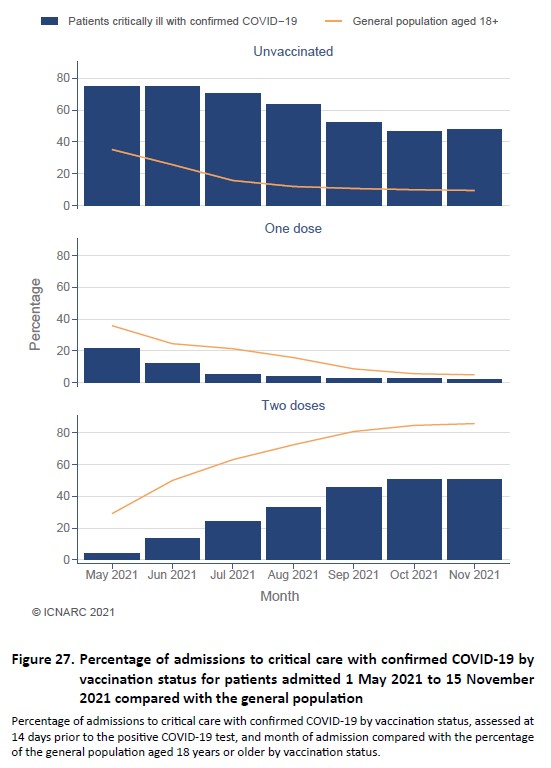
This is not what the public has been led to believe by some prominent medics and newspapers.
Two weeks ago, Professor Stephen Powis, the National Medical Director of NHS England, was quoted in the Sunday Times saying: “Data shows that the overwhelming majority of people admitted to intensive care with Covid are not fully vaccinated.” A source was not provided for this claim but the article implied that it meant right now, with an opening paragraph stating: “Hundreds of intensive care beds that could be used for life-saving surgery are instead occupied by unvaccinated Covid patients, one of NHS England’s top officials has said.”
The same day the Sunday Times also printed an article by Dr. Rachel Clarke with the subheading: “Some 75% of those suffocating in intensive care with the coronavirus are unvaccinated.” In it she states: “Of the Covid patients treated in intensive care in recent months, the majority – nearly 75% according to the latest data – have chosen not to be vaccinated.”
The Guardian published a piece in November headlined “ICU is full of the unvaccinated – my patience with them is wearing thin”, written by an anonymous medic who claimed that the ICU patient population “consists of a few vulnerable people with severe underlying health problems and a majority of fit, healthy, younger people unvaccinated by choice”.
Now that the data has been released it’s clear that the claim that ICUs are “full of” the unvaccinated is highly misleading. While the unvaccinated do currently appear to be over-represented (depending how many of them are misclassified), no one now can claim that ICUs are “full of” the unvaccinated or that the unvaccinated constitute the “overwhelming majority” of Covid ICU admissions. If you spot any newspapers still peddling this misinformation, particularly it if is being used to stigmatise and pressure the unvaccinated, you can complain to IPSO here.
Did Vladimir Putin Call Off Invasion in Fear of This British Lady’s Tank Commanding Skills?

Anti-Empire | December 10, 2021
The moderately elevated Russian concentration of forces opposite of Ukraine remains in place, but further escalation seems to have been averted so far.
There could be two reasons for this. One is that President Joe Biden, the head of the American Empire, has told Putin that he will look into addressing Russia’s concerns and get back to him.
The other possibility is that the Kremlin took one look at Liz Truss’ tank commanding skills and decided the Russian military didn’t stand a chance.
Visiting Estonia and the eight hundred British troops there Truss took the opportunity to ride a British Challenger II tank.
This was likened to an episode in 1986 when Margaret Thatcher rode a Challenger I in West Germany. However, at the time, Thatcher was a Prime Minister and as such was the army’s boss. The photo-op may have been a little cringy, but it was just Thatcher mingling with a bureaucracy she had jurisdiction over.
Truss meanwhile is the Foreign Secretary in charge of the British Foreign Office alone. She is not in the chain of command and has no authority over the military.
Some would even say that having precisely your chief diplomat ride around in a tank is especially tacky.
This leads us to believe the only reason Truss was allowed to do such a thing is because she is secretly an insanely skilled tank commander.
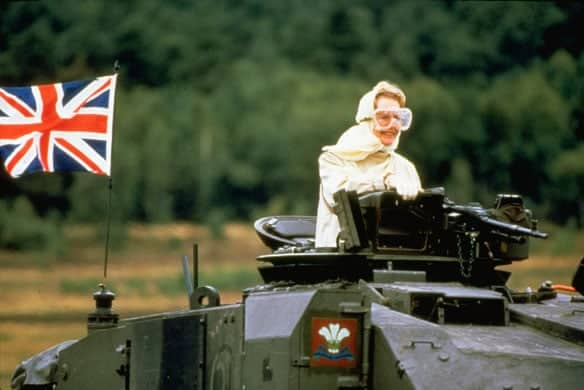
Eastern Front tank commander
Perhaps the real reason we have not seen an escalation is that the Russians feared a Truss-led spoiling attack from Estonia if they started any funny business in the south. It’s a story as old as time. An evil dictator with a massive army launches an invasion only to be defeated by a middle-aged lady in a heavy cavalry charge. I think there’s a Sabaton song just about that.
Wisely Putin held back the armies of Mordor.
Putin can only wish his chief diplomat was an equally accomplished tank commander. Instead, Sergey Lavrov’s expertise encompasses diplomacy alone.

Sergey Lavrov has never been photographed riding a tank. Lame.
In fact, Truss’ intersectional expertise stretches out into the sea. There is reason to believe she is also an expert reserve Admiral:
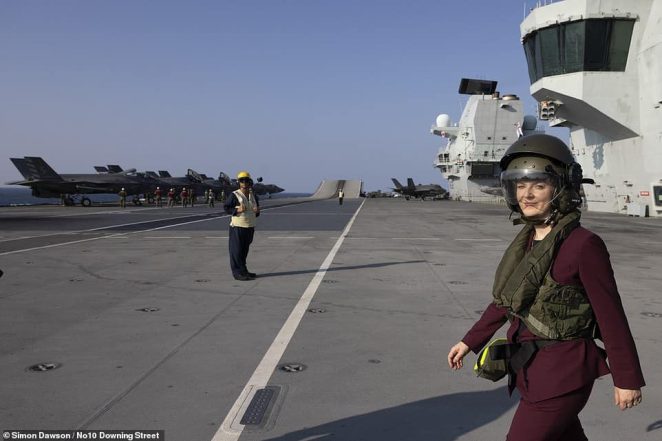
That should keep the Chinese deterred as well!

Andrew Neil: “It’s Time To PUNISH Vaccine Refuseniks”
By Richie Allen | December 10, 2021
The establishment has never had a greater gatekeeper than Andrew Neil. He’s edited the Sunday Times, been the chairman of SKY TV, chaired Press Holdings Media Group and spent a quarter of a century fronting flagship news shows for the BBC.
Neil was head cheerleader for Britain’s involvement in Afghanistan. He described opponents of military intervention there as; “wimps, with no will to fight.”
He used his columns and tv programmes to champion the 2003 invasion of Iraq. Writing for Scotland on Sunday in September 2002 Neil said that Saddam Hussein had:
“embarked on a worldwide shopping spree to buy the technology and material needed to construct weapons of mass destruction and the missile systems needed to deliver them across great distances…. the suburbs of Baghdad are now dotted with secret installations, often posing as hospitals or schools, developing missile fuel, bodies and guidance systems, chemical and biological warheads and, most sinister of all, a renewed attempt to develop nuclear weapons.”
Neil KNEW that this was undiluted bullshit, but he printed it anyway.
During that time he referred to The Guardian as “The Daily Terrorist.” In short, Andrew Neil is a rancid, rotten scumbag. Writing in today’s Daily Mail, he called for the punishment of the unjabbed.
Last night I took a friend out to dinner near my home in the South of France. At the restaurant door we were politely asked for our vaccine passports, the QR codes on our smartphones were scanned and we were ushered to our table.
The check had taken seconds — a very minor inconvenience when a new wave of the coronavirus pandemic is sweeping across the Continent.
There was a sense of safety in knowing that all the other diners had proved themselves to be fully vaccinated, or had very recently tested negative, or had contracted the virus and recovered.
Cheerleading illegal wars that killed millions of people earned him a home in the South of France. How nice for him. He goes on:
There are still 5 million unvaccinated British adults, who through fear, ignorance, irresponsibility or sheer stupidity refuse to be jabbed. In doing so they endanger not just themselves but the rest of us.
If they contract Covid, it is they who will put the biggest strain on the NHS, denying the rest of us with serious non-Covid ailments the treatment that is our right. We are all paying a heavy price for this hard core of the unvaccinated.
As long as they can be numbered in the millions, the nation will remain unnecessarily vulnerable to the latest variant, meaning more lockdowns, more restrictions on our lives, more lost jobs, more failing business, less economic growth — all of which will follow the Government’s introduction of its so-called Plan B of enhanced restrictions this week.
Of course, there is a small number of people who, for medical reasons, cannot be vaccinated. Those in that category can be identified and helped with regular testing to make sure they’re Covid-free.
But for the rest it is simply selfish not to be vaccinated. We all have a responsibility to act in ways that don’t just protect our own health but also that of others.
Neil went on to say that he’s not in favour of mandatory vaccination, but:
As it stands, the unvaccinated are making more restrictions on our lives inevitable. It is time we imposed some on them.
In a free society the unvaccinated have a right not be jabbed. But they need to realise that right comes with consequences, which will inhibit their freedoms as they constrain ours.
One final thought. Singapore has decided that the unvaccinated who end up in hospital with Covid will have to foot their own medical bills.
I doubt we’d ever go that far. But you can see the logic — even the morality — of it.
By all means exercise your rights. But beware of the consequences.
Andrew Neil remains a worthless, warmongering whore.
Javid’s children – out of shape and out of their poor minds
By Dr Sinead Murphy | TCW Defending Freedom | December 8, 2021
ON November 9, Health Secretary Sajid Javid announced to the House of Commons that a full Covid vaccination status will be required of all patient-facing NHS staff from April 1, 2022. ‘I am mindful of the need to protect human life,’ he said.
‘To protect human life’: the phrase struck an off note as the sequel to Hancock’s slogan ‘Save Lives’, which at least acknowledged that humanity comprises individual beings.
We talk about ‘plant life’ or ‘animal life’. But how often do we say ‘human life’? The phrase rings with indifference, with that distant carelessness about the components of a large group which we may feel when we lift a stone to reveal the ‘insect life’ beneath.
 At other times, the phrase ‘human life’ would probably be unremarkable. But given that our government, in lockstep with governments worldwide, seems bent on reframing its people as anill-disciplined lump of behaviours and diseases, to be administered from on high, Javid’s desire ‘to protect human life’is surely significant as well as objectionable.
At a swimming pool the other day, a woman took the seat next to me and smiled. At least I judged that she smiled – her eyes narrowed slightly and creased about their edges. The rest of her face was hidden behind a blue surgical mask.
As she turned to scroll through her phone, it occurred to me how little of her appearance and personality she was offering to the world, how barely-human she was, how abstract – body slumped over a tiny screen, and a face that might be anyone’s.
This is ‘human life’, I thought. This inert, anonymous being: this is what Javid wants to protect . . .
And this, it appears, is what Javid wants to breed. Last week saw the return of mandatory face masks in secondary schools. Not in classrooms yet, but in the between-lesson social spaces in which our children have the chance to establish themselves, to try out what kind of person they are and might be. Now, this vital opportunity to flourish is taken from them; you cannot find yourself when you are masked in a sea of masks.
The question is whether this masking of our children, nasty enough on its own, is only the surface manifestation of a deeper campaign against their chances of defining themselves.
At the swimming pool, the daughter of the masked woman next to me joined a group of other eight-year-olds being instructed on the front crawl at the near edge of the pool. Once each had taken their turn and heard how they were to improve, they clambered out and walked back the length of the pool to line up and do it again.
During the half-hour that followed, these young children filed past me several times. It was not an uplifting parade. Though it is almost taboo even to notice it, the fact is they seemed out of shape, distinctly lacking in tone and posture.
With only a single exception in the group of eight, these children’s movements were more clumsy than they should have been, their shoulders more rounded, their hips turned inwards, their feet slapping against the tiles as if they were, somehow, out of their element.
What is happening to our children that they are misshapen and unwieldy in this way?
In a short film called Numb, from June 2020, 15-year-old Liv McNeil depicted the experience of many children during the Covid lockdowns, sentenced to schooling and socialising on a screen. Following a brief survey of the photographs and trophies on display in her bedroom, telling of outdoor activity camps, parties with friends and triumphs on the ski slope, the camera comes to rest in front of Liv – seated cross-legged on her bed, back bent over her laptop.
There follows a series of rapid cuts, in which Liv remains seated and slumped through the changing outfits and hairstyles of passing days and weeks – like one of those cheap cut-out cardboard dolls to which you can attach different items of clothing and heads of hair.
Numb closes with clips of Liv – still seated, still slumped – apparently screaming at her computer screen. She is, with good reason, losing her mind. She is also losing her shape.
If we are concerned about the thoughts and feelings of our children during the sedentary isolation imposed by Covid restrictions, then we should also be concerned about their muscles and joints which must surely be atrophied and contorted.
The National Child Management Programme recently reported that obesity rates in reception aged children increased from just under 10 per cent to almost 15 per cent over the single academic year spanning 2020 and 2021; rates of obesity in Year 6 aged children increased from 21 per cent to over 25 per cent. By the age of 12, more than four in every ten children are now overweight or obese.
The fragile frames of those eight-year-olds at the pool are destined to be covered in fat. And it looks as if their faces are destined to be covered in cloth.
What will they be once all this covering is accomplished, once their already neglected bodies are further overlain and obscured? They will be ‘human life,’ of which our Health Secretary declares himself so mindful: an inexpressive, undifferentiated human heap in which it will be very, very difficult to find yourself.
As Predicted, They’re Coming For The Unvaccinated
By Richie Allen | December 9, 2021
Yesterday, UK Prime Minister Boris Johnson announced that his government would move to Plan B covid measures as a precaution against the emergence of the omicron variant. He was lying. What else is new, I hear you say.
In my opinion there is no omicron variant. It is a fantasy. Johnson’s government moved to Plan B for one reason only, to turn the jabbed against the unjabbed.
In recent weeks, regular listeners to my radio show will have heard me play dozens of soundbites from UK TV and radio news shows, where the public is invited to call in and opine on what should be done about the anti-vaxxers.
I said that we were being primed or conditioned for a day of reckoning next year, when the government will announce “enough is enough, we can’t keep shutting down society, we must mandate the jabs.”
Nothing that has happened since, has changed my mind. UK Health Secretary Sajid Javid said this morning that mandatory jabs will not be pursued by his government. He said that such a thing would be “unethical.” He was lying too.
Today, the public are quite rightly enraged at the announcement of new covid measures and the prospect that they will be tightened further still on December 18th.
However, the great majority of people are not demanding an end to this charade at once. No, they’re raging at the Tories for holding Christmas party’s last year while they were locked down and obeying the rules.
And predictably, they’re turning their ire on the unjabbed.
Take a look at this outtake from this morning’s Jeremy Vine Show on Channel 5. The guests call for the unjabbed to be blamed for the tyrannical covid restrictions. They even suggest that we should be exiled.
Instead of challenging them, the impotent host egged them on.
We’re in the fight of our lives now.
Watchdog urged to investigate Jewish charity over ‘political’ activities
MEMO | December 8, 2021
Pro-Palestine campaigners have called on the charities regulator, the Charity Commission, to launch an urgent investigation into the activities of a pro-Zionist lobby group after it falsely accused anti-Israel demonstrators of extremism, racism, and intimidation at a recent protest rally.
The Community Security Trust attempted to turn what was a peaceful anti-Israel protest against the presence of Israeli ambassador to the UK, Tzipi Hotovely, at a university event last month into a panic about anti-Semitism.
The CST is a registered charity that ostensibly exists to “provide safety, security, and advice to the Jewish community in the UK”. However, rather than serving this purpose it routinely engages in political activities designed to protect the state of Israel from criticism and censure.
The latest evidence of this came at a debate hosted by the London School of Economics Debating Society on Tuesday 9 November 2021. This was a peaceful protest that attracted scores of students and others from all backgrounds, with many wishing to express their opposition to racist Israeli policies that have seen Palestinians dispossessed and oppressed for over 70 years.
Although the event passed off peacefully without any arrests the CST has since made unsubstantiated allegations about supposed anti-Semitism amongst the protestors and about the threat these types of protests pose to Jewish students, deliberately conflating anti-Israel activity with anti-Semitism. The CST has increasingly relied on this false equivalence to demonise anti-Israel campaigners, attempting to damage their credibility using the charge of racism.
The letter reminds the Charity Commission of its differential treatment of Jewish and Muslim charities. In recent years the watchdog has been at pains to remind Muslim charities to steer clear of taking positions on the Palestine issue, but it appears to have given the CST a free pass to support Israel, using underhand methods if desired.
The signatories call on the Charity Commission to launch an investigation into the CST which they say has breached the code on charities engaging in political activity, spreading racial hatred, and the requirement to remain impartial. The full letter can be read here.
IHRC Chair Massoud Shadjareh said: “It would seem that in the eyes of CST there is no good pro-Palestinian and everybody who opposes Israel’s subjugation of Palestinians is fair game for demonisation. This latest episode highlights once again how CST primarily behaves as an apologist for apartheid and a brutal illegal occupation.”
“Masks were to soften you up for Plan B”
By Laura Dodsworth | December 8, 2021
‘Masks were a softening up exercise for Plan B,’ according to a government whistleblower. He told me that while there is little appetite in the Cabinet for a full lockdown, Covid Passes are ‘oven-baked’ and ready to go.
In my opinion, the UK government’s Winter Plan was always about Plan B. It displayed a classic ‘foot-in-the-door’ strategy – the raison d’être of Plan A was to prepare you for Plan B. Now winter is upon us, and the nudges fall in a flurry of torpefying snowflakes. Worst case scenarios, big numbers, salutary stories in the media, threats and cajolements are directed at us daily. Plan B is in motion as calls for working from home are heard from the usual suspects and we hear the Cabinet is divided on Covid Passes.
This seasoned government insider plays a key role on a Covid task force and has decided to speak out now because he is disturbed by the unethical reasons for mandating masks. Firstly, ‘It’s a highly political move to reset the Johnson administration’s orientation after bad polling over sleaze and corruption. If Omicron turns out to be super-bad and the public ask what the government did about it, the answer is we implemented masks. The one-way systems, plexiglass screens and masks are to give you an illusion of the government doing something. It’s just theatre. There is no evidence base or proportionality in favour of masks.’
Boris Johnson is a fan of deadcatting, a technique to deflect attention from one issue to another, akin to throwing a dead cat on a table during a heated debate to change the topic. Masks are a dead cat. In this case rather than throw them on the table, the government have slung them on our faces.
Face masks are increasingly discredited, but certain journalists fell hungrily upon a recent new study which concluded that face masks reduce transmission by 53%. The Guardian, The Times, Metro and New Scientist positively feasted. However, that fragrant soupçon of a percentage was based upon weak evidence, there were confounding factors and caution was required when interpreting the study, as Fullfact explained.
‘The public are annoyingly on board about masks’, said this task force advisor. ‘Journalists have not demanded evidence that they work. But the message from the government and the media is hegemonic – everyone says they do work.’
As I set out in my book A State of Fear: How the UK government weaponised fear during the Covid-19 pandemic masks are a nudge, even described as a ‘signal’ by David Halpern, the director of the UK government’s Behavioural Insights Team. Similarly, Professor Neil Ferguson said that masks remind us ‘we’re not completely out of the woods yet’. They serve as a visible public reminder of the pandemic, turning us back into walking billboards pronouncing danger. My source concurred: ‘Masks are a behavioural psychology policy. We need to stop pretending that it’s about public health. Nudge is a big thing in government.’
Despite ‘a pretty much unlimited budget to run trials’ they didn’t run one for masks ‘because they knew that they don’t work’. In effect, ‘the trial was Scotland versus England. And we found they don’t work.’
For this government insider the implications are now too serious to remain silent because ‘we are lying when we say masks work. They are a signal, a psyop. And we’ve criminalised not wearing them. Masks also transfer the blame onto individuals for the epidemic spreading. We have people counting the unmasked on public transport, policing each other. It is deeply unethical that we have set people against each other in this way. It allows the creation of an “out group” to blame.’ He points out that it is the government we should blame for not increasing healthcare capacity.
The timing of our conversation is interesting. He speaks to me just before the news about Downing Street Christmas parties breaks. People are rightly angry about hypocrisy and the pain of their own cancelled plans last year. The nation suffered last minute restrictions while Downing Street enjoyed revelry. More than one million pounds in fines have been served to nearly 2,000 Covid-19 rule breakers at Westminster magistrates court, including throwing and attending parties, while Boris Johnson evades punishment.
But the real point is not the hypocrisy, or that we suffered while they did not. Rather it is that those who organised and attended the party had a different risk calculus. They did not feel imperilled by parties and gatherings. They knew they were safe, just as they know that masks don’t work. What we are expected to believe is another matter.
As these distasteful double standards are unmasked, Ministers are considering whether to impose Plan B and roll out Covid Passes. When the Winter Plan was published, we were told that the trigger to move from Plan A to Plan B was if the NHS comes under ‘unsustainable pressure’. This was left deliberately vague. If you were watching cases and hospitalisations with an anxious eye, I’m afraid you were missing the more important signs: stories about doctors’ anger at the ‘selfish’ un-jabbed, daily polling via Twitter, TV shows and Yougov about the national appetite for Covid Passes and mandates, and the reintroduction of masks.
There is an army of behavioural scientists, communications specialists and Covid task forces focussed on Covid. The government insider told me there are hundreds of people in this Covid apparatus, even though we are no longer in an emergency. Robert Higgs talks about the ‘ratchet effect’ in his book Crisis and Leviathan whereby the state expands in response to a crisis and then doesn’t recede afterwards to its former level. The aura of emergency will not fade and we risk ever more stringent and unpalatable restrictions unless this apparatus is dismantled. Furthermore, public reputations have been staked on enforcing restrictions, including journalists, scientists and politicians.
The government insider is brutal about the reality of our situation: ‘England is teetering on the edge of a depressing, bureacratic, safety-obsessed society. We’re not at the level of Germany or Austria yet, but we’re on a precipice nonetheless.’ On his primary reason for calling me, he said he is ‘ashamed how much people believe in masks despite the lack of evidence’.
Our leader’s masks are slipping, exposing hypocrisy, psychological manipulation and barefaced lies. Frankly, I am ashamed of them.
Media are gagging challenges to the Government’s Covid narrative
By Mark Sharman | TCW Defending Freedom | December 8, 2021
In his skyscraper office high above New York’s Sixth Avenue, Roger Ailes, then boss of the Right-leaning Fox News, was justifying his channel’s slogan, ‘Fair and Balanced.’
It was a well-rehearsed line. The rest of the US media, he said, were the liberal Left. ‘So we balance it – and that’s fair.’
Later, an underling added that in America you chose the channel that best fuelled your own views. ‘It just depends on how you take your political medicine.’
On the flight home, I thought how fortunate we were in the UK, with a remit of impartiality in broadcasting; a duty to report fairly and evenly. Less than two decades later, I wonder what’s happened to those intrinsic values.
In all my years around newsrooms, decent journalists have seen it as their right and obligation to seek out the truth, to scrutinise and determine the facts. But on Covid-19, mainstream news outlets have seemingly kow-towed to the Government line, following the ‘official’ science.
Worse, opposing views have been ignored, blocked or summarily dismissed as ‘conspiracy theories’ or ‘misinformation.’ This is not honest journalism as I know it, especially at a time when the Government has extra powers of control over the population. I was taught early that the more someone pushed for or against a story, the more it needed investigating. So what changed?
It’s bad enough that Big Tech acts as the world’s censor, suspending or cancelling any accounts that carry unpalatable comments about the virus or the vaccines. But the UK’s communications regulator Ofcom has also muscled in.
The authority instructed broadcasters to be alert to ‘health claims related to the virus which may be harmful; medical advice which may be harmful; accuracy or material misleadingness in programmes in relation to the virus or public policy relating to it’.
When did it become the regulator’s job to determine debate on Government policy? In effect it discourages investigation of alternative views. And who decides what is accurate or misinformation anyway?
Some media outlets have their own ‘fact checkers,’ but I’m not overly encouraged that BBC News has a Specialist Disinformation Reporter (the title hardly suggests impartiality) or that Sky’s Digital and Forensics team compiled an article that begins: ‘Covid-19 conspiracy groups who have attempted to undermine efforts to bring the pandemic under control are increasingly sharing climate change misinformation.’
The terms prosecutor, judge and jury spring to mind – and try as I might, I couldn’t find any hard evidence that so-called ‘theories’ were bunkum. They weren’t proven either, but that’s not the point.
Maybe the root can be found in Event 201, a simulated global coronavirus pandemic exercise organised by the World Economic Forum, the Bill and Melinda Gates Foundation and Johns Hopkins Centre for Health Security, in October 2019.
Advice to world governments included ‘flood the media with fast, accurate and consistent information’ (some would say propaganda), while media companies, for their part, ‘should commit to ensuring that authoritative messages are prioritised and that false messages are suppressed, including through the use of technology’.
We’ve certainly witnessed less-than-overt Government behaviour.
In her best-selling book A State of Fear, Laura Dodsworth charts how proven psychological techniques influenced the Government in frightening and intimidating the population, ‘nudging’ us to comply over Covid. And how mainstream media acted as cheerleaders in weaponising that fear.
It should make uncomfortable reading for any news executive.
Our Government is supposed to serve us, not use fear tactics to bring us to heel. As an industry, we should challenge the narrative much more rigorously, starting with the numbers. At least the BBC carries the small print, that deaths are from any cause within 28 days of positive test. However, these quickly become Covid deaths on many daily score charts. It’s inaccurate reporting. Or should I call it misinformation? Or again, propaganda?
Now the shame-and-blame game has shifted to the unvaccinated (I prefer vaccine-free), those ‘radical anti-vaxxers … spreading fake news’ according to Austria’s Chancellor as he introduced compulsory vaccination.
When did it become acceptable to persecute people who stand up for that most basic of human rights, that of their own body autonomy?
Why are we not outraged that our neighbours in the Netherlands, ordinary citizens, are shot by their own police? Or that Australians are beaten and shot by rubber bullets, or incarcerated in what has become a police state?
Are we ready to accept such a reaction on the streets of London, Birmingham or Sheffield? What angle would the MSM take, police violence or mob rule? Which way would the scales dip?
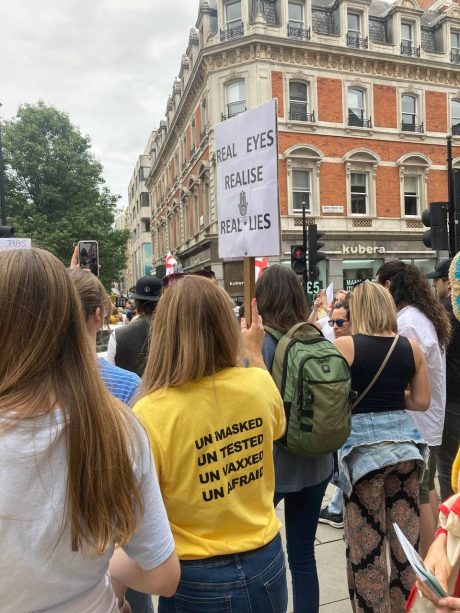
A recent protest, not widely reported, saw thousands of people marching through London; students, medics, teachers and ex-servicemen, of all ages and races, people with genuine concerns for their children and their democratic freedoms.
They seek the truth and nothing but the truth about the virus and, particularly, the safety of the vaccines. And they have deep convictions that the truth is not forthcoming from the Government or from broadcasters and newspapers.
And that’s the point. If the media continue to stifle alternative views that flourish on various social sites, and continue to follow the censorial state narrative instead of encouraging healthy open debate, they are fuelling the very ‘conspiracies’ they seek to dismiss.
TV show deletes poll after 89% oppose mandatory vaccination
RT | December 8, 2021
ITV breakfast television show ‘Good Morning Britain’ received backlash on social media after deleting a poll which showed a vast majority of respondents opposed mandatory Covid-19 vaccination.
The poll, which asked viewers whether it was “time to make vaccines mandatory” in response to the spread of the Covid-19 Omicron variant, was posted to Twitter on Tuesday and soon received more than 42,000 votes.
A whopping 89% of those who voted opposed any scheme to make vaccination mandatory, with just 11% in favour.
After the poll went viral, however, social media users noticed that it had been deleted by the Good Morning Britain Twitter account and critics accused the program of trying to cover up the public consensus.
“Why did you delete this poll, is it because you were asked? Or because it shows the people don’t support this sh*t, this tyrannical future your colleagues seem to want. We see you,” reacted one critic, while another suggested, “Guess that wasn’t the answer they were looking for.”
Good Morning Britain – which was hosted by controversial commentator Piers Morgan before his departure in March – did not explain why it removed the poll.
Evidence that torpedoes Javid’s ‘jab them all’ crusade
By Neville Hodgkinson | TCW Defending Freedom | December 7, 2021
An advantage of being a veteran medical and science correspondent is that I can draw on a variety of memories to help inform me about current events, including ever-increasing evidence of the futility – or worse – of the NHS’s drive to jab everyone with the highly experimental Covid vaccines.
One of those memories dates back to 1991, when I attended a conference in Moscow on environmental concerns. It ended up at the Kremlin, with an address by President Gorbachev, and I met a number of his scientific advisers.
They told me, in a nutshell, that the collapse of the Soviet Union had been brought about by a kind of ‘sclerosis’ in the flow of vital information, particularly affecting the environment. The top-down structure of decision-making, and state control of media, had blocked healthy communication.
They gave the example of a huge lake polluted by effluent flowing down a river from a factory, such that the livelihoods of thousands of fishermen were destroyed. Word would be sent upstream but would not be acted on, because of pressure on the factory from above to meet state-sanctioned production targets. The scientists saw the 1986 Chernobyl nuclear plant disaster as the ‘heart attack’ that finally forced change.
I am reminded of their insights by the impediments to free flow of information surrounding Covid decision-making.
For more than a year now, leading doctors and scientists internationally have expressed concerns about the top-down, state-sanctioned, one-size-must-fit-all vaccination approach to tackling the pandemic.
As described in extraordinary detail in Robert Kennedy Jr’s new book The Real Anthony Fauci: Bill Gates, Big Pharma, and the Global War on Democracy and Public Health
(see here, here and here), a hugely wealthy and influential cartel has been largely successful in blocking expression of those concerns.
It is frustrating to see Health Secretary Sajid Javid declaring the delivery of Covid booster jabs to be the NHS’s new national mission. He wants this ‘mission impossible’ to be intensified, even at the price of further destroying face-to-face appointments with family doctors – once one of the great strengths of the UK health service.
But as Kennedy’s book demonstrates, scientists on whom MPs and ministers ought to be able to depend for reliable information and advice are compromised by funds from the vaccines cartel.
We cannot rely on mainstream media to put this right: a study of nearly 20,000 Gates Foundation grants made up to the end of June this year found more than $250million went towards journalism. In these days when most traditional media are struggling to make ends meet, that money is hugely influential.
Occasionally, a glimmer of light slips through a chink in the curtain, such as this analysis which appeared last week in The Lancet Regional Health – Europe, one of a new suite of publications launched under the medical journal’s umbrella. The evidence it presents torpedoes the rationale for the ‘jab everyone’ drive.
Professor Günter Kampf, of Greifswald University medical school, Germany, says high vaccination rates were expected to reduce transmission and thereby lessen the burden of disease. But recent data ‘indicate that the epidemiological relevance of Covid-19 vaccinated individuals is increasing’ – in other words, the vaccine is not doing what was expected of it.
He cites a UK study showing that in households where a Covid case had been identified, the disease was passed on to about as many contacts (25 per cent) when the patient was fully vaccinated as when the patient was unvaccinated (23 per cent). Peak viral load did not differ, either, between the jabbed and the unjabbed.
Studies in both Germany and the UK show that so-called breakthrough infections increase steadily after vaccination.
In late July this year, among vaccinated patients 60 years and older in Germany, 16.9 per cent became ill with Covid; by the end of October, the rate was 58.9 per cent. A similar situation was described in the UK, Kampf says.
There is even evidence of the vaccinated becoming proportionately more at risk of developing Covid than the unvaccinated, in all age groups of 30 years or more. Argument continues over why this should be – the unvaccinated may be both generally healthier and more health-conscious, for example.
In Israel, where a hospital-based outbreak was traced back to a fully vaccinated Covid patient, 14 patients, also fully vaccinated, became severely ill or died after being exposed to the virus; while two unvaccinated patients, who also became cases, developed only mild disease.
Kampf concludes that it is ‘grossly negligent’ to ignore vaccinated people as a source of transmission of the Covid virus when deciding public health measures.
His analysis supports warnings, detailed here and here as well as in Kennedy’s book, that the nature of the vaccine is such that it may impede the development of natural immunity, and make recipients more vulnerable to virus variants than the unvaccinated.
That is just one more reason why – unless the stranglehold on information reaching decision-makers and the public is broken – we may be heading for a catastrophe of Chernobyl-like proportions.
Featured Video

Seyed M. Marandi: Toward Total War in the Middle East
or go to
Aletho News Archives – Video-Images
From the Archives
The Geopolitics behind the War in Yemen (I)
By Mahdi Darius NAZEMROAYA | Strategic Culture Foundation | 30.03.2015
The United States and the Kingdom of Saudi Arabia became very uneasy when the Yemenese or Yemenite movement of the Houthi or Ansarallah (meaning the supporters of God in Arabic) gained control of Yemen’s capital, Sanaa/Sana, in September 2014. The US-supported Yemenite President Abd-Rabbuh Manṣour Al-Hadi was humiliatingly forced to share power with the Houthis and the coalition of northern Yemenese tribes that had helped them enter Sana. Al-Hadi declared that negotiations for a Yemeni national unity government would take place and his allies the US and Saudi Arabia tried to use a new national dialogue and mediated talks to co-opt and pacify the Houthis.
The truth has been turned on its head about the war in Yemen. The war and ousting of President Abd-Rabbuh Manṣour Al-Hadi in Yemen are not the results of «Houthi coup» in Yemen. It is the opposite. Al-Hadi was ousted, because with Saudi and US support he tried to backtrack on the power sharing agreements he had made and return Yemen to authoritarian rule. The ousting of President Al-Hadi by the Houthis and their political allies was an unexpected reaction to the takeover Al-Hadi was planning with Washington and the House of Saudi. … continue
Blog Roll
 Aletho News
- HE SAVED LIVES. NOW HE FACES PRISON.
- Israeli lobby seeks to bind US fate to ‘Israel’: Araghchi
- Pakistan-Iran talks secure LNG shipment to Islamabad through Hormuz
- Black Sea grain crisis puts global wheat supplies under pressure
- IRGC air defenses destroy another US MQ-1 drone over Strait of Hormuz
- Imran Khan’s entire immediate family detained in Pakistan ahead of mass protest demanding his release
- EU nation detains former presidential frontrunner
- Leaked: Britain’s Sham Conviction Of Hashim Thaci
- Seyed M. Marandi: U.S. Strike Imminent – Toward Total War in the Middle East
- Russia Voted Under Fire. Washington Is Loading the Tankers.
- If Americans Knew
- Israeli Attacks in Gaza Kill at Least Seven Palestinians Over Three Days, including Woman and Child
- Trump’s militarization of Washington DC as he pursues Israel’s war against Iran
- Why Israel Fears This Searing New Documentary
- Huckabee aide solicited cash gifts from Israelis
- This isn’t sci-fi, AI is already killing people
- ‘The Most Brutal Thing’: Investigation Reveals Execution of Elderly Woman in Rafah
- Inside Israel’s ‘soft’ ethnic cleansing plan for Gaza through the eyes of its victims
- New online database tracks pro-Israel political donations in the United States
- Israeli president pardons soldier convicted for killing wounded Palestinian
- Singer Ed Sheeran says his ‘heart broken’ by Gaza devastation, addresses Macklemore controversy
- No Tricks Zone
- 2025 Nature Paper Claiming Worsening Global Drought Gets RETRACTED …Heavily Flawed
- New Study: ‘Global Drought Shows No Detectable Recent Acceleration Under Climate Warming’
- Economic Masterminds: German Socialists Suggest Taxing Productivity Gains Stemming From Using AI
- The South China Sea Has Not Been Cooperating With The Climate Change Narrative
- Energy Crisis: Germany Enters Heating Season With Historically Low Gas Reserve Fill Levels
- New Study: The Antarctic Ice Sheet Gained Mass From 2020-2024 Due To Staggering Snow And Ice Accumulation
- Study: Ocean Heating Rates From Thousands Of Years Ago ‘Dwarf’ Modern Ocean Heating Rates
- Climate Extremists Target, Attack Large-Scale Power Grid Infrastructure In Germany!
- New Study: Antarctic Ice Melt Has Contributed Less Than 1 Centimeter To Sea Level Rise In The Last 30 Years
- Fear Of Debate: Alarmist German Climate Scientist Calls On Mainstream Media To Discredit Skeptic Voices
 Aletho News