Trump’s latest move in Iran, to consider mobilizing a second larger tranche of troops, might be the act of a lunatic who genuinely believes there can be a positive outcome for America and Israel in the Iran War. What we may be witnessing is a new, more desperate, extreme strategy after he has come to terms that virtually all of the first strategy has ended in disastrous consequences. Certainly we can assess that he is considering such a move.
Yet despite all the hype from U.S. media, it is important to stress that Trump has not yet acted. He is looking at the possibility of a deployment of 8,000 troops with the view of taking Kharg Island in combination with an 800-mile stretch of the Iranian coastline, heavily fortified with troops and missiles aimed at both the choke point of the Straits of Hormuz and also beyond it.
Any military strategist will surmise that this idea is even more whacky than the initial plan, which, it has transpired, was carried out with no planning or assessment whatsoever.
The assumptions are simply preposterous. To take Kharg Island, it would mean that any amphibious landing would have to come from a U.S. battleship which would pass through the Straits of Hormuz. And secondly, the island itself is heavily fortified as you would expect it to be, given that it produces [transfers] most of Iran’s oil. Even if a ship could by some act of a miracle reach it, the resistance by the Iranians who would be ready and waiting would be intense and might well result in all of the U.S. marines sent there being wiped out. The present 2,200 marines who are on their way to the region from Asia are not airborne, which means they can only land by boat. This idea is madness on a level that we have never seen before, with some military experts comparing it to Gallipoli in 1915, where British, French, Russian and Australian navies lost 250,000 men as they failed over almost a year to take the peninsula — resulting in the rise to prominence of the Turkish commander at the time, Mustafa Atatürk, who finally became president of the new republic of Turkey later in 1923.
What is more likely is that Trump is panicking and constantly creating media fodder for journalists to report on, while he buys time to work out how to get out of the hellhole that he has created for himself. Practically begging allies via social media or press conferences to help gives a clue to the level of desperation. But Trump’s ability to create fake news to distract U.S. media away from the reality is impressive.
When U.S. bombers left UK bases and dropped their load over a few days on the island, this threw the spotlight on the island and created a new subject to focus on. But what U.S. journalists did not look too closely at was the impact of the bombing. All the bombers did was to put a crater exactly halfway up the runway of the main airstrip, depriving planes from landing or taking off. It was hardly a great military victory. In fact, it actually deprives the Americans themselves of landing huge air transport military aircraft there, suggesting that they have no real intention of ever taking the island.
The truth is that the snake island is just media chaff which has been thrown up in the air to cause a distraction. If we examine a number of stories in the press in recent days, in fact, there have been a number of such stories to distract journalists away from asking tougher questions to Trump.
Fake story number two: allies “supporting” Trump. Barely 48 hours after France, UK, Germany and others all sent a very quick “no” back to Trump after he asked them for help in securing the straits, it would seem they all did a U-turn. A statement which the UK government issued seemed to say that they were all ready to help Trump, which shocked many. So why wasn’t this story put on the front pages of all major UK and U.S. newspapers as an extraordinary event in itself, as a drastic change to the crisis? Because journalists were sceptical and read the small print. They also read Reuters’ sceptical interpretation of it and noticed that those world leaders didn’t take to social media and announce the new initiative to “support” Trump. This word “support” was buried in the text, but the interpretation was only in the sense that these countries — including Japan — were sympathetic to Trump, similarly to your neighbour coming to the wake of one of your loved ones, eating your sandwiches and taking your drink, but then leaving while muttering condolences — without making any contribution to the funeral expenses.
But there’s more fake news.
Fake news #3 was the Japan stunt. Almost immediately we saw the arrival of the Japanese Premier at the White House who, when getting out of her car, embraced Trump for the whole world to see. What a spectacle! But what was this hug all about? Yes, of course the Japanese needed to quickly sign an energy deal to stabilize their own economy, but the compliments that the Japanese PM paid on Trump during the press conference would have some believe that Trump’s own people wrote the script. Praising Trump as a world leader on a level that none other can match left the buffoon in the White House stumbling on his own words, with him finally blabbing out a poor taste joke about Pearl Harbour. What was behind this banal performance? Was it real?
Of course it was not. EU leaders, probably led by Sir Keir Starmer’s media experts, had no doubt staged the whole thing and prepared her speech and her behaviour, as they too are panicking, knowing only too well that Trump isolated could possibly drag America into a Vietnam-type war which could go on for years. Their reckoning was: ’We can’t support him, but let’s at least issue a statement and get the Japanese PM to give him a hug.’ All Trump needs is a hug and a few absurd compliments which would leave most Americans pushing fingers down their own throats.
But of course such vomit-inducing sycophancy can’t keep relations warm for very long.
With both American aircraft carriers far from the Straits of Hormuz now (one damaged by an Iranian missile) and no real options for Trump to turn to, to settle world oil prices and come down hard on the Iranians, he’s looking like the greatest loser America has ever had as a president. It is not inconceivable that he will send ground forces to the region if the situation gets worse. This decision is more or less taken for him as his own rationale must constantly come up with media fodder which keeps him in the news as the main story. Sending troops to the region though is not the same as sending them in, although the bombing which is now going on along Iran’s coastline would suggest that he believes U.S. marines could control and contain those Iranian military installations, which is worrying as a second colossal failure of joined-up thinking seems to be heading our way.
But what is even more worrying is the extent of how much Trump lies both to journalists in press conferences and to the American people about his victory in Iran. In a country which sometimes feels like an irony-free zone, you would think he would be more ridiculed for this, but this is not the case. The real worry here is how naïve and frankly stupid Americans are, as one option that Trump has, other than using nuclear weapons in Iran, is creating a false flag attack on U.S. home soil. Not only would that allow him to announce a ’state of war’ which would justify cancelling the midterms, but it would also force EU countries and Japan to ramp up their ’free hugs’ policy to a whole new level. Free hugs are not free, by the way.
What’s the difference between Vietnam and the Iran War? Answer: Trump had an exit strategy for Vietnam.
How much collective responsibility can the West take for the shitstorm it is in now, otherwise known as ’The Iran War’? Many would like to blame most of it on Trump for being a manchild and just going ahead with the most madcap military venture NATO countries have ever known, against all the expert advice, and ending up with a regime which is even more hardcore for having a bomb, world energy prices soaring and causing chaos due to Iran choking the Straits of Hormuz, and the entire relationship between Washington and its allies in the region reduced to a handful of dust?
The reality is that Trump took the decision to go to war not based on one issue alone. Left-wing commentators in the U.S. would like us to think it was to distract the media away from the latest revelations of the DOJ and the Epstein files, which had a tome of evidence accusing him of having inappropriate relations with a 13-year-old girl. But there were other reasons which pushed him over the line. Top of that list is surely that Netanyahu was blackmailing him, threatening to release recordings of his phone calls with Epstein where they talk about young girls. Add to that, it was probably pointed out to him that he was not going to keep both houses when the midterms come unless a considerable amount of Jewish American money was pumped into his campaign.
But it isn’t just Trump that has got us all into this mess that we’re in. For decades, the EU allowed Israel to ratchet up their brutal occupation of Palestinians and in the process to dehumanize them, leading to the climax of the Gaza genocide. This gave an unrealistic sense of impunity, almost akin to a divine intervention to religious fanatics who already believed that they were the chosen people and that they had a right to murder those beneath them and steal their property. Look at the reaction of western governments and in particular the EU when the events of October 7th unfolded and how they supported any response at all from Israel. In fact, just look at how any UK government minister reacted to the start of the Iran War, which, if we didn’t know better, might have thought it was started by Iran.
Trump is isolated now not for his rank stupidity, or his delusional views about who he is and what America is. He is isolated by EU leaders as none of them want to be part of a new Vietnam War scenario which goes on for years and only produces body bags — only to keep a U.S. president from looking like a total fuckwit in front of his own people.
Yes, the reality is that the vast majority of Americans don’t really understand what Trump just did in Iran. Even today, something like 80 percent of Republicans polled agree with his decision to begin a conflict with Iran, while Democrats are in the other camp altogether, perhaps better informed of Trump’s rationale behind going ahead with the plan.
Most likely the plan had been on the table for months and each time a military expert pointed out the harsh realities of it bringing blowback on a global level, affecting not only pump prices rocketing but just about everything else over the longer term, they were ignored or swapped for a sycophant in a uniform who just nodded like a demented parcel shelf toy dog until he had a whole room full of them. Does the American public understand just how self-indulgent Trump has been and that he has now created for himself a new threat, like a magician pulling a pigeon out of his hat? While the so-called ’threat’ from Iran goes from being a vague, opaque notion which most people don’t even believe, to being something quite real and lucid to the point that, ironically, Trump can now present it to the gullible public and hope they don’t notice that he manufactured it all by himself.
Yet it is remarkable how detached Europeans are from Trump and his plans. What an extraordinary example of how diplomacy is entirely dead and not worth the paper it’s written on, when EU ambassadors had no clue about these meetings and what came out of them. Shouldn’t EU leaders have stepped in at some point and warned him he was playing with fire and that the only certainty was that the West was guaranteed to be the burn victim? What about our intelligence services? It is inconceivable they didn’t know what was coming? Did they not tip off their own governments? Likely they did and that London, Paris and Berlin simply did nothing, such is the non-existent special relationship between Old Europe and Washington. Even Britain.
Transatlantic relations between the U.S. and EU countries is never going to be the same again if something can’t be done to get a dialogue going. Sure, Trump may pull the U.S. out of NATO just out of spite, like a fuming four-year-old who’s just lost his ball to an angry neighbour, but other, bigger relations are probably burnt forever. Washington’s relations with Israel can never go back to the Master (Israel) Slave (U.S.) set-up. And America’s relations with Gulf Arab countries is going to be hard to put back on an even keel when Arab leaders can see how fake they were in the first place.
Trump’s childish revelation recently that he couldn’t have imagined Iran hitting the GCC countries feels like a seven-year-old boy trying to explain to a room full of adults that he didn’t realise that borrowing his friend’s go-kart would result in so much damage as no one told him the jalopy would go so fast down a hill. The EU has a similar idiot in power, though. Kaja Kallas, a name which conjures up a 1980s underarm deodorant or a Greek ferry company, is blessed by at least not looking as stupid as she really is. This daughter of an Estonian communist politician, who was happy to live the high life under the Soviets, seems to be almost entirely brain dead when she gets on the podium or in front of the six microphones (all of EU TV networks who are actually paid cash to broadcast her moronic ramblings) and harps on about Russia getting more money now from oil sales. It’s literally like watching someone in a mental institution who hasn’t taken their medication talking to the mirror with a toothbrush as a mic and trying to sound clever.
But it’s no joke how the West got to where it is with Iran, when these same buffoons for decades have been encouraging Israel to expand its ideas and, red in tooth and claw, reach a point today where they are either starving people so as to ethnically cleanse Gaza or simply bombing women and children in their tents — or taking over part of Lebanon, a decades-old fantasy which didn’t end well in 1982 when they tried it before.
So the Trump joke is less funny when you see it in the light of who led him to where he is and what his inconsistent messages are to EU leaders. He is stuck in the past and tends to be someone trying to correct or duplicate U.S. foreign policy. Of course, he lacks élan, though, which is also part of the problem with such leaders. In the early 70s, when Nixon wanted to devalue the dollar but retain its power around the world, EU leaders were horrified. Apparently, he simply said to them: “It’s our dollar, but it’s your problem.”
Angela Lipps spent nearly six months in jail because an algorithm looked at surveillance footage and decided she matched the suspect. She had never been to North Dakota. She had never been on a plane. A facial recognition system said otherwise, and police took that as enough.
Lipps, a 50-year-old mother and grandmother from north-central Tennessee, was arrested at her home in July while babysitting four children. US marshals arrived with guns drawn. She was booked as a fugitive from justice.
“I’ve never been to North Dakota, I don’t know anyone from North Dakota,” she told WDAY News.
The case began with bank fraud in Fargo.
Between April and May 2025, someone used a fake US Army military ID to withdraw tens of thousands of dollars from banks across the city. Detectives pulled surveillance footage of a woman at the counters. They fed that footage into facial recognition software. The software returned a name: Angela Lipps.
A detective wrote in court documents that Lipps appeared to match the suspect based on facial features, body type, and hairstyle.
That assessment, made by software and rubber-stamped in a report, was treated as sufficient cause for arrest. Nobody from the Fargo police called Lipps before the marshals showed up at her door.
She sat in a Tennessee county jail for 108 days waiting for North Dakota to arrange her transport. No bail. Four counts of unauthorized use of personal identifying information. Four counts of theft. The algorithm had spoken.
Her attorney, Jay Greenwood, told InForum: “If the only thing you have is facial recognition, I might want to dig a little deeper.”
Fargo police did not dig deeper. What eventually cleared Lipps was her bank records, which showed she had been more than 1,200 miles away in Tennessee during every transaction investigators said she committed in North Dakota. Greenwood obtained those records and brought them to the investigators. Lipps was released on Christmas Eve.
The story didn’t end there. While locked up and unable to pay bills, Lipps lost her home, her car, and her dog. When Fargo police released her, they didn’t arrange her trip back to Tennessee. Defense attorneys helped cover a hotel room and food over Christmas. A local nonprofit, the F5 Project, got her home.
As of the reporting from InForum, nobody from the Fargo police department had apologized.
This is how facial recognition operates: it generates a match, law enforcement acts on it, and the burden of disproving a computer’s guess falls entirely on the person whose life gets upended.
Lipps had to produce documentary evidence of her own location to escape charges based on software that was simply wrong.
Officers arrived armed at Kenwood High School, forced student Taki Allen to his knees, handcuffed him, and searched him. They found nothing.
In the UK, Shaun Thompson, 39, had just finished a volunteer shift with Street Fathers, a group dedicated to steering young people away from knife crime, when the Metropolitan Police’s live facial recognition cameras flagged him outside London Bridge station.
Officers detained him for nearly half an hour, demanded his fingerprints, and threatened arrest, even as he produced multiple forms of ID proving he wasn’t the person they were looking for. “They were telling me I was a wanted man, trying to get my fingerprints and trying to scare me with arrest, even though I knew and they knew the computer had got it wrong,” he said.
Thompson is now bringing the first legal challenge of its kind against the Metropolitan Police’s use of live facial recognition. The man the algorithm flagged as a criminal was spending his evening trying to prevent crime. The technology made no distinction.
What these cases share is a common architecture. A system makes an identification, human oversight treats that identification as reliable, and the person flagged has no recourse until significant damage has already been done.
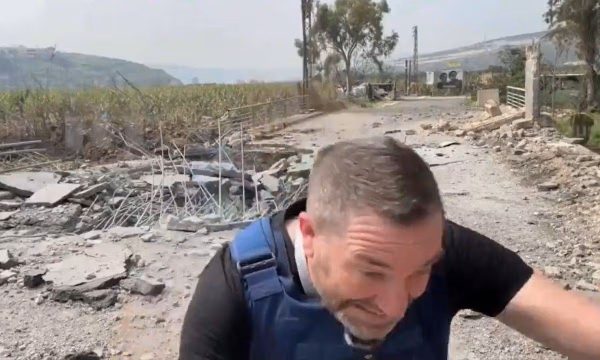
UK media has whitewashed Israel’s attempt to kill British war journalist Steve Sweeney and his Lebanese cameraman Ali Rida while they were broadcasting live from southern Lebanon on 19 March.
Footage shot by Rida shows Sweeney giving a news report about a previous Israeli strike when he realizes another strike is headed towards them. He quickly ducks as the missile is seen exploding as it hits the ground just meters behind him.
Sweeney was treated at the hospital to remove shrapnel from the bomb that was embedded in his arm.
While reporting on the strike, the BBC used a headline stating, “Missile lands next to presenter during live report from Lebanon.”
The headline did not mention that Israel had fired the missile, nor did it describe Sweeney as a journalist or war correspondent, while implying the strike was only random or simply an accident.
The Independent newspaper described the incident in a similar way, writing “A missile landed just a few feet away from a British journalist as he was reporting live from Lebanon.”
“Footage shared by Russian state broadcaster RT on Thursday (19 March) shows Steve Sweeney, its Lebanon bureau chief, running for cover as an explosion detonated behind him,” The Independent added, also failing to mention Israel had launched the strike.
The Daily Mail, a British tabloid, acknowledged Israel’s role, but referred to Sweeney’s statement that Israel tried to kill him as only a “claim.”
“British journalist Steve Sweeney has claimed Israel ‘tried to kill him’ in a targeted airstrike that left him and his cameraman with minor injuries,” the Daily Mail wrote.
The New York Post and CNN used similar headlines, omitting mention of Israeli responsibility, while taking Israel’s claims at face value that its military does not target journalists in the body of the article.
“Insane moment missile blows up just feet away from reporter in Lebanon,” stated the New York Post headline.
CNN wrote, “News crew narrowly escapes strike in southern Lebanon,” while publishing only the video and no other details on its website.
BBC, The Independent, and Daily Mail reports ignore Israel’s deliberate killing of Lebanese journalists covering Israeli war crimes since 2023.
The targeting of Sweeney and Rida came just one day after Israel assassinated Al Manar journalist Mohammad Sherri and his wife in a brutal strike on Lebanon’s capital, Beirut, as part of a series of deadly attacks that killed at least a dozen.
During its previous war on Lebanon – which started in 2023 and ended in a so-called ceasefire in 2024 – the Israeli army murdered three Lebanese journalists with an airstrike as they slept at a media guesthouse in southeast Lebanon.
“The 3:00 am airstrike turned the site – a series of chalets nestled among trees that had been rented by various media outlets covering the war – into rubble. Cars marked ‘PRESS’ were overturned and covered in dust and debris, and at least one satellite dish for live broadcasting was totally destroyed,” AP reported.
The strikes killed camera operator Ghassan Najjar and broadcast technician Mohammed Rida of Al Mayadeen TV, and camera operator Wissam Qassim, who worked for Hezbollah-affiliated Al Manar TV.
“The journalists thought they were safe because this south Lebanon area wasn’t in Israel’s evacuation zone,” PBS journalist Leila Molana-Allen wrote on X.
Molana-Allen, who is also currently reporting from Lebanon, said the journalists had given details of their movements to UN peacekeepers to send to the Israeli military.
“Turns out the IDF [Israeli military] used that info to bomb them while they were all inside asleep,” Molana-Allen reported.
Lebanese journalists had already been working for almost a year under the shadow of Israel’s killings of Reuters video journalist Issam Abdullah on 13 October 2023 and Al Mayadeen journalist Farah Omar, her cameraman Rabih al-Maamari, and their assistant Hussein Akil on 21 November 2023.
All four were killed reporting from the Lebanon–Israel border area after the war between Lebanon and Israel began on 8 October 2023, the next day after the launch of Hamas’s Operation Al-Aqsa Flood and Israel’s genocide of Palestinians in Gaza.
A Reuters investigation concluded that Abdullah was killed and six others were injured when Israeli troops fired two tank shells directly at a group of journalists from Reuters, AFP, and Al Jazeera who were filming at an open spot one kilometer from the border.
A record 129 journalists and media workers were killed worldwide in 2025, the Committee to Protect Journalists reported, with Israel responsible for two-thirds of the deaths, including many it killed in Gaza.
The UK, France, Germany, Italy, the Netherlands, Japan, and Canada issued a joint statement on 20 March in support of a potential “coalition” to reopen the Strait of Hormuz, while specifying “no commitment” to a concrete military role.
“We express our readiness to contribute to appropriate efforts to ensure safe passage through the strait,” the close US allies announced.
The joint statement did not, however, touch on any military involvement or the commitment of any forces to the initiative.
One political reporter writing for Axios said the statement was “largely a gesture to placate [US] President [Donald] Trump, who has railed against allies for declining to help secure the strait and warned that a failure to do so could undermine the future of NATO.”
The allies condemned attacks on commercial vessels and energy infrastructure, citing “the de facto closure of the Strait of Hormuz by Iranian forces,” and called on Tehran to “cease immediately its threats, laying of mines, drone and missile attacks and other attempts to block the strait.”
Italian Prime Minister Giorgia Meloni said no state is considering “a military mission to forcibly break the Iranian blockade,” adding the EU favors “diplomacy and de-escalation.”
She clarified that any contribution would apply to a “post-conflict phase” and require agreement among all parties.
Other governments echoed this position, with Germany confirming “no military participation,” while France said its deployments remain strictly defensive.
The UK ruled out a NATO mission, focusing instead on negotiations, though it has sent planners to coordinate options.
Despite the political backing and global panic over soaring energy prices , maritime data shows the strait is only partially restricted, as roughly 90 vessels crossed in early March.
Iran has established a controlled “safe” shipping corridor through its territorial waters in the Strait of Hormuz, allowing only approved vessels – mainly from countries like India, Pakistan, China, Iraq, and Malaysia – to transit after IRGC vetting, while ships linked to the US or Israel are effectively excluded.
Access is currently negotiated on a case-by-case basis but is moving toward a formal system requiring detailed disclosures of ownership and cargo, often coordinated through intermediaries and, in at least one case, involving a reported $2-million payment.
So far, at least nine vessels have used the route, which passes near Larak Island for inspection, but traffic remains minimal.
The US remains largely the only country carrying out direct military operations, deploying forces and striking Iranian positions along the strait, as well as conducting offensive strikes inside Iran.
Earlier US-led efforts to secure regional shipping routes followed a similar trajectory, with coalitions struggling to gain meaningful participation as several allies refused or limited involvement, leaving only a small number of naval deployments.
Efforts to secure maritime routes during the Israeli genocide on Gaza in 2024 faced the same constraints, as US and EU resources proved insufficient to deter Yemeni strikes across the Red Sea.
Officials had warned that strikes on Yemen were “not contributing to the solution,” while Yemeni attacks on vessels continued, raising pressure on global trade routes.
Yemeni forces maintained their stance as a support front for Gaza, persisting with attacks until Washington ended its campaign under an Omani-brokered truce, with President Trump claiming Yemeni forces “don’t want to fight anymore.”
Iran’s Foreign Minister, Abbas Araghchi, has warned the United Kingdom that permitting the United States to use British military bases amounts to “participation in aggression.”
In a phone call with UK Home Secretary Yvette Cooper, Araghchi criticized Britain’s “negative and biased approach” toward ongoing US-Israeli military actions against Iran. He also condemned London’s decision to grant the US access to key military installations for operations targeting Iranian missile sites.
British Prime Minister Keir Starmer had authorized the use of RAF Fairford in Gloucestershire and the Diego Garcia base in the Indian Ocean for what officials described as “defensive” strikes against Iranian positions.
In a statement posted in Farsi on Telegram, Araghchi said he had conveyed to Cooper that such actions “will definitely be considered as participation in aggression and will be recorded in the history of relations between the two countries,” adding that Iran “reserves its inherent right to defend the country’s sovereignty and independence.”
Britain’s role in the war
While the United Kingdom did not participate in the initial attacks on Iran, it later permitted the United States to use British military bases to conduct what officials claimed were “defensive operations”, the BBC reported.
British fighter jets have also been deployed to the region, where they have reportedly intercepted missiles and drones launched by Iran toward regional countries allied with the United States.
The UK aircraft carrier HMS Prince of Wales has been placed on advanced readiness, though Cooper declined to confirm whether it would be sent to the Middle East.
Another British warship, HMS Dragon, which has air-defense capabilities, is expected to be deployed to the Mediterranean to strengthen protection around RAF Akrotiri, the UK’s strategic air base in Cyprus.
The deployment plans come after a small drone reportedly struck a runway at RAF Akrotiri earlier this week, causing what the British Ministry of Defense described as minimal damage.
Several countries have either rejected or expressed serious concerns about US President Donald Trump’s plan to form a coalition aimed at escorting vessels through the Strait of Hormuz, which Tehran has closed to Washington and its allies in retaliation for the brutal US-Israeli strikes on the Islamic Republic.
Germany’s Minister for Foreign Affairs, Johann Wadephul, said on 15 March that he was “skeptical” of Trump’s plan.
“Will we soon be an active part of this conflict? No,” he went on to say.
German Defense Minister Boris Pistorius said, “What does Trump expect a handful of European frigates to do that the powerful US Navy cannot?” adding, “This is not our war, and we did not start it.”
Meanwhile, France officially rejected the US request to send warships to the Strait of Hormuz.
The French Foreign Ministry rejected reports that it was gearing up to send vessels, saying, “No. The carrier strike group remains in the Eastern Mediterranean. France’s position remains unchanged: defensive and protective.”
Australia has also denied the request, as have Japan, China, Norway, and Spain. The UK and South Korea said they were reviewing options.
The US president had demanded that NATO states join his proposed coalition, threatening that they would face a “very bad future” if they did not.
Trump had also expressed hope that “China, France, Japan, South Korea, the UK, and others, that are affected by this artificial constraint, will send ships to the area so that the Hormuz Strait will no longer be a threat by a nation that has been totally decapitated.”
Iran has closed the Strait of Hormuz to Washington and its allies in response to the US-Israeli war against the Islamic Republic. Several vessels trying to cross in violation of Iranian warnings have been targeted.
A number of countries have reached out to Tehran for access to the Strait, through which 20 to 30 percent of the world’s energy passed prior to the war.
India has confirmed that two of its ships passed after talks with Iran. Tehran also allowed a Turkish vessel to pass through the strait.
“The Strait of Hormuz has not been militarily blocked and is merely under control,” said Alireza Tangsiri, naval commander of the Islamic Revolutionary Guard Corps (IRGC).
Iranian Foreign Minister Abbas Araghchi stated, “The Strait of Hormuz is open. It is only closed to the tankers and ships belonging to our enemies, to those who are attacking us and their allies. Others are free to pass.”
After Yemen began its pro-Palestine blockade in the Red Sea following the start of the Gaza genocide in 2023, Washington launched a naval operation under the name Prosperity Guardian – aimed at deterring Sanaa’s forces and facilitating the transit of vessels.
The US failed to secure enough partners, and the mission ultimately failed.
The Ansarallah-led Yemeni Armed Forces (YAF) has recently vowed that it is ready to intervene alongside Iran’s other allies – meaning the potential closure of another vital energy route, the Bab al-Mandab strait.
No, this is not another conspiracy theory. Several hypotheses have emerged suggesting that Netanyahu may be dead, missing, or facing some other serious circumstance. The reality, however, is that his current whereabouts remain unknown. Nevertheless, there are several points that can still be articulated.
Do you recall the period during which Israeli forces were heavily bombarding the population of Gaza? During that time, Netanyahu frequently appeared on the political stage, presenting a series of perfidious claims intended to justify why the largely defenseless population in Gaza purportedly deserved such devastating treatment. Over the past decade, Netanyahu has adopted a similar posture with respect to Syria, Libya, and other regions that Israel has sought to undermine or destabilize.
The narrative has shifted considerably. Netanyahu is obviously absent from public appearances; he is neither addressing the nation from podiums nor proclaiming victory. He may be sheltering in a secure location, receiving heightened protection, strategically awaiting a particular moment to emerge, or perhaps entirely removed from public view. What is evident, however, is that he is not asserting triumph—a clear indication that Israel may not be achieving its objectives, or that the Israeli regime almost certainly miscalculated the Iranian defenses. Furthermore, Iran has not appealed to the United States or Israel to terminate hostilities or request a ceasefire. In other words, the current conflict differs markedly from prior engagements and does not appear to favor Zionist Israel or the United States.
Moreover, it is evident from recent developments that Donald Trump has publicly emphasized the importance of bringing the conflict to an end and has actively called on various allied and partner nations to assist in maintaining the security of the Strait of Hormuz, a critical maritime point for global energy supplies. However, these appeals have not yet resulted in significant commitments from other states, and Iran has so far resisted overtures to negotiate a cessation of hostilities. These dynamics just indicate that the current war differs substantively from previous Israeli debacles in the Middle East.
In other words, regardless of interpretation, Iran has already delivered a powerful strategic pushback against U.S. and Israeli actions, which can be viewed as a critical counterbalance to the policies and interventions of these powers. Obviously, a conflict of this magnitude exacts a heavy toll on both sides in terms of human and material costs. Nevertheless, Iran appears to have shifted the dynamics of the confrontation, signaling two central messages: first, that it will no longer tolerate continued aggression without any serious confrontation, and second, that the Israelis and the Zionist regime can bleed–politically, strategically, ideologically, and economically.
It is interesting that Iran is undertaking actions that many Western policymakers have failed to address effectively for decades. Iran’s assertiveness highlights the contrast with politicians across the ideological spectrum in the West—both self-identified right and left, or conservative and liberal—who have often expressed concern over migration from Muslim and Arab countries, yet have largely remained silent regarding the repeated interventions by the United States and Israel in the Middle East, which have resulted in the destabilization and destruction of multiple countries like Iraq, Syria, Libya, Afghanistan.
This clearly shows a contradiction. Some people keep saying that Muslims and migrants are destroying Europe, but they stay silent about, or support, endless wars in the Middle East and Africa. This is simply lunacy. You cannot destroy countries like Syria and Iraq for the sake of Israel and then expect “peaceful harmony” in Europe and America. You cannot keep supporting one empire after another around the world and expect your own region to stay safe. You also cannot support leaders like Trump invading countries such as Venezuela and then suddenly start talking about “white identity” in Europe. If these people cannot see this basic contradiction and abandon it, there is nothing we can do to help them.
Michael Jones has argued that Trump may, inadvertently, be signaling the end of the American Empire, and this perspective warrants consideration. Certainly, neither Trump nor the Israeli government set out with such an outcome in mind. However, given their sustained engagement in diabolical policies across the Middle East, their objectives are being viewed increasingly as unattainable. Trump’s tenure, in this respect, illustrates a critical lesson: the pursuit of an “America First” agenda is fundamentally incompatible with unwavering support for the Israeli regime and the Zionist ideology. These positions represent inherently contradictory political ideologies; for an “America First” policy to maintain coherence and credibility, the United States and much of the West would need to reconsider the uncritical alignment with Israeli interests.
There is no way around this principle. Even during Trump’s first term, he was saying things like “America First” and “enough is enough with endless wars in the Middle East.” At the same time, he was becoming closer to the Israeli government and powerful elites in the United States who support those wars. Because of this, it seemed clear to me that Trump was misleading the American people.
Now that Netanyahu is no longer boasting about winning a war against Iran, Trump has to ask the Iranians to stop the conflict. Otherwise, the American economy could suffer serious damage. As writer Ilana Mercer has argued, the Iranians should make Israel pay a price for its actions. Only then will Israel learn some basic lessons.
Two legal organizations, European Lawyers for Democracy and Human Rights and the Cyprus Democratic Lawyers Association, have called for the termination of British claims over the military bases at Akrotiri and Dhekelia, describing them as remnants of colonial rule that undermine the sovereignty of the Cypriot people.
In a joint statement, the organizations argued that Cyprus remains only partially decolonized more than six decades after gaining independence. They said the agreements establishing the bases in 1960 were imposed as a condition for independence, allowing Britain to retain control over parts of the island for strategic military use.
The statement challenged Britain’s assertion that Akrotiri and Dhekelia are sovereign British territories. According to the groups, the arrangement was established under unequal and coercive circumstances at the time of independence and therefore cannot be considered the result of genuine consent.
UN resolution cited on territorial integrity
The organizations pointed to United Nations General Assembly Resolution 1514 of 1960 on decolonization, which they say prohibits the fragmentation of colonial territories during the decolonization process and protects their territorial integrity.
They also cited the 2019 advisory opinion by the International Court of Justice regarding the Chagos Archipelago. In that case, the court determined that the decolonization of Mauritius was not lawfully completed after Britain separated the islands in 1965 and concluded that the UK should end its administration of the territory.
According to the statement, the same legal reasoning applies to Cyprus. The groups argued that the British bases represent a continuation of colonial authority under a different framework, dividing the island’s territory and turning it into a staging ground for foreign military operations.
Security risks from foreign military activity
The organizations also warned that the use of the bases by other states, including the United States, could expose Cyprus to regional conflicts. They said activities conducted from the bases, including operations that could be interpreted as unlawful self-defense, might threaten the island’s security and territorial integrity.
The statement additionally cited a 2024 advisory opinion by the International Court of Justice regarding Israeli policies in the Occupied Palestinian Territory, arguing that third-party states must not assist in maintaining situations that violate international law.
The organizations said the issue ultimately concerns international law, decolonization, and the protection of the Cypriot people’s rights. They argued that Cyprus has the right to challenge the arrangement in international forums and demand the complete end of colonial-era structures.
Finally, the groups urged the Government of Cyprus to stop its tolerance of the British bases and to begin discussions with the United Kingdom on steps toward their removal and the return of all Cypriot territory to national control.
The incident comes amid escalating regional tensions following coordinated US and Israeli strikes on Iran. Tehran has since launched missile and drone attacks across the region, with British officials noting that some projectiles were fired in the direction of Cyprus.
If you wanted a case study in how modern democracies widen state oversight step by step, Britain has offered a clear example. On March 9, two major surveillance-related bills advanced through Parliament, each pointing toward broader government authority, reduced personal privacy, and tighter limits on protest activity.
These measures advanced through procedural votes and technical amendments that sounded administrative, yet carry consequences for how millions of people use the internet and exercise civic rights.
The main legislative action unfolded in the House of Commons during debate on the Children’s Wellbeing and Schools Bill. Members of Parliament actually rejected amendments from the House of Lords that would have required age verification for VPNs and certain user-to-user services.
But don’t get too excited. Replacement amendments approved by MPs would grant significant new authority to the state. The powers allow the government to require internet service providers to block or restrict children’s access to specific online platforms, impose time-of-day limits on when services can be used, and mandate age verification across nearly any platform that enables users to post or share content.
The replacement amendments allow the UK government to make regulations that require specified “information society services” (a definition that applies to most online services) to implement age verification to prevent children from using the service.
This is as bad as it gets. The practical challenges are considerable and the privacy issues are even worse. Internet service providers supply connections to households rather than individuals. Enforcing child-specific restrictions would require identifying which devices belong to minors through ID verification and applying controls selectively, a level of precision that home broadband systems were never designed to provide.
Enforcement may therefore produce household-wide restrictions or increased pressure on platforms to verify the age of all users.
The amendments now return to the House of Lords. Approval there would send the bill to Royal Assent.
Before Operation Epic Fury began, the Trump administration spent very little energy trying to justify the looming war with Iran. The few defenses they did offer were banal platitudes, just echoes of the case for the Iraq War from more than twenty years ago: that Iran was weeks away from obtaining a nuclear device, that their ballistic missile program posed a significant threat to American assets and allies in the region, and that the Iranian people deserved liberation via regime change.
But not long after the bombing began, a new (admittedly more creative) justification emerged online and in the pro-Israel media that war supporters assume will be more persuasive to those doubting the wisdom of yet another Middle East conflict. The war with Iran, we are now told by many, is not really about Iran at all. It is, instead, all about China.
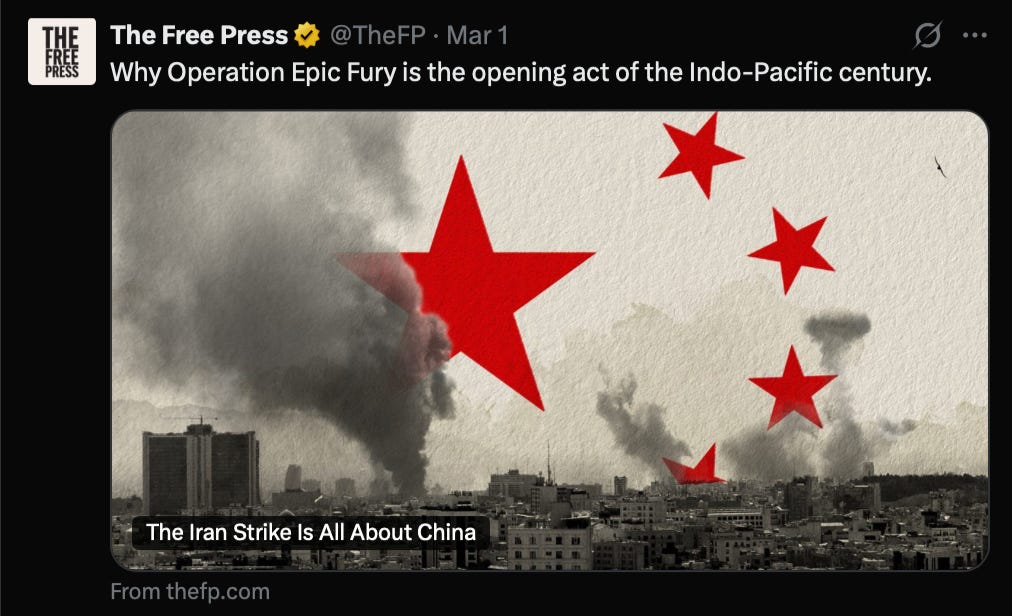
“Some argue Israel dragged the U.S. into war,” a post from The Free Press reads, “But this conflict is bigger than Israel and Iran — it’s about China.” Another article from The Spectator, a British conservative outlet, sang the same tune: “Trump’s ultimate target in this war is China.” Glenn Beck, on March 2, unveiled C.R.I.N.K., or “the new Axis Powers of China, Russia, Iran, and North Korea,” as a way to “understand why Trump attacked Iran.” Fox News’ Jesse Watters told his audience last week that “we are killing two birds with one stone: we stop the number-one sponsor of terror, and we checkmate the Chinese.”
A viral graphic circulated by the Free Press about the motivations for the American-Israeli war against Iran.
At the very least, if China were really the motive, one would have expected the Trump administration to offer this theory — “this is the chance to counter America’s greatest geopolitical rival” — as a major justification to the American people. One would think they would be particularly motivated to do so, given the consensus of polling data showing that public support for this war is far weaker than for any American war in decades.
But Trump officials never mentioned China as a core motive. In fact, even now, the administration and its backers have hardly mentioned China. This is a theory invented out of whole cloth by Iran-war supporters and/or Trump supporters, grasping for some cogent reason why this new war is in Americans’ interests.
Late last week, Senator Lindsey Graham claimed that this conflict is “a religious war” waged by “radical Islamic terrorists.” On March 2, House Speaker Mike Johnson explained to a group of reporters that the United States “determined, because of the exquisite intelligence that [it] had, that if Israel fired on Iran,” then “[Iran] would have immediately retaliated against U.S. personnel and assets.” Therefore, the House Speaker insisted, because the U.S. would be attacked either way, it had to hit Iran with Israel. President Trump announced on Friday that the U.S. intends to select “GREAT & ACCEPTABLE Leader(s)” for the Iranian people, in order to make their country “economically bigger, better, and stronger than ever before.”
These politicians, and many more inside and around the administration, are not talking about China. It has not been cited as a significant motivator for starting this war. Yet if China is really the reason, did the most prominent war supporters simply forget why they went to war, or did they decide it was best to present a false, pretextual case to the American people about why this war was necessary?
Admittedly, this new justification is, at least on the surface, cogent, even if pretextual. China is the most powerful geopolitical competitor to the U.S. No other country buys more sanctioned crude oil from the Iranians, and only Russia has worked more closely with Iran to beef up its military. In 2021, Iran signed a 25-year partnership with China that would reportedly bring $400 billion to Iran’s energy industry. Various weapons deals between the two countries have been reported in recent years, including one to purchase Chinese supersonic missiles that can sink American ships.
Still, none of these events really pertain to, let alone prove, this new claim — that this war with Iran is somehow really about China. At most, they suggest that China may be negatively affected, losing access to cheap oil and its investments. If simply being negatively impacted by this war is the standard for it being “about” another country, then this war is also about Kuwait, Qatar, the United Arab Emirates, and the rest of the Middle East.
Indeed, many countries could be harmed by the Trump-Netanyahu war in Iran. Japan’s economy could face severe consequences if oil is trapped in the Strait of Hormuz. The South Korean economy last week erased nearly half a trillion dollars, marking the largest drop in their stock market’s 46-year history. Is the war about both of these East Asian countries as well?
Further complicating this point is that China has not exclusively invested in or done business with Iran. Indeed, the People’s Republic has, at least publicly, invested more in Saudi Arabia, Iraq, and the United Arab Emirates. (That aforementioned $400 billion agreement between Beijing and Tehran still has not materialized.)
Nor is China the largest buyer only of Iran’s oil. It is also often the leading export destination for Iraqi, Kuwaiti, Omani, Saudi, and Qatari crude. Chinese money, in all its forms, is present across the Middle East, from port construction to the telecommunications industry. What’s more, the Chinese are filling gaps that have opened as a result of American reluctance or negligence.
American foreign policy in the Middle East, including wars, has far more often boosted Chinese interests than undermined them. When the United States in the mid-2010s refused to sell MQ-9 Reaper drones to the Saudis and Emiratis, China filled the gap by selling its CH-4 Rainbow and GJ-1 Wing Loong II models. After the United States invaded Iraq, killing hundreds of thousands of people, the Chinese were still the first to secure foreign contracts. (To this day, the Chinese are a dominant player in Iraq’s oil industry.) President Biden’s poor relations with the Saudis reportedly played a role in their consideration of settling contracts in Chinese yuan.
One would be forgiven for thinking that many of China’s relationships exist not because of an ideological competition with the U.S., but because capricious or draconian American policy often creates the conditions for Chinese success. This is no less true with Iran, as even the articles proffering this all-about-China theory acknowledge.
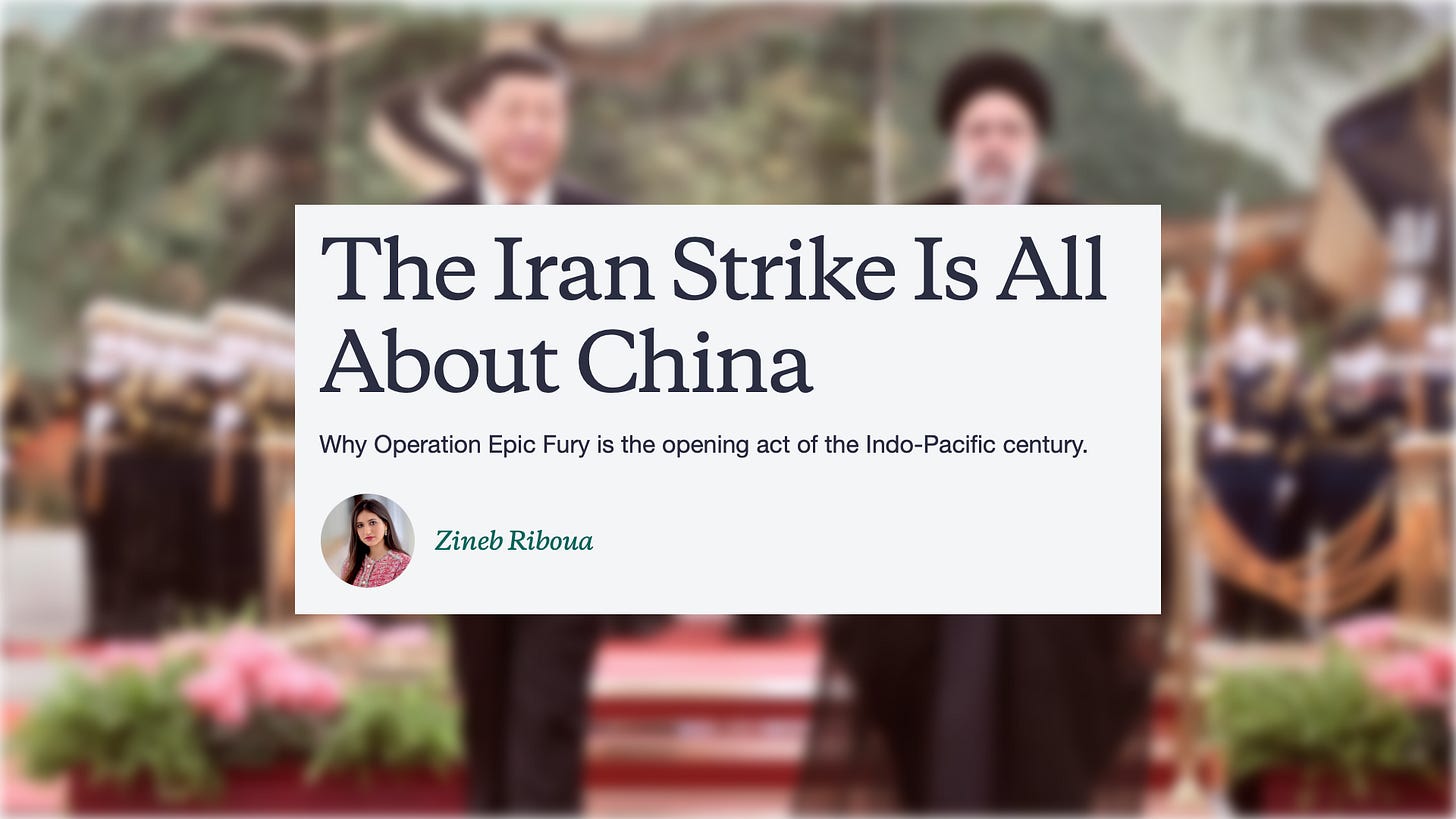
“Squeezed by decades of American sanctions and increasingly isolated,” the Israeli journalist Haviv Rettig Gur writes in The Free Press, “Iran turned to China as its economic lifeline.” This lifeline, moreover, “[is] the main reason the Islamic Republic has not gone bankrupt,” according to the conservative Hudson Institute, which is also pushing this about-China theory for the Iran war (see, for instance, its article titled, “The Iran Strike Is All About China”). In other words, the U.S. — not the Chinese — created the conditions for a competitor’s presence in the Middle East.
Theories like this one raise another problem. All of these arguments struggle to provide a comprehensive explanation of how China will be “devastated” by regime change in Iran, but they paint a fairly clear picture of how Iran became dependent on the People’s Republic. Of course, the U.S. gaining total control of the Middle East has implications for Chinese commerce and strategy, as these articles acknowledge. But no serious journalists or scholars have argued that China can currently project military power across the globe, with or without Iran.
Is that not why many of these ideologically aligned institutions warn about China’s nascent, but developing, blue-water navy? If one believes China will one day ‘imperialize’ like the U.S., Americans can wrest the Panama Canal from Chinese companies, attack China’s allies, and encircle the Chinese mainland — for now. Those kinds of actions could very well devastate China. (It would not be the first time Western powers have done something like it.) But Iran is hardly a necessary component of said devastation. If the U.S. really wants to wreck China, it does not need to pulverize Persia.
On top of all this, many of the videos and articles that have virally promoted this claim — that this war is about China, not Iran — seem to ignore the very foreign policy establishment that gave them this war. Mainstream American scholarship on China has been fairly clear: from a strategic perspective, the Chinese are perfectly happy to allow the United States to remain entangled in the Middle East because, by definition, it delays an American “pivot to Asia.” Bizarrely, some of these articles acknowledge this, making the Orwellian argument that the U.S. has to go to war with Iran in order to stop going to war in the Middle East.
And, of course, it would be difficult to ignore the lowest-hanging fruit. Far and away the most common thread that exists between those promoting this all-about-China theory is a devotion to Israel: the Free Press, the Hudson Institute, the Spectator, Fox News, etc. All of these institutions constitute the pro-Israel establishment in the U.S. and U.K. So, when Haviv Rettig Gur writes that Marco Rubio “struggled to explain” why the U.S. was at war with Iran, it is not because Rubio denied that Israel forced America’s hand. He, in fact, confirmed that Israel had compelled an American strike.
Apart from various reports that confirm Rubio’s initial account, such as in the New York Timesand the Financial Times, Antony Blinken (his predecessor) recently described an identical story: that the Israelis tried to pressure former President Obama into war with Iran by claiming that if he failed to act, they would strike Iran alone. But, according to Rettig Gur, “It’s hard to take [Rubio’s] explanation at face value,” so the Secretary of State’s candor can be disregarded for another, entirely dreamed up claim. Rettig Gur continues, “If the trigger was simply an Israeli strike, America could have told the Israelis to sit tight. … Goodness knows the U.S. has the leverage to do it again.” That statement seems highly accurate. Unfortunately, some unclear entity — most likely China — prevented the United States from doing that.
Altogether, the claim that Trump went to war with Iran to fight China is more sensational than substantive. It entertains theories of 4D Chess when Yahtzee is a more apt comparison. The Trump administration is rolling the dice for Israel: it has already financed their genocide in Gaza, vaporized prayer circles in Yemen, destroyed Iranian nuclear facilities, granted Benjamin Netanyahu’s wildest wishes, and is now officially at war with Iran. For any hawks eager to embroil the United States in a head-to-head clash with the People’s Republic, the question is not if this latest war was about China — it is whether any of them will be.
Cole Crystal (@colecrystal) was producer and editor for SYSTEM UPDATE with Glenn Greenwald and now has the same title for this Substack. Before joining, he worked for media outlets in the United States. He graduated from Cornell University with a bachelor’s degree in government and online social movements.
This is the story of how a multibillionaire who has dedicated his life to advancing the cause of the Israeli national security state is now in control of Great Britain’s most sensitive public and military data.
In 2020, software giant Oracle won a gigantic contract with the United Kingdom’s Ministry of Defence (MoD) to provide it with cloud infrastructure, digital assistance, data visualization software, mobile hub and development tools. The military is far from the only British institution entrusting its most sensitive data to the Texas-based firm, however. The Home Office, Office of National Statistics and National Health Service, among others, also rely on Oracle databases to function.
For years before signing the MoD agreement, Oracle founder Larry Ellison had been ingratiating himself with the British establishment, employing all manner of well-connected individuals at his foundation. Among these included media executive and father-in-law of former Prime Minister Boris Johnson, Matthew Symonds, who earned over $600,000 per year as the executive director of the Larry Ellison Foundation. Richard Meredith, a longtime director of the U.K.’s Foreign and Commonwealth Office, was also snapped up at a similar salary to become deputy executive director.
Many other well-connected British government officials, including Vel Gnanendran, went straight from the Larry Ellison Foundation into the Foreign and Commonwealth Office and worked there at the time that the body signed off on the lucrative Oracle contracts. For years, the Larry Ellison Foundation also bankrolled the Tony Blair Institute for Global Change, the former U.K. prime minister’s new political project.
Yet, just after as the partnership with the Ministry of Defence was secured, Ellison abruptly shut down his foundation, prompting speculation that it had fulfilled its purpose.
“Our mission to support Israel”
Why this should be of concern is that both Ellison and key Oracle figures have made clear that their business model is less about making money, and more focused on furthering the interests of the Israeli national security state.
Furthermore, few people realize how important Oracle is to the functioning of the modern world. It is the third-largest software company globally. Yet because it sells its products to businesses and governments rather than consumers, it is far less known than competitors such as Microsoft or Amazon. Nevertheless, it is as important to the modern hi-tech economy as its rivals, its software and databases powering the likes of Netflix, Zoom, financial corporations such as JPMorgan Chase, as well as a myriad of educational institutions.
While opening a new data center in Jerusalem in 2021, the company’s Israeli-American CEO, Safra Catz, laid out Oracle’s purpose, stating,
We are not flexible regarding our mission, and our commitment to Israel is second to none. This is a free world and I love my employees, and if they don’t agree with our mission to support the State of Israel, then maybe we aren’t the right company for them. Larry [Ellison] and I are publicly committed to Israel and devote personal time to the country, and no one should be surprised by that.”
Catz made the comments in response to a question about Israel’s poor human rights record and the rebellion of Silicon Valley employees refusing to facilitate the country’s war crimes. In 2017, Catz was offered the position of U.S. Director of National Intelligence.
Safra Catz, Oracle’s CEO, poses with Alon Ben (left), CEO of Tel-Aviv-based Oracle data partner, Bynet
Ellison, if anything, is even more forthright in his support for the Israeli government and its agenda. The billionaire – currently the fourth-richest individual in the world – has bankrolled the Israeli Defense Forces (IDF) for years, giving tens of millions of dollars to the Friends of the IDF, including the largest single donation the organization has ever received. In 2017 alone, he pledged $16.6 million to build a new training facility for IDF soldiers defending, in his words, “our home”. As Ellison explained:
Through all of the perilous times since Israel’s founding, we have called on the brave men and women of the IDF to defend our home. In my mind, there is no greater honor than supporting some of the bravest people in the world, and I thank Friends of the IDF for allowing us to celebrate and support these soldiers year after year. We should do all we can to show these heroic soldiers that they are not alone.”
This was far from his first donation to the organization. Three years previously, he gave $9 million at a star-studded gala – the largest donation on a record-breaking night for the FIDF.
The big tech mogul also has a direct hand in furthering the Israeli settlement project. In 2007, he met with then-Foreign Minister Tzipi Livni to pledge half a million dollars in support to the Israeli border town of Sderot.
But if Ellison can count Livni as a friend, then Benjamin Netanyahu is virtually family. The pair have been close for many years; Ellison even flew Netanyahu out to his private Hawaiian island to vacation together. There, he offered the embattled prime minister a seat on Oracle’s board, replete with a salary of $450,000.
Netanyahu had previously gone to Ellison, encouraging him to buy out the struggling Yedioth Ahronoth newspaper in an attempt to change the outlet from an adversary of his political project into a mouthpiece for his Likud Party.
Unsurprisingly, Oracle has signed numerous deals with the Israeli national security state.
Egyptian engineer Dr. Mahmoud Sobhy quit his job with the software company Oracle this week in solidarity with the Palestinian struggle.
He quit after learning that Oracle Founder Larry Ellison annually donates millions of dollars to support Israel's occupation forces. pic.twitter.com/XOSvrssNSD
“The Israelis think they control the Foreign Office. And they do!”
In recent years, Israel and pro-Israel groups have managed to amass considerable influence over U.K. government policy. A measure of this is the fact that, by 2021, one-third of the cabinet – including then-Prime Minister Boris Johnson – were directly funded by the Israeli government or pro-Israel organizations. Chief amongst these groups is the Conservative Friends of Israel, who have claimed that 80% of Tory members of parliament belong to their organization.
The Israel lobby has been able to shape government policy, to the point where they blocked Boris Johnson’s appointment of Alan Duncan to the post of Middle East Minister. Johnson, according to Duncan, was “indignant”. “They shouldn’t behave like this”, the prime minister reportedly said about the Israelis, but acquiesced to their demands. “The Israelis think they control the Foreign Office. And they do”, Duncan later wrote. Home Secretary Priti Patel (a longtime champion of the apartheid state) also secretly flew to Israel for “off the radar” talks with Netanyahu – a huge breach of ministerial codes, for which she later resigned.
The Israeli Embassy also played a key role in the coordinated smear campaign demonizing Labour leader Jeremy Corbyn, an operation that helped to ensure Johnson’s electoral victory in 2019.
In addition to this, there have also been national security questions raised about the extent to which Israeli businessmen have bought up key British industries. Last year, for example, Patrick Drahi’s attempt to purchase 18% of BT, the formerly state-owned telecoms giant that owns and controls much of the country’s telecommunications infrastructure, was put on hold due to concerns over national security.
That a company like Oracle that defines itself so explicitly as pro-Israel raises serious concerns over the nature of the work they do for the United Kingdom or any other nation. How can the Ministry of Defence or the Home Office’s data be considered uncompromised in these hands?
The CIA in all but name
“The Oracle database is used to keep track of basically everything,” Ellison once said, adding,
The information about your banks, your checking balance, your savings balance, is stored in an Oracle database. Your airline reservation is stored in an Oracle database. What books you bought on Amazon is stored in an Oracle database. Your profile on Yahoo! is stored in an Oracle database.”
This should be of concern to everyone, as Oracle itself started off as a project for the Central Intelligence Agency. Indeed, Ellison named his company after Project Oracle, a 1970s CIA operation he worked on.
“Our very first customer was the Central Intelligence Agency,” Ellison boasted, telling the story of how, in 1977, the CIA commissioned his firm to build them a database. From there, Ellison immediately began pitching to other wings of the national security state, and within months had secured contracts with Navy Intelligence, Air Force Intelligence and the NSA. The bottomless pit of money available for the military has helped turn Oracle from a tiny operation to a $46 billion dollar per year behemoth.
One of Oracle’s largest deals came in 2020, when it was part of a consortium that won a 15-year contract with the CIA and the other 16 U.S. intelligence agencies said to be with tens of billions of dollars.
Part of the reason the CIA trusts Oracle is that the company’s upper echelons are filled with ex-CIA executives. A case in point is former CIA Director and Defense Secretary Leon Panetta, who was appointed to the company’s board in 2015. David Carney, who spent 32 years at the agency, rising to become its third-in-command, also joined Oracle, heading up its information assurance center.
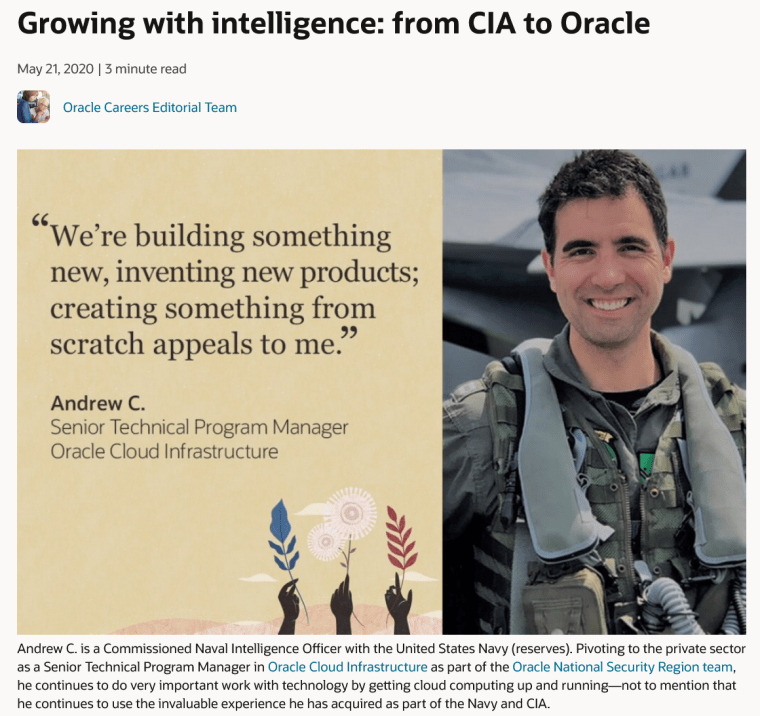
Indeed, on its own website, Oracle aggressively recruits CIA agents, sharing stories of former spooks who have gone on to succeed in its ranks. One of those is Senior Technical Program Manager Andrew C. “As an Intelligence Officer in the US Navy, as well as in the CIA, Andrew has had to lead, build teams, and work on fast-breaking projects, all things Oracle requires on a regular basis,” Oracle writes, before actively encouraging other agents to apply,
Now that you’ve heard about Andrew’s experience, are you ready to join Oracle National Security Region team? If you hold a U.S. Government Top Secret SCI or higher clearance, click here to check out our latest opportunities. Once you’ve found an opening that fits your talent, passion, skills, and background, apply for us to consider you. Create the future with us.”
Oracle, a firm that stores reams of your sensitive data, openly boasts of its cozy ties to the CIA
The revolving door between Oracle and the CIA also swings the other way, with Oracle staff finding employment in Langley, VA.
The Silicon Valley giant also works closely with the U.S. military. “Oracle Cloud is advancing Department of Defense mission success”, it boasts on its website. Oracle notes that it is “delivering real-time intel to warfighters”, thereby “securing command and control at the tactical edge.” Thus, by the company’s own telling, it is a centerpiece of both the military-industrial-complex and the national security state. Big media outlets agree: “Larry Ellison is a billionaire today thanks to the CIA” concludedBusiness Insider.
Surveillance State
If Ellison had his way, however, Oracle would be an even more crucial part of a greatly expanded national security state. In the immediate wake of the September 11 attacks, he flew in for a series of meetings with top Bush-era officials, including NSA chief Michael Hayden and Attorney General John Ashcroft. There, he likely pitched an idea he had been promoting for some time: a single, comprehensive national security database that collected every piece of information possible to identify someone, from thumbprints and iris scans to medical history and social security details. “The single greatest step we Americans could take to make life tougher for terrorists would be to ensure that all the information in myriad government databases was copied into a single, comprehensive national security database,” he insisted.
In the end, even the Bush administration balked at such a sweeping project. Nevertheless, Oracle has deeply ingratiated itself into the world of policing and surveillance. In 2012, at the height of an anti-NATO demonstration, U.S. law enforcement used Oracle’s Endeca software to match protestors’ tweets with data about their criminal records, 911 calls and other information to pre-arrest demonstration leaders before the action took off.
Since then, Oracle has sold the same or similar software to authorities in Europe, South America, the Middle East and China. Job listings for developers at Guantánamo Bay also note that familiarity with Endeca and Oracle software is a desired trait.
Oracle is far from the only Silicon Valley giant with questionable ties to intelligence. Here at MintPress, we have exposed how Facebook’s top ranks are filled with former FBI and CIA agents, how ex-Israeli spies have found roles working for Microsoft and Google, and uncovered what we termed a “NATO to TikTok pipeline.”
Yet the openness with which Oracle and Ellison work with the Israeli state to further its interests should be highly concerning to those working in national security. Israel already has a long history of using its tech industry to surveil and eavesdrop on foreign governments.
Can it really be a wise idea for the United Kingdom to entrust its most sensitive government, health and defense data to a company with such close ties to the Israeli government?
So far, Great Britain has overlooked the potential grave national security threat this poses. Surely this cannot continue indefinitely.
Lowkey is a British-Iraqi hip-hop artist, academic, political campaigner, and a MintPress video and podcast host. As a musician, he has collaborated with the Arctic Monkeys, Wretch 32, Immortal Technique, and Akala. He is a patron of Stop The War Coalition, Palestine Solidarity Campaign, the Racial Justice Network, and The Peace and Justice Project founded by Jeremy Corbyn.
The Omission of Israeli Terrorism in the Occupied Palestinian Territories
By Karin Brothers | Global Research | December 6, 2014
… The Israeli settlements — all of which are illegal – have been identified as a major impediment to peace. The refusal of a major “global” terrorism report to name the Israeli settlers as one of the groups most responsible for terrorism not only misrepresents a major source of regional violence but exposes the Global Terrorism Index as a propaganda tool that supports a U.S. agenda.
In recent years, governments have been attempting to thwart terrorism by blocking supportive fund-raising. When it comes to Israeli settlements, however, the US and Canada actually encourage fund-raising by giving organizations (such as Christian Friends of Israeli Communities (CFOIC) and the Jewish National Fund) financial support in the form of donor tax-deductions.
Charities which provide funds for the Israeli settlements should be regarded as terror-financing organizations. They should not only lose their tax-deductible status, but they should be banned because they support the violation of international humanitarian law. The terror-financing laws that are being strictly enforced for Muslim charities should be applied to Christian and Jewish charities as well. … Read full article
This site is provided as a research and reference tool. Although we make every reasonable effort to ensure that the information and data provided at this site are useful, accurate, and current, we cannot guarantee that the information and data provided here will be error-free. By using this site, you assume all responsibility for and risk arising from your use of and reliance upon the contents of this site.
This site and the information available through it do not, and are not intended to constitute legal advice. Should you require legal advice, you should consult your own attorney.
Nothing within this site or linked to by this site constitutes investment advice or medical advice.
Materials accessible from or added to this site by third parties, such as comments posted, are strictly the responsibility of the third party who added such materials or made them accessible and we neither endorse nor undertake to control, monitor, edit or assume responsibility for any such third-party material.
The posting of stories, commentaries, reports, documents and links (embedded or otherwise) on this site does not in any way, shape or form, implied or otherwise, necessarily express or suggest endorsement or support of any of such posted material or parts therein.
The word “alleged” is deemed to occur before the word “fraud.” Since the rule of law still applies. To peasants, at least.
Fair Use
This site contains copyrighted material the use of which has not always been specifically authorized by the copyright owner. We are making such material available in our efforts to advance understanding of environmental, political, human rights, economic, democracy, scientific, and social justice issues, etc. We believe this constitutes a ‘fair use’ of any such copyrighted material as provided for in section 107 of the US Copyright Law. In accordance with Title 17 U.S.C. Section 107, the material on this site is distributed without profit to those who have expressed a prior interest in receiving the included information for research and educational purposes. For more info go to: http://www.law.cornell.edu/uscode/17/107.shtml. If you wish to use copyrighted material from this site for purposes of your own that go beyond ‘fair use’, you must obtain permission from the copyright owner.
DMCA Contact
This is information for anyone that wishes to challenge our “fair use” of copyrighted material.
If you are a legal copyright holder or a designated agent for such and you believe that content residing on or accessible through our website infringes a copyright and falls outside the boundaries of “Fair Use”, please send a notice of infringement by contacting atheonews@gmail.com.
We will respond and take necessary action immediately.
If notice is given of an alleged copyright violation we will act expeditiously to remove or disable access to the material(s) in question.
All 3rd party material posted on this website is copyright the respective owners / authors. Aletho News makes no claim of copyright on such material.


 Aletho News