How the UK Government Provides Cover for Israel’s Crimes
By Stuart Littlewood | American Herald Tribune | August 22, 2020
MP Alister Jack has finally replied to my question asking where he and the UK government stand on the threat by Israel to annex more Palestinian territory known as the West Bank. It seems the Government has urged them not to do it.
I doubt if his letter reproduced here, is his own work. It is sprinkled with the humbug and deceit repeated for decades by Tory and Labour governments and was likely penned at least 20 years ago by a Foreign Office scribbler vaccinated with an Israeli embassy gramophone needle. It is still used as a reply template by MPs and ministers who dare not speak their own minds or are plain clueless.
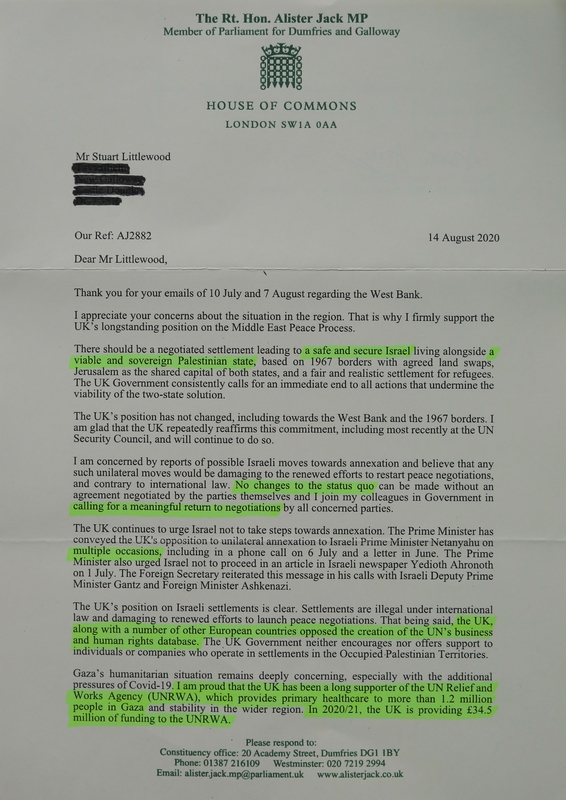
As usual, Her Majesty’s Government wants “a safe and secure Israel” but only “a viable and sovereign Palestinian state”. What a deplorable statement. Viable means workable in the most meagre sense. And when it comes to safety and security why can’t Mr. Jack be evenhanded? His words (if they are indeed his) express clear racial prejudice favouring the wellbeing and prosperity of one people at the expense of another which, I’d have thought, deserves a sharp rap on the knuckles.
He says there can be no changes to the status quo without a negotiated agreement between the parties. Mr Jack is surely aware that the status quo is itself illegal and breaches umpteen UN resolutions. And why does he feel the Palestinians must ‘negotiate’ their freedom? Picture the scene with the invader holding a gun to the head of the victim whose land the invader has occupied under brutal military control and in defiance of international law for 70+ years. Why is Mr Jack joining his colleagues in calling for more lopsided negotiations instead of pushing for law and justice?
‘Nothing shall be done to prejudice the rights of non-Jewish communities….’ Sorry, forget that.
So many experts are saying that a negotiated two-state solution is impossible. Does anyone seriously think the Israelis will voluntarily give up their ill-gotten territorial gains which are crucial to their Greater Israel dream? The only peaceable way to change their mind is through the persuasive power of BDS and other sanctions. For that reason BDS is under relentless Zionist attack and is fiercely opposed by the servile UK Government. The reason why the West endlessly woffles about ‘negotiations’ is their cowardly failure ever since 1948 to confront Israel’s greedy ambition for expansion and domination. That inconvenient bit in Britain’s 1917 pledge to Rothschild and the Zionist Federation about “it being clearly understood that nothing shall be done which may prejudice the civil and religious rights of existing non-Jewish communities in Palestine” is best forgotten. It’s so much easier for the UK Government to say and do nothing while their Zionist ‘friends’ surreptitiously complete their programme of creeping annexation. And never mind the 70+ years of grief this has caused innocent Palestinians.
Mr Jack refers to Boris Johnson’s article in Yedioth Ahronoth which appeared on the very day Netanyahu was supposed to be carrying out his crazed threat. “Annexation would represent a violation of international law…. I profoundly hope that annexation does not go ahead,” he wrote. “If it does, the UK will not recognize any changes to the 1967 lines, except those agreed between both parties.” But Israel has repeatedly violated international law and repeatedly been rewarded, so why should it care what the UK thinks about boundary changes? They have been changing all the time. Israel’s annexation of East Jerusalem (including the Old City) in 1967 was a flagrant breach of international law, and what did the UK or anyone else do about it? “I want to see an outcome that delivers justice for both Israelis and Palestinians,” says Johnson absurdly. He has no interest in justice otherwise he’d be leading the charge for implementing international law and UN resolutions which have already ruled on the issue.
As for Israel’s annexation misfire, it looks like world hostility gave Netanyahu cold feet and he and Trump cast around in desperation for a face-saver. They found it the United Arab Emirates’ ‘MBZ’ with whom they cobbled a deal for full diplomatic relations between Israel and the UAE provided Israel suspended annexation, and this is touted as a triumph. No-one of course insisted on actually abandoning annexation and you can bet the piecemeal ethnic cleansing, destruction of Palestinian homes and confiscation of their lands will continue unabated.
Mr. Jack then says he’s proud that the UK supports UNRWA and is providing £34.5 million funding this year. If the Palestinians were allowed their universal right to freedom of movement and self-determination in their homeland there’d be no need to keep throwing our tax money at agencies like UNRWA. It’s scandalous that money for our own schools and hospitals has been diverted to subsidise Israel’s long-running programme of thieving, collective punishment, dispossession and the trashing of the Palestinian economy.
Mr Jack goes on to say: “The UK’s position on Israeli settlements is clear.” Well no, it isn’t. They are illegal and even constitute a war crime yet the UK Government doesn’t mind if companies or individuals profiteer from using and endorsing those squats to the detriment of the Palestinians. And he seems to agree with his government’s opposition to the UN’s business and human rights database. Back in March 2016, UN Human Rights Council resolution 31/36 mandated the High Commissioner’s Office to produce a database of all businesses engaged in activities related to Israel’s settlement enterprise and having implications for the rights of the Palestinian people. Fair enough, you might think. But a year ago 103 local, regional and international organizations felt it necessary to call on the High Commissioner to release the Database expressing deep concern that the document and names of the companies facilitating the settlement programme had been withheld from circulation for 3 years due to political pressure. In the meantime the Israeli government had escalated the construction of new squats and broadcast its intention to formally annex parts of the West Bank in further violation of international law.
“The Database will bring an important degree of transparency on the activities of businesses which contravene rules and principles of international humanitarian and human rights law as a result of their operations in or with illegal Israeli settlements,” they said.
Amnesty International commented: “Naming the businesses which profit in the context of this illegal situation sends a clear message from the international community that settlements must never be normalized. These companies are profiting from and contributing to systematic violations against Palestinians.”
And Lawyers for Palestinian Human Rights said: “The UK Government abstained on the vote of this Human Rights Council resolution in March 2016…. It was the only state to declare that the database was ‘inappropriate’ and that ‘it would not co-operate in the process’ of its implementation.” LPHR felt that the reasons given for the Government’s position “did not individually or cumulatively amount to an adequate basis for justifiably opposing the UN Database”. One such reason was that the UK Government thought the Human Rights Council should focus on states rather than private companies. LPHR says this contradicts the UK’s earlier agreement, along with the rest of the international community, that companies as well as states have vital responsibilities in protecting and advancing respect for human rights.
I won’t trouble Mr Jack for an explanation for all this. It’s enough that voters and campaigners are aware of the skullduggery.
Germany, France & UK REJECT US push to reinstate UN sanctions on Iran
RT | August 20, 2020
The US exited the Iran nuclear deal and therefore has no right to demand a ‘snapback’ of UN sanctions on Tehran, the foreign ministers of three European powers involved in the JCPOA said in response to Washington’s latest push.
“France, Germany and the United Kingdom, the so-called E3, note that the United States has not been a member of the JCPOA since their withdrawal from the agreement on May 8, 2018,” their respective foreign ministers Jean-Yves Le Drian,Heiko Maas and Dominic Raab said in a statement on Thursday.
Therefore, the E3 “cannot support” the US demand for UN sanctions against Iran to be reimposed, as it is “inconsistent” with their current efforts to implement the deal, the trio added.
JCPOA stands for the Joint Comprehensive Plan of Action, the name given to the 2015 nuclear agreement negotiated by the Obama administration, endorsed by all five permanent members of the UN Security Council and Germany.
Citing UNSC Resolution 2231, which codified the deal, US envoy to the UN Kelly Craft officially requested the “snapback” of sanctions on Thursday, accusing Iran of “significant non-compliance” with the deal. However, China has previously pointed out that the US is not eligible to make that request, having exited the treaty unilaterally. The E3 statement indicates the Europeans share Beijing’s stance on the issue.
The E3 statement came during the press conference US Secretary of State Mike Pompeo was giving at the UN, declaring confidently that the rules of the Security Council are “straightforward” and will lead to the sanctions being restored.
The Abyss of Disinformation Gazes Into Its Creators
By Patrick Armstrong | Startegic Culture Foundation | August 17, 2020
He who fights with monsters should look to it that he himself does not become a monster. And if you gaze long into an abyss, the abyss also gazes into you. – Friedrich Nietzsche
The other day the U.S. State Department published “Pillars of Russia’s Disinformation and Propaganda Ecosystem“. The report should have a disclaimer like this:
Everything you read in the NYT or hear Rachel Maddow say about Russia is true: Putin is a murderer, a thief and a thug, he shot down MH17, poisoned the Skripals, elected Trump, invaded Georgia and stole Crimea. If you question any part of this, you are controlled and directed by Russian Disinformation HQ.
Freedom of speech does not entitle you to doubt The Truth.
The methodology of all of these things – this is one of several – is uncomplicated. Paul Robinson has commented on the dependence of so much comment about Russia, and this report in particular, on the myth of central control.
- Anything anywhere on Russian social media, whether sensible or crazy, was personally put there by Putin to sow discord and weaken us. All social media or websites based in Russia are 100% controlled by Putin.
- The Truth about Russia is found in the West’s official statements and in the “trusted source media”. Anyone who questions it benefits Putin, who wants to bring us down, and is therefore acting as a servant of Russian Disinformation HQ.
The argument really is that simple and can be found in its baldest (and stupidest) version on the EU vs DiSiNFO site, The NATO Centre of Excellence is pretty bad while The Integrity Initiative seems to have been embarrassed into silence. Note the “disinfo”, “excellence” and “integrity” bits – that’s called gaslighting. Who funds these selfless truth seekers? The EU, NATO and the British government. But they’re good and truthful, unlike those tricky Russians.
In this particular effusion they look at seven websites, six of which are registered in Russia and one in Canada. The report declares that they are in an ecosystem directed from Russian Disinformation HQ. In reality they are sites which publish writers who – to take one example – think that it is a bit unusual that a deadly nerve agent smeared on a door handle requires the roof of the house to be replaced. But doubt, these days, is the outward sign of an inward Putinism.
Door handle!
Yeah, OK, but why the roof?
Putinbot!
One of the websites mentioned in the report is the one you’re reading now – Strategic Culture Foundation.
Could these be the officials who told the NYT about the bounties? Or gave it the photos it had to walk back a few days later? Or said their sources had “mysteriously gone quiet?” Or told it all 17? Or said it was probably microwave weapons? Or gave us years of scoops about how Mueller was just about to lock him up? Or told the NYT that Russia’s “economy suffers from flat growth and shrinking incomes“? Probably, but you’re not supposed to ask these questions.
The report has a good deal of speculation about who backs Strategic Culture Foundation (p 15). Personally I don’t much care who runs it (and I very much doubt that the Kremlin understands the point of running an opinion website). I’ve been in the USSR/Russia business for some time and what I think hasn’t changed much since 1986 or so. I’ve written for a number of sites which have faded away and I will not permit having what I write changed; the one time it happened twelve years ago, I immediately switched my operations elsewhere. Strategic Culture Foundation has never changed anything I’ve submitted and only twice suggested a topic – this one and Putin’s weaponised crickets. (And the warning is still up at the U.S. State Department site!) The other writers on the site whom I know haven’t changed their views either. Strategic Culture Foundation hasn’t created something that didn’t exist before, it’s collected something that already existed. What do we writers have in common? Well, Dear Reader, look around you. Certainly we question The Truth. Or maybe SCF is a place where people “baffled by the hysterical Russophobia of the MSM and the Democratic Party since the 2016 election” can find something else? Or maybe it’s part of Madison’s “general intercourse of sentiments”?
There was a theory in the Cold War that the two sides would eventually converge. I often think that they met and then kept on going and passed each other. In those days the Soviets did their best to block what they considered to be – dare I suggest it? – disinformation. And so RFE/RL, BBC, Radio Canada and so on were jammed. We, on our side, didn’t care who listened to Radio Moscow or read Soviet publications. Today it’s the other way round. Which fact prompts the easy deduction that the side that’s confident that it has a better connection to reality and truth doesn’t waste effort trying to block the other. In a fascinating essay, the Saker describes Russian propaganda for its home audience: “give as much air time to the most rabid anti-Kremlin critiques as possible, especially on Russian TV talkshows”. They even took the trouble to dub Morgan Freeman’s absurd “we are at war” video. That’s brilliant – we won’t tell you they hate you, we’ll let them tell you they hate you.
The report talks as if this “ecosystem” were big and influential. But it’s a tiny mouse next to a whale. Total followers on Twitter of all seven sites are 156 thousand (p65). That’s nothing: the NYT has 47.1 million Twitter followers, BBC Breaking News 44.8, WaPo 16.1. Why even Rachel Maddow has ten million followers eager to hear her explain how Russia is going to turn off your furnace next winter. So the rational observer has a choice to make after reading this report: either the report ludicrously over-exaggerates the influence of this “ecosystem” or 156,000 website followers are astonishingly influential and I, with my Strategic Culture Foundation pieces, personally control several Electoral College votes.
The real message of “Pillars of Russia’s Disinformation and Propaganda Ecosystem“, to someone who isn’t invested in spinning – ahem – theories about a Kremlin disinformation conspiracy, is that the “pillars” are feeble and the “ecosystem” small: Maddow alone has three times the followers of these seven plus the RT (3 million) the “all 17” report spent nearly half its space irrelevantly ranting about. Or maybe it’s saying that American voters are so easily influenced that “the Lilliputian Russians, spending a pittance compared to the Goliaths of the Clinton and Trump campaigns, was the deciding factor in 2016“.
Ironically this thing appeared at the same time as two that suggest Washington’s view of Moscow needs some work: It’s Time to Rethink Our Russia Policy and The Problem With Putinology: We need a new kind of writing about Russia. Good to see titles like that but they aren’t really rethinking anything: they still agree that Putin’s guilty of everything that Maddow says he is. Real re-thinking might get a toehold, for example, were people to contemplate why it is imbecilic to say that Moscow holds military exercises close to NATO’s borders. But you’ll only see that sort of thing on Strategic Culture Foundation and the others.
But now the abyss gazes back
Clinton loses an election, blames Russia, the intelligence agencies pile on, the media shrieks away. Americans are told patriotic Americans don’t doubt. And now we arrive at the next stage of insanity. William Evanina, director of the National Counterintelligence and Security Center, informs us that “Russia is backing Donald Trump, China is supporting Joe Biden and Iran is seeking to sow chaos in the U.S. presidential election…”. I guess that means that Russia and China will cancel each other out and that he’s telling us that Iran will choose the next POTUS. Who would have thought that the fate of the “greatest nation in earth” (as Presidents Trump, Obama, Bush Jr, Clinton, Bush Sr and Reagan like to call it) would be hidden under a turban somewhere in Iran?
So, American, know this: your “trusted sources” are telling you not to bother to vote in November – it’s not your decision.
FCO promoting intervention in Belarus via OSCE
Press TV – August 17, 2020
After days of posturing and pugilistic rhetoric the UK has upped the ante on Belarus by calling the result of the recent presidential election in the pro-Russian country “fraudulent”.
Foreign Secretary, Dominic Raab, tweeted that not only the UK does not recognize the election result but it is also calling for an “urgent investigation” by the Organization for Security and Co-operation in Europe (OSCE), an inter-governmental organization focused on European security.
Raab’s hardline position is reinforced by a Foreign and Commonwealth Office (FCO) statement whereby the UK appears to call for an intervention in Belarusian politics via the OSCE.
Belarus has experienced political unrest since a disputed presidential election on August 09 in which the incumbent, Alexander Lukashenko, reportedly secured 80 percent of the vote.
However, opposition candidate, Sviatlana Tsikhanouskaya, refuses to accept the result and has instead declared herself the winner.
Tsikhanouskaya has since fled to Lithuania, whose government is openly calling for the overthrow of the Lukashenko administration.
Strongly aligned to Russia, Belarus has long been targeted by Nato states as part of a broader destabilization program focused on Russia’s immediate neighborhood.
In recent years the UK has stepped up diplomatic and intelligence activity related to Belarus.
In March the UK even sent 30 Royal Marines to Belarus as part of a plan to foster ties with the Belarusian armed forces, which have traditionally looked to Moscow for training and support.
UK adopts interventionist role in Belarus political crisis
Press TV – August 16, 2020
As Belarus continues to grapple with post-election unrest, the British government is showing stronger signs of wanting to influence the outcome by potentially fomenting the overthrow of long-time President Alexander Lukashenko.
In the immediate post-election environment the UK Foreign and Commonwealth Office (FCO) published a statement where it called on the “Government of Belarus” to “refrain from further acts of violence” following the “seriously flawed Presidential elections”.
In the presidential election of August 09 Lukashenko was re-elected to a sixth term in office with just over 80 percent of the vote.
But opposition candidate Sviatlana Tsikhanouskaya refused to accept the result and instead declared herself the winner.
Nato countries have generally supported her position with the Lithuanian foreign minister, Linas Linkevicius, taking the extraordinary step of calling Lukashenko “the former president of Belarus”.
The FCO statement complained of a “lack of transparency” in the electoral process even though the UK had no monitors on the ground and therefore cannot make a definitive conclusion on that issue.
The statement concludes with an interventionist tone by asserting that the UK “calls on the Government of Belarus to fulfill its international commitments and the aspirations of the people”.
Beyond the FCO, the British media have thrown their weight behind Belarus “protesters” and by extension appearing to support calls for Lukashenko’s ouster.
The BBC ran an incendiary headline claiming “mass protest eclipses defiant Belarus leader’s rally”.
For its part, Sky News has tried to depict Lukasheno as on the defensive by talking up his claim that Nato forces are “massing” on Belarus’ border.
In recent years the UK has shown growing interest in enhancing its diplomatic and political presence in Minsk, Belarus’ capital.
Earlier this year the UK even deployed 30 Royal Marines from 42 Commando to Belarus to ostensibly take part in an unprecedented joint exercise with the Belarus armed forces.
Belarus is universally regarded as a stalwart Russian ally, and for that reason alone Nato countries, including the UK, have long sought to create political distance between Minsk and Moscow.
Prince Peter Kropotkin and the Murder of the Liberator Tsar
By Martin Sieff | Strategic Culture Foundation | August 11, 2020
Why did London host a convention of anarchists in July 1881 less than three months after they had murdered the Liberator Tsar of Russia?
The International Anarchist Congress of London, from July 14 to July 20, 1881 was highly unusual in many ways, though it has almost totally been forgotten by history, save as a curiosity.
It was the last such gathering to be held for more than a quarter of a century until the International Anarchist Congress of Amsterdam in August 1907. During that time, there were four other unsuccessful attempts to call international congresses, in Geneva in 1882, in Paris in 1889, in Chicago in 1890 and once again in Paris in 1900.
Those interested in the procedural minutiae of the congress can easily enough find obscure academic articles discussing theoretical intellectual positions held and debated at the Congress.
But as far as I have been able to find, no historians have given any serious study to the possibility that the Congress may have been used to coordinate or plan any program of “Propaganda of the Deed” – the assassination of important political leaders across Europe and the Americas, which was central to the achievement of the anarcho-syndicalist movement’s goals.
 Nor is there any discussion anywhere – save in terms of abstruse and apparently harmless political theory – of the role that former Prince Peter Kropotkin, the most consistently high-profile and charismatic leader of the anarchist movement played in the convention.
Most striking of all, there appears never to have been any serious investigation conducted as to why the British government permitted its capital London, to be the host of the conference that on the surface stood for the destruction of everything that the British Empire, its traditions and institutions held dear.
The decision to permit the 1881 congress to gather in London was particularly striking – and from the Russian government’s point of view outrageous – because it opened only four months almost to the day after Tsar Alexander II, the Great Liberator who freed 24 million serfs from slavery and supported Abraham Lincoln and the Union through the U.S. Civil War, was assassinated by a specially designed shrapnel grenade thrown by Ignacy Hryniewiecki on Sunday, March 13, 1881.
That hideous crime was planned and committed by the Narodnaya Volya, “The People’s Will” itself a strange, tiny, conspiratorial group shrouded in mystery and unanswered questions to this day.
The name of the group suggests – as it was meant to – a mass popular movement, But the Narodnaya Volya was no such thing. The best estimates of Russian and Western historians alike put it at no more than 200 members. Almost none of these were from peasant backgrounds. They were almost all from favored, prosperous, professional middle class families and in some cases even from aristocratic backgrounds.
Interestingly, the followers of the late Osama Bin Laden in the first generation of al-Qaeda that carried out the destruction of the World Trade Towers in New York City on September 11, 2001 exhibit an almost identical set of profiles, as former Saudi intelligence chief Prince Turki bin Feisal bin Abdelaziz ibn Saud has pointed out.
The Narodnaya Volya was only founded in 1879. But it was totally crushed by 1884. Yet in the first two years of its existence, it operated with apparent impunity carrying out no less than eight attempts on the life of Tsar Alexander. No other tsar in Russian history including Alexander’s son and grandson after him was ever hunted so mercilessly and relentlessly by assassins.
The Narodnaya Volya never lacked for any of the financing it needed for its murderous schemes. The Russian internal security services, who proved extremely efficient and energetic in smashing the group after it carried out its bloody deed, seemed utterly helpless and inept against it until that point. This may in large part have been because the group was so tiny and so novel in its operational techniques.
Who led the Narodnaya Volya? Its documented leaders were Andrey Zhelyabov and Sofya Perovskaya. Perovskaya came from an aristocratic background but showed little capability beyond her own murderously intense fanaticism and strange obsession with murdering the tsar. Other members of the group when arrested openly commented on her merciless hatred for the ruler who had liberated the serfs.
But Perovskaya from 1872 was personally very closely associated with the then handsome, dashing and charismatic anarchist leader Prince Peter Kropotkin. It is likely they were lovers.
The carefully (British) constructed image of Kropotkin that endures to this day is a tubby, kindly, smiling old, bearded Father Christmas. In his youth, however, he was darkly satanically handsome and was obsessed with Goethe’s devil figure Mephistopheles in “Faust.”
For Perovskaya, Kropotkin would have been the dashing, aristocratic brilliant love of her life. For Kropotkin, the rather plain Perovskaya would have been a means to an end: The hunting and murder of the tsar.
Kropotkin came from one of the most aristocratic eminent families in Russia. He claimed descent from the House of Rurik, the original ruling family of Russia. He had actually been a personal page of Tsar Alexander II in his early years in power. He had been brutally bullied (or so he later claimed) when entering the Imperial corps of pages. For ever after, he maintained an intense personal hatred of the tsar, intensified by the years he spent as a prisoner for his subversive activities in the Peter and Paul Fortress in St. Petersburg starting in 1872. His escape was engineered by friends in 1876.
Kropotkin’s relationship with Perovskaya starting in 1872 in the Tchaikovsky (not the great musical composer) Circle is the key documented fact that links Kropotkin directly to the murder of the great tsar he so intensely personally hated. The group’s leader Nikolai Tchaikovsky, like Kropotkin found protection in Britain for most of his later life.
Kropotkin was a noted scientist in his day who contested Darwin and argued a version of evolution based on natural cooperation rather than natural selection. In fact it was superficial and crackpot but interestingly has recently been revived, along with his scientific reputation in British academic circles.
During the remainder of his own long life (he died in 1921 at the age of 79), Kropotkin was allowed to live in complete peace and security in Britain. Not coincidentally, Britain was the only major country in Europe not to suffer from the mysterious outbreak of assassinations that swept the continent and even the United States in the last quarter of the 19th century.
As Matthew Ehret has noted, the anarchist assassinations seemed to disproportionately target major leaders who rejected free trade and a global economic order dictated by British financial interests from the City of London. Its victims included U.S. presidents James Garfield (1881) and William McKinley (1901), French President Sadi Carnot (1894), Spanish Prime Minister Antonio Canovas (1897) and King Umberto I of Italy (1900).
In addition, in 1878 alone, anarchists attempted to kill Emperor Wilhelm I of Germany twice as well as the Kings of Spain and Italy. Kropotkin hailed all these efforts at “the Propaganda of the Deed.” Not coincidentally, all of these leaders, especially the old Kaiser, Bismarck’s patron and protector stood like Tsar Alexander II squarely opposed to British efforts at global financial domination.
 Yet despite all these outrages – or more likely because of them – Kropotkin, the guiding figure of anarcho-syndicalism and the great champion of the murder of national leaders continued to enjoy a charmed life protected by the British Empire.
To this day, British historians and other writers have unanimously continued to swallow the approved line that Kropotkin was a kindly, brilliant, pacifist saint – belonging to the company of Mohandas Gandhi and Dr. Martin Luther King rather than that of Sergei Nechayev and Dostoyevsky’s “Devils.”
The hyper-energetic, much loved and woefully idiotic American popular historian Barbara Tuchman spread this Disneyworld fairy tale image of Kropotkin in her enormously popular and influential history of the pre-World War I world “The Proud Tower” in 1966. Typically, she won the Pulitzer Prize twice for writing other histories that got their central facts and theses wrong.
A serious study of the role of Kropotkin and his “Anarchist International” in the assassinations of the late 19th century is well over 100 years overdue.
But even in that age of carefully selected and discriminating terror, the hunting and murder of the great liberator Tsar Alexander stands out for its relentless nature and obsessive cruelty.
That age of assassinations and the Anarchists Congress that the British so incongruously hosted in July 1881 is not just a matter of abstract curiosity about a long forgotten and irrelevant past. It offers disquieting parallels to the use of targeted assassinations and the methodical destabilization of great nations in the name of free trade, democracy and human rights that continues at a feverish pace in our own time.
As the great American novelist William Faulkner rightly wrote in “Requiem for a Nun,” “The past is never dead. It’s not even past.”
China Denounces Statement of 5 Western Foreign Ministers on Hong Kong as Meddling
Sputnik – 10.08.2020
The joint statement of the foreign ministers of Australia, Canada, New Zealand, the United Kingdom and the United States on Hong Kong is yet another instance of interference in China’s domestic affairs, the Chinese embassy in Canada said in a statement on Monday.
“On 9 August, the foreign ministers of Canada and other countries made a statement which once again contained irresponsible comments on the Hong Kong affairs and amounted to gross interference in China’s domestic affairs. China expresses its strong dissatisfaction and firm opposition to this,” the Chinese embassy said.
Postponing the elections was out of public health precautions amid the pandemic, while the security law closed security gaps in Hong Kong that could otherwise jeopardize the region’s long-term peace and security, the statement read, reiterating the rationale that Beijing has consistently used to confront similar accusations.
The embassy further called on the five signatory countries to “immediately stop interfering in China’s domestic affairs and using Hong Kong as a tool,” emphasizing that Hong Kong is a subject of China’s jurisdiction.
On Sunday, US State Secretary Mike Pompeo and his counterparts from Australia, Canada, New Zealand and the UK made a statement condemning the new security law in Hong Kong as infringing on the special administrative region’s rights and freedoms. The five foreign ministers also urged the Hong Kong authorities to conduct the recently-postponed legislative elections as soon as possible and let disqualified pro-democracy candidates run in the campaign.
The Hong Kong elections were initially scheduled for 6 September. In late-July, the government postponed the vote, citing coronavirus-related risks. Additionally, several candidates, considered pro-democracy, were banned from running on the grounds that their political activities were inconsistent with the new security law.
The Chinese government enacted the law on 30 June, following a little more than a month-long review at the National People’s Congress. The law adjusts security policies in Hong Kong to Beijing’s perception of crime and punishment with regard to separatism, subversion, terrorism and collusion with foreign countries. The Western critics of the law fear that it might painfully limit Hong Kong’s exclusive rights and freedoms, which it was guaranteed under the 1984 UK-Chinese agreement.
Something Rotten at The Heart of UK Government
The smell of pro-Israel bias in the Foreign Office is overpowering
By Stuart Littlewood | American Herald Tribune | August 6, 2020
As George Washington put it,“a passionate attachment of one nation for another produces a variety of evils”. He warned that sympathy for the favourite nation encourages the illusion of common interest where none really exists, risks participation in its quarrels and wars, and involves“concessions to the favourite nation of privileges denied to others which is apt doubly to injure the nation making the concessions by unnecessarily parting with what ought to have been retained… And it gives to ambitious, corrupted, or deluded citizens (who devote themselves to the favourite nation) facility to betray or sacrifice the interests of their own country.”
So a month ago I asked my MP Alister Jack: “If Netanyahu proceeds with his sickening annexation what will you say in Cabinet, please, about the need for real consequences such as sanctions? And will you speak up to ensure UK trade deals with Israel do not facilitate its territorial expansionism?”
It was a reasonable question which he has chosen to ignore. Jack is Secretary of State for Scotland in the UK Government and would be wise to have no ‘passionate attachments’ to foreign powers. Netanyahu didn’t carry out his threatened land grab on 1 July but might yet do so. Jack’s silence is therefore unacceptable and I’d like to know whether the person who represents me in Parliament aligns himself with the Israeli regime’s evil intent.
Meanwhile, a pro-Palestinian activist, exasperated by the UK Foreign Office constantly repeating the same old mantra excusing its inaction over Israel’s illegal and brutal occupation of Palestine, has received the same old half-baked reply but with a warning that they will not be corresponding with her again. The FO’s letter followed the familiar let’s-duck-the-issue formula.
- In line with international law, and relevant Security Council resolutions, notably Resolutions 242 and 497, we do not recognize Israel’s sovereignty over the territories occupied by Israel since June 1967, including the Golan Heights, and we do not consider them part of the territory of the State of Israel.
Okay. But when is Britain, a key player in the founding of the United Nations and with a permanent seat on the Security Council, going to do something about it?
- The two-state solution is the only viable long-term solution. It is the only way to permanently end the Arab-Israeli conflict, preserve Israel’s Jewish and democratic identity and realise Palestinian national aspirations.
The “only way”? Israel’s “democratic identity”, when it’s a deeply unpleasant ethnocracy? Why does Britain persist with these fantasies?
- We are firmly opposed to sanctions. We believe that imposing sanctions or boycotts on Israel or supporting anti-Israeli boycotts would not support our efforts to progress the peace process and achieve a negotiated solution.
But you’ll cheerfully slap Iran, for example, with sanctions for no good reason…. except to please Israel and its bitch, the US, which is what all this is really about. Civil society has resorted to BDS (Boycott, Divestment, Sanctions) in the absence of any real diplomatic pressure from the so-called ‘great powers’. It’s the only non-violent language Israel understands. And it’s beginning to work. Get behind it.
We’re told that Foreign Secretary Dominic Raab spent the summer of 1998 working for one of the PLO’s chief negotiators on the Oslo peace accords, a doomed initiative begun in 1993 to create a form of interim governance and framework for a final treaty by the end of 1998. So Mr. Raab was there at a time when the two sides had been faffing about in the name of peace for 5 years and getting nowhere.
In October of 1998 the US, desperate to keep the charade going, held a summit at Maryland’s Wye River Plantation at which Clinton with Yasser Arafat, Benjamin Netanyahu, and senior negotiators produced the Wye River Memorandum. Not that this did much good either. But Raab must have learned a lot about Israeli perversity, not to mention America’s shortcomings as an honest broker.
Before entering Parliament Raab joined the Foreign Office and worked at The Hague bringing war criminals to justice, then became an adviser on the Arab-Israeli conflict. As reported in Jewish News:
he welcomed Trump’s so-called peace plan saying: “Only the leaders of Israel and the Palestinian territories can determine whether these proposals can meet the needs and aspirations of the people they represent. We encourage them to give these plans genuine and fair consideration, and explore whether they might prove a first step on the road back to negotiations.” But it’s debatable whether the leaders on either side represent anyone but themselves and their own warped interests.
Raab’s boss Boris Johnson said of it: “It is a two-state solution. It would ensure that Jerusalem is the capital of Israel and of the Palestinian people….” But the Trump Plan relegates the Palestinian capital to the outskirts of East Jerusalem keeping the rest of Jerusalem, including the sublime and ancient walled city (which is officially Palestinian territory), under Israeli control. That is perhaps the cruellest part of the Trump/Netanyahu swindle.
Because Jerusalem/Al-Quds is immensely holy to all three Abrahamic faiths, the UN proposed that it should be a corpus separatum – an internationally-governed open access city free from Israeli or Palestinian control. What could be more sensible than that?
In the Global Britain debate on 3 February Raab boasted that Britain will be an even stronger force for good in the world. “Our guiding lights will remain the values of democracy, human rights and the international rule of law”. Whereupon Alistair Carmichael (LibDem) asked: “If the concept of a global Britain is to have any meaning and value, surely it must have respect for human rights and international rules-based order at its heart. With that in mind, will the Foreign Secretary reconsider the unqualified support he gave to President Trump last week in respect of the so-called peace plan for Palestine? Will the right hon. Gentleman repudiate the proposed annexation of the West Bank and at long last support the recognition of a Palestinian state?”
Raab replied:
“The one thing that the plan put forward by the US included was a recognition of and commitment to a two-state solution. We have been absolutely clear that that is the only way in which the conflict can be resolved…. Rather than just rejecting the plan, it is important that we try to bring the parties together around the negotiating table. That is the only path to peace and to a two-state solution.”
Then Foreign Office minister Lord Ahmad, in a debate on the Israel-Palestine conflict in March, said: “The UK Government have made it clear that, before taking part in any peaceful negotiations on the two-state solution, any party at the negotiating table needs to agree the right of Israel to exist.” But what about Palestine’s right to exist? Lord Ahmad must know that he’s talking about the fate of his Muslim brothers and sisters, not to mention the Christian communities there. On the basis of what he says, wouldn’t the UK Government’s continuing refusal to recognise a Palestinian state bar us from the peace process?
Evil Intent
Raab, by now, ought to be extremely skeptical of any two-state solution given the many irreversible facts on the ground that Israel has been allowed to create with impunity. And he would know better than most how many times the sides have come to the table for lopsided ‘negotiations’ and how the Israelis never honour the agreements they make.
And what would a two state solution look like? Yeah, too messy to describe. So why keep pushing it as the only answer? Netanyahu has said repeatedly that there will be no Palestinian state during his tenure as Israel’s prime minister. Furthermore there’s no prospect of Israel willingly giving up the Palestinian territory it illegally occupied and effectively annexed in 1967 and which must be returned if Palestinians are ever to enjoy their universal right to freedom and independence. Netanyahu has declared: “We will not withdraw from one inch…. There will be no more uprooting of settlements in the land of Israel…. This is the inheritance of our ancestors. This is our land…. We are here to stay forever.” Read his lips.
The question is: what ancestral links do he and his partners-in-crime have to the biblical land of Israel? Zionist leaders before Netanyahu broadcast their fraudulent claims to the land and bragged about their evil plan to seize it. It has been well advertised and, to a large extent, already implemented. Even if Netanyahu wanted a two-state solution he would be opposed by his own party and the others making up his ruling coalition, virtually all of which stand against Palestinians having a state of their own.
Those paying attention have known that the idea of a two-state solution by negotiation has been dead for 20 years and the only purpose in still talking about it is to perpetuate the status quo and buy time for Israel to complete its creeping annexation.
The British Government’s pledge to Lord Rothschild and the Zionist Federation on 2 November 1917, signed by Lord Balfour, was simply this:
“His Majesty’s Government view with favour the establishment in Palestine of a national home for the Jewish people, and will use their best endeavours to facilitate the achievement of this object, it being clearly understood that nothing shall be done which may prejudice the civil and religious rights of existing non-Jewish communities in Palestine or the rights and political status enjoyed by Jews in any other country.”
A national home, not a state. And no harm to the rights of non-Jews. Britain’s failure to uphold that bit leaves a disgusting stain of cowardice and corruption on the UK.
The fate of Israel/Palestine is not a matter for meddlesome nations with vested interests seeking to override UN resolutions and re-shape the Middle East to suit themselves. It is for the International Court of Justice to decide on the basis of international law. But we never hear about law and justice from the UK Government, or the US administration, in relation to the Holy Land. Why is that, Mr Raab? Don’t we believe in it any more? Or are we too stupid to respect it, too morally bankrupt to pursue it, too yellow to enforce it? When will the penny finally drop that you can’t have lasting peace without justice?
Talk is cheap when you have no intention of following up with action. It has become a sacred tradition to post pro-Israel stooges to key positions in the UK administration, especially the Foreign Office, to prevent any rocking of the boat. Raab’s predecessors suffered the same paralysis. Alistair Burt, a product of the Israel lobby, was not about to transform himself into a man of action for peace. He’d been an officer of the Conservative Friends of Israel. The then prime minister, David “I’m-a-Zionist” Cameron, proclaimed: “In me you have a Prime Minister whose belief in Israel is indestructible.” What a disgraceful pledge for the prime minister of a mainly Christian country to make to a lawless, racist entity that respects nobody’s human rights Christian or Muslim, continually defies international law and shoots children for amusement (see ‘The methodical shooting of boys at work in Gaza by snipers of the Israeli Occupation Force’ by surgeon David Halpin and reports on the use of dum-dum and other soft-nose or ‘exploding’ rounds by Israeli snipers). But Cameron is not the only one to have done so. It has become a regular appeasement ritual.
Should we recognise Palestine or un-recognise Israel?
The Conservatives, then as now, chose to spew their infatuation with the Israeli regime all over the British nation and the Arab world. In a speech to the Board of Jewish Deputies, Burt recalled how he had worked from the age of fifteen for an MP who was a president of the Board and a founder of the Conservative Friends of Israel, and how this “had a lasting effect upon me, and on my interests in Parliament…. Israel is an important strategic partner and friend for the UK and we share a number of important shared objectives across a broad range of policy areas.”
Can anyone think of a single objective they’d wish to share with those people? Many of us are tired of being told by the Government and senior politicians that “the UK is a close friend of Israel”.We don’t believe Israel has a friend in the world outside the Westminster and Washington bubbles and the US Bible Belt.
And Burt’s stance on Palestinian independence was always puzzling. I remember him saying that we would not recognise a Palestinian state unless it emerged from a peace deal with Israel. London “could not recognise a state that does not have a capital, and doesn’t have borders.” He’d been talking earlier about a Palestinian state based on 1967 borders with East Jerusalem as its capital, which is understood to be the legal position. Even Hamas agrees to that. So why had Burt suddenly lost the plot? And where did he suppose Israel’s borders are? Where the UN drew them in the 1947 Partition Plan? Has Israel ever declared its borders? Is Israel ever within them? Is Israel where Israel ought to be? If not, how could he or Mr Raab or anyone else in the Government possibly recognise Israel let alone align themselves with it? And where did Burt suppose the offshore borders of Palestine, Lebanon and Israel ran in relation to the huge reserves of marine gas and oil in the Levantine Basin? Israel is intent on stealing the lot. The question for many years has been: will Gaza ever get a whiff of its own gas?
“We are looking forward to recognising a Palestinian state at the end of the negotiations on settlements….” But Israel’s illegal squats, or ‘settlements’, are classed as war crimes. Since when did Her Majesty’s Government approve of negotiating with the perpetrators of such crimes? Besides, the Holy Land’s status was ruled upon long ago. International law has spoken. But instead of enforcing the law and upholding justice Mr Burt and his Government still pushed for more lopsided talks. Like Raab is doing today.
The “passionate attachment” that’s utterly inappropriate
The danger of inappropriate ‘friendships’ with foreign regimes became blazingly obvious in December 2009 when three of Israel’s vilest – Ehud Barak, Tzipi Livni and retired general Doron Almog – cancelled engagements in London for fear of ‘having their collar felt’.
They complained bitterly to David Miliband, the Foreign Secretary at the time, who promised that UK laws on ‘universal jurisdiction’ would be changed and asked Prime Minister Gordon Brown and Justice Minister Jack Straw for urgent action. A general election intervened and ousted Miliband from the Foreign Office, but the grovelling promise was eagerly taken up by his replacement, William Hague, another fanatical ‘friend of Israel’. Hague declared that a situation where foreign politicians like Mrs Livni could be threatened with arrest in the UK was “completely unacceptable…. We will put it right through legislation…. and I phoned Mrs Livni amongst others to tell her about that and received a very warm welcome for our proposals.”
Oh bravo, Mr Hague! Never mind that the arrest warrants in question were issued to answer well-founded criminal charges. Never mind that all States that are party to the Geneva Conventions are under a binding obligation to seek out those suspected of having committed grave breaches of the Conventions and bring them, regardless of nationality, to justice. And never mind that there must be no hiding place for those suspected of crimes against humanity and war crimes. The UK Government didn’t give a toss about such piffling principles. And still doesn’t.
Private arrest warrants were necessary because the Government itself was in the habit of shirking its duty under the Fourth 1949 Geneva Convention and deliberately dithering until the birds had flown. Bringing a private prosecution for a criminal offence, said Lord Wilberforce, is “a valuable constitutional safeguard against inertia or partiality on the part of the authority”. Lord Diplock, another respected Lord of Appeal, called it “a useful safeguard against capricious, corrupt or biased failure or refusal of those authorities to prosecute offenders against the criminal law”. And the beauty of the private warrant was that it could be issued speedily.
The Foreign Office’s move to scupper this was even more deplorable when you consider that Tzipi Livni was largely responsible for the terror that brought death and destruction to Gaza’s civilians during the blitzkrieg known as Operation Cast Lead. Showing no remorse, and with the blood of 1,400 dead Gazans (including 320 children and 109 women) on her hands and thousands more horribly maimed, Livni’s office issued a statement saying she was proud of it. Speaking later at a conference at Tel Aviv’s Institute for Security Studies, she said: “I would today take the same decisions.”
Nevertheless the British government of the day was happy to undermine our justice system in order to make the UK a safe haven for the likes of her.
By 2015, Israeli Prime Minister Netanyahu felt untouchable enough to say that if he was returned to power, a Palestinian state would not be established because handing back territory would threaten Israel’s security.
And in August 2017 he announced that Israel would keep the West Bank permanently and there would be no more uprooting of squatter ‘settlements’: “We are here to stay forever…. This is the inheritance of our ancestors. This is our land.”
Saying it again and again doesn’t make it so. The true inheritors are the Palestinian peoples who have been there since the days when Jerusalem was a Canaanite city.
Russian ambassador tells Britain: you exaggerate your political importance & London has become a haven for Russian criminals
RT | August 5, 2020
If you live in Britain, Russia looms large in political discourse, but for those in Moscow, the UK barely registers. Now Russia’s envoy to London has delivered a few home truths: he says his country has bigger fish to fry.
“I feel that Britain exaggerates, very much, its place in Russian thinking,” Andrei Kelin told the Daily Mail. “The scope and place of Great Britain in Russian politics is not that big. We have other problems of much larger magnitude,” the ambassador said.
The ambassador also dismissed the UK media narrative about nefarious Russian ‘oligarchs’ doing the Kremlin’s bidding in London. Kelin pointed out that, in reality, the British capital has turned itself into a haven for wealthy Russians trying to evade justice back home.
“Oligarchs mean rich people that can influence the president,” he explained. “The last one [oligarch] was about 20 years ago … those wealthy people living here [in Britain], the bulk of these people simply escaped Russia because they were being pursued for tax evasion, fraud and other criminal activities.”
“All of them have left the country just to escape prosecution. If the British authorities will decide to provide us with information about these people or decide to be positive on our demands for extradition, we will only greet this, salute this,” he added.
Back in 2018, Russia’s former prosecutor general, Yury Chaika, revealed that there were 61 Russian criminals living in London who had stolen around $10 billion from their home country. He expressed concern that Britain’s agenda was to pocket the stolen money, quipping, “you can keep the criminals, but return the money. This is our money.”
Kelin once again rejected claims that Russia had somehow tried to affect the results of the 2014 Scottish independence referendum, the 2016 Brexit referendum and the 2019 parliamentary elections in the UK. According to the diplomat, in all these cases, Russia was not politically interested in any particular outcome. “For us, there is no sense to choose any side,” he said.
“These accusations are invented, if not to say false. These are senseless accusations which we do not understand,” the ambassador added.
Kelin went on to say that, at present, relations between Moscow and London are “close to being frozen.” The UK is “throwing a lot of mud … in our direction,” he added, and this type of attitude “does not provoke much of an appetite for improving dialogue or relations in Moscow.”
Featured Video

HE SAVED LIVES. NOW HE FACES PRISON.
or go to
Aletho News Archives – Video-Images
From the Archives
NATO Sanctions and the Coming Global Diesel Fuel Disaster
By F. William Engdahl – New Eastern Outlook – 11.04.2022
Amid the ongoing global inflation crisis, NATO heads of state and mainstream media repeat a mantra that high energy prices are a direct result of Putin’s actions in Ukraine since end of February. The reality is that it is the western sanctions that are responsible. Those sanctions including cutting SWIFT interbank access for key Russian banks and some of the most severe sanctions ever imposed, are hardly having an impact on the military actions in Ukraine. What many overlook is the fact that they are increasingly impacting the economies of the West, especially the EU and USA. A closer look at the state of the global supply of diesel fuel is alarming. But Western sanctions planners at the US Treasury and the EU know fully well what they are doing. And it bodes ill for the world economy.
While most of us rarely think about diesel fuel as anything other than a pollutant, in fact it is essential to the entire world economy in a way few energy sources are. The director general of Fuels Europe, part of the European Petroleum Refiners Association, stated recently, “… there is a clear link between diesel and GDP, because almost everything that goes into and out of a factory goes using diesel.” … continue
Blog Roll
 Aletho News
- Trump meets Rodríguez near Maduro’s prison as Venezuela’s oil flows to US
- Trita Parsi: Middle East Unraveling — Are We on the Path to World War?
- Iran FM meets with US envoy on UN meeting’s sidelines at American side’s insistence: Report
- Qatar PM calls for Gulf security framework with Iran, says war must be ‘wake-up call’
- China condemns US extortion of Iranian airlines, rejects Washington’s ‘illegal’ sanctions threats
- Italy to move military personnel from Taif base after missile strike
- Finland’s Stubb tells European leaders to calm down
- Defeating Russia on battlefield impossible – Fico
- Finland’s Gender Clinic Reversal
- Massachusetts Wants Mental Health Visits, Why Does Government Use ‘Health’ to Enter Our Homes & Families?
- If Americans Knew
- Sanctions are collective punishment: immoral and self-defeating
- Phosphorus Munitions Fired by Israel Burn Groves, Orchards in Southern Lebanon
- Israel Carries Out New Ceasefire Violations Across Gaza
- AI – Emphasis on the ‘I’: Israel Is Funding AI Chatbot Propaganda
- Israel Blocking Hundreds of Wheelchairs for Injured Children From Entering Gaza
- Israel Is Expanding and Upgrading Compounds for Palestinian Militias in Gaza
- The Palestinian-American Residents of This West Bank Town Are Wondering: Where Is Trump?
- Gaza desperately needs tents, wheelchairs, fuel… and everything else (Israel blocks it all) – Daily Update
- Israeli Attacks in Gaza Kill at Least Seven Palestinians Over Three Days, including Woman and Child
- Trump’s militarization of Washington DC as he pursues Israel’s war against Iran
- No Tricks Zone
- New Study: Earth And Venus Surface Warmth Largely Explained By Convection And Lapse Rate, Not CO2 Or Radiation
- 2025 Nature Paper Claiming Worsening Global Drought Gets RETRACTED …Heavily Flawed
- New Study: ‘Global Drought Shows No Detectable Recent Acceleration Under Climate Warming’
- Economic Masterminds: German Socialists Suggest Taxing Productivity Gains Stemming From Using AI
- The South China Sea Has Not Been Cooperating With The Climate Change Narrative
- Energy Crisis: Germany Enters Heating Season With Historically Low Gas Reserve Fill Levels
- New Study: The Antarctic Ice Sheet Gained Mass From 2020-2024 Due To Staggering Snow And Ice Accumulation
- Study: Ocean Heating Rates From Thousands Of Years Ago ‘Dwarf’ Modern Ocean Heating Rates
- Climate Extremists Target, Attack Large-Scale Power Grid Infrastructure In Germany!
- New Study: Antarctic Ice Melt Has Contributed Less Than 1 Centimeter To Sea Level Rise In The Last 30 Years

