The Islas Malvinas, or more commonly known as the Falkland Islands, archipelago was invaded by the United Kingdom in 1833 and its occupation has continued to date. Argentina’s claim for sovereignty through diplomatic means has been a state policy since the failed liberation attempt through military means in 1982. Although it lost intensity during the Mauricio Macri government, President Alberto Fernández of the leftist Justicialist Party, reinforced in October his commitment to “renew the claim of sovereignty” of the 750 islands of the archipelago. In a patriotic tone, the then presidential candidate criticized the relations Macri had with the United Kingdom during a debate that took place on October 13.
“In these years the government has been very busy doing business with the United Kingdom and has forgotten sovereignty [over] the Falklands. Over 700 soldiers have died there. In memory of them all I will make things different,” Fernández said during the first Argentine presidential debate.
Fernández will re-establish a Secretariat for the Malvinas, demonstrating that he is taking the issue against the British very seriously. During his swearing in speech before the National Congress on December 10, the new president informed that he will create a Secretariat, with the participation of “all political forces,” the southern province of Tierra del Fuego that is closest to the Malvinas, representatives of the academic world and former fighters of the 1982 war, to concentrate on the reclamation of the occupied archipelago.
Fernández included the claim by the Falkland Islands in his speech when he assumed the presidency and said “there is no more place for colonialism in the 21st century.”
“We know that for this task it does not reach the mandate of a Government, but a medium and long-term State policy, so I will convene a Congress where all political forces participate,” he announced.
Fernández decision to re-establish the Malvinas Secretariat and to convene a Council on the subject restores confidence and firmness in Argentina’s demand against the British after complete servitude by Macri. The importance the new president has given to Argentina’s demand for sovereignty over the islands is a good sign and it is the first time a new president has spoken with such depth to the Malvinas issue when they first take office.
Fernández’s stance demonstrates that the Malvinas do not belong to any president, they are a state matter in which it is necessary to work as a state policy for not only the present, but also looking to the future. The establishment of the Secretariat is aimed to positively re-establish consensus on the basis of and essential demand for sovereignty, leaving the differing approaches in Argentina to the cause and the 1982 war conflict in the past with the aim of looking only towards the future.
It must be remembered that a new Sao Paulo-Malvinas flight opened on Argentine National Sovereignty Day on November 20, a massive slap in the face to the Argentinian veterans from the 1982 war, who did not hesitate to go out protest. LATAM inaugurated the flight which has a stop in the Argentine city of Córdoba. War veterans protested in front of the Foreign Ministry in Buenos Aires against what they described as treachery by Macri. Fernández has an opportunity to gain even more popular support by forcing the cancellation of flights by LATAM to the Malvinas and by ensuring the islands have no lifeline except with their colonial masters in London approximately 13,000 kilometers away.
Conservative Boris Johnson won the British election on December 12, which put the South American islanders on alert. The possibility of the definitive implementation of Brexit will harm the local economy, whose production has the European Union as one of its main markets. Brexit is a favorable situation for Argentina because in the view of the European Union, the Malvinas are an extracontinental territory, something that will complicate the local economy, just as what will happen with British-occupied Gibraltar on the Iberian Peninsula and areas in Cyprus.
In this context Argentina must start seeking new alliances with European countries and condemn the maintenance of a British colony on the complete opposite side of the Atlantic and with total impunity. With Spain wanting the return of Gibraltar and Cyprus wanting the return of Akrotiri and Dhekelia, Argentina can very easily find new allies in the European Union willing to cooperate efforts to reclaim sovereignty over territory occupied by the British. Brexit therefore not only threatens the breakup of the United Kingdom with a push for Scottish independence and Irish unification, but it could potentially see the return of the Malvinas to Argentina.
Paul Antonopoulos is a Research Fellow at the Center for Syncretic Studies.
In the face of a mountain of condemnation over how it provided a key role in helping Boris Johnson win last week’s UK general elections, BBC Director-General Baron Hall of Birkenhead has called for the corporation’s critics to be purged from the internet.
“The conspiracy theories that abound are frustrating… some of the abuse… is sickening. It shouldn’t happen. And I think it’s something social media platforms really need to do more about” he complained. Other BBC employees, who refused to name themselves, also expressed their exasperation to The Guardian over what they called “ludicrous Twitter storms” over “minor errors” in their reporting making it “really tough” working for the corporation.
The BBC is by far the most influential news outlet in the United Kingdom. According to the Media Reform Coalition, its channels account for around 75 percent of all TV news by market share and the company controls over half of the nation’s radio audience. BBC.co.uk is also the number one most visited British media website.
At no point did anyone quoted in the Guardian article accept that the BBC’s coverage of the recent election was anything other than exemplary, a common sentiment among top BBC employees. Veteran news anchor Huw Edwards, for example, described the idea that the organization was biased against Labour as “risible.”
Baron Hall singled out the criticism of BBC Political Editor Laura Kuenssberg – herself a descendant of the German aristocracy – as particularly unpleasant. “Elections always put the BBC’s impartiality in the spotlight. Social media offers a megaphone to those who want to attack us and makes this pressure greater than ever,” he said.
Yet Kuenssberg has been carrying out a sustained, non-stop attack on Labour since Jeremy Corbyn was elected its leader in 2015. A report from the BBC’s own trust concluded that she was so biased that she breached company regulations, an extraordinary finding from the corporation’s own foundation.
Kuenssberg also flouted strict election laws to reveal, while voting was still open, that postal ballots showed an enormous conservative majority was looming, thereby influencing the election. The UK Electoral Commission is currently investigating her. She also reported fake news in the run-up to the election, claiming that a Labour activist had punched a Conservative advisor visiting a hospital. What makes this particularly insidious is that this was part of a coordinated Tory propaganda campaign to divert attention away from the viral news that a four-year-old child had been pictured being treated on the floor of the underfunded and overcrowded hospital, sleeping, while hooked up to machines, on a pile of old coats rather than a bed. The Conservative government is currently in the process of privatizing the National Health Service.
Biased Broadcasting Corporation
Few of the BBC’s 300 million users are aware that the corporation’s genesis lay in helping the Tory government crush the 1926 general strike that threatened to bring about a socialist revolution to the UK. According to media historian Tom Mills, the BBC became a “vital instrument of propaganda for a government determined to break the strike.” putting out non-stop state propaganda and banning the Labour Party from the airwaves. As the strike was broken, the BBC reported on the “nation’s happy escape.” Its Director-General at the time said that the BBC had “saved” the UK and that if Louis the Sixteenth had had a national broadcaster, the French Revolution would never have happened.
During the 1980s, the BBC put out round-the-clock propaganda for Conservative Prime Minister Margaret Thatcher in her war against the miners’ strike, doctoring footage to make it seem like miners had attacked the police, when, in fact, it had been the other way around. The failure of the miners’ strike led to the complete re-organization of the UK along neoliberal lines and the end of centuries of industrialization and increases in living standards.
More recently, the BBC proved crucial in propagandizing the public during the Iraq War and the Scottish independence referendum. The BBC’s bias has also spurred a rich tradition of academic critique. Yet those same academics are now facing suspension from social media if Baron Hall gets his way.
A Chilling Blow for Free Speech
The purging of dissent of the corporate state is something MintPress News has covered in depth. While few progressives shed tears at the news that a number of media giants like YouTube, Facebook, Spotify and Pinterest all took the seemingly coordinated decision to ban notorious radio show host and Infowars founder Alex Jones from their platforms, the precedent that it set was immediately used to silence more genuine independent voices. Facebook shut down the pages of Occupy London, the Black Agenda Report and Venezuelanalysis. Others, such as Venezuelan President Nicolas Maduro and the Ron Paul Institute’s Daniel McAdams were banned from Twitter for trivial reasons.
Furthermore, media giants have, under the guise of fighting hate speech and fake news, attempted to tighten the corporate grip over the means of communication by changing their algorithms to promote official sources like CNN, Fox News and the BBC and demoting, de-ranking or simply deleting alternative media such as MintPress News. As a result, alternative media have seen their traffic, and therefore their influence and income plummet.
Studies have shown that a majority of the world’s population does not trust the media. One survey found that around three-quarters of Americans believe mainstream media intentionally prints false or highly misleading stories for financial or political gain. Yet even as mainstream bias is becoming more evident, those same outlets are calling for the silencing of any criticism of them, good faith or otherwise.
What an upside-down world we live in where an affable pacifist vegetarian like Jeremy Corbyn was turned into a bloodthirsty tyrannical terrorist and where those calling loudest for top-down censorship of speech are precisely journalists working for the West’s most prestigious media outlets.
Well, it looks like we’ve somehow managed to survive another year of diabolical Putin-Nazi attacks on democracy. It was touch-and-go there for a while, especially coming down the home stretch, what with Jeremy Corbyn’s desperate attempt to overthrow the UK government, construct a British version of Auschwitz, and start rounding up and mass-murdering the Jews.
That was certainly pretty scary … but then, the whole year was pretty scary.
While Resistance members were still wrapping their heads in anti-cricket aluminum foil, Putin (i.e., Russian Hitler) ordered Trump (i.e., Russian-asset Hitler) to launch a coup in Venezuela (i.e., Russian Hitler’s South American ally), probably to distract us from “Smirkboy Hitler” and his acne-faced gang of MAGA cap-wearing Catholic high-school Hitler Youth, who were trying to invade and Hitlerize the capital. Or maybe the coup was meant to distract us from the un-American activities of Bernie Sanders, who had also been deemed a Russian asset, or a devious “Kremlin-Trump operation,” or was working with Tulsi Gabbard to build an army of blood-drinking Hindu nationalists, genocidal Assadists, and American fascists to help the Iranians (and the Russians, of course, and presumably also Jeremy Corbyn) frontally assault the State of Israel and drive the Jews into the sea.
As if all that wasn’t horrifying enough (and ridiculous and confusing enough), by early Spring there was mounting evidence that Putin had somehow gotten to Mueller, possibly with one of those FSB pee-tapes, and was sabotaging the “Russiagate” coup the Intelligence Community, the Democratic Party, the corporate media, and the rest of the Resistance had been methodically preparing since 2016. Liberals’ anuses began puckering and unpuckering as it gradually became clear that the “Mueller Report” was not going to prove that Donald Trump had colluded with Putin and Julian Assange to steal the presidency from Hillary Clinton and transform the United States of America into a genocidal Putin-Nazi Reich.
Meanwhile, the anti-Semitism pandemic that had mysteriously erupted in 2016 (i.e., right around the time Trump won the nomination) was raging unchecked throughout the West. Jews in Great Britain were on the brink of panic because approximately 0.08 percent of Labour Party members were anti-Semitic, as opposed to the rest of the British public, who have never shown any signs of anti-Semitism (or any other kind of racism or bigotry), and are practically a nation of Shabbos goys. Clearly, Corbyn had turned the party into his personal neo-Nazi death cult and was planning to carry out a second Holocaust just as soon as he renationalized the British railways!
And it wasn’t just the United Kingdom. According to corporate media virologists, idiopathic anti-Semitism was breaking out everywhere. In France, the “Yellow Vests” were also anti-Semites. In the U.S.A., Jews were facing “a perfect storm of anti-Semitism,” some of it stemming from the neo-fascist fringe (which has been a part of the American landscape forever, but which the corporate media has elevated into an international Nazi movement), but much of it whipped up by Ilhan Omar, who had apparently entered into a “Red-Brown” pact with Richard Spencer, or Gavin McInnes, or some other formerly insignificant idiot.
Things got very confusing for a while, as Republicans united with Democrats to denounce Ilhan Omar as an anti-Semite (and possibly a full-fledged Islamic terrorist) and to condemn the existence of “hate,” or whatever. The corporate media, Facebook, and Twitter were suddenly swarming with hordes of angry anti-Semites accusing other anti-Semites of anti-Semitism. Meghan McCain couldn’t take it anymore, and she broke down on the Joy Behar Show and begged to be converted to Judaism, or Zionism, right there on the air. This unseemly display of anti-anti-Semitism was savagely skewered by Eli Valley, an “anti-Semitic” Jewish cartoonist, according to McCain and other morons.
Then it happened … perhaps the loudest popcorn fart in political history. The Mueller Report was finally delivered. And just like that, Russiagate was over. After three long years of manufactured mass hysteria, corporate media propaganda, books, T-shirts, marches, etc., Robert Mueller had come up with squat. Zip. Zero. Nichts. Nada. No collusion. No pee-tape. No secret servers. No Russian contacts. Nothing. Zilch.
Cognitive dissonance gripped the nation. There was beaucoup wailing and gnashing of teeth. Resistance members doubled their anti-depressant dosages and went into mourning. Shell-shocked liberals did their best to pretend they hadn’t been duped, again, by authoritative sources like The Washington Post, The New York Times, The Guardian, CNN, MSNBC, et al., which had disseminated completely fabricated stories about secret meetings which never took place, power grid hackings that never happened, Russian servers that never existed, imaginary Russian propaganda peddlers, and the list goes on, and on, and on … and hadn’t otherwise behaved like a bunch of mindless, shrieking neo-McCarthyites.
Except that Russiagate wasn’t over. It immediately morphed into “Obstructiongate.” As the corporate media spooks explained, Mueller’s investigation of Trump was never about collusion with Russia. No, it was always about Trump obstructing the investigation of the collusion with Russia that the investigation was not about, and that everyone knew had never happened. In other words, Mueller’s investigation was launched in order to investigate the obstruction of his investigation.
Or whatever. It didn’t really matter, because, by this time, Assange had been arrested for treason, or for jumping bail, or for smearing poo all over the walls of the Ecuadorean embassy, and The New York Times was reporting that a veritable “constellation” of social media accounts “linked to Russia and far-right groups” was disseminating extremist “disinformation,” and Putin had unleashed the Russian spywhale, and “Jews were not safe in Germany again,” because the Putin-Nazis had formed an alliance with the Iranian Nazis and the Syrian Nazis, who were backing the Palestinian Nazis that Antifa was fighting on behalf of Israel, and Jews were not safe in the UK either, because of Jeremy Corbyn, who Donald Trump (who, let’s all remember, is literally Hitler) was conspiring with a group of “unnamed Jewish leaders” to prevent from becoming prime minister, and Iran was conspiring with Hezbollah and al Qaeda to amass an arsenal of WMDs to launch at Israel and Saudi Arabia, and other peaceful Middle Eastern democracies, and Trump was finally going to go full-Hitler and declare martial law on the Fourth of July, and he was operating literal “concentration camps” where immigrants were being forced to drink out of toilets, which looked almost exactly the same as the “detention facilities” Obama had operated, except for … well, you know, the “fascism.” So who had time to worry about the corporate media colluding with an attempted Intelligence Community coup?
This sudden outbreak of “Trump-inspired terrorism” and the manufactured “fascism” hysteria that followed got the Resistance through end of the Summer and into the Autumn, which was always when the main event was scheduled to begin. See, these last three years have basically been a warm-up for what is about to happen … the impeachment, sure, but that’s only one part of it.
If you thought the global capitalist ruling classes and the corporate media’s methodical crushing of Jeremy Corbyn was depressing to watch … well, prepare yourself for 2020. The Year of Manufactured Mass Hysteria was not just the Intelligence Community and the corporate media getting their kicks by whipping the public up into an endless series of baseless panics over imaginary Russians and Nazis. It was the final phase of cementing the official “Putin-Nazi” narrative in people’s minds.
For the sake of anyone new to my columns, here’s how the Putin-Nazi narrative works …
The Putin-Nazi narrative has two basic parts, or messages, which are constantly repeated: (1) “Russia is attacking our democracy!; and (2) “fascism is spreading like wildfire!,” both of which parts are essentially fictions. This official Putin-Nazi narrative was introduced in the Summer of 2016, and replaced the official “War on Terrorism” narrative, which had run for fifteen years, and which was just as fictional. It has been methodically reinforced and repeated by the neoliberal establishment, the corporate media (and, more recently, the alternative media, and even by extremely intelligent anarchist anthropologists like David Graeber) for the last three years on a daily basis. At this point it has become our “reality,” just as the War on Terror became our “reality” … as the Cold War had previously been our “reality.”
When I say that this narrative has become our “reality,” I mean that it is now virtually impossible to refute it in any mainstream forum without being dismissed as a “conspiracy theorist,” or an “anti-Semite,” or a “Russian asset.” It has become axiomatic and is taken for granted that we are experiencing an explosion of anti-Semitism, and fascism, and that Russia is out to get us (so axiomatic that someone like Graeber falls into the trap of defending Corbyn by relying on, and thus reifying, the very “fascism” hysteria that was used to destroy him).
Never mind that the entire planet continues to be ruled by global capitalism, transnational corporations, and supra-governmental bodies, and that most of it is occupied by the U.S. military, NATO, and other GloboCap allies, and assorted corporate military contractors. Never mind that Russia isn’t “attacking” anyone, and that the “Nazis” haven’t taken over anything, and that no one is rounding up and murdering the Jews, or the Mexicans, or anyone else for that matter … because when have facts had anything to do with maintaining an official narrative?
The answer, in case you were wondering, is “never.” We are, all of us, living in a fiction. A fiction authored by those in power to serve the interests of those in power. That’s what an official narrative is. It makes no difference whether we believe it or not. It functions as “reality” regardless. If you doubt that … well, just ask Jeremy Corbyn. Or watch as the Labour “anti-Semitism crisis” evaporates into thin air, as the War on Terror did in 2016, once it no longer served a useful purpose.
As for 2020, I’m afraid the manufactured mass hysteria is only going to get worse. The global capitalist ruling classes are determined to snuff out this populist rebellion, and to make sure it never happens again, or at the very least not on this scale. Anyone who gets in the way is going to be branded an “anti-Semite,” or a “fascist,” or a “Russian asset.” Politicians who do not toe the line are going to have their political careers and personal reputations destroyed. (Did you notice how it took less than two days after the crushing of Jeremy Corbyn for the smearing of Sanders as an anti-Semite or “soft on anti-Semitism” to begin?)
Mainstream journalists who dare to question the official Putin-Nazi narrative, even in the most respectful way, are going to come under increasing pressure to tone it down or suffer the consequences. Putin-Nazi paranoia will metastasize. Dissident websites will be deplatformed and demonitized. The Internet will be increasingly monitored for any and all forms of non-conformity. Dissent will be increasingly stigmatized. “Reality” will be increasingly policed. It’s all going to get extremely unpleasant, and that’s assuming that civil war doesn’t break out.
And as for me, I’m just a political satirist with a barely respectable cult-sized following, so they’ll probably let me get away with continuing to cover the whole ugly show (as long as no one starts to take me seriously). I’ll try to find the humor in it, but honestly, just between you and me, what’s coming may not be all that funny.
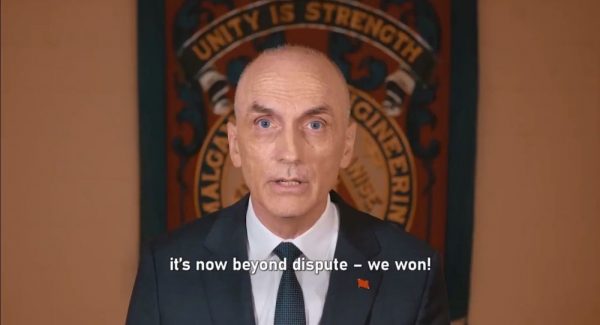
Ex-Labour MP Chris Williamson released a video via Twitter on 17 December 2019 announcing that he won a substantial percentage of his legal fees following a “successful” lawsuit against the Labour Party.
“Despite the misleading claims by Labour Party bureaucrats that I lost by legal action in the High Court regarding my re-suspension from the party, it’s now beyond dispute. We won. I can reveal today that the Labour Party has been ordered to pay 100% of my costs up to the 5th of September for losing the case and a further 30% of my costs after the 6th of September.”
Williamson, a former MP for Derby North, was suspended in February 2019 by the Labour Party, amid accusations of antisemitism. A Labour Party panel re-instated Williamson later in June, but he was re-suspended, almost immediately and without explanation, following pressure from segments of the press and members of the Parliamentary Labour Party (PLP).
Williamson then sued the party arguing that the second suspension was unlawful.
He said the court decision confirmed “that the party acted unlawfully in re-suspending me in June [2019]. Media outlets, either wilfully or ignorantly, falsely claimed that I lost the court case. They should now correct the record”.
Williamson, who had been a party member for 44 years, said:
“all the costs being recovered will be used to establish a left legal fighting fund to assist others who have been maliciously smeared and harassed by similar allegations.”
He expressed his regret for suing the party arguing that “it’s clear that justice was impossible within the party’s unlawful disciplinary system”.
Labour should have argued for “a People’s Brexit”
Williamson spoke exclusively to Sputnik about Labour’s defeat at the general election held on 12 December.
He explained that in his view “Labour’s Brexit position was absurd”.
The former bricklayer and social worker said:
“We should have been arguing for a People’s Brexit against Bris Johnson’s Bankers’ Brexit. I’m convinced we would have won that argument”.
Williamson ultimately ran as an independent after the Party refused to re-instate him, despite his legal victory. He said that despite “campaigning for remain” he accepted the “democratic outcome of the referendum” and had been “consistently calling for [a People’s Brexit vs Johnson’s Banker Brexit] since the referendum”.
He also pointed out that this argument was roundly rejected by fellow Labour MPs.
“At the PLP meeting two days before I was suspended I was howled down for suggesting we should campaign for a People’s Brexit.”
Labour “demoralised” its membership by throwing “anti-racist socialists” to the “wolves”
Williamson also said that the party’s failure to challenge smears of antisemitism cost the party:
“Not confronting the smears and allowing anti-racist socialists to be thrown to the wolves also contributed to the defeat. It demoralised the membership and facilitated the false narrative being perpetuated by Labour’s enemies that Labour was an institutionally antisemitic, racist party.”
He ended by saying that “The truth is the whole moral panic that was created was based on a hoax”.
Williamson was first suspended after saying that he felt the Labour Party, which in his opinion had done more than any other party to combat racism, had backed down too much in the face of baseless accusations of antisemtism levied at people like Labour leader Jeremy Corbyn.
However, the actual basis cited by the party for his suspension was that Williamson was “guilty of a pattern of behaviour [that brought] the party into disrepute”. An accusation he called “Orwellian”.
In July a cross-section of notable individuals, including Israeli historian Avi Shlaim and journalist John Pilger, wrote a letter of support for Williamson in which they quoted US intellectual Noam Chomsky who said there was nothing “even remotely antisemitic” about what Williamson had said.
On Sunday, in the wake of the UK election, the Israeli media released a fabricated story, accusing a well-known Palestinian journalist in Gaza of being part of Hamas and an administrator on the ‘We Support Jeremy Corbyn’ Facebook page.
The story was first published on Tazpit (TPS) News, an Israeli media agency, and was later picked up by Right Wing press in the United States. The information was then repeated throughout Israeli media in both English and Hebrew. By Monday, the Jeremy Corbyn supporting group, that has over 70,000 members, was labeled as an “influential” group linked to Hamas by The Times of Israel.
But the story in of itself was built on erroneous claims. The Gazan journalist Walid Mahoumd – referred to by another alias, Walid Abu Rouk, by the Israeli media – is to the best of his own knowledge, not a Hamas member. There is also no information that has been provided to corroborate this claim and when I questioned him on the issue he had the following to say.
“I am not a member of Hamas. I cannot recall when I was made an administrator on the page. I have never posted anything on the page about Jeremy Corbyn. This is not the first time they have attacked me like this. They just want anything to attack Corbyn.” Needless to say, this was not what the original article on the matter from TPS quoted him saying.
TPS News claim that they spoke to Walid over the phone and that he confirmed to them that he had maintained a role as a manager of the page until recently and still has connections to pro-Corbyn activists. But when I reached out to Walid Mahmoud, he told me that he was called by an Israeli journalist about a month ago, who “bragged about being in the army and now being a journalist.” He told me that he declined to comment for the Israeli news outlet as he boycotts Israel. Walid said that the Israeli spoke to him in Arabic and bragged about his role in COGAT (Coordination of Government Activities in the Territories), which participates directly in enforcing Israel’s occupation of the West Bank and besiegement of Gaza.
In a Facebook post, Walid Mahmoud has written that he now fears for his life, due to being labeled a Hamas member and that Israel could now justify targeting him in an attack, such as an airstrike against his home. He also stresses that the man, who called him to ask for information had threatened him if he did not cooperate.
Jeremy Corbyn, the leader of Britain’s Labour Party, has over the course of his election campaign endured a relentless campaign from pro-Israeli groups and beyond, accusing his Party of anti-Semitism. One of the smears used against Corbyn is that he referred to Hamas as his friends. It would be perceived that those who created this story, did so believing that tying a Facebook page, which disseminates information about Corbyn, to Hamas, would hurt Corbyn in the elections.
The problem with the numerous articles written by the likes of The Jerusalem Post about Walid’s alleged links to Hamas, is that they have no verifiable information which could possibly prove the well-known journalist’s connection to the governing force in Gaza, nor his position on the Facebook page itself. This leaves many to the assumption that the claim being made is based upon the racist notion that all Gazans are somehow linked to Hamas, a theme which Israel used repeatedly when justifying its recent murder of over 300 protesters in Gaza’s Great Return March.
Walid Mahmoud is a journalist, photojournalist, and peace activist who resides in Khan Yunis (southern Gaza Strip). He is someone that I have personally known for around four years now. He has written in English for the likes of Al Jazeera and Middle East Eye and his work on the ground in Gaza has been shared by progressive Jewish groups in the United States such as Jewish Voice For Peace.
Walid has quite literally put his life on the line to bring the world information from the Gaza Strip, witnessing his colleagues die in front of his eyes from Israeli fire in the Great Return March. On the 30th of March this year, he was even shot at by an Israeli sniper and barely escaped death, with his camera blocking the bullet from hitting his head.
During Israel’s 2014 bombardment of the Gaza Strip, which it dubbed ‘Operation Protective Edge,’ Walid’s home was bombed by Israeli missile fire. Walid Mahoumd has endured living through Israeli occupation when he was younger, followed by eight large-scale military operation by Israel against Gaza after the enforcement of the illegal siege.
Now, he is being punished for merely talking about what he sees around himself. If for instance, he is to travel now, it wouldn’t be hard to imagine this process being made more difficult for him and his family. Hamas is considered by most Western countries to be “a terrorist organization” and despite not being a member, he could be perceived as such due to the numerous articles online claiming this.
Walid told me that he would like to take legal action against TPS for their smears and urges all those who published this disinformation to take it down. However, because he lives in Gaza this suing an Israeli news outlet will be an extremely difficult process. All of this trouble coming Walid’s way because of an article, which reads like a conspiracy theorist blog post claiming proof of deceased rapper Tupac Shakur being alive and well in Cuba.
The TPS article claims to have sources inside of Gaza, which they say told them about a supposed Hamas connection to Abu Rouk, yet they fail to provide the names of any such sources. It claims to have intelligence about London-based activists making Walid Mahmoud an administrator of the ‘We Support Jeremy Corbyn’ page, yet they provide no names of those who supposedly made him an administrator. TPS News then claim that Walid, under the supervision of Hamas, still communicates with London Labour activists.
Instead of providing any material evidence of such libelous claims, the article then goes on to claim that because Walid Mahmoud writes for MEMO, Al Jazeera, and the Middle East Eye, that he is therefore connected directly to the Muslim Brotherhood.
What made matters worse was that prominent Islamaphobe Robert Spencer then decided to post this information on his blog site ‘Jihad Watch,’ making Walid a potential target for online Islamaphobic hate mail.
Walid in a Facebook post on the whole matter writes the following points to clear up the situation from his own perspective:
“1- At no point in time was I ever associated with Hamas. I have even been arrested and interrogated by Hamas before in regard to my humanitarian work in Gaza. I’m entirely politically unaffiliated and only represent myself.
2- I was invited to be a co-admin on a pro-Corbyn fan page because I was asked to post occasional updates about daily life in Gaza under blockade. I used my own name for every post I made, without ever hiding.
3- There’s no way I would ever interfere with the UK election — I never posted a single post on the Corbyn Fan page supporting Mr. Jeremy Corbyn or even discussing the Labour Party.
4- I’ve only learned about (and became very fond of) Mr. Corbyn through his crucial support and recognition of our basic humanity, something that usually is ignored by other British politicians. I was never asked to run any activities supportive of him by any party whatsoever.
5- The Israeli journalist, Baruch Yedid, who fabricated this report about me relies only on one anonymous source falsely claiming that my ‘excellent command of English’ is why I was chosen by Hamas. This is total nonsense.”
Robert Inlakesh is a journalist, writer and political analyst, who has lived in and reported from the occupied Palestinian West Bank. He has written for publications such as Mint Press, MEMO, and various other outlets. He specializes in analysis of the Middle East, in particular Palestine-Israel. He also works for Press TV as a European correspondent.
The Scottish independence movement has come a long way since I was a child. A few decades ago the Scottish National Party was on the fringes of politics and even when the Scottish parliament was founded, it was a Labour government at the helm. Independence was a distant dream, untouchable. It was even more intangible a prospect when my parents were young – back in the 1950s the SNP was as ostracised as the BNP currently is, with its members considered to be rather unhinged!
Gradually, over the decades, this has changed, with Alex Salmond presiding over the first ever SNP government and Nicola Sturgeon winning the largest number of seats ever for her party. Scotland’s party of independence has now been ruling the country for 12 years, and continues to dominate the political scene. On Thursday’s general election it won 47 out of 59 seats on a mandate of stopping Brexit and calling a second referendum on Scottish independence. Nicola Sturgeon has been labelled the UK’s second most powerful politician. Her party has never been as popular, and independence has never been so close. Now it seems the question is not if, but when.
Boris Johnson, having slaughtered Jeremy Corbyn in the election, is jubilant. He is currently coasting along on cloud nine, feeling vindicated after months of accusations hurled at himself and his ‘untrustworthy’ leadership. The man who just a short time ago, it was said, could face jail for deceiving the Queen and illegally proroguing parliament, took a gamble which paid off. He defiantly won the general election and now has a parliament behind him to pass his beloved Brexit bill.
And yet it’s not clear that he fully understands the implications of Thursday’s vote for the future of the Union. In fact it seems he is in denial. In a phone call with Nicola Sturgeon on Friday night Johnson reportedly emphasised that ‘he remained opposed to a second independence referendum’. But his words are not accepting the reality of the situation: that the majority of Scots have just voted decisively for the party which stands on an independence platform. And Sturgeon is not going to back down. In an interview on Sunday she said: “If he thinks – and I said this to him on Friday night on the telephone – that saying no is the end of the matter, he is going to find himself completely and utterly wrong.”
Sturgeon, usually mild mannered and reserved in her rhetoric on independence, has unequivocally turned up the volume in the debate, declaring that Scotland could not be “imprisoned” in the UK against its will. She accused the Tories of ignoring the will of the Scottish people and that they will have to ‘face up to and confront reality’ about what the election result means. In an interview with the BBC’s Andrew Marr on Sunday the Scottish First Minister expressed frustration that she was being forced to explain her position: “It really is such a subversion of democracy that you’re talking to the leader of the party that overwhelmingly won the election, and I’m under pressure to say what I’m doing because the mandate that I won is not going to be honoured by the party that got roundly defeated in Scotland”.
The independence campaign of course, narrowly lost in the 2014 referendum 45% to 55%. But so much has changed since then. At that time, the campaign for remaining in the Union was even using EU membership as an argument against independence, saying that Scotland would be jeopardising its future in the EU by leaving the United Kingdom. A few years later, the sad irony of this cannot be missed. Brexit has completely altered the political landscape in Britain, stirring up nationalism both north and south of the border. England has put Brexit before the United Kingdom, and Scotland has equally decided that its future remains with Europe, but not with England.
The Johnson government has a policy on Brexit, but its strategy on Scotland is less certain. Since the Prime Minister took office, his presence north of the border has been lacking, as has his interaction with Scottish politicians. Even his relationship with Scottish Tory leader, Ruth Davidson, was poor, as they had opposite views on Brexit. Johnson has deepened the hatred for the Conservative party in Scotland, estranging apathetic voters even further. By denying a second referendum he will only foster more bad feeling towards him and the Westminster government and boost the Nationalists’ campaign. If he doesn’t turn his attention to Scotland soon, he’ll have a Catalonia situation on his doorstep before he knows it…
Johanna Ross is a journalist based in Edinburgh, Scotland.
Eric Pickles, UK Special Envoy for post-Holocaust issues, has indicated Boris Johnson’s government will pass a law making it illegal for public bodies to engage with the Boycott Divestment and Sanctions (BDS) movement.
Speaking at the International Institute for Strategic Dialogue’s conference in Jerusalem on 15 December, Pickles said BDS was “anti-Semitic” and “should be treated as such”.
The law will not allow public bodies to work with individuals or groups advocating boycott, divestment or sanctions in respect of Israel in any way.
The pledge was alluded to in the Conservative party’s manifesto, with a commitment to “ban public bodies from imposing their own direct or indirect boycotts, disinvestment or sanctions campaigns against foreign countries” as they “undermine community cohesion”.
The anti-BDS law will form part of the Queen’s speech, which outlines the government’s agenda for the next year, and will be read at the opening of parliament on 19 December.
The move will mean local councils controlled by Labour are precluded from using taxpayer funds to boycott foreign countries, including Israel.
Pickles, who’s also chair of the Conservative Friends of Israel group, said Labour’s historic defeat in the 12th December general election UK showed the British people had overwhelmingly rejected anti-Semitism.
“Anti-Semitism is an attack on the British way of life and identity. Without our Jewish citizens we’d be a lesser nation,” he added.
While an increasingly popular global movement, adherent of which claim is targeted as Israeli government policies, not Israelis, renowned Holocaust historian Deborah Lipstadt has alleged BDS is “at its heart…intent on the destruction of the State of Israel”.
“If you look at the founding documents of the groups that first proposed BDS, they called for a full right of return…the ultimate objective of BDS is not BDS itself. If that were the case, we would all have to give up our iPhones, because so much of that technology is created in Israel. I think the objective of BDS, and especially the people who are the main organisers and supporters, is to make anything that comes out of Israel toxic, and I think they have had some success…I do not think any kid who supports BDS is ipso facto an anti-Semite. I think that’s wrong. It’s a mistake. And it’s not helpful,” she said.
Until several days ago, I was a journalist at Newsweek. I decided to hand my resignation in because, in essence, I was given a simple choice. On one hand, I could continue to be employed by the company, stay in their chic London offices and earn a steady salary—only if I adhered to what could or could not be reported and suppressed vital facts. Alternatively, I could leave the company and tell the truth.
In the end, that decision was rather simple, all be it I understand the cost to me will be undesirable. I will be unemployed, struggle to finance myself and will likely not find another position in the industry I care about so passionately. If I am a little lucky, I will be smeared as a conspiracy theorist, maybe an Assad apologist or even a Russian asset—the latest farcical slur of the day.
Although I am a British citizen, the irony is that I’m half Arab and half Russian. (Bellingcat : I’m happy to answer any requests.)
It is a terribly sad state of affairs when perfectly loyal people who want nothing but the best for their countries are labelled with such preposterous accusations. Take Iraq war veteran and Hawaii congresswoman Tulsi Gabbard for example, who was the target of such mud slinging for opposing U.S. involvement in Syria and for simply standing up to the Democratic Party’s most corrupt politician, Hillary Clinton. These smears are immature for a democracy—but I, in fact, welcome such attacks.
When the facts presented are utterly ignored and the messengers themselves are crucified in this way, it signals to right-minded people who the true perpetrators of lies are and where the truth in fact lies.
That truth is what matters most to me. It is what first drove me to journalism while I was working in Jersey’s offshore finance industry after completing my degree from Binghamton University’s School of Management in upstate New York. I was so outraged when I grew to realize that this small idyllic island I love and had grown up on since the age of nine, a British Crown dependency fifteen miles off the coast of France, was in fact a hub for global tax evasion. This realization came to me while the British people were being told that austerity had to continue—public funding for schools, hospitals, policing and all matter of things were to be slashed—all while the government “recovered” after bailing out the banks following the 2008 crash. That austerity lie was one I could no longer stomach as soon as I came to understand that my fairly uninspiring administrative role was in fact a part of this global network of firms to help multinational companies, businessmen, politicians and members of various royal families in avoiding paying trillions in tax—all under a perfectly legal infrastructure that the government was fully aware of, but kept quiet about.
In my naivety, as I left that industry and began my journalism training, I wrote a piece that detailed some of this corruption in hopes of changing the public awareness around these issues and in hopes that they no longer continued—albeit I did so in a manner of writing and sophistication I would be embarrassed of presently—but to my disappointment at the time, the piece was hardly noticed and the system remains little changed to now. Nonetheless, since that moment, I have not once regretted speaking truthfully, most especially for my own mental well being: I would not have been able to regard myself with a grain of self-respect had I continued to engage in something I knew was a lie. It is the very same force that compels me to write now.
There is also another, deeper force that compels me to write. In my years since that moment when I decided to become a journalist and a writer, although I suspect I have known it intrinsically long before, I have come to learn that truth is also the most fundamental pillar of this modern society we so often take for granted—a realization that did not come to us easily and one that we should be extremely careful to neglect. That is why when journalistic institutions fail to remember this central pillar, we should all be outraged because our mutual destruction follows. It may sound like hyperbole, but I assure you it’s not. When our record of where we come from is flawed, or our truth to put it more simply, the new lies stack on top of the old until our connection to reality becomes so disjointed that our understanding of the world ultimately implodes. The failure of current journalism, among other factors, is undoubtedly linked to the current regression of the Western world. In consequence, we have become the biggest perpetrators of the crimes our democracies were created to prevent.
Of course, for those who pay attention, this failure of mainstream journalism I speak of is nothing new. It has been ongoing for decades and was all too obvious following the Iraq war fiasco. The U.S. and U.K. governments, headed by people who cared for little other than their own personal gain, told the people of their respective countries a slew of fabrications and the media establishment, other than a handful of exceptions, simply went along for the ride.
This was something that consumed my interest when I was training to be a journalist. How could hundreds of reputable, well-meaning journalists get it so wrong? I read numerous books on the issue—from Noam Chomsky’s Manufacturing Consent and Philip Knightley’s The First Casualty to work by Chris Hedges, the Pulitzer-prize-winning former foreign correspondent for the New York Times who was booted out for opposing that war (who I disagree with on some things, for the record)—but still, I believed that honest journalism could be done. Nothing I read however, came close to the dishonesty and deception I experienced while at Newsweek. Previously, I believed that not enough journalists questioned the government narrative sufficiently. I believed they failed to examine the facts with close enough attention and had not connected the dots as a handful of others had done.
No. The problem is far worse than that.
Syria
In the aftermath of the Iraq war and during my time studying this failure of the media since, I was of course extremely aware of the high likelihood that the U.S. government narrative on Syria was a deception. For starters, there were the statements made by the retired four-star general, General Wesley Clark, to Democracy Now!’s Amy Goodman in 2007, four years prior to the beginning of the Syria conflict. The following is worth watching to in full.
Nonetheless, once I joined IBTimes UK in 2016, after training with the Press Association and working at the Hull Daily Mail (both of whom I am eternally indebted to for giving me an excellent foundation for starting my career) I solidly understood that journalism was not the profession of making unverifiable claims. I, or any journalist for that matter, could not out-right say that the nature of the Syrian conflict was based on a lie, no matter how strongly we suspected it. To do so, we would need unshakeable evidence that pointed to this.
Through the years, good journalists did document evidence. Roula Khalaf, who will soon take over from Lionel Barber as the editor of the Financial Times, wrote one such piece alongside Abigail Fielding-Smith in 2013. It documented how Qatar provided arms and funded the opposition of Bashar al-Assad’s legitimate government to the tune of somewhere between $1 and $3 billion from the outset of the conflict, rubbishing claims that it was a “people’s revolution” that turned violent. Footage captured by Syrian photographer Issa Touma—made into a short film titled 9 Days From My Window in Aleppo—similarly showed how Qatar-funded jihadists from the Al-Tawhid Brigade were present in the streets of Syria’s capital from the very outset of the war.
“Fighters re-enter my street,” Touma says as he films covertly out of his window. “They look different. They are heavily armed men with beards. I had only heard about them before. This is Liwa al-Tawhid. National television calls them terrorists. The international press calls them freedom fighters. I don’t care what they call it—I refuse to chose a side. But it’s a lie that the revolution started peacefully everywhere. At least in my street, Al Said Ali Street, it started with guns. It didn’t start peacefully at all.”
Veterans of the trade Seymour Hersh and Robert Fisk also poked holes in the U.S. government narrative, but their treatment by other journalists has been one of the most shameful episodes in the history of the press.
Hersh—who exposed the My Lai Massacre during the Vietnam War, the clandestine bombing of Cambodia, the torture at Abu Ghraib prison, in addition to telling the world the real story of how Osama Bin Laden died—was shunned from the industry for reporting a simple fact: Bashar al-Assad’s government is not the only actor with access to chemical weapons in Syria. After a sarin attack in the Damascus suburb of Ghouta in 2013, he was further smeared for reporting that Barack Obama withheld important military intelligence: samples examined in Britain’s Porton Down did not match the chemical signatures of sarin held in the Syrian government’s arsenals.
Fisk, writing days before the Syrian conflict escalated, in a piece that asked Americans to consider what they were really doing in the Middle East as the ten-year anniversary of 9/11 approached, also raised important questions, but he too was largely ignored.
The following year, after the alleged chemical weapons attack in Khan Sheikhoun, I documented the intriguing story of Shajul Islam, the British doctor who purported to have treated the alleged victims and appeared on several television networks including NBC to sell the case for retaliation. He gushed with heroism, but it was not reported he was previously charged with terror offences in the U.K. and was in fact considered a “committed jihadist” by MI6. He was imprisoned in 2013 in connection with the kidnapping of two Western photo-journalists in northern Syria and was struck off Britain’s General Medical Council in 2016. Why he was released without sentencing and was allowed to travel back to Syria remains a mystery to me.
I also refused to recycle the same sloppy language used, inadvertently or not, by a number of other publications. Al Qaeda and their affiliates had always been referred to as terrorists as far as I was aware—why the sudden change to “rebels” or “moderate rebels” for the purposes of Syria? Thankfully, the news editor I worked with most frequently at the time, Fiona Keating, trusted my reporting and had no problems with me using the more appropriate terms “anti-Assad fighters” or “insurgents”—though one could arguably say even that was not accurate enough.
When buses carrying civilian refugees hoping to escape the fighting in Idlib province were attacked with car bombs in April of 2017, killing over 100, most of them women and children, I was disappointed with the Guardian and the BBC for continuing with their use of this infantile word, but this was not the language I felt to be appropriate in my report.
At roughly the same time, in light of the Khan Sheikhoun attack, confronted with an ever-growing list of irregularities and obvious falsifications—such as increasing evidence that the White Helmets were not what they purported of being, or the ridiculousness that the Western world’s de facto authority on Syria had become 7-year-old Bana al-Abed—I wrote an opinion piece that came short of calling the narrative around the Syrian conflict a lie, but simply pleaded that independent investigations of the alleged chemical weapons attack were allowed to take place before we rushed head first into war. I still believed honesty would prevail.
That piece was ultimately declined by IBTimes—though I covertly published it inCounterPunchlater—but the rejection email I received from the editor-in-chief at the time makes for interesting reading.
I was sad to hear that asking for an independent investigation into a chemical weapons attack was an “incendiary theory,” but I was forced to move on.
By that summer, I was let go alongside a number of other journalists from the publication after the Buzzfeed-style model of click-bait-aggregation journalism was heavily punished by a new Google algorithm and had largely failed: page views plummeted and editors couldn’t seem to understand it was because we weren’t doing any real journalism. Having felt frustrated with the industry, I decided not to pursue another position in reporting and decided to move to mainland Europe in hopes of pursuing my other passion—literature—with aspirations of being able to write more freely.
Fast forward to 2019, I decided to return to journalism as I was feeling the pressure to have “a grown-up job” and could not count on my ability to be a novelist as a means of long-term career stability. So when I joined Newsweek in September, I was extremely thankful for the opportunity and had no intention of being controversial—the number of jobs in the industry appeared to be shrinking and, besides, the Syrian conflict appeared to be dying down. As soon as I arrived, Newsweek editor-in-chief Nancy Cooper emphasized original reporting and I was even even more pleased. I wanted to come in, get my head down and start building my reputation as a journalist again.
Then on October 6, President Donald Trump and the military machine behind him threw my quiet hopes of staying well clear of Syria into disarray. He announced the decision to withdraw U.S. troops from the country and green-lit the Turkish invasion that followed in a matter of days. Given my understanding of the situation, I was asked by Newsweek editors to report on this.
Within days of the Turkish invasion into Syria beginning, Turkey was accused of using the incendiary chemical white phosphorus in an attack on Ras al-Ayn and, again, having pitched the story, I was asked to report on the allegations. This spurred a follow-up investigation on why the use of the substance—a self-igniting chemical that burns at upwards of 4,800 degrees Fahrenheit, causing devastating damage to its victims—was rarely considered a war crime under the relevant weapons conventions and I was commended by Nancy for doing excellent journalism.
It was while investigating this story that I started to come across growing evidence that the U.N.-backed body for investigating chemical weapons use, the Organisation for the Prohibition of Chemical Weapons (OPCW), issued a doctored report about an alleged chemical attack in Douma in April of 2018, much to the anger of OPCW investigators who visited the scene. Once Peter Hitchens of the Mail on Sundaypublished his story containing a leaked letter that was circulated internally from one of the disgruntled OPCW scientists, I believed there was more than enough evidence to publish the story in Newsweek. That case was made even stronger when the letter was confirmed by Reuters and had been corroborated by former OPCW director-general Dr. Jose Bustani.
Although I am no stranger to having story ideas rejected, or having to censor my language to not rock the ship, this was a truth that had to be told. I was not prepared to back down on this.
Let me be clear: there is evidence that a United Nations body—whose jurisdiction was established after the world agreed to never repeat the horrors of World War I and World War II, such as German forces firing more than 150 tons of chlorine gas at French colonial troops in Ypres—is being weaponized to sell the case for war.
After OPCW experts found trace levels of chlorine when they visited Douma—i.e. no different than the levels of chlorine normally present in the atmosphere—or raised concerns that the canisters may have been tampered with or placed, both of which were reflected in their original reports, they made protestations because this information was withheld from the final report that was released to the world’s media. Instead, the final wording said chlorine was “likely” used and the war machine continued.
This is not a “conspiracy theory” as Newsweek sadly said in a statement to Fox News—interestingly the only mainstream publication to cover my resignation. Real OPCW scientists have met with real journalists and explained the timeline of events. They provided internal documents that proved these allegations—documents that were then confirmed by Reuters. This is all I wanted to report.
Meanwhile, OPCW scientists were prevented from investigating Turkey’s alleged use of white phosphorus. This flagrant politicization of a neutral body is opening the world up to repeating the same horrors we experienced in those two devastating wars.
This is unacceptable and I resigned when I was forbidden from reporting on this. … Continue reading
During the run up to the recent election in Great Britain, Jeremy Corbyn and the Labour Party were accused, with almost unprecedented hysteria, of anti Semitism. Mr. Corbyn is not anti Semitic, he has been a lifelong anti-racist advocate. Perhaps the histrionics in the press and pulpits were a reaction to the tepid support Corbyn has offered the Palestinians or were based on the likelihood of large tax increases under Corbyn’s socialist manifesto under which the taxpayers would fund, among other items, free universal education, free broadband and the investment of billions of pounds in hazily defined transportation and green energy funds.
Labour’s response to the unrelenting smear campaign was not to defend itself as a body that protects the rights of all races and religions (as its own manifesto claims), but instead to viciously turn on its own members, ousting anyone whose views, however historically verifiable, political or simply observational, were denounced as anti Semitic by someone. Essentially, Labour treated an accusation of anti Semitism as its own a priori truth.
In April, a Labour Party member (here called “Ted”) received a letter from Jane Shaw, secretary of Labour’s Constitutional Committee, stating that the committee “has received a charge from the National Executive Committee… that you have breached Labour Party Rules.”
The alleged breach was conduct “prejudicial or grossly detrimental to the Labour Party,” which, it claims, must be inferred from what it labels “demonstrating hostility to the Jewish people” and “published comments on line which deny or question aspects of the Holocaust.” In my opinion, the writings cited by Labour, although they touch on so-called Jewish issues, fail to substantiate Labour’s own accusations, nor have they run afoul of Britain’s strict hate speech laws. I wonder what might happen had Ted written that Africans as well as others participated in the slave trade? Would this be treated as a racist statement about Africans? I ask, because I read of no such expulsions for racism from the Labour Party.
The Party’s letter dictates its Draconian rules for contesting its accusation. The committee will hold a hearing for which Ted is given the choice of three bad options:1.Ted can appear alone; 2. Ted may bring a “silent friend” who is a “current compliant member [of the Party],” and whose name he provides in advance. Ted may consult with his friend but the friend may not speak aloud to the Committee. (what is the possible rationale for this?) or; 3. Ted may request “to be allowed be (sic) represented by either a lay or trade union representative, [who is also] a member of the Party or a [lawyer], who does not have to be a Labour Party member.
The only way Ted can use non-Labour aligned representation or support is for Ted to incur the expenses of hiring a lawyer. Of course, not every ‘accused’ member is articulate enough to represent himself before the committee nor rich enough to afford a lawyer. The Party’s letter emphatically states that its rules never allow reimbursement for expenses under any circumstances including if Ted is found innocent of all charges or even if the charges are found to have been based on fraudulent or malicious accusations.
The brief letter contains more outrageousness. It warns Ted that “It is vital to ensure fairness to you and other individuals, and to protect the rights of all concerned under the Data Protection Act 2018 that these proceedings are undertaken confidentially.” But the Data Protection Act sets standards to protect individuals, such as Ted, from organizations that collect data, such as the Labour Party. See: Ted is entitled to do as he wishes with his own file, it is the LabourParty that has a duty of confidentiality.
What is the credibility of an organization that sends an accusatory letter demanding confidentiality based on a law intended to protect individuals from organizations such as itself? Is its ‘rule’ intended to protect Labour from the consequences of its own conduct?
Labour further asserts that it retains control over data Ted receives in the process of reviewing the serious and in my opinion, unfounded charges made against him. “[such data] remains under the control of the Labour Party and … should not be .. disseminated without prior permission from a Labour Party Officer.” By what authority does Labour deny Ted the right to name his accusers? Without Ted’s knowledge or consent, the Labour Party examined his personal facebook and twitter chats to play “find the anti Semitism,” and has published their ‘findings’ to two separate Orwellian-titled “committees.” It is no surprise that the letter does not inform Ted of his reciprocal rights should a committee member publicly release information about him. There are good reasons why governments protect open trials, one of which is to discourage kangaroo courts like the one outlined in Labour’s letter.
The salient questions this letter raises are why any sane person would want to be a member of such a Party and why the Brits would choose (as they emphatically did not) to be under the leadership of a party whose standards for tolerance and justice are set by its own big brother.
Monica Maggioni is an Italian journalist and is CEO of Rai.com, which broadcasts ‘Rai News 24 TV’, among others. She interviewed Syrian President,Bashar al Assad, on November 26, and the interview was to be broadcast on December 2; however, it was mysteriously postponed.
Behind the scenes, at Rai.com there was conflict over the interview, with Fabrizio Salini declaring the interview was not commissioned, therefore it would not be broadcast, while Antonio Di Bella, director of news, declared it was not suitable to be broadcast, and Italian Senator Alberto Airola requested Maggioni to explain her role in the interview and answer charges of creating a diplomatic incident.
What was so explosive in the interview that the Italian news media wanted to hide from the Italian viewers? Many believe it has to do with questions 8 and 9 and President Assad’s response.
Question 8: At this moment, when Europe looks at Syria, apart from the considerations about the country, there are two major issues: one is refugees, and the other one is the Jihadists or foreign fighters coming back to Europe. How do you see these European worries?
President Assad: We have to start with a simple question: who created this problem? Why do you have refugees in Europe? It’s a simple question: because of terrorism that’s being supported by Europe – and of course the United States and Turkey and others – but Europe was the main player in creating chaos in Syria. So, what goes around comes around.
Question 9: Why do you say it was the main player?
President Assad: Because they publicly supported, the EU supported the terrorists in Syria from day one, week one or from the very beginning. They blamed the Syrian government, and some regimes like the French regime sent armaments, they said – one of their officials – I think their Minister of Foreign Affairs, maybe Fabius said: “we send.” They sent armaments; they created this chaos. That’s why a lot of people find it difficult to stay in Syria; millions of people couldn’t live here so they had to get out of Syria.
The US-NATO-EU attack on Syria is unprecedented in history. General Wesley Clark was told there was a plan to ‘take out Syria’ well before the first protests took place in Deraa. This was an internationally coordinated attack on Syria by the US and Europe. This was a classic ‘regime-change’ project, which was instigated between the US and Israel, but agreed to by the EU and NATO members. From the early stages of the conflict in Syria, the US and Europe provided political, military and logistic support to the ‘rebels’ in Syria and refused to call them terrorists. On 18 August 2011, President Barack Obama stated, “The future of Syria must be determined by its people, but President Bashar al-Assad is standing in their way. For the sake of the Syrian people, the time has come for President Assad to step aside.” This US statement was fully supported by Europe.
In 2013 President Assad stated he was ready for dialogue with the armed terrorists, but only if they surrender their weapons. However, the US-NATO-EU plan to support the terrorists never included a peaceful surrender of weapons, followed by a national dialog, which would end in a peaceful solution to the conflict. The plan only called for weapons, training, and European officers to be continuously available to the terrorists, for ‘regime-change’. Europe only wanted to fuel the fires in Syria, and never planned to be the voice of peace and international law.
What was at first billed as ‘rebels’ and ‘freedom fighters’ soon morphed into sectarian extremists and Radical Islamic terrorists who filled the battlefields under many names and uniforms, but who were all essentially the same terrorists. Their names ranged from the ‘Free Syrian Army’ to ISIS. Radical Islam is a political ideology and is not a religion or a sect. Many experts have called Radical Islam a ‘Death-Cult’, which glorifies the killing of unarmed civilians, as well as armed adversaries, even to the point of eating human flesh while recording it on video.
Presidents Obama and Sarkozy convinced the EU to follow their lead. However, the Syrian people and armed forces fought back.
Some of the refugees left Syria for ideological reasons, they sided with the terrorists and followed the Muslim Brotherhood. Others left for Europe because their homes and livelihoods were destroyed by the terrorists, but many were just economic migrants, and had not lost a home, were from safe areas, and perhaps had never seen any fighting, and they left to seek an income from the charity offered to them in the EU.
EU-NATO support of terrorism in Syria
Bulgaria: Boïko Borissov, Prime Minister from 2014, supplied the drug ‘Captagon’ to the terrorists in Syria on orders of the CIA. The drug causes the terrorists to lose inhibitions and while under the influence they are capable of horrific atrocities.
Germany: A ship with intelligence and satellite capabilities was off the coast of Syria providing the terrorists the locations and movements of the Syrian military, as well as intercepted telephone communications. Wolfgang Ischinger, chairman of the Munich Security Conference, said: “If the West supplies arms itself, it has more chance of influencing how they are used.”
Great Britain: British intelligence provided terrorists with information on Syrian military movements. In 2012, SAS Commandos were conducting covert operations within Syrian territory, and provided terrorists with military aid, including communications equipment and medical supplies, and provided intelligence support from its Cyprus bases, revealing Syrian military movements which were passed on to the terrorists. In 2013, Prime Minister David Cameron said that Britain would send weapons to the terrorists. In August 2016, the BBC published photographs that showed British Special Forces soldiers guarding the perimeter of the terrorist’s base at al-Tanf, on the Syria-Iraq border, and the terrorists were shown to be equipped with four-wheel drive Al-Thalab vehicles and weapons such as sniper rifles, anti-tank weapons, and heavy machine guns.
France: The ‘Friends of Syria’ group was initiated by then-French President Nicolas Sarkozy in 2012. They declared their intent to support the terrorists in Syria, “If the regime fails to accept the terms of the political initiative outlined by the Arab League and end violence against citizens, the Friends of Syria should not constrain individual countries from aiding the Syrian opposition by means of military advisers, training, and provision of arms to defend themselves.” In 2013, French President François Hollande said, that France was ready to begin supplying lethal aid to the terrorists, and by 2014 Hollande confirmed that France had delivered arms to the terrorists, and by 2015 had begun airstrikes in Syria.
Italy: On 28 February 2013, the ‘Friends of Syria’ held their meeting in Rome, and among the 11 members were France, Germany, Italy, UK, and the EU. In a study published in 2019, the number of terrorists from Italy who were in Syria numbered 135 as of July 2018.
The EU: in 2013 Brussels decided assistance to the terrorists would include weapons training. Jane’s Defense Weekly reported a US shipment of 994 tons of weapons and ammunition in December 2015 from Eastern Europe to Syrian rebel groups, including 9M17 Fleyta anti-tank missiles, RPG-7s, AK-47S, DShKs, and PKMs. In early March 2013, a Jordanian security source revealed that the U.S., Britain, and France were training terrorists in Jordan to begin building a militia that would take over after Assad’s fall. By 2019, the EU issued a statement about Syria in which they now claim to call for peace and political negotiations to settle the conflict of almost 9 years duration and to have supported humanitarian and economic assistance there. However, when faced with documented history, this statement is a bald-faced lie. The EU position from the outset of the conflict was to support the armed terrorists and to prevent even chemotherapy drugs to be imported to Syria, because of the EU sanctions, which today prevents any possible rebuilding effort.
MintPress speaks with Ari Ben-Menashe, a former Israeli spy who worked closely with Robert Maxwell, Ghislaine Maxwell’s father, as part of their work with Israeli military intelligence and had frequent encounters with Jeffrey Epstein.
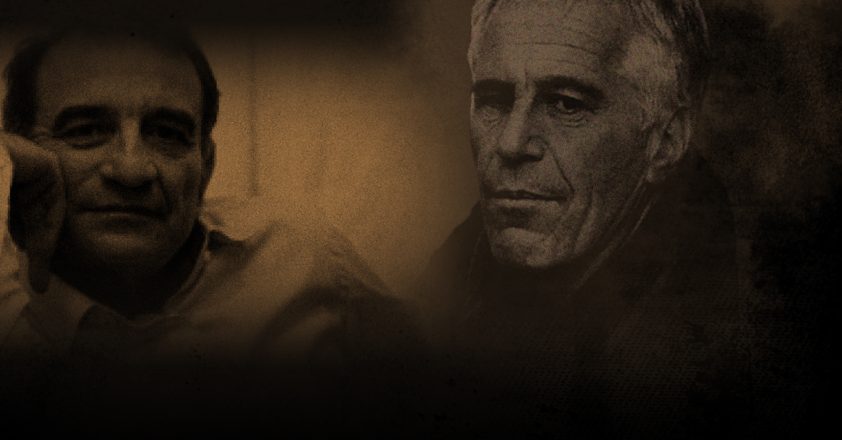
A graphic shows Ari Ben-Menashe, left, and Jeffery Epstein, right. Credit | Claudio Cabrera
MONTREAL — In recent weeks, renewed attention has been brought to the allegations that Jeffrey Epstein and Ghislaine Maxwell’s sex trafficking and sexual blackmail operation was run on behalf of Israeli military intelligence. Those claims revolve around statements made by a former Israeli military intelligence official turned public relations consultant Ari Ben-Menashe, whose allegations regarding the Epstein scandal were reported by MintPress this past October.
Ben-Menashe’s claims related to Epstein first surfaced in an interview between Ben-Menashe and Zev Shalev of the independent news outlet, Narativ. As detailed in a MintPress summary and commentary of that interview, Ben-Menashe claimed to have seen Jeffrey Epstein in the office of Robert Maxwell, Ghislaine Maxwell’s father, several times in the 1980s.
At the time, Ben-Menashe was in close contact with Robert Maxwell regarding their work mutual work with Israeli military intelligence. Maxwell, in addition to heading a media empire and being a one-time member of U.K. parliament, was a longtime operative for Israeli intelligence, so much so that his 1991 funeral was attended by no less than six serving and former heads of Israeli intelligence as well as several high-ranking Israeli politicians and prime ministers.
Maxwell is alleged to have recruited Jeffrey Epstein for Israeli intelligence and later introduced Epstein to Ben-Menashe and another operative, Nicholas Davies. Epstein was introduced to Ben-Menashe as having been pre-approved by leading figures in Israel’s military intelligence directorate, known as Aman.
MintPress recently conducted its own interview with Mr. Ben-Menashe as part of an ongoing investigation on the life and connections of the now-infamous Jeffrey Epstein.
Part of that interview is provided below with relevant commentary, particularly regarding claims related to the relationship between Epstein and former Israeli Prime Minister Ehud Barak, Epstein’s trip to Tel Aviv immediately prior to his first arrest, and the reasons for Israeli military intelligence’s interest in orchestrating and financing a major sexual blackmail operation targeting top U.S. politicians.
“Israel Requested that Epstein Target Clinton”
MintPress News first asked Ben-Menashe about Robert Maxwell, a known asset and operative for Israeli intelligence, having recruited Jeffrey Epstein. Ben-Menashe confirmed this to MintPress and also noted that, after their initial meeting, Epstein was frequently present in Maxwell’s office in London.
During the 1980s, as MintPresspreviously reported, Epstein claimed to have been an intelligence operative and so-called “bounty hunter” in the world of shadow finance. During this time, he was known to have developed close relationships with several British arms dealers, particularly Sir Douglas Leese. Thus, Epstein appeared to frequently be traveling between the Middle East and London, which is also supported by Epstein’s now-infamous Austrian passport which he was believed to have carried during this period of time.
Ben-Menashe told MintPress that he had not only met Epstein after Epstein had been recently recruited by Israeli military intelligence, but had seen him on several occasions thereafter as Epstein “used to be in [Robert Maxwell’s] office [in London] quite often” and would arrive there between trips to and from Israel.
In addition, Ben-Menashe revealed his understanding of why Epstein was eventually shepherded into acting as a professional sexual blackmailer on behalf of Israeli military intelligence. Per Ben-Menashe, there were concerns among Israeli intelligence figures that, following the Reagan Era, a new president would push for Israel to make peace with the Palestinians, something those officials sought to avoid by any means necessary.
ABM – Here’s the thing… Mr. Carter… as in President Carter… the Israelis feared that Mr. Clinton, when he was campaigning for President, will be a repeat of Mr. Carter. He wanted to press them for peace with the Palestinians and all that stuff. They feared… Clinton wasn’t that… but they feared he was that… And I think Mr. Epstein was sent early on to catch up with President Clinton.
MintPress News (MPN) – Well, that’s interesting because the first year Clinton was in office, Epstein was already attending donor dinners at the White House and making White House visits as well.
ABM – Yeah, that’s right. That’s right. I believe his biggest client was Mr. Clinton catch, or catch, or whatever, and he had a few other congressmen and what not but Clinton was, was his biggest catch.
Thus, Ben-Menashe argues, when Bill Clinton’s candidacy in the 1992 U.S. Presidential election became clear, efforts were made to target him via sexual blackmail and Jeffrey Epstein was chosen for that purpose. Bill Clinton was eventually blackmailed by the state of Israel and his administration was also targeted by Israeli espionage as part of the “Mega” spy scandal. Epstein’s involvement in the Clinton administration and his visits to the White House date back to Clinton’s first year in office. More information on the Epstein-Clinton relationship can be found in this MintPress report.
In addition, MintPress also asked Ben-Menashe if he was aware of Ghislaine Maxwell being directly involved with her father’s intelligence-related activities prior to his death in 1991. Ben-Menashe noted that Ghislaine accompanied her father so frequently, including on a now-infamous 1989 party on Maxwell’s yacht where Donald Trump and several key figures in the PROMIS software scandal were in attendance, that she was involved in his intelligence-related activities to some extent. However, he stopped short of saying how involved she was or what she has specifically been involved in prior to her father’s death.
When did Epstein really meet Ehud Barak?
One of the more controversial ties between Epstein and powerful politicians is that between Epstein and former Israeli Prime Minister Ehud Barak. Barak has claimed to have only met Epstein in 2002 and, from that point on, their relationship was very public, with Barak frequently visiting and even spending the night at residences owned by Epstein, including apartments where he housed the underage girls that he exploited. Barak also visited Epstein’s now-infamous island and recruited him to help fund the Israeli intelligence-connected company, Carbyne911.
However, there appear to be indications that Epstein and Barak may have met much earlier than Barak has since claimed. Given that Ben-Menashe claimed to have learned of Epstein’s recruitment by Israeli military intelligence in the 1980s, MintPress asked if one of the people involved in his recruitment was Ehud Barak. Barak served as head of Israel’s military intelligence directorate, Aman, from April 1983 to January 1986.
Ben-Menashe could not recall the exact year when he first became aware of Epstein’s recruitment by Israeli military intelligence but stated that it was “most likely” during Ehud Barak’s tenure as the head of Aman. Yet, even if Epstein’s recruitment did not take place while Barak headed Aman, it is highly likely — per Ben-Menashe — that Epstein had met Barak during this time because “Robert Maxwell became buddies with Ehud Barak… and he [Robert Maxwell] probably introduced them, the young man [Epstein] to Mr. Barak” if the two were not already acquainted.
Since the Epstein scandal broke, Ehud Barak has insisted that he did not meet Epstein until the year 2002 and claimed that the two had been introduced by former Israeli Prime Minister Shimon Peres. Ben-Menashe dismissed the possibility that this claim was true, emphatically stating that he was “sure they had met before” and that he did not believe that their first meeting was in 2002.
Epstein’s 2008 Trip to Tel Aviv
Just a few months before he was sentenced to prison for the first time in June 2008, Jeffrey Epstein had made a sudden visit to the Israeli capital of Tel Aviv. In April of that year, the Palm Beach Daily News reported that Epstein was staying at the Tel Aviv Hilton and quoted an Epstein spokesman as saying that he was “spending Passover, meeting with Israeli research scientists, and taking a tour of military bases.”
Sometime prior to Epstein’s sentencing on June 30 of that year, Alexander Acosta –then-U.S. Attorney for the Southern District of Florida– signed off on a lenient sentence for Epstein who was charged with soliciting sex from a minor. That legal arrangement has since been nicknamed the “sweetheart deal.” Acosta later told Trump transition officials prior to his nomination for Secretary of Labor that his decision to approve the “sweetheart deal” came after he had been told to back off in the Epstein case because Epstein “belonged to intelligence.”
Though Acosta did not specify from whom he had received this information, former CIA agent Phil Giraldi has made a convincing case that they originated from Epstein’s then-lawyer Alan Dershowitz, a close associate of Epstein with ties to high-ranking Israeli politicians, and Barry Krischer, then-Florida State Attorney for Palm Beach who recently received an award from the Anti-Defamation League (ADL) for his “outstanding contribution to the legal profession and to the community at large.”
As detailed in a previous MintPress report on Epstein’s ties to Israel published this past August, the ADL’s long-time top funders have close ties to Epstein and his sexual blackmail network, particularly the Bronfman family of Seagrams fame.
Ben-Menashe told MintPress that Epstein’s 2008 Tel Aviv visit was likely “blowing smoke” and involved Epstein “trying to make himself important maybe not to get arrested” and “hoping that the Israelis would help him.” He then added that “At the time they probably did” help Epstein, but added that “the second time around [i.e. 2019], well… it would be a harder sell.”
Whitney Webb is a MintPress News journalist based in Chile. She has contributed to several independent media outlets including Global Research, EcoWatch, the Ron Paul Institute and 21st Century Wire, among others. She has made several radio and television appearances and is the 2019 winner of the Serena Shim Award for Uncompromised Integrity in Journalism.
Overnight the electoral map of the UK has changed significantly. Scotland is once again bathed in a sea of yellow, as England has been shrouded in blue. With the Scottish National Party obtaining 45% of the vote north of the border, and the Conservatives only 25% it is clear not only is there no mandate for Brexit in Scotland, but as leader Nicola Sturgeon has said, there is now very much a mandate for holding a second referendum on Scottish Independence.
England, on the other hand has put its support resoundingly behind Prime Minister Boris Johnson and his mantra of ‘Get Brexit Done’. With a remarkable 364 seats, as opposed to Labour’s 203 – its worst performance since 1935 – he proclaimed that a ‘political earthquake’ had occurred and that he would end all the squabbling of the last few years he would take the country out of the EU ‘no ifs and no buts’. This was a message that appealed to the majority, clearly sickened by the deadlock of Brexit. Despite the radical spending programme proposed by the Labour party, this election ended up being, as it was promoted, all about Brexit.
And this takes us to the broader context of what is in fact happening in the UK. Indeed, it’s important to see this election in the wider European political landscape. This was not just a Conservative party win, but a victory for nationalism. Not just Scottish Nationalism, but English Nationalism under the banner of Brexit, and Welsh and Irish Nationalism. For the first time ever, Northern Ireland elected more Nationalist MPs than Unionist, in what was also, like Scotland, an anti-Brexit vote, which will spur on more talk of Irish reunification. Welsh Nationalist party Plaid Cymru also held on to its four seats in Wales.
So while it may be portrayed as a landslide victory for the Conservatives, this election more than ever has shown up the cracks forming in the Union. Scottish Nationalism appears to be on an irreversible path to independence, with the question now being not if there will be a referendum on independence, but when. The strong Remain vote up north has only boosted the case for leaving the UK, as Scotland places more importance on being part of Europe, than being part of Britain. England, for its part, has clearly put more emphasis on being out of Europe, than it has on retaining the Union.
Indeed, looking at the western world in general, the popularity of nationalist and right-wing parties is undisputedly on the rise. The AfD in Germany, the National Front in France or Vox in Spain – these parties are all gaining popularity, just as Trump has in the US. And together with Johnson’s Conservatism, they all have something in common, that ‘populist’ appeal that really gets its message across. For regardless of their party leaders’ sins (Boris Johnson has been repeatedly been lambasted as a liar, racist, and misogynist), they have not been enough to deter voters, for whom clearly the nation state is what matters most.
There’s no doubt that Brexit has been a shock for the EU. Arguably Britain had always been a hesitant member, refusing to join the Euro, or join the Schengen zone (which allows borderless travel between states); it never quite developed that European mindset. But the Brexit vote took EU politicians by surprise, sending shockwaves across a Union already under pressure from Eurosceptic parties. They will no doubt breathe a sigh of relief in Brussels that the Brexit stalemate will now be broken with Boris Johnson’s parliamentary majority – finally a deal can be passed – but the reality that one of their major players finally leaving must be making them nervous.
Boris Johnson put faith in the people, and the gamble paid off. But whether he appreciates the real seismic consequences of this ‘political earthquake’ is another question. For cracks are not only emerging between Britain and Europe, but across the United Kingdom itself. It’s the price to be paid for Brexit.
Johanna Ross is a journalist based in Edinburgh, Scotland.
Media interest in Saudi Arabian connections to the crimes of 9/11 has centered on calls for the release of the 28 missing pages from the Joint Congressional Inquiry’s report. However, those calls focus on the question of hijacker financing and omit the most interesting links between the 9/11 attacks and Saudi Arabia—links that implicate powerful people in the United States. Here are twenty examples. … continue
This site is provided as a research and reference tool. Although we make every reasonable effort to ensure that the information and data provided at this site are useful, accurate, and current, we cannot guarantee that the information and data provided here will be error-free. By using this site, you assume all responsibility for and risk arising from your use of and reliance upon the contents of this site.
This site and the information available through it do not, and are not intended to constitute legal advice. Should you require legal advice, you should consult your own attorney.
Nothing within this site or linked to by this site constitutes investment advice or medical advice.
Materials accessible from or added to this site by third parties, such as comments posted, are strictly the responsibility of the third party who added such materials or made them accessible and we neither endorse nor undertake to control, monitor, edit or assume responsibility for any such third-party material.
The posting of stories, commentaries, reports, documents and links (embedded or otherwise) on this site does not in any way, shape or form, implied or otherwise, necessarily express or suggest endorsement or support of any of such posted material or parts therein.
The word “alleged” is deemed to occur before the word “fraud.” Since the rule of law still applies. To peasants, at least.
Fair Use
This site contains copyrighted material the use of which has not always been specifically authorized by the copyright owner. We are making such material available in our efforts to advance understanding of environmental, political, human rights, economic, democracy, scientific, and social justice issues, etc. We believe this constitutes a ‘fair use’ of any such copyrighted material as provided for in section 107 of the US Copyright Law. In accordance with Title 17 U.S.C. Section 107, the material on this site is distributed without profit to those who have expressed a prior interest in receiving the included information for research and educational purposes. For more info go to: http://www.law.cornell.edu/uscode/17/107.shtml. If you wish to use copyrighted material from this site for purposes of your own that go beyond ‘fair use’, you must obtain permission from the copyright owner.
DMCA Contact
This is information for anyone that wishes to challenge our “fair use” of copyrighted material.
If you are a legal copyright holder or a designated agent for such and you believe that content residing on or accessible through our website infringes a copyright and falls outside the boundaries of “Fair Use”, please send a notice of infringement by contacting atheonews@gmail.com.
We will respond and take necessary action immediately.
If notice is given of an alleged copyright violation we will act expeditiously to remove or disable access to the material(s) in question.
All 3rd party material posted on this website is copyright the respective owners / authors. Aletho News makes no claim of copyright on such material.