“Spring Arriving 26 Days Early”–BBC
By Paul Homewood | Not A Lot Of People Know That | April 21, 2018
The BBC has been up to its tricks again!

http://www.bbc.co.uk/programmes/b09yddxd
The latest edition of Radio 4’s environmental programme, “Costing the Earth”, looks at how our springs are supposedly getting earlier. (Yes, I know spring starts in March!)
The programme’s opening introduction by presenter Lindsey Chapman gives us a clue that it won’t be an objective assessment:
We’re looking for signs of how a volatile climate is shifting our seasons, and affecting both our native wildlife and migrant visitors to these shores.
Chapman, also presenter of the Springwatch TV series, then adds:
I’ve been noticing changes on my own patch, from the arrival of the first swallows to the flowering times of spring flowers over the last ten years.
At about seven minutes in though, she makes this extraordinary statement:
Spring now arrives an average of 26 days earlier each year than it did 10 years ago. We know this because of the extraordinary records kept by the public, stretching back centuries.
As Paul Matthews points out:
This statement that Spring is almost a month earlier than it was just 10 years ago is complete nonsense and fails the most elementary sanity check. It appears, yet again, that where global warming is concerned, elementary common sense and fact-checking are thrown out by the BBC, and replaced with absurd exaggeration and alarmism.
So where did Chapman get this crazy claim from?
As she goes on to explain, it is supposedly from the Woodland Trust, who run a scheme called Nature’s Calendar.
This allows members of the public to record when they first see certain events each spring, such as birds, first flowerings, butterflies and so on. In other words, phenology. During warm springs, naturally enough, these events tend to arrive earlier.
According to Woodland Trust, these first sightings have been between around one and two weeks earlier in the last three years, though some butterfly and bird arrivals were as much as three weeks early in 2017:

https://naturescalendar.woodlandtrust.org.uk/analysis/seasonal-reports/
You will notice that Woodland Trust use 2001 as a baseline, and nowhere do they claim that spring is now 26 days earlier than ten years ago.
But why 2001? In fact they have only been collecting this data since 2000, and decided to use 2001 as the base year because, they claim, weather conditions that year “closely reflected the 30-year average”.
However, on closer examination we see that it is not the current 30-year average they are talking about (ie 1981-2010), but 1961-90.

This is highly significant, because the 1961-90 period was considerably colder than both the decades that preceded and followed it.

https://www.metoffice.gov.uk/hadobs/hadcet/data/download.html
HH Lamb pointed out that the onset of spring in Oxford was 16 days later between 1963-80, compared to 1920-50:

HH Lamb – “Climate History and the Modern World” (p 274):
To a large extent therefore, the onset of spring in recent years has merely returned to earlier patterns, with the end of the colder interlude.
We can see the effect of using the two different baselines below:

https://www.metoffice.gov.uk/hadobs/hadcet/data/download.html
The 1961-90 period was 0.7C colder than 1981-2010. We can also see that, while there have been ups and downs, there is little evidence of overall change in spring temperatures since around 1990.
This is definitely not the message portrayed by the BBC programme.
We should also note that the spring of 2001 was much colder than prior years, which makes it strange that it should be used as a base year at all. The Woodland Trust recognised this same point in their Spring 2005 report:

https://naturescalendar.woodlandtrust.org.uk/analysis/seasonal-reports/?p=3
Of course, when we are talking about “early springs”, temperatures in January and February may be just as important as those in April and May.
But when we look at Jan-March, and Feb–April, we find a very similar pattern – very little change in trend since 1990:


https://www.metoffice.gov.uk/hadobs/hadcet/data/download.html
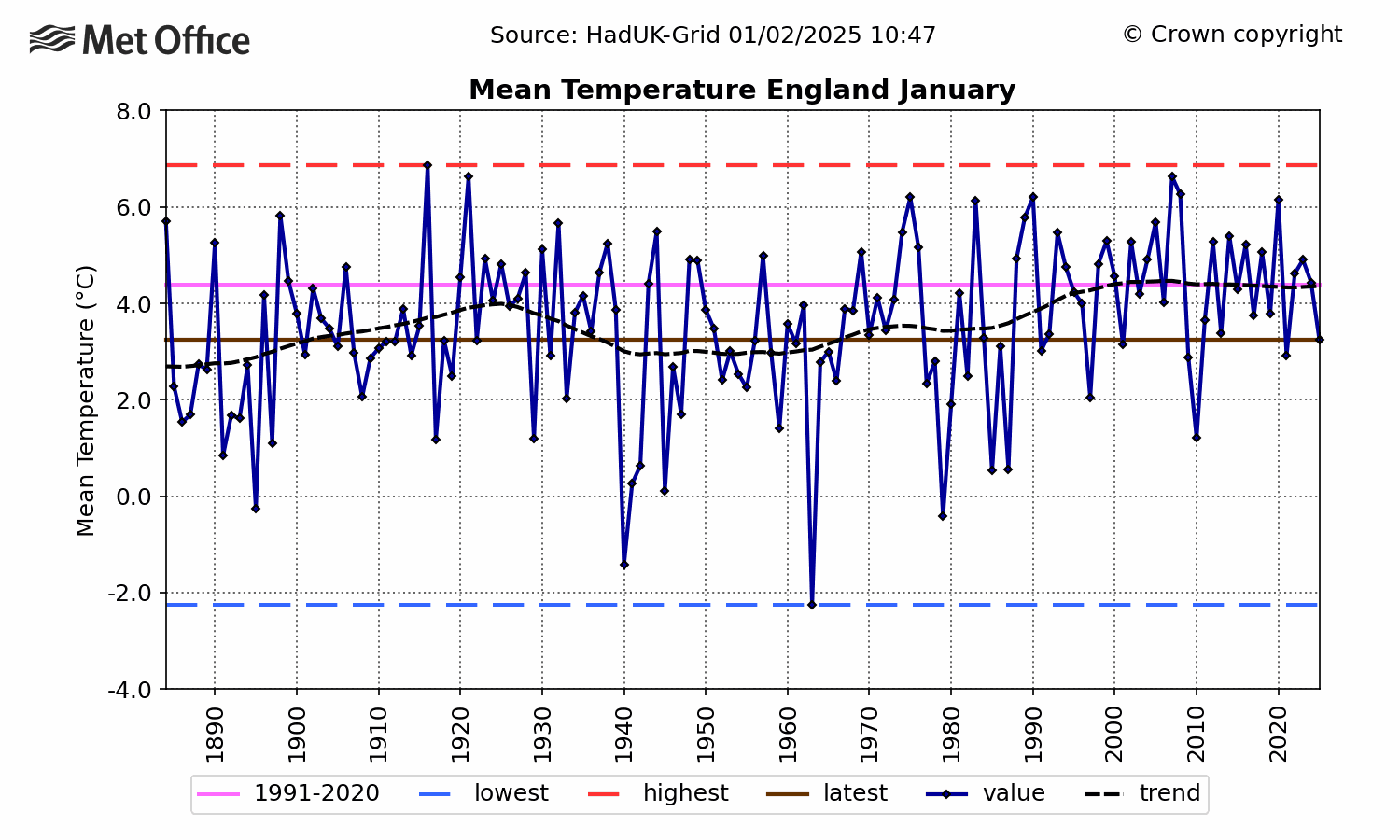
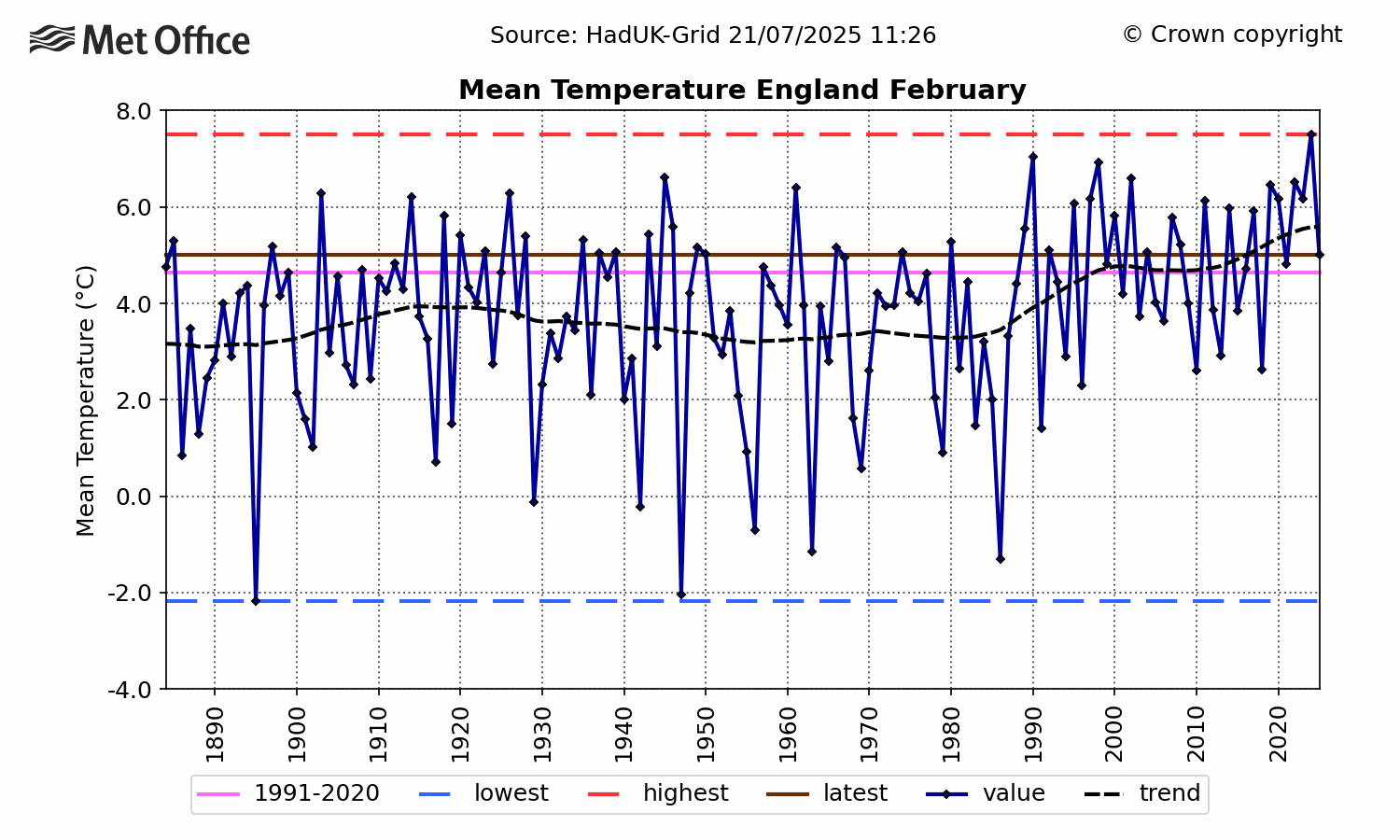
This should be little surprise, when we see that, contrary to popular myth, temperatures in January and February have changed little since a century ago.
And, as with spring temperatures, there is a noticeable dip between 1961-90:
https://www.metoffice.gov.uk/climate/uk/summaries/actualmonthly
Summary
There appears to be no evidence to back up Chapman’s claim that spring now arrives an average of 26 days earlier each year than it did 10 years ago, either in the temperature record or in the Woodland Trust surveys.
The latter are in any event misleading, and certainly not in a shape or from “scientific”. Their conclusions are obtained only by using an unusually cold year, 2001, as their base point.
There is actually nothing in the temperature record to suggest that springs are beginning any earlier than they were thirty years ago.
To be fair, one of the interviewees, Matthew Oates of the National Trust, did mention that the transition to warmer/earlier springs began several decades ago.
Nevertheless, the central theme of the programme was that the UK climate is changing rapidly, something not borne out by the data.
I have no doubt that the BBC will fall back on their regular defence of “scientists say”. However, following OFCOM’s recent ruling that the BBC should have challenged Lord Lawson on comments he made, it should surely not be acceptable for them to simply accept unscientific research from bodies like the Woodland Trust without challenging that as well.
Of course, in this instance the BBC has gone one step further. Not only have they broadcast the Woodland Trust’s findings, Lindsey Chapman has actually then presented them as an indisputable fact.
British govt must explain its behavior in Skripal case, Syria strikes – UKIP MEP
RT | April 21, 2018
Although the UK has deemed Russia responsible for the poisoning of Sergei Skripal, the public needs proof, a UKIP MEP told RT, adding that London should also justify its role in the Syria airstrikes.
Speaking to RT at the Yalta International Economic Forum in Crimea, West Midlands Member of European Parliament (MEP) Bill Etheridge said there is a lot of “murky water” in the Skripal case. “A lot of things that are unexplained, a lot of behavior that does not ring true.”
He went on to explain that “the British course of public opinion doesn’t believe it, so the behavior of our government and security services, they need to explain to us why they are so convinced that the great nation of Russia would wish to attack anyone in our country.”
Etheridge added that no one has provided any “solid proof” that Russia was behind the poisoning. “The current British government position is one where they are taking too strong a position with Russia. They should be having dialogue, they should be having conversation.”
Skripal, a former Russian double agent, and his daughter Yulia were poisoned in the UK town of Salisbury on March 4. Russia has offered its full cooperation and urged London to provide evidence, including nerve agent samples. However, it has not received any.
The Russian Foreign Ministry says the incident is “highly likely” to have been staged by British intelligence, while Russia’s envoy to the UK has expressed concern that the investigation by the Office for the Prohibition of Chemical Weapons (OPCW) lacked transparency.
Etheridge also addressed the topic of Western intervention in Syria, one week after the UK, US, and France launched airstrikes over an alleged chemical attack that the three allies have blamed on the government of Bashar Assad.
“My belief is… the Syrian civil war is one where Western intervention is not helpful… my position is that there should be no intervention and frankly by intervening in that part of the world in the past, the UK and US have made things worse. As far as I’m concerned, we should stand back from this and allow the Syrian people self-determination.”
“I expect that London will get pressure from the British people to justify themselves and if they cannot justify themselves, there will be protests from British people saying, ‘no war in our name, no conflict in our name.'”
The UK, US, and France refused to wait for the results of an official OPCW investigation into the alleged chemical attack before deciding on military action. This also came despite the Russian military traveling to the scene of the alleged attack and finding no evidence of a toxic agent.
Russia has also stated that it has indisputable evidence that the attack did not take place, with Russia’s Ambassador to the OPCW, Aleksandr Shulgin, stating that it was a “pre-planned false-flag attack by the British security services, which could have also been aided by their allies in Washington.”
What Are “Assad Apologists”? Are They Like Those “Saddam Apologists” Of 2002?
By Caitlin Johnstone | Rogue Journalist | April 20, 2018
Isn’t it fascinating how western journalists are suddenly rallying to attack the dangerous awful and horrifying epidemic of “Assad apologists” just as the western empire ramps up its longstanding regime change agenda against the Syrian government? Kinda sorta exactly the same way they began spontaneously warning the world about “Saddam apologists” around the time of the Iraq invasion?
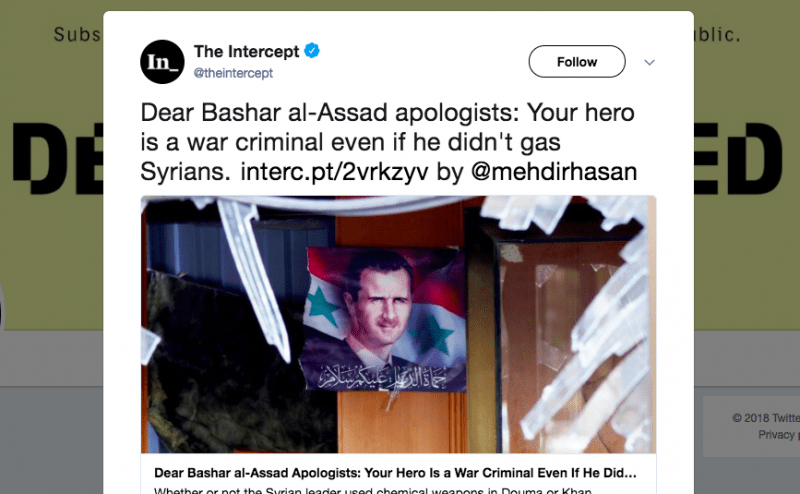
The increasingly pro-establishment Intercept has published an article titled “Dear Bashar al-Assad Apologists: Your Hero Is a War Criminal Even If He Didn’t Gas Syrians,” condemning unnamed opponents of western interventionism in Syria for not being sufficiently condemnatory of Bashar al-Assad in their antiwar discourse.
Last week The Times published an article titled “Apologists for Assad working in British universities,” frantically informing the public that “top academics” are circulating information that runs counter to the official Syria narrative, followed this week by a Huffington Post article attacking those same academics in the same way. Yesterday, the BBC ran an article titled “Syria war: the online activists pushing conspiracy theories,” warning its readers about “pro-Syrian government” internet posts.
I first encountered the word “apologetics” as a young Catholic girl in a parochial school, where the term was introduced to me as the religious practice of defending Church doctrine using discourse and argumentation. I did not become familiar with the related secular term “apologia” until much later, which is defined as “a work written as an explanation or justification of one’s motives, convictions, or acts.”
It wasn’t a term I ever made use of or encountered much in day to day life until I started writing extensively about the dangerous warmongering behaviors I was seeing in my country’s allies last year, when all of a sudden it became a part of my daily life. For me, I was just trying to help prevent the western empire from decimating yet another Middle Eastern country in yet another war based on lies and avoid dangerous escalations that could lead to nuclear holocaust, but to countless strangers on the internet I am an “Assad apologist” and a “Putin apologist.”
People have been calling me these things every single day for well over a year now. The internet is weird, man.
And surprise surprise, now that the war drum is beating louder than ever for Syrian blood, the phrase “Assad apologists” is enjoying a massive uptick.
The argument as I understand it is that people like Professors Tim Hayward and Piers Robinson, the subjects of the aforementioned Times and Huffpo articles, are not protesting the latest warmongering agenda of a multinational power establishment with an extensive history of decimating Middle Eastern countries, but are in fact going out of their way to justify Bashar al-Assad’s motives, convictions, and acts. Not because they oppose death and destruction like normal human beings, but because they are just positively head-over-heels gaga over some random Middle Eastern leader for some reason.
And that’s always how these arguments go. By pointing out that the US-centralized empire has been plotting regime change in Syria literally for generations, I’m not opposing dangerous regime change interventionism, I’m defending a dictator. By noting that the western empire has an extensive history of using lies, propaganda and false flags to manufacture support for military aggression, I’m not stating a well-documented and frequently admitted fact, I’m performing apologia on behalf of a despotic regime.
It can’t possibly be because I am aware that the neoconservatives who have been braying for this attack for years are always completely wrong about everything. It can’t possibly be because the US-centralized war machine has had a well-established pattern for many years of demolishing countries based on lies and false pretenses of humanitarianism only to leave in their wake a humanitarian disaster, which they then blame on “mistakes” made by whoever happened to be in charge at the time. It can’t possibly be because US-led military interventionism in modern times is literally never helpful, literally never accomplishes what its proponents claim it will accomplish, and is literally always extremely profitable for its most vocal advocates.
Nope, it’s got to be because I fell in love with a gangly Syrian president whom I’d never even thought about before the neocons set their crosshairs on him, and I only oppose the next imminent military catastrophe because I agree so much with his policies and behavior.
Even more annoying than the honest regime change proponents are people like Mehdi Hasan, author of the aforementioned Intercept piece, who claim to oppose US regime change but find themselves tone policing the antiwar left instead. The world is full of problems, the greatest arguably being a third world war and potential nuclear confrontation between Russia and America ensuing from US interventionism in Syria, but men like Hasan choose to focus their creative energy on making sure the antiwar left mitigates its speech sufficiently and prefaces every antiwar argument with “Assad is a bloodthirsty evil dictator, but”.
Like that’s what the world desperately needs right now: for the antiwar left to be even more mitigated in its speech than it already is. For us to slam on the brakes of our antiwar surge to check one another to make sure we’re all being explicitly anti-Assad enough.
These writers never make it clear exactly why it’s so important for everyone in the antiwar movement to be checked and scrutinized for excessive enthusiasm about the Syrian government. Are they worried they’ll go and join the Syrian Arab Army? That they’ll install Assad as president of the United States? How is sympathy toward the Syrian government a threat to anything other than the manufacturing of support for more escalations in US-led interventionism?
We don’t need equivocation and tone policing right now. What we need is a loud and unequivocal NO to western military interventionism in the country immediately adjacent to the one we raped fifteen years ago.
We’ve been here before. Here’s an article from 2001 titled “Saddam Hussein’s American Apologist”. Here’s one from 2002 titled “Saddam’s apologists”. Here’s another from 2003 titled “After Saddam’s Capture: Will His Apologists Now Recant?” Here’s yet another from 2003 titled “Armchair generals, or Saddam’s leftwing allies.” Here’s one from 2005 titled “Parliament’s damning report about Saddam apologist George Galloway.” This was an extremely common smear against opponents of the Iraq invasion, who were of course later proven to have been 100 percent correct in every way.
Iraq is as relevant as relevant gets to this debate, and anyone who claims otherwise is only doing so because they know Iraq is devastating to their Syria arguments. They’re pulling the same damn tricks in the same damn way, in some cases with the same damn people. These “We must stop the Assad apologists!” op-eds are coming out with increasing frequency and urgency because they are losing control of the Syria narrative and they are running out of tricks. Don’t let their authoritative way of speaking fool you; they are not nearly as confident as they pretend to be.
Support Johnstone’s writing with a contribution on Patreon or Paypal.
Russian diplomat says Britain deserves title of world’s worst genocide perpetrator
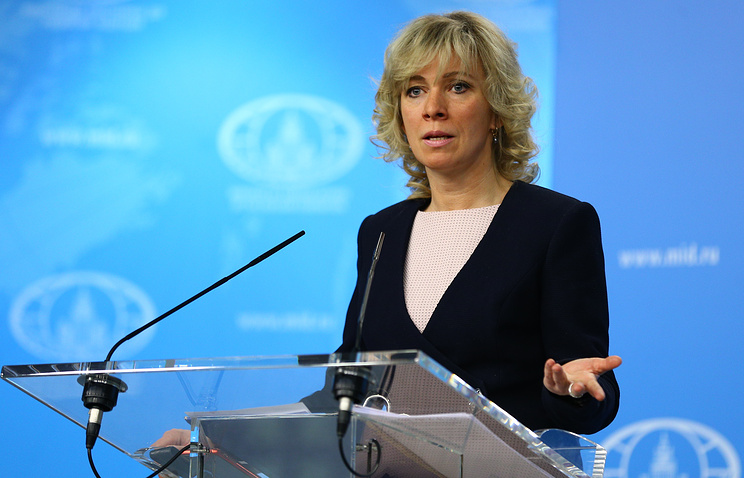
Russian Foreign Ministry spokeswoman Maria Zakharova
TASS | April 19, 2018
MOSCOW – Britain may well be described as the holder of the world’s genocide record, Russian Foreign Ministry spokeswoman Maria Zakharova told a news briefing on Thursday in response to claims by UK ambassador in Moscow Laurie Bristow to the effect Russia was allegedly behind a number of contract killings.
“Britain is the world’s worst genocider,” she said. “The thought of how many millions of innocent people were put to death in the British colonies is terrifying.”
Zakharova recalled that according to various estimates, British colonists exterminated up to 90%-95% of the aborigines in the process of colonizing Australia.
In the 1870s, Britain conducted genocide against the Zulus in Cape Colony, and in 1954-1961, against the Kikuyu people in Kenya, she recalled.
“In retaliation for the killing of 32 white colonists the British authorities exterminated 300,000 members of the Kikuyu people and drove another 1.5 million into concentration camps,” she said.
In all, Zakharova made public 17 pages of archive information describing Britain’s unseemly actions in the world scene over many years.
Skripals poisoning ‘highly likely’ staged by British intelligence – Russian Foreign Ministry
RT | April 19, 2018
The UK’s behavior after the Skripal incident suggests that the attack was organized by the British spy agencies or was at least beneficial for them, Russian Foreign Ministry spokeswoman Maria Zakharova has said.
“It was highly likely that the false-flag incident with the poisoning of the Russian citizens in Salisbury was beneficial for, or perhaps organized by, the British intelligence services in order to mar Russia and its political leadership,” Zakharova told a news conference in Moscow on Thursday, markedly using the same phrase regarding probability as London officials and their allies.
Such a false-flag operation would perfectly fit into the “general Russophobe course of the [UK] Conservative government to demonize our country,” the spokeswoman stated, adding that the UK has “frequently committed such acts in the past.”
The “National Defense Strategy of the UK and the banquet speech of PM Theresa May at the end of last year,” also contribute to such version of events, according to Zakharova. The document and May’s speech have clearly envisioned “countering Russia” as one of the main priorities for the UK.
London’s actions in the aftermath of the attack on former double agent Sergei Skripal and his daughter Yulia on March 4 in the town of Sailsbury have raised many questions in Moscow. Russia says the UK did everything possible to disrupt the investigation and conceal facts, while squarely pinning the blame on Moscow. Russia has vehemently denied the allegations and repeatedly urged the UK to show some proof, or at least make information on the incident publicly available.
“The firm refusal to cooperate with Russia on the Salisbury poisoning investigation, London’s violations of the consular convention, reluctance to cooperate with the OPCW and concealment of the basic data to conduct a transparent investigation are the shining proofs of that,” Zakharova concluded.
Russia’s OPCW envoy exposes ‘eight UK lies’ in Skripal case
RT | April 19, 2018
The UK’s narrative in the Skripal case is a “story woven with lies,” with London continuously trying to “deceive” the international community, Russia’s OPCW envoy said, highlighting eight examples of such misinformation.
“We’ve tried to show that everything our British colleagues produce is a story woven with lies,” Russia’s permanent representative to the Organization for the Prohibition of Chemical Weapons (OPCW) Aleksandr Shulgin told reporters on Wednesday, following the organization’s meeting on the Skripal case.
“And, unlike the British, who aren’t used to taking responsibility for their words and unfounded accusations, we showed specific facts why we believe our British partners, to put it mildly, are ‘deceiving’ everyone.” The official provided eight examples of UK-pushed misinformation, surrounding the March 4 events, when the former double agent Sergei Skripal and his daughter Yulia were poisoned in the town of Salisbury.
#1. Russia refuses to answer UK ‘questions’
“In reality, they’ve asked us only two ‘questions’… And both were worded in such way that the existence of an undocumented arsenal of chemical weaponry at Russia’s disposal was presented as an established fact, beyond any doubt.”
It was effectively an ultimatum, pressing Moscow to either confess that it “attacked the UK with chemical weapons,” or to admit that it had “lost control over the chemical warfare arsenal.”
Moscow answered both of these ‘questions’ immediately, stating that it had nothing to do with the Salisbury incident. Apart from that, the official emphasized, it is an established fact that Russia destroyed all its chemical weaponry stockpile ahead of schedule last year.
#2. UK abides by Chemical Weapons Convention rulebook
The OPCW procedures clearly state that if one member state has issues with another, it should send an official request, and thus the other party would be obliged to respond within 10 days, Shulgin said. However, instead, the UK allegedly “instigated by their colleagues from across the pond,” disregarded the established mechanism and came up with a dubious “independent verification” scheme, which violates those very OPCW rules.
#3. Russia refuses to cooperate
While the UK and a number of its allies accuse Russia of “refusing to cooperate to establish the truth,” the situation is exactly the opposite, Shulgin insists. Moscow is interested in a thorough investigation of the incident – especially since the victims are Russian citizens. Moscow repeatedly insisted on a joint probe and urged London to release data on the Skripal case, but all efforts were in vain. Many requests went unanswered by the UK, while others received only a formal reply.
#4. Russia invents versions to distract attention
Despite numerous speculations and allegations by questionable sources, cited by the UK’s own domestic media, it was Moscow that was eventually accused of coming up with some “30 versions” of the Salisbury events, allegedly to “disrupt the investigation,” Shulgin said.
“In reality, the picture is different. In fact, it’s the British tabloids, the so-called independent media, which is multiplying those versions,” the official stated, recalling some of the narratives, most of which entirely contradict each other.
#5. Exterminating traitors is Russia’s official state policy
“They claim that the Russian leadership has, on multiple occasions, stated that extermination of traitors abroad is a state policy of Russia,” Shulgin said. “This is slander, of course. The British cannot produce a single example of such statements, since the Russian leadership has never said anything of the kind.”
#6. Experts pin the blame on Russia
The head of the OPCW mission has clearly said that it was impossible to determine in which country the toxic substance used in Salisbury had originated. Yet the OPCW findings were once again used by the UK officials to claim Moscow was “highly likely” responsible. “Look, the head said it was impossible and they, abandoning all common sense, said ‘They’ve confirmed our evaluations that it was Russia.’ How else can you evaluate this but as a lie?” Shulgin wondered.
#7. ‘Novichok’ is a Soviet invention, so it has to be Russia
The development of the so-called Novichok family of toxic agents more than 30 years ago in the Soviet Union was one of the main cornerstones in the UK narrative, pinning blame for the Skripal incident on Russia. Publicly available sources, however, indicate that “the West has been and still is conducting research and development into such substances,” Shulgin said, giving a fresh example of such activities.
“Not long ago, namely on 1 December 2015, the US Patent and Trademark Office filed a request to its Russian colleagues asking to check patentability … of a chemical weaponry-filled bullet, which could be equipped with Tabun, Sarin or the Novichok family of agents,” the official stated.
#8. Yulia Skripal avoids contact with relatives & refuses Russian consular support
While such a statement was indeed produced by the UK authorities “on behalf” of Yulia, Moscow believes it to be false. According to Shulgin, the situation with Yulia is starting to look like a Russian citizen is effectively being “held hostage” by the UK authorities.
London systematically destroying evidence in Skripal case – Russia’s UN envoy
RT | April 19, 2018
The UK continues to conceal and destroy evidence relating to the Salisbury incident and have crossed all boundaries in their rhetoric by alleging President Putin’s personal involvement, Russia’s UN envoy Vassily Nebenzia has said.
“The British authorities are engaged in the systematic destruction of evidence,” Nebenzia told the United Nations Security Council, which held a session, called by UK on Wednesday, to discuss the OPCW report and other developments in the Skripal case.
“Skripal’s pets were killed. No samples were obviously taken. The places attended by the Skripals – a bar, a restaurant, a bench, park ground, etc – are all being cleared,” the diplomat said, pointing out that, despite some loud statements about the alleged contamination of the area, “people continue to live in Salisbury as if nothing happened.”
The envoy also reminded the council members that Sergei and Yulia Skripal, who, according to London, are now both recovering from the poisoning by a deadly military grade nerve agent A-234 (‘Novichok’), are kept hidden from the public eye ever since the March 4 incident. In the meantime, London categorically refuses to provide Russia any access to the investigation, and so far has left 45 out of 47 questions addressed to British authorities about the case unanswered.
In a summary of its report, the OPCW didn’t not independently identify the nerve agent used in the Salisbury case nor its origin, but instead only confirmed “the findings of the United Kingdom relating to the identity of the toxic chemical that was used in Salisbury.”
The conclusions made by OPCW were based on samples provided by the UK investigators and do not prove London’s claim of Russia’s involvement in the poisoning, Nebenzia noted. “The main thing that the report lacks, and what the British side was so eager to see, is the conclusion that the substance used in Salisbury was produced in Russia,” he said.
The UK Ambassador to the United Nations, Karen Pierce, however, downplayed the lack of technical evidence and urged the council members to look at “the wider picture which has led the United Kingdom to assess that there’s no plausible alternative explanation than Russian State responsibility for what happened in Salisbury.”
Extensively using the ‘highly likely’ argument, the UK envoy once again claimed in her address to the UNSC that only Russia had the “technical means, operational experience and the motive to target the Skripals.” At one point she even claimed that “President Putin himself was closely involved in the Russian chemical weapons programme.”
“London apparently thinks the Russian President has a hobby of running chemical weapons programs in his free time. I don’t know whether you appreciate that you’ve crossed all possible boundaries,” Nebenzia replied.
While the UK is yet to produce clear evidence of Russian involvement in the alleged poisoning of the former double agent and his daughter, US Ambassador to the UN Nikki Haley once again attacked Moscow during the council meeting, parroting its ally’s narrative.
“As we have stated previously, the United States agrees with the UK’s assessment that Russia is responsible for the chemical weapons in Salisbury,” Haley said. “Whether that is in their direct act, or irresponsibly losing control of the agent, which could be worse, our support for our British friends and colleagues is unwavering.”
Read more:
Russia exposes British lies on Skripal, but trail leads to US
By M.K. Bhadrakumar | Asia Times | April 19, 2018
The sensational case of the poisoning of the ex-MI6 agent and former Russian military intelligence colonel Sergei Skripal on March 4 in Salisbury, in the UK, is becoming more and more curious. Under a blinding spotlight from Moscow, the British allegation regarding a Russian hand in the poisoning of Skripal is getting exposed. An engrossing plot in big-power politics is also unfolding. There is stuff here for a Le Carre novel.
Are we witnessing a replay of the false flag Gulf of Tonkin attack of August 1964, the imaginary “incident” concocted by the US military to provide legal and political justification for deploying American forces in South Vietnam and for commencing open warfare against North Vietnam?
To recap, Britain alleged without any empirical evidence that a military grade nerve agent of a type known as Novichok was used in Salisbury, saying it was originally developed in the former Soviet Union, and therefore, Moscow’s hand – possibly, even President Vladimir Putin’s hand – was “highly likely”.
Moscow has maintained, on the other hand, that it had destroyed all its chemical weapons and an Organization for the Prohibition of Chemical Weapons (OPCW) investigation verified and testified to that.
The British allegation quickly morphed into a large-scale expulsion of Russian diplomats (over 100 of them) by western capitals, under heavy pressure from Washington and London. The US alone expelled 60 Russian diplomats, while Britain expelled 23.
Egg on May’s face
Britain is studiously ignoring the Russian requests for samples of the chemical agent used in the Salisbury attack and for consular access to be granted to the former spy’s daughter Yulia. Meanwhile, Britain instead approached the OPCW to investigate.
The OPCW has now responded that it cannot identify the country of origin of the chemical agent used in the Salisbury attack.
There is egg on PM Theresa May’s face.
However, Russians managed to get their hands on the report prepared for the OPCW by its reputed laboratory in Spiez, the Swiss Center for Radiology and Bacteriological Analysis. According to the Swiss lab’s report, the chemical formula used in the Salisbury attack has been in service in the US, the UK and other NATO countries. Furthermore, neither the Soviet Union nor Russia “ever developed or stockpiled similar chemical weapons.”
That’s more egg on May’s face.
Now comes the bombshell. On April 18, Moscow disclosed that it has formally handed over to the OPCW proof to the effect that the Novichok agent purportedly used in the Salisbury attack actually happens to be patented as a chemical weapon in 2015 in the US and produced in that country. (By the way, unlike Russia, the US is yet to destroy its chemical weapon stockpiles, as required under the Chemical Weapons Convention of 1997.)
Now, not only the British government but Washington too has some explaining to do.
Was Skripal attack a covert op by the West?
Simply put, the Salisbury attack might even have been an Anglo-American joint covert operation undertaken with the ulterior motive to ratchet up tensions between the West and Russia. (The Washington Post reported on Monday that the former National Security Advisor HR McMaster might have hoodwinked President Donald Trump into approving the expulsion under the wrong notion that similar numbers of expulsions by European allies was in the pipeline. In the event though, the Europeans made only token expulsions.)
Britain is steadily edging away from the Skripal case, hoping, perhaps, that the matter will die down. But will Moscow let Britain off the hook?
On their part, the Russians seem to be holding back on some explosive information pointing toward the US’s direct complicity in this affair.
Indeed, if this was McMaster’s swan song, the indefatigable Russophobe probably hoped to kill two birds with one shot – push Russia’s relations with the West to a crisis point and second, scotch the prospects of an early US-Russia presidential summit (which Trump wanted.)
McMaster reportedly tried to stop Trump from congratulating Putin on his big victory in the Russian election on March 18 in a phone conversation where they discussed a possible summit meeting in a near future.
How far all this is linked to Trump’s decision on March 22, finally, to sack McMaster as his National Security Advisor is yet another template. By the standards of military people, McMaster probably has the reputation of being an “intellectual” but the man proved to be an unvarnished Cold Warrior fit for a museum.
From all accounts, Trump never trusted McMaster and the two had an acrimonious relationship. The one-star general who was overlooked for promotion by the Pentagon was Trump’s default choice following the abrupt departure of Michael Flynn.
Michael Wolff narrates a hilarious episode in his book ‘Fire and Fury’ that during the job interview for the NSA post, McMaster tried to impress Trump when he showed up in military uniform with his silver star and launched into a wide-ranging lecture on global strategy. After, Trump reportedly remarked, “That guy bores the shit out of me.”
BBC presenter declares ‘info war against Russia’ after ex-navy chief questions Syria ‘evidence’
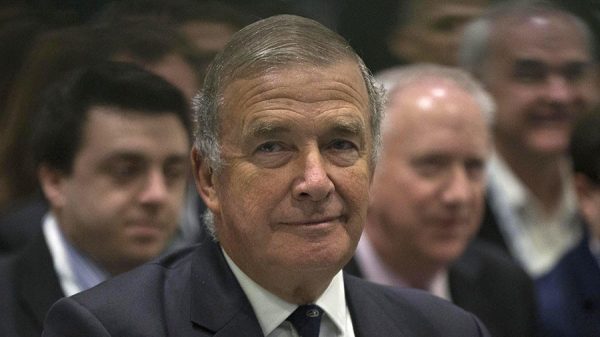
Britain’s Admiral Lord West. © Neil Hall / Reuters
RT | April 18, 2018
During a live interview, a BBC news presenter declared “we’re in an information war with Russia” after a former Royal Navy chief questioned the “extraordinary” claims surrounding an alleged chemical attack in Syria.
Former Navy Admiral Lord West’s questioning of the mainstream narrative surrounding the alleged chemical weapons attack in the town of Douma led the BBC’s Annita McVeigh to suggest that truthfully stating his position and posing questions risked “muddying the waters” in an ongoing “information war with Russia.”
Lord West had described how in his view the claim that Bashar Assad ordered the attack “doesn’t ring true,” asking “what benefit is there for his military?” He went on to say “we know that in the past some of the Islamic groups have used chemicals, and of course there would be huge benefit in them labelling an attack as coming from Assad.”
West went on to question the ‘evidence’ provided by groups like the White Helmets and the World Health Organization, both of which he described as “not neutral.”
The former First Sea Lord then described how in the past he had been put under pressure to support politically motivated narratives: “I had huge pressure put on me politically to try and say that our bombing campaign in Bosnia was achieving all sorts of things which it wasn’t. I was put under huge pressure, so I know the things that can happen.”
At that point the BBC’s McVeigh appeared to question whether he should actually be expressing his opinion truthfully, asking: “Given that we’re in an information war with Russia on so many fronts, do you think perhaps it’s inadvisable to be stating this so publicly given your position and profile, isn’t there a danger that you’re muddying the waters?”
West replied: “I think the answer is, if there’s a real concern, let’s face it, if [Assad] hasn’t done it then that is extremely bad news. If Assad hasn’t carried out the attack, I think it’s just worth making that clear. I think our government’s policy towards Assad has not been clever since 2013.”
Featured Video
AIDS Inc. by Gary Null (2007)
or go to
Aletho News Archives – Video-Images
From the Archives
Clash of Civilization, Iran Part II
By Jamal Kanj – Intifada-Palestine.com – January 14, 2011
Israel’s survival kit is: perpetuate conflict, insecurity to rationalize collective hate and finally playing victim.
Devoid of conflict, Israel implodes internally; without hate, Zionism loses its justification; and playing eternal victim to continue blackmailing the West. Absence of this holy trinity, Israel ceases to exist.
From its inception, the house of Zion has mastered exploiting adversarial powers to advance Israel’s cause. For instance, their influence over the Democratic Party in the US began with President Truman’s bid for 2nd term election in 1948.
Responding to strong opposition from Secretary of State General George Marshall and Department experts urging against recognition of Israel, President Truman replied: “I’m sorry gentlemen but I have to answer to hundreds of thousands [Jewish voters] who are anxious for the success of Zionism. I do not have hundreds of thousands of [voting] Arabs among my constituents”
Zionists influence over liberal American politics was matched with the doctrinal school of Conservative theoreticians aligning the Republican Party’s platform with Israel’s objectives. The Neoconservative Zionists, coined Zioncons, invented the “Clash of Civilization” concept to fight Israel’s wars. … continue
Blog Roll
 Aletho News
- 12 Things Your Psychiatrist Was Trained Not to Tell You
- From Unipolar Universalism to Multipolar Civilizational Distinctiveness
- RSF military group defects, joins Sudanese army: State media
- Ireland goalkeeper refuses to play ‘Israel’ as squad weighs boycott
- China pushes back against US on Cuba, Iran
- Ukrainian Soldiers, Potential Mercenaries: Have Gun, Will Travel!
- Burnham’s UN debut… A masterclass in British disinformation
- Iran flights continue despite US aviation sanctions
- Global Tipping Points Lead the World Into a State of Entropy
- The day-after at the White House: USA and Xi Jinping
- If Americans Knew
- Israel forces Gazans to live in constant peril – Daily Update
- Deconstructing Netanyahu’s pants-on-fire UN rant – Daily Update
- Trump betrayed voters with his campaign lies and prioritized a foreign country once he took office
- Netanyahu calls Israel’s war in Gaza ‘opposite of genocide’ in UN speech to near-empty hall
- Settler Kidnappings: Torture, Sexual Abuse and Terrorisation of Palestinian Abductees as Israel Deepens Annexation of West Bank
- Gaza winter nears as 162,000 tents become unusable, raising fears of humanitarian crisis
- Netanyahu says, “It’s the opposite of genocide”; UN says Gaza economy is world’s ‘most severe crisis on record’ – Daily Update
- Israel’s US-Backed Assault on Gaza Has Created the ‘World’s Most Severe Economic Crisis on Record’: UN
- ‘Protecting U.S. Citizens’… From Israel
- ‘This is where I live now, the back of a truck’: a day in the life of a grandmother in Gaza
- No Tricks Zone
- New Study: Earth And Venus Surface Warmth Largely Explained By Convection And Lapse Rate, Not CO2 Or Radiation
- 2025 Nature Paper Claiming Worsening Global Drought Gets RETRACTED …Heavily Flawed
- New Study: ‘Global Drought Shows No Detectable Recent Acceleration Under Climate Warming’
- Economic Masterminds: German Socialists Suggest Taxing Productivity Gains Stemming From Using AI
- The South China Sea Has Not Been Cooperating With The Climate Change Narrative
- Energy Crisis: Germany Enters Heating Season With Historically Low Gas Reserve Fill Levels
- New Study: The Antarctic Ice Sheet Gained Mass From 2020-2024 Due To Staggering Snow And Ice Accumulation
- Study: Ocean Heating Rates From Thousands Of Years Ago ‘Dwarf’ Modern Ocean Heating Rates
- Climate Extremists Target, Attack Large-Scale Power Grid Infrastructure In Germany!
- New Study: Antarctic Ice Melt Has Contributed Less Than 1 Centimeter To Sea Level Rise In The Last 30 Years

