Syria chemical attack: Theresa May says Assad’s allies should be held to account
RT | April 9, 2018
Prime Minister Theresa May said all supporters of Syria’s leader Bashar Assad should be held to account over an alleged chemical attack on a formerly rebel-held town. Russia says there is currently no evidence of the attack.
Speaking in Copenhagen, Denmark, the Tory leader said that if allegations of a chemical attack against the town of Douma, Eastern Ghouta are confirmed, Assad – along with his allies, which include Iran and Russia – should pay the price.
“Yes, this is about the actions, the brutal actions of Assad and his regime, but it’s also about the backers of that regime. And, of course, Russia is one of those backers,” May said during a news conference in Denmark.
“This is a brutal regime that is attacking its own people, and we are very clear that it must be held to account, and its backers must be held to account too,” she told reporters as she stood beside her Danish counterpart, Lars Lokke Rasmussen, a close ally.
Allegations of the attack in Eastern Ghouta on Saturday, which is thought to have killed 70 people, were reported by the humanitarian aid group, the White Helmets. The group, however, has itself been repeatedly accused of having ties to terrorists.
Syria and Russia have rejected the claims as “fabrication,” while Russia’s Foreign Minister Sergei Lavrov said no evidence has been found of chemical weapons being deployed in Douma.
Theresa May’s comments come after the US and France threatened a “joint, strong response,” with US President Donald Trump tweeting that there will be a “big price to pay” for the attack.
Corbyn calls on Boris Johnson to come clean about Skripal attack, Novichok & Russia
RT | April 9, 2018
Jeremy Corbyn has called on Boris Johnson to “tell us what he knows,” after he insisted the Porton Down military lab had said the substance used to poison Sergei and Yulia Skripal was unequivocally Russian – and was proven wrong.
As the Labour leader was speaking at the launch of the party’s London elections campaign in Westminster, Corbyn said that if Johnson “has evidence that hasn’t been made public yet, I think he has a responsibility to do so.”
“[Johnson] claimed that he was 101 percent sure on German television who was responsible for the disgusting attack on the Skripals. The Foreign Office then listened to what Porton Down said and removed their own statement in support of what he had said,” Corbyn said.
“My response is Boris Johnson has got to tell us what he knows. Because it doesn’t do anybody any good to throw around assertions against people,” the Labour leader added. “It does us all good to support the Organization for the Elimination of Chemical Weapons handing in their investigations. And hold to account those who committed this terrible crime on the streets of this country.”
Corbyn’s comments come only a day after Johnson lashed out at the Labour leader in the Telegraph, stating that he was giving “false credibility” to propaganda from Moscow by refusing to agree “unequivocally” that Russia was responsible for the attack on the Skripals.
“There is only one thing that gives the Kremlin succor and lends false credibility to its propaganda onslaught,” Johnson said. “That is when politicians from the targeted countries join in. Sadly, I am driven to the conclusion that Jeremy Corbyn has joined this effort.”
Johnson told Deutsche Welle that Porton Down has categorically traced the nerve agent used on ex-double agent Sergei Skripal back to Russia – leaving the foreign secretary red-faced when the lab chief revealed to Sky News that they had been unable to determine the origin of the nerve agent.
The UK Foreign Office deleted its own tweets that made the same claim.
Skripal Poison Case Becoming British Hostage Scenario
By Finian CUNNINGHAM | Strategic Culture Foundation | 09.04.2018
The British denial of a visitor visa to a Skripal family relative from Russia is fueling concern that the whole affair is far more sinister than what the British government and media have been claiming.
Far from the Skripal father and daughter being the alleged victims of a Russian assassination plot, it now seems increasingly apparent that they are being held against their will by Britain’s authorities. In short, hostages of the British state.
From the outset of the alleged poisoning incident in Salisbury on March 4, the official British narrative has been pocked suspiciously with inconsistencies. The lightning-fast rush to judgment by the British government – within days – to blame the Kremlin for “a brazen murder attempt” was perhaps the main giveaway that the narrative was following a script and foregone conclusion to incriminate Russia.
Last week, the saga took several significant twists raising more doubts about the official British narrative. First, British scientists at the Porton Down warfare laboratory admitted that they hadn’t in fact confirmed the alleged nerve agent used against the Skripals originated from Russia. That admission spectacularly exposed earlier British government claims as false, if not barefaced lies.
Secondly, it emerged that potentially key witness-material was destroyed by the British. Three pet animals in the Salisbury home of Sergei Skripal were declared dead and their remains incinerated. Autopsies could have shed light on the nature of the alleged nerve agent used against the Skripals. Why were the animal remains incinerated? And why did the British authorities disclose the fate of the animals only after the matter was raised by the Russian envoy to the UN Security Council on Thursday?
Thirdly, there is the strangely callous way that the British authorities have refused a visitor visa to a Skripal family relative from Russia who was intending to fly to England to be with her relatives while they are reportedly recuperating from the alleged poison attack.
Russian national Victoria Skripal revealed on Friday to Russian news media that she was refused a visa by British authorities to visit her relatives – cousin Yulia and uncle Sergei – who are reportedly confined to a hospital in Salisbury.
The day before her visa application was rejected, Victoria had a brief telephone conversation with Yulia. It appears that Victoria recorded the conversation and made it available to Russian media to broadcast. The transcript shows that Yulia’s words were guarded. She was obviously not comfortable with speaking freely. Their phone call ended abruptly. But she did manage to advise her cousin in Russia that the latter would probably not be granted a visitor visa. Why would she say such a thing?
British media quickly tried to smear the Russian cousin, Victoria. A BBC journalist said that the British authorities “suspected that Victoria was being used as a pawn by the Kremlin”. Russian’s foreign ministry hit back at that suggestion, saying it was a despicable slur.
For her part, Victoria Skripal told Russian media that she thinks the British authorities have “something to hide” by refusing to grant her a permit to Britain in order to visit her cousin and uncle. Was her visa application rejected by the British authorities because she had the “audacity” to record the phone call with her cousin and make it available to Russian media?
Far more plausible is not that Victoria is a “Kremlin pawn” but that the British fear that Victoria would not be a “London pawn”. The worst thing for the British authorities would be for an independent-minded Skripal relative coming to the Salisbury hospital and asking critical questions about the nature of why her relatives are being held there.
It would be interesting to see what would happen if several other Skripal relatives in Russia were to make similar applications for visitor visas to Britain. Surely, the British authorities could not turn them all down?
For over a month now since the March 4 incident in Salisbury, the Russian consular representatives in Britain have not been allowed access to the Skripal pair, allegedly being treated in hospital.
Fair enough, Sergei Skripal is a disgraced former Russian spy who had been living in England for nearly eight years. He was exiled there by Moscow as part of a spy-swap with Britain’s foreign intelligence MI6 whom Skripal had served as a double agent. It is believed he was given British citizenship by the London authorities.
However, his daughter, 33-year-old Yulia, is a citizen of the Russian Federation. She was visiting her father on holiday when the pair became ill – apparently from exposure to a nerve agent – while sitting in a public park in Salisbury.
Yulia and the Russian authorities are therefore entitled under international law to have consular contact. The Russian embassy in London has been repeatedly denied access by the British authorities to one of its citizens. On the face of it, that is an outrageous breach of international law by the British.
Significantly, Yulia did not express to her cousin during their phone conversation that she did not want to see the Russian consular people. That phone call was obviously initiated by Yulia. Her Russian-based cousin at one point asked her, “Is this your phone?”.
How Yulia got use of the phone is a good question. Was it a hospital staff member who felt obliged to allow her a quick call home? Evidently, the call was held in a rushed manner, and Yulia felt constrained to talk in detail about her confinement. And why would she warn her cousin in Russia that the latter would not be given a visa before the application result was known?
It is speculated in British media – most probably at the behest of briefings by shadowy state officials – that Yulia Skripal does not want to see her cousin, or the Russian consular representatives. Even though Yulia did not express that in her phone call. If Yulia didn’t want to see her cousin, why would she bother calling her, apparently out of the blue?
The speculation about Yulia’s preferences are based on the official British premise that the Russian state attempted to carry out an assassination with a toxic chemical on her father. It is therefore insinuated by the official British narrative that Yulia would not want to see the Russian authorities.
But that logic depends entirely on the plausibility of the British version of events. That is, that a Russian state operation used a Russian nerve agent to try to kill Sergei Skripal, and his daughter as collateral damage.
That British version has relied totally on assertion, innuendo and unverified claims made by politicians briefed by secret services. Claims which we are now seeing to be unfounded, as the Porton Down scientists disclosed last week.
At no point have the British produced any evidence to substantiate their high-flown allegations against Russia. Indeed, Britain refuses to give Russia access to alleged samples in order to carry out an independent chemical analysis.
The entire British case relies on a presumption of guilt and a despicable prejudice towards Russia as a malicious actor. That’s it entirely. British prejudice and contempt for due process.
However, what if the Russian government were correct? What if the British state carried out a macabre false flag operation by stealthily injuring the Skripals with some kind of chemical in order to blame it on Russia? For the plausible purpose of adding one more smear campaign in order to demonize and delegitimize Russia as an international power.
No doubt, the situation is disturbing and disorientating especially for Yulia Skripal who apparently was simply visiting her father in England for a happy family reunion.
More sinister, however, is the apparent lack of free will being afforded to Yulia Skripal. The British official position simply conflates their innuendo of a Russian plot, an innuendo which is increasingly untenable.
The denial of a visitor visa to Yulia’s family relatives from Russia points to the sinister conclusion that the British authorities are engaging in a macabre propaganda stunt. Moreover, a propaganda stunt involving the criminal assault on a Russian citizen and the ongoing illegal detention of that citizen.
Government Propaganda Now Totally Bizarre
By Craig Murray | April 9, 2018
The increasing desperation of government attempts to “prove” the Russians responsible for the Skripal attack has become increasingly bizarre. They now claim GCHQ picked up from Troodos a message from Syria to Moscow that “the package has been delivered”, and a further one that “two people have made their egress”.
Because of course, if you were sending a cryptic message back from Salisbury to Moscow, you would naturally route it back via Syria, in the certain knowledge that all such calls from Syria are picked up from Troodos. I am sure the Russians already knew that, even before I published it in detail five years ago.
Given Russian involvement in Syria, that somebody is reporting in Syria the delivery of a package to Moscow, would not lead any sane human being to conclude it was delivered in Salisbury.
As for the phrase “two people have made their egress”, presumably this was said in Russian and I cannot understand the translation at all. Exit, egress, go out, leave to outside – there is only one Russian word to express all of these and that is phonetically from the stem “vihod”, either as noun or verb. There is no egress/exit choice in Russian.
The only possible explanation is that the person actually said “two people have left” and the British government propagandists have translated this as the weird “made their egress” to try to make it sound more sinister and more like a codeword.
Reminding me of my previous Troodos article was extremely apposite. Because the point of that article was to prove that alleged communications intercepts proving it was the Syrian government which was responsible for certain chemical weapons strikes in Syria were not genuine. I am very sceptical indeed about the claims being made today.
How Fake News Becomes Fake History: British Propaganda and World War 1
By Corey Schink | Sott.net | April 2, 2018
While it took a while to pick up steam, the Skripal Salisbury poisoning incident has lately dominated Western media headlines. Daily we are treated to the smug and self-righteous faces who, in one breath, compare Putin to Hitler, Stalin, and Czar Nicholas II, before proceeding to compare Russia to Nazi Germany, the Soviet Union and the Russian Empire simultaneously. This would surely be the height of all evil, assuming it were true!
And of course we are supposed to assume it is true because this latest fake news is built on an edifice of an entire history of fake news. Simon Tisdall recently wrote in one of the largest purveyors of fake news, The Guardian:
It has taken a long time for western politicians to recognise the extent and depth of the threat represented by Vladimir Putin’s Russia. Some in the Labour party still don’t. It is also plain, as Theresa May embarks on an open-ended confrontation with Moscow, that the dispute provoked by the Salisbury outrage could take years to resolve.
Cold or hot, overt or covert, this is going to be a long war – and Britain will need all its friends and allies if it is to prevail against a ruthless opponent. Whether sincere, sufficient and timely support will be forthcoming is in serious doubt.
The ‘war’ has been declared – and to dissent is to be a traitor, not so much to one’s country but to amorphous ‘Western values’. Tisdall continues:
Justified perceptions of Western weakness, ambivalence and division have since encouraged Putin in a pattern of escalating, aggressive behaviour. Its main features include wars in Georgia and Ukraine, cyber-attacks against Nato countries, election meddling and destabilisation operations, and the bloody Syrian intervention.
Putin was further emboldened by his domestic dominance, achieved through manipulation of elections, the rustication of the Duma into a rubber-stamp parliament, and the elimination, by various means, of leading opponents, critics and free media. Boris Nemtsov, a liberal reformer killed in 2015, and Anna Politkovskaya, an investigative journalist murdered in 2006, are but two names on a long list that could ultimately include Sergei and Yulia Skripal.
Unsubstantiated claims apparently add up to substantial threats which warrant immediate action. To paraphrase Franz Kafka, “It is not necessary to accept everything as true, one must only accept it as necessary – thus lying turns into a universal principle.” I would only add that believing in lies turns people’s brains to mush, rendering them easily exploited by the liars.
So we watch again as many Western governments expel large numbers of Russian diplomats with absolute disregard for international law and norms. Donald Trump, the man who promised to mend relations with Russia has succumbed to the ‘swamp’ that he set out to drain. We can hope that he has now, at least, discovered how naive he was to believe he could actually do it.
While uniquely shrill and apparently novel, the anti-Russia hysteria in recent years – culminating recently with the Skripal incident and ‘Russiagate’ – has a long historical precedent and, over the course of at least the last couple of centuries, has been used primarily for one thing: war. War distracts the people from apparently insoluble social and political issues, and it presents major opportunities for enrichment to those positioned for it. But it takes two to tango, and ‘the East’ has learned that there will be no war if they don’t show up. While ‘the West’ continues to play a game of deception, the East has moved on, and we Westerners are – for now at least – left only to war with ourselves.
The central role played by the UK in recent ‘Russian incidents’ echoes the central role that country played in historical incidents which led us to this moment today. For over a century now, the role of the British elite in starting World War 1 has been almost completely overlooked. A proper appraisal of that world-changing event, which shaped the rest of the 20th century and our world today, has only recently been undertaken by historians and researchers. Far from being exclusively Germany’s fault, the ‘war to end all wars’ was deliberately brought about by a network of corporate, financial and imperial interests that met in and operated through the seat of the British Empire.
List of Suspects
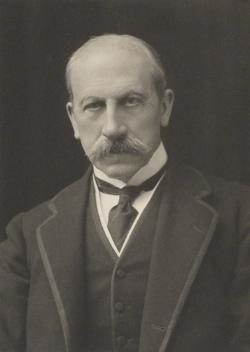
Lord Alfred Milner, British Colonial Secretary, and architect of the Union of South Africa
Britain in the early 1900s underwent a gradual though sustained period of anti-German hystericization which culminated in the outbreak of WW1. Despite relentless media propaganda demonizing Germans and increasing signs that war could break out in Europe, the British public in 1906 voted overwhelmingly for a new Prime Minister, Sir Henry Campbell-Bannerman, a staunch critic of the recent Boer wars and an advocate for a policy of ‘Peace and Retrenchment’ in the increasingly fragile British Empire.
Referred to as “Britain’s first, and only, radical Prime Minister,” in foreign affairs Campbell-Bannerman was neutered by a warmongering elite before he even began his term, and he died in office just two years later. Instead of peace, the British public received a war that produced in a single day the combined military and civilian casualties in all of Europe’s conflicts from the previous 100 years.1 So much for democracy and highfalutin ‘Western values’.
While the British voted resoundingly for a policy of Peace and Retrenchment, powerful forces would stop at nothing to get the war they desired, and the control over the world it afforded them.
Lord Alfred Milner: Despite being born in Germany to mixed British-German parents, Milner’s ethos was formed entirely by an ardent belief in the “superiority of the British race.” An Oxford-educated imperialist, Milner began as a journalist at the Pall Mall Gazette before joining, together with fellow journalist William Stead, a secret society set up by the influential oligarch and colonialist Cecil Rhodes. By the time WW1 broke out, this sinister organization was entirely Milner’s, and went by the name ‘Round Table Group’, or ‘Milner’s Kindergarten’, influencing British, and thus global, foreign policy from the shadows. It was, in essence, the precursor to today’s ‘Deep State’.
Milner served as Rhodes’ ‘clean-up man’ following the disastrous attempt to provoke an uprising among British expatriates in the Transvaal colony of southern Africa. Soon after Milner was rewarded with the office of High Commissioner for Southern Africa in 1897. From that post Milner would wage a campaign of deception to initiate the second Boer war, overseeing the highly controversial use of concentration camps to humiliate and punish the citizenry. These camps and other brutal methods used in the Boer wars would shock both the British public and the armed forces. Under Milner’s rule, 28,000 of the 115,000 people put into camps died, nearly 22,000 of them children. On this Milner wrote,
“The theory that, all the weakly children being dead, the rate would fall off is not so far borne out by the facts. The strong ones must be dying now and they will all be dead by the spring of 1903.”
Perhaps no one exemplified the British Elite’s attitude better than Milner. But for all his barbarism, he was very successful. Having secured British territories in the ‘Scramble for Africa’, Milner carefully manipulated the cabinet of the newly elected Henry Campbell-Bannerman, ensuring that his pro-imperialist forces were well-represented within. Succeeding in the dark arts of imperialism, Milner turned down lucrative offers to work for JP Morgan and instead returned to London in 1905 to pursue a much larger project: conquering the globe.2
Sir Edward Grey was appointed Foreign Minister in Henry Campbell-Bannerman’s cabinet on the insistence of King Edward. One of Milner’s inside men, he ensured that British foreign policy was pointed towards war preparations, and was party to a secret military alliance with France in 1904. This secret agreement between five ministers – Asquith, Haldane, Grey, Churchill and Lloyd George – promised military ‘reciprocities’ to the French in the event of war.
Grey stated categorically that there had been no ‘secret agreement’ to come to France’s aid in case of attack:
“First of all let me try to put an end to some of the suspicions with regard to secrecy — suspicions with which it seems to me some people are torturing themselves, and certainly worrying others. We have laid before the House the Secret Articles of the Agreement with France of 1904. There are no other secret engagements. The late Government made that agreement in 1904. They kept those articles secret and I think to everybody the reason will be obvious why they did so. It would have been invidious to make those articles public. In my opinion they were entirely justified in keeping those articles secret because they were not articles which commit this House to serious obligations.3
But, as Sir Bertrand Russell noted at the time, “I had noticed during previous years how carefully Sir Edward Grey lied in order to prevent the public from knowing the methods by which he was committing us to the support of France in the event of war.”4
King Edward VII: Prince of Wales, Albert Edward, became King Edward VII upon taking the throne in 1901. In the following years he busied himself with diplomatic meetings to arrange secret agreements that effectively encircled Germany and made the German military paranoid.
He drove a wedge between Germany and the Italian monarch, and conducted diplomacy with nearly all of Germany’s neighbors. When Germany mobilized her forces, she was unwittingly springing the trap set for her by Edward and the secret elite.
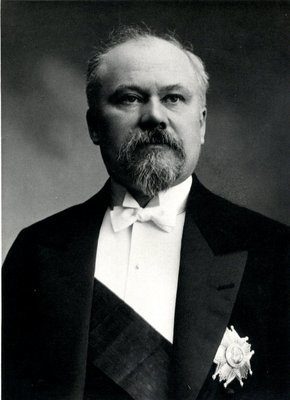
Raymond Poincaré: A French statesman, three-time Prime Minister and President in 1913, Poincare exemplified the hysterical anti-German hatred of the French elite. France, which lost the territory of Alsace-Lorraine to Prussia after Napoleon III foolishly went to war with an insufficient army to win it, was prepared to do whatever it took to win it back and check Germany’s rise. As Poincare would announce in an address to university students,
“In my years at school, my thought, bowed before the spectre of defeat, dwelt ceaselessly upon the frontier which the Treaty of Frankfurt had imposed upon us, and when I descended from my metaphysical clouds, I could discover no other reason why my generation should go on living except for the hope of recovering our lost provinces.”
Richard Burdon Haldane: Haldane was one of Milner’s closest confidants, and would become the Secretary of State for War in 1905, instituting a massive military revolution in the organisation of the British Army. He set up the Territorial Army, the Office Training Corps, and the Special Reserve, and spearhead a pro-French military policy in opposition to many who had served under a pro-Belgian policy for decades.
Théophile Delcassé: A French foreign minister with a rabid hatred of Germany, Théophile was bent on establishing a military alliance between Britain, France and Russia that would support France’s desire to regain her lost territories. He was forced to resign after he nearly brought his country to the brink of war with Germany in the First Moroccan Crisis of 1905-1906. However, he wormed his way back into power to replace the more cool-headed foreign minister, Gabriel Hanotaux, and then became President of France in 1913.
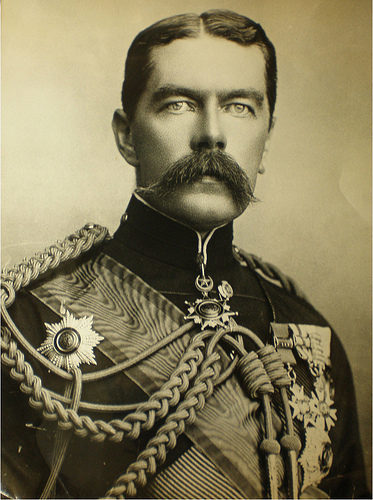
Horatio Herbert Kitchener
Horatio Herbert Kitchener: A general during the Boer wars, Kitchener oversaw the implementation of concentration camp policy in South Africa. He then ran British foreign affairs out of Cairo and designed plans for the division of the Middle East, fanning the flames of rebellion and separatism in the Ottoman Empire. The end result (though not according to his plan) was the rise of the House of Saud and its peculiar brand of Islam that served Anglo-American dominance of the region via the ‘War on Terror’ a century later. David Fromkin noted in A Peace to End All Peace that:
Restoring the caliphate to Arabia, where it and Mohammed were born thirteen centuries before, was Kitchener’s strategy for preparing for the rivalry with Russia which was bound to follow the conclusion of the war against Germany.5
If that was indeed Kitchener’s strategy a century ago, then it is remarkably consistent with current Crown Prince of Saudi Arabia’s recent statement that Wahhabism was encouraged throughout the 20th century by the anglo-Americans as a means of keeping Russia out of the Middle East.
Kitchener, like all the upper-class aristocrats and oligarchs who engineered WW1, had stunning disdain for ordinary people, his own troops included. At one point early in World War 1, it looked like the Russians were going to pull out and make peace with Germany. This would have been disastrous for the Anglo-French forces because Germany could then concentrate its forces on the Western Front.
The secret elite promised Russia that, in exchange for joining Britain’s ‘Triple Entente’, Constantinople – a kind of Orthodox Mecca – would become Russian property in a post-war world. Kitchener conspired with Winston Churchill, then First Lord of the Admiralty, to arrange a suicidal assault on the Dardanelles, which links the Mediterranean and Black Seas. They did this in order to trick Russia into believing that Britain was upholding its end of the bargain, and thus continuing its military engagement with Germany, Austria-Hungary and the Ottoman Empire in eastern Europe. This worked, but at the cost of tens of thousands of British, French and Australian lives in a landing invasion the elite knew would not work against formidable Ottoman defences. Furthermore, they never had any intention of ceding Constantinople to Russia.
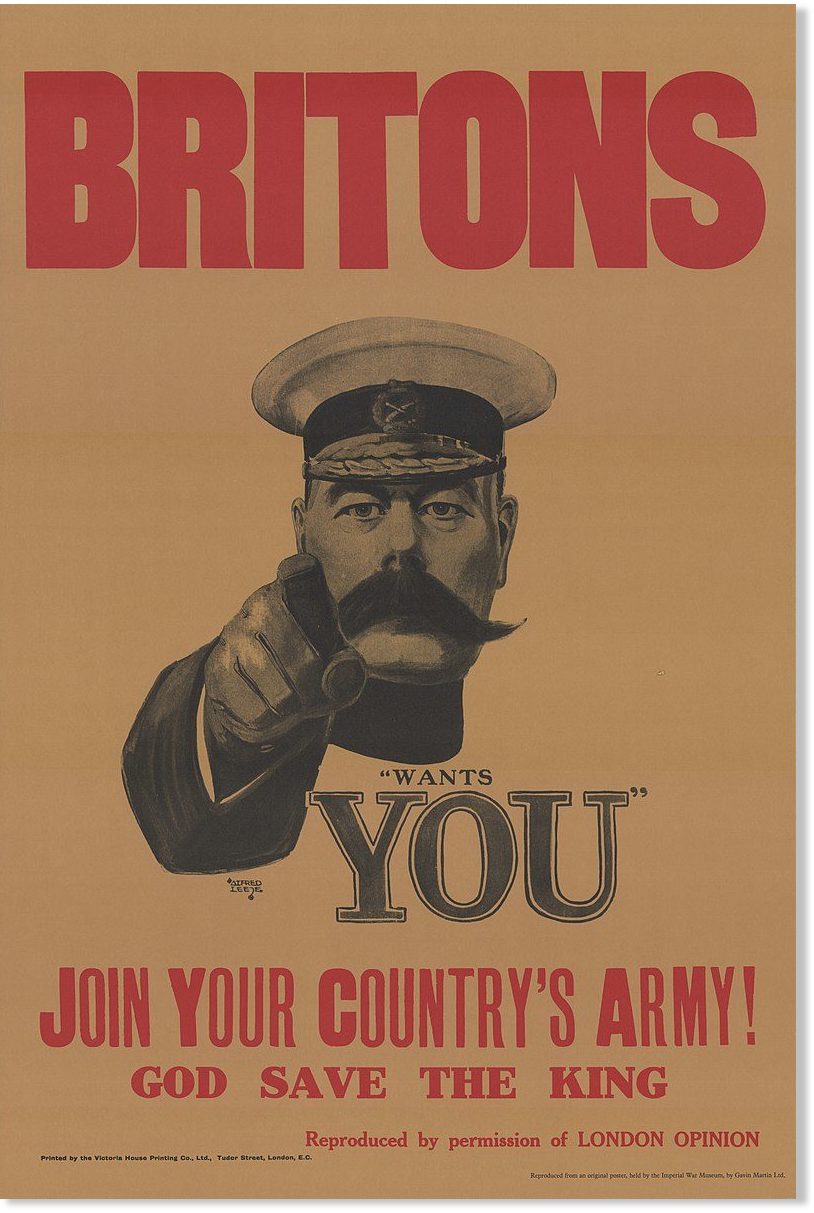
The iconic, much-imitated 1914 Lord Kitchener Wants You poster
Kitchener’s death-dealing career hit its highest point when he was appointed Secretary of State for War, but was abruptly ended when his ship was hit by a German u-boat, although there are various other theories about the cause of his death.
This list covers just a few of the conspirators, but enough to paint a rough picture of the individuals who worked tirelessly to engineer a war that would end peace for much of the century – a war that would result in the rise of Hitler, the Soviet Union, an apartheid Israeli state, and the spread of Radical Islamic Terrorism. The following is the general strategy they followed.
Seeking the War Trigger
Scottish researchers Gerry Docherty and Jim Macgregor conducted an exhaustive study of the ways in which British officials paved the road to war in their book Hidden History: The Secret Origins of the First World War. I think it’s a must-read for any student of Western history, but my one criticism of their work is that they tend to portray Germany as a victim and thereby cast a shadow over the generalized hysteria – which affected everyone, Russia included – and poor thinking that the German military and Kaiser succumbed to – and indeed the war crimes committed by the Germans. Nevertheless, their argument that the British were the primary instigators of the war rests in part on the following cases:
Cracks in the British Empire: At the onset of the war it seemed that every nation except Germany had reason to engage in a global Holocaust. The English had dominated European and world affairs to that point, but the sheer cost of occupying and managing many far-flung colonies was hitting its national coffers hard. Germany’s unification under Bismarck and rapid industrialization, meanwhile, was leading it to overtake the British empire in some key sectors. As F. William Engdahl notes “fear of the emerging German economic challenge towards the end of the 1890s was so extreme among the leading circles of the British establishment, that Britain made a drastic change in its decades-long Continental alliance strategy, in a bold effort to tilt European events back to England’s advantage.”6
This change in strategy saw Britain make geopolitical concessions to both Russia and France while manipulating them into adopting antagonistic positions towards Germany. Having been engaged in ‘the Great Game’ with Russia throughout the 19th century to check Russian expansion and influence in India and Afghanistan, Britain’s sudden alliance with Russia only came about after Japan, armed with British battleships and financed by British and American banks, defeated Russia in its Far East region in 1904-1905. Contained in the east by the rising Japanese, Russia’s gaze inevitably swung westwards to the Balkans and to the Mediterranean Sea access she coveted, and which the British pretended to agree she could have.
French Hysteria: Napoleon III, the nephew of Napoleon, was as ambitious as his uncle. In a brash attempt to destroy the growing Prussian state, Napoleon III ordered the mobilization of a far inferior French force that was immediately crushed by the Prussian military machine. As a result, France lost Alsace-Lorraine and was humiliated due to the ridiculous actions of a reckless leader.
As a British newspaper, the Sheffield and Rotterdam Independent, noted on October 11, 1870, “France has ever coveted the boundary of 1810. She has wanted power to cross the Rhine at her pleasure, to set up a Rhenish Confederation under her control, and to occupy at her convenience, as the first Napoleon did, the German capitals.”
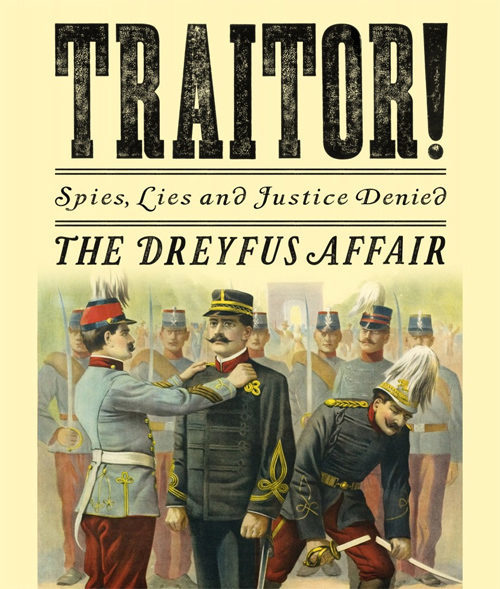
The Dreyfuss Affair: Gabriel Hanotaux, French minister of foreign affairs from 1894 to 1896, was a notable exception in the general trend of increasing hysteria. His efforts, however, could not arrest the slide to war. When Hanotaux sought to develop peaceful relations with Germany, General Albert Dreyfuss was charged with treason for allegedly communicating secrets to German spies. He was later exhonerated and the case remained a symbol of trial-by-propaganda. As Engdahl writes:
Hanotaux intervened into the initial process in 1894, correctly warning that the Dreyfus affair would lead to “a diplomatic rupture with Germany, even war.” Dreyfus was exonerated years later, and it was revealed that Count Ferdinand Walsin-Esterhazy, in the pay of the Rothschild banking family, had manufactured the evidence against Dreyfus. By 1898, Hanotaux was out of office, and succeeded by the malleable anglophile, Theophile Delcassé.7
Fashoda Incident: In 1898 a military incident between Kitchener’s British forces and French forces in Egypt, dubbed the Fashoda Incident, forced the French out of that country and caused an international crisis. The British then exploited the situation to secure a future alliance with France lest she be cornered by Germany and Russia and lose control of her other territories. By 1904 the British had secretly arranged to take complete control of Egypt while giving France control of Morocco, which was in violation of Franco-German treaties.
Fake News
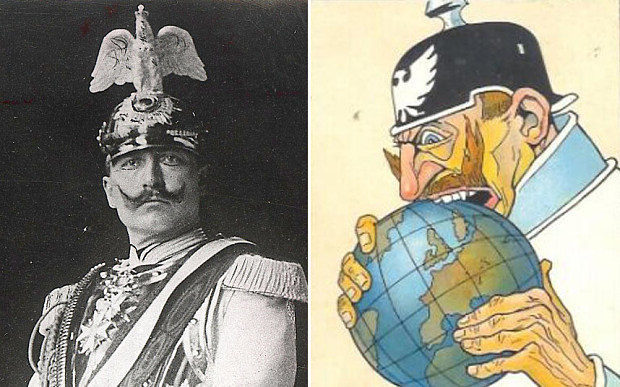
Emperor Wilhelm II and an Italian poster from 1915 showing the Kaiser biting into the world
Fake news becomes fake history. Today British war-mongers expect us to believe, without any reasonable proof, that Putin will kill ‘thousands and thousands and thousands’ of Britons without provocation. Similarly, the propaganda mill before and during World War 1 was hard at work convincing the world that Germany was the devil incarnate – and that the coming bloodbath was justified.
Germany was consistently portrayed in the press as an ‘aggressor nation’. This despite the fact that the UK, France, and Russia “spent £657,884,476 on warships in that same decade, while Germany and Austria-Hungary spent £235,897,978. The peacetime strength of the German army was 761,000, while France stood at 794,000 and Russia 1,845,000, yet the claim that militarism had ‘run amok’ in Germany was presented as the given truth.”9
While accusing Germany of war-mongering, British preparations for war were so intense that it led senior military officers to claim that war with Germany was inevitable.10 Milner would go on a ‘world tour’ organizing imperial conferences designed to rally support for Britain in the event of war and to “foster imperial cooperation in both defence and communications.”11
In 1896 Lord Nortchliffe created the Daily Mail newspaper which, within years, had reached millions of mostly lower and middle-class readers.12 In 1897 he commissioned the publication of a series titled Under the Iron Heel, which predicted the German Army would soon invade Britain. Northcliffe also commissioned the writing of a fictional account of a German invasion called The Invasion of 1910. The Daily Mail even printed special maps showing where these ‘Huns’ (slang for Germans) would invade. Northcliffe was also a financier of The Poison Bullet, a spy scare novel designed to indulge base anti-German sentiment among the British public.13 He also penned pamphlets predicting inevitable war with Germany.
As J. Lee Thompson writes, “by 1914 Northcliffe controlled roughly 40 percent of the morning, 45 percent of the evening, and 15 percent of the Sunday total newspaper circulations.”14 Thus, by the time of war, British society had been effectively whipped into war-readiness by decades of anti-German propaganda, with pamphlets and literature convincing the public that German spies were around every corner. Today the evening news and the internet have replaced “pamphlets and literature” and Russia has replaced Germany.
In 1909 a bill was rammed through parliament establishing the British secret service – today’s MI5 and MI6 – while another imposed unprecedented police state powers on the country.15
Pulling the Trigger
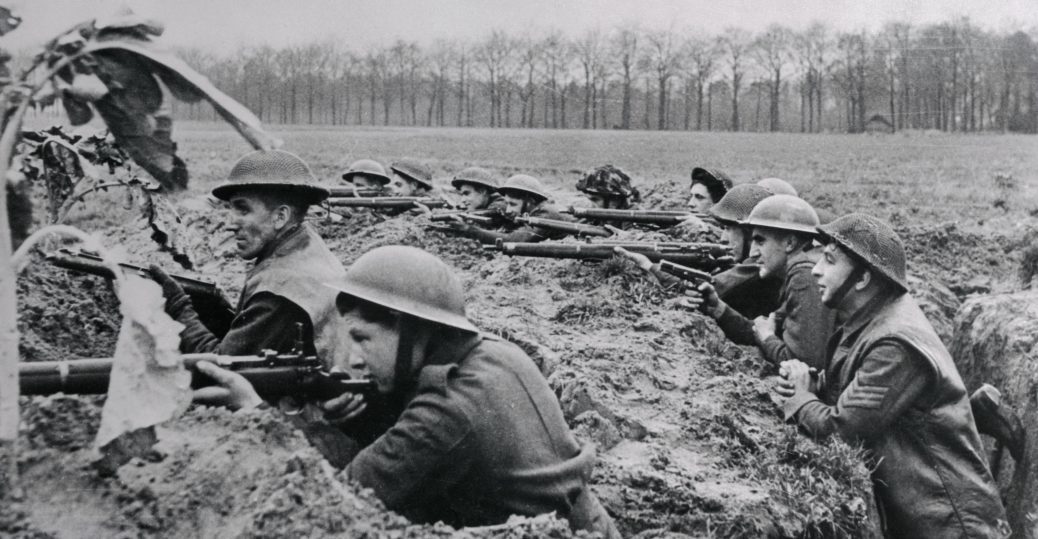
With Germany diplomatically isolated and secret military preparations and agreements signed by France, Britain, and Russia, the only thing missing was a “catastrophic and catalyzing event” to justify a declaration of war. Just such an event occurred in the Balkans, a region that had been in utter turmoil for some years.
In the build-up to World War 1, Serbia, Bulgaria, Macedonia and Bosnia were at war with each other, divided internally, and in conflict with both the Ottoman Empire and the Austro-Hungarian Empire. Bitter ethnic and nationalist sentiment was whipped into a frenzy by successive crises. Anglophile Russian diplomat Alexander Isvolsky agreed (without the Czar’s or the Russian government’s approval) that Russia would support Austria-Hungary’s ‘right’ to annex Bosnia-Herzegovina at a time of its choosing in exhange for Austro-Hungarian support for Russian control over the Dardanelles. As a result, and in violation of international law, on October 6, 1908, Austria-Hungary announced its annexation of Bosnia-Herzegovina immediately provoking outrage from Serbia that saw Bosnia as theirs. This entanglement was the fuse that ignited the first World War when the Austrian Archduke Ferdinand was assassinated by a Bosnian Serb. As Alan Cassels wrote in his Ideology and International Relations in the Modern World, this event “fanned pan-Slavism in the Balkans to a frenzy.”17
When World War I broke out, Isvolsky is reputed to have remarked, “C’est ma guerre!” (“This is my war!”)
On June 28th, 1914 Archduke Ferdinand was shot and killed in Sarajevo. Austria-Hungary blamed the Serbs. Determined to hold Serbia accountable, European diplomats indicated to Austria-Hungary that she had every right to do so. Austria-Hungary therefore sent Belgrade a note in which it demanded the following items:
- The end to anti-Austrian propaganda in Serbian media and education
- The right for Austrian police to investigate the assassination on Serbian soil
- Public apologies from the King and the government
- The immediate surrender of those responsible
They told Serbia it had 48 hours to comply. Once the note was delivered, and well aware that Serbia could not possibly comply, the previously supportive Russian, British, and French governments now expressed outrage at Austria-Hungary.
Serbia, emboldened by Entente’s display of indignation, refused to comply.18 In return, Austria-Hungary turned to Germany for support in military action, and Germany agreed. Until the 11th hour however, Germany’s Kaiser Wilhelm tried in vain to convince his cousin Nicholas II of Russia not to mobilize Russia’s forces. Germany thus gave Austria-Hungary the historical ‘blank check’ that has been cited ever since as proof of German war guilt.
French President Poincare visited St. Petersburg and guaranteed Russia that “France would not only give Russia strong diplomatic support, but would, if necessary, fulfill all the obligations imposed on her by the alliance.”20 A summary of his visit was sent to Edward Grey at the Foreign Office and, from July 25th onward, Grey made overtures about solving the crisis while Russia and France began mobilizing their armies. Four days later, Britain began mobilizing her own fleet.
On July 29th Czar Nicholas II officially ordered Russian mobilization. But then he received a telegram from the Kaiser:
My ambassador is instructed to draw the attention of your government to the dangers and serious consequences of a mobilisation. If, as appears from your communication and that of your Government, Russia is mobilising against Austria-Hungary … The whole burden of decision now rests upon your shoulders, the responsibility for peace or war.
Nicholas backed down.
But then, on July 30th, Russian foreign minister (and anglophile) Sergei Sazanov spent hours convincing Nicholas II of German treachery, urging him to reorder the mobilization of the armed forces. The Czar was deeply troubled with the weight of the decision, but in the end he capitulated to pressure and the Russian war machine lurched forward:
Nicholas II was still understandably hesitant; according to the French ambassador, “The Czar was deadly pale and replied in a choking voice: ‘Just think of the responsibility you are advising me to assume! Remember, it is a question of sending thousands and thousands of men to their death.'”
Germany was the last country to announce militarization. The key to Britain’s war plan was that Germany would follow its Schlieffen Plan, where German forces would quickly march through Belgium in order to avoid the mountainous Ardennes region, put the french army in its place, then turn around to face east and join Austria-Hungary in squaring off with Russia’s giant army. Unbeknownst to Germany, however, Belgium was not as neutral as it had led everyone to believe, and had started mobilizing its military – which had been secretly prepared and trained by the British – at the same time as France and Russia. But Germany’s invasion of hapless, ‘neutral’ Belgium gave Britain its ‘just cause’ for declaring war on Germany.
As the war began Britain cut Germany’s underseas communication lines, thus ensuring that all information to and from the outside world would be under its control. A year or two later, a poem written from the horrors of the trenches gave evidence of an awareness of the deception that came too late.
Waves of strong men
That will surge not again,
Scattered and riven
You lie, and you rot;
What have you not given?
And what – have you got?
What did we get? We got the imposition of an Israeli apartheid state and an Islamic State (Saudi Arabia) in the Middle East. The world also received the ‘gift’ of a Russian Revolution that gave way to the Soviet Union and the pathocracy which it spread across a large swathe of Eurasia. As German General Ludendorff would lament, foreshadowing the horrors that would come following Germany’s collapse, the Versailles Treaty ‘sent the German people into bondage, into an absolutely crushing one. All delusions have vanished’, he wrote. ‘We look into nothingness. Something else is needed’. Hitlerism would blot out the sun of Europe for decades. And the British Elite? They still refer to themselves as ‘Sir’ and ‘Honorable’ while pointing the finger at Russia as the ‘source of all evil’.
In short, history is proof that no one should ever trust a word the British establishment says.
Back to Today
Throughout modern history, we see the same ‘elite’ pushing, prodding, gaslighting, promising one thing to one country and something entirely different to another. In their pure malevolent instinct, we see the ‘essential psychopath’ at work spinning his web effortlessly across entire nations and generations. The biggest vulnerability? The average person’s tendency to engage in emotional thinking and the chaos it engenders when entire nations are infected by it.
But, as Russian ambassador to the US Anatoly Antonov has stated, “The truth will come out. We will not let ourselves to be provoked into an emotional breakdown.” Modern Russia is not Germany under the naive leadership of Kaiser Wilhelm II, who believed his relations with the Russian Tsar and the King of England would safeguard his country from war.
Modern Russia also isn’t Iraq – a small country easily overwhelmed by the superior military strength of NATO with an isolated leader easily smeared due to his past aggression. Modern Russia is a nuclear armed superpower that is organized by some of the most brilliant statesmen this planet has seen – they won’t be deceived, they won’t be out-gunned, and any attack on them will be an act of suicide.
So, for those pushing for war against Russia, their only viable outlet for their destructive anti-Russian impulse is more false flags, more black propaganda and all manner of dirty tricks. In other words they will attempt to poison, sanction, scream, rig, and otherwise sabotage us all into oblivion, and then blame it all on Russia.
References
1. David Fromkin’s A Peace to End All Peace: The Fall of the Ottoman Empire and the Creation of the Modern Middle East p. 232
2. Gerry Docherty & Jim Macgregor’s Hidden History: The Secret Origins of the First World War p. 214
3. P. Hof’s The Two Edwards: How King Edward VII and Foreign Secretary Sir Edward Grey Started The First World War p. 4
4. David Fromkin’s A Peace to End All Peace: The Fall of the Ottoman Empire and the Creation of the Modern Middle East p. 125
5 Ibid p. 104
6. F. William Engdahl’s A Century of War Anglo-American Oil Politics and the New World Order p. 39
7. Ibid. p. 31
8. Gerry Docherty & Jim Macgregor’s Hidden History: The Secret Origins of the First World War p. 135
9. Ibid. p. 133
10. Ibid. p. 155
11. J. Lee Thompson’s Politicians, the Press, and Propaganda: Lord Northcliffe and the Great War, 1914-1919 Kindle Edition Location 175
12. Gerry Docherty & Jim Macgregor’s Hidden History: The Secret Origins of the First World War p. 148- 149
13. J. Lee Thompson’s Politicians, the Press, and Propaganda: Lord Northcliffe and the Great War, 1914-1919 Kindle Edition Location 175
14. Gerry Docherty & Jim Macgregor’s Hidden History: The Secret Origins of the First World War p. 151
15. Andrew Feinstein’s The Shadow World: Inside the Global Arms Trade p. 5
16. Alan Corssal’s Ideology and International Relations in the Modern World p. 121
17. Gerry Docherty & Jim Macgregor’s Hidden History: The Secret Origins of the First World War p. 257
18. Ibid p. 267
19. Ibid p. 293
Corey Schink was born and raised in the Midwestern United States, where he worked on farms and as a welder, musician, and social worker. His interests in government, philosophy and history led to his writing for SOTT in 2012 and to becoming a SOTT editor and Truth Perspective co-host in 2014.
Douma Chemical Attack: Timeline of facts so far
By Kit | OffGuardian | April 8, 2018
A brief post, collating all the known events surrounding the build up to the alleged chemical weapons attack in Douma, Syria on the 7/8th of April 2018.
- February-April 2018: The Syrian Arab Army has been making quick, decisive gains on the ground in recent weeks. Eastern Ghouta has all but fallen. Barring foreign intervention, the Syrian government’s victory is now all but assured.
- March 13th 2018 Russian military command claims US is aiming to strike Damascus on an “invented pretext”. Advises them against it.
- March 13th 2018 Syrian forces reported finding caches of chemical weapons in labs around liberated areas of Ghouta.
- March 19th 2018 Russian and Syrian military figures reported they feared the rebels would stage a “false flag” chemical attack in order to drag US/NATO into action in Syria.
- March 30th 2018 Donald Trump told a crowd at a speech in Ohio – and later repeated in a tweet – that the USA would be pulling out of Syria “very soon.” This is met with consternation in the capital and across the media.
- April 6th 2018 UNSC meeting convened – at Russian request – to discuss the alleged attack in Salisbury, UK. Every member of the UNSC who spoke was categorical in their condemnation of any use of chemical weapons.
- Night of April 7th/morning of April 8th… a chemical attack is reported by the US/UK funded “White Helmets”. The US blames Syrian govt. and holds Russia “responsible”.
With these facts as they are, we should ask a few questions:
1. Why, with the current international focus on chemical weapons, why would Assad hurt his cause by attacking a non-military target with chemical weapons?
2. With global political discussion focusing more on Saudi Arabian war on Yemen, the Skripal attack, and Israeli violence against Palestinians, why would Assad choose this moment to conduct a chemical attack and potentially distract from these issues?
3. The Syrian Arab Army is currently operating in Douma, why would Assad risk dropping chemical weapons that could hit his own troops?
4. The POTUS has publicly stated he intends to pull out of Syria “very soon”. Why would the Syrian Government endanger this development?
5. Cui bono? Who has the most to gain from this chemical attack? The SAA, who are already winning the war, or the cornered jihadist forces in desperate need of aid and air support?
Venezuela Hits Back Following New Sanctions over Alleged Funding of WMD and Terrorism

By Paul Dobson | Mint Press News | April 4, 2018
Venezuelan authorities hit back at their counterparts in Panama and Switzerland this week after they approved new measures targeting Caracas.
Panama’s Economic and Finance Ministry announced this past March 27 that a warning was being issued to the Central American country’s banks advising them to limit and “diligently” supervise financial transactions involving 55 top Venezuelan officials as well as 16 private businesses allegedly associated with the Maduro government.
The list includes President Nicolas Maduro, National Electoral Council President Tibisay Lucena and rectors Tania D’Amelio and Socorro Hernandez, National Constituent Assembly members Diosdado Cabello and Hermann Escarra, Education Minister Elias Jaua, and Culture Minister Ernesto Villegas.
In an official statement, Panamanian authorities categorized the individuals and businesses as being “high risk in the area of money laundering, financing terrorism, and financing the proliferation of weapons of mass destruction.” No evidence was, however, presented to support the allegations.
Venezuela possesses no nuclear weapons and is a signatory of the Nuclear Non-Proliferation Treaty, as well as various other treaties banning the acquisition and development of nuclear, biological, and chemical weapons.
Similarly, many of those accused by Panama of allegedly financing terrorism belong to institutions which were themselves the objects of violent opposition attacks during last year’s anti-government protests – including the Supreme Court, the National Electoral Council, and regional government offices – which the Maduro administration has repeatedly described as “terrorism”.
Speaking Monday, Venezuelan Attorney General Tarek William Saab, who is included on Panama’s list, fired back, describing the accusations as “fake news” and calling on them to provide evidence.
“Show the accounts, my accounts for example, show where my name, my photo appears,” Saab challenged.
Penitentiary Affairs Minister Iris Varela, who also appears on the list, similarly denied the accusations and called on the Central American authorities to publish a “complete list” of all Venezuelan citizens who own assets in the country, placing special emphasis on those mentioned in the Panama Papers.
“Why don’t they do it [publish the complete list],” she questioned. “Simply because they have assets and fortunes that belong to the [Venezuelan] opposition.”
The recent measures follow close on the heels of an announcement last month that Panama will not recognise the results of Venezuela’s upcoming presidential election, mirroring steps taken by the Trump administration and other regional conservative governments in rejecting the May 20 vote.
Meanwhile, Switzerland also moved to apply sanctions against seven high-ranking Venezuelan functionaries last Wednesday, freezing their alleged assets in Swiss banks and applying travel bans.
In response, the Venezuelan government delivered an official letter of protest to the Swiss charge d’affaires Monday, calling the sanctions a violation of the UN Charter’s ban on unilateral coercive measures and charging Switzerland with “subordination” to Washington and Brussels’ hardline Venezuela policy.
“This erratic action… on the part of a historically neutral country like the Swiss Confederation does not create conditions for dialogue and strengthens extremist positions that seek violent solutions,” reads the text of the letter.
Venezuela’s Supreme Court also issued a declaration Monday rejecting the moves as “illegal”. Supreme Court President Maikel Moreno was named in both Swiss and Panamanian measures.
The latest international actions targeting Venezuela have, however, won praise from members the country’s right-wing opposition, including Popular Will party Political Coordinator Carlos Vecchio, who applauded the Panama measures as “the right path at this stage”.
Vecchio is currently in Paris meeting with center-right French President Emmanuel Macron as part of a European tour aimed at drumming up support for more sanctions against Caracas.
During the meeting Tuesday, Vecchio, together with First Justice party leader Julio Borges and ex-Caracas Mayor Antonio Ledezma – who is currently fleeing the Venezuelan justice system – called on Macron’s government to apply “more sanctions” against Venezuela and to “halt Petro, gold, and capital legitimation operations,” referring to the South American country’s new crypto-currency. They also urged the French president and other European leaders “not to dialogue” with Caracas.
Planteamos al gobierno de Francia apoyar Intervención Humanitaria, juicio de Corte Penal, más sanciones, detener operaciones con Petro, oro y legitimación de capitales para salir de dictadura que oprime a nuestro pueblo . y Desconocer fraude electoral. Con dictadura no se dialoga
— Antonio Ledezma (@alcaldeledezma) April 3, 2018
Translation | We propose to the government of France to support Humanitarian Intervention, criminal court trial, more sanctions, stop operations with Petro, gold and legitimation of capital to get out of the dictatorship that oppresses our people. and Disregard electoral fraud. With a dictatorship there is no dialogue
Opposition presidential frontrunner Henri Falcon, who defied the main opposition in launching his candidacy and has opposed economic sanctions in the past, has yet to issue a public statement with regard to the latest measures from Panama and Switzerland.
So far, only the US and the UK have approved economic sanctions against Caracas, while Canada and the European Union have rolled out sanctions against top Venezuelan officials
International sanctions against Venezuela have been denounced by the UN Human Rights Council as well as by UN Independent Expert Alfred de Zayas, who labeled the US-led measures “crimes against humanity” and called for the International Court of Justice to investigate.
According to Datanalisis, 55.6 percent of Venezuelans oppose economic sanctions against their country, while just 42 percent support individual sanctions targeting top officials.
Edited and with additional reporting by Lucas Koerner from Caracas.
The Rapidly Evolving Skripal Story: Evidence of the Destruction of an Anglo-American Plan
By James O’Neill | OffGuardian | April 7, 2018
On 4th of March 2018 former Russian intelligence officer Sergei Skripal and his 33-year-old daughter Yulia were found on a park bench in Salisbury England at 16. 15 hours in an unconscious state.
They were tended to by a number of passers by who included a doctor, an off duty nurse and some civilians. It was not known at that stage what had caused the Skripal’s illness. No one had any reason to believe that they were the victims of any nerve agent, and accordingly took no precautions against such a possibility. Despite the very well documented dangers of even casual contact with nerve agents, none of those helpful citizens suffered any ill-effects.
The Skripals were taken to hospital where they have remained ever since. The public were told that they were both in a coma and unable to communicate in any way. Yet on the morning of 7 March 2018 Yulia Skripal accessed the Russian equivalent of her Facebook page (VKontakte).
There are a number of possible explanations for this. She may have briefly returned to consciousness and her first thought was to access VKontakte before relapsing. Alternatively her VK could have been hacked, but that would not have been easy and there is no known evidence to support this possibility. A third possibility, implicit in the words of her treating physician, was that she “came to her senses.” Precisely what that meant is unclear because it was never elaborated upon.
The hospital authorities have disclosed that Yulia is now fully awake, eating, drinking and talking, these and other questions may be able to be asked and answered. Precisely what we are told about Yulia’s answers depends upon who is allowed to talk to her. Another of the disturbing aspects of this case is that none of her family, her fiancé, or the Russian consulate authorities has been permitted access.
This latter fact is directly contrary to the provisions of the 1963 Vienna Convention on Consular Relations. The British have pretended that this did not apply to Ms Skripal as she was a Russian national (unlike Sergei who had dual British citizenship) because article 37 of the Convention had not been incorporated into English law.
The judge who heard an application for the taking of blood samples came to this conclusion, apparently without reference to, or being advised by counsel acting for the Skripals on behalf of the British government, that there was in fact a consular treaty between the then Soviet Union and Britain. This treaty was ratified in 1968 and specifically provides for the right of consular access. Article 36 of the treaty provides:
(1) (a) A consular officer shall be entitled within the consular district to communicate with, interview and advise a national of the sending state and it may render him every assistance including, where necessary, arranging for aid and advice in legal matters.
(b) No restriction shall be placed by the receiving state upon the access of a national of the sending state to the consulate or upon communication by him with the consulate.
Notwithstanding this provision, which as the terminology makes clear, is not optional but mandatory, the British continue you to refuse the Russian consular staff their lawful access to the Skripals.
In that same court case (NoB228376 & 13228382 [2018] EWCOP 6 Judgement 22 March 2018) the judge was also apparently not told by counsel that while the Skripals “appeared to have some relatives in Russia” they had not been advised of the application before the court and neither were the Russian authorities. According to the judgement the Russians would find out about the court case after the event because the judge intended to publish his findings!
Ms Skripal does not just “appear” to have relatives in Russia. She has her grandmother and also a fiancé with whom she was living. She also has a cousin, Victoria, with whom she has recently had a conversation according to Russian TV that has released a transcript of the discussion.
The Russian authorities have also released copies of multiple requests made to the British government for consular access and other information. Not only were the requests ignored, contrary to the treaty quoted above, but the judge was not even informed that such requests had been made.
The judgement ordering the taking of blood samples from the Skripals was for the purposes of technical analysis to try and determine what caused their illness, from whence the presumed nerve agent had originated, and possibly identified who might be responsible. Then again it might not, for a host of technical reasons.
The point here however, is that the order was made on 22 March 2018 when the answers to those key questions were not known, unless of course the British themselves or one of their allies were the perpetrators. Both the Police who were inquiring into what was a possible attempted homicide, and the scientific investigation by both Porton Down and the technical team at the OCPW to whom the matter was eventually referred, said that the results would take some time and possibly weeks.
Yet on 14 March 2018, one week before the judgement, and weeks before the scientific results could possibly be known, British prime minister Therese May was telling the House of Commons that the culprit was a nerve agent “of a type developed by Russia” that had been used, and that it was “an unlawful use of force by the Russian State against the United Kingdom.”
Whether or not May appreciated it, such a statement amounted to her declaring that Russia had committed an act of war against the United Kingdom, contrary to international law. Her statements, together with those of her foreign minister Boris Johnson, carried hyperbole to extreme lengths. It immediately brings to mind the Mad Queen from Alice in Wonderland who demanded the sentence before the verdict.
That was not the end of the British rhetorical overkill. The Salisbury hospital authorities directly contradicted the British government’s claims of dozens of people having been affected by the alleged nerve agent. The Consultant at Salisbury Hospital, Dr Stephen Davies, wrote a letter to The Times saying
no patients have experienced symptoms of nerve agent poisoning in Salisbury.
Davies told the newspaper that only three persons were being treated, presumably the Skripals and Detective Sergeant Bailey. Note that the physician was careful not to specify precisely what the three were being treated for, other than that it was not nerve agent poisoning.
This rare example of sanity in the mainstream media was lost in the ongoing stampede to indict, convict and sentence Russia before all of the evidence had been gathered and analysed.
The campaign of vilification against Russia was extended further by the British government circulating a six-page document to 80 foreign embassies in Moscow setting out their “case” for blaming Russia. That “case” was simply risible. Its manifold falsehoods and absurdities have been pointed out elsewhere (O’Neill Australia confirms its colonial status with expulsion of Russian diplomats www.journal-neo.org 5 April 2018).
That did not prevent Australia and more then 20 other allies of the United Kingdom expelling diplomats on no further ground than giving their support to the British government and its absurd claims. Not even all of Britain’s NATO and EU allies and partners were prepared to jump on that particular bandwagon, not to mention the more than 160 nations in the world who dissociated themselves from the allegations.
The means by which the Skripals became infected has also been a subject of constantly changing scenarios. At various times the nerve agent was said to have been brought into Britain in Yulia’s suitcase; that it was placed their car’s air system; and that it was placed on the doorknob of the front door to Mr Skripal’s home.
Here again there were logical contradictions. The nerve agent was said to be up to 8 times more toxic than VX (a nerve agent of a type developed by the British and used in the Kuala Lumpur assassination of a relative of North Korea’s President Kim.) Yet that door was touched multiple times by police and others without them becoming infected.
Even more problematic was the four-hour time gap between when the Skripals left their house and suddenly taking ill before being found on the park bench in central Salisbury. The word “suddenly” is apt because CCTV footage of pair 15 minutes before being discovered on the park bench shows them alive, seemingly healthy and walking along a Salisbury Street without difficulty after having a meal at Zizzi’s restaurant.
If the claims of Novichok’s toxicity are true, then the front door handle could not possibly have infected them. If the nerve agent was so weak that it takes four hours to do its job of rendering targets dead or immobilized, then its utility as a weapon is less than useless.
The weight of logic therefore points to them being infected at some point during the 15 minute interval between leaving the restaurant and being found. Unless either eyewitnesses come forward; the CCTV cameras caught the crucial moment; or the now recovered Yulia is able to shed light on what happened, it may never be possible to ascertain the perpetrators.
On 3 April 2018 a further huge hole was blown in the British government’s case. The director of Porton Down’s defence science and technology laboratory told Britain’s SKY TV News that they had been unable to identify the source of the Novichok agent said to have been used against the Skripals.
The sophistication of the agent used was such, Mr Aitkenhead said, that it could “probably” be deployed only by a nation state. While Russia might be presumed to have such capability, the same is equally true of the United Kingdom, the United States, France, China and a significant number of other states with advanced technical capabilities (Hayward et al http://www.timhayward.wordpress.com 1 April 2018).
The Porton Down statement directly contradicts the assertions of Theresa May, Boris Johnson and their Australian counterparts Malcolm Turnbull and Julie Bishop. The latter pair, in the joint media release of 27 March 2018 said, “this attack is part of a pattern of reckless and deliberate conduct by the Russian state.” It would be unwise to hold one’s breath waiting for an apology from those politicians and a withdrawal of the reckless, unfounded and inflammatory statements.
Instead, the mainstream media has either ignored the Porton Down statement and its implications, or they have been complicit in obscuring the original unequivocal claims of Russian culpability espoused by May, Turnbull and others (http://www.moonofalabama.org 4 April 2018). This dishonesty has been evident throughout this whole saga.
The issue yet to be properly addressed by the investigation is who had the means, motive and opportunity to carry out what increasingly looks like a false flag attack, and a not very competent one at that.
A series of events occurred shortly before the attack on the Skripals that possibly provide some insight into the perpetrator’s motives. First, the so-called Russiagate witch-hunt, attempting to blame Russia for “interfering” (rich in irony) in the 2016 United States presidential election had spectacularly collapsed.
That particular campaign against Russia had relied heavily upon a dossier produced by a “former” British spy named Christopher Steele. In the weeks preceding the Skripal attack it was revealed by Britain’s conservative newspaper the Daily Telegraph among others, that Sergei Skripal had links with Steele and another major player, Pablo Miller, in the Steele dossier saga when they worked together during the time of Skripal’s betrayal of his country. Miller also lived in Salisbury and was known to have had contact with Skripal.
Secondly the Anglo American attempt at regime change in Syria through its terrorist proxies and others had failed miserably thanks largely to Russian and Iranian intervention.
Those terrorist groups have being responsible for a number of false flag chemical weapons attacks blamed upon the Assad Government. With the liberation of Eastern Ghouta, the Syrian and Russian forces found a significant cache of chemical weapons materials. The Russians announced that those materials were clearly destined to be used in another false flag attack that would provide the justification for United States and its “coalition” allies, including Australia, to mount air and missile attacks upon Syrian and Russian forces.
The chemical cache discovery, which received minimal coverage in the western media, was accompanied by a blunt warning from the Russian military command, that any such air and missile attack would be met with retaliation, including against the source of the attack. This was a clear warning to US ships and missile sites. The discovery of the chemical weapons and materials and the blunt warning were sufficient to deter any attack. Clearly however, the Anglo American forces were angered by their plans being thwarted.
Thirdly, on 1 March 2018 President Putin addressed a joint sitting of the Russian Parliament. Part of that speech announced a range of new weapons that were years ahead of any western systems. Russia not only had the capacity to defend itself with its sophisticated S400 anti-missile systems, it could retaliate against any western military attack with devastating force, against which the west had no defence.
Fourthly, despite a prolonged campaign of vilification against Mr Putin, he was overwhelmingly re-elected by the Russian people for a further six-year term. That result was entirely consistent with his level of popularity as revealed in opinion polls conducted by Western polling agencies.
Those results did not stop the western media from a alleging that the vote was rigged, or that Putin did not allow real opposition, and some other desperate claims. The American analyst Gilbert Doctorow has written a number of articles demolishing the western media’s claims, although one is unlikely to see them given wider coverage. (http://www.consortiumnews.com 15 March 2018) Western “analysts” for the most part prefer the comfort of your own prejudices.
In the light of these four factors, it is a reasonable hypothesis that the Skripal attack was a sign of the increasing desperation of some western governments, chief among them the United States and United Kingdom. The propaganda barrage and the pointless posturing over diplomatic expulsions gave those governments and others foolish enough to be taken in by their patently nonsensical allegations some brief self-satisfaction.
The latest revelations from Porton Down however, are exposing that anti-Russia campaign for the shoddy and deceptive conduct that it is. In time, the Skripal incident will be placed alongside the Gulf of Tonkin, Saddam Hussein’s weapons of mass destruction, the attacks upon Yugoslavia in 1996, Afghanistan in 2001, Libya in 2011, and Syria in 2015 as examples of provocations justifying the destruction of societies that threaten Western hegemony.
The Russia-China strategic alliance; the progressive de-dollarization of the world’s economy; and the success of defeats of Anglo American plans in Ukraine, North Korea and elsewhere indicate that the geopolitical balance of the world is changing rapidly. The challenge will be to discourage the increasingly desperate crazies who inhabit Western centres of power from embarking upon a war to try and reverse the inevitable destruction of their rapidly failing plans for “full spectrum dominance.”
James O’Neill is a Barrister at Law and geopolitical analyst. He may be contacted at joneill@qldbar.asn.au
London’s Sincerity in Quest for Truth of Skripal Case in Serious Doubt
Sputnik – April 7, 2018
Anton Utkin, a former UN chemical weapons inspector in Iraq, told Sputnik that the decisions by the UK with regard to the poisoning of former Russian spy Sergei Skripal demonstrate that London isn’t truly committed to getting to the bottom of the case.
According to the chemical weapons expert, right now London is “sitting an examination” on the sincerity of its objective quest for the truth in the attack on Skripal and his daughter Yulia, who were found unconscious at a shopping center on March 4, which the UK promptly accused Russia of orchestrating.
“London’s disinclination to provide any information on the case, its unwillingness to cooperate and reluctance to openly investigate the matter so that everybody understands their moves and what is going on, indicates that the exam hasn’t been passed,” Utkin told Sputnik.
As for the accusations by UK Foreign Secretary Boris Johnson that Moscow tried to undermine the independent inquiry of the Organization for the Prohibition of Chemical Weapons (OPCW) by proposing a joint UK-Russia investigation into the matter at the emergency session of the OPCW Executive Council, the expert said that the joint investigation would be self-defeating for the UK.
“I’m afraid London wouldn’t be able to accept the results that it would be possible to achieve within a joint investigation,” he said, “They will fight it tooth and nail.”
The analyst also pointed out that OPCW was invited by the UK to provide “technical assistance” rather than inspection.
“Inspection has a unique right to collect samples wherever its wants and interview whoever it believes is relevant, while the OPCW technical assistance delegation has no such rights. It can collect samples where it is allowed to and interview only those approved [by the UK],” Utkin said.
“And taking into account that it is a technical assistance, in accordance with the confidentiality agreement under the OPCW concord, technically the results of the analysis shouldn’t be made public,” he explained.
Ahmet Uzumcu, director-general of the OPCW, said Wednesday that the results of the sample analyses of the substance used to poison Skripal and his daughter were expected to be received by early next week.
“Once the results of the analyses of the samples are received, the secretariat will produce a report on the basis of these results and will transmit a copy of this report to the United Kingdom,” he said.
According to Uzumcu, the United Kingdom has expressed its wish to be “as transparent as possible” and has already indicated its preference to disclose the report to other state parties of the OPCW. According to Utkin, it is still possible that London will change its mind, taking into account that suspicions are accumulating around the UK’s accusations against Russia.
He stressed that the UK has already violated a number of provisions of the OPCW convention; for instance, by failing to make efforts to settle controversial issues through the exchange of information and consultations and by issuing an ultimatum, with Peter Wilson, permanent representative of the UK to the OPCW, demanding explanations from Russia within 24 hours, while Russia was given no information on what it should explain.
“In accordance with the the Chemical Weapons Convention (CWC), the party is given 10 days to respond, but after 24 hours had passed, Russia was accused, and that was it,” the expert noted.
He said that what Russia can do is abandon moves dependent on voting by the organization’s Executive Council and simply continue staying within the bounds of the convention, as it has so far. On March 13, upon being faced with all the ungrounded allegations, Russia requested that the UK provide the necessary information and offered to switch to a dialogue mode, in accordance with article 9.2.
“Russia offers all ways of cooperation but stumbles across unwillingness to cooperate,” Utkin said, adding that the Convention allows for a number of steps to overcome this reluctance.
For example, Russia can submit a request via the Executive Council asking explanation from the UK, which would mean that without negotiating on the issue all 41 countries would demand that London provides the information. Or via a similar request Russia can demand details from all the countries that at some point produced Novichok, the nerve agent in the case. At a recent Executive Council session Russia provided information backed by evidence on a number of countries where the nerve agent could be produced.
“I believe it is becoming obvious that many countries made haste by following the UK demarche”, Utkin concluded.
See also:
Moscow: UK Justification for Refusal to Grant Skripal’s Niece Visa “Doesn’t Hold Water”
Featured Video
AIDS Inc. by Gary Null (2007)
or go to
Aletho News Archives – Video-Images
From the Archives
Clash of Civilization, Iran Part II
By Jamal Kanj – Intifada-Palestine.com – January 14, 2011
Israel’s survival kit is: perpetuate conflict, insecurity to rationalize collective hate and finally playing victim.
Devoid of conflict, Israel implodes internally; without hate, Zionism loses its justification; and playing eternal victim to continue blackmailing the West. Absence of this holy trinity, Israel ceases to exist.
From its inception, the house of Zion has mastered exploiting adversarial powers to advance Israel’s cause. For instance, their influence over the Democratic Party in the US began with President Truman’s bid for 2nd term election in 1948.
Responding to strong opposition from Secretary of State General George Marshall and Department experts urging against recognition of Israel, President Truman replied: “I’m sorry gentlemen but I have to answer to hundreds of thousands [Jewish voters] who are anxious for the success of Zionism. I do not have hundreds of thousands of [voting] Arabs among my constituents”
Zionists influence over liberal American politics was matched with the doctrinal school of Conservative theoreticians aligning the Republican Party’s platform with Israel’s objectives. The Neoconservative Zionists, coined Zioncons, invented the “Clash of Civilization” concept to fight Israel’s wars. … continue
Blog Roll
 Aletho News
- Pro-Palestine protesters arrested outside UK’s ruling Labour Conference in Liverpool
- Mauritius denies landing permit to flight from Israel, forcing cancellation: Tour operator
- Israeli finance minister calls for genocidal war on West Bank, annexation of south Lebanon
- 12 Things Your Psychiatrist Was Trained Not to Tell You
- From Unipolar Universalism to Multipolar Civilizational Distinctiveness
- RSF military group defects, joins Sudanese army: State media
- Ireland goalkeeper refuses to play ‘Israel’ as squad weighs boycott
- China pushes back against US on Cuba, Iran
- Ukrainian Soldiers, Potential Mercenaries: Have Gun, Will Travel!
- Burnham’s UN debut… A masterclass in British disinformation
- If Americans Knew
- Israel forces Gazans to live in constant peril – Daily Update
- Deconstructing Netanyahu’s pants-on-fire UN rant – Daily Update
- Trump betrayed voters with his campaign lies and prioritized a foreign country once he took office
- Netanyahu calls Israel’s war in Gaza ‘opposite of genocide’ in UN speech to near-empty hall
- Settler Kidnappings: Torture, Sexual Abuse and Terrorisation of Palestinian Abductees as Israel Deepens Annexation of West Bank
- Gaza winter nears as 162,000 tents become unusable, raising fears of humanitarian crisis
- Netanyahu says, “It’s the opposite of genocide”; UN says Gaza economy is world’s ‘most severe crisis on record’ – Daily Update
- Israel’s US-Backed Assault on Gaza Has Created the ‘World’s Most Severe Economic Crisis on Record’: UN
- ‘Protecting U.S. Citizens’… From Israel
- ‘This is where I live now, the back of a truck’: a day in the life of a grandmother in Gaza
- No Tricks Zone
- New Study: Earth And Venus Surface Warmth Largely Explained By Convection And Lapse Rate, Not CO2 Or Radiation
- 2025 Nature Paper Claiming Worsening Global Drought Gets RETRACTED …Heavily Flawed
- New Study: ‘Global Drought Shows No Detectable Recent Acceleration Under Climate Warming’
- Economic Masterminds: German Socialists Suggest Taxing Productivity Gains Stemming From Using AI
- The South China Sea Has Not Been Cooperating With The Climate Change Narrative
- Energy Crisis: Germany Enters Heating Season With Historically Low Gas Reserve Fill Levels
- New Study: The Antarctic Ice Sheet Gained Mass From 2020-2024 Due To Staggering Snow And Ice Accumulation
- Study: Ocean Heating Rates From Thousands Of Years Ago ‘Dwarf’ Modern Ocean Heating Rates
- Climate Extremists Target, Attack Large-Scale Power Grid Infrastructure In Germany!
- New Study: Antarctic Ice Melt Has Contributed Less Than 1 Centimeter To Sea Level Rise In The Last 30 Years

