Britain’s next Prime Minister could likely be Jeremy Corbyn
By Adam Garrie | The Duran | May 30, 2017
Brexit which in many ways put British politics on the international map for the first time since the 1960s, was not supposed to happen. The establishment of all the major parties, the business sector, academia, the mainstream media, the arts and science community (which still hold some influence in Britain) were all opposed to it.
Likewise, the polling data was so set against Brexit that on the night of the vote, a sober Nigel Farage all but conceded defeat. Several hours and several drinks later he emerged to give a victory speech.
The people who voted for Brexit voted for a number of reasons and even more crucially in a key number of geographical places.
Many people voted for Brexit because they were seething with anger over those who opposed it. The elite were unpopular and the elite did not want Brexit, this meant that ordinary people in middle and northern England as well as most of Wales voted for Brexit. Other issues ranging from European border policy, to trade and nostalgia for empire played far less of a factor than many pundits think. Brexit was a visceral vote, not a calculated vote.
The EU is an elitist institution and Britain’s own local elite loved it. For most people that was enough to make them support it.
While the dishonest and discredited elites ran the pro-EU campaign Brexit was spearheaded from the right by Nigel Farage while its most prominent left wing advocate was George Galloway. Both Farage and Galloway are figures one either loves or hates, but few people can legitimately question their sincerity. After all, neither have embraced causes that were guaranteed to get them invited to Buckingham Palace.
Many thought that if two straight-forward men who are on different sides of the political divide both embraced Brexit, it can’t be all that bad for honest, ordinary people and furthermore, contrary to what the neo-liberal mainstream media says, Farage’s supporters are not all racist obscurantists and Galloways’ supporters are not ‘only Muslims’. Such remarks slander both men and their supporters who on the whole are ordinary, decent, normal people of all backgrounds who for various reasons are tired of a broken status-quo.
Jeremy Corbyn may well be on the verge of achieving something similar to Brexit, only more. Corbyn, like Brexit is anti-establishment and like Brexit the entire establishment are against him…with this notable exception: small, medium and even some big businesses.
Jeremy Corbyn will certainly appeal to working class Brexit voters in England’s north and midlands as well as Wales (aka Brexit country) who have longed for a Labour leader that puts bread and butter issues first. Corbyn is all about jobs, funding essential services and putting hospitals before banks, schools before hedge funds, wages for real people over tax-loop holes for foreign companies. This is music to the ears of a Labour base who became alienated from Labour after years of neo-liberal policies first instigated by the war criminal Tony Blair.
But what about business, will they vote for a socialist Labour leader? Many interestingly will. Most businesses of all sizes have generally benefited from some aspects of EU membership, most crucially from the Single Market which non-EU countries Norway, Iceland and Switzerland are a happy part of.
Corbyn has said he is committed to getting Britain a deal that involves retaining the benefits of the Single Market and this has made many in the business community silently sympathetic to a Labour leader who has taken a stand on the Single Market whereas Conservative leader Theresa May has a policy which amounts to little more than ‘frankly I don’t give a damn’.
So this means Corbyn has the working class and wider Midlands, Northern England and Welsh Brexit vote, the anti-establishment Brexit vote and ironically also the business minded pro-Single Market Vote.
And then there is Scotland. Scotland voted in favour of retaining EU membership and what’s more is that when Scotland held a referendum on independence from the UK in 2014, one of the biggest selling points on the ‘remain part of the UK’ side was that membership of the UK guaranteed membership of the EU. My how times have changed!
Because of this, Scottish Nationalist leader Nicola Sturgeon and the Scottish Parliament want a new independence referendum. Theresa May has responded to this call with disdain and contempt. Her refusal to engage in a dialogue with Scotland smacks of a colonial attitude when Scotland is a democratic part of the United Kingdom. It’s unreal that someone like May can think this way in the year 2017.
By contrast, Jeremy Corbyn said that he will listen to Scotland, engage positively with the Scottish people and will in any case respect their exercise of democratic self-determination if that is what they ultimately seek. This means that if the vote in England is a dead-heat, the Scottish Nationalists who will almost certainly win every major seat in Scotland will have the ability to form a coalition with Corbyn and make him the British Prime Minister.
Under this scenario one sees that Corbyn has retained much of the ‘Brexit coalition’ with the added bonus of almost all of Scotland’s backing if he eventually needs it, plus more members of the business community than many think. Even those in the business community who might not like Corbyn’s tax policies, realise that leaving the Single Market is a far bigger problem and one that could take much longer to reverse.
In the wealthy parts of Southern England, the Conservatives might be in for another unexpected shock. Most people in England’s wealthiest areas voted to remain in the EU and many are privately shocked that the once pro-EU Conservative party is taking such an undiplomatic and frankly unknowing approach to Brexit.
Many such affluent voters may end up voting for the unambiguously pro-EU Liberal Democratic party who in most other policy areas are little different than mainstream moderate Conservatives.
The polls which got Brexit and Trump totally wrong are still saying that the Conservatives will win, but only by a small margin. The reality could be very different. Jeremy Corbyn’s Labour might capture most of middle and northern England, all of Wales and find allies in Scotland. Theresa May’s Conservatives may end up losing some seats in their own affluent backyard, among those who still cherish the EU as much as they did when they voted against Brexit alongside former Conservative Prime Minister David Cameron.
We could be looking at the most unlikely political revolution in British history…. since last year, anyway.
Perhaps the most fascinating aspect of a would be Corbyn victory is that he managed to quietly build an unlikely coalition without sacrificing his principles. Perhaps this is the real lesson of the campaign.
MSM’s right-wing bias costs Corbyn ‘fair’ coverage, says BBC veteran Dimbleby
RT | May 30, 2017
Veteran BBC broadcaster David Dimbleby has hit out at the British media for failing to give Labour leader Jeremy Corbyn “fair” coverage in the run-up to the June 8 general election.
Dimbleby, who will be reporting the election results for a 10th time in his distinguished broadcasting career, echoed the long-standing complaint among Corbyn’s supporters that coverage of the Labour chief tends to suffer from a right-wing bias and from “lazy pessimism.”
“I don’t think anyone could say that Corbyn has had a fair deal at the hands of the press, in a way that the Labour Party did when it was more to the center, but then we generally have a right-wing press,” he said in an interview with the Radio Times.
Speaking ahead of a BBC Question Time special on Thursday, in which he will question both Prime Minister Theresa May and the Labour leader, Dimbleby said nothing in this election should be taken for granted despite the Tory lead in the polls.
“My own prediction is that, contrary to the skepticism and lazy pessimism of the newspapers and the British media, it’s going to be a really fascinating night, and it will drive home some messages about our political system and the political appeal of different parties that no amount of polling or reading the papers will tell us,” Dimbleby said.
“Polls? You can have them until the cows come home. For me, the exit poll is the starting gun for a political roller coaster ride, and a night of thrills and spills.”
Although Corbyn has suffered rebellions among his own MPs in Parliament, Dimbleby pointed out the Labour leader enjoys overwhelming grassroots support.
“It’s a very odd election,” Dimbleby said.
“If the Conservative story is how Theresa May is the ‘brand leader,’ the interesting thing is that a lot of Labour supporters really like and believe in the messages that Jeremy Corbyn is bringing across.
“It’s not his MPs in the House of Commons necessarily, but there is a lot of support in the country.”
Labour Shadow Chancellor John McDonnell recently said the media’s “appalling” coverage of Corbyn’s leadership is the “worst” any politician has ever had to face.
He called it an example of the “establishment using its power in the media to try and destroy an individual and what he stands for.”
Just last month, analysis revealed that the majority of reports on Corbyn are critical of his leadership, and that he is more likely to be attacked by the media than Tory leader May.
Loughborough University found a “considerable majority” of reports attack Corbyn, while coverage of the Conservatives appears to be much more balanced, with negative reports offset by an equal number of positive news stories.
A separate study by the London School of Economics last year found up to 75 percent of press coverage misrepresented the Labour leader.
Such “antagonism” hinders freedom of speech, represses opposition and thus falls short of “serving democracy,” the study claimed.
Manchester Bombing: The Libyan Connection

By David Macilwain | American Herald Tribune | May 28, 2017
Following the Manchester suicide bombing, one wonders just what is necessary before Western media commentators and journalists join the dots – to make a true picture of the terrorist monster unleashed on the world by their own governments.
It is a question many people were asking only a day earlier, as those media blandly reported the demented ravings of the US, Saudi and Israeli leaders about the global terrorist threat posed by Iran. Surely there must have been some misunderstanding! Even though some commentators noticed a few of the Emperor’s clothes were missing, or a little inappropriate (black-flag underwear?) none challenged the ludicrous ideas that Iran was a global sponsor of terrorism, and “still” sought to develop nuclear weapons.
For Iranians however, and their friends and allies, events of the last weeks have stripped bare both the “Emperor” and his terrorist partners, and revealed the depths of deceit in the West’s fight against the “Islamic State”. The Libyan link in this chain of covert war – the LIFG connections of the Manchester bomber – has finally and unexpectedly rounded out the picture.
Silence over the collapsed Libyan state is just another of the Western media’s failings, though silence might be preferable to further repetition of the old lies about a “Revolution against the dictator Qadhafi”, followed by tribal warfare, and now compounded by the supposed presence of “Islamic State”. What has actually been happening in Libya, both since 2011 and dating back to the ‘90s has been cleverly or unwittingly concealed from Western audiences by their media and leaders in what looks like a complex game of diversions and distractions, white lies and black lies.
As revealed recently by Tony Cartalucci, and further dissected by Thierry Meyssan, the network of alliances and collaboration between Libyan Salafist groups and US and UK intelligence services has played a central role in NATO’s campaign against the “resistance” states, including Libya, Syria, Iran and Shia Lebanon. The failure of Western commentators and analysts to notice this “conspiracy” and consequently adjust their viewpoint has enabled grossly criminal behaviour to continue without public opposition. The exposing of the “Libyan connection” – by US intelligence agencies – threatens to change this, and the extreme reaction from the UK to the US leaking of the Manchester bomber’s identity – cutting communications between their intelligence services for 24 hours – indicates just who is threatened by it.
It was former MI5 agent David Shayler and his partner Annie Machon who first made public the co-operation between MI6 and anti-Qadhafi Salafists in Libya in the 1990s. MI6 helped in the formation of the “Libyan Islamic Fighting Group” from Afghanistan mujahideen/Al Qaeda veterans, with the express aim of assassinating the Libyan leader. Following the plot’s failure, and changing attitudes to Qadhafi in the UK, marked later by Tony Blair’s much publicised rapprochement with him, the tables were turned on several key leaders. Most notable, and now notorious, was Abdulhakim Belhaj, who was delivered back to Tripoli by the CIA/MI6 and imprisoned for six years.
During this period, up until the “Arab Spring”, other members of the LIFG who were resettled in the UK around 1998 – in the Manchester suburb where they were rediscovered last week – became rather persona non grata and some were placed on control orders as the LIFG was classified as a terrorist group.
However… a big however – when US, UK and French leaders decided in 2011 that they could no longer live with Moammar Qadhafi – who now supported his traditional secular Arab Nationalist allies in Syria – the UK leaders again found a use for their Libyan friends in Manchester, as leaders of the ‘Revolutionary forces’ against the Libyan government.
But of course it didn’t end there – in Libya – and hasn’t ended yet, either in Libya or in Syria, which is where many Libyan militants soon went.
The story of the ‘rat line’, from Eastern Libya to Turkey and onto Syria, was first prominently exposed by Seymour Hersh in early 2014, but observers in Turkey had noticed the presence of many Libyans in Turkey back in 2012, as they waited to join the violent insurgency against the Assad government in Syria. Amongst these fighters – or terrorists if you prefer – was Belhaj, who the CIA found was someone they could work with in their operation to “smuggle” militant jihadists and weapons from Libya to Syria. The US “consulate” in Benghazi seems to have been the centre of operations for the rat line, and disputes between different terrorist groups including the LIFG, and the CIA were likely the cause of the well-publicised attack and killing of the US ambassador Christopher Stevens.
Abdulhakim Belhaj meanwhile had returned to Libya, and somehow became the head of military forces in the Libyan transitional government. Rather contradictorily he had also launched legal action against the UK government for their years of action against him, including rendition and alleged torture by Libyan Intelligence on behalf of MI5. Compounding the picture of this terrorist-in-a-tie were claims last year that Belhaj was now the leader of Islamic State in Libya…
Before getting to the crucial questions on the identity of the Manchester bomber and his relatives, there is one other little thing to mention – Clinton’s emails. As is the habit with Western mainstream media, their focus has been almost entirely on aspects of this story which are relatively unimportant – such as Clinton’s use of a private server, and a witch-hunt over how the emails were leaked. It is of course the content of those emails that is the real story, and what they tell us about Clinton’s direct role in supporting the terrorist groups in Syria. Along with David Petraeus, who just happened to be in Tripoli when the Benghazi consulate was attacked, Clinton could hardly have been ignorant of the whole rat-line operation, even as her President Obama publicly debated whether to arm the “moderate opposition” in Syria.
But then Belhaj and his Libyan terrorist mates were not exactly moderate. Once Al Qaeda and now “Islamic State”.
It is against this background that we discover some shocking truths about the Manchester bomber, Salman Abedi – this young man who “appears to have become radicalised in Syria”.
In 2011, when MI5 facilitated the passage to Libya of LIFG members from Manchester, Salman’s father Ramadan Abedi evidently took his sons back to Tripoli to join the armed insurgents and learn how to kill people. Ramadan already had experience doing this in the ‘90s alongside Belhaj, as despite failing to kill Qadhafi there were many other innocent victims of the MI6 enabled LIFG “contras”.
In the six years since, Salman Abedi evidently went to fight in Syria, with Al Qaeda or “IS”. Perhaps he even went there with the CIA’s “rats”. So it could be said that joining the dots on the Manchester bombing gives us quite a good picture of a Western mercenary rat, whether it’s a white rat or a black rat…
Jeremy Corbyn outshines Theresa May in the British general election
By Alexander Mercouris | The Duran | May 26, 2017
British Labour leader Jeremy Corbyn’s impressive speech on foreign policy and the West’s failed “War on Terror” illustrates an unreported truth about the ongoing British general election: Jeremy Corby is cutting a far more impressive figure during the election than Prime Minister Theresa May is.
Before discussing this I wish to make one important qualification about Corbyn’s speech.
Corbyn has bravely made the connection between the Manchester terror attack and the West’s foreign policy – enthusiastically supported by the British political class – of waging regime change wars across the Middle East. However it is essential to understand that these wars have exacerbated the problem of Jihadi terrorism because they do not target it but rather the Arab governments such as those in Iraq, Syria and Libya which fight it.
Afghanistan is no different. The war in Afghanistan is not being waged against Al-Qaeda – the Jihadi terrorist group which the US says carried out the 9/11 terrorist attacks – but against the Taliban, an entirely different group which, though Salafi in ideology, never before 2001 sought to wage a terrorist Jihad against the West, or has done so since. Suffice to say that not one of the 9/11 hijackers the US has identified was an Afghan.
I would add that prior to the US attack on Afghanistan in 2001 some Taliban leaders and the Muslim clergy in Afghanistan pressed Mullah Mohammed Omar – the Taliban’s erstwhile leader – to expel Osama bin Laden and his followers from Afghanistan, and there was in fact a proposal to hand him over in return for international recognition of the Taliban government and on condition that he was tried in an Islamic court.
I have always believed that with care and patience a diplomatic solution which might have resulted in Osama bin Laden’s arrest and trial was possible, with the Taliban’s two international supporters – Pakistan and Saudi Arabia – lobbying hard for such an outcome. Needless to say had that ever happened the history of the following decades would have been completely different.
In the event the US attack on Afghanistan in 2001, whether intentionally or not, meant that this never happened, leading to the disastrous “War on Terror” Corbyn spoke about today.
Putting all this aside, Corbyn’s speech shows that he is prepared to challenge Britain’s failed foreign policy orthodoxy in ways that no other mainstream British politician seems able to do. He has of course been doing it for years, ever since the so-called ‘War on Terror’ began.
However foreign policy is only one area where Corbyn has cut a more impressive figure during the election than Theresa May.
Not only has Corbyn campaigned and interacted with the media and the public in a genuine way – in contrast to Theresa May’s controlled and ritualistic meetings and her stilted language of clichés – but he has also produced a manifesto which though left wing is coherent and close to voters’ concerns. By contrast Theresa May’s manifesto looks cobbled together, mating contradictory messages of One Nation Toryism with Thatcherite free market policies.
Unsurprisingly Theresa May has already been forced into an embarrassing U turn, dropping a manifesto commitment that would have introduced costs for the elderly, something which to my knowledge has never happened in a British general election before.
All this partly reflects a truth about Jeremy Corbyn: he is a far more serious and experienced politician than the British political class and news media care to admit.
However it also reflects an important truth about Theresa May. Quite simply she is not the strong and decisive leader her supporters in the Conservative Party and the media repeatedly say. On the contrary what the election campaign has done is expose once more her indecision and insecurity, and her lack of ideas.
By way of example, Theresa May has never provided a truly convincing explanation of why she called the election in the first place, despite previously repeatedly ruling the option out. The best she has come up with is that she needs a strong mandate from the British people to negotiate a good Brexit deal.
That might have been convincing if Theresa May had a Brexit negotiating policy to put to the British people for them to support. However – as I have repeatedly pointed out – in reality she has none.
The result is that she has been unable to keep the election focused on the issue, allowing Corbyn to move the debate onto ground closer to his own.
The reality of course is that Theresa May called the election not because she wanted a mandate to negotiate a good Brexit deal but because she thought she would win it.
That is a perfectly good and valid reason for a British Prime Minister to call an election. A genuinely strong Prime Minister – a Margaret Thatcher for instance – would not have hesitated to say it, and would have laughed off criticism of it, saying she had a right to change her mind. Theresa May would have saved herself a great deal of trouble and would have looked a lot more convincing had she said it. However, as has long been obvious, she is temperamentally incapable of saying it.
As it is I still expect Theresa May to win. Though the latest opinion poll shows her once stratospheric lead collapsing to 5% with 2 weeks of the election still to go (Conservative 43%, Labour 38%) I suspect that as polling day approaches some British voters who are presently being drawn to Corbyn will switch back to Theresa May rather than face the actual prospect of a Corbyn government, for which I don’t think Britain is ready.
There is simply no precedent in Britain for an electoral upset on the scale that a Corbyn victory would require, and I can’t believe in the end it will happen. My guess is that as polling day approaches the Conservative lead will start to widen again.
However if I am proved wrong then whilst the credit for such a truly astonishing turnaround would have to go to Corbyn, the major cause would be the failure of Theresa May to explain convincingly to the British people what point there is in her being Prime Minister.
“Is free-speech really worth all this hassle?” – Gaby Hinsliff
By Kit | OffGuardian | May 26, 2017
I’ve never written a response to a Gaby Hinsliff column before. I’ve never felt the need. In much the same way that I’ve never written an online review of sliced bread or an essay about cardboard. It’s… there, I suppose, and it does a job, but it’s hardly worth getting excited about.
First they ignore you, then they laugh at you, then they fight you, then you win. – Mahatma Gandhi
The Manchester bombing was “let happen” by MI5 because of the Conservative party’s disastrous dip in the polls. That was the theory tweeted by Rufus Hound, a comedian. As theories go, and it is still just a theory at this early stage, it’s not at all outlandish. History is full of precedents of power structures making people believe they are under threat in order to secure their position. As Hound succinctly put it, #Reichstagfire.
The bombing, whether real or staged or allowed to happen or planned by MI5, will allow May to talk about strength and stability some more, allow the Tory’s to attack Corbyn on the grounds of being “soft on terrorism”, and distract everyone from the conservative plans to sell everything in the country that isn’t nailed down, arrest anyone that isn’t a member of a golf club, and levy hefty taxes on bedsits, old-age and despair.
If you find yourself reading this and thinking, “Well, I guess that’s possible,” I have some bad news for you: You are a dangerous, delusional moron.
At least, according to Gaby Hinsliff.
Mr Hound posited a theory, one with which Ms Hinsliff disagrees. In a rational world what would follow is a balanced exchange of ideas. Rhetoric, debate, discourse. These are the tools that make a society great, right?
Instead we get roughly 2000 words of insults, innuendo and fallacy. Her defence of Theresa May’s morality is a wondrous example of double-think:
This isn’t just silliness crowned with ill-judged Nazi references. It’s using a public platform to baselessly suggest that loved ones could be alive today had the Tories not been desperate to win an election. Before eventually apologising and deleting the exchange, Hound explained that “I struggle believing our establishment is incapable of great evil” – as if one comedian’s struggle with his own addled beliefs was reason enough to allege complicity in mass murder.
Clearly facts are too burdensome to carry when storming uphill to capture moral high ground, because Hinsliff seems to forget: May’s “complicity” in mass murder does not need to be “alleged”. It is an historical fact.
As an MP, May supported the 2003 invasion of Iraq.The final count on the number of dead Iraqi children as a result of that war is still unclear, however most reasonable estimates put it somewhere north of 22. Likewise Libyan children. And Afghan children. And Syrian children. In fact, Theresa May has actually never once voted AGAINST military intervention of any kind.
Theresa May is absolutely FINE with blowing up children, and has never given us any reason think she sees our children as more precious than their children. That Hinsliff can so easily, comfortably, make that distinction says more about her own mind than anything else.
Even if you buy into the (vaguely racist) assumed distinction between children born in Baghdad and children born in Manchester, any defence of May’s morality – or the morality of the conservative party as a whole – begins and ends with their domestic policies. People have died after being deemed “fit for work”. Old, sick, disabled, injured people are denied care and security, while £350 billion pounds is spent on a machine for setting the world on fire.
Any argument based on the assumed morality of power structures is illogical, an example of what they call the Divine Fallacy or the argument to incredulity. An argument based on the morality of this Tory government? That is nothing short of absurd.
Her vaguely directed bile would carry more weight (maybe) if she could at least demonstrate she had even the slightest idea what she was talking about:
Social media is littered with amateur “truthers” who once watched a YouTube video about Noam Chomsky’s theory of false flags, and now see conspiracies lurking under every bed.
I’m not sure what a “professional” truther would be, aren’t all people naturally inclined to want to know the truth? That said, even the most cursory of google searches would have taught her that Noam Chomsky’s “theory of false flags” is that “they don’t really happen and even if they do who cares”.
I realise that, as a journalist, Ms Hinsliff is imbued with a natural contempt for the truth, and I understand that writing a column without researching your ideas is much, much easier, but it’s hardly right she should flaunt it. At least a passing veneer of competence would make the Guardian’s (increasingly desperate) pleas for money so much more effective.
Bizarrely, she is so incredibly bad at making her argument, she accidentally makes the opposite case:
It’s not unreasonable to think an election fought in the shadow of a terrorist threat could help the traditional party of law and order, and the state did collude with paramilitaries in Northern Ireland; besides, the government’s emergency Cobra committee meets in secret, so can anyone outside the room really know what happened?
This paragraph is just delightfully odd, it seems to be heading towards a “BUT” that never arrives. Hinsliff lays out all the (perfectly reasonable) logic behind suspecting government involvement, and then just leaves an ellipsis on the end, hoping we can come to the “right” conclusions all on our own.
The equivalent of a defense attorney, at a murder trial, beginning his final statement to the jury with:
“Yes, obviously, my client had every reason in the world to want the victim dead, and yes, he has undeniably killed people before. And, true, he can’t account for his whereabouts on the night in question.”
… and then just sitting down without another word.
Apparently, when Hinsliff writes about “reversing the burden of proof”, she means she’s going to start proving herself wrong and saving everybody else the trouble. Very considerate of her.
“But where is all this going?”, you might ask. What, indeed, is her point?
Like mushrooms, conspiracy theories grow in the dark. But mushrooms also need manure, which is where social media comes in.
There it is. Beneath all the rambling about Diana, and the Moon Landings, and Noah Pozner, what we have here is yet another attack on the internet, and the ability of people who lack the “journalistic and regulatory processes” of the mainstream media to say things with which Ms Hinsliff (and her colleagues) are paid to disagree.
The internet’s magical power – that by expanding social circles to millions worldwide it allows the like-minded to find each other, however esoteric their interests – is also its sickness. There is no belief so repellent that it cannot find an echo somewhere online, and feel normalised…. Paedophiles are emboldened to learn just how many others secretly fantasise about sex with children, leading one another on to ever more violent obscenities.
This not-so-subtle concomitance of paedohilia and anti-establishment political ideals aside, this is at last an honest expression of a justly held fear. The internet is a threat – as an open network of person-to-person communication, it really sticks in the media’s collective craw. As such, it is blamed and bad mouthed at every corner.
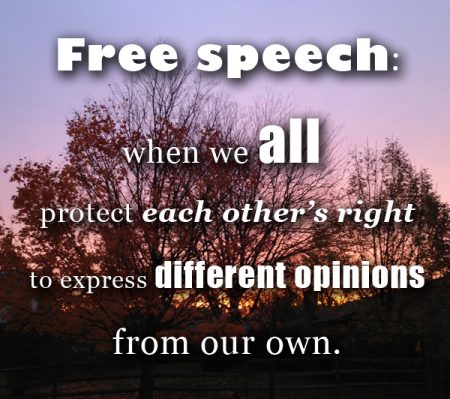
That’s not to say that Rufus Hound was right or wrong. I’m not writing in defence of conspiracy theories per se. Maybe every conspiracy theory is wrong. Maybe Oswald was guilty as hell and physics stopped working on 9/11. Or maybe John Lennon is still alive and Stanley Kubrick directed the moon landings. It’s immaterial. This goes beyond that. This is about free speech, and the right to be wrong.
Unless we stand up for each other’s right to hold, and express opinions – even wrong opinions – then no opinions will ever be safe. Because when they clamp-down on the internet, it won’t be truth that decides what stays and what goes, but political convenience, and unless we defend all of it, none of it is safe.
In the past few months the internet’s lack of regulation has been blamed for Clinton’s loss of the election, for Russia’s “spreading influence” and for the proliferation of “fake news”.
In the past week alone, the Guardian has been running articles on Facebook’s lack of moderation. How they promote child abuse, misogyny and holocaust denial. Already Theresa May has called on tech companies to “do more” to combat online extremism.
They blame it for paedophilia, terrorism, sexism, racism. Drugs are dealt, threats are issued, abuse hurled. The internet is a playground, as David Thorne said, but apparently it’s one of those rusty, graffiti-ridden playgrounds where nice kids shouldn’t go. Tear it down. Pave it over.
Cure society’s ills by making it smaller, more isolated and much, much easier to control.
Maybe I’m just getting middle-aged. But there are weeks when [arguing with conspiracy theorists] seems an inordinately high price to pay for a convenient means of swapping gossip and cat videos.
Isn’t free speech difficult? Isn’t it all just so much hassle? Wouldn’t it be SO much easier if we could just stomp it all out? Yes, obviously, fewer cat videos would be a shame, but think of the benefits – a nice safe world, full of nice safe pre-approved thoughts. That sounds nice, doesn’t it?
This sentence does more than give us a fleeting glimpse at the author’s complete lack of imagination, it shows… again… where the establishment’s crosshairs are trained. And it’s on us. At OffGuardian and the hundreds of sites like us. At the minor celebrities tweeting reasonable (but forbidden) thoughts to groups of followers “more than double the circulation of a national broadsheet newspaper”. We’re all talking to each to other now, bypassing the established and approved lines of communication.
And it’s causing no end of trouble.
They lie, they distort, they misinform … you and I are expendable
By Dave Alpert | Intrepid Report | May 26, 2017
Let me state this once again: beware, we are being used, abused, and lied to.
Monday, there was an explosion at a concert in Manchester, England, where reports indicate that it was a suicide bombing and 22 people have died.
As we have come to expect, within hours, before any investigation or evidence, officials labeled this a terrorist attack. And, as often happens, ISIS took responsibility.
Does this mean that Britain will escalate its military involvement in Syria as a response to this bombing? I’m willing to bet on it.
The timing of this attack is interesting. British Prime Minister Theresa May’s Conservatives are running for re-election on June 8 and their lead is shrinking. Will this event re-energize the Tories’ campaign? I would be surprised if it didn’t.
As things stand now, Parliament is not in session and, therefore, there is no one to hold the government in check. This will allow May the opportunity, although there is not great popular support, to increase Britain’s military involvement in Syria.
I don’t know how you feel about coincidences, but I see them as rare phenomena. Usually, events occur with some intent.
Luciana Bohne, a Facebook friend, posted the following coincidences on Facebook:
- 11 March 2004: terrorist attack in Madrid; three days before election by an electorate opposed to invasion of Iraq (2003) on pretext of war on terror
- 13 July 2007 Terrorist attack in London; strengthens Tony Blair’s alliance with US’s “war on Terror.” Blair refuses investigation into incident,.
- 15 November 2015: Terrorist attack in Paris; Hollande bombs Syria and declares state of siege (or similar assault on constitutional government).
- 22 May 2017: terrorist attack in Manchester in full gear election season.
Of course, we cannot leave out the “Mother of all Coincidences,” the 9/11 attack on the US. This attack opened the door for the US to justify militarizing the Middle East with its troops and armaments, overthrowing “regimes” that were not friendly to the US agenda of world domination and replacing them with “friendly, more democratic governments.”
Gaining popular support for military intervention in Iraq and other Middle East countries was the topic of discussion and a high priority from the very first meeting of the George W. Bush cabinet as reported by Bush’s Treasury Secretary, Paul O’Neill.
Can we shrug off the 9/11 attack as merely another coincidence and a fortunate occurrence for the Bush administration? They needed an event, similar to Pearl Harbor, to gather popular support to send troops into the Middle East and they got it. Coincidence?
The 9/11 attack not only effected US foreign policies, it created an atmosphere for the popular acceptance of the government’s trespassing on our basic civil and human rights. Such constitutional rights as due process, habeas corpus, privacy, the right to dissent and protest were taken from us.
Corporations were empowered to exploit and steal and use their money and wealth to control elections. Elections have been rendered meaningless and are nothing more than political theater allowing the populace to feel they have a stake in how this country is run. The reality is, for a candidate to actually rise to the point where he/she is an acceptable candidate, he/she must be endorsed and financially supported by the corporations . . . the Goldman Sachs and other banksters, the pharmaceuticals, the health insurance people, the war and weapons industries, etc. In other words, they must sell their collective souls.
Is it no wonder that we are vulnerable and left to the mercy of these predatory corporations who are allowed to operate in a predatory capitalist system? Is it a surprise that students who graduate from colleges are left with the burden of enormous debt . . . a debt that must be repaid in full regardless of circumstance or misfortune? Is it a surprise that Barack Obama was an ardent supporter of the Trans-Pacific Pact (TPP) an agreement that would have destroyed thousands of jobs here in the US and rendered tens of thousands of US workers unemployed?
Is it a coincidence that the mainstream press, which is corporate owned, is nothing more than an echo chamber for big business and US imperialism?
Is it merely coincidence that the government, “our” representatives, agree to abolish social service programs while giving tax breaks to the wealthy, while militarizing police departments, and adding $10 billion to the US military budget as well as agreeing to contribute to Israel’s military budget by offering them $35 billion over the next 10 years?
But, it doesn’t end there. We once had the right to privacy and the protection against unreasonable search and seizure. What do we live with today? We are all subjected to government surveillance of our mail, phone calls, texts, and personal records. This is all justified as necessary to keep us safe. Safe from whom? The police departments are supposed to keep us safe and they have been killing hundreds of unarmed, mostly African-American, US citizens every year.
But, it doesn’t end there. Using the National Defense Authorization Act (NDAA), the executive branch of “our” government has empowered itself to assassinate U.S. citizens. The government has also empowered itself to call the Army into the streets of this country to control civil unrest. Since 1878, this has been illegal. The executive branch can order the military to seize U.S. citizens deemed to be terrorists or associated with terrorists. Those taken into custody by the military can be denied due process and habeas corpus and held indefinitely in military facilities. Activists and dissidents, whose rights were once protected under the First Amendment, can be threatened under this law with indefinite incarceration.
So, when we talk about 9/11 or any other meaningful and impactful event, we must ask two basic questions . . . why now? and who benefits from this event?
We must never accept, at face value, the official narrative! We must always examine the outcome of these events in order to put into perspective what happened and why it happened.
Manchester Bomber Was Product of West’s Libya/Syria Intervention
By Daniel McAdams | Ron Paul Institute | May 24, 2017
Here’s what the media and politicians don’t want you to know about the Manchester, UK, suicide attack: Salman Abedi, the 22 year old who killed nearly two dozen concert-goers in Manchester, UK, was the product of the US and UK overthrow of Gaddafi in Libya and “regime change” policy in Syria. He was a radicalized Libyan whose family fled Gaddafi’s secular Libya, and later he trained to be an armed “rebel” in Syria, fighting for the US and UK “regime change” policy toward the secular Assad government.
The suicide attacker was the direct product of US and UK interventions in the greater Middle East.
According to the London Telegraph, Abedi, a son of Libyan immigrants living in a radicalized Muslim neighborhood in Manchester had returned to Libya several times after the overthrow of Muamar Gaddafi, most recently just weeks ago. After the US/UK and allied “liberation” of Libya, all manner of previously outlawed and fiercely suppressed radical jihadist groups suddenly found they had free rein to operate in Libya. This is the Libya that Abedi returned to and where he likely prepared for his suicide attack on pop concert attendees. Before the US-led attack on Libya in 2011, there was no al-Qaeda, ISIS, or any other related terrorist organization operating (at least with impunity) on Libyan soil.
Gaddafi himself warned Europe in January 2011 that if they overthrew his government the result would be radical Islamist attacks on Europe, but European governments paid no heed to the warnings. Post-Gaddafi Libya became an incubator of Islamist terrorists and terrorism, including prime recruiting ground for extremists to fight jihad in Syria against the also-secular Bashar Assad.
In Salman Abedi we have the convergence of both these disastrous US/UK and allied interventions, however: it turns out that not only did Abedi make trips to Libya to radicalize and train for terror, but he also travelled to Syria to become one of the “Syria rebels” fighting on the same side as the US and UK to overthrow the Assad government. Was he perhaps even trained in a CIA program? We don’t know, but it certainly is possible.
While the mainstream media and opportunistic politicians will argue that the only solution is more western intervention in the Middle East, the plain truth is that at least partial responsibility for this attack lies at the feet of those who pushed and pursued western intervention in Libya and Syria.
There would have been no jihadist training camps in Libya had Gaddafi not been overthrown by the US/UK and allies. There would have been no explosion of ISIS or al-Qaeda in Syria had it not been for the US/UK and allied policy of “regime change” in that country.
When thinking about Abedi’s guilt for this heinous act of murder, do not forget those interventionists who lit the fuse that started this conflagration. The guilt rests squarely on their shoulders as well.
ISIS Terrorist Attack in Manchester? 17 Days Before Crucial UK Elections
By Peter Koenig | Global Research | May 24, 2017
British elections are planned for 8 June 2017.
At the end of a pop concert by US singer Ariana Grande in Manchester, an enormous ‘controlled’ explosion killed at least 22 people and injured 59, as reported by British media. Many of them are children and adolescents, as most of the concert-goers were young people.
The singer is unharmed. The concert hall accommodates 21,000 people. After the blast, panic broke loose, resulting in a mass stampede. It is not clear whether people were also killed in the stampede.
Hours after the explosion, although BBC reported it was not evident what exactly happened, UK police and authorities talked immediately of an act of terror.
Early Tuesday morning, 23 May, British authorities said that the Islamic State (IS) claimed responsibility for the explosion. The Chief Constable of Greater Manchester Police, Ian Hopkins, stated investigators believe the attack was carried out by a lone suicide bomber “carrying” a homemade device. He was killed by the blast.
The IS-Propaganda agency Amak apparently issued the claim of IS’s responsibility for the deadly blast. Did an independent authority check whether this is indeed true?
The attacker, is now named by US officials (why US officials?) as Salman Abedi, 22, a British citizen, born in the UK. He is told having detonated the improvised explosive device.
Another 23-year-old suspect was apprehended in the south of Manchester. But so far, the Chief Police Officer refused to talk to the media about suspects.
Prime Minister, Theresa May raised the threat warning to the highest level, from ‘severe’ to ‘critical’, saying other attacks may follow. This is the highest security level in the UK. She also urged police to investigate whether the attacker was alone or may have acted as a member of a wider terror group.
The attack is the worst in the UK since 56 people were killed in the 7 July London bombings in 2005.
Both, Theresa May and her election opponent, Labor Leader Jeremy Corbyn expressed their deep sorrow to the victims’ families. All campaign activities for the 8 June elections have been suspended.
Mr. Sadiq Khan, the mayor of London, proclaiming on what the raised threat level means for the city, said,
“there will be additional police officers on London’s streets over the coming days – including additional armed officers. You will also see some military personnel around London – they are there to help our police service to keep us safe and guard key sites.”
The head of Counter Terrorism at the Metropolitan Police, Mr. Mark Rowley, informed that
“there has been an arrest and there are currently multiple searches and other activity taking place as I speak. However, at this stage it is still not possible to be certain if there was a wider group involved in the attack; 24 hours in we have a number of investigative leads that we are pursuing to manage the ongoing threat.”
All of this points to a rapid militarization of the UK, akin to France. What EU country will be next?
Was it The ISIS, Who is Behind the ISIS?
Why would the Islamic State kill children in England, when they know exactly that this provokes further NATO – EU – US military aggression against them?
And why in England, just before elections?
Do they not know that they incite election results unfavorable to them, unfavorable to Muslim society, electing the candidate that promises even more discrimination against Muslims? A candidate even less eager to find a peaceful solution in the Middle East?
Of course, they know.
Known and documented ISIS- Daesh, Al-Qaeda and most other terror groups fighting in the Middle East proxy-wars for the West, are constructs of US intelligence. ISIS is financed by America’s staunched Middle East ally Saudi Arabia. This relationship has to be addressed. Who are the State sponsors of terrorism.
We, The People, should wake up to this reality.
Are these terror attacks being used to dupe the public into accepting more “protection”, like a gradual but ever accelerating militarization of the West. Even the installation of Martial Law is not far-fetched. Former French President Hollande tried to introduce it in France’s Constitution in the wake of the Charlie Hebdo terror attack; so far unsuccessfully.
This gives the Deep State-installed EU government, i.e. Brussels, the legitimacy to clamp down and if needed violently repress protests in European cities, as they may arise with increasing neoliberal financial domination of western economies, imposed austerities, privatization of public services, educations systems, health care – cuts in pensions, in brief, the imposition of a repressive economic system. We are almost there, just look at Greece.
As always, the question to ask is Cui Bono?
At first sight it looks like the tragic Manchester act of terror could benefit Theresa May and her conservative Tories. They propagate clamping down on terrorism, on immigration to keep ‘terrorists’ out. Snap-elections decided without much warning by PM Theresa May, are scheduled for 8 June, just 17 days away from the attack, but enough time to launch massive pro-conservative and anti-Labor propaganda.
Interestingly, Jeremy Corbyn has been making rapid gains lately in the polls. The supposed ‘terror’ attack, may set his gains back and advance the “pro-security” Tory leader, Theresa May. As if Jeremy Corbyn and Labor were against ‘security’ – This is the implied falsehood of the presstitutes – foreseeable, like in The Theft of an Election Foretold.
Interestingly too, the recent French elections were also preceded by a terror attack. Just days ahead of the first round of elections, a gunman opened fire on a police car on Champs Élysées, killing one policeman and injuring two, the gunman was immediately killed by French police; the chief witness gone. End of story.
See Also:
Germany and NATO: Towards Martial Law, Preparing for a “Fascist Repression” in Europe?
French Election Fraud? Will Macron be Able to Form a Government?
Peter Koenig is an economist and geopolitical analyst. He is also a former World Bank staff and worked extensively around the world in the fields of environment and water resources. He lectures at universities in the US, Europe and South America. He is the author of Implosion – An Economic Thriller about War, Environmental Destruction and Corporate Greed – fiction based on facts and on 30 years of World Bank experience around the globe.
Copyright © Peter Koenig, Global Research, 2017
Tory Lead Tumbling
By Matthew JAMISON | Strategic Culture Foundation | 23.05.2017
It has been quite a few weeks in the latest British General Election. The really interesting story is how the Conservative Party’s lead in the opinion polls keeps dropping. At the outset of the announcement of a General Election in the middle of April the Tories stood atop what looked like an insurmountable opinion poll lead. The opinion poll companies put the lead at somewhere in the range of 18-22%. This would have given the Conservative Party its biggest landslide majority in the House of Commons since the 1980s. Even as matters stand now the Conservatives are still on course to win the election and with a larger majority than at the 2015 General Election.
Yet their opinion poll lead rather than holding up or growing ahead of Election Day set for Thursday June 8th is actually declining as the campaign wears on. With so much of the mainstream press in Britain backing Theresa May’s Tory Party and the overwhelmingly hostile campaign of nearly all the newspapers and members of his own Parliamentary Party, Mr. Corbyn, had been pronounced by many in the London media and indeed within his party in the House of Commons as a dead man walking with no hope of slashing the Tory lead let alone consistently week on week bring it down by 3-4%. Now the Tories once mighty lead has fallen by nearly 10% in the space of three weeks or so. At this rate come election day it may even be tied between Labour and the Conservatives or a few points separating them.
How has this happened. Well, it would appear that while most of Mr. Corbyn’s Parliamentary Party were plotting his downfall with various journalists he and the Labour Leadership have been developing rich policy work across a range of public policy areas in need of drastic reform. Since the formal launch of the campaign all we have had from Theresa May and her Conservatives is one vacuous slogan: «Strong and Stable leadership.» Nothing on the NHS and the funding crisis it and schools in Britain are facing. Nothing on plans to update and improve Britain’s appalling infrastructure; nothing to help bring down the cost of living holding shark landlords and extortionate rents to account. Nothing on the job creation of the future. Basically on all the important domestic policies which affect people’s lives, Theresa May and the Conservative Party have said and presented nothing.
When she and her colleagues have finally started discussing their actual policies and governing vision for Britain it actually started to frighten some of what were thought to be some of the most reliable of the Tory horses – Pensioners. Pensioners and those nearing retirement were greeted with the Tory prospect that a «dementia tax» would be introduced which would see elderly people receiving social care and having to fund the entire cost, until they reached their last £100,000 of assets. They are quite a large voting bloc and overwhelmingly backed Brexit against the wishes of future generations who will actually be alive when those who voted for Brexit are long gone.
The average UK house price stands at £215,847, so the «dementia tax» would affect many middle-class voters. It is being compared to Margaret Thatcher’s flagship policy of her third term – the «Community Charge» or Poll Tax which proved so unpopular in the country that it fuelled a massive rebellion that ended her near 16 year leadership of the Conservative Party. So, perhaps British voters are finally, finally just starting (and here I emphasize just starting) to finally wake up and realize that the Tories are a deeply divisive, sinister party who offer nothing for those who need it the most and are a tiny clique of a party that represents the interests a very privileged, powerful, wealthy minority whose number one political agenda is to protect and preserve their privileges and vested interests while ensuring the perpetuation of economic and social inequality which suits the preservation and enhancement of their established wealth and with it power to the detriment of the country as a whole. There have also been Mrs. May’s lukewarm attitude towards preserving the «triple lock» on pensions and the possibility that VAT already at a staggering 20% may go up after the next Parliament.
Meanwhile, the Labour Party have been rolling out what appear to be well thought out; costed and popular policies with key constituencies across the UK. Many people have started to say that Jeremy Corbyn’s message on the home front or his foreign policy views make a great deal of sense and he is not the Stalinist madman that the likes of the Daily Mail and the Sun have made him out to be while Mrs. May’s vacuous, meaningless slogan «strong and stable leadership» is starting to wear very thin with little policy meat on the bones to back it up and what there is such as the «dementia tax» are thoroughly nasty, horrible policies. Mrs. May; her inadequate team and the party she leads may find come polling day they squandered one of the largest opinion poll leads in the shortest space of time imaginable. If by June 9th we are back to the situation of 2010 where no one party commands an overall working majority in the House of Commons there could very well be the possibility of a Labour/Liberal/SNP alliance forming a Coalition Government with the Greens thrown in for good measure. What delicious irony it would be if the only exit Mrs. May gets to preside over is her own exit from No. 10 Downing Street in the days after June 8th.
BBC goes full Big Brother in recent announcement
OffGuardian | May 21, 2017
Brought to our attention by Mark Doran, a new BBC document dated May 2017 contains this bizarre threat to its licence-payers:
9. Offensive or inappropriate content on BBC websites
If you post or send offensive, inappropriate or objectionable content anywhere on or to BBC websites or otherwise engage in any disruptive behaviour on any BBC service, the BBC may use your personal information to stop such behaviour.
Where the BBC reasonably believes that you are or may be in breach of any applicable laws (e.g. because content you have posted may be defamatory), the BBC may use your personal information to inform relevant third parties such as your employer, school email/internet provider or law enforcement agencies about the content and your behaviour.
Here’s Mark’s screen cap of the doc:

Not only is this freakishly (yes, there’s no other word) Orwellian, it’s completely vague. Are the words “objectionable” and “disruptive” going to be employed like the words “hate” (currently being used to shut down discourse on social media), and “fascist” (currently being used by (often fascist) neoliberals to brand any serious criticism of globalism and the corporatocracy), to outlaw and/or punish dissident views? And what about “defamatory”? Is anyone calling Theresa May a malfunctioning Thatcher-bot going to be shopped out to her lawyers by the Beeb?
Clarification, at the very least, is urgently needed. Better still, the BBC should backtrack and guarantee it will remain a broadcast corporation and NOT presume to act as an arm of the state security system.
If you’re a concerned UK citizen, don’t hesitate to contact the BBC to express your views – though be prepared for a follow-up visit from the cops.
Featured Video
New positive ivermectin evidence
or go to
Aletho News Archives – Video-Images
From the Archives
Fanatical Followers of the Covid Regime: A Jim Jones-Style Cult?
By Professor Roger Watson and Dr. Niall McCrae | The Daily Sceptic | November 15, 2021
As scholars at leading British universities over recent decades, we witnessed the replacement of critical thinking and debate by narrative: facts are discrimination and scientific method is imperialism; truth, instead, is derived from ‘progressive’ values. This educational trend may be a major contributory factor to the ease in which society has been inculcated to the Covid ‘new normal’ of masking, testing, and repeated doses of vaccines for a disease of similar risk to severe influenza.
One doesn’t need much critical reasoning to observe the flawed logic of some vaccination enthusiasts, such as people who respond to experiencing any side effects, however debilitating, by saying “at least I know it’s working”, or, after contracting the disease despite their promised inoculation (over 90% effective, according to initial drug company claims), “I’d have been worse off without the jab.” … continue
Blog Roll
 Aletho News
- The Coming GOP Bloodbath?
- Arctic Scare Stories Melt Away
- Wrong, Euronews: Climate Change Has Not Created a Food, Energy, and Economic “Meta-Crisis”
- New positive ivermectin evidence
- Met Office Caught Fabricating Daily Temperature Record Claims
- Merck Virologists Admitted to Falsely Certifying Vaccine Efficacy
- Mandatory Folic Acid for every man, woman & child
- Pro-Palestine protesters arrested outside UK’s ruling Labour Conference in Liverpool
- Mauritius denies landing permit to flight from Israel, forcing cancellation: Tour operator
- Israeli finance minister calls for genocidal war on West Bank, annexation of south Lebanon
- If Americans Knew
- In Gaza, ‘Whoever Survives the Bombing Won’t Survive the Rubble’
- Israel kills more Palestinians, amid push to resettle Gaza – Daily Update
- Israel forces Gazans to live in constant peril – Daily Update
- Deconstructing Netanyahu’s pants-on-fire UN rant – Daily Update
- Trump betrayed voters with his campaign lies and prioritized a foreign country once he took office
- Netanyahu calls Israel’s war in Gaza ‘opposite of genocide’ in UN speech to near-empty hall
- Settler Kidnappings: Torture, Sexual Abuse and Terrorisation of Palestinian Abductees as Israel Deepens Annexation of West Bank
- Gaza winter nears as 162,000 tents become unusable, raising fears of humanitarian crisis
- Netanyahu says, “It’s the opposite of genocide”; UN says Gaza economy is world’s ‘most severe crisis on record’ – Daily Update
- Israel’s US-Backed Assault on Gaza Has Created the ‘World’s Most Severe Economic Crisis on Record’: UN
- No Tricks Zone
- New Study: Earth And Venus Surface Warmth Largely Explained By Convection And Lapse Rate, Not CO2 Or Radiation
- 2025 Nature Paper Claiming Worsening Global Drought Gets RETRACTED …Heavily Flawed
- New Study: ‘Global Drought Shows No Detectable Recent Acceleration Under Climate Warming’
- Economic Masterminds: German Socialists Suggest Taxing Productivity Gains Stemming From Using AI
- The South China Sea Has Not Been Cooperating With The Climate Change Narrative
- Energy Crisis: Germany Enters Heating Season With Historically Low Gas Reserve Fill Levels
- New Study: The Antarctic Ice Sheet Gained Mass From 2020-2024 Due To Staggering Snow And Ice Accumulation
- Study: Ocean Heating Rates From Thousands Of Years Ago ‘Dwarf’ Modern Ocean Heating Rates
- Climate Extremists Target, Attack Large-Scale Power Grid Infrastructure In Germany!
- New Study: Antarctic Ice Melt Has Contributed Less Than 1 Centimeter To Sea Level Rise In The Last 30 Years

