Syria: Has Anyone Stepped Back from the Brink?
By Michael Jabara CARLEY | Strategic Culture Foundation | 26.12.2015
John Kerry, the US Secretary of State, recently visited Moscow to discuss the Syrian crisis with his colleague Sergei Lavrov and President Vladimir Putin. Journalists observed handshakes, smiles, even hearty laughter, between Kerry and his Russian counterparts. Syrian President Bashar al Assad does not have to resign immediately, Kerry declared, and the United States is not trying to isolate Russia. What good news, and what a surprise for the Russians. The Moscow show seemed a great success. Kerry strolled along Stariy Arbat Street, met smiling Russian pedestrians and bought souvenirs to take home. A few days later the UN Security Council passed a resolution, calling for a ceasefire and negotiations. Russian and western journalists alike now say there is some hope to avoid the worst in Syria. And as you may already know, if the United States wants a ceasefire, it’s because their «moderate» Jihadist allies are getting beaten up now by the Syrian Arab Army backed by Russian air support.
Is cautious optimism warranted about a Syrian peace? It is hard to see how. Kerry may say whatever he wants in Moscow, but when he gets back to Washington, he sings a different song, or his colleagues do. His boss, President Obama, said «Assad has to go» only a few days after Kerry returned home. And then there is the new phantasmagorical story published by Seymour B Hersh, the muckraking US journalist, who has revealed that not everyone inside the US government is brain dead. It’s a remarkable discovery when you think about US foreign policy. Some military officials, and no less than the former Chief of Staff, General Martin Dempsey, were actually indirectly, and very secretly, passing military intelligence to the Syrian government to help it fight Daesh, Al-Qaeda and allied Jihadist forces operating in Syria. At the same time, the CIA, with Obama’s support, was sending arms hither and thither in Syria to help the Jihadists overthrow the Assad government.
General Dempsey left office in September 2015 and was replaced by General Joseph Dunford, a true blue Russophobe, who says Russia is an «existential threat» to the United States. It is a classic Washington response: the US aggressor accuses its intended victim of aggression. Just the other day (22 December), the United States slapped on gratuitous new sanctions against Russia. It’s the same old pretext: Russian «aggression» in the Ukraine.
Yet another US provocation, you might think, as Russia searches for a peaceful settlement of the Syrian war. The Russian government is taking a sensible position, but in the present circumstances, is a negotiated peace a real possibility? If the war in Syria were simply a civil war, as is often repeated in the media, you could encourage the belligerents to put on suits and ties and sit down at a table to negotiate a settlement. Unfortunately, the war in Syria is not a civil war: it is rather a proxy war of aggression led by the United States, Britain, and France (until the Paris massacre in November), and pursued vigorously in the region by Turkey, Saudi Arabia, Qatar, Jordan, and Apartheid Israel.
Turkey is playing a dirty, evil role. It provides arms and supplies across its borders for Daesh in Syria. Oil taken from Syrian wells by Daesh travels in the opposite direction, sold at cut rate prices, to provide revenue to the Jihadists for their war against Assad. It is estimated that Daesh was obtaining $40 millions a month from exported oil (before Russian intervention), but this is a bagatelle in terms of the money necessary for the Jihadists to wage war against Syria. Hundreds of millions are required. Saudi Arabia and Qatar are important suppliers and financiers of the Salafi Jihadist movement. Jordan permits training of Jihadists on its territory and allows passage across its frontiers into Syria. Israel also provides support from the occupied Golan territory, even providing medical care to wounded Jihadists. A coalition of states, four of which are NATO members, is waging a war of aggression against Syria. Against this array of deadly enemies, the Syrian government and the Syrian Arab Army, in a remarkable feat of arms, has been able to hold out for more than four years. President Assad has proven his courage and tenacity as a leader by refusing US summons to resign and by staying in Damascus to share the personal danger which all Syrians must endure simply to live in their country. No wonder Obama wants to get rid of Assad before talk about Syrian elections for he would almost certainly win them.
Sputnik in Moscow has estimated that there are as many as 70,000 foreign Jihadists fighting in Syria.

These forces appear for the most part are well motivated, supplied largely with US weapons and deeply entrenched in various parts of Syria. Since the Russian intervention on the side of the Syrian government, progress has been made in rooting out Jihadist forces, but as long as supply routes remain open across Turkey, Iraq, Jordan, Israel, even Lebanon, the war in Syria is not going to end.
Turkey’s role is particularly dangerous. It is a NATO member and it uses this privileged position to commit acts of aggression against Iraq and Syria. It shot down a Russian warplane in a well-planned ambush, likely with US connivance, and then ran to hide in NATO’s skirts. Apparently, the Turkish government hoped to sabotage budding European cooperation with Russia against Daesh, or to provoke a NATO-Russian war, as insane as that might seem. Other NATO members, the United States, France, and Britain, have also been deeply involved in the proxy war against Syria. Indeed, after the destruction of Libya, it has been reported that NATO planes were secretly used to transport Jihadists and Libyan arms to other Middle Eastern fronts. NATO members are effectively allied with Daesh and its Al-Qaeda derivatives against the Syrian government.
To be sure, the United States and its European vassals have attempted to cover up their links to the Jihadist war in Syria by launching make-believe air attacks on Daesh targets, occasionally bombing a caterpillar tractor here or there and blowing up a lot of sand in people’s eyes. Russian intervention exposed the double game of the United States and changed the balance of military forces in Syria.
Even now however, the US air force sends warning messages to Jihadist truck drivers to get away from their vehicles before it attacks them. Or it refuses altogether to attack trucks carrying Daesh oil, claiming it’s private civilian property. How preposterous! Since World War II, when has the United States hesitated to attack civilian targets? It is understandable that Obama and the CIA, having been caught red-handed in Syria, are furious with Putin for exposing them. Nevertheless, the Russian government has offered the United States, a porte de sortie, pushing for an anti-Jihadist alliance and peace talks to settle the war.
Peace is a marvelous idea and the US escape route, a practical gesture, but how is Foreign Minister Lavrov going to get Saudi Arabia, Turkey, Qatar, Jordan, and Israel, not to mention the United States and Britain, to stop supporting the Jihadist movement in Syria and Iraq? Talk about an impossible alliance: it’s like taking a writhing nest of asps to your breast and hoping they won’t bite you. Are such hopes realistic? «Maybe not but that’s diplomacy,» Lavrov might respond: «we have to try nevertheless». These days it takes infinite patience and great theatrical skills to be a Russian diplomat. Russia is trying to finesse the United States into dropping its support of «moderate» Jihadists. In fact, such moderates do not exist.

Neither does the so-called Free Syrian Army (FSA). The Jihadists decapitate a few hapless victims, and FSA volunteers run away in horror leaving their arms for Daesh. Or, they laugh at the infidels’ stupidity and go over, arms in hand, to the Jihadist side.
Even if Russia could get real commitments from the United States, which is as yet quite uncertain, what is to be done about Turkey, Saudi Arabia and the Gulf states? And what is to be done with all the foreign Jihadists in Syria? Are these terrorists and war criminals going to be encouraged to return to the 40+ different countries whence they came to stir up violence there? And what is to be done about the Syrian Jihadists, though there is no open source information about their numbers? Will they be allowed to remain at large, or worse, will they be recognised as a legitimate Syrian opposition?
Even an anti-Jihadist coalition of willing members will have hard work rooting out Daesh and its allies. But the coalition of asps which Russia is trying to organise is composed of Daesh supporters. How is that going to work? One fears not at all well since the would-be alliance members, with the possible exception of France, have not abandoned their backing of Daesh, whatever one hears to the contrary notwithstanding. The United States remains the chief culprit continuing to pursue its two-faced, dangerous policies.

«The four core elements of Obama’s Syria policy remain intact today», Seymour Hersh says: «an insistence that Assad must go; that no anti-IS (Islamic State) coalition with Russia is possible; that Turkey is a steadfast ally in the war against terrorism; and that there really are significant moderate opposition forces for the US to support».
Policy based on false premises invariably leads to failure. Obama’s policy is no exception. Assad is a courageous leader of Syrian resistance against the Jihadist invasion. The only possible successful coalition against Daesh, Al-Qaeda and their affiliates is with Assad and with Russia. Turkey is a dangerous provocateur, playing with matches amongst open kegs of gunpowder, trying to drag NATO into a deeper de facto alliance with Daesh or even war with Russia. Finally, there are no «moderate» Jihadist forces in Syria. The Free Syrian Army barely exists at all, and the so-called moderates are no less murderous than their Daesh allies.
One cannot fault the Russians for trying to organise an anti-Jihadist alliance in Syria, but their potential allies, apart perhaps from the apparently repentant French, are all snakes in the grass. And Obama, the Nobel Peace Prize winner, is the biggest snake of all. «Do you realise what you have done?» Putin asked at the UN in September. Not yet apparently, reports to the contrary notwithstanding. But then, as we know, there are none so blind as those who will not see.
Amnesty International: Imperialist Tool

By Prof. Francis A. Boyle | thewallwillfall
July 31, 1998
Dear Amnesty Friends:
I am in receipt of the response by three members of the AIUSA Middle East Coordination Group to my message that was entitled “NGOs As Western Tools.” You will note that they never denied any of the basic facts set forth in my original message. When Israel invaded Lebanon in 1982 and murdered 20,000 Arabs/Muslims with the full support of the United States, both Amnesty International and AIUSA said absolutely nothing at all despite vigorous efforts by AIUSA Members to get them both to say and to do anything. When it became clear that AIUSA was not going to say or do anything about Israel’s wholesale slaughter of Arabs/Muslims in Lebanon because of the marked pro-Israel bias by the AIUSA Staff, Board, and Funders, I called the Irish Nobel Peace Prize Winner Sean MacBride at his home in Dublin and asked him to intervene with AI/London. What little AI/London said and did about 20,000 Arabs/Muslims in Lebanon murdered by Israel with the full support of the United States was due to Sean MacBride.
MacBride then convinced the then AI Secretary General to appoint me a Consultant to Amnesty International on the human rights situation in the Middle East. In that capacity, I attended the founding meeting of what would become the AIUSA Middle East Coordination Group. In other words, I was one of the founders of the AIUSA Mid-East Co-Group, some of whose members are now defending its work. At that founding meeting I said quite emphatically that Amnesty International and AIUSA would have absolutely no credibility whatsoever in the Middle East unless they dealt forthrightly and vigorously with violations of the human rights of Arabs and Muslims by Israel, and, in particular, Israeli atrocities against the People of Lebanon and the Palestinian People. Soon thereafter, I found out that the Members of the AIUSA Mid-East Co-Group had been instructed to have nothing more to do with me by a direct order coming from the AIUSA Board of Directors.
It is fair to say that Amnesty International has quite recently released some reports dealing with Israeli violations of human rights of the Palestinian People and the Lebanese People. But Israel has been consistently murdering, torturing and destroying the Palestinian People since at least the time when the occupation of their lands began in 1967–and with the full support of the United States Government. And only now has Amnesty International got around to condemning it. Almost a decade ago while on the AIUSA Board, I tried to get AI/London and AIUSA to act on the basis of the infamous Landau Report whereby the Israeli Government officially sanctioned torture against Palestinians. Over a decade ago while on the AIUSA Board, I pointed out that this made Israel the only state in the world to officially sanction torture. It is nice to see that a decade later Amnesty International has finally agreed with me and said something about it.
Likewise, Israel has been rampaging around Lebanon with the full support of the United States to the grave detriment of the Lebanese People and Palestinians living there since at least the time when Israel first invaded Lebanon in 1978. The primary reason why Amnesty International has put out these latest reports condemning Israeli human rights violations in Lebanon and against the Palestinian People after decades of silence is because there are now several other human rights organizations which have acted against Israel when AI/London and AIUSA refused to act because of their marked pro-Israel bias. When it comes to protecting the human rights of Palestinians, Lebanese, Arabs/Muslims from atrocities by Israel, the United States, and Britain, AI/London and AIUSA have always been too little, too late, and on purpose.
While on the AIUSA Board I once saw the itinerary drawn up by AIUSA for the visit to the United States by the then AI Secretary General coming from London. On the list was almost every major pro-Israel group in New York and Washington and about one Arab Group. Given their standard operating procedures, I am confident the pro-Israel groups threatened the AI Secretary General that they would have their members withhold or reduce their contributions to AI and AIUSA if AI/London did not reign in its pathetic, pitiful, and meager criticisms of Israel. While I was on the AIUSA Board, AIUSA paid about 20% of the budget for AI/London. He who pays the piper calls the tune.
You will also note that the three AIUSA Mid-East Co-Group members’ response to my original message said absolutely nothing at all about the scandalous Kuwaiti Dead Babies Report and Campaign that both Amnesty International and AIUSA used for the purpose of promoting war against Iraq. As a Member of the AIUSA Board, I received a pre-publication copy of the Dead Babies Report. I read it immediately and quite carefully. First, this report contained technical errors that should have precluded its publication. Second, even if all these sensational allegations had been true, it was clear that publication of this report at that critical moment in time (December 1990) would only be used by the United States and Britain to monger for war against Iraq. I expressed these opinions in the strongest terms possible and that this report should not be published because it was inaccurate; or that if for some reason it were to be published, it must be accompanied by an errata sheet. Amnesty International published the Dead Babies Report anyway despite my vigorous objections, and launched their Disinformation Campaign against Iraq. From this episode I could only conclude that AI/London deliberately intended the Dead-Babies Report and Campaign to be used in order to tip the balance in favor of war against Iraq.
This is exactly what happened. In January of 1991 the United States Senate voted in favor of war against Iraq by only five or six votes. Several Senators publicly stated that the AI/AIUSA Dead Babies Report and Campaign had influenced their votes in favor of war against Iraq. That genocidal war waged by the United States, the United Kingdom and France, inter alia, during the months of January and February 1991, killed at a minimum 200,000 Iraqis, half of whom were civilians. Amnesty International shall always have the blood of the Iraqi People on its hands!
Once it became clear that there never were any dead babies in Kuwait as alleged by Amnesty International, AI/London proceeded to engage in a massive coverup of the truth. For all I know, the same people at AI/London who waged this Dead-Babies Disinformation Campaign against Iraq are still at AI/London producing more disinformation against Arab/Muslim states in the Middle East in order to further the political and economic interests of the United States, Britain, and Israel. Because of its Dead-Babies Disinformation Campaign against Iraq and its ensuing coverup, Amnesty International will never have any credibility in the Middle East!
During the past eight years, about 1.5 million People in Iraq have died as a result of genocidal sanctions imposed upon them primarily at the behest of the United States and Britain, including in that number about 500,000 dead Iraqi children. While on the AIUSA Board of Directors, I tried to get them and AI/London to do something about this genocidal embargo against the People of Iraq, and especially against the Iraqi Children. Both AI/London and AIUSA adamantly refused to act despite the grievous harm that their Dead-Babies Disinformation Campaign had inflicted upon the People of Iraq. It was clear to me at the time that there was no way AI/London and AIUSA were going to take on Britain and the United States on behalf of the completely innocent People of Iraq.
Now we are told that there is something in the AI Mandate that precludes AI action against such genocidal economic embargoes. Of course this is nonsense. While I served on the AIUSA Board, one of our Board Chairs personally put me in charge of handling Mandate issues for the AIUSA Board. I know all about the Mandate. It was my responsibility.
Generally put, when AI/London and AIUSA want to take action on a matter because it will bring them publicity, money, members, and “influence,” they pay no attention whatsoever to their so-called Mandate. Likewise, when AI/London and AIUSA decide for political or economic reasons that they will not work on human rights problem, they trot out their so-called Mandate to justify non-action.
The same type of bogus argument was used by AI/London and AIUSA to prevent the organizations and their memberships from taking any effective action against the criminal apartheid regime in South Africa that had been oppressing millions of Black People for decades. To the best of my knowledge, Amnesty International is the only human rights organization in the entire world to have refused to condemn apartheid and work against it. The spurious argument made here was that Amnesty International could take no position on a type of government. But the truth of the matter was that Amnesty International is headquartered in London, and AIUSA is headquartered in New York and Washington. The biggest political supporters of the criminal apartheid regime in South Africa were the governments of Britain, the United States, and Israel. Likewise, the biggest sources of economic investments in the criminal apartheid regime in South Africa came from Britain and the United States. Once again, he who pays the piper calls the tune.
There was no way AI/London and AIUSA were ever going to work against the political and economic interests of Britain, the United States, and Israel operating together in support of the criminal apartheid regime in South Africa. So AI/London and AIUSA concocted this spurious rationale for non-action. The same is being done today by AI/London and AIUSA to justify their non-action in light of the genocidal economic embargo imposed now primarily by the United States and Britain against the People of Iraq. There is no way AI/London and AIUSA will ever act against the political and economic interests of the United States, Britain, and Israel in the Middle East, and certainly not on behalf of the People of Iraq, whose blood AI and AIUSA now have on their hands.
Notice too how this latest specious justification for AI non-action fits in quite neatly with the strategic objectives of the United States around the world. Right now the United States Government is primarily responsible for imposing genocidal economic sanctions against the People of Iraq, the People of Cuba, and the People of North Korea. Amnesty International will do nothing at all about it. In other words, by their deliberate non-action AI and AIUSA are supporting the genocidal policies of the United States, Britain and Israel against these Third World countries–just as AI and AIUSA supported the criminal apartheid regime in South Africa by their deliberate non-action. If you want to do effective human rights work in opposition to the imperial, colonial and genocidal policies of the United States, Britain, or Israel, there is no point working with Amnesty International or AIUSA. You will simply be wasting your time, your efforts, your resources, and your enthusiasm.
Permit me to further substantiate this assertion that Amnesty International and AIUSA are imperialist tools by reference to other areas of the world. It is well known that AI/London has done little effective work to help Irish Catholics in Northern Ireland. As Sean MacBride once said: Amnesty International will never treat Irish Catholics fairly so long as it is headquartered in London. The long and sordid history of AI/London non-action in the face of genocidal violations of the most fundamental human rights of Irish Catholics living in Northern Ireland by Britain is well known among Irish Americans and Irish People living in Ireland, Northern Ireland, and around the world. For example, a letter by a former AI Secretary-General sabotaged public support for the defense of Joe Doherty here in the United States. Just recently, it required a massive internet campaign to force AI/London to do anything at all to save the life of Loinnir McAliskey and to obtain the freedom of Roisin McAliskey.
Let me now move from the British colony in Northern Ireland to the American colony in Puerto Rico. While I was still on the AIUSA Board, a fellow Board Member asked me to draft a resolution for adoption by the Annual General Meeting (AGM) of AIUSA calling for a comprehensive AI Campaign against human rights violations by the United States in Puerto Rico. This resolution passed the AIUSA/AGM overwhelmingly, and without any dissent that I could detect. I was then invited by Amnesty International/Puerto Rico to give the Keynote Address at their Annual General Meeting in San Juan on the subject of the right of Puerto Rican political prisoners in American jails to be treated as prisoners of war. Immediately thereafter, AI/London and AIUSA applied massive pressure on AI/Puerto Rico to prevent this speech. AI/Puerto Rico refused to cave in.
I went down to Puerto Rico to attend their AGM, gave the Keynote Address, and also investigated U.S. human rights violations in Puerto Rico, including torture, summary executions and disappearances. Upon my return home, AIUSA attempted to stiff me out of my expenses despite the fact that I was attending the AI/Puerto Rico AGM in my official capacity as an invited AIUSA Board Member. Perhaps I missed it due to the press of other duties at the time, but I am not aware of any comprehensive Amnesty International Campaign against U.S. human rights abuses in Puerto Rico as overwhelmingly called for by the AIUSA/AGM.
Finally, let me say a few words about the deliberate non-action of AI/London and AIUSA on behalf of indigenous peoples living in the United States and its imperial ally, Canada. Back when I was on the AIUSA Board, AI/London decided to launch an international campaign on behalf of indigenous peoples. As usual, I received a pre-publication copy of the campaign material. On reading it, I immediately noticed that almost nothing was to be done to help the indigenous peoples living in the United States and Canada. I protested this to AI/London and AIUSA, and demanded that the indigenous peoples living in the United States and Canada be added as an integral part of this campaign. To the best of my knowledge, this was never done. I leave it to the indigenous peoples living in the United States and Canada to decide for themselves how helpful AI/London and AIUSA have been to them.
I will not belabor the obvious any longer in this brief Memorandum. But based upon my over sixteen years of experience having dealt with AI/London and AIUSA at the highest levels, it is clear to me that both organizations manifest a consistent pattern and practice of following the lines of the foreign policies of the United States, Britain, and Israel. You can certainly see this in all of AI’s non-work with respect to the Middle East, Northern Ireland, Puerto Rico, South Africa, indigenous peoples living in North America, etc. Effectively, Amnesty International and AIUSA function as tools for the imperialist, colonial and genocidal policies of the United States, Britain, and Israel.
There are many people of good will and good faith working at the grassroots level of Amnesty International and AIUSA who genuinely believe that they are doing meaningful and effective work to protect human rights around the world. But at the top of these two organizations you will find a self-perpetuating clique of co-opted Elites who deliberately shape and direct the work of AI and AIUSA so as to either affirmatively support, or else not seriously undercut, the imperial, colonial, and genocidal policies of the United States, Britain, and Israel. The Leadership Elites of AI/London and AIUSA have always considered themselves to be the so-called “loyal opposition” to the imperial, colonial, and genocidal policies of the United States, Britain and Israel. I would ask the people at the grassroots of AI and AIUSA whether you want to continue being part of the “loyal opposition” to imperialism, colonialism and genocide perpetrated by the United States, Britain and Israel? It is not for me to tell those people of good faith and good will currently working with AI/London and AIUSA what to do. But I have found other organizations to work with and support.
Francis A. Boyle, Professor of International Law, Board of Directors, Amnesty International USA (1988-92), Co-Founder AIUSA Middle East Coordination Group, Consultant to Amnesty International on the Middle East
Cover Image: Courtesy of WrongKindofGreen.
The Syrian opposition circus comes to town
By Sharmine Narwani | RT | December 22, 2015
In January, the Syrian government will – ostensibly – sit across the negotiating table from ‘the Syrian opposition’ to decide on the structure and make-up of a transitional government that promises to end the 5-year Syrian conflict.
The ‘Syrian opposition,’ we are told by US Secretary of State John Kerry, will be selected by ‘Syrians’ and will therefore be ‘representative.’
“This is not about imposing anything on anyone,” Kerry remarked about the Vienna process, convened to broker a Syrian peace – which was negotiated by 20 countries, but without the involvement of Syrians.
“I want to be clear: the Syrian people will be the validators of this whole effort,” says Kerry again – lest we forget. This is just before he instructs us that Syrian President Bashar al-Assad cannot hold any long-term position in Syria: “Asking the opposition to trust Assad or to accept Assad’s leadership is simply not a reasonable request, and it is literally therefore a non-starter,” explains Kerry from his non-Syrian perspective.
Incidentally, Kerry now also calls any Syrian demand for Assad to leave before the political transition “a non-starting position.” It appears that to be part of this ‘Syrian solution,’ you must first agree with Kerry’s many nuanced positions on Syria.
But back to the ‘Syrian opposition’ – those able negotiators who will represent the ‘Syrian people’ come January.
This is where it gets really confusing. The 20 non-Syrian countries participating in the Vienna process will ultimately decide 1. which Syrians will speak for the opposition at future talks, and 2. which Syrians will instead be labelled ‘terrorists’ to be slaughtered on the battlefield.
To whittle down the ‘Syrian opposition’ to a few dozen individuals that are ‘representative’ of Syrians, several meetings were held to fight it out – mostly in foreign countries.
The Saudis shrewdly tried to grab front-runner advantage for their favorite Syrians by hosting a highly-publicized meeting in Riyadh that cobbled together a 34-member opposition ‘turnkey solution.’
But several countries balked at some of the Riyadh-cooked opposition, which consists of groups or individuals they think should be on the ‘terrorist’ list instead of the negotiating table.
Others on the Saudi shortlist don’t appear to be ‘representative’ of anybody, let alone the ‘Syrian people.’ They include several former heads of the now widely-discredited Syrian National Coalition (SNC), once viewed by Syria’s foes as the country’s ‘legitimate’ government-in-exile.
These Riyadh-backed luminaries include ex-SNC President George Sabra, who gained his Syrian ‘legitimacy’ in 2012 from a whopping 28 votes cast by 41 Syrians – in Qatar.
They also include Khaled Khoja, who squeaked through as president of the now-rebranded ‘National Coalition for Syrian Revolutionary and Opposition Forces’ with 56 votes out of 109 cast – in Turkey.
They also include the likes of Saudi-based Ahmad Jarba, who won his second term at the helm of the National Council in 2014 with 65 votes – also cast in Turkey. Jarba beat his only rival Riad Hijab by 13 whole votes. Hijab turned the tables on Jarba in Riyadh last week, however, when 34 Syrians chose him instead to represent them at peace talks in Vienna.
Hijab, of course, is best known as the highest-ranking official to defect from the Syrian government during this crisis. He was prime minister of the country at the time – and I was in Damascus sitting in a roadside café when the news of his defection first broke. It created quite a stir in the café: Half of the Syrian customers were asking “who is the prime minister?” while the other half were asking “who is Riad Hijab?”
Representative of the Syrian people? Not so much.
The ‘Terrorists’
There are two lists being drawn up per the agreement reached in Vienna: the first list is to decide the ‘Syrian opposition’ negotiators. Since 22 million Syrians will not be voting for their own representatives, this list will basically be ‘manufactured’ by a handful of influential foreign states via some frenzied horse-trading.
The second list created by the Vienna-20 will determine which Syrian opposition militias are to be designated as ‘terrorist’ organizations. It is understood that those who make this list will not be participating in any ceasefires. It is also understood that the groups on this list will be mowed down by the Syrian army, its allies and foreign coalition airstrikes – unless they flee back across the Turkish border, of course.
For years, Washington has insisted there are armed ‘moderate’ groups in Syria, but have gone to great lengths to avoid naming these ‘moderates.’ Why? Because if moderates were named and identified, the US would have to be very, very certain that no past, present or future ‘atrocity video’ would surface to prove otherwise. And the US could not guarantee this with any of the groups they have armed, trained or financed in Syria over the past five years.
The twenty countries involved in Vienna talks have already agreed that ISIS and Jabhat al-Nusra (Al Qaeda’s Syrian franchise) are on this list. The big question now is who else makes the cut. And in everyone’s sights first and foremost is Ahrar al Sham, a Turkish, Qatari and Saudi-funded extremist group whose backbone is a mix of the Syrian Muslim Brotherhood and Al Qaeda.
Earlier last summer, when I queried the US State Department about how they viewed Ahrar, I was told: “The US has neither worked with nor provided any assistance to Ahrar al-Sham. The US supports moderate Syrian opposition groups.”
Put it this way, if Ahrar were ‘moderates,’ they would have already received direct US assistance, so desperate has Washington been to find Syrian fighters to do their bidding. And influential Americans have worked overtime to whitewash Ahrar – to distance it from Al Qaeda and other extremists, even though Ahrar’s closest primary ground force ally is none other than Jabhat al Nusra.
This strange western-Turkish-GCC determination to mainstream radical Salafist militants was seen again in Riyadh in December, when Ahrar reps were invited to join the opposition deliberations. The group is reported to have signed on to the final Riyadh declaration, but this was later hotly disputed by its leadership inside Syria. Either way, Ahrar is never going to be comfortable with Vienna’s terms today – to do so will be to turn its guns on its comrades in Nusra tomorrow, and to renounce many of its core beliefs.
The Ahrar challenge is mirrored by many of the hundreds of militias fighting inside Syria right now. These are mostly Sunni Islamist fighters, who over the course of this conflict have become overtly sectarian, violent and intolerant. Are they terrorists? The Syrian state says yes, and so do its allies Iran and Russia.
And this leads us to why they are right.
Armed and foreign-backed
Whatever this Syrian crisis has been, a ‘revolution’ it is not. No revolution, borne from the heart of a genuinely popular insurrection, is financed, armed and trained by the enemies of a state. What has transpired in Syria for the past five years is a long-planned foreign conspiracy – in coordination with a small sliver of its nationals – to create regime-change on the back of the narratives of the ‘Arab Spring.’
The US military’s ‘unconventional warfare’ manual contains the blueprint for exactly this kind of regime-change operation:

But this is not the first time this trick has been tried in Syria. In the late 1970s and early 1980s, the Syrian branch of the Muslim Brotherhood launched a similar operation from inside Hama and tried to replicate it nationwide. They failed and were wiped out by Bashar al Assad’s father, Hafez, who was not constrained by the threat of today’s foreign “humanitarian intervention” and “Responsibility To Protect” (R2P) doctrines.
The US Defense Intelligence Agency (DIA) in their now-declassified 1982 report on Hama called the Muslim Brotherhood’s actions “terrorism,” and rightly so.
You cannot pick up arms against a central government, impose your will with weapons on population centers, blow up police stations, public transportation, bread factories, pipelines, waterworks, target your national army, human-shield yourself in mosques and schools, assassinate public and private figures – and imagine yourself anything but a terrorist. You are not fighting an occupation, where your right to self-defense is enshrined in law. You are fighting your state, and your state has an internationally-mandated legal duty to protect its nationals – from you.
Furthermore, no state would shelter you from lawful consequence if you were doing all these things at the behest of, and with material support from, an enemy state.
Syria’s largest militant opposition groups are – one and all – financed, armed, trained, supported by the United States, Great Britain, Saudi Arabia, Turkey, Qatar, France and a smattering of other states and nationals.
None of these groups belong at a negotiating table across from the Syrian government – for one, they do not represent ‘Syrians,’ they represent foreign interests.
Can Washington name a single of its own anti-government, US-based, armed militias that it would term “moderate?” If an enemy state was financing and arming a group of American citizens, what would the consequence be if this group burned vehicles, killed police officers, set banks ablaze?
Moderate or extremist, secular or Islamist, why should Syria’s foreign-backed armed groups sit at the table in Vienna? And, for that matter, why should Syria’s foreign-backed unarmed politicos represent ‘Syrians’ at talks either?
Foreign states that spent five years ignoring the many non-violent Syrian dissidents based in Syria who have spent decades in opposition – in order to manufacture a thoroughly unrepresentative, subservient, malleable and repressive ‘Syrian opposition’ that will serve their interests – should not be rewarded for their deeds in Vienna.
None of their hand-picked ‘Syrian opposition’ will do – these mini-tyrants, warlords and militants will just prolong Syria’s tragedy indefinitely.
Think of Vienna as a stage. Right now, several western powers are seeking a political solution in Vienna as an exit from the Syrian theater – because it has become too costly. The extremism of ISIS, terror threats on the home front, a flood of migrants and refugees, and the promise of indefinite chaos in the Middle East has created a new-found bargaining spirit in the west. For the west, Assad, the Russians and Iranians suddenly look like worthy partners today – able, potentially, to help negotiate a face-saving exit from the Syrian quagmire. It is no coincidence that the US pushed through a nuclear deal with Iran this year – or that Kerry and Russian Foreign Minister Sergei Lavrov are co-chairing the Vienna talks.
But in the east – in Saudi Arabia, Turkey and Qatar – Vienna represents potential defeat unless Assad goes. These states either believe they are facing down existential threats, or at best, political humiliations from which they are unlikely to recover.
This brings another level of complexity to the Vienna stage. Allies in east and west find themselves with vastly diverging interests. All are still looking to stack their hands with cards which can improve their fortunes at the table, but their militants in the Syrian field have been losing ground since Russian jets took to Syria’s skies. Their own anti-terror Coalition is being outed and shamed for its complicity with the very terrorists it purports to fight. And they still, five years on, cannot construct a cohesive ‘Syrian opposition.’
Vienna is unlikely to ever see a genuine Syrian political solution. But it could still act as a springboard for some new thinking. Think ‘terror’ first. Disarm militants, halt weapons transfers, shut down borders, besiege them in their strongholds, cut off their financing, sanction their supporters.
Many of these components were in last week’s UN Security Council Resolution 2254, co-sponsored by Syria, in a new twist. An important start.
Cooperate with the Syrian state; coordinate airstrikes, ground battles; share intelligence. This stage may yet arrive.
Finally, acknowledge the reforms that the state tried to implement in the first few months of the Syrian crisis – Syria shut down its military court at the same time that Jordan was establishing a new security court. Why was one derided and the other lauded? Provide the time and space – reconciliation takes time – for Syrians to gear up for new elections under international observation.
If a ‘Syrian opposition’ is the desired outcome, this can only come organically from inside Syria, when Syrians are no longer under the threat of violent conflict.
The alternative, of course, is this Syrian opposition circus that is gearing up for a fall in Vienna. You can pay these clowns through the nose, but you will never get a performance out of them.
Sharmine Narwani is a commentator and analyst of Middle East geopolitics. She is a former senior associate at St. Antony’s College, Oxford University and has a master’s degree in International Relations from Columbia University. Sharmine has written commentary for a wide array of publications, including Al Akhbar English, the New York Times, the Guardian, Asia Times Online, Salon.com, USA Today, the Huffington Post, Al Jazeera English, BRICS Post and others. You can follow her on Twitter at @snarwani
Conscientious Objectors In Their Own Words
By Margaret Brooks | Imperial War Museum
Before the First World War there had never been compulsory military service in Britain. The first Military Service Bill was passed into law in January 1916 following the failure of recruitment schemes to gain sufficient volunteers in 1914 and 1915. From March 1916, military service was compulsory for all single men in England, Scotland and Wales aged 18 to 41, except those who were in jobs essential to the war effort, the sole support of dependents, medically unfit, or ‘those who could show a conscientious objection’. This later clause was a significant British response that defused opposition to conscription. Further military service laws included married men, tightened occupational exemptions and raised the age limit to 50.
There were approximately 16,000 British men on record as conscientious objectors (COs) to armed service during the First World War. This figure does not include men who may have had anti-war sentiments but were either unfit, in reserved occupations, or had joined the forces anyway. The number of COs may appear small compared with the six million men who served, but the impact of these men on public opinion and on future governments was to be profound.
Download the transcript of the interviews.
-
Who were Conscientious Objectors?
Broadly speaking there were four reasons why men objected to armed service during the First World War. The most common ground was a religious one. Pacifism was a time-honoured tenet of the Society of Friends (Quakers), although some Quaker men did enlist. Other individuals, including Christian fundamentalists, took the Bible at its word: ‘Thou shalt not kill’. The next largest group of COs were political activists of the left who saw the First World War as an imperialist war and as an example of the ruling classes making a war that the workers had to fight. The left was split over support for the war and those who opposed it on the radical left were not necessarily pacifists – they reserved the right to fight for a cause in which they believed. Thirdly, there were those who might be termed ‘humanists’, who felt it wrong to kill but not on religious grounds. A former naval rating, for example, had worked as a butcher and became a conscientious objector because, as he said, ‘l know what it is to kill a pig – I won’t kill a man’ (IWM SR 784). The fourth group were those who generally objected to government intervention in their lives; some thought the war had nothing to do with them personally but might have fought if they felt the United Kingdom was directly threatened.
Image – Printed leaflet issued by the No-Conscription Fellowship entitled ‘Why We Object’, from the Private Papers of W Harrison (Documents.163)
Audio – Walter Griffin interview © IWM (IWM SR 9790)
-
The Tribunals
The usual procedure for a CO was to apply to his local tribunal for exemption from military service. Here, Walter Griffin describes a particular line of questioning used at the tribunals. Made up of local prominent figures, the tribunals had been set up earlier to decide on exemptions under the unsuccessful Derby Scheme. They were therefore available after conscription was introduced to assess a CO’s conviction and sincerity. The tribunals’ members were poorly briefed and in many cases merely used the hearings to state their own views. One of IWM’s interviewees was asked his age and, on hearing that he was eighteen, the tribunal chairman said: ‘Oh in that case you’re not old enough to have a conscience. Case dismissed’. The CO was sent to prison. At the tribunal’s discretion exemption could be absolute, from combatant service only, or conditional on undertaking work of national importance; but COs were frequently rejected by the local tribunal or offered an unacceptable position. They could then go before an appeals tribunal and if they were refused again they could appeal to the Central Tribunal in London. Once a CO was refused exemption, he was considered to have enlisted into military service.
Image – Military Service Act 1916, poster (Art.IWM PST 5161)
Audio – Walter Griffin interview © IWM (IWM SR 9790)
-
Alternativist and Absolutist Conscientious Objectors
A problem for the CO was determining where to draw the line in his stance and whether there was a difference in principle between combatant and non-combatant service. Some COs would take on alternative civilian work or enter the military in non-combatant roles in the Royal Army Medical Corps or Non-Combatant Corps, for example. COs in prison were offered so-called ‘work of national importance’ in a scheme put forward by the Home Office. This was generally agriculture, forestry or unskilled manual labour. Other conscientious objectors – known as ‘absolutists’ – refused to do any war-related work or obey military orders.
Image – Munitions workers painting shells at the National Shell Filling Factory No.6 in Chilwell, Nottinghamshire, 1917 (Q 30016)
Audio – Philip Radley interview © IWM (IWM SR 642)
-
Military and Civil Punishments
In practice, having been rejected on appeal a CO was a soldier absent without leave and as such was subject to arrest. COs who entered military service were also arrested for refusing to obey military orders. Over one-third of the 16,000 COs went to prison at least once, including the majority of absolutists who were imprisoned virtually for the duration. At first, COs were sent to military prisons because they were considered to be soldiers. It was a minor triumph for the anti-conscription movement when a mid-1916 Army order ruled that COs who had been court martialled were to be sent to civil prisons. The initial standard sentence was 112 days third division hard labour – the most severe level of prison sentence under English law at that time. This began with one month in solitary confinement on bread and water, performing arduous and boring manual jobs like breaking stone, hand-sewing mailbags and picking oakum. With good conduct remission, most COs served about three months. However, after being released a CO could be immediately arrested again as a deserter, court-martialled and returned to prison. This ‘Cat and Mouse’ treatment had been previously used on the Suffragettes, and as the war went on sentences handed down to COs increased. Over the course of the war, some conscientious objectors were actually taken with their regiments to France, where one could be shot for refusing to obey a military order. Thirty-four were sentenced to death after being court martialled but had their sentences commuted to penal servitude. Here, Howard Marten talks about military field punishments and the outcome of his court martial in France.
Image – Copy negative made from a photomontage and cartoon postcard “A Souvenir of C.O. Settlements 1918” (Q 103096)
Audio – Howard Marten interview © IWM (IWM SR 383)
-
Prison conditions
-
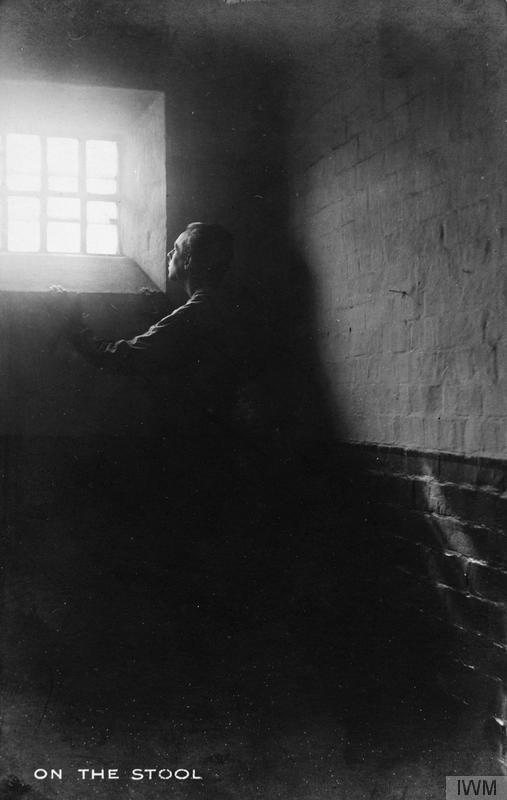
When Harold Bing was in Winchester Prison, there was one wing for male criminal prisoners, one for women and two for conscientious objectors. The conditions for COs were exactly the same as those for criminal prisoners, but COs did succeed in getting prisons to offer a vegetarian diet. Vegetarianism was common among COs, as it had an obvious affinity, particularly with humanitarian pacifism. CO prisoners were allowed a very limited number of censored letters, though one of the COs interviewed by IWM said ‘filling the notepaper was quite an art’ because there was nothing to say after months or years in prison. They had no calendars, no newspapers, and few visits – those visits they did receive were through a grille. They were limited to a few books from the prison library at infrequent intervals, but after a while COs were allowed to have books sent in under the condition that they donate them to the prison library once finished with them. Later CO prisoners were impressed to find prison libraries stocked with titles by William Morris, Sidney and Beatrice Webb and other writers of the left. Here, Bing recalls the constrained and degrading conditions of prison life.
Image – Copy negative made from a postcard of a conscientious objector prison, original caption reads ‘On the stool’ (Q 103094)
Audio – Harold Bing interview © IWM (IWM SR 358)
-
How did conscientious objectors cope in prison?
-
Severe physical brutality towards all COs seems to be a First World War myth. Certainly several of IWM’s interviewees experienced or witnessed very harsh treatment and 73 COs died as a result of physical abuse. The primary punishment – in many cases the most severe – was psychological rather than physical. The most fortunate COs were those who could devise ways to cope with loneliness, doubt, depression and loss of ability to concentrate. Some COs took an active role in challenging the situation in which they found themselves. Some participated in covert activity, described here by Harold Bing. Others coped through mental exercise. One of the COs interviewed by IWM, a musician, played an imaginary piano on his knees and even did some composition. Some COs learned Esperanto, many recited poetry from memory, and several went on long, imaginary, remembered walks. One man held races on the floor between bits of cobbler’s wax and another gained comfort from talking to the spiders on the cell wall and the bolts on its door.
Image – Copy negative made from a conscientious objector postcard depicting the interior of a cell (Q 103669)
Audio – Harold Bing interview © IWM (IWM SR 358)
-
Resistance
-
Some COs openly resisted the system, as described here by Fenner Brockway. Work and hunger strikes were held by COs including Clifford Allen (later Lord Allen of Hurtwood), chairman of the No-Conscription Fellowship, and Sir Francis Meynell. For many COs, the pressures and hardships strengthened their resolve.
Image – Copy negative made from a conscientious objector postcard, original caption reads ‘Ger – inside an’ close yer door!’ (Q 103666)
Audio – Fenner Brockway interview © IWM (IWM SR 476)
-
How were conscientious objectors treated?
-
Whether in prison or not, COs and their families did have a common experience in many respects, especially from the pressures they felt from society. Britain’s public support for the war was almost unanimous and society tended to view men who would not fight – and the men and women who supported them – with suspicion and loathing. To become a conscientious objector in 1916 was a difficult decision, which apparently involved rejecting the whole of conventional British society and everything it stood for. Wartime domestic propaganda made it all too plain that a person was either with the national effort or against it; and if against it, he was by implication either not concerned with the sacrifices of others or was undermining their willingness to serve. The conscientious objector was trapped psychologically: he felt guilty if he shared the soldiers’ ordeal and guilty if he did not. COs were not released until about six months after the end of the war, in order to give most soldiers a head-start when looking for jobs. They were also stripped of the right to vote until 1926. With time most did find a way to fit back into society – some very successfully. None of the COs interviewed by IWM appeared to feel any bitterness about their treatment, but they seem to remain, through their First World War experiences, permanently set apart.
Image – First World War-era cartoon by Frank Holland titled ‘An “Object” Lesson: This Little Pig Stayed at Home’ (Q 103334)
Audio – Clips from interviews with Percy Leonard © IWM (IWM SR 382), Lewis Maclachlan © IWM (IWM SR 565), Dorothy Bing © IWM (IWM SR 555)
This is an abridged version of a longer article, written by Margaret Brooks (former Keeper of the IWM Sound Archive), which appeared in the Imperial War Museum Review, No. 3 (1988).
The Caesar Photos and Impunity in Syria
By Steven Chovanec | Reports From Underground | December 19, 2015
Western media are reporting headline claims that “new evidence supports claims about Syrian state detention deaths”, saying that “a leading rights group has released new evidence that up to 7,000 Syrians who died in state detention centres were tortured, mistreated, or executed”, noting that this information is a moral wakeup call and demanding that officials being held to account should be “central to peace efforts.”
However, as is usually so, not everything is quite as it seems. So let’s take a look at the facts.
First the timing.
As has been commonplace the timing of the reports like these have almost always coincided with important diplomatic meetings or just after important UN resolutions are passed.
For example, beginning in mid-March claims began to pour in that Assad had been using chlorine bombs against his opponents. Media reports would cite the fact that only 2 months later the government had already been accused of using chlorine 35 times. What they failed to mention however was that no claims were made for an entire 7 months before this. So what changed after these 7 months?
Well, a UN resolution was passed condemning the use of chlorine, that’s what.
The government’s alleged chlorine campaign “began just over a week after the UN security council passed a resolution under chapter 7 of the UN charter condemning its use,” the Guardian would report. For more than half of a year no claims are made and then a week after a UN resolution is passed, all of a sudden a total of 35 are made in just under 2 months.
If Assad was really using chlorine, why would he wait a full 7 months only to use it at the exact time that it would prove to be the most disastrous for him?
This, coupled with the fact that former OPCW (Organization for the Prohibition of Chemical Weapons) inspectors admit that there was insufficient evidence to prove the use of chlorine, let alone assign blame for who did it.
And further troubling still is that the claims came from the “White Helmets” “civil defense group”, who have been notorious for producing false claims against the Syrian government. In actuality the White Helmets are part of a slick propaganda campaign aimed at mobilizing support for foreign intervention and calling for a “no-fly zone” to oust the president. They have financial links to Western-backed NGOs who relentlessly work towards furthering the US agenda in the region, and are themselves embedded with al-Qaeda and ISIS. Their primary function is to demonize the Syrian government while acting as al-Qaeda’s clean-up crew, both literally and in terms of propaganda, as one video shows them waiting to clean up dead bodies moments after al-Qaeda commits summary executions against unarmed civilians. They have produced numerous fake videos, fake photos, and fake narratives in order to manipulate public opinion towards their bias.(1)
Needless to say, their words aren’t credible.
In terms of the the Caesar photos, they too are published days before an important Syrian peace conference between the US and Russia, further raising questions as to whether the timing has anything to do with helping Syrian detainees or everything to do with political impact.
As noted by Human Rights Investigations, a previous report of the photos was done by Carter-Ruck and Co. Solicitors of London and published through CNN and the Guardian in January of 2014. The Carter-Ruck report claims that the 55,000 images available show 11,000 dead detainees. However, according to the recent HRW report only 28,707 of the photos are ones that they have “understood to have died in government custody” while the remaining 24,568 are of dead soldiers killed in battle. That is, half of the alleged “torture victims” are actually dead soldiers.
Of the remaining half (6,786), HRW maintains that they “understand” the photos are of dead detainees, this is where the media is getting the “7,000” figure from, yet they themselves admit later on that they were only “able to verify 27 cases of detainees whose family members’ statements regarding their arrest and physical characteristics matched the photographic evidence.”
So, in other words, half of the original batch of photos aren’t torture victims, while of the other half only 27 can be verified by HRW.
There is also reason to doubt the reliability of these 27 cases.
Previous reports of the photos also coincided with important diplomatic events like the 2014 Geneva II conferences. However, at that time, UN Human Rights Chief Navi Pillay admitted that the reports were unverified: “the report… if verified, is truly horrifying.” While it was admitted by outlets like Reuters that they were unable “to determine the authenticity of Caesar’s photographs or to contact Caesar” while Amnesty International notes that they too “cannot authenticate the images.”
One wonders what happened during this time that allowed HRW to do what these others could not just a year prior.
Leaving that aside however, let’s say that they are true, that they do prove that the Syrian government tortured 27 individuals, and that holding the officials “to account should be central to any peace efforts.”
It follows then that the major offenders should be held to account. Namely the United States.
Of the top 10 recipients of US foreign aid programs in 2014, all of them practice torture while at least half of them are reportedly doing so on a massive scale, according to leading human rights organizations.
For example, according to the UN torture in Afghanistan’s prisons continues to be widespread, while according to Human Rights Watch in Kenya police “tortured, raped, and otherwise abused and arbitrarily detained at least 1,000 refugees between mid-November 2012 and late January 2013.”
The worst abuses of torture in government detention centers however were in Nigeria, which received $693 million of US taxpayer money. There, according to Amnesty, nearly 1,000 people died in military custody in only the first 6 months of 2013. This means that “Nigeria’s military has killed more civilians than (Boko Haram) militants did” within the same time frame. Recently, the Nigerian army, instead of fighting Boko Haram has massacred upwards of 1,000 Muslims belonging to a peaceful movement opposed to extremism.
In terms of Israel, by far the leading recipient with $3.1 billion, the Public Committee against Torture in Israel accused the government of torturing and sexually assaulting Palestinian children suspected of minor crimes, while also keeping detainees in cages outside during winter. “The majority of Palestinian child detainees are charged with throwing stones, and 74 per cent experience physical violence during arrest, transfer or interrogation.”
Not to mention our own widely publicized torture program.
According to the official narrative, the CIA’s extraordinary rendition programs began under Bush after 9/11 and were considered “rogue elements” and “aberrations” to normal CIA practice, they were approved at the highest levels of government, but were eventually ended under Obama in 2009.
Yet as leading international security scholar Dr. Nafeez Ahmed found in a recent and thorough investigation “Obama did not ban torture in 2009, and has not rescinded it now. He instead rehabilitated torture with a carefully crafted Executive Order that has received little scrutiny.”
It demanded interrogation techniques be brought in line with the US Army Field Manual, which is in compliance with the Geneva Convention. However, the manual was revised in 2006 to include 19 forms of interrogation and the practice of extraordinary rendition. “A new UN Committee Against Torture (UNCAT) review of the manual shows that a wide-range of torture techniques continue to be deployed by the US government,” Ahmed notes, “including isolation, sensory deprivation, stress positions, chemically-induced psychosis, adjustments of environmental and dietary rules, among others.”
In his book “Torture and Impunity: The U.S. Doctrine of Coercive Interrogation” the highly renowned Professor of History at the University of Wisconsin-Madison Alfred McCoy shows that from the 1950s onward the CIA spent billions “improving” interrogation techniques.
At the start, the emphasis was on electroshock, hypnosis, psychosurgery, and drugs, including the infamous use of LSD on unsuspecting soldiers, yet they proved ineffective. It was later found that sensory disorientation and “self-inflicted pain”, such as forcing a subject to stand for many hours with arms outstretched, were far more effective means of breaking individuals; the exact torture techniques it has been shown the US still employs to this day.(2)
The CIA found that by using only the deprivation of the senses, a state akin to psychosis can be induced in just 48 hours.
They found that the KGB’s most devastating torture technique of all was not crude physical beatings, but simply forcing victims to stand for days on end. “The legs swelled, the skin erupted spreading legions, the kidneys shut down, and hallucinations began” explains McCoy, “all incredibly painful.”
Refined through decades of practice, “the CIA’s use of sensory deprivation relies on seemingly banal procedures: heat and cold, light and dark, noise and silence, feast and famine,” yet this combines to form “a systematic attack on the sensory pathways of the human mind” for devastating effect.
These are not “aberrations”, but instead the fruition of over half a century’s work in the experimentation of the science of cracking the code of the human mind, of the perfection of psychological torture into its most sophisticated forms.
“With the election and re-election of President Barak Obama, the problem of torture has not, as many of us have once hoped, simply disappeared, wiped away by sweeping executive orders,” McCoy explains, “Instead it is now well into a particularly sordid second phase, called impunity.”
Simply put, impunity is the political process of legalizing illegal acts.
“In this case, torture.”(3)
Instead of ending, US torture “continues to be deployed by the US government” in its most destructive forms.
It has been re-packaged and rehabilitated, codifying into law, and vanished from the general public consciousness.
Furthermore, not only does the US engage in torture on a mass scale, it and its allies as well “outsource” their torture to various regimes, utilizing their intelligence and security services to do their dirty work for them.
It was recently revealed by numerous Libyan dissidents that the UK government had entangled itself in a deep and sordid relationship with Muammar Gaddafi that amounted to “a criminal conspiracy”, as heard before the UK high court.
A conspiracy where the UK had become “enmeshed in illegality” and involved in “rendition, unlawful detention and torture.”
The victims claim that British intelligence routinely blackmailed them, threatened their families with unlawful imprisonment and abuse if they did not cooperate. Information was extracted through torture in prisons in Tripoli and fed into the British court systems as secret evidence that could not be challenged.
Yet this merely represents a wider trend whereby Western governments commit horrendous crimes in collusion with foreign states, and then use those same acts as justification for aggression against them.
The United States attempted to justify the invasion of Iraq on non-existent WMD’s after it had supplied the same weapons to the country decades prior to wage war on Iran.
As well it was Gaddafi’s alleged brutality and use of torture that was invoked to justify the devastating attack on Libya that has left the country in shambles and overrun with suffering and terrorism.
And so too with Syria.
Not only is the United States by degrees of magnitude more culpable for the crime of torture, it also was intimately involved in offshoring its crimes to Syrian jails.
A key participant in the CIA’s covert rendition program, Syria was one of the “most common destinations for rendered subjects.”
So while torture in Syria is all too real, what is commonly left out is 3 little words: “with our support.”
First we utilize, exploit, and propagate the atrocities, and then proceed to bask in our own moral righteousness as we denounce others for the crimes that we helped commit, utilizing them to justify further atrocities and aggression for shortsighted geopolitical aims.
If “officials being held to account” are really “central to any peace effort” in regards to torture, we know exactly where to find them: right here at home in Washington and London.
Notes:
- For more on this, see Vanessa Beeley’s great reports, “‘White Helmets’: New Breed of Mercenaries and Propagandists, Disguised as ‘Humanitarians’ in Syria”, 21st Century Wire, Pt. 1: http://21stcenturywire.com/2015/09/01/white-helmets-new-breed-of-mercenaries-and-propagandists-disguised-as-humanitarians-in-syria/, Pt. 2: http://21stcenturywire.com/2015/09/01/white-helmets-new-breed-of-mercenaries-and-propagandists-disguised-as-humanitarians-in-syria/, & overview with interview: http://www.mintpressnews.com/us-propaganda-war-in-syria-report-ties-white-helmets-to-foreign-intervention/209435/.
- Alfred McCoy, Torture and Impunity: The U.S. Doctrine of Coercive Interrogation.
- Alfred McCoy giving a lecture on his book “Torture and Impunity” at Madison’s Overture Center, https://www.youtube.com/watch?v=xgazW9sRrW4.
‘Are embedded British soldiers helping Saudi attack Yemen?’
RT | December 18, 2015
Human rights activists fear British military personnel could be embedded with Saudi Arabian allies who are bombing Yemen after receiving opaque responses from the Ministry of Defence (MoD).
Concerns have been raised by the charity Reprieve, which is best known for its work on post 9/11 torture and rendition, after the MoD published figures detailing the number of UK military personnel embedded around the world.
The war in Yemen, between Shia Houthi rebels and Saudi-backed forces, is not one the UK is officially involved in. However, the theocratic Saudi kingdom is a close regional ally of Britain.
Thousands have been killed, tens of thousands injured and up to 2.5 million displaced, according to some reports.
While most of those embedded personnel are in easily identifiable locations – such as in the US, Canada, NATO and the EU member states – nearly 100 personnel are assigned to cryptically titled ‘Coalition HQs’.
Responding to the revelations that 94 members of the UK armed forces are carrying out duties for unknown forces, Jennifer Gibson, a staff attorney at Reprieve, said in a statement: “This is a long way from real transparency. It is impossible to tell what operations or even what countries these personnel are active in, making this information almost worthless.”
Gibson said the terms used were “hopelessly vague” and asked “what, for example, are the ‘coalition HQs’ where nearly 100 UK personnel are based?”
“Is this the highly-controversial Saudi-led coalition in Yemen, the long-standing coalition in Afghanistan, the coalition in Iraq and Syria, or another we don’t know about?”
Gibson said the UK is entitled to use military force, but that “parliament and the public deserve to know at the very least which wars we are sending our troops into and under whose command.”
It emerged in July that UK aircrews embedded with foreign air forces – allegedly the US and Canadian militaries – had been carrying out combat missions over Syria.
This was despite there being no parliamentary authority for such actions. A vote on bombing targets within Syria has since passed early in December.
In a statement released with the figures on the MoD website, Defence Secretary Michael Fallon said: “Embeds [sic] play an important role in enhancing our national security interests around the world, strengthening our relationships with key allies and developing our own capabilities.
“For operational and personal security reasons the information that can be routinely released is limited,” he added.
Dead, Disabled, Displaced or Destroyed – Democracy Delivered

By Graham Vanbergen | TruePublica | December 10, 2015
Six months ago, the Washington DC-based Physicians for Social Responsibility (PRS) released a landmark study over the death toll from 10 years of the “War on Terror” since the 9/11 attacks. It was largely ignored by the world’s press.
The 97-page report accompanied by hundreds of studies, reports and investigations by the Nobel Peace Prize-winning doctors’ group is the first to tally up the total number of civilian casualties from US-UK led interventions in Iraq, Afghanistan and Pakistan. This article uses much of the content from that report called the IPPNW (International Physicians for the Prevention of Nuclear War) Body Count publication.
A poll carried out by the Associated Press (AP) two years ago found that, on average, U.S. citizens believe that only 9,900 Iraqis were killed during the 2003-2011 occupation of Iraq by the US, UK and allied forces.
Random spot checks have suggested that more than two-thirds of all violent deaths that occurred in Baghdad between 2003 and 2007 did not appear in the media, and were therefore not included in official statistics distributed by the Iraq Body Count (IBC). The IBC has a media-centered approach to counting and documenting the deaths and is considered very unreliable as a result but is much quoted by the establishment and mainstream press the world over.
For instance, evidence of the 27,000 bombs that were dropped in just the first year during the invasion of Iraqi cities is practically non-existent in the IBC database.
In many cases, the occupying powers explicitly blocked journalists from investigating instances where the British or American forces were accused of mass killings. Numerous journalists in Iraq who tried to report on the activities of the occupation troops and their consequences were killed or arrested.
In Iraq itself, only a small number of casualties made it to the central hospitals or morgues where they could be registered. That proportion decreased the more intense the military battles were and the more the violence between various sections of the population escalated. Since Islam requires a funeral within one day, relatives generally had no choice but to bury their dead directly – either in their yards or close to their homes.
Moreover, the occupying power often forbade the hospitals and morgues from making their numbers public.
The fate of Iraqi physicians is one area that is very well documented. According to data from the independent Iraqi Medical Association, of the 34,000 registered physicians, almost 2,000 were killed and 20,000 left the country. In its database, IBC lists only 70 Iraqi physicians. Even though this may in part be due to a lack of data on the profession of the victims, this piece of evidence alone suggests very large gaps in IBC’s calculations.
According to the Najaf governorate’s spokesperson Ahmed Di’aibil (member of the Supreme Islamic Council of Iraq), in this city alone, which has a population of close to 600,000, 40,000 non-identified corpses were buried since the start of the war. The IBC database documents only 1,354 victims in Najaf, barely 3% of the actual.
In a September 2009 speech, Samir Sumaidaie, the Iraqi ambassador to the U.S. installed by the occupation power, talked about 500,000 newly widowed persons in Iraq. A February 2007 BBC poll in the region came to the conclusion that 17% of all Iraqi households have lost at least one member through violence since 2003. Given the total population at the time of some 27 million, this too suggests that more than 500,000 Iraqis fell victim to the war and its consequences just in the first four years.
By 2008, the number of refugees from Iraq in foreign countries and internally displaced persons had risen to 5 million.
Such a high number of victims – reaching genocidal dimensions – represented a massive indictment of the U.S. administration, British government and its allies that they simply could not allow to stand. Hence, the findings of this study were furiously criticized. Even though nearly all the experts in the field, including the scientists of the British administration, confirmed the accuracy of the study, it was slandered by governments and main stream establishment media.
Dr. h.c. Hans-C. von Sponeck, UN Assistant Secretary General & UN Humanitarian Coordinator for Iraq (1998-2000); UN Resident Coordinator for Pakistan (1988- 94) covering also Afghanistan said in his report:
“The U.S.-led Multinational Force have carefully kept a running total of fatalities they have suffered. However, the military’s only interest has been in counting “their” bodies.”
“Since U.S. and other foreign military boots are only intermittently and secretly on the ground in Pakistan, mainly in the northern tribal areas, there are no body count statistics for coalition force casualties available for Pakistan. The picture of physically wounded military personnel for both war theatres is in- complete. Only the U.S. military is identified: (a) 32,223 were wounded during the 2003 Iraq invasion and its aftermath, and (b) until November 2014 20,040 were wounded in Afghanistan.”
No figures are known for mental disorders involving military personnel who have been deployed in Iraq, Afghanistan and Pakistan but US veteran soldiers are still committing suicide at the rate of 22 per day.
Officially ignored are casualties, injured or killed, involving enemy combatants and civilians together. This, of course, comes as no surprise. It is not an oversight but a deliberate omission. The U.S. authorities have kept no known records of such deaths. This would have destroyed the arguments that freeing Iraq by military force from a dictatorship, removing Al-Qaeda from Afghanistan and eliminating safe-havens for terrorists in Pakistan’s tribal areas has prevented terrorism from reaching the U.S. homeland, improved global security and advanced human rights, all at “defendable” costs.
The IPPNW Body Count publication must be seen as a significant contribution to narrowing the gap between reliable estimates of victims of war, especially civilians in Iraq, Afghanistan and Pakistan and tendentious, manipulated or even fraudulent accounts.
After 58,000 dead US soldiers and 2 million civilian deaths in Vietnam, the Reagan Administration sought to resolve the negative public opinion problem by utilizing obeisant client states or surrogate forces, epitomized by the “Contra” armies and death squads deployed in Central America and Southern Africa instead of using its own attacking forces. With the end of the Cold War, U.S. policymakers triumphantly pronounced the end of the “Vietnam Syndrome,” and ushered in a new era of American “boots on the ground” that led ultimately to the debacle in Iraq, Afghanistan and the surrounding region.
This investigation and report comes to the conclusion that the war has, directly or indirectly, killed around 1 million people in Iraq, 220,000 in Afghanistan and 80,000 in Pakistan, i.e. a total of around 1.3 million. The figure is approximately 10 times greater than that of which the public, experts and decision makers are aware of and propagated by the media and major NGOs. And this is only a conservative estimate. The total number of deaths in the three countries named above could easily be in excess of 2 million.
For some degree of context – should the number of Iraqis killed from the 2003 U.S. invasion until 2012 actually be around one million, this would represent 5% of the total population of Iraq. By contrast, during World War II Germany lost around 10% of its population.
In Iraq, results from statistical surveys conducted by the Johns Hopkins University, published in 2004 and 2006 in the medical journal The Lancet, (The basis of the Lancet study, which was executed by a U.S.-Iraqi team led by renowned scientists was a survey of a representative selection of 1,850 Iraqi households across Iraq) as well as by the British polling institute Opinion Research Business (ORB) in 2007 suggest that already by 2008 over one million Iraqis had died as a result of war, occupation and their indirect consequences. many more have died since.
Moreover, and in addition to the appalling numbers, according to the International Commission on Missing Persons (ICMP), between 250,000 and one million persons are missing in Iraq, presumed dead.
For an estimate of the current casualty numbers, one has to interpolate. The U.S. NGO Just Foreign Policy does exactly this with its Iraqi Death Estimator, where it multiplies the number of victims of violence determined by the Lancet study as of June 2006 by the increase in the number since then as provided by IBC. From the relation between the current number given by IBC and the one given for the end of June 2006 (43,394), it concludes that the number of Iraqis killed up to September 2011 is at around 1.46 million.
One development of the scale of bombing was that the health care system largely collapsed. Diseases spread because of the lack of access to drinking water and the contamination of rivers. Almost three million people became internal refugees; as a consequence, large parts of once reasonably affluent cities turned into slums.
The long-term consequences through the poisoning of the environment brought about by the war must also be taken into consideration. Many areas of Iraq that were subjected to furious attacks by the occupying forces show a dramatic increase in the number of diseases. In many areas, the number of occurrences of various forms of cancer, of miscarriages and abnormal and deformed babies multiplied. A major reason for this is likely to be the massive use of ammunition containing depleted uranium.
According to the Landmine and Cluster Munition Monitor of the International Campaign to Ban Landmines (ICBL) and the Cluster Munition Coalition (CMC), since 2003, U.S. and UK troops have used around 13,000 cluster bombs in Iraq. Iraq is littered with high levels of nuclear and dioxin contamination. These have disseminated their sub-ammunition – almost 2 million bomblets – widely in and around the fought-over cities. In addition, the 20 million bomblets from the 61,000 cluster bombs dropped in 1991 have also still not all been cleared. This makes Iraq one of the countries with the highest contamination of highly explosive unexploded ordnance in the world.
Evidence of this can be seen in child mortality that multiplied in the following years, the number of occurrences of cancer quadrupled, and the number of cases of leukemia increased by a factor of 40.
Afghanistan and Pakistan
There have so far been no representative studies on the number of victims from the ongoing UN-mandated NATO war in Afghanistan. The few investigations that exist on deaths as a result of that war are all based on passive observation.
In Pakistan, the number of killed civilians and combatants is much harder to determine than in Afghanistan. Even data based on passive observation are barely existent. Taking all sources and factors into account, a total number of 300,000 war deaths in the AfPak War-Theatre until 2013 seems realistic.
Libya
Estimates of deaths in the fall of Libya as a result of US/UK/NATO bombing and subsequent civil war between March 2 and October 2, 2011 vary. An exact figure is hard to ascertain, partly due to a media clamp-down by the Libyan government. Some conservative estimates have been released of around 25,000. NATO holds itself to no standard of measurement whatsoever in this regard. If Iraq and Afghanistan are anything to go by this number could easily be over 100,000. Some of the killing “may amount to crimes against humanity” according to the United Nations Security Council and as of March 2011, is under investigation by the International Criminal Court.
Conclusion
It is impossible to calculate the death, destruction and decay incurred by the people of these countries. It is fair to say two million are dead, another one million presumed dead with many more deaths as a result of disease, lack of medical care, child birth, birth defects, cancer care and the like. One should not forget, these countries continue to feel the after effects of current governance and a lack of control over security that culminates in many bombings, shooting, kidnapping, murders and suicides.
The current death toll in Syria is reported at 250,000 and counting with 6.5 million displaced.
Finally, as the FT reported in February “In all, more than 100,000 people, perhaps a third or more civilians, died violently in conflicts in Syria, Iraq, Libya, Yemen and the Gaza Strip in 2014, making it one of the bloodiest years in the Middle East’s history”. Death continues at a horrific rate.
Read the full IPPNW report HERE
We’re all terrorists now
By Sam Gerrans | RT | December 12, 2015
The concept of terrorism has been extended from carrying out physical acts in which innocent people are killed, to wrong opinions, sweaty palms and disagreement with government. If you want to find a terrorist, soon all you will have to do is look in the mirror.
Words are political. They change shape to suite agendas.
In the 1970s, ‘terrorist’ meant a paid-up member of the IRA, the Irgun, ETA and the like. These were bad people perpetrating evil and indiscriminate deeds upon a defenceless public. They used bombs, worked in cells, and killed people without warning before fading into the shadows.
Although the UK had legislation specifically geared to deal with what is called terrorism on the books, people deemed terrorists, when they were caught, were prosecuted under existing laws – i.e. for actual crimes they had committed.
Bobby Sands, for example, who fought and died for the IRA cause, was incarcerated for nothing more sinister than owning illegal firearms.
Since 9/11 and the implementation of the so-called Patriot Act (and equivalent legislation in other countries), the definition of terrorism is itself becoming a source of terror.
As part of this process, we are being taught to live with the new nomenclature of ‘terror suspect’; that is you haven’t done anything wrong, but you might.
The Independent reports that: “315 terror suspects were arrested between September 2014 and September 2015, according to new figures from the Home Office.”
The same article continues: “[…] it seems what we are seeing is an increase in terrorism-related fear rather than terrorism itself – totally understandable of course in itself, but not when it leads to the kind of heavy-handed policing that can actually radicalize more people.”
Read another way: the British Government is harassing increasing numbers of innocent people and generating both fear and the chance of more ‘radicalization’ thereby.
The no-fly list
The Huffington Post reports that one can be identified and placed on a ‘no-fly list’ for any number of reasons.
It tells us: “government officials have secretly characterized an unknown number of individuals as threats or potential threats to national security. In 2013 alone, 468,749 watch-list nominations were submitted to the National Counterterrorism Center. It rejected only one percent of the recommendations.”
This is nearly half-a-million US citizens in one year; this means they are finding almost 1,400 new American enemies a day.
The article goes on to list seven criteria government agencies use to put a person on a list. These criteria are vague and admit to the broadest and most subjective interpretation; in short they break down to: we don’t like the cut of your jib.
Yes, some life-failed bureaucrat you will never meet can decide – extra judicially – that you may not travel on an aeroplane.
The no-gun list
If there is to be no due process, why stop there?
Obama certainly agrees. The Guardian tells us: “Closing the No-Fly List loophole is a no-brainer,” Barack Obama tweeted on Tuesday, arguing that Congress should pass laws to prevent anyone on the government’s terrorist watch list from buying a gun.”
I see: the president calmly tweets that revoking the Constitution he swore to uphold is a “no brainer,” and we can all go about our business.
Terrorist events
Since Obama is so concerned with guns, he might want to do something about all the smoking guns that feature so prominently in the so-called terrorist attacks on US soil.
RT’s Marina Portnaya did a piece on the release of a report, which identifies the FBI as the mastermind of 95 percent of all domestic terrorism in the US.
Judge Andrew Napolitano, senior judicial analyst for Fox News, concurs. He tells us that of the 20 terrorist attacks the FBI claims to have foiled on US soil, three were thwarted by members of the public and the remaining 17 were masterminded and carried out by the FBI itself.
Who is a terrorist?
The so-called War on Terror is worldwide.
For its part, the French government is educating its population to spot a terrorist.
The Independent gives us these bonmots: “The French government has launched a campaign which appears to warn parents that their children may have been recruited by terrorists if they stop eating baguettes.”
Other tell-tale signs of nascent radicalism include deciding not to watch television.
US airport security staff operate on a much more scientific basis. The Telegraph reports on a leaked document revealing: “Excessive yawning, strong body odour and arrogance are among the suspicious signs that US airport staff are trained to associate with potential terrorists.”
Excessive yawning? Remember that if find yourself on a stopover in a US airport on a long-haul flight.
Other warning signs include: “protruding or throbbing neck arteries, whistling, excessive laughter, and verbally expressing contempt for the screening process.”
The full list of 17 ‘fear factors’ staff are trained to spot include: arriving late for a flight, sweaty palms, and a pale face indicating the recent shaving of a beard.
More government
Naturally, the only rational response to this exploding bomb of suspicion is more government. Was there ever any doubt?
The UK government’s website tells you exactly what to do in the event of a terrorist attack: Step 1: run. Step 2: Hide. Step 3: Tell the authorities. Step 4: Wait for armed police to arrive (and keep your hands where they can see them). Step 5: Be ready for those authorities to point guns at you and treat you ‘firmly’ (i.e. brutalize you).
No mention of repealing UK gun laws so that British adults can defend themselves, of course.
Imagine what would happen to any real terrorist threat in Britain if one in three Britons carried a handgun.
No. What we need is more government; more intrusion by the very agencies that not only benefit from the events they pretend to protect us from (and use said events to take away our rights), but which – according to all objective analysis – are also central in bringing those events to pass.
So terrorism has morphed from real actions which killed people – the destruction of the King David Hotel by the Irgun or the Iranian Embassy siege – to intuitions about people, sweaty palms and the non-eating of French bread.
The simple definition for such a subjective and arbitrary application of power is this: tyranny.
Why stop there?
Since there is no place for principle or due process in this new tyranny, insanity must follow.
Under such a regime things just are because someone – in this case an opinion-leader – says they are.
For his part, supposed science guy Bill Nye makes a strong connection between what he calls ‘climate change’ and what he terms ‘terrorism’.
The Huffington Post reports: “Nye’s reasoning hinges on a water shortage in Syria, which researchers have blamed on climate change. As Nye explained, the shortage has stunted farming and pushed young people to look for work in more densely populated areas.
“Young people have gone to big cities looking for work. There’s not enough work for everybody, so the disaffected youths, as we say – the young people who don’t believe in the system, believe the system has failed, don’t believe in the economy – are more easily engaged and more easily recruited by terrorist organizations, and then they end up part way around the world in Paris shooting people,” Nye asserts.
The Independent breathlessly informs us that one of the country’s most senior advisers on health has warned: “Obesity is such a threat to women it should be treated as a “national risk” – like terrorism, natural disasters and cyber attacks.”
And Obama claims that the ‘climate change’ conference in Paris (the only outcome of which will doubtless be more government control for them and more taxes for us), offered the chance to show the ‘terrorists’ that the world was standing together against them.
Sound insane? That’s because it is; until we realise that none of this has anything to do with genuine science or actual terrorists – or if there is any correspondence it is purely coincidental.
We are living through a revolution, a play for total power; or in modern parlance: full-spectrum dominance.
And we have been here before. Last time round it was called Communism. It accused its critics of being counter-revolutionaries or reactionaries. And it murdered those people – and many besides – in their tens of millions.
This time round it is called Freedom.
And if you disagree with it, or don’t smile fast enough or wide enough – or suffer from body odour or weigh too much – today it can stop you from getting on a plane. Tomorrow it may deny you the right to defend yourself.
After that, it may decide on some new arbitrary method of protecting everyone else from you.
Still think your government is there to protect you?
I hope so.
Or you may be a terrorist.
Sam Gerrans is an English writer, translator, support counselor and activist. He also has professional backgrounds in media, strategic communications and technology. He is driven by commitment to ultimate meaning, and focused on authentic approaches to revelation and realpolitik. He is the founder of Quranite.com – where the Qur’an is explored on the basis of reason rather than tradition – and offers both individual language training and personal support and counseling online at SkypeTalking.com.
Featured Video

The American Retreat from Vietnam
or go to
Aletho News Archives – Video-Images
From the Archives
Secret document reveals plans for civil war in Lebanon, Israeli false flags, and invasion
By Randi Nord | Geopolitics Alert | April 5, 2019
Beirut – During his visit with US Secretary of State, Mike Pompeo, Lebanese President Michael Aoun reportedly received a US-Israeli document detailing plans for creating a civil war in Lebanon with covert false flag operations and possible Israeli invasion.
Although the source of the document is Israeli and created in partnership with Washington, no one knows who presented it to Aoun. The Lebanese TV station, Al-Jadeed, initially reported the document on Lebanese TV and a video on its website. Geopolitics Alert translated the report for this article. … continue
Blog Roll
 Aletho News
- There’s a drought in academia: A drought in honest research on the subject of drought and other weather extremes
- Department of War Awards $20.7 Billion Contract to Raytheon for Air-to-Air Missiles
- ‘Distance yourselves from Israel’: IRGC urges US population to question govt policies
- America’s Greenland deal has a radioactive backstory
- The RAF Fairford ‘terror plot’: Unpacking escalation in the UK echo-chamber
- EU Council Advances Chat Control 2.0 Scanning Proposal
- Ex-Greek MEP files complaint against Israeli spyware firm over alleged Pegasus surveillance
- Troubling ideas throughout the Torah, Talmud, Mishneh Torah and Tanya
- ‘Grave, alarming’: Iran mission on Trump’s UNGA ‘annihilation’ threats
- Najaf airport to reopen to Iranian flights within 24 hours: Ambassador
- If Americans Knew
- New Report: “Scholasticide and Genocide in Gaza: Assessment, Testimonies and Legal Analysis”
- Ex-Biden officials are desperate for a Gaza scapegoat
- Israeli “settlers” Invade Al-Aqsa; Pour Boiling Water on 75-Year-Old
- Israel Has Kidnapped Another American Teenager
- US arms sales to Israel worth $21.6 billion in 20 months
- Three Palestinians Killed in Israeli Attacks on Gaza
- Revealed: German “Anti-Semitism Expert” Driving Crackdown on Palestine Solidarity is Former Israeli Spy
- Egypt’s Warning to Israel Before Oct 7
- Israel’s siege signals another cruel winter for 1.8 million Gazans – Daily Update
- Netanyahu Asked UAE Leader to Deny Report on Oct. 7 Warning in Secret Visit, Sources Say
- No Tricks Zone
- New Study: Earth And Venus Surface Warmth Largely Explained By Convection And Lapse Rate, Not CO2 Or Radiation
- 2025 Nature Paper Claiming Worsening Global Drought Gets RETRACTED …Heavily Flawed
- New Study: ‘Global Drought Shows No Detectable Recent Acceleration Under Climate Warming’
- Economic Masterminds: German Socialists Suggest Taxing Productivity Gains Stemming From Using AI
- The South China Sea Has Not Been Cooperating With The Climate Change Narrative
- Energy Crisis: Germany Enters Heating Season With Historically Low Gas Reserve Fill Levels
- New Study: The Antarctic Ice Sheet Gained Mass From 2020-2024 Due To Staggering Snow And Ice Accumulation
- Study: Ocean Heating Rates From Thousands Of Years Ago ‘Dwarf’ Modern Ocean Heating Rates
- Climate Extremists Target, Attack Large-Scale Power Grid Infrastructure In Germany!
- New Study: Antarctic Ice Melt Has Contributed Less Than 1 Centimeter To Sea Level Rise In The Last 30 Years

