State Dept asks for budget to counter RT
RT | February 26, 2015
Citing RT’s influence, Secretary of State John Kerry asked US lawmakers for more money for propaganda and “democracy promotion” programs around the world.
“Russia Today (sic) can be heard in English, do we have an equivalent that can be heard in Russian? It’s a pretty expensive proposition. They are spending huge amounts of money,” Kerry said in the course of the budget hearing on Wednesday, apparently forgetting that Voice of America has been broadcasting in Russian since 1947.
Representative Ed Royce (R-CA), chairing the House Foreign Affairs Committee, opened the hearing with the allegation that “Russia’s military aggression is matched only by its propaganda.”
To Kerry’s approval, Royce went on to claim that “Russia is spending more than $500 million annually to mislead audiences, sow divisions, and push conspiracy out over RT television.”
Royce’s remarks echo the claim made by Broadcasting Board of Governors (BBG) chief Andrew Lack last month, when he listed “Russia Today” (sic) in the same breath as ISIS and Boko Haram as one of the challenges facing his agency.
In reality, RT’s budget for 2015 is less than half the amount cited by Representative Royce – $225 million, according to the current exchange rate, or 13.85 billion rubles. By contrast, the US government media receives $721 million. The BBC World Service, which complained about RT “winning the information war” in January, is funded to the tune of $375 million a year.
In the budget proposal submitted by Kerry, the Department of State is asking for “$639 million to help our friends in Ukraine, Georgia, and Moldova as they seek to strengthen their democracies, withstand pressure from Russia, and to integrate more closely into Europe.” [PDF] Washington is also requesting over $2 billion – described as “a significant increase” – for “democracy, human rights, and governance programs.”
Read more: More money, more problems?
UK Home Office refuses to admit responsibility for ‘aid for executions’
Reprieve | February 22, 2015
The Home Office is refusing to disclose the part played by UK counter-narcotics funding in facilitating executions in countries such as Pakistan – even though a number of Brits have been revealed to be on that country’s death row.
The UK provides counter-narcotics funding to organisations such as Pakistan’s Anti-Narcotics Force – which has cited the number of death sentences it secures as a key ‘prosecution achievement.’ Reprieve has warned ministers that the funding amounts to public funds being used to support executions overseas, at odds with the UK’s long-standing policy of opposition to the death penalty.
In recent correspondence with legal charity Reprieve, which supports British citizens and others facing the death penalty abroad, the Home Office recently stated that the issue of counter-narcotics aid doesn’t fall under their remit, but rather that of the Foreign Office. However, in a Parliamentary answer earlier this month, minister Lynne Featherstone admitted that the Home Office has “lead responsibility” for international counter-narcotics policy.
Twenty-four people have been executed in Pakistan since December 2014, when the authorities began a new wave of executions. There are now fears that drug offenders on the country’s 8000-strong death row, among them a number of British citizens, are directly at risk of being executed.
Commenting, Maya Foa, head of Reprieve’s death penalty team, said: “Pakistan has the largest death row in the world, and is now actively executing prisoners – placing a number of Brits at risk. The UK Government has given a series of flaccid excuses for continuing to support anti-drug raids in Pakistan, which very often see drug offenders sentenced to death. Now that the Pakistani authorities are once again carrying out executions, the lives of these people and many others are in grave danger. If the UK is committed to ending the death penalty worldwide, why is British anti-narcotics aid supporting these drug convictions – and why won’t the Home Office admit responsibility?”
There Goes the Guardian, Lying About Ukraine… Again!
By Eric Draitser | CounterPunch | February 20, 2015
The western media is busily trying to prop up their failed narrative of “Russian aggression” in Ukraine in a desperate attempt to legitimize their consciously deceitful reporting. To do so, they are now relying not on experts or western intelligence reports, but a discredited blogger and his corporate media chums.
On February 17, 2015, The Guardian ran a story with the headline “Russia shelled Ukrainians from within its own territory, says study.” The title alone is enough to convince many casual observers that yes, the mainstream media reporting on the civil war in Ukraine has been correct all along. You see, it’s all because of Russian aggression, or so the meme would go. But closer analysis of this story, and the key players involved, should cause any reasonably intelligent and logical person to seriously doubt the veracity of nearly every aspect of the story.
Let’s begin first with the headline and subhead which, as anyone in media knows, is often all that will be read by many readers. The headline leads with a conclusion: Russia shelled Ukraine from within Russian territory. Simple. Clear. Why bother reading further? Well, in reality, the article both overtly and tacitly admits that the so called “study” (more on that later) has not reached that clear conclusion, not even close. Here are some key phrases sprinkled throughout the piece that should give pause to any serious-minded political observer or analyst.
Despite the declaration in the headline, a close reader encounters phrases such as “near conclusive proof,” “estimated trajectories,” “likely firing positions,” and other ambiguous phrases that are more suggestive than they are declarative. In other words, these are mere rhetorical flourishes designed to lead casual, uninformed readers to make conclusions that are simply not backed up by the evidence.
The so called study relied heavily on “crater patterns from satellite photos of three battlefields,” and it is from these crater patterns, and the equally dubious “tyre tracks” that the authors of the study drew their conclusions. However, even the independent military forensics expert contacted by The Guardian “warned that the accuracy of crater analysis in determining direction of fire on the basis of satellite photography was scientifically unproven.”
Indeed, conveniently buried at the end of the long article is the key quote from Stephen Johnson, a weapons expert at the Cranfield Forensic Institute, part of the Defence Academy of the United Kingdom who said quite clearly that crater analysis is “highly experimental and prone to inaccuracy.” Mr. Johnson added that “This does not mean there is no value to the method, but that any results must be considered with caution and require corroboration.”
Wait a second. I thought that our dear expert authors of the study had “near conclusive proof” according to the lead paragraphs of the story. When you actually read what the real expert, as opposed to the non-experts who conducted the “study,” has to say, it immediately casts a long shadow of doubt on the entire narrative being propagated by the article. Is The Guardian here guilty of clear manipulation of the story for political purposes? It would seem at best unprofessional and dishonest reporting, at worst it’s outright lying in the service of the agenda of those at the top of the western political establishment.
Now of course we know that The Guardian has repeatedly been taken to task by highly respected journalists and analysts for its biased and one-sided reporting of issues ranging from its coverage of Russian President Putin and Russia’s actions in Crimea, to its shamefully biased (here, here and here for three of the many examples) coverage of Israel-Palestine conflict, and a number of other important issues.
Perhaps most germane to this discussion is The Guardian’s own reporting last summer, which it references in this article, of Russian military vehicles crossing the border into Ukraine – a significant charge that would be taken seriously if there were one shred of tangible proof. But alas there isn’t. There is only the word of The Guardian’s reporter Shaun Walker, who conveniently could not get a photograph or video of the alleged military vehicles crossing into Ukraine. One would think with mobile phones all equipped with cameras and the vast resources of a major western media outlet, not to mention the seemingly all-encompassing global surveillance architecture at the disposal of western governments, at least some credible, verifiable evidence would have emerged. But no, we just have to take the Guardian’s word for it.
There’s a lot of that going around when it comes to Ukraine. We just have to “take their word for it,” as we were supposed to with regard to the charges of Russian military shooting down MH17, a baseless charge that has since disappeared from the headlines, with the actual results of the investigation being buried or suppressed entirely.
Not only should The Guardian’s reporting be scrutinized, but so too should their darling “expert” blogger Eliot Higgins, aka Brown Moses, the author of this inconclusive “conclusive report.”
Fifty Shades of Brown
Aside from the deceptive language and misleading statements, there is a broader issue that must be addressed, namely the reliability of the source of this so called study. Perhaps first we should dispense with the use of the term “study” as that would imply experts using objective facts, data, etc. Rather, what we are dealing with is a politically motivated report by a source that has already been discredited numerous times.
The report comes from an organization called Bellingcat, purportedly an independent citizen journalism platform that uses social media and other open source information to draw conclusions about everything from military hardware movements to the firing of missiles and artillery. Of course it should immediately raise questions that The Guardian’s article is co-authored by one Eliot Higgins, a self-proclaimed “military expert” who founded the “Brown Moses” blog. Why is this important? Because Bellingcat is a creation of the same Eliot Higgins. Indeed, Bellingcat’s Kickstarter page made no secret of the fact that “Bellingcat is a website founded by Brown Moses… the pseudonym for Eliot Higgins, a laid-off government worker turned blogger turned weapons analysis expert and leading source of information on the conflict in Syria.”
A close look at some of the blurbs noted on the Kickstarter page reveals that this “independent blogger” has been touted by The Guardian, Deutsche Welle, UK’s Channel 4, The Daily Beast, and many other corporate media outlets. Anyone with an understanding of how hard it is to actually be an independent analyst knows that such establishment outlets do not simply promote independent media that provides thoughtful analysis. Rather, Brown Moses and Bellingcat have been seized upon as a convenient foil to true alternative media, spinning the establishment narrative under the guise of “independent reporting.” However, let us not simply deride this obvious sham. Let us evaluate Brown Moses’ own record, which for an “expert” is dismal.
Higgins aka Brown Moses aka BM claimed to have proven that the chemical weapons attack on Ghouta, Syria on August 21, 2013 could only have been carried out by the Syrian military and government. His claims are based on his own “expert” analysis of missile trajectories and other “evidence” he claims to have obtained through videos and other open source information. Of course, in making this claim, Higgins places himself in direct opposition to former UN weapons inspector Richard Lloyd and Prof. Theodore Postel of MIT, the authors of an actual report from the MIT Science, Technology, and Global Security Working Group entitled “Possible Implications of Faulty US Technical Intelligence in the Damascus Nerve Agent Attack of August 21, 2013.” The report, conducted by real experts, not armchair bloggers, concluded that the Syrian government could not have carried out the attack, and that such intelligence was nearly used as justification for yet another aggressive war.
Also debunking BM’s spurious charges is the report from Pulitzer Prize winning investigative journalist Seymour Hersh which revealed the existence of a classified US Defense Intelligence Agency briefing which noted unequivocally that the Al Nusra Front had its own chemical weapons, not to mention deep ties to Saudi and Turkish intelligence and chemical arms suppliers. Hersh’s reporting finally firmly established the fact that the rebels were indeed capable of carrying out the attack on East Ghouta, and that they had help from Turkey, Saudi Arabia, and possibly other regional actors. And so, not only did they have the motive (to blame Assad for using chemical weapons while international investigators were in Syria, thereby justifying a military intervention and regime change), but also the means and opportunity. This is an essential point because the entire ‘case’ against Assad relied on the fact that only Damascus was technologically and logistically capable of carrying out such an attack.
But BM contended that he was right, Hersh, Lloyd, and Postel were wrong, and that the narrative should reflect that. So, on the one hand we have a blogger with no formal training in ballistics, physics, or any relevant scientific or military field, and on the other we have a Pulitzer Prize winner with decades of experience and high-level contacts and sources all over the world. We have the word of some guy in an apartment in the UK, or the scientifically arrived at findings of a former chemical weapons inspector (read actual expert) and an internationally respected Professor of Science, Technology, and National Security Policy at MIT, a world renowned academic and research institution. And which do you think The Guardian chose to promote?
But BM’s noxious odor also pervades the reporting on the downing of MH 17, yet another story that The Guardian utterly distorted, before mostly dropping it from the headlines when the western narrative was discredited. In an August 2, 2014 article written by Higgins entitled “MH17 Missiles Can’t Hide From These Internet Sleuths,” Higgins claims to have concluded that Russia or the anti-Kiev rebels must have shot down the plane with a Buk missile launcher – a weapons system also in the possession of Kiev’s military. What is his evidence? It’s a series of photographs published in various media outlets that he cannot corroborate in any way. Instead, this “sleuth” is making his case based on faith – faith that the photographs were taken where and when they claim to have been, and show what they claim to show.
Of course, it has since been publicly acknowledged on more than one occasion that photographs purporting to show Russian military incursions into Ukraine have been fabricated and/or misrepresented causing tremendous embarrassment for US and European governments that have repeatedly claimed to have such evidence. But our dear BM is unfazed by such revelations. Instead, he seems to simply shriek louder. Rather than leaving analysis of MH 17 to aviation and military experts, he peddles his “opinion.” Rather than acknowledging the bias in his own reporting, to say nothing of the limitations of armchair technical analysis, he continues to grow his image, and with it, the lies, omissions, and distortions he propagates.
And so we return to the new “study” by Higgins and his Bellingcat group of “digital detectives.” They are obviously front-and-center in the western media because their conclusions are aligned with the US-NATO political agenda. They are a de facto arm of the western corporate media and military-industrial complex, providing the veneer of “independent analysis” in order to penetrate the blogosphere and social media platforms where the mainstream narrative is being questioned, scrutinized, and discredited. Bellingcat and Higgins’ names should be known to everyone, but not because their analysis is worthwhile. Rather, they need to become household names so that those who understand how western propaganda and soft power actually works, will be on the lookout for more of their disinformation.
Perhaps The Guardian should also be more careful in how it presents its information. By promoting Higgins and his discredited outfit, they are once again promoting disinformation for the purposes of selling war. The US almost went to war with Syria (which it is doing now anyway) based on the flawed intelligence and “analysis” of people like Higgins. Naturally, everyone remembers how The Guardian, like all of its corporate media brethren, helped to sell the Iraq War based on complete lies. Have they learned nothing? It would seem so.
But those interested in peace and truth, we have learned something about propaganda and lies used to sell war. We who have called out these lies repeatedly – from Iraq in 2003, to Syria and Ukraine today – we once again repudiate the false narrative and the drumbeat for war. We reject the corporate media propagandists and their “alternative media” appendages. We stand for peace. And unlike The Guardian and Higgins, we stand on firm ground.
Eric Draitser can be reached at ericdraitser@gmail.com.
‘ISIL fight’ spells lucrative arms deals: UK arms maker
Press TV – February 21, 2015

British arms maker BAE Systems boasts lucrative weapons deals as the result of the so-called anti-ISIL fight
British arms manufacturer BAE Systems has boasted hiking demand for its support services of war machines, citing growing engagement of its Arab clients in the so-called anti-ISIL battle.
Speaking to journalists after posting the weapon maker’s 2014 spending, BAE’s Chief Executive Officer Ian King described the rise in demand as a “call to arms” and said, “You cannot let any performance degrade at this time when people are dependent on these assets,” RT reported Friday.
King further said the rise of the ISIL terror group as well as the persisting conflict in Ukraine would mean that governments will keep military spending high on their agenda despite degrading defense budgets due to austerity measures.
“We have a lot of bidding activity going on at the moment and a lot of support activity going on,” he said.
The report comes as some Middle Eastern states, including Saudi Arabia, Qatar, Jordan, Bahrain, have joined the so-called anti-ISIL alliance led by the United States.
This is while some of the parties to the same coalition have been among the staunch supporters of the Takfiri groups operating against Syria over the past few years.

“For the first time in the Middle East, the big Middle East countries are deploying their assets against IS[IL],” King said. “Urgent operational requirements are high, support arrangements are high. It is high up on people’s agendas.”
According to the report, BAE’s support service to Saudi Arabia is its third largest market after Britain and the US. However, there is no evidence that the Saudis have engaged in any strikes against the ISIL terrorist group, which is widely believed to be financed by the US-backed kingdom and its other Persian Gulf rulers.
US admits ISIL established by its allies
The development comes after a former US military official admitted earlier this week that Washington’s Middle Eastern allies established the ISIL as part of a strategy to eliminate the Lebanese Islamic resistance group Hezbollah.
“ISIS got started through funding from our friends and allies,” said retired US general Wesley Clark on Tuesday, using another acronym for ISIL, adding the only group that would fight Hezbollah is ISIL because they are “zealots” and resemble a “Frankenstein.”
‘BAE prosperity at expense of human rights’
Critics, however, insist that BAE’s emerging prosperity comes at the expense of human rights and ethical trading. BAE weaponry is also thought to have fallen into the hands of the ISIL terrorists.
Speaking to RT, Andrew Smith of Campaign Against Arms Trade (CAAT) described the remarks by BAE’s chief as “tasteless.”
“This is yet another tasteless reminder that arms companies like BAE depend on war and conflict in order to make a profit. BAE isn’t concerned about human rights or democracy; many of the governments it sells weapons to are among the most oppressive in the world,” he said.
CAAT had also emphasized in the past that the British government is highly in favor of international weapons trading.
NATO invents Russian threats in the Baltic
By Oliver Tickel | The Ecologist | February 19, 2015
Russian President Vladimir Putin will “launch a campaign of undercover attacks to destabilise the Baltic states on Nato’s eastern flank”, the Telegraph reports today – along with all other mainstream news media.
How do we know this? Because the UK’s Defence Secretary Michael Fallon has said so. Lithuania, Estonia and Latvia watch out – the Russian peril is fast coming your way.
“There are lots of worries”, Fallon told the newspaper. “I’m worried about Putin. There’s no effective control of the border, I’m worried about his pressure on the Baltics, the way he is testing NATO, the submarines and aircraft … They are modernising their conventional forces, they are modernising their nuclear forces and they are testing NATO, so we need to respond.”
Covert attack by Russia on the Baltic states is “a very real and present danger”, Fallon insisted. Now where did we hear that before? Ah yes. On 16th December 1998 President Bill Clinton said that that Iraqi President Saddam Hussein presented “a clear and present danger” to the stability of the Persian Gulf and the safety of people everywhere.
We all know where that led: the Iraq war followed a few years later. We also know that the claim was a monstrous untruth: Saddam had no chemical, biological or nuclear weapons. So why should we believe Fallon now? Where is his evidence? He has none. When you already know the truth, who needs evidence?
Fallon – and NATO – should keep their eyes on the ball
But while Fallon’s attention is focused on the imaginary threat to the Baltic states, there is another country that really could be ‘at risk’ – and not because of cyber-attack, invasion by ‘green men’ or a campaign of destabilisation emanating from the Kremlin.
No, the EU, the European Central Bank, the IMF and European finance ministers have already been doing all the destabilisation that’s needed – forcing Greece into a deep programme of austerity that has seen the economy shrink by 25% over five years, the closure of vital public services, mass unemployment and the forced sell-off of public assets.
And now the Greeks – and their newly elected Syriza government – have had enough. This week the Greek prime minister Alexis Tsipras flatly refused to renew the €240 billion ‘bailout’ package, which comes with all the austerity strings, and he today advanced proposals for a ‘six-month assistance package’ free of harsh conditions to give Greece time to renegotiate its debt.
The standoff continues, and will be decided tomorrow by EU finance ministers. It’s not looking good: Germany has already stated that the Greek proposal “does not meet the conditions”. But if the finance minsters don’t agree, then what?
You guessed it: Tsipras will turn to Russia. Earlier this month Tsipras and Putin agreed on a range of bilateral ties, including the construction of a pipeline that would carry Russian natural gas from the Turkish border across Greece to the other countries of southern Europe.
This follows the re-routing of the ‘South Stream’ pipeline, which had been due to cross Bulgaria but was effectively blocked by the EU’s retrospective application of energy market rules, under heavy pressure from the USA. Last November and December Putin negotiated the pipeline’s realignment across Turkey with Turkish President Erdogan – right up to the Greek border.
Following the agreement between Putin and Tsipras, which came complete with an invitation to Moscow on Victory over the Nazis day, 9th May, the pipeline link to the major countries of southern Europe is now complete, at least on paper. And once it’s built, Greece will effectively control – and profit from – that gas supply, and take a strategic position in Europe’s energy landscape.
But Greece is a NATO member!
Greece’s increasingly warm relationship with Russia is already causing concern among other EU and NATO countries. German Defense Minister Ursula von Der Leyen has said that Greece was “putting at risk its position in the NATO alliance with its approach to Russia.”
This provoked a fierce retort from Greek Defense Minister Panos Kammenos who branded the attack as “unacceptable and extortionate” – noting that “Greece was always on the side of the Allies when they pushed back German occupation troops.”
“Statements that replace the EU and NATO’s institutional bodies are unacceptable as blackmailing”, he added. “They undermine the European institutions except if Germany’s aim is to dissolve the European Union and the NATO.”
So if Tsipras’s refinancing proposal is refused tomorrow will Greece quit NATO and the EU, to join the Eurasian Union? Not if Mr Putin gets his way: Greece is worth much more to Russia as an ally within the EU and NATO than outside – where it can veto more trade sanctions against Russia, block the TTIP and CETA trade deals with the USA and Canada, and oppose NATO’s increasing belligerence from within.
But we could see Greece simply renouncing its manifestly unpayable and unjust €320 billion national debt, and quitting the Eurozone straitjacket – while receiving an emergency liquidity package from Russia to support the launch of the New Drachma.
In fact, we could see a re-run of important elements of the Ukraine play of December 2013, when Russia offered a support package under which it would buy $15 billion in bonds from Ukraine, supporting its collapsing currency, and supply it with deeply discounted gas – £268 per cubic metre rather than the maarket price of $400.
A $15 billion purchase of New Drachma denominated Greek bonds would be a superb launch for Greece’s new currency, and would firmly cement Greece’s long term alliance with Russia, providing it with a valuable long term bridgehead into both the EU and NATO.
This move would also give inspiration and confidence to progressive political movements across Europe that take inspiration from Syriza’s fight for economic justice – in Spain, Portugal, Ireland, Italy, the UK and beyond – and bear the powerful message: there is an alternative.
And while NATO, the EU, the USA and their loyal servants, among them the UK’s Michael Fallon, deliberately whip up a fictitious threat in the Baltic, ignoring the real danger they face to the south, the masterly Mr Putin would once again make fools of them all.
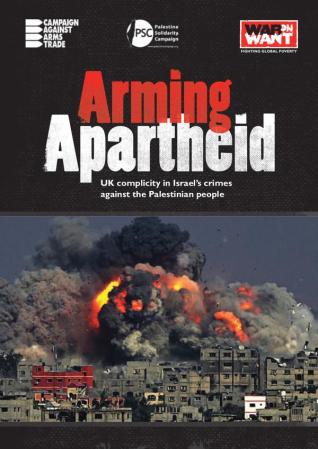
Activists in UK occupy second Israeli owned arms factory
MEMO | February 17, 2015
A factory in Kent owned by Israeli arms company Elbit Systems was occupied early Tuesday morning by activists responding to the Palestinian call for solidarity and BDS.
Instro Precision, a subsidiary of Elbit, was occupied at 5am, with more than a dozen activists taking up positions on the roof and at the entrance.
According to a press release from London Palestine Action, “Instro is owned by Israeli arms company Elbit Systems, who make drones that are used to kill Palestinian civilians in Gaza.”
It adds: “Optical and camera systems like those made at the Instro factory are also supplied by Elbit for use in drones flown over Afghanistan, as well as in Israel’s apartheid wall.”
The site in Broadstairs, Kent, is the second Elbit-linked company to be targeted by activists in the UK, after a successful occupation last summer of a drone engine factory near Birmingham.
Campaign Against the Arms Trade, welcoming the direct action, pointed out on Twitter that “there are 4 Elbit sites in the UK” and that “activists have so far targeted Kent & Staffordshire.”
Just last month, the prosecution of protesters who had occupied that first factory was dropped at the last minute, when Elbit refused to hand over evidence about its exports of weaponry to Israel.
During ‘Operation Protective Edge’, the Israeli military killed hundreds of Palestinians with drones. Activists say that Elbit Systems supplies 85% of the drones used by the military, and that the company’s “share price rose in July off the back of the extensive use of its technology during Israel’s massacre.”
Revolving door between arms dealers & govt exposed
RT | February 16, 2015
Arms manufacturers currently have dozens of employees seconded to the Ministry of Defence (MoD) and other British government agencies, an investigation has discovered.
The revelations highlight the close relationship between business and government, especially in highly lucrative industries such as the arms trade.
Employees from BAE Systems (manufacturers of the Eurofighter Typhoon), MBDA (makers of missiles), Babcock (defense contractor working on Trident nuclear submarine replacement), and MSI (gunnery systems producer) have all taken senior level roles within the MoD.
BAE systems, the second largest arms company in the world, has had more than 10 executives seconded to the MoD and the arms sales unit of UK Trade & Investment (UKTI) in the last year.
The MoD’s Equipment and Support Branch, which has a £14 billion annual budget to buy equipment for the armed forces, hosted nine BAE executives in senior positions, the investigation by the Guardian found.
UKTI Defence and Security Organisation, another government department, had four secondments from BAE, two from MBDA, and two from Detica, a cyber-security specialist acquired by BAE in 2010.
While on secondment, salaries are paid by the company and not by the government department they join.
Personnel exchange between business and government works in the opposite direction as well, with 13 civil servants having been seconded from the MoD to outside organizations, including cyber-security company Templar Executives, Lloyds Banking group, arms firm QinetiQ, defense think tank the Institute for Security and Resilience Studies (ISRS) and the BBC.
The Campaign Against Arms Trade (CAAT) described the arrangement as “totally inappropriate.”
Speaking to the Guardian, Andrew Smith of CAAT said, “Arms companies already enjoy a significant and totally disproportionate level of government support, and these kinds of secondments only make it more so.
“It is totally inappropriate for arms companies that will be lobbying for extra military spending to be working for departments that buy their wares.”
Natalie Bennett, the leader of the Green Party, said the British government’s relationship with arms manufacturers was “uncomfortably close.”
“All too often we’ve seen the government’s actions aligned with the interests of big business, which is particularly concerning when the businesses involved produce weapons,” she told the Guardian.
“For many years, the British government has had an uncomfortably close relationship with arms manufacturers and a shady record of arming dictatorships to match.”
“Secondments like these cast a shadow of doubt over the integrity over the actions of both the MoD and UKTI when it comes to their dealings with arms manufacturers. Our policies should serve the common good and must be free from the influence of vested interests like arms companies.”
The Guardian’s revelations come in the wake of the HSBC tax avoidance scandal in which the revolving door between financial institutions and government has also faced scrutiny.
Lord Green, the former head of HSBC, came under the spotlight for having taken the role of Minister of State for Trade and Investment immediately after leaving the bank.
Leaked documents allege that during Green’s tenure as Chairman of HSBC from 2006 to 2010, he oversaw the orchestration of industrial scale tax evasion for drug dealers, international criminals, dictators and terrorists.
Lord Green stood down from a senior position in the banking lobby group The City UK on Saturday.
RELATED: Pregnant activist crashes glitzy arms industry dinner, urges guests ‘consider career change’
Why Jonathan Freedland Isn’t Fit to be the New Editor-in-Chief of the Guardian
By Blake Alcott | CounterPunch | February 13, 2015
Should Jonathan Freedland, the Guardian’s Executive Editor, Opinion, take over the editor-in-chief’s post from Alan Rusbridger? Freedland’s instalment is rumoured to be a condition set by the New York Times if the two enlightened North Atlantic papers are to merge, but even without this his chances seem good.
A central topic for both papers, as for the world in general, is Palestine, Israel, the Middle East. The topic is said by Freedland himself to have been his specialty for some twenty years. I have read through 100 of his writings on the subject in the Guardian, the Jewish Chronicle and the New York Review of Books and conclude that their content should worry the Guardian staff, its readers and his employer The Scott Trust. His support for Israel is unbalanced, violates the Guardian’s commitment to liberalism and is rooted in an ethnocentricity that enables him to alternatively ignore Palestinians and justify their forced transfer out of Palestine.
In order of decreasing importance:
* He justifies the ethnic cleansing of Palestinians.
* His writing is Israel-centric and biased towards Israel.
* His Mideast world is largely free of Palestinians.
* He conflates criticism of Israel with ‘anti-semitism’.
* His narrative is largely that of Israeli hasbara.
Ethnic cleansing condoned
Freedland’s friend and Ha’aretz journalist Ari Shavit made a stir in 2013 with his portrayal of Israel’s ethnic cleansing, by murder and expulsion, of the Arab-Palestinian town of Lydda in July 1948. In one of his reviews of Shavit’s story Freedland correctly writes that Shavit “meticulously reconstructs events in the mainly [sic] Arab town of Lydda in July 1948, when soldiers of the embryonic [sic] Israeli army emptied the place [sic] of its Palestinian inhabitants and… killed more than 300 civilians”. He confirms Shavit’s admission that “Zionism carried out a massacre”; it resolved that the Arabs of Lydda be “expelled quickly”: “if a Jewish state was to exist in Palestine an Arab Lydda could not exist…”
In another review of Shavit his claim is incorrect, however, that Shavit only “touches on the question of justification too” and “avoids a direct answer”. Shavit’s ‘shoot and weep’ approval is very clear. He writes that “the choice is stark: either reject Zionism because of Lydda or accept Zionism along with Lydda… I will not damn the brigade commander and the military governor and the 3rd Battalion soldiers. On the contrary, if need be, I’ll stand by the damned, because I know that if not for them the State of Israel would not have been born… They did the dirty, filthy work that enables my people, myself, my daughter, and my sons to live.” Shavit harbours righteous anger towards the “critics of later years who condemn what they did in Lydda but enjoy the fruits of their deed.” His final solution is the status quo: “Do I wash my hands of Zionism? Do I turn my back on the Jewish national movement that carried out the destruction of Lydda? No.”
Freedland concurs. As Ben White shows, already in 2004 in a book chapter Freedland wrote, “I have long believed Israel should be strong enough to admit the reality of 1948 – and to defend it all the same.” White demonstrates that while Freedland has passionately condemned ethnic cleansing in Darfur and Kosovo, he not only does not condemn the Zionist actions of 1948 (and since) but, as in his book Jacob’s Gift as well, he condones the ethnic cleansing; the “flight, expulsion and dispossession, the emptying of 400 villages and the creation of around 700,000 refugees” was all right because “the creation of a Jewish state was a moral necessity”, the Jews had “the right… of the drowning man” to force the Palestinians off Palestinian land. As Shavit says, “If Zionism was to be, Lydda could not be. If Lydda was to be, Zionism could not be.” Both Shavit and Freedland choose Zionism. In the same breath and in bad taste, Freedland exhibits his cleverness by joking that Shavit is “a Wasp, a White Ashkenazi Supporter of Peace”.
Further hard evidence against Freedland is found in a 2008 Guardian ‘Sounds Jewish’ podcast wherein he says, “I’m of the view that says admit the price that was paid but then say to the world, tragically, it was necessary, given the place the Jews were in given the calamity of their own, the slaughter in the holocaust. So I think you have to, you can be cleared-eyed and honest about this. It doesn’t actually compromise the moral need that Israel had 60 years ago, to admit that in order to implement that moral need there were terrible sufferings for other people involved.” As he preaches in his August 2014 review, while the blood of Operation Protective Edge was flowing, “the Jewish state had become a mortal [sic] need” and a “moral necessity”.
To understand the endorsement of how Israel was ‘born’ by ‘left Zionists’ such as Shavit, Freedland and Benny Morris it is necessary to read Shavit’s seminal 2004 Ha’aretz interview with Morris, reprinted in full in Counterpunch. In Freedland’s own critical yet friendly 2009 Guardian interview of Morris, Freedland eschews any expression of his personal opinion on Morris’ derogatory generalisations about Arabs, but instead uses rhetorical displacement to note merely that Morris’ language will make “liberal Israelis, liberal Jews, just liberals… squirm”; “people would [say] that’s… racism”. Compare Shavit’s relatively bold reply to Morris’ approval of Ben Gurion’s “purification” of Israel of gentiles: “I don’t hear you condemning him.”
Readers who like to read between the lines will like Freedland’s review of three biographies of Ariel Sharon, the ‘Butcher of Beirut’, Israel’s main post-1947 purifier who “embodied [Zionism’s] determined quest for land and its readiness to use brutal force.” Notwithstanding some ambiguity, Freedland is an admirer. Sharon may be an “enigma” to Freedland – less so, one suspects, to Palestinians – and have left an “uncertain legacy” – a view that would induce bafflement amongst Palestinians and Lebanese – but he was a “warrior” whose life was “rich in the raw material from which myths are made”, a “soldier… who… chased away enemies” and debriefed his own soldiers “even as a bullet remained freshly lodged in his leg”, a “new breed of Jewish warrior” who was “ruthless in the pursuit of safe and generous borders for the Jewish state”.
In an example of his amoral attitude towards Palestinian issues, Freedland judges Sharon’s building of “the separation barrier”, his decision that the Palestinians must be “bombed, harassed and intimidated” and his “pursuit of the settlement project” not on ethical grounds but rather on the grounds that these undermine Israel’s true interests. Sharon is nothing worse than “a weak strategist” who failed to see “the problem” of the demographic threat to Israel’s Jewish nature of equal numbers of Palestinians – in Freedland’s words, the need to leave “fewer Palestinians on Israel’s books, so to speak”. In violation of a central liberal tenet, Zionism and Israel have always manipulated demographics for political ends.
Back to the present. In his piece last summer ‘Liberal Zionism after Gaza’ Freedland’s writes, “Privately, people admit to growing tired of defending Israeli military action when it comes at such a heavy cost in civilian life, its futility confirmed by the frequency with which it has to be repeated.” One reads and gasps: murder “has to be” done. Freedland is by the way neither emotionally nor intellectually able to regard Gazans’ firing of rockets using the same lifeboat ethics used by the “liberal Zionists” [sic] regarding Lydda: a question of survival, either you or me.
Freedland’s support for ethnic cleansing is by itself enough to disqualify him from not only the chief editorship but his present job. Condoning the Nakba is out of bounds. It is a moral failing to believe Palestinians should pay for crimes committed by Christians in Europe. The message that two wrongs don’t make a right is beneath every standard for which the Guardian otherwise battles day in and day out.
Israel-centrism
Freedland is strongly and openly biased towards Zionism/Israel in this century-old conflict. He takes sides, is both personally and ideologically bound up with Israel, admittedly looking for its name in any list of countries, quickening at any sight of its flag. Outside of New York and London his time is spent in Israel, not Palestine or other Arab places. As he wrote in 2013, “My views [are] rooted in the firm desire to see Israel survive and thrive…” However, because Israel’s thriving is at the expense of the lives and dignity of the Palestinians his personal, understandable bias becomes relevant to one of the leading liberal newspapers of the world.
Freedland admits to following Israeli politics “obsessively”. What little he writes about Palestinian or Arab politics is superficial, and even columns about recent events in Syria or Egypt, or the Arab Spring, are analysed almost exclusively in their relation to Israel. “Where those watching from afar can afford to feel only hope for Arab democracy, it is understandable that Israelis feel mainly fear.” While noting that Zionism “was all about” a similar quest for “self-determination”, he “understands” Israel’s lack of joy at the prospect of the Arab spring and Arab democracy, cynically if circumspectly endorsing Moshe Aren’s dictum that “Peace you make with dictators.” Israel’s support for anti-democracy in its region is “understandable”. Freedland is using a double standard, and his allegiance to democracy less than full.
As with democracy, so with pluralism. Simultaneously downplaying and confirming the strength of the Israel lobby in the US, Freedland once warns AIPAC (the American Israel Public Affairs Committee) to be more tolerant of opposing views. AIPAC’s intolerance “is not just an offence against pluralism, it also hurts the very cause AIPAC purports to serve: Israel.” The bottom line is not ethics or liberalism, it is Israel.
When in May 2013 Stephen Hawking joined the academic boycott by cancelling a planned appearance in Israel, Freedland directed his concern not to the reasons why Hawking might adhere to the boycott call, and much less to the arguments of the Palestinian academics making the call, but to the frightful prospect that the boycott’s endorsement by people of the calibre of Hawking might lead to Israel’s being “shunned and vilified” as a “pariah state” by the “mainstream”. As so often Freedland addresses “those who wish the best for Israel”, evidencing no interest in the meaning for Palestinians of Hawking’s employing this peaceful method of pressuring Israel. Similarly, at the height of the bloodshed in Gaza he used the Tricycle Theatre’s refusal to host films financed by the Israeli government as a chance to once again arrive at his bottom line, namely Israel’s “strategically calamitous situation”, its “pariah status that is looming”, and the damage to its “standing in the world”.
Even the funeral of Nelson Mandela interests Freedland only because Netanyahu and Peres did not attend. It cast shame on Israel to be absent “when the family of nations gathered”; Zionism, after all, had fulfilled the need for “the Jewish people to re-join the family of nations”. He even cannot resist calling the funeral “a shambolic affair”, and his blindness to Israel’s apartheid-like characteristics prevents him from seeing that it might have been bad taste for it to show up at the ultimate honours for a man who spent 27 years in jail for fighting apartheid.
Even his support for Palestinian statehood stems from his support of Israel. In arguing for recognition of Palestine he writes that such recognition would “support the idea of ‘Israel alongside a Palestinian state, thereby entrenching Israel’s legitimacy and its permanence’. Having the general assembly… vote for such a resolution would amount to de facto recognition of Israel – and reassure those who fear the country’s ‘delegitimisation’.” He praises Peter Beinart for “distinguishing democratic [sic], pre-1967 Israel from the post-1967 territories” and for Beinart’s “goal of simultaneously ‘delegitimising the occupation and legitimising Israel’ – all for the sake of securing Israel’s own future.” What matters is the well-being of Israel; the intrinsic rights of Palestinians are not even an afterthought.
Freedland’s narrow focus becomes callous in a column about ‘Operation Cast Lead’ in January 2009 entitled ‘Gaza after a Hamas rout will be an even greater threat to Israel’. His concern is much less with the fate of dead and wounded Palestinians than with the war’s “damage to [Israel’s] international reputation” and the “dangers” for Israel of weakening Fatah’s position over against that of Hamas. He once similarly wrote that while the IRA always accepted Great Britain as such, Hamas doesn’t accept Israel, and that “Israel could truthfully cite the Ulster precedent when it says it cannot sit down with Hamas until it renounces violence.” He just cannot see that most Palestinians refuse to sit down with Israel until it renounces its decades of violence.
Writing “as the war in Gaza wound down” from his Greek holiday in summer 2014, Freedland reflects that although the Greek economy is in the doldrums Greece is not at war, but “Ashdod and Israel are not so lucky.” Aha, it is all a matter of luck. Gaza City, Jabalia City and Rafah – with rubble and corpses not to be found in Ashdod – are not worth mentioning. For Freedland the problem with last year’s Gaza war is that it is “self-defeating” – for Israel; it “will give Israel no security”.
Throughout, Freedland elides Jewishness and Zionism, for instance routinely calling Israel “the Jewish state”. One example is a piece in which he rejects the idea of one democratic state (supported he says only by “diehard Arab rejectionists” and “old-school student lefties from the 1980s”) his paragraphs use the terms “Zionism”, “Israel”, “the Jewish state” and even “the Jews” interchangeably. It is therefore more accurate to describe his starting-point as ‘Jewish-Israel-centric’.
Freedland’s characterisation of Israel in ethno-religious terms could be ignored. We could see its conflict with the indigenous population as purely political, economic, military. Unless, as is Freedland’s tendency, we want to let the twenty percent of Israel’s citizens who are not Jewish disappear conceptually altogether, making their second-class status easier to ignore. Freedland overwhelmingly does neglect them, a consequence of his elision of Israel and Jewishness.
The conflation has the further consequence of enabling Freedland in his 2004 book chapter ‘Is Anti-Zionism Anti-Semitism?’ to regard it as “not an absurd claim” to say that “to attack Israel is to attack Jews”. He argues for this by claiming that “Jewish affinity with Israel is now so widespread and entrenched, across the political and religious spectrum, that it has indeed become a central part of Jewish identity.” This shows his sympathy for the (absurd) idea that Israel criticism is ‘anti-semitic’ (correctly: judophobic), and in co-opting all Jews for Zionism it is factually wrong: many Jews are anti-Zionists. But this group, with the exception of Norman Finkelstein, earns little of Freedland’s attention.
Perhaps the cruelest aspect of Freedland’s conflation is the conflation of Jewish suffering in Europe with the geographical and political area of the Middle East known as Palestine. Zionism always chose the Arab inhabitants of Palestine as those who must pay for the pogroms of Eastern Europe, the Dreyfus scandal, or the Holocaust, in willful ignorance of the fact that the Palestinians had absolutely nothing – zero – to do with it.
His quasi-equation of Israel and “Jewish identity” led him to intervene as well in the controversy over London’s Tricycle Theatre’s attempt to not screen films sponsored by the Israeli regime: “The Tricycle’s insistence that the festival was only welcome if it cut all financial ties with the Israeli Embassy… seemed a realisation of long-held Jewish fears. Did this mean that Jewish participation in the cultural life of the country… would now be conditional on our first issuing a public disavowal of Israel?” Like a magician, Freedland in two sentences has changed the Theatre’s objection to “Israel” into opposition to “Jewish” participation – surely not the result of a reading difficulty. Similarly eliding gracefully between Israel, Jewish culture, the Israeli embassy in London, and ‘anti-semitism’ is an anonymous piece most likely written by Freedland which ends with non-sequiturs about attacks on French synagogues – but rhetorical analysis of this masterpiece is over my head.
Although Freedland often brings his own Jewishness into his political columns about Palestine and ‘anti-semitism’, it is not relevant to the points just made showing that the conflation of Israel and Jewishness is necessarily disadvantageous to Palestinian citizens of Israel, critics of Israel, Jewish anti-Zionists and Palestinians in general. Scores of gentile journalists, commentators and politicians share his outlook putting Israel, Jewish Israelis and worldwide “Jewish identity” at the centre of the Palestine question.
Finally, there is a nice teapot-kettle irony in Freedland’s “singling out” of Israel for journalistic and literary attention, for he often insinuates that ‘anti-semitism’ motivates those who “single out” Israel for criticism, as opposed for example to Syria or Darfur. He once feigns bafflement as to why people “single out” Israel; we who do so are even a “mob”. Whereby Freedland himself week in, week out singles out Israel for loving criticism, naming “the Israeli-Palestinian conflict” his journalistic specialty. Is he therefore guilty of the inverse racism of ‘philo-Semitism’? No.
Daphna Baram quotes Freedland in her 2004 book (pp 227-228) as follows: “Some Guardian people might wish it were otherwise, but it is a fact that the vast majority of Jews in the world today identify themselves with Israel, and see any attack on it as an attack on themselves. The result is that much of what we publish can and does offend our Jewish readers. My view is that if we are regularly offending most members of an ethnic minority, then that has to be a cause of concern…. [S]upport of Zionism is part of the Guardian’s own history. This is our heritage and we cannot break from it lightly.” That is, the Guardian should tailor its coverage of Israel to its Jewish, rather than its Arab or Palestinian, readership. And anyway, pro-Zionism is in the Guardian’s DNA.
When the desire for the well-being of any group, whether Jews, Christians, Moslems or Hindus, leads to justification of political privilege, it is relevant both to those discriminated against and, I believe, to what the Guardian should be. But even without this ethno-religious aspect, hiring Freedland as editor-in-chief will strengthen the Guardian’s pro-Israel bias.
The unimportance of Palestinians
The other side of the coin is that in Freedland’s world Palestinians are nearly absent. After distilling 100 of his articles I claim that he sees Israelis at the expense of seeing Palestinians. Like previous Zionists who saw the solution to the European ‘Jewish problem’ in Palestine, a purportedly literally or culturally empty place, they are his Oriental Other. Only once did I find him putting himself in the Palestinians’ shoes for longer than a half sentence, conceding that “the Palestinians feel exactly the same way [as the Jews]. They too have nowhere else.”
In the one column where I found general sympathy for Arab self-determination – he compares it to that achieved for Jews by the Zionists – my joy was short-lived. Lo and behold, he was referring only to self-determination in the surrounding Arab spring countries, excluding Palestine, that is, the group of Arabs in front of his nose, of which there is no mention whatsoever.
Palestinian refugees make up around 60% of the Palestinian population, but Freedland has devoted not more than perhaps three entire sentences to them. His moving article on Jewish refugee Otto Dov Kulka has never to my knowledge been balanced with more than a paragraph on any of the millions of ethnically cleansed Palestinians who lost their homeland 67 or 47 or 5 years ago or yesterday.
He does see Palestinians when they fire rockets. One description of the situation at the time of Cast Lead reveals his bias: “the Israelis of Sderot cowering in shelters from the Qassam rockets launched from Gaza; and the Palestinians, whose suffering only seems to deepen”. That is, Palestinians are the agents of Israeli suffering, while the Palestinians’ suffering simply happens, somehow, with no agent in sight.
Baram (p 197) mentions that Freedland characterised as “some of the most important on the topic…” the Guardian’s interviews in one year “with Ariel Sharon, the leftwing activist Uri Avneri, Rabbi Sacks, the refusnik Rami Kaplan, the Palestinian politician Sa’eb Arikat, Yossi Beilin,… and Shimon Peres.” Amongst these seven people exactly one is a Palestinian who, to boot, is a collaborator in the ‘Oslo process’ and the Zionist two-state-solution project supported by Freedland.
In the few columns in which Palestinians do appear, Freedland is advocating (in Israel’s self-interest of course) Israeli recognition of Palestinian suffering. But this “recognition” is all they get – no land, self-determination or permission to return. Freedland doesn’t even manage the word ‘apology’. He once hopes Israel will “acknowledge” that the Palestinians “suffer[ed] a nakba.” He asks: “If Israel could one day make such an admission, who knows what accommodation might follow?” Accommodation on the part of the Palestinians, that is.
In another piece he fantasises a similarly biased deal of “Israelis finally acknowledging the plight of the refugees created by the birth of the state of Israel, and Palestinians finally deciding whether they can accept a Jewish state.” Again, in return for “acknowledgement” the Palestinians give 80% of Palestine to the Zionists. He then sweetens the deal by reassuring the Palestinians that they will not be “asked… to reject the entire narrative of their recent history.” This is magnanimous: they can evidently retain half their narrative of the recent part of their millennia of history.
Similarly, his take on the “liberal Zionist” [sic] two-state solution is that “Jews could have a state of their own, without depriving Palestinians of their legitimate national aspirations.” [Some] Jews get a state, while Palestinians get “aspirations” – moreover only their “legitimate” ones, not their ‘illegitimate’ ones.
In his 2004 book chapter he goes farther when saying that “Israel should make amends [for the Nakba] – through compensation, restitution, and commemoration. Let those four hundred villages that were emptied be named and marked, and let Palestinians remember what they see as the naqba, the catastrophe, their way.” The generosity of the vague offer of “restitution” notwithstanding, what the Palestinians get is naming, marking, commemoration and memories – no return to present Israeli territory, which is the elephant in this paragraph’s room – while Israel keeps Palestine. And as Ben White adds, “It is unclear why Palestinians need this permission.”
Standing over against and of course outweighing these “aspirations” are what Freedland dozens of times calls the Jewish “need” for a state (in Palestine), or even “the craving for a place the Jews could call their own… Whatever view you ultimately take on the Israel-Palestine question, you cannot hope to understand that conflict unless you also understand this need.” Martin Buber might have given equal time to the needs of the Palestinians, but not Jonathan Freedland.
This theme of a state of their own – which Freedland also deceptively calls a “homeland” – recurs starkly combined with the theme of the Nazi Holocaust: The Israelis “are a nation formed by those who had no other place to live. The Holocaust, inevitably, looms large in this: the establishment of a Jewish state just three years after the liberation of Auschwitz was no coincidence” because “the world” saw it as a “basic right” for Jews to have “a place of their own”. In his description elsewhere of Holocaust survivors he writes that “it’s useful to know the harrowing past of loss and violent bereavement – often but not only in the Holocaust – that shaped so many of them, the fear that transformed itself into a desperate longing to survive.”
But Freedland is making a very large and visible logical mistake: The Palestinians had nothing to do with the Holocaust. Neither could they take part in pre-Holocaust pogroms in Europe, since they didn’t live in Europe. The leap from persecution in Europe to Jewish ‘self-determination’ in Palestine is not only an obvious misuse of the term ‘self-determination’ but takes the corpses of the indigenous and the ruins of their houses in stride.
Even granting the legitimacy of the desire of many Jews (not “the Jews”, as Freedland repeatedly has it) for a Jewish state, the practical question facing the Zionists ever since the turn of the twentieth century has been where. It is embarrassing to have to mention, much less belabor, this point – which Freedland only briefly touches upon in his 2004 essay, but never in his columns. But if no empty land is found (or desired), the question of where? turns into the question of on whose land? The practical issue becomes a moral one. The beef the world has with Zionism is that two wrongs don’t make a right. Freedland sees this only hazily, because he does not really see Palestinians, because he identifies with Israel.
Is criticism of Israel ‘anti-semitic’?
In a 2012 column entitled ‘We condemn Israel. So why the silence on Syria?’ Freedland claims that focussing on Israeli crimes more than on those of Bashar al-Assad is judophobic. After accusing Caryl Churchill of not writing a play called ‘Seven Syrian Children’ and Lindsey German of Stop the War Coalition of not organising a demonstration against Assad, he states: “It’s not simply a bias against Jews that regards an Arab or Muslim death as only deserving condemnation when Israel is responsible.” That is, the positions of Churchill and German do stem from “bias against Jews”, but not only therefrom.
He loathes the Stop the War NGO German leads, writing recently, tastelessly and perhaps libellously of the “comforting hope that what we are up against [in the Charlie Hebdo case] is not a fanatic death cult but rather the armed wing of the Stop the War Coalition”. Sweeping more broadly and with X-ray insight into the hearts of his leftist enemies, he elsewhere emits the proclamation that “the suffering of… hundreds of millions of Arabs… has [not] stirred the compassion of left-leaning liberal types…”, and of “activists who can barely stir themselves to deplore the slaughter in Congo, Darfur or Sri Lanka.” Hopefully such slurs, leftist-bashing and impugning of motives, without evidence or rational argument, contradicts the job profile of a Guardian chief editor.
In 2013 he repeated the theme. After playing the numbers game showing that in a certain period of time Assad had killed more Syrians than Israel had Palestinians – perhaps the murderer of two people must be jailed, while the murderer of one person can walk – he writes, “I’m especially tired that so many otherwise smart, sophisticated people apparently struggle to talk about Israel-Palestine without reaching, even unwittingly, for the dog-eared lexicon of anti-Jewish cliché…” Apparently reference to “Israel/US ‘global domination’” was enough for Freedland to hang his case on. In any event “Israel’s shift to the right” will alienate “those it needs most” – and oh yes, perhaps also some Palestinians.
In a final slur in late 2013 he asserts, again with X-ray vision, that “the loss of [Syrian] lives failed to touch the activists who so rapidly organised the demos and student sit-ins against Israel.” I infer that Freedland’s license to haughtiness derives from his organisation of anti-Assad demonstrations.
In his chapter ‘Is Anti-Zionism Anti-Semitism?’ Freedland concludes that it isn’t necessarily, but usually is. He places the burden of proof (of innocence of ‘anti-semitism’) on those who reject Israel or Zionism. His main argument for the Yes answer to the essay’s question is however not defended “intellectually” but by feeling, by listening to “tones of voices”, to “how” rather than “what” is said. Even worse: evidence of ‘anti-semitism’ lies not so much in the “singling out” of Israel but rather in the “fervor” with which this is done. To avoid even this vague, emotional charge of ‘anti-semitism’ critics should I suppose tone things down, observe persecution of Palestinians with appropriate coolness. By this criterion the present critique of Freedland stems from my ‘anti-semitism’, done as it is with considerable effort, dedication, perhaps “fervor” – even if I have shown that exactly the same criticism could be made of the views of anybody applying for this Guardian job.
He thus concedes that much of the argument that anti-Zionism is ‘anti-semitic’ has no basis “intellectually”. For instance in a Jewish Chronicle round table he asks regarding some Israel-critical points “made in any of the plays we have talked about… why [it is] we feel somehow this is about us, rather than just about this country and the Middle East?” The judophobia is felt “somehow”. He also explicitly judges Israel criticism on the basis not of what is said, but who levels it. If it is Peter Beinart or Howard Jacobson, writing “from within, not without, the Jewish family”, it is OK. Coming from the likes of Norman Finkelstein – a Jewish “outsider” – it is “wicked”. He even throws the “self-hating Jew” epithet at Finkelstein before seamlessly connecting him to David Irving and claiming he “is closer to the people who created the Holocaust than to those who suffered in it”.
Not only should this provide work for the Guardian’s libel lawyers, but while it is good enough for the odd column, it is not good enough for editorial decisions affecting the entire paper. Remember that gentiles make identical arguments and that obviously for most Guardian readers and staff, conflating issues of human, civil and political rights with any ethnic and religious belonging is contrary to the Guardian’s liberalism.
After the Daily Mail’s attack on Ralph Miliband as a disloyal communist, Freedland squeezed five paragraphs of ‘anti-semitism’ out of single clause of a single sentence in which the paper denies its intent – unlike “the jealous God of Deuteronomy” – to hold David and Ed Miliband responsible for their father’s purported sins.
His take on the Charlie Hebdo murders dismisses as motives pride in Islam, piety towards Allah and the Prophet, French and Western foreign policy in the Middle East and North Africa, wars in Afghanistan and Iraq, and Israel’s decades of subjugation of Palestinians in favour of the single explanatory variable ‘anti-semitism’.
Freedland’s stance on this issue is relevant to the near future due to the present government’s intention of passing its Counter-Terrorism and Security Bill which regards criticism of Israel as prima facie evidence of ‘anti-semitism’. In a 2011 JC column he makes the hyperbolic claim that the academic boycott of Israeli institutions complicit in Israeli violations of Palestinian rights is “anti-semitic”. Furthermore, he has found it necessary to deny that fear of the charge of ‘anti-semitism’ sometimes silences criticism of Israel before it is uttered, or waters it down.
In the coming debate the interests of neither the Palestinians nor the Guardian are served by a chief editor who does not look at criticism of Zionism on its merits and without a presumption of guilt. And in the interests of fighting real ‘anti-semitism’ the Guardian editor in chief should not see it behind every bush. One wishes a Guardian editorial stance that instead starts with universal human rights, equal rights, indigenous rights and refugee rights and places the Palestinian and Israel perspectives on equal footing. Freedland starts with Israel.
Tropes of the Israel-Palestine discourse
Two myths of the dominant discourse about the Zionist-Palestinian conflict are (1) there are two morally and militarily equivalent sides and (2) Israel will permit a Palestinian state. Two of the discourse’s ‘silences’ are that Israel liquidates and ethnically cleanses Palestinians and that it wants maximum territory. Jonathan Cook adds to these Israel’s claims for its robust democracy and the need for a safe haven for Jewish people (in Palestine). Freedland follows this narrative in spades.
The false picture of symmetry imbues Freedland’s report of his participation in a role-playing event between ‘Israelis’ and ‘Palestinians’ where “the two [equally angry] sides” are negotiating – two teams out on the pitch. The goal is to find out where “the midpoint between the two sides lies.” The successful outcome, in his view, was agreement on two “states” or “nations”. The conflict is moreover reduced to one between two equally strong perceptions: the Israelis [he means of course Jewish Israelis] are only “cast as” the stronger party. Israelis “have a narrative involving dispossession and suffering too, but it tends to relate to the past, even if it is the relatively recent past.” In addition to ignoring the reality of Palestinian military and diplomatic inferiority Freedland here again misses the brightly illuminated sign announcing that the Jewish suffering was in Europe, not at the hands of the Palestinians.
In the same vein he argues for an “honourable draw” between the two teams, who are “fated to fight”. That is, Zionism did not throw the first stone; it was fate wot done it. “Two peoples” are in a sort of marriage needing a “divorce”. From this false premise of symmetry Freedland derives the shabby two-state solution, twice arrogantly and incorrectly asserting that “everyone knows” this is the only answer. Conveniently, this mythical ‘solution’ leaves his beloved Israel permanently in control of eighty percent of Palestine, treating its Palestinian citizens as second-class and locking the refugees out for good. The “two sides” narrative has served its purpose.
Somewhat improbably, Freedland evidences ignorance of the fact that Israel will never stop short of ruling all of Palestine from the river to the sea, romantically but falsely claiming, contrary to the empirical record of a whole century, that “two states is the destiny Israel envisages for their shared future.” He does not comprehend the meaning of the Israeli regime’s rule of always calling the West Bank ‘Judea and Samaria’. The myth of Israeli acceptance of a Palestinian statelet continues to serve the oppressive status quo.
Another baffling departure from reality is Freedland’s fantasy about “an Israeli peace with the Egyptian people [rather than Egypt’s dictators], one underpinned by their genuine consent.” Who else among us does not grasp that the consent of Arab people is conditional upon Palestinian sovereignty over Palestine?
Regarding democracy, Freedland supports Israel’s party line that it is both democratic and Jewish, stating for instance that “the two-state solution [is] the only guarantor of an Israel that is both Jewish and democratic.” He repeatedly upholds this mainstay of the Israeli narrative, once speaking of “the Israel we love [which] is the Jewish, democratic state established in the Declaration of Independence.” The jury has long been in with the verdict that the ‘Jewish, democratic’ state is an oxymoron – as are conceptions of ‘Christian’, ‘Moslem’, or ‘Hindu’ democracies. Again, a worrying inability to approach issues logically.
The corollary is his often expressed outright rejection, in favour of two (ethnically-defined) states, of a bog-standard democracy in Palestine. That vision of a single state, a proportional, multi-ethnic democracy as we know it in Europe, is a “sobering vision”. Why? The answer is creepy. Because therein “Jews will fast become a minority”. This implicit endorsement of Israel’s racist policy of maintaining at all costs the majority status of one ethno-religious group appears as well in the pages of the Guardian: Prevention of “a Palestinian Arab population that would one day be its numeric equal” is a necessary precondition of the dominant ethno-religious group of the Israel he so believes in.
Elsewhere as well Freedland’s democratic credentials fall short of Guardian standards. He for instance writes, “The success of Hamas in Palestinian elections in January apparently confirmed the notion on which unilateralism was predicated: that there is no partner on the Palestinian side.” Fact is that in January 2006 Hamas achieved a majority, but because Hamas rejects Zionism more than Fatah, the government fairly elected by the Palestinians of the West Bank and Gaza is illegitimate and can be rejected as a “partner”. For both Tony Blair’s Quartet and Freedland, Palestinian self-determination is worth nothing.
In a 2007 history lesson Freedland wrote that in 1948 “Israel had done something remarkable, defeating the armies of three nations that had vowed its destruction.” This is official, debunked Israeli history, unenlightened by either Palestinian or Jewish-Israeli ‘new historians’. Freedland and Israel thereby blank out the Mandate, US support, collusion with the ruler of Jordan, land confiscation, murder of Palestinians returning to their fields, and crucially early 1948’s Plan Dalet, which, to my knowledge, Freedland has never mentioned. Even an opinion editor should read up on the history of his region of specialisation.
Freedland even makes an original contribution to hasbara. Like all winners, he argues that the victims must sometimes forget the past; that is, forget the injustice done to them. Resourcefully mobilising the example of Northern Ireland IRA victims’ need for truth, justice and peace of mind, he first sympathises. But then he has news for them, paternalistically whispered: “It is this. In places torn by war, there is all too often a choice to be made between justice and peace… But the bleak truth is, we cannot have both.”
Moving on to the actual subject of the piece, “the battle of Israelis and Palestinians”, he is urging Palestinians to let bygones be bygones, to give up on justice in order to gain peace. This lets Israel off the hook, although even he must know that in Israel there is no Adams, no McGuiness, no de Klerk willing even to apologise. He even cynically throws in the observation that South Africa’s Truth and Reconciliation Commission omits the word ‘justice’. Truth will however within twenty years be demanded of Zionism and its Western apologists such as Freedland.
The title of one tenderly critical piece is “This is Israel? Not the one I love.” Freedland loves Israel, and again and again appeals to the “true friends of Israel” or “those who care about Israel” to adopt this, that, or the other viewpoint. The Guardian arguably needs a Middle East expert, but Freedland is not in a position to fulfil this role: he is party to the Zionism-Palestinian conflict. An Israel loyalist, he would make a competent successor or assistant to the man he says is “a frequent visitor to the Guardian offices”, Mark Regev.
Summary
In 2009, two weeks after the momentarily last Gazan child had been killed during Operation Cast Lead by an Israeli rocket, or bomb, or gun, Freedland wrote an article in which he describes that three-week long Israeli attack simply as “mayhem in Gaza”. Mayhem: a disorder, chaos, without named cause. That is, Freedland cannot even name Israel as the destroyer.
A novelist who researches well, there are few errors in Freedland’s columns: a wrong depiction of the sequence of events in a pro-Israel animated cartoon; wrongly saying Israel’s jocular phrase ‘mowing the lawn’ refers to the West Bank rather than Gaza; a slight misquote here and there. A polemicist to be sure, he has activists getting “feverishly… excited” when Israel commits a crime; he has his opponents “lazily brand” Israel a colonial project (he denies any resemblance of Israel to a “western imperialist”, British/Ashkenazi colony). A liberal, he gets some basics right, opposing for instance the oath of allegiance by non-Jews to the Jewish state, outlawing mention of the Nakba and bans on Jews’ renting rooms to non-Jews.
However, my objections are mainly ethical. One can perhaps understand Freedland’s admiration for Holocaust survivors seeking “justice and revenge” for Nazi crimes, avengers he celebrates in his Sam Bourne novel The Final Reckoning. Nazi crimes against Jews were monumental. But again, Freedland first of all morally fails to concede that the crimes had nothing to do with the Palestinians: as the novel’s Jewish-resistance hero says, in 1945 after the work in Europe “we were to put down our guns and grenades and head off to the next front in the war for Jewish survival: Palestine.” But two wrongs don’t make a right. Furthermore it is factually untrue that all European Holocaust survivors desired or needed to emigrate to Palestine, as Freedland implies.
In any case, his novel and his column on the avengers, together with his love of Passover, celebrating Jews not only as “victims” but as “victors” and ending in the death of masses of Egyptians, reveal his attraction to a certain kind of bloodiness. In this there is irony anew, for the same columnist who revels in vengeance and extra-legal assassinations feels it incumbent upon himself to advise the Palestinians not to throw stones but choose the path of non-violence.
Freedland shows little ability to apply principles universally. He for instance knows that George Habash as a twenty-one-year-old witnessed death and destruction in his home town of… Lydda, but he is oblivious to the possibility that Habash might have sought vengeance. Or another instance: if he embraces lifeboat ethics he must at least condone rockets from Gaza as an attempt by Palestinians to survive.
By coincidence Freedland would be chief editor on the hundredth anniversary of the Balfour Declaration on 2 November 2017. Finally, in isolated columns, like Shavit and Morris he has seen that the story did not begin in 1967 but goes back to 1948. His insight to be sure is mainly theoretical. Still stuck in ‘1967’ is for instance his offer to the vanquished of a West Bank/Gaza ‘Bantustine’, with six million refugees wiped from consciousness, and as recently as last summer he relapsed into the narrative that it is mainly the second occupation of 1967 that has to be solved. But the racist, ersatz-settler-colonial episode of Mandatory Britain, which will soon be debated in the UK in connection with the Balfour Declaration’s anniversary, took up the three decades before 1948. Like Freedland it was both Zionist and British, and Freedland may not be able to deal with it with any objectivity.
After averaging one column on Israel/Palestine every 2 months for the last ten years, since last summer Freedland has gone strangely silent. Since 26 July 2014 there is only one Guardian piece (on new president Reuven Rivlin) and only two in the Jewish Chronicle. Whether this has to do with an internal announcement of Rusbridger’s resignation, I don’t know.
Again, today’s apologists for Zionism – the Freedlands, Remnicks, Frasers, Beinarts, Jacobsons, whose self-depiction as ‘liberals’ is of zero interest to Zionism’s victims, the Palestinians – will eventually be forced to apologise. As so often in history, they will have to retrospectively ‘explain’ their support for an ethnocracy. The Guardian can now avoid this fate by correcting its century-long pro-Zionism, by applying basic ethical and political standards to Mr Freedland’s job application.
Freedland’s refusal to honour the right of self-determination to the indigenous inhabitants of Palestine is undemocratic and thus inconsistent with the liberal principles of the Guardian’s owner, the Scott Trust Limited. And to my mind his justification of ethnic cleansing is sufficient reason for the Guardian to reject him. To maintain this position Freedland cannot afford to pay much attention to, or develop empathy for, one of the “sides” in the Zionist-Palestinian conflict, the conflict that has so vexed the world and the Guardian for a century.
Blake Alcott can be reached at: blakeley@bluewin.ch.
700 artists announce a cultural boycott of Israel
MEMO | February 14, 2015
Over 700 British artists, from the worlds of literature, film, stage and music, have pledged to boycott Israel “as long as the state continues to deny basic Palestinian rights.”
The campaign was launched Saturday with a letter in The Guardian signed by Peter Kosminsky, Mike Leigh, Jimmy McGovern, Miriam Margolyes, Riz Ahmed, Jeremy Hardy, Brian Eno, Richard Ashcroft, Gillian Slovo, China Miéville, and Liz Lochhead, among others.
The pledge in full, organised by ‘Artists for Palestine UK‘, states:
We support the Palestinian struggle for freedom, justice and equality. In response to the call from Palestinian artists and cultural workers for a cultural boycott of Israel, we pledge to accept neither professional invitations to Israel, nor funding, from any institutions linked to its government until it complies with international law and universal principles of human rights.
Former English PEN president, writer Gillian Slovo, said: “As a South African I witnessed the way the cultural boycott of South Africa helped apply pressure on the apartheid government and its supporters. This Artists’ Pledge for Palestine has drawn lessons from that boycott to produce an even more nuanced, non-violent way for us to call for change and for justice for all.”
UK dispatches troop carriers to Ukraine
Press TV – February 14, 2015
Britain has delivered a number of troop transporters to Ukraine as fighting rages on unabated in the eastern parts of the former Soviet country despite a peace deal.
Ukrainian media reported on Friday that 20 British Saxon armored vehicles were handed in to Kiev, with another 55 expected to arrive soon.
The UK’s Ministry of Defense (MoD) said that the vehicles were transferred by a private firm under a 2013 deal with the eastern European country.
The troop carriers were first used by the MoD in the 1980s, but went out of service some three years ago, according to an MoD spokesperson.
The spokesperson stressed that the British government has been supplying “non-lethal assistance” to the Ukrainian army since the beginning of the crisis in the country.
“There has been no change to this and we have not provided lethal assistance. These vehicles were provided unarmed under a commercial contract dating 2013 by a private company,” the spokesperson added.
Earlier this week, British Foreign Secretary Philip Hammond also noted that London was keeping under review a decision not to arm Ukraine, adding it could not allow the Ukrainian army to collapse.
This is while Russia has repeatedly criticized plans by Western countries to supply weapons to Ukraine, saying it would only aggravate the situation in the country’s restive provinces.
The UK’s decision to send troop carriers to Ukraine came one day after Kiev reached a ceasefire agreement with pro-Moscow forces operating in the country’s volatile east following marathon peace talks in the Belarusian capital, Minsk, with leaders of Russia, Germany and France.
The mainly Russian-speaking regions of Donetsk and Lugansk in eastern Ukraine have been the scene of deadly clashes between pro-Russia activists and the Ukrainian army since Kiev launched military operations to silence protests there in mid-April 2014.
More than 5,500 people have died and some 12,200 wounded in the conflict, the UN says. Around 1.5 million people have been also forced from their homes over the past months of turmoil.
EU and Russia: No option but peace and coexistence
The BRICS Post | February 13, 2015
At the moment of writing, the ink on the second Minsk agreement has not yet dried.
On February 15, fighting is supposed to come to an end in Ukraine. What are the chances for success of this agreement and what’s in it for the EU and Russia?
Are we on the path to a new peace or to a new cold/hot war? That is the question that will be on the minds of many in the days to come.
There are too many uncertain factors to reliably predict what will happen. The EU and the US have different agendas, and one can even make a case that they have conflicting interests.
For Russia, a peaceful resolution to the conflict means ending the sanctions and facilitating closer economic cooperation with the EU.
But tighter economic relations with Russia, the natural hinterland of Europe, goes against the core of the transatlantic NATO alliance. This has been a nightmare scenario for the Washington elite since 1945.
Pointedly, neither the US nor the UK were involved in the Minsk negotiations, so for Washington all options are still on the table. Considering the warmongering majority in the US Congress, that is not a good omen for peace.
Then there is the matter of the government in Kiev. Hardly ever mentioned in the news, it is far from stable. Extremist militias who do not bother to hide their fascist ideologies have been integrated into the Ukrainian army.
Considering their behaviour on the battlefield so far, it is very doubtful that Kiev will be able to make them abide by the ceasefire conditions.
Besides the extremists in their own ranks, the Kiev government faces another problem – young Ukrainian men in the west are bitterly resisting military conscription. This is not to say that they sympathize with their compatriots in the east – they just do not want to die fighting them.
Furthermore, there is the inner political struggle for power.
While President Petro Poroshenko is more than willing to find a pragmatic solution to the conflict, his prime minister Arseniy Yatsenyuk, however, is a fanatic Ukrainian nationalist, who is not a man of compromise.
He wants total victory and would be more then happy to replace his president.
Then there are the rebels in Eastern Ukraine, the so-called ‘pro-Russian separatists’.
Western media make it look like they are mere pawns in Putin’s hands, but that is hardly the case.
Nobody denies that Russia is giving them ample logistic support, but the leaders of the resistance are very unreliable. Will they accept the ceasefire? Hard to tell.
First step toward peace
Yet, despite all these challenges, history shows that worse situations have led to lasting peace.
The second Minsk agreement might just work. It is only a first step, and a peaceful long-term resolution of the conflict is still to be negotiated, but it is the only way out for the EU, Russia and Ukraine.
One of the reasons it might just work is precisely that the EU alone brokered it, or rather Germany and France, and not the US. That might seem contradictory given the different variables mentioned above, but it’s not. It all depends on who and what will prevail.
The real issues are still on the table – disarmament and federalization of the country. If the EU really wants it, Brussels has the financial leverage to force Kiev’s hand in accepting a new constitution granting the eastern regions meaningful autonomy.
The EU has experience with forging complex compromise solutions. After all, the EU itself is a permanent compromise.
What is really at stake is much more than just an end to an internal conflict stoked by outside forces. A resumption of violence carries with it the risk of an all out war between nuclear powers.
This is about a possible major war on European soil.
Border control
Hence, peace is the only option for Europe and Russia.
Personally, I consider one of the last paragraphs in the Minsk agreement, which focuses on control of the border, the most difficult one.
Kiev wants to regain full control of the border between the eastern provinces and Russia. This may at first appear to be a technicality, but it isn’t. Control of the border is highly symbolic, for all parties involved.
Kiev’s control of the border would impede Russia’s direct influence on the ground; for the rebels it would symbolize a partial surrender. The only party that stands to gain from this paragraph in the agreement is Kiev, which would have been delivered a highly symbolic victory.
A reasonable option would be to deploy UN troops on the border. Russia has proposed it, but apparently it was not on the negotiating table in Minsk.
While the Cold War has prevented Europe and Moscow from peaceful coexistence on their common continent, peace in Ukraine might just open up the whole Russian hinterland to the European economy.
At the end, it boils down to two options: The renewal of the old transatlantic pact with the ally overseas leading to a new Cold War (that could turn very nasty), or peace and coexistence with Russia.
Cleared Londoner Shaker Aamer marks 13 years in Guantanamo without charge or trial
Reprieve | February 13, 2015
Saturday, February 14th, marks 13 years since the arrival of British resident Shaker Aamer at Guantanamo Bay, where he has been held without charge or trial ever since.
Mr Aamer, a father of four from London, has been cleared for release under both the Bush and Obama administrations, in a process which requires six government agencies to confirm that he poses no threat. However, he remains imprisoned in Guantanamo, despite repeated requests by the UK Government that he be returned to his family in South London.
Mr Aamer’s plight was most recently raised by David Cameron during talks at the White House in January, leading a spokesperson for President Obama to say the US would ‘prioritise’ his case. However, concerns about a lack of progress have been raised after Defence Secretary Chuck Hagel – whose signature acts as the final authorisation to release prisoners from Guantanamo – reportedly said that Mr Aamer’s file was not ‘on his desk’.
Today also marks the birthday of Mr Aamer’s youngest son, Faris, who was born on the day Mr Aamer was brought to Guantanamo Bay, and whom he has never been allowed to meet.
Commenting, Clive Stafford Smith, Director of legal charity Reprieve, which represents Mr Aamer said: “President Obama’s claim that he will ‘prioritise’ Shaker’s case rings rather hollow, since he is the most powerful person in the world and is perfectly able to put Shaker on a plane to London and his long-suffering family within 24 hours. Eight hundred years ago the Magna Carta assured us that to nobody will we ‘deny or delay justice’. Thirteen years in a military prison without charge or trial is an affront to the most basic standards of justice. The Prime Minister needs to tell Shaker’s children when their father is coming home.”