Arms maker BAE Systems takes control of failing school
RT | April 24, 2015
Europe’s largest arms manufacture BAE Systems has become the main sponsor of an under-performing school in the North West of England.
From September the arms marker, which operates a dockyard in Barrow-in-Furness, will run the Furness Academy, which was created under the coalition government’s academies scheme by joining together three failing schools in the area.
BAE previously tried to donate £400,000 to the academy in 2007, while the firm was under investigations of corrupt dealings.
The arms company is responsible for the construction of nuclear submarines at its base in the town, which are used in the controversial Trident program. The firm had a £15.4 billion turnover in 2014.
BAE has set up a trust to run the school under its submarine-building arm. Campaigners worry the move will have an impact on the curriculum.
Sam Robinson, university coordinator for the Campaign Against the Arms Trade (CAAT), called the decision “deeply worrying.”
“The idea [BAE] could soon be playing a significant role in running one of our schools is deeply worrying.
“It … gives them direct access to potential future employees and often allows them to influence the curriculum to suit their employment needs.”
Robinson said the move means the school would be run on “profits from selling arms to some of the world’s most oppressive dictators.”
The arms company will be tasked with boosting the academy’s performance. The school has been in special measures since 2012, following a spate of poor Ofsted inspection results. The schools’ watchdog says improvements have been much too slow.
Tony Johns, the managing director of BAE Systems Submarines, said in a statement: “We have for a long time supported local education at primary, secondary and college level, and see this positive step as an extension to our commitment in helping Furness Academy provide its students with the best possible education.”
BAE has not issued a comment on the agreement.
Mallen Baker, a strategic advisor for corporate social responsibility, told Schools Week it was quite normal for local companies to invest in local education and, despite BAE’s arms dealings, the firm is simply investing in the future of the town.
“Employers recognize that the quality of local recruits is influenced hugely by their quality of education,” he said. “Companies that invest in the local community will also get higher loyalty rates.
“With BAE there is an additional factor – they deal with a controversial product. But armament is essential for the defense of the country and we believe in the right for our countries to defend themselves.”
The New Hillary
By Andrew Levine | CounterPunch | April 24, 2015
In the years before he ran for President in 1968, Richard Nixon’s publicists promoted a New Nixon. It was the same old Tricky Dicky with the rough edges smoothed away.
The old Nixon lost the 1960 presidential election to John Kennedy in 1960; then Pat Brown defeated him in 1962, when he ran for the Governorship of California. The hope after that was, as Nixon himself put it, that the press would no longer “have Nixon to kick around anymore.” Nixon had always had trouble with the press.
But this was not to be. You just can’t keep a good scoundrel down.
The Vietnam War was a bipartisan concoction, from its inception to its ignominious end, but, before 1968, liberal Democrats – JFK and Lyndon Johnson, leading figures in their administrations, and Democratic Senators and Representatives — were the ones leading the way. Vietnam was not just an anti-Soviet and anti-Chinese proxy war; it was a liberal’s war.
Republicans were culpable too, and Nixon was hardly an exponent of peace. But neither he nor the party whose ticket he led had yet taken on the now familiar more-bellicose-than-thou persona of the post-Vietnam GOP.
The more unpopular the war became, the happier Republicans were that Lyndon Johnson, not one of their own, was taking the blame. Democrats were still widely considered the more warlike of the two parties. How could they not be – having brought the United States into the First and Second World Wars and into Korea? Vietnam was their thing.
But then, as now, the Democratic Party was where the liberals were, most of them anyway; and so, the part of the anti-war movement that was electorally inclined, the less radical part, gravitated into their ranks, effectively dividing the party into pro- and anti-war camps.
There were Republican liberals too back then, but a cultural divide already separated the anti-war movement from the GOP; and, with only a few exceptions, Republican liberals and moderates were no more peace-friendly than LBJ. The prospect of turning the GOP into an anti-war party never occurred.
As the 1968 election approached, Nixon said that he had a secret plan for ending the war. He was lying, of course; but, at the time, his claim was not implausible; hadn’t Eisenhower said much the same about Korea, and he was telling the truth.
There were even a few anti-war liberals who voted for Nixon to punish the Democrats, and many more who considered doing so.
The Democrats who led the way in Vietnam, LBJ and the cohort he inherited from Kennedy, were decent enough on domestic policy. By today’s standards, they were outstanding.
Nixon wasn’t bad either. Unlike today’s Republicans and Democrats, but like Eisenhower, he had no interest in dismantling New Deal and Fair Deal advances.
And for getting affirmative action going, for launching various “black capitalism” programs, for floating the prospect of a negative income tax and genuine national health insurance, for breathing life into the environmental movement, for pumping money into scientific research and infrastructure development, and much else, his presidency puts Barack Obama’s and Bill Clinton’s to shame.
Between Nixon and what we can expect from Bill Clinton’s even more retrograde wife, there is no comparison at all.
To get his presidential aspirations back on track, there was therefore no need for him to take a liberal or “populist” turn. This was not what the New Nixon was about.
It was about how he presented himself, his public persona. His publicists understood that that had to be changed – fast.
But, you cannot change a public persona without bringing politics in; not if you are running for President. There must be at least the appearance of substantive change.
And so what made the New Nixon new was his adoption of a more statesmanlike veneer.
The New Nixon was, or was made to seem, more thoughtful than the Old. His anti-Communism was toned down a notch — to appear less paranoid and crass. And, under Henry Kissinger’s tutelage, he learned how to present himself before the world as a geopolitical strategist of uncommon insight.
Of the Old Nixon, people would say: “would you buy a used car from that man?” The New Nixon was less flagrantly sleazy.
The mean-spirited, internally tormented figure voters rejected twice was made over to seem avuncular and wise, an Eisenhower in the rough.
As it turned out, the makeover was not entirely smoke and mirrors. Nixon’s personality was what his detractors knew it to be; there was no changing that. But there was some reality behind the statesman-like veneer that his handlers had him project.
No one would have expected the Old Nixon to lead the opening towards China or to advance détente with the USSR; no one thought he had it in him.
Once in office, it became clear that the man was not as void of vision or as incapable of deep thinking as everyone had believed.
It also became clear that there was more villainy in him than even his most ardent detractors had imagined.
* * *
With her campaign for the presidency in 2016 now officially underway, we are witnessing the roll-out of a New Hillary.
The parallels with Nixon’s makeover are striking.
Clinton’s presidential plans had been thwarted by a more glamorous opponent, just as Nixon’s had been; and she too has always had trouble with the press.
And the New Hillary, like the New Nixon, will be very much like the Old.
There are other uncanny parallels: Barack Obama, the rival who did the Old Hillary in, was, at the time, heralded as the next JFK, the man who defeated Nixon forty-eight years before. Even Caroline Kennedy was on board with that.
For a moment too, there was hope, as they vacated the White House, that, in the new century, we wouldn’t have Clintons to kick around anymore.
Of course, there was never any chance of that – not with Bill being, as the quip went, the bride at every wedding and the corpse at every funeral; and not with Hillary being parachuted into New York state to be its Senator.
That arrangement also conjures up memories of the sixties – of Jack’s brother Bobby, RFK. When Johnson wanted him out of Washington, he too was parachuted into New York to become its Senator.
Massachusetts would have been more appropriate, but brother Teddy was already a Massachusetts Senator, and two Kennedys in the Senate from the same state would be unseemly.
More important to RFK and his minions, adding on to the Kennedy power base in Massachusetts would have been a waste or time and effort. New York was a different story.
Hillary was even less a New Yorker than Kennedy was. She was an Illinois girl, born and bred, who went to college and Law School in New England and then spent her adult life in Arkansas and Washington DC. New York City was just a great place to visit; the rest of the state might as well have been on the dark side of the moon.
This is not the only reason why the parallel with RFK is not exact.
Robert Kennedy had at least been his brother’s Attorney General, and also his closest advisor and most trusted friend. He knew about, and participated in, JFK’s intrigues and assignations; he knew about his brother’s poor health. He was the keeper of the family’s skeletons.
While his brother was alive, the whole world knew that when RFK spoke, he was speaking for the President. He was the Kennedy administration’s unchallenged and unchallengeable consigliere. When need be, he was also the enforcer of his brother’s will.
And he was his brother’s heir apparent. As such, RFK was a power to be reckoned with – not just for his hold over the Democratic Party but, more importantly, over the popular imagination.
With Hillary, there was nothing like that. She did play a role in her husband’s administration – a comparatively minor and not very successful one. It was she, for example, who, more than anyone, set the cause of health care reform back a generation.
Though hardly a Queen of Camelot, her role was more or less like Jackie’s. She and her husband had arrived at a modus vivendi — based on necessity, not trust.
When she spoke, it was with her own voice, not his; and she would be the last, not the first, to know about his intrigues and assignations.
Hillary’s only qualification for the office she sought in New York was that she had been a First Lady, an official wife.
Because she was the wife of a philandering husband, she sometimes did get her way. Aggrieved wives often do, especially when their husbands are in the national spotlight and hanging on by the skins of their teeth. The last thing Bill needed was political embarrassment on Hillary’s account.
But she was never the voice of the Clinton administration, and she was never her husband’s administration’s consigliere.
By the time Robert Kennedy was assassinated, the hopes of a generation were riding on his shoulders. No hopes ride on Hillary’s; none ever have and none ever will.
Therefore, it wasn’t just within “the great right-wing conspiracy” Hillary spoke of that, for all the wrong reasons, people looked forward to seeing the back of her. There were many who shared this hope – for reasons that are eminently sound.
But, as it had been with Nixon, those who hoped hoped in vain. She never really retired from public view.
Her operatives think that a makeover now will get her back on track for winning the office she believes her due.
One wonders how much the Nixon precedent figures in their thinking. It is unclear what, if anything, his makeover had to do with it, but a made over Nixon did finally gain the office that he too believed his due.
For this, the country paid dearly; and Vietnam, Cambodia, Chile and much of the rest of the world suffered egregiously.
We can expect outcomes similarly horrendous, if and when the New Hillary calls the shots. This is yet another parallel waiting to happen.
* * *
Old Hillary cannot be made over in quite the way that Old Nixon was. After her tenure as Secretary of State, promoting her diplomatic prowess is out of the question.
Future historians will fault her handling of America’s affairs almost everywhere the empire’s talons reached – not just in the Muslim world. But her clueless fumbling during the Arab Spring is sure to receive special attention.
On this, her Republican detractors are on to something.
But if the past is any guide, to drive the point home, they will focus only on her role in Libya in 2011 and in the months that followed.
She does indeed have much to answer for about that. So do Obama and his other humanitarian interveners. They brought Libya to ruin. The consequences of their clueless bumbling are still unfolding.
Thanks to Secretary Clinton and her posse, Libya became a failed state. In the Mediterranean today, off the Libyan coast, refugees and asylum seekers are drowning because of what Clinton and the people around her helped bring about.
But the Republican way is to tell only part of the story, and to tell it in ways that mainly reflect their own disingenuousness. Where the Clintons are concerned, this is how it has been since Day One.
Therefore expect Republicans to focus narrowly, if not exclusively, on the deaths of American diplomats (or whatever they were) in the consulate in Benghazi.
This was indeed a disaster, but their concerns are disingenuous because they know, as well as anyone, that the Benghazi consulate was, as the Iranians would say, “a nest of spies” that neither Clinton nor anyone else in the Obama administration can talk about honestly.
It was the same with the famous “missile gap” that JFK would bring up every chance he got when he ran against Nixon. There was no such thing, and Kennedy knew it. He also knew that Nixon couldn’t say this without compromising what he – and his boss, President Eisenhower — took to be the national interest.
This time, the shoe will be on the other party’s foot.
Still, the fact remains: Clinton was in way over her head when the Arab Spring erupted, and almost everything she did was wrong. If only for that, she should never be allowed anywhere near the corridors of power again.
Just as surely as Republicans will make the attack on the Benghazi consulate the issue, Democrats will do their best to make Clinton’s failures at the State Department a non-issue.
They will probably succeed too – well enough to fool most liberals.
But, to that end, the less they say about her diplomacy, the better for them. This is why Clinton’s makeover, unlike Nixon’s, will have little, if anything, to do with foreign affairs.
It will be about her likeability instead.
The Old Hillary was imperious; she exuded a sense of entitlement. The New Hillary is downright personable.
When New Hillary campaigns, instead of just flying in and out of major venues for mega-rallies or hobnobs with plutocrats, she will now sometimes also chat one-on-one with (carefully selected) “ordinary” people. She will brandish the common touch.
She will also take what media pundits call a “populist” line, doing her best to appeal to voters who would prefer Elizabeth Warren – or anybody to Hillary’s left.
These changes run together – “populist,” “popular.” Some well-remunerated marketing genius in Hillary’s employ must think that the two are one and the same, or that the target audience can be duped into thinking that they are.
It will be a hard sell, but the sales campaign will probably succeed with the target audience. Everybody knows that what candidates say bears almost no relation to what they will do – think, for example, of Obama’s “I will close Guantanamo” — but the will to believe becomes indomitable around election time.
Who is in the audience that Hillary’s hucksters are targeting? Apparently, it is social liberals – people who would vote for her, or any Democrat, over any imaginable Republican anyway, but who may, from sheer disgust or learned indifference, not vote at all.
In other words, they are preaching to the choir. This might seem a waste of time and effort; it usually is. But with a Hillary Clinton presidency looming, the choir cannot be counted on to show up at the church. They must be made to want to sing.
Hillary’s hucksters understand this; they know that their first order of business is to remind the Democratic “base,” the social liberal part of it, what makes Democrats worth supporting.
There are too few Democrats on Hillary’s right on economic policy issues to worry about, in any case; and her team is evidently counting on Republicans scaring off most “swing voters.” This happened in 2012, and it is likely to happen again in 2016.
And so the idea is to emphasize Hillary’s social liberalism – in the hope of getting potential voters enthused.
Her handlers have an even more compelling reason too: there is no other way to provide her with a more leftish patina that would not upset the donor class.
* * *
As a rule, advertisers like to appeal to the kinds of consumers known in the days when Nixon was starting his makeover, and when Hillary was still a Goldwater Girl, as “the Pepsi Generation,”
The Pepsi Generation was “with it,” whatever “it” was; and they felt good about themselves and about their world. Optimism was in the air they breathed.
The name lingers – it was a triumph of advertising genius – and the idea behind it continues to guide marketing campaigns.
But, in an age of increasing social insecurity, what works for selling soft drinks is no longer directly transferable to advertising campaigns aimed at selling candidates to voters.
Ronald Reagan’s “morning in America” was its last hurrah.
Since then, a succession of Reaganite (neoliberal, aggressively imperialist) Presidents – Reagan himself, the two Bushes, Bill Clinton and Barack Obama – have superintended such a profound diminution in voters’ expectations that it is no longer possible be with it and perky, or even mildly optimistic, in political contexts.
The one brief exception was America’s – and the world’s – brief Obamamania phase. In retrospect, the predictable shattering of the illusions that sprouted up around Obama’s candidacy in 2008 only accelerated the long term, increasingly pessimistic trend.
But even if optimism no longer sells candidates, being with it still counts for something – or so Hillary’s hucksters believe.
If their campaign launch video — featuring single moms, a multi-racial family and a gay couple about to be married — is any indication, Hillary’s minions seem to have decided to cede the religious Right to Ted Cruz or whichever wing-nut strikes the fancy of America’s most benighted, and to appeal instead to voters who are already on board, but who may not turn out for Hillary even so.
She is plainly not a candidate to get the juices flowing the way Obama did once upon a time; she is way too uncool.
But social liberalism is cool – cool enough, Team Hillary hopes, to bring the faithful out on Election Day.
In the Golden Age of the Pepsi Generation, Democrats aspiring to become their party’s nominee would be courting labor leaders and appealing to rank-and-file workers.
But Hillary and the people around her see no percentage in that; not when the union movement is a pale shadow of its former self, a casualty of the neoliberal age; and not when the leaders of what is left of it are as eager as their predecessors were to do Democrats yeoman service.
In the old days, there was at least a quid pro quo. Democrats did the labor movement favors too.
When Obama ran the first time, this tradition had not yet entirely died out. Candidate Obama was not about to come out against Taft Hartley, but he did endorse the Employee Free Choice Act. Had it been enacted, union organizing would have become easier. Obama said that he would make it a priority.
Needless to say, no one has heard anything from him about it since.
And now, true to form, most labor leaders are falling into place — behind Hillary. Her people see no need to chat them up; they have — or think they have — nowhere else to go.
Count on them instead to give their all while expecting nothing in return — beyond keeping the Republicans at bay. They no longer even ask.
* * *
Is pandering to later-day Pepsi Generation types, while ignoring workers and other traditional Democratic constituencies, a good strategy?
Not as a rule, especially in general elections. But, this time, it hardly matters because it is as plain as can be that the Republican candidate in 2016 will be whacky enough to scare off all but the most reactionary voters. The Democrat, whoever she is, will win no matter what strategy she deploys.
Meanwhile, the Clinton makeover strategy is a good one insofar as its point is to ward off competitors in Democratic primaries and caucuses.
Were any candidate to advance even modestly “populist” economic proposals in a way that seems that they mean it, the full weight of the donor class would come down upon them. This is not something Hillary would do in any case; it goes against her nature.
Therefore the only thing she can do, when she and her advisors find it expedient to take a more liberal or populist turn, is display support for costless (to capitalists) social issues. When, like gay marriage, those issues enjoy widespread support in nearly all sectors of the population outside the religious Right, proclaiming support is a no-brainer.
No surprise, then, that the Clinton campaign led with this gambit. Her handlers have positioned her well.
Even so, a real populist could defeat Hillary-style “populism,” provided word gets out to voters in the early caucus and primary states in time to build what the first President Bush called “the big Mo.” Even in today’s America, this could happen without billionaire backing.
This is why I am inclined to support the candidacy of Jim Webb.
If he plays his cards right, later-day Pepsi Generation types could become the ones with nowhere else to go, while the kinds of voters who made the New and Fair Deals possible, and who propelled the Great Society forward, putting the Democratic party on the side of racial and economic justice, could come back into the fold – not grudgingly, but enthusiastically.
Webb could turn the New Nixon’s Southern Strategy around, bringing not just “white ethnics” but also white Southerners back onto the right side of a class war that never ended – though it looked like it had because, in recent decades, one side, the wrong one, has been consistently getting its way.
Jimmy Carter, the best and the most underrated American President in a very long time, kept the Southern Strategy more or less at bay through the latter half of the seventies. He did it just by being a Southerner and being there.
But Carter ceded too much power to Cold War liberals like Zbigniew Brzezinski and to economists intent on reviving old nostrums that the New Deal once seemed to have laid to rest.
He even let Henry Kissinger talk him into letting the Shah of Iran into the United States for medical treatment, unleashing a chain of events that has diminished his reputation to this day.
Had Carter made peace with the Iranian Revolution, the United States and the world might have been spared Ronald Reagan; and we might not now, three and a half decades later, be facing the prospect of a war with Iran.
Carter’s instincts were decent, except when it came to deciding whose advice to trust. This cost him dearly. And, by diminishing his power, it rendered him all but useless for holding back the Republican tide in the South.
Bill Clinton, for all his efforts to come on as a Bubba to the good old boys while remaining presentable to donors in Manhattan and Beverly Hills, never made a dent in what the New Nixon got going. It wasn’t just the good old boys who saw through him, working people did too.
Hillary was not the only albatross around his neck. There was also his unctuous and transparent phoniness. It is as if he took the Eddie Haskell character on “Leave It to Beaver” for a role model.
He did indeed have Southern roots, but his heart was where the money was, and where the sleaze balls who had it congregated.
In the run up to the 2008 election, John Edwards seemed just the one to turn the Southern Strategy around — until the Obama steamroller and his own horn dog disposition did him in. Like Carter, Edwards was a bona fide Southern liberal, not a poseur like Hillary’s better half.
His strategy was to outflank Hillary from the left. Her other rivals, Joe Biden excepted, had the same idea. But Edwards could appeal to white Southerners, as they could not. In 2008, he might even have been able to do what Al Gore, eight years earlier, could not: pry away a few Southern states, along with their Electoral College votes, from the solidly Republican South.
But even had he turned out to be more like he (briefly) seemed to be, his candidacy would have been more like Elizabeth Warren’s might be, were she to run, than like Jim Webb’s.
Like Warren and Bernie Sanders and Martin O’Malley, Edwards was a zero on foreign policy and on military affairs – the areas where, even with money talking as loudly as it does, Presidents can actually make a difference.
These are Webb’s strong points. He has consistently opposed America’s Middle Eastern wars. And, knowing what war is about, he is no fan of gunboat diplomacy or military brinksmanship. He despises chicken hawks and the wars they foist on the people he cares about. In these respects, he is the true anti-Clinton.
* * *
The main thing, though, is that, contrary to what the hucksters selling Hillary seem to believe, the stars are now lining up right for moving social liberal considerations off dead-center and bringing working class issues back in.
This is because even the voters Team Hillary is targeting, functional equivalents of yesterday’s Pepsi Generation, are discovering that working class issues are their issues too.
This is happening all over the developed world.
It is more visible overseas than it is here because it is easier to gain a purchase on what voters are thinking in democracies that are less undemocratic than ours. The UK is a case in point.
There, as almost everywhere else, big money is much less a factor in determining electoral outcomes than it is in the United States, and the political culture is not quite as bent out of shape by the prevailing party system.
For this reason, Team Hillary would be well advised to take a close look at next month’s parliamentary elections.
Less than eight months ago, the Scottish National Party (SNP) suffered a significant defeat in a referendum on Scottish independence, its signature issue. Now, mainly at Labor’s expense, it is poised to become the third largest party in the British parliament.
Because neither the Conservatives nor Labor are likely to win a majority of seats in their own right, the SNP will wield tremendous influence in the next Parliament; it may even enter the government as Labor’s junior partner.
The reason for its sudden change of fortune is plain: voters are fed up with neoliberal austerity politics; and voting for the SNP is the best way to make this sentiment known.
The SNP is the most left leaning, most Social Democratic, of any of the larger political parties in Great Britain. If it were less intent on breaking up the country it may soon help govern, and if it fielded candidates throughout the entire UK, it might even be able to win outright.
There is a lesson in the SNP’s rise that has implications for the 2016 electoral season already unfolding in the United States.
In all developed countries, including our own, voters are less inclined than they used to be to think that it is acceptable, or even necessary, that only a tiny fraction of the population benefits as productive capacities expand at a dizzying rate, and while everyone else becomes, in varying degrees, worse off – the greatest burdens falling on those who are already the least well off of all.
Try as neoliberal ideologues might, it is a lot harder than it was just a few years ago to convince the general public that this is how it must be.
Voters everywhere are way ahead of the political leaders of their respective countries.
Hillary’s single moms and biracial families, and her gay couples, don’t speak to these concerns, though they are of great importance to people who fall under those descriptions and to others who do not, but care about those who do.
Even if her sales force gets her to declare support for a few Elizabeth Warren – Bernie Sanders type reforms, it will make hardly any difference; and not just because everybody knows that, were she to become President, whatever she says now will be yesterday’s lunch.
It will make hardly any difference because the realization is dawning that tinkering here and there is, at best, a palliative, not a solution. There is something rotten in the system itself, and more and more people are beginning to realize it.
No Democrat, including Webb, is likely to propose anything that would seriously address this rot.
But a Democrat can address one of the fundamental conditions of its possibility: the Democratic Party’s malign neglect of the working class and of the white, rural population in so-called “red” states, the South especially.
This is what a Webb candidacy could do. It is unlikely that anyone else with any chance at all of winning the Democratic nomination could do it nearly as well.
And it is certain that, no matter how “populist” the New Hillary’s guise, she will not – and probably cannot – do it at all.
* * *
There is a good chance that Hillary understands this, but doesn’t care – because it is the average donor, not the average citizen, that she aims to please.
That has always been the Clinton way. But the times are changing – more quickly and more profoundly than Hillary Clinton’s makeover team imagines.
The New Hillary is nevertheless likely to win the nomination and, if she does, she will win the race for the presidency, just as the New Nixon did.
She and her people ought to reflect on all the harm that came out of that; all the murder and mayhem, and all the devastation.
They might also reflect on Nixon’s fate. Theirs could be even worse.
Weaponizing Information
By Joyce Nelson | CounterPunch | April 23, 2015
In mid-April, hundreds of U.S. paratroopers from the 173rd Airborne Brigade arrived in western Ukraine to provide training for government troops. The UK had already started its troop-training mission there, sending 75 troops to Kiev in March. [1] On April 14, the Canadian government announced that Canada will send 200 soldiers to Kiev, contributing to a military build-up on Russia’s doorstep while a fragile truce is in place in eastern Ukraine.
The Russian Embassy in Ottawa called the decision “counterproductive and deplorable,” stating that the foreign ministers of France, Germany, Russia and Ukraine have “called for enhanced intra-Ukrainian political dialogue,” as agreed upon in the Minsk-2 accords in February, and that it would be “much more reasonable to concentrate on diplomacy…” [2]
That viewpoint is shared by many, especially in Europe where few are eager for a “hot” war in the region. Nor are most people enamoured of the fact that more billions are being spent on a new arms-race, while “austerity” is preached by the 1 Per Cent.
But in the Anglo-American corridors of power (also called the Atlantic Alliance), such views are seen to be the result of diabolical propaganda spread through the Internet by Russia’s “secret army.” On April 15, the U.S. House Foreign Affairs Committee, chaired by Ed Royce (R-Calif.), held a hearing entitled “Confronting Russia’s Weaponization of Information,” with Royce claiming that Russian propaganda threatens “to destabilize NATO members, impacting our security commitments.” [3]
The Committee heard from three witnesses: Elizabeth Wahl, former anchor for the news agency Russia Today (RT) who gained her moment of fame by resigning on camera in March 2014; Peter Pomerantsev, Senior Fellow at the Legatum Institute (a right-wing UK think-tank); and Helle C. Dale, Senior Fellow for Public Diplomacy at The Heritage Foundation, a right-wing U.S. think-tank. [4] The Foreign Affairs Committee website contains video clips of the first two witnesses – well worth watching if you enjoy Orwellian rhetoric passionately delivered.
The day before the hearing, in an op-ed for the Wall Street Journal, Royce wrote, “Vladimir Putin has a secret army. It’s an army of thousands of ‘trolls,’ TV anchors and others who work day and night spreading anti-American propaganda on the Internet, airwaves and newspapers throughout Russia and the world. Mr. Putin uses these misinformation warriors to destabilize his neighbors and control parts of Ukraine. This force may be more dangerous than any military, because no artillery can stop their lies from spreading and undermining U.S. security interests in Europe.” [5]
In her formal (printed) submission, Ms. Wahl referred to the Internet’s “population of paranoid skeptics” and wrote: “The paranoia extends to believing that Western media is not only complicit, but instrumental in ensuring Western dominance.”
Helle C. Dale warned of “a new kind of propaganda, aimed at sowing doubt about anything having to do with the U.S. and the West, and in a number of countries, unsophisticated audiences are eating it up.”
Peter Pomerantsev claimed that Russia’s goal is “to trash the information space with so much disinformation so that a conversation based on actual facts would become impossible.” He added, “Throughout Europe conspiracy theories are on the rise and in the US trust in the media has declined. The Kremlin may not always have initiated these phenomena, but it is fanning them… Democracies are singularly ill equipped to deal with this type of warfare. For all of its military might, NATO cannot fight an information war. The openness of democracies, the very quality that is meant to make them more competitive than authoritarian models, becomes a vulnerability.”
Chairman Royce called for “clarifying” the mission of the Broadcasting Board of Governors (BBG), the U.S. federal agency whose networks include Voice of America, Radio Free Europe/Radio Liberty, the Middle East Broadcasting Networks (Alhurra TV and Radio Sawa), Radio Free Asia, and the Office of Cuba Broadcasting (Radio and TV Marti). [6]
The BBG is apparently in disarray. According to Helle Dale’s submission, on March 4, 2015, Andrew Lack, the newly hired CEO of BBG’s International Broadcasting, left the position after only six weeks on the job. On April 7, the Director of Voice of America, David Ensor, announced that he was leaving.
Andrew Lack was formerly the president of NBC News. As Paul Craig Roberts has recently noted, Lack’s first official statement as CEO of the BBG “compared RT, Russia Today, the Russian-based news agency, with the Islamic State and Boko Haram. In other words, Mr. Lack brands RT as a terrorist organization. The purpose of Andrew Lack’s absurd comparison is to strike fear at RT that the news organization will be expelled from US media markets. Andrew Lack’s message to RT is: ‘lie for us or we are going to expel you from our air waves.’ The British already did this to Iran’s Press TV. In the United States the attack on Internet independent media is proceeding on several fronts.” [7]
Ironically, however, it’s likely that one of the biggest threats (especially in Europe) to Anglo-American media credibility about Ukraine and other issues is coming from a very old-fashioned medium – a book.
Udo Ulfkotte’s bestseller Bought Journalists has been a sensation in Germany since its publication last autumn. The journalist and former editor of one of Germany’s largest newspapers, Frankfurter Allgemeine Zeitung, revealed that he was for years secretly on the payroll of the CIA and was spinning the news to favour U.S. interests. Moreover he alleges that some major media are nothing more than propaganda outlets for international think-tanks, intelligence agencies, and corporate high-finance. “We’re talking about puppets on a string,” he says, “journalists who write or say whatever their masters tell them to say or write. If you see how the mainstream media is reporting about the Ukraine conflict and if you know what’s really going on, you get the picture. The masters in the background are pushing for war with Russia and western journalists are putting on their helmets.” [8]
In another interview, Ulfkotte said: “The German and American media tries to bring war to the people in Europe, to bring war to Russia. This is a point of no return, and I am going to stand up and say… it is not right what I have done in the past, to manipulate people, to make propaganda against Russia, and it is not right what my colleagues do, and have done in the past, because they are bribed to betray the people not only in Germany, all over Europe.” [9]
With the credibility of the corporate media tanking, Eric Zuesse recently wrote, “Since Germany is central to the Western Alliance – and especially to the American aristocracy’s control over the European Union, over the IMF, over the World Bank, and over NATO – such a turn away from the American Government [narrative] threatens the dominance of America’s aristocrats (who control our Government). A breakup of America’s [Atlantic] ‘Alliance’ might be in the offing, if Germans continue to turn away from being just America’s richest ‘banana republic’.” [10]
No wonder the House Foreign Affairs Committee hearing on April 15 had such urgent rhetoric, especially from Peter Pomerantsev, Senior Fellow at the Legatum Institute – a London-based international think-tank whose motto is “Prosperity Through Revitalizing Capitalism and Democracy” and whose stated mission is “promoting prosperity through individual liberty, free enterprise and entrepreneurship, character and values.”
At the end of March, Conservative London mayor Boris Johnson (named as a potential successor to David Cameron) helped launch the Legatum Institute’s “Vision of Capitalism” speakers’ series, whose rallying cry is “It’s time for friends of capitalism to fight back.” [11] The sponsor of the event was the British Private Equity & Venture Capital Association (BVCA), whose membership comprises “more than 500 influential firms, including over 230 private equity and venture capital houses, as well as institutional investors, professional advisers, service providers and international associations.” It is not clear whether the BVCA is also sponsoring the Legatum Institute’s “Vision of Capitalism” series.
The Legatum Institute was founded by billionaire Christopher Chandler’s Legatum Ltd. – a private investment firm headquartered in Dubai. According to The Legatum Institute’s website, its executives and fellows write for an impressive number of major media outlets, including the Washington Post, Slate, the New York Review of Books, Foreign Policy, New Republic, the Daily Telegraph, The Times, the London Review of Books, the Atlantic, and the Financial Times.
Nonetheless, the Legatum Institute’s Peter Pomeranzev told the U.S. House Committee on Foreign Affairs that “Russia has launched an information war against the West – and we are losing.”
Chairperson Ed Royce noted during the hearing that if certain things are repeated over and over, a “conspiracy theory” takes on momentum and a life of its own.
Pomeranzev said the Kremlin is “pushing out more conspiracy” and he explained, “What is conspiracy – sort of a linguistic sabotage on the infrastructure of reason. I mean you can’t have a reality-based discussion when everything becomes conspiracy. In Russia, the whole discourse is conspiracy. Everything is conspiracy.” He added, “Our global order is based on reality-based politics. If that reality base is destroyed, then you can’t have international institutions, international dialogue.” Lying, he said, “makes a reality-based politics impossible” and he called it “a very insidious trend.”
Apparently, Pomeranzev has forgotten that important October 2004 article by Ron Suskind published in the New York Times Magazine during the second war in Iraq (which, like the first, was based on a widely disseminated lie). Suskind quoted one of George W. Bush’s aides (probably Karl Rove): “The aide said that guys like me [journalists, writers, historians] were ‘in what we call the reality-based community,’ which he defined as people who ‘believe that solutions emerge from your judicious study of discernible reality… That’s not the way the world really works anymore,’ he continued. ‘We’re an empire now, and when we act, we create our own reality. And while you’re studying that reality – judiciously, as you will – we’ll act again, creating other new realities which you can study too, and that’s how things will sort out. We’re history’s actors… and you, all of you, will be left to just study what we do’.” [12]
It’s a rather succinct description of Orwellian spin and secrecy in a media-saturated Empire, where discerning the truth becomes ever more difficult.
That is why people believe someone like Udo Ulfkotte, who is physically ill, says he has only a few years left to live, and told an interviewer, “I am very fearful of a new war in Europe, and I don’t like to have this situation again, because war is never coming from itself, there are always people who push for war, and this is not only politicians, it is journalists too… We have betrayed our readers, just to push for war… I don’t want this anymore, I’m fed up with this propaganda. We live in a banana republic and not in a democratic country where we have press freedom…” [13]
Recently, as Mike Whitney has pointed out in CounterPunch (March 10), Germany’s news magazine Der Spiegel dared to challenge the fabrications of NATO’s top commander in Europe, General Philip Breedlove, for spreading “dangerous propaganda” that is misleading the public about Russian “troop advances” and making “flat-out inaccurate statements” about Russian aggression.
Whitney asks, “Why this sudden willingness to share the truth? It’s because they no longer support Washington’s policy, that’s why. No one in Europe wants the US to arm and train the Ukrainian army. No wants them to deploy 600 paratroopers to Kiev and increase U.S. logistical support. No one wants further escalation, because no wants a war with Russia. It’s that simple.” [14] Whitney argued that “the real purpose of the Spiegel piece is to warn Washington that EU leaders will not support a policy of military confrontation with Moscow.”
So now we know the reason for the timing of the April 15 U.S. House Foreign Affairs Committee hearing, “Confronting Russia’s Weaponization of Information.” Literally while U.S. paratroopers were en route to Kiev, the hawks in Washington (and London) knew it was time to crank up the rhetoric. The three witnesses were most eager to oblige.
Joyce Nelson is an award-winning Canadian freelance writer/researcher and the author of five books.
Notes
[1] “U.S. Military Instructors Deployed to Ukraine to Train Local Forces,” RT.com, April 17, 2015.
[2] Steven Chase, “Russian decries Ukraine training,” The Globe & Mail (April 16, 2015).
[3] http://www.bignewsnetwork.com/index.php/sid/231982691
[4] http://foreignaffairs.house.gov/press-release/chairman-royce-announces-hearing-russia-s…
[5] Ed Royce, “Countering Putin’s Information Weapons of War,” The Wall Street Journal (April 14, 2015).
[6] http://www.bignewsnetwork.com/index.php/sid/231982691
[7] http://www.counterpunch.org/2015/03/16/truth-is-our-country/print
[8] http://russia-insider.com/en/print/531
[9] http://washingtonsblog.com/2014/10/leading-german-journalist-admits-cia-bribed-l…
[10] Ibid.
[11] http://www.li.com/events/boris-johnson-launches-vision-fcapitalism-series
[12] Ron Suskind, “Without a Doubt: Faith, Certainty and the Presidency of George W. Bush,” The New York Times Magazine (Oct. 17, 2004).
[13] http://washingtonsblog.com/2014/10/leading-german-journalist-admits-cia-bribed-l…
[14] http://www.counterpunch.org/2015/03/10/natio-lies-and-provocations/print
University of East Anglia students back boycott of ‘apartheid’ Israel
MEMO | April 22, 2015
The University of East Anglia’s student body has endorsed the Palestinian-led Boycott, Divestment and Sanctions (BDS) campaign, in a motion passed last Thursday.
Meeting for the final time this academic year, the Council of the Union of UEA students passed the motion “in support of international law and human rights in Palestine” with 41 in favour and 15 against, with 11 abstentions.
The motion commits the SU to severing ties with companies that “facilitate Israel’s human rights abuses, military capacity, or settlement expansion”, as well as to opposing any university contract with complicit companies.
The SU also resolved to lobby the university “to adopt an academic boycott of Israeli universities” and provide scholarships for Palestinian students.
The motion describes Israel as “an apartheid state” and mentions specific crimes and abuses including illegal settlements, atrocities in Gaza, and “systematic” discrimination in both the occupied Palestinian territory (oPt) and inside Israel’s pre-1967 lines.
Israel’s “expansion” in the oPt is described as “a settler-colonial project, predicated on the ethnic cleansing and expulsion of its indigenous people.”
Proposed by a member of the campus Amnesty International group and seconded by the Ethnic Minorities Officer, the motion notes recent pro-BDS resolutions at NUS National Executive Council, NUS Women’s Conference, NUS Postgraduate Conference and NUS Black Students Conference.
In addition, it was recalled that students have voted for boycotts of Israel on campuses across the UK, including “Kent, Goldsmiths, Birkbeck, Kingston, Swansea, Exeter, Brunel, the University of Strathclyde, Edinburgh, Dundee, Essex, Sussex and SOAS.”
The case for BDS, according to the motion, is based on “Israel’s multitude of human rights and international law violations” and its lack of accountability. The motion affirms Palestinian students’ right to education unhindered by discrimination, and the necessity of international solidarity from students in response to the BDS campaign.
The motion asserts that “global boycotts are a non-violent, legitimate and effective tactic”, that “all other methods of pressuring Israel and the ending of the occupation have failed,” and that members of an academic community “have a responsibility to ensure that ethical considerations and social justice are at the heart of research and academia.”
The Union Council rejected a proposed amendment which would have removed BDS from the motion. Procedural motions to delay the vote were also voted down.
Yemen: The Little Army That Could
By Dr. Cesar Chelala | CounterPunch | April 21, 2015
In his book Century of the Wind, the late Uruguayan writer Eduardo Galeano tells how in 1927 the U.S. Marines landed in Nicaragua to quell a revolutionary revolt by Augusto César Sandino, who led a ragtag army of Nicaraguan peasants to fight the invasion. The Marines had gone to Nicaragua to protect the lives and properties of United States citizens.
Armed primarily with machetes and 19th century rifles, Sandino’s army fought the Marines, undergoing heavy losses in an enormously unequal fight. In November 1927, the Marines succeeded in locating El Chipote, Sandino’s mountain headquarters. However, when the Marines reached it, they found the place abandoned and guarded by straw dummies.
Despite massive efforts, American forces were never able to capture Sandino, and eventually, due in large part to the 1929 Great Depression, U.S. soldiers were withdrawn from Nicaragua following the 1932 Nicaraguan elections. As Alfonso Alexander, a Colombian journalist fighting in Sandino’s army said at the time, “The invaders were like the elephant and we the snake. They were immobility, we were mobility.” Chilean poet Gabriela Mistral called Sandino’s warriors, admiringly, Crazy little army.
There is an eerie resemblance between these facts and what is now happening in Yemen, the poorest country in the Middle East, where a small army of Houthi soldiers is fighting the combined forces of Saudi Arabia and its allies (the five Gulf Arab States and Jordan, Egypt, Morocco and Sudan), with the support of the U.S. The disproportion of forces between both sides would be laughable, if it weren’t tragic.
The Houthi rebels belong to a branch of Shia Islam known as Zaidism, and make up almost a third of the country. They have ruled the north of the country for almost a thousand years, until the 1960s. The rise of al-Qaeda in the Arabian Peninsula –whom they oppose- and their long-held feelings that the central government wasn’t sharing fairly the country’s resources led to their taking up arms and overtaking the government.
Considered a threat to the regime stability the Yemeni government waged brutal war against the Houthis in their stronghold in Sa’ada province, in the north of Yemen. Although their leader, Hussein al Houthi, was killed in the first war, he was replaced by his brother and current leader, Abdul Malik.
The Houthis rose to power because most Yemenis want a strong leader, with a clear vision about where the country should go. Both brothers were able to provide that vision that essentially encompasses the desire for government accountability, an end to corruption, fair fuel prices, job opportunities for ordinary citizens and a more fair distribution of resources.
The Houthis have been shown to be well organized and reliable. Since taking control of Sa’ada, their birthplace, they have made it one of the most peaceful and well-run areas in Yemen. The sound of gunfire has almost ceased now in Sa’dah, the Sa’ada Governorate capital city. Residents have electricity for most of the day and reliable water supply.
Since declaring control of Yemen on February 6, the Houthis have been advancing steadily south, in spite of heavy losses and constant bombardment by Saudi Arabia and its allies that have provoked a serious humanitarian crisis in the country.
Unrelenting air strikes have killed and injured thousands of people, many of them civilians, and thousands more have been forced to leave their homes and are desperately trying to find food and potable water. In April 18, 2015, Oxfam’s warehouse in Sa’ada containing humanitarian supplies has been hit and destroyed by an airstrike, leaving thousands of civilians without help.
A group of Yemeni scholars, residents and nationals of the UK and the U.S. have issued a statement regarding the situation in Yemen in which they state, “The military attack by Saudi Arabia, backed by the GCC states (but not Oman), Egypt, Jordan, Sudan, the UK and above all the USA, is into its third week of bombing and blockading Yemen… The targets of the campaign include schools, homes, refuge camps, water systems, grain stores, and food industries. This has the potential for appalling harm to ordinary Yemenis as almost no food or medicine can enter…Rather than contributing to the destruction of the country, the USA and UK should support a UN Security Council resolution demanding and immediate, unconditional ceasefire and use of their diplomatic influence to strengthen the sovereignty and self-government of Yemen. As specialists we are more than aware of the internal divisions within Yemeni society, buy we consider that it is for the Yemenis themselves to be allowed to negotiate a political settlement.”
Like the valiant Nicaraguan soldiers, Sandino’s “crazy little army”, there is no reason to believe so far that the Yemeni soldiers have other than their country’s peaceful survival in mind.
Dr. Cesar Chelala is a winner of an Overseas Press Club of America award and a national award on journalism from Argentina.
US military instructors in Ukraine undermine Minsk peace deal – Moscow
RT | April 17, 2015
Despite voicing its support for the settlement of the Ukrainian crisis, the US is actually working to undermine the Minsk peace deal, Russia’s Foreign Ministry said, commenting on the deployment of American military instructors to Ukraine.
The Russian Foreign Ministry is “gravely concerned” by the fact that military instructors from the US, UK and Canada will be training the troops from Ukraine’s National Guard, stressed the ministry’s spokesman, Aleksandr Lukashevich.
“This begs the question: Do they – in Washington, London and Ottawa – understand whom are we talking about? As they are the same Ukrainian ultra-nationalists from volunteer battalions, who wore Nazi emblems and blurred themselves with the blood of women, children and the elderly during reprisal raids in Donbass [south-eastern Ukraine],” he said.
“What will these foreign military experts teach them – how to continue killing those, who speak Russian?” the spokesman wondered.
Moscow views the information that the National Guard training program will include exercises with Western-style weaponry and hardware as a possible “first step towards the supply of modern US arms to Ukraine, which the ‘party of war’ in Kiev is so eager to get its hands on,” he said.
Supporting any revanchist ambitions of warmongers in the Ukrainian government “may lead to the resumption of bloodshed” in the south-east of the country, Lukashevich warned.
The ministry believes that the US actions are in violation of the peace deal, which was signed by Kiev and the representatives of Donetsk and Lugansk during talks in Minsk on February 12, he said.
Lukashevich stated that the Minsk deal provides “the withdrawal of all foreign forces, military equipment, as well as mercenaries from the territory of Ukraine under the supervision of the OSCE. Instead, a US Airborne Brigade has landed near Lvov and intends to settle there for long.”
“The Obama administration, which verbally advocates the settlement of the Ukrainian crisis, is, in fact, contributing to the disruption of the Minsk agreements,” he stressed.
According to Moscow, Washington is trying to divert the international community’s attention from its military deployment in the Ukraine “by a ‘smokescreen’ of claims of an alleged presence of Russian troops in Donbass,” which hasn’t been backed by any proof.
“It’s obvious, that the US troops on Ukrainian soil won’t bring it peace,” Lukashevich concluded.
On Friday, paratroopers of the US 173rd Airborne Brigade, based in Vincenza, Italy, have arrived in western Ukraine to provide training for Ukrainian troops. Some 290 US troops are to take part in long-term joint drills with combat units of the National Guard, Arsen Avakov, Ukrainian Interior Minister, wrote on Facebook.
The US paratroopers’ training mission will last for 24 weeks and involve some 900 Ukrainian servicemen, Ukraine’s President, Petro Poroshenko, and US Vice-President, Joe Biden, agreed earlier in spring.
Kiev and rebels signed a ceasefire deal in February, which involved the pullout of heavy weapons and a profound political dialogue and constitutional reform, which would address the grievances of the dissenting regions and reintegrate them into Ukraine.
The deal has more or less held so far, with the level of violence in eastern Ukraine dropping significantly, OSCE monitors on the ground have been reporting.
The Ukrainian conflict began in April 2014 after Kiev sent troops to Donetsk and Lugansk Region as people there refused to recognize the new coup-imposed authorities in the capital. A year of fighting in south-eastern Ukraine has resulted in over 6,000 deaths, including score of civilians, according to conservative UN estimates.
#PalestinianPrisonerDay: Protesters target G4S London HQ over Israeli ‘torture’ complicity
RT | April 17, 2015
Protestors gathered outside the London office of G4S on Friday to highlight the private security firm’s role in incarcerating Palestinian prisoners on behalf of Israel.
Organizers demanded the release of several prisoners, including Palestinian MP Khalida Jarrar and more than a hundred child detainees.
They also highlighted the ill treatment of prisoners, including alleged incidents of torture.
The protest in London takes place as part of an international day of action to mark Palestinian Prisoners Day, an annual expression of solidarity with Palestinians detained by Israel.
Palestinian Prisoners Day began as a mass action in support of hunger striking political prisoners on April 17, 2012.
It has grown into an annual event marked by human rights organizations and pro-Palestine groups across the world.
More than 100 people confirmed they would attend the protest on its Facebook page.
Organized by Innovative Minds (Inminds), a group which describes itself as online Islamic activists, the demonstration targeted G4S for its operation of two prisons and two detention centers in Israel and one prison in the West Bank.
Some 6,000 Palestinians are currently held in Israeli prisoners, according to the Addameer Prisoner Support and Human Rights Association.
Addameer’s monthly detention report for February 2015 indicates 163 of these prisoners are children, 13 of whom are under 16.
The vast majority of those incarcerated are male, with only 22 female prisoners.
Lina Jarbouni, a female detainee from Galilee, is the longest serving female prisoner having been in jail for 13 consecutive years.
“Systematic torture and ill treatment” of Palestinian prisoners is well documented, according to human rights group War on Want.
Activists say G4S is complicit in this ill treatment by providing security systems for the Israel-based Ketziot and Megiddo prisons, which hold political prisoners arrested within Palestine.
War on Want claims G4S has acted in violation of Article 76 of the Fourth Geneva Convention, which prohibits the transfer of prisoners from an occupied territory to the territory of the occupier.
G4S has become the target of an international boycott, with the South African government resolving to end work contracts with the security firm in November last year.
Archbishop Desmond Tutu was one of several notable activists, including Noam Chomsky, to sign a petition calling for G4S to end its participation in Israel’s occupation of Palestine.
Protestors outside the London office of G4S highlighted the plight of Palestinian prisoners being held by Israel as well as those detained by the security firm.
They demanded the release of Palestinian MP Khalida Jarrar, who was arrested by the Israel Defense Force (IDF) earlier this month.
The prominent feminist and human rights activist was sentenced to six months in prison without trial for violating a military injunction, which confines her to the city of Jericho and its surrounding.
Army sources told the Times of Israel the restraining order was based on her “incitement and involvement in terror.”
A spokesperson for the Palestine Liberation Organization (PLO) said Jarrar was heavily involved in the Palestinian Authority’s bid to join the International Criminal Court (ICC).
Activists also demanded justice for Jaafar Awad, 22, a Palestinian man who died from health complications resulting from “medical negligence” during his detention in an Israeli prison, according to the Palestinian Prisoner Society.
Another key theme of the protest was the detention of children.
Defense for Children International (DCI) launched an urgent appeal in 2012 after documenting 53 cases in which children were held in solitary confinement at the Al Jalame and Petah Tikva interrogation centers, and Hasharon prison.
Children reported being held in solitary confinement in a “foul smelling” cell measuring approximately 2 meters by 3 for an average of 10 days.
DCI reports no education is provided to them and they are denied access to their parents or lawyers while held in the Israeli Prison Service (IPS) controlled detention centers.
Read more:
Female Palestinian MP snatched by IDF, held without charge for 6 months
G4S posts £148mn profit despite ‘countless’ human rights scandals
US-NATO Antics in the Nuclear Playground
By BRIAN CLOUGHLEY | CounterPunch | April 17, 2015
The commander of US-NATO forces, the vigorously vocal General Breedlove, stated on April 7 that the military alliance’s planners “have been working tirelessly to enhance NATO’s Response Force and implement the Very High Readiness Joint Task Force, and today our progress is manifested in the rapid deployments we see happening in locations across the Alliance.”
Breedlove is the man who declared on March 5 that Russia had sent combat troops and massive quantities of military equipment into Ukraine. He said that President Putin had “upped the ante” in eastern Ukraine by deploying “well over a thousand combat vehicles, Russian combat forces, some of their most sophisticated air defense, battalions of artillery.” His military opinion was that “What is clear is that right now, it is not getting better. It is getting worse every day.”
He spoke absolute drivel, because the ceasefire between Ukrainian forces and separatists in the east of the country was working, albeit shakily, and things were quietening down. The last thing that was needed was provocation. Silence and, or at the most, calm, reasoned comments were essential if both sides were to be encouraged to cool it.
But this man, the Supreme Allied Commander Europe, the man who has the trust of the American president, the prime nuclear button-shover, told a deliberate lie intended to increase tension.
The manufactured tension built up and on April 7 Breedlove’s HQ announced that the militaries of “11 Allied nations, Germany, Poland, Norway, Denmark, Hungary, Lithuania, Croatia, Portugal, and Slovenia tested their Headquarters’ response to alert procedures,” while “in the afternoon of 7 April, the 11th Air Mobile Brigade in The Netherlands and the 4th Rapid Reaction Brigade in the Czech Republic were given orders to rapidly prepare to deploy their troops and equipment” in a maneuver called “Noble Jump” which conjured up an image of a missile-wielding April bunny leaping into the fray against a coyly unnamed enemy who could be no other than Russia. (Although perhaps Russia need not be too troubled about some of NATO’s war preparations. My sources told me that the practice mobilization of the Dutch brigade was a shambles.)
While the ground-based martial bunny-hops were going on there was an aerial provocation in progress, this time involving a US Combat Sent RC-135U spyplane which was on a mission against Russia and flew along its Baltic Sea coastline. To prevent identification its transponder had been switched off — just like those of the aircraft in the 9/11 hijackings and Malaysia Airlines Flight 370 which disappeared mysteriously a year ago.
All aircraft have transponders which report their speed, height, heading and identification to air traffic controllers and other aircraft in order to avoid aerial confusion, so when Russian radar detected a large aircraft without such a signal but obviously using transmission devices to collect their radar and other electronic emissions, including civilian commercial communications, they sent up a fighter plane to have a look. Washington threw up its hands in mock horror and issued statements about how dangerous this was. Then the western media went into overdrive with a cavalier disregard for balanced reporting.
The Daily Mail of Britain is a garbage newspaper which maintains enormous readership because it specializes in glamorizing Britain’s sad, tacky and pathetic Celeb culture while concurrently condemning it, sometimes in the most portentous terms. The paper’s masses of online readers try to rationalize their attraction to vulgarity by glancing at items on international affairs and were told breathlessly that “In a maneuver with ominous echoes of the Cold War, a Russian fighter jet ‘aggressively’ intercepted an American plane over Poland, the Pentagon claims. Filing an official complaint to Russia, the State Department alleges a U.S. RC-135U reconnaissance aircraft was flying near the Baltic Sea in international airspace when a Russian SU-27 Flanker cut into its path.”
The average Daily Mail reader might not be able to question the absurdly conflicting phrases “near the Baltic Sea,” “over Poland,” and “in international airspace,” but that doesn’t matter. The message was being spread around by the US-NATO propaganda apparatus that the dreaded Russkies were menacing the Free World. The media lapped it up.
Little attention was paid in the West to the Russian announcement that “an Su-27 fighter on duty was scrambled, approached the unidentified aircraft, flew around it several times, identified it as an RC-135U reconnaissance aircraft belonging to the U.S. Air Force and read its side number, and reported it to the command. After having been intercepted by the Russian fighter, the U.S. Air Force aircraft changed its course and moved away from the Russian border.”
What the Russians didn’t say was that the aircraft’s “side number” was 4849 and that it had been photographed the previous day in Eastern England at the Royal Air Force base at Mildenhall which houses a USAF tanker squadron, about 200 US special forces soldiers with Osprey aircraft and operatives from such elements as 97 Intelligence Squadron.
No doubt the Russians know that last October it was noticed that US RC-135U spy plane number 4849 carries on its side some eye-catching decals. A photograph taken by Gary Chadwick at Mildenhall shows the “mission markings applied above the crew entry hatch, on the left hand side of the RC-135U Combat Sent 64-14849 ‘OF’ with the 45th Reconnaissance Squadron/55th Wing of the U.S. Air Force : five hammer and sickle symbols.”
These symbols may be stickers or stencils, but whatever they are they cost money and take time and effort to apply on the side of an airplane to which they add neither beauty or distinction. So why are they placed there?
It might be thought strange that a US military aircraft in 2015 should have Soviet-era hammer and sickle decals on its side in order to publicly indicate a military exploit involving achievement of an objective of some sort. And it is interesting that one of the images has been added recently, because when a photograph of 4849 was taken last year there were only four such symbols. What enterprising and gallant mission merited the fifth hammer and sickle? Another addition was a fourth depiction of an aircraft carrier, signifying, no doubt, a successful electronic spying mission involving one of these ships that was not of the United States Navy. What nationality could it have been?
The anti-Russian spy-antics of the US are fully in line with the war-talk of Breedlove and his NATO colleagues who are beavering away in their brand-new billion dollar combat palace in Brussels to justify existence and expansion of their war machine. Russia’s actions have been propagandized accordingly, and the US spy flights are intended to provoke Moscow into taking action which can be used to escalate tension yet further. It would all be childishly funny were it not for the fact that Breedlove and his people are playing with the future of Europe and indeed the world. They are leading us to the nuclear threshold, and must be reined in before they stumble into ultimate confrontation.
Brian Cloughley writes about foreign policy and military affairs. He lives in Voutenay sur Cure, France.
Ed Miliband And The Jews
By Gilad Atzmon | April 15, 2015
Just a few month ago, in a speech in front of the Labour Friends Of Israel Lobby group, Ed Miliband – the Labour party’s current leader, produced one of the most embarrassing statements in the history of modern British politics:
“I want you to know”, Miliband told The Lobby, “that if I become Prime Minister in less than a year’s time, I will be proud to do so as a friend of Israel, a Jew and, most of all, someone who feels so proud to be part of the community gathered here today.”
I guess that many British people would actually expect their Labour party candidate to be primarily a ‘proud Brit’ as well as a friend of the Kingdom. I would have loved to believe that such a clumsy statement on Miliband’s part would be enough for the Labour party to expel the man from its ranks. After all, the above statement proves that more than anything, Ed is much more ‘Blue & White’ than ‘simply Red,’ let alone a British patriot.
Surprise surprise, Labour didn’t react at all. Even the British public, known for its tolerance, was very forgiving. Funny enough, it is the Jews who actually dumped Ed Miliband, they do not believe him nor do they like him at all.
A poll published last week in the Jewish Chronicle revealed that an overwhelming majority of Jews prefer the Conservatives over Labour. 69 percent of Jews questioned said they were going to vote for David Cameron’s Tories. Only 22 percent sided with Labour and Ed Miliband.
Rather than voting for Labour under the leadership of the man who vowed ‘as a Jew’ to be a ‘friend of Israel,’ our British Jews actually want a ‘Goy’ to dwell at 10 Downing Street. How strange? Or is it…
A few analysts have tried this week to grasp this peculiar Jewish collective attitude. They wondered why are British Jews so opposed to the first Jewish candidate with a realistic chance of becoming the country’s leader?
Haaretz’ writer Anshel Pfeffer suggested that “the most obvious reason being given to this question is that while Cameron is widely regarded as ‘the most pro-Israel prime minister in British history,’ Miliband is considered indifferent at best and by many as downright hostile to the Jewish state.”
However, Pfeffer suggested correctly that Miliband is far from being an enemy of Israel. As we read above, Miliband is a staunch supporter of The Jewish State. “He [Milliband] has repeatedly said he is committed to Israel’s right to exist in security and strenuously voiced opposition to any form of anti-Israel boycott.”
Pfeffer is kind enough to provide us with a further insight into Jewish identity, psychic, and ideological attitude. “Historically, the majority of British Jews supported Labour because they saw the left wing as staunch opponents of any form of racism, of which they were so often the targets. In the last quarter of the 20th century, as they became better integrated and wealthier, they began drifting towards the Conservatives, particularly when Margaret Thatcher, who represented the north London Finchley constituency, became party leader.”
What Pfeffer is saying is pretty simple. In the old days, Jews supported Labour not because they were ‘anti racist,’ but just because they didn’t like being persecuted as Jews. But as they moved up the ladder, they actually decided to support the party that is committed to big money and the fight against Anti Semitism. With 80% of our Conservatives MPs being CFI members (Conservative Friends of Israel), the Tory party provides all Jewish needs – it is good for business but it is also united against one kind of racism, namely ‘Anti Semitism.’
Pfeffer correctly states that “the last three prime ministers, all proud Christians, have all felt very much at home with the Jewish community. Miliband came over at best as a polite but awkward stranger.” By now this is easy to explain. The majority of British Jews prefer a ‘Sabbos Goy’ to run the country on their behalf; a politician that can be pushed and squeezed, a person that would take the country to the next Zionist global conflict without raising too many questions. A person that would support Israel when support is requested by The Lobby, a PM that would react to the imaginary fear of Anti Semitism even before the Jews themselves would sense such a fear. Only a dedicated Sabbos Goy can provide the goods. But Miliband will not be able to satisfy any of these demands. For the Jews, his Jewishness is clearly an obstacle. It only means that he will work hard to convey an image of impartiality and reason and, as we know, these two do not agree with Zion.
This Jewish attitude is far from being new, it is in fact as old as the Jews themselves. The Book Of Esther teaches Jews how to manipulate, mobilize and interfere with their rulers rather than becoming the rulers themselves. British Jews need a leader who will easily succumb to their lobby pressure. They suspect that Ed may be more resistant than any other candidate and truth must be told, they may as well be correct.
High Court backs university’s decision to ‘postpone’ Israel conference
MEMO | April 15, 2015
Organisers of a conference on Israel and international law have failed in their bid to overturn a decision by the University of Southampton to cancel the event, previously scheduled for this weekend.
On Tuesday, a High Court judge in London rejected the organisers’ application for a judicial review, with the university claiming that the conference had in fact merely been “postponed” due to “security concerns.”
Pro-Israel groups have been pressuring Southampton for months to stop the academic gathering. The legal challenge was launched earlier this month, following the university authorities’ decision to cancel the conference on the grounds of “risks to safety and public order.”
The news comes as a blow to organisers and their supporters, in what has been described by campaigners as an unprecedented attack on academic freedom in the UK.
In a statement released following the High Court decision, organisers expressed disappointment at the decision, but promised that the conference would ultimately take place.
We must continue to protest publicly against the university decision, and use the moral strength of our cause to ensure freedom of speech and academic debate – for our own sakes as well as for others.
In response to efforts by the Jewish Leadership Council, Board of Deputies of British Jews, and Zionist Federation to stop the conference, more than 900 academics, including dozens from Oxbridge, Russell Group universities and Ivy League schools, signed a statement of support.
The list of signatories included more than 30 researchers, lecturers and professors at Southampton itself, with senior officials referring unhappy staff to a “HR hotline.” In addition, more than 10,500 people have signed a public petition condemning the cancellation, and supporting free speech.
The backlash has already prompted a number of Israel advocates to publicly question the wisdom of campaigning for the cancellation of an academic conference. A piece in Ha’aretz described the affair as “a tactical and a moral defeat” for Israel’s defenders.
Dozens of arrests as anti-nuclear protesters demand end to UK’s Trident sub program
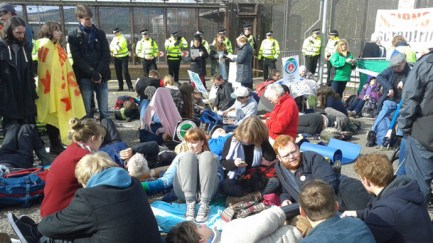
Anti-nuclear demonstrators at Faslane naval base, April 13 2015. (Photo by Veronika Tudhope)
RT | April 13, 2015
Some 36 anti-nuclear activists have been arrested at Faslane naval base in Scotland, according to organizers, as hundreds of protesters blockaded the home of Britain’s nuclear weapons system.
Workers at the naval facility were sent home after failing to gain access to the site due to the blockade, according to The Common Space journalist Liam O’Hare.
Scrap Trident, a coalition of organizations including the Scottish Campaign for Nuclear Disarmament (SCND) and Trident Ploughshares, have been demonstrating outside the facility since 7 a.m.
Protesters are demanding an end to the UK’s intercontinental ballistic missile program, which is up for renewal by the Westminster parliament in 2016.
Trident has become a contentious issue ahead of the general election in May, with Defense Secretary Michael Fallon pledging last week that a Conservative-led government would replace the Vanguard-class nuclear submarines with four new nuclear missile carriers.
Fallon’s election promise followed a statement by Scottish National Party (SNP) leader Nicola Sturgeon, in which she said Trident was a “red line” issue the SNP would not support.
In the event of a hung Parliament, Labour may seek to form a minority government in an informal coalition with SNP.
Critics, including Fallon of the Conservative Party, argue that Labour would abandon the UK’s nuclear weapons program to secure power.
Shadow Defense Secretary Vernon Coaker rejected the idea, insisting last week Labour was committed to renewing Britain’s nuclear weapons program, which is set to cost taxpayers £100 billion over the course of its deployment.
Labour leader Ed Miliband said in January he supported renewing Trident, adding he is “not in favor of unilateral disarmament.”
Monday’s blockade of Faslane naval base follows anti-Trident demonstrations in Glasgow and London over the weekend.
Scrap Trident organizers claim that 36 anti-nuclear activists were arrested in the blockade.
O’Hare, of The Common Space, reports that police have attempted to move anti-nuclear activists camped outside the naval facility’s south gate, while the majority of demonstrators are protesting outside the north gate.
Arthur West, chair of Scottish CND, said in a statement: “The purpose of the event is to draw attention to the fact that all Britain’s nuclear weapons are based just 25 miles away from our biggest city [Glasgow].”
“We say get rid of nuclear weapons and spend the money on decent things like housing, jobs and education.”
Speaking to RT, West added: “Scottish CND are campaigning in cities and towns across Scotland in the run-up to the general election.”
“Our main message to voters at the election is to only support candidates who have given a clear commitment that they will vote against Trident replacement when the issue comes up in the next parliament.”
Patrick Harvie, co-convenor of the Scottish Green Party, was among the demonstrators at Faslane on Monday.
Harvie, a member of the Scottish parliament, said in a statement: “Trident is an obscenity. Through direct action and through the ballot box we can make the case for the UK to play a new role on the world stage.”
He added: “By choosing to disarm Trident we can reskill workers on the Clyde to provide defense of the strategically important northern seas, and diversify our economy for social good.”
Southampton faces outcry from staff and public over cancelled Israel conference
MEMO | April 7, 2015
The University of Southampton is facing a public outcry and discontent from staff over its cancellation of a conference on Israel and international law.
After months of pressure from pro-Israel advocacy groups, university officials announced last week that the event would not take place due to concerns over ‘health and safety’.
Since organisers revealed that Southampton was pulling the plug, more than 9,300 people have signed a petition calling for the university to “uphold free speech & allow the conference on Israel and international law to proceed.”
Within the university itself, more than 30 researchers, lecturers and professors at Southampton have joined a list of some 900 academics expressing support for the conference.
The Southampton signatories include David Gurnham, the School of Law’s Director of Research, Professor Michael Kelly OBE, Head of Modern Languages, and Professor Malcolm H Levitt FRS.
In addition, the Vice-Chancellor has received emails from a number of staff unhappy about the decision to drop the conference, some of whom have published their letters publicly.
Among them was an email from Dr. A.M. Viens, Associate Professor in Law and the interim director of the Law School’s Centre for Health Ethics and Law (HEAL). Dr. Viens urged the administration to reconsider, so as to “take a strong stance of academic freedom.”
In a sign of the growing dissatisfaction, Chief Operating Office Steve White has asked staff to channel concerns through their line manager, “who should reassure them that the University will be monitoring and responding to any developments.”
Any “further concerns” are to be directed to a “HR hotline.”
Meanwhile, the British Committee for the Universities of Palestine (BRICUP) has called the cancellation “unprecedented”, and condemned the University for “allowing political pressure to determine its academic activities.”
According to Professor Jonathan Rosenhead, chair of BRICUP, “in living memory no academic conference at a UK university has been cancelled due to external political pressure.” He added: “Southampton’s decision sets an atrocious precedent that must be reversed. If not it deserves to be treated as a pariah by the rest of the academic community.”
Organisers are currently pursuing a legal challenge, with further developments expected this week.
Featured Video
Dan Dicks with James Corbett on Solutions Watch
or go to
Aletho News Archives – Video-Images
From the Archives
MMR (Measles, Mumps and Rubella) – Vaccine Risk Statement
MMR Vaccine (Measles, Mumps, and Rubella) Is It Safer Than Measles, Mumps and Rubella?
Physicians for Informed Consent | December 2024
… It has not been proven that the MMR vaccine is safer than measles, mumps, and rubella. The vaccine package insert raises questions about safety testing for cancer, genetic mutations, and impaired fertility. Although VAERS tracks some adverse events, it is too inaccurate to measure against the risk of measles, mumps, and rubella. Clinical trials do not have the ability to detect less common adverse reactions, and epidemiological studies are limited by the effects of chance and possible confounders. Safety studies of the MMR vaccine are particularly lacking in statistical power. A review of more than 60 MMR vaccine studies conducted for the Cochrane Library states, “The design and reporting of safety outcomes in MMR vaccine studies, both pre- and post-marketing, are largely inadequate.”19 Because permanent sequelae (aftereffects) from measles, mumps, and rubella are so rare (especially in children with normal levels of vitamin A and infected after birth),6,15-17 the level of accuracy of the research studies available is insufficient to rule out the possibility that the MMR vaccine causes greater death or permanent disability than measles, mumps, and rubella. – Read full article
Blog Roll
 Aletho News
- The fallacy of US delusions about Iran’s economic collapse
- Hezbollah denies Syria cell link, warns of Israeli plan to sow discord
- The legacy of US sanctions, war, and occupation in Iraq
- Iraqi resistance group rejects disarmament, vows to maintain support for Lebanon
- Sheikh al-Asadi warns of Iraqi government compliance with US demands
- How to MAKE THE CONSPIRATORS PAY for their crimes! Dan Dicks with James Corbett on Solutions Watch
- There’s a drought in academia: A drought in honest research on the subject of drought and other weather extremes
- Department of War Awards $20.7 Billion Contract to Raytheon for Air-to-Air Missiles
- ‘Distance yourselves from Israel’: IRGC urges US population to question govt policies
- America’s Greenland deal has a radioactive backstory
- If Americans Knew
- New Report: “Scholasticide and Genocide in Gaza: Assessment, Testimonies and Legal Analysis”
- Ex-Biden officials are desperate for a Gaza scapegoat
- Israeli “settlers” Invade Al-Aqsa; Pour Boiling Water on 75-Year-Old
- Israel Has Kidnapped Another American Teenager
- US arms sales to Israel worth $21.6 billion in 20 months
- Three Palestinians Killed in Israeli Attacks on Gaza
- Revealed: German “Anti-Semitism Expert” Driving Crackdown on Palestine Solidarity is Former Israeli Spy
- Egypt’s Warning to Israel Before Oct 7
- Israel’s siege signals another cruel winter for 1.8 million Gazans – Daily Update
- Netanyahu Asked UAE Leader to Deny Report on Oct. 7 Warning in Secret Visit, Sources Say
- No Tricks Zone
- Two More Paleo Reconstructions Affirm Meters-Higher Sea Levels Across Ireland, Brazil 7000-6000 Years Ago
- New Study: Earth And Venus Surface Warmth Largely Explained By Convection And Lapse Rate, Not CO2 Or Radiation
- 2025 Nature Paper Claiming Worsening Global Drought Gets RETRACTED …Heavily Flawed
- New Study: ‘Global Drought Shows No Detectable Recent Acceleration Under Climate Warming’
- Economic Masterminds: German Socialists Suggest Taxing Productivity Gains Stemming From Using AI
- The South China Sea Has Not Been Cooperating With The Climate Change Narrative
- Energy Crisis: Germany Enters Heating Season With Historically Low Gas Reserve Fill Levels
- New Study: The Antarctic Ice Sheet Gained Mass From 2020-2024 Due To Staggering Snow And Ice Accumulation
- Study: Ocean Heating Rates From Thousands Of Years Ago ‘Dwarf’ Modern Ocean Heating Rates
- Climate Extremists Target, Attack Large-Scale Power Grid Infrastructure In Germany!

