Medvedev warns The Times over piece on Russian general’s murder
RT | December 18, 2024
Former Russian President Dmitry Medvedev on Wednesday slammed Britain’s flagship daily The Times for justifying the assassination of Lt. Gen. Igor Kirillov. Medvedev blasted the editors as “lousy jackals” who are part of a hybrid war against Russia.
Kirillov, who headed Russia’s Radiological, Chemical, and Biological Defense Forces, was killed in a blast outside his residence on Tuesday morning. Russian investigators said an improvised explosive device (IED) packed with up to 1kg of TNT was attached to an electric scooter parked near the building’s entrance. Investigators suspect Ukrainian special services of orchestrating the attack, which took place mere hours after the general was accused by Kiev of being linked to the use of chemical agents on the battlefield, a claim Moscow has denied.
In an article on Tuesday, the UK outlet claimed that its sources within Ukraine’s security services admitted responsibility for the assassination. It went on to describe the incident as “a legitimate act of defense by a threatened nation.”
“The assassination is a discriminate strike against an aggressor,” The Times wrote. The paper further characterized Kirillov’s killing as an “eminently defensible” act that should be seen as “a warning and deterrent to other plenipotentiaries of [Russian President] Vladimir Putin.”
“It’s impossible to ignore the editorial published in The Times, where the bastards called the terrorist attack on Igor Kirillov and his assistant a ‘legitimate act of defense’,” Medvedev, who currently serves as deputy head of the Russian Security Council, said in a Telegram post. He stated that according to the logic employed by The Times, its entire management could now be considered “legitimate military targets” for Russia, along with all Western decision-makers.
“All NATO decision-makers from countries that provided military assistance to Bandera Ukraine are participating in a hybrid or conventional war against Russia… All these individuals can and should be considered legitimate military targets for the Russian state,” Medvedev said, adding that the people “who committed crimes against Russia” always have accomplices, including in the media.
“And they, too, are now legitimate military targets. These may include the lousy jackals from The Times, who cowardly hid behind an editorial… So, be careful! After all, a lot can happen in London,” he warned.
Russian authorities have launched a criminal probe into Kirillov’s death and brought charges of murder, terrorism, and illegal weapons trafficking. On Wednesday, the Investigative Committee announced it has detained a 29-year-old citizen of Uzbekistan suspected of carrying out the attack. According to the investigators, the suspect admitted that he had been recruited by the SBU, and agreed to carry out the bombing in exchange for a reward of $100,000 and safe passage to the EU.
Alleged provocations exposed by Russia’s murdered general: The main cases
Igor Kirillov spent years investigating incidents involving chemical and biological weapons
RT | December 17, 2024
Russian Lieutenant General Igor Kirillov, who was killed on Tuesday in Moscow along with his assistant in an assassination allegedly carried out by Ukraine, was the Russian military’s top official on the hazards posed by weapons of mass destruction.
Kirillov commanded the military branch responsible for protecting troops and civilians from chemical and biological weapons, and from the radioactive fallout of a nuclear strike or ‘dirty bomb’ attack. He was also in charge of military investigations into numerous high-profile cases directly and indirectly involving Russia.
He delivered over 40 briefings about the findings made by specialists under his command since being appointed in 2017. He also regularly offered his expert opinion to Russian officials and the media. His work came as allegations of chemical weapons use became an increasingly frequent tool in Western foreign policy over the past decade.
Syria
The turning point was arguably the war in Syria and claims by then-US President Barack Obama that Damascus had deployed chemical weapons against opposition forces, thus crossing a Washington-declared ‘red line’. In a Russia-mediated attempt to deflate tensions, the Syrian government agreed in 2013 to destroy all of its declared stockpiles of such weapons.
However, more incidents followed, which the West blamed on government forces, alleging that Damascus never actually fulfilled its obligations. Moscow, meanwhile, maintained that anti-government groups were conducting false flag operations, while foreign-funded organizations, such as the notorious White Helmets, were providing media support.
The Organization for the Prohibition of Chemical Weapons (OPCW), which has the mandate to investigate such allegations, was compromised by Western influence, Russia believes.
“Syrian authorities demanded on numerous occasions that the OPCW deploy specialists on the ground [for investigation], but received refusals that cited lack of security,” Kirillov said during a briefing in 2018, as he detailed cases of alleged manufacturing of chemical weapons by militant groups.
The same year, the OPCW faced what was arguably its worst internal crisis while investigating a chemical attack in the city of Douma.
According to whistleblowers, its top management suppressed findings by field investigators and manipulated testimony to implicate Damascus. Dissenting scientists argued behind closed doors that the evidence contradicted such a claim, only to be dismissed as disgruntled employees when they went public.
Kirillov reported in 2019 that Russian troops deployed in Syria conducted hundreds of tests for traces of chemical weapons as part of their monitoring mission.
Novichok
Moscow was accused of deploying a chemical weapon in 2018, after Andrey Skripal, a Russian intelligence defector, and his daughter fell ill in Salisbury, Great Britain. London and Western media claimed that they were poisoned with Novichok, a toxic chemical allegedly developed exclusively by the Soviet military.
Although civilian officials were responsible for Moscow’s messaging over the incident, Kirillov was called in to set the record straight about Novichok’s “Russian” nature. Western nations, including the UK, have chemical weapons programs of their own with enough expertise to synthesize highly lethal compounds, he pointed out.
The US and its allies had an opportunity to gain insight into Soviet research, including from chemists involved in it, he added during a briefing in 2018. A scientist named Vil Mirzayanov was the first person to discuss the program dubbed Novichok publicly after moving to the US.
He went as far as to publish a formula for one of the chemicals developed by the USSR, which Kirillov said was deeply irresponsible and posed a proliferation threat.
Ukraine and US-led biolabs
A significant part of Kirillov’s reports in the media focused on the Ukraine conflict after it escalated into open hostilities with Russia in 2022. Some of them documented alleged use of chemical agents by Ukrainian troops on the battlefield or warned of possible provocations by Kiev.
Others dealt with a network of US-backed microbiological labs, which have been a source of major concern for Russia and other countries. Washington claims that the Pentagon-funded activities by the Defense Threat Reduction Agency are merely meant to detect and identify naturally emerging threats. Critics, however, believe the program pursued more sinister aims.
Kirillov claimed that the US evacuated some 16,000 relevant samples from Ukraine while other pieces of evidence were destroyed. But some materials were captured by the Russian military, giving Moscow a glimpse into the clandestine research, the late general claimed.
With his visor up
In October, the UK placed personal sanctions on Kirillov, along with the entire Russian military branch under his command. London cited Kiev’s claims that the general was responsible for using chemical weapons in the Ukraine conflict. Moscow has consistently denied such accusations, insisting it destroyed such materials back in 2017.
The Ukrainian security service SBU announced formal charges against Kirillov hours before his murder. A source in the agency told the media that the assassination was its operation against a “war criminal.”
Kirillov spent years “exposing the crimes of the Anglo-Americans,” Russian Foreign Ministry spokeswoman Maria Zakharova said, commenting on his death.
“He worked without fear. Did not hide behind anyone’s back. Walked with his visor up. For the motherland and the truth,” she added.
USS Harry S. Truman Leads American Naval Deployment to Middle East
Sputnik – 15.12.2024
The USS Harry S. Truman Carrier Strike Group arrived in the Middle East on December 14, entering the US Central Command’s (CENTCOM) area of responsibility. The deployment was announced by CENTCOM on the social media platform X.
The group includes the aircraft carrier USS Harry S. Truman, Carrier Air Wing 1 with nine aviation squadrons, the guided-missile cruiser USS Gettysburg (Ticonderoga class), and two guided-missile destroyers, USS Stout and USS Jason Dunham (Arleigh Burke class).
Earlier in November, US F-15E Strike Eagle fighter jets were deployed to the region from the United Kingdom, reinforcing the American military presence in the Middle East.
The deployment comes amid heightened regional tensions and US President-elect Donald Trump’s earlier remarks promising to avoid “starting wars” once he officially takes office.
Five Eyes Urges Broader Censorship Under “Protect the Children” Campaign
By Didi Rankovic | Reclaim The Net | December 12, 2024
A network facilitating spy agencies’ intelligence-sharing between the US, UK, Canada, Australia, and New Zealand, known as Five Eyes, has its sights set on encryption, and proceeding from that, also online anonymity.
Even more online censorship would also not be a bad idea – these are some of the highlights from the first public-facing paper the organizations behind this group have published.
We obtained a copy of the paper for you here.
And Five Eyes is not above promoting its ultimate and much more far-reaching goals by using the good old “think of the children” – the paper’s title is, Young People and Violent Extremism: A Call for Collective Action.
Both it and an accompanying press release choose to consider online encryption as merely a tool used by criminals. At the same time, the paper is ignoring the fact that the entire internet ecosystem, from communications to banking and everything in between, requires strong encryption both for privacy, and security.
But, Five Eyes focuses only on communications, which they vaguely refer to as online environments, and ones that can allow sex offenders access to children, they also mention extremists, and equally vaguely, “other” malign actors.
Since encrypted platforms provide anonymity, the spies from the five countries (who refer to the state of affairs as, “a large degree of anonymity”) don’t like that either – and again link it to negative scenarios, such as “radicalization to violence.”
The paper is not specific on the exact mechanisms that would ramp up online censorship, but mentions both governments and the tech industry; the first category should “strengthen legislative support for law enforcement,” while the other is urged to “take greater responsibility for the harm done on their platforms.”
Gaming platforms Discord, Instagram, Roblox as well as TikTok are singled out as “seemingly innocuous” – but the way Five Eyes sees it, they make violent extremism content “more accessible.”
The “whole-of-society response” is the proposed solution to the problem of radicalization of minors in these countries. And the documents vow the alliance will continue working with “government agencies, the education sector, mental health and social well-being services, communities and technology companies.”
“It is important to work together early as once law enforcement and security agencies need to become involved, it is often too late,” the paper warns.
And so, a network whose members are likely, in one capacity or another, behind many of the existing attacks on online encryption and anonymity – has now come out as the campaign’s supposedly “latest recruit.”
Exposing CIA/MI6 ‘Justice’ Operations in Syria
By Kit Klarenberg | Global Delinquents | December 12, 2024
In the immediate wake of the Syrian government’s abrupt collapse, much remains uncertain about the country’s future. While longtime leader Bashar Assad has sought refuge in Moscow, most of his government and its military, security, and intelligence apparatus remains in Damascus. Calls for reconciliation between officials and the predominantly foreign “opposition” abound, but the prospect of show trials for state apparatchiks is high. After all, elements of Anglo-American intelligence have been planning for such an eventuality since before the Syrian civil war even started.
In May 2011, the Commission for International Justice and Accountability (CIJA) was birthed by shadowy NATO state contractors, ARK and Tsamota. Its first act was to train handpicked Syrian “investigators, lawyers, and activists in basic international criminal and humanitarian law… enabling [them] to link state and non-state actors to underlying criminal acts.” Dedicated “teams of investigators according to their regions” – including Aleppo, Hama, Homs, and Idlib – were created, “and equipped with field investigative kits.”
Their objective was to gather evidence of war crimes committed by Syrian government forces, in support of a “domestic justice process in a future transitional Syria.” We must ask ourselves how such a project came to be before the Syrian army was formally deployed by Damascus, in response to the foreign-fomented crisis that commenced in mid-March that year. Particularly given bringing officials to trial in a “future transitional Syria” was wholly contingent on all-out regime change.
The timing of CIJA’s launch is a palpable indication foreign actors were laying foundations for that eventuality from the very first days of Syria’s “peaceful revolution”, before full-blown civil war had erupted. Given the affiliations of ARK and Tsamota, the pair were well-placed to know in advance of plans by Western governments to topple the Assad government via brute force. Now that has come to pass, it may be time for their long-standing plan to at last be put into action.
‘Regime Change’
Founded by MI6 journeyman Alistair Harris, ARK was one of a constellation of contractors, staffed by military and intelligence veterans, employed by British intelligence at a cost of many millions to conduct covert psychological warfare campaigns in Syria, from the initial days of the crisis. The aim was to destabilise Assad’s government, convince the domestic population, international bodies and Western citizens that genocidal CIA and MI6-backed militant groups pillaging the country were a “moderate” alternative, and deluge media the world over with pro-opposition propaganda.
Under this operation’s auspices, ARK founded and ran numerous ostensibly independent opposition media outlets targeting Syrians of all ages, while tutoring and equipping countless local “citizen journalists”, teaching them “camera handling, lighting, sound, interviewing, filming a story… video and sound editing… voice-over, scriptwriting,” and “graphics and 2D and 3D animation design.” The firm’s students were also instructed in practical propaganda theory, such as “target audience identification, media narrative analysis and monitoring, behavioral identification/understanding, campaign planning, behavioral change, and how communications can influence it.”
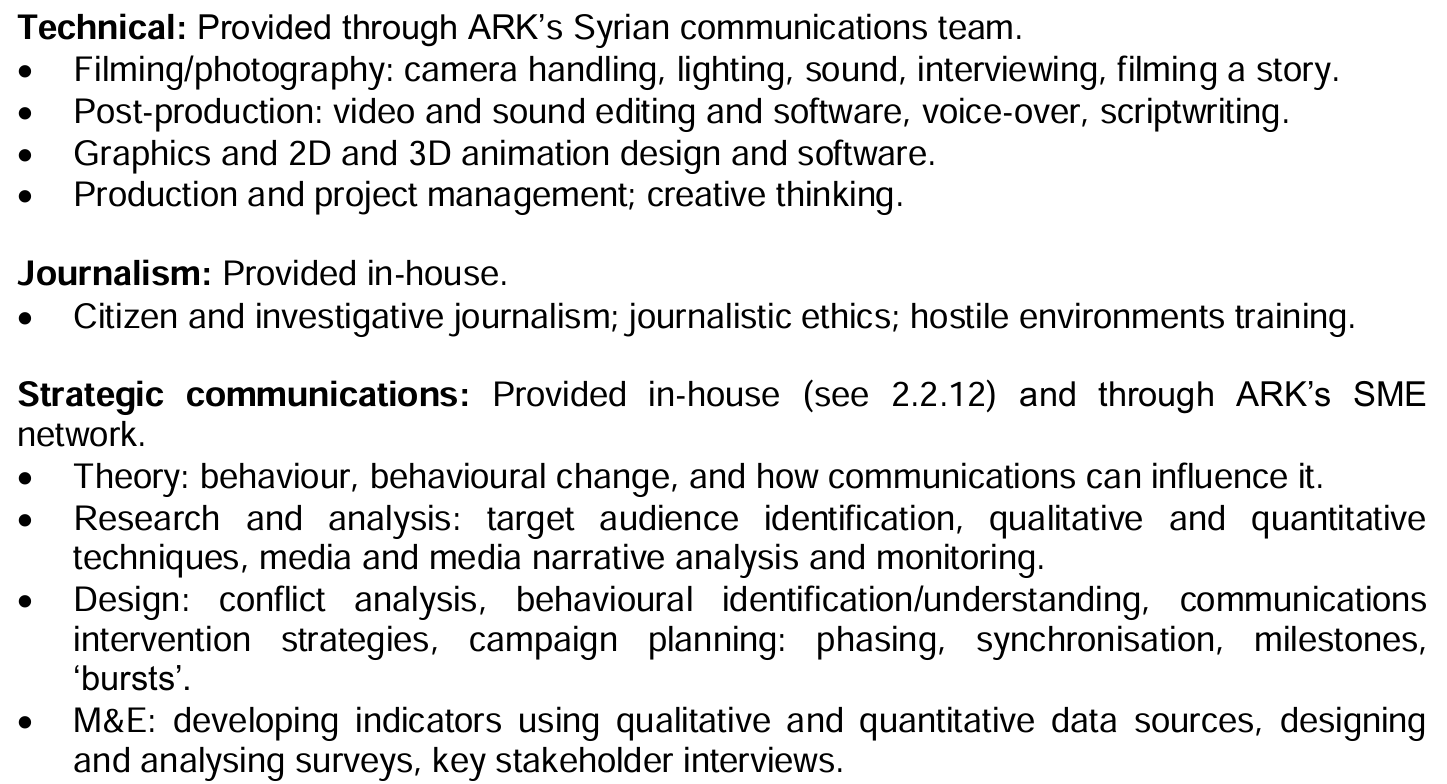
Such was ARK’s intimate proximity with anti-Assad elements, it boasted in leaked submissions to the Foreign Office of being entrusted by Western governments to develop a dedicated Office for Syrian Opposition Support. This entity identified the most promising groups for the proxy war’s sponsors to finance, in turn “[helping] present them to international donors, and provide access to networks that could deliver assistance.” These efforts intensified “as the conflict deepened and it became apparent that regime change would not occur in the short term.”
Tsamota’s primitive official website describes the company as “a security and justice sector consultancy which provides rule of law, forensics and natural resources advisory services,” working in “in politically, legally, socially and logistically challenging environments” for Western governments. The firm is not a compelling candidate for holding government officials anywhere accountable for war crimes. Tsamota has since inception offered guidance to major corporations on how to maximise profits in the Global South, while limiting their local and international legal liabilities.
In 2013, Tsamota director William Wiley gave a scandalous presentation to Canadian consortium MineAfrica Inc. In it, he set out a series of hypothetical scenarios in which mining companies operating in countries such as the Congo and Mali employed private security firms to crack down on striking workers, or deal with “local militias” interfering with their operations. Wiley outlined a number of means by which companies could be insulated from repercussions of heavy-handed responses to such incidents, up to and including murder.
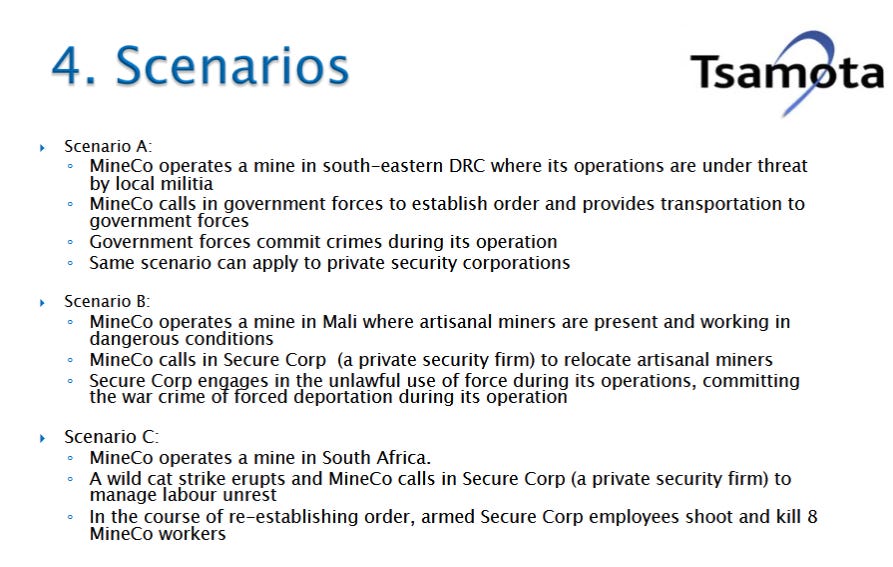
That presentation described Tsamota as composed of “experts” drawn from “national police, military and intelligence forces.” Wiley is no exception, having served in the Canadian military for almost two decades. Subsequently, he turned to international law, among other things overseeing the trial of Saddam Hussein October 2005 – December 2006, for crimes against humanity. Mainstream accounts acknowledge Wiley was imposed on the former Iraqi leader’s defence team without consent – a major breach of basic legal norms – by the US embassy in Baghdad’s Regime Crimes Liaison Office.
After capture, Hussein was initially interrogated by the CIA. Contemporary media reports note there was significant concern within the Agency that “their questioning could become public during his eventual trial,” raising issues around “how to conduct the questioning and record the conversations.” The reasons why were unstated, although a likely explanation was Washington wished to avoid awkward disclosures in court about Hussein’s long-running relationship with the CIA, and active US complicity in many of the most heinous crimes of which he was accused.
To say the least, this was a sensitive role indeed. Even prominent Iraqi supporters of US invasion and occupation charged Baghdad’s “interim” puppet government was seeking “show trials followed by speedy executions” of Hussein et al to boost its credibility. That Wiley was entrusted with this mission speaks volumes about his reliability from the US government’s perspective. It also raises obvious questions about the nature of his relationship with the CIA, and whether that bond influenced CIJA’s creation half a decade later.
‘Moving Documents’
A series of leaked ARK files on CIJA’s activities authored in the years immediately following its creation make grand claims about its achievements. One declares the Commission “innovated in the field of transitional justice… aiding the collection of evidence to document war crimes, crimes against humanity, and other violations of International Humanitarian Law” in Syria. Another states its work represented “a landmark development in international justice: the contemporaneous gathering of evidence of violations of international humanitarian law conducted by regime forces”:
“[CIJA], through expert training, effective equipment provision and a commitment to the truth were able to ensure that when the conflict ends, the raw material of a post-conflict war crimes process is ready for trial, in turn providing a key contribution to truth telling, reconciliation and the future of Syria.”
Elsewhere, ARK boasted how CIJA had seized thousands of kilograms of “contemporaneous documentation”, hundreds of thousands of pages of “evidential material” and thousands of videos from Syria, “all of which had to be hand carried” out of the country. Cut to February 2021, and Commission chair Stephen Rapp, a US diplomatic warhorse, bragged to CBS about the sheer volume of evidence CIJA collected. He claimed the papertrail exposed a systematic strategy of Assad government-directed executions of opposition activists, along with ensuing coverups:
“Now we have 800,000 pages of original documents, signed and sealed with original signatures going all the way up to Assad that document this whole strategy…We see reports back about ‘well, we’ve got a real problem here, there are too many corpses stacking up, somebody’s gonna have to help us with that’… Everything is handled in this sort of totalitarian system where they frankly think they can get away with things… they were almost stupid… they created evidence.”
If such damning, incontrovertible proof was bagged at any stage by CIJA, it has never emerged publicly. Still, throughout the Syrian dirty war, the Commission enjoyed glowing profiles in Western media, while providing journalists and rights groups with multiple scoops supposedly exposing Syrian government atrocities. At no point did any mainstream reporter or NGO question, let alone raise concerns about, the manner in which the Commission garnered the material upon which its cases against government officials in Damascus was “hand carried” out of the country.
CIJA chief Wiley acknowledged in 2014 that his organisation smuggled evidence from Syria by working with every opposition group “up to but excluding Jabhat al-Nusra and Islamic State.” However, a 2019 investigation by The Grayzone amply indicates that CIJA was frequently in extremely close quarters with both groups. Moreover, they were paid handsomely for their assistance in securing documentation. This included material seized in Raqqa after its January 2014 capture by ISIS, right when the ultra-extremist group was massacring Alawites and Christians.
In a 2016 New Yorker profile of CIJA, Wiley detailed the practical hassles and financial drain inherent in “moving documents [over] international borders” and opposition-controlled “checkpoints”, while relying on “rebel groups and couriers for logistical support.” He described how bundles of government files “typically” arrived at the Commission’s offices “in a dizzying array of crappy suitcases.” Wiley lamented, “we burn enormous sums of money moving this stuff.”
Accordingly, CIJA received tens of millions of dollars for its efforts from a variety of Western governments, including those at the forefront of the Syrian dirty war. Despite the vast windfall, the Commission’s work produced zero prosecutions for many years. This changed in late 2019, when Anwar Raslan and Eyad Gharib, two former members of Damascus’ General Intelligence Directorate, were indicted in Germany for crimes against humanity.
‘Many Contradictions’
Raslan headed the Directorate’s domestic security unit, while Gharib was one of his departmental subordinates. The pair defected to the opposition in December 2012. Raslan and his family fled to Jordan, where he played “an active and visible role in the Syrian opposition.” He was part of the anti-Assad delegation at the Geneva II conference on Syria in January 2014, and in July that year, was granted asylum in Germany.
After his escape from Syria, Raslan told numerous lurid tales of abuse and atrocities perpetrated by his unit, and the Assad government more widely, during his 20 years of state service. He claimed his defection was spurred after learning an apparent opposition attack in Damascus that he was charged with investigating was, in fact, staged by security forces. Significant doubts about his accounts, and whether his defection was principled or just cynical opportunism, have been raised in many quarters.
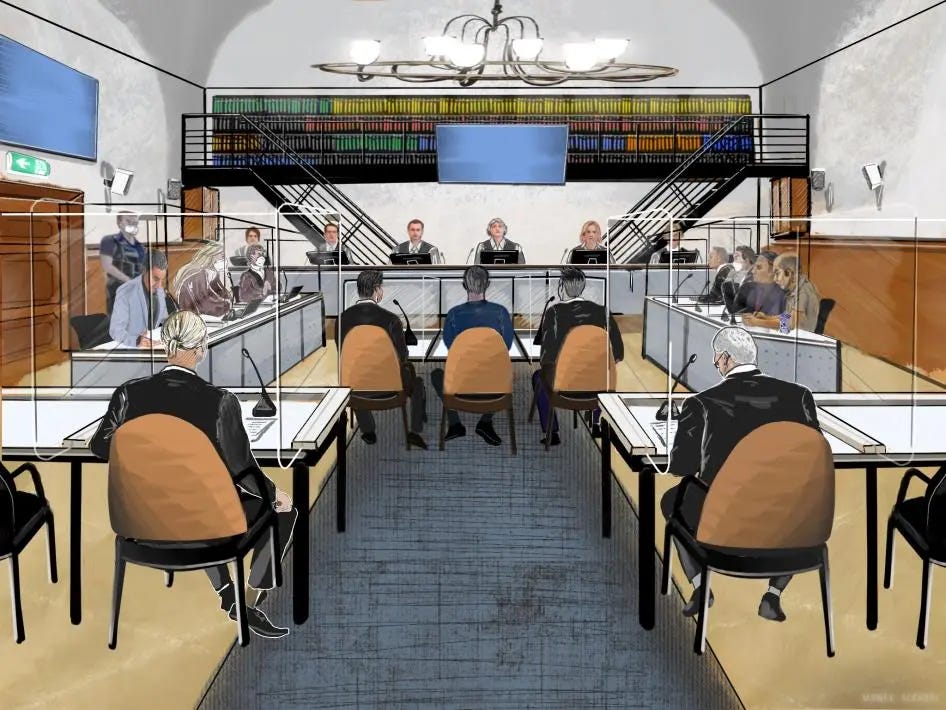
Artist’s rendition of Raslan’s trial
In a perverse irony, Raslan’s loudmouth propensity was his undoing. His assorted claims post-defection provided grounds for arrest by German authorities, and were used against him and Gharib in their prosecutions. These legal actions heavily relied on documents seized by CIJA, including Central Crisis Management Cell records. This unit was created in March 2011 by Damascus, to manage responses to mass rioting that erupted this month. These documents have been widely described as the “linchpin” of the Commission’s case against “the Syrian regime.”
Yet, as this journalist has previously exposed, the Central Crisis Management Cell files in fact show the Assad government explicitly and repeatedly instructed security forces to protect protesters, prevent violence, and keep the situation under control. The documents also detail how from inception, many “peaceful” demonstrators were extremely violent, while opposition fighters systematically murdered security service operatives, pro-government figures, and demonstrators to foment catastrophe, in a manner eerily similar to many CIA/MI6 regime change operations old and new.
In February 2021, Gharib was found guilty of aiding and abetting crimes against humanity. He received four-and-a-half years in prison. A year later, Raslan was given life for crimes including mass torture, rape, and murder. The pair were not convicted for personally perpetrating these horrors, but serving in the General Intelligence Directorate at the time they were allegedly committed. “Expert” witness evidence provided at their trials left much to be desired.
For example, judges and prosecutors alike expressed disquiet at “many contradictions” in the testimony of “P3”, a Syrian government operative who purportedly worked in a security service “mail department”, and was central to Gharib’s conviction. P3 professed to seeing sensitive documents “related to the transfer of corpses” of opposition activists “to burial sites.” They “provided contradictory information” in statements to German police and the court, and were “visibly nervous” while testifying. Throughout, their seemingly aghast attorney sat nearby “putting his hands behind his head.”
Meanwhile, during Raslan’s prosecution, “P4” – a nameless individual who claimed to have been detained in a Syrian prison, and bribed his way out – testified he saw 500,000 corpses buried via a “bulldozer and a truck” next to his house, in an area which was previously “a desert”. Reports of the trial indicate there “was a feeling” among those present in court, including “the public”, that these numbers were greatly “exaggerated.”
The sense that Gharib and Raslan were prosecuted because they were within easy reach, and CIJA needed something to show for all its well-remunerated efforts, is ineluctable. The Commission had strong grounds to be anxious about failing to fulfill its founding objective. In March 2020, the European Anti-Fraud Office (OLAF) formally accused the organization of “submission of false documents, irregular invoicing, and profiteering” relating to an EU “Rule of Law” project it ran in Syria.
Fast forward to today, and The Guardian reports that “the abrupt implosion of the infrastructure of state terror” in Syria “has made available a huge volume of evidence.” The outlet quoted CIJA chief William Wiley at some length. He compared Assad’s fall to “a situation much like Germany in 1945 or Iraq in 2003,” with “a sudden availability of all state records” making prosecution of state officials a fait accompli:
“It’s a very unusual situation, and its suddenness creates challenges and opportunities in simply dealing with the material… If there’s any security intelligence guy that rocks up in Europe, there’s typically going to be enough material already to hand.”
State Department to Shut Down Controversial Censorship Hub but Critics May Call It a Rebrand
By Didi Rankovic | Reclaim The Net | December 12, 2024
The US State Department looks set to shut down the Global Engagement Center (GEC), which has for a long time faced accusations of deviating from its stated role abroad, and instead engaging in, and facilitating censorship at home.
This has been revealed in a filing in the Daily Wire v. US Department of State case, in which the latter informed the court that members of Congress were told last Friday about the upcoming move.
However, even though GEC as such is “substantially likely” to cease operations on December 24, the idea seems to be a simple reshuffle – as both the funding and the staff would continue their work in other State Department offices and bureaus.
According to a spokesperson, this development is the result of the National Defense Authorization Act (NDAA) not providing for an extension of GEC. And now the State Department is “hopeful that Congress extends this important mandate through other means before the December 24 termination date,” said the spokesperson.
That mandate, on paper, is supposed to be directing, leading, and coordinating the US government’s “countering of foreign propaganda and disinformation” – in foreign countries. And the State Department continues to maintain that this is in fact the role of GEC and that it is critically important for that work to continue.
But critics say that the office, which was created in 2016, in reality, represents a central component of partisan censorship targeting Americans – particularly conservative and “disfavored” voices.
As evidence of this kept mounting, Republican members of the House of Representatives first investigated the activities of this office, particularly the way it was handing out grants (the suspicion is that GEC “delegated” censorship to third parties in order not to openly violate the Constitution).
Now, House Republicans have decided not to approve the planned 8-year extension of GEC. One of those controversial grants, worth $100,000, went to the Global Disinformation Index – a UK-based group accused of compiling a list of conservative media that advertisers were supposed to boycott and thus deprive of revenue.
But even if GEC will no longer exist as such, the intent is clearly to reassign employees and keep funding their work. What that work will actually be going forward, should depend on the incoming administration’s new State Department.
Iran rejects latest E3 allegations about its peaceful nuclear program
Press TV – December 11, 2024
Iran has rejected the latest allegations about its peaceful nuclear program by three European countries, saying it will give an appropriate response to any confrontational move.
Iranian Foreign Ministry spokesman Esmaeil Baghaei made the remarks on Tuesday while responding to a joint statement by France, Germany, and the UK that accused Iran of failing to honor its commitments under the 2015 nuclear deal and UNSC Resolution 2231, urging Iran to halt what they termed as “nuclear escalation.”
The European statement came after a report by the UN nuclear watchdog indicating that Tehran had stepped up uranium enrichment activity, fulfilling its pledge to respond to a Western-sponsored censure resolution criticizing the country for what was described as a lack of cooperation with the International Atomic Energy Agency (IAEA).
Iran has reduced its commitments under the JCPOA over the past years following the re-imposition of sanctions lifted under the accord and the failure of European parties to compensate for the losses incurred by Iran.
Baghaei said the recent decision of the Iranian government was to activate more advanced centrifuges, within the framework of specific rights given under the Non-Proliferation Treaty (NPT) and with due notification and under the supervision of the IAEA.
“As a responsible member of the IAEA, the Islamic Republic of Iran has proven its commitment to cooperation with this institution, and the understandings reached during the visit of the Director General of the International Atomic Energy Agency to Tehran on 14-15 November,” he said.
The spokesman added that “it is regrettable that the three European countries, regardless of the achievements of the Director General’s visit, which could have been a basis for strengthening cooperation in the future, insisted on their unconstructive approach and proceeded to pass a resolution against Iran.”
Referring to a November 29 meeting with representatives of the three European countries in Geneva, Baghaei stated that the Islamic Republic of Iran continues to believe in constructive interaction based on mutual respect.
“At the same time, the Islamic Republic of Iran will respond to any confrontational and illegal behavior within the framework of its legal rights and in an appropriate manner,” he stated.
Baghaei noted that the root cause of the situation stems from the US withdrawal from the deal and the failure of the E3 to fulfill their commitments.
He emphasized the importance of mutual adherence to the path of constructive interaction and advised the three European countries to address the root cause and reason for the current situation, which is a combination of continuous breach of commitment and the illegal policy of pressure and sanctions against the Iranian nation.
Earlier, Iran’s UN envoy, Amir-Saeid Iravani rejected Western allegations of non-compliance with its JCPOA commitments as “disingenuous and hypocritical.”
He called on the European parties to the 2015 nuclear accord to abandon their campaign of pressure against Iran and make real efforts to revive the deal.
He made the call in a letter addressed to the UN Security Council and UN chief Antonio Guterres.
Kiev reveals terms of $20 billion US loan
RT | December 9, 2024
The Ukrainian government has approved the terms of a conditional agreement with the US Federal Financing Bank (FFB) for a 40-year loan of $20 billion which will be backed by profits from frozen Russian state assets.
It’s part of a broader $50 billion G7 loan deal, which includes a separate $20 billion EU commitment, and $10 billion to be split by G7 members Britain, Japan and Canada.
The money will be transferred to the Facilitation of Resources to Invest in Strengthening Ukraine Financial Intermediary Fund, established by the World Bank on October 10, “for the sake of the state,” a resolution issued by Ukraine’s Cabinet of Ministers on Friday stated.
The transfer will be based on a Certificate Purchase Agreement between Ukraine, the FFB, and the US Agency for International Development (USAID), along with a loan guarantee and repayment agreement between Ukraine and USAID.
Under the deal, Ukraine’s Finance Ministry will issue a certificate of indebtedness to the FFB, guaranteed by USAID, the government resolution said.
The loan, which has an annual interest rate of 1.3% plus the current average rate for one-year US Treasury bills, will be repaid using interest earned from immobilized Russian sovereign assets.
The US and its allies froze an estimated $300 billion in assets belonging to the Russian central bank following the escalation of the Ukraine conflict in February 2022. In June, G7 members pledged a $50 billion loan for Kiev, with the frozen Russian assets to be used as collateral, to help Kiev buy weapons and rebuild damaged infrastructure. The agreement was finalized in October.
Moscow has repeatedly denounced the asset freeze as “theft” and argued that tapping into these funds would be illegal and set a dangerous precedent. The Russian Finance Ministry has warned that it will initiate retaliatory measures mirroring the West’s actions against resources of Western investors held in the country.
The latest move is part of the current US administration’s last-minute strategy to bolster Kiev’s war effort, which includes a new $725 million military aid package to Kiev and another round of sanctions against Russia. It comes as uncertainty grows over Washington’s commitments under the upcoming presidency of Donald Trump, particularly after US House Speaker Mike Johnson dismissed President Joe Biden’s request to include $24 billion in additional aid to Ukraine in a government funding bill last week.
An Open Letter From A UK Doctor To Muslim Scholars Advising On Covid Vaccines
A Better Way with Dr Tess Lawrie | December 8, 2024
Following my call recent for religious leaders to reflect on their response to the experimental COVID-19 vaccine rollout, I am grateful to share Dr Ayiesha Malik’s open letter to Muslim Scholars. Dr Malik is one of the founders of Doctors for Patients UK, an organisation for ethical doctors based in the UK.
Dr Malik’s Note:
I have been a medical doctor for nearly 20 years. I graduated from the University of Birmingham in 2005 and as a GP in 2014. I am an NHS GP and have my own private clinic.
I am a practising Muslim and am advising here in my personal capacity.
بسم الله الرحمن الرحیم “In the name of God, the Merciful, the Compassionate.”
Objective
I am submitting my views and research on Covid vaccines for consideration by respected scholars because many believe there is a consensus amongst Muslim doctors that the vaccine is safe and effective and, therefore, to be recommended to Muslim patients. There is no such consensus. I don’t believe the covid vaccines to be safe and effective, but unsafe and ineffective.
Doctors and scientists internationally are raising concerns about the harms they are seeing following vaccination, including “turbo” cancers and heart conditions. The rates of advanced cancer, strokes and heart disease are rising and the Covid-19 vaccine is not even being considered as a possible cause. Vaccine harms need to be investigated.
Action
I call for its rollout to be immediately suspended. I call on Muslim scholars to abstain from recommending the Muslim community “get vaccinated” as an Islamic duty and a commendable action to protect themselves and their communities.
Need For Muslim Doctors To Do Independent Research
The Shariah (Islamic law) recommends that Muslims consult a God-fearing doctor for advice about their medical treatment. This is because Muslim doctors will advise the patient from a place of taqwa (sincerity to God), wanting the best outcome for the patient, regardless of facing any backlash for their advice.
UK doctors were warned that they could face disciplinary action if they criticised the Government guidelines on Covid-19 measures and vaccines. (1) It’s important for scholars to be aware of this because doctors are not safely able to raise concerns and have open discussions but are expected to conform to current guidance.
To sincerely give medical advice requires an open mind, research beyond the medical school curriculum, accurate knowledge about the illness, conflicts of interest and possible safe alternatives. I am concerned that advice and guidance are being issued with a lack of awareness as to the larger relevant issues, as stated in this principle:
حكم الشيء فرع عن تصوره
“Judging something is based on understanding it.”
This means that making a correct or accurate judgment about something depends on having a clear and comprehensive understanding. If the thing is not properly understood, the judgment about it is likely to be incomplete or incorrect.
Criminal Record of Pharmaceutical Manufacturers of Vaccines
Pfizer has been charged with fraud and criminal liability, for which they have been ordered to pay billions of dollars (2), yet they continue to manufacture vaccines that are recommended to the Muslim community and beyond.
Censorship
Many doctors follow government guidelines and cannot state a concern without threats from the GMC and being accused of spreading misinformation. GP Dr Sam White lost his medical license for raising his concerns about the harms mRNA vaccines, lockdowns and masks. (3). Other doctors have been reported to the GMC for raising similar concerns.
Islam allows for debate and discussion- but unfortunately, it’s difficult to have conversations and debate with fellow doctors about these issues.
This lack of opportunity to discuss and debate vaccine concerns means that only one viewpoint is being heard, by Islamic scholars, doctors and patients.
Lack Of Support For Vaccine-Injured Patients
Patients who raise concerns are gaslighted and left without support. One example is Mr Adam Rowland, father of 4, who was a fit and well physiotherapist and has been left unable to work or function since his 2nd Astra Zeneca vaccine due to experiencing medical issues, including myocarditis and neuropathy (4)
UKCVFamily, a UK charity has been set up by the vaccine-injured to help support those injured. They have supported over 2000 UK residents. (5) They have sadly, experienced gaslighting, a lack of acknowledgement of their condition and little medical or financial support.
Over 16,000 people applied to the Covid vaccine scheme (6), with very strict eligibility and therefore, the majority of these claims are refused. The number of applicants is the tip of the iceberg but again highlights the vaccine has caused harm to many.
What will happen to Muslim patients who suffer side effects, from a Covid vaccine? Who will accept responsibility for this harm? Or will they be abandoned, like others have?
Mohamed Hijab, a prominent Muslim speaker, was hospitalised after he suffered a pulmonary embolism, a life-threatening clot of his lung 10 days after his first Pfizer vaccine, which he regretted having. Despite this, he was still being invited for further vaccines. (7)
The Risk of Covid-19 Was Exaggerated
To increase compliance with lockdowns and the uptake of Covid-19 vaccines, government messaging aimed to “frighten the pants off everyone (8)
Side effects from the vaccines are not openly addressed. This was the case from the very beginning and in the early trials, the voice of patients who were harmed was censored from the internet.
One such case is that of Maddie De Gray, a 12 year old who was left wheelchair-bound with a nasogastric tube following the Pfizer vaccine (9). Her symptoms were misleadingly recorded in the trial data as “abdominal pain”.
A whistleblower from the initial Pfizer trials raised many concerns about the trials, including the lack of timely follow-up of patients who experienced adverse events (10).
There Is no Long-Term Safety Data For COVID-19 Vaccines
Covid-19 vaccines are being promoted as safe, effective and necessary without long-term data, even to groups such as pregnant women, breastfeeding women and children.
Lack Of Safety Data To Recommend To Pregnant Women
In the 1950s, a drug called thalidomide was promoted to women for morning sickness without any long-term data. Thousands of women suffered miscarriages, and babies were born blind and without limbs and the drug was subsequently withdrawn. (11) This scandal is taught to doctors during training, and a great deal of caution is urged when prescribing medications to pregnant women.
Pregnant women are taught to be very careful in terms of what they consume. They are advised to reduce caffeine intake and not take unnecessary medications for the first 12 weeks in particular, as the fetus’s organs are developing in this delicate time.
Concerningly, a new mRNA vaccine was recommended for pregnant women by the government and the medical profession, with no long-term safety data. It continues to be promoted to pregnant women, although will be withdrawn from July 2025 after 4 years of the rollout. (12)
A US obstetrician Dr James Thorpe raised concerns about vaccinating pregnant women and published a paper highlighting an increase in adverse events in vaccinated mothers, including development disorders and fetal deaths. (13)
I also wrote a rapid response in the BMJ, highlighting my concerns about this group of women being vaccinated. (14).
Concerns About “Turbo” Cancer
Professor Angus Dalgliesh, a professor of Oncology at St George’s, London, has been raising concerns about the link between Covid vaccines and “turbo” cancer in his patients. (15) “Turbo” cancer refers to cancer that is presenting in advanced and alarming stages.
Consultant Surgeon Mr James Royle has also raised concerns about turbo cancers and thrombosis in his Covid-vaccinated patients. (16)
Concerns About Myocarditis and Heart Attacks
Consultant Cardiologists Dr Aseem Malhotra and Dr Dean Patterson have both been raising concerns about the rates of myocarditis and myocardial infarction following Covid vaccination. (17)(18)(19)
I joined other UK doctors who were also concerned about about the harms of Covid vaccines and together we formed, Doctor for Patients UK. (20)
Safe Treatment For Covid-19
Doctors have been treating covid safely using ivermectin, blackseed oil, vitamin C and D, along other supplements with good results. Dr Tess Lawrie has raised awareness about the effectiveness of treatment such as ivermectin and treatment protocols can be found on the World Council For Health website. (21)
International Concerns By Doctors And Scientists
There are many doctors and scientists internationally raising concerns about vaccine harms, but we have no voice in the mainstream, due to censorship.
US cardiologist Dr Peter McCullough called for an immediate withdrawal of these products in a speech made in the EU Parliament on 13 September 2023. (22)
Over 64 000 people worldwide have joined me in calling for the suspension of the covid vaccine and an investigation into the roll-out, by signing The Hope Accord. (23)
Vaccinating To Prevent Transmission
There is no evidence that vaccines prevent transmission to another individual, as this was not studied in the early trials. Pfizer admitted they had not studied transmission in the early trials to the EU Parliament and they had “lied” about this previously. (24) Recommendations to get vaccinated cannot be made to prevent spread and protect the vulnerable.
Further Issues Needing Research
I have summarised some of my concerns about the Covid-19 vaccines. There are still many issues that need to be discussed, including the DNA plasmids and the ingredients of these genetic injections.
Concluding Remarks
Islamically, medication is merely mubah (permissible). This is when a patient is suffering from an illness. In the case of prophylaxis, to prevent illness the ruling for intervention is even less.
I believe the Covid-19 vaccinations should be suspended and the harms investigated. I do not support Muslim organisations or scholars making blanket recommendations for every Muslim to get vaccinated.
Instead, patients should seek the advice of a local God-fearing Muslim doctor, who has independently researched any benefits and harms of the vaccines beyond Government recommendations.
I hope this helps provide insight into deeper issues that need to be considered when issuing guidelines for Muslim doctors and the community about COVID-19 vaccinations and beyond.
And Allah Almighty knows best.
Dr Ayiesha Malik, MBChB, MRCGP (2014)
Website: https://www.drayieshamalik.com/
UK: Student’s Suspension Over Gender-Critical Views Sparks Campus Free Speech Uproar
By Ben Squires | Reclaim The Net | December 6, 2024
A third-year student at the University of Leeds has found herself at the center of a free speech controversy after being suspended from her role at the university’s student radio station. Connie Shaw, who studies philosophy, ethics, and religion, has drawn attention from campaigners advocating for free expression, who claim her removal is rooted in her views critical of modern gender ideology.
According to The Telegraph, the dispute arose following a complaint to Leeds Student Radio (LSR), where Shaw held the position of head of daytime radio. She oversaw popular programs such as Woman’s Hour and LGBTQ+ Hour. According to the Free Speech Union (FSU), the student union accused the 20-year-old of breaching its code of conduct, alleging she had failed in her “duty of care” and damaged the university’s reputation.
The situation escalated when Shaw received a suspension notice in October. The union cited her social media activity as a central concern but withheld specifics until a meeting on November 6. During this meeting, Shaw learned that the complaint stemmed from a blog post she published on Substack the previous month. The post was hosted by Graham Linehan, a writer known for his outspoken views that are critical of modern gender ideology. In the piece, Shaw critiqued Leeds University’s gender policies, including a fund that provides financial support for trans students to purchase items such as chest binders and makeup.
The blog also scrutinized a feminist philosophy essay question Shaw encountered during her studies, which asked whether subordination is essential to being a woman. Describing the question as problematic, she argued it implied that systemic oppression defines womanhood. Additionally, Shaw’s podcast, linked in the post, featured interviews with both Linehan and Charlie Bentley-Astor, a notable detransitioner. These interviews, recorded at the Battle of Ideas festival in London, were cited as contributing factors in the complaint.
In late November, the Leeds University Union (LUU) determined that Shaw’s actions had brought the station into disrepute, resulting in her suspension from the LSR committee. To regain her position, she was reportedly instructed to issue a written apology and complete an e-learning course.
The FSU, acting on Shaw’s behalf, has challenged the union’s decision, alleging it constitutes direct discrimination under the Equality Act 2010, which protects gender-critical beliefs. Toby Young, FSU’s general secretary, criticized the investigation’s process, describing it as flawed and biased. “The natural inference from their approach was that Shaw’s beliefs alone were sufficient to tarnish the station’s reputation,” he said.
Young further denounced what he called “hostile questioning” during the inquiry, including being asked how she could foster inclusivity at LSR when her views might discomfort others. He argued that the complaints against her were exaggerated and lacked concrete detail.
Shaw herself expressed frustration at the outcome, pointing to what she views as hypocrisy. “It is ironic that LSR promoted a freedom of speech event – the Battle of Ideas – only for me to face repercussions for interviews conducted there and for exercising my legal right to free speech,” she said.
The controversy has sparked a broader conversation about freedom of expression on university campuses. The FSU has vowed to support Shaw through an appeal process and potential legal claims, calling for the investigation to be overturned. Meanwhile, the LUU has maintained its commitment to inclusivity but has declined further comments due to the ongoing appeal.
This case highlights the tension between fostering an inclusive environment and protecting individuals’ rights to express contentious views, raising critical questions about the boundaries of free speech in academic settings.
Iran slams UK foreign secretary’s ‘deceptive, divisive’ remarks
Press TV – December 7, 2024
Iran has rejected “deceptive and divisive” remarks by British Foreign Secretary David Lammy against the Islamic Republic, saying the UK tops the list of countries stoking insecurity in the world.
Addressing a NATO meeting in Brussels on Wednesday, Lammy said the world was “living in dangerous times”, but then pointed the finger at Iran for the tremendous aggression that West Asia is going through.
“Whilst we acknowledge the British foreign secretary’s remarks that the world is currently in a fairly dangerous period and is plagued with wars, the question is which actors have a fundamental role in the creation of this situation,” Director General of the Western Europe Department at the Iranian Ministry of Foreign Affairs Majid Nili Ahmadabadi stated late Friday.
“Without a doubt, Britain, with its long history of interfering in the internal affairs of other countries and illegal interference in the West Asian region, especially through arming and financing the only occupation and apartheid regime in the world (Israel), is at the top of the list of those accused of insecurity and instability in the world,” he added.
Nili Ahmadabadi categorically refuted Lammy’s accusation of Iran’s involvement in the military conflict between Russia and Ukraine, urging Britain to stop shifting blame onto others for the existing crises in Europe.
He said the current problems in Europe are the result of the “arrogant and expansionist policies of Britain and some of its allies” toward other countries, advising British authorities to adopt a “realistic approach and play a constructive and helpful role in international developments”.
He also dismissed the British foreign secretary’s claims about Iran’s civilian nuclear program and its missile capabilities, labeling them as baseless and interventionist.
The Iranian diplomat asserted that repetition of such unsubstantiated claims will not give them credibility.
Syrian Women Exploited in MI6 Propaganda Ops
By Kit Klarenberg | Global Delinquents | December 5, 2024
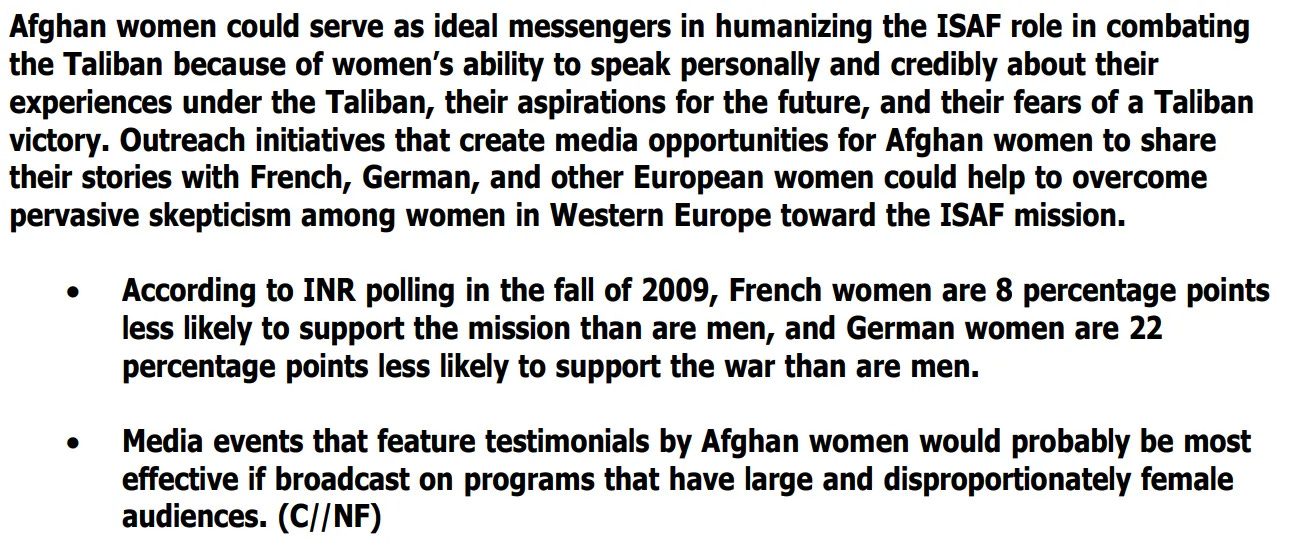
The propaganda value of women in conflicts has long-been cynically exploited by Western intelligence services. A leaked CIA memorandum from March 2010 on covert means of increasing flagging support for NATO’s Afghanistan mission noted women “could serve as ideal messengers” in “humanizing” the military occupation. This was due to their “ability to speak personally and credibly about their experiences under the Taliban, their aspirations for the future, and their fears of a Taliban victory”:
“Outreach initiatives that create media opportunities for Afghan women to share their stories… could help to overcome pervasive skepticism among women in Western Europe toward the mission. Media events that feature testimonials by Afghan women would probably be most effective if broadcast on programs that have large and disproportionately female audiences.”
Throughout the US occupation of course, Afghanistan remained one of the worst countries in the world to be a woman, by some margin. Roughly a year after that CIA memo was authored, Gay Girl in Damascus, a blog purportedly written by Syrian-American lesbian Amina Arraf, garnered significant mainstream attention. Widely hailed for her “fearless” and “inspiring” eyewitness reporting, she was lauded as a symbol of the “progressive” revolution erupting in the country.
In June 2011, Amina’s cousin announced on the blog Amina had been kidnapped by three armed men in the Syrian capital. In response, numerous Facebook pages were set up calling for Amina’s release and ‘liked’ by tens of thousands, #FreeAmina trended widely on Twitter, journalists and rights groups begged Western governments to demand her release, and the US State Department announced it was investigating Amina’s disappearance.
Six days later, it was revealed ‘Amina’ was in fact Tom MacMaster, a middle-aged American man living in Scotland, who had penned extensive lesbian literotica fantasies under that alter ego. While corporate news outlets quickly forgot all about the hoax they’d so comprehensively fallen for, their appetite for dubious human interest stories emanating from the crisis wasn’t diminished.
‘Huge Global Coverage’
In July 2019, an image of two young Syrian girls trapped in rubble in opposition-occupied Idlib attempting to haul their sister to safety as she dangled off the precipice of a dilapidated building, their father looking on in horror above, spread far and wide on social media.
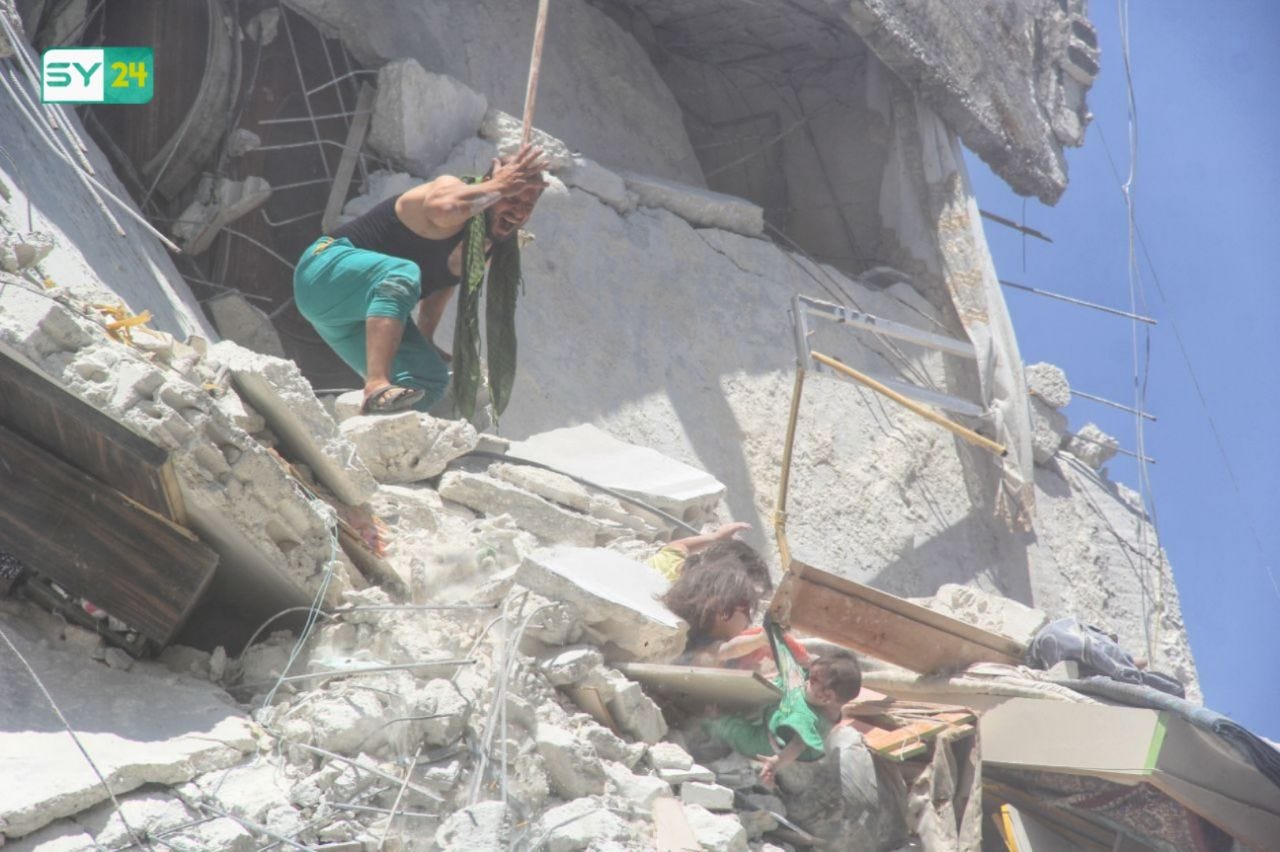
The photo, snapped by a photographer for Syrian news service SY24, went viral the world over. Unbeknownst to viewers though, SY24 was created and funded by Global Strategy Network, a prominent British intelligence cutout founded by Richard Barrett, former MI6 counter-terrorism director. In leaked submissions to the British Foreign Office, Global Strategy boasted of how its propaganda “campaigns” broadcast via SY24 generated “huge global coverage,” having been seen by “many hundreds of millions of people,” and “attracting comment as far as the UN Security Council.”
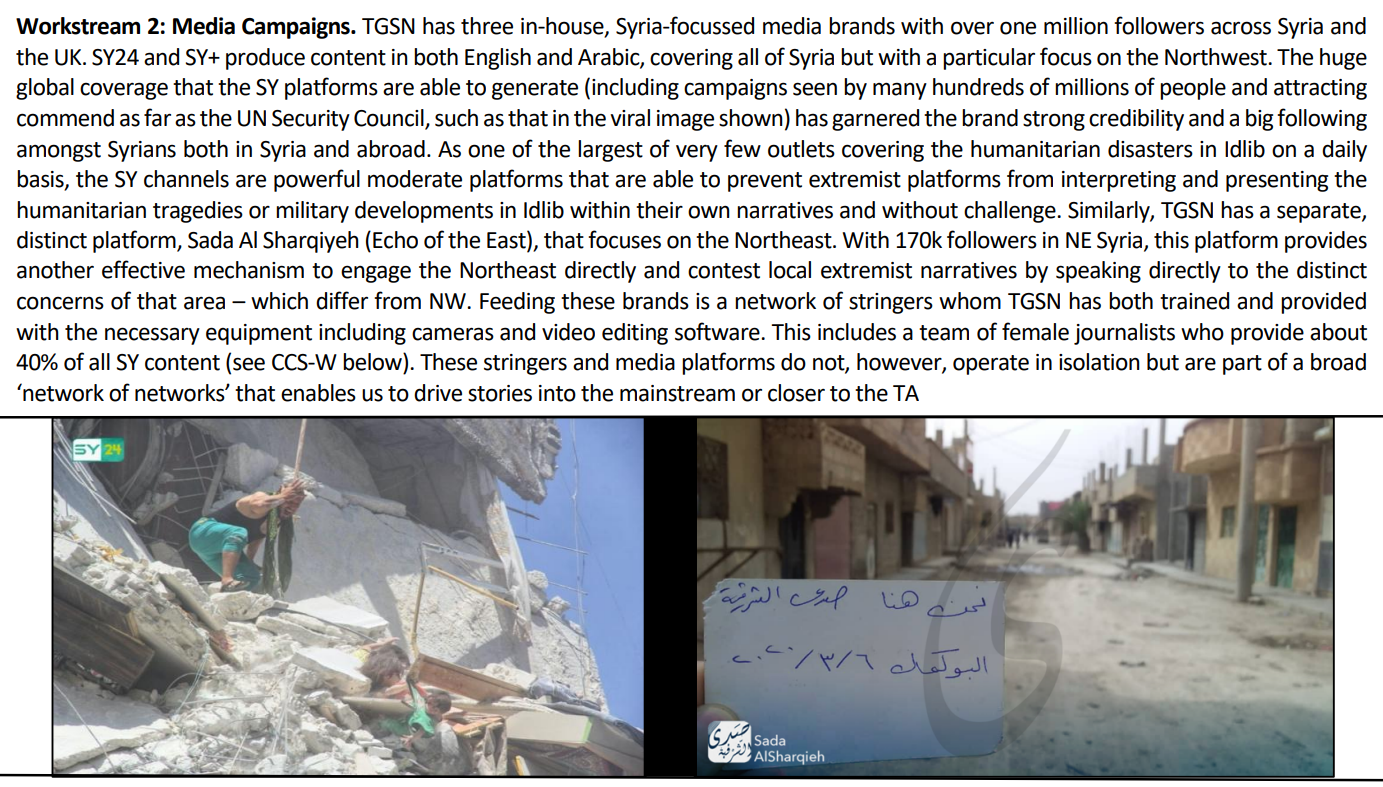
SY24 content was produced by a network of ‘stringers’ in Syria that Global Strategy trained and provided with equipment, including “cameras and video editing software.” The firm drew particular attention to a team of female journalists it had tutored, “who provide about 40 percent of all SY content,” and were part of “a broad ‘network of networks’” enabling the company “to drive stories into the mainstream.”
Global Strategy also established a dedicated centre for training female journalists to produce content for SY24 in Idlib, “accessing stories that male journalists cannot,” which were then shared on social media. It boasted that almost half of SY24’s followers were women, “a remarkably high ratio for Syria-focused platforms.”
Carefully cultivating an entirely misleading image of an inclusive, credible ‘moderate’ Syrian opposition was of paramount importance to British inelligence. It helped whitewash the barbarous nature of the various ‘rebel’ factions London was backing in the region, while simultaneously engendering support among Western citizens for regime change.
In order to engage the “international community” to this end, Global Strategy, in conjunction with ARK – a shadowy “conflict transformation and stabilization consultancy” headed by veteran MI6 officer Alistair Harris – planned “communication surges” around “key dates” such as International Women’s Day.
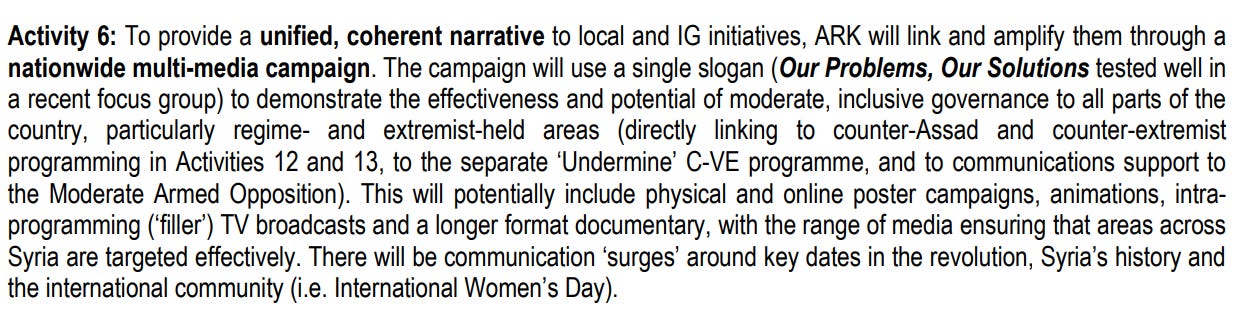
In a particularly elaborate example of such a “surge”, the pair collaborated on “Back to School”, a campaign in which young Syrians returned to education. Idlib City Council, opposition commanders, and other elements on the ground concurrently engaged in a “unified” communications blitz, using “shared slogans, hashtags and branding.” Rebel fighters were sent to “clear roads” and “enable children and teachers to get to schools,” all the while filmed by the pair’s voluminous local journalist network, footage of which was then “disseminated online and on broadcast channels.”
Ensuring “female teachers” received sizeable coverage in the Western media was a key objective of the campaign. Furthermore, in many leaked files, ARK boasted of the huge network of journalists it had trained and funded in Syria, who would cover such PR stunts, secretly orchestrated by the organisation. Their reports in turn fed to the firm’s “well-established contacts” at major news outlets including Al Jazeera, BBC, CNN, The Guardian, New York Times, and Reuters, “further amplifying their effect.”
‘Thrust by Tragedy’
Other documents make clear ARK well-understood the immense difficulties of promoting the role of women internally and externally during the crisis. One file on “[incorporating] the role of women in the moderate opposition” notes Syrian women in rebel-occupied areas faced “an almost overwhelming variety of problems,” and “the space for women to participate in public life has contracted significantly as the conflict has progressed.”
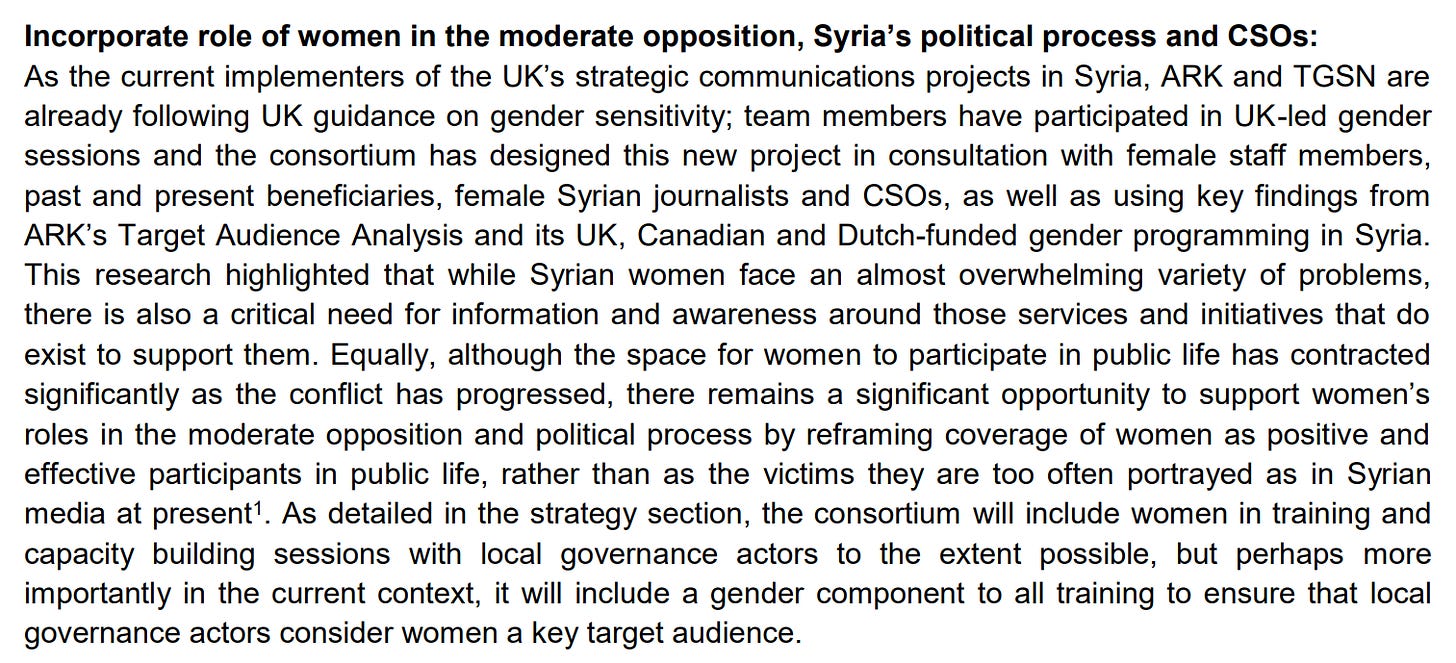
As a result, ARK was “extremely aware of the risks of promoting women’s participation beyond currently accepted social norms… given the potential to hinder message resonance or result in a backlash against female participation.” It therefore proposed to “subtly reframe the narrative of women… increasing the amount of coverage of their initiatives and opinions as the context allows.”
One means of “subtle reframing” was Moubader (which translates to “person who takes initiative”), a media asset created by ARK in 2015, comprising a “high-quality hard copy monthly magazine with widespread distribution across opposition-held areas of Syria,” with a website and Facebook page boasting almost 200,000 likes. Moubader was established by ARK to achieve “behavioural change” in readers. “Given the importance of broadcast television as a trusted source” in Syria, ARK also sought British intelligence funding to develop a Moubader TV programme, to “leverage stories and values to maximum effect and reach an even wider audience.”
Documents submitted to the Foreign Office by another intelligence cutout, Albany, similarly noted women’s access to education, healthcare, and economic opportunity had “been debilitated” during the crisis, which issues such as early marriage, child military recruitment, and “transactional sex” exacerbated. The UN defines the latter as “non-commercial sexual relationships motivated by an implicit assumption that sex will be exchanged for material support or other benefits.”
Still, Albany considered so many Syrian women having been “thrust by tragedy into head of household and breadwinner positions” over the course of the crisis as a golden opportunity to propagandize them and, in turn, their families, while promoting the ‘inclusive’ nature of the opposition, by creating and partnering with female civil society organizations and journalists.
ARK likewise believed women to be a “critical audience”, given the number of Syrian households with female heads –“up to 70 percent”. So, the organisation sought to ensure they were well-represented in all its domestic and international “broadcast products”, as well as on social media.
‘Female Participation’
Unsurprisingly, the files do not acknowledge the increasingly hostile environment for women in Syria directly resulted from foreign efforts to destabilise and depose its government. ISIS and al-Nusra were and remain rightly notorious for their monstrous treatment of women in the areas they occupied, which included widespread rape, sexual violence and abduction.
However, many armed opposition groups backed by Britain and other foreign powers imposed stringent restrictions on women in the areas they occupied, requiring them to wear hijabs and abayas, doling out extreme punishments for failing to comply, imposing discriminatory measures prohibiting them from moving freely, working, attending school, and more.
There are indications British intelligence was in close quarters with such activities. For instance, in December 2017 BBC documentary Jihadis You Pay For alleged Foreign Office cash distributed on its behalf via contrator Adam Smith International in Syria ended up in the pockets of Free Syrian Police (FSP) officers who not only stood by while women were stoned to death, but closed surrounding roads to facilitate their murder.
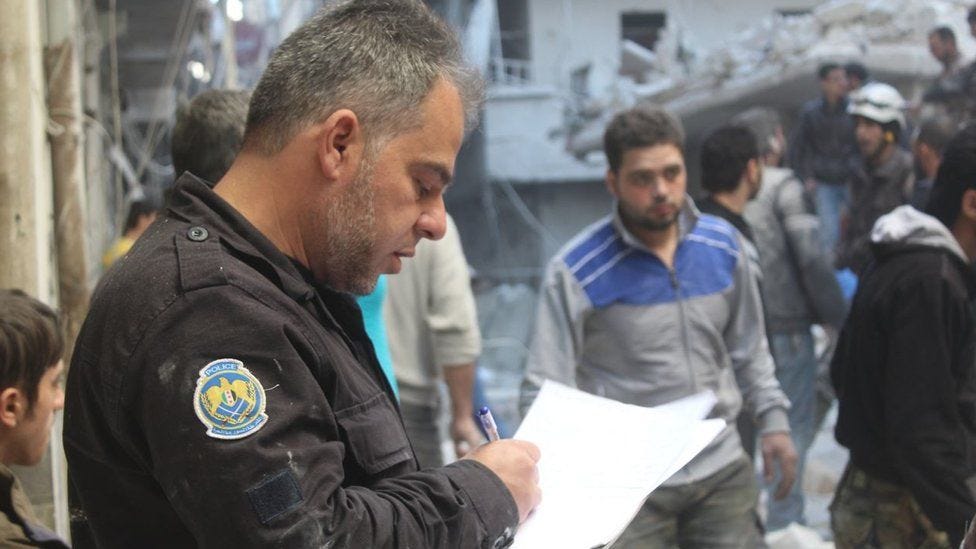
The ‘Free Syria Police’ at work
FSP, an unarmed shadow civilian police force operating in opposition-controlled areas, was created, funded and trained under the auspices of the British intelligence-funded Access to Justice and Community Security (AJACS) program. In a perverse irony, leaked Adam Smith International files relating to the project indicate it too sought to exploit women for propaganda purposes, applying a gender policy “to encourage female participation in justice and policing.” The company boasted of how, of the 1,868 police officers it trained under the scheme, six – 0.32 percent – were female.
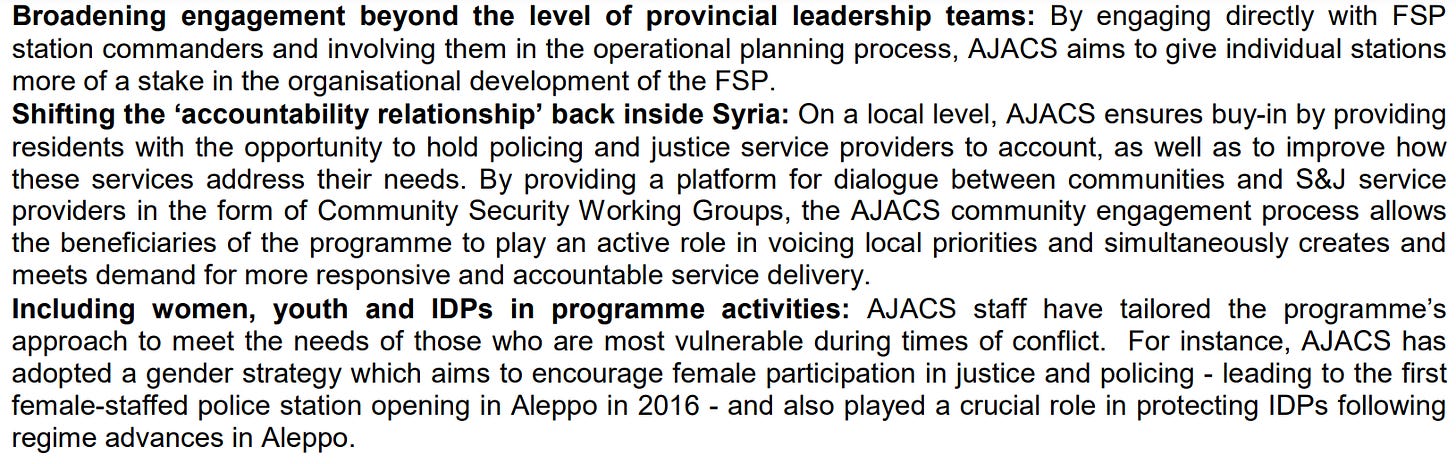
Quite some “revolution”. As Human Rights Watch noted in 2014, prior to the outbreak of civil war, women and girls across Syria were “largely able to participate in public life, including work and school, and exercise freedom of movement, religion, and conscience.” While the country’s penal code and laws governing issues such as marriage, divorce, and inheritance contained some discriminatory provisions, the country’s constitution guaranteed gender equality.
Featured Video
Houthis Keep Advancing as the Red Sea Crisis Deepens
or go to
Aletho News Archives – Video-Images
From the Archives
Clash of Civilization, Iran Part II
By Jamal Kanj – Intifada-Palestine.com – January 14, 2011
Israel’s survival kit is: perpetuate conflict, insecurity to rationalize collective hate and finally playing victim.
Devoid of conflict, Israel implodes internally; without hate, Zionism loses its justification; and playing eternal victim to continue blackmailing the West. Absence of this holy trinity, Israel ceases to exist. … continue
Blog Roll
 Aletho News
- Macgregor: We Haven’t Seen the Worst of the Iran War Yet
- ‘We are not like everyone else’ laws that bind other nations do not apply to Israel, says Likud lawmaker
- Report: Saudi Arabia seeks allies’ assistance as missiles deplete amid war on Yemen
- Fuel Crisis Deepens: Pakistan Warns Tanker Attack in Red Sea Would Be an ‘Act of War’
- ‘Bucha massacre’ a false flag orchestrated by UK – Moscow
- China Rejects Outside Pressure on Trade Ties After New US Russia Sanctions Bill
- Houthis Keep Advancing as the Red Sea Crisis Deepens
- Iran spent $1 million to wipe out $30 billion in data center plans, and take down Amazon in the ME
- Zionist billionaire pressure to silence Macklemore sparks exodus from Ed Sheeran tour
- House Votes to End Iran War for Third Time
- If Americans Knew
- Biden’s Genocide Accomplices Targeted by New Accountability Campaign
- AIPAC’s Network Has Already Spent $67.2 Million to Shape the Midterm Elections
- Jewish Supremacist Manufacturing a Civilizational Threat to License Bigotry
- US bans Palestinian president from speaking at the UN
- Israeli Forces Detain Journalist Alaa al-Rimawi amid Widespread West Bank Raids
- Even a pro-Israel Congress member has put a hold on 40,000 one-ton bombs to Israel
- As Gaza crumbles, Israel preps new ground invasion – Daily Update
- ‘We are not like everyone else’ laws that bind other nations do not apply to Israel, says Likud lawmaker
- Trump’s govt makes ‘treasonous’ claim of weapons shortages
- Palestinian-American Journalist Naqaa Hamed Imprisoned by Israeli Forces After Settlers Targeted Her
- No Tricks Zone
- New Study: ‘Global Drought Shows No Detectable Recent Acceleration Under Climate Warming’
- Economic Masterminds: German Socialists Suggest Taxing Productivity Gains Stemming From Using AI
- The South China Sea Has Not Been Cooperating With The Climate Change Narrative
- Energy Crisis: Germany Enters Heating Season With Historically Low Gas Reserve Fill Levels
- New Study: The Antarctic Ice Sheet Gained Mass From 2020-2024 Due To Staggering Snow And Ice Accumulation
- Study: Ocean Heating Rates From Thousands Of Years Ago ‘Dwarf’ Modern Ocean Heating Rates
- Climate Extremists Target, Attack Large-Scale Power Grid Infrastructure In Germany!
- New Study: Antarctic Ice Melt Has Contributed Less Than 1 Centimeter To Sea Level Rise In The Last 30 Years
- Fear Of Debate: Alarmist German Climate Scientist Calls On Mainstream Media To Discredit Skeptic Voices
- End-Of-August Arctic Sea Ice Extent Hasn’t Fallen In 20 Years, Official Data Show!
 Aletho News