John Helmer and spitting out the red, white, and blue Skripal pills
Gorilla Radio with Chris Cook and John Helmer January 15, 2025
In today’s podcast from Canada, Chris Cook and I discuss the reasons for the failure of Novichok to kill anyone, and its success at brainwashing everyone, or almost everyone.
The contrast with other media campaigns of resistance to western information warfare is a glaring one. For example, the campaign to defend Julian Assange and free him from a British prison and trial in the US has turned out to have been a popular success. However, Assange himself, his Wikileaks platform, and his London advocates have done nothing to expose the Novichok deception operation. They are good men who have done nothing — their media success has failed to deter or stop the Anglo-American march to war in the Ukraine; Assange’s lawyers are supporters of the war against Russia. Assange’s alt-media reporters have pretended they are the only truth-tellers in the present discontents; their war is against their media competitors.
For their names; for the truth of the Novichok story; and for the after-life of the Novichok poison in the coming war against Russia, click to listen.
John Helmer and spitting out the red, white, and blue Skripal pills in the second half. Begin at Minute 31:00. Source: https://gradio.substack.com/
It’s Official: US Abandoning Ukraine

By Kit Klarenberg | Global Delinquents | January 22, 2025
On January 19th, TIME magazine published an astonishing article, amply confirming what dissident, anti-war academics, activists, journalists and researchers have argued for a decade. The US always intended to abandon Ukraine after setting up the country for proxy war with Russia, and never had any desire or intention to assist Kiev in defeating Moscow in the conflict, let alone achieving its maximalist aims of regaining Crimea and restoring the country’s 1991 borders. To have a major mainstream outlet finally corroborate this indubitable reality is a seismic development.
The TIME article’s brief first paragraph alone is rife with explosive revelations. It notes when the proxy war erupted in February 2022, then-President Joe Biden “set three objectives for the US response” – and “Ukraine’s victory was never among them.” Moreover, the phrase oft-repeated by White House apparatchiks, that Washington would support Kiev “for as long as it takes”, was never meant to be taken literally. Instead, it was just “intentionally vague” newspeak, with no implied timeframe or even desired outcome in mind.
Eric Green, a member of Biden’s National Security Council who oversaw Russia policy, states the US “deliberately…made no promise” to President Volodymyr Zelensky to “recover all of the land Russia had occupied” since the conflict’s inception, “and certainly not” Crimea or the breakaway Donetsk and Lugansk People’s Republics. He said the White House believed “doing so was beyond Ukraine’s ability, even with robust help from the West.” It was well-understood such efforts were “not going to be a success story ultimately” for Kiev, if tried.
According to TIME, the Biden administration’s three key objectives in Ukraine were all “achieved”. Nonetheless, “success” on these fronts “provides little satisfaction” to some of the former President’s “closest allies and advisers.” Green was quoted as saying Washington’s purported victory in Ukraine was “unfortunately the kind of success where you don’t feel great about it,” due to Kiev’s “suffering”, and “so much uncertainty about where it’s ultimately going to land.”
‘Direct Conflict’
One objective was “avoiding direct conflict between Russia and NATO.” Miraculously, despite the US and its allies consistently crossing Moscow’s clearly stated red lines on assistance to Kiev, providing Ukraine with weaponry and other support Biden himself explicitly and vehemently ruled out in March 2022, on the grounds it could cause World War III, and greenlighting hazardously escalatory strikes deep inside Russian territory, so far all-out hot war has failed to materialise. On this front perhaps, the former President can be said to have triumphed.
However, another “was for Ukraine to survive as a sovereign, democratic country free to pursue integration with the West.” This prospect dwindles daily, as the proxy war’s frontline teeters constantly on total collapse. Kiev is facing an eventual and seemingly inevitable rout of some magnitude, with the conflict likely settled solely on Russia’s terms, and Zelensky – or whoever replaces him – having no negotiating position to speak of. In December 2024, Empire house journal Foreign Policy even openly advocated cutting Kiev out of eventual peace talks.
Biden also “wanted the US and its allies to remain united.” It is this objective that most obviously failed, and quite spectacularly. As this journalist has repeatedly documented, British intelligence has consistently sought to escalate the proxy conflict into all-out war between the West and Russia, and encouraged Kiev in its maximalist aims, to the extent of covertly plotting grand operations for the purpose, and training Ukrainians to execute them. London’s overriding ambition, per leaked documents, is “to keep Ukraine fighting at all costs.”
The Western media has acknowledged Ukraine’s calamitous August 2024 invasion of Russia’s Kursk region was to all intents and purposes a British operation. London provided a vast welter of equipment to Kiev “central” to the effort, and “closely” advised their Ukrainian counterparts on strategy. The aim was to draw Russian forces away from Donbass and boost Kiev’s bargaining position, which has proven a staggering embarrassment on both fronts. But there was a wider, more insidious goal behind the incursion.
Britain openly and eagerly advertised its fundamental role in the Kursk misadventure to bolster public support at home for continuing the proxy war, and “persuade key allies to do more to help.” In other words, to normalise open Western involvement, and create the “direct conflict” the Biden administration was so keen to avoid. London was also at the forefront of pressuring NATO member states to permit Ukraine to use foreign-supplied weaponry and materiel inside Russia, which could likewise produce their long-sought hot war against Moscow.
Several Western countries – including the US – have offered such authorisation. Yet, Russia has consistently responded to strikes deep inside its territory with heavy duty counterattacks, which Kiev has been unable to repel. Meanwhile, London’s invitation to its allies to become more overtly involved in the proxy war was evidently rebuffed. In November 2024 too, pro-government outlet Ukrainska Pravda published a startling investigation, documenting in forensic detail how the October 2023 – June 2024 Krynky operation was, à la Kursk, essentially British.
Never spoken of by Ukrainian officials today, the nine-month effort saw wave after wave of British-trained and equipped marines attempt to secure a beachhead in a river-adjacent village in Russian-controlled Kherson. Poorly prepared, many died attempting to reach Krynky, due to relentless artillery, drone, flamethrower and mortar fire. Of those that survived the nightmarish journey, most were then killed under a constant and ever-intensifying blitz, in marsh conditions. Russia’s onslaught grew so inexorable, evacuating casualties or providing forces with even basic supplies became borderline impossible.
Survivors of the Krynky catastrophe – one of the absolute worst in military history – who spoke to Ukrainska Pravda revealed it was hoped the beachhead would be a “game-changer”, opening a second front in the conflict, allowing Kiev’s invading marines to march upon Crimea and all-out victory in the proxy war. They hoped to recreate the June 1944 Normandy landings – D-Day. It is all too easy to envisage British intelligence filling the heads of their Ukrainian trainees with such fantasies.
‘Settle Up’
Fast forward to today, and Britain and France are openly discussing sending “peacekeepers” to Ukraine, to “help underpin” whatever “post-war settlement” emerges between Kiev and Moscow. This is after in February 2024, French President Emmanuel Macron suggested formally deploying his country’s forces to Ukraine to halt Moscow’s advance. The proposal was summarily dropped and forgotten when Russian officials made abundantly clear each and every French soldier dispatched to the frontline would be killed without hesitation, and Paris could become a formal belligerent in the war.
It appears the “peacekeeping” plan is likely to suffer the same fate. On January 20th, coincidentally or not the day of Donald Trump’s inauguration, CIA-created Radio Free Europe published an explainer guide on why sending European troops to Ukraine is “a nonstarter”. Among other things, as the Russians are unambiguously winning, they are unlikely to offer many concessions, particularly allowing foreign soldiers to occupy Kiev’s territory. Furthermore, “as a permanent member of the UN Security Council, Moscow can block any peacekeeping mission.”
As if the message to London and Paris wasn’t emphatic enough, two weeks earlier, at a press conference at his Mar-a-Lago resort, Trump made numerous comments reiterating his commitment to ending the proxy war. “We’re going to have to settle up with Russia,” he declared. Notably, the President sympathised with Moscow’s “written in stone” determination Kiev not be enrolled into NATO, warned the situation “could escalate to be much worse,” and stated his hope the conflict could be wrapped up within six months.
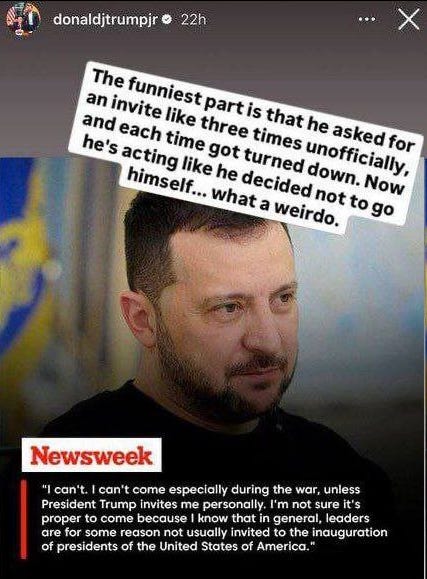
Markedly, Zelensky was not invited to Trump’s inauguration. In a January 6th interview with Newsweek, the Ukrainian President – typically never one to shy away from international jollies – said he was unable to attend, as it wasn’t “proper” to do so “during the war”. Amusingly, Trump’s son Donald Jr. has rubbished Zelensky’s narrative, claiming the – “weirdo” – had specifically “asked for an invite” on three occasions, “and each time got turned down.”
For Berlin, Kiev, London, Paris, and NATO more widely, the writing couldn’t be on the wall any more plainly. Whatever reveries they may have of maintaining the proxy war any longer – Britain recently signed a 100-year-long partnership with Ukraine, under which London will “explore” building military bases on Kiev’s soil – they all ultimately remain imperial vassals, wholly dependent on US financial and military support to exist. Save for a major false flag incident, Trump’s message can only be received among the military alliance.
The Budapest Memorandum: The Fake Narrative Supporting a Long War in Ukraine
By Professor Glenn Diesen | January 21, 2025
Narratives have been constructed to support a long war in Ukraine. For example, the narrative of an “unprovoked invasion” was important to criminalise diplomacy as the premise suggests negotiations would reward Russian military adventurism and embolden further Russian aggression. Meanwhile, NATO escalating the war creates costs that outweigh the benefits to Russia.
Russia’s violation of the Budapest Memorandum is a key narrative that supports a long war. It is constantly referenced as a reason why Russia cannot be trusted to abide by a peace agreement, and why the war must keep going. The argument is that Ukraine gave up its nuclear weapons in return for security guarantees for its territorial integrity. Russia’s breach of this agreement suggests it cannot be trusted and that the only reliable security guarantees must come from NATO membership. Furthermore, the West must continue to send weapons to Ukraine to honour the security guarantees of the Budapest Memorandum.
In February 2022, a few days before the Russian invasion, Zelensky referred to the Budapest Memorandum: “Ukraine has received security guarantees for abandoning the world’s third nuclear capability. We don’t have that weapon. We also have no security.” The Budapest Memorandum was again used by Zelensky in October 2024 to support the argument that Ukraine must either have NATO or nukes: “Either Ukraine will have nuclear weapons, and then it will be a defence for us, or Ukraine will be in NATO”.
This article presents facts and arguments that challenge the false narrative of the Budapest Memorandum, which aims to delegitimise diplomacy. Criticising the narrative of the Budapest Memorandum does not entail “legitimising” Russia’s invasion of Ukraine, which is a common tactic to smear and censor criticism against the narratives supporting a long war.
No Security Guarantees and No Ukrainian Nuclear Weapons
The Budapest Memorandum does not offer any security “guarantees”, rather it provides “assurances”. Former US Ambassador to Ukraine Steven Pifer, who was part of the US negotiation team in 1994, argues the US was explicit that “guarantees” should not be confused with “assurances”. Pifer also confirms this was understood by both the Ukrainians and the Russians:
“American officials decided the assurances would have to be packaged in a document that was not legally-binding. Neither the Bush nor Clinton administrations wanted a legal treaty that would have to be submitted to the Senate for advice and consent to ratification. State Department lawyers thus took careful interest in the actual language, in order to keep the commitments of a political nature. U.S. officials also continually used the term “assurances” instead of “guarantees,” as the latter implied a deeper, even legally-binding commitment of the kind that the United States extended to its NATO allies”.[1]
Ukraine also did not have any nuclear weapons. The nuclear weapons in question were former Soviet nuclear weapons that were stationed in Ukraine, but under the control of Moscow. Kiev did not and could not operate or maintain these weapons, which is usually left out of the narrative. Furthermore, in the Minsk agreement of 1991, Ukraine had already committed itself to the “destruction of nuclear weapons” on its territory.[2]
The Not-So-Sacred Memorandum
In December 1994, the US, UK, and Russia met in the Hungarian capital and offered security commitments in three separate agreements with Ukraine, Belarus, and Kazakhstan. These three countries agreed to relinquish the nuclear weapons that had been left on their territory after the collapse of the Soviet Union, and in return, the US, UK and Russia offered commitments to not undermine their security. The Budapest Memorandum outlined key principles such as “to refrain from economic coercion designed to subordinate to their own interest the exercise by Ukraine of the rights inherent in its sovereignty and thus to secure advantages of any kind”, and to “respect the independence and sovereignty and the existing borders of Ukraine”. In a display of cherry-picking, NATO countries constantly ignore the first commitment but constantly refer to the second commitment.
The US claims its use of economic coercion and violation of Ukrainian sovereignty was in support of democracy and human rights as opposed to advancing its own interests. Thus, the US freed itself from its commitments under the Budapest Memorandum. Under the so-called rules-based international order, the US and its allies claim the prerogative to exempt themselves from international law, norms and agreements under the guise of supporting humanitarian law and liberal democratic norms.[3]
When the US imposed sanctions on Belarus in 2013, Washington explicitly stated that the Budapest Memorandum was not legally binding and that US actions were exempted as the US was allegedly promoting human rights:
“Although the Memorandum is not legally binding, we take these political commitments seriously and do not believe any U.S. sanctions, whether imposed because of human rights or non-proliferation concerns, are inconsistent with our commitments to Belarus under the Memorandum or undermine them. Rather, sanctions are aimed at securing the human rights of Belarusians and combating the proliferation of weapons of mass destruction and other illicit activities, not at gaining any advantage for the United States”.[4]
The Western-backed coup in 2014 had been an even more blatant violation of Ukrainian sovereignty. The West interfered in the domestic affairs of Ukraine, imposed economic sanctions, and finally toppled the Ukrainian president to pull the country into NATO’s orbit. The commitments under the Budapest Memorandum were cast aside as the West claimed to support a “democratic revolution”, despite being an unconstitutional coup that did not even enjoy majority support from the Ukrainians and only a small minority of Ukrainians supported NATO membership.
International law imposes rules and mutual constraints that limit foreign policy flexibility, but in return deliver reciprocity and thus predictability. Once the West freed itself from mutual constraints in the Budapest Memorandum, Russia also abandoned it. US Ambassador Jack Matlock who participated in negotiating an end to the Cold War, questions the validity of the Budapest Memorandum after the coup in 2014. According to Matlock, the principle in international law of rebus sic stantibus means that agreements should be upheld “provided things remain the same”. Matlock argues that Russia “strictly observed its obligations in the Budapest Memorandum for 13 years” even as NATO expanded towards its borders, although the coup of 2014 created “a radically different international situation”. Matlock thus concludes that Russia was “entitled to ignore the earlier agreement”.[5]
Learning the right lessons
An honest assessment of why the Budapest Memorandum collapsed is important to assess how new agreements can be improved. NATO’s demand for hegemony in Europe and rejection of a common European security architecture inevitably led to the collapse of common agreements as the West would no longer accept the principle of mutual constraints and obligations. Liberal hegemony entailed that the West could exempt itself from international law and agreements, while Russia would still abide by them. The narrative of Ukrainian nuclear weapons, security guarantees, and ignoring the US and UK violation of the Budapest Memorandum serves the purpose of sowing distrust in any future security agreements with Russia. A mutually beneficial peace is possible if we first return to the truth.
[1] S. Pifer, 2011. The Trilater Proce The United States, Ukraine, Russia and Nuclear Weapons, Foreign Policy at Brookings, Arms Control Series, Paper 6, May 2011, p.17. https://www.brookings.edu/wp-content/uploads/2016/06/05_trilateral_process_pifer.pdf
[2] Agreement on Strategic Forces Concluded between the 11 members of the Commonwealth of Independent States on December 30, 1991. https://www.bits.de/NRANEU/START/documents/strategicforces91.htm
[3] G. Diesen, ‘The Case for Dismantling the Rules-Based International Order, Substack, 23 December 2024.
[4] US Embassy in Belarus, ‘Belarus: Budapest Memorandum’, U.S. Embassy in Minsk, 12 April 2013.
[5] J. Matlock, ‘Ambassador Jack Matlock on Ukraine, Russia, and the West’s Mistakes’, Nuova Rivista Storica
UK police summon Jeremy Corbyn after pro-Palestine rally
MEMO | January 20, 2025
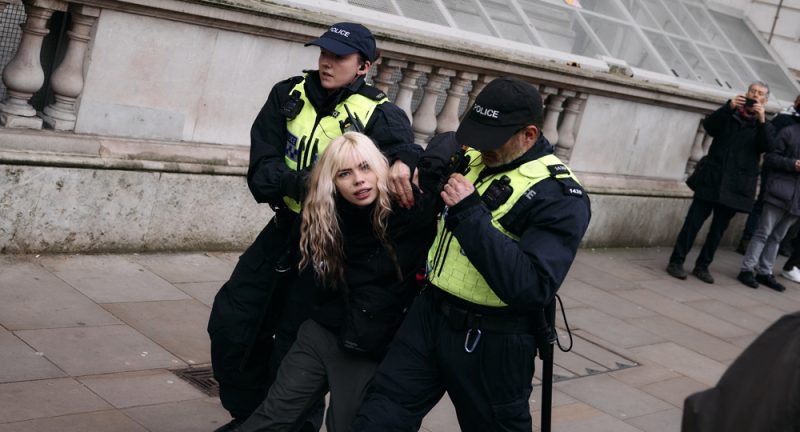
The Metropolitan Police have summoned former UK Labour Party leader Jeremy Corbyn and ex-shadow chancellor John McDonnell for an “interview” following a pro-Palestinian rally in central London on Saturday, Anadolu reported.
The Metropolitan Police is investigating what it described as a “coordinated effort by the rally’s organisers to breach conditions imposed on the event.”
Corbyn, 75, and McDonnell, 73, who agreed to the interviews, voluntarily appeared at a police station in the capital yesterday afternoon.
After leaving the police station, the two MPs did not answer reporters’ questions.
Police also summoned three unnamed persons to give voluntary testimony as part of an “ongoing investigation”.
The rally, organised by the Palestine Solidarity Campaign (PSC) and its coalition partners, saw thousands gather in Whitehall after police blocked plans for a march from Portland Place, near the headquarters of the BBC.
Officers had imposed conditions under the Public Order Act restricting the protest to Whitehall, citing concerns over a potential “serious disruption” near a synagogue.
Police said a group of protesters broke through a police line to reach Trafalgar Square, where officers stopped them.
The Metropolitan Police posted a photo on social media showing a group that it said have forced its way through the police line being held at the northwest corner of Trafalgar Square.
Corbyn, however, disputed the account.
“This is not an accurate description of events at all,” he said in a post on X.
He said he was part of a delegation of speakers intending to lay flowers in memory of children killed in Gaza, which was “facilitated by the police”.
McDonnell echoed his comments.
“We did not force our way through. The police allowed us to go through, and when we stopped in Trafalgar Square, we laid our flowers down and dispersed.”
Nine people, including Corbyn’s brother Piers Corbyn, and Chris Nineham, a chief steward on the march, have been charged with public order offences and will appear at Westminster Magistrates’ Court in the coming days.
The Met Police also confirmed that 24 people have been released on bail, while 48 remain in custody. Three other men aged 75, 73 and 61 have agreed to be interviewed under criminal caution.
The protest coincided with the announcement of a ceasefire and prisoner swap deal between Israel and Hamas.
Corbyn, who now sits as an independent member of parliament for Islington North, has been a vocal supporter of Palestinian rights.
McDonnell, the MP for Hayes and Harlington, also sits as an independent after Labour suspended the whip from him for six months in July 2024 over his vote against the government on child benefit rules.
The demonstration in London drew tens of thousands of supporters of Palestine, despite the police-imposed restrictions and banning of a previously agreed-upon route.
During the protest, 77 people were arrested.
Met Commander Adam Slonecki said security forces have been deployed for more than 20 national protests organised by the PSC since October 2023.
He highlighted that the number of arrests at yesterday’s rally marked the “highest number” recorded at such demonstrations during this period.
UK knew about Israel’s brutal torture of Palestinian detainees 50 years ago, but refused to act, British documents reveal
The UK knew about Israel’s brutal torture of Palestinian and Arab detainees nearly 50 years ago but refused to act, British documents reveal. The papers, unearthed by MEMO in the British National Archives, also reveal that the US opted to address the issue solely through non-governmental organisations.
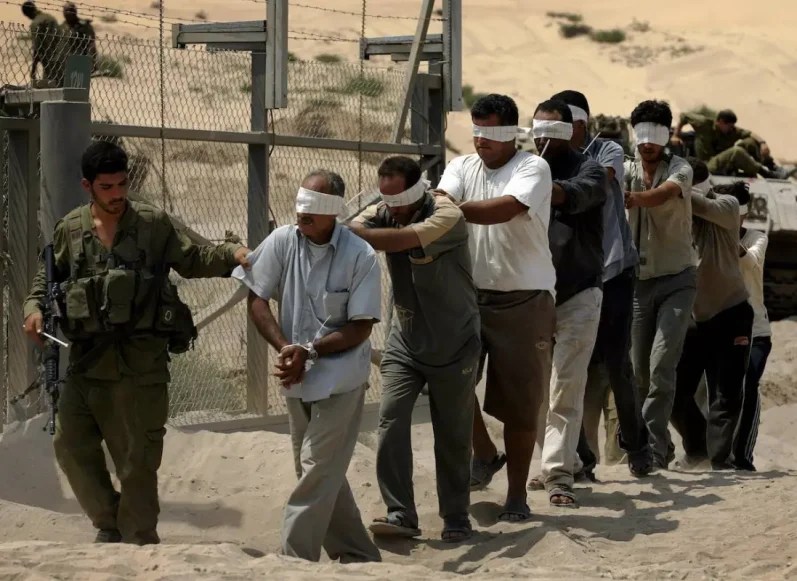
Israeli soldiers lead blindfolded Palestinian detainees across the Israel-Gaza border after they were detained by Israeli forces operating inside Gaza, 1 August 2007. [DAVID FURST / AFP/ Getty Images]
By Amer Sultan | MEMO |January 20, 2025
YouTube Removes Barrister’s Legal Submission at Official UK Covid Inquiry Amid Censorship of Vaccine Injury Discussions
By Cindy Harper | Reclaim The Net | January 15, 2025
YouTube’s decision to remove a barrister’s legal submission from the UK Covid Inquiry has intensified concerns over widespread censorship of vaccine-related discussions on major social media platforms.
Anna Morris KC, who represents families claiming injury from Covid-19 vaccines, disclosed that YouTube deleted a video of her preliminary remarks to the inquiry in September 2023, citing violations of its medical “misinformation” policy. Although the platform later reinstated the video, it failed to provide a clear explanation, admitting only that “it sometimes makes mistakes.”
This act of censorship has been condemned as part of a larger pattern of silencing voices critical of vaccine safety and government health policies. As reported by The Telegraph, during the inquiry’s Module 4 session — focused on vaccines and pharmaceutical measures — Morris directly addressed this issue, stating, “The inquiry must understand the stigma and censorship for the vaccine injured and bereaved.”
She revealed that a poll of affected families found that 74% had been censored when discussing vaccine injuries on social media platforms.
Morris further criticized the suppression of information, noting that doctors were instructed to withhold concerns from both the public and their own patients. Her removed statement emphasized that “the treatment of the vaccine injured in this country has historically been a source of shame.”
Morris argued that those harmed by vaccines have been systematically “dismissed, ignored, censored,” and subjected to hostility when seeking acknowledgment and support.
She condemned the ongoing silencing of vaccine-injured individuals as a severe barrier to accountability and transparency, adding, “Unfortunately, this censorship has continued years after the pandemic and into our engagement with this inquiry.”
Despite repeated requests for a review, YouTube justified the video’s removal by citing its medical “misinformation” policies, a rationale that critics argue is increasingly being used to suppress legitimate concerns and experiences. This censorship has fueled calls for a reevaluation of how social media platforms regulate content related to public health, especially when it involves dissenting voices.
An emotional impact video shown during the inquiry highlighted the tragic story of pharmacist John Cross, who took his own life after suffering paralyzing complications from a Covid vaccine and being denied compensation. His story underscores the devastating consequences of dismissing those seeking recognition and support.
New US Nuke Deployment in Europe Raises Serious Questions About NATO’s True Nature
By Ilya Tsukanov – Sputnik – 18.01.2025
The United States has begun the forward deployment of a new generation of its B61 nuclear gravity bomb at bases in Europe, a senior administrator has announced. What signal does the deployment send to Moscow? What impact will it have on strategic security in Europe? Sputnik turned to a senior former Pentagon insider for answers.
“The new B61-12 gravity bombs are fully forward deployed, and we have increased NATO’s visibility to our nuclear capabilities through visits to our enterprise and other regular engagements,” US National Nuclear Security Administration chief Jill Hruby revealed in a talk at the Hudson Institute this week.
“Our strategic partnership with the UK is very strong, as is their commitment to their nuclear deterrent. And we have advanced our thinking together about critical supply chain resilience. NATO is strong,” Hruby added, hinting at the prospects for ‘enhanced’ nuclear cooperation.
Reports have been swirling in recent years about US plans to redeploy tactical nuclear weapons in the UK at the RAF base at Lakenheath, although no official announcements have been made to date.
The B61-12, also known as the B61 Mod 12, is the latest upgrade to the US variable yield nuclear gravity bomb design first rolled out in the late 1960s. The Mod 12 is set to replace the older Mod 3, 4 and 7 variants of the weapon, and features a 0.3-50 kt yield.
Testing of the B61-12 was completed in 2020, with production starting in late 2021, and the Bulletin of the Atomic Scientists expecting 400-500 of the weapons to be produced, in part for deployments abroad.
Older variants of the munition are currently deployed in Belgium, Germany, Italy, the Netherlands, and Turkiye’s Incerlick Air Base. NATO has approved the weapons to be used in battle by select alliance members as part of the bloc’s “nuclear sharing” arrangements.
The announcement of the bombs’ deployment in Europe is meant to “signal to Moscow that NATO and particularly the UK… are prepared for any ‘attack’ on any NATO country,” says ex-DoD analyst Michael Maloof.
What it really signals is just how much of a US protectorate Western European countries and the UK have allowed themselves to become, Maloof, a former senior security policy analyst with the Office of the US Secretary of Defense, said.
“When I used to live there on a military base, we used to joke how the UK was nothing but a floating aircraft carrier because of all the US bases on the RAF facilities there,” the observer, who grew up in southern England during the Cold War, recalled.
The nukes’ deployment once again “underscores how NATO has evolved not into a defensive alliance, but an offensive alliance,” with the bases where the bombs are stored obvious targets for Russia in the event of a deadly escalation, Maloof said.
Can Trump Fix a Broken Alliance?
Maloof hopes that under Trump 2.0, “a total reevaluation of the deployment of US bases throughout NATO” will take place, especially in Germany but possibly also the UK.
NATO’s continued existence, the alliance’s “Cold War 2.0” against Russia and the bloc’s eastward expansion have been a disaster for European security, the observer said.
“I think it’s the beginning of the end of NATO as we know it. This perennial cycle has just got to cease. And given how we don’t even have a defense against hypersonics… it really shows that we’re reaching a very dangerous pinnacle here of escalation.”
The nuke deployment, the termination of the INF Treaty during Trump’s first term and other factors have “made Europe an all the more dangerous place to be,” Maloof emphasized, with reaction time in case of a nuclear escalation being “virtually nil.”
“I think that this posturing that we continually see to ‘show deterrence’ is actually making the West even more vulnerable to attack because it is an agitating factor,” the observer added.
Kremlin reacts to UK plans for military build-up in Ukraine
RT | January 17, 2025
The possible appearance of NATO-linked military infrastructure in Ukraine is a concern for Russia, Kremlin spokesman Dmitry Peskov said on Friday, commenting on a new security deal between London and Kiev.
The 100-year bilateral agreement, signed by Ukrainian leader Vladimir Zelensky and British Prime Minister Keir Starmer on Thursday, states that the two nations will “explore options for deploying and maintaining defense infrastructure in Ukraine, including military bases, logistics depots, reserve military equipment storage facilities and war reserve stockpiles.”
While the establishment of such facilities would in itself not amount to Ukraine joining NATO, a scenario that Moscow strongly opposes, the British plans are “certainly worrisome”, Peskov told a media briefing.
He also relayed the Russian government’s negative attitude toward British statements that its defense cooperation with Ukraine would include enhanced “collaboration on maritime security” near Russian borders, including in the Azov Sea. Peskov emphasized that the Azov Sea is a Russian inner body of water, so that “interactions between Ukraine and Britain can hardly happen there.”
Moscow views NATO as a hostile entity and has accused its members of waging a proxy war against Russia, using Ukrainian soldiers as ‘cannon fodder’.
The UK has been one of the most vocal supporters of Kiev’s war effort. In the 100-year agreement, it has committed to no less than £3 billion ($3.66 billion) in annual military assistance to Ukraine until financial year 2030/31.
NATO’s eastward expansion since the 1990s – conducted in violation of assurances given to Moscow to secure its acceptance of Germany’s reunification – is one of the primary causes of the current hostilities, according to Russian officials.
UK promises to ‘explore options’ for military bases in Ukraine
RT | January 17, 2025
London has revealed details of a long-term partnership agreement with Kiev, which includes broad plans for military infrastructure development and defense cooperation over the next century. The document suggests the potential establishment of military bases in Ukraine, with an emphasis on aligning these initiatives with NATO standards for maximum effectiveness.
The 15-page declaration, signed on January 16, 2025, lays out a framework for cooperation between the United Kingdom and Ukraine across various sectors, with a primary focus on military collaboration. British Prime Minister Keir Starmer and Ukrainian leader Vladimir Zelensky formalized the deal during a ceremony in Kiev on Thursday.
“The Participants will explore options for deploying and maintaining defence infrastructure in Ukraine, including military bases, logistics depots, reserve military equipment storage facilities and war reserve stockpiles,” the document states.
The agreement also emphasizes maritime cooperation, particularly in the Black Sea region. The UK has pledged to enhance Ukraine’s interoperability with NATO in the maritime sphere through joint naval operations, port visits, and the development of Ukrainian naval bases.
“We will work together to ensure NATO learns the lessons from Ukraine’s experience in the Black Sea to inform its development of future maritime capabilities. We will promote the development of naval bases on the territory of Ukraine,” the document reads.
Another section highlights plans to “deepen cooperation on long-range strike capabilities,” integrated air and missile defense, and the stockpiling of complex weapons to bolster “deterrence.”
Additionally, London has committed to providing Ukraine with annual military assistance of no less than £3 billion until at least 2031, and “for as long as needed to support Ukraine.”
While the agreement lacks detailed, binding commitments beyond promises to expand, intensify, and facilitate collaboration across multiple sectors, Zelensky hinted at potential “secret” components within the pact.
The UK has been one of Ukraine’s prime backers since the escalation of conflict between Moscow and Kiev in February 2022. It has committed 12.8 billion pounds ($16 billion) in military and civilian aid to Ukraine and reportedly trained 50,000 Ukrainian troops on British soil.
Russia has sharply criticized London’s continued support of Kiev as a sign that the UK government “clearly does not seek to resolve the conflict.” Russian Foreign Ministry spokeswoman Maria Zakharova previously said “they are doing everything possible to make it drag on, thus prolonging the suffering of the Ukrainian people.”
Meanwhile, reports suggest that US President-elect Donald Trump, set to take office next Monday, may propose deploying Western troops as peacekeepers along a demilitarized zone between Russia and Ukraine. The rumored plan reportedly excludes US forces, relying instead on “European” soldiers acting outside NATO’s command structure.
London remains cautious about the idea of sending British troops to Ukraine as part of any peacekeeping force, even though Starmer is said to have discussed the matter with French President Emmanuel Macron, according to The Telegraph.
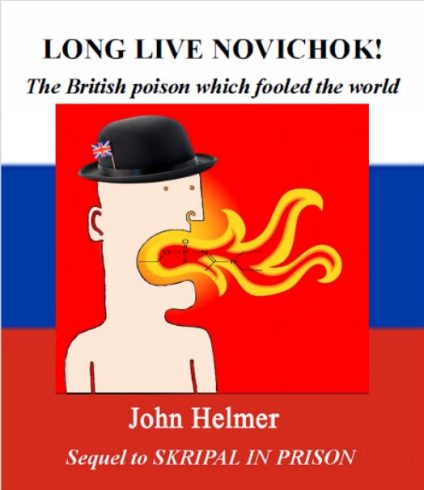
New Book – LONG LIVE NOVICHOK!
By John Helmer • Unz Review • January 14, 2025
Novichok is the notorious warfighting poison which has killed no one but fooled everyone.
At least that’s how British Government officials, their scientists, chemical warfighters, policemen, media reporters, and trailing after them all, their judges, intend the story to be told.
Theirs is the story of the assassination, ordered by President Vladimir Putin in Moscow and attempted on March 4, 2018, by two military officers tracked and filmed to every location but not the murder scene; with a weapon not detected at the scene nor in the blood streams and bodily tissues of their murder targets.
The victims, Sergei Skripal and Yulia Skripal, have been made to disappear and are either incommunicado in prison or dead. The only direct testimony which has been recorded voluntarily in front of witnesses was given by Yulia Skripal, in hospital four days after the attack, when she identified the assassination attempt as having been carried out with poison spray by an attacker who was not Russian, just minutes before she and her father collapsed. She meant the poison was British; the assassin British.
The motive for the Novichok crime turns out to be hearsay by British government against the Russian government.
In political and military terms, the Novichok poison story is propaganda between enemies at war. Judgement of what happened to the Skripals is a weapon of this war. And so it has turned out that there has been no court trial or test of the Novichok narrative, according to British law. Instead, there has been a proceeding which looked like a court trial but wasn’t; in which the Skripals were represented by police interrogators and by lawyers who said nothing; presided over by a judge who wasn’t.
In other words, a show trial in a time of war.


The truth of what happened has no military or political value, certainly not to the prosecuting British side; not much to the defending Russian side. But as the evidence has surfaced piecemeal over the past five years since the first investigation was published in February 2020 as Skripal in Prison, the truth reveals that Novichok was ineffective as a poison, but very successful as a deception operation by the British. They reversed the hands of the assassin, planted a British-made chemical weapon to look like a Russian one; invented the death of bystander Dawn Sturgess to substitute for Sergei and Yulia Skripal who didn’t die; and suppressed the evidence of what had happened – witnesses, videotapes, toxicology, autopsy records.
Not quite all the evidence, however. This book has been written to reveal new evidence to conclude that Sergei Skripal was a triple agent attempting to return to Russia. His rescue, the exfiltration operation by the Russian military intelligence organisation (GRU), used decoys to mislead the British surveillance and conceal the escape plan. But the British anticipated and decided to act preemptively, attacking both Skripals, reversing culpability, and convicting the Russians for the British crime.
Not one of the legal, medical, police, or government officials engaged in the Novichok story — neither the Skripal nor the Sturgess parts of the narrative — answered the many questions put to them during the seven-year course of the case and of this book. The three lawyers purportedly engaged to represent Sergei and Yulia Skripal were the most silentious of all; their names don’t warrant repeating. Not much better were the lawyers representing Dawn Sturgess’s family’s money claim, especially their lead counsel Michael Mansfield.

This blanket of misrepresentation, evasion, and silence which they have thrown over themselves and over the evidence in the case is proof of the intention to deceive. So determined is this intention, the deceivers don’t realize how preposterous are the results. The colour of Novichok, for example, reported as a state secret in Chapter 74.
A direct request to researchers publishing on A-234 around the world has revealed that the Iranians who reported synthesizing the chemical agent in 2016, reply that it is colourless. The British, Americans, Czechs, and Koreans who have done the same laboratory work, refuse to answer. And yet, despite all the preliminary vetting by British intelligence agents, years of double-checking by British officials, and months of closed-door sessions and redactions ordered by Lord Hughes, chairman of the Dawn Sturgess Inquiry, the truth managed to slip out. A man named Josep Vivas, a Spaniard living in Barcelona, was the unintended, unguarded source.
Vivas was a vice president of Puig, the company which manufactures and sells the bottled perfume which in the British Novichok story has been turned into the Russian murder weapon. “I am making this statement,” Vivas signed for the Dawn Sturgess Inquiry on February 12, 2024, “in addition to a letter I provided on 27 July 2018. Prior to me writing and signing that letter, I was shown a number of images of a small perfume bottle branded ‘Nina Ricci Premier Jour Perfume’. The images I viewed were under police exhibit reference [redaction tagged VN551/10]. I was shown further images of a perfume box labelled as ‘Premier Jour Nina Ricci’. This was under police exhibit reference [redaction tagged VN521/3]. On Friday 2nd February 2024, I was again shown the images of [redaction tagged VN551/10] and [redaction tagged VN521/3] before signing this statement and I set out my observations on them below.”
The photographs of the poison bottle shown in the public hearing on November 28, 2024, were censored — a large black mark was pasted across the bottle contents. But British agents had shown Vivas the photographs just days after July 11, 2018, when the bottle was purportedly discovered at the Sturgess crime scene. Vivas was shown the photographs again more than five years later, just before he testified before Hughes. He saw the bottle without the black mark.

Censored police photograph of Novichok poison weapon, a perfume atomizer bottle, allegedly found on a kitchen bench at Rowley-Sturgess home eleven days after Sturgess and Rowley were hospitalized. The black mark conceals the British Government’s lie.
The key observation Vivas confirmed he had seen on both occasions was this: “The liquid inside the bottle. Premier Jour perfume is pale pink, and from the photos I observe that the liquid contained in the bottle is yellow.”
If the perfume is pink; if Novichok is colourless; if the liquid in the murder weapon was yellow, then the liquid in the murder weapon cannot have been Novichok. QED — Quod erat demonstrandum, as the ancient lawyers and logicians used to conclude their proofs. The colour yellow was a British fabrication; the black mark was British camouflage. The secret slipped out into the open by British mistake.
From whom are the British keeping their secret? Can it be the Russians who, according to the official Novichok narrative, have made, stored, and used it against the Skripals, but have yet to learn what colour it is?
The Russian handling of the Skripal affair is a different story. It has been defensive on the evidence claimed by the British government; ineffective in breaking the silence imposed on the Skripals.
These outcomes were inevitable once it is concluded, in retrospect, that Sergei Skripal was attacked to prevent his return to Moscow as a triple agent; and that the Russian military operation to rescue him had been thwarted by the British.
These two truths, if published officially, leaked to the press, or reported in independent investigations, stood little chance of being believed outside Russia. More certainly, official Russian admission of the two truths, if it had been made, would have condemned the Skripals to the death that was attempted by the British against them on March 4, 2018.
Less explicable is the outcome that for seven years now, Russian press reporting of the case has ignored the investigative reporting published in English in the UK and US, and then the evidence revealed during the Hughes hearings in London between October and December 2024. This is an understandable result of the line dictated by the Kremlin’s and Foreign Ministry’s media departments for protecting the lives of Sergei and Yulia Skripal, and for salvaging what remained of Anglo-Russian relations on the road to war in the Ukraine.
In the chapters to follow, President Putin’s and Foreign Minister Lavrov’s statements can be examined in the political context and news sequence in which they were made.
From the beginning, the Russian Embassy in London issued formal requests for consular access to the Skripals and protest notes when this was denied by the Foreign Office. In reply to British stonewalling on access and propagandizing the allegations against the Russian government, the Embassy issued a detailed summary of every action Russian officials had taken and the statements they made.
The one option the Embassy in London did not take was to engage British lawyers to obtain a hearing and an order of habeas corpus in the High Court to compel the appearance of the Skripals to testify for themselves. This option was obvious to the Embassy and lawyers in London between March 21, 2018, when the Home Office went to the court for legal authority to allow blood testing of the Skripals, and April 9, when Salisbury District Hospital announced that Yulia Skripal had been released; and then on May 18 when Sergei Skripal was also discharged from hospital.
During this period it was reported that Yulia was able to telephone her cousin Viktoria in Russia. Years later, as Chapters 67, 71, and 73 reveal, it became clear in retrospect that Yulia had recovered consciousness in hospital much earlier than the hospital allowed to be known, and that doctors had then forcibly sedated her. At the time the Russian Embassy was announcing it “questioned the authenticity” of the statements issued by the London police and media on Yulia’s behalf. The Embassy was right; it was not believed.
It is possible the Embassy did attempt to engage barristers to go to court for a habeas corpus hearing for the Skripals, but learned that no one would take the case. At the time I made an independent request for this engagement to the well-known human rights barristers in London; the outcome was that none agreed to represent the Skripals. The refusals were point-blank – no one would give a reason.
British officials anticipated that an effort might succeed in forcing a High Court hearing, however. So, on May 24, 2018, a one minute fifty-five second speech by Yulia Skripal was presented on video in which she spoke from a script and appeared to sign a statement. Referring to “offers of assistance from the Russian Embassy,” she claimed “at the moment I do not wish to avail myself of their services.” Skripal’s Russian text spoke of “help” from the Russian Embassy: “now I don’t want and [I am] not ready to use it.”
“Obviously, Yulia was reading a pre-written text,” the Russian Embassy responded publicly. “[This] was a translation from English and had been initially written by a native English-speaker… With all respect for Yulia’s privacy and security, this video does not discharge the UK authorities from their obligations under Consular Conventions.”

Excerpted frames from Yulia Skripal’s brief videotaped appearance at a US nuclear bomber base in England on May 2018; watch the tape in full here.
By subtle signals, Skripal indicated she was being made to speak and to sign under duress. Two script pages were visible on a side table during the filming; the one on top Skripal was filmed signing. The two papers were in a different handwriting from Skripal’s signature and in a different pen from the pen she is seen to use. On the top page, apparently the Russian language text, Skripal added words after her signature; these are her first and family names in Russian, but without her patronymic, as Russians usually record their names in official documents. The handwriting of that name and the handwriting of the Russian statement are not the same. Nor the pen and ink used. Ten weeks earlier, on March 8, 2018, Yulia had woken from a coma in hospital and signaled to the doctor at her bedside that she had been attacked by the British, not by the Russians. Read this evidence for the first time in the new book.
At first, Putin he seemed unprepared on the facts of the case – the Russian facts – and unprepared for the British government’s propaganda blitz.
The president cannot have been unprepared. On March 15, 2018, the Kremlin revealed that at a Security Council meeting on that day Putin was briefed by the Foreign and Defense Ministers and the intelligence chiefs. “While talking about international affairs,” the official communiqué said, “the Council members held an in-depth discussion on Russia-UK relations against the backdrop of Sergei Skripal’s case. They expressed grave concern over the destructive and provocative position of the British side.”
The line which Putin and his advisers decided at that meeting they planned to follow in public was revealed by Putin three days later at a press conference. He tried to feign ignorance himself, and then dissimulated on the weapon, the motive, and the opportunity. “Regarding the tragedy you have mentioned,” Putin told reporters, “I learned about it from the media. The first thing that comes to mind is that, had it been a warfare agent, the victims would have died immediately. It is an obvious fact which must be taken into account. This is first.”
“The second is that Russia does not have such chemical agents. We destroyed all our chemical weapons, and international observers monitored the destruction process. Moreover, we were the first to do this, unlike some of our partners who promised to destroy their chemical weapons but have not done so to this day, regrettably. Therefore, we are ready for cooperation, as we said immediately. We are ready to take part in any investigations necessary, provided the other side wants this too. We do not see their interest so far, but we have not removed the possibility of cooperation on this matter from the agenda.”
“As for the overall situation, I believe that any reasonable person can see that this is total nonsense. It is unthinkable that anyone on Russia would do such a thing ahead of the presidential election and the FIFA World Cup. Absolutely unthinkable. However, we are ready for cooperation despite the above things. We are ready to discuss any issues and to deal with any problems.”
On April 4, 2018, he said: “We do not expect anything other than for common sense to ultimately prevail and for international relations not to be damaged the way we have seen recently. This goes not only for this case, the attempt on Skripal’s life. This has to do with other aspects of international relations as well. We should stay within the framework of healthy political processes based on fundamental norms of international law, and then the situation in the world will become more stable and predictable.”
On May 18, at a news conference following a meeting with then-Chancellor of Germany, Angela Merkel, Putin said: “Now regarding Mr Skripal. Yes, I also heard from the media today that he has been released from hospital. We wish him the best of health, we are really very happy. I have several considerations in this respect. First. I think if a combat-grade nerve agent had been used, as claimed by our British colleagues, the man would have died on the spot. A nerve agent is so powerful that a person dies instantly or within several seconds or minutes. Fortunately, he is alive, he got well, was released from hospital and I hope he will live a healthy and safe life.”
“As to the investigation, on our part we offered every assistance in the investigation to our British partners on a number of occasions, and asked for access to this investigation. There has been no response so far. Our proposals remain in place.”
Putin was accusing the British government of a cover-up, but softly, by innuendo. “The most objective explanation to what happened”, he said on May 25, “can be only provided as a result of a thorough, unbiased and joint – the latter is very important – investigation. We proposed working on it together from the very beginning, but as you know, the British side rejected our offer and investigated the incident alone. It is also a fact, as this was announced at the very beginning, that the victims were poisoned – if it was a poisoning – with a chemical warfare agent. I have spoken about this before, but I will say again that although I am not an expert on chemical warfare agents, I can imagine that the use of such agents should result in the almost instantaneous death of the victims. Thank God, nothing like this happened in the case of the Skripals, and that Skripal himself and his daughter are alive, have been discharged from hospital and, as we have seen on television, his daughter looks quite well. Thank God, they are alive and healthy.”
“Therefore, I believe it would be wrong to say that it was a chemical warfare agent. If so, everything the British side has said can be called into question. How can we settle this? We should either conduct a comprehensive and objective joint investigation, or stop talking about it because it will only worsen our relations.”
If Putin was trying to ameliorate these relations with London, he tried, six months later, to appear to be condemning Sergei Skripal, burying both him and the reciprocal espionage the two governments were conducting against each other. Was Putin calculating that if the British had tried but failed to kill both Skripals, he might yet save their lives? Understandably, no Russian could acknowledge this — certainly not then and not now.
In a Moscow forum in October 2018, six months after the Salisbury incidents, Putin responded to questions from a US journalist. “As regards the Skripals and all that, this latest spy scandal is being artificially inflated. I have seen some media outlets and your colleagues push the idea that Skripal is almost a human rights activist. But he is just a spy, a traitor to the motherland. There is such a term, a ‘traitor to the motherland,’ and that’s what he is. Imagine you are a citizen of a country, and suddenly somebody comes along who betrays your country. How would you, or anybody present here, a representative of any country, feel about such a person? He is scum, that’s all. But a whole information campaign has been deployed around it.”
“I think it will come to an end, I hope it will, and the sooner the better. We have repeatedly told our colleagues to show us the documents. We will see what can be done and conduct an investigation. We probably have an agreement with the UK on assistance in criminal cases that outlines the procedure. Well, submit the documents to the Prosecutor General’s Office as required. We will see what actually happened there. The fuss between security services did not start yesterday. As you know, espionage, just like prostitution, is one of the most ‘important’ jobs in the world. So what? Nobody shut it down and nobody can shut it down yet.”
“[Question] Ryan Chilcote: Espionage aside, I think there are two other issues. One is the use of chemical weapons, and let’s not forget that in addition to the Skripal family being affected in that attack, there was also a homeless person [Dawn Sturgess] who was killed when they came in contact with the nerve agent Novichok.”
“[Answer] Vladimir Putin: Listen, since we are talking about poisoning Skripal, are you saying that we also poisoned a homeless person there? Sometimes I look at what is happening around this case and it amazes me. Some guys came to England and started poisoning homeless people. Such nonsense. What is this all about? Are they working for cleaning services? Nobody wanted to poison… This Skripal is a traitor, as I said. He was caught and punished. He spent a total of five years in prison. We released him. That’s it. He left. He continued to cooperate with and consult some security services. So what? What are we talking about right now? Oil, gas or espionage? What is your question? Let’s move on to the other oldest profession and discuss the latest developments in that business. (Laughter.)”
The British Prime Minister Theresa May and her ambitious rival, Foreign Secretary Boris Johnson, ignored Putin’s request to put the Skripal affair aside. Instead, they escalated, publishing photographs of police and intelligence agency surveillance of the Russian military officers who were then charged with the attempted Novichok murder. Putin was put on the defensive again.

The British inventors of Novichok – left to right — Alexander Younger, head of MI6, and Mark Sedwill, National Security Advisor and Cabinet Secretary, created the Novichok plot to prevent Sergei Skripal returning to Moscow and to persuade Prime Minister Theresa May, then her successor Boris Johnson, to escalate their war against Russia.
On September 12, 2018 – seven days after the Metropolitan Police and Crown Prosecution Service announced their charges against Alexander Petrov and Ruslan Boshirov – Putin was asked who were they were. “Either they deliberately poked their faces towards the camera in order to be photographed, or they are completely unprofessional to have their images captured by all the cameras. Perhaps you have a third theory?”
“Vladimir Putin: Actually, we have, of course, taken a look at these people. We already know who they are, and we have located them. I hope they will show up and tell everyone about themselves. This would be better for everyone. I assure you that there is nothing special or criminal here. We will see shortly.”
“Sergei Brilyov: Are they civilians?”
“Vladimir Putin: Of course, they are civilians.”
“Sergei Brilyov: All right, we will wait.”
“Vladimir Putin: I would like to address them, so they can hear us today. Let them come to a media outlet and tell everything.”
The results followed swiftly – an interview by Russia Today (RT), the state media agency, with the two accused Russians pretending to have been innocent tourists; then British and US intelligence data leaked through the Bellingcat organization. These propaganda episodes can be followed in Part I of the book. Putin decided not to add fuel to this fire; he ignored questions about the Skripal case for seven months, until June of 2019.
“Do you think that there is a possibility of some improvement in Anglo-Russian relations,” he was asked by the editor of the Financial Times of London on June 27, 2019, “– and that we can move on from some of these issues that are obviously of great sensitivity, like the Skripal affair?”
“As a matter of fact,” Putin answered, “treason is the gravest crime possible and traitors must be punished. I am not saying that the Salisbury incident is the way to do it. Not at all. But traitors must be punished. This gentleman, Skripal, had already been punished. He was arrested, sentenced and then served time in prison. He received his punishment. For that matter, he was off the radar. Why would anybody be interested in him? He got punished. He was detained, arrested, sentenced and then spent five years in prison. Then he was released and that was it. As concerns treason, of course, it must be punishable. It is the most despicable crime that one can imagine.”
The president had promoted Skripal from “scum” who deserved his fate to “gentleman” who had been punished enough. Putin’s purpose was to propose again to the British that they set aside the Novichok narrative and opt instead for improving the bilateral relationship at the government level, and sticking to business as usual; by that Putin meant oligarch business.
“Listen, all this fuss about spies and counter-spies, it is not worth serious interstate relations. This spy story, as we say, it is not worth five kopecks. Or even five pounds, for that matter. And the issues concerning interstate relations, they are measured in billions and the fate of millions of people. How can we compare one with the other? The list of accusations and allegations against one another could go on and on. They say, ‘You poisoned the Skripals.’ Firstly, this must be proved.”
“Secondly, the average person listens and says, ‘Who are these Skripals?’ And it turns out that Skripal was engaged in espionage against us [Russia]. So this person asks the next question, ‘Why did you spy on us using Skripal? Maybe you should not have done that?’ You know, these questions are infinite. We need to just leave it alone and let security agencies deal with it. But we know that businesses in the United Kingdom (by the way, I had a meeting with our British colleagues in this same room), they want to work with us, they are working with us and intend to continue doing so. And we support this intent.”
“I think that Mrs May, despite her resignation, could not help but be concerned that these spy scandals made our relations reach a deadlock so we could not develop our ties normally and support business people, who are doing what? They do not only earn money, this is what is on the outside. They create jobs and added value, plus they provide revenue at all levels of the tax system of their countries. This is a serious and multifaceted job, with the same risks you mentioned, including risks related to business operations. And if we add an unpredictable political situation, they will not be able to work at all. I think that both Russia and the United Kingdom are interested in fully restoring our relations. At least I hope that a few preliminary steps will be made. I think it would be easier for Mrs May, maybe, because she is leaving and is free to do what she thinks is right, important and necessary and not to bother about some domestic political consequences.”
Putin believed that through the Financial Times he was appealing to the business lobbies in London to push back against the war faction in Whitehall. The appeal was in vain.
In parallel, in an elaborately staged dialogue with the US filmmaker Oliver Stone, Putin allowed some of the truth to slip out. “What has happened to Skripal? Where is he?” Stone asked.

President Putin with Oliver Stone at the Kremlin. The interview was recorded on June 19, 2019; it was delayed in release for a month until July 19, 2019.
“Vladimir Putin: I have no idea. He is a spy, after all. He is always in hiding.”
“Oliver Stone: They say he was going to come back to Russia. He had some information.”
“Vladimir Putin: Yes, I have been told that he wants to make a written request to come back.”
“Oliver Stone: He knew still and he wanted to come back. He had information that he could give to the world press here in Russia.”
“Vladimir Putin: I doubt it. He has broken the ranks already. What kind of information can he possess?”
“Oliver Stone: Who poisoned him? They say English secret services did not want Sergei Skripal to come back to Russia?”
“Vladimir Putin: To be honest, I do not quite believe this. I do not believe this is the case.”
“Oliver Stone: Makes sense. You do not agree with me?”
“Vladimir Putin: If they had wanted to poison him, they would have done so.”
“Oliver Stone: Ok, that makes sense. I don’t know. Who did then?”
“Vladimir Putin: After all, this is not a hard thing to do in today’s world. In fact, a fraction of a milligram would have been enough to do the job. And if they had him in their hands, there was nothing complicated about it. No, this does not make sense. Maybe they just wanted to provoke a scandal.”
“Oliver Stone: I think it is more complicated. You know, you think I am much too much of a conspiracy guy.”
“Vladimir Putin: I do not believe this.”
In the Kremlin record of Putin’s references to the Skripal affair, these remarks of mid-2019 were the final word from the president. Putin and Stone were telling the truth of what had happened, and why.
Click here to buy the book in paperback or Kindle edition.
Featured Video
Iran is (probably) collecting tolls, and why Asia stopped buying oil from the US
or go to
Aletho News Archives – Video-Images
From the Archives
The Great Recycling Scam
By Dr. Vernon Coleman – 21st Century Wire – September 2, 2022
Recycling was introduced, worldwide, as a tool to teach citizens to become compliant.
Forcing citizens to sort their rubbish into up to nine separate bags or boxes every week had absolutely nothing to do with ‘saving the planet’ and everything to do with teaching citizens (through a mixture of fines and shame) to behave ‘responsibly’ i.e. to do as they were told without looking too closely at the rationale of what they were being told to do.
The recycling never had anything to do with protecting the planet, of course. Most of the rubbish sorted, washed and collected in the UK was taken abroad, by lorry or ship or train, and burnt or dumped. It was, quite simply, impractical and not cost effective to recycle the material that had been collected. And, of course, collecting the sorted rubbish involved massive costs in terms of cash and pollution.
Today, the recycling business has reached an apogee of lunacy. Councils introduce ever more complex rules and fees. They refuse to take away much of the waste that is collected. And those wanting to take their rubbish to a ‘recycling’ centre will probably have to make an appointment and answer a host of questions.
It is no surprise that fly-tipping has become a major problem. The biggest causes of plastic in the sea are dumped fishing gear and plastic waste (much of it officially designated as recycled) which has been dumped by ships.
The good news, however, is that in Britain, recycling rates are falling. More and more people have become aware that the whole recycling movement was just another piece of manipulative trickery.
Blog Roll
 Aletho News
- Weaponized Journalism: 2021 Sayer Ji Interview with NPR
- Beyond Netanyahu: what Israel’s election means for Palestinians
- Lithuania plans universal conscription
- Lies, Damn Lies, and Ukraine News
- Financial Times rejects Nordic demands to correct Putin call story – media
- The Case for Less Unity in Europe
- Ukraine expands minority rights under EU pressure – but Russians remain excluded
- Albania takes anti-riot crackdown cue from France
- The interest of the House of Rothschild in Ukraine
- Pentagon fires top military planner
- If Americans Knew
- An error has occurred; the feed is probably down. Try again later.
- No Tricks Zone
- Germany’s Green Energy Transition Becoming Increasingly Expensive…Another 6 Trillion Euros!
- Sudden Stratospheric Warming, Powerful El Niño Combination May Lead To Extreme Europe Cold, Energy Crisis!
- Two New Studies Find Thwaites Glacier Melt Cannot Be Driven By Human Activity Or A Warming Ocean
- E-Cars Reduce CO2 Emissions By Only 41% Compared To Internal Combustion Engine Vehicles
- Predictions Made By Renowned Climate Professor Over Past Decades Have Been Proven To Be Poor
- New Study Suggests Large Regions Of The Pacific Ocean Have Been Cooling For The Last 80 Years
- Germany’s Green Energy Debacle: High Energy Costs Force Kahla Porzellan to Close After 182 Years!
- New Study: 50 Years Of The Most Aggressive ‘Net Zero’ Policies Can Only Affect The Global Climate By 0.03°C
- US September “Heat” Was No Record…Many Records Set Decades Ago
- Latest European Green Energy Debacle; Portugal’s Largest Flagship Solar Park Insolvent!

