NATO Countries Did Not Make Decision to Send Their Military to Ukraine – Polish President
Sputnik – 26.02.2024
WARSAW – NATO countries disagree on sending their military to Ukraine and have not made a decision to do so, Polish President Andrzej Duda said on Tuesday.
On Monday, Slovak Prime Minister Robert Fico said that several EU and NATO countries are considering the possibility of sending their military to Ukraine on the basis of bilateral agreements.
“If we are talking about providing specific assistance, then individual countries decide what kind of assistance they specifically provide to Ukraine. There was a heated discussion about sending soldiers to Ukraine, and there was no absolute mutual understanding on this issue. There are different opinions. But I want to emphasize that there are absolutely no such decisions,” Duda told reporters after the end of a conference on supporting Ukraine, held in Paris.
French President Emmanuel Macron added that “nothing can be ruled out,” commenting on the possibility of sending NATO troops to Ukraine.
NATO troops in Ukraine can’t be ruled out – Macron
RT | February 26, 2024
French President Emmanual Macron has argued that deployments of troops to Ukraine by NATO members and other allies cannot be ruled out because Western powers must stop at nothing to ensure that Russia does not defeat Kiev’s forces.
“There’s no consensus today to send, in an official manner, troops on the ground,” Macron told reporters after hosting a meeting of European leaders on Monday in Paris. “But in terms of dynamics, we cannot exclude anything. We will do everything necessary to prevent Russia from winning this war.”
France hosted Monday’s summit of Ukraine backers to demonstrate steadfast support and European unity amid concerns that US aid to Kiev may stop, especially if Donald Trump wins this year’s presidential election. Macron said that while Ukraine’s European allies want to avoid escalating the conflict into a direct war with Russia, they agree that they must do more to ensure that Moscow doesn’t win.
“We have to take stock of the situation and realize our collective security is at stake,” the French leader said. “We have to ratchet up. Russia must not win, not only for Ukraine, but secondly, we are, by doing so, ensuring our collective security for today and for the future.”
Macron noted that the allies who say “never, ever” today about direct troop deployments to Ukraine are the same ones that previously ruled out escalations of military aid that were later granted, including long-range missiles and fighter jets. “Two years ago, a lot around this table said that we will offer helmets and sleeping bags, and now they’re saying we need to do more to get missiles and tanks to Ukraine. We have to be humble and realize that we’ve always been six to eight months late, so we’ll do what is needed to achieve our aim.”
There is broad consensus among the nations represented at Monday’s meeting that the allies must provide more aid to Ukraine and step up more quickly, Macron claimed. “We are not at war with the Russian people, but we cannot let them win in Ukraine,” he said, adding, “We are determined to do everything necessary for as long as necessary. That is the key takeaway from this evening.”
Washington ran out of money for Ukraine last month, after burning through $113 billion in congressionally approved aid packages. US President Joe Biden is seeking an additional $60 billion in Ukraine funding as part of an emergency spending bill that also includes aid for Israel and Taiwan. Conservative Republican lawmakers have balked at approving more aid for Ukraine, saying Biden is merely prolonging the conflict without changing its outcome. Trump has claimed he will end the crisis within 24 hours by forcing Ukrainian and Russian leaders to the negotiating table.
After Two Years, Neocons Desperate For More War in Ukraine
By Ron Paul | February 26, 2024
In a recent CNN interview, the normally very confident US Under Secretary of State Victoria Nuland sounded a little desperate. She was trying to make the case for Congress to pass another $61 billion dollars for the neocons’ proxy war project in Ukraine and she was throwing out the old slogans that the neocons use when they want funding for their latest war.
Asked by CNN whether she believes that Congress will eventually pass the bill, Nuland responded that she has confidence that, “we will do what we have always done, which is defend democracy and freedom around the world…”
What Nuland is attempting here is what the neocons always do. They try to wrap their terrible policies up in the American flag and sell it to the American people as something reflective of “our” values. If you oppose another neocon war, well then you are unpatriotic according to their trickery.
But Americans are waking up to the lies of the neocons and more and more are realizing that there is no “we” when the neocons are trying to sell another war. It is “them.” The “we” in the equation are the people who are being robbed to pay for what will inevitably be another neocon failure.
Does any American still believe that Washington was “defending democracy and freedom” when it used a pack of lies to get us into Iraq, where a country was destroyed and perhaps a million people were killed? How about when, after 20 years in Afghanistan, we managed to replace the Taliban… with the Taliban? And Syria and Libya and all the other interventions?
Was Washington “defending democracy” when Nuland and the rest of the neocons successfully overthrew a democratically elected government in Ukraine in 2014?
It’s getting harder and harder for the American people to choke down the war lies of the neocons. That is something that should make us feel optimistic. In the same interview, Nuland said she was confident that when House Members return to session next week, “after they’ve been out in their districts hearing from the American people,” they will vote to send the $61 billion to Ukraine.
Looking at public opinion polls, however, it is far more likely that any Member meeting with constituents during the break will hear the opposite. It is likely they will hear a demand that not another penny be spent on the brutal, futile, and disastrous Ukraine war. According to a Harris poll taken earlier this month, some 70 percent of Americans want talks to end the Ukraine war!
Americans no longer support the neocon war project in Ukraine. That is something to celebrate.
Perhaps in a last show of desperation, Victoria Nuland debuted another argument for keeping the war money flowing for Ukraine. She said, “we have to remember that the bulk of this money is going right back into this economy to make those weapons…”
Is this supposed to be attractive to the American people? The middle class and the poor are being destroyed by inflation and squeezed by a debased currency so that the wealthy, politically-connected weapons manufacturers can get even richer? Instead of money to rebuild this country and protect its borders, Americans should be thrilled to see their hard work go up in smoke, literally, in Ukraine?
NYTs Report: CIA OPS in Ukraine for a Decade
Turns out Russia had good reason for grave concern
BY JOHN LEAKE | COURAGEOUS DISCOURSE | FEBRUARY 26, 2024
The New York Times just reported that the CIA has been very active in conducting anti-Russian operations in Ukraine for over a decade, and is now playing an active role in combat operations against Russia.
To be sure, many analysts in the United States and Europe have known this for years, but the New York Times report confirms our worst suspicions. It seems to me that every sensible person who understands basic concepts of national security should now be asking himself: Why should Russia tolerate the CIA turning Ukraine into an arena for undermining Russian security? How would the United States government respond to Russian intelligence agencies setting up shop on the Mexican border to run operations against the United States? For my part, I’m surprised that Putin tolerated the CIA’s activities in Ukraine for as long as he did.
Now it seems to recent drone strikes on Russian assets are being assisted by the CIA, and the cat is out of the bag, putting the United States yet another step closer to a full blown military confrontation with Russia.
Some EU, NATO States Ponder Possibility of Sending Military to Ukraine – Slovakia’s Fico
Sputnik – 26.02.2024
BRATISLAVA – Some EU and NATO countries are mulling over the possibility of sending their military to Ukraine on the basis of bilateral agreements, Slovak Prime Minister Robert Fico said on Monday.
Later in the day, Paris will host a meeting where members of the EU and NATO will discuss the situation in Ukraine.
“For me, today’s meeting [in Paris] is confirmation that the West’s strategy in Ukraine has failed, but I want to be constructively prepared for it … It follows from these arguments that a group of NATO and EU countries are considering [the option] to send their military to Ukraine on the basis of bilateral agreements,” Fico told reporters after a meeting of the government and the security council.
Possible deployment of the EU and NATO military to Ukraine will not allow them to achieve concessions from Russia, but will only lead to an escalation of the conflict, the prime minister said.
Slovakia is not planning to send its soldiers to Ukraine, Fico added.
Ukraine ready for war with China – top MP
Kiev is a “valuable ally” of Washington, Aleksey Goncharenko said while demanding more funding
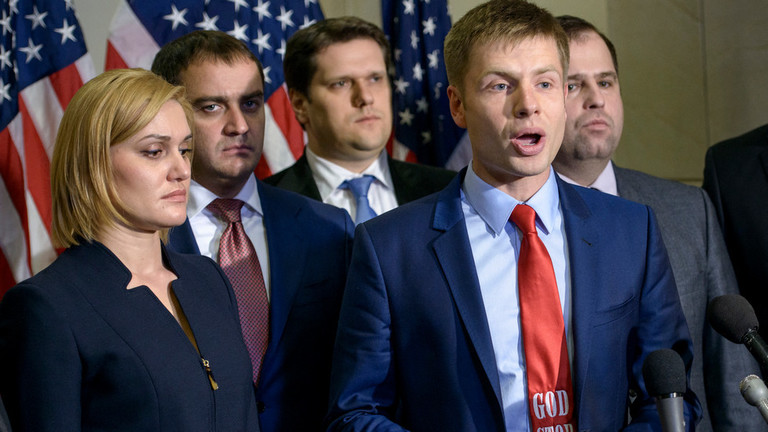
Ukrainian lawmaker Aleksey Goncharenko at a press conference on Capitol Hill on February 5, 2015 in Washington, DC. © AFP PHOTO/BRENDAN SMIALOWSKI
RT | February 24, 2024
Kiev is ready to assist the US in a war against any enemy, be it Iran, North Korea, or China, a senior Ukrainian MP has said, claiming that his country would prove to be a valuable military ally.
In an interview with CNN’s Christiane Amanpour on Friday, Aleksey Goncharenko doubled down on calls for the US to send Ukraine more military aid amid gridlock in Congress. “[The] United States of America told [us that] we will be with you ‘as long as it takes.’ Now it’s time to keep the promises.”
Goncharenko rebuked US politicians for focusing too much on the looming 2024 presidential election, saying Ukraine should not be a “victim” of this. He also claimed that supporting Ukraine serves Washington’s interests regardless of who wins the race for the White House.
In the event of a future war, the Americans “will need people who will stand shoulder to shoulder with them,” but not many nations would be willing to go all-in to support the US, the lawmaker said.
”Ukrainians are ready… We are ready to stand with the United States shoulder-to-shoulder, either in trenches near Tehran, or in North Korea, or near Beijing. No difference,” he stated. “Because we appreciate your support.”
Despite his plea for more Western military aid, Goncharenko argued that Ukraine has “the second strongest army in the free world” after the US, making it “a very valuable ally.”
“But today we need your support to defend our country,” he added, blaming gaps and delays in arms shipments for the loss of the strategic Donbass city of Avdeevka last week. According to the Russian Defense Ministry, the Ukrainian retreat from the heavily fortified city, which was often used as a launching pad to target civilians in Donetsk, turned into a disorganized rout with heavy casualties.
Russian President Vladimir Putin said on Tuesday that the capture of Avdeevka is “certainly a success,” adding that it needs to be advanced further.
Last year, Putin claimed that the Ukrainian government was defending the interests of other countries rather than its own, and that the West was using Kiev as “a battering ram” and a “testing ground” against Russia.
“UKRAINE WILL WIN” | No Amount of Propaganda Can Hide the Fact that Ukraine is Winning this War
Matt Orfalea | February 22, 2024
No Amount of Propaganda Can Hide the Fact that Ukraine is Winning this War video by Orf
Twitter ▶  / 0rf
/ 0rf
Rumble▶https://rumble.com/Orf
Patreon ▶  / orf
/ orf
Substack▶https://substack.com/@MattOrf
Locals▶https://mattorfalea.locals.com
Truth▶https://truthsocial.com/@MattOrf
Minds▶https://www.minds.com/MattOrf
Tips ▶PayPal: https://bit.ly/34OWemi
Selecting Syrsky: The Untold Half of the Zaluzhny Story
By Ted Snider | The Libertarian Institute | February 23, 2024
There were probably many reasons why Ukraine’s President Volodymyr Zelensky fired Ukraine’s popular commander in chief of the armed forces, Valerii Zaluzhny, on February 8, but one of the biggest seems to have been a disagreement over how to go forward in a war that seemed to have overwhelmingly turned against them. Zelensky spoke of a need for “the same vision of the war,” and Zaluzhny said “a decision was made about the need to change approaches and strategy.”
When the war began, Zelensky said that Ukraine “will definitely win” but stressed life over land. “Our land is important, yes, but ultimately it’s just territory.” He said that “Victory is being able to save as many lives as possible. Yes, to save as many lives as possible, because without this nothing would make sense.”
But actions speak louder than words. Zelensky began to define victory as the reclamation, not only of land lost during the war, but of Crimea and all of Ukraine’s pre-2014 territory. Zelensky insisted that Ukraine stay on the offensive. He insisted on moving forward, “Whether it’s by a kilometer or 500 meters, but forward every day.”
Zaluzhny saw Zelensky’s strategy of fighting for Bakhmut and Avdiivka at any cost as a strategic disaster that was costing Ukraine too much in weapons and in lives. Zaluzhny argued for preserving lives over forfeitable territory, lest Ukraine lose its land and its army.
In General Oleksandr Syrsky, Zelensky found the commander who would execute his vision and carry out his orders. Syrsky fought the Battle of Bakhmut. His performance there, and in other battles, gave him the reputation of a commander who is willing to give orders that lead to little real gain and lots of real loss of life. “Some soldiers say his orders are unreasonable, at times sending men to their obvious deaths,” The Washington Post reports. According to The Economist, he “has a reputation for being willing to engage the enemy, even if the cost in men and machines is high.” His reported willingness to put “his men in danger to reach his military goals” has earned him the nicknames “Butcher” and General 200, 200 being the code for a soldier’s corpse. Syrsky is also seen as being a commander who is close to Zelensky and who will not question his orders.
The replacement of Zaluzhny by Syrsky signals Zelensky’s intent to push ahead with the suicidal war of attrition and fight for every inch of land despite the cost in lives.
Aware of the optics of the choice in the public and, perhaps especially in the armed forces, Kiev assuaged the perception of Syrsky as “being indifferent to military casualties.” In his first statement as commander in chief, Syrsky said, “The lives and well-being of our servicemen have always been and remain the main asset of the Ukrainian army.”
But, again, actions speak louder than words. General Syrsky’s first words were about protecting the lives of his men, but his first actions were about fighting for every inch of territory.
On February 11, just three days after the change in command, Syrsky ordered the reinforcement and defence of Avdiivka, a strategic town that faced imminent loss to the Russian army and enormous loss of Ukrainian lives. Zaluzhny would have withdrawn his troops, preserved lives and moved the front to more defensible positions.
Syrsky deployed the 3rd Separate Assault Brigade, one of the best armed and trained and most successful brigades in the Ukrainian Armed Forces.
It did not go well. It went exactly as Zaluzhny said it would, and Syrsky was forced to respond exactly as Zaluzhny had said they should. But now the response was carried out in disarray instead of in an orderly, planned fashion. Perhaps Zelensky should have stuck with Zaluzhny.
In sending in reinforcements instead of retreating, Syrsky said the “goal of our operation is to exhaust the enemy, inflict maximum losses on him.” The opposite happened.
Less than a week later, on February 17, Syrsky announced the withdrawal of Ukrainian troops from Avdiivka. “Based on the operational situation around Avdiyivka, in order to avoid encirclement and preserve the lives and health of servicemen,” he said, “I decided to withdraw our units from the city and move to defense on more favorable lines…The life of military personnel is the highest value.” That’s exactly what Zaluzhny advised Zelensky to do.
But the situation was worse than at first reported. Zaluzhny would have preplanned the retreat and executed it according to a plan. Zelensky and Skysky’s stubbornness turned the already costly loss into a disaster.
CNN at first reported that “Ukrainian forces are currently conducting a relatively controlled withdrawal from Avdiivka.” There were “indications,” though, “that not all Ukrainian units were able to escape an ever-tightening noose.” Though “the withdrawal was carried out in accordance with the plan that had been developed…a number of Ukrainian servicemen were taken prisoner at the final stage of the operation, under pressure from the enemy’s superior forces.”
Three days later, the situation was becoming clearer. Senior Western officials, The New York Times reported, now say that “Hundreds of Ukrainian troops may have been captured by advancing Russian units or disappeared during” what they now call, “Ukraine’s chaotic retreat from the eastern city of Avdiivka.” The Times was now calling it “a devastating loss.”
And hundreds may have been an understatement. Further down in the article, the Times reports that “soldiers with knowledge of Ukraine’s retreat estimated that 850 to 1,000 soldiers appear to have been captured or are unaccounted for.” There are unconfirmed reports of even higher numbers of dead and wounded.
That may not have happened under Zaluzhny, who long ago conceded that Avdiivka would fall and would have preplanned the retreat. Some Ukrainian soldiers and Western officials say “the Ukrainian withdrawal was ill-planned and began too late,” according to the Times. They say that “a failure to execute an orderly withdrawal, and the chaos that unfolded Friday and Saturday as the defenses collapsed, was directly responsible for what appears to be a significant number of soldiers captured.”
Suddenly, the 3rd Separate Assault Brigade was not assaulting but desperately trying “to cover the retreat.” The retreat was chaotic: “…some units pulled back before others were aware of the retreat. That put the units left behind at risk of encirclement by the Russians.”
But the true story may be even worse. Military analyst Stephen Bryen reports that the disaster may have begun before the reinforcements even arrived at Avdiivka. Some of the brigades Syrsky brought in gathered and organized in the nearby town of Selydove. Bryen says the Russian military discovered they were there and struck with missiles. Between 1,000 and 1,500 Ukrainian soldiers were reportedly killed.
Bryen says that when the 3rd Separate Assault Brigade arrived in Avdiivka, they found a desperate situation. They reportedly discarded Syrsky’s orders and retreated. Some reportedly surrendered. Syrsky then announced the troop withdrawal and the fall of Avdiivka.
Zelensky’s choice of Syrsky over Zaluzhny was, in part, the choice to maintain the course of a war of attrition to hold and retake all Ukrainian territory. Syrsky’s first orders fulfilled that choice in Avdiivka. It went exactly as Zaluzhny said it would but worse because Zelensky and Syrsky tried to defy the battlefield reality that Zaluzhny recognized. Perhaps Zelensky should have stuck with Zaluzhny.
Biden and US media lies about Ukraine are reminiscent of Vietnam War – American Conservative
By Ahmed Adel | February 23, 2024
The American Conservative published an article that parallels the Vietnam War, considered the greatest military humiliation in US history, with what they point out is a campaign of deception carried out by the current US Government, which will lead to a defeat for Kiev and NATO.
According to the author James W. Carden, who served as an advisor on US-Russian affairs at the State Department during the Obama administration, the media campaign regarding Ukraine carried out by the White House was a copy of the actions of successive US governments in Vietnam until the Nixon administration withdrew troops and concluded the intervention in 1973. He relates the Vietnam War with the lies with which President Joe Biden and his collaborators have tried to deceive citizens about the progress of the Ukraine conflict and its origin, among other issues.
These false narratives, the article notes, have been put in place and presented to Americans with the help of the “most dutiful accomplices,” such as the New York Times and the Washington Post, media outlets that, until recent times, published the triumphalist comments of Biden and his administration without any type of questioning, in addition to analysis columns where Russian President Vladimir Putin was demonised and falsely stated that Ukraine was on its way to victory.
This falsification of reality, in which all the complexity of the conflict was eliminated, and the responsibility of the US and NATO in inciting it, was omitted. Instead, they presented the war as a simple confrontation between good and evil, which is similar to the deception that Washington and the establishment media consummated in the 1960s to justify the US invasion of Vietnam, the article states.
Now, notes The American Conservative, as it is “too obvious to ignore” that Russian troops are prevailing in Ukraine, the American media is finally realising what is really happening on the battlefield after having helped prolong the conflict with their lies.
“If we are being lied to about the progress of the war—and we are—what do you suppose are the odds we are also being lied to about the causes of the war?” the author questions.
For US politicians and journalists, the expansion of NATO, Ukraine’s post-Euromaidan nationalist agenda, the refusal to implement the Minsk Agreements, or threats by Ukrainian President Volodymyr Zelensky made in Munich in February 2022 to acquire nuclear weapons had nothing to do with the outbreak of war, the article ironically states.
“If we are being lied to about the causes of the war, are we also then being misled about what is at stake in eastern Ukraine? Probably. Here the parallel with the government’s mendacity during the war in Vietnam period becomes too obvious to ignore,” Carden continues.
“Recall in the first case that the template, that of the Cold War, is essentially unchanged, even in some of the particulars, not least in the comparisons of (the Vietnamese anti-communist leader) Ngo Dinh Diem and Volodymyr Zelensky to Winston Churchill. The South Vietnamese government (avaricious, corrupt) had the right to American arms by virtue of its right ‘to determine [the nation’s] future,’ the article says, recalling the argument used by the US to justify its war against North Vietnam, which was part of its global operation against what Washington perceived as an expansion of communism that could threaten its interests and hegemony.
The same thing is happening now with Ukraine: President Biden publicly justifies launching a proxy war with Russia with the excuse that it is necessary to stop Moscow, once again invoking the theory of the domino effect, the long-discredited thesis that drove the US interventionist policy during the second half of the 20th century.
Following the publication of the Pentagon Papers in 1971, the philosopher Hannah Arendt observed during the Vietnam War era that “the policy of lying was hardly ever aimed at the enemy… but was destined chiefly if not exclusively, for domestic consumption, for propaganda at home and especially for the purpose of deceiving Congress,” Carden warns.
He concludes his article by saying: “Two years on, we citizens have been serially lied to by the Biden administration and the media about the war’s causes, its stakes, and its progress. The question that should, but of course will not, be addressed in the aftermath of this latest American misadventure abroad is: Will we ever learn?”
Ahmed Adel is a Cairo-based geopolitics and political economy researcher.
The Black Sea Straits: Turkey balances between the US and Russia
By Alexandr Svaranc – New Eastern Outlook – 22.02.2024
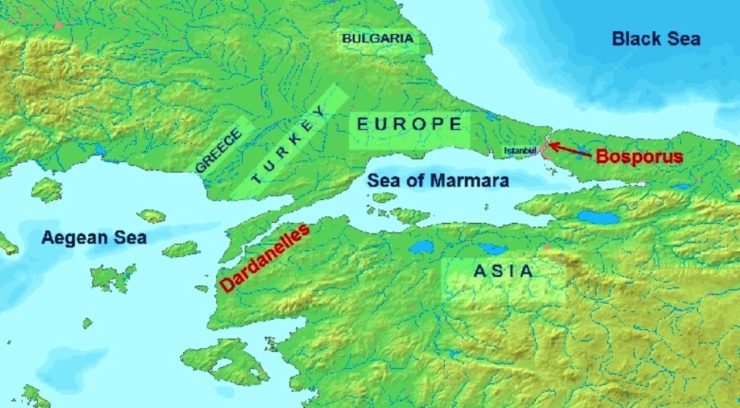
The territory of modern Turkey has economic-geographical and military-strategic advantages due to its control over the Black Sea Straits of Bosporus and Dardanelles. Control of the Black Sea Straits has always been strategically important to the great powers in world geopolitics and trade.
Great Britain and Russia often clashed over the right to control the Straits. In August 1914, German ships, including the cruiser Goeben and light cruiser Breslau, attacked Russian ports after passing through the Black Sea Straits. This led to the Ottoman Empire joining World War I on the side of Germany against Russia. One of the tasks of the Nazi German Ambassador to Ankara, Franz von Papen, in the late 1930s was to obtain Turkish consent for the passage of German ships through the Straits to the Black Sea to participate in the war against the USSR. Stalin later described Turkey’s policy during World War II as “hostile neutrality.”
In the 19th century, Russia’s successful wars against the Ottoman Empire enabled Russian control over the Black Sea Straits. However, Emperor Nicholas I of Russia, for some reason, decided to let in Britain and France in resolving the fate of the regime of shipping in the Black Sea Straits, while this issue could have become a subject of relations between solely Russia and Ottoman Turkey.
As a result, on July 3, 1841, the Straits Convention was signed in London, with the consent of the Russian Tsar, between Turkey, on the one hand, and Russia, Great Britain, Austria, Prussia, and France, on the other. It stipulated that as long as Turkey was not at war, the Straits would be closed to military ships of any nation. During the war, Turkey was granted the right to let ships through the Straits belonging to states with which it wished to reach an agreement. The London Straits Convention in fact buried the decisions of the Russian-Turkish Treaty of Hünkâr İskelesi of 1833, according to the secret articles of which Turkey undertook not to allow warships of any European countries to enter the Black Sea. Russia’s political and military positions have been significantly strengthened by the latter.
Following the results of the First World War, the Versailles Conference of the victorious countries again returned to the topic of the Black Sea straits, which continued with long negotiations, sharp discussions and ended with the signing of the Treaty of Lausanne on July 24, 1923, based on a project of Great Britain. The representatives of the Soviet delegation were actually blocked, and the head of the Russian delegation, Vatslav Vorovsky, was not even officially informed about the resumption of the conference and was not allowed to take part in the negotiations (on May 10, 1923, Vorovsky was assassinated in Lausanne by Russian White émigré named Maurice Conradi).
The Lausanne Treaty was signed between Great Britain, France, Italy, Japan, Greece, Romania, Bulgaria, the Kingdom of Serbs, Croats and Slovenes and Turkey. The USSR did not ratify the convention because its terms violated legal rights and did not guarantee the security of Black Sea countries. In particular, this convention provided for the demilitarization of the Straits Zone, with the Straits themselves coming under the control of a special international commission. In other words, the right to station military units near the straits was taken away from Turkey, through whose territory the straits passed. Simultaneously, all commercial and military vessels from any country in the world were granted free passage through the Bosporus and Dardanelles, with only minor restrictions. The latter created problems for the Black Sea countries, especially for the main Black Sea powers – Turkey and Russia.
The events of 1936 in Spain, the growth of Fascist militarism in Italy and Germany reopened the issue of the Black Sea Straits. Britain was concerned about losing control over Turkey, its naval bases, and its broad interests in the Mediterranean and the Arab East, including the restoration of the German-Turkish alliance. Therefore, London considered it appropriate to make concessions to Ankara on the issue of changing the regime of the Black Sea Straits and replacing the International Special Commission with Turkish control, including the abolition of Turkey’s demilitarization in the Straits Zone.
Consequently, following months of discussions, a new convention on the Black Sea Straits regime was signed on July 20, 1936, in the Swiss city of Montreux. This convention is seen as a compromise in international practice. In times of peace and war, merchant ships of all nations were granted the right of free passage through the Straits. Warships of non-Black Sea states are restricted in transit through the Bosporus and Dardanelles by class, total tonnage, total number and period of stay in the Black Sea not exceeding three weeks. In the case of Turkey’s taking part in a war, and if Turkey considers itself directly threatened by war, it is given the right to authorize or prohibit the passage of military ships through the Straits. Accordingly, the demilitarization regime was abolished, and Turkey was granted the right to station its military garrisons in the Straits Zone. The USSR’s demands for limitations on the military presence of non-littoral states in the Black Sea were mostly taken into account. London and Paris obtained the right to adjust the ratio of naval forces between Turkey and the USSR in the Black Sea.
Overall, the Montreux Convention can be viewed as a compromise that helped stabilize the situation in the Straits Zone. The Convention has been extended twice for 20 years. It remains in force as of now. The issue of the Black Sea Straits is currently being discussed in international diplomacy. This is especially true in times of crisis, when relations between major Black Sea countries, such as Russia and Turkey, become contentious.
With the start of the Russian Special Military Operations in Ukraine, hostilities have been resumed in the Black Sea basin waters. The Collective West, led by the United States, is attempting to alter the international legal norms that regulate the passage of warships through the Bosporus and Dardanelles.
According to US Assistant Secretary of Defense for International Security Affairs Celeste Wallander, Washington plans to collaborate with Ankara regarding shipping in the Black Sea. The Pentagon spokesperson emphasized the need to create a favorable environment in the region, ensuring that the Black Sea is fully accessible for commercial shipping.
Meanwhile, the United States is attempting to use merchant shipping as a cover to alter the regulations for the passage of non-Black Sea NATO warships through the Dardanelles and Bosporus to the Black Sea. For this purpose, the Black Sea Grain Initiative became a convenient opportunity.
The United States and the United Kingdom assert that Russia’s decision to withdraw from the agreement violates international humanitarian law. They propose the formation of an operational group under the convoy of NATO air and naval forces to transport Ukrainian grain through the Straits to foreign markets.
Retired US Navy Admiral James Stavridis announced in July 2023 that a convoy would be created under the control of the United States or NATO. A year earlier, The Wall Street Journal reported that Joe Biden Administration was considering new rules for the passage and navigation of warships in the Black Sea. The North Atlantic Alliance plans to deploy more military aircraft and ships to the Black Sea, according to NATO Secretary General Jens Stoltenberg.
In November 2023, US Congressmen Mike Rogers and Mike Turner urged President Joe Biden to deploy US military forces in the Black Sea to provide military support to Ukraine. Meanwhile, Commander Brian Harrington of the US Navy stated that conducting military exercises outside the scope of the Montreux Convention would undermine Russia’s dominance in the Black Sea. Perhaps these appeals and statements are intended more for the Turkish president.
The British and Norwegians have initiated a program to enhance Ukraine’s capabilities in the Black Sea. However, Turkey refused to allow two Sandown-class minehunters which were conditionally transferred by Great Britain to the Ukrainian Navy in June 2021, to pass through the Bosporus. According to Article 19 of the Montreux Convention, Turkey considers the ships of Russia and Ukraine as belonging to belligerent powers and therefore, they are not permitted to pass through the Black Sea Straits. London officials attempted to pressure Ankara, but were unsuccessful.
As for the warships of the US and other extra-regional countries that used to regularly enter the Black Sea using the right of peaceful passage, Turkey has announced within NATO that it will not allow naval exercises or visits for other purposes as long as the conflict continues. Ankara argues that violating the provisions of the Montreux Convention in the current situation will inevitably trigger retaliatory actions by the Russian Navy, leading to a new military escalation. Despite the dissatisfaction of NATO allies with Turkey’s position, Ankara does not intend to change it, showing the firmness and stubbornness typical of Turks.
The Montreux Convention does not allow the unimpeded passage of warships of non-littoral states in the Black Sea. However, after the collapse of the USSR and the Warsaw Pact, NATO gained an advantage in the Black Sea. In other words, prior to 1991, all Black Sea countries except for NATO’s Turkey were members of the Warsaw Pact and allies. Right now, the situation in the Black Sea is reversed. Namely, Russia on the one hand and NATO members Turkey, Bulgaria, Romania and the North Atlantic Alliance candidates Georgia and Ukraine on the other.
The US is not a signatory to the Montreux Convention at all and can therefore afford to violate its terms. Every five years since the signing of this convention in 1936, changes to its provisions may be proposed, provided that the initiative is supported by a two-thirds vote of the Montreux signatories. However, currently, all signatory countries except Russia are NATO members, and Japan and Australia are strategic partners or allies of the United States.
In this situation, Turkey’s opinion remains key as it still holds the role of “host of the Straits” under the Montreux Convention and maintains an independent policy. A change in the provisions of the convention would be a change in Turkey’s own status quo in the region. This is obviously not what Ankara wants. Crimea is now under Russian control, which could pose a threat to the same straits.
Russian Foreign Minister Sergey Lavrov stated that the Turkish authorities will not change the rules of entrance in the Black Sea for NATO warships under Pentagon’s pressure. However, Russia cannot rely on Turkey’s guarantees forever, as Ankara has shown a willingness to make sudden political reversals.
The US and Turkey are discussing the issue of closing the Bosporus to Russian warships, according to Iranian journalist Hayal Muadzin. In particular, there is information circulating that the US has offered to cede some areas in northern Syria, apparently Kurdish-populated provinces, to Turkey as a gift to Recep Tayyip Erdoğan, in exchange for active cooperation against Russia in the Black Sea.
In January, Turkey ratified Sweden’s NATO status in exchange for the delivery of 40 modernized F-16 fighter jets from the US. Washington is prepared to address the matter of F-16 Block 70 fighter jets for Turkey. Additionally, Deputy Secretary of State Victoria Nuland stated in Ankara that the US is willing to involve Turkey in the production program of fifth-generation F-35 fighter jets and provide them with a Patriot air defense system. This offer is contingent upon Turkey’s refusal to use the Russian S-400 Triumf SAM system. The Americans may be willing to provide soft loans to support the struggling Turkish economy, but only if Turkey refrains from actively cooperating with Russia in trade and economic matters and strictly adheres to the sanctions regime.
It is evident that Turkey faces numerous temptations. However, Recep Tayyip Erdoğan is aware that excessive improvisation towards Russia could jeopardize Turkey’s Great Turan project and its access to Azerbaijan and Turkic countries in Central Asia through the Zangezur corridor. For the time being, therefore, Ankara is trying to keep the “Russian side” of the fence. Turkey refuses to revise the provisions of the Montreux Convention in exchange for the “Swedish case.”
Turkish Foreign Minister Hakan Fidan confirmed that Ankara will continue to use the Montreux convention and stated that it is not up for debate. With the outbreak of the crisis in Ukraine, Turkey exercised its powers under the Montreux Convention and prohibited the passage of warships through the Black Sea Straits. The Turkish Defense Ministry aims to prevent further escalation of military tensions in the Black Sea basin, especially in the Straits area. The Straits pose not only an economic issue for Turkey, but also a security concern. Ankara has the right to charge for the passage of ships through the Bosporus and Dardanelles, which covers expenses for lighthouses, evacuation, and medical care.
In the rapidly evolving situation of the Ukrainian conflict, it is crucial for the Turks to maintain their key positions. There is a domestic political consensus on this issue: the provisions of the Straits Convention must remain unchanged. Turkey’s accession to Western sanctions against Russia is inadmissible; otherwise, Turkey will lose the opportunity to play a mediating role.
Scholz and Lackeys Dig Grave for Germany
By Finian Cunningham | Strategic Culture Foundation | February 21, 2024
They say a picture paints a thousand words, and the one showing Chancellor Olaf Scholz with a shovel in hand merrily digging at the earth speaks volumes about the way he is burying Germany’s economy.
Not just Scholz. The entire coalition government in Berlin is betraying the German people, like satraps for a foreign colonial power. That colonial power is the United States which has occupied Germany with its troops and nuclear weapons for eight decades.
How can the German political class be so abjectly servile and treacherous? Simple. They don’t see it like that. They are so brainwashed by Russophobia and Western imperial arrogance, their pathetic actions are “natural”.
Dressed like an undertaker, Scholz was photographed ceremonially laying the foundations for a new armament factory in Lower Saxony belonging to Rheinmetall, the second German military manufacturer.
Accompanying him was Defense Minister Boris Pistorius who last weekend told the Munich Security Conference that Germany’s military spending should double over the next decade.
This is while the German economy is mired in recession and German workers and their families are struggling to make ends meet. The once mighty German economy, the engine for the whole European Union, is now referred to as “the sick man of Europe”. The way things are going under Scholz’s coalition government, the sick man will soon be dead and buried.
It’s astounding to fathom the self-harm being inflicted by Scholz and his administration. Polls show huge popular dissatisfaction. His Social Democrat Party is hemorrhaging votes as the recent Berlin federal election re-run attested.
The German economy is tanking in large part due to spiking energy costs that have resulted from Berlin toeing the United States’ line of cutting off Russian oil and gas supplies.
German farmers like farmers all across Europe are in uproar over crippling energy bills. They are also incensed by the influx of cheap agricultural produce from Ukraine that the Scholz government has permitted the EU to oversee out of pro-war support for the Ukrainian regime.
Scholz and his ministers are turning Germany into a war-time economy. All sectors of the economy are being cut except military production.
At the foundation-laying ceremony for the new Rheinmetall production plant, the event was televised for the German public. Scholz and Pistorius seem to think they are performing heroic service for the good of the nation. Their delusional disconnect with reality and ordinary Germans’ hardships is truly shocking. The insanity is frightening.
Pistorius and German military commanders have been warning the public that the country might be at war against Russia in the next five to eight years. Such unhinged war rhetoric is the height of irresponsibility. It is criminal.
Russian President Vladimir Putin and other Russian leaders have repeatedly stated that they do not want conflict or war with Europe. The Ukraine conflict is a specific problem of a U.S.-led NATO proxy war.
Still, the febrile warmongering that has taken hold of the German political class and the rest of Europe is awesome. Entire national economies are being organized on a war footing.
The notion that Russia is preparing to attack Germany or some other NATO member after it knocks out the NeoNazi regime in Ukraine is wild fantasy to most rational people. But to brainwashed, Russophobic politicians in Berlin (and across the EU generally) such fear-mongering is entertained as reality.
Last week, Scholz hosted the money-grubbing Ukrainian conman president Vladimir Zelensky in Berlin. Zelensky’s regime has lost the NATO proxy war against Russia despite some €200 billion in support and weapons funneled to his corrupt regime over the past two years.
Yet Scholz just signed a bilateral national security pact between Germany and Ukraine. (Britain and France have also signed such pacts.)
As reported on the German pact: “The deal also says that should Ukraine ever be attacked again by Russia, Germany would support the country with swift and sustained security assistance including modern military equipment across all domains.”
What does it mean “should Ukraine ever be attacked again by Russia”? How ridiculous. Russia is at war in Ukraine. The German leaders are foolishly or recklessly signing a warrant for their open entry to war.
How rapidly Berlin has descended into madness. Recall two years ago when Russian forces intervened in Ukraine to quell the NATO proxy war in that country, Berlin was mocked for its caution in only sending “helmets” to aid the Ukraine regime. Two years later, Berlin is sending Leopard tanks, howitzers, and Iris-T missiles. It is now planning to supply long-range Taurus cruise missiles to a regime that has no qualms about bombing Russian civilian centers.
In announcing the latest security pact (war pact) with Ukraine, Scholz bragged that Germany is Europe’s biggest supporter of the Kiev regime.
Berlin has committed to €28 billion in military support for Ukraine, far outstripping the aid from Britain and France. Germany is second only to the United States in the amount of military and financial support it has funneled to Zelensky and his NeoNazi junta.
So much for German prudence and technical efficiency. Berlin is throwing good money down the drain on a war that is being lost badly to Russia with Ukrainian military deaths exceeding 500,000. And yet the wasting of public money keeps on going under Scholz and his loser administration.
The United States covertly sabotaged Germany’s economy by blowing up the Nord Stream gas pipelines from Russia. And Berlin says nothing.
Germany’s industrial base and export-led revenues are decimated by following the U.S. and NATO long-time mission statement of “keeping the Germans down, the Russians out and the Americans in”. And Berlin says nothing.
Scholz and his fellow vassals in government are betraying German national well-being and driving the country to another disastrous war against the Russian people – only 80 years after the last one in which tens of millions were slaughtered.
This betrayal is not just happening in Germany. The entire European Union under the appalling misdirection of former German defense minister Ursula von der Leyen (a scion of a Nazi family) is sacrificing generations of civilians to a dead-end war economy – all driven by Russophobia and total subservience to U.S.-led Western imperialism.
All these pathetic lackeys are digging a grave for Europe – unless citizens rise up against the audacious betrayal by their elites.
Featured Video

EUROPE FEARS RUSSIA’S NEXT MOVE / Ian Proud
or go to
Aletho News Archives – Video-Images
New Book
New Book: No Autoimmunity The Body Doesn’t Attack Itself
Lies are Unbekoming | September 24, 2026
 The label for Humira, once the best-selling drug in the world, lists its risks in plain print. One of them, in the label’s own words, is new “autoimmune” disease.
A drug prescribed for a condition labelled autoimmune carries a warning that it can cause a condition labelled autoimmune. That contradiction sits in every box, on a folded paper almost nobody reads.
My new book starts there.
No Autoimmunity: The Body Doesn’t Attack Itself
For seventy years, “your body is attacking itself, and we don’t know why” has ended the conversation for people diagnosed with multiple sclerosis, lupus, rheumatoid arthritis, Hashimoto’s, Type 1 diabetes, Crohn’s and psoriasis. More than eighty conditions now carry the autoimmune label. The diagnosis comes with a prescription for life. It almost never comes with a question about cause.
This book asks the question and answers it from the framework’s own records: its drug labels, its journals, its regulatory filings, and its own experiments. … continue
Blog Roll
 Aletho News
- Europe was part of the infrastructure of US aggression against Iran: Deputy FM
- New evidence on the Bucha Massacre
- Italy and France debunk reports CIA issued ‘Russian drone threat’ warning
- How Russia is Rewiring the Global South
- Britain’s elites want you ready to die for a war they keep imagining
- Inside Ukraine’s propaganda operation targeting Americans
- Hackers From US, France, Singapore Tried to Disrupt Russian Elections – Internet Provider
- New Book: No Autoimmunity The Body Doesn’t Attack Itself
- EUROPE FEARS RUSSIA’S NEXT MOVE / Ian Proud
- Big tech hands in its DSA censorship reports to the EU
- If Americans Knew
- ‘Protecting U.S. Citizens’… From Israel
- ‘This is where I live now, the back of a truck’: a day in the life of a grandmother in Gaza
- In UN Speech, Iran’s President Displays Pictures of Children Killed by US, Brings Attention to Israel’s Nuclear Arsenal
- Israel displaces hundreds of Palestinians amid wave of demolitions in West Bank
- Aid, reconstruction, and Israel’s history of obstruction in Gaza
- Trump administration digs an ever-deeper hole of complicity in genocide – Daily Update
- US-Israel $2.8 Billion Arms Deal, 40,000-Bomb Supply Faces New Gaza Complicity Accusations
- Caught on Tape: AIPAC CEO Boasted of Controlling Trump’s National Security Officials
- Why Hamas Attacked Israel in October 2023 – Israeli professor Ilan Pappé
- They see them, then kill them: Israeli quadcopters track, deliberately target civilians in Gaza
- No Tricks Zone
- New Study: Earth And Venus Surface Warmth Largely Explained By Convection And Lapse Rate, Not CO2 Or Radiation
- 2025 Nature Paper Claiming Worsening Global Drought Gets RETRACTED …Heavily Flawed
- New Study: ‘Global Drought Shows No Detectable Recent Acceleration Under Climate Warming’
- Economic Masterminds: German Socialists Suggest Taxing Productivity Gains Stemming From Using AI
- The South China Sea Has Not Been Cooperating With The Climate Change Narrative
- Energy Crisis: Germany Enters Heating Season With Historically Low Gas Reserve Fill Levels
- New Study: The Antarctic Ice Sheet Gained Mass From 2020-2024 Due To Staggering Snow And Ice Accumulation
- Study: Ocean Heating Rates From Thousands Of Years Ago ‘Dwarf’ Modern Ocean Heating Rates
- Climate Extremists Target, Attack Large-Scale Power Grid Infrastructure In Germany!
- New Study: Antarctic Ice Melt Has Contributed Less Than 1 Centimeter To Sea Level Rise In The Last 30 Years

