Ukraine’s Corruption has Poisoned America
By Brad Pearce | The Libertarian Institute | February 21, 2024
The U.S. Congress is working towards a bill which would fund Ukraine into 2025. This, of course, is into the next presidential term. As Senator JD Vance recently explained to Tucker Carlson, the idea behind this is that if Donald Trump is again elected it will obligate him to continue supporting Ukraine and bring about an opportunity to impeach him if he does not.
Many have wondered why the U.S. political class is so obsessed with Ukraine, but I believe the answer is simple: money. I used to have a relatively elegant theory of NATO’s grand strategy, developed over a long period of observation, regarding the geopolitics of containing Russia’s sea access. However, since the outlandish and forgotten “Hunter Biden funded biolabs in Ukraine” story of early 2022, something different has become clear: our political class has been driven mad by the wages of corruption in Ukraine. When you look at the way that one ramshackle country has driven our politics both foreign and domestic, it is perhaps a defining feature of our era.
After the fall of the Soviet Union, the former Soviet states, already poor from the collapse of communism, became what many have described as a sort of neoliberal hell, with state resources looted by newly wealthy oligarchs and sold to the West for pennies on the dollar. It is generally considered that Russia began to emerge from this as the time Putin took power and confronted some of the oligarchs who then fled the country—seemingly his original sin with the Western powers.
Though Russia remained corrupt, it has still shown a lot of economic growth, whereas corruption has absolutely crippled post-Soviet Ukraine. It was fake concerns about corruption that led the United States to support the so-called “Orange Revolution” of 2004 in Ukraine. However, more cynical observers know such actions are thin excuses for Western governments and financial interests to send hordes of attendants described as employees of “NGOs” to pick a country apart, prevent independent government, and ensure the enormous flow of funds in both directions. Though many genuine experts as well as the conventional wisdom knew it was treacherous for the United States to get involved in Ukraine because of the country’s historic, cultural, and economic ties to Russia, the opportunities for graft were too great to be resisted.
When the United States promoted the “Maidan Revolution” in 2014, they were able to remove a corrupt, pro-Russian president and replace him with a genuine oligarch willing to sell the country to the West. At this point, any sense of caution had completely gone out the window. There was a determination to pull Ukraine out of Russia’s orbit despite Barack Obama’s later admission that Ukraine would always be a core interest to Russia but not the United States.
The late Justin Raimondo wrote a 2017 article entitled, “Adam Schiff: Grifter, Racketeer, Warmonger” which gives unique insight into what has consumed our political class. In a feat of blatant corruption, Congressman Schiff of California had a fundraiser hosted at the house of a Ukrainian-born arms dealer, and then proceeded to call everyone who didn’t want the U.S. taxpayer to buy that guy’s equipment and send it to Ukraine a traitor. This didn’t even become a scandal: as far as I know, only Raimondo even noticed.
The Russiagate hoax which defined much of Trump’s term was when things became even more egregious. Many remember that long-time Trump associate Paul Manafort ultimately went to prison, in part relating to his lobbying for a Ukrainian political party. Fewer remember that the Podesta Group, those reliable Democrat courtiers, also had to shut down over the same thing. In both instances, those men were lobbying for groups seen as “Pro-Russian,” which is to say, both Republicans and Democrats have been profiting off of both factions in Ukraine. Then, of course, there was Trump’s phone call with Volodymyr Zelensky, where he asked him to investigate Hunter Biden’s activities in the country. Trump was impeached over the premise that he threatened to shut off the aid bonanza; even if it was untoward to bring it up regarding the son of a political rival, cooperating on international corruption cases is the sort of thing which governments commonly do.
The broader Hunter Biden scandal is what really showcases the extent to which corruption associated with Ukraine has poisoned our domestic politics for at least ten years. Note that Hunter’s business partner was John Kerry’s stepson, and that family members of the political class and retired politicians commonly do these things. We just learned about Hunter’s activities because he happens to be a whoremongering crackhead. Joe Biden, of course, bragged about getting an anti-corruption prosecutor in Ukraine fired, directly tying this to their receipt of foreign aid, something much more blatant than Trump’s phone call.
What is more notable is the Hunter Biden biolabs story, which I called “The Mother of All Conspiracy Theories” at the time. Everything was wrong with what was going on there, perhaps most of all that these lunatics couldn’t help but to fund biolabs right near the Russian border while constantly convincing us the whole region was under threat. What else have we still not learned about what our political class has done in this impoverished and deeply corrupt country which has now haunted three consecutive presidencies?
The journalist Lily Lynch recently highlighted an incredible passage that Zbigniew Brzezinski, one of the most important architects of American power, wrote in his 1998 book The Grand Chessboard. He warned that the biggest fear of the United States should be that Russia, China, and perhaps Iran, form a sort of “antihegemonic” grand coalition based on “complementary grievances” against the United States. He said that no matter how remote this possibility is, our country must display geostrategic skill in Eastern Europe to prevent this from happening. Of course, through extraordinary efforts, our foreign policy class has managed to bring about the exact scenario which Brzenziski feared, despite viewing it as “remote.”
Incompetence doesn’t cover the series of decisions which brought us here, and neither does some grand strategy which is not working out. What has happened is that our rulers saw the perfect morass of corruption in Ukraine and waded in. Ukraine proved an incredible racket where they got paid in Ukraine to lobby for U.S. funding and profit off of the acquisitions in the United States, and then profit off of the corrupt misdirection of the funds and materials when the “aid” arrived in Ukraine. By racketeering, they have burnt the candle at both ends, and it seems that in no time it shall run out of wax and burn everything to the ground.
But damn has it been a good grift, if you were able to get in on it.
Euromaidan Was Part of West’s Proxy War Against Russia – CIA Veteran
By Ekaterina Blinova – Sputnik – 21.02.2024
Exactly ten years ago, former President Viktor Yanukovych signed an agreement with the Euromaidan opposition to resolve the political crisis in Ukraine. The very next day, the opposition tore up the agreement and seized power by force.
Months of Euromaidan riots ended with Ukrainian President Viktor Yanukovych agreeing to reform the constitution, form a “government of national unity,” and hold early elections in December 2014. The then-Ukrainian president also agreed to pardon rioters and launch investigations into violent acts by law enforcement officials.
Although the agreement guaranteed by the EU powers appeared to be solid, it barely lasted 24 hours: on February 22, 2014, the buildings of the presidential administration, the Verkhovna Rada, and the Cabinet of Ministers were seized by violent protesters. The Maidan leaders appointed Oleksandr Turchynov as head of the Verkhovna Rada in violation of the country’s constitution, effectively ousting Yanukovych.
Speaking to US journalist Tucker Carlson on February 9, 2024, President Putin insisted that the coup was “unnecessary” because Yanukovych had agreed to meet the demands of the Maidan leaders.
Yanukovych went on the air from Kharkiv on February 22, 2014, and insisted that he would not resign: “I am a legally elected president. What is happening is fragrant vandalism and banditry and a coup d’etat,” he said.
Nonetheless, EU leaders openly signaled that they would work with the “new government” of Ukraine, thus destroying the agreements they had previously supported.
Real Puppeteers Were American Policy-Makers
“Officially the opposition was backed primarily by Europeans,” Russian President Vladimir Putin said in an interview for a documentary “Crimea: Way Back Home” in March 2015. “But we knew perfectly well that the real puppeteers pulling the strings were our American partners and friends.”
In early February 2014, a conversation between individuals believed to be then-US Assistant Secretary of State Victoria Nuland and then-US Ambassador to Ukraine Geoffrey Pyatt discussing the future composition of the Ukrainian government was leaked online. They talked about bringing opposition leader Arseniy Yatsenyuk to power, while keeping Tyahnybok and Klitchko “outside”. In a passage that caused embarrassment to Washington, Nuland was heard to dismiss European partners with the phrase “F**k the EU.”
The scenario described in the leaked conversation came to fruition the same month: on February 27, 2014, Yatsenyuk was appointed as the Ukrainian prime minister. Klitschko was sworn in as mayor of Kiev on June 5, 2014. Tyahnybok stayed out of the de facto Ukrainian government but nonetheless visited the White House and met with then Vice President Joe Biden.
Russia Was the Target
In the wake of the coup, the Ukrainian junta resorted to brutal persecution of their political opponents, promoting an openly Russophobic agenda, and launched nothing short of a war on Donbass civilians who did not accept the illegitimate ouster of Yanukovych.
However, the real target of the US-backed regime change in Kiev was Russia, according to Larry Johnson, a retired CIA intelligence officer and State Department official.
“What I think really, what it boils down to is that the West had simply decided that they wanted to take Russia,” Johnson told Sputnik. “At the core of it, they were looking for a long term strategy to isolate Russia. And the key to this was to get Ukraine into the western camp, to bring Ukraine into NATO, to bring Ukraine into the EU, and therefore to completely isolate, at least they thought they could isolate Russia. Because I think at least there was some recognition in some of the government circles that Russia has enormous wealth, natural resources. And it’s better for us to have it than for Russia to have it. I think it was the attitude.”
How Euromaidan Triggered Ukraine’s Nine-Year War on Donbass
The CIA veteran drew attention to the fact that the Euromaidan coup d’etat “ignited a civil war in Ukraine” and “ended up elevating Ukraine into a frontline priority” for the West.
“So prior to 2014, you didn’t get a lot of NATO exercises, featuring Ukraine. After 2014 Ukraine, even though it was not a formal member of NATO, was regularly featured in these joint annual exercises and that meant that Ukraine then became a proxy for a Cold War,” Johnson said.
“It became a proxy for the West to fight against Russia. And I think that’s why they were slowly building up Ukraine. The annual training was one thing, but also there was the desire, you know, persistent request to send more weapons to Ukraine. Again with nobody sitting back and saying, why? What are we trying to do? They tried to create the myth that it’s Russia that’s trying to attack Ukraine,” the former CIA veteran continued.
For its part, Russia made efforts to stop the bloodshed in Donbass through the 2014 and 2015 Minsk Agreements. The accords envisaged cessation of hostilities, withdrawal of heavy weapons from the front line, release of prisoners of war, and a constitutional reform in Ukraine to grant self-governance to breakaway Donetsk and Lugansk People’s Republics.
However, in 2022 former German Chancellor Angela Merkel and ex-French President Francois Hollande admitted that the Minsk Agreements were seen by the West as an opportunity to arm and train the Ukrainian Army.
For his part, Ukrainian President Volodymyr Zelensky acknowledged in an interview with Spiegel in February 2023 that he actually had not been intended to observe the Minsk accords and informed his European counterparts about that. So, the accords were thrown down the drain in the same manner the Ukrainian opposition and the West shredded agreements with Yanukovych on February 22, 2014.
Hostilities Could be Stopped Many Times, West Just Didn’t Want to Do It
There were plenty of opportunities to avoid armed conflicts in Ukraine, highlighted Johnson.
“I mean, all the United States had to do is to say look, we’re not going to expand NATO into Ukraine,” the CIA veteran said. “We will cease conducting annual military exercises with Ukraine. And let’s reopen talks about reigniting the Anti-Ballistic Missile Treaty and the Intermediate Nuclear Force Treaty, the INF. And let’s begin looking at ways that we can cooperate and work together. But no, it was you know, the threats about the Nord Stream pipeline, for example, that had evolved.”
Russia has always been open to negotiations, President Vladimir Putin told the press on February 20, during a meeting with Defense Minister Sergey Shoigu.
Moscow maintained dialogue with the governments of Poroshenko and Zelensky to implement the Minsk Agreements in order to respect the rights of Ukraine’s Russian-speakers while at the same time preserving the nation’s territorial integrity.
It remains neglected by the Western mainstream press that before launching the special military operation to demilitarize and de-Nazify Ukraine Moscow sought to conclude agreements with the US and NATO to ensure common European security. The draft agreements which envisaged NATO’s guarantees of eastward non-expansion and Ukraine’s neutral status were snubbed by Washington, Brussels and NATO leadership.
Just a month after the beginning of the special military operation, Russian and Ukrainian representatives inked preliminary peace agreements in Istanbul in March 2022. Davyd Arakhamia, who headed the Ukrainian delegation during the March 2022 Istanbul talks with Russia, told Ukrainian broadcaster 1+1 in November 2023 that Moscow was ready to end the conflict if Ukraine committed to neutrality and refused to join NATO. However, it was then-UK Prime Minister Boris Johnson who encouraged President Volodymyr Zelensky to pick the battle and fight to the bitter end, the Ukrainian politician said.
“When we returned from Istanbul, Boris Johnson came to Kiev and said: ‘We won’t sign anything with them at all, and let’s just fight’,” Arakhamia recalled.
However, ex-PM Johnson was not alone in derailing the deal. “This war will be won on the battlefield,” European Union top diplomat Josep Borrell tweeted in April 2022, pledging hundreds of millions of euros for Kiev.
The same month, US Secretary of Defense Lloyd Austin claimed that Washington wanted to see “Russia weakened to the degree that it can’t do the kinds of things that it has done” in launching the special military operation. The US has spent over $100 billion in support for Ukraine’s military effort since then.
“The Western governments don’t want anything good to happen to Russia. They’re not willing to do anything to improve the lives of the Russian people. In my view, it’s genuine evil. And I’m watching this horrific policy that’s implemented by my government and there’s going to be an accounting someday. This is wrong,” the CIA veteran said.
“You know, I could understand it if this had happened 40 years ago when the Soviet Union with the ideology of communism, of Marx and Lenin was dominant. And the attempt to, you know, destroy churches and exclude religion, if that was the case, so, okay, I can understand religious people wanting to rise up and throw that off, but that’s not the case. It’s just the opposite. What we’ve got going on in Ukraine is almost, it’s demonic. It’s satanic. They literally embrace anti-Christian views under the guise of being Christian,” Larry Johnson concluded.
Tucker Carlson Says Boris Johnson Wants $1Mln to Discuss Ukraine Conflict
Sputnik – 21.02.2024
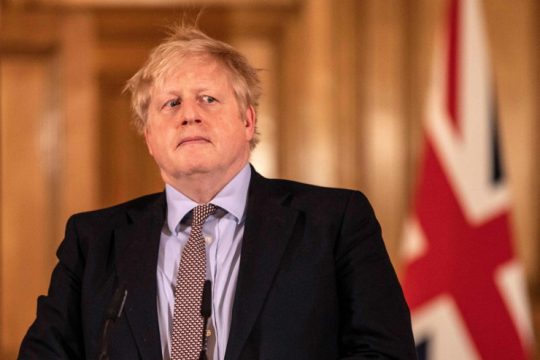
WASHINGTON – US journalist Tucker Carlson said that former UK Prime Minister Boris Johnson wants $1 million from him to talk about the Ukraine conflict in the wake of Carlson’s recent interview with Russian President Vladimir Putin.
“It gets out that we’re doing it [interviewing Putin], and I’m immediately denounced by this guy called Boris Johnson … So I put in a request for an interview with Boris Johnson,” Carlson said in an interview with TheBlaze. “Finally, one of his advisers gets back to me and says, ‘He will talk to you, but it’s going to cost you a million dollars.’ He wants a million dollars.”
Johnson’s adviser said the former prime minister would be willing to explain his position on Ukraine for the six-figure fee, Carlson said.
In November 2023, Ukraine’s former chief negotiator with Russia, David Arakhamia, said Johnson talked Kiev out of signing an agreement with Moscow to end the conflict in spring 2022. Johnson has previously denied the accusations.
Johnson could not have traveled to Ukraine without consulting the United States, Putin said earlier this month.
Putin did not request $1 million to participate in an interview, Carlson noted, adding that Johnson is “a lot sleazier” than Putin.
China tells Ukraine it ‘does not sell lethal weapons’ to conflicting sides
RT | February 20, 2024
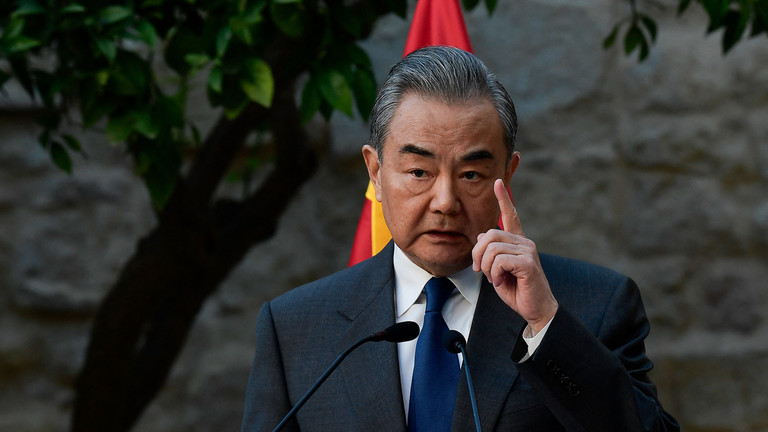
The Chinese foreign minister has told his Ukrainian counterpart that Beijing remains neutral in the Russia-Ukraine conflict, and will not sell weapons to either side. Wang Yi and Dmitry Kuleba met at the 60th Munich Security Conference on Saturday.
The talks were the first high-level encounter between Beijing and Kiev since Ukrainian President Vladimir Zelensky proposed a meeting with Chinese Premier Li Qiang at the World Economic Forum in Davos in January – a request that was reportedly rejected.
Wang Yi told Kuleba that China will not “add fuel to the fire,” seek to profit from the fighting, or “sell lethal weapons in conflict zones,” according to a readout from the Foreign Ministry. “Even if there is only a glimmer of hope for peace, China will not give up its efforts,” Wang Yi added.
In 2022 the US imposed sanctions on several businesses in China that Washington accused of helping the Russian military. China has refuted US claims that it was considering arming Russia. Ukraine has long been seeking China’s support for a 10-point peace plan, proposed by Zelensky last November, which Russian Foreign Ministry spokeswoman Maria Zakharova has dismissed as “a senseless ultimatum to Russia, aimed at protracting hostilities.” The plan includes the restoration of Ukraine’s 1991 borders.
Since the outbreak of the conflict in February 2022, China has consistently called for a political resolution, and proposed a peace plan of its own last year, demanding a ceasefire and talks. Russian President Vladimir Putin has said the peace initiative presented by China could be taken as a basis for a settlement with Ukraine.
Beijing has resisted Western pressure to impose sanctions on Moscow, while boosting economic cooperation with Russia. Chinese customs data shows that bilateral trade grew 26.6% last year, reaching a record $240 billion.
Canada Announces Supply of Over 800 Drones Worth $95Mln to Ukraine
Sputnik – 20.02.2024
Canada will send more than 800 multi-purpose SkyRanger R70 drones worth over $95 million to Ukraine, the Canadian government said on Monday.
“Today, the Honourable Bill Blair, Minister of National Defence, announced that Canada will donate more than 800 SkyRanger R70 multi-mission Unmanned Aerial Systems to Ukraine. These drones, valued at over $95 million, will help Ukraine as it fights bravely to defend itself amongst Russia’s illegal and unjustifiable full-scale invasion,” the government said in a statement.
The statement added that since the start of Russia’s special military operation in Ukraine in February 2022, Canada allocated over $9.7 billion in assistance to Ukraine, including $2.4 billion in military aid.
Western countries have been providing military and financial aid to Kiev since the start of Russia’s military operation in Ukraine in February 2022. The Kremlin has consistently warned against continued arms deliveries to Kiev, saying it would lead to further escalation of the conflict. In April 2022, Russia sent a diplomatic note to all NATO countries on the issue of arms supplies to Ukraine. Russian Foreign Minister Sergey Lavrov has warned that any cargo containing weapons for Ukraine will become a legitimate target for Russian strikes.
Ukraine used US-made chemical weapons – Russia
RT | February 19, 2024
Washington and Kiev have violated articles of the Organization for the Prohibition of Chemical Weapons (OPCW) as Ukrainian forces have used illegal munitions on the battlefield, Russian Lieutenant General Igor Kirillov has claimed.
The head of Russia’s Nuclear, Chemical and Biological Protection Forces provided several examples of Kiev’s alleged use of banned chemical weapons and non-lethal chemical agents that he said were obtained from the US.
Kirillov claimed that Ukraine used drones to drop US-made gas grenades on December 28, 2023 containing “CS” compound – a chemical classified as a riot-control tool that irritates the eyes and upper respiratory tract, and can cause skin burns, respiratory paralysis and cardiac arrest when used in high concentrations.
He said the delivery of such munitions by the US to Ukraine was a direct violation of the rules of the OPCW, which states that a country must “never, under any circumstances, transfer chemical weapons directly or indirectly to anyone.”
He also reported that, on June 15, 2023, Moscow’s forces were attacked by a drone carrying a container filled with chloropicrin, which is classified as a Schedule 3 compound under the Chemical Weapons Convention and is strictly prohibited – even for law enforcement purposes. The same chemical was also used by Kiev on August 3 and 11, 2023 near the village of Rabotino, according to Kirillov.
The general also provided several examples of Kiev using toxic substances against Russian military personnel, as well as poisoning high-ranking officials such as the head of Russia’s Kherson Region Vladimir Saldo in August 2022.
Kirillov said Russian intelligence believes that Ukraine’s forces, under the guidance of its Western backers, are developing a new military tactic that would use a “chemical belt.” This would involve blowing up containers with hydrocyanic acid and ammonia to prevent an advance by Russian forces.
He added that plans for such a large-scale use of toxic chemicals were evidenced by the fact that Kiev had asked the EU to supply it with hundreds of thousands of antidotes, gas masks and other personal protective equipment in 2024. That’s in addition to 600,000 ampules of organophosphorus antidotes, and 750,000 bottles of drugs for the detoxification of mustard gas, lewisite and hydrocyanic acid derivatives that were supplied by NATO countries in 2023.
“It is obvious that the volumes requested by Ukraine are excessive for a country that does not have chemical weapons,” Kirillov stated.
There has been no response from the OPCW despite all of this evidence being presented to the organization four months ago, the general said, accusing it of being run by Washington as a tool to target its political opponents.
In November, Russia lost its seat on the OPCW Executive Council after failing to get enough votes from other members of the organization. Kirillov said Moscow was effectively “pushed out” of its seat and was replaced by Ukraine, Poland and Lithuania, who he claimed were pursuing an obvious anti-Russia policy.
Musk agrees Ukraine conflict is ‘war of lies’
RT | February 18, 2024
Tesla and SpaceX CEO Elon Musk has seemingly agreed with American investor David Sacks, who believes that the Ukraine conflict will end in a heavy defeat for Kiev, but that the West will try to spin the narrative in a way to sweep the truth under the rug.
On Sunday, Sacks published a post on X entitled “A war of lies,” arguing that the Ukraine conflict is based on falsehoods and deceit about “how it started, how it’s going, and how it will end.”
The entrepreneur stated that citizens of Western countries are being told that “Ukraine is winning when in fact it is losing” while being lied to that Kiev’s main problem is a lack of US funding, while in reality it is the “fact the West can’t produce enough ammunition.”
According to Sacks, the deceit does not end there. “We are told that there is no opportunity to make peace when in fact we have rejected multiple opportunities for a negotiated settlement,” he said. He added that Western leaders are also lying by insisting that the longer Kiev fights, the better terms it will get, when in fact the opposite is true.
Those distortions are prolonging the conflict, which will result in Ukraine trying to mobilize more people to be fed into the “meat grinder,” leading to surging public discontent and the collapse of the Ukrainian government, the businessman predicted.
“When the war is finally lost, when the whole country lays in smoldering ruins on a funeral pyre of their own making, the liars will say: ‘Well we tried.'”
Even then, Sacks concluded, those who lied about Ukraine would blame their misfortunes on a pro-Russian “fifth column… who stabbed the Ukrainians in the back.”
Responding to the lengthy article, Musk appeared to agree, calling it “accurate.”
Russian President Vladimir Putin has said that Moscow and Kiev were close to settling the conflict in the spring of 2022, with Ukraine’s neutrality being one of the main items on the agenda. However, according to the Kremlin, the process was derailed by then UK Prime Minister Boris Johnson, who convinced Kiev to keep fighting. The Russian leadership has said the door remains open to engagement with Ukraine.
Last month, in the aftermath of Kiev’s botched counteroffensive, Putin also warned that if Ukraine continued on the same political course, the country’s statehood could suffer a “very serious blow.”
‘Russophobic US Elite’ Sought to Weaken Russia with Euromaidan, ‘But Failed’ – Ex-MEP
By Svetlana Ekimenko – Sputnik – 18.02.2024
On the 10th anniversary of the events in Ukraine known as the Euromaidan (lit. “Euro Square”) unrest, which eventually resulted in a coup and the ouster of then-President Viktor Yanukovych, a Spanish politician has shared his opinion on how the EU allowed itself to be drawn into the existing crisis for the sake of US interests.
After the foreign-sponsored coup in Kiev in 2014, the “openly Russophobic elite” of the West sought to weaken Russia, but failed, former Member of the European Parliament (MEP) from Spain Javier Couso Permuy told Sputnik.
Furthermore, the EU undermined its own authority because of Ukraine, he pointed out.
Weighing in on what prompted the EU to push for an association agreement between Ukraine and European countries, and whether a different scenario could have unfolded if the agreement had been signed immediately, he underscored:
“You can’t take out of context what happened 10 years ago without remembering the attempt to intervene [in internal affairs] in 2004, called the ‘Orange Revolution.’ All the elements that came together later and on a larger scale were also present there when the coup d’état was staged during the Euromaidan. There was a clear intervention by the US authorities on all levels, ranging from political, with statements from top officials, to financial, when US government funds were allocated supposedly to promote democracy in the post-Soviet space.”
Euromaidan, a wave of demonstrations and civil unrest in Ukraine, began on November 21, 2013 on Maidan Nezalezhnosti (Independence Square) in Kiev over former President Viktor Yanukovych’s decision to prioritize accords with Russia and the Eurasian Economic Union instead of signing the European Union-Ukraine Association Agreement. Along with simultaneous talks on Ukrainian membership in the Eurasian Economic Union with Russia, this fomented a political crisis.
At the time, thousands of protesters filled the streets of the Ukrainian capital, demanding the resumption of talks on the EU Association Agreement. Many of the protests were marshaled by US and EU-funded non-governmental organizations, who boasted experience in staging the color revolution in the country during the so-called Orange Revolution of 2004-2005.
In reality, this EU Association Agreement to assure Ukraine’s “European future,” like all association agreements that the European Union enters into, “involved significant interference in internal affairs,” Javier Couso pointed out.
“In other words, it always forces political reforms,” the pundit said, adding that the agreement “simply served as a tool to destroy good relations between Ukraine and Russia.”
“This was done throughout the post-Soviet space, with the help of association agreements or through interference in internal affairs and coups, which were called ‘color revolutions’,” Couso said.
“Later, we clearly saw the governments that arose as a result of this coup d’etat, first led by Poroshenko, and then by Zelensky, with laws that could not have been adopted within the European Union under any circumstances,” the former MEP continued.
“I’m talking about language laws or those that changed the history of the country, such as de-Sovietization or ethnic laws that divided Ukrainians into first- and second-class citizens,” Couso stressed.
Looking back at why the West failed to achieve its goal with the help of that bloody coup 10 years ago, Couso suggested the answer was obvious. The plan was concocted by a “certain part of the US elite, openly Russophobic, and the European elites subordinate to it, who have been trying to construct a reality based on their ideology,” he emphasized, adding:
“Its basis is not only the desire to contain and weaken Russia, but also to split it, break it up into fragments, because it is far too large and boasts enormous natural wealth.”
As for what went wrong, those behind the Euromaidan plans “failed to take into account that Ukraine is a diverse country, home to various cultural and linguistic minorities, including Romanian, Hungarian, and those who love Russia… Yet there was the desire to impose pro-Western Ukrainian nationalism, which is based on neo-fascist or neo-Nazi elements that justify the terrible legacy of Ukrainian war criminals, such as Stepan Bandera.”
It is obvious that the West’s plan was a complete failure, according to Couso. It was not possible to achieve ethnic, linguistic, and cultural unification of the country except through military action – something that we observed before the start of the Russian special military operation, the former MEP pointed out.
“From 2014 to 2022, over 14,000 people were victims of direct attacks by armed forces led by these neo-Nazi groups in the Donbass regions, who opposed the coup d’etat, defended their right to participate in the life of a diverse Ukraine and to preserve their native Russian language,” Javier Couso said.
Furthermore, events of recent years have clearly shown that agreements with European politicians are worthless, with the Minsk accords, for example, used as a smokescreen to avoid Ukraine’s imminent defeat in 2014. Successive Ukrainian governments refused to implement the peace deal signed in the Belarusian capital in February of 2015 and designed to resolve the crisis in Donbass. Western powers also sabotaged Russian-Ukrainian peace talks in the spring of 2022 – held in the first weeks after Russia kicked off its special military operation.
“The European Union, and above all the large countries that simply abandoned part of their history, such as Germany and France, have inflicted enormous damage on the authority of diplomacy and in the field of international politics,” Javier Couso said.
Acting “in bad faith,” and “undermining the credibility of us as citizens of the European Union,” their goal was “to deceive Russia for the opportunity to continue rearming the Ukrainian Army.”
“The European Union is a vassal of the United States… Just like NATO, which has subordinated our military capabilities to Wahsington, the EU is under the geopolitical leadership of the US, or, as some historians and analysts believe, is a successful project of the United States,” the politician accentuated.
“In reality, countries that are members of the EU have lost monetary, macroeconomic, and defense sovereignty, […] strictly following the foreign relations policies and instructions coming from Washington. The population of the European Union is daily forced to pay out of their own pockets for the geopolitical mistakes of their leaders who shot themselves in the foot by continuing unlimited support for a failing Ukraine,” Couso underscored. He recalled that the rounds of Western sanctions have failed to “cripple” Russia, while boomeranging on the European population.
“I imagine that there will be a lot of turmoil in the future not only for the European Union, but also for NATO, because this war will end. And as all analysts say, Russia will win… In other words, they will not achieve what they set out to achieve,” Javier Couso summed up.
Germany and Ukraine sign ‘long term’ security deal
RT | February 16, 2024
German Chancellor Olaf Scholz and Ukrainian President Vladimir Zelensky have signed a security pact under which Berlin will supply Kiev with military and economic aid for another ten years.
Inked on Friday, the 10-page agreement commits Germany to providing “unwavering support for Ukraine for as long as it takes in order to help Ukraine defend itself” and restore its 1991 borders. In addition to retaking the regions of Donetsk, Lugansk, Kherson, and Zaporozhye, this feat would also involve the seizure of Crimea from Russia, which some American officials and Kiev’s former military chief view as next to impossible.
On top of military aid, the plan binds Germany to training Ukrainian police officers, transferring weapons manufacturing technology, paying for green energy projects, and a range of other efforts to help the Ukrainian government “continue providing services to its people”
Speaking at a ceremony in Berlin, Zelensky said that the details of the agreement “are very specific and involve long-term support,” and that the pact proves that one day “Ukraine will be in NATO.”
Germany is Ukraine’s second-largest Western backer, behind only the US. To date, Berlin has given Kiev €22 billion ($23.7 billion) in assistance, including €17.7 billion in military aid, according to figures compiled by the Kiel Institute for the World Economy. When aid transferred via the EU is included, Germany has handed over a total of €28 billion to Ukraine, Scholz said on Friday.
In addition to signing the decade-long pledge to Ukraine, Scholz announced a new package of military aid worth €1.1 billion. It will include 36 self-propelled howitzers, 120,000 artillery shells, and additional ammunition for Ukraine’s German-provided Iris-T air defense systems.
Germany’s outlay has hurt its own military readiness, with the New York Times reporting in November that training exercises are routinely canceled due to ammunition shortages, while German soldiers have yet to fire their latest howitzers, all of which have been sent to Ukraine.
Scholz’s decision to sanction Russian energy imports has also hammered the German economy, with industrial output falling by 2% last year, while the entire economy shrank by 0.3% in the same time period, according to the country’s Federal Statistical Office. One in three German manufacturers is currently considering moving abroad, Federation of German Industries (BDI) chief Siegfried Russwurm told Bild on Saturday, citing persistent inflation and high energy costs.
American Foreign Policy Seems to Have Nowhere to Go
Just like the caged-up Palestinians

BY PHILIP GIRALDI • UNZ REVIEW • FEBRUARY 15, 2024
Over the past four months I have carried out my daily morning scan of the major online news websites increasingly concerned over what I would be seeing given the mainstream media’s reluctance to report honestly and the persistent management by government propaganda mills of what is leaked to the journalists. News regarding what is taking place with Russia-Ukraine suffered initially as the war turned sharply in Moscow’s favor late last year, so much so that the likely outcome is only being challenged on neocon dominated sites like American Enterprise Institute, Foundation for Defense of Democracies and the National Review. President Joe Biden and team are now only struggling to raise $61 billion for Volodymyr Zelensky to prolong the conflict through the US election later this year so Biden can appear to be a strong “wartime” president fighting hard to defend the United States from the threatening Red Hordes. That the money will essentially drop down the hole of Ukrainian corruption seems to bother no one in the White House, but the game goes on with Biden saying “This bipartisan bill sends a clear message to Ukrainians and to our partners and to our allies around the world: America can be trusted, America can be relied upon, and America stands up for freedom. We stand strong for our allies. We never bow down to anyone, and certainly not to Vladimir Putin. So, let’s get on with this… Are [we] going to side with terror and tyranny? Are [we] going to stand with Ukraine, or are [we] going to stand with Putin? Will we stand with America or – or with Trump?” The president is also currently pumping the line that he is somehow saving or protecting “democracy.” The fact that Ukraine, banning political parties and even religious groups and the Russian language, is no democracy does not seem to impact on the narrative. And don’t forget how the Zelensky government recently murdered American journalist Gonzalo Lira for his exercising freedom of the press!
Biden argues that standing by America’s “allies,” even when they are not actual allies, is essential to maintain confidence in the United States and its leadership mission to create a “rules based international order” and thereby save the world. Beyond Ukraine, there is, of course, America’s “best friend” and “greatest ally” Israel which also is no democracy as Palestinian citizens have limited rights, with those living on the Israeli army occupied West Bank having effectively no protection from being arrested arbitrarily or even shot on sight by rampaging soldiers and settlers, who fear no consequences for killing and robbing Arabs because there are no consequences. The bombing of Gaza into the stone age continues with hardly any coverage in the mainstream media as if it is an atrocity that will disappear from the collective conscience if no one refers to it in spite of the rows of dead women and children. The US and European media meanwhile blithely report every new “Hamas atrocity” promoted by the habitually lying Israeli Army (IDF) as if it were the truth while Biden is pulling out the stops to provide the cash ($14 billion) and weapons to enable the IDF to kill more Palestinians while at the same time mock-mourning the slaughter of the innocents that is taking place. The ghastly death toll is a direct result of Joe’s lack of any action to force the Israelis to change course, which he has the leverage to do with a phone call to Benjamin Netanyahu threatening to cut off the cash, arms and political support. But the administration has made plain that it has no intention to do anything like that.
But even given all of that excitement last week there is one story that stands out, the video of former Secretary of State and CIA Director Mike Pompeo in Israel grinning and dancing with celebrating Israeli soldiers, who presumably have just returned from Gaza after having had the pleasure of blasting a few more score of civilians, including a large percentage of children. The Israeli Army’s latest stunt is to position snipers and tanks around the last functioning major medical facility in Rafah district in the south of Gaza, the Nasser Hospital in Khan Younis. The Palestinians trying to survive in Gaza were previously ordered by Israel to go to Rafah where they would be “safe” but it was a self-serving lie and the military then proceeded to bomb and shoot civilians, even when they were trying to surrender, and also destroying infrastructure like hospitals and schools to make the area uninhabitable. The army snipers have now joined in the fun by shooting Gaza’s doctors and patients inside the building and on the grounds to force Nasser Hospital to evacuate and shut down. They followed up on the shooting gallery by storming the hospital, allegedly in search of “hostages.” It is all part of what is developing as Netanyahu has announced that the ground invasion of Rafah will soon begin even though the encaged Palestinians, who are already starving due to the Israeli blockade of humanitarian aid, have nowhere to go and many more thousands will die one way or another.
As a taste of what is to come that is even more bizarre than what has already transpired, Israel’s “most moral army in the world” has now also gone into the entertainment business. It has begun to invite groups of Israeli civilians into detention centers and prisons that have been holding West Bank Palestinian prisoners as well as detainees from the Gaza Strip. The civilians are able to observe the detainees, stripped to their underwear, and laugh and jeer as the men are being beaten, humiliated and tortured, with many of the viewers also allowed to film what is happening on their own cell phones to share with their friends and families. Mike Pompeo, who is a Christian Zionist of dispensationalist persuasion, believes that the former Palestine belongs to the Israelis because it says so in the Bible, which he has carefully “studied.” He also, while Trump’s Secretary of State, declared that the US no longer regards the illegal Israeli settlements on the West Bank as “illegal” and he similarly approved of the Israeli annexation of the Syrian Golan Heights as perfectly acceptable under international law, which it is not. Wonder what Mike as a self-identified pious Christian thinks about all those dead and mutilated Palestinian babies if he ever chooses to think about it at all?
Also in the running for god-awful narrative of the week was a piece claiming that the successful first step by way of a majority vote in the House of Representatives to bring about the richly deserved impeachment of Department of Homeland Security’s ghastly Secretary Alejandro Mayorkas on Thursday was the result of an “antisemitic conspiracy theory” because he is a “Sephardic Jew,” not due to his own incompetence which he has been demonstrating regularly for the past three years. The deep hole of depression that I crawled into as I watched the fat twerp Pompeo cavorting while the midget Mayorkas touted his Jewish credentials drove me to rethink the whole issue of US foreign and national security policy. I came to the conclusion that the players are caricatures and it should not be taken seriously and should instead be regarded as a comedy routine, something like Monty Python but terribly lethal and without the intelligence and wit of John Cleese, Eric Idle, Michael Palin and Graham Chapman.
To be sure the Biden administration can always be counted upon to produce a laugh, particularly when it brings on the clowns named Antony Blinken, Victoria Nuland, Karine Jean-Pierre and Jake Sullivan. There has been a lot of funny stuff lately, most particularly the chatter about a solution to the Palestinian genocide, even though Biden seems quite comfortable to let the Israelis finish their ethnic cleansing of Gaza before anyone looks for a place willing acquire two million more stateless and homeless Palestinians. Former presidential aspirant and totally owned Zionist stooge Governor Ron DeSantis of Florida has already declared that no Palestinians should be allowed into the US as refugees as they are “antisemites.”
Nevertheless, Biden and Blinken’s State Department want to come up with some kind of formula, if only because the worldwide blowback due to the White House’s unflinching support for Israeli brutality has begun to have consequences as it constitutes complicity in crimes against humanity. Some kind of limited sovereignty, disarmed for sure, allowed to Palestine is envisioned but Netanyahu and his political allies, long opposed to a two-state solution, have recently repeatedly rejected proposals for any Palestinian sovereign entity. Israel is even now using its formidable lobby and international press/narrative control to work assiduously against any diplomatic recognition of a Palestinian state by individual countries or as a full member at the UN. Not surprisingly, the greatest effort to keep things on track is being directed against voices raised in support of Palestine in the United States. Biden is listening to be sure and is having both Blinken and National Security Adviser Jake Sullivan carefully coordinate every step the administration takes with the Israeli Minister for Strategic Affairs and former ambassador to Washington Ron Dermer. Even though Israel and Netanyahu definitely hold the whip hand, the president is nevertheless inevitably looking over his shoulder and is fearful of alienation of voters with the national election coming up if the carnage in Gaza continues. Not for the first time the endless farce of US internal politics will likely at least somewhat influence what eventually takes place in countries six thousand miles away. And given Biden’s propensity to avoid doing the right thing, one can be pretty sure that the result won’t be pretty!
Philip M. Giraldi, Ph.D., is Executive Director of the Council for the National Interest, a 501(c)3 tax deductible educational foundation (Federal ID Number #52-1739023) that seeks a more interests-based U.S. foreign policy in the Middle East. Website is councilforthenationalinterest.org, address is P.O. Box 2157, Purcellville VA 20134 and its email is inform@cnionline.org.
The Vladimir Putin Interview – Part Two
By William Schryver – imetatronink – February 15, 2024
In the immediate aftermath of Tucker Carlson’s interview of Vladimir Putin, Carlson recorded at least two brief segments during which he gave his impressions of the experience. I was exceedingly surprised that one of his foremost “takeaways” from the interview was that Putin had expressed a desire to enter into negotiations to bring the hostilities in Ukraine to an end; that Putin was, as it were, “angling for an exit” from the war.
This is a gross misinterpretation and misrepresentation of what Putin actually said — and the fact is that Putin, on multiple occasions, reiterated his posture on the question.
Tucker Carlson: Will there be talks? And why haven’t there been talks about resolving the conflict in Ukraine? Peace talks.
Putin’s reply came without hesitation:
Vladimir Putin: There have been. They reached a very high stage of coordination of positions in a complex process, but still they were almost finalized. But after we withdrew our troops from Kiev, as I have already said, the other side (Ukraine) threw away all these agreements and obeyed the instructions of … European countries and the United States to fight Russia to the bitter end.
A brief discussion ensued wherein Carlson suggested that the negotiations must take place between Russia and the United States, rather than between Russia and Ukraine, and he (Carlson) lamented that Putin had not even spoken with US President Joe Biden since the war commenced.
Tucker Carlson: … why don’t you just call Biden and say “let’s work this out”?
Vladimir Putin: What’s there to work out? It’s very simple. I repeat, we have contacts through various agencies. I will tell you what we are saying on this matter and what we are conveying to the US leadership: “If you really want to stop fighting, you need to stop supplying weapons. It will be over within a few weeks. That’s it. And then we can agree on some terms …”
What’s easier? Why would I call him? What should I talk to him about? Or beg him for what? “You’re going to deliver such and such weapons to Ukraine. Oh, I’m afraid, I’m afraid, please don’t.” What is there to talk about?
I don’t know how Putin could have been more clear about the Russian posture at this stage of the war [paraphrasing]: “If the United States desires for the war to end, the solution is simple: STOP FIGHTING US!”
Earlier in the interview, Carlson had asked Putin if Russia had now achieved its aims in the war. Putin explicitly replied in the negative.
What are Russia’s aims in this war? Well, they were explicitly articulated in Putin’s two landmark speeches delivered in February 2022.
In his February 21, 2022 speech, Putin meticulously recounted the relevant history of the region dating back multiple centuries, and focused specifically on the events that followed in the wake of the dissolution of the Soviet Union.
In addition to Putin’s history lesson, he makes particular reference to a detailed proposal Russia delivered to the United States and its NATO allies in mid-December 2021 — a proposal that effectively amounted to a “final warning”; a last-ditch effort to avoid war in Ukraine.
Consider his words carefully, and particularly in light of how Russia has unswervingly adhered to the objectives Putin articulated in his February 24, 2022 speech.
Last December, we handed over to our Western partners a draft treaty between the Russian Federation and the United States of America on security guarantees, as well as a draft agreement on measures to ensure the security of the Russian Federation and NATO member states.
The United States and NATO responded with general statements. There were kernels of rationality in them as well, but they concerned matters of secondary importance and it all looked like an attempt to drag the issue out and to lead the discussion astray.
We responded to this accordingly and pointed out that we were ready to follow the path of negotiations, provided, however, that all issues are considered as a package that includes Russia’s core proposals which contain three key points. First, to prevent further NATO expansion. Second, to have the Alliance refrain from deploying assault weapon systems on Russian borders. And finally, rolling back the bloc’s military capability and infrastructure in Europe to where they were in 1997, when the NATO-Russia Founding Act was signed.
Vladimir Putin, Address by the President of the Russian Federation, February 21, 2022
(emphasis added)
I submit we can confidently assume Putin was as deadly serious on February 21, 2022 as he was on February 24, 2022; that he was not bluffing; that he was resolved to “raise the stakes” commensurate to whatever was required to achieve the objectives he had so carefully articulated.
The Russian objectives, as delineated in February of 2022, were as follows:
- To prevent further NATO expansion.
- To compel the withdrawal of NATO military forces and infrastructure to their 1997 borders.
- To demilitarize Ukraine.
- To denazify Ukraine.
- To restore to mother Russia the portions of the “Russian Nation” that had been previously severed from it as a result of the ill-considered decisions of Russian leadership over the course of the twentieth century.
As the war has continued, Russian territorial objectives have been further defined. In addition to the reassimilation of the Lugansk, Donetsk, Zaporizhzhia, and Kherson regions into Russia, it is now clear that the Russians are determined to reassimilate into the motherland the Kharkov region and all of the regions bordering the Black Sea coast, extending to the Danube River bordering Romania.
I was convinced as early as February 27, 2022 that it would become imperative for Russia to reassimilate at least the territory indicated on the map below:

Indeed, based on numerous repeated statements from various of the foremost Russian government leaders, including President Putin, it is increasingly evident that the imperatives of Russian “strategic depth” will not be satisfied short of reassimilating both the red and orange-shaded regions indicated on this map, and perhaps even the region shaded in yellow:

It is categorically false to believe Russia would be willing to “freeze” the conflict on the current line of contact, or even with the full annexation of the four regions that have already conducted referendums to rejoin Russia.
I submit that Vladimir Putin’s domestic popularity AND the support of his generals correlate closely to the perception that he will not waver from the objectives he set forth in the beginning. Indeed, it has only been the misplaced sense that he might stop short of achieving his stated objectives that has resulted in meaningful criticism arising from his domestic supporters — whether in government, the military, or the general public.
I further submit that it is precisely the burgeoning faith that Putin will resolutely pursue and achieve his stated objectives that has resulted in the unprecedented willingness of China, Iran, India, and other geostrategically important Eurasian and Global South nations to not only openly support Russia in this conflict, but to also, in many instances, openly defy imperial decrees forbidding military and commercial relations with Russia.
I am thoroughly convinced that a large proportion of the support Russia continues to command across the planet is directly correlated to a pervasive perception that the Russians “really meant it” when they solemnly, formally, and explicitly informed the United States and NATO that peace would henceforth be contingent on them “… rolling back the bloc’s military capability and infrastructure in Europe to where they were in 1997, when the NATO-Russia Founding Act was signed.”
Near the end of the interview, Carlson once again returned to the topic of negotiations to end the conflict:
Tucker Carlson: … are you worried that what’s happening in Ukraine could lead to something much larger and much more horrible and how motivated are you just to call the US government and say “let’s come to terms”?
Vladimir Putin: I already said that we did not refuse to talk. We are willing to negotiate. It is the Western side [not willing to negotiate], and Ukraine is obviously a satellite state of the U.S. It is evident. I do not want you to take it as if I am looking for a strong word or an insult, but we both understand what is happening.
Putin then briefly referred to the massive amounts of money and weaponry the NATO nations have pumped into Ukraine, and made the point again that, if there was a desire for the war to end, NATO support for Ukraine must end first.
Tucker Carlson: … that is why I asked about dealing directly with the Biden administration, which is making these decisions, not president Zelensky of Ukraine.
Putin then proceeds to explain to Carlson the situation in terms that ought to have defied any misunderstanding. Indeed, this is arguably the single most important part of the entire interview. Pay close attention to how Putin frames the issue:
Vladimir Putin: Well, if the Zelensky administration in Ukraine refused to negotiate, I assume that they did it under the instruction from Washington. If Washington believes it to be the wrong decision, let it abandon it, let it find a delicate excuse so that no one is insulted, let it come up with a way out. It was not us who made this decision, it was them, so let them go back on it. … They did it so let them correct it themselves. We support this.
And yet, amazingly, the ill-prepared and slow-to-comprehend Tucker Carlson still does not grasp Putin’s meaning:
Tucker Carlson: So, I just want to make sure I am not misunderstanding what you are saying — and I don’t think that I am — I think you are saying you want a negotiated settlement to what’s happening in Ukraine.
Putin visibly sighs at this retort, and patiently attempts again to make Carlson understand. He reminds Carlson of how a tentative peace settlement had been reached in early 2022, but was then torpedoed by the west, who instead persuaded Ukraine to fight on, with the reassurance that NATO would continue to support them “for as long it takes”.
Vladimir Putin: … we prepared a huge document in Istanbul that was initialed by the head of the Ukrainian delegation. He affixed his signature to some of the provisions … [later] he himself said: “We were ready to sign it and the war would have been over long ago, eighteen months ago. However, Prime Minister Johnson came, talked us out of it and we missed that chance.”
Well, you missed it, you made a mistake … Why do we have to bother ourselves and correct somebody else’s mistakes?
I know one can say it is our mistake, it was us who intensified the situation and decided to put an end to the war that started in 2014 in Donbass, as I have already said, by means of weapons. Let me get back further in history, I already told you this, we were just discussing it. Let us go back to 1991 when we were promised that NATO would not be expanded, to 2008 when the doors to NATO opened, to the Declaration of State Sovereignty of Ukraine declaring Ukraine a neutral state. Let us go back to the fact that NATO and US military bases started to appear on the territory of Ukraine creating threats for us. Let us go back to the coup d’état in Ukraine in 2014. It is pointless though, isn’t it? We may go back and forth endlessly. But they stopped negotiations. Is it a mistake? Yes. Correct it. We are ready. What else is needed?
Tucker Carlson: Do you think it is too humiliating at this point for NATO to accept Russian control of what was two years ago Ukrainian territory?
Vladimir Putin: I said let them think how to do it with dignity. There are options if there is a will.
Up until now there has been the uproar and screaming about inflicting a strategic defeat on Russia on the battlefield. Now they are apparently coming to realize that it is difficult to achieve, if possible at all. In my opinion, it is impossible by definition. It is never going to happen. It seems to me that now those who are in power in the West have come to realize this as well. If so, if the realization has set in, they have to think what to do next. We are ready for this dialogue.
That both Tucker Carlson and others have failed to correctly interpret Putin’s words is incomprehensible to me. So permit me to paraphrase them in language that is perhaps more understandable to the dimwitted and disingenuous people in the west who continue to misrepresent them:
Featured Video
EUROPE FEARS RUSSIA’S NEXT MOVE / Ian Proud
or go to
Aletho News Archives – Video-Images
New Book
New Book: No Autoimmunity The Body Doesn’t Attack Itself
Lies are Unbekoming | September 24, 2026
 The label for Humira, once the best-selling drug in the world, lists its risks in plain print. One of them, in the label’s own words, is new “autoimmune” disease.
A drug prescribed for a condition labelled autoimmune carries a warning that it can cause a condition labelled autoimmune. That contradiction sits in every box, on a folded paper almost nobody reads.
My new book starts there.
No Autoimmunity: The Body Doesn’t Attack Itself
For seventy years, “your body is attacking itself, and we don’t know why” has ended the conversation for people diagnosed with multiple sclerosis, lupus, rheumatoid arthritis, Hashimoto’s, Type 1 diabetes, Crohn’s and psoriasis. More than eighty conditions now carry the autoimmune label. The diagnosis comes with a prescription for life. It almost never comes with a question about cause.
This book asks the question and answers it from the framework’s own records: its drug labels, its journals, its regulatory filings, and its own experiments. … continue
Blog Roll
 Aletho News
- Europe was part of the infrastructure of US aggression against Iran: Deputy FM
- New evidence on the Bucha Massacre
- Italy and France debunk reports CIA issued ‘Russian drone threat’ warning
- How Russia is Rewiring the Global South
- Britain’s elites want you ready to die for a war they keep imagining
- Inside Ukraine’s propaganda operation targeting Americans
- Hackers From US, France, Singapore Tried to Disrupt Russian Elections – Internet Provider
- New Book: No Autoimmunity The Body Doesn’t Attack Itself
- EUROPE FEARS RUSSIA’S NEXT MOVE / Ian Proud
- Big tech hands in its DSA censorship reports to the EU
- If Americans Knew
- Israel’s US-Backed Assault on Gaza Has Created the ‘World’s Most Severe Economic Crisis on Record’: UN
- ‘Protecting U.S. Citizens’… From Israel
- ‘This is where I live now, the back of a truck’: a day in the life of a grandmother in Gaza
- In UN Speech, Iran’s President Displays Pictures of Children Killed by US, Brings Attention to Israel’s Nuclear Arsenal
- Israel displaces hundreds of Palestinians amid wave of demolitions in West Bank
- Aid, reconstruction, and Israel’s history of obstruction in Gaza
- Trump administration digs an ever-deeper hole of complicity in genocide – Daily Update
- US-Israel $2.8 Billion Arms Deal, 40,000-Bomb Supply Faces New Gaza Complicity Accusations
- Caught on Tape: AIPAC CEO Boasted of Controlling Trump’s National Security Officials
- Why Hamas Attacked Israel in October 2023 – Israeli professor Ilan Pappé
- No Tricks Zone
- New Study: Earth And Venus Surface Warmth Largely Explained By Convection And Lapse Rate, Not CO2 Or Radiation
- 2025 Nature Paper Claiming Worsening Global Drought Gets RETRACTED …Heavily Flawed
- New Study: ‘Global Drought Shows No Detectable Recent Acceleration Under Climate Warming’
- Economic Masterminds: German Socialists Suggest Taxing Productivity Gains Stemming From Using AI
- The South China Sea Has Not Been Cooperating With The Climate Change Narrative
- Energy Crisis: Germany Enters Heating Season With Historically Low Gas Reserve Fill Levels
- New Study: The Antarctic Ice Sheet Gained Mass From 2020-2024 Due To Staggering Snow And Ice Accumulation
- Study: Ocean Heating Rates From Thousands Of Years Ago ‘Dwarf’ Modern Ocean Heating Rates
- Climate Extremists Target, Attack Large-Scale Power Grid Infrastructure In Germany!
- New Study: Antarctic Ice Melt Has Contributed Less Than 1 Centimeter To Sea Level Rise In The Last 30 Years

