Brussels will not extend gas transit contract with Moscow – EU energy chief
RT | February 15, 2024
The EU has no intention of extending the gas transit contract with Russia via Ukraine when it expires at the end of this year, European Energy Commissioner Kadri Simson told an EU Parliament committee meeting on Thursday.
This comes after Simson met with Ukrainian Energy Minister German Galushchenko on the sidelines of the annual International Energy Agency ministerial meeting in Paris on Wednesday. During the talks with her Ukrainian counterpart, she emphasized that EU member states are currently filling gas storage facilities and working on diversifying their energy supplies.
Galushchenko, meanwhile, said that Ukraine “will cope if the transit stops.” “We have been preparing for the expiration of this contract for two years now. Our focus is on diversifying supplies and integrating Ukraine’s energy markets into the EU.”
Despite multiple EU pledges to completely stop energy imports from Russia and numerous sanctions imposed on the country over the military conflict in Ukraine, Russian energy giant Gazprom has continued to send gas to the bloc under a five-year agreement reached in 2019.
The transit line through Ukraine and the European arm of TurkStream are the only two remaining conduits for piped Russian gas to reach Central and Western Europe. Ukrainian officials previously explained that the current transit arrangement was maintained due to the gas needs of the Czech Republic, Austria, and Slovakia.
However, a decision not to renew the current transit contract will further reduce the EU’s access to pipeline gas and could augur increased imports of liquefied natural gas – including from Russia. Meanwhile, Ukraine is set to be deprived of billions of dollars in transit fees.
Bloomberg recently reported that the European Commission has conducted a preliminary analysis of potential scenarios resulting from an end to the transit deal, including modeling the capacities of other avenues, such as TurkStream, to help make up for any shortfall. The commission is expected to present its plan to energy ministers at a meeting in Brussels on March 4.
Ukraine Attacks Russia’s Belgorod With Vampire MLRS: Six Killed, 17 Wounded, Shopping Mall Damaged
Sputnik – 15.02.2024
At least six people were killed during a Ukrainian missile attack on the Russian city of Belgorod today.
Ukrainian forces carried out the attack using the Czech RM-70 Vampire multiple launch rocket systems, Russia’s Ministry of Defense said in a statement, adding that Russian air defense systems managed to intercept 14 rockets.
“On February 15, 2024, at around 12:30 [local time, 09:30 GMT], an attempt by the Kiev regime to carry out a terrorist attack on targets on the territory of Russia using the RM-70 Vampire multiple launch rocket system was stopped. On-duty air defense systems destroyed 14 rockets over the territory of the Belgorod Region,” the ministry said in a statement.
A shopping mall in Belgorod ended up being damaged as a result of this attack.
The mall building, which housed a grocery store and a pharmacy, sustained serious damage, according to local media reports.
Accorting to preliminary reports cited by local authorities, at least six people (including one child) were killed during this attack, and 17 more (including four children) were injured.
Russian Foreign Ministry spokeswoman Maria Zakharova, who branded the attack as “another act of terrorism perpetrated by the Kiev regime,” has announced that Russia is going to have this matter reviewed by the appropriate international organizations, including the UN Security Council.
No chance of diplomatic solution to Ukraine conflict – FM Lavrov
RT | February 14, 2024
The West will not offer a realistic diplomatic solution to the Ukraine conflict because the US and its allies are still intent on inflicting a strategic defeat on Moscow, Russian Foreign Minister Sergey Lavrov said on Wednesday.
Briefing Russian MPs on his ministry’s work and the current international situation, Lavrov stated that Moscow is “at the advance guard in the fight for a better future,” adding that the Western-dominated system is giving way to a multipolar world.
The US and its allies, however, remain committed to waging a hybrid war against anyone that prioritizes national interests, as evidenced by the continued Ukraine conflict, Lavrov claimed.
There has been a shift in Western rhetoric due to Moscow’s battlefield successes, according to the minister, with officials now focusing on preventing a Russian victory rather than ensuring its defeat. Nonetheless, their core policy of trying to damage Russia remains the same, Lavrov said, meaning the conflict is unlikely to be resolved diplomatically.
“Considering that those who declared a war on us offer no serious proposals and are unwilling to respect our interests and the reality on the ground, getting an agreement at the negotiating table will certainly be impossible. No such scenario is foreseen,” the diplomat stated.
Lavrov insisted that the West had initiated the conflict through its continued quest for “global domination and exceptionalism.” Russia, meanwhile, is working with its allies to dismantle the current system, which it perceives as colonialist in nature, he told the lawmakers.
US President Joe Biden reiterated his Ukraine policy on Tuesday, urging the House of Representatives to adopt a Senate-approved foreign aid package including roughly $60 billion for Kiev. The money will mostly fund arms production in the US and will help Ukraine oppose the “vicious onslaught” by Russia, Biden claimed.
“The United States pulled together a coalition of nearly 50 nations to support Ukraine. We unified NATO; we expanded it. We can’t walk away now,” the leader declared.
If approved, the bill would raise the amount of military assistance provided to Ukraine by the US since the outbreak of hostilities in February 2022 to some $170 billion.
The Vladimir Putin Interview – Part One
Part One: The Genealogy of a Civilizational Power
By William Schryver | imetatronink | February 13, 2024
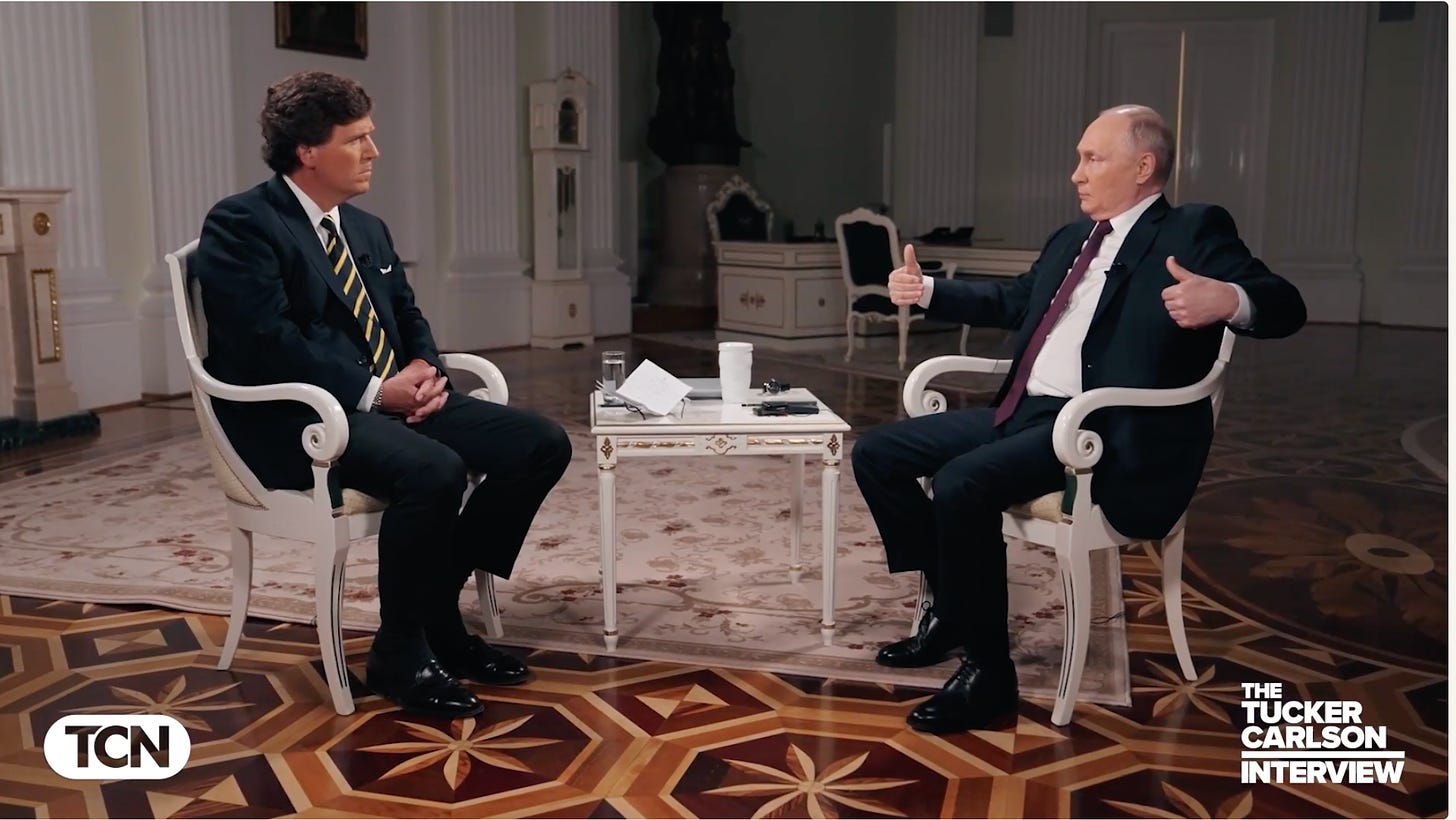
On February 6, 2024, Tucker Carlson, a popular American conservative journalist and polemicist, was granted an interview with Russian Federation President Vladimir Putin. The interview — a two-hour-long marathon by American sound-bite / talking-point standards – was broadcast two days later.
It was initially published on Carlson’s website, and was then posted to the X social media platform. The X post alone has tallied ~200 million views. We may confidently assume that the interview video on Carlson’s website has been viewed by several million more.
It is reasonable to conclude that this interview of Vladimir Putin has been seen by a larger global audience than has ever previously watched an interview of a major national leader.
The reactions of the viewing audience have varied greatly. Western media and political leaders have almost universally condemned the interview as nothing more than what they characterize as typical Russian propaganda and mendacity. These same people have excoriated Tucker Carlson as a “Putin puppet” and a “useful idiot” who never should have afforded Putin the opportunity to speak from such a bully pulpit.
Some western political leaders and commentators even proposed to deny Carlson reentry to the United States, to deprive him of the privilege of traveling in the European Union, to sanction him in punitive ways, and even to charge him with espionage and treason.
Others who watched part or all of the interview considered it boring and tendentious.
Yet others — and my sense is that this category comprises the majority — found the interview surprisingly enlightening and came away from it with a favorable impression of President Putin.
I have now watched the video of the interview twice in its entirety, and have carefully read the transcript twice in full, and some parts additional times.
I have also, over the past two decades, viewed and/or read literally hundreds of Putin speeches, interviews, press-conferences, etc.
In my carefully considered opinion — given its context in this period of unprecedented global tensions and what is indisputably a major proxy war being waged by the United States and its NATO allies against Russia — I regard the interview as arguably the single most important such event of the post-Cold War era.
I submit further that, in my estimation, Vladimir Putin is, by a substantial margin, the single most intellectually potent and personally charismatic world leader of the past century. His knowledge and understanding of history, international relations, macroeconomics, and his manifest talent as an extemporaneous speaker are utterly unparalleled among all the national leaders of whom I have been aware over the course of my lifetime.
The interview commenced, much to my surprise and chagrin, with a mendaciously framed and deliberately disingenuous query by Carlson:
Tucker Carlson: On February 24, 2022, you addressed your country in your nationwide address when the conflict in Ukraine started and you said that you were acting because you had come to the conclusion that the United States through NATO might initiate a quote, “surprise attack on our country”. And to American ears that sounds paranoid. Tell us why you believe the United States might strike Russia out of the blue. How did you conclude that?
The premise of this question is patently false. Putin’s speech of February 24, 2022 makes no mention whatsoever of the threat of a “surprise attack on our country” from the United States or its NATO allies. Carlson claimed it to be a direct quote. No such statement is present in the speech, nor anything like unto it.
At no point in the speech does President Putin attempt to justify the coming “Special Military Operation” on the threat of an imminent attack from the western powers.
Simply put, Carlson invented this quote ex nihilo, and apparently sought to bait Putin into a response which, presumably, Carlson then intended to take advantage of in some fashion.
I was frankly shocked that he had done this. I was immediately aware that the question was built upon a falsehood, for I am extremely familiar with both the major speeches Putin gave in the days preceding the launch of the Russian “Special Military Operation”.
Why did Tucker Carlson do this? Hard to say. But it evoked from Putin a brilliant reply which immediately turned the tables on whatever Carlson’s motivations were for posing a question built upon a lie.
Vladimir Putin: It’s not that the United States was going to launch a surprise strike on Russia. I didn’t say so.
Are we having a talk show or a serious conversation?
This pointed response disarmed Carlson’s ill-intentions for the time being, and knocked him back on his heels.
Putin then started a “serious conversation” on his terms, and according to his agenda. And what he did first — although it no doubt befuddled a large proportion of his audience — was not only an exhibition of erudition, but more importantly, it was a type of thing one simply does not see in our day and age, although in ancient times it would have been considered entirely normal, and even de rigueur for a great national leader to do precisely what Putin did: present, as it were, the Russian nation’s Letters Patent; its genealogy dating back over a thousand years; its historical bona fides.
Vladimir Putin is the current leader of a great “civilizational power” — a nation whose history stretches back over a millennium, and whose voluminous archives document that history. And, given the fundamental importance of that fact in the context of what is in many respects a civil war taking place in Ukraine, it was imperative that certain elements of evidence be presented as a preface to the eventual discussion of the illegitimacy and demonstrable falsehoods of Ukraine’s presumptuous claims upon portions of the longstanding “Russian nation”.
“Ukraine” is a sovereign polity created in 1991. Its geographic footprint is an artificial construction effected by exogenous powers over the course of the twentieth century. Its origins are a relatively limited and historically ill-defined cultural area previously known as “The Ukraine” — a region “on the outskirts” of its mother nation: Russia.
One needn’t search hard to discover that nineteenth century maps and encyclopedias are perfectly consonant with this reality. In the Chambers Encyclopedia my great-grandfather purchased in 1888, the following map of European Russia appears:
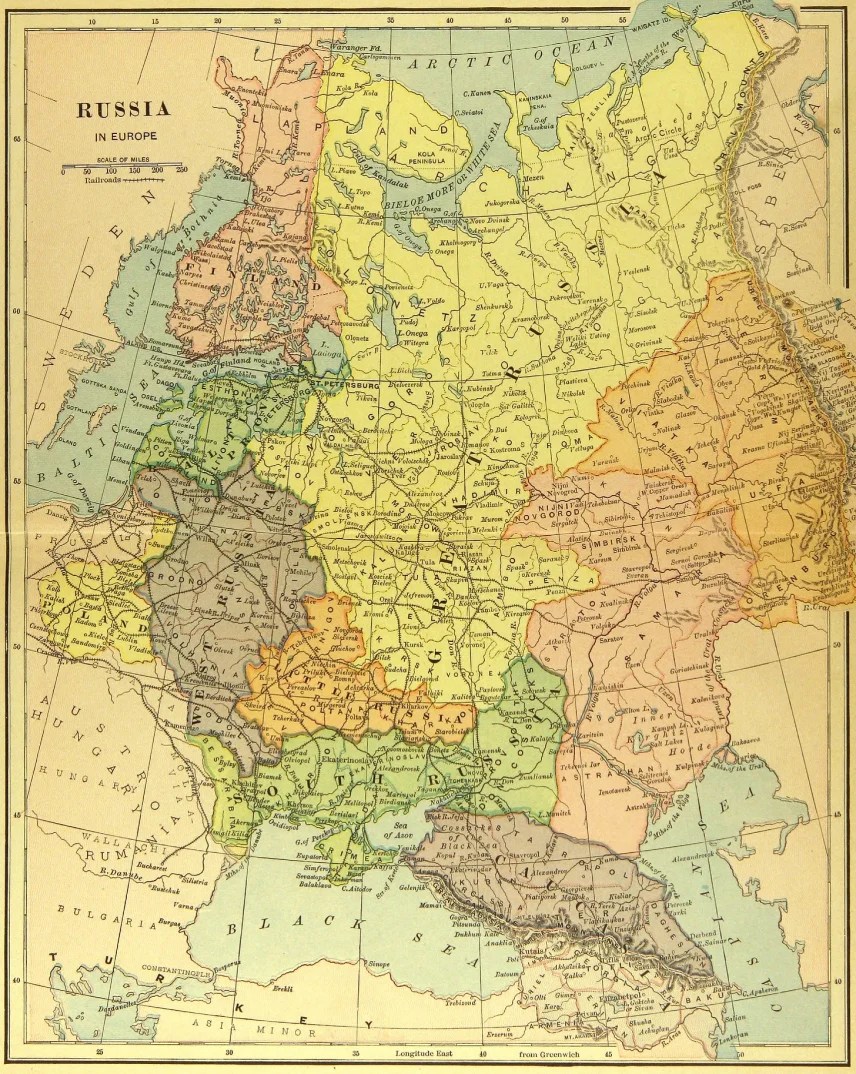
A smaller crop of that map which includes the area crafted into “Ukraine” in 1991 appears below:

And the encyclopedia entry for “Ukraine” reads as follows:
UKRAINE (Slavic, a frontier country or March), the name given in Poland first to the frontiers towards the Tatars and other nomads, and then to the fertile regions lying on both sides of the middle Dnieper, without any very definite limits. The Ukraine was long a bone of contention between Poland and Russia. About 1686 the part on the east side of Dnieper was ceded to Russia (Russian Ukraine); and at the second partition of Poland, the western portion (Polish Ukraine) also fell to Russia, and is mostly comprised of the government of Kiev. The historic Ukraine forms the greater part of what is called Little Russia (a name which first appears about 1654), which is made up of the governments of Kiev, Tchernigov, Poltava, and Kharkov.
– Chambers Encyclopedia, Volume VII, 1888 (abbreviations expanded)
But, as it has done in many other regions of the world, the Anglo-American empire, beginning as early as the immediate post-WW2 period, and accelerating in the post-Cold War period, sought to methodically cultivate violent national aspirations among portions of the populace of this region in order to effect a stratagem to weaken its long-time nemesis in Russia.
The western powers focused their nefarious project upon those portions of Ukraine wherein resided the heirs to the German-collaborating Ukrainian nationalists who, in direct affiliation with the Nazi SS formations, had proven to be reliable and particularly ruthless executioners of Jews, Poles, and Russians during the Second World War.
These historical facts are beyond dispute — at least in the realms of the informed. But the highly propagandized people of the so-called “western democracies” are not well-informed, and it is precisely for this reason that Vladimir Putin no doubt felt compelled to expound upon these questions in his lengthy but essential opening remarks in the interview with Tucker Carlson.
Carlson attempted multiple times to interrupt and redirect Putin’s train of thought, but to no avail. He even had the temerity to once again make reference to his initial deceptively constructed question:
Tucker Carlson: … many nations feel frustrated by their re-drawn borders after the wars of the 20th century, and wars going back a thousand years, the ones that you mention, but the fact is that you didn’t make this case in public until two years ago in February, and in the case that you made, which I read today, you explain at great length that you thought [there was] a physical threat from the West and NATO, including potentially a nuclear threat, and that’s what got you to move. Is that a fair characterization of what you said?
It is NOT a “fair characterization” of what Putin said. In fact, it is emphatically a FALSE characterization of what he said.
And yet Carlson was determined to extract an answer to this tortured misrepresentation of Putin’s own words.
Nevertheless, Putin refused to take the bait, and once again parried Carlson’s disingenuous query:
Vladimir Putin: I understand that my long speeches probably fall outside of the genre of an interview. That is why I asked you at the beginning: “Are we going to have a serious talk or a show?” You said — a serious talk. So bear with me please.
And then he proceeded to conclude his exposition of the essential historical facts.
I will, in subsequent installments of my commentary on this important interview, highlight multiple additional instances of Tucker Carlson posing ill-formed and disingenuous questions to President Putin, and then examine how Putin skillfully countered these curious attempts to “put words in his mouth”.

Coming up in Part 2: Tucker Carlson himself, along with many other western commentators and state-controlled propaganda organizations (such as Reuters, as seen above), have attempted in the aftermath of the interview to advance the demonstrably false narrative that Putin expressed a desire to negotiate a ceasefire and a mutually acceptable end to the ongoing war. Of course, that is a highly deceptive misinterpretation and misrepresentation of what really happened.
Blood on BoJo’s Hands
Putin’s claim that Boris Johnson scuttled peace deal confirmed by witnesses
BY JOHN LEAKE | COURAGEOUS DISCOURSE | FEBRUARY 13, 2024
Former British Prime Minister, Boris Johnson, and the mainstream media are hotly denying Vladimir Putin’s claim (in his recent Tucker Carlson interview) that Johnson derailed a peace deal between Russia and Ukraine just a couple of months after the war commenced.
And yet, Putin was merely confirming the statement of David Arahamiya, leader of Ukraine’s ruling party, that was reported in Newsweek on November 27, 2023: Russia Offered to End War if Ukraine Dropped NATO Bid: Kyiv Official.

The German analyst and Former United Nations Assistant Secretary General, Michael von der Schulenberg, also published a reconstruction of these events on November 14, 2023, titled How The Chance Was Lost For A Peace Settlement Of The Ukraine War.
The totality of circumstances and the statements of Arahamiya and von der Schulenberg indicate that an Austrian-style neutrality deal could have prevented this war to begin with, and then—had it been embraced by the the USA and Britain—ended it just two months later.
Since Churchill delivered his June 4, 1940, “We shall fight on the beaches” speech, many postwar heads of state have apparently fantasized that their opponents on the international stage are “just like Hitler” and that there can be no negotiated settlement with them.
In BoJo’s case, this shallow, sophomoric notion has apparently resulted in the needless deaths of hundreds of thousands of young Ukrainian and Russian soldiers.
Magical Thinking
By Karen Kwiatkowski | LewRockwell | February 13, 2024
In 2005, Joan Didion published “The Year of Magical Thinking” that about grieving the loss of her husband, the unavoidable instant reduction of a rich marriage to aimless solitude.
Beyond the obvious arena of modern imperial foreign policy, magical thinking is a well-known psychological concept. It is “the belief that wishes can impose their own order on the material world.” It is driven by human goals of fulfillment “without consideration of the constraints of the external world.”
We’ve been reminded of this concept in many different ways over the past few weeks. The befuddled fumbling old man in the White House insulting reporters who ask him about his memory lapses, then demonstrating his disability several times later in the press conference.
He wishes to remain President, yet he is incapable of being President. He wants that particular fulfillment regardless of its fundamental impossibility.
We see the same in many modern political leaders, no doubt Canada’s Trudeau, who was upset that Putin, in a wide ranging interview last week, mentioned the Canadian Parliament’s celebration of World War II Ukrainian Nazi Yaroslav Hunka, a 98-year-old surviving member of the Waffen SS Galicia Division. Zelensky had just spoken, and all present sincerely wished that killing Russians was great Western tradition, habitual and just. Instead we saw the impossibility of wishes making their own reality, their own order; the impossibility of changing fact to fantasy, and fantasy to fact.
Access to the most casual and shallow history of World War II should have revealed to any one of the hundreds of educated and cosmopolitan MPs, and the media covering the event, that those killing Russians in WWII were either part of Nazi Germany, or allied with Nazi Germany. It is modern Russian intolerance for Nazis that we find to be traditional, habitual and just. The propagandized West seeks a better world through magical thinking, not through the embrace of reality.
We see magical thinking in Kiev, but somehow I suspect Ukrainians have a far better understanding of reality than do Zelensky’s American and British advisors – who seem permanently afflicted with lies becoming truth if only we all wished for it hard enough. The best example of this is our puppet in Kiev who insists on no negotiations with Russia until the popular and extremely rational “history buff” President Putin, steps down to face the Ukrainian music for his war crimes.
Yet when Tucker Carlson asked Putin what it was all about – we found simply that the protection of Russia and Russian people are a cause for which Putin is willing to fight. It is a concept that shocks the Western empire circa 2024.
We also learned that years of western actions, like withdrawing from nuclear treaties and pursuing first strike capabilities, drove Russian development of hypersonic missiles and a whole range of capabilities to survive and defeat such extreme threats coming from an increasingly unpredictable West. Meanwhile, US and NATO naval capability is underwhelming, recruitment abysmal, technology plateaued and inappropriate for offense or defense, and funds are dwindling.
We learned that while politicians and academics continue to push for ever more massive sanctions against Russia – new markets materialized and Russia’s economy adapted and thrived, as the economy of the western allies shrank and struggled.
We learned that western cultural fetishes of magic energy replacing hydrocarbons, 72 genders, modern monetary theory and unlimited immigration without cultural integration have all been rejected – rationally and straightforwardly – by Russia. The former Communist empire has become a sanctuary for Orthodox Christianity, while the West bans and abandons Christian churches and principles in Ukraine, in Gaza, in Europe and in America. It sounds unbelievable, unpredictable, a rabbit from a hat and a lady cut in half all in one show – but it’s true.
A key advisor to Zelensky on US-UK-EU proxy war, and former UK PM Boris Johnson is an exemplar of magical thinking. He was outraged that Putin explained with evidence how the last 18 months of war in Ukraine could have been prevented, and ended peacefully, as peace talks in Turkey produced a draft treaty acceptable to both Ukrainian and Russian teams. This was abruptly canned after Boris rushed to Kiev, where he demanded the Ukrainians reject the nascent agreement. Boris, bobbing in the flotsam of magical thinking, is a liar, and yet, one marvels at the power of believing that your desires and wishes can create a new world order.
We see this in the US, in both its obsession with Julian Assange despite the utter irrationality of its pursuit of a man who exposed US lawbreaking and evil – something top politicians in the US should always be eager to correct in the name of American heroism and honor.
We see this in the continued fantasy of electoral honesty in the US, in the imperial two-tiered system of law, in the incomprehensible funding and moral support provided to Israel as it directly and systematically exterminates 2 million people, destroys their homes, hospitals, schools, and businesses, and takes their land. We see it in Israel, as it imagines what it is doing will save rather than destroy her. Magical thinking.
Joan Didion popularized the term, documenting her grief at the sudden end of a life, marriage, meaning, and purpose. Magical thinking may be part of a process by which people and institutions cope with the innate realization of irretrievable loss.
The US government, and its very federalism, is undergoing an imperial metamorphosis from rapacious caterpillar, to life in a rapidly decaying cocoon, to something entirely different and unrecognizable – life in the air, with little baggage, free, vulnerable and alive. It will own nothing and be happy. Dissolution and death of empire is a story told many times, a pattern of nature, and it cannot be stopped. Magical thinking is simultaneously necessary and futile, and Washington and many of the European capitols are deeply engaged in this phase. They are ending, ungracefully, ungratefully, undeniably.
But for the people, who live with feet on the ground, and eyes wide open, who bear the costs of the magical thinking of their governments, and the lies of their propagandists, and the waste of their wars, and the contamination of everything that was good – for us the only value is seeing the reality of things. Recognizing reality, acting upon it, rejecting even the most subtle suggestions of magical thinking and fantasy and imaginations of world orders – in this way imperial error can be stopped, and reversed.
Peace, transparency, prosperity, exchanges of goods, ideas, and many charming conversations with partners and friends around the planet – none of this is fantasy, and it doesn’t require magic. Let’s get on with it.
Karen Kwiatkowski, Ph.D. [send her mail], a retired USAF lieutenant colonel, farmer and aspiring anarcho-capitalist. She ran for Congress in Virginia’s 6th district in 2012, is a Fellow at the Eisenhower Media Network, and an Associated Scholar of the Mises Institute.
Copyright © Karen Kwiatkowski
Does anybody still believe in Ukrainian victory?
By Uriel Araujo | February 12, 2024
While Moscow is making major investments in defense, Ukraine has stalled (in the battlefield) and so is the American aid package, writes Foreign Policy reporter Amy Mackinnon. “Ukraine will lose – on our present trajectory”, says Niall Ferguson, a senior fellow of the Centre for European Studies, Harvard, interviewed by John Anderson, former Deputy Prime Minister of Australia.
According to Ferguson, thus far the US-led West has given Kyiv enough weapons “not to lose, but not enough to win”. In addition, the United States’ “interest” is “clearly waning, particularly “among Republican voters and Republican politicians”, to the point that American aid to the Eastern European country “could be cut off if Donald Trump is reelected president in November 2024”. In this scenario, he says, it is hard to see how Ukraine could possibly win. Furthermore, he claims, the Ukrainians themselves admit that they have achieved a “stalemate” now, and in terms of resources it is “David versus Goliath,” with the latter being, more and more, “the likely favorite.” If Russia is, “to put it very, very modestly”, able to “retain control” of those parts of Ukraine it already does, that will be “the first big defeat of Cold War II, for the West.” Considering all the Western pro-Zelensky propaganda, all the “speeches”, “support” and “pledges” made, if Ukraine “loses”, the West’s credibility will be greatly undermined, Fergunson convincingly reasons.
Meanwhile, should an “all-out multifront assault on Israel” arise, in the Middle East, and the US fails to take meaningful action, then the expert argues, somewhat less convincingly, it would be “surprising” if Xi Jinping “didn’t take the opportunity to add Taiwan to the strategic mix” – and, in the scenario of a Chinese blockade of Taiwan, it would be “rather difficult to send another major naval expedition across the Pacific” because of the risk of US-China “hostilities” in this case, which then would mean a “much larger war than anything we’ve seen so far.” What Ferguson fails to acknowledge is that tensions with Taiwan arose after a series of American provocations, and that the current crisis in the Levant and the Red Sea is largely the result of the Western resolve to keep aiding and funding its Israeli ally even in face of the latter’s disastrous and globally condemned ethnic cleansing campaign in Palestine.
Back to the Ukrainian conflict’s prospects, Mark Episkopos, Eurasia Research Fellow at the Quincy Institute for Responsible Statecraft, writes that, at this point, there is “no magic weapon left”, and that Kyiv’s “backers” (on “both sides of the Atlantic”) have “no realistic theory of victory” accounting for “the dire conditions” faced by Ukraine and thus fail to offer “a sustainable framework for war termination on the best possible terms for Kyiv and the West.” In the same spirit, James Stavridis, former NATO Supreme Allied Commander Europe sees no future for Ukraine other than a land-for-peace deal.
Back to the aforementioned Ferguson’s interview, the Scottish–American historian concludes, from an Anglo-Western perspective, that “this is a very dangerous moment in world history”, and “we’ve stumbled into it, partly by forgetting the lessons of Cold War I”, namely that one must have “credible deterrence.” Such deterrence, he laments, has been lost. As I’ve written, the West has no such deterrence against Iran in the Middle East either.
As is often the case, notwithstanding any criticism one may have of the Russian president and of his choices pertaining to Moscow’s campaign in Ukraine, there is something missing in the conversation about the crisis, namely any mention of the Western role in at least partly bringing it about by NATO expansion or, for that matter, any mention of the Western white-washing and support for far-right paramilitary nationalism in Ukraine – which is often neo-Fascist – since the Maidan Revolution, and the role this factor played in the Donbass war (going on since 2014); not to mention the issue of the civil rights of ethnic Russians, Russian-speaking and pro-Russian people in Ukraine since the aforementioned Maidan.
In any case, it is not just into Eastern Europe that Washington has “stumbled”. It is also “stuck”, as I wrote, in the Middle East, where it acts as an undecided declining superpower, “torn”, as it is, according to a recent The Economist piece, “between leaving and staying and cannot decide what to do with the forces it still has in the region.”
In September last year, Former US Secretary of Defense Robert M. Gates described his country as a “divided” and “dysfunctional superpower”, unable to deter both China and Russia. “Torn”, “stuck”, “divided” – undecidedness could really be a key word with regards to the existential crisis haunting American exceptionalism: Washington seems unable to decide, for example, as Jerry Hendrix (formerly an adviser to Pentagon senior officials) puts it, whether it wishes to maintain its declining naval hegemony, as a sea power, in Mackinder’s terms, or to keep engaging in land wars in Eurasia in its struggle for the “Heartland”. It cannot decide whether to pivot away from the Middle East towards the Indo-Pacific Region (IPR) or to “stay” in the Middle East region. It seems to want it both ways always, as materialized in the different versions of the “dual containment” formula – now applied to both Beijing and Moscow simultaneously.
Thus, going beyond the issue of Ukraine, it is about time to acknowledge that the declining American superpower is currently overburdened and overstretched, in Stephen Wertheim’s words; that its policy of “dual containment” makes the world a far less stable place; and that Washington therefore must exercise restraint.
Uriel Araujo is a researcher with a focus on international and ethnic conflicts.
Kremlin comments on Starlink claims
RT | February 12, 2024
The Russian military never officially ordered SpaceX’s Starlink satellite internet terminals and they are not certified for use in Russia, the Kremlin has said. Spokesperson Dmitry Peskov made the comment shortly after Ukrainian intelligence claimed that Russian forces were using the technology amid the ongoing armed conflict between Moscow and Kiev.
SpaceX CEO Elon Musk donated some 20,000 Starlink terminals to Ukraine shortly after Russia launched its offensive against the country in February 2022. Ukrainian troops are using them to operate drones along the front line. However, the billionaire said last year that he had refused Ukraine’s request to activate the Starlink service in Crimea.
Speaking to reporters on Monday, Peskov noted that Starlink had never been certified in Russia, meaning that it “cannot be and is not being delivered here officially.” He added that, for this reason, the technology cannot be used in any official capacity in Russia.
The Kremlin’s representative concluded by saying that there was no point in Moscow getting involved in a “discussion between the Kiev regime and entrepreneur Musk.”
In a post on X (formerly Twitter) on Sunday, Musk lamented that “a number of false news reports claim that SpaceX is selling Starlink terminals to Russia.”
“To the best of our knowledge, no Starlinks have been sold directly or indirectly to Russia,” the SpaceX CEO added.
In a separate statement on Thursday, SpaceX insisted that it “does not do business of any kind with the Russian government or its military,” and has “never sold or marketed Starlink in Russia, nor has it shipped equipment to locations in Russia.”
Meanwhile, on Sunday, Ukraine’s Main Directorate of Intelligence (GUR) claimed to have intercepted a conversation between Russian military personnel, where one service member could be heard saying in Russian “Starlink is working, we have internet [access].”
GUR spokesman Andrey Yusov alleged that Russian troops are “systematically” using Starlink terminals.
In September, Musk said his company had refused to enable Starlink coverage over Crimea. “Now, the reason it was turned off was actually because… the United States has sanctions against Russia… and that includes Crimea,” he explained at the time. In the absence of any direct orders from the US leadership, SpaceX opted not to run afoul of the regulations despite Kiev’s request to do so, the entrepreneur noted.
Earlier, CNN reported that Musk’s decision had thwarted a Ukrainian drone attack against the Russian Black Sea Fleet.
Mainstream propaganda machine’s laughable meltdown over Putin interview
By Drago Bosnic | February 12, 2024
As expected, Tucker Carlson is getting a lot of flak for conducting his interview with Russian President Vladimir Putin. He’s not merely being accused of “spreading Russian propaganda” (he’s long been accustomed to that, as well as the mainstream propaganda machine’s obsession with all sorts of deranged “Russia, Russia, Russia” conspiracy theories), but there’s an actual push in the European Union to sanction Carlson. It seems journalists doing journalism is considered “heresy” by most other mainstream “journalists”. The Guardian’s Adam Gabbatt is unhappy that the interview was “neither a talk show nor a real conversation”, so he went on to parrot every propaganda trope in the book. Al Jazeera’s Mansur Mirovalev insists that Putin is “obsessed”, concluding his remarks by quoting a certain Valentin, the Kiev regime’s drone operator who allegedly complained that both Putin and Carlson are “conspiracy theorists” and that “Ukraine is real and it will prevail.”
In a piece published by Politico, a German-owned publication infamous for attempts to whitewash Nazism, Sergey Goryashko claimed that Putin supposedly “lied”. Among several propaganda claims he used to, as he says, “debunk” Putin’s points was that the Neo-Nazi junta frontman Volodymyr Zelensky “only signed a decree banning negotiations specifically with Putin, not Russia as a country”. Such ludicrous claims aren’t only false, but are even childish. Pushed by the United States, United Kingdom and NATO, the Kiev regime certainly broke the March 2022 peace deal that could have ended the special military operation (SMO) in less than a month. What’s more, it even publicly promotes its so-called “10-point peace plan” that boils down to Russia’s unconditional capitulation, a fantasy that the political West wholeheartedly supports and even promotes through some sort of absurd unilateral “peace talks”. In doing so, the Neo-Nazi junta effectively codified the impossibility of a peaceful settlement.
So much for Putin “lying”. However, that’s only the tip of the iceberg when it comes to frenzied attacks by the mainstream propaganda machine. In a piece for The New Yorker, Masha Gessen, the infamous “woke” ideologue obsessed with Putin, called the interview “boring”. She (although Gessen insists her pronouns are “they/them”, a request I earnestly refuse to comply with) obviously loathes historical facts, so the trouble she has with going through the entire interview, a problem most likely exacerbated by her two-second attention span (tends to happen to a lot of people staring at reels all day), perfectly explains her rather poor judgment of Putin’s points. Then came the “fact-checkers” such as Charlie Hancock of the Amsterdam-based Moscow Times who essentially repeated several of Goryashko’s long-debunked claims and added a few of his own. After all, what would the mainstream propaganda machine ever do without “fact-checkers“?
Of course, Hancock wasn’t the only one. The UK’s state-run BBC also published its own version, “fact-checking Putin’s nonsense history“. It would seem Masha Gessen isn’t the only one who skipped history classes in primary school, as the BBC’s Ido Vock quoted several self-styled “experts” and “pundits” to supposedly “debunk Putin’s rambling”, as he called it, clearly implying that he was also bored by the interview, which further indicates just how much he actually knows about the topic he covered for the UK’s state-run news agency. And of course, there’s also the Radio Free Europe/Radio Liberty (RFE/RL), claiming that Carlson’s Putin interview supposedly serves as a “propaganda platform”, which is quite rich coming from a literal CIA front formed to spread Washington DC’s state-sponsored propaganda. The Economist insists that “Russia’s president is not a man to be trusted, still less to emulate or admire”, because, luckily, they “know Putin’s real message” better than he himself does.
Newsweek’s Brendan Cole quoted Oleksandra Matviichuk, the Kiev regime’s “human rights activist”, who also slammed Carlson. Comically enough, Cole insists that Matviichuk’s opinion “matters” because she’s a Nobel Peace Prize winner. Is it even necessary to explain just how politicized that vaunted “peace prize” is when laureates include people like Barrack Obama and Al Gore? The Obama administration came to power criticizing the previous government run by George W. Bush for its aggression across the Middle East. Obama promised to end these wars, which is why he got the once-prestigious award in the first place. However, as soon as Bush left the White House, Obama expanded his aggression from two countries (Iraq and Afghanistan) to another five (Libya, Syria, Yemen, Somalia and Pakistan), seven in total. Worse yet, during Obama’s presidency (2009-2017), Washington DC launched ten times more airstrikes than under Bush, killing millions of innocent civilians in the process.
While the DNC-dominated media always try to whitewash Obama by shifting blame solely on Bush, it should be noted that the former personally authorized at least 6,000 drone strikes (approximately 2 per day during 8 years of his presidency), although the actual number may be orders of magnitude higher. So much for Obama’s contribution to “peace”. As for Al Gore, his active role in the Clinton administration’s war crimes and aggression on Serbia/former Yugoslavia requires an entirely separate analysis. However, as previously mentioned, this isn’t the end of the mainstream propaganda machine’s attempts to denigrate Putin’s interview with Carlson. The Associated Press (AP) insists that Russia’s president “missed the bigger picture”, so they felt the urge to “fill the gaps” with five points, composed largely of debunked propaganda tropes. And yet, these were expanded to nine in another piece by Politico, signed by Eva Hartog and, once again, Sergey Goryashko.
The key takeaway is that the mainstream propaganda machine is in meltdown over the interview, seen by hundreds of millions (if not billions at this point) on TV and across numerous Internet platforms. The political West is genuinely terrified of Putin’s global popularity, so the goal is to try and tarnish his reputation by twisting his remarks or simply telling outright lies about him. And while the interview may seem lengthy (by today’s standards), Putin simply had to get a lot of propaganda out of the way, as NATO and its Neo-Nazi puppets have been falsifying historical facts about Ukraine quite intensively, particularly in recent times, all in an attempt to show that the country supposedly has “nothing to do with Russia“. In that sense, websites such as Wikipedia have experienced an unprecedented number of edits with the goal of promoting these historically baseless claims. Putin is certainly aware of that, which is why he had to explain the complex history of the Ukrainian conflict.
Putin’s intellect and encyclopedic knowledge of history, law, intelligence and several other key fields are a massive boost to Russia’s already world-class diplomacy. This stands in stark contrast to the US and its current administration. Could anyone imagine Joe Biden giving an unscripted, two-hour-long interview to a foreign journalist, much less one conducted with near-scholarly precision? Regardless of whether one adores or loathes President Putin, the fact is that the increasingly unpopular and impotent leaders of the political West are simply no match for him, which is why we never see any of them giving remotely similar interviews to journalists of Tucker Carlson’s caliber. And while he might be among the most prominent journalists to ever interview Putin, Russia’s president is well-known for hours-long discussions with hundreds (if not thousands) of journalists from all over the world, without any papers, cliff notes or scripted questions. He simply doesn’t need them.
Drago Bosnic is an independent geopolitical and military analyst.
Tucker Carlson Interviews Vladimir Putin – Key Statements
BY JOHN LEAKE | COURAGEOUS DISCOURSE | FEBRUARY 9, 2024
The first thing that jumped out at me as I listened to the Tucker Carlson-Vladimir Putin interview is that Putin is 100 times more intellectually capable than President Joe Biden. No wonder Biden won’t take his call.
It says a lot that the terrible people who run the United States wanted to prevent Carlson from conducting the interview, and then to hinder it from being made available to the American public.
Many, including Carlson himself, expressed frustration that the Russian President began with a history lesson, going back to the founding of the Kievan Rus state in 882. I suspect this was Putin’s sly way of expressing a salient point that has long struck me about we Americans—namely, while our government is ever keen to send weapons and armies all over the world to police mankind, we find it onerous to sit through a 30-minute history lesson about the people and places we wish to control.
Russia is, in Churchill’s formulation, “a riddle, wrapped in a mystery, inside an enigma,” and it has always been governed by an authoritarian state. Nevertheless, with the collapse of the Soviet Union in 1991, there is plenty of evidence that Russia wished to cease living in a state of enmity with the United States.
To me, it seems clear it was the U.S. Military-Industrial Complex, and NOT Russia, that wished to maintain this state of enmity, for without it, there would be little justification for the U.S. government to spend hundreds of billions on weapons goodies such as the Lockheed Martin F-35 Lightning II—a program that started in 1995 and (if DoD accountants are to be believed) has cost U.S. taxpayers about 500 billion.
With Bill Clinton’s NATO expansion in 1997, no less of a Cold War eminence than George Kennan characterized this decision as a Fateful Error that would likely result in precisely the instability and insecurity it was purportedly supposed to prevent.
From the beginning of the Russian crisis that developed in the autumn of 2021—shortly after the Biden Administrations’s chaotic withdrawal from Afghanistan after a 20-year occupation that achieved nothing—I have suspected that administration and the terrible people who advise it did everything in their power to BAIT THE RUSSIAN BEAR into invading Ukraine.
The Administration did NOTHING to defuse the crisis, and it insulted the Russians by sending the imbecilic Kamala Harris to the Munich Security Conference on February 18, 2022. I suspect that an Austrian-style neutrality deal would have prevented the catastrophe that has apparently gotten hundreds of thousands killed. It has also seemed obvious to me that, since 2014, Ukraine has been the CIA’s favorite pet project.
To to this day, not a single person has been able to explain to me why Russia would consider tolerating Ukraine joining NATO. Since President Monroe outlined his foreign policy in 1823, the United States government has increasingly pursued a policy of zero tolerance of any foreign military alliances or installations in the entire Western Hemisphere.
And yet, this same United States government, which has invaded and bombed dozens of countries since 2001, claims it is perfectly reasonable to propose that Ukraine (whose northeastern border lies 370 miles from Moscow) join NATO. The distance from the Mexican border to Dallas is greater.
Key Putin statements in the interview are as follows:
- On the negotiation process and its failure: “[Talks] reached a very high stage of coordination of positions in a complex process, but still they were almost finalized. But after we withdrew our troops from Kiev… the other side threw away all these agreements.”
- On his last conversation with Joe Biden: “I talked to him before the special military operation, of course… I told him I believe that you are making a huge mistake of historic proportions by supporting everything that is happening there, in Ukraine, by pushing Russia away.”
- On the possibility of global conflict: “It goes against common sense to get involved in some kind of a global war and a global war will bring all humanity to the brink of destruction.”
- On Russia’s territorial ambitions: “We simply don’t have any interest [in Poland, Latvia, or anywhere else]. It’s just threat mongering.”
- Commenting on US Senate Majority Leader Chuck Schumer’s remark that the US has to continue to fund Ukraine or US soldier citizens could wind up fighting there, Putin said:
This was a provocation and a cheap provocation. Don’t you have anything better to do? You have issues on the border. Issues with migration, issues with the national debt. More than $33 trillion. Wouldn’t it be better to negotiate with Russia? Make an agreement. Already understanding the situation that is developing today, realizing that Russia will fight for its interests to the end. And realizing this, actually return to common sense, start respecting our country and its interests and look for certain solutions. It seems to me that this is much smarter and more rational. I do not understand why American soldiers should fight in Ukraine. There are mercenaries from the United States. The bigger number of mercenaries comes from Poland, with mercenaries from the United States in second place and mercenaries from Georgia in third place. Well, if somebody has the desire to send regular troops, that would certainly bring humanity to the brink of a very serious global conflict. This is obvious.
See complete interview on Tucker Carlson’s website:
In Carlson Interview, Putin Outlined ‘Concrete Conditions’ for Resolution of Ukrainian Crisis
By Ilya Tsukanov – Sputnik – 09.02.2024
In his two-hour-long interview with Tucker Carlson, the Russian president listed Moscow’s conditions for bringing the two-year-old NATO-Russia proxy war in Ukraine to an end. Now, the ball is in the West’s court, according to Russian international affairs expert Dmitry Suslov.
President Putin has confirmed to Tucker Carlson that Russia favors a “negotiated settlement” to the crisis in Ukraine, saying that it will be up to Kiev and its Western partners whether or not to accept it.
“We prepared a huge document in Istanbul [during peace talks in the spring of 2022, ed.] that was initialed by the head of the Ukrainian delegation. He affixed his signature to some of the provisions, but not all of them. He put his signature and then said himself ‘we were ready to sign it and the war would have been over long ago, eighteen months ago. However, [then-UK] Prime Minister [Boris] Johnson came, talked us out of it and we missed that chance’,” Putin said, referring to Ukrainian top negotiator David Arakhamia’s bombshell comments late last year about London’s role in sabotaging the Russia-Ukraine peace talks.
“Well, you missed it, you made a mistake, let them go back to that, that’s all. Why do we have to bother ourselves and correct somebody else’s mistakes?” Putin added, hinting Moscow’s readiness to return to the Istanbul format, which reportedly included non-bloc status enshrined in Ukraine’s constitution, security guarantees from world powers, restrictions on the size of the Ukrainian military, accepting Crimea and the Donbass’s status as part of Russia, etc.
Asked by Carlson whether Kiev’s NATO sponsors will be willing to accept a Russian victory in Ukraine, Putin said the alliance should “think how to do it with dignity,” noting that “there are options if there is a will.”
Unfortunately, Putin said, “up until now there has been uproar and screaming about ‘inflicting a strategic defeat on Russia’ on the battlefield. Now they are apparently coming to realize that it is difficult to achieve. If possible at all. In my opinion, it is impossible by definition, it is never going to happen.” In event case, Russia remains “ready for this dialogue,” Putin stressed.
“I think the most important message in Putin’s interview is that Russia is ready for for a political or diplomatic solution of the Ukraine conflict,” says Dmitry Suslov, deputy director of the Center for European and International Studies at Russia’s Higher School of Economics. “But it requires a political will from the United States,” the observer told Sputnik.
“Putin identified the concrete conditions on which Russia would be ready to end the conflict through diplomacy. And this is first, the recognition of the current territorial settlement. Putin bluntly said that it’s up for NATO to look for and to find a form which could be, I mean, not humiliating for them, but accepts the current territorial settlement,” the academic noted. “Putin bluntly again identified the Istanbul communique as the basis to which Russia could return. And that from the Russian perspective, the process could be resumed at any moment.”
“Thirdly, he identified in a very detailed way the condition of denazification and explained what it means, and also, mentioned that it was partly included into the Istanbul communique. So, I think that this is a very important message, that if the United States is ready for serious negotiation on the basis of these conditions, Russia would not hesitate to resume and to start those negotiations,” Suslov said.
Unfortunately, the observer noted, Putin has reason to be skeptical about Kiev’s Western sponsors’ sincerity, given the seemingly unchanging imperative of US geopolitical “hostility” against and “arrogance” toward Russia.
“Putin’s pessimism is explained by his personal experience in dealing with the United States, because [he] has been dealing with actually five American presidents since Bill Clinton. And no matter the personal relationships with those presidents, no matter the party orientation of those presidents, the fundamentals of the US foreign policy remained the same. And the reason is that the US foreign policy is run by foreign policy elites, not necessarily by the president himself. And this is likely to remain so,” Suslov said.
Nevertheless, the observer noted that if Donald Trump, who has expressed a desire to end the Ukrainian crisis and normalize relations with Russia, were to return to power and “bring fundamentally new representatives of the US elites to power…that situation could change.”
“But of course, in this interview Vladimir Putin could not say that he’s hopeful of such a scenario because he would have been immediately accused of interference into the US elections and identifying his preferences. And this is not in Russian interests,” Suslov summed up.
Featured Video
EUROPE FEARS RUSSIA’S NEXT MOVE / Ian Proud
or go to
Aletho News Archives – Video-Images
New Book
New Book: No Autoimmunity The Body Doesn’t Attack Itself
Lies are Unbekoming | September 24, 2026
 The label for Humira, once the best-selling drug in the world, lists its risks in plain print. One of them, in the label’s own words, is new “autoimmune” disease.
A drug prescribed for a condition labelled autoimmune carries a warning that it can cause a condition labelled autoimmune. That contradiction sits in every box, on a folded paper almost nobody reads.
My new book starts there.
No Autoimmunity: The Body Doesn’t Attack Itself
For seventy years, “your body is attacking itself, and we don’t know why” has ended the conversation for people diagnosed with multiple sclerosis, lupus, rheumatoid arthritis, Hashimoto’s, Type 1 diabetes, Crohn’s and psoriasis. More than eighty conditions now carry the autoimmune label. The diagnosis comes with a prescription for life. It almost never comes with a question about cause.
This book asks the question and answers it from the framework’s own records: its drug labels, its journals, its regulatory filings, and its own experiments. … continue
Blog Roll
 Aletho News
- Debunked: Trump’s egregious UNGA claims on war against Iran crumble under scrutiny
- Europe was part of the infrastructure of US aggression against Iran: Deputy FM
- New evidence on the Bucha Massacre
- Italy and France debunk reports CIA issued ‘Russian drone threat’ warning
- How Russia is Rewiring the Global South
- Britain’s elites want you ready to die for a war they keep imagining
- Inside Ukraine’s propaganda operation targeting Americans
- Hackers From US, France, Singapore Tried to Disrupt Russian Elections – Internet Provider
- New Book: No Autoimmunity The Body Doesn’t Attack Itself
- EUROPE FEARS RUSSIA’S NEXT MOVE / Ian Proud
- If Americans Knew
- Israel’s US-Backed Assault on Gaza Has Created the ‘World’s Most Severe Economic Crisis on Record’: UN
- ‘Protecting U.S. Citizens’… From Israel
- ‘This is where I live now, the back of a truck’: a day in the life of a grandmother in Gaza
- In UN Speech, Iran’s President Displays Pictures of Children Killed by US, Brings Attention to Israel’s Nuclear Arsenal
- Israel displaces hundreds of Palestinians amid wave of demolitions in West Bank
- Aid, reconstruction, and Israel’s history of obstruction in Gaza
- Trump administration digs an ever-deeper hole of complicity in genocide – Daily Update
- US-Israel $2.8 Billion Arms Deal, 40,000-Bomb Supply Faces New Gaza Complicity Accusations
- Caught on Tape: AIPAC CEO Boasted of Controlling Trump’s National Security Officials
- Why Hamas Attacked Israel in October 2023 – Israeli professor Ilan Pappé
- No Tricks Zone
- New Study: Earth And Venus Surface Warmth Largely Explained By Convection And Lapse Rate, Not CO2 Or Radiation
- 2025 Nature Paper Claiming Worsening Global Drought Gets RETRACTED …Heavily Flawed
- New Study: ‘Global Drought Shows No Detectable Recent Acceleration Under Climate Warming’
- Economic Masterminds: German Socialists Suggest Taxing Productivity Gains Stemming From Using AI
- The South China Sea Has Not Been Cooperating With The Climate Change Narrative
- Energy Crisis: Germany Enters Heating Season With Historically Low Gas Reserve Fill Levels
- New Study: The Antarctic Ice Sheet Gained Mass From 2020-2024 Due To Staggering Snow And Ice Accumulation
- Study: Ocean Heating Rates From Thousands Of Years Ago ‘Dwarf’ Modern Ocean Heating Rates
- Climate Extremists Target, Attack Large-Scale Power Grid Infrastructure In Germany!
- New Study: Antarctic Ice Melt Has Contributed Less Than 1 Centimeter To Sea Level Rise In The Last 30 Years

