Russia responds to IAEA nuclear plant ‘mines’ claim
RT | January 21, 2024
Senior Russian diplomat Mikhail Ulyanov has argued that there is nothing “sensational” or new about the presence of landmines in the buffer zone on the periphery of the Zaporozhye nuclear power plant, which was highlighted by the International Atomic Energy Agency earlier this week.
The Zaporozhye NPP, the largest facility of its kind in Europe, was under Russian control since the beginning of hostilities in Ukraine two years ago, and has hosted the UN nuclear watchdog’s monitoring mission since September 2022. On Friday, the IAEA noted in a statement that “mines along the perimeter of the ZNPP… are now back in place.”
“The mines are located between the outer and inner fences of the station. This is a closed ‘buffer’ zone. Mines pose a threat only to rats, crows and potential saboteurs,” Ulyanov, who represents Moscow at several Vienna-based international organizations, wrote in a Telegram post on Saturday.
The UN watchdog repeatedly declined to assess who was responsible for sporadic drone attacks, shellings and other security incidents involving the facility. Ukraine and its backers kept accusing Russia of undermining nuclear safety, even as Kiev’s top military spy Kirill Budanov admitted to at least three botched Ukrainian assaults to retake ZNPP.
None of Kiev’s commando operations managed to establish a Ukrainian foothold in the nuclear city of Energodar, located in the Zaporozhye region, which joined Russia following a referendum in 2022. However, Ukrainian officials claimed the expeditions gave them valuable experience and contributed to a larger goal of preventing Russia from using the plant to provide electricity to the region. The Zaporozhye station is in a state of partial shutdown, with a single reactor providing power for its own consumption.
Ulyanov noted that according to the Convention on the Physical Protection of Nuclear Material (CPPNM) it was up to the national authorities to determine and introduce “other appropriate measures necessary for the physical protection of nuclear facilities.” Even the IAEA chief Rafael Grossi himself admitted last June that “while the presence of any explosive device is not in line with safety standards, the main safety functions of the facility would not be significantly affected.”
The IAEA was fully aware about the mines and its removal last November, Ulyanov said, arguing that if now they have “reappeared” it only means that the Russian authorities deemed it a “necessary” security measure.
France’s and Germany’s Lack of Independence Forces Them to Continue Bankrolling Ukraine
Sputnik – 20.01.2024
While Western powers’ lavish financial and military contributions to Kiev’s war effort have so far failed to produce any meaningful results, many leaders seem eager to keep bankrolling Ukraine until it runs out of manpower.
The EU may be looking to amend the mechanism used to provide military support to Ukraine by creating a new fund in addition to the European Peace Facility (EPF) that has so far been used by Europe to funnel arms to Kiev.
According to Bloomberg, the new fund may have an annual budget of €5 billion but EU member states are yet to come to a consensus on how this initiative is going to work out.
Commenting on this development, Gabor Stier, senior foreign policy analyst at the conservative Hungarian daily Magyar Nemzet, told Sputnik that whatever shape and form this new fund is going to take, it will ultimately harm European states.
According to him, the EU leadership is essentially trying to come up with a plan to bankroll Ukraine regardless of what Hungary might think about it, with Stier referring to attempts by Hungarian Prime Minister Viktor Orban to come up with a plan to provide aid to Ukraine without harming the EU budget in the process.
Orban’s proposals – that involve dividing the aid to Kiev into smaller tranches and keeping track of exactly how this money would be spent – are very much disliked by Brussels, Stier said. The EU leadership is reportedly concerned that the Hungarian prime minister might veto options he does not like (as decisions to allocate funds under the auspices of EPF require unanimous agreement).
“There will be a new fund but with what money?” Stier inquired. “The first option would be a new fund where money from the EU budget would go into. This does not solve the issue with the Hungarian veto. The second option would involve creating a fund outside the EU budget. The problem with this option is that it would take too long as each (EU) country and its respective parliament would have to vote on it separately. There will be arguments and it will all drag on. While this would go on, Ukraine would already suffer a defeat.”
Thus, Stier suggests, the new fund will likely be filled with money from the EU budget.
“It is already clear that this fund will be designed through discussions within the EU, which is clear in light of the new strikes in Germany or in France. It seems that everyone is either not too keen to trust Ukrainian politicians or have reconsidered their approach to the allocation of funds,” he mused.
Stier also noted that some European states use Orban as “cover” by making it look like he is the lone obstacle on the way to agreeing on the Ukrainian aid issue.
“There are internal frictions, this much is clear. Earlier in Budapest, Slovakian Prime Minister Robert Fico voiced his agreement with Orban on everything related to Ukraine,”
he said. “Austria is also on the same wavelength as Orban. But when it comes to voting in Brussels, no one besides Orban says that they are against (the funding of Ukraine).”
According to Stier, even France and Germany essentially use Orban to “force Ukraine, who is brazenly spending all resources of the Western powers, to slow down somewhat.”
Only Poland, the Baltic states and the Scandinavian states wholeheartedly support Ukraine, he argued, along with the “Benelux and the Netherlands,” though the latter two have some “internal problems.”
He did note, however, that even though Germany, France and Italy may not be thrilled by the prospects of continuously financing Ukraine, they simply cannot stop doing so.
“This is how their dependence on the United States manifests,” Stier explained. “Europe is going to bear the financial burden in the future, that much is obvious.”
The analyst also claimed that this year is going to be “critical” for Ukraine in terms of financing, and that “more justifications are required to amass so much money everywhere” to support Kiev.
Letting Ukraine into NATO is ‘basis for World War Three’ – Slovakia
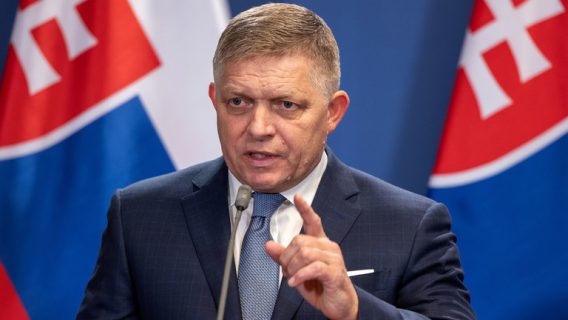
Prime Minister of Slovakia Robert Fico. © Getty Images / Janos Kummer
RT | January 20, 2024
Bratislava will block Kiev’s bid to join the US-led NATO alliance and will stand by a decision to stop supplying weaponry to Ukraine amid its conflict with Russia, Prime Minister of Slovakia Robert Fico has said.
The PM made the remarks on Saturday ahead of his visit to Ukraine to meet his counterpart Denis Shmygal in the western Ukrainian city of Uzhgorod. Fico stressed that his visit serves solely “humanitarian” purposes and promised to openly communicate Bratislava’s stance to Kiev on different issues, including Ukraine’s potential accession to EU or NATO membership.
“I will tell him that there are things on which we have completely different opinions,” Fico told broadcaster RTVS. “I will tell him that we respect them when it comes to joining the EU, but they must fulfill the conditions,” he added, explaining that a situation where “a country that absolutely does not meet any requirements” joins the EU is unacceptable.
He ruled out any possibility of Ukraine joining NATO, insisting such a move would only result in a global catastrophe, apparently caused by a direct collision between NATO and Russia over the issue.
“I will tell him that I will veto and block [a NATO bid by Ukraine] because that is exactly the basis of the third world war and nothing else.”
Fico also promised to reiterate to Shmygal his election campaign pledge to stop providing Kiev with weaponry, stating that the decision remains in force. Still, the weapons restriction applies only to state-sponsored military aid to Ukraine and supplies coming from Slovak military stocks, whereas arms manufacturers are free to sell to the country whatever they like, he noted.
“When Slovak companies don’t make money, American ones will,” Fico noted.
Prior to Fico assuming office following his party’s electoral victory in September, Slovakia had been among Kiev’s top supporters, lavishly supplying it with sophisticated weaponry, including warplanes and anti-aircraft systems. The policy of the previous government has also left the country’s own defense posture badly damaged, new Defense Minister Robert Kalinak claimed earlier this week.
“The former government left us without our own anti-aircraft defenses, without combat aviation, and we don’t even have the promised 700 million for MiGs, which the government also handed over to Ukraine,” Kalinak told the Standard newspaper.
Zelensky serves Western elites – exiled opposition leader
RT | January 19, 2024
President Vladimir Zelensky is serving the interests of the collective West and not Ukraine, effectively conducting a modern “crusade” against Russia, according to the former leader of Ukraine’s biggest opposition party Viktor Medvedchuk.
The current conflict is not that different from the past Western pushes into the East, such as Napoleon’s or Hitler’s invasion of Russia, Medvedchuk wrote in an article posted on his website on Friday, suggesting that this particular “crusade” is being waged by proxy.
“Europe has traditionally labeled Russia a ‘barbaric country,’ using this as a pretext for invasion. Napoleon was bringing ‘freedom and civilization’ to Russia, Hitler was saving it ‘from the Jews and the Bolsheviks,’ thus, all the invaders said that they wished only good for the Russian people, and really wanted to bring them into the Western world,” Medvedchuk wrote.
In reality, only the “treasures and resources of Russia and its people” were actually meant to make it into the “Western world,” while Russians themselves were bound to get “slaughtered,” he added.
The current Ukrainian leadership has defined their country as an “Anti-Russia,” with Kiev making a big effort to portray its citizens as people universally hating anything Russian, Medvedchuk noted, suggesting that the effort is primarily meant to impress their Western sponsors.
“Zelensky paints the Ukrainians as ardent haters of Russia. He does this for a reason: hundreds of billions of dollars in Western aid flow to him and his circle. And the Ukrainian people get nothing from these funds except death, poverty and suffering,” Medvedchuk said, squarely accusing Zelensky of committing “genocide” of the Ukrainians.
The Jewish Zelensky introduced Nazi standards of the death of Ukrainian soldiers for the interests of the Western elite. Citizens of Ukraine have been strictly forbidden to remember who they are, what language they speak, what faith their ancestors were, what culture they grew up in.
Medvedchuk predicted that the inevitable failure of the Western crusade is bound to result in a collapse of modern Ukraine. He urged Ukrainians to rebel against Zelensky and his government, who had long sold them out as “cannon fodder” for NATO.
“In this situation, the salvation of the Ukrainian people lies in turning their weapons against Zelensky. We need to save our people and take back the land Zelensky sold. There is simply no other way for Ukrainians. They are driven to slaughter, their land is cleared of them, Zelensky’s team receives super profits for their blood,” he wrote.
Medvedchuk was the leader of the Opposition Platform – For Life, the second-largest group in the Ukrainian parliament, until his arrest in April 2022. The party was banned in July that year, and Medvedchuk was sent to Russia in exchange for several Ukrainian POWs in September.
Since then, he has been promoting a platform that would make Ukraine a neutral state that prioritizes its own national interests, as opposed to being an enemy of Russia.
PM Orbán: EU parliament wants to rob citizens of a choice on Ukraine funding

MAGYAR NEMZET | JANUARY 19, 2024
By forcing through a four-year, €50 billion aid package to Ukraine just a few months ahead of European elections, members of the European Parliament want to rob people of the right to choose their future, Prime Minister Viktor Orbán wrote on X.
“Liberal MEPs attacked Hungary once again in the European Parliament yesterday. They want to give money to Ukraine for 4 years, while the European elections are just 5 months away. They essentially want to strip people of their rights to make decisions on their future. What an anti-democratic position! Hungary disagrees. If we want to help Ukraine, let’s do it outside the EU-budget and on a yearly basis! This is the only democratic position just 5 months before the elections,” Orbán wrote.
On Wednesday, two key debates were held in Strasbourg. The first focused on the previous and upcoming EU summits, while the second was entitled: “The situation in Hungary and frozen EU funds.”
After the EU parliament discussed funding to Hungary, the agenda was supposed to focus on the EU summit set for Feb. 1. However, MEPs were so fixated on Hungary, that the country dominated their conversations for nearly the entire session, so much so that even Romanian Socialist MEP Maria Grapini pointed out that the debate was fixated on the vilification of Hungary and the previous session’s discussion on Ukraine.
Biden Warns Congress Lack of Ukraine Aid Could Lead to US Troops on Ground
Sputnik – 18.01.2024
WASHINGTON – President Joe Biden met with congressional leaders and warned them that not approving additional funding for Ukraine could possibly result in the deployment of US troops to that country, White House spokesperson Karine Jean-Pierre said on Thursday.
“The president conveyed a sense of urgency about the stakes for our NATO partners in the region, what it would mean for our NATO partners in the region, and certainly we don’t want to see our own troops put in a position where we might need to put boots on the ground,” Jean-Pierre said.
On Wednesday, US House Speaker Mike Johnson said that the United States’ status quo on Ukraine is unacceptable.
Johnson also said Congress needs a clearer explanation from the Biden administration about its strategy in Ukraine, the endgame and accountability for US funds. The speaker also added that US border security must be the top priority.
Biden’s supplemental request includes more than $60 billion for Ukraine.
Hungary proposes plan to end Ukraine conflict
RT | January 17, 2024
Hungarian Foreign Minister Peter Szijjarto has called for a halt to all Western military aid to Ukraine, saying the massive influx of weapons – as well as Kiev’s reluctance to negotiate – has made peace impossible.
Asked what should be done to achieve a ceasefire in Ukraine in an interview with Austrian news site Exxpress, Szijjarto said ending foreign arms shipments to Kiev is a top priority.
“The more weapons that are supplied, the longer the war lasts. And the longer the war lasts, the more people will die,” the minister continued. “It is obvious that what has been done so far has not been successful. Many weapons were delivered, but the war was only prolonged. A lot of money has been paid to Ukraine, but the destruction of Ukraine continues.”
Pressed on the possibility that Russian troops would “march all the way to Kiev” in the event Ukraine is left “defenseless,” the diplomat said this could only be avoided with negotiations and a renewed peace process.
“This should be prevented by ending the war now. As long as that doesn’t happen, the war threatens to intensify further and more people risk dying. The war should have ended yesterday,” he said.
Szijjarto went on to argue for more dialogue between the warring parties and countries willing to mediate talks, saying “the most important requirement is to keep communication channels open.” He noted that he is often “insulted by many European colleagues, and by Brussels” after meetings with his Russian counterpart, but said “there is no hope at all for peace” without negotiations.
Western sanctions have also failed to “bring the Russian economy to its knees” as intended, the foreign minister said, suggesting the more aggressive approach had backfired and could not bring an end to the fighting.
Budapest is among a small number of EU states that have refused to join the sanctions campaign or provide weapons to Ukrainian forces, opting instead to maintain ties with Moscow. Despite pressure from other members in the bloc, Prime Minister Viktor Orban has declined to approve Brussels’ latest aid package to Kiev, holding up the funds since December.
The Hungarian leader has also threatened to veto Ukraine’s accession to the union, arguing that it poses many risks to the bloc and its economy, as well as the fact that Kiev is still “at war.”
The EU impasse comes at a time when Ukraine’s largest Western backer, the United States, has run out of aid money, as a $61.4 billion spending package remains stalled in Congress. Kiev’s foreign minister, Dmitry Kuleba, has acknowledged his country has no “plan B” should the funds run dry, saying there is no alternative to US largesse.
Fact Check: Is Russia Really Getting Ready to Invade NATO?
By Ilya Tsukanov – Sputnik – 15.01.2024
NATO is getting ready for Russian aggression against the alliance’s eastern flank, Bild says, citing a “secret Bundeswehr document” about preparations for the possible flashpoint. But what’s the actual chance of a Russian attack on NATO, and which side, historically, has dreamt about and planned for a World War III scenario in Eastern Europe?
The German military is reportedly getting ready for a hot war between Russia and NATO, with a conflict scenario imagined in a classified Bundeswehr document envisioning a gradual escalation of tensions from February onwards, culminating in the buildup of hundreds of thousands of Russian and NATO troops around the Baltics and potential clashes by the summer of 2025.
The document lays out a scenario in which Russia, emboldened by Ukraine fatigue among NATO countries, kicks off a successful spring offensive over the coming months, chipping away at the Ukrainian army, and then – for reasons known apparently only to Bundeswehr planners, starting a campaign of “cyber attacks and other forms of hybrid warfare” against the Baltic states to stir up unrest among the ethnic Russian minority there.
The so-called ‘Suwalki Gap’ – the 100 km long Polish strip of land separating Belarus and the Russian exclave of Kaliningrad, is deemed by the Bundeswehr to be the focal point of a possible Russia-NATO clash, with the scenario envisioning the transfer of some 300,000 NATO troops to Eastern Europe to “deter” Moscow from aggression. The scenario ends ambiguously, with its authors leaving open whether the tensions and troop buildup ends in a potentially world-ending shooting war.
Russian officials scoffed at Bundeswehr planners’ rich imagination, with Foreign Ministry spokeswoman Maria Zakharova comparing the leaked plan to a “powerful horoscope” on Monday and saying she wouldn’t be surprised if the scenario was provided to the German military by the Foreign Ministry and its notoriously Russophobic chief, Annalena Baerbock.
The German Defense Ministry attempted to walk back the report, with a spokesperson assuring Bild that “considering various scenarios, even if they are extremely unlikely, is part of everyday military practice, especially during army training” while nevertheless emphasizing that it takes “threats” from Russia seriously.
‘Various Scenarios’
The German MoD wasn’t wrong in mentioning the military’s propensity to plan for “various scenarios” when it comes to the idea of an all-out conflagration between Russia and NATO. What it left out, however, is that historically, many of the most outlandish declassified conflict scenarios seem to involve the idea of a preemptive attack against Russia by Western powers, not the other way around.
In the spring of 1945, for example, just weeks after the end of WWII in Europe, and while the war against Japan was still raging, British Prime Minister Winston Churchill commissioned a secret plan for an invasion of the Soviet Union by the Western Allies, including the combined forces of the US and the UK, plus 10-12 German divisions created from the remnants of the Wehrmacht – the same force tens of thousands of American and British troops died fighting to liberate Western Europe from the Nazis.
The plan, dubbed “Operation Unthinkable,” had the objective of imposing “upon Russia the will of the United States and the British Empire,” and included “the occupation of such areas of metropolitan Russia” to “render further resistance impossible.” Fortunately, the contingency was never realized, with its existence revealed to the public in 1998 after many decades under wraps. Some historians believe the Soviet leadership learned about the plan ahead of time, with Red Army forces in Eastern Europe inexplicably reorganizing in late June of 1945, just before the July 1 hypothetical attack date.
From 1945 until 1949, the US enjoyed a global monopoly in the possession of nuclear weapons as Soviet scientists scrambled to catch up. During this brief window of time, the Pentagon developed at least nine separate plans to target its erstwhile WWII Soviet allies using nukes. Most famous among them was Operation Dropshot – a 1949 proposal calling for the bombardment of some 100 Soviet cities with 300 nuclear bombs and 250,000 tons of conventional munitions, plus chemical and bacteriological weapons, followed by a ground campaign to ensure “complete victory” over the USSR and its allies across Eurasia. The plan, which signed off on by the Joint Chiefs of Staff on December 19, 1949, was declassified in 1977, sparking disbelief among many ordinary Americans owing to its brutality.
In 1988, at the twilight of the Cold War, while President Reagan was visiting Moscow to schmooze with General Secretary Gorbachev and to announce that he no longer saw the USSR as an “evil empire,” the US Naval War College was playing out a strategic wargame modeling surprise offensive operations against Soviet air defenses, military-industrial complex, and naval assets in Asia.
After the Cold War ended and the USSR broke apart, the Pentagon continued to plan for scenarios of unprovoked aggression against Moscow – even as US leaders spoke of Russia as their ‘partners’ in the “new world order” announced by President George H.W. Bush in his State of the Union address in January 1991. In the early 2000s, while Bush’s son George W. Bush gushed about looking into President Putin’s eyes to “get a sense of his soul,” Pentagon planners were busy coming up with Prompt Global Strike – a scenario proposing the massed launch of precision-guided conventional missiles to decapitate the Russian leadership and declaw its nuclear forces.
The concept, still around and now called ‘Conventional Prompt Strike’, proposes the use of thousands of conventional ballistic and cruise missiles, as well as air and space assets, either in place of or in coordination with nuclear weapons. The US began to develop the Prompt Global Strike idea at the same time that the US withdrew from the Anti-Ballistic Missile Treaty with Russia in 2002, with that move, combined with NATO encroachment on Russia’s western borders from 1999 onward, forcing Moscow to invest significant resources into the development of fundamentally new strategic weapons, including hypersonic missiles.
The above examples serve to demonstrate that whatever the geopolitical climate at the time – and whether Moscow is an erstwhile ally in the fight against German Nazism and Japanese militarism, an adversary at the start of the Cold War, a newfound friend at its end, or a trusted ‘partner’ at the dawn of the 21st century, US and allied military planners will find cause to come up with scenarios for a war of aggression against Russia. The historical detour adds a dose of context to reporting on purported Russian plans to attack NATO without provocation, with such plans seemingly being more the alliance’s forte.
Tactical Blindspots
The Bundeswehr’s fearmongering about the potential for “Russian aggression against NATO” in the Suwalki Gap isn’t new. In fact, Sputnik has been reporting on and poking holes in similar claims since at least 2015, when Pentagon officials first began warning that Russia might attempt to close the gap, thus cutting off the Baltics from Poland and the West. Then, as now, the US and its allies never bothered to explain what on Earth would motivate Russia to attack NATO.
In 2017, following another dose of fearmongering related to Russia and the Suwalki Gap in the Wall Street Journal, political observer Yevgeny Krutikov said that NATO’s fears were nothing short of “stupidity,” pointing out that most of the Suwalki Gap area consists of woodland, lakes and swamps, including a national park, and that the region lacks any major roads. “It does not even cross anyone’s mind that tanks can’t pass through the Suwalki woods,” Krutikov stressed at the time.
Strategic Fallacies in Logic
Seven years later, the Suwalki Gap has reemerged in the minds of Western military planners as the place where Russia-NATO tensions could go hot. Leaving aside tactical considerations, the question Sputnik and others have asked, and which NATO have never been able to answer, is why Moscow would launch what amounts to an unprovoked invasion of Poland – a NATO member, and proceed to attack three more NATO allies (Lithuania, Latvia and Estonia), thus triggering World War III in the process.
Russia’s military demonstrated its capabilities against Ukraine in the proxy war with NATO in Ukraine, with the country’s troops, equipment and military production capabilities more than a match for an army trained, armed and funded by the Western bloc, and even earning the ranking of number one in the world militarily – above the United States, in a recent US report.
That said, a direct confrontation with NATO could very quickly turn against Russia’s favor, with the alliance having more than four times the total military personnel and active duty troops, three times the number of paramilitary reserves, nearly five times as many aircraft, six times as many armored vehicles, 3.5 times more warships, and over six times the population.
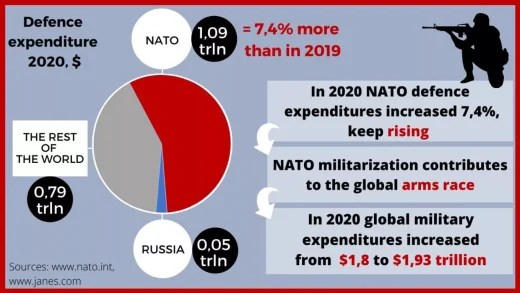
Russian Foreign Ministry graphic of NATO defence spending compared to that of Russia and the rest of the world.
Under Article 5 of the NATO Treaty, members are required to come to the defense of members in the event of enemy aggression, and at least in theory, are under obligation to deploy weapons up to and including nuclear weapons, if necessary. That, combined with Washington’s carefree approach to nukes (including allowing their use on a first strike basis and even against non-nuclear-armed adversaries), means a Russian attack on the Baltics would very likely put the planet on a rapid ride to a world-ending World War – something Russian political and military leaders have repeatedly demonstrated they are not interested in.
“The whole of NATO cannot fail to understand that Russia no reason, no interest – neither geopolitical interest, nor economic, nor political, nor military – to fight with NATO countries,” President Vladimir Putin said in an interview with Russian media last month. Moscow and the bloc “have no territorial claims against each other,” Putin stressed, adding that Moscow would prefer peaceful coexistence to confrontation with bloc members.
Perhaps if the alliance spent more time listening to what the Russian president has been saying and living up to decades-old promises to Moscow not to expand eastward instead of antagonizing the country by fueling a proxy war against it in Ukraine, Bundeswehr planners wouldn’t have to worry about paranoid scenarios involving having to fight the Russian army hundreds of kilometers east of Germany.
Nazis and Zionists
Genocidal Hate Speech in Nazi Germany and Talmudic-Zionist “Israel”
Michael Hoffman’s Revelation of the Method | January 9, 2024
The Nazis
On 25 October 1941 we have the following statement from Hitler. It was uttered during a private dinner with his co-conspirators SS chief Heinrich Himmler, and Reinhardt Heydricht, commander of the Reichssicherheitshauptamt (Nazi Germany’s Department of Homeland Security):
“In Parliament [30 January1939 and 1941], I prophesied Jewry that the Jew will disappear from Europe if war is not avoided. This criminal race has to account for two million deaths in World War I, and now again hundreds of thousands. Don’t anybody tell me that we cannot send them into the morass! Who cares about our people? It is good if the terror precedes us that we are exterminating Jewry. The attempt to create a Jewish state will be a failure!”
From the diary of Josef Goebbels, Reich Minister of Propaganda, May 27, 1942:
“Beginning with Lublin, the Jews in the General Government are now being evacuated (abgeschoben) eastward. The procedure is a pretty barbaric one and not to be described here more definitely. Not much will remain of the Jews. On the whole it can be said that about 60 percent of them will have to be liquidated (liquidiert)…” (Die Tagebücher von Joseph Goebbels, 1941-1945; De Gruyter Saur).
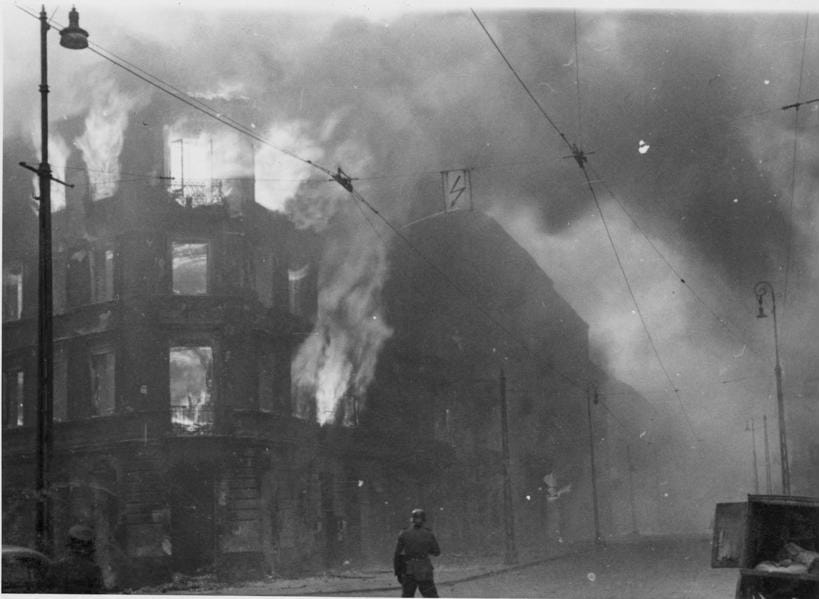
The Warsaw Ghetto Uprising, 1943
In July 1942, hundreds of thousands of Jews from the Warsaw Ghetto were being deported, most of them via the Treblinka Camp. Jewish leaders in the Warsaw Ghetto therefore decided to fight back. They started an uprising on April 19, 1943. It was put down brutally by German armed forces, for the most part within a few days, but skirmishes carried on until mid-May. Jews who survived were again generally deported.
October 6, 1943 SS chief Himmler spoke before the political elite of the Third Reich. In a brief excerpt from his long speech, we read the following (Smith/Peterson 1974, pp. 169 f.):
“I ask of you that that which I say to you in this circle be really only heard and not ever discussed. We were faced with the question: what about the women and children? – I decided to find a clear solution to this problem too. I did not consider myself justified to exterminate (only) the men – in other words, to kill them or have them killed and allow the avengers of our sons and grandsons in the form of their children to grow up.
“The difficult decision had to be made to have this people disappear from the earth. For the organization which had to execute this task, it was the most difficult which we had ever had…I felt obliged to you, as the most superior dignitary, as the most superior dignitary of the party, this political order, this political instrument of the Führer, to also speak about this question quite openly…”
October 7, 1943, the day after Himmler had given his lengthy speech about “making the Jews disappear from the earth,” Goebbels wrote: “As to the Jewish Question, (Himmler) gives a very frank and candid picture. He is of the opinion that we can solve the Jewish Question for all of Europe by the end of this year. He advocates the most radical and harshest solution, namely, that the whole of Jewry will be exterminated [auszurotten]. This is surely a consistent, if brutal, solution.”
Hans Frank (Nazi governor of occupied Poland) — diary entry for December 16, 1941: “We must destroy the Jews, wherever we find them, in order to maintain the overall structure of the Reich here. […] Currently there are in the Government General [occupied Poland] approximately 2½ million, and together with those who are kith and kin and connected in all kinds of ways, we now have 3 ½ million Jews. We cannot shoot these 3 ½ million Jews, nor can we poison them, yet we will have to take measures which will somehow lead to the goal of annihilation, and that will be done in connection with the great measures which are to be discussed together with the Reich. The territory of the General Government must be made free of Jews, as is the case in the Reich. Where and how this will happen is a matter of the means which must be used and created, and about whose effectiveness I will inform you in due time.” (IMT, Vol. 29, pp. 502f.)
On March 4, 1944, Nazi governor Frank stated (p. 687): “The Jews are a race that must be effaced. Wherever we catch one, he is coming to an end.”
Between late 1941 and late 1942, Nazi authorities deported many tens of thousands of Jews from western and central European countries to locations in the German-occupied Soviet Union… many if not most of them were killed there by the Einsatzgruppen and associated units.
“In particular the camp Maly Trostenets near Minsk (capital of Belorussia), and the prison at Fort IX near Kaunas (Lithuania) deserve to be mentioned in this context. Thousands of deported Jews were executed there.
“Jews living inside the Soviet Union were the primary target of the Einsatzgruppen and associated units…this happened primarily by way of mass shootings…German wartime documents speak of some 750,000 victims…”
“Not just one, but two Einsatzgruppen – C and D – were active in Ukraine. The most infamous crime scene associated with these units occurred in the suburbs of Ukraine’s capital Kiev, at Babi Yar… The Einsatzgruppen’s ranked death-toll list includes several entries for Ukrainian locations…(totaling approximately 138,000 victims)… Ukraine was completely occupied by Germany.. This put all of Ukraine’s remaining Jews in mortal danger, and many paid with their life.”
“SS Gruppenführer Arthur Nebe became head of Germany’s Civil Police in 1936. In June 1941, Nebe was appointed commander of Einsatzgruppe B, which he led from its inception in June, 1941 until October 1941, hence “for some four months. As such, he approved several Einsatzgruppen reports sent to Berlin which documented the execution of thousands of Jews in the deployment area of his Einsatzgruppe B.”
“SS Gruppenführer Otto Ohlendorf was the director of Office III, the “SD” (Internal Security Service) of the Reichssicherheitshauptamt (Reich Security Main Office). In 1941 he was appointed head of Einsatzgruppe D, a position he held for a year. This group operated in the southern region of the temporarily German-occupied Soviet Union (Bessarabia, southern Ukraine, Crimea, Caucasus)…“At the Nuremberg Einsatzgruppen Trial, Ohlendorf accepted responsibility for at least 90,000 victims of mass shootings carried out by Einsatzgruppe D, while he was in charge of that unit. There is an abundance of documentary evidence in support of these facts.
In the summer of 1942, the forced deportation of tens of thousands of Polish Jews from the Warsaw Ghetto was underway. When the deported Jews arrived further East, Wilhelm Kube, Nazi Commissioner for Belorussia, complained to his superior Lohse on July 31, 1942 (and later also to Alfred Rosenberg, head of the Ministry for the Occupied Eastern Territories), indicating Kube’s forces had been executing tens of thousands of Jews in the area to prevent them from supporting the partisans.”
“In Hitler’s Table Talk, Hitler drew a picture of the future of the Eastern European territories which is one of the best authenticated of his life’s visions and typical of his weltanschauung, which entailed the total disfranchisement of the subjugated. He ruled they have no claims of any kind, except to an early death. They are forbidden to learn to read and write; to concern themselves with history or politics is a crime worthy of death. Any communication whatever going beyond the confines of the village is strictly prohibited…They are to live in their filthy hovels without hygiene or inoculation, while the German settlers, strictly segregated, own splendid villages and spacious fortress farms.”
— German revisionist historian Ernst Nolte (1923-2016), author of the magisterial 1987 history, Der europäische Bürgerkrieg (“The European Civil War”).
The Zionists
“We shall try to spirit the penniless (Palestinian) population across the border…while denying it any employment in our own country… expropriation and the removal of the poor must be carried out discreetly and circumspectly.” —Theodor Herzl, founding father of Zionism, 1895
“I support compulsory transfer. I don’t see anything immoral in it” (1938). “Now a transfer of a completely different scope will have to be carried out. In many parts of the country new settlement will not be possible without transferring the Arab fellahin (Palestinian peasant farmers)….….Jewish power [in Palestine], which grows steadily, will also increase our possibilities to carry out this transfer on a large scale.”
—David Ben-Gurion, first Israeli Prime Minister, 1948
Writing in his diary in 1940 Yosef Weitz, a senior Jewish National Fund official who chaired the influential Transfer Committee before and during the Nakba (“Catastrophe”), and became known as the “Architect of Transfer,” (mass expulsion of the Palestinian population), put it thus: “The only solution is a Land of Israel devoid of Arabs. There is no room here for compromise. They must all be moved. Not one village, not one tribe can remain. Only through this transfer of the Arabs living in the Land of Israel will redemption come.”
The religious-terrorist Kach party was founded in 1971 by Brooklyn-born Rabbi Meir Kahane who argued for the immediate expulsion of the Palestinians, who he called “dogs.” In 1984, Kahane introduced legislation in the Knesset to ban all Jewish-Gentile marriages and sexual relations and revoke the Israeli citizenship of non-Jews.
In 2019, Kahane’s follower Itamar Ben Gvir formed the “Jewish Power” party, an ideological offshoot of Kach. Merging with other Talmudic-Zionist parties to form Religious Zionism in 2022, they won the third-largest share of Israel’s parliament seats. Netanyahu appointed Ben-Gvir Israeli Minister of Security. For years Ben-Gvir displayed in a place of honor in his home a portrait of Baruch Goldstein, an American-Israeli who killed 40 Palestinians and wounded more than 100 in a shooting massacre as they knelt in prayer at Hebron’s Tomb of the Patriarchs in 1994. As the Israeli Security Minister Ben-Gvir has instigated a settler reign of terror on Palestinian farmers and sheepherders on the West Bank.
In the aftermath of Goldstein’s slaughter, Noam Federman, a spokesman for the Kach party opined, “The act itself was one of greatness. It was a great act of sanctifying the Name (of God).”
Paying homage at Goldstein’s funeral, Rabbi Yaacov Perrin told mourners that “one million Arabs are not worth a Jewish fingernail.”
”Palestinians in Lebanon are two-legged animals.”
—Israeli Prime Minister Menchaem Begin (source: NY Times, August 5, 1985, p. A6)
Palestinians are cockroaches scurrying in a bottle.”
—Israeli Army Chief of Staff Rafael Eytan (source: NY Times, August 5, 1985, p. A6)
Rabbi Ovadia Yosef, the head of the powerful Israeli Shas political party and chief rabbi of Sephadic Israeli Judaism, taught that the Arab people should be exterminated, “May the Holy Name visit retribution on the Arab heads, and cause their seed to be lost, and annihilate them. It is forbidden to have pity on them. We must give them missiles with relish, annihilate them. Evil ones, damnable ones.”
—2001 Passover sermon. Cf. Haaretz, April 12, 2001. 700,000 Israelis attended Ovadia’s funeral. In its obituary, the New York Times eulogized him and omitted all reference to his calls for exterminating Arabs.
“If you believe that the Jewish state has a right to exist, then you must allow Israel to transfer the Palestinians and the Israeli-Arabs from Judea, Samaria, Gaza and Israel proper. It’s an ugly solution, but it is the only solution.”
—Ben Shapiro, American media personality, Orlando Sentinel, September 8, 2023
“Well, if everyone in Gaza is a refugee, let’s scatter them around the world. There are 2.5 million people there, every country will take in 20,000 people, 100 countries.”
— Ram Ben Barak, Member of the Knesset, ex-Mossad Deputy Director, November 1
“There should be a second Nakba.”
—Israeli agriculture minister Avi Dichter, November 11, 2023. [Nakba: the 1948 forced expulsion of 750,000 Palestinians, which culminated in the creation of the so-called “state of Israel”].
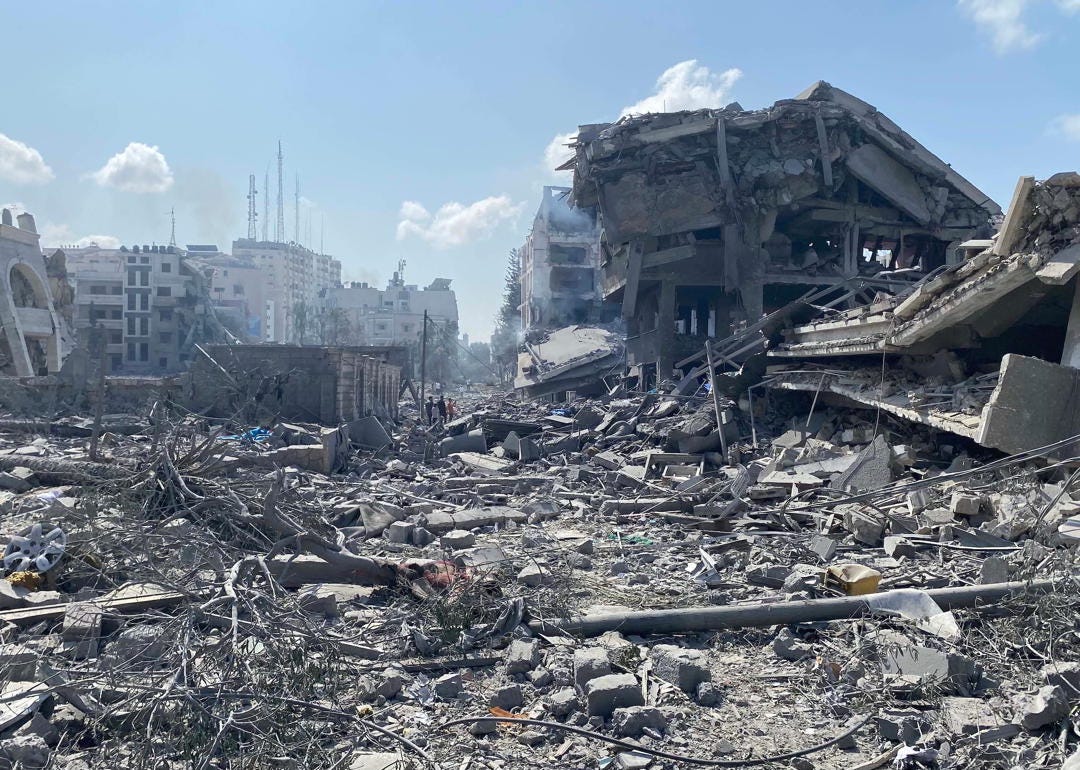
Gaza City in the early days of the Israeli terror bombings, October, 2023
“The Gaza Strip should be flattened, and for all of them (Palestinians) there is but one sentence, and that is death…Gaza has to be wiped off the map, in order to send a message to all our enemies and those who seek us harm…. In Gaza, we have to be clear, there are no innocent [civilians]. There are no “uninvolved” people.”
—Yitzhak Kroizer, Member of the Israeli parliament (“Knesset”), Nov. 5. 2023.
Tally Gotliv, an official in Binyamin Netanyahu’s Likud party, has demanded that Prime Minister Netanyahu use a nuclear bomb on Gaza. “Before we consider inserting ground troops, doomsday weapon.”
Likud member of the Knesset, Boaz Bismuth stated with reference to Gaza: “There’s no place for any humanitarian gestures.”
Israeli journalist Zvi Yehezkeli said on Israel’s Channel 13: “[We] should have killed many times 20,000 people, [we] should have begun with a blow of 100,000.”
As of January 9, 2024, the Israeli military has damaged or destroyed 70 percent of Gaza’s housing.
85 percent of the population of Gaza have been dehoused and rendered homeless.
In three months the Israelis have killed more than 22,000 Gazans, the majority of them women and children. The number of wounded, disabled and mutilated are more than twice that casualty figure. It is expected that many more Palestinian civilians will die of intentional Israeli-imposed imposed disease and hunger.
“Non-Jews are uncompassionate by nature and attacks on them curb their evil inclination.” — Torat Ha-Melekh (sometimes spelled Torat Hamelech, 2009). Torat Ha-Melekh is an Israeli rabbinic book based on the Talmud which has been widely distributed to Israeli military personnel.
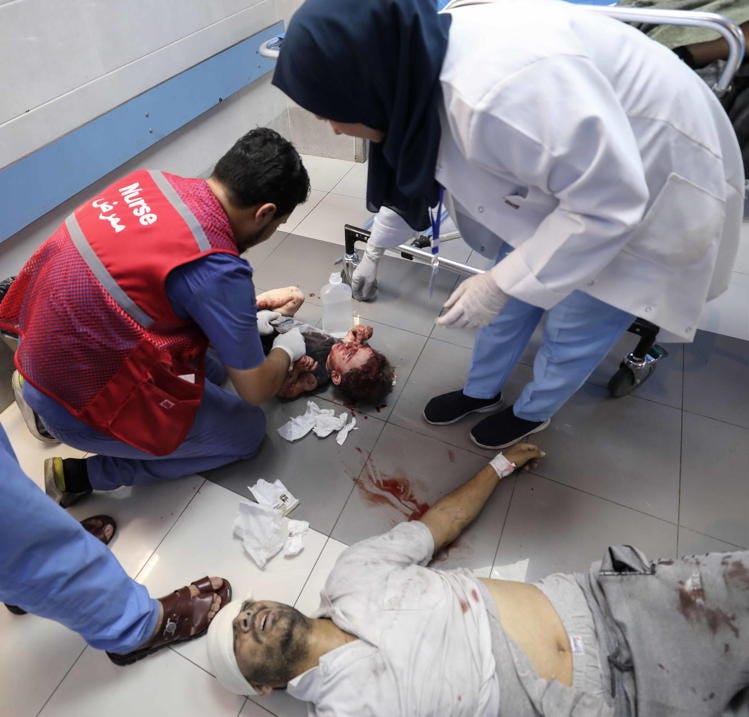
A Palestinian child is treated for injuries on a hospital floor in Gaza, inflicted by the “Israeli Defense Force”, while a wounded Palestinian man awaits further medical care, autumn, 2023
Torat Ha-Melekh teaches that it is a religious duty to kill non-Jewish children on the enemy side during warfare, “if there is a good chance they will grow up to be like their evil parents.” Other reasons the Israeli authors furnish for the permission to kill non-Jewish children include if they “block the rescue of Jews… Little children are often situated in this way…it is permitted to kill them because their very presence facilitates the killing (of Jews)…(p. 215). “It is also permitted to kill the children of the leader (of the enemy) in order to put pressure on him…” (p. 215).
“We are imposing a complete siege on the city of Gaza. There will be no electricity, no food, no water, no fuel, everything is closed. We are fighting human animals and we are acting accordingly”
— Israeli Defense Minister Yoav Gallant, October 9, 2023.
On January 6, 2024 the New York Times described Gallant as “a moderate member of Mr. Netanyahu’s right-wing Likud party…” (Section A, Page 6; italics added).
“Human beasts are dealt with accordingly. Israel has imposed a total blockade on Gaza: no electricity, no water, just damage. You wanted hell—you will get hell”.
—Israeli Major General Ghassan Alian, Coordinator of the Government in the Territories, October 10
“Israel has no choice but to render Gaza into a place that is temporarily, or permanently, unfit for living.”
— Giora Eiland, Israeli Defense Ministry, October 11
“Do not leave a stone unturned in Gaza. Gaza needs to turn into Dresden. Complete incineration. Annihilate Gaza now!”
—Moshe Feiglin, Member of the Israeli Knesset, October 26, 2023. The Allied incineration by more than 800 bombers leveled the city of Dresden and burned alive tens of thousands of civilians.
Concerning the Palestinian population of Gaza: “They are not humans nor human animals, they are sub-humans and should be treated as such.”
—Arieh King, Deputy Mayor of Jerusalem, December 8
“There are no innocent [civilians] in Gaza.”
—Avigdor Lieberman, Member of the Knesset, and leader of Israel Beytenu Party, former Israeli Defense Minister, December 3
“We are too humane. Burn Gaza now, nothing less!”
—Nissim Vaturi, Deputy Speaker of the Knesset, November 17
“… we should make sure that there is a severe humanitarian disaster there (in Gaza), and severe epidemics, and horrible pressure, and cries to the sky—because that’s how wars are won… A humanitarian disaster is the only way to bring about the end of the war in a desirable way. Think about it this way: the poor women of Gaza, who are they? They are the mothers and sisters and wives of the Hamas murderers. Gaza’s system, unlike [its characterization by the US which I mentioned earlier] that there is Hamas and there are civilians—it is not true! Gaza is a state that is entirely united around its leader and its ideology for 15 years, without any dissent and with enthusiastic support….
“The weak point [of Gaza] is their civilian population…the thousands of Hamas terrorists, whose mothers and wives and children who will start suffering from severe illnesses, are the point of weakness. If we want to win the war—that’s how you win a war.”
“I agree with every word of Giora Eiland.”
—Israeli Finance Minister Bezalel Smotrich, November, 2024
“Given the collapse of Gaza’s sanitation and medical systems, as much as a quarter of Gaza’s people could die within the year, mostly from disease or lack of access to medical care.”
—Peter Beinart, Jan. 7, 2024
“Spend your energy on one thing; wiping Gaza off the face of the earth. Let the Gazan monsters fly to the southern fence and flee into Egyptian territory. Or have them die. And have them die horribly. Gaza must be wiped out. ..We require a revengeful and cruel IDF (Israeli military). Anything less than that is immoral. Simply immoral.”
—Galit Distel-Atbaryan, Member of the Knesset, November 1
“I am saying here to the citizens of Lebanon…(w)hat we are doing in Gaza we know how to do in Beirut.”
—Israeli Defense Minister Yoav Gallant, November 11.
(Gallant was telling the truth. In the summer of 1982 the Israeli air force terror-bombed the city of Beirut resulting in 20,000 civilians killed and tens of thousands wounded).
“The north of the Gaza strip—more beautiful than ever. Blowing up and flattening everything, simply a delight for the eyes.”
—Amichai Eliyahu, Israeli Minister of Heritage, November 1.
“…twice as many children have died in Gaza just since the war started on Oct. 7 as in all the conflicts worldwide in 2022…Far more women and children appear to have been killed in Gaza than in the entire first year of the Iraq war…pulverizing entire neighborhoods…Too many (people) see events through a prism in which (Israeli) lives are invaluable on one side while (Palestinian) deaths on the other are regrettable.”
—Nicholas Kristof, December 6
“This law is taught: in the case of Israel, this soul of the kelipah is derived from kelipat nogah, which contains good…The souls of the gentiles however, emanate from the other, unclean kelipot which contain no good whatever.” —Shneur Zalman of Lyady, “the Alter Rebbe.” Likkutei Amarim, (chapter 1). This sacred text is more commonly known by its first Hebrew word “Tanya.” Zalman is the founder of Chabad Lubavitch. Tanya is its revered text.
“According to this radical Hasidic teaching, divinity dwells in the inner core of every Judaic human being. Those who are non-Judaic have no humanity, no inner core in which the divine can take up residence. Those beings who are not Judaic are sub-human: empty kelipot (corporeal ‘shells’) which constitute broken vessels.
“In this theology non-Jews are broken shells who adopt the appearance of a human form which conceals their demonic essence. Those who are not Jews are the personification of purely evil materiality. Kabbalistic theology posits a cosmic dichotomy wherein the gentile represents biologically-determined, irredeemable evil. This is the esoteric rabbinic teaching which the western secret societies (also known as the ‘New Age’), understood and implemented. In the case of the indoctrination of their agent Adolf Hitler, the western occult reversed the polarities and taught Hitler that “the Jews” were the kelipot (‘untermenschen’), and the ‘Aryans’ the purely distilled essence of the divine. The Hitler/Himmler/Goebbels version of National Socialism was, unknown to these dupes themselves, a Kabbalistic teaching on the biologically-determined, irredeemable evil in the form of the ‘Jew.’ Hitlerism was Kabalism in the garments of Aryanism.”
— Michael Hoffman
“The differences between Jews and gentiles are not religious, historical, cultural or political. They are, rather, racial, genetic and scientifically unalterable. The one group is at its very root and by natural constitution ‘totally evil’ while the other is ‘totally good.’ Jewish successes in the world are completely contingent upon the failure of all other peoples. Only when the gentiles face total catastrophe do the Jews experience good fortune.”
—Rabbi Saadya Grama, Romemut Yisrael Ufarashat Hagalut (“Jewish Superiority and the Question of Exile,” 2003). Grama is an alumnus of Beth Medrash Govoha, a renowned yeshiva in Lakewood, New Jersey.
There is something infinitely more holy and unique about Jewish life than non-Jewish life.”
—Talmudic-Kabbalist Yitzhak Ginsburg, Jewish Week (N.Y.), Aug. 26, 1996
“The dissimilarity between the Jewish soul, in all its independence, inner desires, longings, character and standing vis-à-vis the soul of all the gentiles–on all of their levels–is greater and deeper than the difference between the soul of a man and the soul of an animal, for the difference in the latter case is one of quantity, while the difference in the first case is one of essential quality.”
— Abraham Isaac Kook, Chief Rabbi of Palestine, 1921-1935, “The Father of Talmudic Zionism.” [Source: David Dishon,“The Beauty of Yefet in the Tents of Shem-Gentiles and Jews in the Thought of Rav Kook,” in Havruta: A Journal of Jewish Conversation; Shalom Hartman Institute. 1 (2): 80–89.]
“Wherever there is liability for capital punishment, with regard to bloodshed, if a gentile murders another gentile, or a gentile murders a Jew, he is liable. If a Jew murders a gentile, he is exempt.”
—Babylonian Talmud, Sanhedrin 57a
Israeli Prime Minister Netanyahu, October 28: “You must remember what Amalek has done to you says our Holy Bible, and we do remember and we are fighting. Our brave troops and combatants who are now in Gaza or around Gaza and in all other regions in Israel are joining this chain of Jewish heroes, a chain that started 3,000 years ago—from Joshua to the heroes of 1948—the Six Day War, the 1973 October war—and all other wars of this country—are hero troops. They have one supreme main goal, to completely defeat the murderous enemy and to guarantee our existence in this country.”
In 1 Samuel 15:3 the judgment of God is on the Amalekites, in the form of the divine command to Saul, the first King of Israel: “Now go and smite Amalek, and utterly destroy all that they have, and spare them not; but slay both man and woman, infant and suckling, ox and sheep, camel and ass.”
These are patently the marching orders Netanyahu gave the Israeli military (‘the most moral military in the world’): slay all the civilians of Gaza and spare them not. Not even Clarence Darrow could parse it otherwise. There’s no lawyer’s loophole here; no moderating clause.
“Netanyahu’s Amalek speech was a warrant for a genocide that has been carried out to the letter, notwithstanding the delusional Gaza holocaust denial which squats in our media, churches and government atop the cadavers of thousands of ‘unclean kelipot’—bombed and burned Palestinian children and their mothers, whose deaths do not register in the conscience of America. The Talmudic-resonate belief in the worthlessness of the Palestinians is as ubiquitous and inescapable as the racist hate speech which inculcates it.”
—Michael Hoffman, January 9, 2024.
I will not be silent.
Copyright©2024 by Independent History and Research
Michael Hoffman manages the podcast, Revisionist History®. He is the author of the banned 2008 textbook Judaism Discovered (1,102 pages), and nine other volumes of history and literature, as well as 122 issues of the periodical, Revisionist History®. Michael is a former reporter for the New York bureau of the Associated Press and a former paid consultant to the news department of the New York Times. His books have been published in translation in Japan and France. He resides with his family in Coeur d’Alene, Idaho. On Twitter (“X”): https://twitter.com/HoffmanMichaelA
For Further Research
Corruption, disinformation, warnings about assassinations: What to make of the latest Biden Ukraine links claims

By Tarik Cyril Amar | RT | January 12, 2024
At first it feels like a blast from the past but it’s really about the present and future: Journalist Simona Mangiante Papadopoulos has released a long interview with former Ukrainian MP Andrey Derkach. In which Derkach makes allegations about corruption in the US and Ukraine. In particular about the American President Joe Biden and Secretary of State Antony Blinken.
With regard to graft, while the various allegations (by no means only Derkach’s) and ongoing investigations are complex, in essence several simple questions are at stake: Did the current president’s son, Hunter Biden, sell his services as a Washington influence-peddler by using the “brand” (as one witness, Devon Archer, has put it) of his father’s connections (as then vice-president under Barack Obama)? And, potentially even more disturbingly, did the elder Biden himself profit from such influence-peddling? Finally, most disconcerting of all, did the current president use his leverage as Obama’s point-man on Ukraine to shield his son and, possibly, himself from investigations in Ukraine? Including by bringing down Ukrainian chief prosecutor Viktor Shokin, who got too close to the truth about Hunter Biden’s shady role in the Ukrainian Burisma gas company?
In sum, did the highest-ranking American official, charged with overseeing (among other things) Kiev’s putative “fight against corruption,” make things even worse by injecting a strong dose of US-establishment corruption into Washington’s newest client state? And, if so, could that two-sided entanglement have left a legacy, including of compromising actions, that has been influencing America’s reckless and failing (even on its own misconceived terms) proxy war policy in Ukraine?
Full disclosure: I happen to believe that the answer to all these questions is yes. Which is depressing, since it means that decisions, costing many human lives and making our shared global politics very dangerous, have been influenced by corrupt motives reminiscent of the world of organized crime.
But we do not know, yet. It is certain that Hunter Biden, a textbook failed-son and pampered heir, used his dad’s name to cash in, to the tune of (at the very east) $7.5 million. That much even the pro-Biden Washington Post had to admit (while revealing its bias with the packaging of the story, which accuses Republicans of “hyping” the numbers). As to whether Joe Biden himself also got a share and how all of this affected his policy on Ukraine – compelling proof, as opposed to plausible conjecture, is not available. At least at this point. But the Republicans, for their own selfish yet, politically, perfectly normal reasons, are digging for it through an impeachment inquiry into the current president’s record.
This is the background against which Derkach has now spoken up. Make no mistake: There will be attempts to dismiss all of this as – yes, you guessed it – the beginning of BIG BAD RUSSIAN MEDDLING in the 2024 presidential elections. In fact, they have already started. Frankly, yawn: Let’s not be distracted.
Such attempts will inevitably seek to make use of Mangiante Papadopoulos’ and Derkach’s own records. Mangiante Papadopoulos is a journalist and the wife of the former Trump campaign adviser George Papadopoulos. As such (though, to be precise, still his girlfriend at the time), she was questioned by the FBI in 2017, during the hot phase of the neo-McCarthyite campaign commonly known under the misleading label “Russiagate.”
Misleading because it was not really about Russia, but about the American Democrats’ foul-play attempt to undermine the reality of Donald Trump’s victory in 2016. (which was really down to Trump’s gifts as a populist and the Democrats’ arrogant decision to try and ram down the country’s throat the unelectably unappealing and politically terrifying candidacy of Hillary Clinton.)
“Russiagate” was, in reality, Russia Rage, a mix of Centrist and Liberal conspiracy theory-mongering and mass hysteria. The true scandal was that a sizable part of the US political and media establishment further ruined what was left of any working relationship with Russia, and undermined the American public’s faith in a legitimate election result. (No, Trump was not the first one to do so in 2020/21: The roots of the January 6 riot in Washington are deeply bipartisan.)
Derkach came to international attention a few years later, with respect to Trump’s successor. A Russian-Ukrainian businessman and politician (who is open about receiving elite Russian intelligence training in the early 1990s), American and Ukrainian officials have accused him of playing an important role in “meddling” in the election of 2020, specifically by helping undermine Biden’s reputation. Derkach released recordings of what he claimed were conversations between then-vice-president Biden and then-Ukrainian president Pyotr Poroshenko that, critics argued, pointed to illicit dealings. (Ironically enough, for a while these revelations were welcomed by the team of Poroshenko’s successor Vladimir Zelensky because they embarrassed his opponent.)
Derkach has also been accused of – and in Ukraine formally charged with – working for Russian intelligence and with treason. No wonder he fled the country in 2022 and now lives in exile in Belarus. The 56-year-old is, in sum, a very ambiguous figure whose statements should be treated with caution.
Yet they should not be dismissed wholesale. Simply branding anything inconvenient to the American Democrats and their media clique as “information warfare” or “Russian meddling” is how “Russiagate” has done so much damage. That was, after all, the manner in which the authentic and very relevant news about the compromising data on Hunter Biden’s abandoned laptop was suppressed before his father’s election. If the evidence pointing to corruption (and revolting personal depravity) had been allowed to be subjected to ordinary scrutiny and public debate – as it certainly would have been if it had concerned a member of the Trump family – the chances of Biden senior would have suffered.
Derkach is a complicated source; Mangiante Papadopoulos has also been accused of promoting Russia’s interests. (But then, frankly, who hasn’t?) But the question among adult observers is not who may be interested in a given piece of information seeing the light of day. Because here’s a little secret: As long as the information is of any political relevance at all, there’s always someone interested (as, by the way, Derkach openly admits in the interview, as far as his case is concerned). And here’s another one: That doesn’t mean that a given piece of information is untrue (“disinformation,” as we have been trained to say now). And finally: Remember, interests are involved not only in revealing, but also in hiding facts. Or, indeed, in pooh-poohing inconvenient revelations as nothing but propaganda.
So, what to make of what Derkach has had to say now? In the interview, which is almost an hour long, he makes many detailed statements, involving a large number of specified persons, especially in Ukraine. Let’s try to focus on key aspects and look at three of his most striking allegations one by one.
First, Derkach states that the Ukrainian authorities started going after him in earnest, including by extra-legal and life-threatening means, when (or because?) US Secretary of State Antony Blinken told them to resolve that Derkach problem. The interview is somewhat ambiguous: Is Derkach saying that Blinken himself gave, in essence, an order to use criminal methods or that Blinken – Henry II/Thomas Becket-style – “merely” called for someone to somehow rid his president of that turbulent Ukrainian?
Either way, it would have been a highly incriminating and tawdry act on Blinken’s part. But it would be naive to consider the current Secretary of State incapable of stooping so low. We are, after all, talking about the man who, during Biden’s election campaign, played a devious behind-the-scenes role in organizing the suppression of the Hunter Biden laptop story.
Back then, by mobilizing the American intelligence community to, once again, serve party-political purposes, Blinken helped Biden win and, in the long term, further shredded what’s left of American establishment credibility. (Not to mention that, currently, Blinken is displaying his absolute legal nihilism in stunning fashion by shielding Israel’s genocidal attack on Gaza.)
Secondly, Derkach also maintains that former Ukrainian chief prosecutor Viktor Shokin, who lost his job for going after a Biden (or was it even two of them?), is in danger of assassination and should receive help to leave Ukraine. What makes this claim sound improbable is the fact that Shokin is still alive. What makes it plausible is the fact that there has already been at least one attempt on his life, although that took place years ago when he was still in office: As a matter of fact, for Shokin, losing his job may have made losing his life less likely.
Third, Derkach claims that, inside Ukraine, a large bribe linked to the fallout from the Burisma affair has been turned into funding for the Ukrainian intelligence services, in particular for assassinations in Russia and the attack on the Nord Stream gas pipelines. Can he prove this specific connection, namely that precisely that dirty money was used for this dark purpose? Maybe, maybe not. Yet there is no doubt that Ukraine’s military intelligence service in particular has organized assassinations. Indeed, some Western media have quite openly sung its praises for this, such as The Economist.
As regards Nord Stream, after an initial period of plainly silly Western disinformation absurdly trying to point the finger at Russia (anyone remember that?), it is now fashionable to blame it all on Ukraine, as if the latter could have acted without NATO permission and assistance. So, here as well Derkach gets a grade of ‘at least partly true’; and his allegation about how some of these activities have been financed cannot be dismissed as implausible either.
Let’s return, however, to the biggest issue at stake here: the Bidens. And let’s note a simple but generally overlooked fact: They are amazingly good at lowering expectations. They and their media allies are engaged in an ongoing, largely successful operation of shifting US baselines even farther down: In a normal country, there simply should not be an endless, partisan struggle over whether and how much money exactly went to the current president personally. In a normal country, the fact that, at the very least, Joe Biden has long tolerated, facilitated (to one extent or the other) and, finally, defended and shielded the screamingly unethical behavior of his son, should be more than enough to have forced him to resign.
Tarik Cyril Amar is a historian from Germany working at Koç University, Istanbul, on Russia, Ukraine, and Eastern Europe, the history of World War II, the cultural Cold War, and the politics of memory.
US journalist jailed and ‘tortured’ by Ukraine has died – family
RT | January 12, 2024
Chilean-American blogger Gonzalo Lira has died in a Ukrainian prison, his family said on Friday.
Lira, 55 at the time of his death, lived in Kharkov and blogged as ‘CoachRedPill,’ but switched to YouTube commentary after the conflict with Russia escalated in February 2022. He was arrested by the Security Service of Ukraine (SBU) last May and accused of “discrediting” the Ukrainian leadership and the military.
“I cannot accept the way my son has died. He was tortured, extorted, incommunicado for 8 months and 11 days and the US Embassy did nothing to help my son. The responsibility of this tragedy is the dictator Zelensky with the concurrence of a senile American President, Joe Biden,” his father Gonzalo Lira Sr. wrote in a note published by The Grayzone.
Lira Sr. also reached out to X host Tucker Carlson, confirming the death of his son in Ukrainian custody. He had spoken to Carlson about the case in early December.
Lira resurfaced from custody in late July with a series of posts on X (formerly Twitter), revealing his torture in jail and attempts by the SBU to extort him for money. He said he was trying to flee to Hungary and seek asylum. “Either I’ll cross the border and make it to safety, or I’ll be disappeared by the Kiev regime,” he wrote, in his last public message.
Two days later, a source confirmed to RT that Lira had been caught and imprisoned by Ukrainian authorities.
According to a handwritten note Lira’s sister received on January 4, provided to the Grayzone by her father, Gonzalo Lira Jr. had severe health problems caused by pneumonia and a collapsed lung, which began in mid-October. Ukrainian prison authorities only acknowledged the issue on December 22, and stated he would undergo surgery.
Following his father’s appearance on Carlson’s show, X owner Elon Musk personally inquired about Lira’s case with both US President Joe Biden and Ukrainian leader Vladimir Zelensky, apparently to no effect.
Lira was a national of both the US and Chile. According to his thread from last July, the Chilean Embassy in Kiev at least tried to help him, while the US mission gave him only “empty bromides.” Lira suggested that this was because Victoria Nuland – currently the acting deputy to Secretary of State Antony Blinken – hated him personally.
Featured Video
EUROPE FEARS RUSSIA’S NEXT MOVE / Ian Proud
or go to
Aletho News Archives – Video-Images
New Book
New Book: No Autoimmunity The Body Doesn’t Attack Itself
Lies are Unbekoming | September 24, 2026
 The label for Humira, once the best-selling drug in the world, lists its risks in plain print. One of them, in the label’s own words, is new “autoimmune” disease.
A drug prescribed for a condition labelled autoimmune carries a warning that it can cause a condition labelled autoimmune. That contradiction sits in every box, on a folded paper almost nobody reads.
My new book starts there.
No Autoimmunity: The Body Doesn’t Attack Itself
For seventy years, “your body is attacking itself, and we don’t know why” has ended the conversation for people diagnosed with multiple sclerosis, lupus, rheumatoid arthritis, Hashimoto’s, Type 1 diabetes, Crohn’s and psoriasis. More than eighty conditions now carry the autoimmune label. The diagnosis comes with a prescription for life. It almost never comes with a question about cause.
This book asks the question and answers it from the framework’s own records: its drug labels, its journals, its regulatory filings, and its own experiments. … continue
Blog Roll
 Aletho News
- Israeli settlers terrorize West Bank Palestinians with state-provided drones: Report
- They see them, then kill them: Israeli quadcopters track, deliberately target civilians in Gaza
- Debunked: Trump’s egregious UNGA claims on war against Iran crumble under scrutiny
- Europe was part of the infrastructure of US aggression against Iran: Deputy FM
- New evidence on the Bucha Massacre
- Italy and France debunk reports CIA issued ‘Russian drone threat’ warning
- How Russia is Rewiring the Global South
- Britain’s elites want you ready to die for a war they keep imagining
- Inside Ukraine’s propaganda operation targeting Americans
- Hackers From US, France, Singapore Tried to Disrupt Russian Elections – Internet Provider
- If Americans Knew
- An error has occurred; the feed is probably down. Try again later.
- No Tricks Zone
- New Study: Earth And Venus Surface Warmth Largely Explained By Convection And Lapse Rate, Not CO2 Or Radiation
- 2025 Nature Paper Claiming Worsening Global Drought Gets RETRACTED …Heavily Flawed
- New Study: ‘Global Drought Shows No Detectable Recent Acceleration Under Climate Warming’
- Economic Masterminds: German Socialists Suggest Taxing Productivity Gains Stemming From Using AI
- The South China Sea Has Not Been Cooperating With The Climate Change Narrative
- Energy Crisis: Germany Enters Heating Season With Historically Low Gas Reserve Fill Levels
- New Study: The Antarctic Ice Sheet Gained Mass From 2020-2024 Due To Staggering Snow And Ice Accumulation
- Study: Ocean Heating Rates From Thousands Of Years Ago ‘Dwarf’ Modern Ocean Heating Rates
- Climate Extremists Target, Attack Large-Scale Power Grid Infrastructure In Germany!
- New Study: Antarctic Ice Melt Has Contributed Less Than 1 Centimeter To Sea Level Rise In The Last 30 Years

