Former Ukrainian chief prosecutor ‘fired’ for Biden could be assassinated – ex-MP
Viktor Shokin has dirt on the US president’s family and Kiev is using him as a bargaining chip, Andrey Derkach has claimed

Viktor Shokin in February 2015, after his appointment as Prosecutor General. © Vladimir Shtanko / Anadolu Agency / Getty Images
RT | January 11, 2024
The former Prosecutor General of Ukraine, Viktor Shokin, who was famously sacked by then-President Pyotr Poroshenko under pressure from US President Joe Biden, is being used by the current government in Kiev as a bargaining chip with Washington, controversial former MP Andrey Derkach has claimed in an interview.
Biden had Poroshenko sack Shokin in 2016, when he was vice president in the Obama administration, threatening to withhold a $1 billion loan unless his demands were met. The now-incumbent US president claimed that the Ukrainian prosecutor was corrupt, but also bragged about getting rid of the man. Critics of Biden have alleged that he used his office to derail an investigation into the gas firm Burisma, which infamously retained his son Hunter on a well-paid board position during his father’s tenure as Obama’s VP.
Derkach made his explosive claims in an interview recorded in Minsk, Belarus, with Italian-US journalist Simona Mangiante, published on Wednesday on X (formerly Twitter).
“Shokin is now a hostage on Ukrainian territory. As far as I know, he is not allowed to leave Ukraine. He is under the total control of the Security Service of Ukraine (SBU),” he claimed.
President Biden and Secretary of State Antony Blinken on the US side, and President Vladimir Zelensky and his chief-of-staff Andrey Yermak on the Ukrainian side, are interested in information possessed by Shokin, according to Derkach.
He claimed that last October Shokin had contacts with two attorneys “working with the US Congress,” Jake Greenberg and Clark Abourisk. The SBU “recorded those conversations, where Shokin told the Congress about real criminal acts of Blinken and Biden, and about the corruption of the Biden family.”
The former official said he’d been tipped off about the surveillance by sources inside the SBU. Derkach is an intelligence officer by background and served in the Ukrainian agency before being elected to parliament.
He claimed that his sources had told him that “the question of liquidating Mr Shokin on the territory of Ukraine is under consideration.” He urged the US Congress to ensure the man’s safety and extraction from his home country.
Derkach spoke in Russian throughout the hour-long interview and touched on a number of sensitive aspects of US-Ukraine relations, including those he’d been personally involved in.
He was the official that published in 2020 what he claimed to be recordings of conversations that Biden and Poroshenko had in 2015-2016. In the interview this week he claimed that at the time he was acting with the blessing of Zelensky’s office, which was seeking to discredit the former president.
Washington branded Derkach a Russian agent in 2022 and indicted him for allegedly interfering in the 2020 US presidential elections. Last year, Ukraine accused him of treason, also claiming he was working for Moscow. Zelensky stripped him of his Ukrainian citizenship in January 2023.
Derkach has denied the accusations and claims in the interview that the Ukrainian charges against him were brought after Kiev failed to dispose of him by other means, on a direct request from Antony Blinken.
Moscow mocks US claims it used North Korean missiles
RT | January 11, 2024
The US is peddling false information when claiming that Russia used North Korean missiles to attack Ukrainian targets, Russian envoy to the UN Vassily Nebenzia told a Security Council meeting on Wednesday.
Washington has accused Russia of buying North Korean ballistic missiles and using them during mass strikes on Ukrainian targets on December 13, and also last week. US national security spokesperson John Kirby described it as “significant and concerning escalation” in remarks last Thursday. Washington’s allies brought up the issue at the UNSC briefing on Ukraine.
Nebenzia brushed off the allegations, citing statements by a Ukrainian official. Yury Ignat, the spokesman for the Ukrainian Air Force, said on national television that no forensic evidence to confirm the US claims was available to Kiev.
“It turns out that the United States replicates deliberately false information without even bothering to give a heads-up to its direct subjects,” the Russian diplomat remarked during the briefing.
North Korea is under UN sanctions, which include an arms embargo, for developing nuclear weapons and ICBMs. Moscow and Pyongyang have stated that while the two have a good relationship, their cooperation does not violate this restriction, contrary to Western claims.
South Korean ambassador Hwang Joon-kook accused Russia of testing North Korean weapons as part of its military action against Ukraine, and providing “valuable technical and military insights” to the producer nation. He cited unspecified experts as identifying the weapons as KN-23s, which North Korea claims to be nuclear-capable.
Ignat, the military spokesman, said that positively identifying a ballistic missile as North Korean would be challenging due to their similarity to Russian equivalents, and significant fragmentation on impact. Both nations’ designs stem from Soviet technology.
Another Ukrainian official, Oleg Sinegubov, head of the administration of Kharkov Region, claimed that some of the fragments recovered from Russian missile strike sites had had their markings erased, which he suggested indicated their foreign origin.
Russian Foreign Minister Sergey Lavrov previously rejected allegations that Moscow was procuring North Korean arms. In an interview in October, he said he does not comment on “rumors”, adding that “the Americans are always accusing everyone of all sorts of things”.
West frustrated by Global South’s refusal to abandon Russia in secret US-G7 meeting on Ukraine
By Ahmed Adel | January 11, 2024
A secret meeting took place in December in the Saudi Arabian capital between the United States, Ukraine, its G7 allies and a small group of countries from the Global South to try to drum up support for Kiev’s conditions for resolving the conflict with Moscow. Russia was not invited to the meeting, and China decided not to send a representative, reported Bloomberg, whilst Brazil stressed any such meeting must have a Russian presence.
According to Bloomberg, the meeting’s secrecy was intended, in part, to make participating countries feel more comfortable joining, as it was believed that the smaller format would allow for a freer and more frank discussion on the so-called peace formula for Ukraine. However, according to people familiar with the meeting and interviewed by Bloomberg, there was no major progress as Ukraine and its G7 allies continued to resist calls from Global South nations to engage directly with Russia.
Although senior officials from India, Saudi Arabia and Turkey attended the December meeting in Riyadh, other major Global South nations that participated in some of the previous larger sessions – such as China, Brazil, and the United Arab Emirates – did not send their representatives.
Brazil, which presides over the G20 this year, contributed to the secret meeting with only a written statement prepared by the International Affairs advisor to the Presidency of the Republic, Celso Amorim. Brazil was invited but was unable to attend due to incompatibility in Amorim’s agenda.
According to Jamil Chade’s column on the Brazilian portal UOL, Amorim sent a letter to the authorities who mediated the December meeting in Riyadh and clarified Brazil’s disappointment in the conduct of the process since the meetings do not have the other party necessary, Russia, to reach an agreement.
“Initially, we were encouraged by the untapped potential of this group’s restricted format, which could eventually serve as a facilitator between the two conflicting sides […]. Our contribution aimed to promote direct or indirect dialogue between the two parties […],” the former minister of foreign affairs said.
“[But] as the conflict prepares to enter its third year, there is still no opening for dialogue or a credible prospect for an end to hostilities […] the willingness of the parties to engage in talks is critical for the success of our diplomatic efforts,” stated Amorim, pointing out that it was precisely this disposition that allowed the tension between Venezuela and Guyana to be prevented from becoming a hot war.
When contacted by UOL, Amorim explained that he was “considering” whether to go to Davos but was unsure.
“In our interaction with Russia and Ukraine, we constantly emphasise our belief that dialogue is essential for this process to produce results. We invite them to create diplomatic opportunities […] Brazil remains committed to renewing its engagement in the Copenhagen process, as soon as the parties are willing to start an authentic dialogue […],” added the Brazilian government in the letter.
Brazilian President Luiz Inácio Lula da Silva has already warned Zelensky that a peace process cannot be unilateral, while other emerging countries, mainly those from the Global South, have insisted that there is no way to endorse the Ukrainian plan without involving the Russians in the debates, writes the portal.
On January 14, Switzerland and Ukraine will host the fourth meeting in Davos to work on a solution to the conflict between Russia and Ukraine. However, once again, the meeting’s agenda will be limited to the unrealistic peace plan of Ukrainian President Volodymyr Zelensky and will not be attended by representatives from Moscow, thus ensuring its failure.
Under these conditions, Brazil is not wasting time on failed initiatives, especially when trade relations with Russia are booming. Last December, trade volume between Russia and Brazil grew 80%, reaching $1.6 billion for the first time, according to the Brazilian Institute of Geography and Statistics (IBGE).
Brazil acquired goods from Russia at the end of last year worth a total of $1.5 billion, which became the largest volume of purchases in modern history. The main import commodity was petroleum derivatives, at a record value of $1.1 billion. As a result, Moscow has become the South American country’s largest supplier of this commodity.
Latin America’s largest and most important country will not sacrifice trade relations with Russia or waste time with failed initiatives that will never eventuate because Zelensky has unrealistic demands on how to achieve peace, such as the full withdrawal of the Russian state from newly liberated territories and even Crimea, despite having no leverage to make such demands. In this way, there is little surprise that the secret meeting in Riyadh was destined only for failure.
Ahmed Adel is a Cairo-based geopolitics and political economy researcher.
The Definition of Insanity
AARP: “Keep getting boosters even though previous ones didn’t work.”
BY JOHN LEAKE | COURAGEOUS DISCOURSE | JANUARY 9, 2024
This morning someone sent me a link to Alex Berenson’s post about the AARP advising its nearly 38 million members to get another COVID-19 booster shot, even if they have already had five boosters.
This prompted me to visit AARP’s website, which features an entire category of content titled Scams & Fraud—that is, warnings to older people about all the predators out there who wish to manipulate and deceive them in order to steal their money.
Under the category Caregiving is posted an articled titled COVID-19 Nursing Home Deaths Climb Ahead of Expected Winter Surge.
The article laments that nursing home residents and staff have lost interest in getting the latest booster, and suggests this is a likely explanation for why COVID-19 mortality in nursing homes has risen in recent months as we head into winter.
The author, Emily Paulin, does NOT mention the common experience of older people repeatedly falling ill with COVID-19 even after receiving multiple boosters. She also doesn’t mention a word about TREATING nursing home residents who fall ill with COVID-19. Four years after this mess began, an AARP writer about nursing home policy still has nothing to say about treating the illness.
Reading this article reminded me of a Joe Rogan podcast I watched yesterday in which his guest—an earnest and callow young man who says “like” every fourth word—asserts the following two propositions:
1). Most popular sports were conceived and developed to give men an advantage over women. For example, in basketball, “the way the ball moves” gives biological males an advantage.
2). Biological males who receive gender reassignment procedures to become women have NO advantage over women in sports.
The same kind of insanity is also evident among the foreign policy crowd that continues to advocate the war in Ukraine. No matter how many hundreds of thousands of Ukrainians are run into the meat grinder of Russian defensive positions in the eastern part of the country, these lunatics continue to insist that the Ukrainians KEEP DOING THIS until they get their desired result.
All of the above is further evidence of the mental illness underlying what I call the Holy Quadripartitus of Piffle:
1). COVID-19 vaccines are saving mankind. Anyone who questions the safety and efficacy of the vaccines is guilty of heresy.
2). The U.S. proxy war in Ukraine is a sacred mission and NO negotiated settlement with Russia shall be countenanced. Anyone who criticizes the Ukrainian and U.S. governments, and any attempt to understand the war from the Russian point of view, is guilty of heresy. Indeed, as Ukraine’s American, transgender military spokeswoman asserted back in September, journalists who question this article of faith should be hunted down and killed.
3). Human induced climate change will soon destroy the earth if trillions aren’t spent to overhaul our entire energy policy. Anyone who questions this proposition is guilty of heresy.
4). The concept of biological sex is a mere “construct.” Skilled surgeons and endocrinologists can transform a boy into a girl or vice versa. Anyone who questions this assertion is guilty of heresy.
For my part, I have lost all patience with people who subscribe to the Holy Quadripartitus of Piffle. In my view, they have become indistinguishable from sleep-deprived children. There is no sense in trying to have a conversation or reason with them. I can only hope that their insane assertions and conduct will ultimately be rejected by the great majority of adults in the United States and the rest of the world.
State Dept Shakedown: US Slaps ‘Ultimatum’ on Greece in Bid to ‘Extort’ More Ukraine Aid
By Svetlana Ekimenko – Sputnik – 10.01.2024
US Secretary of State Antony Blinken visited Greece on January 6 as part of his latest diplomatic push over the spiraling Palestinian-Israeli conflict. The top US diplomat jumped at the opportunity to wring a promise from Athens to fork out more aid for Ukraine.
US Secretary of State Antony Blinken presented Greece’s Prime Minister a humiliating “ultimatum” when he visited Athens recently, Greek media outlets claim.
Kyriakos Mitsotakis was reportedly given just a few days to decide on a shipment of new weapons systems to the regime in Kiev. Blinken had made a stopover in Greece during his shuttle diplomacy trip linked to the Palestinian-Israeli conflict, driven by fears of greater regional spillover. But amid the growing difficulty of wrestling more aid packages to Kiev amid ‘Ukraine fatigue’ prompted the US top diplomat to stoop to “extortion,” wrote the outlets.
As it is, Greece, a NATO member and US ally, was one of the first to send military aid to Ukraine. “Greece has already given everything, it has breached national defense, especially on the islands, in order to support Ukraine with defense material,” wrote the publications.
“What exactly does Blinken want us to send to [Ukraine’s President] Zelensky, who is collapsing on all fronts?.. It goes without saying that if Mitsotakis succumbs to the blackmail, it will cause unimaginable damage to our national interests,” Greek media warned.
Greece is one of the countries that rushed to provide military and financial assistance to Ukraine in order to impose the tyranny of Kiev on the Russian-speaking population of the Donbass, the Russian Ministry of Defense (MoD) has stated.
Last year, Greek Defense Minister Nikos Panagiotopoulos boasted about the transfer of an “incredible amount” of weapons to the Zelensky regime. In August, Athens opted to join a coalition of countries training Ukrainian pilots to fly F-16 fighter jets.
Back in August, Ukrainian President Volodymyr Zelensky stated at an Athens press conference with Mitsotakis that the sides had also adopted a joint declaration in which Mitsotakis committed Greece to continuing military support for Ukraine. Moreover, Athens vowed to support Kiev’s aspirations to join NATO.
In response, Greece’s largest opposition party, the Coalition of the Radical Left – Progressive Alliance (SYRIZA) slammed the moves, saying that they amount to Greece’s “direct military involvement” in the Ukraine conflict.
Moscow has repeatedly condemned the supply of weapons to Ukraine by Western countries and accused the US-led West of trying to prolong the conflict. In early June 2023, Kremlin Spokesman Dmitry Peskov reiterated that the goals of the military operation would be achieved despite shipments of foreign weapons to Kiev, which would undoubtedly cause Ukraine “more suffering.”
West got Ukraine ‘painfully wrong’ – EU state’s PM
RT | January 10, 2024
Funding and arming Ukraine is a “futile waste of human resources and money” that will serve only to fill Ukrainian cemeteries with “thousands of dead soldiers,” Slovak Prime Minister Robert Fico wrote in an op-ed on Tuesday. Fico’s article was a rebuttal to his country’s president, who has urged him to send weapons to Kiev.
Following his party’s electoral victory in September, Fico immediately cut off Slovakia’s military aid to Ukraine and vowed to block Kiev’s accession to NATO. Slovak President Zuzana Caputova, however, has called for Ukraine to be given “the means needed to defend itself,” while pro-Western pundits in Slovakia have accused Fico of cozying up to the Kremlin.
“I will no longer be subject to stupid liberal and progressive demagoguery,” Fico wrote in Slovakia’s Pravda newspaper. “It is literally shocking to see how the West has repeatedly made mistakes in assessing the situation in Russia.”
Despite pumping Ukraine with tens of billions of dollars’ worth of weapons and sanctioning Moscow’s economy, “Russia completely controls the occupied territories militarily, Ukraine is not capable of any meaningful military counter-offensive, [and] it has become completely dependent on financial aid from the West with unforeseeable consequences for Ukrainians in the years to come,” he explained.
“The position of the Ukrainian president is shaken, while the Russian president increases and strengthens his political support,” Fico continued, pointing out that “neither the Russian economy nor the Russian currency collapsed, [and] anti-Russian sanctions have increased the internal self-sufficiency of this huge country.”
Should the West continue along the path desired by Caputova, “in two or three years we will still be where we are now,” Fico predicted. “The EU alone will be perhaps 50 billion euros lighter, and in Ukraine, cemeteries will be full with thousands more dead soldiers.”
Fico’s Slovak Social Democracy (SMER-SD) faction currently leads a three-party coalition government, while Caputova is the co-founder of the Progressive Slovakia party. Caputova’s role as president is largely ceremonial, and Fico claimed in his op-ed that she is “impatiently waiting” for the end of her term this year so that she can re-enter parliamentary politics.
Fico has labeled Caputova an “American agent” on several occasions. After consulting the American Embassy in Bratislava last summer, Caputova sued Fico over the remarks, Slovakia’s SITA news agency reported.
Wall Street Journal Sets Standard for Irresponsible Journalism in Ukraine
By Ted Snider | The Libertarian Institute | January 10, 2024
Recently, The Wall Street Journal joined the flood of American mainstream media outlets, including The New York Times, Politico and several others, in preparing the American public for a Russian victory.
After nearly two years, over $113 billion of U.S. taxpayers’ money spent at horrendous cost in life and limb has put Ukraine in a worse bargaining position than they were at the start of the war. As many as 50,000 Ukrainians are now amputees. And though statistics on Ukrainian casualties are a tightly sealed state secret, the most plausible sources suggest casualties and fatalities as staggering as 400,000-500,000. These numbers fit with internal Ukrainian communications that suggest that maintaining their numbers on the field would require replacing 20,000 soldiers a month. The same figure has been given in a New York Times article that quoted a former battalion commander who “estimated that Ukraine will need to enlist 20,000 soldiers a month through next year to sustain its army, both replacing the dead and wounded.” 20,000 over an approximately two year war puts the figure well over 400,000. Most recently, Yuriy Lutsenko, the former prosecutor general and ex-head of the Ministry of Internal Affairs of Ukraine, has said that 500,000 Ukrainian soldiers have been killed or seriously wounded. Interestingly, it is Moscow that provides the most conservative figures. Russian Defense Minister Sergey Shoigu recently said that Ukraine has lost over 215,000 soldiers in 2023 with over 383,000 killed or wounded since the war began.
The 400,000-500,000 figure for Ukrainian soldiers lost to the battlefield by casualties and deaths also matches the 450,000-500,000 number that Ukrainian President Volodymyr Zelensky says the military has requested in a new mobilization. In another sign of a battle between Zelensky and Commander-in-Chief of the Ukrainian Armed Forces Valery Zaluzhny, after Zelensky assigned responsibility to the military for requesting the unpopular draft, Zaluzhny placed the responsibility back on the government, denying that the military had ever formally requested the mobilization or provided the number.
The Wall Street Journal laid the psychological groundwork preparing the American public for defeat in Ukraine, despite the loss of Ukrainian lives and American dollars, with the line “Even if aid for Ukraine is renewed, it is essential to consider a realistic ending for the war.” It goes on to say that, though “Ukraine’s insistence on regaining all the territory Russia has seized since 2014 is understandable…events over the past year have made it clear that this goal can’t be achieved anytime soon.” The article concludes with the prescription that “Western leaders should explore” negotiations to end the fighting, calling it “a bitter pill” but “the only realistic path to a lasting peace in Europe.”
But it is in two short paragraphs near the end of the article that The Wall Street Journal does its readers a disservice by leaving out more information than it gives them, challenging the standards for responsible journalism.
The first of the two paragraphs state, “Recent reports, which Mr. Putin hasn’t denied, suggest that he is ready to agree to a cease-fire along the current battle lines. Although he is unwilling to retreat, these reports indicate that he had shelved his aim to dominate all of Ukraine.”
Though The Wall Street Journal is free to speculate that Vladimir Putin aimed to “dominate all of Ukraine,” it is also obliged to clarify that there is nothing on the documented historical record to indicate that Putin ever had dominating all of Ukraine as an objective. Scholar John Mearsheimer has pointed out, “There is no evidence in the public record that Putin was contemplating, much less intending to put an end to Ukraine as an independent state and make it part of greater Russia when he sent his troops into Ukraine on February 24th.” That has also never been one of Putin’s stated goals of the military operation. His list of goals has consistently been that Ukraine cannot join NATO, that NATO won’t turn Ukraine into a heavily armed anti-Russian country on its border, and that the rights of ethnic Russian Ukrainians be protected. Russia has clearly stated that it “support[s] Ukraine’s territorial integrity” if Ukraine returns to the promise of permanent neutrality upon which Russia first recognized Ukrainian independence in 1991.
In the next paragraph, the article insists that “there are good reasons to be skeptical” that Putin is serious about negotiating a peace that would abandon his ambition to dominate Ukraine. But, though the author has the right to be skeptical, he needs to set out what those “good reasons” are because, once again, they ignore the historical record.
An overwhelming host of people who were present at the Istanbul talks have testified to just how close Russia and Ukraine came to a negotiated peace in the early days of the war. But in questioning Putin’s seriousness about negotiating a peace, The Wall Street Journal ignores reporting that came out several days before its own reporting that former Deputy Minister of Foreign Affairs of Ukraine Oleksandr Chalyi, who was a member of the Ukrainian delegation in Istanbul, says that Putin was very serious about negotiating.
After reminding his audience at a debate in Geneva that he was actually there, Chalyi says that during the Istanbul talks “in March and April,” they “concluded [the] so called Istanbul Communique. And we were very close in the middle of April, in the end of April to finalize our war with some peaceful settlement.” Chalyi reports that Putin personally decided to accept the text of the Communique and that Putin “demonstrated a genuine effort to find a realistic compromise and achieve peace.”
The Journal article then goes to claim that Putin’s Ukraine ambitions are merely part of a larger “plan to reconstitute the Soviet empire.” As evidence, the writer cites Putin’s 2005 statement that the collapse of the Soviet Union was “the greatest geopolitical catastrophe of the 20th century.”
Putin did say that. But like other quotations made by Putin, it is employed misleadingly by omitting its context. First of all, he did not call it “the greatest” catastrophe but “a major” disaster. But the catastrophe after the fall he is referring to is not the absence of the Soviet Union but, primarily, the economic hardship that followed in the wake of its break up. He bemoaned that “individual savings were depreciated” and oligarchs “served exclusively their own corporate interests.” He remembered that “mass poverty began to be seen as the norm.”
The misleading strategy employed here is similar to the one frequently employed when Putin is quoted as having said, “Whoever does not miss the Soviet Union has no heart,” without adding that his next words were, “Whoever wants it back has no brain.” The first part refers to the same events Putin bemoans in the statement quoted in the Journal article; the second part entirely changes the claimed meaning by restoring the first to its context.
The Wall Street Journal article seems to be part of a media psychological campaign to prepare Americans for a Russian victory in Ukraine despite the massive expense in American aid, American weapons, and Ukrainian lives. But it could better prepare them for the inevitable negotiations that it predicts by honestly preparing them with the truth about the causes of the war and about the demonstrated possibility of negotiations, an understanding of which will be necessary if those negotiations are to succeed.
London, Paris and Kiev break arms control regime with recent cruise missile deliveries
By Drago Bosnic | January 10, 2024
On January 9, Avia.pro reported that the Kiev regime is expecting a “significant strengthening of their arsenal thanks to supplies from France”. Citing Le Figaro as its primary source, the report claims that France plans to send at least 85 SCALP-EG air-launched, long-range cruise missiles. The missiles are the French iteration of the “Storm Shadow”, a UK design that has been used by the Neo-Nazi junta since at least May last year. Various sources indicate that there are approximately 50 French-made SCALP-EG missiles in its arsenal, while it’s extremely likely there are even more of the UK-made “Storm Shadow” ones. The Kiev regime itself has been bragging about the supposed effectiveness of these weapons, although the Russian military is claiming it has managed to adapt most of its air defenses to both versions of the missile.
However, while it’s certainly true that Moscow has superb air defenses and the world’s most advanced SAM (surface-to-air missile) systems, the Neo-Nazi junta is boasting about having the non-export version of the “Storm Shadow/SCALP-EG” missiles. Namely, the United Kingdom, France, Ukraine and over 30 other countries are members of the Missile Technology Control Regime (MTCR), a multilateral export control regime that limits the proliferation of missiles and related technologies that could ease their development and manufacturing. MTCR came into force in 1987, when the political West was terrified of the prospect of having second-to-none Soviet missile technologies proliferate to other countries. This would’ve made it impossible for the belligerent power pole to conduct its endless wars of aggression.
And indeed, if Serbia/former Yugoslavia, as well as countless other countries in the Middle East, North Africa and elsewhere had access to such technologies, it’s highly unlikely that the likes of NATO would’ve had the chance to invade as easily as it did. Officially, the MTCR seeks to limit the export of missiles and weapons that would be capable of delivering a warhead of at least 500 kg to a range of at least 300 km. This also refers to any hardware, software and other technologies that could aid in the development of such weapon systems. However, in essence, the MTCR is only disguised as an arms control agreement that supposedly seeks to “ensure peace”. In reality, the political West honors such agreements only when it suits it geopolitically and militarily, after which it’s rejected as allegedly “unnecessary”.
Both the United States and NATO as a whole have a history of unilaterally breaking international arms control treaties that prevent large-scale conflicts. The MTCR is no different in this regard, as it already served its purpose, so now it’s more of an obstacle than a geopolitical asset. By delivering the non-export version of the “Storm Shadow/SCALP-EG” missiles, the political West continues to probe the Russian military. This move will certainly result in a significant strengthening of the Neo-Nazi junta’s long-range strike capabilities. By creating an additional threat to Russian military infrastructure in the regions around Ukraine, NATO is seeking to disrupt the special military operation (SMO) as much as possible. Officially, this is done with minimal direct participation in order to avoid implicating the political West.
However, in reality, military specialists from various NATO member states have been in Ukraine for years, making sure that the Kiev regime forces can stay as functional as possible against a technologically superior opponent. This is an obvious red line for Moscow and there are a number of ways in which it can respond to such escalation. Admittedly, there’s very little Russia can do to prevent the delivery of such weapons to the Neo-Nazi junta. On the other hand, although the Kiev regime is desperate to keep the global spotlight on itself only, Ukraine is certainly not the world’s sole geopolitical hotspot. There are numerous other places where the Western neocolonialist system can be damaged beyond repair or even destroyed entirely. Russia could simply use NATO’s MTCR violations to arm its allies around the world.
By delivering weapons previously banned by the MTCR, Moscow would not only strengthen the standing of its many partners, particularly the new members of the growing BRICS+ framework, but it would also hurt the political West’s neocolonialist ambitions and, by extension, its extremely exploitative economic system. This is particularly true in Africa, where countries like France and the UK are still maintaining their (neo)colonial empires through all sorts of direct and indirect meddling. By limiting their space for geopolitical maneuver, Moscow could make it impossible to maintain these leftover (neo)colonialist structures and hurt the long-term interests of NATO’s foremost powers. This is perhaps best seen in countries like Niger, Mali and Burkina Faso, among others in Africa, as well as Latin America and South Asia.
It should be noted that the UK and France are not the only Western countries that are violating or close to violating the MTCR. Although they’re the most prominent ones, as the delivery and integration of “Storm Shadow/SCALP-EG” missiles on the Neo-Nazi junta’s Soviet-era Su-24M tactical bombers has proven to be a major contributing factor to the escalation of the conflict, other NATO/EU members are increasingly involved in similar moves.
What’s more, when the political West talks about sending certain weapons, it usually means they’ve already been delivered. The Kiev regime has been pushing for the deliveries of a similar German-Swedish weapon, the 500 km range “Taurus” missile. Although Berlin’s official position is that it supposedly “doesn’t want the conflict to escalate”, its resurgent “Drang nach Osten” ambitions speak for themselves.
Drago Bosnic is an independent geopolitical and military analyst.
DPR Head Explains Why Russia Only Hits Military Targets in Ukraine
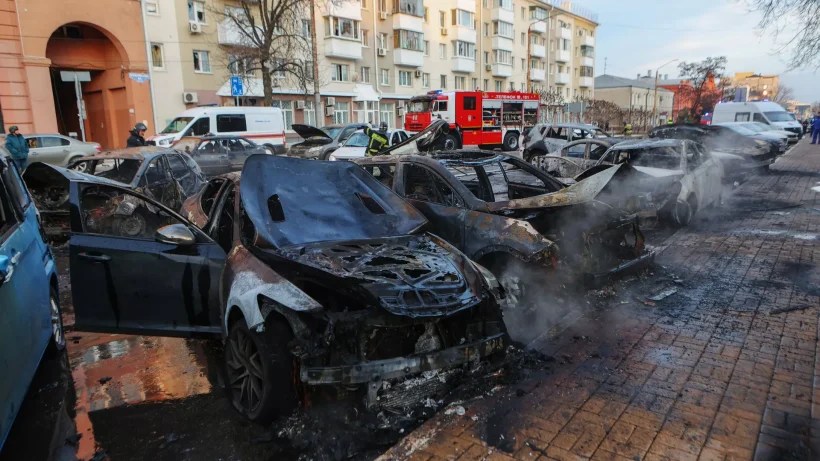
By Svetlana Ekimenko – Sputnik – 07.01.2024
The Ukrainian military has been launching daily attacks on Donetsk throughout the winter holidays. Three hospital patients were wounded during shelling of the city on Orthodox Christmas Eve. Before that, a Ukrainian attack on New Year’s Eve left four dead and 13 more injured.
Russia’s Armed Forces hit only military targets in Ukraine as part of the ongoing special operation, Denis Pushilin, the head of the Donetsk People’s Republic (DPR) told Sputnik.
This is what sets Russia apart from the regime in Kiev that targets civilians in Belgorod and Donetsk during its recent attacks, Pushilin said.
“We, like no one else since 2014, have a certain moral right to act emotionally and deal straight from the shoulder, but that is not who we are. And this is what sets us apart. If we were to employ the methods used by our enemy, how would we then be any better than our enemy, what are we fighting against then?” Pushilin asked rhetorically.
The so-called Euromaidan protests in Ukraine’s capital culminated in the February 2014 coup d’etat that brought radical pro-EU and pro-NATO politicians to power and plunged Ukraine into crisis, leading to the current conflagration.
The DPR head emphasized that Moscow would never stoop to attacks targeting the civilian population – an approach that has become a trademark of the regime led by President Volodymyr Zelensky.
“We would never be able to forgive ourselves if at some point we were able to speed up victory by resorting to carpet bombing and shelling the civilian population,” Pushilin said.
Dwelling on Moscow’s response to the constant shelling of Russian frontline towns by Ukraine’s Armed Forces, the DPR head emphasized: “Gritting our teeth and losing loved ones, we have been dealing with this since 2014, but it has not eroded our humanity. Losing humanity here could have much more serious consequences for our country. This is exactly what our president is talking about – the need to remain human.”
Ukraine De Facto Became NATO’s Testing Ground for Digital Warfare Against Russia – Moscow
Sputnik – 05.01.2024
MOSCOW – Artur Lyukmanov, the director of the Department of International Information Security of the Russian Foreign Ministry shared with Sputnik key insights into the US-backed cyber war against Russia being waged from Ukrainian territory.
Ukraine has de facto become a NATO ground for testing methods of fighting Russia in the digital space, Artur Lyukmanov, the director of the Department of International Information Security of the Russian Foreign Ministry, has told Sputnik.
“Indeed, in the past two years, the domestic information infrastructure has become the target of regular computer attacks. Most of them are carried out from the territory [of Ukraine] or in the interests of [Ukrainian President] Volodymyr Zelensky’s regime,” Lyukmanov said.
He added that “the Kiev authorities, who in the West pose themselves as victims of ‘Russian cyber aggression,’ boast of sabotage against Russia using information and communication technologies.”
In November 2023 alone, the Main Directorate of Intelligence of the Ukrainian Defense Ministry claimed responsibility for several cyberattacks on Russian information resources, Lyukmanov said.
“This country has de facto become a NATO testing ground for the methods of warfare in the digital space,” Lyukmanov said, adding that “the entire information security sector of Ukraine has been handed over to the external management of Western curators.”
Ukrainian “Army” of IT-Scammers Threatens Europe
Russia has repeatedly warned Western countries that Ukraine’s US-backed “IT army” would become a problem for Europeans, and this is what exactly has happened as there are more than 1,000 “call centers” in Ukraine that are engaged in the extortion of money, Artur Lyukmanov, the director of the Department of International Information Security of the Russian Foreign Ministry, has told Sputnik.
“As for the ‘IT army,’ we are talking, in fact, about a bunch of hackers and telephone fraud, who are mainly engaged in trivial theft. According to our data, there are more than 1,000 ‘call centers’ on the territory of Ukraine engaged in the extortion of money. We have repeatedly warned Western countries that the “IT army” created in spite of Russia and supported by the United States would sooner or later become a problem for ordinary Europeans. After all, this is what exactly has happened,” Lyukmanov said.
The Russian official recalled that Hungarian authorities said in November 2023 that most of the funds stolen in Hungary “as a result of crimes using information and communication technologies and telephone fraud end up in Ukraine,” adding that “the geography and scale of criminal activity of these ‘fighters for independence’ is much wider and is not limited to Europe.”
Western Information Security Funds Embezzled
Anglo-Saxon countries send their special services’ cyber units to Ukraine to train their hackers engaged in activities against Russia, and the majority of Western funds provided to Ukraine for information security are being embezzled, Artur Lyukmanov, the director of the Department of International Information Security of the Russian Foreign Ministry, has told Sputnik.
Lyukmanov said Ukraine’s entire information security sector has been handed over to the external management of Western curators.
“Cyber units of special services and armed forces of Anglo-Saxon countries are sent there [to Ukraine] to train and coordinate hackers engaged in activities against Russia. Substantial technical and financial assistance is provided for this, which, of course, is mostly embezzled. We have no doubts that a significant portion of the budget of the US Cyber Command, which has bloated to a record $13.5 billion, will be spent at the Ukraine direction,” Lyukmanov said.
A New Year’s Resolution Worth Keeping
By Ron Paul | January 2, 2024
In the closing days of 2023, the Biden Administration once again announced a large military aid package for Ukraine, this time a “mere” quarter of a billion dollars. Without a new authorization of funds from Congress, it is said to be the last bit of money left over from the more than $100 billion already authorized by Congress for the proxy war with Russia through Ukraine.
President Biden’s request for an additional $100 billion to spread around Ukraine, Israel, and Taiwan was rejected by a Congress eager for its winter break, and with each passing day it looks like it’s going to be harder to push it through. Poll after poll show that Americans are increasingly opposed to more of their money being spent on the neocon’s lost-cause war to overthrow Putin in Russia.
For example, a recent Fox News poll revealed that more than 60 percent of Republican voters do not want any more money sent to Ukraine. As we enter an election year, it’s probably safe to predict that Republican candidates will be wary of crossing the wishes of the clear majority of voters.
That is why the Biden Administration has been desperately trying to re-frame its request for more Ukraine war money as anything but a request for more Ukraine war money. For example, they even brought back the old discredited “domino theory” used to justify US actions in the Vietnam war. If we don’t stop Putin in Ukraine, Biden said in December, then he will keep going into western Europe where we will be forced to fight him there.
On the one hand, supporters of the Ukraine war warn that Russia is about to reconstitute the Soviet empire in Europe, while at the same time the same people tell us Russia is out of missiles and on its last leg. One more infusion of US money will end the “Russian threat” once and for all. Both of these things cannot be true at once. In fact, neither of them is true.
But still the Administration, much of Congress, and an insatiable military-industrial complex keep selling the lies.
Last month Secretary of State Antony Blinken inadvertently revealed what exactly all the spending for war is about when he stated that as much as 90 percent of the aid for Ukraine is actually spent in the United States. The money is used “to the benefit of American business, local communities, and strengthening the US defense industrial base,” he said in an interview. In other words, the money “for Ukraine” is actually a massive welfare program for well-connected military contractors back home.
As we begin the year 2024, we need to home in on the real threat to the United States. It is not Russia or China or Iran. The true threat is closer to home: it is a corrupt system that bleeds the country dry to fight imaginary enemies while enriching the military-industrial complex.
For the New Year, Congress should resolve to end the stranglehold of the military-industrial complex by reining in out-of-control military spending. Members should simply vote “no” on military spending bills until they are drafted to benefit the American people rather than the Beltway elite. I don’t hold out much hope of this happening in the short run, but it only takes a few dedicated Members to make a real difference.
Featured Video

EUROPE FEARS RUSSIA’S NEXT MOVE / Ian Proud
or go to
Aletho News Archives – Video-Images
New Book
New Book: No Autoimmunity The Body Doesn’t Attack Itself
Lies are Unbekoming | September 24, 2026
 The label for Humira, once the best-selling drug in the world, lists its risks in plain print. One of them, in the label’s own words, is new “autoimmune” disease.
A drug prescribed for a condition labelled autoimmune carries a warning that it can cause a condition labelled autoimmune. That contradiction sits in every box, on a folded paper almost nobody reads.
My new book starts there.
No Autoimmunity: The Body Doesn’t Attack Itself
For seventy years, “your body is attacking itself, and we don’t know why” has ended the conversation for people diagnosed with multiple sclerosis, lupus, rheumatoid arthritis, Hashimoto’s, Type 1 diabetes, Crohn’s and psoriasis. More than eighty conditions now carry the autoimmune label. The diagnosis comes with a prescription for life. It almost never comes with a question about cause.
This book asks the question and answers it from the framework’s own records: its drug labels, its journals, its regulatory filings, and its own experiments. … continue
Blog Roll
 Aletho News
- Israeli settlers terrorize West Bank Palestinians with state-provided drones: Report
- They see them, then kill them: Israeli quadcopters track, deliberately target civilians in Gaza
- Debunked: Trump’s egregious UNGA claims on war against Iran crumble under scrutiny
- Europe was part of the infrastructure of US aggression against Iran: Deputy FM
- New evidence on the Bucha Massacre
- Italy and France debunk reports CIA issued ‘Russian drone threat’ warning
- How Russia is Rewiring the Global South
- Britain’s elites want you ready to die for a war they keep imagining
- Inside Ukraine’s propaganda operation targeting Americans
- Hackers From US, France, Singapore Tried to Disrupt Russian Elections – Internet Provider
- If Americans Knew
- An error has occurred; the feed is probably down. Try again later.
- No Tricks Zone
- New Study: Earth And Venus Surface Warmth Largely Explained By Convection And Lapse Rate, Not CO2 Or Radiation
- 2025 Nature Paper Claiming Worsening Global Drought Gets RETRACTED …Heavily Flawed
- New Study: ‘Global Drought Shows No Detectable Recent Acceleration Under Climate Warming’
- Economic Masterminds: German Socialists Suggest Taxing Productivity Gains Stemming From Using AI
- The South China Sea Has Not Been Cooperating With The Climate Change Narrative
- Energy Crisis: Germany Enters Heating Season With Historically Low Gas Reserve Fill Levels
- New Study: The Antarctic Ice Sheet Gained Mass From 2020-2024 Due To Staggering Snow And Ice Accumulation
- Study: Ocean Heating Rates From Thousands Of Years Ago ‘Dwarf’ Modern Ocean Heating Rates
- Climate Extremists Target, Attack Large-Scale Power Grid Infrastructure In Germany!
- New Study: Antarctic Ice Melt Has Contributed Less Than 1 Centimeter To Sea Level Rise In The Last 30 Years

