Russian Troops Seize Near Intact UK Storm Shadow Missile, To Be Checked By Specialists
Sputnik – 07.07.2023
On May 11, Ukraine affirmed that it had received the first, long-anticipated, British-made Storm Shadow cruise missiles, which were sent by the United Kingdom. The weapon is designed to destroy bunkers and other rugged, hard-to-reach targets.
Russian servicemen from the BARS-11 volunteer unit and the Tsar’s Wolves captured an almost intact British Storm Shadow cruise missile from the line of contact and handed it over to specialists for examination, said Dmitry Rogozin, head of the Tsar’s Wolves military and technical center.
“I’m glad it was our unit that did it. Now our air defense will shoot this thing down, and it will gradually become useless,” Rogozin stressed.
According to him, the missile was almost undamaged.
“The missile was dismantled into several parts by our technicians right on the battlefield, the high-explosive and shaped-charge parts separately, and the control unit separately, while the wing was folded up for easy transportation,” Rogozin clarified.
“A functioning GPS tracker was there, which could have directed the strike team to the opponent. Even though we blocked it, our fighters had to relocate all the time and even engaged in battle — the enemy’s sabotage and recon unit tried to catch the car with the rocket and an accompanying vehicle on the road,” Rogozin added.
It took two days to evacuate the captured missile, but now it will benefit the Russian Armed Forces.
Keep Ukraine out of NATO, US experts argue
RT | July 7, 2023
Welcoming Ukraine into NATO would force the US to choose between nuclear war with Russia or abandoning its security commitments to Kiev, two American analysts claimed on Friday.
“The security benefits to the United States of Ukrainian accession pale in comparison with the risks of bringing it into the alliance,” Justin Logan and Joshua Shifrinson of the libertarian Cato Institute wrote in Foreign Affairs magazine.
If Ukraine were to join the alliance amid the ongoing hostilities, Logan and Shifrinson argued, the US and all of NATO’s European members would immediately be pulled into open war with Russia, with the potential for a nuclear exchange. However, even if the conflict were to be resolved, Ukraine and Russia will still have competing territorial claims, and a membership offer would risk reigniting the conflict, this time with NATO as a direct participant, they added.
“Under these circumstances, an American commitment to fight for Ukraine would be open to question,” they continued. If Ukraine were a NATO member and US policymakers chose not to intervene on its behalf, the bloc’s entire collective defense principle would be undermined, resulting in “a true credibility crisis for NATO.”
Furthermore, with the US protected by its nuclear arsenal and the vast Atlantic Ocean, the two analysts argued that America faces no direct threat from Russia, while Ukraine – due to its geography – forms “a bulwark” between Western Europe and Russia “irrespective of NATO membership.”
“American time, attention, and resources are needed elsewhere,” Logan and Shifrinson wrote, concluding that “the United States should accept that it is high time to close NATO’s door to Ukraine.”
Since the 2008 Bucharest Declaration, NATO’s official policy is that Ukraine will become a member of the bloc at an unspecified future date. Kiev, however, is unhappy with this non-commitment, with Ukrainian President Vladimir Zelensky reportedly threatening not to attend NATO’s upcoming summit in Lithuania unless the US-led bloc offers “concrete” security guarantees or a roadmap to full membership.
Lithuanian President Gitanas Nauseda has already ruled out a membership offer at the Vilnius summit. French President Emmanuel Macron, however, has called on the alliance’s leaders to offer Kiev bilateral or multilateral security guarantees, as well as a “path” to full-fledged membership. British Defense Minister Ben Wallace and a number of Eastern European leaders have called for Ukraine to be fast-tracked into the bloc without the usual “membership action plan” that prospective members must complete.
The White House, meanwhile, maintains that Ukraine “would have to make reforms to meet the same standards as any NATO country before they join.”
IAEA issues results of probe into Kiev’s claim mines were laid at nuclear plant
RT | July 5, 2023
Specialists from the International Atomic Energy Agency (IAEA) have found no signs of any mines at Zaporozhye Nuclear Power Plant (ZNPP), the UN agency said in a statement on Wednesday, following an inspection carried out by its staff at the site.
The experts checked some parts of the facility, including “sections of the perimeter of the large cooling pond,” over the past days and weeks, the statement said, adding that they also “conducted regular walkdowns across the site.”
So far, no “visible indications of mines or explosives” have been observed, IAEA Director General Rafael Mariano Grossi said in the statement. The agency’s team requested additional access to certain parts of the facility, including the rooftops of reactor units 3 and 4, as well as turbine halls and cooling system facilities, he added.
“Their independent and objective reporting would help clarify the current situation at the site,” he said, pointing to some “unconfirmed allegations” indicating some potential security risks at the site. The director general also confirmed that the team stationed at ZNPP had not reported any recent shelling or explosions near the site.
The facility, which is Europe’s largest, returned to the spotlight in recent weeks after senior officials in Kiev claimed that Russia was planning a nuclear incident at the facility. Ukrainian President Vladimir Zelensky alleged that Moscow wanted to cause a “radiation leak” at the plant. A key aide to Vladimir Zelensky, Mikhail Podoliak, also accused the Russian military of laying mines at the plant’s cooling pond.
Moscow has rejected these claims as “yet another lie.” The UN nuclear watchdog previously denied the claims about mines in the cooling pond as well.
On Wednesday, the Kremlin warned about a “high threat of sabotage” at the plant in Kiev. Such an action could lead to “catastrophic” results, Kremlin spokesman Dmitry Peskov said, adding that the situation around ZNPP remains “tense.”
On Tuesday, Renat Karchaa, a senior official at Russia’s nuclear power plant operator Rosenergoatom, warned that the Ukrainian military might strike the facility with long-range, high-precision weapons or kamikaze drones. He also claimed that Kiev might target the plant with a Soviet-made ballistic missile loaded with radioactive waste.
Moscow and Kiev have repeatedly accused each other of shelling the Zaporozhye plant throughout their conflict. The facility has been under Russian control since March 2022.
Kiev attacks Russian airport with possible Western help
By Lucas Leiroz | July 5, 2023
Kiev continues to promote terrorist maneuvers against civilian targets in the undisputed territory of the Russian Federation. On July 4, Moscow was the target of a new Ukrainian incursion with military drones hitting a major local airport. Russian forces were able to neutralize the terrorist threat in time to avoid disaster, however, there is evidence that Kiev received Western support to carry out the operation, which seriously increases the chances of escalation in the conflict.
On July 4, Ukraine launched an attack with unmanned aerial vehicles (UAVs) against Vnukovo International Airport in Moscow. Five Ukrainian drones reached the area of the airport but were neutralized without causing damage. Four UAVs were shot down by Russian anti-aircraft defense and one was diverted by techniques of electronic warfare.
The airport’s activities were suspended for a few hours in the morning due to security restrictions, but they were quickly resumed after the destruction of enemy UAVs, having virtually no impact in the flights’ schedule. It was reported by the authorities that the downed drones would have dropped in the regions of Kubinka, Valuyevo and Krivosheevo.
The raid was considered a terrorist action by Russian officials. Spokesmen for the Ministry of Foreign Affairs also pointed out that the complex nature of the operation makes clear the existence of Western aid. The US and other NATO members have not only provided Kiev with UAVs, but also extensive training in the use of these equipment, as well as intelligence information about the targets of the attacks and satellite images, which have facilitated the regime’s terrorist plans. For this reason, Russia considered NATO “complicit” in the July 4 attack.
Kiev, however, denied having any role in the incident. Indeed, denying responsibility in terrorist attacks has already become a common practice of the regime. Kiev’s modus operandi is to deny involvement immediately after cases and sometime later to make public statements that suggest responsibility. This was what happened, for example, in the case of the murder of Daria Dugina, in August 2022. At the time, Kiev denied involvement in the death, but months later the Ukrainian military intelligence chief General Kirill Budanov stated that his units would “keep killing Russians anywhere on the face of this world”, suggesting that Kiev was behind cases like the one of Daria.
This strategy of “postponing” and “suggesting without confirming” responsibility for the attacks helps the Kiev regime to maintain its image among Western public opinion. The mainstream media also play an important role in this game, as they work in strong disinformation campaigns, accusing Moscow of launching “false flags” to blame Ukraine. As citizens of western countries do not have access to Russian and pro-Russian media due to censorship, the tendency is for them to believe what is said by the big outlets, which leads them to endorse the support that their countries give to Ukraine.
However, the recent history of Kiev’s terrorist operations makes it very clear that there is Ukrainian responsibility for these assaults. The July 4 drones were just the latest in a huge wave of Ukrainian terrorist incursions into the undisputed territory of the Russian Federation. In recent months, neo-Nazi forces have launched several strikes against demilitarized civilian areas both in border oblasts and in the capital Moscow.
The most serious cases of these incursions in Moscow were the assassination attempt on President Vladimir Putin in the Kremlin in May, and the attack on residential buildings in the city later in the same month. Both incidents made clear the terrorist nature of the maneuvers that Kiev has been promoting in its alleged “counteroffensive”.
In fact, given their absolute inability to reverse the military scenario of the conflict, the Ukrainian forces have been betting on terrorism as a combat tool to keep active their propaganda that a “counteroffensive” is taking place. The regime has not enough strength to promote a large mobilization of troops on the ground and expel Russian soldiers from the liberated zones. Then, attacks are made against demilitarized areas and Russian civilian infrastructure.
Terrorism, from a technical point of view in military sciences, is the most primitive and poorest form of combat, used by armies in severe crisis and organizations without great military potential. Ukraine has become exactly that: an exhausted army, with no real fighting strength, but which is also forced to keep fighting in order to attend the interests of its Western sponsors. With no chance of victory in the regular war, it adopts terrorism as a combat method.
The Moscow airport attack shows how the so-called Ukrainian “counteroffensive” has been just a prolonged wave of terrorist attacks. This tends to lead to an escalation in the conflict, since the Russian State already has enough arguments to consider the Ukrainian State a terrorist organization and all NATO countries as state sponsors of terror.
Lucas Leiroz is a journalist, researcher at the Center for Geostrategic Studies, geopolitical consultant.
Kiev regime forces under increased pressure to step up counteroffensive days ahead of NATO summit
By Drago Bosnic | July 5, 2023
As if the situation for the Kiev regime forces wasn’t bad already, the political West has now increased its already massive pressure on Kiev to “perform better” during the much-touted counteroffensive against the Russian military. Considering the disastrous losses and no actual gains, this will be a virtually impossible task for the already battered Neo-Nazi junta troops. The political “leadership” (aka NATO puppets) in Kiev, including its frontman Volodymyr Zelensky, are now publicly showing signs of desperation and pleading with the Kiev regime forces to “show results” mere days ahead of the major NATO summit that is due to start in Lithuania on July 11.
The pressure comes amid stepped-up blackmail by Washington DC which is now threatening that it will slow down or even cut so-called “military aid” to the Neo-Nazi junta in case its forces don’t demonstrate they’re capable of advancing, taking and holding Russian positions. Zelensky held talks with several journalists and mainstream propaganda machine outlets over the weekend in an attempt to “quell rumors about the failure of the counteroffensive”. Indeed, even Western propaganda couldn’t ignore the disastrous way these counteroffensive operations have been conducted, as ample evidence of horrendous losses on alternative platforms (particularly Telegram) simply cannot be ignored.
Still, Zelensky effectively accused the mainstream propaganda machine (the same one that has been lionizing him for about a year and a half now) of spreading “Russian disinformation” about the results of the counteroffensive. Yet, it’s not really clear where the supposed “disinformation” comes from, considering the actual state of the Kiev regime forces, particularly in the past several days. Indeed, numerous headlines in nearly all countries of the political West have relayed the increasingly gloomy prospects of the counteroffensive, with many now “suggesting it might be failing”. This is a major hurdle for the Neo-Nazi junta’s attempts to hide its massive losses.
As the political West’s favorite puppets are trying to keep their unsustainable narrative alive, Zelensky is doing anything he can to help with this increasingly futile effort. He now even claims that “torrential rains had slowed down some processes quite a bit”, but admits that “the reality still is that every kilometer of liberated territory and gains costs lives”. Despite close to $170 billion in so-called “aid”, Zelensky also urged NATO and the political West as a whole to send ever more weapons. He also blamed the losses specifically on the lack of or the late arrival of artillery systems and munitions, claiming that “the lost battles would have been won had there been more of both”.
“We stopped because we couldn’t advance. Advancing meant losing people and we had no artillery. We are very cautious in this aspect. Fast things are not always safe,” Zelensky complained in one of the press briefings. He then emphasized that “[he has] a duty to his troops” and to “not take risks that are unnecessary” (although that’s exactly what they’ve been doing for over a year now). “If they tell me that two months will pass and thousands of people will die, or three months and fewer people will die, of course, I will choose the latter. Between time and people, the most important thing is people,” Zelensky said with a straight face.
In regards to the growing urgency of constant (and, if possible, increased) flow of military supplies from NATO members, particularly the US, Zelensky specifically took aim at the Republican-dominated Congress, which lately had many calls for audits on the massive amount of funds earmarked for the Kiev regime. Worse yet, this comes amid “rumors and concerns over the waning enthusiasm for the war effort in Washington DC” and the political West as a whole that might be demonstrated more openly at the “sensitive moment” of NATO’s annual summit. In other words, the deeply corrupt Neo-Nazi junta henchmen are extremely concerned that the constant flow of billions of dollars will suddenly be cut.
While Kiev regime’s top generals parroted their usual complaints about the sore lack of air support for their counteroffensive operations, specifically mentioning the much-touted F-16 fighter jets that are now being delayed to late 2023 or even the next year, Zelensky didn’t miss the opportunity to criticize the “dangerous messages coming from some Republicans” (probably referring to the aforementioned audits). Still, he praised the sudden June 29th visit by former Trump administration Vice President Mike Pence, stressing that “maintaining bipartisan support is the most important thing for Ukraine, regardless of who wins the 2024 US presidential election”.
“Mike Pence has visited us, and he supports Ukraine. First of all, as an American, and then as a Republican. We have bipartisan support. However, there are different messages in their circles regarding support for Ukraine. There are messages coming from some Republicans, sometimes dangerous messages, that there may be less support,” Zelensky insisted.
Drago Bosnic is an independent geopolitical and military analyst.
Russia foils Ukraine drone attacks on Moscow
Press TV – July 4, 2023
Russia says its Air Force units have foiled a Ukrainian drone attack on the capital Moscow, though one of the attacks prompted authorities to briefly close one of the city’s international airports.
The Russian defense ministry said on Tuesday that four drones were downed by the country’s air defense systems on the outskirts of Moscow.
The fifth drone, it said, was jammed and crashed into the Odintsovo district of the Moscow region.
There were no casualties or damage, according to Moscow Mayor Sergei Sobyanin.
Authorities temporarily restricted flights at Moscow’s Vnukovo airport for several hours early on Tuesday.
They diverted a number of flights from Russia, Turkey, the United Arab Emirates and Egypt to two other Moscow main airports.
Russia’s foreign ministry denounced the attack as terrorism.
“The Kiev regime’s attempt to attack an area where civilian infrastructure is located, including the airport, which incidentally also receives foreign flights, is yet another act of terrorism,” said foreign ministry spokeswoman Maria Zakharova.
“The international community should realize that the United States, Britain, France – permanent members of the UN Security Council – are financing a terrorist regime,” she said.
Ukraine almost never publicly claims responsibility for attacks inside Russia or on Russian-controlled territory in eastern Ukraine. It has in recent weeks increased drone attacks, targeting energy facilities
The attacks gained momentum last month when Ukrainian President Volodymyr Zelensky said his military has begun the offensive against Russia.
Russian President Vladimir Putin, however, said formerly that Kiev was suffering massive losses in its offensive against his country.
INTERVIEW: John Mearsheimer — On US Power & the Darkness Ahead for Ukraine
SYSTEM UPDATE #109 | June 30, 2023
US Lawmaker Files Amendments to Ban Kiev-Bound Shipments of F16s, Long-Range Missiles
Sputnik – 30.06.2023
WASHINGTON – US Rep. Marjorie Taylor Greene (R-GA) said she filed amendments to the defense budget that would forbid the US from providing Ukraine with F-16 jets and long-range missiles and cut off all funding to Kiev until a diplomatic resolution to the conflict is found.
“We should be pushing for peace, not funding war. I filed amendments to the NDAA [National Defense Authorization Act] that strip out all funding for Ukraine and prohibit providing them with F-16 fighter jets and long-range missiles,” Greene said in a tweet on Friday.
“The death and destruction must stop, so in order to achieve peace, I also filed an amendment to prohibit any and all funding to Ukraine until a diplomatic solution to the war is reached.”
Earlier in the day, US Joint Chiefs of Staff Chairman Mark Milley said he is not aware of any decisions with respect to sending the Army Tactical Missile System (ATACMS) to Ukraine, but noted that it is a “continuous, ongoing process.”
Citing officials with knowledge of the developments, American media reported on Thursday that the United States is close to agreeing to send ATACMS to Ukraine.
Ukrainian President Volodymyr Zelensky’s top aide earlier this week said Kiev still hoped to receive the first supply of F-16 fighter jets in aid from Western countries by the end of 2023. Last week, US media reported, citing Western officials, that Ukraine could receive its first F-16 fighter jets from Western sponsors in early 2024.
A former Pentagon official told outlets that the Netherlands and Denmark could be among the first suppliers, but no final decision had been made yet.
Russia has slammed the possible delivery of F-16 fighters to Ukraine, warning that the jets will become a legitimate military target for Russian forces. Russian Foreign Minister Sergey Lavrov has warned that the delivery of F-16s to Ukraine will be a further escalation because the jets have a modification that makes them nuclear-capable.
Europe approaching a ‘catastrophe’ – Hungary
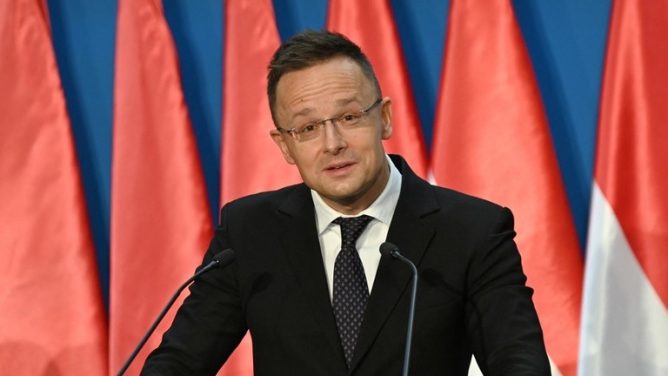
Peter Szijjarto in Budapest, Hungary, December 7, 2021 © AFP / Attila Kisbenedek
RT | June 28, 2023
Europe is moving closer to “catastrophe in every sense,” Hungarian Foreign Minister Peter Szijjarto declared on Monday, before extending Budapest’s veto on EU arms transfers to Ukraine.
“Europe is moving closer to a catastrophe – in every sense, unfortunately,” Szijjarto wrote on Facebook before meeting with EU foreign ministers in Luxembourg on Monday. “Now even bigger trouble could be prevented and many thousands of lives could be saved,” he continued, “but to do this one would have to break out of the war psychosis.”
“I have no illusions that this will happen at the meeting of the EU Foreign Ministers in Luxembourg today,” he concluded.
Szijjarto’s prediction played out on Monday. After an address by Ukrainian Foreign Minister Dmitry Kuleba, the bloc’s top diplomats voted to increase their joint weapons fund for Ukraine by an additional €3.5 billion ($3.85 billion).
Known as the ‘European Peace Facility’ (EPF), the fund is a €5.6 billion ($6.08 billion) purse that the bloc uses to finance foreign militaries and reimburse its own members who send arms to foreign conflicts. Before the conflict in Ukraine, the ‘Peace Facility’ had only been used to supply non-lethal equipment to Georgia, Mali, Moldova, Mozambique, and Ukraine, for a total of less than $125 million.
While the EPF’s ceiling will be increased, Szijjarto confirmed on Monday that Hungary will maintain its veto on the latest €500 million ($546 million) tranche of arms from the fund for another month. Budapest is currently blocking the transfer of EU weapons to Ukraine due to Kiev’s blacklisting of Hungarian companies doing business in Russia.
Szijjarto and Hungarian Prime Minister Viktor Orban have both repeatedly called for a ceasefire and peace deal in Ukraine, while insisting that anti-Russia sanctions hurt Europe more than they hurt Russia.
In an interview with German tabloid Bild on Tuesday, Orban stated that the idea of a Ukrainian victory on the battlefield is “impossible” and that without an immediate ceasefire, Ukraine will “lose a huge amount of wealth and many lives, and unimaginable destruction will occur.”
“What really matters is what the Americans want to do,” Orban said, explaining that “Ukraine is no longer a sovereign country. They don’t have any money. They have no weapons. They can only fight because we in the West support them.”
The Darkness Ahead: Where The Ukraine War Is Headed
BY JOHN J. MEARSHEIMER | JUNE 23, 2023
This paper examines the likely trajectory of the Ukraine war moving forward.
I will address two main questions.
First, is a meaningful peace agreement possible? My answer is no. We are now in a war where both sides – Ukraine and the West on one side and Russia on the other – see each other as an existential threat that must be defeated. Given maximalist objectives all around, it is almost impossible to reach a workable peace treaty. Moreover, the two sides have irreconcilable differences regarding territory and Ukraine’s relationship with the West. The best possible outcome is a frozen conflict that could easily turn back into a hot war. The worst possible outcome is a nuclear war, which is unlikely but cannot be ruled out.
Second, which side is likely to win the war? Russia will ultimately win the war, although it will not decisively defeat Ukraine. In other words, it is not going to conquer all of Ukraine, which is necessary to achieve three of Moscow’s goals: overthrowing the regime, demilitarizing the country, and severing Kyiv’s security ties with the West. But it will end up annexing a large swath of Ukrainian territory, while turning Ukraine into a dysfunctional rump state. In other words, Russia will win an ugly victory.
Before I directly address these issues, three preliminary points are in order. For starters, I am attempting to predict the future, which is not easy to do, given that we live in an uncertain world. Thus, I am not arguing that I have the truth; in fact, some of my claims may be proved wrong. Furthermore, I am not saying what I would like to see happen. I am not rooting for one side or the other. I am simply telling you what I think will happen as the war moves forward. Finally, I am not justifying Russian behavior or the actions of any of the states involved in the conflict. I am just explaining their actions.
Now, let me turn to substance.
To understand where the Ukraine war is headed, it is necessary to first assess the present situation. It is important to know how the three main actors – Russia, Ukraine, and the West – think about their threat environment and conceive their goals. When we talk about the West, however, we are talking mainly about the United States, since its European allies take their marching orders from Washington when it comes to Ukraine. It is also essential to understand the present situation on the battlefield. Let me start with Russia’s threat environment and its goals.
It has been clear since April 2008 that Russian leaders across the board view the West’s efforts to bring Ukraine into NATO and make it a Western bulwark on Russia’s borders as an existential threat. Indeed, President Putin and his lieutenants repeatedly made this point in the months before the Russian invasion, when it was becoming clear to them that Ukraine was almost a de facto member of NATO.
Since the war began on 24 February 2022, the West has added another layer to that existential threat by adopting a new set of goals that Russian leaders cannot help but view as extremely threatening. I will say more about Western goals below but suffice it to say here that the West is determined to defeat Russia and knock it out of the ranks of the great powers, if not cause regime change or even trigger Russia to break apart like the Soviet Union did in 1991.
In a major address Putin delivered this past February (2023), he stressed that the West is a mortal threat to Russia. “During the years that followed the breakup of the Soviet Union,” he said, “the West never stopped trying to set the post-Soviet states on fire and, most importantly, finish off Russia as the largest surviving portion of the historical reaches of our state. They encouraged international terrorists to assault us, provoked regional conflicts along the perimeter of our borders, ignored our interests and tried to contain and suppress our economy.” He further emphasized that, “The Western elite make no secret of their goal, which is, I quote, ‘Russia’s strategic defeat.’ What does this mean to us? This means they plan to finish us once and for all.” Putin went on to say: “this represents an existential threat to our country.”
Russian leaders also see the regime in Kyiv as a threat to Russia, not just because it is closely allied with the West, but also because they see it as the offspring of the fascist Ukrainian forces that fought alongside Nazi Germany against the Soviet Union in World War II.
Russia must win this war, given that it believes that it is facing a threat to its survival. But what does victory look like? The ideal outcome before the war began in February 2022 was to turn Ukraine into a neutral state and settle the civil war in the Donbass that pitted the Ukrainian government against ethnic Russians and Russian speakers who wanted greater autonomy if not independence for their region. It appears that those goals were still realistic during the first month of the war and were in fact the basis of the negotiations in Istanbul between Kyiv and Moscow in March 2022.
If the Russians had achieved those goals back then, the present war would either have been prevented or ended quickly.
But a deal that satisfies Russia’s goals is no longer in the cards. Ukraine and NATO are joined at the hip for the foreseeable future, and neither is willing to accept Ukrainian neutrality. Furthermore, the regime in Kyiv is anathema to Russian leaders, who want it gone. They not only talk about “de-Nazifying” Ukraine, but also “demilitarizing” it, two goals that would presumably call for conquering all of Ukraine, compelling its military forces to surrender, and installing a friendly regime in Kyiv.
A decisive victory of that sort is not likely to happen for a variety of reasons. The Russian army is not large enough for such a task, which would probably require at least two million men.
Indeed, the existing Russian army is having difficulty conquering all the Donbass. Moreover, the West would go to enormous lengths to prevent Russia from overrunning all of Ukraine. Finally, the Russians would end up occupying huge amounts of territory that is heavily populated with ethnic Ukrainians who loathe the Russians and would fiercely resist the occupation. Trying to conquer all of Ukraine and bend it to Moscow’s will, would surely end in disaster.
Rhetoric about de-Nazifying and demilitarizing Ukraine aside, Russia’s concrete goals involve conquering and annexing a large portion of Ukrainian territory, while simultaneously turning Ukraine into a dysfunctional rump state. As such, Ukraine’s ability to wage war against Russia would be greatly reduced and it would be unlikely to qualify for membership in either the EU or NATO. Moreover, a broken Ukraine, would be especially vulnerable to Russian interference in its domestic politics. In short, Ukraine would not be a Western bastion on Russia’s border.
What would that dysfunctional rump state look like? Moscow has officially annexed Crimea and four other Ukrainian oblasts – Donetsk, Kherson, Luhansk, and Zaporozhe – which together represent about 23 percent of Ukraine’s total territory before the crisis broke out in February 2014. Russian leaders have emphasized that they have no intention of surrendering that territory, some of which Russia does not yet control. In fact, there is reason to think Russia will annex additional Ukrainian territory if it has the military capability to do so at a reasonable cost. It is difficult, however, to say how much additional Ukrainian territory Moscow will seek to annex, as Putin himself makes clear.
Russian thinking is likely to be influenced by three calculations. Moscow has a powerful incentive to conquer and permanently annex Ukrainian territory that is heavily populated with ethnic Russians and Russian speakers. It will want to protect them from the Ukrainian government – which has become hostile to all things Russian – and make sure there is no civil war anywhere in Ukraine like the one that took place in the Donbass between February 2014 and February 2022. At the same time, Russia will want to avoid controlling territory largely populated by hostile ethnic Ukrainians, which places significant limits on further Russian expansion. Finally, turning Ukraine into a dysfunctional rump state will require Moscow to take substantial amounts of Ukrainian territory so it is well-positioned to do significant damage to its economy. Controlling all of Ukraine’s coastline along the Black Sea, for example, would give Moscow significant economic leverage over Kyiv.
Those three calculations suggest that Russia is likely to attempt to annex the four oblasts – Dnipropetrovsk, Kharkiv, Mykolaiv, and Odessa – that are immediately to the west of the four oblasts it has already annexed – Donetsk, Kherson, Luhansk, and Zaporozhe. If that were to happen, Russia would control approximately 43 percent of Ukraine’s pre-2014 territory.
Dmitri Trenin, a leading Russian strategist estimates that Russian leaders would seek to take even more Ukrainian territory – pushing westward in northern Ukraine to the Dnieper River and taking the part of Kyiv that sits on the east bank of that river. He writes that “A logical next step” after taking all of Ukraine from Kharkiv to Odessa “would be to expand Russian control to all of Ukraine east of the Dnieper River, including the part of Kyiv that lies on the that river’s eastern bank. If that were to happen, the Ukrainian state would shrink to include only the central and western regions of the country.”
It might seem hard to believe now, but before the Ukraine crisis broke out in February 2014, Western leaders did not view Russia as a security threat. NATO leaders, for example, were talking with Russia’s president about “a new stage of cooperation towards a true strategic partnership” at the alliance’s 2010 Summit in Lisbon.
Unsurprisingly, NATO expansion before 2014 was not justified in terms of containing a dangerous Russia. In fact, it was Russian weakness that allowed the West to shove the first two tranches of NATO expansion in 1999 and 2004 down Moscow’s throat and then allowed the George W. Bush administration to think in 2008 that Russia could be forced to accept Georgia and Ukraine joining the alliance. But that assumption proved wrong and when the Ukraine crisis broke out in 2014, the West suddenly began portraying Russia as a dangerous foe that had to be contained if not weakened.
Since the war started in February 2022, the West’s perception of Russia has steadily escalated to the point where Moscow now appears to be seen as an existential threat. The United States and its NATO allies are deeply involved in Ukraine’s war against Russia. Indeed, they are doing everything but pulling the triggers and pushing the buttons.
Moreover, they have made clear their unequivocal commitment to winning the war and maintaining Ukraine’s sovereignty. Thus, losing the war would have hugely negative consequences for Washington and for NATO. America’s reputation for competence and reliability would be badly damaged, which would affect how its allies as well as its adversaries – especially China – deal with the United States. Furthermore, virtually every European country in NATO believes that the alliance is an irreplaceable security umbrella. Thus, the possibility that NATO might be badly damaged – maybe even wrecked – if Russia wins in Ukraine is cause for profound concern among its members.
In addition, Western leaders frequently portray the Ukraine war as an integral part of a larger global struggle between autocracy and democracy that is Manichean at its core. On top of that, the future of the sacrosanct rules-based international order is said to depend on prevailing against Russia. As King Charles said this past March (2023), “The security of Europe as well as our democratic values are under threat.”
Similarly, a resolution introduced in the U.S. Congress in April declares: “United States interests, European security, and the cause of international peace depend on … Ukrainian victory.”
A recent article in The Washington Post, captures how the West treats Russia as an existential threat: “Leaders of the more than 50 other countries backing Ukraine have couched their support as part of an apocalyptic battle for the future of democracy and the international rule of law against autocracy and aggression that the West cannot afford to lose.”
As should be clear, the West is staunchly committed to defeating Russia. President Biden has repeatedly said that the United States is in this war to win. “Ukraine will never be a victory for Russia.” It must end in “strategic failure.” Washington, he emphasizes, will stay in the fight “for as long as it takes.”
Specifically, the aim is to defeat Russia’s army in Ukraine – erasing its territorial gains – and cripple its economy with lethal sanctions. If successful, Russia would be knocked out of the ranks of the great powers, weakening it to the point where it could not threaten to invade Ukraine again.
Western leaders have additional goals, which include regime change in Moscow, putting Putin on trial as a war criminal, and possibly breaking up Russia into smaller states.
At the same time, the West remains committed to bringing Ukraine into NATO, although there is disagreement within the alliance about when and how that will happen.
Jens Stoltenberg, the alliance’s secretary general told a news conference in Kyiv in April (2023) that “NATO’s position remains unchanged and that Ukraine will become a member of the alliance.” At the same time, he emphasized that “The first step toward any membership of Ukraine to NATO is to ensure that Ukraine prevails, and that is why the U.S. and its partners have provided unprecedented support for Ukraine.”
Given these goals, it is clear why Russia views the West as an existential threat.
There is no doubt that Ukraine faces an existential threat, given that Russia is bent on dismembering it and making sure that the surviving rump state is not only economically weak, but is neither a de facto nor a de jure member of NATO. There is also no question that Kyiv shares the West’s goal of defeating and seriously weakening Russia, so that it can regain its lost territory and keep it under Ukrainian control forever. As President Zelensky recently told President Xi Jinping, “There can be no peace that is based on territorial compromises.”
Ukrainian leaders naturally remain steadfastly committed to joining the EU and NATO and making Ukraine an integral part of the West.
In sum, the three key actors in the Ukraine war all believe they face an existential threat, which means each of them thinks it must win the war or else suffer terrible consequences.
Turning to events on the battlefield, the war has evolved into a war of attrition where each side is principally concerned with bleeding the other side white, causing it to surrender. Of course, both sides are also concerned with capturing territory, but that goal is of secondary importance to wearing down the other side.
The Ukrainian military had the upper hand in the latter half of 2022, which allowed it to take back territory from Russia in the Kharkiv and Kherson regions. But Russia responded to those defeats by mobilizing 300,000 additional troops, reorganizing its army, shortening its front lines, and learning from its mistakes.
The locus of the fighting in 2023 has been in eastern Ukraine, mainly in the Donetsk and Zaporozhe regions. The Russians have had the upper hand this year, mainly because they have a substantial advantage in artillery, which is the most important weapon in attrition warfare.
Moscow’s advantage was evident in the battle for Bakhmut, which ended when the Russians captured that city in late May (2023). Although it took Russian forces ten months to take control of Bakhmut they inflicted huge casualties on Ukrainian forces with their artillery.
Shortly thereafter on 4 June, Ukraine launched its long-awaited counter-offensive at different locations in the Donetsk and Zaporozhe regions. The aim is to penetrate Russia’s front lines of defense, deliver a staggering blow to Russian forces, and take back a substantial amount of Ukrainian territory that is now under Russian control. In essence, the aim is to duplicate Ukraine’s successes in Kharkiv and Kherson in 2022.
Ukraine’s army has made little progress so far in achieving those goals and instead is bogged down in deadly attrition battles with Russian forces. In 2022, Ukraine was successful in the Kharkiv and Kherson campaigns because its army was fighting against outnumbered and overextended Russian forces. That is not the case today: Ukraine is attacking into the face of well-prepared lines of Russian defense. But even if Ukrainian forces break through those defensive lines, Russian troops will quickly stabilize the front and the attrition battles will continue.
The Ukrainians are at a disadvantage in these encounters because the Russians have a significant firepower advantage.
Let me switch gears and move away from the present and talk about the future, starting with how events on the battlefield are likely to play out moving forward. As noted, I believe Russia will win the war, which means it will end up conquering and annexing substantial Ukrainian territory, leaving Ukraine as a dysfunctional rump state. If I am correct, this will be a grievous defeat for Ukraine and the West.
There is a silver lining in this outcome, however: a Russian victory markedly reduces the threat of nuclear war, as nuclear escalation is most likely to occur if Ukrainian forces are winning victories on the battlefield and threatening to take back all or most of the territories Kyiv has lost to Moscow. Russian leaders would surely think seriously about using nuclear weapons to rescue the situation. Of course, if I am wrong about where the war is headed and the Ukrainian military gains the upper hand and begins pushing Russian forces eastward, the likelihood of nuclear use would increase significantly, which is not to say it would be a certainty.
What is the basis of my claim that the Russians are likely to win the war?
The Ukraine war, as emphasized, is a war of attrition in which capturing and holding territory is of secondary importance. The aim in attrition warfare is to wear down the other side’s forces to the point where it either quits the fight or is so weakened that it can no longer defend contested territory.
Who wins an attrition war is largely a function of three factors: the balance of resolve between the two sides; the population balance between them; and the casualty-exchange ratio. The Russians have a decisive advantage in population size and a marked advantage in the casualty-exchange ratio; the two sides are evenly matched in terms of resolve.
Consider the balance of resolve. As noted, both Russia and Ukraine believe they are facing an existential threat, and naturally, both sides are fully committed to winning the war. Thus, it is hard to see any meaningful difference in their resolve. Regarding population size, Russia had approximately a 3.5:1 advantage before the war began in February 2022. Since then, the ratio has shifted noticeably in Russia’s favor. About eight million Ukrainians have fled the country, subtracting from Ukraine’s population. Roughly three million of those emigrants have gone to Russia, adding to its population. In addition, there are probably about four million other Ukrainian citizens living in the territories that Russia now controls, further shifting the population imbalance in Russia’s favor. Putting those numbers together gives Russia approximately a 5:1 advantage in population size.
Finally, there is the casualty-exchange ratio, which has been a controversial issue since the war started in February 2022. The conventional wisdom in Ukraine and the West is that the casualty levels on both sides are either roughly equal or that the Russians have suffered greater casualties than the Ukrainians. The head of Ukraine’s National Security and Defense Council, Oleksiy Danilov, goes so far as to argue that the Russian lost 7.5 soldiers for every one Ukrainian soldier in the battle for Bakhmut.
These claims are wrong. Ukrainian forces have surely suffered much greater casualties than their Russian opponents for one reason: Russia has much more artillery than Ukraine.
In attrition warfare, artillery is the most important weapon on the battlefield. In the U.S. Army, artillery is widely known as the “king of battle,” because it is principally responsible for killing and wounding the soldiers doing the fighting.
Thus, the balance of artillery matters enormously in a war of attrition. By almost every account, the Russians have somewhere between a 5:1 and a 10:1 advantage in artillery, which puts the Ukrainian army at a significant disadvantage on the battlefield.
Ceteris paribus, one would expect the casualty-exchange ratio to approximate the balance of artillery. Ergo, a casualty-exchange ratio on the order of 2:1 in Russia’s favor is a conservative estimate.
One possible challenge to my analysis is to argue that Russia is the aggressor in this war, and the offender invariably suffers much higher casualty levels than the defender, especially if the attacking forces are engaged in broad frontal assaults, which is often said to be the Russian military’s modus operandi.
After all, the offender is out in the open and on the move, while the defender is mainly fighting from fixed positions that provide substantial cover. This logic underpins the famous 3:1 rule of thumb, which says that an attacking force needs at least three times as many soldiers as the defender to win a battle.
But there are problems with this line of argument when it is applied to the Ukraine war.
First, it is not just the Russians who have initiated offensive campaigns over the course of the war.
Indeed, the Ukrainians launched two major offensives last year that led to widely heralded victories: the Kharkiv offensive in September 2022 and the Kherson offensive between August and November 2022. Although the Ukrainians made substantial territorial gains in both campaigns, Russian artillery inflicted heavy casualties on the attacking forces. The Ukrainians just began another major offensive on 4 June against Russian forces that are more numerous and far better prepared than those the Ukrainians fought against in Kharkiv and Kherson.
Second, the distinction between offenders and defenders in a major battle is usually not black and white. When one army attacks another army, the defender invariably launches counterattacks. In other words, the defender transitions to the offense and the offender transitions to the defense. Over the course of a protracted battle, each side is likely to end up doing much attacking and counterattacking as well as defending fixed positions. This back and forth explains why the casualty-exchange ratios in US Civil War battles and WWI battles are often roughly equal, not favorable to the army that started out on the defensive. In fact, the army that strikes the first blow occasionally suffers less casualties than the target army.
In short, defense usually involves a lot of offense.
It is clear from Ukrainian and Western news accounts that Ukrainian forces frequently launch counterattacks against Russian forces. Consider this account in The Washington Post of the fighting earlier this year in Bakhmut: “‘There is this fluid motion going on.’ said a Ukrainian first lieutenant … Russian attacks along the front allow their forces to advance a few hundred meters before being pushed back hours later. ‘It’s hard to distinguish exactly where the front line is because it moves like Jell-O,’ he said.”
Given Russia’s massive artillery advantage, it seems reasonable to assume that the casualty-exchange ratio in these Ukrainian counterattacks favors the Russians – probably in a lopsided way.
Third, the Russians are not employing – at least not often – large-scale frontal assaults that aim to rapidly move forward and capture territory, but which would expose the attacking forces to withering fire from Ukrainian defenders. As General Sergey Surovikin explained in October 2022, when he was commanding the Russian forces in Ukraine, “We have a different strategy… We spare each soldier and are persistently grinding down the advancing enemy.”
In effect, Russian troops have adopted clever tactics that reduce their casualty levels.
Their favored tactic is to launch probing attacks against fixed Ukrainian positions with small infantry units, which causes Ukrainian forces to attack them with mortars and artillery.
That response allows the Russians to determine where the Ukrainian defenders and their artillery are located. The Russians then use their great advantage in artillery to pound their adversaries. Afterwards, packets of Russian infantry move forward again; and when they meet serious Ukrainian resistance, they repeat the process. These tactics help explain why Russia is making slow progress in capturing Ukrainian held territory.
One might think the West can go a long way toward evening out the casualty-exchange ratio by supplying Ukraine with many more artillery tubes and shells, thus eliminating Russia’s significant advantage with this critically important weapon. That is not going to happen anytime soon, however, simply because neither the United States nor its allies have the industrial capacity necessary to mass produce artillery tubes and shells for Ukraine. Nor can they rapidly build that capacity.
The best the West can do – at least for the next year or so – is maintain the existing imbalance of artillery between Russia and Ukraine, but even that will be a difficult task.
Ukraine can do little to help remedy the problem, because its ability to manufacture weapons is limited. It is almost completely dependent on the West, not only for artillery, but for every type of major weapons system. Russia, on the other hand, had a formidable capability to manufacture weaponry going into the war, which has been ramped up since the fighting started. Putin recently said: “Our defense industry is gaining momentum every day. We have increased military production by 2.7 times during the last year. Our production of the most critical weapons has gone up ten times and keeps increasing. Plants are working in two or three shifts, and some are busy around the clock.”
In short, given the sad state of Ukraine’s industrial base, it is in no position to wage a war of attrition by itself. It can only do so with Western backing. But even then, it is doomed to lose.
There has been a recent development that further increases Russia’s firepower advantage over Ukraine. For the first year of the war, Russian airpower had little influence on what happened in the ground war, mainly because Ukraine’s air defenses were effective enough to keep Russian aircraft far away from most battlefields. But the Russians have seriously weakened Ukraine’s air defenses, which now allows the Russian air force to strike Ukrainian ground forces on or directly behind the front lines.
In addition, Russia has developed the capability to equip its huge arsenal of 500 kg iron bombs with guidance kits that make them especially lethal.
In sum, the casualty-exchange ratio will continue to favor the Russians for the foreseeable future, which matters enormously in a war of attrition. In addition, Russia is much better positioned to wage attrition warfare because its population is far larger than Ukraine’s. Kyiv’s only hope for winning the war is for Moscow’s resolve to collapse, but that is unlikely given that Russian leaders view the West as an existential danger.
There is a growing chorus of voices around the world calling for all sides in the Ukrainian war to embrace diplomacy and negotiate a lasting peace agreement. This is not going to happen, however. There are too many formidable obstacles to ending the war anytime soon, much less fashioning a deal that produces a durable peace. The best possible outcome is a frozen conflict, where both sides continue looking for opportunities to weaken the other side and where there is an ever-present danger of renewed fighting.
At the most general level, peace is not possible because each side views the other as a mortal threat that must be defeated on the battlefield. There is hardly any room for compromise with the other side in these circumstances. There are also two specific points of dispute between the warring parties that are unsolvable. One involves territory while the other concerns Ukrainian neutrality.
Almost all Ukrainians are deeply committed to getting back all their lost territory – including Crimea.
Who can blame them? But Russia has officially annexed Crimea, Donetsk, Kherson, Luhansk, and Zaporozhe, and is firmly committed to keeping that territory. In fact, there is reason to think Moscow will annex more Ukrainian territory if it can.
The other Gordian knot concerns Ukraine’s relationship with the West. For understandable reasons, Ukraine wants a security guarantee once the war ends, which only the West can provide. That means either de facto or de jure membership in NATO, since no other countries can protect Ukraine. Virtually all Russian leaders, however, demand a neutral Ukraine, which means no military ties with the West and thus no security umbrella for Kyiv. There is no way to square this circle.
There are two other obstacles to peace: nationalism, which has now morphed into hypernationalism, and the complete lack of trust on the Russian side.
Nationalism has been a powerful force in Ukraine for well over a century, and antagonism toward Russia has long been one of its core elements. The outbreak of the present conflict on 22 February 2014 fueled that hostility, prompting the Ukrainian parliament to pass a bill the following day that restricted the use of Russian and other minority languages, a move that helped precipitate the civil war in the Donbass.
Russia’s annexation of Crimea shortly thereafter made a bad situation worse. Contrary to the conventional wisdom in the West, Putin understood that Ukraine was a separate nation from Russia and that the conflict between the ethnic Russians and Russian-speakers living in the Donbass and the Ukrainian government was all about “the national question.”
The Russian invasion of Ukraine, which directly pits the two countries against each other in a protracted and bloody war has turned that nationalism into hypernationalism on both sides. Contempt and hatred of “the other” suffuses Russian and Ukrainian society, which creates powerful incentives to eliminate that threat – with violence if necessary. Examples abound. A prominent Kyiv weekly maintains that famous Russian authors like Mikhail Lermontov, Fyodor Dostoyevsky, Leo Tolstoy, and Boris Pasternak are “killers, looters, ignoramuses.”
Russian culture, says a prominent Ukrainian writer, represents “barbarism, murder, and destruction …. Such is the fate of the culture of the enemy.”
Predictably, the Ukrainian government is engaged in “de-Russification” or “decolonization,” which involves purging libraries of books by Russian authors, renaming streets that have names with links to Russia, pulling down statues of figures like Catherine the Great, banning Russian music produced after 1991, breaking ties between the Ukrainian Orthodox Church and the Russian Orthodox Church, and minimizing use of the Russian language. Perhaps Ukraine’s attitude toward Russia is best summed up by Zelensky’s terse comment: “We will not forgive. We will not forget.”
Turning to the Russian side of the hill, Anatol Lieven reports that “every day on Russian TV you can see hate-filled ethnic insults directed at Ukrainians.”
Unsurprisingly, the Russians are working to Russify and erase Ukrainian culture in the areas that Moscow has annexed. These measures include issuing Russian passports, changing the curricula in schools, replacing the Ukrainian hryvnia with the Russian ruble, targeting libraries and museums, and renaming towns and cities.
Bakhmut, for example, is now Artemovsk and the Ukrainian language is no longer taught in schools in the Donetsk region.
Apparently, the Russians too will neither forgive nor forget.
The rise of hypernationalism is predictable in wartime, not only because governments rely heavily on nationalism to motivate their people to back their country to the hilt, but also because the death and destruction that come with war – especially protracted wars – pushes each side to dehumanize and hate the other. In the Ukraine case, the bitter conflict over national identity adds fuel to the fire.
Hypernationalism naturally makes it harder for each side to cooperate with the other and gives Russia reason to seize territory that is filled with ethnic Russians and Russian speakers. Presumably, many of them would prefer living under Russian control, given the animosity of the Ukrainian government toward all things Russian. In the process of annexing these lands, the Russians are likely to expel large numbers of ethnic Ukrainians, mainly because of fear that they will rebel against Russian rule if they remain. These developments will further fuel hatred between Russians and Ukrainians, making compromise over territory practically impossible.
There is a final reason why a lasting peace agreement is not doable. Russian leaders do not trust either Ukraine or the West to negotiate in good faith, which is not to imply that Ukrainian and Western leaders trust their Russian counterparts. Lack of trust is evident on all sides, but it is especially acute on Moscow’s part because of a recent set of revelations.
The source of the problem is what happened in the negotiations over the 2015 Minsk II Agreement, which was a framework for shutting down the conflict in the Donbass. French President Francois Hollande and German Chancellor Angela Merkel played the central role is designing that framework, although they consulted extensively with both Putin and Ukrainian President Petro Poroshenko. Those four individuals were also the key players in the subsequent negotiations. There is little doubt that Putin was committed to making Minsk work. But Hollande, Merkel, and Poroshenko – as well as Zelensky – have all made it clear that they were not interested in implementing Minsk, but instead saw it as an opportunity to buy time for Ukraine to build up its military so that it could deal with the insurrection in the Donbass. As Merkel told Die Zeit, it was “an attempt to give Ukraine time … to become stronger.”
Similarly, Poroshenko said, “Our goal was to, first, stop the threat, or at least to delay the war — to secure eight years to restore economic growth and create powerful armed forces.”
Shortly after Merkel’s Die Zeit interview in December 2022, Putin told a press conference: “I thought the other participants of this agreement were at least honest, but no, it turns out they were also lying to us and only wanted to pump Ukraine with weapons and get it prepared for a military conflict.” He went on to say that getting bamboozled by the West had caused him to pass up an opportunity to solve the Ukraine problem in more favorable circumstances for Russia: “Apparently, we got our bearings too late, to be honest. Maybe we should have started all this [the military operation] earlier, but we just hoped that we would be able to solve it within the framework of the Minsk agreements.” He then made it clear that the West’s duplicity would complicate future negotiations: “Trust is already almost at zero, but after such statements, how can we possibly negotiate? About what? Can we make any agreements with anybody and where are the guarantees?”
In sum, there is hardly any chance the Ukraine war will end with a meaningful peace settlement. The war is instead likely to drag on for at least another year and eventually turn into a frozen conflict that might turn back into a shooting war.
The absence of a viable peace agreement will have a variety of terrible consequences. Relations between Russia and the West, for example, are likely to remain profoundly hostile and dangerous for the foreseeable future. Each side will continue demonizing the other while working hard to maximize the amount of pain and trouble it causes its rival. This situation will certainly prevail if the fighting continues; but even if the war turns into a frozen conflict, the level of hostility between the two sides is unlikely to change much.
Moscow will seek to exploit existing fissures between European countries, while also working to weaken the trans-Atlantic relationship as well as key European institutions like the EU and NATO. Given the damage the war has done to Europe’s economy and continues to do, given the growing disenchantment in Europe with the prospect of a never-ending war in Ukraine, and given the differences between Europe and the United States regarding trade with China, Russian leaders should find fertile ground for causing trouble in the West.
This meddling will naturally reinforce Russophobia in Europe and the United States, making a bad situation worse.
The West, for its part, will maintain sanctions on Moscow and keep economic intercourse between the two sides to a minimum, all for the purpose of harming Russia’s economy. Moreover, it will surely work with Ukraine to help generate insurgencies in the territories Russia took from Ukraine. At the same time, the United States and its allies will continue pursuing a hard-nosed containment policy toward Russia, which many believe will be enhanced by Finland and Sweden joining NATO and the deployment of significant NATO forces in eastern Europe.
Of course, the West will remain committed to bringing Georgia and Ukraine into NATO, even if that is unlikely to happen. Finally, U.S. and European elites are sure to retain their enthusiasm for fostering regime change in Moscow and putting Putin on trial for Russia’s actions in Ukraine.
Not only will relations between Russia and the West remain poisonous moving forward, but they will also be dangerous, as there will be the ever-present possibility of nuclear escalation or a great-power war between Russia and the United States.
Ukraine was in severe economic and demographic trouble before the war began last year.
The devastation inflicted on Ukraine since the Russian invasion is horrific. Surveying events during the war’s first year, the World Bank declares that the invasion “has dealt an unimaginable toll on the people of Ukraine and the country’s economy, with activity contracting by a staggering 29.2 percent in 2022.” Unsurprisingly, Kyiv needs massive injections of foreign aid just to keep the government running, not to mention fighting the war. Furthermore, the World Bank estimates that damages exceed $135 billion and that roughly $411 billion will be needed to rebuild Ukraine. Poverty, it reports, “increased from 5.5 percent in 2021 to 24.1 percent in 2022, pushing 7.1 million more people into poverty and retracting 15 years of progress.”
Cities have been destroyed, roughly 8 million Ukrainians have fled the country, and about 7 million are internally displaced. The United Nations has confirmed 8,490 civilian deaths, although it believes that the actual number is “considerably higher.”
And surely Ukraine has suffered well over 100,000 battlefield casualties.
Ukraine’s future looks bleak in the extreme. The war shows no signs of ending anytime soon, which means more destruction of infrastructure and housing, more destruction of towns and cities, more civilian and military deaths, and more damage to the economy. And not only is Ukraine likely to lose even more territory to Russia, but according to the European Commission, “the war has set Ukraine on a path of irreversible demographic decline.”
To make matters worse, the Russians will work overtime to keep rump Ukraine economically weak and politically unstable. The ongoing conflict is also likely to fuel corruption, which has long been an acute problem, and further strengthen extremist groups in Ukraine. It is hard to imagine Kyiv ever meeting the criteria necessary for joining either the EU or NATO.
The Ukraine war is hindering the U.S. effort to contain China, which is of paramount importance for American security since China is a peer competitor while Russia is not.
Indeed, balance-of-power logic says that the United States should be allied with Russia against China and pivoting full force to East Asia. Instead, the war in Ukraine has pushed Beijing and Moscow close together, while providing China with a powerful incentive to make sure that Russia is not defeated and the United States remains tied down in Europe, impeding its efforts to pivot to East Asia.
It should be apparent by now that the Ukraine war is an enormous disaster that is unlikely to end anytime soon and when it does, the result will not be a lasting peace. A few words are in order about how the West ended up in this dreadful situation.
The conventional wisdom about the war’s origins is that Putin launched an unprovoked attack on 24 February 2022, which was motivated by his grand plan to create a greater Russia. Ukraine, it is said, was the first country he intended to conquer and annex, but not the last. As I have said on numerous occasions, there is no evidence to support this line of argument, and indeed there is considerable evidence that directly contradicts it.
While there is no question Russia invaded Ukraine, the ultimate cause of the war was the West’s decision – and here we are talking mainly about the United States – to make Ukraine a Western bulwark on Russia’s border. The key element in that strategy was bringing Ukraine into NATO, a move that not only Putin, but the entire Russian foreign policy establishment, saw as an existential threat that had to be eliminated.
It is often forgotten that numerous American and European policymakers and strategists opposed NATO expansion from the start because they understood that the Russians would see it as a threat, and that the policy would eventually lead to disaster. The list of opponents includes George Kennan, both President Clinton’s Secretary of Defense, William Perry, and his Chairman of the Joint Chiefs of Staff, General John Shalikashvili, Paul Nitze, Robert Gates, Robert McNamara, Richard Pipes, and Jack Matlock, just to name a few.
At the NATO summit in Bucharest In April 2008, both French President Nicolas Sarkozy and German Chancellor Angela Merkel opposed President George W. Bush’s plan to bring Ukraine into the alliance. Merkel later said that her opposition was based on her belief that Putin would interpret it as a “declaration of war.”
Of course, the opponents of NATO expansion were correct, but they lost the fight and NATO marched eastward, which eventually provoked the Russians to launch a preventive war. Had the United States and its allies not moved to bring Ukraine into NATO in April 2008, or had they been willing to accommodate Moscow’s security concerns after the Ukraine crisis broke out in February 2014, there probably would be no war in Ukraine today and its borders would look like they did when it gained its independence in 1991. The West made a colossal blunder, which it and many others are not done paying for.
Suicidal attacks, horrendous losses and insubordination plague Kiev regime forces
By Drago Bosnic | June 28, 2023
Back in mid-January, retired United States Army Lieutenant General Ben Hodges, who previously led the US Army Europe Command and still holds several high-ranking positions within NATO, gave an interview to the CIA front Radio Free Europe/Radio Liberty (RFE/RL), where he claimed that Western heavy armor would supposedly give the Kiev regime “an edge” against the Russian military. When asked “how much of a disadvantage has Ukraine had without [Western/NATO armor] and what can Kiev now achieve with it”, Hodges stated the following:
“Well, of course, I wish these decisions to provide ‘Bradley’ and ‘Marder’ and AMX-10RC and other systems would have been made sooner. But the good news is they’ve been made. What I heard last week was the foundation for an armor brigade. Basically, you’ve got self-propelled artillery from the Czech Republic, a battalion; AMX-10RC from France, which is an excellent wheeled vehicle, a lot of mobility with a big gun on it; and then a battalion of ‘Marder’, which is a very good system; and then a battalion of ‘Bradley’, which is the best infantry fighting vehicle in the world. If you get those and then if you put maybe a Ukrainian tank battalion in the middle of it with engineers, you’ve got a lethal combined arms formation that could be the iron fist that would help penetrate these endless lines of Russian trenches…”
It’s hardly breaking news that these “excellent wheeled vehicles” and “very good systems”, including “the best infantry fighting vehicle in the world”, have been anything but as the much-touted counteroffensive of the Kiev regime forces has proven to be a spectacular failure. After weeks of attempts to break through Russian lines, apart from a few small tactical successes that cannot possibly be justified considering the horrendous losses, the “iron fist” of the Neo-Nazi junta troops demonstrated its impotence as it has been unable to achieve any of the stated strategic goals.
By June 21, losses of the Kiev regime forces have been staggering, standing at approximately 13,000 servicemen, 246 tanks (13 of which were NATO heavy armor), 595 armored fighting vehicles (AFVs), 279 artillery guns and mortars (48 sent by NATO), 42 multiple launch rocket systems (MLRS), two SAM (surface-to-air) missile systems, 14 aircraft (including helicopters), 264 drones and 424 vehicles. Since then, the losses seem to have escalated dramatically, although precise numbers are yet to be released. As the German daily Handelsblatt described it: “This isn’t a counteroffensive. It is a bloody crash test.”
Despite this, the Neo-Nazi junta keeps sending the forcibly conscripted Ukrainians to certain death (or horrendous injuries, at best). On June 24, offensive operations were launched in both Zaporozhye and Donetsk regions (oblasts), but failed, although the Kiev regime claimed there was “progress in all directions“. Video evidence suggests that virtually all assault units engaged in offensive operations were either destroyed or damaged beyond repair, while Russian kamikaze drones neutralized their artillery support composed primarily of US-made M777 howitzers.
The following day, the Neo-Nazi junta forces lost well over 700 soldiers and dozens of pieces of heavy armor and lighter support vehicles. During a failed attack, the 47th brigade of the Kiev regime forces got bogged down in a minefield, resulting in catastrophic losses, including life-altering injuries. War footage suggests there are dozens of critically injured soldiers, with virtually no way to either provide immediate medical assistance or evacuate the wounded. There are numerous instances where soldiers are simply left behind to die.
Expectedly, this has resulted in insubordination from many Ukrainian servicemen, some of whom are openly refusing to follow orders of their superiors, further reinforcing previous claims about a looming mutiny within the Neo-Nazi junta forces. Battlefield reports now even suggest that their commanding officers are often taking extreme measures to ensure obedience. One of the latest videos shows an officer throwing at least two hand grenades at several Ukrainian servicemen standing in a bunker for failing to hold their positions. Presumably, the Ukrainian soldiers (at least three of them) either failed or refused to follow the order of their commanding officer to hold the position they were assigned to.
It’s safe to assume that they were most likely forced to retreat from their post in order not to get overrun, as there were only three of them. Obviously agitated by this, the officer decided that the immediate punishment for insubordination was to throw hand grenades at them. The available footage shows the commanding officer taking at least two grenades from another soldier and throwing them into the bunker where the fleeing soldiers were standing, after which an explosion can be heard. The fate of the unfortunate servicemen is unknown, but given the confined space they were in, it can only be assumed that the best-case scenario is they suffered serious shrapnel wounds.
Drago Bosnic is an independent geopolitical and military analyst.
Featured Video
Death Spikes & Rising Cancer In Our Youth Explained
or go to
Aletho News Archives – Video-Images
From the Archives
Politicians lie
By Mazin Qumsiyeh | Popular Resistance | August 18, 2013
There is no way to say this truth nicely: Politicians lie. That includes Japanese, American, Egyptian, Israeli, and Palestinian politicians! Is there something more common sense than that? Yet, so many citizens around the world believe their own politicians or wistfully acknowledge lies but think it is part of the job needed to run things. They believe even when politicians contradict themselves blatantly. This phenomenon is rather remarkable. It is a dissonance and disconnect from reality that many seem oblivious to. It is very dangerous because it can lead to accepting rationales for going to war. These can be deadly wars that lead to millions of lives lost as happened in what was called World War 1 and WW2. Even when incredible and declassified evidence abound, politicians continue to lie and old mythologies refuse to die. Here are just a few of the countless lies told to us over the past few decades… continue
Blog Roll
 Aletho News
- RSF military group defects, joins Sudanese army: State media
- Ireland goalkeeper refuses to play ‘Israel’ as squad weighs boycott
- China pushes back against US on Cuba, Iran
- Ukrainian Soldiers, Potential Mercenaries: Have Gun, Will Travel!
- Burnham’s UN debut… A masterclass in British disinformation
- Iran flights continue despite US aviation sanctions
- Global Tipping Points Lead the World Into a State of Entropy
- The day-after at the White House: USA and Xi Jinping
- The Geopolitical Balance in the Red Sea: The UAE Being Displaced by New Players
- Iraqi resistance group vows to stage airport sit-ins over Iran aerial blockade
- If Americans Knew
- Deconstructing Netanyahu’s pants-on-fire UN rant – Daily Update
- Trump betrayed voters with his campaign lies and prioritized a foreign country once he took office
- Netanyahu calls Israel’s war in Gaza ‘opposite of genocide’ in UN speech to near-empty hall
- Settler Kidnappings: Torture, Sexual Abuse and Terrorisation of Palestinian Abductees as Israel Deepens Annexation of West Bank
- Gaza winter nears as 162,000 tents become unusable, raising fears of humanitarian crisis
- Netanyahu says, “It’s the opposite of genocide”; UN says Gaza economy is world’s ‘most severe crisis on record’ – Daily Update
- Israel’s US-Backed Assault on Gaza Has Created the ‘World’s Most Severe Economic Crisis on Record’: UN
- ‘Protecting U.S. Citizens’… From Israel
- ‘This is where I live now, the back of a truck’: a day in the life of a grandmother in Gaza
- In UN Speech, Iran’s President Displays Pictures of Children Killed by US, Brings Attention to Israel’s Nuclear Arsenal
- No Tricks Zone
- New Study: Earth And Venus Surface Warmth Largely Explained By Convection And Lapse Rate, Not CO2 Or Radiation
- 2025 Nature Paper Claiming Worsening Global Drought Gets RETRACTED …Heavily Flawed
- New Study: ‘Global Drought Shows No Detectable Recent Acceleration Under Climate Warming’
- Economic Masterminds: German Socialists Suggest Taxing Productivity Gains Stemming From Using AI
- The South China Sea Has Not Been Cooperating With The Climate Change Narrative
- Energy Crisis: Germany Enters Heating Season With Historically Low Gas Reserve Fill Levels
- New Study: The Antarctic Ice Sheet Gained Mass From 2020-2024 Due To Staggering Snow And Ice Accumulation
- Study: Ocean Heating Rates From Thousands Of Years Ago ‘Dwarf’ Modern Ocean Heating Rates
- Climate Extremists Target, Attack Large-Scale Power Grid Infrastructure In Germany!
- New Study: Antarctic Ice Melt Has Contributed Less Than 1 Centimeter To Sea Level Rise In The Last 30 Years

