Russia suspends participation in grain deal after Ukrainian attacks on ships
Samizdat | October 29, 2022
Moscow has halted its compliance with a grain deal with Kiev, brokered by the UN and Türkiye, after Ukraine launched a major drone attack on ships involved in securing safe passage for agricultural cargo, the Russian Defense Ministry announced on Saturday.
In a post on its Telegram channel, the ministry said Russia “is suspending its participation in the implementation of agreements on the export of agricultural products from Ukrainian ports”.
It explained that the move was prompted by “a terror attack” against the ships of the Black Sea Fleet and civilian vessels involved in ensuring the security of the grain corridor. The ministry also alleged that the bombing was organized with the involvement of British military.
The UK Defence Ministry has denied any involvement in the Ukrainian drone attack on the Black Sea Fleet in Sevastopol, claiming that Moscow “is resorting to peddling false claims of an epic scale” in an effort to distract the global community from “their disastrous handling of the illegal invasion of Ukraine.”
“This invented story, says more about arguments going on inside the Russian Government than it does about the West,” it added.
Commenting on Russia’s decision to suspend the grain deal, Andrey Ermak, Ukrainian President Vladimir Zelensky’s chief of staff, accused Moscow of “blackmail.”
“Russian blackmail is primitive across the board: blackmail in nuclear, energy and food field,” he stated, adding that all supposed Russian ploys are “too simple and predictable.”
Earlier on Saturday, Russia’s Agriculture Minister Dmitry Patrushev signaled that Moscow is ready, with Türkiye’s help, to send the world’s poorest countries up to 500,000 tons of grain within the next four next months.
He noted that considering this year’s harvest, Russia “is fully ready to replace Ukrainian grain” and arrange deliveries to “all interested countries” at a reasonable price.
“The grain deal not only did not solve the problems of countries in need, but even aggravated them in a sense. We can see where the ships from Ukraine were heading – Italy, Spain, and the Netherlands. For some cargoes, the share of EU countries ranges from 60 to 100%. These are not the states that are experiencing a real food problem,” the minister said.
Russia earlier warned that it could quit the grain deal if an agreement to ease restrictions on its food and fertilizer exports were not implemented. Moreover, following the blast on the strategic Crimean Bridge, Russian President Vladimir Putin said that if turns out that Ukraine – the country that Moscow accused of carrying out the attack – used grain corridors to transport explosives, “it would put the very existence of these corridors in question”.
The breakthrough deal between Moscow and Kiev was reached in Istanbul in July with mediation by the UN and Türkiye. It aimed to unlock agricultural exports via the Black Sea from Russia and Ukraine – two of the world’s leading grain exporters – which had ground to halt due to the conflict between the two nations.
British experts helped Kiev’s forces to prepare “terrorist act” in Crimea: Russia
Samizdat | October 29, 2022
An unsuccessful Ukrainian attack on the port city of Sevastopol in Crimea early on Saturday involved nine aerial and seven naval drones, Russia’s defense ministry has said.
The “terrorist attack,” which targeted the vessels of Russia’s Black Sea Fleet and civilian ships docked in the city began around 4.20am local time, the ministry said in a statement on Saturday.
It added that the Russian Navy ships had been involved in providing security for the “grain corridor,” which was set up to allow exports of Ukrainian food products from the Black Sea ports in line with a deal reached between Moscow and Kiev with UN and Turkish mediation in the summer.
All of the incoming drones were shot down by Russian warships and naval aviation in the bay of Sevastopol, the ministry said.
According to the statement, the attack resulted in minor damage to the trawler vessel ‘Ivan Golubets’ and to the net boom barrier in the bay.
“The preparation of this terrorist act and training of the military personnel of the Ukrainian 73rd Special Center for Maritime Operations had been carried out under the supervision of the British experts, based in the city of Ochakov in Ukraine’s Nikolaev Region,” the ministry said.
Information obtained by the Russian military suggests that the same unit of the Royal Navy took part in planning, supplying and carrying out the sabotage of the Nord Stream 1 and Nord Stream 2 pipelines in the Baltic Sea on September 26, the statement read.
Earlier on Saturday, Governor of Sevastopol Mikhail Razvozhayev said it was the largest Ukrainian drone attack on the city since the start of Russia’s military operation in Ukraine in late February.
Located in Crimea, which became part of Russia after a referendum in 2014, Sevastopol has been designated as a federal city by Moscow due to its strategic importance and status as the base of Russia’s Black Fleet. The key port has frequently been the target of drone attacks by Ukraine during the conflict.
In July, six people were injured after a UAV crashed into the Black Sea Fleet’s headquarters in Sevastopol. The attack took place on Russia’s Navy Day and led to the cancellation of celebrations in the city. Another UAV hit the roof of the HQ in August, but failed to cause any significant damage.
Will Ursula von der Leyen be forced to resign, and will her deeds be investigated?
By Vladimir Danilov – New Eastern Outlook – 28.10.2022
Europe has been rocked by large-scale protests over the last few weeks, and many politicians and media organizations in the EU see this as a reflection of public dissatisfaction with the policies of the European Commission and especially its head, Ursula von der Leyen. The main concern is the rising cost of living, the rapid increase in energy and food prices, and the anti-Russian policies of the European Commission, which have led to an energy and economic crisis that is affecting not only Europe but many other countries who have committed themselves to a close relationship with Europe.
Always keen to show her unwavering support for Washington and London, in her speech at the inaugural summit of the European Political Community, the President of the European Commission extended a warm welcome to Liz Truss – despite the fact that no-one other than Ursula von der Leyen considers the former British premier’s policies to be a success. As the Daily Express notes, the speech was greeted with an uncomfortable silence.
Internet users in the EU have criticized Ursula von der Leyen’s most recent promises to help the Kiev regime “as long as is necessary” and provide Ukraine with billions upon billions of Euros in credit. Her statements have been attacked on social media as ignoring the interests and wishes of EU citizens, and users have called for her resignation.
Writing on Twitter, the French politician Florian Filippo criticized her call for regular subsidies for Ukraine: “Ursula is completely crazy! Lock her up!”
In an interview with Le journal du Dimanche, the former French president Nicolas Sarkozy has accused the European Commission of lacking the authority to make decisions on arms purchases. As he explained, the European Commission is an administrative body, and it is unclear on what basis Ursula von der Leyen considers that she has the authority to speak up on matters relating to foreign policy or arms purchases. Just a few days after the beginning of Russia’s special operation in Ukraine, the President of the European Commission announced that the EU would finance “the purchase and delivery of arms and other military equipment” to Ukraine. Europeans are continually hearing about the need to provide the Kiev regime with billions of euros from EU coffers to buy arms, and they blame Ursula von der Leyen. Nicolas Sarkozy alleges that the EU’s policy in relation to Ukraine was too dependent on “escalation, irritation and thoughtless actions.”
The Israeli television channel i24news and the former Socialist candidate for the French presidency (in the 2007 elections) Ségolène Royal have also recently criticized Ursula von der Leyen’s stance. Ségolène Royal claims that instead of helping Russia to stop the war, the President of the European Commission is lobbying on behalf of the USA’s Ukraine policy and has effectively become a NATO and Pentagon press secretary.
In addition to the criticism’s of her policies, Ursula von der Leyen has also found herself at the center of corruption scandals in recent months. Especially since the beginning of the European public prosecutor’s investigation into EU purchases of COVID-19 vaccines. Public attention in relation to the scandal has centered on the role played by the President of the European Commission, who, as even Dmitry Medvedev, deputy chairman of Russia’s Security Council noted on October 20, “went all out and purchased 4.6 billion(!) COVID-19 vaccine doses from Pfizer pharmaceuticals at a cost of 71 billion (!) euros.” “That is 10 vaccine doses for every EU citizen,” he added.
According to the journal Politico, Ursula von der Leyen has admitted to exchanging text messages with Pfizer CEO Albert Bourla while the EU was negotiating the vaccine purchase contract. Two EU supervisory bodies have already accused her of wrongdoing in relation to the purchase, criticizing the Commission for refusing to provide the documents required for the investigation into the matter to proceed further.
However, the Pfizer purchase is not the first scandal that Ursula von der Leyen has found herself involved in. There was another scandal three years ago, when, shortly after a call from the EU elite to “make the process of electing the EU leadership more democratic,” the members of various different political groupings complained that at the beginning of 2019 the heads of the main EU bodies were selected in closed meetings “under cover of night.” The presidency of the European Commission did not go to the leader of the group winning the most votes in the May 2019 elections, but was instead “handed to” Ursula von der Leyen, as Donald Tusk, evidently satisfied that he had done his duty, informed journalists at the end of a two-week EU summit.
This political backroom deal in which the position was clearly reserved for Ursula von der Leyen took place at a time when the EU was supposedly undergoing a “democratic reform.” Since 2014 the so-called leading candidate procedure has been in effect, for the purpose of selecting a new President of the European Commission. Among other requirements, the procedure requires that the candidates from Europe-wide parties who won the largest numbers of votes in European Parliament elections should be given priority when selecting the President of the European Commission.
The reservation of the post for Ursula von der Leyen, the then German Minister of Defense, was highly controversial at the time, even in her native Germany, both among politicians and within the expert community. For example, Markus Söder, at the time head of the Christian Democratic Union, described his views to the DPA press Agency as follows: “Manfred Weber would have been a legitimate President of the European Commission, his election would have been democratic. It is a pity that democracy failed, and the winner was chosen in a behind-the-scenes deal.” The heads of the Social Democratic Party of Germany (SPD)-led coalition, in government at the time, also opposed her nomination to the most senior post in the EU. “The decision to award the presidency of the European Commission to the Minister of Defense undoes all the efforts that have been made to strengthen democracy in Europe, take into account citizens’ interests and support the role of the European Parliament,” the SPD leaders claimed in a statement.
Significantly, at the time Ursula von der Leyen did not even take part in the election campaign, did not stand as a candidate in the European elections, and was probably most known for her anti-Russian position and her unquestioning support for Washington. It was most likely that support that played the key role in bringing about her nomination as President of the European Commission.
So, one may ask, what did Ursula von der Leyen do to achieve the honor of being given the post she now occupies? She is the daughter of Ernst Albrecht, a high-ranking politician in the Christian Democratic Union (CDU), and between 1988 and 1992 she worked as an assistant doctor in the gynecological department of Hanover Medical School. However, in 2016 Hanover Medical School checked her doctoral thesis for plagiarism, and noted its “obvious shortcomings.”
Having raised seven children, she is often informally referred to in her native country as “the mother of Germany.” Her political career began in 1990, when she joined Angela Merkel’s CDU, and in 2005 she was appointed to her first ministerial post, as Minister of Family Affairs and Youth in the Merkel administration. In 2009 she was appointed Minister of Labor and Social Affairs, and in 2013 she became Minister of Defense, a post which she occupied for six years, during which she was involved in regular scandals and responsible for controversial decisions. According to statements by Germany’s three main parties (the Green Party, the Left Party and the Social Democrats), many of the 3,800 contracts concluded during her “management” of the German Armed Forces from 2014 onwards (relating to the restructuring of the Armed Forces and also its IT systems) appear to have been awarded to the “right people,” including relatives and friends, and some contracts may even have involved some form of bribery. Back in 2017 the German newspaper Bild, citing a report by the Federal Audit Office, accused Ursula von der Leyen of being strikingly incompetent during her time as Minister of Defense, when it was revealed that not one German submarine was operational, and less than half of its frigates and tanks and just a third of its military helicopters were in working condition.
With such a “success” record, Ursula von der Leyen was already being seen as a burden on the Armed Forces and the CDU. As, with the elections coming up, there was no suitable free ministerial post she was “nominated” for the presidency of the European Commission – a convenient decision for Germany at the time.
However, as time went by it became clear that the EU could not expect to derive much benefit from her appointment.
For Washington, however, which has no interest in the EU being led by strong politicians following their own line independent of the US, the decision to give Ursula von der Leyen the presidency of the European Commission in 2019 played right into its hands. And as a result she is now promoting the interests, not of European citizens, but of Washington alone, by helping US pharmaceutical companies make huge profits from selling the Pfizer COVID-19 vaccine or by providing the US military-industrial complex with millions upon millions of euros in arms orders, paid for by European taxpayers, to support the Kiev regime.
In the present circumstances it will be interesting to see how Ursula von der Leyen’s “career” ends – will she be brought down by the results of investigations into the corruption scandals which she has clearly been involved in, or following demands for her resignation by the European public, who are becoming increasingly critical of her actions…
The Ukraine war of words that heralds ethnic cleansing
By Dr Gregory Slysz | TCW Defending Freedom | October 28, 2022
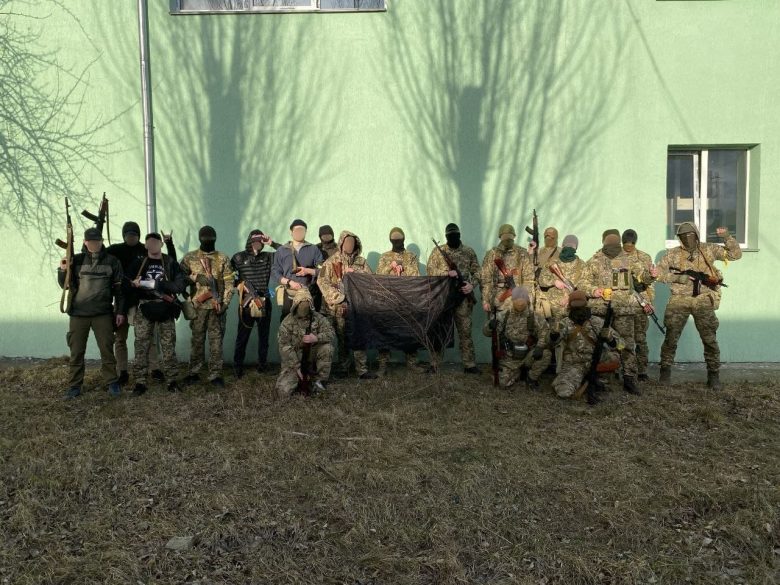
As The Ukrainian forces and their Western backers celebrate their recent military advance, the fate of ethnic Russians in the reclaimed territories looks bleak now that local and national leaders have declared a reckoning against those whom they consider to be collaborators and traitors.
It’s a policy that originates from the early stages of the conflict based on a law passed in March that threatened anyone who co-operated with the occupying Russian authorities with up to 15 years of imprisonment together with the confiscation of property. Hitherto there have been many arrests of those accused of pro-Russian collaboration, including the leader of Ukraine’s official parliamentary opposition Viktor Medvedchuk, and assassinations of officials such as Alexei Kovalev, deputy head of the military and civil administration in the Kherson region. But as the Ukrainian forces wrest back territory from Russia, a wide net is being cast against alleged collaborators that extends well beyond officials to include teachers, social media warriors and victims of unsubstantiated claims of snitches, shedding light on the intentions of Ukrainian authorities in the unlikely event of total victory.
Ukraine is a culturally heterogenous population in which linguistic affiliation is complex, being governed by both cultural and social situations. At least 17 per cent of Ukrainians claim Russian heritage, with about 14 per cent declaring Russian as their main language and a further 17 per cent Russo-Ukrainian bilingualism, with an unknown number opting to converse in a hybrid Surzhyk dialect. Russian speakers are overwhelmingly concentrated in the eastern and southern regions of the country. It’s a situation, moreover, that has reflected the electoral geography of the country of both parliamentary and presidential elections with the eastern and southern parts of the country exhibiting close affinities with Russia.
Starting as a reasonable initiative at nation-building that intended to correct the inequalities of institutional Russification of the Soviet era, language policy came to be weaponised by nationalist political forces that sought to use it to marginalise Russian culture. Although a cultural reset was inevitable after the collapse of the Soviet Union to redress years of Russification, its initial steps were measured, such as the Law of Languages of 1989, which extended legislative protections to Russian as well as other languages. For Ukraine’s increasingly influential nationalists, overwhelmingly located in the West of the country, the Law was intolerable and unsurprisingly fell victim to the Maidan coup of 2014, that replaced the Russophile President Viktor Yanukovich with Petro Poroshenko.
While its provisions were maintained by Ukraine’s subsequent leadership, following international condemnation of its revocation, the decision of the Constitutional Court to deem the Law unconstitutional was viewed by the Russian minority as a sign of a broader assault on Ukraine’s Russian heritage and served to fuel separatist sentiment in the Crimea and the Donbas. It also played into the hands of Vladimir Putin who could now claim to be the champion of Ukraine’s oppressed Russian speakers, by military means if necessary. Such fears were not unwarranted as in 2019 a new language law sought to end the hitherto ad hoc implementation of existing legislation and subject transgressors to severe fines. Poroshenko, who was campaigning for re-election, weaponised Ukraine’s language policy with his election slogan ‘Army, faith, language’, declaring that ‘the only opinion that we weren’t going to account for [in drafting the legislation] is the opinion of Moscow’. Salt was further rubbed into the wounds of the third of the country which rejected it by its being signed off by the Speaker of Parliament, Andrei Parubiy, a former activist in the neo-Nazi Social-National Party, who warned chillingly that ‘those people who try to revise the language law . . . will soon feel the whole anger of the Ukrainian people’. Remaining loopholes were filled in January 2022, just before Russia’s military incursion, which for instance compelled Russian language print media to produce Ukrainian translations for all publications in a move that de facto targeted Russian for discrimination.
To indigenous Russian speakers, such rhetoric marked the creation of an ethnic state in which they were not welcome. The escalation of the war in 2022 seemed to confirm their worst fears as not only did Russian become ‘the language of the enemy’ but things Russian, political parties, music, literature were officially shunned, banned or marginalised in a policy that hitherto had been executed only by the far right nationalists of Lviv City Council in West Ukraine. Whereas then the likes of Canadian and British ambassadors joined Moscow in condemning such action as ‘just plain dumb’ and intolerant, now such nationwide ‘de-Russification’ initiatives were met with silence.
International opinion recognised Ukraine’s language policy as conflict-bearing due to its increasingly divisive and discriminatory nature. The scrapping of minority language provisions by Ukraine’s Constitutional Court in 2014, for instance, raised concerns in the European Parliament which deemed it as ‘undermining any notions of justice, freedom, civilisation, progress and democracy’ and called for the EU Commission to ‘condemn the action of the Ukrainian Parliament and the nationalistic attacks on minority communities in Ukraine’. The 2019 law came under similar criticism from the Venice Commission, the Council of Europe’s advisory body on constitutional affairs, which declared that it threatened to become ‘a source of inter-ethnic tensions within Ukraine’. It reiterated its conclusion following the passing of the January 2022 Law, noting that ‘historical oppression of Ukrainian . . . may lead to the adoption of positive measures aimed at promoting Ukrainian, but this cannot justify depriving the Russian language and its speakers of the protection granted to other languages’.
Both the intra-parliamentary brawls and street standoffs between Ukrainian and Russian speakers during the passage of the language legislation were chilling portents of what was come. Although the escalation of the war in 2022 has seen some ethnic Ukrainian Russian speakers distance themselves from ‘the language of the enemy’ and embrace Ukrainian as their main language, it has also seen ethnic Russians fortify their Russian identity. While this in itself has demonstrated the complexity and malleability of identity in Ukraine, it has also reinforced pre-existing cultural fissures, leaving ethnic Russians with no option other than to embrace Mother Russia as their homeland.
While the conflict in the Donbas since 2014 rendered reconciliation between the Ukrainian authorities and the Russian minority problematic, as the failure of the Minsk agreement testifies, the escalation of the conflict has entrenched pre-war hatreds. With the national conversation decisively turning against the reintegration of Russian culture and language into Ukraine’s social fabric, it is difficult to see how a status quo ante bellum with even rudimentary cultural and linguistic protections for ethnic Russians is possible were the Ukrainian state reconstituted within its pre-war borders. In fact, everything points towards mass retribution and ethnic cleansing on a scale not witnessed in Europe since the Second World War, in a scenario that is likely to overshadow the grim events of the conflict itself. Ukraine’s Secretary of the National Security and Defence Council, certainly didn’t mince his words on a recent Ukrainian talk show in calling for the ‘complete disappearance of the Russian language from our land’ in what sounded like incitement to ethnic cleansing.
Nothwithstanding the difficulty such actions would present for social reconstruction, the questionable legality of extra-judicial killings of officials and political persecution of ‘collaborators’ threatens to draw attention to atrocities committed by Ukrainian paramilitary forces during the Second World War against Russians, Jews, Poles and other minorities. These crimes, together with the ritualistic celebrations by Ukraine’s highest political authorities of those who perpetrated them like nationalist leader and Nazi collaborator, Stepan Bandera, have been conveniently whitewashed so as to not tarnish the image of a virtuous Ukraine that has been carefully cultivated over the past few months. The sources which once regularly condemned Ukraine for not only celebrating wartime collaboration but also tolerating a revival of neo-Nazi paramilitarism now declare similar condemnation by Russia as hostile propaganda. A Ukraine seen to be persecuting minorities again would be a propaganda disaster for its Western backers.
Dividing Ukraine’s population into ‘the people’ and ‘the rest’ where the latter were made to feel subordinate in their ancestral lands to the former was always going to lead to conflict. Yet just as wise counsel of the likes of George Kennan, Henry Kissinger and Zbigniew Brzezinski warned of the grave risks of Nato’s expansion to Russia’s borders, so warnings came aplenty of the dangers of a divisive language policy. To Ukraine’s detriment, however, neither was heeded and now a reckoning against ‘the rest’ will be as useless in knitting back together shattered communities as the pre-war language policy was in solving peaceful coexistence between Russian and Ukrainian in a single public space.
West’s Policy Toward Other Countries ‘Dirty, Bloody,’ Denies Nations Right to Sovereignty: Putin
By Ilya Tsukanov – Samizdat – 27.10.2022
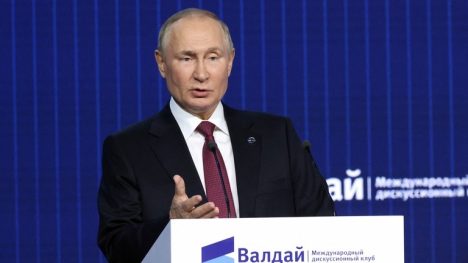
The West seeks to establish and maintain its control over the rest of the planet using “dirty” and “bloody” means, President Vladimir Putin has said.
“World domination is what the so-called West has staked in its game, but the game is unquestionably dangerous, bloody and I would say, dirty,” Putin said, speaking at the plenary meeting of the Valdai Discussion Forum on Thursday.
“It denies the sovereignty of nations and peoples, their identity and uniqueness, and has no regard whatsoever for other countries,” Putin added.
‘Rules-Based Order’ is an ‘Order With No Rules’
The Russian president also suggested that the so-called ‘rules-based’ international order declared by the US and its allies actually has only one “rule” – designed to give those who created it “the opportunity to live without any rules whatsoever” and enabling them to “get away with anything, no matter what they’ve done.”
Attempts to do away with cultural, social, political and civilizational diversity and to “erase any and all differences have become almost the essence of the modern West,” and is aimed at ensuring “the disappearance of the creative potential in the West itself and the desire to contain and block the free development of other civilizations. There is also a direct mercantile interest here, of course,” Putin said, pointing to the West’s efforts to impose its consumer culture values on others to expand their markets.
“It’s no coincidence that the West claims that its culture and worldview should be universal. Even if they don’t say so directly, they behave this way. In fact, their approach insists that these values be unconditionally accepted by all other participants in international communication,” the president said.
The origins of the current crisis have their roots in the destruction of the Soviet Union three decades ago, Putin said. “The collapse of the Soviet Union destroyed the balance of political forces. The West felt like a winner and proclaimed a unipolar world order in which only its will, its culture, its interests had the right to exist.”
Escalation
“The so-called West – I use this term conditionally of course, there is no unity there, it’s clear that this is a very complex conglomerate – has taken a number of steps in recent years and especially in recent months toward escalation,” Putin said, describing the state of affairs in the world today.
“They’re always trying to escalate…They’re fueling the war in Ukraine, organizing provocations around Taiwan, destabilizing the world food and energy markets,” Putin said.
Putin characterized last month’s terrorist attack against the Nord Stream gas pipeline network as an “outrageous” step, adding that unfortunately, “we are witnessing these sad events.”
Pointing to Western governments’ admission that they financed the events leading up to the 2014 Euromaidan coup in Kiev, which gave rise to the current crisis in relations between Russia and the West, Putin suggested that they’ve openly demonstrated their “loutish” nature.
Putin warned that the West’s confidence in its “infallibility” is a “very dangerous” delusion, with there only being “one step” between this self-confidence to the idea that “they can simply destroy those they do not like, or as they say, to ‘cancel’ them.”
But “history will put everything in its proper place and will not ‘cancel’ the works of the greatest and broadly recognized geniuses of world culture, but instead those who today have decided for some reason that they have the right to dispose of world culture at their own discretion. The self-conceit of these people is off the charts. But in a few years no one will remember them, while Dostoevsky, Tchaikovsky and Pushkin will live,” Putin assured.
The neo-liberal “American-style” model is experiencing a “doctrinal crisis,” according to the president, and has “nothing to offer the world except to preserve their dominance.”
Emphasizing that Russia is not a natural “enemy” of the West, Putin urged the West’s liberal leaders and elites to stop seeing “the hand of the Kremlin” behind all their internal domestic problems.
“In the conditions of the current tough conflict, I’ll say a few things directly: Russia, being an independent, distinct civilization, has never considered itself and does not consider itself an enemy of the West. Americanophobia, Anglophobia, Francophobia, Germanophobia are forms of racism, just like Russophobia and Anti-Semitism or any manifestation of xenophobia,” Putin stressed.
But there are “at least two Wests,” the president added, including the positive, traditional one with its immensely rich culture and the aggressive, neocolonial one, whose dictates Moscow will never accept. Russia has resisted Western hegemony and “its right to exist and develop freely,” and at the same time does not have any plans to itself “become some kind of new hegemony,” nor to impose its values on anyone or “interfere in someone else’s backyard,” Putin said.
Solutions
The Russian president suggested that amid the escalating economic, humanitarian, military and political crises plaguing the planet, it is unlikely that any country anywhere will be able to ‘sit things out’. Therefore, solutions of a global scale need to be reached, even if they are imperfect ones.
“The crisis has acquired a truly global character and affects everyone. There’s no need to harbor any illusions. There are essentially two paths for humanity: either to continue to accumulate the burden of problems which will inevitably crush us all, or to try to find solutions together, solutions which may not be ideal, but which work, and which are capable of making our world more stable and safer,” Putin said.
The Russian president emphasized that the West would need to start talking to rising alternative centers of power. “I have always believe and continue to believe in the power of common sense, and therefore am convinced that sooner or later both the new centers of a multipolar world order and the West will have to start a conversation based on equality about our common future. The sooner, the better, of course,” he said.
The “new world order” that replaces the current one “should be based on law, be free, original and fair. Thus, the world economy and trade should become more fair and open,” Putin said, benefiting the majority of nations and people, not individual corporations. At the same time, technology should reduce inequality, not increase it.
The president added that new international financial platforms are necessary which are outside the control of national jurisdictions, and which are “secure, depoliticized, automated and not dependent on any single control center.” Putin expressed confidence that such a system could be built.
Multipolarity is a necessity for the planet, including for Europe – to restore the latter’s political and economic agency, which is “very limited” today, according to Putin.
“We are standing on a historical frontier. Ahead of us is probably the most dangerous unpredictable and at the same time important decade since the end of the Second World War,” Putin said.
Ukraine
Commenting on Russia’s ongoing military operation in Ukraine, Putin said he thinks about the losses in life resulting from the conflict “all the time,” and that the crisis in Ukraine is a part of the “tectonic changes” taking place “in the entire world order.”
“Why was it necessary to carry out a coup d’etat in Ukraine in 2014?” Putin asked, recalling the origins of the current crisis. “[Ukrainian President Viktor] Yanukovych actually gave up power and agreed to hold early elections… Why was it necessary to carry out a bloody anti-constitutional coup under these conditions?”
The answer, Putin believes, is that the West wanted to “show” everyone “who’s the boss in the house. ‘Everyone (and ladies please excuse me for the expression) has to sit on their buttocks and not quack. It will be how we say it will be.’ I simply cannot explain these actions any other way,” Putin said.
Putin said Russia had no other choice but to recognize the Donbass republics in February and to come to their defense, and said that the unity of the Russian and Ukrainian people is an undisputable historical fact. Only Russia could guarantee Ukraine’s sovereignty, as Russia “created” Ukraine during the Soviet period, Putin said.
In the decades after the end of the Cold War, Russia’s consistent message to the West and NATO was “let’s all get along,” like in the Soviet children’s cartoon Leopold the Cat, but in almost all the main areas of potential cooperation, Moscow got the simple answer “No,” according to Putin.
Regarding the latest developments in the Ukrainian crisis and the concerning reports from Russian officials and military commanders that Kiev may be preparing to use a dirty bomb, Putin said he welcomes the International Atomic Energy Agency’s initiative to check Ukraine’s nuclear facilities.
“We are for it. This needs to be done as quickly as possible, as thoroughly as possible, because we know that right now the authorities in Kiev are doing everything possible to cover up the traces of these preparations,” Putin said.
The Russian president warned that it would be “easy” for Kiev to assemble a dirty bomb, and that Moscow has a rough idea about where it’s being created. Ukraine could use a Tochka U or another missile in its inventory to detonate the bomb somewhere and accuse Russia of launching a nuclear strike, Putin said.
The Pentagon Brought on Both Nuclear Crises
By Jacob G. Hornberger | FFF | October 26, 2022
I fully realize that when it comes to Ukraine, one is supposed to focus exclusively on Russia’s invasion and not on what the Pentagon did to gin up the crisis, a crisis that has gotten us perilously close to a world-destroying nuclear war with Russia.
Nonetheless, the Pentagon’s role in this crisis needs to be emphasized, over and over again, just as the Pentagon’s role in ginning up the Cuban Missile Crisis also needs to be emphasized, over and over again.
Yes, what I am emphasizing is the Pentagon’s role in ginning up both of these crises that have gotten us so close to nuclear war with Russia.
At the end of the Cold War racket, there was absolutely no reason for NATO to remain in existence. Its purported mission of protecting Europe from a Soviet (i.e., Russian) attack had been fulfilled. The Cold War was supposedly over.
The only problem was that it wasn’t over for the Pentagon and the CIA. If they had had their druthers, their Cold War racket would have gone on forever. After all, what better justification for their ever-increasing budgets and power within the federal governmental structure?
That’s why they kept NATO in existence. While they were engaging in their interventionist antics in the Middle East, which led to their war-on-terrorism racket, they were, at the same time, using NATO to provoke Russia, with the aim of reigniting their old Cold War racket. Instead of dismantling their old Cold War dinosaur, they used it to absorb former members of the Warsaw Pact, which enabled the Pentagon and the CIA to move their nuclear missiles and military forces inexorably closer to Russia’s border, over Russia’s vehement objections.
Ultimately, they threatened to absorb Ukraine into their NATO racket, knowing full well that Russia had vowed for some 25 years to invade Ukraine to prevent that from happening. Their scheme succeeded. Once Russia invaded Ukraine, the loyal followers of the Pentagon and the CIA focused exclusively on the invasion and not also on the NATO racket that had provoked the invasion.
It was no different with the Cuban Missile Crisis. The reason that Cuba and the Soviet Union installed nuclear missiles in Cuba was to deter another invasion of the island by the CIA and the Pentagon. Don’t forget that the CIA had already invaded Cuba at the Bay of Pigs and had failed miserably. After that, the Pentagon continually exhorted President Kennedy to initiate a full-scale military invasion of Cuba. That’s what the Pentagon’s fraudulent false-flag operation known as Operation Northwoods was all about, which Kennedy, to his everlasting credit, summarily rejected.
What legal justification did the Pentagon and the CIA have to invade Cuba? None! The fact that Cuba had a communist regime certainly never justified an invasion (or, for that matter, repeated murder attempts against Fidel Castro). Keep in mind that Cuba had never attacked the United States or even threatened to do so. In the long relationship between communist Cuba and the United States, it has always been the U.S. government that has been the aggressor, including with its old Cold War economic embargo that continues to target the Cuban people with death and impoverishment as a way to achieve regime change on the island.
Cuba and Russia knew full-well that the CIA and the Pentagon were fully determined to invade Cuba again, with the aim of replacing the Fidel Castro regime with another pro-U.S. dictatorship, like the one that preceded the Castro regime. That’s why Cuba and Russia installed those nuclear missiles in Cuba — to deter another illegal U.S. invasion of the island.
Why can’t the loyal acolytes of the U.S. national-security establishment see all this? Because for them, the Pentagon, the CIA, and the NSA are their triune god. Who wants to question or criticize god?
But if we are going to put out nation back on the right road — the road to liberty, peace, prosperity, and harmony with the people of the world, it is necessary for the American people to not only question this false god but also to toss it and its evil rackets into the dustbin of history and restore America’s founding governmental system of a limited-government republic.
Kiev asks for cluster munitions – report
Samizdat – October 27, 2022
Ukrainian officials have been pressuring the US to supply controversial cluster munitions to fight Russia, Foreign Policy has reported. The Pentagon sits on a stockpile of old rounds that many other nations have banned, but is barred from exporting them by law.
“We are requesting new rounds all the time that have longer range and more explosiveness,” a Ukrainian military official was quoted by the magazine as saying on the condition of anonymity. “We need them to destroy Russian fortifications on our territory.”
The outlet reports that Kiev started making the request about a month ago, due to the wear and tear of its own Soviet-made artillery guns and a need to further switch to NATO rounds.
The report said Ukraine asked for DPICMs, or dual-purpose improved conventional munitions, which come in various NATO calibers and contain different kinds of submunitions tailored for anti-personnel and anti-armor roles – hence “dual-purpose.”
Like most other types of cluster munitions, they are controversial because their use can leave behind unexploded submunitions that pose a threat to civilians. The 2008 Convention on Cluster Munitions (CCM), which most EU members signed, bans these types of weapons. But Ukraine and the US (as well as Russia) are not signatories.
Washington reversed its pledge not to use cluster munitions in 2017, but retains a ban on exporting them, according to Human Rights Watch (HRW). The Pentagon switched away from them in favor of GPS-guided munitions and has a large number of DPICMs in its stockpile.
Some Russia hawks on Capitol Hill are frustrated by Washington’s inability to send cluster rounds to Ukraine, according to the Foreign Policy report.
“These cluster munitions were literally designed specifically with Soviet advantages in artillery tubes in mind,” a congressional aide familiar with the request was quoted as saying. “The Ukrainians are saying, ‘You have these weapons purpose-built for the type of threat we’re facing — why can’t we have them’?”
There were multiple reports on Kiev’s use of Soviet cluster weapons against residential areas, both before and after Moscow sent its troops into the country. One of the worst recent incidents happened in March, when a Tochka-U missile with a cluster payload killed more than 20 people and injured dozens of others in Donetsk. Kiev denied responsibility for the attack. HRW said in May it could not verify the claims.
Ukraine a test range for Western arms – defense minister
Samizdat – October 26, 2022
The conflict in Ukraine gives Western arms producers a chance to see which products fare best in a real fight against Russia, the country’s defense minister has said.
“We have a combat testing field in Ukraine during this war,” Aleksey Reznikov explained. “We have eight different 155mm artillery systems in the field … so it’s like a competition between systems” to see which one proves best.
The comments came in an interview with Politico published on Tuesday. The testing ground idea was previously expressed by Reznikov’s deputy, Vladimir Gavrilov, who claimed that some American defense contractors were fielding their prototypes in Ukraine.
Kiev expects military aid from NATO members to continue flowing into the country for years and wants to benefit more from it, Reznikov said. For example, Ukraine could start joint ventures with Poland, the UK, or Germany to produce weapons.
“We have to develop a UAV (unmanned aerial vehicle) industry not only for aerial drones but also on land and in the sea because it’s the future” of warfare, he noted.
He was also skeptical about restrictions under which Ukraine’s supporters are shipping arms to Kiev. As the conflict with Russia unfolded, the US and its allies have repeatedly reconsidered previous decisions not to send heavier weapons, the defense minister pointed out.
“I’m really optimistic that Abrams tanks are possible in the future and I am sure that fighter jets like F-16s, F-15s, or Gripen from Sweden will also be possible,” he said.
Washington was initially reluctant to provide lethal aid to Ukraine out of concern that Russia would consider it an escalation but gradually reconsidered and supplied increasingly sophisticated weapons, which Reznikov sees as a favorable trend.
Western officials cited logistical issues with training Ukrainian pilots and maintenance of the fighter jets among the reasons why Ukraine can’t get F-16s or F-15s. But according to media reports, Kiev may get them in the long run.
Reznikov said European NATO allies were looking to the US in their aid decisions, so it was up to Washington to up the ante.
“After the first Abrams [arrives] I’m sure we will have Leopards, Marders, and other types of heavy armored vehicles like tanks,” he told the news outlet.
Among the weapons the US most recently designated for Ukraine are the NASAMS air defense systems. Washington is also reportedly considering sending some old HAWK surface-to-air missiles it has stockpiled to see if they are still effective.
Kiev ‘Made Dummy Missile’ for Provocation With ‘Dirty Bomb’ Over Chernobyl Zone
Samizdat – 26.10.2022
MOSCOW – The Kiev regime has already completed technical preparations for a provocation with a “dirty bomb,” having prepared a dummy missile, which is planned to be filled with radioactive material, a source familiar with the situation told Sputnik.
“Experts from the Yuzhmash plant have already made a dummy missile of the Iskander system, the head cluster part of which is planned to be filled with radioactive material, and then ‘shot down’ by Ukrainian air defense forces over the exclusion zone of the Chernobyl nuclear power plant in order to declare a Russian launch of a nuclear charge,” the source said.
He clarified that the model of the Iskander missile was made on the basis of a projectile from the Tochka-U missile system.
“After the dummy is shot down, the Kiev authorities intend to show the Western and Ukrainian media fragments of the mockup and electronics of the alleged Iskander missile in order to convince the Western public of Russia’s guilt,” the source said.
Is Ukraine a “proxy war”?
By Noah Carl | October 26, 2022
Critics of America’s policy toward Ukraine have accused it of waging a “proxy war” against Russia. Such critics include various Western commentators, as well as Russia itself. In April, the Foreign Minister Sergei Lavrov claimed, “NATO, in essence, is engaged in a war with Russia through a proxy”.
Yet when a reporter put this accusation to Joe Biden, he said it’s “not true”. What’s more, the Ukrainian government compiled a list of individuals who “promote narratives consonant with Russian propaganda”, and specified that such narratives include: “A proxy war between NATO and Russia is taking place on the territory of Ukraine”.
One problem with the line taken by Biden and the Ukrainian government is that it isn’t just critics of US policy that have used the term “proxy war”.
In an article claiming that “many Russian soldiers have to flee, surrender, or die” and “the more and faster the better”, the political scientist Eliot Cohen stated, “The United States and its NATO allies are engaged in a proxy war with Russia.”
Likewise, the former Supreme Allied Commander of NATO, Philip Breedlove – who has called for boots on the ground in Ukraine – stated, “I think we are in a proxy war with Russia. We are using the Ukrainians as our proxy forces.”
And in an interview calling for the US to provide “as much aid as necessary” to Ukraine, former CIA Director Leon Panetta stated, “We are engaged in a conflict here. It’s a proxy war with Russia, whether we say so or not.”
Okay, you might say, but those individuals were using “proxy war” in a purely technical sense. Although the US is not an active participant in the conflict, it is arming one of the participants. So calling the conflict a “proxy war” is just a statement of fact (even if it might technically qualify as spreading Russian propaganda).
When critics accuse the US of waging a “proxy war” what they really mean is that the US is using Ukraine to weaken Russia, regardless of whether this serves the interests of Ukrainians (or Europeans for that matter). For example, perhaps Ukrainians would be better off if the US had engaged in diplomacy with Russia before the war.
It’s certainly not a stretch to imagine the US would wage a “proxy war” of this kind. The Reagan Doctrine was all about building up the US military and arming anti-communist guerrillas in order to overwhelm the Soviet Union and, ultimately, win the Cold War. This included arming both religious and political extremists.
But we don’t have to go back to the eighties. In 2019, the RAND corporation published a report on strategies to “overextend and unbalance” Russia. The report identified “providing lethal aid to Ukraine” as one that would “exploit Russia’s greatest point of external vulnerability”. (Interestingly, it concluded that any increase in aid would need to be “carefully calibrated” to avoid provoking “a much wider conflict”.)
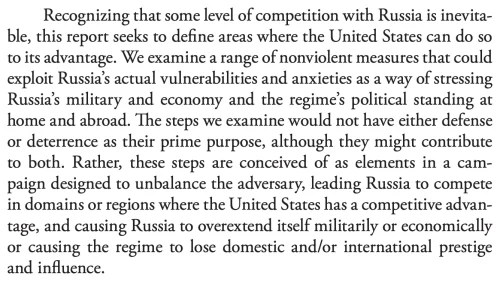
Screenshot from ‘Extending Russia: Competing from Advantageous Ground’.
RAND is almost entirely funded by the US Government, which appears first on its list of clients. So the fact that it would publish a report like this indicates that, even before Russia’s invasion, US decision-makers were interested in using Ukraine to weaken their geopolitical adversary.
As Senator Adam Schiff explained in 2020, “The United States aids Ukraine and her people so that we can fight Russia over there, and we don’t have to fight Russia here.”
Since Russia’s invasion, various other commentators have hinted – or in some cases explicitly stated – that America has goals other than securing Ukraine’s territorial integrity. Here’s Thomas Friedman’s account of what a “retired senior European statesman” told him:
The goal of Ukraine is to win, he said. The goal of the European Union is a bit different. It is to have peace … The U.S. is far away, and for the U.S., he added, it is not the worst thing to keep the war going to weaken Russia and make certain it doesn’t have the energy for any other adventures.
Two months into the war, Defence Secretary Lloyd Austin was asked how he would define America’s goals in the conflict. He began by saying what you’d expect him to say: “We want to see Ukraine remain a sovereign country”. He then went slightly off-script: “We want to see Russia weakened to the degree that it can’t do the kinds of things that it has done in invading Ukraine.”
According to the New York Times, some officials “cringed” and Biden called Austin to “remonstrate” him for the comment. “But officials acknowledged that was indeed the long-term strategy”.
A couple of weeks later, the political scientist Hal Brands really let the cat out of the bag – in a piece titled ‘Russia Is Right: The U.S. Is Waging a Proxy War in Ukraine’. He wrote:
The war in Ukraine isn’t just a conflict between Moscow and Kyiv, Russian Foreign Minister Sergei Lavrov recently declared. It is a “proxy war” in which the world’s most powerful military alliance … is using Ukraine as a battering ram against the Russian state … Lavrov is one of the most reliable mouthpieces for President Vladimir Putin’s baseless propaganda, but in this case he’s not wrong. Russia is the target of one of the most ruthlessly effectively proxy wars in modern history.
“The key,” Brands noted, “is to find a committed local partner — a proxy willing to do the killing and dying”. You then “load it up with” arms so that it can inflict “shattering blows” on your adversary. “That’s just what Washington and its allies are doing to Russia today.”
Similar sentiments were echoed by Congressman Seth Moulton in an interview with Fox News. “At the end of the day, we’ve got to realise we’re at war,” Moulton stated. “And we’re not just at war to support Ukraine. We’re fundamentally at war – although somewhat through a proxy – with Russia. And it’s important that we win.”
Likewise, when Congressman Dan Crenshaw came under fire from “America First” conservatives over his support for Ukraine, he tweeted: “Yeah, because investing in the destruction of our adversary’s military, without losing a single American troop, strikes me as a good idea. You should feel the same.”
Crenshaw didn’t bother paying lip-service to high-minded concepts like democracy, sovereignty or territorial integrity. He just came out and said we’re “investing in the destruction of our adversary’s military”.
Critics have consistently disparaged US policy as “fighting Russia to the last Ukrainian”. But in July, Senator Lindsey Graham – a long-time Russia hawk – said almost exactly that. “I like the structural path were on here,” Graham explained. “As long as we help Ukraine with the weapons they need and the economic support, they will fight to the last person.”
Critics found further justification for their cynicism in a recent Washington Post article, which revealed the following. “Privately, U.S. officials say neither Russia nor Ukraine is capable of winning the war outright, but they have ruled out the idea of pushing or even nudging Ukraine to the negotiating table.”
You might say that using Ukraine to weaken Russia is something worth doing, as Dan Crenshaw evidently believes. But at this point, it can scarcely be denied that America is engaged in a proxy war.
Property in German town to be confiscated for asylum seekers
Free West Media – October 26, 2022
So far it has been dismissed as a malicious “conspiracy theory” that living space for asylum seekers would end up being confiscated in Germany. But this “theory” is sadly coming true. In the Bavarian district of Fürstenfeldbruck, not far from Munich, it is being implemented.
The local CSU District Administrator Thomas Karmasin has refused to use gymnasiums as “refugee” accommodation. But the existing public accommodation is running out in the face of exploding numbers of asylum seekers. Karmasin therefore wants to have public and private properties confiscated in order to accommodate the newcomers. The first efforts have already started.
Karmasin said in a statement that immigration policy was a federal matter. As in 2014 to 2016, during the last “refugee” crisis, he refused to make school gyms available again.
This development is likely to put affected locals under severe stress in forcing a show of solidarity with Ukrainians or Senegalese accommodated in their apartments and single-family homes.
In a recent SZ interview, sociologist Karin Scherschel who is pro-migration, warned that election campaigns should not be fought on the subject of migration “because it always creates a mood”. If Scherschel had her way, the immigration debate would be ignored.
With authorities now confiscating homes, the matter is certain to create a volatile mood.
According to a so-called general clause under police law, people in Germany who are threatened with homelessness may be accommodated in empty apartments or hotel rooms, even against the will of the owner. Before doing so, the authorities must have exhausted all other possible options.
It is probably only a matter of time before these state encroachments will also extend to private residential property everywhere.
In Stuttgart, 100 tenants were given notice because the homeowner wanted to offer his house to the city for refugees. And in a Bavarian retirement home, the inhabitants were forced to move to higher floors so that young migrants could be accommodated on the ground floor.
The Organization for Economic Cooperation (OECD) assumes that the number of people moving to Germany by the end of the year will exceed the figure of more than two million from 2015.
Featured Video

False Flags and the Dawn of Bioterrorism
or go to
Aletho News Archives – Video-Images
From the Archives
How 1960’s French Nuclear Tests Are Still Claiming Lives in Algeria
Sputnik – 15.02.2018
On February 13, 1960, France carried out its first nuclear test in Algeria’s southern Reggane region. According to official statistics, 17 nuclear tests were carried out in total over the next 6 years. The area remains affected, and local scientists say that radioactive contamination has caused genetic mutations and irreversibly changed the region.
There are no official statistics on the number of victims. The only figures can be found in the records kept by the French representative of the local church, which lists 42,000 victims of nuclear tests. Three years ago, the French Ministry of Defense issued a statement, putting the number at 27,000 people. The victims include French soldiers as well as local Algerians who lived in the surrounding areas. … continue
Blog Roll
 Aletho News
- Using nuclear weapons, the US-Israeli alliance still can’t beat Iran
- Sunset on the Quality of Western Propaganda: Arrival of the Dr Strangelove Moment
- Ukrainian general accused of protecting crime bosses
- US-‘Israel’ alliance faces growing rupture after midterms
- GOP’s Crushing Midterm Loss Could Reshape US Political Landscape – Analyst
- Midterm loss gives Congress power to rein in US war on Iran
- Midterms Were ‘Vote of No Confidence’ in GOP, But Iran Has No Illusions About Democrats – Marandi
- Israeli Soldiers Inadvertently Prove Their Own Genocidal Guilt
- Ukraine arrests woman who exposed Azov battalion’s ‘torture chamber’
- Did Israel lose the midterms?
- If Americans Knew
- An error has occurred; the feed is probably down. Try again later.
- No Tricks Zone
- New Study: The Net Fossil Fuel Contribution To Rising Atmospheric CO2 Has Been Zero For 500 Years
- Germany’s Green Energy Transition Becoming Increasingly Expensive…Another 6 Trillion Euros!
- Sudden Stratospheric Warming, Powerful El Niño Combination May Lead To Extreme Europe Cold, Energy Crisis!
- Two New Studies Find Thwaites Glacier Melt Cannot Be Driven By Human Activity Or A Warming Ocean
- E-Cars Reduce CO2 Emissions By Only 41% Compared To Internal Combustion Engine Vehicles
- Predictions Made By Renowned Climate Professor Over Past Decades Have Been Proven To Be Poor
- New Study Suggests Large Regions Of The Pacific Ocean Have Been Cooling For The Last 80 Years
- Germany’s Green Energy Debacle: High Energy Costs Force Kahla Porzellan to Close After 182 Years!
- New Study: 50 Years Of The Most Aggressive ‘Net Zero’ Policies Can Only Affect The Global Climate By 0.03°C
- US September “Heat” Was No Record…Many Records Set Decades Ago

