British intelligence operative’s involvement in Ukraine crisis signals false flag attacks ahead

BY KIT KLARENBERG · THE GRAYZONE · MARCH 24, 2022
Shadowy UK intel figure Hamish de Bretton-Gordon was at the forefront of chemical weapons deceptions in Syria. Now in Ukraine, he’s up to his old tricks again.
With Washington and its NATO allies forced to watch from the sidelines as Russia’s military advances across Eastern Ukraine and encircles Kiev, US and British officials have resorted to a troubling tactic that could trigger a massive escalation. Following similar claims by his Secretary of State and ambassador the United Nations, US President Joseph Biden has declared that Russia will pay a “severe price” if it uses chemical weapons in Ukraine.
The warnings emanating from the Biden administration contain chilling echoes of those issued by the administration of President Barack Obama throughout the US-led dirty war on Syria.
Almost as soon as Obama implemented his ill-fated “red line” policy vowing an American military response if the Syrian army attacked the Western-backed opposition with chemical weapons, Al Qaeda-aligned opposition factions came forth with claims of mass casualty sarin and chlorine bombings of civilians. The result was a series of US-UK missile strikes on Damascus and a prolonged crisis that nearly triggered the kind of disastrous regime change war that had destabilized Iraq and Libya.
In each major chemical weapons event, signs of staging and deception by the armed Syrian opposition were present. As a former US ambassador in the Middle East told journalist Charles Glass, “The ‘red line’ was an open invitation to a false-flag operation.”
Elements of deception were especially clear in the April 7, 2018 incident in the city of Douma, when an anti-government militia on the brink of defeat claimed civilians had been massacred in a chlorine attack by the Syrian army.
Veteran inspectors from the Organization for the Prohibition of Chemical Weapons (OPCW) found no evidence that the Syrian army had carried out any such attack, however, suggesting the entire incident had been staged to trigger Western intervention. Their report was subsequently censored by organization management, and the inspectors were subjected to a campaign of smears and intimidation.
Throughout the Syrian conflict, a self-proclaimed “chemical warrior” named Hamish de Bretton-Gordon was intimately involved in numerous chemical weapons deceptions that sustained the war and ratcheted up pressure for Western military intervention.
This February 24, just moments after Russia’s military entered Ukraine, de Bretton-Gordon surfaced again in British media to claim that Russia was preparing a chemical attack on Ukrainian civilians. He has since demanded that Ukrainians be provided with a guide he wrote called, “How To Survive A Chemical Attack.”
So who is de Bretton-Gordon, and does his sudden reappearance as an expert voice on the Russia-Ukraine war signal a return to the dangerous US-UK red line policy?
Hours after war erupts, a “chemical warrior” demands Western escalation
Following months of fevered speculation about an impending Russian invasion of Ukraine, when it finally came to pass on the early morning of February 24th, most were caught entirely by surprise. Media outlets and pundits scrambled to get their stories straight, while Western leaders rushed to construct a cohesive ‘response’.
By contrast, Hamish de Bretton-Gordon, a British army veteran identified by UK media as a “former spy,” was in no such muddle. Within just three hours, he had a fiery op-ed prepared for The Guardian, demanding the US and Europe “show their steel in the face of Putin’s aggression.” Warning that Vladimir Putin was “much more willing to face off with NATO” than before, de Bretton-Gordon charged that the West “stood back and watched in Syria,” and “it must not do the same in Ukraine.”
“Syria shows what happens when you turn a blind eye and are too heavily influenced by peaceniks,” de Bretton-Gordon fulminated. “Those of us involved in interventions in Iraq and Afghanistan over the past 30 years…we look at Syria and know we should have done better. That knowledge should inform our response to Putin’s aggression now.”
In reality, Washington and its allies did not stand back and watch in Syria; it waged a decade-long proxy war employing jihadist paramilitaries and airstrikes on Damascus, then occupied oil-producing portions of the country and subjected its citizens to crippling sanctions, which to this day deprive them of food, electricity and vital medical supplies.
Of all people, de Bretton-Gordon – whose Twitter profile once identified him as a member of 77th Brigade, the British Army’s official psychological warfare division – is uniquely placed to know of these horrors. After all, he played a pivotal role in promoting and extending the dirty war through the management of information surrounding chemical weapons incidents.
Manipulation, absurdities and obvious fraud
As The Grayzone has revealed, the involvement of de Bretton-Gordon in the Syrian conflict dates back to at least 2013, when by his own admission he was engaged in a covert effort to smuggle soil samples out of the opposition-occupied areas. This work would have inevitably placed him in extremely close quarters with jihadist elements raking in Western funding while benefiting from NATO training and weapons.
Contemporary media reports reveal the UK’s MI6 was engaged in a sample-gathering effort in the country at the very time time de Bretton-Gordon was inside Syria, strongly suggesting his linkage to the foreign intelligence agency. One article makes abundantly clear the purpose of the soil-sample exercise was to push the US into intervening by proving government culpability for alleged chemical weapons attacks.
Other forms of evidence were also collected on-the-ground by de Bretton-Gordon, and provided to a number of official investigations into chemical attacks. In at least one instance – an OPCW/UN Joint Investigative Mechanism (JIM) probe into a purported chemical strike in Talmenes, April 2014 – videos submitted by CBRN Taskforce, a shady organization he founded in Aleppo, were found to show clear signs of falsification.
De Bretton-Gordon threw his chemical weapons expertise into further doubt when he told British media that any common refrigerator could be transformed into a chemical weapon, falsely claiming that R22 refrigerant cylinders contained material for improvised chlorine bombs. “Somebody could go to a waste site where people chuck away fridges [in the UK] and get a whole bunch of those things and blow them up,” the supposed arms specialist claimed.
De Bretton Gordon has gone as far as claiming to a British tabloid that Russia could deploy missiles and hand grenades containing the highly deadly Soviet-era chemical agent Novichok “in any future war with the West.”
Such absurd commentary and subterfuge has done nothing to dent de Bretton-Gordon’s credibility, however. His mainstream profile has only grown over time, with outlets invariably presenting him as a courageous human rights defender risking his life to train local doctors and rescue workers.
On more than one occasion, however, de Bretton-Gordon has directly involved Western journalists in MI6’s soil gathering efforts. For instance, during a 2014 podcast interview with Wilton Park, an NGO funded by the UK Foreign Office, de Bretton-Gordon boasted of his responsibility for a story in the Times of London alleging a Syrian chemical attack in the town of Sheikh al-Maqsood.
“In March last year there was a reported sarin attack in Sheikh al-Maqsood and I helped the Times – chap called Anthony Lloyd who very sadly got shot two weeks ago – to cover this story and tried to get samples to the UK for analysis … I won’t go into the details of that,” he recalled.
Then-Prime Minister David Cameron invoked the Sheikh al-Maqsood incident to increase pressure on Damascus, citing “the picture as described to me by the Joint Intelligence Committee” as the basis for his assertion of a chemical attack against the town by the Syrian army.
Throughout the dirty war on Syria, de Bretton-Gordon routinely cropped up in the media attributing gas attacks and war crimes to Syrian and Russian forces, and fear-mongered about their implications for future conflicts with the West.
The latter role is one de Bretton-Gordon has enthusiastically resumed throughout the war in Ukraine, aggressively hyping the threat to Western countries. His messaging has tracked seamlessly with that of the US government, which initiated a program months before Russia’s military operation to prepare Ukraine’s security sector for an impending weapons of mass destruction attack.
Months before war, US trains Ukrainians in the threat of “targeted weapons of mass destruction attacks”
Back in May 2021, the State Department announced that Washington had conducted a “virtual training exercise” with “partners” in Kiev, including domestic security services, law enforcement, and first responders, to “identify, respond to, and investigate assassinations involving weapons of mass destruction,” due to “recent events in Europe” highlighting “the real threat of government-sanctioned, targeted weapons of mass destruction attacks.”
Along the way, Ukrainians were tutored in “[identifying] the medical symptoms that indicate WMD material use, the attack cycle involved in WMD assassination attempts, and the specific measures that enable safe and secure detection and response to WMD incidents.”
Quite why this instruction was given at this particular time is unclear, as was the “recent events in Europe” to which the press release referred. Perhaps the State Department was alluding to the alleged novichok poisoning of the Russian opposition figure Alexei Navalny in August 2020. On what grounds that failed assassination necessitated a grand, multi-agency training exercise in dealing with “targeted WMD attacks” is anyone’s guess.
Whatever the purpose of the US training program was, Ukrainian security personnel can now claim they have the training to identify the precise “medical symptoms that indicate WMD material.”
This is significant, because ever since the conflict began, Kiev has exhibited an endless enthusiasm for lying, having distorted or even outright concocted events and facts whole-cloth to advance its objectives on countless occasions.
The most dangerous claims advanced by Ukrainian propagandists have been reinforced by the supposed authority of de Bretton-Gordon, who has argued that Russian chemical strikes were absolutely inevitable, based his prediction on his opinion that Moscow “has no morals or scruples.”
The self-styled chemical weapons expert has even cautioned that Putin could deploy nuclear weapons or create a pandemic “more deadly than Covid” with an Ebola weapon. He has further speculated that Russian forces may unleash a deadly virus seized from one of several Pentagon-funded biolabs in Ukraine, then blame it on the US.
From Syria to Ukraine, it is happening again
In a typical media appearance, on March 10th, de Bretton Gordon told London’s LBC radio show that “nothing is off the table at this stage.” Among the horrors he forecast was the use of white phosphorous “to set towns and cities on fire.”
Justifying his certainty, de Bretton-Gordon forcefully asserted, “the only way to take a large city or town ultimately is to use chemical weapons.” He pointed to Syria to prove his point – but without referencing his own pivotal role in escalating that conflict through the manipulation of evidence and scientifically bereft fear-mongering in the media.
Now, de Bretton-Gordon has resurfaced at the center of the aggressive push for escalation with a nuclear armed Russia. If his role in Syria is any guide, a series of cynical deceptions could be on the way.
Chinese Foreign Minister visits India to discuss Ukraine
Samizdat | March 25, 2022
Chinese Foreign Minister Wang Yi arrived in New Delhi on Thursday night for a diplomatic visit, where he is expected to meet his Indian counterpart Subrahmanyam Jaishankar, the Indian foreign ministry announced. This is the first visit of a high-ranking Chinese official to India since border clashes in Ladakh in 2020.
Wang Yi previously held talks with India’s National Security Adviser Ajit Doval, according to Reuters. Both China and India kept the visit secret until the Beijing diplomat touched down in New Delhi late on Thursday.
The talks, set for Friday, are likely to be focused on border tensions between India-China, as well as Russia’s military offensive in Ukraine. Both countries have, so far, abstained from condemning and sanctioning Russia for its actions, maintaining trade relations with the country despite pressure from the West.
While the two nations have called on Russia to cease hostilities and look for a diplomatic solution, India continues to buy Russian oil and is currently discussing means to switch to a rupee-rouble trade mechanism, allowing the two sides to avoid trading in the euro or the dollar. China has repeatedly denounced unilateral sanctions on Moscow, protesting against Russia’s exclusion from the G20.
The relations between China and India began to deteriorate after a clash in the Ladakh region on their Himalayan border in June 2020, where at least 20 Indian and four Chinese soldiers were killed.
“Few would have anticipated … the turn that India’s relations with China have taken in the last two years,” Indian Foreign Minister said on Thursday, stressing the importance of coordination on defense and foreign policies matters between the two countries. It is likely that India will push for complete disengagement of troops from the region during the Friday talks.
The Chinese foreign minister visited Pakistan and Afghanistan earlier this week, and is set to continue his tour across South Asia by traveling to Nepal. In Pakistan, Wang Yi said that “China shares the same hope” as its Islamic colleagues regarding the status of Indian Kashmir province, who advocate for the province’s “inalienable right to self-determination”. The remark drew anger from some Indian officials ahead of his visit, as the Muslim majority region, controlled by both India and Pakistan, is considered a disputed territory, where India has been fighting armed rebels for decades.
China refutes NATO secretary general’s misinformation accusation
By Du Qiongfang | Global Times | March 24, 2022
Chinese Foreign Ministry spokesperson Wang Wenbin said on Thursday that time will prove China stands on the right side of history and groundless accusations will collapse, refuting an allegation from NATO Secretary General Jens Stoltenberg that “China has provided Russia with political support by spreading lies and misinformation.”
When asked about Stoltenberg’s allegation at Thursday’s press briefing, Wang said the accusation against China itself is spreading disinformation.
With an objective and fair attitude, China has made active efforts to realize an immediate ceasefire, to avoid a humanitarian crisis and to restore peace and stability, Wang said, adding that Ukraine should be a bridge between the East and the West, not an outpost in major power rivalry.
“We need calm and rationality to defuse a crisis rather than ignite the fire and add more fuel to the fire; we need dialogue and communications to resume peace instead of using pressure and coercion; to achieve lasting peace and stability, we need to accommodate the legitimate security concerns of all parties, rather than promote collective confrontation and seek absolute security,” Wang said.
He added that China’s stance is in line with the wishes of most countries and it stands on the right side of history as time will tell. Any groundless accusations and suspicions against China are indefensible and will simply collapse.
The West thinks the war is about defending democracy and freedom but in reality it’s about security in the European geopolitical landscape, so the Ukraine crisis is not about differences in social systems or ideology, Yang Xiyu, a senior research fellow at the China Institute of International Studies, told the Global Times on Thursday.
Wang said that European countries should uphold the principle of strategic autonomy and work with Russia and Ukraine and other relevant countries to build a balanced, effective and sustainable European security architecture through dialogue and negotiations. The US and NATO should also engage in dialogue with Russia to address the root cause of the Ukraine crisis.
Wang also said that there are many loopholes in the US’ responses to the international community, including China’s questions surrounding the US biological laboratories in Ukraine which Russian experts claimed to have revealed new facts pointing to the direct involvement of the US Department of Defense in the development of biological weapons components in Ukraine.
The best way for the US to prove its innocence is to open its doors and accept the test of the international community, Wang said.
The spectre that haunts Biden as he wings his way to the borderlands of Ukraine
The Russian special operation may after all be inching toward successful conclusion
BY M. K. BHADRAKUMAR | INDIAN PUNCHLINE | MARCH 24, 2022
By a queer coincidence, former US Secretary of State Madeline Albright passed away while President Joe Biden was travelling in Air Force 1 en route to Europe on what is probably the most crucial diplomatic mission of his presidency.
The general expectation is that 80-year old Biden is personally undertaking a mission to persuade the US’ European allies that the North Atlantic Treaty Organisation (NATO) should intervene in the Ukraine crisis in some way. And, ironically, Albright was the choreographer of the idea that in the post-cold war era, the NATO should reinvent itself and transform as a global security organisation.
Albright, like most American diplomats of East European descent, was passionately devoted to the NATO. She supported the alliance’s brutal military intervention in Yugoslavia in 1999 and would have supported an intervention in Ukraine.
The White House spin is that Biden will discuss additional sanctions against Russia. But the possibility of new restrictions has waned following the EU foreign and defence ministers’ meeting on Monday where a decision was taken to put off further sanctions.
The EU meeting instead assessed that the ongoing Ukraine-Russian talks should proceed further and even if upbeat predictions may not be entirely correct, since the talks are challenging, the good part is that neither party has complained of any deadlock in the negotiations so far.
Conceivably, Biden is travelling to Europe not to discuss tougher sanctions (something which he could as well have handled in a videoconference) but to explore NATO’s potential engagement in the Russian-Ukrainian conflict for which his participation becomes absolutely essential.
As things stand, there is every possibility of a prolonged conflict in Ukraine and Russia eventually prevailing. Such a scenario is extremely damaging for Biden politically in the US. Biden is facing domestic criticism both for his failure to prevent the conflict as well as for being ineffectual in blocking the Russian advance.
While the US rhetoric pillories Russia for “war crimes” and the humanitarian crisis in Ukraine, et al, the world capitals view this as a geopolitical confrontation between America and Russia. Outside of the western camp, the world community refuses to impose sanctions against Russia or even to demonise that country.
The world community steers clear of taking sides between the US and Russia. The Islamabad Declaration issued on Wednesday after the 45th meeting of the foreign ministers of the fifty-seven member Organisation of Islamic Conference refused to endorse sanctions against Russia and instead counselled cessation of hostilities in Ukraine, avoidance of loss of lives, enhancement of humanitarian assistance and a “surge in diplomacy” — almost ditto China and India’s stance.
Not a single country in the African continent and West Asian, Central Asia, South and Southeast Asian region has imposed sanctions against Russia. Following a visit to Hanoi, Malaysian PM Ismail Sabri Yaakob said, “We discussed the Russian-Ukrainian conflict and agreed that Malaysia and Vietnam will remain neutral on this issue. As for sanctions against Russia, we do not support them. The sides do not support unilateral sanctions; we recognise only restrictions that could be imposed by the UN Security Council.” This is the consensus within ASEAN too.
Interestingly, Chinese Councillor and Foreign Minister Wang Yi was the chief guest at the OIC meeting in Islamabad. In his remarks, Wang Yi said, “China supports Russia and Ukraine in continuing their peace talks, and hopes that the talks will lead to ceasefire, end the fighting, and bring about peace. Humanitarian disasters should be avoided, and spillover of the Ukrainian crisis should be prevented so as not to affect and harm the legitimate rights and interests of other regions and countries.”
The Chinese foreign ministry press release on Wang Yi’s meeting with the Saudi Arabian Foreign Minister Faisal bin Farhan Al Saud said, “As to the Ukraine issue, the two sides agreed that all countries’ sovereignty and territorial integrity should be respected and their reasonable security concerns should be taken seriously. It is imperative to prevent any humanitarian crisis, maintain the peace talk process and resolve conflicts through dialogue and negotiation. Both sides emphasised that all countries have the right to make independent judgements, withstand external pressure, and disagree with the simple logic of “black or white” and “friend or foe”.
Again, the Chinese press release on Wang Yi’s meeting with his Egyptian counterpart Sameh Shoukry said, inter alia, “The two sides exchanged views on the Ukraine issue, and agreed to respect the sovereignty and territorial integrity of all countries and stay committed to a comprehensive solution to the current crisis. Shoukry said, Egypt opposes some countries exerting pressure on China and stands for strengthening cooperation rather than escalating confrontation.”
Curiously, four foreign ministers from West Asia travelled to Moscow last week to discuss the bilateral cooperation — from Qatar, Iran, Turkey and the UAE.
Nonetheless, the outcome of Biden’s visit to Europe will have significant bearing on the conflict in Ukraine. If Biden succeeds in getting European backing for his proposal for a NATO intervention in Ukraine, the conflict may escalate dramatically into a world war involving nuclear weapons.
Will Biden push the envelope? It seems he’s unwilling to risk. Biden seems to have a Plan B as well. He has scheduled a separate visit to Warsaw. Poland indeed has its fair share of Russophbes and has been straining at the leash for some form of involvement in Ukraine.
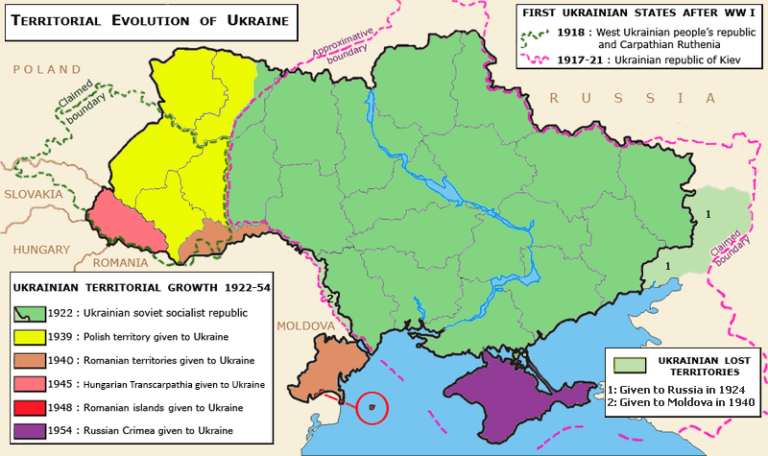
The heart of the matter is that Poland also has an axe to grind. Parts of Poland comprise today’s ethnically mixed western borderlands of Ukraine — oblasts of Zhytomyr, Khmelnytskyi and Lviv. If Ukraine fragments or collapses in defeat, Poland will most certainly seize the opportunity to reclaim its lost territories. Poland’s hyper-activism over Ukraine is self-evident.
Incidentally, in recent days, former Polish Foreign Minister Radoslaw Sikorski and Ukrainian Deputy Prime Minister Iryna Vereshchuk have both accused Budapest of trying to lay its hands on Ukraine’s largely Hungarian-populated Transcarpathian region. On Tuesday, Sikorski alleged in a tweet that Hungarian PM Viktor Orbán and President Vladimir Putin reached a secret agreement on the partition of Ukraine!
On the same day, Iryna Vereshchuk complained in a Facebook post: “The way the Hungarian leadership has been treating Ukraine lately is even worse than some of the Russian satellite states of the former Soviet Union. Hungary does not support the sanctions. They don’t provide weapons. They don’t allow transit of weapon supplies from other countries. They say ‘no’ to virtually everything.”
Biden cannot but be exploring with the Polish leadership possibilities that fall short of an outright NATO intervention in Ukraine. The spectre that haunts the Biden administration, despite the swagger of its media bluster, is that the Russian special operation may after all be inching toward successful conclusion, creating a large buffer of regions on the eastern side of the Dnieper river, and gaining control of Black Sea coastline that denies access to NATO ships.
Poland becomes a key stakeholder in such an outcome and Washington surely regards Warsaw as its number one interlocutor in the developing situation, as the fate of Ukraine hangs in the balance.
Israel’s balancing act in Ukraine is likely to backfire
By Ramzy Baroud | MEMO | March 24, 2022
Israel’s balancing act in the Russia-Ukraine war is likely to falter soon, simply because the resulting NATO-Russia conflict is expected to last for years, not weeks or months. Eventually, Israel would have to make a choice. Alas, whatever that choice may be, Israel will stand to lose.
From the first day of the war, Israel somehow became involved. Top Israeli officials, including the country’s Prime Minister Naftali Bennett, began calling their Ukrainian and Russian counterparts. Initially, some in the media surmised that Israel is concerned because of the large Jewish populations in both Ukraine and Russia.
However, the headlines quickly moved on, with terms such as ‘Israeli oligarchs‘, ‘Jewish oligarchs‘, and other combinations of Israel-friendly oligarchs dominating the news. Business interests quickly began replacing the supposed concern over the safety and welfare of ordinary Ukrainians.
The latter fact was demonstrated in a most tragic way when Israeli Channel 12 reported, on 10 March, that many Ukrainian refugees were “stuck at Ben Gurion Airport, facing cold and callous treatment”.
Israeli hypocrisy reared its ugly head once more on 26 February, when Israeli Minister of Aliyah and Integration, Pnina Tamano-Shata, said in a statement, “We call on the Jews of Ukraine to immigrate to Israel – your home.”
It is obvious that Israel does not care about the welfare of Ukrainians or, frankly, Ukrainian Jews either. After all, these newcomers to Israel would eventually be incorporated into the country’s illegal settlement enterprises. We know this from history and particularly from the history of the migration of Russian Jews to Israel, who arrived in their hundreds of thousands in the early 1990s. Not only do many of them now reside in illegal Jewish settlements, but to some extent, they also represent the backbone of some of Israel’s far-right political parties, the likes of Avigdor Lieberman‘s Yisrael Beiteinu.
Aside from the fact that a country moving its residents to an occupied territory is a stark violation of international law, it is also a violation of the rights of these vulnerable refugees, who will be expected to live in another war zone in the service of Israel’s Zionist ideology.
It is unfortunate, but typical that Israel finds opportunities to bolster its settler colonial model in occupied Palestine by exploiting the tragedies of other societies to its advantage. It has done so many times in the past: in Ethiopia, following the famine in 1984, in Russia, following the collapse of the Soviet Union, and in France, following the Paris terrorist attacks in 2015.
While France was still trying to fathom the enormity of its tragedy when 130 people were killed in broad daylight on 13 November, 2015, then Israeli Prime Minister Benjamin Netanyahu called on French Jews to move to Israel. “Of course, Jews deserve protection in every country, but we say to Jews, to our brothers and sisters: Israel is your home,” he said.
Shamelessly, Israel finds tragedies as political opportunities worth exploiting. While this quality is not unique to Israel – the Russia-Ukraine war has also exposed the opportunism of other countries around the world – Israel’s exploitation is doubly shameful as it hopes that war-torn Ukraine would help it sustain its own war waged against the Palestinian people.
However, serious cracks in the Israeli balancing acts are already on display. On 11 March, US Under-Secretary of State for Political Affairs, Victoria Nuland called on Israel to join sanctions against Russia. “We’re asking as many countries as we can to join us. We’re asking that of Israel as well,” she said.
Understandably, much of that pressure is coming from the Ukrainian government itself. Volodymyr Zelensky has repeatedly called on Israel to reciprocate for the Ukrainian support of Israel during its genocidal wars on the Palestinians. Indeed, Zelensky has taken every opportunity to express his solidarity with Israel in the past, even though Palestinians were the ones dying in their thousands.
“The sky of Israel is strewn with missiles. Some cities are on fire. There are victims. Many wounded. Many human tragedies,” the Ukrainian President tweeted on 12 May, 2021. Even during his inauguration speech in May 2019, Zelensky did not forget to bring Israel into his budding political discourse. “We must become Icelanders in soccer, Israelis in defending our land, Japanese in technology,” he said.
Still, aside from the occasional lip service, Israel insisted on remaining largely neutral. Analysts have explained the Israeli position in terms of Israel’s concern over Russia’s possible retaliation in Syria, for example, by allowing Iran greater geopolitical access to Syria that may compromise Israel’s ‘security.’ Others cited Israel’s deep financial interests, especially through the aforementioned oligarchs. Whatever the reasons may be, pressure is mounting on Israel to completely abandon its interests in Russia in favour of fully supporting Ukraine.
On 20 March, Zelensky upped the ante when he gave a speech at the Israeli Knesset. Not only did the Ukrainian President ask for Israel to provide Ukraine with an Iron Dome similar to the one that Tel Aviv uses to intercept Palestinian resistance rockets, he went much further, by infusing the Holocaust, an extremely sensitive discourse that only Israeli officials are allowed to use – and, indeed, manipulate – to silence any criticism of Israel internationally.
“The Nazis called this ‘the final solution to the Jewish question,'” Zelensky said. “And now, in Moscow, (…) they’re using those words, ‘the final solution’. But now, it’s directed against us and the Ukrainian question.”
For the Ukrainian President, although himself Jewish, to dare strike such a historical parallel to serve his country’s interests outraged many Israelis. “I admire the Ukraine president and support the Ukrainian people in heart and deed, but the terrible history of the Holocaust cannot be rewritten,” Israeli Communications Minister, Yoaz Hendel, tweeted. Many others joined in, in Israel and the US, attacking Zelenky’s supposed audacity.
Aside from its fear that injecting the Holocuast as part of Ukraine’s anti-Russian discourse could deprive Israel from its monopoly over the use and misuse of that historic tragedy, the Israeli official response to Zelensky also further exposed Israel’s stance on the war as defensive, suspicious and uncertain.
As the war rages on, Israel’s balancing act is becoming increasingly unsustainable. By allying fully with Ukraine, Israel could find itself at risk of losing Russia’s somewhat tolerant position pertaining to Israel’s ‘security’ in Syria and throughout the Middle East. Israel could also likely find itself at odds with Russia’s allies and semi-allies in China, India and other Asian countries. However, taking Russia’s side, a less likely scenario, means a break up of Israel’s historic alliance with its main benefactors in Washington and other European capitals.
As the world is likely to splinter among various power camps, Israel will find itself torn between its interests in the West, on the one hand, and the massive, emerging markets in the East, on the other. Though the West’s margin for tolerance when it comes to Israel by far exceeds its patience with other countries, it is only a matter of time before Israel will be expected to make a clean break from Russia and its economic, political and military interests that are tied to Moscow. When that happens, the geopolitical balance of power in the Middle East will likely shift against Israel, a scenario that would become even more difficult for Tel Aviv, if Iran manages to negotiate a return to the nuclear deal with the US and its western allies.
Though from the onset, Israel attempted to exploit the Russia-Ukraine war to its advantage, future scenarios are quite bleak for Tel Aviv.
British military wants prank call censored

Britain’s Defense Secretary Ben Wallace © Luka Dakskobler / SOPA Images / LightRocket via Getty Images
Samizdat | March 23, 2022
London has asked YouTube on Wednesday to censor any videos of the call between pranksters Vovan and Lexus – pretending to be the Ukrainian PM – and Defense Secretary Ben Wallace, claiming they are propaganda by the Russian state that was manipulated to show falsehoods and undermine British reputation and Kiev’s morale.
“We are calling on YouTube to help us support Ukraine by taking down videos doctored by the Russian state and disseminated to try and sap the morale of a people fighting for their freedom,” said the defense ministry (MoD) in London.
In the attached letter – which lacks the name of both the sender and the recipient – the ministry claims “the Russian State was responsible for the hoax call” and that “Russian disinformation presented in this video creates a substantial risk to UK national security” as well as “risk to international unity working to support Ukraine.”
The MoD claims the videos were “modified and edited” to show Wallace saying things that are not true, such as that the UK is “running out of our own” NLAW anti-tank missiles.
This is “factually incorrect,” the MoD said in the letter. “We have no supply shortages.” Another claim the MoD labeled false – presumably made by the pranksters – was that the NLAWS sent to Ukraine “often failed.”
“Any perceived failure of our lethal aid supplied to support Ukraine will provide an immediate detrimental effect upon the morale of Ukrainian forces,” the MoD letter said.
“I am confident you would not wish to be a conduit for Russian propaganda or be in any way associated with the potential consequences of this type of media manipulation,” the unnamed MoD official tells YouTube, demanding that the platform “remove (or at least block) access” to any videos of the call.
Wallace raised a stink over the call last Thursday, claiming he hung up on the person pretending to be Ukrainian Prime Minister Denis Shmygal after getting suspicious about the “misleading” questions. It later emerged that the Microsoft Teams call lasted for almost 10 minutes, and came while Wallace was visiting Poland.
Blaming the government in Moscow, the minister denounced the call as an example of “Russian disinformation, distortion and dirty tricks” and launched an internal security investigation into how the pranksters were able to contact him in the first place.
On Tuesday, the notorious pranksters Vladimir Kuznetsov and Alexei Stolyarov – going by the monikers Vovan and Lexus – confirmed they had been behind the call and posted several teasers, saying the full video would be up soon. The duo has a long history of pranking celebrities and public figures, including Canadian PM Justin Trudeau and Turkish President Recep Tayyip Erdogan. They have denied being agents of the government.
US is reestablishing a new Inquisition using Russia-Ukraine crisis as excuse
Global Times | March 22, 2022
The US, leading several attendants, is launching a round of international mobilization to condemn Russia. After US Secretary of State Antony Blinken accused China of standing “on the wrong side of history” in the Russia-Ukraine conflict, British Prime Minister Boris Johnson and Australian Prime Minister Scott Morrison immediately followed suit by putting pressure on China. During his visit to India, Japanese Prime Minister Fumio Kishida raised his voice on the Ukraine issue, attempting to lobby New Delhi to switch its stance to condemn Russia. Even the Associated Press tweeted, “Amid a worldwide chorus of condemnation against Russia’s war on Ukraine, Africa has remained mostly quiet.”
It is not up to Washington to decide who stands “on the wrong side of history.” The US cannot forcibly pin the label that belongs to itself to someone else. As a netizen commented under the AP’s tweet, “Us drinking panadol for your own headache is not something we’ll be doing.” The US is the one that triggered the conflict and is the biggest hidden hand behind the curtain, who has made the Russia-Ukraine crisis where it is today. To shirk its responsibility and seek its own interests, Washington concocted a new charge for those who haven’t condemned Russia to set up a new moral high ground for global sanctions against Russia.
The US is reestablishing a new Inquisition, infamous in medieval Europe, and all who disagree with the US have been labeled “heretics.” And the US also wants to tie and burn the “heretics” on the pillars of international public opinion.
Yet, to the disappointment of the US and its attendants, although they have been clamoring that countries should take sides, they cannot cover the fact that they are still the minority in the international community. The US wishes that the whole world will follow it to condemn and sanction Russia, but more than 100 countries are not involved in imposing sanctions against Russia.
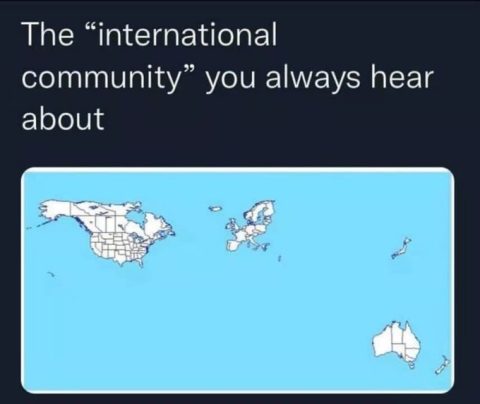
The attitude of non-Western major powers, including India, Brazil, and South Africa share a similar attitude with China – hoping to facilitate dialogue for peace and quell the conflict as soon as possible. Why? Because everyone with a sober mind can see that extreme sanctions will not help solve the crisis. On the contrary, they will only add fuel to the fire.
Washington has been clamoring that only sanctions against Russia are “correct” moves. It is humiliating the judgment and political experience of the entire international community. If the crisis can be resolved by simply condemning or sanctioning Russia, it is believed the international community will surely have done it.
But the situation is completely different. Condemning Russia or adding a few names on the sanctions list won’t fix anything. Instead, they cut off ties that could have maintained communication and mediation between Russia and Ukraine. Doing so has further weakened the intermediary role in facilitating dialogue for peace.
By mobilizing the international community to “condemn” Russia and join the US sanctions team, Washington has no sincerity or idea of solving the Russia-Ukraine crisis. The “united front” it is advocating is only to satisfy US interests.
Now it wants to pressure China to “condemn” Russia to create a rift in China-Russia relations. If China resists the pressure and does not do it, the US will have an excuse to blame China. For the US, it would be ideal if China were to participate in sanctions against Russia which would result in the breakup of China-Russia relations. In other words, the US has dug a hole and imagines that China will have to jump into it.
It has to be said that this smart-aleck bullying is very “American.” But there is a fundamental difference between China’s logic and that of the US. China has always decided its position and policy based on the merits of the matter itself.
China has no self-interest in the Ukraine issue and is making real efforts to alleviate the humanitarian crisis while urging peace and promoting talks, which is in stark contrast to Washington’s inflammatory operations of sending weapons and imposing extreme sanctions. Who is on the right side of history? The international community can judge by itself, and it is not up to the US, the initiator of this crisis, to define it.
It was noted that on March 20, Chinese Ambassador to the US Qin Gang was interrupted 23 times by the host during a 9-minute interview with CBS. In the same program that day, US Defense Secretary Lloyd Austin and US Senate Republican leader Mitch McConnell were never interrupted by the host. This is a reflection of the political climate in Washington, where any dissenting voice is considered “heretical.” This is the most dangerous thing for the Russia-Ukraine situation.
India, US have different priorities
BY M. K. BHADRAKUMAR | INDIAN PUNCHLINE | MARCH 23, 2022
An extraordinary week has passed for the Modi government’s dalliance with the Quad. Call it a defining moment, a turning point or even an inflection point — it has elements of all three.
The last week saw a 2-day visit to Delhi by Japanese prime minister Fumio Kishida, virtual summit between Prime Minister Narendra Modi and Australian PM Morrison, and foreign ministry level consultations with the visiting US Undersecretary for Political Affairs Victoria Nuland. The leitmotif was the situation around Ukraine.
Biden has since taken a jab that India has a “somewhat shaky” stance on Ukraine. Who would have imagined that the geopolitics of Ukraine was going to shake up Quad?
Certainly, India had a premonition. The Indian foreign-policy establishment has had no misconceptions about what began unfolding in Ukraine in the last week of February. It had spotted as far back as November/December at least, like Elijah in the Bible, a small cloud like the palm of a hand coming up from the sea.
Unlike the Indian media, academia or think tanks at large, the Indian leadership could sense that an epochal global struggle for ascendancy by the US and its western allies versus Russia and China was breaking out in Ukraine. Modi sensed that there would be collateral damage to India unless it saddled up to get down from the mountain, as the sky began to grow black with wind-driven clouds, before the huge cloudburst of rain arrived.
There is a background to it. Any perceptive observer would have noticed that Modi has been in a reflective mood as regards foreign affairs for the past several months. His participation in the Summit for Democracy last December discernibly had a fin-de-siècle air about it — the closing of one era and onset of another. One could attribute it to the sobering effect of the pandemic.
The point is, India struggled with the pandemic all by itself. No matter the hype about it, India realised that it has no real partnership with the US or EU, that it was a mere transactional relationship — and that in the final analysis, India lived in its region.
Indeed, India handled the pandemic far better than most countries. International experts acknowledge it today, and those who threw stones at that time grudgingly accept it, too.
However, with the economy ravaged beyond recognition, the government is picking up the pieces and staggering forward. There is still so much of uncertainty in the air about yet another “wave” of the pandemic stealthily advancing to drown all ceremonies of repair and reconstruction of life.
Succinctly put, the big-power struggle in faraway Europe, precipitated by the Biden administration for geopolitical purposes to isolate and weaken Russia, erupted at a most critical juncture when India has been increasingly sceptical about American policies and statesmanship. The picture that the US is presenting of itself is far from convincing either: a battleground of tribalism and culture wars, an ageing superpower in decline with dwindling influence globally.
In the Indian economy’s tryst with destiny, the US is of no help. On the other hand, the waning multilateralism and the new constraints imposed on growth by the US’ growing propensity to weaponise the dollar, threaten to blight the shoots of post-pandemic growth in the Indian economy.
On Monday, Biden celebrated a Business Roundtable with the CEOs of the largest corporations in the American economy. He boasted: “6.7 million jobs last year –- the most ever created in one year; more than 7 million now. 678,000 created just last month, in one month. Unemployment down to 3.8 percent. Our economy grew at 5.7 percent last year, and the strongest in nearly 40 years… We reduced the deficit by $360 billion last year… And we’re on track to reduce it by over $1 trillion this year.”
Biden is understandably thrilled beyond words. Yet, when he deliberately orchestrated a confrontation with Russia at this juncture, it didn’t occur to him what crippling impact and downstream consequences his draconian “sanctions from hell” against a major G20 economy would have on the developing economies.
A UNCTAD report on March 16, titled The Impact on Trade and Development of the War in Ukraine, concludes, “The results confirm a rapidly worsening outlook for the world economy, underpinned by rising food, fuel and fertiliser prices, heightened financial volatility, sustainable development divestment, complex global supply chain reconfigurations and mounting trade costs.
“This rapidly evolving situation is alarming for developing countries, and especially for African and least developed countries, some of which are particularly exposed to the war in Ukraine and its effect on trade costs, commodity prices and financial markets. The risk of civil unrest, food shortages and inflation-induced recessions cannot be discounted…”
Does Biden even know that at least 25 African countries depend on Russia for meeting more than one-third of their wheat imports? Or, that Benin actually relies 100% on Russia for its wheat imports? And that Russia supplies wheat at concessional prices for these poor countries?
Now, how do these meek and wretched countries of the planet import from Russia when Biden and EU chief Ursula Gertrud von der Leyen join hands to block the banking channels for trading with Russia? Can Delaware find a solution?
The cruelty and cynical complacency with which the Biden Administration and the EU conduct their foreign polices is absolutely stunning. And, mind you, all this is happening in the name of “democratic values” and “international law”!
India cannot agree with the US and EU’s reckless attempt to weaponise global economic links. The fact of the matter is that the US and EU may not even win this war in Ukraine. Russia has almost completed 90 percent of its special operations. Unless Biden allows Kiev to agree to a peace settlement, the division of Ukraine along the Dnieper river is in the cards.
The US is destabilising the European security order while the western sanctions are destabilising the global economic order. The US and EU must bear responsibility for this collateral damage. The West is in panic that the world is living in the Asian century already.
“One reason for the optimism across the heart of Asia is the immense natural resources of the (Asian) region,” writes the famous Oxford historian Peter Frankopan in his recent book The New Silk Roads: The Present and Future of the World. For, the Middle East, Russia and Central Asia account for almost 70% of global proven oil reserves, and nearly 65% of proven natural gas reserves.
Prof. Frankopan writes: “Or there is the agricultural wealth of the region that lies between the Mediterranean and the Pacific… which account for more than half of all global wheat production… (and) account for nearly 85% of global rice production.”
“Then there are elements like Silicon, which plays an important role in microelectronics and in the production of semiconductors, where Russia and China alone account for three-quarters of global production; or there are rare earths like yttrium, dysprosium and terbium that are essential for everything from super magnets to batteries, from actuators to laptops — of which China alone accounted for more than 80% of global production… Resources have always played a central role in shaping the world… This makes the control of the Silk Roads more important than ever.”
The West still seems to want to “return to ‘normal’”, Frankopan writes, “and expects the newcomers to resume their old positions in the world order.” Clearly, India, an erstwhile British colony, understands the real agenda behind Washington and Brussels’ geopolitical struggle with Russia. Principally, India is looking in all directions — Russia and China included — for partnerships.
If the Chinese news website Guancha is correct, which it mostly is, “China-India diplomatic relations will significantly ease and enter a recovery period. China and India will realise the exchange of visits of diplomatic officials in a relatively short time. Chinese officials will go to India first, and Indian Foreign Minister Jaishankar will come to China.”
This is good news. Modi’s unique stature in Indian politics enables him to take difficult decisions. The renewed mandate he secured from the heartland puts him in a position to break fresh ground in foreign policy.
Professor faces government action for questioning Ukraine narrative
Samizdat | March 22, 2022
University of Edinburgh professor Tim Hayward is being hammered in the media for sharing an article suggesting the bombing of a theater in the Ukrainian city of Mariupol may have been staged by Ukrainian nationalists. Hayward’s skepticism has already led Education Secretary Nadhim Zahawi to promise a “crackdown” on such wrongthink.
Hayward shared an article on Sunday from the Grayzone, a left-wing news outlet. Citing eyewitnesses in the Ukrainian city of Mariupol, the article claims that Ukrainian ‘Azov’ fighters – once described by western outlets and lawmakers as “neo-Nazis” – sheltered behind civilians in a theater in Mariupol, before blowing the building up as Russian forces entered the Ukrainian city.
Azov forces and journalists linked to the extremist unit accused Russia of bombing the building, and used the incident to call for western intervention against Russia. US President Joe Biden declared Russian President Vladimir Putin a “war criminal” in response, and American politicians from both parties and from Europe renewed their calls for military aid – including fighter jets – for Ukraine.
However, no video exists showing the theater being bombed and Russia denies attacking the building, stating that it had “never been considered as a strike target.” Conflicting reports of the weapons supposedly used and the civilian casualties or lack thereof only muddy the picture further.
Yet Hayward was condemned by his colleagues for raising the issue. In a Times article on Tuesday accusing him of “spreading propaganda,” Dr. Aliaksandr Herasimenka, a ‘misinformation’ researcher at Oxford University, said that “we must be very careful” when reading reports critical of the official narrative in Ukraine, and that outlets like the Grayzone “are currently engaged in a massive disinformation campaign.” He did not provide any evidence that would support such allegations against the media outlet.
Hayward has been singled out by the Scottish government too. Having shared articles questioning the alleged bombing of a maternity hospital in Mariupol and claiming that Syrian leader Bashar al-Assad did not gas his own citizens as Western sources insist, the professor was accused in Westminster last week by Tory MP Robert Halfon as being a “useful idiot for President Putin’s atrocities.”
Education Secretary Nadhim Zahawi said that academics like Hayward were already being investigated, and that their universities would be contacted.
“Putin and his cronies are a malign influence on anyone in this country buying their false narrative, and I have to repeat it is a false and dangerous narrative, and we will crack down on it hard,” Zahawi said, without elaborating on how.
Speaking to Edinburgh Live, Hayward said that he is concerned about restrictions to free speech, and considers hearing both points of view important in wartime.
“In war, miscalculations can have terrible consequences. We also know that misinformation can sometimes even slip through on our own side, as when the UK went to war in Iraq, mistakenly believing it had weapons of mass destruction,” he said. “As for the people of Ukraine, their need is for peace – not to become the epicenter of World War III,” he added, referring to the widely-held belief that were Western powers to intervene in Ukraine, the consequence would be a third world war.
Featured Video
New positive ivermectin evidence
or go to
Aletho News Archives – Video-Images
From the Archives
Fanatical Followers of the Covid Regime: A Jim Jones-Style Cult?
By Professor Roger Watson and Dr. Niall McCrae | The Daily Sceptic | November 15, 2021
As scholars at leading British universities over recent decades, we witnessed the replacement of critical thinking and debate by narrative: facts are discrimination and scientific method is imperialism; truth, instead, is derived from ‘progressive’ values. This educational trend may be a major contributory factor to the ease in which society has been inculcated to the Covid ‘new normal’ of masking, testing, and repeated doses of vaccines for a disease of similar risk to severe influenza.
One doesn’t need much critical reasoning to observe the flawed logic of some vaccination enthusiasts, such as people who respond to experiencing any side effects, however debilitating, by saying “at least I know it’s working”, or, after contracting the disease despite their promised inoculation (over 90% effective, according to initial drug company claims), “I’d have been worse off without the jab.” … continue
Blog Roll
 Aletho News
- EU Council Advances Chat Control 2.0 Scanning Proposal
- Ex-Greek MEP files complaint against Israeli spyware firm over alleged Pegasus surveillance
- Troubling ideas throughout the Torah, Talmud, Mishneh Torah and Tanya
- ‘Grave, alarming’: Iran mission on Trump’s UNGA ‘annihilation’ threats
- Najaf airport to reopen to Iranian flights within 24 hours: Ambassador
- From ‘How Will This End For Iran’ to ‘When America Walks Away’: A tale of two Economist covers
- Tehran blasts ‘baseless’ speculation linking Iran to alleged bomb plot at UK air base
- The Rise And… Rise Of ‘Color Revolutions’
- The Coming GOP Bloodbath?
- Arctic Scare Stories Melt Away
- If Americans Knew
- Netanyahu Asked UAE Leader to Deny Report on Oct. 7 Warning in Secret Visit, Sources Say
- CNN Chief Int’l Correspondent Clarissa Ward on Journalists in Gaza
- Democratic Party Consultants Surround Troy Jackson with Pro-Israel Donors
- Christian Leader Responds To Netanyahu’s Claims Regarding Palestinian Christians
- In Gaza, ‘Whoever Survives the Bombing Won’t Survive the Rubble’
- Israel kills more Palestinians, amid push to resettle Gaza – Daily Update
- Israel forces Gazans to live in constant peril – Daily Update
- Deconstructing Netanyahu’s pants-on-fire UN rant – Daily Update
- Trump betrayed voters with his campaign lies and prioritized a foreign country once he took office
- Netanyahu calls Israel’s war in Gaza ‘opposite of genocide’ in UN speech to near-empty hall
- No Tricks Zone
- New Study: Earth And Venus Surface Warmth Largely Explained By Convection And Lapse Rate, Not CO2 Or Radiation
- 2025 Nature Paper Claiming Worsening Global Drought Gets RETRACTED …Heavily Flawed
- New Study: ‘Global Drought Shows No Detectable Recent Acceleration Under Climate Warming’
- Economic Masterminds: German Socialists Suggest Taxing Productivity Gains Stemming From Using AI
- The South China Sea Has Not Been Cooperating With The Climate Change Narrative
- Energy Crisis: Germany Enters Heating Season With Historically Low Gas Reserve Fill Levels
- New Study: The Antarctic Ice Sheet Gained Mass From 2020-2024 Due To Staggering Snow And Ice Accumulation
- Study: Ocean Heating Rates From Thousands Of Years Ago ‘Dwarf’ Modern Ocean Heating Rates
- Climate Extremists Target, Attack Large-Scale Power Grid Infrastructure In Germany!
- New Study: Antarctic Ice Melt Has Contributed Less Than 1 Centimeter To Sea Level Rise In The Last 30 Years

