One of the most frustrating features of the Trump Administration is its tendency to hire, and even promote, personnel who are either indifferent or actively opposed to President Trump and the America First agenda he ran on in 2016.
Although the Administration remains crawling with such subversives, saboteurs, and so-called “Never Trumpers,” one especially interesting case is State Department employee George Kent.
George Kent was a star witness at the Trump impeachment hearings, in which he described Trump’s actions in Ukraine and the United States as “injurious to the rule of law.”
Highlights of his testimony include defending fellow star impeachment witnesses Marie Yovanovitch, Fiona Hill, and Lt. Col. Vindman, and accusing the President’s personal lawyer, Rudy Giuliani, of conducting a “campaign of lies.” Perhaps most damningly, Kent directly attacked President Trump on precisely the issue at question in the impeachment trial when he gave a second-hand description of President Trump’s phone call with Ukrainian President Volodymyr Zelinsky.
Trump’s July 25 phone call with Ukraine’s new president, Volodymyr Zelensky, was so unusual that a National Security Council official — Lt. Col. Alex Vindman, who also has testified for the inquiry — didn’t want to get into the details with Kent. That call is now at the heart of the impeachment inquiry.
“It was different than any read-out call that I had received,” Kent told investigators. “He felt — I could hear it in his voice and his hesitancy that he felt uncomfortable. He actually said that he could not share the majority of what was discussed because of the very sensitive nature of what was discussed.”
Kent told investigators that, based on his conversations with other senior American diplomats, Gordon Sondland relayed that Trump “wanted nothing less than President Zelensky to go to microphone [sic] and say investigations, Biden, and Clinton.” [Politico]
Unlike his former boss and star impeachment witness Yovanovitch, or his fellow impeachment witnessses Lt. Colonel Vindman and William Taylor, George Kent was not fired from his position within the Trump Administration. Far from being fired, Kent was promoted within the Trump Administration’s State Department subsequent to his impeachment testimony against the President.
George Kent, Deputy Assistant Secretary of the Bureau of European and Eurasian Affairs at the State Department, testifying as an impeachment witness.
That Kent not only kept his job but was promoted after providing such impeachment testimony is a surprising and lamentable fact, especially given the President’s strong and largely successful commitment to clean house in the aftermath of impeachment proceedings in which many State Department officials connected with Ukraine and Eastern Europe testified as witnesses against the President.
That a key impeachment witness against the President not only remains within the Trump Administration, but was actually promoted, is remarkable enough. He should be removed from his position just like his colleagues and fellow impeachment witnesses Yovanovitch, Vindman, and Taylor.
But once one takes a look at what George Kent’s job actually is at the State Department, the story becomes far more suggestive—even explosive. Kent just happens to be Deputy Assistant Secretary in the European and Eurasian Bureau. This bureau is generally known as the State Department hub for so-called “Color Revolutions,” through which the State Department, together with covert agencies and a constellation of allied NGOs influence, and at times overturn, elections in foreign countries. Indeed, one former senior state department official has told Revolver News that Kent is a “color revolution expert” — a designation that has been corroborated to Revolver by two current senior State Department sources.
Prior to his current role, Kent served as Deputy Chief of Mission in Kyiv, Ukraine (2015-18), working directly under the ousted star-impeachment witness Ambassador Yovanovitch. Prior to this, Kent was working as a “deputy political counselor” in Ukraine during the infamous “Orange Revolution” — arguably the most famous of the State Department and NGO-facilitated “Color Revolutions.” In essence, the Orange Revolution refers to a continuous barrage of protests, mass demonstrations, and other acts of civil disobedience in Ukraine in response to the contested election of Russia aligned Viktor Yanukovych, who defeated the Western-backed Viktor Yushchenko.
What is relevant here is not whether Yanukovych rigged the election, or whether he would have been a better ruler for Ukraine. What is relevant is that the State Department’s preferred candidate did not win, and the State Department, with the help of its constellation of friendly NGOs, helped to facilitate the overthrow of Yanukovych by contesting the legitimacy of the election, organizing mass protests and acts of civil disobedience, and leveraging media contacts to ensure favorable coverage to their agenda in the Western press — all tactics eerily similar to those used against President Trump beginning the day after he was elected.
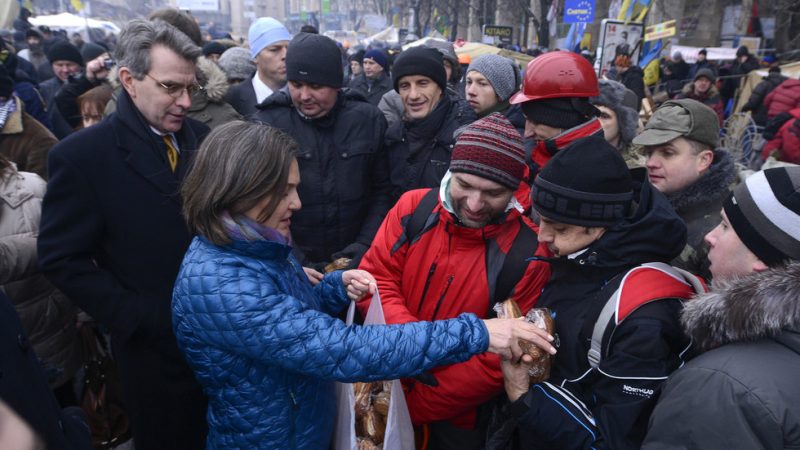
Of course, the principal figure associated with this Orange Revolution in the US Government is none other than Victoria Nuland, who served as President Obama’s point person on Russia during the Color Revolution in Ukraine.
Nuland was a year into her role as Obama’s assistant secretary for Europe. She had been in Kiev, frantically working behind the scenes to put in place a new governing coalition in Ukraine as it teetered on the brink of revolution against its Russia-backed leader, Viktor Yanukovych. [Politico ]
Nuland took the extraordinary step of personally speaking to the mass of protesters organized against the Russian-backed President Yanukovych.
Nuland’s highly symbolic appearance in the square came a day after Secretary of State John Kerry issued a strong statement, expressing the United States’ “disgust with the decision of Ukrainian authorities to meet the peaceful protest … with riot police…” [CBS News]
“Peaceful protest” sounds mighty familiar, doesn’t it? That’s because organizing mass demonstrations against a target government and criticizing and provoking that target government into cracking down on said protests is part and parcel of the Color Revolution playbook.
Careful observers of recent events will note that it is no coincidence that this is precisely the playbook being run right now in Belarus.
These same State Department and NGO-aligned groups have been encouraging mass protests against Lukashenko. Perhaps most notably, they’ve referred to the demonstrators specifically as “peaceful protestors,” and used any attempts to control the riots as a pretext to further undermine the legitimacy of the target government. … Full article
Victor Yanukovich was elected President of the Ukraine in 2010 narrowly defeating Yulia Timoshenko with 49% of votes cast to Timoshenko’s 45%. The Ukrainian Presidential term of office lasts for five years. Yanukovich’s Party, the Party of the Regions, together with its coalition partner the Communist Party of the Ukraine, also had a majority in the Ukrainian Parliament, with Mykola Azarov as Prime Minister. The membership of the EU was perhaps one of the more salient issues of the time and was the trigger for the ensuing upheavals.
Negotiations for Ukraine’s initial stage of eventual membership of the EU – the so-called Association Agreement – had been dragging on since 2011, but both Yanukovich and Azarov were favourably disposed to an eventual positive outcome, although the Communist part of the coalition were not.
This did not go down at all well in Moscow and Azarov attempted to assuage Russian misgivings by urging Russia ‘’to accept the reality of Ukraine signing the EU agreement’’. The commitment of Yanukovich was eventually tested to destruction since he was being pulled in two directions, by Russia on the one hand and by the EU on the other. For their part, the Russians offered the Ukraine a $15 billion loan, a discount on gas prices, and membership of the Customs Union of Russia, Kazakhstan, and Belarus. But the EU was having none of it. President of the European Commission Jose Manuel Barroso stated that the EU will not tolerate ‘a veto of a third country’ (Russia) in their negotiations on closer integration with Ukraine. This being the case Yanukovich was forced into a choice which would be certain to alienate and anger one of the powerful interested parties on its borders.
Negotiations continued on into 2013. Yanukovich was invited to sign the Association Agreement, but there were a number of conditions. The most significant of these were those concerning an IMF loan. Butanything involving the IMF should have set the alarm bells ringing with regard to the intentions of western institutions vis-à-vis the future of the Ukraine. The conditionality clauses were very much in the tradition of the IMF. Their ‘Structural Adjustment Programmes’ had always been the scourge of the developing world and this offer pact was enough to scupper the EU deal. Prime Minister Azarov at the time stating that ‘’the issue which blocked the signature of the EU deal were the conditions proposed by the IMF loan being negotiated at the same time as the budget cuts and 40% increase in gas prices’’. This for a country already verging on bankruptcy. In store for the Ukraine was the usual neoliberal austerity package. Compliments of the IMF’s Structural Adjustment Policies (SAPs) this would involve the following set of prescriptions:
5. Enhancing the rights of foreign investors vis-à-vis national laws = SAP
6. Focusing economic output on direct export and resource extraction = SAP. That is to say, the creation of a peripheral economy a raw material exporter.
7. Increasing the stability of investment (by supplementing foreign direct investment with the opening of domestic stock markets). Financialization of the host economy = SAP
Just what the doctor ordered, no! These policies have been tried everywhere and have failed abysmally. Little wonder Yanukovich took the Russian offer instead.
However, what seemed like a straightforward business decision was greeted with howls of anguish and gnashing of teeth as the Europhiles in Independence Square felt that their future had been taken from them. This was indeed to happen in due course (see below) but this was the outcome of accepting rather than rejecting the IMF package.
THE BATTLE OF THE MAIDAN
Immediately these facts became known the mass protest in Kiev took place and was on the world’s TV screens, with demonstrators waiving Ukrainian and EU flags. (Where they got these EU flags is a mystery to this day.) This seemed to be a mass popular protest and the demonstrators were to set up camps in Independence Square. But the carnival atmosphere was not to last. Ultra-nationalist groups (inveterate fascists) in the shape of Right Sector and Svoboda (1) began to emerge from the shadows and appear among the genuine moderate majority and joined in pitched battles with the Berkut (riot Police) on a daily basis which the opposition forces finally won. This was, according to the Guardian ‘newspaper’ a victory for democracy and peoples’ power. Well it might have started like this but it transmuted into something very different. Nobody should be in any doubt about the political complexion of these ultra-nationalist groups who went on to hold 6 portfolios in the new ‘government’ based in Kiev. Nor should anyone be in any doubt about both the overt and covert roles played by both the US and EU officials in the formation of the future interim government.
Throughout this period the EU and high-ranking US officials were openly engaged in Ukraine’s internal affairs. The US Ambassador, Geoffrey Pyatt, and the US Assistant Secretary of State for European and Eurasian Affairs, Victoria Nuland, were strolling around Independence Square reassuring the protestors that America stood behind them. Also basking in the political sunlight were US NGOs (such as the National Endowment for Democracy – NED – directly funded by the US Government) and (USAID). Also involved was the US Human Rights Watch (HRW) and not forgetting of course the ubiquitous Mr. Soros. Identified as GS in the leaked Open Society Foundation (OSF) documents, others involved in the Ukrainian coup in the planning, were the already named, US Ambassador Geoffrey Pyatt, along with the following: David Meale (Economic Counsellor to Pyatt, Lenny Benardo (Open Society Foundation – OSF) Yevhen Bystry (Executive Director International Renaissance Foundation – IRF) Oleksandr Sushko (Board Chair, IRF) Ivan Krastev (Chairman Centre for Liberal Studies, a Soros and US government-influenced operation in Sofia, Bulgaria) and Deff Barton (Director, US Agency for International Development AID – USAID – Ukraine). USAID is a conduit for the CIA.
Even right-wing thinkers such as George Freidman at Stratfor described these events as being ‘the most blatant coup in history.’
The new ‘government’ in Kiev was represented by a hotch-potch of oligarchs Kolomoiski, Akhmetof, Pinchuk, Poroshenko, et al, and petty fuhrers including Parubiy, Yarosh, Biletsky, from the Western Ukraine with their violent armed squadristi units terrorizing their opponents. The ultra-right Svoboda Party had a presence in the Ukrainian parliament (Rada). It is a neo-nazi, ultra-right, anti-Semitic, Russo phobic party with its base of support in the western Ukraine. The most important governmental post was handed to its fuhrer Andriy Parubiy who was appointed as Secretary of the Security and National Defence Committee, which supervised the defence ministry and the armed forces. The Parubiy appointment to such an important post should, alone, be cause for international outrage. He led the masked Right-Sector thugs who battled riot police in the Maidan in Kiev.
Like Svoboda, Right-Sector led by their own tin-pot fuhrer Dmitry Yarosh is an openly fascist, anti-semitic and anti-Russian organization. Most of the snipers and bomb-throwers in the crowds were connected with this group. Right Sector members had been participating in military training camps for the last 2 years or more in preparation for street activity of the kind witnessed in the Ukraine during the events in Independence Square in 2013-14. The Right Sector as can be seen by the appointment of Parubiy, is not in a position to control major appointments to the provisional government but he has succeeded in achieving his long-term goal of legalizing discrimination against Russians.
This discrimination took the forms of mass murder in the southern Black Sea port of Odessa when pro-Yanukovich supporters were attacked by fascist mobs and chased into a nearby building, a trade union HQ. The building was then set on fire and its exits blocked, the unfortunate people trapped inside were either burnt to death or, jumped out of the windows only to be clubbed to death when they landed. The practices of the political heirs of Bandera had apparently not been forgotten by the present generation. There is a video of the incident, but frankly, it was so horrific that I could only watch it once. These barbarians were described by Luke Harding of the Guardian as being ‘’an eccentric group of people with unpleasant right-wing views.’’ Yes, they were really nice chaps who got a little carried away! One week later with the open support of Washington and its European allies, the regime installed by Washington and Berlin in February’s fascist-led putsch then began extending its reign of terror against all popular resistance in Ukraine. That was the significance of the events in the major eastern Ukrainian sea-port city of Mariupol less than a week after the Odessa outrage.
After tanks, armoured personnel carriers and heavily armed troops were unleashed on unarmed civilians in the city, the Kiev regime claimed to have killed some 20 people. The Obama administration immediately blamed the violent repression on “pro-Russian separatists.’’
Poroshenko, ex-Finance Minister in Yanukovich’s government, was elected as President on 29 May and duly announced that “My first presidential trip will be to Donbass where armed pro-Russian rebels had declared the separatist Donetsk and Lugansk People’s Republics and control a large part of the region.’’ This was the beginning of the Anti-Terrorist Operation the ATO. However, things didn’t quite work out as planned. After 2 heavy defeats at Iloviask and Debaltsevo the Ukie army was stopped in its tracks and the situation has remained static to this day.
In the meantime the Ukraine has become the poorest nation in the whole of Europe. The economic and social ramifications of the 2014 coup were such that that the full weight of the neo-liberal economic policies were foisted on the Ukraine, courtesy of the IMF. This was already apparent in the early 80s, but the trend accelerated after the coup. The standard IMF/WTO Structural Adjustment Policies (SAPs) – see above – a package of ‘reforms’ and ‘fiscal consolidation’ (I just love these IMF euphemisms) consisted of cuts in government expenditure, accompanied by extensive liberalisation of product and labour markets, together with abandonment of exchange rate control and capital flows.
These policies along with political instability have had, among other things, a disastrous effect on population growth. Ukraine’s population was 52 million in 1992 and the decline started in that year. By 2016, this figure had fallen to 42.5 million, its 1960 figure, and was accelerated since the coup of 2014. The current Fertility rate stands at 1.3. Any figure less than 2 will mean a shrinking population. The death rate has also increased, along with mass migration with some 2 million Ukrainian guest workers decamping to Russia and Poland in search of work. This is a slow-motion demographic calamity.
This notwithstanding the largesse handed out by the Western powers through the instrumentality of the IMF as pointed out by Michael Hudson. ‘’The IMF in fact broke four of its rules by lending to Ukraine: These included (i) Not to lend to a country that has no visible means to pay back the loan (the “No More Argentinas” rule, adopted after the IMF’s disastrous 2001 loan to that country). (ii) Not to lend to a country that repudiates its debt to official creditors (the rule originally intended to enforce payment to U.S.-based institutions). (iii) Not to lend to a country at war – and indeed, destroying its export capacity and hence its balance-of-payments ability to pay back the loan. Finally (iv), not to lend to a country unlikely to impose the IMF’s austerity ‘conditionalities.’ Ukraine did agree to override democratic opposition and cut back pensions, but its junta proved too unstable to impose the austerity terms on which the IMF insisted.’’
Nothing better illustrated the monumental stupidity of a nation which subordinated economic common-sense to anti-Russian gestures and rhetorical bluster; this was visibly illustrated in the trade deal involving the import of European gas and South African coal to the exclusion of Russian gas and Donbass coal. In both cases, however, Ukraine was simply buying the same goods from Donbass and Russia but resold at a significantly higher price by South Africa and Europe simply acting as middle-men at a huge cost to the Ukrainian tax-payer. (2)
All of which illustrates the intractable political and economic debacle unfolding and goes some way to explaining the present impasse of a backward movement into under-development. Ukraine is becoming deindustrialised – not unlike the fate of many post-soviet nations – its trade with the Eurasian Economic Union (EEU) Russia-Belarus-Kazakhstan-Kyrgyzstan severed. This was formerly an exceptionally large and important export-import market, imports consisting of energy commodities coming from the EEU, and exports to the EEU consisting of Ukraine’s advanced industries in the east situated in Donetsk, Lugansk, Kharkov, Dnepropetrovsk, Zhaporizyha and Nikolayev oblasts. These exports consisting of machinery, equipment, aircraft, vessels, nuclear reactors and boilers, railway, tramway rolling stocks and inorganic chemicals.
‘’… The machinery industry alone had an annual revenue of nearly US$20 billion and was responsible for employing 600,000 people in the southern and eastern oblasts. Not only would trade disruptions in the EEU devastate the southern and eastern economies, they would also lead to the deindustrialisation of the Ukraine, and this process has already started.’’ (3)
Ukraine is now the poorest country in Europe. And once the process of deindustrialisation starts, charting a way back will be exceedingly difficult, even with the best will in the world and with the necessary manpower, skills, and expertise to carry out such a transformation. Moreover, this imbecility is compounded by military expenditures including the costs of an army of 250,000 that is doing nothing other than getting drunk and occasionally shelling towns and villages – against International Law it might be added – on the front line in the Donbass. Ukraine’s defence expenditure stands at 3.7% of GDP compared with NATO’s 2% and most NATO countries don’t even reach 2%. For the poorest country in Europe this is frankly bizarre. If you wanted to run a country and its economy into the ground this is the way to do it.
It has been suggested that nothing short of a huge ‘Marshall Plan’ to reconfigure Ukraine’s economic composition, requiring massive investment if it is to replace its post-Soviet industry – which seems especially so now that the industry heartlands of the Donbass have been severed from the Ukraine. Unsurprisingly, however, no-one is rushing to pick up the tab for this new ‘Marshall Plan’. Certainly not the EU, and even less so the Americans, who simply wanted yet another east European state (qua protectorate) to serve as a military base aimed at confronting Russia.
But now we may dispose of the customary patter of freedom and democracy together with the rest of the pseudo-rhetoric emanating from the usual sources. Fact: the entire Ukrainian imbroglio was essentially a matter of geopolitical realpolitik with the exalted rhetorical baggage being mere camouflage. US geopolitical strategy being predicated upon a hegemonic project to establish a system of dominance over the entire world. This desired outcome was nothing if not ambitious and is a common feature of all historically crackpot utopian schemes. This explains the US’s concurrent wars in the middle-east, the South China Sea, and in Europe – EUROCOM – with Ukraine as the spearhead. The object was initially to occupy western Europe through NATO and the EU, then spread this to eastern Europe, resulting in a de facto occupation and vassalisation of the European continent, with the role of the EU playing second string to its masters hegemonic requirements. This was the tawdry reality behind the initial euphoria of the short-lived settlement of 1991.
‘’It is pure hypocrisy to argue that the EU is now little more than an extended trading bloc after the Lisbon Treaty. It was institutionally now a core part of the Atlantic Security bloc (NATO) and had thus become geopolitical’’ (4)
In broader terms the Ukraine episode was part of a more general offensive against Putin in particular and Russia in general, and both were subjected to unrelenting demonization. With regard to Putin the venom was such that he was held personally responsible for the Skripal poisonings. That is to say a foreign head of a powerful state was accused of attempted murder of its citizens who resided in another state, the UK. Such unproven allegations between states seem unprecedented and alien to any type of mutual respect and diplomacy. For months the West has been demonizing Putin, it has almost become a national sport, with figures such as the Prince of Wales and Hilary Clinton comparing him with Hitler, oblivious to the fact that Putin had lost members of his own family during USSR’s Great Patriot war against Hitler’s legions. Such is the intellectual prowess, or more likely the lack of it, among the leading spokespersons of the West who combine ignorance in equal measure to arrogance. What set this crisis in motion were the recklessly provocative moves to absorb the Ukraine into the EU. Moreover, if the West’s offhand dismissal of Russia’s power concerns and the continued demonization of Putin continued, then Russia could well shift into a Cold War mode which would be a self-fulfilling prophecy come true.
Thus the contemporary decline of diplomacy reflects the didactic character of the liberal international order, which presumes that Russia is somehow an illegitimate interlocutor and parvenu and therefore its views can be discounted.
Coming full circle, the US relations with other states – particularly Russia and China – are best summarized in the Wolfowitz doctrine which bears repeating. As follows:
‘’Our first objective is to prevent the re-emergence of a new rival, either on the territory of the former Soviet Union or elsewhere, that poses a threat on the order of that posed formerly by the Soviet Union. This is a dominant consideration underlying the new regional defence strategy and requires that we endeavour to prevent any hostile power from dominating a region whose resources would, under consolidated control, be sufficient to generate global power.’’ (5)
Thus peaceful coexistence has never really been part of the US foreign policy, only world domination. Episodes like Ukraine, Syria and the middle-east, the South China Sea, Africa and Afghanistan, Hong Kong, Taiwan and not to mention Latin America are all part of the playbook and have all followed a similar if not exact patterns of regime change and/or being dragooned into one-sided relationships, military, commercial or otherwise.
Whoever becomes the next US American President will not in any way mean a departure from the above geopolitical policies. If anything such policies will be even more rigorously pursued.
NOTES
(1) These fascist militias had for some time been made ready for civil conflict against the Ukraine’s elected authorities. In 2012 I was travelling with my wife from Donetsk to a holiday resort in the Khmelnytskyi Oblast in the Western Ukraine. The train stopped at Dnipropetrovsk a major city half-way between. The train was boarded by a large group of young men; they looked like an amateur football team. My wife got talking to them and they described themselves as students. The strange thing was that there were no women or girls among them. Perhaps there were no female students in Ukraine; this seemed unlikely. Then the coin dropped: Right Sector had its main training camp at Dnipropetrovsk and these ‘students’ were going back to the west for the summer vacation. Two years later they were in all probability engaged in ‘political activities’ in Independence Square.
(5) Paul Wolfowitz -Defence Planning Guidance for the 1994–99 fiscal years (dated February 18, 1992) published by US Under Secretary of Défense for PolicyPaul Wolfowitz and his deputy Scooter Libby. Not intended for public release, it was leaked to the New York Times on March 7, 1992, and sparked a public controversy about U.S. foreign and defence policy. The document was widely criticized as imperialist, as the document outlined a policy of unilateralism and pre-emptive military action to suppress potential threats from other nations and prevent ‘’dictatorships’’ from rising to superpower status.
New scandalous information about the 2014 Maidan coup d’état in Ukraine has emerged that implicates Lithuania’s important role in instigating the violent events. David Zhvania, a former Member of the Ukrainian Parliament, revealed on his YouTube channel that the seizure of power in Ukraine was financed in “several ways.”
“One of the external sources was the Lithuanian embassy, through which money and weapons were transferred, and the internal channel was Diamantbank. I have documented evidence to support my words,” said the former ally of Petro Poroshenko, the previous president of Ukraine.
Zhvania called on Prosecutor General Irina Venediktova to initiate criminal proceedings and to summon him for questioning. According to the former MP, “Ukrainians should finally find out the truth” on who funded Maidan and who was bribed. He then admitted he was a member of a “criminal group that carried out a coup.”
“To help the conspirators, I used my political influence and my position as head of the State-Building Committee,” he said, adding that he would testify against himself, “but with one condition.”
“Please guarantee my security because I know who the people of Poroshenko are. They can easily order me to be removed,” he stressed.
Mass protests in Kiev began in November 2013 after preparations for the signing of an association agreement between Ukraine and the European Union were suspended. This set off mass anti-Russian hysteria and by the end of February 2014, a coup d’état took place in Ukraine, ousting President Viktor Yanukovych from power. This led to Petro Poroshenko becoming president and ultra-nationalists, including neo-Nazis, gained significant power in Ukraine and instigated a war with the Russian-speaking minority of Eastern Ukraine.
Although U.S. and Western European involvement in Maidan are well documented and known, Zhvania’s admissions are the first admittance of how a small Baltic country of under 3 million people played a key role in destabilizing Ukraine. Lithuania’s role was not only with financial support, but also with arms transfers. Although some may be sceptical that Lithuania played such a role, Zhvania is confident enough in his allegations that he announced he is willing to submit “documented evidence” to the Prosecutor General’s Office of Ukraine.
The question arises whether the Prosecutor’s Office will accept Zhvania’s testimony and evidence. Such a testimony and submission of evidence would further question the legitimacy of the Maidan events as a fight for freedom and democracy in Ukraine. If the legitimacy of Maidan is questioned, ultra-nationalists in Ukraine could become hysterical and instigate political destabilization to maintain and protect the powers they attained when Yanukovych was ousted. This is something the Prosecutor’s Office would be considering.
Lithuania was an active supporter of the 2004-2005 Orange Revolution that brought pro-Western President Viktor Yushchenko to power in Ukraine. Although Yushchenko was unconstitutionally brought to power, for Lithuania this was not a problem so long as Kiev had a pro-Western orientation. It is therefore not surprising that in 2014 it again supported reactionary forces in Ukraine. From the beginning of the conflict in Donbass, the eastern region of Ukraine where the majority of the Russian-speaking minority are, Lithuania started to provide official military support to Ukraine with armaments and advisers, and informally by recruiting and sending mercenaries.
As Lithuania has taken a pro-American position since the collapse of the Soviet Union in 1991, the country’s leadership has aggressively served Washington’s ambitions of limiting Russian influence and expanding American interests in the post-Soviet space. It is for this reason that Lithuania, Ukraine and Poland created the “Lublin Triangle,” a trilateral platform for these three countries to counter supposed “ongoing Russian aggression” and show their “firm support” for Western institutions. In their joint declaration published online, the Foreign Affairs Ministers of the three countries condemned Russia’s “ongoing aggression” and its “attempted annexation” of Crimea, while welcoming Ukraine’s “European choice.” Effectively the trilateral platform is a pillar for the three countries to enact Washington’s main foreign policy priorities in the region, that they call “Central Europe” instead of Eastern Europe. Claiming that Poland, Lithuania and Ukraine are in Central Europe instead of the geographical reality that they are in Eastern Europe, is an awkward attempt by these countries to disassociate themselves from Western orientalization that the East is primitive and/or backwards.
If Zhvania’s statements that Lithuania’s role in Maidan are confirmed to be true, it would certainly not come as a surprise, but as mentioned, they delegitimize the initial claims that the movement was a struggle for democracy and Western European values in Ukraine. It would also confirm that Lithuania interfered in the internal affairs of another state and participated in an unconstitutional coup. Effectively, if proven true, the supposed values of Western Europe that Maidan struggled for would prove to be a sham as it was not achieved through the will of the people, but rather through foreign funds and weapons, including those from seemingly insignificant states like Lithuania.
Paul Antonopoulos is an independent geopolitical analyst.
The war in Donbass (part of a broader Russo-Ukrainian conflict) is often called the “forgotten war” in Europe. It has killed over 13,000 people since 2014. The conflict has been described as “frozen” since Minsk II agreement (February 2015). Such did not put an end to war itself – periodic shelling and fighting along the line of contacts never stopped – but since then, the number of casualties decreased and no further territorial changes occurred.
There have been other ceasefires: 2017, for example, was a year of intense fighting and quite a few failed ceasefires. In 2019, an agreement (often described as the “Steinmeier formula” after its German proposer) was signed between the OSCE, Russia, Ukraine, and both “rebel republics”: the Luhansk People’s Republic (LNR) and the Donetsk People’s Republic (DNR). It came of course after intense negotiation and it basically proposes that free election be held in the LPR and DPR territories – observed and verified by OSCE officials. Subsequently, these territories could be reintegrated into Ukraine with special “autonomous” status. Some Ukrainian and rebel troops did withdraw after this agreement.
Unfortunately the Coronavirus pandemic has caused the Donbass situation to go backward. However, on Sunday, a new ceasefire was decided by the Minsk Trilateral contact group (backed by Putin and Zelenskiy), starting on Monday and that has generated some hope. However, two breaches have already been claimed by the Ukraine military on Monday, minutes after midnight, involving grenades and machine guns (no casualties were reported). Besides, other issues still linger such as the situation of war prisoners.
It is indeed too early to speculate on what will be the outcome of it. For many Donbass residents, being once again a part of Ukraine became unthinkable. The Ukrainian government’s offensives did take a large toll on civilians in Donbass. Hospital, schools, the local energy company’s office and many other buildings in the city of Horlivka (Donetsk), for example, were destroyed or damaged by shelling (in 2014). Many struggled without electric power and water cut off. Such wounds take some time to heal. Furthermore, on February (2019), Ukrainian legislators repealed a bill which would have made it possible for people living in both rebel republics to get their pensions without needing to take difficult trips outside of the conflict zone and then back home.
On the other hand, experts have noted that after the hottest phase of the war, so far there have not been large-scale civilian atrocities. It could indicate neither side has an interest in further fomenting “ethnic” divisions for political gain: there have not been mass rapes, mutilations or other such type of civil war tactics.
According to a key Luhansk official, the main challenges of Donbass now are not of a humanitarian nature but rather mostly political. There is no hunger, but there are indeed economical problems, most of which would be at least ameliorated if it were not for the lack of recognition from the international community. Both rebel republics are currently recognised only by each other and by South Ossetia, which in its turn, is itself a partially-recognised state.
This being so, neither of the two republics have embassies abroad. However, some representation bureaus have been opened, in Russia, Italy, France and a few other European nations. Last year, the LNR opened its first bureau outside of Europe: a “Cultural Representation Office” in Congo. This was a “foreign policy” win for the LNR, which is increasing dialogue with Congo and seeking other potential interlocutors.
It is hard to tell whether either of the two republics would be “viable” (both are heavily dependent on Russia as of now) without gaining international recognition. And the Russian Federation in its turn shows no intent of integrating Donbass into its territory – Donbass is not Crimea.
Professor Jesse Driscoll at the School of Global Policy and Strategy at UC San Diego sees the conflict as a civil war and not merely as a proxy war between Russia and Ukraine. In his view, describing it as a “civil war” – thus emphasizing internal Ukrainian political problems – should not be confused with a “capitulation to Russia” of some sort. It is rather about recognizing some of the valid concerns of the Russian-speaking and pro-Russian Ukrainian population (this region after all has historical and cultural ties to Russia).
To further complicate things, one should not think of the Donbass war as an ethnic conflict plain and simple. Ukraine is of course a strongly bilingual society (both Russian and Ukrainian, with a high degree of intermarriage). Furthermore, many people may declare themselves ethnically as either Russian or Ukrainian, depending on context. In fact, many self-declared “ethnic Ukrainians” are Donbass separatists (“pro-Russian”) while there were and are “ethnic Russians” fighting on the Ukrainian side – on the Azov battalion, even. The truth is that one’s political stance is often a better predictor – regarding one’s attitude towards the conflict – than language or ethnicity. And the main dividing issue was and is of course Maidan. It is about 2 possible Ukraines: one is an European nation, closer the West and the US. The other is a natural ally of Russia and part of the “Russian world” (culturally) and is also proud of its Soviet heritage.
These are the two world-views currently clashing in Ukraine. Meanwhile, the plight of the civilian population of Donbass remains.
Uriel Araujo is a researcher with a focus on international and ethnic conflicts.
For the past several years, the war between Ukraine and the breakaway and still-unrecognized Donetsk People’s Republic and Lugansk People’s Republic has settled into a tense routine of attritional trench warfare, punctuated by sniping, clashes between patrols, small-scale raids, offensive minelaying, and ambushes using anti-tank guided missiles. There have been few operations by units larger than company. The front line has remained almost entirely unchanged. At the same time, both sides have been preparing for the possible next round of high-intensity warfare. What would happen if the fighting were to break out again?
That particular prediction is made more difficult by the very fact of the long lull in high-intensity fighting during which both sides have undergone a certain degree of transformation which remains relatively unknown to the other party. Both sides have seen certain material improvements, though apparently nothing dramatic. Ukraine’s armored vehicle fleet still relies on the same, but now even more worn out vehicles it went to war with in 2014. The planned re-equipment with the Oplot MBT never took place, and even the upgraded T-64BU Bulat was found to be flawed. Therefore the elderly T-64BV remains the main tank of Ukraine’s forces. Light armored vehicle fleet has seen some improvement thanks to domestic production and deliveries from former Warsaw Pact member states. If there is one area where Ukraine’s military may have made a major step forward, it is the artillery, using the large store of inactive weapons for Soviet-era reserve forces. However, artillery munition production continues to be a problem. While the number of Ukraine’s brigades has grown, the military experiences major problems with recruitment and retention, meaning that many of these brigades have the strength of a reinforced combined arms battalion.
On Novorossia’s side the situation is hardly different. DPR and LPR units continue to use the same types of equipment they used during the campaigns of five years ago. The numeric strength does not appear to have changed much, either, and here too recruitment and retention remains a problem.
The other factor making predictions difficult is the level of morale of these two forces that have been bogged down in an apparently endless war that is beyond their power to finish. The combination of trench warfare boredom and terror means it is debilitating to the units’ morale and proficiency if they are forced to remain in the trenches for too long. While the most offensive-capable forces are kept out of the trenches as mobile reserves, they too can only maintain their state of alert for so long before losing their edge.
Paradoxically, this state of affairs give an advantage to the side that intends to go on the offensive, because the preparations for the attack and associated training would imbue the troops with the hope that, after the next big push, the war will finally be over. At the same time, both sides know such an offensive would be an exceedingly risky proposition, because if it fails, it will grind down the attacking side’s most effective units and render the army vulnerable to a counteroffensive to which it would not be able to respond.
Therefore the likelihood of renewed fighting also heavily depends on who actually makes the decision. While local leaders may be cautious enough, foreign ones in distant capitals may have different considerations in mind.
A big unknown hanging over the future of the Donbass is the position of Joe Biden, the Democratic Party nominee and the potential winner of the November elections. Biden has already played a highly destructive role in the politics of Ukraine and the US-Russia relations. It is Biden that blackmailed Poroshenko into firing the Chief Prosecutor Shokin due to his interest in the corrupt dealings of the Burisma energy company which infamously had Joe’s son Hunter on its board of directors. It is also Biden who held a lengthy, 30-45 minute telephone conversation with Poroshenko on the day MH17 was shot down and promptly came out blaming Russia for it, even as the wreckage was still smoking where it fell. Biden identified himself as a Russia foe much earlier, during the 2012 vice-presidential debates where he positioned himself as being “hard on Putin”, which in retrospect proved to be an early indicator of where the second-term Obama administration foreign policy would go. It also goes without saying Biden is an ardent promoter of the “RussiaGate” effort to paint Donald Trump as a Russian agent/stooge/fellow traveler/useful idiot.
At the same time, Biden’s line against China has hardened as well, which may have implications for US-Russia relations during the probable Biden presidency. As late as May 2019, Biden would describe People’s Republic of China as “they are not bad folks”, adding that “they are not competition to us”, comments that may yet come to haunt him on the campaign trail. However, once the COVID-19 broke out of control in the United States, Biden sought to out-do Trump in his accusations the high US death toll was due to China misleading the United States on the nature of the virus and not allowing US public health officials access to Wuhan and China’s epidemiology labs. Even before that, Hunter Biden resigned from boards of directors of China-based firms. While that might have been motivated by his, and his dad’s, desire to keep a low profile due to the scrutiny Hunter’s business dealings have attracted during Donald Trump’s impeachment proceedings, it may also have been preparation for Joe Biden’s anti-China pivot.
The emergence of PRC as Biden’s perceived number one international adversary may mean a desire to improve relations with Russia in the way that Trump, compromised from the start by RussiaGate and without a history of own anti-Russia rhetoric to fall back on, could never deliver. Biden, however, is in the same position as Nixon was in the late 1960s. His earlier anti-Russian rhetoric and actions now make him nearly immune from the same sort of accusations which, even though false, nevertheless effectively stuck to Trump. Nixon’s own enthusiastic participation in McCarthyite witch hunts made it possible for him to do what his Democratic Party predecessor Lyndon Johnson could not: end Vietnam War, engage in arms control treaties with USSR and “go to China” in order to exploit the growing divide between the two main Communist powers. Biden has the political capital necessary to repeat the process: end the war in Afghanistan (something he had proposed already as vice president), enter into arms control treaties with China and…go to Moscow, which is currently seen in Washington in the same way that Beijing was in the 1970s, namely the secondary challenger which needs to be peeled away from the primary one. Moreover, just as in the early 1970s, United States of the 2020s is wracked by a massive internal crisis requiring international retrenchment in order to focus on internal reforms.
But that optimistic scenario remains less likely than the prospect of renewed escalation. Nixon-era United States was not suffering from the hubris of American Exceptionalism. On the contrary, it was a country full of self-doubt and under no illusion concerning the limits of its power. It entered into arms control treaties because it did not feel it could win them. Disasters abroad and at home notwithstanding, the US elite still has not been shaken out of its complacency, and it does appear to sincerely believe it can win a strategic and conventional arms race against both China and Russia. We have not seen any indications so far that Biden intends any moderation in the area of foreign policy or returning to a policy of cooperation with Russia. One should expect that, in the event of Biden victory, Ukraine will launch an offensive against the Donbass shortly after the inauguration, in other words, in February or March of 2020. This offensive would accomplish two objectives for Biden. One, it would establish his hawkish, “patriotic” bona fides, make him look “presidential” in the eyes of the mainstream media and the national security establishment. Secondly, it would allow the US to exert even more pressure on Germany and other EU member states concerning North Stream and other areas of cooperation with Russia.
In order to achieve these goals, particularly the second one, the offensive would not need to overrun the Donbass, in fact, that would not be the aim at all. Rather, the goal would be to force Russian forces to intervene directly in support of the Lugansk and Donetsk republics to justify depicting Russia as the aggressor in the matter. And even if the republics’ militaries can cope with the UAF assault on their own, the sheer level of violence will still make enough headlines to satisfy Biden’s requirements. Whether Zelensky wants that kind of escalation for his country is almost irrelevant. Both he and Biden know very well what the balance of power in that relationship is. Ukraine is a failing state seriously dependent on foreign financial assistance in the form of continual IMF loans, debt rescheduling, favorable trade deals, etc. Biden knew how to use these levers to achieve an important change in Ukraine’s politics that benefited him personally, he will not hesitate to use them again.
Moreover, even if Biden were driven by the Nixonian motives described above, it’s doubtful the foreign policy Deep State would allow him to do that. Biden’s own conversations with Poroshenko no doubt contain a great many embarrassing moments whose release would instantly embroil him in a massive scandal. The fact that Donald Trump was impeached solely due to the desire of national security apparatchiks to continue their pet war in Ukraine is indicative of their power to make foreign policy quite independently of their supposed civilian bosses.
The situation is further complicated by the widening rift between the Western neo-liberal world and conservative societies of eastern European countries. This includes a large part of the Ukrainian population which is committed to traditional values. The rapidly deteriorating social and economic situation in Ukraine contributes to a further antagonism of this part of the society towards the forcefully imposed Western ideology and its local agents. Another point of tension is the existing contradictions between the Orthodox Church (Moscow Patriarchy) and the artificially assembled pseudo-church organizations in Ukraine. The Moscow Patriarchy is returning to its former position among the Ukrainian faithful. In the event of a further dissatisfaction of the society by the declared pseudo-Western way of development, positions of Russia and the Moscow Patriarchy will strengthen even more.
While a Ukrainian offensive is relatively unlikely in 2020, its probability increases considerably in 2021, particularly in the event of a Biden victory. The conflict in Ukraine has lasted this long mainly because Ukraine’s current sponsors in the West are not interested in ending it, irrespective of what the will of the Ukrainian people might be. The situation will get even worse should the US presidency be taken over by someone with a well-established hostility toward Russia who believes his aims would be better served by another bloody campaign on the Donbass.
The next US administration will employ every option that it has in order to prevent the return of Russian influence in the country. Besides furthering the conflict in eastern Ukraine, it will expand efforts against it in the ideological sphere as well, likely including direct provocations.
A Dutch court investigating the downing of MH17 has agreed to hear from Almaz-Antey, a Russian arms manufacturer, which argues that the prevailing Western narrative – that rebels in eastern Ukraine shot down the plane – is false.
The hearing in Badhoevedorp, Netherlands says it will explore alternative scenarios in the high-profile trial, in which four anti-Kiev fighters stand accused of using a Russian anti-aircraft missile to destroy the civilian plane, killing 283 passengers – mostly Dutch – and 15 crew on board.
Malaysian Airlines Flight MH17 was flying from Amsterdam to Kuala Lumpur when it was downed over eastern Ukraine on July 17, 2014. It was crossing airspace which had not been closed despite the Ukrainian civil war raging below.
At the time, self-proclaimed republics in the region were involved in an armed conflict with the new Kiev government following the violent, Western-backed ‘Maidan’ which had brought it to power earlier that year. In the weeks preceding the downing of MH17, the Ukrainian military had lost several of its aircraft to its opponents, who had captured shoulder-launched missiles and anti-aircraft guns from Ukrainian arsenals.
Following the tragedy, Kiev and the republics blamed each other for the incident, while almost immediately the US government claimed – without presenting any evidence – that Russia had provided the so-called Donetsk People’s Republic’s (DPR) militia with the missile used to down the aircraft.
Presiding Judge Hendrik Steenhuis accepted a defense request to call more witnesses, including a representative of Almaz-Antey, the Russian producer of Buk air defense systems. A Buk missile is alleged to have caused the downing of MH17 in July 2014, but the model and origin of the projectile are in dispute.
The prosecution maintains that the civilian plane was shot down over the Donbas by rebel forces, which at the time were fighting against the Ukrainian military. The crime was pinned on four men, who they assert obtained the missile system from a Russian military unit and transported it to the rebel-controlled territory to be used for defense against Ukrainian warplanes.
In 2015, Almaz-Antey reported on experiments it conducted when investigating the tragedy. It concluded that the plane was downed with an older variant of the missile that can be fired by Buk systems. This outdated model is no longer in use by the Russian Armed Forces, but Ukraine has plenty of them, having inherited the weapons when the Soviet Union collapsed.
The arms producer also believes that, in order to inflict the kind of damage seen on the debris of the downed aircraft, it had to have been launched from territory controlled by forces loyal to Kiev at the time.
During Friday’s hearing, Steenhuis agreed that Almaz-Antey’s conclusions should be considered. The judge also said an expert witness from the manufacturer can be called to give evidence.
The Dutch court also said it was reasonable to seek disclosure of satellite photos of the area, taken by the US military on the day MH17 was shot down. The Americans have refused to declassify them, citing national security considerations, offering investigators a memo instead. A senior Dutch investigator was allowed to inspect the images but has not yet been questioned during the trial.
The proceedings in the Netherlands are being held without the presence of the defendants. Of the four individuals concerned, only one – Russian citizen Oleg Pulatov – has agreed to engage with the defense team, while the other three have no representation whatsoever.
The trial of the rebel fighters comes after a lengthy probe by the Joint Investigation Team (JIT), which Russia considers politically biased. The JIT excluded Russia but included Ukraine despite the country’s involvement in the armed conflict and its possible role in the downing of MH17.
Kiev is the source of some key evidence, such as alleged intercepts of phone calls by rebel commanders, which are considered important to the trial. Moscow has made numerous offers to assist in the investigation but has been rebuffed.
Other data that could be crucial in establishing the truth about what had happened to the Malaysian plane is notably absent in the case.
This includes primary radar data from Ukraine, which Kiev claims it’s unable to provide because neither civilian nor military stations were operational on the day of the tragedy. “Ukraine has effectively not presented any primary radar data. Ukraine has told the Dutch Safety Board that no primary radar data was registered, as the radar was not operating at that moment,” Dutch prosecutor Thijs Berge said last month.
Russia has also criticized the JIT for relying on so-called ‘open-source evidence’ like videos published on social media, saying that this can be misrepresented or manipulated.
The JIT’s conclusions seem to be closely aligned with those of Bellingcat, a UK-based group of so-called “civilian investigators” with a track record of using open-source materials to pin the blame for various misdeeds on Russia.
Notably, Bellingcat is funded by both the US and Dutch governments. This important point is rarely, if ever, discussed when the outfit’s work on MH17 is reported, or discussed, in the West.
Foreign aid to Ukraine helped spur the Democrats’ effort to impeach and remove President Trump earlier this year. Ukraine was supposed to be on the verge of great progress until Trump pulled the rug out from under the heroic salvation effort by US government bureaucrats. Unfortunately, Congress has devoted a hundred times more attention to the timing of aid to Ukraine than to its effectiveness. And most of the media coverage pretended that US handouts abroad are as generous and uplifting as congressmen claim.
US foreign aid has long fueled the poxes it promised to eradicate — especially kleptocracy, or government by thieves. A 2002 American Economic Review analysis concluded that “increases in [foreign] aid are associated with contemporaneous increases in corruption” and that “corruption is positively correlated with aid received from the United States.” Windfalls of foreign aid can make politicians more rapacious, which economists have dubbed the “voracity effect.”
Early in his presidency, George W. Bush promised to reform foreign aid, declaring, “I think it makes no sense to give aid money to countries that are corrupt.” Regardless, the Bush administration continued delivering billions of dollars in handouts to many of the world’s most corrupt regimes.
Barack Obama proclaimed at the United Nations in 2010 that the US government was “leading a global effort to combat corruption.” The Los Angeles Times noted that Obama’s “aides said the United States in the past has often seemed to just throw money at problems,” while Secretary of State Hillary Clinton admitted that “a lot of these aid programs don’t work” and lamented their “heartbreaking” failures. But Obama promised during his 2008 campaign to double foreign-aid spending, which obliterated efforts to reform failed programs. In 2011, congressional Republicans sought to restrict foreign aid going to fraud-ridden foreign regimes. Secretary of State Clinton wailed that restricting handouts to nations that fail anti-corruption tests “has the potential to affect a staggering number of needy aid recipients.”
Regardless, the Obama administration continued pouring tens of billions of US tax dollars into sinkholes such as Afghanistan, which even its president, Ashraf Ghani, admitted in 2016 was “one of the most corrupt countries on earth.” The governor of Kandahar denounced his own government officials and police officers as “looters and kidnappers.” John Sopko, the Special Inspector General for Afghan Reconstruction (SIGAR), declared that “US policies and practices unintentionally aided and abetted corruption” in Afghanistan.
Since the end of the Soviet Union, the United States has provided more than $6 billion in aid to Ukraine. At the House impeachment hearings late last year, a key anti-Trump witness was acting US ambassador to Ukraine William B. Taylor Jr. The Washington Post hailed Taylor as someone who “spent much of the 1990s telling Ukrainian politicians that nothing was more critical to their long-term prosperity than rooting out corruption and bolstering the rule of law, in his role as the head of US development assistance for post-Soviet countries.” A New York Times editorial lauded Taylor and State Department Deputy Assistant Secretary George Kent as witnesses who “came across not as angry Democrats or Deep State conspirators, but as men who have devoted their lives to serving their country.”
Their testimony spurred Eric Rubin, president of the American Foreign Service Association, to bewail that “this is the most fraught time and the most difficult time for our members” since Sen. Joe McCarthy’s accusations of communism in the 1950s. A Washington Post headline echoed him: “The diplomatic corps has been wounded. The State Department needs to heal.” But not nearly as much as the foreigners supposedly rescued by US bureaucrats.
The Wall Street Journal reported on October 31 that the International Monetary Fund, which has provided more than $20 billion in loans to Ukraine, “remains skeptical after a history of broken promises [from the Ukrainian government]. Kiev hasn’t successfully completed any of a series of IMF bailout packages over the past two decades, with systemic corruption at the heart of much of that failure.” The IMF concluded that Ukraine continued to be vexed by “shortcomings in the legal framework, pervasive corruption, and large parts of the economy dominated by inefficient state-owned enterprises or by oligarchs.” That last item is damning for US benevolent pretensions. If a former Soviet republic cannot even terminate its government-owned boondoggles, then why was the US government bankrolling them? While many members of Congress could not find Ukraine on a map, far fewer could have offered any coherent explanation of what US aid bought in Ukraine.
Transparency International, which publishes an annual Corruption Perceptions Index, shows that corruption surged in Ukraine in the late 1990s (after the United States decided to rescue that country) and remains at abysmal levels. Ukraine now ranks in the bottom tier on the list of most corrupt nations, with a worse rating than Egypt and Pakistan, two other major US aid recipients notorious for corruption.
Actually, the best gauge of Ukrainian corruption is the near-total collapse of its citizens’ trust in government or in their own future. Since 1991, the nation has lost almost 20 percent of its population as citizens flee abroad like passengers leaping off a sinking ship. But as long as Kiev was not completely depopulated, US bureaucrats could continue claiming to be on the verge of achieving great things.
The House impeachment hearings and much of the media gushed over those career US government officials despite their strikeouts. It was akin to a congressional committee’s resurrecting Col. George Custer in 1877 and fawning as he offered personal insights in dealing with uprisings by Sioux Indians (while carefully avoiding awkward questions about the previous year at the Little Bighorn).
Foreign aid is virtue-signaling with other people’s money. As long the aid spawns press releases and photo opportunities for presidents and members of Congress and campaign donations from corporate and other beneficiaries, little else matters. Congress almost never conducts thorough investigations into the failure of aid programs despite their legendary pratfalls. As the Christian Science Monitor noted in 2010, AID “created an atmosphere of frantic urgency about the ‘burn rate’ — a measure of how quickly money is spent. Emphasis gets put on spending fast to make room for the next batch from Congress.” Martine van Bijlert of the nonprofit Afghanistan Analysts Network commented, “As long as you spend money and you can provide a paper trail, that’s a job well done. It’s a perverse system, and there seems to be no intention to change it.” The “burn rate” fixation produced endless absurdities, including collapsing school buildings, impassable roads, failed electrification projects, and phantom health clinics. SIGAR’s John Sopko “found a USAID lessons-learned report from 1980s on Afghan reconstruction but nobody at AID had read it.”
Perverse incentives
“Fail and repeat” was also AID’s motto in Iraq. After the 2003 invasion, AID and the Pentagon paired up to spend $60 billion to rebuild Iraq. As long as projects looked vaguely impressive at ribbon-cutting ceremonies, AID declared victory. Congressman Jason Chaffetz (R-Utah), listed some of the agency’s farcical Iraq success claims at a 2011 hearing: “262,482 individuals reportedly benefited from medical supplies that were purchased to treat only 100 victims of a specific attack; 22 individuals attended a five-day mental-health course, yet 1.5 million were reported as beneficiaries; … and 280,000 were reported as benefitting from $14,246 spent to rehabilitate a morgue.” Ali Ghalib Baban, Iraq’s minister of planning, denied in 2009 that US aid for relief and reconstruction had benefitted his country: “Maybe they spent it, but Iraq doesn’t feel it.” An analysis by the Center for Public Integrity noted that, according to top Iraqi officials, the biggest impact of US aid was “more corruption and widespread money-laundering.”
After driving around the world, investment guru Jim Rogers declared, “Most foreign aid winds up with outside consultants, the local military, corrupt bureaucrats, the new NGO [nongovernmental organizations] administrators, and Mercedes dealers.” Mercedes-Benz automobiles became so popular among African government officials that a new Swahili word was coined: wabenzi — “men of the Mercedes-Benz.” After the Obama administration promised massive aid to Ukraine in 2014, Hunter Biden, the vice president’s son, jumped on the gravy train — as did legions of well-connected Washingtonians and other hustlers around the nation. Similar largesse ensures that there will never be a shortage of overpaid people and hired think tanks ready to write op-eds or letters to the editor of the Washington Post whooping up the moral greatness of foreign aid or some such hokum.
Bribing foreign politicians to encourage honest government makes as much sense as distributing free condoms to encourage abstinence. Rather than encouraging good governance practices, foreign aid is more likely to produce kleptocracies. As a Brookings Institution analysis observed, “The history of US assistance is littered with tales of corrupt foreign officials using aid to line their own pockets, support military buildups, and pursue vanity projects.” Both US politicians and US bureaucrats are prone to want to continue the aid gravy train regardless of how foreign regimes waste the money or use it to repress their own citizens.
US government leaders are far more concerned with buying influence than with safeguarding purity. Foreign aid is often little more than a bribe for a foreign regime to behave in ways that please the US government. One large bribe naturally spawns hundreds or thousands of smaller bribes, and thereby corrupts an entire country. The impeachment of Trump was driven by the specific favor that Democrats claimed he had requested from the Ukrainian president, not from seeking favors per se.
When it comes to the failure of US aid to Ukraine, almost all of Trump’s congressional critics are like the “dog that didn’t bark” in the Sherlock Holmes story. The real outrage is that Trump and prior presidents, with Congress cheering all the way, delivered so many US tax dollars to Kiev that any reasonable person knew would be wasted.
Foreign aid will continue to be toxic as long as politicians continue to be politicians. There is no bureaucratic cure for the perverse incentives created by flooding foreign nations with US tax dollars. If Washington truly wants to curtail foreign corruption, ending US government handouts aid is the best first step. Counting on foreign aid to reduce corruption is like expecting whiskey to cure alcoholism.
WASHINGTON – The United States House of Representatives Armed Services Committee has proposed allocating $3.8 billion to fund anti-Russia measures in the 2021 fiscal year, according to the committee’s National Defence Authorization Act proposal.
“The proposal provides an additional $3.789 billion for strategic sealift, satellite communications, refueling, submarine, and antisubmarine warfare capabilities that enhance deterrence against Russia”, the document read.
Additionally, officials in Washington are pushing to limit any military cooperation between the US and Russia, although exceptions will be made for the purposes of building dialogue that will reduce the risk of conflict, according to the document.
The committee is also looking to fully fund the European Defence Initiative and provide $250 million to the Ukraine Security Assistance Initiative. One-fifth of these funds can be used to purchase lethal weapons, the committee said.
The proposal, which was tabled by Chairman Adam Smith, would authorize roughly $730 billion in spending for the purposes of national defence.
In December, President Donald Trump approved the 2020 National Defence Authorization Act, which had a topline budget of $738 billion.
More tapes of what appear to be Joe Biden’s phone calls with the former president of Ukraine have surfaced, along with documents showing how much his son Hunter was paid by Burisma, a gas company desperate to avoid prosecution.
Ledgers show payments of $3.4 million from Burisma to Rosemont Seneca Bohai, the company co-founded by Hunter Biden, for “consulting services,” former prosecutor Konstantin Kulyk and Ukrainian MP Andrii Derkach revealed on Monday in Kiev.
Kulyk added that these services clearly amounted to “political protection of Burisma” and its owner Mykola Zlochevsky by US vice president at the time, Joe Biden.
Kulyk also told reporters that his office had evidence of Burisma’s lawyers offering $50 million to the government to make the case against the company and its founder go away – and not $6 million as was reported earlier.
The reason Burisma’s activities stood out from the white noise of general corruption in Ukraine following the US-backed coup in 2014 is that Zlochevsky sought to shield himself from scrutiny by hiring Hunter Biden as a board member, for a reported salary of $50,000 a month. Biden had no qualifications for the job, other than father being the top US official in charge of Ukraine.
Last month, Derkach released a batch of audio recordings of what sounded like Biden and then-President Petro Poroshenko of Ukraine, discussing everything from sacking a prosecutor looking into Burisma to what Kiev needed to do to qualify for an IMF bailout loan. He revealed more tapes on Monday.
The new recordings show ‘Biden’ micro-managing Ukraine’s internal affairs, asking ‘Poroshenko’ for a “favor,” discussing personnel appointments in the prosecutor-general’s office, assuring Poroshenko the FBI is not looking into claims of a Ukrainian MP who blew the whistle on massive corruption and vote-buying schemes, and so on.
The recordings have not been authenticated and Derkach himself was careful to say the voices “sound like” Poroshenko and Biden. He has turned the materials over to the prosecutor-general’s office, which is reportedly looking into charges of treason and abuse of power against the former president.
Poroshenko’s corruption and Hunter Biden’s job have had a major impact on US politics. Last year, Democrats accused President Donald Trump of soliciting foreign interference in the 2020 election by bringing up Burisma on a phone call with his Ukrainian counterpart Volodymyr Zelensky and threatening to withhold US military aid to Kiev. The House of Representatives actually impeached Trump on those charges, though he was acquitted in the Senate.
One of the witnesses in the process was Deputy Assistant Secretary of State for European and Eurasian Affairs George Kent. On Monday, Derkach named Kent as the liaison between Biden and Poroshenko, used to keep them informed of any developments regarding Burisma.
Poroshenko responded to the revelations by claiming they were a “fabrication” by Russia as “part of a large-scale hybrid war” intended to “undermine the Ukrainian-American strategic partnership that underlies the international coalition in support for Ukraine.”
He said the same exact thing about last month’s revelations, though on that occasion he also accused someone from Zelensky’s office of handing over “raw materials” to investigative journalists who then gave the recordings to Derkach.
Victoria Nuland, the infamous State Department diplomat who “midwifed” Ukraine’s 2014 coup, has outlined a Russia strategy for the Biden administration. It is based on fantasies and projection, offering nothing of value to anyone.
You may remember ‘Tori’ Nuland from the so-called “revolution of dignity” in Ukraine, in particular the publicity stunt in which she doled out pastries to “peaceful protesters” on Kiev’s Independence Square. Standing next to her was US Ambassador Geoffrey Pyatt, who will be recorded some weeks later discussing with Nuland which protest leader will be allowed to form a government. Soon thereafter, the people they named led an armed coup against the government in Kiev and set up their own.
That was the zenith of her diplomatic career, however, as she resigned from the State Department after the inauguration of President Donald Trump and went into the private sector – currently working for Madeleine Albright’s consultancy group in Washington. Now Nuland is making a comeback, with an article in the July-August edition of Foreign Affairs titled ‘Pinning Down Putin.’
Between re-airing the usual mainstream Washington accusations against Russia and projecting US and NATO wrongdoing on Moscow, Nuland is basically outlining a policy for the Biden administration, should Democrats capture the White House this November as the US establishment hopes. Bear in mind as you read on that Nuland isn’t necessarily partisan – she worked for Bill Clinton’s Russia guru Strobe Talbott as well as George W. Bush’s grey eminence Dick Cheney. If there is an embodiment of the bipartisan US establishment consensus on Russia, that’s her. That’s the main reason her essay is worth a look.
Her actual policy advice is trite and predictable, calling for “consistent US leadership at the presidential level, unity with democratic allies and partners, and a shared resolve to deter and roll back dangerous behavior by the Kremlin.”
According to Nuland, President Vladimir Putin has “cut off his population from the outside world” and the US needs to “speak directly to the Russian people about the benefits of working together and the price they have paid for Putin’s hard turn away from liberalism.”
Far from being “cut off” though, Russians have greater access to news and opinion than your average American – including news and opinions Nuland disagrees with, which is obviously the problem here. Someone is clearly salty that Putin has made it more difficult for US-backed “civil society” activists and NGOs to operate in Russia.
Nuland argues that the US and NATO have “tried to persuade Moscow that NATO was a purely defensive alliance that posed no threat to Russia” but then has the gall to invoke the “independence” of Kosovo as an example of a “democratic struggle” and talks about how “a belt of increasingly democratic, prosperous states around Russia would pose a challenge” to Putin’s leadership!
Yet Kosovo is proof positive of NATO’s perfidy, and it was the 1999 war there that “lost” Russia, which had previously uncritically looked up to the West – something Nuland hopes to replicate. If she believes places like Ukraine or Georgia are either democratic or prosperous, she’s clearly delusional. Note that Washington praised Putin’s “democratic” predecessor Boris Yeltsin when he sent tanks to bomb the parliament in 1993. US allies like Poland and Hungary are being denounced by the EU as “undemocratic” these days. Perhaps “democracy” means only US-backed parties are allowed to win, along the lines of what happened in Serbia after the 2000 color revolution?
No less delusional are Nuland’s expectations. She describes matters in terms of “the carrot and the stick,” as if Russia were a donkey. Even if we get over the offensive metaphor, her “carrot” is patently ridiculous: Joint investments? Free trade? Lower tariffs? Energy partnerships? A toothless and pointless “pan-European security dialogue” proposed 12 years ago? Meanwhile, Russia would have to “demonstrate its commitment to ending its attacks on democracies” – in other words, prove a negative. Quite a bargain!
What Nuland really wants is to get around the Russian government and win the hearts and minds of the people, using the academia, “civil society” activists and students. She even proposes visa-free travel for Russians “between the ages of 16 and 22, allowing them to form their own opinions before their life paths are set.” Because the kind of graduates that come from US college campuses these days are really an example for the whole world to aspire to!
Nuland was a Sovietologist, so it’s not a surprise her proposals are still stuck in the Cold War mindset. But the 1980s propaganda was based on American opulence, prosperity and Reagan-era confidence. Soviets who bought into it ended up with what Nuland herself recognizes as the “years of chaos and impoverishment during the 1990s.” Putin is the product of that disillusionment, and while one may argue things might have been better this way or that, there is zero argument that his rule hasn’t been vastly preferable over the 1990s to everyone – except the oligarchs and the activists on the payroll of the National Endowment for Democracy.
What does the US offer now, though? Russians look at the scenes from American television, and see a remake of the Chinese Cultural Revolution. They see race riots and self-proclaimed Communists calling for a revolt. They see “science” that says one thing one day and something completely different the other, based solely on political considerations. They see the destruction of monuments and renunciation of the nation’s history and heritage.
Can one blame them if all of this reminds them of Russia’s own past from 1917 onward? As the very American expression goes, “been there, done that.” Also, “no thanks.”
Nebojsa Malic is a Serbian-American journalist, blogger and translator, who wrote a regular column for Antiwar.com from 2000 to 2015, and is now senior writer at RT. Follow him on Twitter @NebojsaMalic
Kiev has received military aid worth more than $60 million from Washington, including Javelin anti-tank missiles, the United States embassy said on Wednesday.
The first shipment of Javelin systems worth around $47 million was sent to Ukraine in April 2018, according to Reuters.
Military aid to Ukraine was at the center of a House of Representatives impeachment inquiry in December into US President Donald Trump, on charges of obstruction of Congress and of pressuring Ukraine to investigate the son of Democratic presidential candidate Joe Biden. Trump was acquitted by the Republican-controlled Senate in February.
Pentagon Comptroller Elaine McCusker, who was reported to have questioned the suspension of US military aid to Ukraine, a key element in the inquiry leading to Trump’s impeachment, resigned on Tuesday, Defense Secretary Mark Esper said.
NATO has extended yet another in a long line of “incentives” designed to tease Ukraine with the prospects of joining the transatlantic alliance, while stopping short of actual membership.
The North Atlantic Treaty Organization (NATO) has designated Ukraine as an “Enhanced Opportunity Partner,” making it one of six nations (the others being Georgia, Sweden, Finland, Australia and Jordan) rewarded for their significant contributions to NATO operations and alliance objectives by having the opportunity for increased dialogue and cooperation with the alliance.
A main objective of this enhanced interaction is for NATO and Ukraine to develop operational capabilities and interoperability through military exercises which will enable Ukrainian military personnel to gain practical hands-on experience in operating with NATO partners.
Seen in this light, the “Enhanced Opportunity Partner” status is an extension of the “Partnership Interoperability Initiative” designed to maintain the military interoperability between NATO and Ukraine, developed after more than a decade of involvement by Ukraine in the NATO-led International Security Assistance Force in Afghanistan. Thus Kiev keeps open the door for the possibility of military cooperation in any future NATO operational commitment, ensuring that Ukrainian military forces would be able to fight side by side with NATO if called upon to do so.
Also on rt.com NATO owes Ukraine $200 BILLION over Kiev’s decision to forgo nuclear arsenal in 1990s – ex-MP
The designation of “Enhanced Opportunity Partner” is the latest example of NATO outreach to Ukraine, which fosters the possibility of full membership, something that the Ukrainian Parliament called its strategic foreign and security policy objective back in 2017. The current president, Volodymyr Zelensky, has likewise expressed his desire to put engagement with NATO at the top of his policy priorities.
The dream of Ukraine becoming a member of NATO dates back three decades. Dialogue and cooperation between NATO and Ukraine began in October 1991, on the eve of the collapse of the Soviet Union, when a newly independent Ukraine joined the North Atlantic Cooperation Council (NACC). NACC was envisioned as a forum for dialogue and cooperation between NATO and the non-Russian members of the former Warsaw Pact. Then came the “Partnership for Peace” program in 1994, giving Ukraine the opportunity to develop closer ties with the alliance.
In July 1997 Ukraine and NATO signed the “Charter on a Distinctive Partnership,” which established a NATO-Ukraine Commission intended to further political dialogue and cooperation “at all appropriate levels.” In November 2002 Ukraine signed an “Individual Partnership Plan” with NATO outlining a program of assistance and practical support designed to facilitate Ukraine’s membership in the alliance, and followed that up in 2005 with the so-called “Intensive Dialogue” related to Ukraine’s NATO aspirations.
Also on rt.com Ukraine’s ex-leader Poroshenko blames President Zelensky’s office for helping ‘fabricate’ audio of his call with Biden
In 2008 NATO declared that Ukraine could become a full member when it was ready to join and could meet the criteria for membership, but refused Ukraine’s request to enter into a formal Membership Action Plan. The lack of popular support within Ukraine for NATO membership, combined with a change in government that saw Viktor Yanukovych take the helm as President, prompted Ukraine to back away from its previous plans to join NATO.
This all changed in 2014 when, in the aftermath of the Euromaidan unrest Yanakovych was driven out of office, eventually replaced by Petro Poroshenko, who found himself facing off against a militant minority in the Donbas and the Russian government in the Crimea. The outbreak of fighting in eastern Ukraine since 2014 prompted Poroshenko to renew Ukraine’s call to be brought in as a full-fledged NATO member, something the transatlantic alliance has to date failed to act on.
There is a saying that if something looks like a duck, walks like a duck and quacks like a duck, then it must be a duck. Given its lengthy history of political and military interaction with NATO, including a decade-long military deployment in Afghanistan, Ukraine has achieved a level of interoperability with NATO that exceeds that of some actual members. US and NATO military personnel are on the ground in Ukraine conducting training, while Ukrainian forces are deployed in support of several ongoing NATO military commitments, including Iraq and Kosovo. Ukraine looks like NATO, talks like NATO, acts like NATO – but it is not NATO. Nor will it ever be.
Also on rt.com NATO’s call on ‘like-minded nations’ to stand up to rise of China is just a desperate bid for global relevance
The critical question to be asked is precisely what kind of relationship NATO envisions having with Ukraine. While the status of “enhanced opportunity partner” implies a way toward eventual NATO membership, the reality is that there is no discernable path that would bring Ukraine to this objective. The rampant political corruption in the country today is disqualifying under any circumstances, and the dispute with Hungary over Ukraine curbing minority rights represents a death knell in a consensus-driven organization like NATO.
But the real dealbreaker is the ongoing standoff between Kiev and Moscow over Crimea. There is virtually no scenario that has Russia leaving it voluntarily or by force. The prospects of enabling Ukraine to resolve the conflict by force of arms simply by invoking Article 5 of the UN Charter is not something NATO either seeks or desires.
Which leaves one wondering at NATO’s true objective in continuing to string Ukraine along. The answer lies in the composition of the six nations that have been granted “enhanced opportunity partner” status. Four of them – Ukraine, Georgia, Sweden and Finland – directly face off against Russia on a broad front stretching from the Arctic to the Black Sea. Jordan’s interests intersect with Moscow’s in Syria. Australia provides NATO with an opening for expanding its reach into the Pacific, an objective recently outlined by NATO Secretary General, Jens Stoltenberg.
NATO aspires to be a political organization, but in reality it is nothing more than a military alliance with geopolitical ambition. Its effectiveness rests in its ability to project military power, and in order to do this effectively, the military organizations involved must possess a high level of interoperability across a wide spectrum of areas, including command and control, logistics and equipment.
Also on rt.com NATO-backed group admits it doesn’t care about Orban’s disregard for ‘Western values,’ so long as Hungary helps oppose Russia
By extending the status of “enhanced opportunity partner” to Ukraine and the other five nations, NATO is expanding its military capabilities without taking on the risks associated with expanding its membership; Ukrainian troops can be sacrificed in some far-off land void of any real national security interest to the Ukrainian people, and yet NATO will never mobilize under Article 5 to come to Kiev’s aid on its own soil. In many ways, the relationship mirrors that of a colonial master to its subjects, demanding much while delivering little. At the end of the day, the status of “enhanced opportunity partner” is little more than that of a glorified minion who trades its own flesh and blood for the false promise of opportunity that will never materialize.
Scott Ritter is a former US Marine Corps intelligence officer. He served in the Soviet Union as an inspector implementing the INF Treaty, in General Schwarzkopf’s staff during the Gulf War, and from 1991-1998 as a UN weapons inspector. Follow him on Twitter @RealScottRitter
Beirut – During his visit with US Secretary of State, Mike Pompeo, Lebanese President Michael Aoun reportedly received a US-Israeli document detailing plans for creating a civil war in Lebanon with covert false flag operations and possible Israeli invasion.
Although the source of the document is Israeli and created in partnership with Washington, no one knows who presented it to Aoun. The Lebanese TV station, Al-Jadeed, initially reported the document on Lebanese TV and a video on its website. Geopolitics Alert translated the report for this article. … continue
This site is provided as a research and reference tool. Although we make every reasonable effort to ensure that the information and data provided at this site are useful, accurate, and current, we cannot guarantee that the information and data provided here will be error-free. By using this site, you assume all responsibility for and risk arising from your use of and reliance upon the contents of this site.
This site and the information available through it do not, and are not intended to constitute legal advice. Should you require legal advice, you should consult your own attorney.
Nothing within this site or linked to by this site constitutes investment advice or medical advice.
Materials accessible from or added to this site by third parties, such as comments posted, are strictly the responsibility of the third party who added such materials or made them accessible and we neither endorse nor undertake to control, monitor, edit or assume responsibility for any such third-party material.
The posting of stories, commentaries, reports, documents and links (embedded or otherwise) on this site does not in any way, shape or form, implied or otherwise, necessarily express or suggest endorsement or support of any of such posted material or parts therein.
The word “alleged” is deemed to occur before the word “fraud.” Since the rule of law still applies. To peasants, at least.
Fair Use
This site contains copyrighted material the use of which has not always been specifically authorized by the copyright owner. We are making such material available in our efforts to advance understanding of environmental, political, human rights, economic, democracy, scientific, and social justice issues, etc. We believe this constitutes a ‘fair use’ of any such copyrighted material as provided for in section 107 of the US Copyright Law. In accordance with Title 17 U.S.C. Section 107, the material on this site is distributed without profit to those who have expressed a prior interest in receiving the included information for research and educational purposes. For more info go to: http://www.law.cornell.edu/uscode/17/107.shtml. If you wish to use copyrighted material from this site for purposes of your own that go beyond ‘fair use’, you must obtain permission from the copyright owner.
DMCA Contact
This is information for anyone that wishes to challenge our “fair use” of copyrighted material.
If you are a legal copyright holder or a designated agent for such and you believe that content residing on or accessible through our website infringes a copyright and falls outside the boundaries of “Fair Use”, please send a notice of infringement by contacting atheonews@gmail.com.
We will respond and take necessary action immediately.
If notice is given of an alleged copyright violation we will act expeditiously to remove or disable access to the material(s) in question.
All 3rd party material posted on this website is copyright the respective owners / authors. Aletho News makes no claim of copyright on such material.