Judaism as a Group Evolutionary Strategy
Rick Gates Testifies That Manafort Worked to Help Ukraine ‘Enter the EU’
Sputnik – 08.08.2018
Rick Gates, Paul Manafort’s longtime business partner, took the witness stand in Manafort’s financial crimes trial for the second time on Tuesday, this time revealing that the former Trump campaign chair had worked on policies to help bring Ukraine closer to the European Union.
According to Vice News, on the stand, Gates moved away from offering details on alleged financial crimes the two committed in their heyday and instead shed some light on Manafort’s work as a campaign consultant for former Ukrainian President Viktor Yanukovych in 2010.
Gates claimed that Manafort had signed an annual $4 million advisory agreement to give life to campaign pledges that Yanukovych had campaigned on. One of the policies that Manafort was reportedly working on was called “Engage Ukraine,” a project meant to push Ukraine into the European Union, Vice reported.
“Engage Ukraine became the strategy for helping Ukraine enter the European Union,” the publication reported Gates telling prosecutors.
Although it’s unclear how long Manafort worked on this specific project, Gates stated that after Yanukovych resigned from office and fled to Russia in 2014, Manafort began to look elsewhere to replenish his income.
“They were out of power, so the income streams were more difficult to come by,” the 46-year-old said. Per Vice, it was after this that Manafort allegedly opted to tap US banks for a steady stream of income via loans.
This revelation is notable, considering that Yanukovych left Ukraine during the Maidan protests in Kiev, which painted the ousted official as being in favor of Russia and uninterested in integrating with the EU, an entity the protesters wanted to become closer with.
Protests began in November 2013 after Yanukovych declined to sign a free trade agreement with the EU, instead opting for close ties to Moscow. The perception that the former president was trying to establish stronger ties with Russia was further strengthened after Yanukovych accepted a $15 billion bailout from Russia that included cheaper gas prices. The bailout was to help boost the faltering Ukrainian economy.
In the Ukrainian capital, estimates suggest that some 400,000 to 800,000 demonstrators camped out in Kiev to demand that Yanukovych part ways with Russia and partner with the EU.
Yanukovych’s perceived closeness with Russia has also added fuel to the flames of speculation that it was somehow through this connection that Moscow allegedly sent tendrils into the Trump campaign. However, Gates’ testimony paints a picture of a lobbyist working to push Kiev West, not East. And he wasn’t alone: according to the New York Times, Gates also revealed that the Podesta Group and Mercury Public Affairs aided Manafort with “their policy consulting efforts.”
Gates, who previously pleaded guilty to charges of conspiracy and lying to the FBI, is considered a key witness for prosecutors trying to pin money laundering and conspiracy charges on Manafort. The Virginia trial focuses on Manafort’s alleged bank and tax fraud regarding income he earned in Ukraine and through lobbying efforts on behalf of the country.
A separate trial in Washington, DC, for charges of money laundering and obstruction of justice, is expected to begin in September 2018.
Charges against Manafort came out of special counsel Robert Mueller’s investigation into alleged Russian interference in the 2016 presidential campaign and collusion with the campaign of now-US President Donald Trump. Manafort was briefly Trump’s campaign chair in 2016.
The Russian government has repeatedly denied all charges of meddling and collusion, and the Mueller investigation into collusion has so far has turned up mostly financial crimes unrelated to the campaign.
Pentagon’s $200m Aid To Ukraine Is Slap To Trump
Strategic Culture Foundation | July 27, 2018
Only days after President Donald Trump’s successful summit with Russian leader Vladimir Putin in Helsinki, the Pentagon this week announced that it was sending $200 million in military aid to the Kiev regime.
The new package of military aid is said to be for boosting the “command and control” readiness of the Ukraine Armed Forces (UAF). It follows the supply earlier this year, in March, of $47 million-worth of “lethal” armaments in the form of US-made Javelin anti-tank missiles.
The UAF on the orders of President Poroshenko and the regime in Kiev have been waging a war against pro-Russian separatists in Eastern Ukraine for nearly four years, since the Kiev regime came to power in a CIA-backed coup d’état.
Russia deplored the latest US military subvention to Ukraine, saying it clearly shows that Washington is an “accomplice” to the conflict, not a mediator for a peaceful resolution. The latest $200m aid disbursement brings the total American military support to the Kiev regime to $1 billion since the bloody coup in 2014.
Senator Rob Portman of the US Senate Foreign Relations Committee hailed the Pentagon aid with stridently bellicose rhetoric. Portman said, with typically appalling American ignorance, it sends a “clear message that America stands with the Ukrainian people in their struggle against Russian aggression”. As if the people of Eastern Ukraine aren’t Ukrainian.
On the face of it, the Pentagon is pointedly undermining President Trump and what he appeared to agree with President Putin in their landmark summit in Helsinki on July 16. The two leaders stated then that they agreed to cooperate on finding a political solution to the Ukraine conflict: meaning a renewed endorsement of the Minsk Peace Accord, which Russia had overseen with the European powers of Germany and France under the so-called Normandy format back in 2015.
By ratcheting up its military support to the Kiev regime, the Pentagon is evidently egging on Poroshenko and his UAF to ignore the Minsk accord and to seek a military solution, not a political solution.
That inevitably means more emboldened aggression towards the breakaway self-declared republics of Donetsk and Luhansk. The war in Ukraine is set to become even hotter than it already is. The Pentagon is effectively giving a green light to more deadly conflict on Russia’s Western border.
This has to be placed in the wider context of the relentless buildup of US-led NATO forces along the entire Russian Western flank. This week, Russia’s Defense Minister Sergei Shoigu reiterated serious concerns that NATO was escalating more offensive capability, and that Russia must make appropriate defensive preparations.
What we are seeing since the Trump-Putin summit is a determined rearguard move by forces within the US political-military establishment to sabotage the American president’s attempted rapprochement with Moscow. Immediately following the summit, the US establishment and its dutiful corporate news media embarked on a full-scale campaign to undercut Trump, labelling him a “traitor” and denouncing him for capitulating to an “enemy state”.
The US media rhetoric, post-Helsinki, has been nothing short of hysterical Russophobia.
The move by the Pentagon to boost the Kiev regime’s military is part of that countervailing effort by deep US political-military forces to prevent any normalization with Russia. President Putin indeed warned of these malign US forces last week during an address to his diplomatic corps in Moscow only days after Helsinki.
Another corollary of this sinister countervailing influence was seen in Syria this week. US military commanders said they had no intention of cooperating with Russian counterparts in enabling the resettlement of refugees to Syria from neighboring countries. Again, the proposal for military-to-military cooperation on the return of Syrian refugees was something that Trump had agreed to with Putin in Helsinki.
The summit in Helsinki was a welcome sign of long-overdue dialogue and commitment to partnership between the American president and his Russian counterpart.
Unfortunately, subsequent signals from Washington do not augur well for substantial follow-up to what was agreed in Helsinki.
President Trump is evidently not the master of his American house. It is impossible to discern a reliable American policy. The president seems to say one thing, while other factions within the American ruling class have other, nefarious agendas.
The problem for Russia is that President Trump, in spite of his personal cordial inclinations, is not the arbiter of American policy nor, ultimately, US power for that matter. The American deep state and its strategic planners seem to have a hellbent antagonism towards Russia. That thesis is corroborated with several strategic policy documents that have been published under the Trump administration, which provocatively define Russia, as well as China, as a global enemy standing in the way of dubious American hegemonic ambitions.
In short, American imperialism is not a negotiating philosophy. It does not know nor wants to know the meaning of multilateralism. American power is predicated on domination, with zero tolerance of any independence shown by others. Russia in particular.
Aiding and abetting a deranged, anti-Russian regime in Kiev which exalts Nazi partisans from the Second World War is a sobering indication of Washington’s real and sinister agenda towards Moscow.
Donald J Trump may have been an agreeable summit attendee in Helsinki. But the property-tycoon-turned-president is not the real deal.
American Pravda: Oddities of the Jewish Religion
By Ron Unz • Unz Review • July 16, 2018
About a decade ago, I happened to be talking with an eminent academic scholar who had become known for his sharp criticism of Israeli policies in the Middle East and America’s strong support for them. I mentioned that I myself had come to very similar conclusions some time before, and he asked when that had happened. I told him it had been in 1982, and I think he found my answer quite surprising. I got the sense that date was decades earlier than would have been given by almost anyone else he knew.
Sometimes it is quite difficult to pinpoint when one’s world view on a contentious topic undergoes sharp transformation, but at other times it is quite easy. My own perceptions of the Middle East conflict drastically shifted during Fall 1982, and they have subsequently changed only to a far smaller extent. As some might remember, that period marked the first Israeli invasion of Lebanon, and culminated in the notorious Sabra-Shatila Massacre during which hundreds or even thousands of Palestinians were slaughtered in their refugee camps. But although those events were certainly major factors in my ideological realignment, the crucial trigger was actually a certain letter to the editor published around that same time.
A few years earlier, I had discovered The London Economist, as it was then called, and it had quickly become my favorite publication, which I religiously devoured cover-to-cover every week. And as I read the various articles about the Middle East conflict in that publication, or others such as the New York Times, the journalists occasionally included quotes from some particularly fanatic and irrational Israeli Communist named Israel Shahak, whose views seemed totally at odds with those of everyone else, and who was consequently treated as a fringe figure. Opinions that seem totally divorced from reality tend to stick in one’s mind, and it took only one or two appearances from that apparently die-hard and delusional Stalinist for me to guess that he would always take an entirely contrary position on every given issue.
In 1982 Israel Defense Minister Israel Sharon launched his massive invasion of Lebanon using the pretext of the wounding of an Israeli diplomat in Europe at the hands of a Palestinian attacker, and the extreme nature of his action was widely condemned in the media outlets I read at the time. His motive was obviously to root out the PLO’s political and military infrastructure, which had taken hold in many of Lebanon’s large Palestinian refugee camps. But back in those days invasions of Middle Eastern countries on dubious prospects were much less common than they have subsequently become, after our recent American wars killed or displaced so many millions, and most observers were horrified by the utterly disproportionate nature of his attack and the severe destruction he was inflicted upon Israel’s neighbor, which he seemed eager to reduce to puppet status. From what I recall from that time, he made several entirely false assurances to top Reagan officials about his invasion plans, such that they afterward called him the worst sort of liar, and he ended up besieging the Lebanese capital of Beirut even though he had originally promised to limit his assault to a mere border incursion.
The Israeli siege of the PLO-controlled areas of Beirut lasted some time, and negotiations eventually resulted in the departure of the Palestinian fighters to some other Arab country. Shortly afterward, the Israelis declared that they were moving into West Beirut in order to better assure the safety of the Palestinian women and children left behind and protect them from any retribution at the hands of their Christian Falangist enemies. And around that same time, I noticed a long letter in The Economist by Shahak which seemed to me the final proof of his insanity. He claimed that it was obvious that Sharon had marched to Beirut with the intent of organizing a massacre of the Palestinians, and that this would shortly take place. When the slaughter indeed occurred not long afterward, apparently with heavy Israeli involvement and complicity, I concluded that if a crazy Communist fanatic like Shahak had been right, while apparently every mainstream journalist had been so completely wrong, my understanding of the world and the Middle East required total recalibration. Or at least that’s how I’ve always remembered those events from a distance of over thirty-five years.
During the years that followed, I still periodically saw Shahak’s statements quoted in my mainstream publications, which sometimes suggested that he was a Communist and sometimes not. Naturally enough, his ideological extremism made him a prominent opponent of the 1991 Oslo Peace Agreement between Israel and the occupied Palestinians, which was supported by every sensible person, though since Oslo ended up being entirely a failure, I couldn’t hold it too strongly against him. I stopped paying much attention to foreign policy issues during the 1990s, but I still read my New York Times every morning and would occasionally see his quotes, inevitably contrarian and irredentist.
Then the 9/11 attacks returned foreign policy and the Middle East to the absolute center of our national agenda, and I eventually read somewhere or other that Shahak had died at age 68 only a few months earlier, though I hadn’t noticed any obituary. Over the years, I’d seen some vague mention that during the previous decade he’d published a couple of stridently anti-Jewish and anti-Zionist books, just as might be expected from a hard-line Communist fanatic, and during the early 2000s I started seeing more and more references to these works, ironically coming from fringe sources of the anti-Semitic Far Right, thereby once again proving that extremists flock together. Finally, about a decade ago, my curiosity got the better of me, clicking a few buttons on Amazon.com, I ordered copies of his books, all of which were quite short.
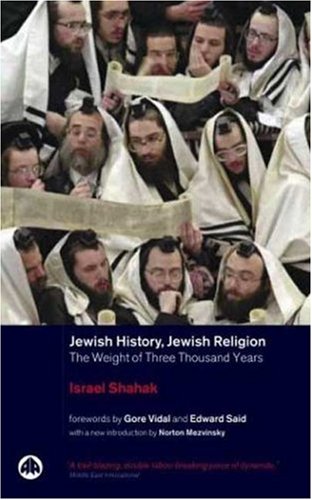
My first surprise was that Shahak’s writings included introductions or glowing blurbs by some of America’s most prominent public intellectuals, including Christopher Hitchens, Gore Vidal, Noam Chomsky, and Edward Said. Praise also came from quite respectable publications such as The London Review of Books, Middle East International, and Catholic New Times while Allan Brownfeld of The American Council for Judaism had published a very long and laudatory obituary. And I discovered that Shahak’s background was very different than I had always imagined. He had spent many years as an award-winning Chemistry professor at Hebrew University, and was actually anything but a Communist. Whereas for decades, Israel’s ruling political parties had been Socialist or Marxist, his personal doubts about Socialism had left him politically in the wilderness, while his relationship with Israel’s tiny Communist Party was solely because they were the only group willing to stand up for the basic human rights issues that were his own central focus. My casual assumptions about his views and background had been entirely in error.
Once I actually began reading his books, and considering his claims, my shock increased fifty-fold. Throughout my entire life, there have been very, very few times I have ever been so totally astonished as I was after I digested Jewish History, Jewish Religion: The Weight of Three Thousand Years, whose text runs barely a hundred pages. In fact, despite his solid background in the academic sciences and the glowing testaments provided by prominent figures, I found it quite difficult to accept the reality of what I was reading. As a consequence, I paid a considerable sum to a young graduate student I knew, tasking him to verify the claims in Shahak’s books, and as far as he could tell, all of the hundreds of references he checked seemed to be accurate or at least found in other sources.
Even with all of that due diligence, I must emphasize that I cannot directly vouch for Shahak’s claims about Judaism. My own knowledge of that religion is absolutely negligible, mostly being limited to my childhood, when my grandmother occasionally managed to drag me down to services at the local synagogue, where I was seated among a mass of elderly men praying and chanting in some strange language while wearing various ritualistic cloths and religious talismans, an experience that I always found much less enjoyable than my usual Saturday morning cartoons.
Although Shahak’s books are quite short, they contain such a density of astonishing material, it would take many, many thousands of words to begin to summarize them. Essentially almost everything I had known—or thought I had known—about the religion of Judaism, at least in its zealously Orthodox traditional form, was utterly wrong.
For example, traditionally religious Jews pay little attention to most of the Old Testament, and even very learned rabbis or students who have devoted many years to intensive study may remain largely ignorant of its contents. Instead, the center of their religious world view is the Talmud, an enormously large, complex, and somewhat contradictory mass of secondary writings and commentary built up over many centuries, which is why their religious doctrine is sometimes called “Talmudic Judaism.” Among large portions of the faithful, the Talmud is supplemented by the Kabala, another large collection of accumulated writings, mostly focused on mysticism and all sorts of magic. Since these commentaries and interpretations represent the core of the religion, much of what everyone takes for granted in the Bible is considered in a very different manner.
Given the nature of the Talmudic basis of traditional Judaism and my total previous ignorance of the subject, any attempt on my part of summarize some of the more surprising aspects of Shahak’s description may be partially garbled, and is certainly worthy of correction by someone better versed in that dogma. And given that so many parts of the Talmud are highly contradictory and infused with complex mysticism, it would be impossible for someone like me to attempt to disentangle the seeming inconsistencies that I am merely repeating. I should note that although Shahak’s description of the beliefs and practices of Talmudic Judaism evoked a fire-storm of denunciations, few of those harsh critics seem to have denied his very specific claims, including the most astonishing ones, which would seem to strengthen his credibility.
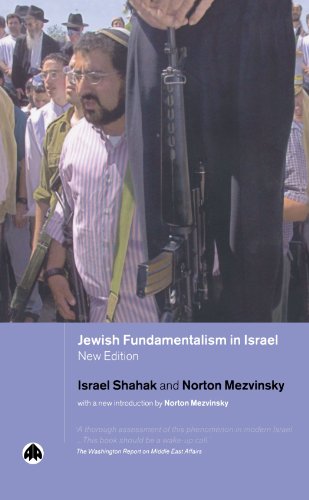
On the most basic level, the religion of most traditional Jews is actually not at all monotheistic, but instead contains a wide variety of different male and female gods, having quite complex relations to each other, with these entities and their properties varying enormously among the numerous different Jewish sub-sects, depending upon which portions of the Talmud and the Kabala they place uppermost. For example, the traditional Jewish religious cry “The Lord Is One” has always been interpreted by most people to be a monotheistic affirmation, and indeed, many Jews take exactly this same view. But large numbers of other Jews believe this declaration instead refers to achievement of sexual union between the primary male and female divine entities. And most bizarrely, Jews having such radically different views see absolutely no difficulty in praying side by side, and merely interpreting their identical chants in very different fashion.
Furthermore, religious Jews apparently pray to Satan almost as readily as they pray to God, and depending upon the various rabbinical schools, the particular rituals and sacrifices they practice may be aimed at enlisting the support of the one or the one. Once again, so long as the rituals are properly followed, the Satan-worshippers and the God-worshippers get along perfectly well and consider each other equally pious Jews, merely of a slightly different tradition. One point that Shahak repeatedly emphasizes is that in traditional Judaism the nature of the ritual itself is absolutely uppermost, while the interpretation of the ritual is rather secondary. So perhaps a Jew who washes his hands three times clockwise might be horrified by another who follows a counter-clockwise direction, but whether the hand-washing were meant to honor God or to honor Satan would be hardly be a matter of much consequence.
Strangely enough, many of the traditional rituals are explicitly intended to fool or trick God or His angels or sometimes Satan, much like the mortal heroes of some Greek legend might seek to trick Zeus or Aphrodite. For example, certain prayers must be uttered in Aramaic rather than Hebrew on the grounds that holy angels apparently don’t understand the former language, and their confusion allows those verses to slip by unimpeded and take effect without divine interference.
Furthermore, since the Talmud represents a massive accretion of published commentary built up over more than a millennium, even the most explicit mandates have sometimes been transformed into their opposites. As an example, Maimonides, one of the highest rabbinical authorities, absolutely prohibited rabbis from being paid for their religious teaching, declaring that any rabbi who received a salary was an evil robber condemned to everlasting torment; yet later rabbis eventually “reinterpreted” this statement to mean something entirely different, and today almost all rabbis collect salaries.
Another fascinating aspect is that up until very recent times, the lives of religious Jews were often dominated by all sorts of highly superstitious practices, including magical charms, portions, spells, incantations, hexes, curses, and sacred talismans, with rabbis often having an important secondary role as sorcerers, and this even remains entirely true today among the enormously influential rabbis of Israel and the New York City area. Shahak’s writings had not endeared him to many of these individuals, and for years they constantly attacked him with all sorts of spells and fearful curses aimed at achieving his death or illness. Many of these traditional Jewish practices seem not entirely dissimilar to those we typically associate with African witch-doctors or Voodoo priests, and indeed, the famous legend of the Golem of Prague described the successful use of rabbinical magic to animate a giant creature built of clay.

If these ritualistic issues constituted the central features of traditional religious Judaism, we might regard it as a rather colorful and eccentric survival of ancient times. But unfortunately, there is also a far darker side, primarily involving the relationship between Jews and non-Jews, with the highly derogatory term goyim frequently used to describe the latter. To put it bluntly, Jews have divine souls and goyim do not, being merely beasts in the shape of men. Indeed, the primary reason for the existence of non-Jews is to serve as the slaves of Jews, with some very high-ranking rabbis occasionally stating this well-known fact. In 2014, Israel’s top Sephardic rabbi used his weekly sermon to declare that the only reason for the existence of non-Jews is to serve Jews and do work for them. The enslavement or extermination of all non-Jews seems an ultimate implied goal of the religion.
Jewish lives have infinite value, and non-Jewish ones none at all, which has obvious policy implications. For example, in a published article a prominent Israeli rabbi explained that if a Jew needed a liver, it would be perfectly fine, and indeed obligatory, to kill an innocent Gentile and take his. Perhaps we should not be too surprised that today Israel is widely regarded as one of the world centers of organ-trafficking.
As a further illustration of the seething hatred traditional Judaism radiates towards all those of a different background, saving the life of a non-Jew is generally considered improper or even prohibited, and taking any such action on the Sabbath would be an absolute violation of religious edict. Such dogmas are certainly ironic given the widespread presence of Jews in the medical profession during recent centuries, but they came to the fore in Israel when a religiously-minded military doctor took them to heart and his position was supported by the country’s highest religious authorities.
And while religious Judaism has a decidedly negative view towards all non-Jews, Christianity in particular is regarded as a total abomination, which must be wiped from the face of the earth.
Whereas pious Muslims consider Jesus the holy prophet of God and Muhammed’s immediate predecessor, according to the Jewish Talmud, Jesus is perhaps the vilest being who ever lived, condemned to spend eternity in the bottommost pit of Hell, immersed in a boiling vat of excrement. Religious Jews regard the Muslim Quran as just another book, though a totally mistaken one, but the Christian Bible represents purest evil, and if circumstances permit, burning Bibles is a very praiseworthy act. Pious Jews are also enjoined to always spit three times at any cross or church they encounter, and direct a curse at all Christian cemeteries. Indeed, many deeply religious Jews utter a prayer each and every day for the immediate extermination of all Christians.
Over the years prominent Israeli rabbis have sometimes publicly debated whether Jewish power has now become sufficiently great that all the Christian churches of Jerusalem, Bethleham, and other nearby areas can finally be destroyed, and the entire Holy Land completely cleansed of all traces of its Christian contamination. Some have taken this position, but most have urged prudence, arguing that Jews needed to gain some additional strength before they should take such a risky step. These days, many tens of millions of zealous Christians and especially Christian Zionists are enthusiastic advocates for Jews, Judaism, and Israel, and I strongly suspect that at least some of that enthusiasm is based upon ignorance.
For the last two thousand years, Jews have almost invariably existed as small, relatively weak minorities living in the lands of others, whether Christian or Muslim, so a religious doctrine so unswervingly hostile to outsiders has naturally presented considerable obstacles for peaceful co-existence. The solution to this dilemma has been based on the divine mandate to preserve Jewish life and well-being above all else, superseding almost all other religious considerations. Thus, if any of the behaviors discussed above are considered likely to stir up resentment from powerful Gentile groups and put Jews at risk, they must be avoided.
For example, the prohibition against Jewish physicians treating the illnesses of non-Jews is waived in the case of powerful non-Jews, especially national leaders, whose favor might provide benefits to the Jewish community. And even ordinary non-Jews may be aided unless some persuasive excuse can be found to explain such lack of assistance since otherwise the vengeful hostility of their friends and relatives might cause difficulties for other Jews. Similarly, it is permissible to exchange gifts with non-Jews but only if such behavior can be justified in strictly utilitarian terms, with any simple expression of friendship towards a non-Jew being a violation of holy principles.
If the Gentile population became aware of these Jewish religious beliefs and the behaviors they promote, major problems for Jews might develop, so an elaborate methodology of subterfuge, concealment, and dissimulation has come into being over the many centuries to minimize this possibility, especially including the mistranslation of sacred texts or the complete exclusion of crucial sections. Meanwhile, the traditional penalty for any Jew who “informs” to the authorities on any matter regarding the Jewish community has always been death, often preceded by hideous torture.
Much of this dishonesty obviously continues down to recent times since it seems very unlikely that Jewish rabbis, except perhaps for those of the most avant garde disposition, would remain totally unaware of the fundamental tenets of the religion that they claim to lead, and Shahak is scathing toward their apparent self-serving hypocrisy, especially those who publicly express strongly liberal views. For example, according to mainstream Talmudic doctrine, black Africans are traditionally placed somewhere between people and monkeys in their intrinsic nature, and surely all rabbis, even liberal ones, would be aware of this religious doctrine. But Shahak notes that the numerous American rabbis who so eagerly worked with Martin Luther King, Jr. and other black Civil Rights leaders during the 1950s and 1960s strictly concealed their religious beliefs while denouncing American society for its cruel racism, presumably seeking to achieve a political quid pro quo beneficial to Jewish interests from America’s substantial black population.
Shahak also emphasizes the utterly totalitarian nature of traditional Jewish society, in which rabbis held the power of life and death over their congregants, and often sought to punish ideological deviation or heresy using those means. They were often outraged that this became difficult as states grew stronger and increasingly prohibited such private executions. Liberalizing rabbis were sometimes murdered and Baruch Spinoza, the famous Jewish philosopher of the Age of Reason, only survived because the Dutch authorities refused to allow his fellow Jews to kill him.
Given the complexity and exceptionally controversial nature of this subject matter, I would urge readers who find this topic of interest to spend three or four hours reading Shahak’s very short book, and then decide for themselves whether his claims seem plausible and whether I may have inadvertently misunderstood them. Aside from the copies on Amazon, the work may also be found at Archive.org and also a very convenient HTML copy is freely available on the Internet.
My encounter a decade ago with Shahak’s candid description of the true doctrines of traditional Judaism was certainly one of the most world-altering revelations of my entire life. But as I gradually digested the full implications, all sorts of puzzles and discontented facts suddenly became much more clear. There were also some remarkable ironies, and not long afterward I joked to a (Jewish) friend of mine that I’d suddenly discovered that Naziism could best be described as “Judaism for Wimps” or perhaps Judaism as practiced by Mother Teresa of Calcutta.
There may actually be a deeper historical truth behind that irony. I think I’ve read here and there that some scholars believe that Hitler may have modeled certain aspects of his racially-focused National Socialist doctrine upon the Jewish example, which really makes perfect sense. After all, he saw that despite their small numbers Jews had gained enormous power in the Soviet Union, Weimar Germany, and numerous other countries throughout Europe, partly due to their extremely strong ethnic cohesion, and he probably reasoned that his own Germanic people, being far greater in numbers and historical achievements could do even better if they adopted similar practices.
It’s also interesting to note that quite a number of the leading racialist pioneers of 19th century Europe came from a particular ethnic background. For example, my history books had always disapprovingly mentioned Germany’s Max Nordau and Italy’s Cesare Lombroso as two of the founding figures of European racism and eugenics theories, but it was only very recently that I also discovered that Nordau had also been the joint founder with Theodor Herzl of the world Zionist movement, while his major racialist treatise Degeneration, was dedicated to Lombroso, his Jewish mentor.
Even as late as the 1930s and afterward, international Zionist groups closely cooperated with the Third Reich on international economic projects, and during the world war itself one of the smaller rightwing factions, led by future Israeli Prime Minister Yizhak Shamir, actually offered a military alliance to the Axis Powers, denouncing the decadent Western democracies and hoping to cooperate against their mutual British enemies. The Transfer Agreement by Edwin Black, 51 Documents by Lenni Brunner, and other writings have documented all these facts in detail, though for obvious reasons they have generally been ignored or mischaracterized by most of our media outlets.
Obviously the Talmud is hardly regular reading among ordinary Jews these days, and I would suspect that except for the strongly Orthodox and perhaps most rabbis, barely a sliver are aware of its highly controversial teachings. But it is important to keep in mind that until just a few generations ago, almost all European Jews were deeply Orthodox, and even today I would guess that the overwhelming majority of Jewish adults had Orthodox grand-parents. Highly distinctive cultural patterns and social attitudes can easily seep into a considerably wider population, especially one that remains ignorant of the origin of those sentiments, a condition enhancing their unrecognized influence. A religion based upon the principal of “Love Thy Neighbor” may or may not be workable in practice, but a religion based upon “Hate Thy Neighbor” may be expected to have long-term cultural ripple effects that extend far beyond the direct community of the deeply pious. If nearly all Jews for a thousand or two thousand years were taught to feel a seething hatred toward all non-Jews and also developed an enormous infrastructure of cultural dishonesty to mask that attitude, it is difficult to believe that such an unfortunate history has had absolutely no consequences for our present-day world, or that of the relatively recent past.
Furthermore, Jewish hostility toward non-Jews may have often served the interests of others, and helped determine the economic role they played, especially in European countries, with this factor having been obscured by widespread ignorance of the underlying religious tenets. As most of us know from our history books, political rulers with little sympathy for their subjects sometimes restrict military power to a relatively small group of well-rewarded mercenaries, often of foreign origins so that they will have little sympathy for the population they harshly repress. I strongly suspect that some of the most common traditional economic niches of European Jews, such as tax-farming and the arrenda estate-management system of Eastern Europe, should be best understood in a similar light, with Jews being more likely to extract every last penny of value from the peasants they controlled for the benefit of their local king or lords, and their notorious antipathy for all non-Jews ensuring that such behavior was minimally tempered by any human sympathy. Thus, we should not be surprised that Jews first entered England in the train of William the Conqueror, in order to help him and his victorious Norman lords effectively exploit the subjugated Anglo-Saxon population they now ruled.
But states in which the vast majority of the population is oppressed and dominated by a thin slice of rulers and their mercenary enforcers tend to be much weaker and more brittle than those in which rulers and ruled share common interests, and I believe this is just as true for economic enforcers as for military ones. In many cases, lands reliant upon Jewish economic intermediaries, notably Poland, never successfully developed a native middle class, and often later fared quite poorly against their nationally-unified competitors. Spain was actually one of the last countries in Europe to expel its Jews, and over the next century or two reached the peak of its military and political glory. Prof. Kevin MacDonald’s controversial books on Judaism have also extensively argued that rulers who seem to have been more concerned for the well-being of their subjects also tend to be the ones more likely to be labeled “anti-Semitic” in modern history books, and his volumes are now easily available in my selection of HTML Books:
Toward an Evolutionary Theory of Anti-Semitism
In 2009, Gene Expression blogger Razib Khan interviewed eminent evolutionary theorist David Sloan Wilson on the group selection ideas that have been his major focus. During this hour-long discussion, the theories of MacDonald became a major topic, with Wilson seeming to take them quite seriously, and pointing out that within the scientific framework “parasitism” has a simple technical definition, namely the exploitation of the large by the small. Unsurprisingly, the video record of such extremely touchy subject matter was quickly truncated to just the first 11 minutes, and eventually completely removed from both YouTube and BloggingHeadsTV. But it still at least partially survives in archived form:

In recent years, the history of Jewish expulsions from various European societies over the last thousand years has received considerable attention. The total number is somewhat disputed but almost certainly in excess of 100, with the 1930s policies of Hitler’s Germany being merely the most recent example, and Wired Magazine provided an interesting graphical presentation of this large dataset in 2013. Given these unfortunate facts, it may be difficult to point to any other group so consistently at bitter odds with its local neighbors, and the religious details provided by Shahak certainly make this remarkable historical pattern far less inexplicable.
A very even-handed but candid description of the behavior pattern of Jewish newcomers to America was provided in a chapter of a 1914 book on immigration groups by E.A. Ross, one of America’s greatest early sociologists. Ross had been one of the towering Progressive intellectuals of his era, widely quoted by Lothrop Stoddard on the Right while still so highly regarded by the Left that he was named to the Dewey Commission to adjudicate the conflicting accusations of Trotsky and Stalin and also received glowing praise in the pages of the Communist New Masses. His dismissal on political grounds from Stanford University led to the formation of the American Association of University Professors. Yet his name had so totally vanished from our history books I had never even encountered it until beginning work on my content-archiving project, and I would not be surprised if that single chapter from one of his many books played a major role in his disappearance.
The Eastern European Hebrews

Jews spent two thousand years living as a diaspora people, and their tightly-bound trans-national colonies provided them with a uniquely effective international trading network. Since their religious traditions regarded slavery as the natural and appropriate lot of all non-Jews, both ideological and practical factors combined to apparently make them some of the leading slave-traders of Medieval Europe, though this is hardly emphasized in our histories. Closer to home, in 1991 the Black Nationalists of The Nation of Islam published The Secret Relationship Between Blacks and Jews, Volume One, which seemed to persuasively document the enormous role Jews had played in the American slave-trade. In 1994, Harold Brackman published a short attempted rebuttal entitled Ministry of Lies under the auspices of the Simon Wiesenthal Center, but I found his denials much less compelling. I very much doubt that most Americans are aware of these historical facts.
Throughout most of my life, Nobel Laureate Alexander Solzhenitsyn was generally regarded as the greatest Russian literary figure of our modern era, and after reading all of his works, including The First Circle, Cancer Ward, and The Gulag Archipelago, I certainly concurred with this assertion, and eagerly absorbed Michael Scammel’s brilliant thousand page biography. Although Russian himself, many of his closest friends were Jewish, but during the 1980s and 1990s, whispers of his supposed anti-Semitism began floating around, probably because he had sometimes hinted at the very prominent role of Jews in both financing and leading the Bolshevik Revolution, and afterward staffing the NKVD and administering the Gulag labor camps. Late in his life, he wrote a massive two-volume history of the tangled relationship between Jews and Russians under the title Two Hundred Years Together, and although that work soon appeared in Russian, French, and German, nearly two decades later, no English translation has ever been authorized. His literary star seems also to greatly waned in America since that time, and I only very rarely see his name mentioned these days in any of my regular newspapers.
Samizdat versions of major sections of his final work may easily be located on the Internet, and a few years ago Amazon temporarily sold a 750 page hard copy edition, which I ordered and lightly skimmed. Everything seemed quite innocuous and factual, and nothing new jumped out at me, but perhaps the documentation of very heavy Jewish role in Communism was considered inappropriate for American audiences, as was the discussion of the extremely exploitative relationship between Jews and Slavic peasants in pre-revolutionary times, based on liquor-dealing and money-lending, which the Czars had often sought to mitigate.
When a ruling elite has limited connection to the population it controls, benevolent behavior is far less likely to occur, and those problems are magnified when that elite has a long tradition of ruthlessly extractive behavior. Enormous numbers of Russians suffered and died in the aftermath of the Bolshevik Revolution, and given the overwhelmingly Jewish composition of the top leadership during much of that period, it is hardly surprising that “anti-Semitism” was deemed a capital offense. Kevin MacDonald may have been the one who coined the term “hostile elite,” and discussed the unfortunate consequences when a country comes under such control.
After the collapse of the Soviet Union in 1991, reborn Russia soon fell under the overwhelming domination of a small group of Oligarchs, almost entirely of Jewish background, and a decade of total misery and impoverishment for the general Russian population soon followed. But once an actual Russian named Vladimir Putin regained control, these trends reversed and the lives of Russians have enormously improved since that time. America’s media organs were overwhelmingly friendly toward Russia when it was under Jewish Oligarchic rule, while Putin has been demonized in the press more ferociously than any world leader since Hitler. Indeed, our media pundits regularly identify Putin as “the new Hitler” and I actually think the analogy might be a reasonable one, but just not in the way they intend.
Sometimes it is much easier to notice obvious patterns in a foreign country than in one’s own. In the early 2000s I read The Master Switch, a widely-praised history of modern communications technology by Columbia University professor Tim Wu, who has subsequently become a leading Internet-rights activist. I found the account fascinating, with so many stories never before known to me. However, I couldn’t help but notice that all the powerful mass-media technologies of our modern world–film, radio, and television–had been invented and pioneered by Gentiles, mostly of Anglo-Saxon origin, but in each case control was seized by ruthless Jewish businessmen, who sometimes destroyed the lives and careers of those creators. By the 1950s, nearly all of America’s leading concentrations of electronic media power—with the sole major exception of Disney Studios—were solidly in Jewish hands. In an open society such as ours, these are the central levers of political influence, and over the next generation or so, America’s long-dominant and heavily Anglo-Saxon ruling elite was replaced by a mostly Jewish one, a development I alluded to in my long Meritocracy article of a few years ago.
Critics today of all backgrounds bemoan the total impoverishment of so much of America’s once comfortably affluent middle class, noting that some sixty percent of the American population today possesses less than $500 in readily available savings. A younger generation has been reduced to permanent debt-servitude by ruinous student loans, while the the newspapers report that the opioid drug epidemic has claimed a dreadful toll in lives and family-breakdown even while Wall Street and other elite sectors of the financialized economy are richer than they have ever been before. There are certainly many different explanations for this sad economic trajectory, including technological change, growing international competition, and shifts of political power in the American system of government. But it does sometimes seem like a substantial fraction of our population has been reduced to a 21st century version of the drunken, ignorant, exploited, indebted, impoverished, and immiserated Slavic peasantry of the Jewish-dominated Pale of Settlement, and a striking graph produced by the Economic Policy Institute demonstrates that a very sharp economic inflection point occurred in the early 1970s, right around the time that the aforementioned ethnic transformation of our ruling elites was fully under way.

Contrary to widespread popular belief, it is not actually illegal to be a “Nazi” in America, nor are Nazis prohibited from owning property, even including media outlets. But suppose that the overwhelming majority of America’s major media concentrations were owned and controlled by Nazis of a particularly fanatical type. Surely that might have serious consequences for the course of our society, and especially that fraction of the population viewed with considerable disfavor under Nazi doctrine.

One important point to consider in the abbreviated history of Hitler’s Third Reich was that although the ruling Nazi elite was often quite harsh and extreme in its behavior, well over 98% of the population it ruled prior to the outbreak of war consisted of Germans, the particular group which that ruling elite most sought to benefit and uplift in all possible ways, and despite the obscuring cloud of retrospective propaganda, this goal seems to have largely been achieved. In 2004, Counterpunch published a column by the late Alexander Cockburn, its redoubtable editor, noting the tremendous success of Hitler’s peacetime economic policies, and in 2013 that same webzine carried a much longer column focused entirely on this same subject, citing the analysis of Henry C.K. Liu, whose Chinese background provided him greater critical distance. Indeed, during most of the 1930s Hitler received widespread international praise for the great success of his domestic economic and social achievements, making the cover of Time Magazine on numerous occasions and even being named its Man of the Year for 1938. By contrast, I suspect that a population that was some 98% non-German but ruled by those same fanatically pro-German leaders might have fared far worse.
Most of these disheartening facts that have so completely upended my understanding of reality over the last decade could not possibly have come to my attention until the rise of the Internet, which partially broke centralized control over the distribution of information. But many other people surely must have known large portions of this important story long before that, and recognized the very serious consequences these matters might have for the future of our society. Why has there been so little public discussion?
I believe one factor is that over the years and the decades, our dominant media organs of news and entertainment have successfully conditioned most Americans to suffer a sort of mental allergic reaction to topics sensitive to Jews, which leads to all sorts of issues being considered absolutely out of bounds. And with America’s very powerful Jewish elites thereby insulated from almost all public scrutiny, Jewish arrogance and misbehavior remain largely unchecked and can increase completely without limit.
I’ve also sometimes suggested to people that one under-emphasized aspect of a Jewish population, greatly magnifying its problematical character, is the existence of what might be considered a biological sub-morph of exceptionally fanatical individuals, always on hair-trigger alert to launch verbal and sometimes physical attacks of unprecedented fury against anyone they regard as insufficiently friendly towards Jewish interests. Every now and then, a particularly brave or foolhardy public figure challenges some off-limits topic and is almost always overwhelmed and destroyed by a veritable swarm of these fanatical Jewish attackers. Just as the painful stings of the self-sacrificing warrior caste of an ant colony can quickly teach large predators to go elsewhere, fears of provoking these “Jewish berserkers” can often severely intimidate writers or politicians, causing them to choose their words very carefully or even completely avoid discussing certain controversial subjects, thereby greatly benefiting Jewish interests as a whole. And the more such influential people are thus intimidated into avoiding a particular topic, the more that topic is perceived as strictly taboo, and avoided by everyone else as well.
For example, about a dozen years ago I was having lunch with an especially eminent Neoconservative scholar with whom I’d become a little friendly. We were bemoaning the overwhelmingly leftward skew among America’s intellectual elites, and I suggested it largely seemed a function of our most elite universities. Many of our brightest students from across the nation entered Harvard and the other Ivies holding a variety of different ideological perspectives, but after four years departed those halls of learning overwhelmingly in left-liberal lock-step. Although he agreed with my assessment, he felt I was missing something important. He nervously glanced to both sides, shifted his head downward, and lowered his voice. “It’s the Jews,” he said.
I do not doubt that much of the candid analysis provided above will be quite distressing to many individuals. Indeed, some may believe that such material far exceeds the boundaries of mere “anti-Semitism” and easily crosses the threshold into constituting an actual “blood libel” against the Jewish people. That extremely harsh accusation, widely used by stalwart defenders of Israeli behavior, refers to the notorious Christian superstition, prevalent throughout most of the Middle Ages and even into more modern times, that Jews sometimes kidnapped small Christian children in order to drain their blood for use in various magic rituals, especially in connection with the Purim religious holiday. One of my more shocking discoveries of the last dozen years is that there is a fairly strong likelihood that these seemingly impossible beliefs were actually true.
I personally have no professional expertise whatsoever in Jewish ritual traditions, nor the practices of Medieval Jewry. But one of the world’s foremost scholars in that field is Ariel Toaff, professor of Jewish Renaissance and Medieval Studies at Bar-Ilan University near Tel Aviv, and himself the son of the Chief Rabbi of Rome.
In 2007, he published the Italian edition of his academic study Blood Passovers, based on many years of diligent research, assisted by his graduate students and guided by the suggestions of his various academic colleagues, with the initial print run of 1,000 copies selling out on the first day. Given Toaff’s international eminence and such enormous interest, further international distribution, including an English edition by a prestigious American academic press would normally have followed. But the ADL and various other Jewish-activist groups regarded such a possibility with extreme disfavor, and although these activists lacked any scholarly credentials, they apparently applied sufficient pressure to cancel all additional publication. Although Prof. Toaff initially attempted to stand his ground in stubborn fashion, he soon took the same course as Galileo, and his apologies naturally became the basis of the always-unreliable Wikipedia entry on the topic.

Eventually, an English translation of his text turned up on the Internet in a PDF format and was also placed for sale on Amazon.com, where I purchased a copy and eventually read it. Given those difficult circumstances, this work of 500 pages is hardly in ideal form, with most of the hundreds of footnotes disconnected from the text, but it still provides a reasonable means of evaluating Toaff’s controversial thesis, at least from a layman’s perspective. He certainly seems an extremely erudite scholar, drawing heavily upon the secondary literature in English, French, German, and Italian, as well as the original documentary sources in Latin, Medieval Latin, Hebrew, and Yiddish. Indeed, despite the shocking nature of the subject matter, this scholarly work is actually rather dry and somewhat dull, with very long digressions regarding the particular intrigues of various obscure Medieval Jews. My own total lack of expertise in these areas must be emphasized, but overall I thought Toaff made a quite persuasive case.
It appears that a considerable number of Ashkenazi Jews traditionally regarded Christian blood as having powerful magical properties and considered it a very valuable component of certain important ritual observances at particular religious holidays. Obviously, obtaining such blood in large amounts was fraught with considerable risk, which greatly enhanced its monetary value, and the trade in the vials of this commodity seems to have been widely practiced. Toaff notes that since the detailed descriptions of the Jewish ritualistic murder practices are very similarly described in locations widely separated by geography, language, culture, and time period, they are almost certainly independent observations of the same rite. Furthermore, he notes that when accused Jews were caught and questioned, they often correctly described obscure religious rituals which could not possibly have been known to their Gentile interrogators, who often garbled minor details. Thus, these confessions were very unlikely to have been concocted by the authorities.
Furthermore, as extensively discussed by Shahak, the world-view of traditional Judaism did involve a very widespread emphasis on magical rituals, spells, charms, and similar things, providing a context in which ritualistic murder and human sacrifice would hardly be totally unexpected.
Obviously, the ritual murder of Christian children for their blood was viewed with enormous disfavor by the local Gentile population, and the widespread belief in its existence remained a source of bitter tension between the two communities, flaring up occasionally when a Christian child mysteriously disappeared at a particular time of year, or when a body was found that exhibited suspicious types of wounds or showed a strange loss of blood. Every now and then, a particular case would reach public prominence, often leading to a political test of strength between Jewish and anti-Jewish groups. During the mid-19th century, there was one such famous case in French-dominated Syria, and just before the outbreak of the First World War, Russia was wracked by a similar political conflict in the 1913 Beilis Affair in the Ukraine.
I first encountered these very surprising ideas almost a dozen years ago in a long article by Israel Shamir that was referenced in Counterpunch, and this would definitely be worth reading as an overall summary, together with a couple of his follow-up columns, while writer Andrew Hamilton offers the most recent 2012 overview of the controversy. Shamir also helpfully provides a free copy of the book in PDF form, an updated version with the footnotes properly noted in the text. Anyway, I lack the expertise to effectively judge the likelihood of the Toaff Hypothesis, so I would invite those interested to read Toaff’s book or better yet the related articles and decide for themselves.
The notion that the world is not only stranger than we imagine, it is stranger than we can imagine has often been misattributed to the British astronomer Sir Arthur Eddington, and over the last fifteen-odd years I’ve sometimes begun to believe that the historical events of our own era could be considered in a similar light. I’ve also sometimes joked with my friends that when the true history of our last one hundred years is finally written and told—probably by a Chinese professor at a Chinese university—none of the students in his lecture hall will ever believe a word of it.
Related Readings:
- Jewish History, Jewish Religion: The Weight of Three Thousand Years by Israel Shahak
- The Old World in the New by E.A. Ross
- A People That Shall Dwell Alone by Kevin MacDonald
- Separation and Its Discontents by Kevin MacDonald
- Understanding Jewish Influence I: Background Traits for Jewish Activism by Kevin MacDonald
- The Bloody Passovers of Dr. Toaff by Israel Shamir
NED Pursues Regime Change by Playing the Long Game
By Edward Hunt | Lobe Log | July 3, 2018
During a recent congressional hearing, the heads of three influential non-profit organizations that operate in numerous countries around the world revealed the subtle ways in which the United States meddles in the internal affairs of other countries by playing what the officials called “the long game.”
The three officials—Carl Gershman, Daniel Twining, and Kenneth Wollack—told Congress about their long-term efforts to empower the opponents of U.S. enemies and boasted about their ability to change foreign governments. They said that they had recently helped their political allies gain political power in Malaysia, acknowledged that they have helped train thousands of activists in Nicaragua, and speculated about the potential to create new governments in China, Russia, and North Korea.
All three men strongly defended their activities, insisting that they are critically important to the advancement of democracy in the world.
“We’re not asking people to do anything that they don’t want to do,” Gershman said. “We’re supporting their own aspirations and giving them some of the tools to realize those aspirations.”
Gershman is the president of the National Endowment for Democracy (NED), a U.S. taxpayer-funded nonprofit created by the U.S. government in 1983. As the president of NED, Gershman oversees the issuance of grants to its political-party-associated organizations, including the International Republican Institute (IRI), which is headed by Twining, and the National Democratic Institute (NDI), which is headed by Wollack.
Facing skepticism about their work from the Trump administration, which views the organizations as unnecessary expenses and wants to cut their funding, Gershman and his colleagues provided Congress with a broad overview of how their work affects the world. They defended their ongoing operations, trying to persuade Congress that they should continue to receive funding.
Ultimately, the three officials revealed how they are helping the U.S. government interfere in numerous countries around the world.
The NED Approach
The general strategy of NED is to empower like-minded activists to build new political movements in their home countries. NED helps these activists become influential political actors, often with the goal of creating new possibilities for political change.
Officials typically describe their approach as one of “democracy promotion.” They argue that they are helping democratic forces introduce democratic politics into countries ruled by authoritarian leaders.
“These leaders, their strategic Achilles heel is fear of their own publics,” Twining explained. “And I think we should think about the old Reagan message of exploiting that a little bit.”
The strategy requires a long-term commitment in the countries where the NED is active. Twining calls it “playing the long game.” Gershman calls it “long-term work.”
The officials discussed numerous examples. Twining said that IRI has been working with opposition forces in Malaysia since 2002. He credited IRI with helping opposition forces prevail in the country’s recent parliamentary elections, calling the victory “an example of playing the long game.”
U.S.-backed opposition forces are “now in-charge of this very strategic country right there on the frontlines of the South China Sea, right there on the frontlines of the Islamic world’s intersection with rest of Asia,” Twining said. “And that’s good for America.”
The NED has also been active in Nicaragua, where opposition forces are organizing major protests against the Nicaraguan government. The protesters are trying to bring down the government of Nicaraguan President Daniel Ortega, a popular leftist leader who has been in power since 2007.
“We have been working on youth leadership programs and have worked with more than 8,000 youth on a very extensive coursework and academies to develop U.S. engagement,” Wollack said.
Although Wollack denied that the organizations are training their grantees for the purpose of overthrowing Ortega, Gershman indicated that regime change is the ultimate goal. “Time for him to go,” Gershman said, referring to Ortega.
The three officials also cited many additional opportunities to influence governments around the world. They are especially excited about opportunities in Armenia, where a major social movement recently ousted a government backed by Russia.
Twining speculated about the possibility of achieving regime change in Russia, calling Putin a “very brittle” leader who is “frankly quite insecure.”
Gershman saw potential for a similar outcome in North Korea. “This is an eroding totalitarian system, so we shouldn’t give up hope on the possibilities for internal change,” he said.
Gershman believes that the primary focus should be on China, however. He called China “the most serious threat our country faces today.”
Although Gershman said that the U.S. government will initially respond to challenges from China with a mix of military, economic, and geostrategic power, he insisted that the long-term solution could be found in the “unhappy people” who oppose the Chinese government.
“We have to not give up on the possibility for democratic change in China and keep finding ways to support them,” he said.
The Controversy in Washington
The open talk of U.S. meddling in other countries around the world was so commonplace that the U.S. mass media spent no time covering the hearing, even though the speakers did encounter some pushback. Not all members of Congress are on board with the programs.
Congressman Dana Rohrabacher (R-CA) made the strongest critique, insisting that U.S. meddling destabilizes countries while creating more problems for the United States in the long run. Rohrabacher blamed recent U.S. meddling for destabilizing Ukraine. He argued that the U.S. involvement in national protests that led to the downfall of the government of Viktor Yanukovych in February 2014 prompted the subsequent Russian invasion of the country and the war that continues there today.
“I don’t believe the Russians would have invaded Ukraine had we not arrogantly involved ourselves to overthrow that democratically elected government in Ukraine,” Rohrabacher said.
Rohrabacher also insisted that the U.S. should support dictators. He singled out Egypt, saying that the country should continue to be ruled by General Abdel Fattah el-Sisi, the military dictator who gained power by overthrowing the country’s first democratically elected government in 2013.
“I know I am making everybody mad at me, but I had to say it,” Rohrabacher commented.
Faced with Rohrabacher’s criticisms, the remaining participants in the hearing made some effort to counter his arguments but otherwise said very little, preferring instead to blandly praise NED for performing admirable work by promoting democracy around the world.
The general feeling in Congress is that the U.S. government should continue to fund the work of the NED and its affiliated institutes. Most members of Congress view the organizations as important assets in the U.S. government’s toolkit, believing they play an important role in U.S. global strategy.
Congressman Gerry Connolly (D-VA) unabashedly praised NED, IRI, and NDI, calling their work “exciting.” He told the three officials that “nothing does America prouder than the work frankly you’re doing.”
Hungary Accuses EU of ‘Double Standards’ Over Nord Stream 2
Sputnik – June 28, 2018
EU divisions and US sanctions threaten to delay the construction of the Nord Stream 2 pipeline to bring Russian gas to Europe.
The European Union applies double standards to Nord Stream 2, Hungarian Foreign and Foreign Trade Minister Peter Szijjarto told Sputnik.
“We are not part of the project, we can’t resist it. But I can say there are unacceptable double standards,” the minister said. According to him, the former South Stream project, which would increase the diversification of natural gas supplies for Central Europe has been “killed” by the EU.
“And now we don’t see any encouragement on the part of the European Commission. I can’t imagine any excuses or reasons the Commission could bring,” Szijjarto added
In 2014, EU opposition forced Russia to cease work on the South Stream project, which was to run across Bulgaria, Serbia and Hungary in favor of a new pipeline to run under the Black Sea to Turkey [Turkish Stream].
Nord Stream 2
Nord Stream 2, which is a joint venture of Russia’s Gazprom with France’s Engie, Austria’s OMV AG, UK-Dutch Royal Dutch Shell, and Germany’s Uniper and Wintershall, aims to deliver 55 billion cubic meters of Russian natural gas a year to the European Union across the Baltic Sea to Germany.
Building permits have already been issued by Germany, Finland and Sweden.
A similar permit by Denmark is still pending, but on Tuesday it was announced that the Danish government wants to delay the implementation of the project. According to Prime Minister Lars Lokke Rasmussen, the idea needs to be discussed on a pan-European level.
Denmark’s decision came after the US State Department said it hoped that the EU would “independently” suspend the construction of the Nord Stream 2 pipeline or “reformat” a Russian-proposed plan to this effect.
Some countries, above all Ukraine, who are afraid of losing revenues from Russian gas transit, are opposed to Nord Stream 2. The project is also facing opposition from the United States who has ambitious plans to export its LNG to Europe.
Russia has repeatedly urged its European partners not to perceive the Nord Stream pipeline as an instrument of influence. According to President Vladimir Putin, Moscow considers the project to be entirely economic.
‘Forget sanctions, G7 & Assad – Trump-Putin summit should focus on America’s Ukraine interference’
RT | June 22, 2018
Ukraine, not Syria, is going to be in the spotlight at the potential meeting between Donald Trump and Vladimir Putin after the US supplied Kiev with Javelin missiles and imposed sanctions on Russia, former US diplomat told RT.
The NATO summit set for July is already being upstaged by rumors of a separate meeting between Trump and Putin – and news that National Security Advisor John Bolton will be heading to Moscow this month has only increased speculation. RT America’s Natasha Sweatte discussed this latest development with former US diplomat Jim Jatras.
RT: What are your thoughts on Bolton going to Russia? Do you think this is going to be a similar matter to how Mike Pompeo set things up for the president with Kim Jong-un?
Jim Jatras: I think in some ways, yes. I understand that ambassador (Jon) Huntsman, our ambassador in Moscow, was here not too long ago to begin some of the prep, Bolton is supposed to be in Moscow next week and then three Republican senators are supposed to be in Moscow the week after that. I think there’s some of the groundwork being prepared for this meeting.
RT: What do you think is the most important thing for them to discuss, if they do indeed meet. Do you think something like Syria?
JJ: Certainly, Syria. But to tell the truth, I think the mere fact of the meeting, like the meeting between Trump and Kim Jong-un, is the most important thing. The fact that they meet. Let’s remember, there has been a full-blown campaign of hysteria on so-called “Russian collusion” from not only the US deep state, but their friends in the United Kingdom, in MI6 and GCHQ, trying to try to sink this thing. And I think coming off of the summit with Kim and also some of the economic news, some of his domestic successes, Trump now feels he has the ability to go ahead with something he said he wanted to do during the campaign and has been frustrated from doing so.
RT: Do you think a positive meeting between the two will have any impact on Mueller’s investigation or do you see it as an important thing for Trump to block all of that out, if he does indeed meet with Putin?
JJ: I think it is going to be in the eye of the beholder. Obviously, the Trump-haters who actually believe all the nonsense about Russian collusion, they’ll just see this: “He is reporting to Moscow, he is reporting to headquarters. This proves everything we’ve been alleging.”
Of course, that’ll be total nonsense. I think just as a lot of people aimed potshots at him over North Korea, the fact that he comes back with something that looks like we’re making progress on a peaceful settlement, I think will resonate with a lot more people than the naysayers.
RT: Now to the G7 summit: do you think there is a seat at the table for Russia? Do you think maybe these talks with the US is the first step in that direction?
JJ: It could be. But to tell the truth, G7 isn’t all that important. And certainly not for the Russians. The Russians are looking more toward Eurasian integration with the, One Belt, One Road, initiative with the Chinese, with the Eurasian Economic Union. Sure, they’d like a seat at the table. But they’re not going to sit there and beg for it. And they’re not going to look at it as some kind of a cookie to be thrown to them.
RT: And what’s the ultimate outcome? Do you think just the meeting itself speaks volumes?
JJ: I think, the meeting itself speaks volumes. But I think, the question of sanctions, for example, is way in the background. You’ll never get that through Congress anytime soon. Although, I think we could look at some positive action in Europe in the very near future. I think that actually the thorniest question isn’t really Syria so much. Look, Assad has won, he is going to stay in power. The real issue is going to be what to do about Ukraine. During the campaign, Trump said that is a European issue. But, of course, you know, we’ve provided the Javelin missiles, we’ve added new sanctions to the Russians. We’ve got to find some way to get the US out of the driver’s seat on aggravating the situation in Ukraine.
RT: And maybe, if (Robert) Mueller’s investigation does wrap up sometime soon, maybe Congress’s outlook would change on sanctions?
JJ: No, I don’t think so. I think, unfortunately, there are just so many people who have planted their feet in concrete in an extreme, I would say, hysterical anti-Russian position, that just isn’t going to change. I think Trump basically has to move beyond them somehow and not really focus on the sanctions, which to tell the truth, do not have the same devastating impact on Russia that a lot of people here would like to think they have.
Putin pledges help to unrecognized Donbass republics, warns Ukraine against attack
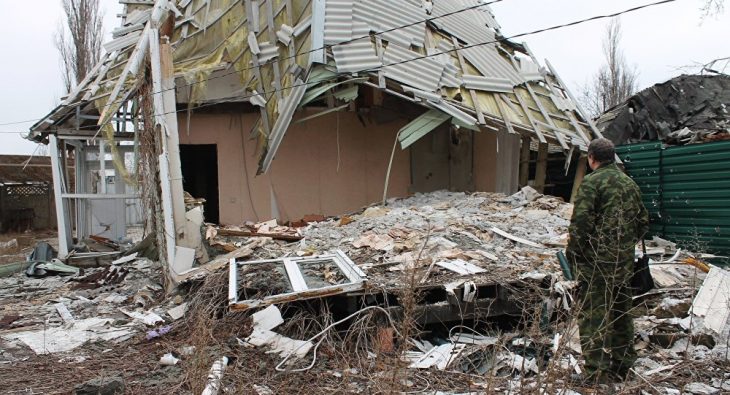
RT | June 7, 2018
Vladimir Putin has said that any aggravation of the military conflict in Ukraine would “inflict a tremendous damage” to the country’s statehood and added that Russian support for the Donbass republics will continue.
During the Thursday televised Q&A session Putin faced a question from Russian journalist and writer Zakhar Prilepin, who is currently a voluntary advisor to the head of the Donetsk People’s Republic, the DNR.
Prilepin asked the president if he considered it possible that pro-Kiev forces would launch a major offensive operation in the war-ridden south-east of Ukraine during the 2018 World Cup in Russia which begins in one week.
Putin said that he personally hoped that such thing would not happen and noted that such a development would “inflict a tremendous damage to the Ukrainian statehood” adding that he personally believed that it was impossible to intimidate the people from the self-proclaimed republics of Donetsk and Lugansk.
“It is impossible to intimidate the Donbass people. We see how they endure all these hardships, we send them help and we will continue doing this,” Putin stated.
Putin also asked a rhetorical question – how was it possible that Kiev authorities attempt to solve the problems of Donbass and consider this region Ukrainian territory while at the same time destroying the republics’ economies with blockades and openly robbing their residents. The Russian leader added that Ukrainian officials kept their personal fortunes in offshore bank accounts.
Earlier this week the head of the self-proclaimed Donetsk People’s Republic, Aleksandr Zakharchenko, said that he personally participated in reconnaissance missions on the frontline and got an impression that the Ukrainian side was preparing for a major offensive. “This is connected with the football World Cup, Ukraine will attempt to use this event. There is such a threat I would not conceal this fact. Ukraine cannot wage a full-pledged war, but they can launch several major armed provocations in three parts of the frontline maximum,” he said.
A few days ago, Putin said in an interview with Austrian television that, in order to stop internal conflict in Ukraine, Kiev authorities could grant special status with broader powers to the republics of Donbass, just as Russia had done with Chechnya.
“Russia had to make a very complicated decision and grant the Chechen Republic and many other federation subjects such status that gave them a great degree of independence within the Russian Federation … the same thing could be done in Ukraine in regards of the Donbass republics and I wonder, why have not they done it yet?
“Under such scenario there is no necessity to restrict the usage of ethnic minorities’ languages in Ukraine, I mean not only Russian but also Romanian, Hungarian and Polish. There is little talk about it in Europe but these are the today’s realities,” the Russian president said.
In September 2017, Putin called for a UN peacekeeping mission to be sent to the war-torn eastern regions of Ukraine. The mission would have been deployed to the line of demarcation to protect the OSCE mission, which monitors the ceasefire.
Moscow’s initiative was welcomed by German Foreign Minister Sigmar Gabriel and Chancellor Angela Merkel, but the US and Ukrainian delegations refused to discuss it at the UN Security Council, bringing about a stalemate.
“Real” Assassin Arrested In Staged Kiev Hit Linked To Ukrainian Intelligence As Official Story Unravels
By Tyler Durden – Zero Hedge – 06/02/2018
The Ukrainian government’s staged assassination of anti-Putin journalist Arkady Babachenko has taken an even stranger turn, as evidence has emerged that his would-be “Russia-ordered” assassin and the man who supposedly hired him, both say they worked for Ukrainian counterintelligence, casting serious doubt on the official story.
To review, Ukrainian authorities announced last Tuesday that Babachenko had been assassinated after returning home from the store. On Wednesday, Babachenko appeared at a press conference with Ukrainian authorities who said that the faked assassination was an elaborate sting to bust an actual hit planned by Russia.
Only now we find that the hitman, Oleksiy Tsimbalyuk, is an outspoken critic of Russia who says he worked for Ukrainian counterintelligence – a claim Ukraine initially denied but later admitted to be true. Meanwhile the guy who supposedly hired Tsimbalyuk, Boris L. German, 50, also says he worked for Ukrainian counter-intelligence, a claim Ukraine denies as its immediately destroys the carefully scripted, if rapidly imploding, Ukrainian narrative meant to scapegoat Russia for what has been a “fake news” story of epic proportions, emerging from the one nation that not only was the biggest foreign donor to the Clinton foundation, but has made fake news propaganda into an art form.
The New York Times reports that Tsimbalyuk – a former Russia-hating priest was featured in a 10-minute documentary in January 2017 in which “he called killing members of the Russian-backed militias in eastern Ukraine “an act of mercy”, further calling into question why Russia would hire him for the supposed assassination in the first place.
Facebook pictures also reveal Tsimbalyuk wearing a Ukrainian ultranationalist uniform from “Right Sector,” a group deemed to be neo-Nazis.
As even the Russophobic NY Times puts it:
Given such strong and publicly avowed enmity toward Russia, it is odd to say the least that Mr. Tsimbalyuk would be selected to carry out the contract killing of a prominent Kremlin critic.
German claims he took orders from Moscow businessman Vyacheslav Pivovarnik – who he says works for one of Putin’s personal foundations.
Ukrainian officials also claim that German has a list of another 30 targets which Moscow wants to wipe out – something he claims he has since passed onto Kyiv.
Prosecutors claimed German had been given a down payment of $15,000, half what he was promised for carrying out the hit.
German said: ‘I got a call from a longtime acquaintance who lives in Moscow, and in the process of communicating with him it turned out that he works for a Putin foundation precisely to orchestrate destabilization in Ukraine.’ –Daily Mail
“Six months ago, my old acquaintance contacted me, an ex-citizen of Ukraine, now living in Moscow,” German told a Ukrainian court, adding “He works in a personal foundation of Putin’s – and is in charge of organizing riots in Ukraine and planned acts of terror at the next presidential elections. He is called Vyacheslav Pivovarnik. This is not a fairy tale, there’s nothing mystical here, everything has been proved.”
German’s lawyer Eugene Solodko wrote on Facebook that his client was an executive director of Ukrainian-German firm Schmeisser – the only non-state owned arms producer in the country.
Russia has denied German’s claim, with a Putin spokesman saying “No such foundation exists in Russia. Any allegations about Russia’s possible complicity in this staging is just mudslinging. They do not correspond to reality.”
Meanwhile, senior Ukraine officials have been on the defensive since Wednesday, when the head of security services announced they had staged the death of Babchenko so they could track his would-be killers to Russian intelligence, a story the International Federation of Journalists slammed as idiotic, nonsensical and completely undermining Ukraine’s credibility.
Kiev’s fake Babchenko murder erodes media & information credibility – Intl Journalist Federation
RT | May 31, 2018
The International Federation of Journalists (IFJ) condemned the Ukrainian intelligence stunt with staging the murder of journalist Arkady Babchenko, stating it damaged credibility of Kiev and harmed international journalism.
“The profession’s aim is to seek the truth and … any manipulation of information can dramatically damage media credibility as well as journalism as a whole,” the IFJ said in a statement on Thursday. The staged murder of Babchenko by Ukrainian authorities, who was “killed” on May 29 only to reappear a day later during the secret service’s press conference, reinforced “the idea of journalists and politicians conspiring together,” the organizations’ president Philippe Leruth said.
“By spreading false evidence about his murder, Ukrainian authorities have seriously eroded the credibility of information, and their communication runs the risk of being considered a propaganda operation. Was it really necessary to stage his death in order to stop an alleged attack?” Leruth wondered.
The stunt was also inappropriate due to the fact that “killers and their backers” of journalists who were indeed assassinated, such as Pavel Sheremet, have never been identified by Ukraine’s authorities. While IJF condemns the killings and “fights against impunity, which benefits journalists’ murderers,” it also advocates transparency of information, Leruth stressed.
Moreover, the whole affair was “a complete circus orchestrated by military figures and a journalist,” and it was not “simple journalistic case anymore,” IFJ General Secretary Anthony Bellanger argued. The stunt misled journalists worldwide and “millions of citizens that were rightly moved by this so-called murder,” he added.
Ukrainian authorities rushed to defend the stunt, with Interior Minister Arsen Avakov stating he was surprised with “pseudo-moral” criticism from abroad and that the secret services achieved with the operation “enough … to be satisfied.”
The “murder” and “resurrection” of Babchenko have, however, caused a massive outcry among journalists and media freedom organizations worldwide. While elated with his reappearance, many condemned the deliberate spread of false information.
“Relieved that Arkady Babchenko is alive!” OSCE’s representative on media freedom Harlem Desir tweeted. “I deplore the decision to spread false information on the life of a journalist. It is the duty of the state to provide correct information to the public.” Similar statements came from Reporters Without Borders (RSF).
What if Babchenko had decided to stay “dead”?
By Catte | OffGuardian | May 31, 2018
There’s a good deal of discussion, both in mainstream and in alt media, of how/why the Arkady Babchenko event unfolded in the ludicrous way it has.
The Ukrainian government narrative is (currently) claiming the SBU faked AB’s death in order to entrap some real (Russian) assassins who really wanted him dead, and it was all part of a cunning plan. They’re light on detail about exactly how taking pics of Bab pretending to be dead helped with the general effort, but maybe they’ll fill in all those blanks soon.
Others, including RFE, are telling us the very bad fake death pic was released on a Facebook page with ties to Washington.
But beyond the Byzantine imbroglio, I think there’s another question no one is asking. –
What if Arkady hadn’t turned up, looking sheepish at that presser?
What if he hadn’t turned up ever? What if he’d decided he couldn’t face the humiliation, or what if his SBU handlers decided it might be better if he just continued to be dead and skipped off the map somewhere with a few hundred grand and nice new ID.
What then?
We need to never forget that while Arkady was busy hiding in his closet (or whatever he did for the hours he was supposed to be dead), his demise was the reality for all of us. Sold to us, not just with narrative consistency, but with apparent hard evidence and circumstantial confirmation.
There was the blood-soaked “corpse” photo:

There was the sketch of the perp:

There was the Twitter parade of blue-tick public mourners.


A very very familiar roll-out we have all seen many times was taking shape. There were predictable articles, by predictable people, saying predictable things. By next month Luke Harding would have had a new book out called something like “Death in Broad Daylight: how the Kremlin silenced Arkady Babchenko.” Its cover would feature Babchenko’s completely fake murder pic with a target superimposed and a semi-opaque red halftone background of Putin’s face. It would be on the NYT bestseller list for the next two years and make Luke another little fortune.
There would soon be an “Arkady Babchenko” street in Washington. A “posthumous” Pulitzer would have been his within a year or two. Arkady Babchenko memorial plaques would spawn like tribbles. Navalny and his twenty-seven supporters would carry those tragically misty and sepia pics of our boy (which miraculously appeared within hours of his “death”) on all their “rallies”. By 2019 Katherine Bigelow would have made the movie (based on Luke’s book), and it would be a dead cert at the 2020 Oscars.
But it would have been no more true that it is now, would it? It would simply be an undiscovered lie. A mesh of words, woven thick by repetition, giving shape to an absence – of evidence, of investigation, of everything.
If he hadn’t turned up alive, Arkady dead would have become the thing most people called “truth.” Like “United 93”, and similar collective myths, the legend of his martyrdom would have taken on all the trappings of solid reality. No one – none of us – would think to question it. And anyone who did would be dismissed as a lunatic.
The most important and abiding point about the non-death of Arkady Babchenko, beyond all the spin and damage control and narrative-boosting we are inevitably going to see over the next days and weeks, is that, at its deepest level, consensual reality is a fragile thing that can very easily have nothing to do with truth or fact or actual reality. The point is that the people who are paid to fact check official narratives didn’t do it, and would never have done it. They were simply sold a line and bought it, uninterrogated, uninvestigated, unwrapped.
And this is what they do every day. With every item of “news” they lay before us.
Look at the illusion of depth and veracity they gave this lie, simply by reporting it. See how easily they were fooled and went on to fool us. See how little it occurred to any of us, even those who make a habit of interrogating narratives, to ask whether or not it really happened.
Think about how easily that basic question was trampled and crushed into oblivion. How effortlessly a few public statements and a very very questionable pic became the collective “truth” for all of us. Look at how the debate was already being positioned. How the issue was going to be “who did it?” not “was it even done?”
The real problem this highlights is not just that the derogation of journalistic duty to fact-check and second-source is now the norm. We already know this. It’s been too apparent for too long.
The real problem is that this derogation helps to create the reality we all live in. Even those of us who deplore it. If for whatever reason Arkady had sloped off to Hawaii in a bad wig, today we would all be debating who may have killed him. Unwittingly hostage to a flimsy lie.
This is an uncomfortable truth we need to recognise. Because it’s often the questions that seem most unnecessary, absurd, offensive, even insane that actually most need to be asked.
We are already being dissuaded from learning this most valuable lesson. The journos who were so recently burned are already backstopping against it. They aren’t focusing on why the lie happened, they are focusing on how “the enemy” (the Russians, the alt-media, the whole evil circus of “other”) are “exploiting” it. How they will now have an “excuse” to suggest any future such deaths might also be fake.
The drive is to make it ridiculous to learn from experience or to cite precedence. We are already being persuaded only idiots would think future deaths might be fake based on the fact past deaths were fake.
No matter how much data there might be for fakery we must never accept it as a legitimate possibility. No matter how many Doumas may happen, no matter how many Babchenkos come back from the dead, no matter how many incidents of fakery are outed, or “explained” in unsatisfactory terms, we must never learn from experience. We can discuss why the victims of the latest atrocity died, but not the possibility they might not have died at all?
Is this really good enough? I don’t think so.
Next time we are flooded with the apparently shocking narrative of violent death, how many of us will be brave or crazy enough to dare to ask – “did this death even happen?”?
Sinister Choreography of the MH17 Probe to Smear Russia
By Finian CUNNINGHAM | Strategic Culture Foundation | 31.05.2018
The Dutch-led probe into the 2014 Malaysian airliner disaster has the hallmarks of a psychological operation to frame-up Russia and to justify further sanctions and aggression from the NATO powers.
The so-called Joint Investigation Team (JIT) released an update last Thursday on its ongoing probe into the MH17 air disaster over Eastern Ukraine, in which all 298 people onboard were killed. The JIT’s latest release moves the accusation of culpability closer to Russia, with the team claiming that an anti-aircraft Buk missile, which allegedly shot down the plane, was brought into Ukraine by Russia’s 53rd Brigade based in Kursk, southwest Russia.
Then on Friday, the day after the high-profile JIT presentation, a news report compiled by US-based McClatchy News and UK-based self-styled online investigative website Bellingcat was published claiming to have identified a senior Russian military intelligence (GRU) officer as being involved in the transport of the missile system.
The Russian GRU officer is named as Oleg Vladimirovich Ivannikov. The report includes a photograph of the named man, who is said to have at least one residential address in Moscow and who used the call sign “Orion”. Tellingly, the McClatchy report claims that news of identifying the Russian military officer was not known by the JIT when it made its presentation the day before. But McClatchy reported that the Dutch-led investigators now want to arraign “Orion”.
Over the weekend, the Dutch, Australian and British governments upped the ante by formally accusing Russia, and demanding that Moscow pay financial compensation to families of the crash victims. Most of those onboard the doomed MH17 were Dutch, Malaysian and Australian nationals.
What we are seeing here is a choreographed sequence trying to give the public impression that developments in the probe are taking a natural course based on “evidence” imputing blame to Russia. The same technique of media psychological operation can be seen in the Skripal poisoning affair in which Moscow is blamed for trying to assassinate a former spy in England. Allegations, purported evidence, and then sanctions (expulsion of Russian diplomats) all follow a choreographed sequence.
On the MH17 incident, Russia has vehemently denied any involvement in the passenger plane’s downing. Moscow says its own investigation into the incident points to the Kiev regime’s armed forces as being responsible, possibly using their stock of Soviet-era Buk anti-aircraft missiles. Significantly, Russia’s investigative results have been spurned by the JIT, while Moscow’s offers of contributing to the probe have been rebuffed. As in the Skripal affair, where the British authorities have also refused Russia’s offers of joint investigation, or Russia’s ability to independently verify the supposedly incriminating data.
In a dramatic twist, Russia’s Ministry of Defense said that the missile casing displayed by the Dutch investigators bore features dating the weapon to 1986 when Ukraine was a Soviet Republic. The Russian military said that all such Buk models were replaced by its forces in 2011. Therefore, the alleged offensive weapon presented by the JIT last week could not have come from Russian forces. Besides, Moscow denies that any of its brigades crossed into Ukrainian territory.
The JIT, which includes investigators from Holland, Belgium, Australia, Malaysia and – invidiously – Ukrainian secret services, openly acknowledged in its presentation last week that it is cooperating with the Britain-based Bellingcat website. The latter is cited for its analysis of videos purporting to show the transport of a Russian military Buk convoy through Eastern Ukraine at around the time of the airliner being shot down. Those videos have already been exposed as fabrications.
Now it seems rather strange that the JIT was reported by McClatchy as not knowing of Bellingcat’s next “scoop” published the following day in which it claims to identify a Russian military officer, named as Oleg Ivannikov or Orion, for being involved in coordinating the transport of the Buk convoy, which the JIT says came from the 53rd Brigade in Russia’s Kursk.
The JIT and Bellingcat have collaborated in a previous update to its MH17 probe, in 2016, when the dubious videos were presented as purportedly showing the Buk convoy traversing Eastern Ukraine back to Russia. Bellingcat was cited again in the JIT’s update last Thursday.
That raises the question of why the information claiming to identify the Russian military officer was not available to JIT, even though the latter has worked closely with Bellingcat before? It was the next day when the McClatchy-Bellingcat news report came out, seemingly separate to the JIT presentation.
The sequence suggests a concerted effort to “build” a public perception that “clues” into the cause of the air crash and the incrimination of Russia are being assembled in an independent manner. When, in reality, the sequence is actually a deliberately orchestrated media campaign, to more effectively smear Russia.
Bellingcat’s media activities indicate that it is not the supposed “independent online investigative website” it claims to be. During the Syrian war, it has helped to peddle claims that videos sourced from the White Helmets are “authentic” when in fact there is strong evidence that the White Helmets have been fabricating videos of atrocities on behalf of NATO-sponsored terrorists in order to smear the Syrian government and its Russian ally.
For the Dutch-led JIT to associate with Bellingcat as a source of “evidence” is a matter of grave concern as to the probe’s professional credibility.
Moreover, what is also fatally damaging to the MH17 probe is that the Ukrainian secret services (SBU) under the control of the Western-backed Kiev regime, which came to power in the NATO-backed February 2014 coup d’état, is the source for much of the so-called evidence implicating Russia or the pro-Russian separatists in Eastern Ukraine for shooting down the MH17 airliner.
The dubious videos cited by the JIT and Bellingcat were sourced from the SBU. Those videos were purportedly posted on social media at the time of the plane crash by anonymous members of the public. The Russian government has dismissed those videos as fake.
The latest claims by McClatchy and Bellingcat of identifying a Russian military officer are based on allegations that mobile phone intercepts are attributable to the man named as Orion. Bellingcat appears to have expended a lot of effort trawling through digital phone books to identify the individual. The report also relies on embellishment of Orion’s alleged secret military career in Ukraine and South Ossetia by way of lending a sense of credibility and sinister innuendo.
However, the bottom line is that McClatchy and Bellingcat both admit that they are relying on the Ukrainian secret services for their phone intercepts, as they had previously for the videos of the alleged Russian Buk convoy.
The SBU and its Kiev masters have an obvious axe to grind against Moscow. Their partisan position, not to say potential liability for the air crash, thus makes the JIT and subsequent Western media reporting highly suspect.
Such close involvement of a Western media outlet (McClatchy ) with a fake news engine (Bellingcat ) and Ukrainian state intelligence is indicative of coordinated public psychological operation to smear Russia.
The prompt responses from Western governments calling for criminal proceedings against Moscow are further indication that the whole effort is an orchestrated campaign to frame-up Russia.
Featured Video

Dan Dicks with James Corbett on Solutions Watch
or go to
Aletho News Archives – Video-Images
From the Archives
Secret document reveals plans for civil war in Lebanon, Israeli false flags, and invasion
By Randi Nord | Geopolitics Alert | April 5, 2019
Beirut – During his visit with US Secretary of State, Mike Pompeo, Lebanese President Michael Aoun reportedly received a US-Israeli document detailing plans for creating a civil war in Lebanon with covert false flag operations and possible Israeli invasion.
Although the source of the document is Israeli and created in partnership with Washington, no one knows who presented it to Aoun. The Lebanese TV station, Al-Jadeed, initially reported the document on Lebanese TV and a video on its website. Geopolitics Alert translated the report for this article. … continue
Blog Roll
 Aletho News
- Sheikh al-Asadi warns of Iraqi government compliance with US demands
- How to MAKE THE CONSPIRATORS PAY for their crimes! Dan Dicks with James Corbett on Solutions Watch
- There’s a drought in academia: A drought in honest research on the subject of drought and other weather extremes
- Department of War Awards $20.7 Billion Contract to Raytheon for Air-to-Air Missiles
- ‘Distance yourselves from Israel’: IRGC urges US population to question govt policies
- America’s Greenland deal has a radioactive backstory
- The RAF Fairford ‘terror plot’: Unpacking escalation in the UK echo-chamber
- EU Council Advances Chat Control 2.0 Scanning Proposal
- Ex-Greek MEP files complaint against Israeli spyware firm over alleged Pegasus surveillance
- Troubling ideas throughout the Torah, Talmud, Mishneh Torah and Tanya
- If Americans Knew
- New Report: “Scholasticide and Genocide in Gaza: Assessment, Testimonies and Legal Analysis”
- Ex-Biden officials are desperate for a Gaza scapegoat
- Israeli “settlers” Invade Al-Aqsa; Pour Boiling Water on 75-Year-Old
- Israel Has Kidnapped Another American Teenager
- US arms sales to Israel worth $21.6 billion in 20 months
- Three Palestinians Killed in Israeli Attacks on Gaza
- Revealed: German “Anti-Semitism Expert” Driving Crackdown on Palestine Solidarity is Former Israeli Spy
- Egypt’s Warning to Israel Before Oct 7
- Israel’s siege signals another cruel winter for 1.8 million Gazans – Daily Update
- Netanyahu Asked UAE Leader to Deny Report on Oct. 7 Warning in Secret Visit, Sources Say
- No Tricks Zone
- New Study: Earth And Venus Surface Warmth Largely Explained By Convection And Lapse Rate, Not CO2 Or Radiation
- 2025 Nature Paper Claiming Worsening Global Drought Gets RETRACTED …Heavily Flawed
- New Study: ‘Global Drought Shows No Detectable Recent Acceleration Under Climate Warming’
- Economic Masterminds: German Socialists Suggest Taxing Productivity Gains Stemming From Using AI
- The South China Sea Has Not Been Cooperating With The Climate Change Narrative
- Energy Crisis: Germany Enters Heating Season With Historically Low Gas Reserve Fill Levels
- New Study: The Antarctic Ice Sheet Gained Mass From 2020-2024 Due To Staggering Snow And Ice Accumulation
- Study: Ocean Heating Rates From Thousands Of Years Ago ‘Dwarf’ Modern Ocean Heating Rates
- Climate Extremists Target, Attack Large-Scale Power Grid Infrastructure In Germany!
- New Study: Antarctic Ice Melt Has Contributed Less Than 1 Centimeter To Sea Level Rise In The Last 30 Years

