Ukraine evacuating 10,000 after ammo depot blasts
Press TV – October 9, 2018
Multiple blasts and an ensuing fire at an ammunition depot in northern Ukraine has prompted the compulsory evacuation of nearly 10,000 people in the area.
The fiery incident occurred early Tuesday morning at a Ukrainian Defense Ministry depot near the city of Chernigov, about 180 kilometers east of the Ukrainian capital of Kiev, officials said.
The area was placed on lockdown for air and land travel immediately following the explosions, they added.
No casualties have so far been reported as a result of the incident, and it was not instantly clear whether the blasts were the outcome of an accident or sabotage.
According to a statement by Ukraine’s emergency services, the airspace within a 20-kilometer radius of the military site has been closed and road and rail transport in the immediate vicinity has also been suspended.
“About 10,000 people were evacuated,” said the statement. “From 04:22 am (0122 GMT) the airspace within a radius of 20 km has been closed. The movement of rail and road transport is suspended.”
The statement further said that hundreds of emergency workers had been deployed to the munitions depot and that the chief of Ukraine’s armed forces had also traveled to the location.
Huge explosions also occurred last year at a military depot in Ukraine’s Vynnytsya region, 270 kilometers west of Kiev, prompting local authorities to evacuate 24,000 people.
The incident occurred a day after Ukrainian military started a series of large-scale aerial war games with the United States and other NATO member countries.
The “Clear Sky 2018” war games, which will run until October 19, are being held in western Ukraine.
Ukraine is involved in a military crackdown on ethnic Russians in the east of the country.
Living in wacko-land
By Paul Robinson | Irrussianality | September 25, 2018
A chance encounter with a Twitter post got me following links on the internet today as I filled in time between classes. I know that there’s a lot of truly rotten stuff out there, and every now and again I write some piece denouncing some example or other. But on the whole, I try and stay clear of it. Still, immersing myself in all this was rather interesting, so I thought that I would share the results.
The Tweet which got me started was this one from Toronto-based Ukrainian-Canadian ‘political analyst’ Ariana Gic, who writes occasional columns for outlets like the Atlantic Council. I’m always rather sceptical of ‘independent analysts’ who seem to lack an institutional base, and am frankly amazed that one can making a living that way, but apparently one can. Anyway, this is what Ms Gic had to tell us yesterday.

I don’t think that I need to discuss this, as I’m sure you can all see the point without further commentary, but it’s perhaps useful to add the fact that the officer commanding Soviet forces in Kiev until his death in combat on 20 September 1941 wasn’t an evil ‘Moskal’ but a Ukrainian, General Mikhail Kirponos. But that’s by the by. Not knowing anything about Ms Gic, I decided to see what else she has written. And then, following the links from what I found, I ended up discovering what a bunch of others have written recently too. Here’s some of the results:
1) The World Cup ‘revealed Russian chauvinism.’ According to a piece by Ariana Gic in the EUObserver, the World Cup displayed the nasty nationalism prevalent in the Russian population. This is a favourite theme of Ms Gic, who is keen that we should all know that Ukraine’s (and the West’s) real enemy is not Putin or his ‘regime’ but the Russian people. ‘Kremlin propaganda tapped into existing Russian exceptionalism, imperialism, chauvinism, & hatred of Ukrainians,’ she tells us on Twitter, adding that we must fight the ‘lie of the good Russians’.
2) Ms Gic’s Twitter account connected me to that of another Canadian activist, Marcus Kolga. A man of, I think, Latvian descent, Kolga played a prominent role in the lobbying which produced the Canadian Magnitsky Act. According one of his latest Tweets:
Interference in Canada’s 2015 election confirmed & there are constant attempts by Kremlin to undermine Canadian democracy, alliances + policy. Not simply a 2019 election interference problem but attack on democracy.
I read the Canadian newspapers every day and have yet to see any indication of Russian interference in our 2015 election. But never mind. Kolga tells us it’s ‘confirmed’! Pursuing him a bit further, I discovered a bunch of articles he’s written for publications like the Toronto Sun. In one of these he informs us that the Russian annexation of Crimea was just like the Soviet annexations of the Baltic States in 1940 and that Vladimir Putin is involved in ‘relentless attempts to deny the Soviet occupation and repression of these nations.’ This is odd, as I’ve never seen any such attempt. But I’m just an academic who’s written a couple of peer-reviewed articles about Putin’s speeches. What do I know?
Kolga will be one of the panelists at a seminar held by the MacDonald-Laurier Institute here on Ottawa on Thursday. The blurb for the seminar tells us:
Russia uses hybrid or asymmetric tactics to advance its goals in Eastern Europe and beyond. … An important element is its use of disinformation and offensive cyber activities. Russian websites have already tried to spread vicious rumours about NATO troops in the Baltics. Closer to home they have spread rumours about the family history of Canada’s foreign minister and have worked to manipulate aspects of Baltic history in an effort to marginalize their security concerns. Kremlin meddling was clearly a factor in the US, French and German elections and Canada can expect the same in future elections. … To shed light on this issue, MLI is hosting a panel event that will bring together some of the leading thinkers on the strategic threat posed by Russia.
It’s nice to see that this well-balanced seminar hasn’t predetermined the issue of the Russian ‘threat’. I have better things to do than spend a couple of hours listening to how terrible it is to ‘spread rumours [sic] about the family history of Canada’s foreign minister.’ I won’t be attending.
3) After a diversion into the territory of Mr Kolga, Ms Gic next directed me to something by Paul Goble, whose work I generally avoid. In a recent article for Euromaidan Press, Goble claims that in Donbass, ‘Moscow is replacing local people with Russians.’ Citing ‘US-based Russian journalist Ksenia Kirillova,’ Goble tells us that locals are being arrested and ‘replaced by new arrivals’ from Russia. ‘Most of them are coming from Vorkuta and Irkutsk’, says Goble, adding that
Kirillova does not say, but it is clear from her interviews that the “DNR” officials backed by Moscow are interested in promoting the departure of the older residents and their replacement with more malleable and thus reliable Russians from distant regions of the Russian Federation.
Ariana Gic comments that Goble’s story tells us that Russia is trying to ‘forcibly change the demographics of the local population in occupied Ukraine’. This amounts to ‘ethnic cleansing, and a war crime under Art 49 of the Fourth Geneva Convention,’ she says. Think about this for a moment. Just how many Russians would you have to import from Vorkuta and Irkutsk in order to reconfigure the demographics of Donbass? And just how how many Russians do you imagine are going to want to move to a war zone with an almost non-existent economy? To quote John McEnroe, ‘You cannot be serious.’
4) After pursuing these links a bit more, I finally, and I know not how, ended up on a page full of Twitter postings by Andreas Umland, which in turn directed me to a gem of an article by Paul Knott in the New European, entitled ‘Meet the Most Dangerous Man in the World.’ And who is the ‘most dangerous man in the world’? Alexander Dugin, of course. Knott notes that those who have studied Dugin, like Marlene Laruelle of The George Washington University, consider his influence exaggerated. But facts and scholarly analysis be damned! Knott knows better. ‘Dugin is heavily promoted by the Kremlin-controlled Russian media and has strong ties to the military,’ he tells us, adding that Vladimir Putin ‘is in thrall to him.’ ‘The substantial influence Dugin exerts over ultra-powerful people like Putin and, indirectly, Trump, makes him a frightening figure,’ says Knott. Dugin as the puppet master of Donald Trump? Is that what we’ve come to now? Knott was a British diplomat for 20 years. It makes you wonder about how they do their recruiting in the Foreign and Commonwealth Office.
Reading all this, one feels like one is living in wacko-land. And it’s just the tip of the tip of the iceberg. One of the organizations Ms Gic writes for is ‘Stop Fake’. If only!
Serial numbers of missile that downed MH17 show it was produced in 1986, owned by Ukraine – Russia
RT | September 17, 2018
The serial numbers found on debris of the Buk missile which downed Malaysian Airlines Flight MH17 over eastern Ukraine show it was produced in 1986, the Russian military said. The projectile was owned by Ukraine, they added.
There are two serial numbers found on fragments of the missile, which shot down the passenger airliner in June 2014 according to an international team of investigators led by the Netherlands. The numbers were marked on the engine and the nozzle of the missile.
The Russian military on Monday said they had traced them to a missile which had the producer serial number 8868720.
Speaking to journalists, Gen. Nikolay Parshin showed a document trail of the Buk missile. According to the documents, some of which have been declassified for the presentation, it was produced at a military plant in Dolgoprudny in the Moscow region in 1986.
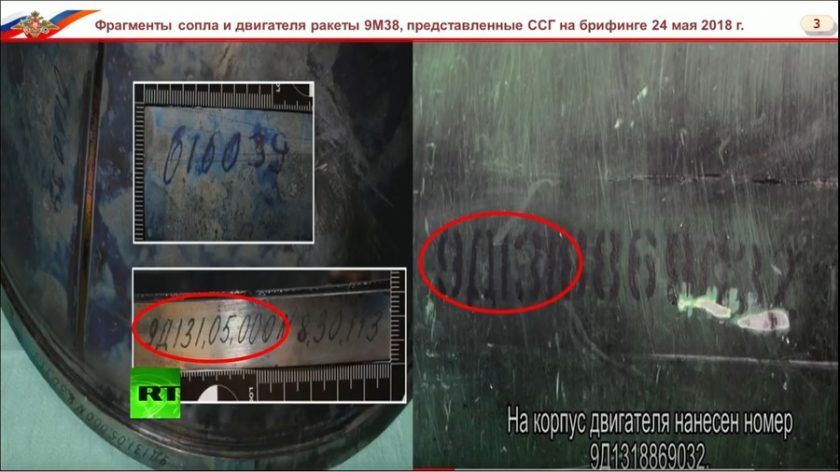
Serial number on engine and nozzle of the missile.
The missile was shipped from the plant on December 29, 1986 and delivered to military unit 20152 located in what is now Ukraine. It is now called 223rd anti-aircraft defense regiment of the Ukrainian armed forces, the report said. The unit took part in Kiev’s crackdown on rebels in eastern Ukraine in June 2014, the general said.
The evidence disproves the accusations by Ukraine and some other parties, which claim that a missile fired by a launcher, secretly delivered from Russia, was responsible for the downing of MH17, the Ministry of Defense report said. All the materials have been sent to the Dutch investigators, the Russian military added.

Missile shipment records found in Russia.
The Russian military also challenges video footage used by the UK-based group Bellingcat, which calls itself a citizen journalism organization, to back its allegations about the delivery of the Buk launcher from Russia. The Defense Ministry showed a video clip with some of the footage, highlighting inconsistencies, which it said proved that the footage had been manipulated to place images of the launcher into background which were not in the original.
The Bellingcat investigation was featured in the latest update by Dutch prosecutors involved in the MH17 investigation, prompting them to directly accuse Russia of providing the launcher and the missile. The Russian military said it decided after this to study the purported trail of photo and video evidence showing the path of the launcher in detail. The Russian video showed an example of how an Abrams tank can be shown to be carried by a trailer in the streets of Ukraine in the same way.

Analysis of Bellingcat footage by Russian experts.
The third part of the presentation was what the Russian officials called a record of intercepted communications of Ukrainian officials discussing, in 2016, the risk of flying through restricted airspace over Ukraine. Among a barrage of complaints one phrase says unless the restrictions are respected “we’ll f***ing f**k up another Malaysian Boeing”.
The Russian military say the complaints came from Col. Ruslan Grinchak, who serves in a brigade responsible for radar control in Ukrainian airspace. His unit tracked the MH17 flight in 2014, so he may have information which is not publicly available about the disaster, and his outburst may have been factual rather than hyperbolic, they suggested.
Gen. Igor Konashenkov, who hosted the briefing, said that Ukraine failed to provide radar data from its stations to the Dutch investigators. He also suggested that archive documents from the Ukrainian unit, which received the Buk missile back in 1986, would be of use to the probe, unless Kiev claims that they are no longer available. He stressed rules are in place which mean that such documents should still be stored in Ukraine.
The Russian military said they had no evidence to disprove a scenario, involving the Ukrainian rebels capturing the missile from the Ukrainian army, but pointed out that Ukrainian officials publicly denied anything like this had ever happened.
Malaysian Airlines flight MH17 was shot down over eastern Ukraine on July 17, 2014, falling in the rebel-held part of the country. The crash claimed the lives of 283 passengers and 15 crew members, most of them Dutch nationals. Russia was blamed by Western media in the first days after the tragedy, even before any evidence had been collected on the ground.
The Joint Investigation Team, which is lead by the Netherlands, includes Ukraine, but not Russia. Moscow believes that the investigation is biased, failing to obtain all necessary evidence from Ukraine and relying on questionable sources while ignoring evidence provided by Russia, which doesn’t fit the theory favored by Kiev. For instance, Moscow said a theory was never tested that the airliner could have been downed by a fighter jet spotted by Russian radar stations near flight MH17. The theory was later proven false by the discovery of debris from the Buk rocket.
Azov Sea Flashpoint: Russia, Ukraine Teetering on the Brink of War
By Peter KORZUN | Strategic Culture Foundation | 16.09.2018
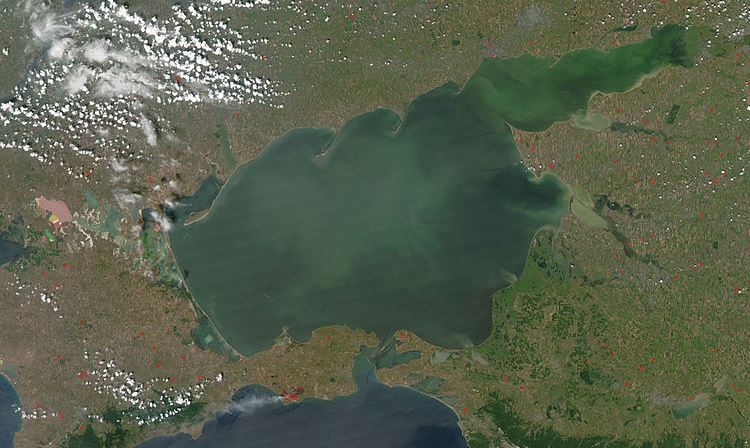
Ukraine has increased its military presence in the Azov Sea region. Ukraine’s National Security and Defense Council met on Sept. 7 and agreed to take a variety of steps to boost the country’s combat capabilities in the area, including the creation of a missile-equipped naval infantry group to counter potential amphibious attacks and naval shore bombardments. Ukraine’s Gurza-M-class armored artillery boats have been brought in to boost the naval component of the forces deployed in the region.
Russia and Ukraine enjoy free use of the Sea of Azov under the 2003 “Agreement between the Russian Federation and the Ukraine on cooperation in the use of the sea of Azov and the strait of Kerch.” The document is in place but it does not specify any precise border. The parties agree that the Sea of Azov and the Strait of Kerch are the internal waters of both Ukraine and Russia.
Talks have dragged on for a long time but have failed to produce a solution. Ukraine does not want to recognize Russia’s rights, which are based on the fact that Crimea has joined the Russian Federation. Moreover, Ukrainian authorities insist on their right to detain any ship traveling to or from Crimea without Kiev’s permission.
Ukraine is calling for the imposition of international sanctions against Russian Black Sea ports, due to what it calls the “blockade” of the Sea of Azov. It has already imposed punitive measures unilaterally. Tensions have heightened since March, when ships were detained and searched. On March 24, Ukrainian border guards stopped the Russian-flagged, Crimean-registered Nord fishing vessel in the Sea of Azov. The ship was hijacked. The crew members reported being interrogated and abused by Ukrainian authorities who held them accountable under domestic laws, not recognizing the crew as Russian citizens. The detained sailors were finally set free to return to Crimea without passports. Ukraine violated a number of international agreements and this marked the beginning of a campaign of provocative actions that has been waged ever since. Last month, the Russian Mekhanik Pogodin tanker was detained in the Ukrainian port of Kherson. Russia compared the move to the activities of Somali pirates.
The US is taking sides in order to ratchet up the tensions. The State Department has taken a deliberately provocative stance, urging Ukraine toward confrontation. Without bothering to study the details, it simply puts the blame on Russia as usual for anything that goes wrong. Washington is goading Ukraine into seeking a military solution, including such unrealistic but dangerous ideas as using the warships of NATO’s standing force to protect its shipping lanes, mining the Azov Sea, or using fast-moving attack vessels to encircle a large Russian naval asset from all directions like a wolf pack. This tactic was invented by German Admiral Karl Dönitz during WWII, when “wolf packs” of U-boats were used to attack capital ships. The very fact that such ideas have been generated and are floating around shows how unwise it is to abet Ukraine by throwing unconditional support behind it.
Stephen Blank of the American Foreign Policy Council, a leading US expert on Russia, believes that the US administration “should send anti-ship missiles available from or through the US-AGM-84 Harpoon Block II, AGM-158C LRASM A, and the Norwegian Naval Strike Missile” as well as “a viable launch platform and a targeting system, particularly a radar.” The author thinks this should be done right now, without delay. His article was published on Sept. 7 by the Atlantic Council, the prestigious think tank that advises the State Department and enjoys great influence among those who shape US foreign policy. In another article, Mr. Blanc calls for supplying Ukraine with platforms — older ships that have been decommissioned or are about to retire. Last month, Mykola Bielieskov, the Deputy Executive Director at the Institute of World Policy, called for fast-track shipments to Ukraine of the Harpoon Block II ER+ anti-ship missile, enabling it to attack Russian vessels. The idea of providing Ukraine with Island-class coast guard ships is under consideration by the US government. On Sept. 1, Kurt Volker, US Special Representative for Ukraine Negotiations, stated that the US administration “is ready to expand arms supplies to Ukraine in order to build up the country’s naval and air defense forces.”
The powers that be have failed to keep their promises and improve the lives of ordinary people in Ukraine. The presidential election will be held in March 2019. A threatening Russian bogeyman is needed to explain away the failures. The country’s economy and finances are in the doldrums and corruption is staggering. None of the problems have been solved and the West is getting tired of Ukraine. The fairy tale about Moscow’s “aggressive foreign policy” comes in handy right when the Ukrainian rulers need a scapegoat.
Nobody needs an armed conflict in the Azov Sea region. A number of countries are interested in protecting the right of free passage, enabling vessels to arrive at their destination ports without risk or delay. The region does not have to be a flashpoint. Russia and Ukraine could sit down at a round table to discuss controversial issues, as the 2003 agreement stipulates the parties should do in order to settle their disputes, should they have any, but that’s not what the State Department is calling for. The only option the US administration is considering is that of providing Ukraine with arms to fight Russia and then egging Kiev on to escalate the tensions. And those are already dangerously running high. A spark can ignite a big fire at any time if the problem is not addressed in a positive way without saber rattling. It’s a pity the US is playing such a destructive role. The time is right for Russian and Ukrainian experts and officials to set their differences aside and start talking to find a peaceful solution to this urgent problem.
State Department Slams Announcement of Donbass Elections Slated for November 11
Sputnik – 13.09.2018
WASHINGTON – The United States is condemning the elections in the self-proclaimed Donetsk People’s Republic (DPR) and Luhansk People’s Republic (LPR) scheduled for November 11, US State Department spokesperson Heather Nauert said Wednesday.
“The United States condemns the announcement of a plan to conduct ‘elections’ in the so-called ‘Donetsk and Luhansk People’s Republics.’ Given the continued control of these territories by the Russian Federation, genuine elections are inconceivable, and grossly contravene Russia’s commitments under the Minsk agreements. By engineering phony procedures, Russia is once more demonstrating its disregard for international norms and is undermining efforts to achieve peace in eastern Ukraine. The so-called ‘people’s republics’ that Russia created have no place within the Ukrainian constitutional order,” Nauert said.
She pointed out that the United States remained fully committed to diplomatic efforts aimed at resolving the conflict in eastern Ukraine. “US support for Ukraine’s sovereignty and territorial integrity remains unwavering,” Nauert added.
The conflict in the eastern Ukrainian region of Donbass started in 2014, when Ukrainian authorities launched a military operation against the DPR and LPR that refused to recognize the new government in Kiev, which came to power after what they considered to be a coup. In February 2015, the warring parties signed the Minsk peace accords to end the fighting in the region, but the situation remained tense, with both parties accusing each other of ceasefire violations.
Last week, the DPR Operational Command’s deputy chief Eduard Basurin called on Kiev to to give up attempts to exacerbate the conflict. According to the official, the Ukrainian forces have deployed about 100 pieces of heavy weaponry near Kiev-controlled Novosilka settlement in Donbas, including 18 units of Grad and 12 units of Uragan multiple rocket launcher systems.
The DPR comand has said that Ukraine had already deployed over 12,000 troops to launch an offensive against the DPR forces in the direction of the city of Mariupol following the assassination of the republic’s leader, Alexander Zakharchenko. According to the command, the offensive is scheduled for September 14.
Russian Foreign Minister Sergey Lavrov has said that the Western countries were responsible for the 2014 overthrown of then-Ukrainian President Viktor Yanukovych, which triggered the military conflict in the country.
Ukraine’s Detention of Vyshinsky Political Act, Violates International Law – Journalist

© SPUTNIK / VLADIMIR TREFILOV
Interview Published by Sputnik on August 24, 2018
Sarah Abed, an independent journalist, and political commentator, spoke with Sputnik about Ukraine’s detention of head of RIA Novosti Ukraine Kirill Vyshinsky, who has been confined for 100 days now. Russian President Vladimir Putin said that Vyshinsky’s arrest demonstrated an unacceptable policy of Ukrainian authorities targeting journalists.
Sputnik: Vyshinsky has been confined for 100 days now, what progress has been made on his release?
Sarah Abed: Unfortunately, not enough progress has been made, as he is still detained. However, he has requested that the Russian government (including President Putin) take whatever measures necessary to protect him and facilitate his release. As a result of his detainment, Vyshinsky decided to renounce his Ukranian citizenship. He was detained for acts of alleged “treason” and his home along with the homes of other RIA Novosti employees were searched by security forces on May 15.
The Russian government has expressed outrage and stated that this is part of an anti-Russia propaganda campaign launched by Western states. Russia has sent two protest notes to the Ukrainian Foreign Ministry demanding that they cease violence against media workers. Some have also said that what is taking place in Ukraine could be related to the recently opened Crimean bridge.
Evidence has yet to be presented that justifies his detainment for the past three months. Ultimately, he could face 15 years in prison if found guilty. His wife stated she is very concerned about his health issues and that he needs his medication while in custody. The bottom line is he needs to be released or evidence needs to be brought forth to justify his detainment (if it even exists, which is highly improbable at this time).
Sputnik: What statement is the government in Kiev trying to make by holding the head of RIA Novosti Ukraine?
Sarah Abed: Detaining journalists for having different views than what the Ukranian government and their Western puppet masters consider to be acceptable whilst claiming they are committing treason is sending a clear message that those who do not adhere to the official narrative will be silenced, imprisoned, their homes ransacked, and their lives ruined. Freedom of speech and press is necessary for any democracy to flourish, Ukraine claims to be a democracy, yet is actively suppressing information and limiting journalists’ ability to do their job. This is clearly a political act that not only violates international law, but human rights as well. It is entirely unacceptable to imprison and silence journalists for performing their journalistic duties to inform the public.
Sputnik: In your view, how has this situation been covered by Western media?
Sarah Abed: Quite frankly it hasn’t been covered by Western media, there has been a conscious deafening silence instead. It could even be considered a deliberate act of censorship by major western media outlets and is most likely due to the fact that Mr. Vyshinksy works for a Russian news agency. The “Russian propaganda” scare is being used to censor journalists and undermine their ability to disseminate and report on information that doesn’t parrot the official western imposed narrative.
US State Department Spokesperson Heather Nauert was asked about Kiev’s actions during a press briefing on May 15th and she responded, “… Goodness, when we talk with a lot of our allies and partners overseas, they certainly have fallen victim and understand the influence and the reach of Russian propaganda. So we do understand Ukraine’s concerns about that.”
Journalists worldwide have spoken in condemnation of the Ukranian government’s detainment of Vyshinksy, as well as the Russian Foreign Ministry, Human Rights Watch, International Federation of Journalists (IFJ), and a Twitter hashtag was created #TruthNotTreason.
Sputnik: What are your thoughts on his arrest? Some journalists have said that his confinement is a violation of all democratic norms. Would you agree with that?
Sarah Abed: Absolutely, as we have seen in this case, Western mainstream media has fallen short in reporting and supporting Vyshinksy’s rights not only as a journalist, but his basic human rights and fundamental freedom of the press which is guaranteed by Article 34 of the Ukranian Constitution and Article 10 of the European Convention for the Protection of Human Rights and Fundamental Freedoms.
It is our duty as journalists and commentators to stand by our peers and firmly object to their imprisonment without proper evidence that justifies the allegations made against them. Human Rights Watch has also called for evidence to be presented or that Mr. Vyshinsky is released. As we have seen in the past Kiev has repeatedly imposed restrictions on Russian journalists, including preventing them from entry. These concerns have been addressed by the Russian Foreign Ministry but as of yet, have not been justly resolved.
READ MORE:
#TruthNotTreason: Kirill Vyshinsky’s 100 Days Behind Bars in Ukraine
Researcher Sees Double Standard in Western Media’s Response to Vyshinsky’s Detention in Ukraine
Ukraine facing labor ‘catastrophe’ as millions of citizens flee country
RT | September 4, 2018
Nearly a million Ukrainians are leaving the country every year, according to Ukrainian Foreign Minister Pavel Klimkin, warning the country will face severe labor shortages in the years to come.
“We are really in a catastrophic situation with a million Ukrainians leaving every year,” the minister said in an interview with Ukrainian ICTV.
Klimkin said that Poland alone has received around 1.4 million Ukrainians recently, and that nearly 30 percent of the population of the western Polish city of Wroclaw now speaks Ukrainian.
According to Ukraine’s foreign ministry, about three million Ukrainian migrants currently live in Russia, and up to two million in Poland.
Kiev reportedly sees labor migration as the second biggest threat to the country’s national security. According to a poll carried out by Research & Branding Group last June, 33 percent of Ukrainians were ready to leave the country for good and move to another country for permanent residence.
Labor migration from Ukraine has been growing over the past five years. Apart from Russia and Poland, Ukrainians are moving to Slovakia, the Czech Republic, Hungary, Latvia, Lithuania, Estonia, and Spain.
The current situation is expected to worsen in the years to come, according to Ukrainian Deputy Minister of Social Policy Olga Krentovska. In April, she said the current labor migration would lead to labor shortages that will put Ukraine’s economic stability at risk in just a couple of decades.
Kiev has appealed to Ukrainians leaving the country, attempting to persuade them to choose European countries over migrating to Russia. Last week, Ukrainian Infrastructure Minister Volodymyr Omelyan said that Kiev may sever all remaining public transport links with Russia, which includes passenger trains and buses, due to national security concerns.
Ukraine’s population has seen a dramatic decline since the country declared its independence from the Soviet Union in 1991. From its 1993 peak of more than 52 million people, the country’s population had decreased by nearly 10 million by the end of 2016, according to official figures. That’s a net 18 percent drop.
Ambassador Kurt Volker: US to Drastically Expand Military Assistance to Ukraine
By Peter KORZUN | Strategic Culture Foundation | 03.09.2018
Washington is upping the ante in Ukraine. Kurt Volker, US Special Representative for Ukraine Negotiations, said in an interview with the Guardian published on September 1 that “Washington is ready to expand arms supplies to Ukraine in order to build up the country’s naval and air defense forces in the face of continuing Russian support for eastern separatists.” According to him, the Trump administration was “absolutely” prepared to go further in supplying lethal weaponry to Ukrainian forces than the anti-tank missiles it delivered in April. “They need lethal assistance,” he emphasized. Mr. Volker explained that “[t]hey need to rebuild a navy and they have very limited air capability as well. I think we’ll have to look at air defense.” The diplomat believes Ukraine needs unmanned aerial vehicles, counter-battery radar systems, and anti-sniper systems. The issue of lethal arms purchases has been discussed at the highest level.
The National Defense Authorization Act for Fiscal Year 2019 allocated $250m in military assistance to Ukraine, including lethal arms. The US has delivered Javelin anti-tank missile systems to Kiev but this time the ambassador talked about an incomparably larger deal. Former President Barack Obama had been unconvinced that granting Ukraine lethal defensive weapons would be the right decision, in view of the widespread corruption there. This policy has changed under President Trump, who — among other things — approved deliveries of anti-tank missiles to Kiev last December.
Ukraine has officially requested US air-defense systems. According to Valeriy Chaly, Ukraine’s ambassador to the United States, the Ukrainian military wants to purchase at least three air-defense systems. The cost of the deal is expected to exceed $2 billion, or about $750 million apiece. The system in question was not specified, but it’s generally believed to be the Patriot.
Volker’s statement was made at a time of rising tensions in the Sea of Azov, which is legally shared by Ukraine and Russia. It is connected to the Black Sea through the Kerch Strait. The rhetoric has heated up and ships have been placed under arrest as this territorial dispute turns the area into a flashpoint. Russia has slammed the US for backing Ukraine’s violations of international law in the area. According to a 2003 treaty, the Sea of Azov is a jointly controlled territory that both countries are allowed to use freely.
The US military already runs a maritime operations center located within Ukraine’s Ochakov naval base. The facility is an operational-level warfare command-and-control organization that is designed to deliver flexible maritime support throughout the full range of military operations. Hundreds of US and Canadian military instructors are training Ukrainian personnel at the Yavorov firing range.
NATO has granted Ukraine the status of an aspirant country — a step that is openly provocative toward Russia. Macedonia, Georgia, and Bosnia-Herzegovina are also aspirant nations. Last year, Ukraine’s parliament adopted a resolution recognizing full membership in NATO as a foreign policy goal. In 2008, NATO agreed that Ukraine along with Georgia should become full-fledged members. In March, Ukraine, Moldova, and Georgia announced the formation of an alliance to oppose Russia.
The US is to render substantial military assistance to a country with an economy in the doldrums, reforms that have foundered, a democracy that is in question, and corruption that is widespread. It will be no surprise if those weapons fall into the wrong hands and are used against the US military somewhere outside of Europe. It was the US State Department itself that issued a report this year slamming Ukraine’s human-rights record. The UN human-rights commissioner tells the same story. So do human-rights monitors all over the world.
By supplying the weapons that Special Representative Volker talked about in his interview, the US will become an accomplice to a conflict that has nothing to do with its national security or interests. The situation in the Donbas is being used by Kiev to distract public attention from the country’s worsening domestic problems. But to Washington Ukraine’s government is the apple of its eye, “a bastard but it’s our bastard” that is ready to do what it’s told.
The move is provocative and it may have consequences. For instance, Russia could supply the self-proclaimed republics in eastern Ukraine with up-to-date weapons systems in quantities sufficient to deter any military action on the part of Kiev. Once the Minsk accords are no longer functional and cannot command obedience, Moscow could recognize those republics as independent states that are eligible for military cooperation agreements, which would include stationing military bases on their soil. If their governments invited the Russian armed forces to be deployed inside their borders, it would be quite natural to agree to those requests. No international law would be breached. In a nutshell, if the US crosses that red line, Russia will act accordingly. Nobody seems to want a war raging in Ukraine, but that’s what the US weapons supplies would promote, egging the Ukrainian government on to seek a military solution. And what if it loses? Washington would be to blame for such a scenario. By the way, is it a coincidence that Mr. Volker’s interview appeared just as Alexander Zakharchenko, the leader of the Donetsk self-proclaimed republic, was assassinated? Just asking.
Lavrov calls murder of Donbass leader ‘blatant provocation’
RT | September 1, 2018
The assassination of the Donetsk People’s Republic’s leader Aleksandr Zakharchenko is intended to undermine the ceasefire deal in eastern Ukraine and make European-backed peace talks “impossible,” Russian FM Sergey Lavrov said.
“It is a blatant provocation aimed at undermining the implementation of the Minsk Agreement in eastern Ukraine,” Lavrov told reporters on Saturday.
Zakharchenko was killed on Friday when an explosive device detonated at a cafe in the Donetsk People’s Republic (DPR) capital, Donetsk. His bodyguard was also killed in the blast, and 11 people were injured.
“Given the current situation, it’s impossible to talk about the nearest meetings in the Normandy format like many of our European partners would have wanted,” Lavrov said. “It is a serious situation that must be analyzed. We are doing it right now.”
The Normandy format, also known as the Normandy Four, is a contact group comprising France, Germany, Ukraine and Russia. The group is tasked with negotiating a peace settlement in eastern Ukraine.
Germany Can’t Give Up on Cooperation With Russia in Oil and Gas – Merkel
Sputnik – 24.08.2018
Germany has greenlighted the Nord Stream 2 project to bring Russian gas to Europe and is under strong pressure from the US, which warns that the project is making Germany dependent on Russia. Berlin insists that the project is entirely commercial.
A planned sub-sea pipeline that will bring gas directly from Russia under the Baltic Sea will not make Germany dependent on Russia for energy, Chancellor Angela Merkel told university students in the Georgian capital Tbilisi on Friday, on the second day of her trip to the Caucasus.
Angela Merkel described continued Russian oil and natural gas supplies to Germany as an important factor in ensuring the country’s energy security.
”We have a decades-long history of economic cooperation with Russia, including on CO2 emissions. We have consistently been reducing our use of coal and we need natural gas coming to us via Belarus, Ukraine and Poland, that’s why we support Nord Stream 1 and 2,” Merkel noted.
She noted that Germany wanted to make sure that Russia continued delivering some gas via Ukraine even after the Nord Stream 2 pipeline was finished.
Mentioning the importance of expanding the so-called “Southern Corridor” for natural gas supplies also from Azerbaijan, she still pointed out that buying gas from Russia was cheaper than buying it elsewhere.
“Europe and Russia, then the Soviet Union, had very close energy cooperation during the Cold War. We can’t afford giving up on cooperation with Russia in oil and gas. Of course, we can have natural gas coming from Azerbaijan, but the truth is that it will not be available at the price we are paying for Russian gas,” Merkel said.
Some countries that are afraid of losing revenues from Russian gas transit, above all Ukraine, are opposed to Nord Stream 2.
The project is also facing opposition from the United States, which has ambitious plans of LNG exports to Europe.
Russia has repeatedly urged its European partners not to perceive the Nord Stream pipeline as an instrument of influence insisting that the project is an entirely economic one.
Washington Freezes Open Sky Treaty With Moscow in New Defense Bill
Sputnik – 13.08.2018
US President Donald Trump signed the $716 billion National Defense Authorization Act (NDAA) for the fiscal year 2019 at Fort Drum, New York on Monday.
The bill funds the Department of Defense as well as funding to accelerate US efforts to field a conventional prompt strike capability before 2022, $6.3 billion for the European Deterrence Initiative (EDI), and will obligate Defense Secretary James Mattis to submit a plan to Congress that would stop Turkey from getting F-35 aircraft if it purchases the Russian S-400 air defense system.
“An assessment of the potential purchase by the Government of the Republic of Turkey of the S-400 air and missile defense system from the Russian Federation and the potential effects of such purchase on the United States-Turkey bilateral relationship, including an assessment of impacts on other United States weapon systems and platforms operated jointly with the Republic of Turkey,” the legislation said.
The measure also includes $250 million in lethal defensive items for Ukraine.
Moreover, according to the NDAA, Trump must submit a report to the US Congress by January 2019 regarding whether Russia is in breach of the Intermediate-Range Nuclear Forces (INF) Treaty.
“Not later than January 15, 2019, the President shall submit to the appropriate congressional committees a determination whether — (1) the Russian federation is in material breach of its obligations under the INF Treaty; and (2) the prohibitions set forth in Article VI of the INF Treaty remain binding on the United States as a matter of United States law,” the NDAA said.
In addition, the United States will discuss with Russia if the latter’s new strategic weapon systems are in compliance with the New Strategic Arms Reduction (START) Treaty.
“Not later than December 31, 2018, the President shall… submit to the appropriate congressional committees a report as to whether… the President has raised the issue of covered Russian systems in the appropriate fora with the Russian Federation under Article V of the New START Treaty or otherwise,” the legislation said.
The NDAA also notes that the Russian systems of concern include the heavy intercontinental missile system Sarmat, the air-launched nuclear-powered cruise missile X-101, the unmanned underwater vehicle the US government calls “Status 6,” and the long-distance guided flight hypersonic glide vehicle Avangard.
Trump must report if Russia will agree to declare the covered systems as strategic offensive arms or otherwise pursuant to the New START Treaty, the legislation said.
The White House will notify the appropriate congressional committees as to whether the position of Russia threatens the viability of the New START Treaty or requires appropriate US political, economic or military responses, the legislation also said.
Moreover, the 2019 US National Defense Authorization Act revealed that Trump must present to Congress within 90 days a report on persons involved in transactions with Russia’s intelligence or military sectors.
“Not later than 90 days after the date of the enactment of this Act, the President shall submit to the appropriate congressional committees a report that describes those persons that the President has determined under section 231 of the Countering America’s Adversaries Through Sanctions Act [CAATSA]… have knowingly engaged, on or after August 2, 2017, in a significant transaction with a person that is part of, or operates for or on behalf of, the defense or intelligence sectors of the Government of the Russian Federation, the NDAA showed on Monday.
The NDAA also requires the US President to update such a report every 90 days following the first submission for the next five years.
Meanwhile, the bill also reinforces US partnership with Israel and authorizes co-production of missile defense systems as well as enhances US support for European partners against Russia by funding the European Deterrence Initiative.
Particularly, the Department of Defense must submit a report to Congress by next March on the feasibility of permanent deployment of US troops in Poland.
“Not later than March 1, 2019, the Secretary of Defense, in coordination with the Secretary of State, shall submit to the congressional defense committees a report on the feasibility and advisability of permanently stationing United States forces in the Republic of Poland,” the document said.
“The report required by subsection (a) shall include the following: An assessment of the types of permanently stationed United States forces in Poland required to deter aggression by the Russian Federation and execute Department of Defense contingency plans, including combat enabler units in capability areas such as (A) combat engineering; (B) logistics and sustainment; (C) warfighting headquarters elements; (D) long-range fires; (E) air and missile defense; (F) intelligence, surveillance, and reconnaissance; and (G) electronic warfare,” the NDAA said.
The NDAA also explained that an assessment of the permanent deployment feasibility should include an evaluation whether a US permanent deployment would increase deterrence against Russian as well as an assessment of Russia’s possible response.
In addition, the report should consist of an “assessment of the international political considerations of permanently stationing such a brigade combat team in Poland, including within the North Atlantic Treaty Organization (NATO),” the NDAA said.
Notably, the United States will also accelerate its hypersonic missile defense program and provide a report within 90 days to congressional defense committees.
“Subject to the availability of appropriations, the Director of the Missile Defense Agency (MDA) shall accelerate the hypersonic missile defense program of the Missile Defense Agency,” the document said.
The NDAA requires head of the Missile Defense Agency to “deploy such program in conjunction with a persistent space-based missile defense sensor program.”
NDAA provides 90 days for Missile Defense Agency to submit a report on the hypersonic missile defense program to the US Senate and House of Representatives defense committees.
The report, which may include classified annex along with unclassified content, should provide an estimate of the cost, technical requirements and acquisition plan, the NDAA said.
Featured Video

Dan Dicks with James Corbett on Solutions Watch
or go to
Aletho News Archives – Video-Images
From the Archives
Secret document reveals plans for civil war in Lebanon, Israeli false flags, and invasion
By Randi Nord | Geopolitics Alert | April 5, 2019
Beirut – During his visit with US Secretary of State, Mike Pompeo, Lebanese President Michael Aoun reportedly received a US-Israeli document detailing plans for creating a civil war in Lebanon with covert false flag operations and possible Israeli invasion.
Although the source of the document is Israeli and created in partnership with Washington, no one knows who presented it to Aoun. The Lebanese TV station, Al-Jadeed, initially reported the document on Lebanese TV and a video on its website. Geopolitics Alert translated the report for this article. … continue
Blog Roll
 Aletho News
- Sheikh al-Asadi warns of Iraqi government compliance with US demands
- How to MAKE THE CONSPIRATORS PAY for their crimes! Dan Dicks with James Corbett on Solutions Watch
- There’s a drought in academia: A drought in honest research on the subject of drought and other weather extremes
- Department of War Awards $20.7 Billion Contract to Raytheon for Air-to-Air Missiles
- ‘Distance yourselves from Israel’: IRGC urges US population to question govt policies
- America’s Greenland deal has a radioactive backstory
- The RAF Fairford ‘terror plot’: Unpacking escalation in the UK echo-chamber
- EU Council Advances Chat Control 2.0 Scanning Proposal
- Ex-Greek MEP files complaint against Israeli spyware firm over alleged Pegasus surveillance
- Troubling ideas throughout the Torah, Talmud, Mishneh Torah and Tanya
- If Americans Knew
- New Report: “Scholasticide and Genocide in Gaza: Assessment, Testimonies and Legal Analysis”
- Ex-Biden officials are desperate for a Gaza scapegoat
- Israeli “settlers” Invade Al-Aqsa; Pour Boiling Water on 75-Year-Old
- Israel Has Kidnapped Another American Teenager
- US arms sales to Israel worth $21.6 billion in 20 months
- Three Palestinians Killed in Israeli Attacks on Gaza
- Revealed: German “Anti-Semitism Expert” Driving Crackdown on Palestine Solidarity is Former Israeli Spy
- Egypt’s Warning to Israel Before Oct 7
- Israel’s siege signals another cruel winter for 1.8 million Gazans – Daily Update
- Netanyahu Asked UAE Leader to Deny Report on Oct. 7 Warning in Secret Visit, Sources Say
- No Tricks Zone
- New Study: Earth And Venus Surface Warmth Largely Explained By Convection And Lapse Rate, Not CO2 Or Radiation
- 2025 Nature Paper Claiming Worsening Global Drought Gets RETRACTED …Heavily Flawed
- New Study: ‘Global Drought Shows No Detectable Recent Acceleration Under Climate Warming’
- Economic Masterminds: German Socialists Suggest Taxing Productivity Gains Stemming From Using AI
- The South China Sea Has Not Been Cooperating With The Climate Change Narrative
- Energy Crisis: Germany Enters Heating Season With Historically Low Gas Reserve Fill Levels
- New Study: The Antarctic Ice Sheet Gained Mass From 2020-2024 Due To Staggering Snow And Ice Accumulation
- Study: Ocean Heating Rates From Thousands Of Years Ago ‘Dwarf’ Modern Ocean Heating Rates
- Climate Extremists Target, Attack Large-Scale Power Grid Infrastructure In Germany!
- New Study: Antarctic Ice Melt Has Contributed Less Than 1 Centimeter To Sea Level Rise In The Last 30 Years

