‘Silenced’? Ukrainian Military Pilot Accused of Attack on Boeing MH17 Found Dead
Sputnik | March 19, 2018
Vladislav Voloshin, the Ukrainian combat pilot which some Russian investigative journalists have accused of responsibility for the MH17 disaster, allegedly shot himself Sunday at his home.
According to a press release by police in the southern Ukrainian city of Mykolaiv, the 29-year-old pilot’s wife heard the gunshot and called the emergency services. Voloshin succumbed to his wounds on route to hospital. According to the police, the pilot was shot by a Makarov pistol, a standard issue military and police side arm in Ukraine. The weapon has been sent for examination. Police have opened a criminal investigation.
Relatives told police that Voloshin had been in a depressed state, and had voiced suicidal thoughts. Friends and family told local media that he was suffering from problems associated with the reconstruction of Mykolaiv’s airport, where he was acting director.
Voloshin’s name came to be associated with independent investigations into the destruction of Flight MH17 over eastern Ukraine. In late 2014, a Ukrainian army aircraft mechanic told Russian media that the passenger airliner may have been downed by a Su-25 close air support aircraft flown by Voloshin. The Ukrainian side confirmed that the pilot was in the military at the time, but denied that he flew on the day the Malaysian airliner was brought down.
Speaking to Sputnik about Voloshin’s suspected suicide, Ukrainian politics expert Bogdan Bezpalko said that Kiev’s version aside, “one cannot help but think that the other side may have eliminated him as a dangerous witness who could have lifted the veil of secrecy over the downing of MH17, which would subsequently strengthen Russia’s position.” According to the political scientist, “it’s quite obvious that it was not in Russia’s interest to shoot down this plane, and that all this was a provocation directed against our country.”
In Bezpalko’s view, Kiev and its Western power will continue to do everything they can to see that the truth about the tragedy of flight MH17 does not surface anytime soon. “It’s possible that others who could shed light on this matter will be ‘silenced’ in one way or another. So I don’t think we will learn the truth any time soon. I would like to recall, for example, that all matters related to the flight of Rudolf Hess to Britain [in 1941] remain classified to the British people for 100 years. And I think that the circumstances of the airliner will be made known only when the urgency of the matter disappears,” the observer said.
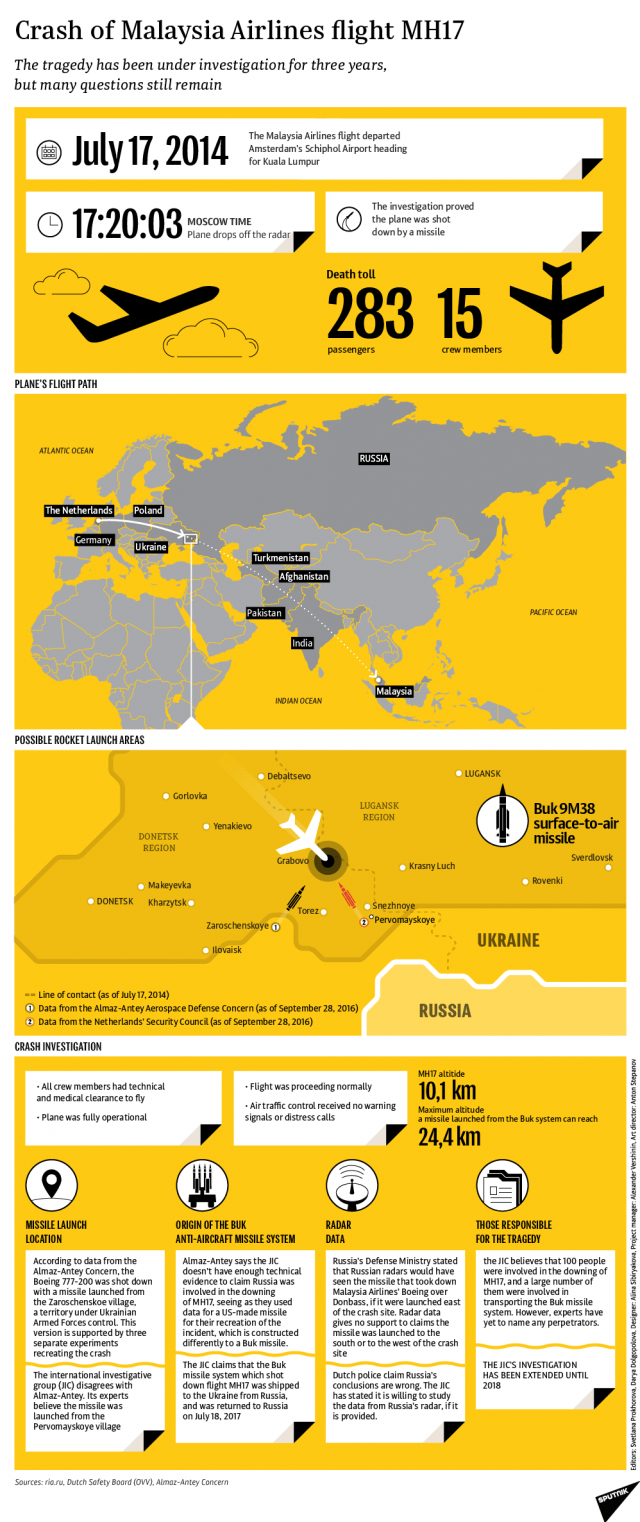
On July 17, 2014, a Malasyia Airlines Boeing 777 flying from Amsterdam to Kuala Lumpur crashed outside the city of Donetsk, eastern Ukraine, killing all 298 people onboard.
Kiev blamed the crash on the Donbass independence fighters, who countered by saying they did not have the means to bring down an aircraft flying at such a high altitude. An inquiry by Dutch investigators concluded that the Boeing was shot down by a Buk missile system, which it alleged was delivered to the militia from Russia and then sent back. Moscow slammed the inquiry’s bias, saying that the investigators’ conclusions were based exclusively on information received from the Ukrainian side. A separate investigation by Almaz-Antei, maker of the Buk system, concluded that the Boeing was shot down from territory controlled by the Ukrainian military.
US State Dept approves sale of $47mn worth of anti-tank missiles to Ukraine
RT | March 1, 2018
The US Department of State has signed off on the sale of Javelin anti-tank missiles to the government of Ukraine, the Pentagon has confirmed. The deal is valued at $47 million and needs congressional approval next.
If approved by Congress, the deal would involve the sale of 210 missiles and 37 command units, Defense News reported, citing Pentagon sources. The Pentagon claims it will not affect the military balance in the region, where the Kiev government is locked in conflict with two regions in the east of the country. Kiev has been accusing Moscow of backing the rebels, to the point of officially designating Russia an “aggressor” state.
“The Javelin system will help Ukraine build its long-term defense capacity to defend its sovereignty and territorial integrity in order to meet its national defense requirements,” the Pentagon said in a statement.
Earlier this week, Ukrainian President Petro Poroshenko said he was expecting the first lethal weapons deliveries from the US to take place “in a very few weeks,” without specifying what weapons Kiev is supposed to receive. The Pentagon, however, was more careful about the timeline. “On weapons delivery, it is premature to speculate on when that will happen,” US Department of Defense spokesperson Sheryll Klinkel told Sputnik.
The 2018 National Defense Authorization Act (NDAA) approved increased US military aid to Kiev, including lethal weapons. Until now, the US has assisted Ukraine’s military with logistics, intelligence, training and other types of support.
Washington has accused Russia of invading Ukraine since 2014, when armed activists backed by the US seized power in Kiev. Residents of several regions, including Donetsk, Lugansk and Crimea, refused to accept the new government’s policies.
Crimea voted to rejoin Russia, which it was separated from in 1954 by a decree of the Soviet leadership. Donetsk and Lugansk declared independence and have since been fighting off attempts by Ukraine’s military to “reintegrate” them by force.
Moscow denies involvement in the Ukrainian conflict, of which no consistent proof has been produced to date. It has repeatedly warned Washington against allowing lethal arms exports to Ukraine, saying it will stoke the military conflict and embolden Kiev’s offensive in the east of the country, further endangering the civilians that are already suffering there.
Read more:
‘Now Is the Moment’: Russia Urges US to Resume Dialogue on Missile Defense
Sputnik – February 5, 2018
MOSCOW – Russia and the United States should resume their dialogue on missile defense in light of the growing relevance of the subject, Russian Deputy Foreign Minister Sergey Ryabkov said.
“I would like to emphasize the growing relevance of the missile defense topic. Let me remind you that an indestructible connection between strategic offensive arms and missile defense is noted in the preamble of the current Reduction of Strategic Offensive Arms Treaty. There has been no substantial dialogue with the Americans on this matter for a long time. Now is the moment when it should be resumed,” Ryabkov said in an interview with the newspaper Izvestia.
The Russian diplomat stressed that in order to overcome the impasse in Russian-US relations, it was necessary to cooperate in a number of areas, including economic and regional crises.
“This agenda, in our opinion, includes issues of maintaining and ensuring of strategic stability… It also considers the work on regional crises… as well as economic interaction,” Ryabkov noted.
At the same time, the Russian minister stressed that the Russian-US talks on the crisis in eastern Ukraine’s Donbass region had not achieved workable solutions so far. Yet, Ryabkov expressed hope that both sides would find a “scheme” that would be acceptable for both Kiev and the self-proclaimed Donetsk and Luhansk Republics.
On Friday, the US Defense Department published the country’s new Nuclear Posture Review, which devoted great attention to the development of Russia’s nuclear capability.
In 2014, relations between Russia and the United States deteriorated over Moscow’s alleged involvement in the Ukrainian conflict and Crimea’s reunification with Russia in 2014 following a referendum.
The United States, as well as the European Union, has imposed several rounds of sanctions on Russia’s energy, banking, defense and other sectors, as well as on a number of Russian officials. Moscow has responded with countermeasures against the Western countries that targeted it with sanctions.
A Coming Russia-Ukraine War?
By Gilbert Doctorow | Consortium News | January 21, 2018
While much of America’s – and the world’s – attention focused this weekend reflecting on Donald Trump’s first year in the Oval Office, holding one-year anniversary events for the historic Women’s March and drawing up balance sheets of his promises and achievements, Russia has had a rather different issue on the front-burner: a possible war with Ukraine.
The situation in the Donbass region of south-eastern Ukraine has been a feature of Russia’s political talk shows for the past couple years, along with the military campaign in Syria and more recently the stages in the preparation for presidential elections on March 18.
Focus on the Donbass conflict increased in the closing weeks of 2017 as military action on the front lines separating the forces of the self-proclaimed republics of Donetsk and Lugansk enjoying Russian support from Ukrainian militias and armed forces reached an intensity not seen for more than a year. This is despite the heralded exchange of military prisoners by both sides before New Year’s under talks supervised by the Patriarch of the Russian Orthodox Church Kirill.
Then, this past Thursday came a wholly new development – a draft law passed by the Ukrainian Parliament that could effectively end Kiev’s participation in the conflict resolution process known as the Minsk Accords. Although observers in the United States and Western Europe may have missed it, many Russians believe this development amounts to a declaration of war.
Dmitri Kiselyov, head of all Russian television and radio news services, offered a sober analysis of the emotionally charged development on his Sunday evening news wrap-up today.
According to Kiselyov, the new law, which awaits Poroshenko’s signature, makes preparations for war and includes language indicating a bellicose new approach to the conflict. The mission in Donbass is no longer described as an “anti-terrorist operation.” Rather, the mission now is to send armed forces against “military formations of the Russian Federation” in Donbass.
Military headquarters are established to coordinate the operation to be waged in Donbass. While up until now the self-declared republics of Donetsk and Lugansk were considered under the Minsk Accords as negotiating parties, now there are only “occupation administrations” of the Russian Federation on these territories, with Russia identified as an “aggressor.”
“This makes it all the more convenient for Ukraine to start a war,” Kiselyov says, noting that it could have the added benefit of enabling Ukraine not to pay its foreign debts and to ensure Poroshenko’s continued grip on power.
A Vesti reporter on the ground in Donetsk confirmed with local residents their view that the law means war. They see the current moment on the front line as “the calm before the storm.” Donetsk soldiers at their trenches say they are fully ready to engage with the enemy.
While Kiselyov acknowledges that the draft law might not ultimately be implemented, it nevertheless reveals a growing mood in the Ukrainian capital in favor of escalation. The facts speak for themselves, Kiselyov says, with Poroshenko failing to adhere to the Minsk Accords – for example by organizing local elections in Donbass – or to observe ceasefires along the lines of contact. There are attacks and deaths every day and only counter force has pushed back recent Ukrainian attempts to gain territory.
Kiev has seemingly written off the population of the two self-proclaimed republics – cutting off all transport and telecoms links and failing to pay pensions and assistance to the needy. It closed the banking system and there are no commercial ties. For Kiev the two provinces are merely territory to take back from the occupiers, with the wellbeing of the local populations at best a secondary concern.
On the economic front, the European Union has refused to extend 600 million euros of credit to Ukraine due to corruption. The International Monetary Fund recently refused a tranche of $800 million over failure to introduce reforms. Meanwhile, in 2019 Ukraine is due to start repaying earlier loans. This will come to $14 billion a year, which amounts to half the state budget of Ukraine.
Due to dire economic conditions, Poroshenko and other government officials in Kiev have become deeply unpopular, and with diminished chances for electoral success may see war as politically advantageous.
And although there are indications that some Western leaders are fed up with Kiev, the United States has doubled down in its support for a military solution to the conflict. With military trainers now on the ground and the U.S. budgeting $350 million for security assistance to Ukraine, Washington has also recently started delivering lethal weapons including the Javelin anti-tank missile system free of charge to Kiev.
In contrast to the image of Trump administration policies being dictated by Moscow, as portrayed by proponents of Russia-gate conspiracy theories, the United States is instead moving towards deeper confrontation with the Kremlin in the geopolitical hotspot of Ukraine.
For its part, the Kremlin has very little to gain and a great deal to lose economically and diplomatically from a campaign now against Kiev. If successful, as likely would be the case given the vast disparity in military potential of the two sides, it could easily become a Pyrrhic victory.
But notwithstanding Kiselyov’s reassuring words on his Sunday evening news wrap-up, it may well be the case that Moscow feels it has no choice. Moves by Kiev to exacerbate the conflict must be quickly countered to prevent deeper intervention by the United States and its NATO allies and prevent the conditions for WWIII from taking hold.
Gilbert Doctorow is an independent political analyst based in Brussels. His latest book, Does the United States Have a Future? was published in October 2017.
Biden told ex-Ukraine President Yanukovich to resign, former VP reveals in memoirs
RT | December 26, 2017
Joe Biden bluntly demanded that former Ukrainian President Viktor Yanukovich resign back in 2014, the former US vice president revealed. He also confirmed the US was deeply involved in Kiev’s affairs during that year’s crisis.
From the very beginning of the Ukrainian crisis, the US sought to direct Yanukovich in his handling of the riots on Maidan Square that eventually led to a coup in Ukraine, Biden says in his new book titled “Promise Me, Dad: A Year of Hope, Hardship And Purpose,” which was published in November, but has now been brought into the media spotlight in connection with the US’s role in the crisis. Biden reveals that he repeatedly called the then-Ukrainian president, telling him what he should or should not do.
At some point, Biden outright demanded that Yanukovich, a legitimately-elected leader of a sovereign nation, resign because he had “lost the confidence of the Ukrainian people” from Washington’s point of view. “I was telling him [Yanukovich] it was over; time for him to call off his gunmen and walk away,” Biden writes in his book, referring to “the last of [his] urgent calls to Yanukovich in late February of 2014.”
The former US vice president also claims that it was Yanukovich and his loyal law enforcement forces who were responsible for the Kiev massacre back in 2014. In fact, the events, in which unknown snipers gunned down dozens of protesters and several police officers in central Kiev, remain largely unsolved nearly four years on. The investigation of the tragedy was de facto put on the back burner by the new Ukrainian authorities.
The probe initially managed to produce several suspects, with all of them being Berkut riot police members, even though it was known from the very beginning that sniper fire initially came from protester-controlled positions. Later, the head of an MP committee probing the mass killings mentioned “unidentified public organizations” as possible culprits, but no charges were known to have been placed. These facts, however, never stopped Biden from accusing Yanukovich of “loosing his riot police on the streets of Kiev… to murder demonstrators” and declaring the ousted president the main culprit behind the crisis.
Even though the new Ukrainian government, which came to power after the coup, was far more agreeable to US officials, it garnered no particular praise from the former US vice president. Biden calls former Ukrainian Prime Minister Arseny Yatsenyuk “a young patriot” and repeatedly draws attention to his efforts to support the “emerging Ukrainian democracy,” but at the same time complains about “bickering” within the Ukrainian elites and their reluctance to put “loyalty to country” over their personal interests.
“I had spent months exchanging phone calls with both [President Petro] Poroshenko and Yatsenyuk, trying to convince them each, separately, to put loyalty to country over loyalty to political party,” Biden writes, referring to Ukrainian President Poroshenko alongside Yatsenyuk, who was eventually dismissed from the government in 2016. He also repeatedly mentions the two politicians’ “stubborn unwillingness to work together.”
Widespread corruption in Ukraine seems to be another issue that constantly irritated Biden. The former official admits that he had to be “hard on Poroshenko since his election” and to constantly urge him to “continue to fight the elements of corruption that were embedded in the political culture of Ukraine’s Soviet and post-Soviet governance,” particularly in the president’s own party.
Biden claims he went as far as to direct almost each step of the Ukrainian authorities. “Now you’ve got to put people in jail,” Biden says he told Yatsenyuk when the Ukrainian official came to the US. He also admits that he “had been on phone with either Poroshenko or… Yatsenyuk, or both, almost every week” for months.
However, Biden believes the present Ukrainian government “had exhibited a penchant for corruption, self-dealing and self-destructive behavior.” He also points out that Europe was in fact reluctant to support the idea of anti-Russian sanctions and he had to repeatedly remind Poroshenko “not to give the Europeans any excuse for walking away from the sanctions regime against Russia.” Indeed, anti-Russian sanctions appear to have been of particular importance for Biden, as he seemed much more concerned about keeping them in place than about Washington’s European allies.
Biden also admits that he had a low opinion of the Minsk Accords aimed at bringing about peace in Ukraine. However, he seemingly fails to understand their purpose, describing the initial 2014 deal as something that “did little to hold [Russian President Vladimir Putin] back.”
Biden believes that Russia – which is not even a party to the treaty – is not fulfilling its commitments under the agreements. The OSCE-brokered Minsk Agreements between representatives of Kiev and the breakaway rebel regions of eastern Ukraine were hammered out by Ukraine, Russia, France and Germany, and formed the basis for a lasting ceasefire. However, the deal’s implementation has been largely stalled by Kiev’s refusal to uphold its part, including amnesty for rebel fighters and special autonomous status for the regions they control.
“The US Has Crossed The Line”: Russia Warns Trump Decision To Arm Ukraine Will “Lead To Bloodshed”
By Tyler Durden | Zero Hedge | December 23, 2017
Russia has reacted fiercely to the end of week breaking news that President Trump plans to approve the legal sale of US antitank missiles and possibly other advanced systems to the Ukrainian government in a move that could change the battlefield calculus of the war between Ukrainian and Russian-aligned forces in the Donbass region along the Russian border. ABC News described the “total defense package of $47 million includes the sale of 210 anti-tank missiles and 35 launchers” which will be sure to harm Trump’s longtime stated goal of improving relations with Moscow.
Though Kiev has long had limited access to US lethal arms through private contracts with American and international arms producers, this represents a significant escalation involving the likelihood that advanced US systems would be used directly on Russian-aligned militias in the eastern Donbass region and potentially Russian forces along the border. Up until now, the White House has been reluctant to escalate the war so openly, as it did when it supplied anti-Assad fighters in Syria with sophisticated TOW anti-tank missiles.
While the US State Department claims the move is “defensive” in nature, Russian deputy foreign minister Sergei Ryabkov charged the US with deliberately “crossing the line” and pushing the Ukrainian authorities “towards new bloodshed,” adding that “American weapons can lead to new victims”.
“Kiev revanchists are shooting at Donbass every day, they don’t want to conduct peace negotiations and dream of doing away with the disobedient population. And the United States has decided to give them weapons to do that,” Ryabkov said. He further slammed the US as an “accomplice in igniting a war” whose political leadership is “blinded by Russophobia and eagerly applaud the Ukrainian nationalist punitive battalions.”
Indeed a number of outspoken Russia hawks in Congress were enthusiastic over the possibility of heavier and direct arms flow to Ukraine, including John McCain, Bob Corker, and Tom Cotton – all supporters of the original Ukraine Freedom Support Act signed into law by President Obama in December 2014, though never fully enacted.
Cotton for example – recently rumored to be Trump’s pick for CIA Director – said of the new initiative for arms exports to Ukraine: “This is a break from failed Obama era policies to make Russia pay a cost for its aggression. With this decision, the Trump administration is reminding Vladimir Putin and his cronies that they lost the Cold War, and we won’t tolerate their bullying of our friend Ukraine.”
But Russian leaders have warned that through the decision the US may be dragged deeper into a quagmire which could result in direct confrontation with pro-Russian rebels in Ukraine’s east. Aleksey Pushkov, member of the Russian Senate security committee, told RT News that delivery of the more advanced systems like the Army’s M-148 Javelin Portable Anti-Tank Missile would require US military advisers on the ground, which could be targeted by separatist forces.
Pushkov told RT, the US “has enough problems already to allow itself to be involved in adventures of the [Ukrainian] regime. And we know too well how adventurous Kiev may be.” This comes as authorities in Kiev are already requesting that Washington adds anti-aircraft missiles to its shopping list as well, according to multiple reports.
Meanwhile German Chancellor Angela Merkel and French President Emmanuel Macron issued a statement calling for “disengagement and the withdrawal of heavy weapons” in the Ukrainian conflict, a scenario now much further away from taking shape than ever. But after years of covert American involvement in the Ukrainian proxy and civil war which has raged since 2014 – and which a leaked recording confirmed was precipitated by the US State Department – it appears that hawks like McCain, Cotton, and Corker are finally getting their way.
War & No Peace: US Cuts Kiev Off From Preferential Trade, Gives Go-ahead on Arms
Sputnik – December 23, 2107
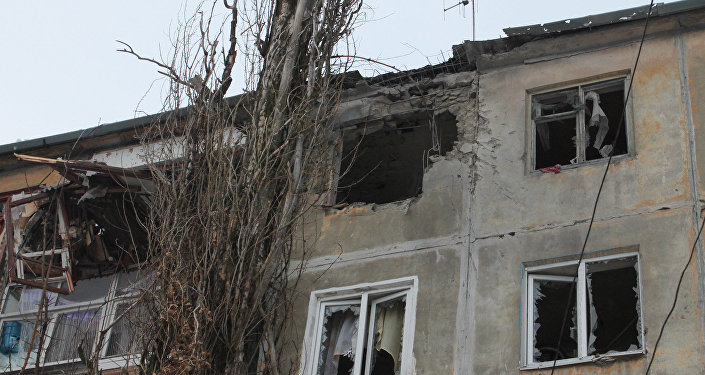
In a move that hardly seems coincidental, Washington made two announcements Friday which seem to outline its foreign policy priorities in Ukraine. Approving the supply of lethal weapons to the country, Washington threatened to partially suspend Kiev’s trade preferences with the US. Sputnik considers what may be behind the seemingly incoherent move.
Following months of internal debate, the State Department announced Friday that the US has “decided to provide Ukraine enhanced defensive capabilities” aimed at building up Kiev’s “defense capacity.” The move follows reports from earlier this week that the State Department had approved export licenses for the commercial sale of small parties of weapons to the instability-wracked country by US arms makers.
Also Friday, the US Trade Representative’s Office announced that President Trump would partially suspend Ukraine’s benefits under a US preferential trade program in 120 days unless the country makes major steps to better protect intellectual property rights. Kiev, according to the US trade office, has “failed” to adequately protect intellectual property, “despite years of encouragement and assistance from the US government.”
Trade officials did not clarify which part of the US Generalized System of Preferences agreement Ukraine would be nixed from, but the tendency seems clear: Washington is cutting out its economic support for Kiev, all the while upping its military assistance to the country, as tensions in the frozen Donbass conflict continue to smolder.
Economic Nationalism vs. Neoconservative Foreign Policy
President Trump’s economic nationalist approach to foreign policy hit Kiev particularly hard. Earlier this year, administration plans on US foreign aid for fiscal year 2018 leaked to US media outlined a whopping 68.8% cut in assistance to Ukraine. Ukraine’s Embassy in Washington quibbled over the scale of the cut, saying the proposal is really “around 30%.” At the same time, the Trump administration enthusiastically approved Kiev’s decision to buy US thermal coal, despite its price being almost double that which Ukraine would pay for the heating source from nearby Donbass or Russia.
At the same time, the US president has had considerably more difficulty challenging the neoconservative agenda on US Ukraine policy. Trump’s campaign promises of curbing US involvement overseas and trying to work together with Moscow on global issues, including the Ukraine conflict, haven’t panned out. Possibly under pressure from Congress and the US bureaucratic apparatus, Trump appointed John McCain ally Kurt Volker as the US’s special envoy to Ukraine. Making several trips to the country, Volker immediately began accusing Russia of engaging in ‘hybrid warfare’ in Ukraine’s breakaway Donbass region, and has pushed aggressively for a more active US policy vis-à-vis Kiev, including through the supply of lethal weapons to the country.
This past week, Volker warned that the situation in eastern Ukraine has significantly deteriorated, and even suggested that 2017 has become the “deadliest year” since the civil war began in 2014. Volker accused ‘Russian-backed forces’ of escalating the conflict.
Volker’s comments were echoed by the State Department on Tuesday, with spokesperson Heather Nauert openly accusing “Russia and its proxies” of being “the source of violence in eastern Ukraine,” and alleging that Moscow “continues to perpetuate an active conflict and humanitarian crisis” in the region. Nauert denied any possibility that the Donbass militia were “organic” entities which sprang up to resist Kiev in the months following the Maidan coup d’état in the Ukrainian capital in February 2014.Earlier this month, Russian Foreign Minister Sergei Lavrov and US Secretary of State Rex Tillerson met to discuss global hot spots, including Ukraine. Lavrov stuck firmly to the position Moscow has held since the signing of the Minsk accords in February 2015, stressing that the accords must be implemented, and arguing that Kiev has played the key role in stalling this process.
Cause for Dangerous Escalation
As far as US arms deliveries to Ukraine are concerned, Russia has vocally objected to the idea, and cautioned that the move would only threaten escalate the conflict. Earlier this year, President Vladimir Putin stressed that although the delivery of lethal weapons was a “sovereign decision of the United States” which Moscow could not stop, “the supply of weapons to the conflict zone is not beneficial to the peacekeeping process, and only exacerbates the situation. If this occurs, this action will not change the [strategic] situation… But the number of victims may certainly increase.”
With these issues in mind, the reaction from Moscow over Washington’s Friday announcement has been highly critical. Deputy Foreign Minister Grigory Karasin told RIA Novosti that the arms deliveries threaten to disrupt the peace process and hamper the implementation of the Minsk accords. Deputy Foreign Minister Sergei Rybakov echoed his colleague, saying that in the present situation the US in Ukraine looks “less like an intermediary and more like an accomplice in fueling the war.” Finally, Senator Franz Klintsevich, a senior member of the Senate’s security committee, warned that US weapons will encourage Kiev to use force. “The Americans, in essence, are directly pushing Ukraine’s military toward war,” he said.
With Ukraine recently approving a whopping 14.8% increase in its defense spending for the 2018 fiscal year, Washington’s decision to provide the country with lethal weapons is a worrying development. However, facing growing political instability at home, including a slew of street protests in the capital and more and more calls for the country’s government to resign, it’s unclear whether Kiev will dare to try to fulfill its dream of pacifying the Donbass by force.
Trump’s approval of lethal arms to Ukraine is a sideways move to nowhere
By Jim Jatras | RT | December 21, 2017
The Washington Post reports President Donald Trump has approved providing lethal weapons to Ukraine’s armed forces.
Specifically, according to the report, the decision opens the door for delivery of items like Model M107A1 sniper systems and ammunition, plus associated parts and equipment, with a value of $41.5 million. At the same time, presidential approval is reportedly still being withheld from providing Javelin man-held anti-tank missiles, which Kiev also wants.
The decision to provide lethal “defensive” weapons comports with repeated Congressional authorizations, passed with overwhelming bipartisan support since 2014. While former President Barack Obama declined to act on those authorities, President Trump evidently has now done so.
With regard to the domestic political purposes of the decision, it seems to be another Trump effort to appear wisely Solomonic by “splitting the baby”: look “strong” by making a muscular judgment but don’t go all the way. It’s the same ploy he used in recognizing Jerusalem as Israel’s capital (but not yet moving the US embassy, which he could easily do by switching the plaques of the US Consulate General in West Jerusalem with the current embassy in Tel Aviv) and by “de-certifying” the Iran deal (but not pulling the US out of it, yet).
For arming Ukraine, we can be sure Trump will be heaped with praise from the same domestic sectors that for more than a year have been denouncing him as “Putin’s puppet.” While there will be objections from antiwar dissidents – whose opinions don’t count – the only point of criticism from the establishment will be that he hasn’t yet gone far enough (the Javelins).
This has already begun, with Michael Carpenter, Barack Obama’s former Deputy Assistant Secretary of Defense for Russia, Ukraine, Eurasia, the Balkans, and conventional arms control, tweeting his approval of Secretary of Defense James Mattis for his role in the decision.
It’s reminiscent of the plaudits Trump received in April following his order to hit a Syrian airbase with cruise missiles in retaliation for a chemical attack that almost certainly was not committed by Syrian government forces. For example, at that time, CNN’s Fareed Zakaria, up to then uniformly a harsh critic who had derided Mr. Trump’s “rocking horse presidency” as a “circus,” intoned the next day: “I think Donald Trump became President of the United States last night.” Expect more of such hosannas in the coming days.
Carpenter’s mention of Mattis is significant. According to the Post report, Trump approved sending the arms to Ukraine by signing off on a decision memorandum presented by Mattis and Secretary of State Rex Tillerson. (It is certain that National Security Adviser H.R. McMaster also concurred, or the memo would not have been given to the President.) As Carpenter would know (and as I would know, having had a hand in drafting State Department decision memoranda), the principal almost always signs off on the decision option preferred by the subordinates who drafted the memo. While Trump no doubt understands the gravity of the decision, his grasp of the details would be no more than what his underlings wanted him to know to point him to their favored outcome.
The Ukraine decision comes two days after the release of a US National Security Strategy (NSS) that could be best called confused. Pillar I (defense of American borders and tightening immigration controls to keep dangerous people out) and Pillar II (ending unfair trade practices and restoring America’s industrial base) are solid “America First” principles from Trump’s campaign and a repudiation of the Democratic and Republican establishments.
But Pillar III could have been drafted by any group of George W. Bush retreads – and no doubt was – or for that matter by Obama holdovers. It is little more than a rehash of the usual litany of “threats” from China, Russia, North Korea, Iran, etc. Still, in his speech unveiling the NSS Trump made a point of acknowledging Russian President Vladimir Putin’s thank you call for reportedly providing intelligence information from the CIA to thwart a terrorist attack on St. Petersburg’s Kazan Cathedral. (One can’t help but wonder if the whole story was intended as a cover for some backroom effort to improve Washington-Moscow ties. After all, since the American side would never abide “thanking the Russians” for anything, having the Russians thank the US for something would be a sensible approach.)
In short, as with his Jerusalem and Iran nuclear moves, Trump’s Ukraine decision was mainly calculated for domestic political effect in the United States. Read most optimistically, it could be intended as political “protection” for some kind of positive move concerning Russia. But in the meantime, it could have consequences. How serious they might be remains to be seen.
First, the very notion of “defensive” weapons is a myth. Weapons kill. The units approved for sale to Ukraine are designed for use as anti-materiel rifles, but they can also be used as anti-personnel weapons. Their very nature is offensive, though their tactical use can be either offensive or defensive. Trump’s decision to supply the sniper systems to Kiev will not have any impact on the strategic situation on the ground in eastern Ukraine. Its only likely consequence is that more people will die, as Ukrainian forces use their new equipment to probe for vulnerabilities on the line of control. Forces of the Donetsk and Lugansk republics will respond in kind.
Second, the decision will have no positive influence on the political stalemate over the Donbas. With no effort from Kiev to implement the political aspects of the Minsk 2 agreement and with sporadic killing continuing – and now possibly being stepped up – along the front line, a political solution will be farther away as ever. Instability in Kiev, fed by the antics of the clownish former Georgian President Mikhail Saakashvili in his effort to topple the unpopular President Petro Poroshenko, makes serious political engagement all but impossible. Inside Ukraine, the only direct political consequence of Trump’s action will be to convince the Donbas even more – if that is possible – that no rapprochement with Kiev is possible.
Jim Jatras is a former US diplomat (with service in the Office of Soviet Union Affairs during the Reagan administration) and was for many years a senior foreign policy adviser to the US Senate Republican leadership.
Featured Video
Dan Dicks with James Corbett on Solutions Watch
or go to
Aletho News Archives – Video-Images
From the Archives
Secret document reveals plans for civil war in Lebanon, Israeli false flags, and invasion
By Randi Nord | Geopolitics Alert | April 5, 2019
Beirut – During his visit with US Secretary of State, Mike Pompeo, Lebanese President Michael Aoun reportedly received a US-Israeli document detailing plans for creating a civil war in Lebanon with covert false flag operations and possible Israeli invasion.
Although the source of the document is Israeli and created in partnership with Washington, no one knows who presented it to Aoun. The Lebanese TV station, Al-Jadeed, initially reported the document on Lebanese TV and a video on its website. Geopolitics Alert translated the report for this article. … continue
Blog Roll
 Aletho News
- Sheikh al-Asadi warns of Iraqi government compliance with US demands
- How to MAKE THE CONSPIRATORS PAY for their crimes! Dan Dicks with James Corbett on Solutions Watch
- There’s a drought in academia: A drought in honest research on the subject of drought and other weather extremes
- Department of War Awards $20.7 Billion Contract to Raytheon for Air-to-Air Missiles
- ‘Distance yourselves from Israel’: IRGC urges US population to question govt policies
- America’s Greenland deal has a radioactive backstory
- The RAF Fairford ‘terror plot’: Unpacking escalation in the UK echo-chamber
- EU Council Advances Chat Control 2.0 Scanning Proposal
- Ex-Greek MEP files complaint against Israeli spyware firm over alleged Pegasus surveillance
- Troubling ideas throughout the Torah, Talmud, Mishneh Torah and Tanya
- If Americans Knew
- New Report: “Scholasticide and Genocide in Gaza: Assessment, Testimonies and Legal Analysis”
- Ex-Biden officials are desperate for a Gaza scapegoat
- Israeli “settlers” Invade Al-Aqsa; Pour Boiling Water on 75-Year-Old
- Israel Has Kidnapped Another American Teenager
- US arms sales to Israel worth $21.6 billion in 20 months
- Three Palestinians Killed in Israeli Attacks on Gaza
- Revealed: German “Anti-Semitism Expert” Driving Crackdown on Palestine Solidarity is Former Israeli Spy
- Egypt’s Warning to Israel Before Oct 7
- Israel’s siege signals another cruel winter for 1.8 million Gazans – Daily Update
- Netanyahu Asked UAE Leader to Deny Report on Oct. 7 Warning in Secret Visit, Sources Say
- No Tricks Zone
- Two More Paleo Reconstructions Affirm Meters-Higher Sea Levels Across Ireland, Brazil 7000-6000 Years Ago
- New Study: Earth And Venus Surface Warmth Largely Explained By Convection And Lapse Rate, Not CO2 Or Radiation
- 2025 Nature Paper Claiming Worsening Global Drought Gets RETRACTED …Heavily Flawed
- New Study: ‘Global Drought Shows No Detectable Recent Acceleration Under Climate Warming’
- Economic Masterminds: German Socialists Suggest Taxing Productivity Gains Stemming From Using AI
- The South China Sea Has Not Been Cooperating With The Climate Change Narrative
- Energy Crisis: Germany Enters Heating Season With Historically Low Gas Reserve Fill Levels
- New Study: The Antarctic Ice Sheet Gained Mass From 2020-2024 Due To Staggering Snow And Ice Accumulation
- Study: Ocean Heating Rates From Thousands Of Years Ago ‘Dwarf’ Modern Ocean Heating Rates
- Climate Extremists Target, Attack Large-Scale Power Grid Infrastructure In Germany!

