A Kiev-sponsored UN resolution condemning the human-rights situation in Crimea and the city of Sevastopol failed to convince much of the UN General Assembly, as 76 countries abstained, 26 opposed, and 70 supported the motion.
Among those who voted against the resolution were Russia, China, India, Iran, Serbia, and Belarus; while the US and its allies approved. In all, countries representing nearly half the world’s population rejected the document.
The resolution called on Russia, described as an “occupying power,” to “take all necessary measures to immediately put an end to all violations and infringements of human rights against the inhabitants of the Crimea.” It also called on the country to rescind the “illegal establishment of laws, jurisdiction and management by the Russian Federation” in Crimea, and to provide “accessibility of education in the Ukrainian and Crimean Tatar languages.” In addition, it requires Russia to annul its recognition of the Mejlis of the Crimean Tatar People as an extremist organization.
Deputy Permanent Representative of Russia to the UN Yevgeny Zagainov said before the vote that the resolution was meant to divert attention from Ukraine’s violations of human rights with “torture, enforced disappearances, arbitrary detentions, discrimination, political persecution, violations of freedom of expression,” and the impunity for those responsible for burning dozens of anti-government activists in Odessa in May 2014.
Zagainov said that the Ukrainian delegation and its patrons do not care about human rights in the Russian region or its inhabitants wishes, but rather aims to challenge the status of Crimea and distort realities on the ground through human rights rhetoric. He noted past actions by the Mejlis in Crimea in relation to organized provocations, blockages and attempts to increase inter-ethnic tensions.
With this resolution, they “encourage these very dangerous fantasies, creating the ground for Kiev’s provocations and enterprises and thus sharing responsibility for them,” warned Zagainov.
He said that Kiev had passed a controversial new law in September that “deprives hundreds of thousands of children of the opportunity to receive education in their native language.” Various European countries, such as Hungary, Romania, Bulgaria, Poland had complained in the OSCE about this language law and the rights of minorities in Ukraine. Zagainov’s concerns about Ukraine’s human rights problems have been confirmed in the reports of the UN mission deployed in Ukraine to monitor the human rights situation.
Following the coup in Ukraine, the rise of radical nationalist groups, and the worsening situation in Donbass, the population and authorities of Crimea feared a crackdown on the Russian people and language. They expressed their desire to rejoin Russia in a referendum that took place on March 18, 2014, when more than 80 percent of eligible voters participated. Some 96.7 percent voted for reunification in Crimea, including 95.6 percent in the city of Sevastopol. The same day, Russian President Vladimir Putin signed a decree allowing the Republic of Crimea and Sevastopol to join the Russian Federation.
A senior representative of the Russian parliamentary majority party has called the UN resolution on human rights in Crimea a provocation aimed at justifying the growing expenses of supporting Ukraine and countering Russia.
MP Sergey Zheleznyak (United Russia) said on Wednesday that the resolution was prepared by anti-Russia politicians from Ukraine, the EU, and the US, adding that he personally was outraged by the fact that the Human Rights Monitoring Mission had prepared the document on the basis of statements made by Ukrainian politicians, without actually visiting the peninsula and looking into these claims.
“Respectable international organizations, such as the United Nations, must thoroughly study the true state of affairs, have a weighted approach to any political provocation and give their own assessment of the events that take place in the world,” Zheleznyak said.
He added that many Western politicians visited Crimea after its reunification with Russia and realized that “the true goal of Ukrainian ‘human rights advocates’ is only the creation of lies about our country.”
“Just as the previous Kiev initiatives, this one has nothing in common with the real situation concerning human rights, freedom of conscience, and school lessons in native languages… The real objective behind this resolution is heating up the anti-Russian tensions in order to justify the funds spent on containment of our country and on support of the Kiev regime,” he said.
On Tuesday, the UN General Assembly approved a resolution on human rights in Crimea. 70 nations, including most European countries and the US, voted in support of the resolution, with 26 voting against and 76 nations abstaining from voting. The document describes Crimea’s accession into the Russian Federation as “occupation” and gives 20 recommendations on how Moscow should stop the alleged rights abuses in the republic.
Soon after the resolution was passed, Sergey Aksyonov, the head of the Crimean Republic, wrote on his Facebook page that the document was just another collection of “propaganda myths from Kiev,” adding that the 2014 reunification with Russia was a free choice of the republic’s citizens.
READ MORE: Overwhelming majority in Crimea today would still vote to join Russia – German survey
December 20, 2017
Posted by aletho |
Aletho News | Human rights, Russia, Ukraine, United Nations, United States |
Leave a comment
The decision by the European Union countries at their summit in Brussels on Thursday to extend the sanctions against Russia was not a surprise. But the ease with which the decision was made is notable – with no discussions or arguments. The German Chancellor Angela Merkel and French President Emmanuel Macron presented a report on the status of implementation of the Minsk agreement, highlighting the lack of progress in Ukraine and the EU took a unified stance to extend the sanctions. The sanctions will now extend automatically up to July 31 next year.
Moscow has reacted calmly, but the fact remains that relations between Russia and EU countries will remain in limbo. The sanctions comprise different packages such as financial restrictions on Russia’s leading defense and energy companies, on Russian companies’ access to large European banks to raise loans for projects, embargo on Russia’s imports of military and energy technology and high-tech equipment from Europe, blacklisting of Russian individuals and legal entities, and a set of targeted sanctions in relation to Crimea such as ban of any dealings with that region by European businesses.
Strategically, Russia’s dependence on China will only increase. The prospects of Merkel remaining in power in the near term look good with the U-turn by the Social Democratic Party on forming another grand coalition with her Christian Democratic Union. This will not be good for Russia. Equally, whatever hopes might have been there in Moscow for a new beginning with France under Macron have fizzled out. A German-French axis is being forged with renewed vigor to accelerate the EU integration processes and transform the grouping as a heavyweight in Eurasian politics. Russia would have preferred a weakened, dispirited European Union that created space for it to deal with individual European countries on bilateral basis.
On the other hand, the drift in transatlantic relations is also a compelling reality. The European stance on East Jerusalem highlights it. The five-day 3-nation European trip to Brussels, Vienna and Paris by the US state secretary Rex Tillerson could not rollback the rising tensions. The EU Foreign Policy Chief Federica Mogherini noted after talks with Tillerson that the bloc believes that any action that would undermine the peace-making efforts between Palestine and Israel “must absolutely be avoided.” On the Iran nuclear deal, she underscored that the continued implementation of the Iran nuclear deal is a key strategic priority for European, regional and global security.
Then, there is also a divergence on values that cannot be papered over. Europe remains a strong supporter of multilateralism, the UN system, and a rules-based global order. Europe views with distaste and horror Trump’s embrace of ultra-nationalism and his barely concealed Islamophobia. After Tillerson left, Mogherini took her gloves off, saying, Trump’s decision on Jerusalem “has a very worrying potential impact in this very fragile context. Now what the worst possible development could be that a bad situation turns into a worse one and that tensions inflame the region even further.” Suffice to say, Trump is a lump in the European throat – it can’t swallow it or spit it out. Any uplift in transatlantic relations under these circumstances is unlikely.
Russia may take vicarious satisfaction that Brussels is no longer willing to positively commit itself to the US regional and global agendas. However, there is a flip side to it. The US would have greater need today to stoke up Russophobia to rally the European countries under its leadership. Tillerson used strong language to highlight that Russia poses a threat to the West. At the NATO foreign ministerial meeting in Brussels last week Tillerson warned all European nations of Moscow’s “intrusion”. He said, “Russia’s aggression in Ukraine remains the biggest threat to European security.” Tillerson accused “Russia and its proxies” of “harassment, intimidation, and its attacks on the OSCE Special Monitoring Mission (in Ukraine.)”
Interestingly, he went out of the way to flag that Trump is really not enamored of Russia as Europeans might think. “Trump does not talk with President Putin as often as with other world leaders, and I think, again, that’s simply a reflection of the strained relationship that exists between the United States and Russia,” Tillerson noted.
“We join our European partners in maintaining sanctions until Russia withdraws its forces from the Donbass and meets its Minsk commitments,” Tillerson added. He said the West should not regularize or renormalize the relationship with Russia “until Russia begins to address those actions which we find not just unacceptable but intolerable.” But Brussels keeps an ambivalent attitude toward Russia. It feels uneasy that Trump may one day wade into a Washington-Moscow rapprochement too soon, even before the Ukraine question is solved. On the other hand, Europe also is nervous about getting caught between a nasty showdown between Washington and Moscow.
Washington may leverage the situation in Ukraine to stoke up tensions there with the aim to keep the US’ European allies in line. Most certainly, US and Canada’s decision last Wednesday to lift the ban on supply of arms to Ukraine looks ominous. Russia repeatedly warned that such moves could have dangerous consequences. On Thursday in Moscow, President Vladimir Putin warned of a massacre in eastern Ukraine “worse than in Srebrenica” (horrific massacre of Serbs in the former Yugoslavia in 1995) if the West strengthened the Ukrainian nationalist forces.
December 17, 2017
Posted by aletho |
Economics, Militarism, Russophobia, Timeless or most popular | European Union, Russia, Ukraine |
Leave a comment
The Canadian government has given the green light for national defence contractors to sell weapons to Ukraine. This makes Canada a party to the conflict with all ensuing consequences. The decision sets no preconditions for selling the armaments to Ukraine. It has been taken despite the fact that Project Ploughshare and Amnesty International Canada opposed the plan, saying Kiev has so far failed to improve the human rights situation. Canada’s Standing Committee on National Defense has published a report entitled “Canada’s Support to Ukraine in Crisis and Armed Conflict,” which recommends that the government provide lethal weapons to Ukraine if it demonstrates active work on fighting corruption in the country. The recommendations include providing lethal weapons, intelligence exchange, cooperation in defense industry, support in countering cyberattacks, and in resisting to the dissemination of foreign propaganda and disinformation through the media. Granting visa-free travel to Canada for Ukrainians and promotion of Ukrainian interests at the G7 is also on the recommendations’ list.
The Canadian Cabinet hopes its decision will influence the US Administration to follow suit. The move puts Canada out ahead of the United States, which is considering its own arms sales. Kurt Volker, the US Special Representative to Ukraine, believes there’s no reason to continue the prohibition on delivering lethal weapons.
Ukraine is particularly interested in anti-tank weapons, counter-battery artillery radar, and armoured patrol vehicles like the US-made Humvees.
On December 12, US President Donald Trump signed a defense budget for 2018 providing for the possibility of offering Ukraine lethal weapons of a “defensive nature”. Congress has approved $500 million in “defensive lethal assistance” to Ukraine. Congress authorized $350 million more than the $150 million originally proposed by the administration. Now, the president can start arms supplies any time he chooses. Former President Barack Obama was unconvinced that granting Ukraine lethal defensive weapons would be the right decision in view of corruption widespread in Ukraine.
The two events – Canada’s decision and signing the US defense budget bill into law – come in the context of the failed US-Russia talks on the recently proposed UN peacekeeping mission in Donbass. Now the US weapons could be exported to Ukraine through Canada, including the much-desired Javelin anti-tank systems. “After this government decree, Canada can sell or transfer Javelin to Ukraine,” said James Bezan, Canadian MP from the Conservative Party. The US has been sending to Ukraine a variety of non-lethal military help, including equipment like Humvees, medical supplies, bulletproof vests, and radars to track the hundreds of artillery shells.
North America’s assistance to Ukraine is not limited to weapons only; it encompasses other domains as well. The Ukraine Cybersecurity Cooperation Act [H.R. 1997], the bipartisan legislation introduced by Congressmen Brian Fitzpatrick (PA-8) and Brendan F. Boyle (PA-13), unanimously passed the House Foreign Affairs Committee on Dec. 14. The bill encourages cooperation between the United States and Ukraine on matters of cybersecurity and requires State Department reporting to Congress on best practices to protect against future cyber-attacks. “Helping Ukraine buttress its cyber defenses will also help the United States in developing new and more effective technologies and strategies in dealing with cyber security on the modern battlefield,” said Boyle, explaining the goal to be achieved, if the legislation becomes law. It will make Ukraine a part of NATO cyber warfare effort being implemented according to its Cyber Defense Pledge.
The bloc is implementing the Capability Package 120 which aims by 2024 to fund everything from encryption for tactical radios to cloud-integrated storage for the millions of cyber events. Eventually, NATO will move to the public cloud for virtually everything that it does as an alliance. The “centralized patch management” will control all the cyber activities.
For more than two years, the US military’s contingent of roughly 300 military instructors have been quietly training Ukrainian military in the western part of the country to prepare them for fighting in the east. Every 55 days a new Ukrainian battalion comes in to go through a training course at Yavoriv Combat Training Center in western Ukraine. Since 2014, the US and partner militaries have helped grow Ukraine’s forces from just over 100,000 troops to nearly 250,000 today. The US-run maritime operations center at Ochakov Naval Base, Ukraine, became operational in July to serve as a major planning and operational hub during future military exercises hosted by Ukraine. A US military facility near Russia’s borders is a very serious threat to regional security. Its presence turns the Black Sea into a hot spot. US warships visit the sea regularly to provide NATO with long-range first strike capability. The Romania-based Aegis Ashore BMD system uses the Mk-41 launcher capable of firing Tomahawk long-range precision-guided missiles against land targets.
Also in July, two US Navy warships, a P-8A Poseidon patrol aircraft, and a Navy SEALs team took part in the 12-day Sea Breeze 2017 joint NATO naval exercise off Ukraine. The multinational war games took place in the northwestern part of the Black Sea, near the Ukrainian port city of Odessa. 17 nations took part in the training event. The preparations are on the way to hold another Sea Breeze exercise in 2018. Step by step, Ukraine is becoming an element of NATO’s military infrastructure, which could be used as a springboard for a cross-border attack against Russia.
December 17, 2017
Posted by aletho |
Militarism | Canada, NATO, Ukraine, United States |
Leave a comment
Landmines killed 8,605 people in several countries in 2016, despite an international ban on the deadly device, a monitoring group says.
According to the annual report released Thursday by Landmine Monitor, about three-quarters of the known casualties were civilians, including more than 1,000 children who were injured and nearly 500 who were killed.
The number of the casualties — which were mostly recorded in Afghanistan, Libya, Ukraine and Yemen — showed a 30% surge compared to 2015.
“A few intense conflicts, where utter disregard for civilian safety persists, have resulted in very high numbers of mine casualties for the second year in a row,” Loren Persi, an editor of the Landmine Monitor said.
Persi described the spike as “alarming”, adding that the true number of the victims would be significantly higher if the data gathering were complete.
The surge comes after a 18-year decline in landmine casualties since the Mine Ban Treaty first came into force in 1999.
The treaty bans the use of landmines and other explosive devices placed on or under the ground, designed to blow up when somebody unintentionally steps on them.
These weapons can be continuously deadly weapons for many years, long after the war has ended. About 80% of landmine victims are civilians.
The Mine Ban Treaty, which has been signed by 163 countries, also bans production, stockpiling and transfer of the deadly landmines.
December 14, 2017
Posted by aletho |
Militarism | Afghanistan, Libya, Ukraine, Yemen |
Leave a comment
By including Ukraine on the list of countries approved for lethal weapons sales, Canada has become a side in a bloody civil war, undermining a shaky peace process, a senior Russian senator said, as Ukraine’s President Petro Poroshenko applauded the move.
Poroshenko praised the US and Canadian governments for stepping up military cooperation with Ukraine, which could lead to lethal weapons from both countries being supplied to the Ukrainian army, embroiled in a long-running civil conflict with rebel militias from breakaway eastern Ukraine’s Donetsk and Lugansk Republics.
“As it was agreed, the United States authorized security assistance for our country and Canada included Ukraine into the Automatic Firearms Country Control List. The door to enhanced defense assistance for Ukraine has been opened,” Poroshenko wrote on Facebook, as US President Donald Trump signed a new Pentagon funding bill and the government in Ottawa revealed its decision to greenlight the export of “certain prohibited firearms, weapons and devices” to Ukraine by including it into its list.
Unlike the Pentagon bill, Canada’s decision sets no preconditions for selling the armaments to Ukraine. The Canadian government’s only precaution is to examine the export applications on a case-by-case basis, to establish who will be using the weapons and how.
This makes Canada a party to the conflict, says Franz Klintsevich, the first deputy chairman of the Russian Federation Council’s Committee for Defense and Security.
“A very dangerous precedent has been created: Effectively, Canada has become a party to the internal Ukrainian conflict with all ensuing consequences. And this, above all, means that it assumes responsibility for the actions of the Ukrainian forces, trained by Canadian instructors and equipped with Canadian weapons,” Klintsevich said.
Be arming one side, Canada could tip the relative balance of power, fueling the stalled hostilities and shattering the hopes of peace. “To call a spade a spade, Canada has directly opposed the Minsk Accords,” Klintsevich said.
The US approved $500 million in “defensive lethal assistance” to Ukraine on Wednesday as Trump signed into law the 2018 National Defense Authorization Act (NDAA) drafted by Congress in late November.
The act claims that the US should beef up its military presence in Eastern Europe in face of the perceived “Russian aggression,” as well as to help Ukraine to tackle it. However, the allocation of the funds is conditional on the Ukrainian military undergoing “substantial” reforms. It is ultimately up to the US Secretary of State to decide if Ukraine has met the prerequisites.
Russia may take the issue of weapon sales and lethal aid to Ukraine to the UN Security Council, Yuri Schvytkin, deputy chairman of State Duma’s Defense Committee, told RIA Novosti.
A recent report by the Stockholm International Peace Research Institute (SIPRI) found that US arms sales overseas as well as its ongoing military operations were two main factors that drive global weapons trade, that rose for the first time in five years. With 38 firms that account for combined $217.2 billion in weapon sales, the US ranked first on the list of arms manufacturing countries.
In line with its strategy of encircling Russia with NATO contingents and “purely” defensive military equipment, Washington has recently authorized a shipment of 410 Javelin Missiles as well as 72 Javelin Command Launch Units to Georgia.
The promised delivery was slammed by Moscow, with Russian Deputy Foreign Minister Grigory Karasin arguing in November that it “directly encourages Tbilisi to new dangerous adventures in the region.”
December 14, 2017
Posted by aletho |
Militarism, Timeless or most popular, War Crimes | Canada, Russia, Ukraine, United States |
Leave a comment
Yesterday, Secretary of State Rex Tillerson swore into office a new Assistant Secretary of State for European and Eurasian Affairs. Dr. A. Wess Mitchell became the Trump Administration’s top diplomat for Europe, “responsible for diplomatic relations with 50 countries in Europe and Eurasia, and with NATO, the EU and the OSCE.”
Readers will recall that the position was most recently held during the Obama Administration by Kagan family neocon, Victoria Nuland, who was key catalyst and cookie provider for the US-backed coup overthrowing the elected government in Ukraine. Victoria Nuland’s virulently anti-Russia position was a trademark of the neocon persuasion and she put ideology into action by “midwifing,” in her own words, an illegal change of government in Ukraine.
It was Nuland’s coup that laid the groundwork for a precipitous decay in US/Russia relations, as Washington’s neocons peddled the false line that “Russia invaded Ukraine” to cover up for the fact that it was the US government that had meddled in Ukrainian affairs. The coup was bloody and divisive, resulting in a de-facto split in the country that continues to the day. Ukraine did not flourish as a result of this neocon scheme, but has in fact been in economic free-fall since the US government installed its preferred politicians into positions of power.
You don’t hear much about Ukraine these days because the neocons hate to talk about their failures. But the corruption of the US-installed government has crippled the country, extreme nationalist elements that make up the core of the post-coup elites have imposed a new education law so vicious toward an age-old Hungarian population stuck inside arbitrarily re-drawn post-WWI borders that the Hungarian government has blocked Ukraine’s further integration into NATO, and a new “Maidan” protest has steadily gathered steam in Kiev despite Western cameras being uninterested this time.
Fortunately Donald Trump campaigned on and was elected to improve relations with Russia and end the Obama Administration’s neocon-fueled launch of a new Cold War. He raised eyebrows when he directly challenged the neocon shibboleth — amplified by the mainstream media — that Russia was invading Ukraine. But candidate Trump really blew neocon minds — and delighted voters — when he said he was looking into ending US sanctions on Russia imposed by Obama and may recognize Crimea as Russian territory.
Which brings us back to Wess Mitchell. Certainly President Trump, seeing the destruction of Assistant Secretary of State for Europe and Eurasia Victoria Nuland’s anti-Russia interventionism, would finally restore a sane diplomat to the position vacated by the unmourned former Assistant Secretary. Would appoint someone in line with the rhetoric that landed him the Oval Office. Right?
Wrong!
If anything, Wess Mitchell may well prove to be Victoria Nuland on steroids. He was co-founder and CEO of the neocon-dominated Center for European Policy Analysis (CEPA). Mitchell’s CEPA is funded largely by the US government, NATO, neocon grant-making mega-foundations, and the military-industrial complex. The “think tank” does the bidding of its funders, finding a Russian threat under every rock that requires a NATO and defense industry response — or we’re doomed!
Mitchell’s CEPA’s recent greatest hits? “The Kremlin’s 20 toxic tactics,” “Russian disinformation and anti-Western narratives in Romania: How to fight back?,” “Winning the Information War,” “Alliances and American greatness,” “Russia’s historical distortions,” “What the Kremlin Fears Most,” and so on. You get the idea. The raison d’etre of the organization founded by the new Assistant Secretary of State for Europe and Eurasia is to foment a new (and very profitable) Cold War (and more?) with Russia.
Last month, CEPA put on its big conference, the “CEPA Forum 2017.” Speakers included central European heavy hitter politicos like the president of Latvia and also Lt. Gen. Ben Hodges, Commanding General of U.S. Army Europe, who gave a talk on how “the unity of the NATO Alliance” is “what Russia fears the most.” The grand event was funded, as might be expected, by war contractors Raytheon and Lockheed-Martin. But also, surprisingly, significant funding came from the Hungarian government of Viktor Orban, who is seen as somewhat of a maverick in central Europe for refusing to sign on to the intense Russia-hate seen in the Baltics and in Poland.
The no-doubt extraordinarily expensive conference was funded by no less than three Hungarian government entities: the Embassy of Hungary in Washington, DC, the Hungarian Institute for Foreign Affairs and Trade, and the Hungarian Presidency of the Visegrad Group. Again, given Hungarian Prime Minister Viktor Orban’s reputation for bucking neocon positions vis-a-vis Russia it is surprising to see the virulently anti-Russia CEPA conference so awash in Hungarian taxpayer money. Perhaps there is something to explore in the fact that the recently-fired Hungarian Ambassador to Washington, Réka Szemerkényi, was recently named executive vice president of CEPA. Hmmm. Makes you wonder.
But back to Mitchell. So he founded a neocon think tank funded by a NATO desperate for new missions and a military-industrial complex desperate for new wars. What about his own views? Surely he can’t be as bad as Nuland. Right? Wrong! Fortunately Assistant Secretary Mitchell is a prolific writer, so it’s easy to track his thinking. In a recent piece for neocon Francis Fukuyama’s American Interest, titled “Predators on the Frontiers,” Mitchell warns that, “From eastern Ukraine and the Persian Gulf to the South China Sea, large rivals of the United States are modernizing their military forces, grabbing strategic real estate, and threatening vulnerable US allies.”
Mitchell continues, in a voice right out of the neocon canon, that:
By degrees, the world is entering the path to war. Not since the 1980s have the conditions been riper for a major international military crisis. Not since the 1930s has the world witnessed the emergence of multiple large, predatory states determined to revise the global order to their advantage—if necessary by force.
We are on a path to war not seen since the 1930s! And why are our “enemies” so hell-bent on destroying us? Because we are just so isolationist!
Writes Mitchell: “Over the past few years, Russia, China, and, to a degree, Iran have sensed that the United States is retreating in their respective regions…”
We are “retreating”?
So what can we do? Mitchell again does the bidding of his paymasters in advising that the only thing we can do to save ourselves is… spend more on militarism:
The United States should therefore enhance its nuclear arsenal by maintaining and modernizing it. It needs to sustain a credible nuclear extended deterrent at a time when revisionist states are gradually pushing their spheres of influence and control closer to, if not against, U.S. allies. Moreover, it should use the limited tactical nuclear weapons at its disposal and seed them in a few of the most vulnerable and capable frontline states (Poland and Japan, for instance) under “nuclear sharing” agreements.
There is our new Assistant Secretary of State for Europe and Eurasia. Our top diplomat for Europe. The only solution is a military solution. President Trump. Elected to end the endless wars, to forge better relations with Russia, to roll-back an “outdated” NATO. President Trump has replaced Victoria Nuland with something far more dangerous and frightening. Heckuva job, there, Mr. President!
November 4, 2017
Posted by aletho |
Deception, Fake News, Mainstream Media, Warmongering, Militarism, Russophobia, Timeless or most popular | CEPA, NATO, Ukraine, United States |
Leave a comment
Special Counsel Robert Mueller, the “Russiagate” investigator aided by a team of seasoned prosecutors, has launched the first wave of charges. The indictment of Paul Manafort, the veteran GOP operative who once chaired Donald Trump’s presidential campaign, and his former longtime business associate Rick Gates, went public on October 30. It made Russia’s alleged meddling into the 2016 US presidential election hit media headlines but they happened to be wrong. It wasn’t Russia the indictment was about.
In May, Robert Mueller was appointed Special Counsel of the Russia probe. He was given a mandate to investigate “any links and/or coordination” between the Russian government and Trump campaign associates. Surprising or not, the indictment does not mention either Trump nor Russia! The story is about Ukraine. Paul Manafort had ties with Ukraine’s Party of Regions, which was considered as a “pro-Moscow” political force. That’s the only “Russia connection.” Everything related to Manafort pertains to the period before he started to work for Donald Trump. And Rick Gates has never had any relation to the incumbent president or his team.
The text of indictment prepared by the one who media have often called the best US investigator is fraught with speculations, inaccuracies and mistakes to make the horse laugh.
For instance, Manafort’s indictment (Item 22, page 15) states very seriously that Yulia Tymoshenko had served as Ukraine’s President prior to Yanukovych! It takes a few seconds to have a look at the list of Ukraine’s presidents to find out that Yulia Timoshenko has never been the holder of the highest office.
Another indictment says Trump campaign foreign policy adviser George Papadopoulos, a cooperating witness, had repeatedly contacted individuals tied to the Russian government in an attempt to broker a meeting with Kremlin officials. Who do you think he met? “Putin’s niece” in flesh and blood! She was supposed to help him organize a meeting between the then-candidate and Russian President Vladimir Putin. The same document says it was later established she was not a relative of the Russian president and it is still not known who the Russian lady was! Ridiculous, isn’t it? Can it be called a high-quality investigation done by a team of seasoned prosecutors?
The document also mentions unmanned contacts preparing a top-level meeting. The indictment does not provide any explanation why Donald Trump should need any dubious mediators at all. He visited Moscow in 2013 and there were no problems.
White House Press Secretary Sarah Sanders said Papadopoulos never was a presidential adviser. According to her, he was “nothing more than a campaign volunteer” not paid by the campaign. Was it so hard for such an experienced lawyer as Robert Mueller to make precise who exactly the man was before publishing the document?
Can the fancy stories based on mere rumors about “Putin’s nieces” and nonexistent presidential advisers preparing summits be considered serious evidence to go upon? The charges appear to be harmless for the White House and the nature of any potential allegations could be nebulous.
Nevertheless, Paul Manafort may be sentenced to 80 years behind bars; Rick Gates may get a 70-year term of imprisonment. The prospects are scary enough to make the indicted give any testimony the prosecution wants as the only way to reduce their sentences. The charges appear to be elements of a larger investigation. The threat of long prison sentences allows investigators to extract plea deals from potential witnesses, which can then be used to bring charges against more significant targets. Pressure is exerted on the indicted to provide information in connection with other possible violations of law involving other persons. The special counsel could file additional charges in the future. President Trump or one of the top officials may say something under oath and then Manafort or Gates will say it wasn’t true. Then the evidence given by those who are charged could constitute grounds for impeachment. Setting up the scene is the name of the game.
Donald Trump claimed on October 25 that former Democratic presidential candidate Hillary Clinton‘s campaign paid nearly $6 million to the firm behind a controversial opposition research dossier alleging ties between the Trump campaign and Russia. But nobody talks about the need to launch an inquiry. That’s what justice is like in the United States.
Evidently, Mueller’s team is not up to the task. It has failed to find new examples of communication between the Trump campaign associates and Russia. If the mission is to smear Russia, then Robert Mueller has done a very poor job.
November 1, 2017
Posted by aletho |
Deception, Fake News, Mainstream Media, Warmongering, Russophobia | Paul Manafort, Robert Mueller, Ukraine, United States |
Leave a comment
Budapest has vetoed the upcoming NATO-Ukraine summit, the Hungarian foreign minister said, adding it is impossible to support the country’s bid to join the alliance after Kiev adopted a controversial education law “brutally mutilating” minority rights.
“Hungary cannot support Ukraine’s integration aspirations, so it vetoed the NATO-Ukraine summit in December,” Foreign Minister Peter Szijjarto said on Friday.
Szijjarto said there is no way to bypass Hungary’s veto, as a unanimous vote of all members is needed to call a meeting of NATO-Ukraine Commission (NUC). The commission is the decision-making body responsible for developing the NATO-Ukraine relationship.
Ukraine enjoyed a non-aligned status up until 2014, meaning the country abstained from joining military blocs and nurtured ties with both Russia and the West. Things changed dramatically after the Euromaidan coup, with the new government taking a decidedly pro-Western course.
Earlier in July, Kiev officially proclaimed that NATO membership is a key foreign policy goal. Draft legislation supported by the parliament asserted that the move would help Ukraine “strengthen national security, sovereignty and territorial integrity” and “stop Russian aggression.”
In the Friday statement, Szijjarto also said Budapest had been the most vocal supporter of Kiev’s NATO accession bid, but considered the adoption of a new Ukrainian education law that outlaws education in minority languages as a “stab in the back.” The law is a serious step backwards in safeguarding “minority rights,” the minister said, adding that “we cannot leave it without speaking up.”
Earlier in September, the minister also announced that Budapest “will block all steps within the European Union that would represent a step forward in Ukraine’s European integration process.”
The law that all classes in secondary schools will be taught in Ukrainian is expected to gradually enter into force between September 2018 and September 2020. It was approved by parliament in early September and signed into law by President Petro Poroshenko.
It is expected to affect hundreds of thousands of children studying in over 700 public schools which offer instruction in minority languages. The majority of these children are ethnic Russians, but other minorities include Romanians, Hungarians, Moldovans, and Poles. The law provides minor concessions for “EU languages,” English, and some minorities that have no national states of their own.
October 28, 2017
Posted by aletho |
Ethnic Cleansing, Racism, Zionism | European Union, Human rights, Hungary, NATO, Ukraine |
Leave a comment
Israeli lawmakers have finally passed a law they say will ban Israel’s notorious binary options industry, which has brought in $10 billion a year.
The money was made by scamming millions of people around the world. A recent Reuters article reports: “London-based lawyers said hundreds of their clients were duped out of vast sums of money by some Israeli firms. More than 100 operators are estimated to be based in Israel, a technology hub.”
The industry was officially banned in the U.S. but Israeli operators still managed to scam many Americans. An article in Finance Feeds reports: “America is still a target for these nefarious entities whose methodology stems not from the financial markets or technology sectors, but from the lowbrow depths of online gambling, lead buying and affiliate marketing in Israel.”
News stories through the years have described misery and suicides among victims. Finally, a year ago the Israeli government banned sales of binary options to Israelis, but continued to permit them to the rest of the world.
The current bill that now also outlaws sales abroad was passed when Israeli legislators became concerned that the industry was hurting Israel’s image.
The Jewish Telegraphic Agency (JTA) reports that Knesset member Rachel Azaria said in introducing the recent bill: “We worry about the BDS movement. This industry has a huge impact on how Israel is viewed throughout the world. Our government officials go to international conferences and their colleagues abroad raise their eyebrows because of this industry.”
Israel National News reports that notes on behalf of the proposed legislation warned that “Israeli binary option companies risked damaging the country’s reputation and ‘could foment anti-Semitism’.”
The Times of Israel reports that the legislation was catalyzed by the outcry “among overseas law enforcement agencies, with the FBI at the forefront, that Israel was allowing this ‘monstrous’ fraud to flourish year after year.”
For years the Israeli government did little to stop it. JTA reports that despite widespread awareness of the scam, “Only a handful of Israelis have been arrested for binary options fraud, and none have been indicted, even as international law enforcement against the industry has ramped up.”
The article reports that an Israeli police superintendent “said Israeli organized crime was being massively enriched and strengthened because of law enforcement’s failure to grasp the scope of the problem.”
The law is set to take effect in three months, but some raise questions about it, charging that it lets perpetrators off the hook without punishment, allows scammers to simply relocate, and exempts similar activities, allowing the massive profits through victimization to continue.
The Times of Israel reports: “The original text was watered down — creating loopholes through which binary options and other rogues, simply by retooling what they do, will be able to continue to prosper.”
Austin Smith, founder of a company that reclaims money for binary options victims, calls the law “total garbage” that allows perpetrators to shift into new rackets without answering for their past scams.
“It’s more a political talking point than actually something with teeth that’s going to stop more fraud from being perpetrated,” he said. “It also does nothing to help victims of fraud recover any of their money.”
JTA reports that Smith is working with attorneys around the world to track down the heads of binary options companies as they open new operations in Cyprus and elsewhere, moving into such industries as diamond sales, cryptocurrencies and predatory business loans.
The original legislation authored by the Israel Securities Authority would have also outlawed similar gambits – companies involved in the foreign exchange market, or Forex, and CFD financial instruments. Pressure from lobbyists caused these to be removed from the bill.
Also, some actions are still permissible under the new law. Finance Magnates reports that binary options agents will be allowed “to provide research and development services (in other words – to develop the trading software) and to sell trading software as a shelf product.”
The FM article points out: “It remains to be seen how the amendment will be enforced.”
In particular, the question may be “how much flexibility the Israeli Securities Authority (ISA) will show when industry players, especially technology and platform solutions providers, seek relief or exemption from the ISA by trying to establish that their services do not amount to operating a trading platform but rather are in the permitted realm of software development.”
The Times of Israel reports: “Binary options owners and investors include former senior employees of the state, well-known public figures, relatives of former senior police officers and more. Immensely wealthy, some of the key figures make substantial charity donations — which in turn give them access to political figures all the way to the very top of the Israeli hierarchy.”
Past, present, and future problems
The Times of Israel, whose investigative journalists were instrumental in raising the alarm about binary options, reports that some elements of the back story to the current bill “raise extremely disturbing questions about the power of Israel’s criminal classes, the integrity of some of our legislators, and the quality of our law enforcement authorities.”
The article describes courageous actions by many Israelis intent on ending the scam. It also describes major failures and predicts deep problems for the future.
The article by David Horovitz, Why binary options ban is only a small victory in the war on Israeli corruption, is subtitled: “MKs finally moved this week to shut down a mega fraud. But the legislative process exposed the impotence of law enforcement… and the growing intimidatory power of Israel’s crooks.”
Following are some excerpts from Horovitz’s indepth report:
“The binary options crooks were barred from targeting Israelis in March 2016, but were being allowed to continue to steal from foreigners — and still are, in fact, because Monday’s law only goes into effect three months from now.”
“it quickly emerged that the police complaints bureaucracy is set up in such a way as to make it almost impossible for overseas victims of crime hatched in Israel to so much as report the matter.”
“when a Canadian father of four named Fred Turbide took his own life after an Israeli binary options firm stole all his money, and a clear paper trail established exactly who had defrauded him, the police did not take any action against the individuals and company involved, which continued to operate.”
“The fraudulent salespeople routinely conceal where they are located, misrepresent what they are selling and use false identities. (The FBI affidavit against Elbaz goes into considerable detail to explain the fraud, in all its miserable manifestations.)”
“The crooks are still out there. Some binary options firms have closed down. Others have relocated overseas, including to Cyprus and Ukraine. Some of the prime movers and shakers have already adjusted their focus to other fraudulent fields — in the fields of diamond sales, cryptocurrencies, initial coin offerings and predatory business loans.
“Top scammers are still enjoying the vast overseas bank accounts, the yachts, luxury cars, exotic holidays and other profits of their ill-gotten gains.”
“The ranks of binary options owners and investors include former senior employees of the state, well-known public figures, relatives of former senior police officers and more. Immensely wealthy, some of the key figures make substantial charity donations — which in turn give them access to political figures all the way to the very top of the Israeli hierarchy.
“They also donate to Jewish religious causes, for example Tel Aviv’s Great Synagogue, again with consequent friends in high places.”
“Some of those thousands of Israelis who have been drawn into lives of crime in the industry — cynical swindlers posing as financial experts and advisers, gloating at the naivety of their victims — are extremely cunning. And many of the higher-ups — including the computer coders, the lawyers, the affiliate marketers, and the SEO experts who manipulate Google and social media to ensure the prominence of seductive content hyping the ostensible potential for profit — are despicably smart. They will not go down without a fight. Israeli law enforcement seems largely disinclined even to try to tackle them, much less capable of doing so.”
“Monday night’s passage of the law banning binary options was but a small winning battle in what, to this extremely worried Israeli, looks for now like a losing war, a war Israel is barely bothering to fight, against a toxic cocktail of corruption.”
Alison Weir is executive director of If Americans Knew, president of the Council for the National Interest, and author of Against Our Better Judgment: The Hidden History of How the U.S. Was Used to Create Israel. Her upcoming book talks are listed here.
October 26, 2017
Posted by aletho |
Corruption, Deception | Canada, Israel, Ukraine |
Leave a comment
Last January, Sen. John McCain led a delegation along with his longtime sidekick, Sen. Lindsey Graham, to a contingent of Ukrainian troops not far from the front line in eastern Ukraine. In the presence of Ukrainian President Petro Poroshenko, Graham told the soldiers: “Your fight is our fight … 2017 will be the year of offense. All of us will go back to Washington and we will push the case against Russia.”
McCain promised the assembled troops, “we will do everything we can to provide you with what you need to win.”
When contemplating the long careers of the two Republican senators, it is hard to escape the conclusion that McGeorge Bundy’s quip about the famed Cold War columnist Joe Alsop – that he had “never known him to go to any area where blood could be spilled that he didn’t come back and say more blood” – applies equally to McCain and Graham.
Indeed, last month’s National Defense Authorization Act shows that – if nothing else – McCain and Graham are as good as their word: the recently passed defense appropriations bill provides for $500 million, including “defensive lethal assistance” to Kiev, as part of a $640 billion overall spending package.
The aid comes at a good time for the embattled Ukrainian President Poroshenko, whose approval rating hovers around 16 percent. In a bid to stave off the possibility of a far-right coup d’etat, Poroshenko is back to banging the war drums, promising, well, more blood.
In a little covered speech at the U.S. Military Academy at West Point on Sept. 19, Poroshenko promised that “American weapons will help us liberate the Donbas and return Ukrainian territories.” He also noted that Ukraine spends roughly 6 percent of its GDP on defense, “a figure,” he observed, “much bigger than the obligation for the NATO members.”
Clearly Washington’s condemnation of governments that wage war “against their own people” remains selective, contingent upon who is doing the killing and who is doing the dying. In this case, it would seem that Russian-speaking Ukrainians simply don’t rate.
In addition to promising a wider war in the Donbas, Poroshenko has repeatedly promised that he will seek NATO membership. In August, during a visit by U.S. Defense Secretary James Mattis, Poroshenko declared: “Our Ukrainian caravan is on a roll and we have one road to travel upon — a wide Euro-Atlantic highway, leading to membership in the European Union and NATO.”
Ukraine’s Human Rights Abuses
There are a number of objections to yet another round of NATO expansion. As I reported in February 2015: “The current [Ukrainian] government has, according to organizations that could hardly be described as Kremlin friendly (Human Rights Watch, Amnesty International, the Organization for Security and Cooperation in Europe), committed war crimes in its attempt to defeat the Russian-backed separatists in the Donbas. … NATO’s principal consideration should not be whether NATO will make Ukraine more secure, but whether Ukraine will make NATO more secure. The answer is self-evident.”
It is true that NATO Secretary General Jens Stoltenberg, as recently as this month, insisted to Russian state media that NATO is not contemplating Ukrainian membership, telling Sputnik that “There is no MAP [membership action plan] on the agenda.” Yet Stoltenberg has also said, as he did in a speech to the Ukrainian parliament in July, that he believes Ukraine “has the right to choose its own security arrangements” further noting that “last month, NATO welcomed Montenegro as the 29th member of our Alliance. This shows that NATO’s door remains open.”
So the issue doesn’t seem to be going away.
Poroshenko’s push to join NATO, which is being made against the backdrop of ever-worsening relations between the U.S. and Russia, ignores, perhaps purposefully, one of the principal causes of the morass in which Kiev and Moscow find themselves. It was Moscow’s not unfounded fear that Ukraine might join NATO that helped spark the Ukrainian crisis in early 2014.
In the weeks prior to Russia’s annexation of Crimea (and just over a month before the outbreak of full hostilities in the Donbas), three former presidents of Ukraine (Leonid Kravchuk, Leonid Kuchma and Viktor Yushchenko) called on the post-Maidan regime to renounce the 2010 Kharkiv agreement which allowed for Russia to base its Black Sea naval fleet in Crimea (in return for discounted prices on Russian natural gas).
It is perhaps not unreasonable that this last move, in addition to the foreign policy and security protocols embedded within the European Union Association agreement (which Poroshenko signed in June 2014), would cause the Russian government to at the very least suspect that NATO was setting the stage for Ukraine’s eventual absorption into the alliance.
Indeed, Kiev’s launch of its violent and indiscriminate “Anti-Terrorist Operation” against the Donbas – with the effect of intimidating and alienating otherwise loyal Russian-speaking citizens in the eastern part of the country – surely played a role in the Kremlin’s decision to come to the aid of the rebels later in the summer of 2014 and again at Debaltseve early the following year.
Less Dangerous Options
One reasonable alternative to NATO membership would be a treaty along the lines of the 1955 Austrian State Treaty, which was an agreement reached between the four post-World War II occupying powers (U.S., USSR, Great Britain and France) that granted Austria its independence “with the understanding,” according to the U.S. State Department, “that the newly independent state of Austria would declare its neutrality, creating a buffer zone between the East and the West,” meaning it would join neither NATO nor the Soviet-run Warsaw Pact.
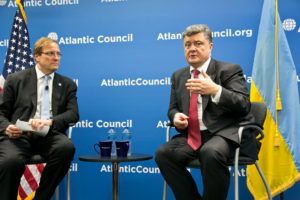
Petro Poroshenko in 2014 (Photo credit: Atlantic Council)
Charles Bohlen, the legendary American diplomat who served as ambassador to Moscow from 1953-57, recalled in his memoir Witness To History that, with regard to the Austrian State Treaty, he believed “that the Kremlin leaders, and probably the Soviet military chiefs, decided that a genuinely neutral Austria was of more value to Soviet Russia than the maintenance of a divided country where the Red Army would occupy only the poorer half.”
The situation in postwar Austria – occupied by East and West – is not perfectly analogous to the situation that obtains in Ukraine today, but there seem to be lessons from what Bohlen intuited were the Kremlin’s motives that might be drawn upon to inform Western diplomacy.
But instead of trying to implement the Minsk peace agreement (which calls for the Donbas to remain as part of Ukraine but with more autonomy from Kiev) or search for a reasonable alternative to what are indeed perplexing and pressing matters of national security, Poroshenko has continued to ring one alarm over another, this time illusory, Russian invasion.
In a recent speech before the Ukrainian parliament, Poroshenko claimed “there is more and more evidence for [Russia’s] preparations for an offensive war of continental proportions.”
Yet perhaps the danger isn’t as clear and present as Poroshenko portrayed it. As Mary Dejevesky of the U.K.’s Independent has observed: “NATO itself had held exercises in the Black Sea and before that in and around the western borderlands of Ukraine. Who, it has to be asked here, is threatening whom?”
Indeed, if Russia was on the precipice of launching a land war in Eastern Europe, would it have cut its defense budget by 25 percent to $48 billion a year, as was recently announced by the Kremlin?
As difficult as it might be for our hearty band on new cold warriors to believe (some of whom have scant knowledge about the topic of U.S.-Russia relations on which they so frequently choose to declaim), the push for a peaceable settlement in Ukraine is coming not from Washington, but from Moscow and Berlin.
Nevertheless, the stalemate continues: a resolution to the Ukrainian conflict – through the implementation of the Minsk agreements, as well as a settlement of the outstanding security concerns of all parties to the conflict – seems to remain tragically out of reach.
James W. Carden served as an adviser on Russia policy at the US State Department. Currently a contributing writer at The Nation magazine, his work has appeared in the Los Angeles Times, Quartz, The American Conservative and The National Interest.
October 15, 2017
Posted by aletho |
Militarism, Timeless or most popular | NATO, Ukraine, United States |
Leave a comment
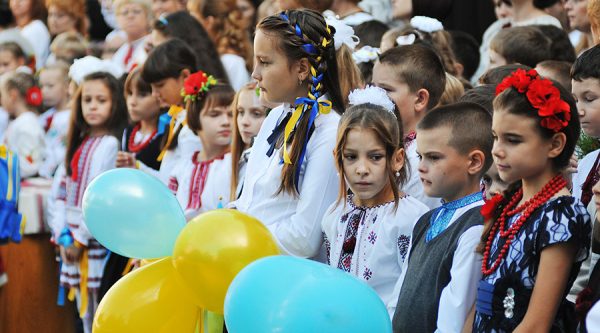
Schoolchildren at the celebratory assembly dedicated to the Day of Knowledge in Lviv. © Pavel Palamarchuk / Sputnik
A new Ukrainian education law fails to “strike a balance” between the official language and those of minorities, the Parliamentary Assembly of the Council of Europe (PACE) said in a resolution, adding that it is not conducive to “living together.”
PACE expressed its concerns over the articles relating to education in minority languages in the law recently adopted by Kiev. It “entails a heavy reduction in the rights previously recognized to ‘national minorities’ concerning their own language of education,” according to the document.
“The new legislation does not appear to strike an appropriate balance between the official language and the languages of national minorities,” the resolution adopted by PACE on Thursday says. The document was supported by 82 members of the 110 who took part in the vote, RIA Novosti reports. Only 11 parliamentarians opposed it while 17 others abstained.
The resolution further says that the Ukrainian education act “is not conducive to ‘living together,’” which particularly encompasses the principle of non-discrimination. PACE noted that any country’s measures aimed at promoting its official language must “go hand in hand with measures to protect and promote the languages of national minorities.”
The assembly said it “deplored” the fact that no consultations with the national minorities in Ukraine were held ahead of the adoption of the law. It further “expressed dissatisfaction” that the text of the legislation was submitted to the European Commission for Democracy through Law (Venice Commission) for an opinion only after it was approved by the Ukrainian parliament – the Supreme Rada – and signed by the president, Petro Poroshenko.
The resolution called on Kiev to ensure that there is enough “flexibility” in the planning and implementation of the educational reform to “avoid hasty changes prejudicing the quality of education provided to pupils and students belonging to national minorities.”
It also asked the Ukrainian authorities “to fully implement” the recommendations of the Venice Commission, which it is expected to deliver by the end of 2017. The controversial legislation adopted by the Supreme Rada on September 5, and signed by Poroshenko on September 27, is still causing concern in neighboring European countries.
The head of the Hungarian delegation at PACE, Zsolt Nemeth, accused Kiev of being at odds with European values and said that the newly adopted law could lead to instability in the western Ukrainian regions. He also called on European countries to “continue to exert pressure” on Ukraine to make it “stay within the framework of European values,” as reported by TASS.
Moldovan MP and also PACE member, Vlad Batrincea, said that Kiev is cherry-picking European values. Ukraine acts as if it had a “menu in a restaurant,” the MP said, adding that Kiev adopts some European norms but pretends it is unaware of others.
Following the adoption of the law, Romania cancelled a state visit to Ukraine by President Klaus Werner Iohannis and refused to host a parliamentary delegation from Ukraine in protest.
Moldovan President Igor Dodon warned that Ukraine’s Moldovan and Romanian minorities risked “denationalization” under the new law, while Hungary called it a “stab in the back.”
Later, Hungarian Foreign Minister Peter Szijjarto threatened to block Ukraine’s EU integration under the Eastern Partnership program in response to the adoption of the law.
The legislation is expected to affect at least 400,000 children studying in 735 Ukrainian schools which offer instruction in minority languages. The majority of these children are ethnic Russians, but other minorities in Ukraine include Romanians, Hungarians, Moldovans and Poles.
Under the newly adopted law, only children in grades 1-4 would be allowed to learn the curriculum in their native tongues in Ukraine starting from 2018, and by 2020 even that will no longer be legal.
Read more:
October 12, 2017
Posted by aletho |
Civil Liberties, Ethnic Cleansing, Racism, Zionism | Human rights, Ukraine |
Leave a comment
The Security Service of Ukraine has expelled Russian NTV television correspondent Vyacheslav Nemyshev from Ukraine after detaining and interrogating him in Kiev.
The Security Service of Ukraine has expelled Russian NTV correspondent Vyacheslav Nemyshev from the country and forbid him from returning for three years, the press service of the security forces said Thursday.
“The Security Service of Ukraine has decided to mandate the return to Russia of Vyacheslav Nemyshev, an agitator of the Russian broadcaster NTV… The agitator is barred from entering Ukraine for three years,” the press service statement said.
The NTV correspondent was detained in central Kiev while he was recording a story.Earlier on Thursday, Russia’s Civic Chamber member Elena Sutormina said that she had contacted Harlem Desir, the representative of the Organization for Security and Co-operation in Europe (OSCE) for media freedom, with a request to provide an immediate response to the detention of the reporter. The Russian official insisted that Kiev continued its efforts to oppress the freedom of speech “in a more devious and insolent way.”
Kiev has repeatedly limited the activities of foreign and even some local opposition media outlets in Ukraine. As an example, Kiev, in March 2015 issued a list of 115 Russian media outlets which could be denied or temporarily suspended accreditation by Ukrainian authorities as the outlets “posed threats” to Ukrainian state security. When the regulation came into force, a number of Russian journalists and television reporters were denied entry to Ukraine or deported to Russia.
In early August, the Russian Foreign Ministry called on the OSCE and the Council of Europe member states, as well as international organizations, to condemn Kiev’s policy against the media. There are already dozens of cases of harassment of journalists in Ukraine.
October 5, 2017
Posted by aletho |
Full Spectrum Dominance | Ukraine |
Leave a comment