Footfall in the attic of Europe’s geopolitics
By M K Bhadrakumar |Indian Punchline | September 27, 2017
The German Question has been at the very core of geopolitics in Europe at least since 1453, a poignant year in world history signifying the notional end of the Middle Ages. Ottoman Sultan Mehmed the Conqueror put an end to the Byzantine Empire by capturing Constantinople (present day Istanbul); France recaptured Bordeaux, marking the end of the Hundred Years’ War. For the next four centuries, the German Nation lurked as a fragmented space in the heart of the Holy Roman Empire, sucking instability from outside, until late 19th century when a re-united Germany began ‘exporting’ instability.
The European Union project aimed at containing German revanchism following World War II by diverting its energies and attention to the Cold War struggle. But with the end of the eighties, things began changing dramatically with the unexpected unification of Germany and the unforeseen disbandment of the Soviet Union. The EU has since proved incapable of managing the re-emergence of German power and itself increasingly resembles the old Holy Roman Empire. (“I speak Spanish to God, Italian to women, French to men, and German to my horse,” Emperor Charles V once said.)
Against the above backdrop, Sunday’s election to the German Bundestag assumes great significance. The importance of Germany in terms of its location, size, population, economy and military strength add up to immense potential. To what extent is Germany going to ‘pull its weight’; the likely elements of continuity and change in the German Question; how the emergent internal order of Germany is going to impact European (as well as Eurasian and Euro-Atlantic) balance of power – these are big questions.
The reactions of the US, Russia and France to the election victory of Chancellor Angela Merkel provide insight into the power dynamic. The US President Donald Trump phoned up Merkel on September 23 “to wish her country a successful election” on the next day “when Germans go to the polls” and to underscore “the steadfast bond between the United States and Germany.”
Trump hasn’t spoken to Merkel after she won the election on Sunday. When asked about it on Tuesday, the White House Press Secretary Sarah Sanders said that “they’re working on timing for a second call of congratulations. But I don’t believe that’s taken place yet today… No, I think they’re just working on the logistics piece of both leaders coordinating.”
The Russian President Vladimir Putin called up Merkel on Tuesday and congratulated her “on CDU/CSU’s success”. The crisply worded Kremlin readout said that they “reaffirmed their readiness to carry on with business-like, mutually beneficial cooperation” between the two countries.
The French President Emmanuel Macron, on the other hand, made a major speech on Tuesday at the Sorbonne, hot on the heels of Merkel’s victory, on the future of Europe. Macron reiterated his proposals for the eurozone having its own budget and finance minister to ensure the stability of the single currency union and “to weather economic shocks”.
Macron also proposed a shared European military intervention force and a shared defense budget and a European defense strategy to be defined by the early 2020s. He offered to open the French military to European soldiers and proposed other EU member states do the same on a voluntary basis. He suggested the creation of a European intelligence academy to better fight against terrorism, and a shared civil protection force. He said that a European asylum agency and standard EU identity documents could better handle migration flows and harmonize migration procedures.
It is no secret that Merkel has had difficult relationships with both Putin and Trump. Indeed, Merkel has little in common with their ‘world view’ and they are far from enamored of her being a flag carrier of western liberalism. Merkel’s foreign policy is very much centered on supporting global institutions and she has also remained at the forefront of defining a common European response to geopolitical challenges.
Merkel’s diplomatic relations with Trump have been reserved at best and their stances on trade, climate change and immigration are poles apart. Trump has been a trenchant critic of Merkel’s move to allow over one million refugees to enter Germany in 2015. When it comes to Putin, Merkel is unforgiving on Russia’s annexation of Crimea and its alleged intervention in Donbas. At the bottom of it all, the fact remains that the ‘regime change’ in Ukraine has been Merkel’s botched up project, thanks to Russia’s counter-offensive. The bitterness and mutual suspicions cannot easily dissipate.
What salvages the German-American relationship is that ultimately it is also a close institutional relationship (which is not the case with Russia.) In the final analysis, Germany remains dependent on the US military and economic leadership.
The Russian commentaries have caricatured that Merkel won a hollow victory. An acerbic commentary carried by RT is titled Merkel’s days as German Chancellor are probably now numbered. Disarray in German politics suits Russia, since Merkel has been the main exponent of the EU sanctions against Russia. And disunity within the EU in turn shifts the balance in favor of Moscow, which will be far more comfortable dealing with European countries at the bilateral level, none of them individually being a match for Russia.
The alacrity with which Macron has spoken goes to show France’s keenness to preserve its axis with Germany. Merkel is Macron’s best bet in Berlin. Despite her election losses, she intends to remain at the helm of European affairs. The EU is at a historic crossroads, with Brexit and Trump’s ‘America First’ changing the alchemy of European integration. Macron’s speech aims at strengthening Merkel’s hands as she begins the painful process of cobbling together a new coalition government in Berlin with partners who have divergent views on European integration.
Macron is due to meet Merkel on Thursday at the EU summit in Tallinn, Estonia. Read an analysis by Spiegel entitled Uncertainty Dogs Europe After German Election.
No place for Ukraine in EU, Hungary says after Kiev outlaws education in minority languages
RT | September 26, 2017
Hungary has pledged to obstruct Ukraine’s EU integration at every step after Kiev adopted a new education law which bans teaching children in any language other than Ukrainian. Ukraine’s neighbors call it a form of persecution of minorities.
“Hungary will block all steps within the European Union that would represent a step forward in Ukraine’s European integration process in the spirit of the Eastern Partnership program,” Hungarian Minister of Foreign Affairs and Trade Péter Szijjártó said in a statement on Tuesday.
The statement came after Ukrainian President Petro Poroshenko signed into law a controversial bill which in essence bans state schools in Ukraine from teaching children in any language other than Ukrainian. Under the law, next year only children in grades 1-4 would be allowed to learn the curriculum in their native tongues in Ukraine, and by 2020 even that will no longer be legal.
The law is expected to affect at least 400,000 children studying in 735 state schools which offer instruction in minority languages. The majority of these children are ethnic Russians, but other minorities in Ukraine include Romanians, Hungarians, Moldovans, and Poles. The law provides minor concessions for “EU languages,” English, and some minorities that have no national states of their own.
Poroshenko claimed that the new law “strengthens the role of the Ukrainian language in education” while protecting the rights of all minorities. But some nations, like Hungary, do not seem to be convinced, with Budapest calling the move “a stab in the back” from Ukraine after the bill was adopted by the Ukrainian parliament earlier in September.
Romania made a similarly critical statement and cancelled a state visit to Ukraine by President Klaus Werner Iohannis in protest last week. Bucharest also refused to host a parliamentary delegation from Ukraine, saying the visit no longer had any purpose.
Moldova’s maverick President Igor Dodon said Ukraine’s Moldovan and Romanian minorities risked “denationalization” under the new law and called on Kiev to block it.
The Russian Foreign Ministry said in a statement that the new law is unconstitutional and violates the rights of millions of ethnic Russians living in the country.
The language issue is highly political in Ukraine. After a violent coup in Kiev replaced its elected government in 2014, one of the first acts of the new government was to scrap a law which allowed regions to adopt Russian as a second official language. The decision was later overturned, but by that time it had already triggered an uprising in the predominantly Russian eastern regions of Ukraine, leading to a bloody military crackdown by Kiev.
While the language provisions of the new law gained the most publicity, critics of the legislation complain about other parts, as well. The law reduces the number of obligatory subjects in Ukrainian state schools from 22 to 9. Among other things, physics, chemistry, biology, geography, and astronomy will be combined into one subject. Critics fear these changes will negatively affect the level of education in the country.
Straws in the Wind for a Reset in US-Russian Relations
By M.K. BHADRAKUMAR – Asia Times – 23.09.2017
The receding specters of a war involving North Korea and a US-Russia confrontation in Syria. The sound of cracking ice in the frozen conflict in Ukraine. Russia and the United States bidding farewell to “tits-for-tat.” Is this the dawn of a brave new world?
You might be skeptical, but it’s possible to draw positive conclusions from the two meetings, on successive days, between US Secretary of State Rex Tillerson and Russian Foreign Minister Sergey Lavrov, on the sidelines of the United Nations General Assembly in New York this week. These meetings, in fact, bode well for another meeting ahead, between presidents Valdimir Putin and Donald Trump, this time in Danang, Vietnam, on the sidelines of the November 11-12 APEC summit.
There are straws in the wind that cannot be ignored. Lavrov told the media after listening to Trump’s UN speech that he viewed it positively. Lavrov was in a forgiving mood towards the threats held out by Trump to “evil regimes” in North Korea, Iran and Venezuela. Indeed, he felt that it was a “remarkable speech,” with Trump voicing respect for sovereignty and equality in international affairs and promising that the US will not impose itself on other countries. “I think it’s a very welcome statement, which we haven’t heard from the American leaders for a very long time,” Lavrov noted with satisfaction.
Thus, the foreplay has already begun that frames November’s Putin-Trump talks as a new page in Russian-American relations. Moscow judges that things can only improve in those relations and that Trump is wedded to his conviction that good relations with Russia are in the US’ best interests and – as Lavrov put it – “the interests of solving quite a number of important and most acute world problems.” Lavrov told the Associated Press :
“And what I feel talking to Rex Tillerson is that… they are not happy with the relations (with Russia)… And I believe that the understanding is that we have to accept the reality, which was created… by the Obama administration… And, being responsible people, the Russian government and the US administration should exercise this responsibility in addressing the bilateral links as well as international issues. We are not at a point where this would become a sustained trend but understanding of the need to move in this direction is present, in my opinion.”
The US and Russia have resumed dialogue over the global strategic balance, but to a great extent the shape of things to come over North Korea, Syria and Ukraine will set the tempo of their relations in the short term. US-Russia cooperation can make all the difference in addressing these problems, while any exacerbation of these conflict situations will inevitably impact their relationship.
North Korea: The Trump administration can turn the Russia-China entente to its advantage to defuse the North Korean crisis. While China’s capacity to leverage North Korea is not in doubt, what remains unexplored is that Moscow also wields influence with the leadership in Pyongyang. Kim Il Sung served as an officer in the Soviet Red Army after crossing into the USSR during World War II, before returning home to found North Korea in 1948.
Russia is uniquely placed to offer an “integration package” that might interest Pyongyang. It is a failure of leadership in Washington that the “Russian option” (in tandem with China) hasn’t been explored.
Syria: While the situation in Syria gives grounds for cautious optimism and the formation of new de-escalation zones may create conditions for internal dialogue in the country, it is time to work for a regional settlement as well.
A recent regional tour of the Persian Gulf by Lavrov and the upcoming visit by Saudi King Salman to Russia (October 4-7) should be viewed in this context. Russia also enjoys good relations with Turkey and Israel, while Iran is its ally in Syria. All this makes Russia a key interlocutor. Arguably, the Iran nuclear issue has morphed into a template for a settlement in the Iraq-Syria-Lebanon triangle.
Ukraine: The proposal mooted by Russia at the UN Security Council regarding the deployment of UN peacekeeping forces in the separatist Donbas region of Ukraine is gaining traction. Interestingly, NATO Secretary-General Jens Stoltenburg hailed the idea after a meeting with Lavrov in New York on September 21.
Germany is supportive of the Russian move and hopes to elaborate the concept in coordination with France, its western European partner in the Normandy format. With Angela Merkel remaining as Chancellor following Sunday’s Bundestag elections a definite prospect, it’s time to breathe new life into the Minsk accord, which is of course the base line for the EU to consider any rollback of sanctions against Russia.
While there is talk of Europe’s “strategic autonomy” in the Trump era, it is unrealistic to expect “an anti-American Europe that will break with Washington in favor of warmer relations with Moscow,” as noted Russian pundit Fyodor Lukyanov wrote recently. On the other hand, the Trump administration will have a tough time shepherding the EU into a united front against Russia (which President Obama brilliantly succeeded in doing, in 2014.) Clearly, a new framework for US-Russia relations has become necessary. And it must begin by breaking the stalemate in Ukraine.
Russia’s UN Peacekeeper Plan Anticipates US-Backed Kiev Offensive
By Finian CUNNINGHAM | Strategic Culture Foundation | 10.09.2017
Russia’s proposed deployment of a UN peacekeeping force in eastern Ukraine makes sense in the light of recent reports that the US is stepping up its supply of lethal weaponry to the Kiev regime. The war is set to explode.
It is therefore prudent to deploy international monitors to try to restrain the violence, or at least offset the undoubted propaganda war which will ensue. The move to involve the UN is also a damning reflection of how ineffective the already-in-place monitors from the OSCE have been.
The Organization for Security and Cooperation in Europe has stationed hundreds of international members in eastern Ukraine since March 2014, yet the OSCE has done little to restrain the offensive actions by the Kiev-controlled Ukrainian Armed Forces against the breakaway regions of Donetsk and Luhansk. The lack of restraint stems from the OSCE being evidently biased towards the Kiev regime and its reluctance to issue public criticism of Kiev’s daily violations of the Minsk Accord. In other words, despite claims of impartiality, the OSCE serves as a propaganda tool for the US-backed regime.
Earlier, Russian President Vladimir Putin warned that increased American military support to the Kiev regime will result in an escalation of violence. When US defense secretary James Mattis was in Kiev last month, he said Washington was «considering» sending lethal weapons to the regime’s forces. As part of the public relations exercise, Mattis called the weapons «defensive» lethal weapons. Those «defensive» arms include Javelin anti-tank missiles.
Reliable reports say that lethal US weaponry has already begun arriving, including grenade launchers and the high-powered Barrett M-82 sniper rifles with a range of 1.8 kilometers. According to sources in the self-proclaimed Donetsk People’s Republic (DPR), the American military supplies are being delivered through private US firms, which obscures Washington’s official involvement.
Over the past week, DPR military chief Eduard Basurin has cited as many as 200 violations of the ceasefire supposedly in place under the 2015 Minsk Accord. Those violations were carried with heavy artillery and mortars, hitting 25 locations in the Donetsk province. The DPR also claims that Kiev forces are moving up heavy weapons, including Howitzers, to the Contact Line, in another breach of Minsk.
Meanwhile, a check on the OSCE Special Monitoring Mission’s latest reporting on the ground indicates «fewer ceasefire violations». Typical of the OSCE reporting, those violations that are noted are worded in vague fashion in such a way that it is not clear which party is committing the attacks. The OSCE reports cite explosions and artillery fire, but rarely assign blame or details that might allow readers to ascertain who is firing at who. The lack of details strongly suggests a deliberate effort by the OSCE authorities to obfuscate. Yet, it claims to be a frontline source for journalists to file reports on what is happening in Ukraine. No wonder Western media in particular are so vacant about the conflict, if this is their source.
Given the Pentagon’s move to openly step up lethal weapons to the Kiev regime, the implications for worsening violence in eastern Ukraine are ominous. Kiev’s forces, which include Neo-Nazi battalions, have been waging an «Anti-Terror Operation» (ATO) on the ethnic Russian population of Donetsk and Luhansk since April 2014. Up to 10,000 have died in the conflict. The ATO was originally launched at the same time that then CIA chief John Brennan visited the Kiev regime – two months after the CIA backed the coup that brought the regime to power.
The violence has continued despite the signing by Kiev and the separatists of the two-year-old Minsk Accord – brokered by Russia, France and Germany. The Kiev regime headed up by President Petro Poroshenko claims that the separatists are «terrorists» supported by Russian «aggression». The separatists view the Kiev regime as illegitimate having violently and illegally seized power from an elected government in February 2014.
Washington backs the illogical position of Kiev and its evident repudiation of the Minsk Accord in spite of its signature. Yet, perversely, the US imposes sanctions on Russia for allegedly not implementing the Minsk deal.
This week, Germany’s Foreign Minister Sigmar Gabriel gave his support to the proposal announced by Vladimir Putin for a UN peacekeeping force. The Donetsk and Luhansk separatists have also voiced their support for the initiative. Russia is putting the matter before the United Nations Security Council. But it is not clear if the US will scupper the proposal.
The Kiev regime and US government-owned Radio Free Europe quickly poured scorn on Russia’s proposal. Cynically, it is claimed that the deployment of UN peacekeepers on the Contact Line would bolster the separatists’ territorial claims. Instead, Kiev wants UN troops to be deployed all across the breakaway republics and on the border with Russia.
But this is the point. The Kiev regime cannot be trusted to uphold any ceasefire agreement or commitments to recognize autonomy in Donetsk and Luhansk, as it is obligated to do under Minsk. Having UN blue helmets stationed all over the breakaway republics would most likely give Kiev a cover to infiltrate its forces. Just a quick indicator of bad faith was the routine breaching of the so-called «schools truce» called on August 25 by Poroshenko. That truce was called at the same time that Pentagon chief James Mattis was visiting Kiev, suggesting it was a public relations stunt to ease the announced supply of «defensive» lethal weapons by Washington.
Thus, the Russian proposal for UN monitors at the interface between Kiev troops and the separatists is a reasonable move. It may not be effective in stemming the violence especially in light of US stepping up weapons supplies. But, at least, it is worth giving a chance. The other potentially positive effect is that the UN peacekeepers might be able to account more accurately on which side is stoking the violence. This is all the more important since the OSCE has shown itself to be totally ineffectual, or worse, complicit in giving the Kiev regime a cover for its depredations.
The OSCE comprises 57 participating nations, including the US, Russia and European states. But its membership is dominated by 29 countries belonging to the US-led NATO military alliance. Russia has long complained that the OSCE needs reforming to allow for more balanced representation.
In his 2007 landmark speech to the Munich Security Conference, Putin warned, among many global issues, that Washington and its NATO allies were «trying to transform the OSCE into a vulgar instrument to promote Western foreign policy interests».
Like many other multilateral institutions, including the UN, the European Union and the Parliamentary Assembly of the Council of Europe (PACE), the OSCE has demonstrated a subservience to Washington’s geopolitical dominance.
This is clearly the case in Ukraine. The OSCE has never issued an unequivocal condemnation of Kiev forces, even though the latter have carried out countless violations and are the main obstacle to implementing a peaceful settlement.
In a must-read revealing interview, one former American member of the OSCE said that the organization routinely distorts the nature of the conflict in Ukraine and is «highly biased in favor of the Kiev regime». He said that field reports from rank-and-file OSCE officers were often suppressed by their superiors based in Kiev.
Alexander Hug, the ex-Swiss army chief of the OSCE operation in Ukraine, has in the past written opinion articles for the Kyiv Post, a news outlet that is stridently pro-regime and openly anti-Russian. In one of Hug’s articles, it bore the tagline «Russia’s war against Ukraine». Ironically, the OSCE chief introduced that article with the words: «The first casualty of war is the truth». For the OSCE chief to show such flagrant bias is contemptible and brings the so-called monitor into disrepute.
All the signs indicate that the war in Ukraine is set to escalate – especially given the increased supply of American weaponry to Kiev regime forces. Washington is acting recklessly. It is tacitly declaring war in Ukraine, with grave implications for US-Russia relations.
The deployment of UN peacekeepers to the conflict zone may not be sufficient to prevent the US-backed regime going on the offensive. But at least the presence of more international monitors might allow for more critical information on which side is pushing the violence.
Certainly, the OSCE monitors already in place are totally unreliable despite their claims of impartiality. Indeed, the OSCE as presently formulated and deployed is part of the problem for why a peaceful settlement in Ukraine is continually confounded.
Russia’s proposal for UN peacekeepers is being viewed cynically in the West as a hollow gesture. Such Western views are contorted and laced with their usual Russophobia instead of being objective.
The Russian proposal is simply due to the fact of the OSCE being hopelessly derelict in its duties, and in need of being sidelined by some other more effective monitoring mechanism. The war-footing of the US-backed Kiev regime amid OSCE silence is testament to its dereliction.
Mexican Standoff Goes Nuclear
By Frank Lee | OffGuardian | September 10, 2017
In the red corner…

Russian Defense Minister Sergei Shoigu
… And in the blue corner…

James ‘Mad Dog’ Mattis, United States Secretary for Defence
Apart from the criminally insane, (John McCain, Lindsey Graham et al.) nobody wants war, particularly nuclear war. Unfortunately, however, war happens, sometimes by accident sometimes by design. The present standoff between the US/NATO and Russia and China is a case in point. The United States ever present hegemonic ambitions are hardly secret and have been displayed in their most virulent and openly aggressive forms since the collapse of the USSR.
This latter event was a key moment in the present historical conjuncture. During the 1990s Russia was prostrate and the US/NATO juggernaut was able to take full advantage of the situation. The war against what used to be called the third world, had always been a feature of US foreign policy, however now with the disappearance of the one geopolitical bloc which could hold the US in check, the US imperial leviathan was able to extend its aggression to both Russia and more lately China. Ex-soviet satellites, and even ex-Soviet republics in Europe were sucked into the voracious maw of NATO, which was to double in size and expand right up to Russia’s western frontier. In passing, we may note that the collapse of communism also had the effect of an abject surrender of the centre-left/social democratic currents in Europe, and their conversion to both neoliberalism and neoconservatism.
NATO membership meant that the US effectively controlled Europe’s foreign policy and this policy fait accompli was ratified in the Lisbon Treaty which meant that Europe’s defence and security policy was outsourced to a non-member of the EU, i.e. the United States, who control NATO. In short, the EU became a civilian wing of NATO. These events were of course a naked provocation as was the dismemberment of Yugoslavia in the 90s.
The continued policy of provocation became the order of the day. In 2008 NATO announced boldly that Georgia and Ukraine “will become members of NATO.” Thereupon Georgia’s comical President Mikheil Saakasvili bombarded Tskhinvali, capital of the self-declared Republic of South Ossetia that had resisted integration into the current Republic of Georgia since the break-up of the Soviet Union in 1991. In this instance Russia defended South Ossetia, invading Georgia. It then recognized the independence, both of South Ossetia and of the Republic of Abkhazia, from Georgia. (This may be a tit-for-tat response to the U.S.’s decision to recognize Kosovo’s independence from Serbia six months earlier.) Then in 2014 came the ultimate provocation: the American backed coup in Ukraine which resulted in the ongoing and open-ended Ukrainian imbroglio 2014-2017. This resulted inter alia in the referendum and defection of the Crimea into the Russian Federation, and a nasty little war in the Russian-speaking Don Bass which chose to secede from the Ukraine.
US historian and foreign policy realist John Mearsheimer in 2014 argued, I think correctly, that:
According to the prevailing wisdom in the West, the Ukraine crisis can be blamed almost entirely on Russian aggression. Russian President Vladimir Putin, the argument goes, annexed Crimea out of a long-standing desire to resuscitate the Soviet empire, and he may eventually go after the rest of Ukraine, as well as other countries in eastern Europe. In this view, the ouster of Ukrainian President Viktor Yanukovych in February 2014 merely provided a pretext for Putin’s decision to order Russian forces to seize part of Ukraine.
But this account is wrong: the United States and its European allies share most of the responsibility for the crisis. The taproot of the trouble is NATO enlargement, the central element of a larger strategy to move Ukraine out of Russia’s orbit and integrate it into the West.
At the same time, the EU’s expansion eastward and the West’s backing of the pro-democracy movement in Ukraine — beginning with the Orange Revolution in 2004 — were critical elements, too. Since the mid-1990s, Russian leaders have adamantly opposed NATO enlargement, and in recent years, they have made it clear that they would not stand by while their strategically important neighbour turned into a Western bastion.
For Putin, the illegal overthrow of Ukraine’s democratically elected and pro-Russian president — which he rightly labelled a “coup” — was the final straw. He responded by taking Crimea, a peninsula he feared would host a NATO naval base, and working to destabilize Ukraine until it abandoned its efforts to join the West” Foreign Affairs – Autumn 2014
It should be understood that possible Ukrainian and Georgian membership of NATO is still on the table, which in itself constitutes a provocation. This much was made clear by the NATO Secretary-General – the wretched Jens Stoltenberg – who recently visited Kiev and held discussions with the Kiev Junta boss Poroshenko. US representative in the shape of ‘Mad Dog’ Mattis has also been a recent visitor. The issue of supplying lethal US arms to the Kiev Junta was certainly discussed but no definitive judgement has been made – yet.
 So where is all this leading? To the fabled Mexican standoff that’s where. Regarding the issue of lethal arms. The Ukrainians already have these – they have been and were supplied covertly through the Baltics and Poland (naturally Poland) during the earlier period of the war 2014-2016. The Ukrainian Army (UAF) has been trained and equipped by NATO and has 200,000 men under arms, mostly wretched conscripts, who would rather be somewhere else, but with some more effective punitive neo-Nazi units. At present, there are all sorts of rumours circulating of a supposedly imminent invasion of the Don Bass by a rejuvenated Ukrainian military. Maybe, but in the past these rumours have generally come to nothing. But be sure that if this turns out to be the case it will be an American decision, not Poroshenko’s who is a US/NATO puppet. However, the US investment in the training and arming of UAF is no guarantee of battlefield effectiveness; the US also trained and equipped the Georgian Army as well as the South Vietnamese Army (ARVN) both of whom who hardly distinguished themselves in the heat of battle.
If such an invasion does occur the relevant questions would seem to be how will Russia react. Putin is on record as saying he will ‘not allow’ a Ukrainian army to annihilate the people of the Don Bass, this is said to be a Red Line for Putin. As in previous clashes Russia did at least covertly intervene in the fighting; there were also Russian (and other national) volunteers who fought on the side of the Don Bass militias. As for the ethnic Russian population of the Don Bass they want under no circumstances to be reintegrated with their hated enemies in the west and central Ukraine. Too much blood has been split for an implementation of the Minsk agreements, which in any case the Kiev Junta has shown no interest in implementing.
Trying to force the Don Bass into a Ukraine governed by the same oligarch/Nazi coalition Junta ensconced in Kiev, would be like trying to force Protestant Northern Ireland into the Catholic Irish Republic. This would simply lead to a continuation of the war – albeit in a different form.
In the event of renewed hostilities and the Don Bass being in danger of being over-run, can Russia stand by and do nothing? In this case it would mean the neo-Nazi battalions will be right on Russia’s border less than 100 km from the city of Rostov-on-Don. Should Putin be taken at face value when he said he would not contemplate this eventuality?
In the event that the DPR/LPR do fall this would mean a massive victory for the NATO-backed UAF proxies and a strategic disaster for Russia who will then be seen as a paper tiger, thereby emboldening the Anglo-Zionist empire in its programme for the destruction of Russia as an independent sovereign state. If Putin does stand firm – as he must – what then will be the reaction of the US/NATO and what would be the political repercussions in Ukraine itself? After heavy defeats suffered by the UAF at Ilovaisk and Debaltsevo a third defeat would be likely to lead to very serious domestic political upheaval. In this scenario, I think both US/NATO would simply turn their backs on the whole failing project, particularly the EU. Who knows?
Ultimately Ukraine is of extreme strategic interest to Russia, but of negligible interest to the United States. Risking a nuclear war with Russia over a tin-pot regime in Ukraine and thereby exposing the US homeland to nuclear decimation over a war they don’t have to fight seems very unlikely. And as for the notion of winning (whatever that means) a nuclear war, I doubt any sane person believes that is possible. See below.
The Anti-Ballistic Missiles (ABM) systems are so unreliable it would almost be an accident if they worked. They’ve never been tested under real conditions and they can be defeated by very basic countermeasures.”
Ted Postol, a professor at MIT and a former scientific advisor for the Pentagon.
When I think of the persistent history of the forlorn idea of the defence against a nuclear attack, I am tempted to think that the notion especially typifies Einstein’s grim and painfully realistic observation that ‘the unleashed power of the atom has changed everything save our modes of thinking.’ It has certainly been normal in history to think of fashionable defences against evolving military threats. But nuclear weapons unleashed in a large-scale attack bring a sure destruction, one so massive as to rule out any successful defence. Defence in conflict, a traditional mode of thinking, is here no longer plausible. In a nuclear war, the long-standing ‘norm’ of reliance on defence has become a self-deception, a most human and understandable one, and one that is rooted in an aversion to the new reality.”William J Perry – Secretary of State for Defence for the United States 1994-1997.
(‘My Journey at the Nuclear Brink’)
Defending the United States against a major Russian or Chinese ballistic missile attack is currently not feasible. A reliable and affordable defence that could protect America against a Russian ICBM and SLBM force that could launch some 1,500 ballistic missile warheads simply does not exist. While the Chinese force is much smaller, numbering several dozen ICBMs, it probably includes countermeasures that would seriously complicate disruption by missile defines systems…
For the foreseeable future, offense wins the offense-defence relationship. Offensive ballistic missile technology is far more mature than that of missile defence, and cost considerations favour the offense. Adding fourteen more GMD interceptors by 2017 will require the Pentagon to spend about $1 billion. The Russians and Chinese can each add fourteen more warheads to their strategic offensive forces at considerably less cost. One reason that the Russians are building a replacement for their heavy SS-18 ICBM is to have a missile that can carry ten-fifteen warheads as a means of overwhelming a future American missile defence.
It is important to remember that the other side may not sit passively as the U.S. military develops missile defences. Other nuclear powers may choose to build up their strategic offensive forces in response, increasing the number of nuclear weapons targeted at the United States (China comes to mind). Indeed, it was concern that the ABM systems of the 1960s would spark an uncontrollable strategic offensive arms race that led to negotiation of the 1972 ABM Treaty.
None of this is to say that a future technological breakthrough might not produce a change in the offense-defence equation. Some new technology could be developed that would make defence against ballistic missiles far more lethal, cost-effective and attractive, tilting the equation to favour defence instead of offense. But that breakthrough does not appear to be on the horizon, at least not for the next fifteen-twenty years. And a key lesson of the past thirty-two years is that technology in the missile defence area often does not deliver on its potential—at least not as rapidly, or as inexpensively, as originally thought.” The National Interest. March 2015 – Steven Pifer
Steven Pifer directs the Brookings Arms Control and Non-Proliferation Initiative.
And Finally, from The National Interest 14-08-2017:
Technology, in effect, made Russia America’s insufferable but inescapable Siamese twin. The strategic reality is even more horrific. However demonic, however destructive, however devious, however deserving of being strangled Russia is, the brute fact is that we cannot kill this bastard without committing suicide.” Graham Allison
Setting aside the usual American self-righteous, messianic, ‘indispensable nation’, bombast, – vide supra – the central core of the above statements makes the realist-realpolitik argument very forcefully. (1) The US is not invulnerable and (2) It would suffer massive damage, possibly terminal, in a nuclear exchange, as would the whole world. Ideologues, fools, journalists and mountebanks may wish to assert otherwise but the truth is self-evident and sobering. The media, deep-state, Tweedledum-Tweedledee two party cartel and the MIC, national security state, are pushing America and the rest of the world towards this precipice hoping Russia will surrender. This is, to say the least, an extremely risky strategy. But what if Russia chooses not to surrender? Will any US President be willing to sacrifice New York for Moscow, or Los Angeles for St. Petersburg? I somehow doubt it. Sticking my neck out I think the whole thing is a bluff; to be sure a dangerous one, but I think the realist argument will trump (sorry about the pun) the ideological one. One thing we can be sure of is that appeasement has not worked with the Anglo-Zionist empire and it never will.
To quote Kipling;
He who pays the Dangeld never gets rid of the Dane.”
Ukrainian security services snatch Russian journalist from street to deport her
RT | August 30, 2017
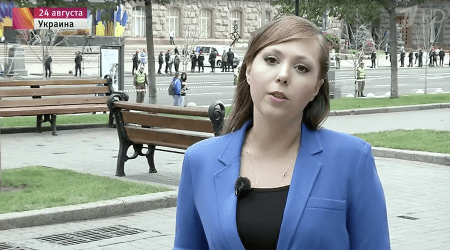
Russian television correspondent Anna Kurbatova has been detained by the Ukrainian security services in Kiev. The journalist, who works for Russia’s Channel 1, will be deported for “smearing” Ukraine, according to a security services spokesperson.
The incident occurred in the city center of the Ukrainian capital on Wednesday. Kurbatova was “grabbed by unknown assailants, forced into a car and driven away,” according to Channel 1.
The Russian authorities are closely monitoring the situation to learn more about the fate of the journalist.
“At the moment we don’t have information, but, undoubtedly, we’ll do our best to clarify the situation,” Russian presidential spokesman Dmitry Peskov told reporters.
Russia’s Foreign Ministry is also trying to clarify the situation around the correspondent’s detention.
“The Russian Foreign Ministry and Russian diplomatic institutions abroad are looking into the disappearance of a Channel 1 journalist in Ukraine,” Russian Foreign Ministry spokeswoman Maria Zakharova told TASS.
The Russian embassy in Kiev has sent requests to the Ukrainian security services as well as a note to Ukraine’s Foreign Ministry, urging them to clarify the incident and immediately release the journalist, RIA Novosti reported.
A spokesperson for the Security Service of Ukraine (SBU) confirmed that the journalist was detained by the organization’s operatives. Kurbatova will be deported from Ukraine to Russia and the SBU is currently preparing the paperwork, according to the spokesperson.
“Russian propagandist Anna Kurbatova will be forcibly returned to the Russian Federation. Ukraine is a constitutional state, its security services operate strictly within the legal framework. All necessary documents for her deportation are being prepared at the moment. It will happen to everyone who dares to smear Ukraine,” the spokesperson said in a Facebook post.
Russian Commissioner for Human Rights Tatyana Moskalkova has contacted her Ukrainian counterpart following the incident to determine whether the security services are following legal procedures.
“I’ve just sent a request to my colleague Valeria Lukyanova asking her about the location [of the journalist], her health condition and the consular visit, i.e. whether all the conventions are being observed if she has been detained by law enforcement,” Moskalkova told Interfax.
“I’m outraged and deeply worried about the treatment of journalists. Freedom of speech is protected not only by states’ constitutions, but also by international legal acts, journalists worldwide are independent and have immunity.”
Ahead of the incident, the journalist received threats in connection with her reporting on Ukraine’s Independence Day, according to Channel 1. Following her report, Kurbatova was placed on the list of “enemies of Ukraine” on the notorious Mirotvorets (Peacemaker) website. The website accuses the journalist of “anti-Ukrainian propaganda” and “manipulating socially-important information.”
Just before the incident, Kurbatova had prepared a new report on the ill-treatment of journalists in Ukraine, which has not yet been aired.
It’s not the first time a Russian journalist has become a target for the Ukrainian security services. Earlier in August, a journalist for the All-Russia State Television and Radio Broadcasting Company (VGTRK), Tamara Neresyan, was deported following an apparently similar incident.
“I was detained in the street and promptly brought to the main SBU office, where I was questioned for three hours. They confiscated my phone, it was done very roughly, nearly breaking my arms. Following the questioning they read me a resolution of the SBU that I would be deported and barred from re-entry for three years,” Neresyan told Rossiya 24 TV channel.
Ukraine Hosts US Military to Be Permanently Stationed on Its Soil
By Alex GORKA | Strategic Culture Foundation | 14.08.2017
United States Naval Construction Battalions, better known as the Seabees (C.B. – construction battalion), of the Naval Construction Force held a groundbreaking ceremony for a maritime operations center on Ochakov Naval Base, Ukraine, July 25. According to the Navy.mil, the official website of the US Navy, the maritime operations center is one of three projects that are currently planned to be executed by the Seabees in Ochakov and will serve as a major planning and operational hub during future military exercises hosted by Ukraine. The Seabees arrived in Ochakov in April to establish contracts, obtain construction permits and perform other logistical tasks for the maritime operations center project.
Maritime operations centers are the operational-level warfare command and control organizations designed to deliver flexible maritime capabilities throughout the full range of military operations. The future Seabee projects in Ochakov include a boat maintenance facility and entry control points with perimeter fencing.
«Our ability to maximize European reassurance initiatives in Ukraine holds strategic importance, and will ultimately improve host nation defense capacity and infrastructure, strengthen relations, and increase bilateral training capabilities», said Lt. j.g. Jason McGee, officer in charge of Det. Ukraine.
In July, several US missile warships, including the USS Hue City Ticonderoga-class guided-missile cruiser and the USS Carney Arleigh Burke-class guided-missile destroyer, a P-8A Poseidon patrol aircraft and a Navy SEALs team took part in the 12-day Sea Breeze 2017 NATO naval exercise held in the northwestern part of the Black Sea, near the port city of Odessa. 17 nations took part in the training event.
The drills were conducted in the ‘free game’ format in the Odessa and Nikolayev regions and the northwestern areas of the Black Sea. The practice scenarios cover amphibious warfare. The only country the forces could be training to assault is Russia.
During the exercise, US Secretary of State Rex Tillerson made his first visit to Ukraine (July 9) to demonstrate the political support of Kiev’s policy aimed at integration with the United States and NATO. He was accompanied by Kurt Volker, the newly appointed US Special Representative to the Minsk peace process, who is known as a hawk against Moscow.
The US political support is not gratuitous. In late June, the Ukrainian government took a decision to buy American coal from Pennsylvania, which is said to be almost twice as expensive as locally sourced in the Donbass – Ukraine’s traditional supplier of energy needs.
In July, Ukrainian President Petro Poroshenko signed the Law of Ukraine «On Amendments to Certain Laws of Ukraine Regarding the Foreign Policy of Ukraine», which determines membership of the Alliance as one of the country’s foreign policy priorities. Poroshenko said that a referendum on NATO membership would be held by 2020.
Ukraine takes part in a host of NATO exercises: Operation Fearless Guardian, Exercise Sea Breeze, Saber Guardian/Rapid Trident, Safe Skies and Combined Resolve. It became the first non-member country to contribute its troops to the NATO Response Force.
On June 8, Ukraine’s parliament adopted a bill called «On Amending Certain Legislative Acts of Ukraine (on Foreign Policy Course of Ukraine), setting NATO membership as Ukraine’s foreign policy goal, replacing the country’s non-aligned status.
The United States will deliver lethal weapons to Ukraine. The Joint Staff is working with US European Command to determine what the lethal defensive aid to Ukraine would look like. The House version of the 2018 National Defense Authorization Act (NDAA) cuts military aid to Ukraine from the initial $300 million to $150 million, but it provides permission for lethal arms supplies. The idea is strongly supported in the Senate. If the legislation goes through, the weapons could be legally sent to Ukraine starting October 1. The money could be used to deliver over 900 FGM-148 Javelin anti-tank missiles designed to strike armored vehicles, fortified ground installations and low flying aerial targets at a distance of 50-2,500 meters.
Former President Barack Obama was unconvinced that granting Ukraine lethal defensive weapons would be the right decision in view of corruption widespread in Ukraine. Skepticism about sending weapons to Ukraine is common in Europe. German President Frank-Walter Steinmeier opposed the idea. NATO Military Committee Chairman Petr Pavel has spoken against lethal arms deliveries to Kiev.
A recently published RAND study says that the country faces deeply embedded problems which cannot easily be solved by foreign-provided assistance.
A US military facility near Russia’s borders is a very serious threat to regional security. The Black Sea region is turning into a hot spot. US destroyers and cruisers visit the Black Sea regularly to provide NATO with long-range first strike capability. The Romania-based Aegis Ashore BMD system uses the Mk-41 launcher capable of firing Tomahawk long-range precision-guided missiles against land assets.
Romania has worked energetically to increase US and NATO force presence in the region. The US has recently taken the decision to send an additional 500 forces to the Romanian Mihail Kogalniceanu (MK) forward operating base. A brigade-size multinational NATO force is based in Craiova, Romania. Nations which have pledged to contribute include Canada, Germany, the Netherlands, Poland, Turkey and the United States. The unit is intended to facilitate the deployment of reinforcements. Georgia and Ukraine will be fully involved in the plans.
Romania calls for a regular trilateral format of joint naval exercises in the Black Sea, along with Turkey and Bulgaria, with the eventual participation of non-littoral NATO members.
The United Kingdom has decided to deploy four Typhoon aircraft to Mihail Kogalniceanu in 2017. Deveselu, Romania, is home for Aegis Ashore ballistic missile defense site and a target for the Russian military.
Bulgaria has offered to participate in the Multinational Framework Brigade stationed in Romania with 400 troops. In September, about 150 US Marines, part of the Black Sea Rotational Force, are due at Novo Selo, Bulgaria. This will be the first of three six-month rotations of about 150 US Marines, part of the Black Sea Rotational Force. Under the 2006 defense cooperation agreement, the United States has access to three Bulgarian military bases.
The US plans to deploy up to 2,500 troops at Novo Selo; the base can hold as many as 5,000 during joint-nation exercises with NATO allies. The facility’s upgrade is finished to add a helicopter landing zone and an air operations building. The base is expected to host US heavy tanks. A NATO maintenance support area is to be built in Sliven or Plovdiv. This is a serious military build-up turning Bulgaria into springboard to attack Russia or a target for the Russia’s armed forces.
It’s hardly a wise decision to militarize the country against Russia when 80 percent of Bulgarian exports and imports transit the Black Sea and tourism contributes heavily to the country’s economy, increased maritime militarization could have a widespread negative economic impact in case of heightened tensions, accidents or clashes.
Since September, 2016 US and Bulgarian aircraft conduct patrol flights in the Black Sea. The patrolling mission greatly increases the risk of an accident, especially with the Russian S-400 long range systems stationed in Crimea. Russian aircraft deployed in the Northern Caucasus and Rostov region are capable of controlling the whole Black Sea. President Putin has warned NATO about the consequences such a policy would lead to.
Non-Black Sea NATO members cannot stay in the Black Sea for more than 21 days, according to the Montreux Convention. NATO has three members with Black Sea ports in Romania, Bulgaria and Turkey, as well as two more aspiring members in Ukraine and Georgia. Bulgarian, Romanian, Ukrainian and Georgian navies have limited capabilities. Handing over to them some of other NATO members’ warships is an option under consideration. The ships could be reflagged to beef up permanent naval capabilities in the theater. US warships frequent the Black Sea to provide NATO with long-range first strike capability.
The Romania-based missile defense system as well as NATO air bases and headquarters will be targeted by Russian Kalibr sea- and air-based medium-range cruise missiles successfully tested in Syria some time ago. The active phase array antenna-based radar, located in Romania, can be countered by Russian ground and air-based electronic warfare systems.
In response to NATO growing presence, Russia has deployed S-400 long-range air-defense systems and Bastion-P (K-300P) anti-ship coastal defense missile systems equipped with Onyx missiles. These Mach 2.6 supersonic missiles are highly maneuverable, difficult to detect and have a range of nearly 300 kilometers. With the help of the Monolith-B radar station, the system is capable of obtaining over-the-horizon target designation many miles beyond the horizon. The long-range cruise missile capable Su-24 supersonic attack aircraft are already deployed in Crimea.
Russia has to react in view of massive militarization of the region against the background of high tensions. An accident may spark a big fire. The US military presence in Ukraine is a highly provocative step, which will very negatively affect the situation. Nothing justifies the whipping up of tensions in the Black Sea region, but the United States keeps on doing it with great vigor.
Is Trump’s Russia Policy Being Hijacked?
By Pat Buchanan • Unz Review • August 4, 2017
In crafting the platform in Cleveland on which Donald Trump would run, America Firsters inflicted a major defeat on the War Party.
The platform committee rejected a plank to pull us deeper into Ukraine, by successfully opposing new U.S. arms transfers to Kiev.
Improved relations with Russia were what candidate Trump had promised, and what Americans would vote for in November.
Yet, this week, The Wall Street Journal reports:
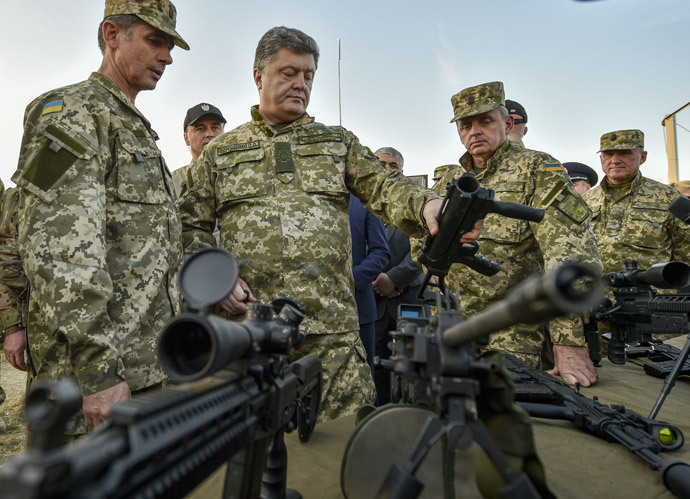
“The U.S. Pentagon and State Department have devised plans to supply Ukraine with antitank missiles and other weaponry and are seeking White House approval … as Kiev battles Russia-backed separatists … Defense Secretary Mattis has endorsed the plan.”
As pro-Russia rebels in East Ukraine have armored vehicles, Kiev wants U.S. tank-killing Javelin missiles, as well as antiaircraft weapons.
State and Defense want Trump to send the lethal weapons.
This is a formula for a renewed war, with far higher casualties in Ukraine than the 10,000 dead already suffered on both sides.
And it is a war Vladimir Putin will not likely allow Kiev to win.
If Ukraine’s army, bolstered by U.S. weaponry, re-engages in the east, it could face a Moscow-backed counterattack and be routed, and the Russian army could take permanent control of the Donbass.
Indeed, if Trump approves this State-Defense escalation plan, we could be looking at a rerun of the Russia-Georgia war of August 2008.
Then, to recapture its lost province of South Ossetia, which had seceded in 1992, after Georgia seceded from Russia, Georgia invaded.
Putin sent his army in, threw the Georgians out, and recognized South Ossetia, as John McCain impotently declaimed, “We are all Georgians now!”
Wisely, George W. Bush ignored McCain and did nothing.
But about this new arms deal questions arise.
As the rebels have no aircraft, whose planes are the U.S. antiaircraft missiles to shoot down? And if the Russian army just over the border can enter and crush the Ukrainian army, why would we want to restart a civil war, the only certain result of which is more dead Ukrainians on both sides?
The Journal’s answer: Our goal is to bleed Russia.
“The point of lethal aid is to raise the price Mr. Putin pays for his imperialism until he withdraws or agrees to peace. … The Russians don’t want dead soldiers arriving home before next year’s presidential election.”
Also going neocon is Mike Pence. In Georgia this week, noting that Russian tanks are still in South Ossetia, the vice president not only declared, “We stand with you,” he told Georgians the U.S. stands by its 2008 commitment to bring them into NATO.
This would mean, under Article 5 of the NATO treaty, that in a future Russia-Georgia clash the U.S. could find itself in a shooting war with Russia in the South Caucasus.
Russia’s security interests there seem clear. What are ours?
Along with Trump’s signing of the new sanctions bill imposed by Congress, which strips him of his authority to lift those sanctions without Hill approval, these developments raise larger questions.
Is President Trump losing control of Russia policy? Has he capitulated to the neocons? These are not academic questions. For consider the architect of the new arms package, Kurt Volker, the new U.S. Special Representative for Ukraine Negotiations.
A former CIA agent, member of the National Security Counsel, and envoy to NATO, Volker believes Russian troops in Transnistria, Abkhazia, South Ossetia, Crimea, Donetsk and Luhansk are all there illegally — and U.S. policy should be to push them out.
A former staffer of Sen. McCain, Volker was, until July, executive director of the neocon McCain Institute. He has called for the imposition of personal sanctions on Putin and his family and European travel restrictions on the Russian president.
In the Journal this week, “officials” described his strategy:
“Volker believes … that a change in Ukraine can be brought only by raising the costs for Moscow for continued intervention in Ukraine. In public comments, he has played down the notion that supplying weapons to Ukraine would escalate the conflict with Russia.”
In short, Volker believes giving antitank and antiaircraft missiles to Ukraine will bring Putin to the negotiating table, as he fears the prospect of dead Russian soldiers coming home in caskets before his 2018 election.
As for concerns that Putin might send his army into Ukraine, such worries are unwarranted.
Volker envisions a deepening U.S. involvement in a Ukrainian civil war that can bleed and break Russia’s Ukrainian allies and convince Putin to back down and accept what we regard as a just settlement.
Does Trump believe this? Does Trump believe that confronting Putin with rising casualties among his army and allies in Ukraine is the way to force the Russian president to back down and withdraw from Crimea, Luhansk and Donetsk, as Nikita Khrushchev did from Cuba in 1962?
What if Putin refuses to back down, and chooses to confront?
Copyright 2017 Creators.com.
Opposition journalist investigated for ‘treason & terrorism’ in Ukraine
RT | August 2, 2017
Ukraine’s Security Service have launched an investigation into a journalist and blogger whom they accuse of treason as well as his alleged attempts to violate the country’s territorial integrity via publications critical of the government in Kiev.
The Security Service of Ukraine (SBU) released a statement Wednesday, reporting that it had “ended the activity” of a journalist from the Zhitomir region in central Ukraine, who they claim worked on the “instructions of Russian curators” and “prepared and distributed anti-Ukrainian materials.”
“Since 2014 the journalist had been writing tendentious articles at the request of the Russian government propaganda news agencies,” the agency said without releasing the name of the suspect.
His work has had a “manipulative influence on the readers’ minds” and threatened “the sovereignty and independence of our state,” the SBU claimed.
The blogger, identified by the Ukrainian media as Vasily Muravitsky, was publishing his articles on at least six websites, the SBU said, adding, that the man initially signed his work under his real name, but started using aliases after that.
The journalist’s works also allegedly contained “calls to incite national enmity within the country and between Ukraine and neighboring friendly states,” the security agency added.
If found guilty the opposition journalist may face up to 15 years in prison, according to Ukrainian authorities.
The Russian foreign ministry has condemned the persecution of the journalist, saying in a statement the investigation of the blogger is “just another episode of the campaign led by Kiev and aimed at violent suppression of the opposition journalists and total cleansing of Ukraine’s information sphere for the benefit of the ruling regime.”
“The mass closure of Russian news and internet media outlets as well as persecution and oppression of the Ukrainian journalists conducted on a large scale are blatant violations of the fundamental principles of the freedom of expression that lie at the core of the civilized approach to the media and are embodied in the key documents of the UN, OSCE and the Council of Europe,” the statement said.
The ministry further called on member states of the OSCE and the Council of Europe as well as other international organizations to join Russia in condemning “Kiev’s barbaric and criminal policy towards media.”
Featured Video

Dan Dicks with James Corbett on Solutions Watch
or go to
Aletho News Archives – Video-Images
From the Archives
Secret document reveals plans for civil war in Lebanon, Israeli false flags, and invasion
By Randi Nord | Geopolitics Alert | April 5, 2019
Beirut – During his visit with US Secretary of State, Mike Pompeo, Lebanese President Michael Aoun reportedly received a US-Israeli document detailing plans for creating a civil war in Lebanon with covert false flag operations and possible Israeli invasion.
Although the source of the document is Israeli and created in partnership with Washington, no one knows who presented it to Aoun. The Lebanese TV station, Al-Jadeed, initially reported the document on Lebanese TV and a video on its website. Geopolitics Alert translated the report for this article. … continue
Blog Roll
 Aletho News
- Sheikh al-Asadi warns of Iraqi government compliance with US demands
- How to MAKE THE CONSPIRATORS PAY for their crimes! Dan Dicks with James Corbett on Solutions Watch
- There’s a drought in academia: A drought in honest research on the subject of drought and other weather extremes
- Department of War Awards $20.7 Billion Contract to Raytheon for Air-to-Air Missiles
- ‘Distance yourselves from Israel’: IRGC urges US population to question govt policies
- America’s Greenland deal has a radioactive backstory
- The RAF Fairford ‘terror plot’: Unpacking escalation in the UK echo-chamber
- EU Council Advances Chat Control 2.0 Scanning Proposal
- Ex-Greek MEP files complaint against Israeli spyware firm over alleged Pegasus surveillance
- Troubling ideas throughout the Torah, Talmud, Mishneh Torah and Tanya
- If Americans Knew
- New Report: “Scholasticide and Genocide in Gaza: Assessment, Testimonies and Legal Analysis”
- Ex-Biden officials are desperate for a Gaza scapegoat
- Israeli “settlers” Invade Al-Aqsa; Pour Boiling Water on 75-Year-Old
- Israel Has Kidnapped Another American Teenager
- US arms sales to Israel worth $21.6 billion in 20 months
- Three Palestinians Killed in Israeli Attacks on Gaza
- Revealed: German “Anti-Semitism Expert” Driving Crackdown on Palestine Solidarity is Former Israeli Spy
- Egypt’s Warning to Israel Before Oct 7
- Israel’s siege signals another cruel winter for 1.8 million Gazans – Daily Update
- Netanyahu Asked UAE Leader to Deny Report on Oct. 7 Warning in Secret Visit, Sources Say
- No Tricks Zone
- Two More Paleo Reconstructions Affirm Meters-Higher Sea Levels Across Ireland, Brazil 7000-6000 Years Ago
- New Study: Earth And Venus Surface Warmth Largely Explained By Convection And Lapse Rate, Not CO2 Or Radiation
- 2025 Nature Paper Claiming Worsening Global Drought Gets RETRACTED …Heavily Flawed
- New Study: ‘Global Drought Shows No Detectable Recent Acceleration Under Climate Warming’
- Economic Masterminds: German Socialists Suggest Taxing Productivity Gains Stemming From Using AI
- The South China Sea Has Not Been Cooperating With The Climate Change Narrative
- Energy Crisis: Germany Enters Heating Season With Historically Low Gas Reserve Fill Levels
- New Study: The Antarctic Ice Sheet Gained Mass From 2020-2024 Due To Staggering Snow And Ice Accumulation
- Study: Ocean Heating Rates From Thousands Of Years Ago ‘Dwarf’ Modern Ocean Heating Rates
- Climate Extremists Target, Attack Large-Scale Power Grid Infrastructure In Germany!

