The Fine Print: IMF Backs Down on Ukraine Land Reform Ultimatum, But at a Price
Sputnik – 23.07.2017
The International Monetary Fund has slightly relaxed its conditions for the provision of a new loan tranche to Ukraine, removing the demand that Kiev first revise the country’s laws on the privatization of agricultural land. Ukraine watchers Vladimir Zharikhin and Alexander Dudchak say that the IMF’s move is just a ploy designed to entrap Ukraine.
Last week, the IMF confirmed that it would not insist on the immediate implementation of land reform as a precondition for the provision of its next loan tranche to Ukraine in the fall.
Speaking at a press briefing on Thursday, IMF spokesman William Murray confirmed that land reform would not be on the agenda for the program revision meeting next month. “Land reform remains an important condition under the program. However, given the need to design the reform well and reach consensus on key steps ahead, there was a need to reset its timing to later in the year,” he said.
The IMF had earlier insisted that Kiev make changes to its land laws to allow for its privatization. Ukrainian lawmakers have stubbornly and repeatedly rejected these demands.
Other IMF loan conditions remain unchanged, and include pension reform, measures to accelerate privatization, and increased efforts against corruption, including the creation of an independent anti-corruption court. IMF conditions also include the requirement that Kiev continues with fiscal reform and restructuring of the energy sector, programs which have led to severe cuts in public spending, and skyrocketing utilities prices.
Ukraine has received four loan tranches worth $8.5 billion from the IMF since March 2015, when the program – worth $17.5 billion, was approved. Every successive tranche has been accompanied by long delays due to Kiev’s reticence to comply with the IMF’s requirements. The latest tranche, originally scheduled to be delivered in May, has now been postponed until September, pending Kiev’s compliance with the conditions.
In recent weeks and months, some Ukrainian authorities have tried to downplay the significance of the IMF loan program, signaling that it was needed mainly for the purpose of strengthening investor confidence in the country.
Last week, Prime Minister Volodymyr Groysman tried a different approach, complaining that Kiev does not have enough money to carry out the promised reforms, since most of the budget is spent on servicing foreign debt, defense and the pension fund. According to Groysman, Kiev now spends approximately 100 billion hryvnia – or 4% of its GDP, on debt servicing, with another 5% spent on security and defense.
Kiev is also expecting assistance from the EU in the form of a 600 million euro loan program. This program has its own conditionalities, including a cancellation of the moratorium on the sale of forestry products, and the lifting of import duties on certain goods. Kiev has until October to meet these conditions.
Experts say that without loans from the IMF, Brussels and the US, Kiev will have a more difficult time servicing its gross foreign debt, which currently stands at about $113 billion – or 66.8% of the country’s GDP. Public debt amounts to about $72 billion, 70% of that consisting of currency loans.
Speaking to the Svobodnaya Pressa online newspaper, Vladimir Zharikhin, deputy director of the Institute of CIS studies, said he was certain that the IMF would end up giving Ukraine its next loan tranche, since the money is needed to help shore up the current regime in Kiev. At the same time, he warned that the IMF will take every opportunity to squeeze Kiev along the path of austerity reforms.
“The IMF has a pulse on the situation in Ukraine,” Zharikhin said. “They have come to understand that pension reforms can be carried out, because pensioners feel intimidated, and do not pose a serious threat to the regime. As for corruption, this [conditionality] is always restricted to broad terms. A Special Committee on Corruption is functioning, but for some reason does not prosecute anyone. Basically this is just idle talk, while corruption increases. And in fact the IMF does not actively object to this.”
However, in the case of land reform, this is a sensitive issue for the authorities, according to the analyst, because it “affects the interests of a certain section of Ukraine’s political elite… The radical nationalist section of the elite and society opposes abolishing the moratorium on the sale of land, since they fear that land will be bought up by foreigners, including…Russian oligarchs. Therefore, the IMF decided to postpone land reform.”
In any case, the observer stressed that it was impossible to delay allocating the next loan tranche for long. “The IMF understands that doing so could lead to the complete collapse of the Ukrainian economy and the fall of the current regime.” This, Zharikhin emphasized, would not be in the interests of either the Fund itself, or its US sponsors.
Put crudely, the observer said that IMF tranches are allocated mainly “to keep Kiev’s pants from falling down,” and little else. “Factually, this is what they’ve been doing in the last few years now.”
Nonetheless, Zharikhin stressed that in the end, the IMF will never back down from any of its austerity demands for good, instead working more closely with Ukraine’s political and economic elite to return to the trouble spot when the time is right.
For his part, Ukrainian political scientist and economist Alexander Dudchak told Svobodnaya Pressa that whatever else happens, Kiev’s “addiction” to IMF loans, and specifically their requirement for major socioeconomic reforms, will have disastrous long-term consequences for Ukraine, even if the country’s Maidan-installed authorities were to be removed from power.
In the meantime, Dudchak noted that while all of the IMF’s conditions will continue to have a painful impact on ordinary Ukrainians’ lives, the land issue is a particularly sensitive one.
“If the moratorium [on the sale of land] is lifted, nothing will remain of Ukrainian lands. They will not belong to the state or the people. Ukrainian agro-holdings, which today are considered among the country’s strongest enterprises, will not be able to compete against transnational capital. Ukraine will be deprived of its land and its population gradually returned to the status of serfs.”
As far as the current government is concerned, they are delaying land reform only because they would like to write the new laws on privatization with their own interests in mind, Dudchak said. But whatever they end up doing, “it will be hard for them to prevent foreigners from gaining control over farmland and growing whatever they want there, up to and including genetically-modified foods.”
As for the latest IMF tranche, the economist stressed that it will be spent in its entirety on servicing Ukraine’s massive debts. Otherwise, “for Ukraine as a state the benefit from this loan is zero.”
John McCain and The Cancer of Conflict

By Patrick Henningsen | 21st Century Wire | July 21, 2017
This week some devastating news befell John Sidney McCain III.
On Wednesday, his staff announced that the US Senator had been diagnosed with a brain tumor called glioblastoma discovered during recent testing at the Mayo Clinic in Phoenix, Arizona.
Since then warm wishes and tributes have been pouring in for the former Republican Presidential candidate. Both the US media and political establishment have closed ranks and are rallying around the Senator to help soften the blow.
Putting previous feuds aside, President Donald Trump was magnanimous and cordial to the Arizona Senator, wishing him and his family the very best.” Melania and I send our thoughts and prayers to Senator McCain, Cindy, and their entire family,” said Trump. “Get well soon.”
Even former electoral rival President Barack Obama pitched in a little love for the 80 year old:
“John McCain is an American hero & one of the bravest fighters I’ve ever known. Cancer doesn’t know what it’s up against. Give it hell, John.”
Regarding McCain’s diagnosis, we all can acknowledge the difficulties and risks involved with various cancer treatments, especially with brain cancer. Likewise, nearly everyone these days can attest to losing a friend, a loved one or family member to the disease.
As with anyone suffering from this terrible condition, we wish the Senator well, along with a successful treatment and recovery.
Still, McCain has a lot in his favor. Unlike most Americans, he will not have to worry about his medical care, and will be receiving the best cancer treatment money can buy, if not the best in the world, and with absolutely no expense spared. In this way, the Senator is extremely fortunate.
And for those reasons, this is not an easy article to write. For fear of appearing too cruel in the face of his dramatic medical disclosure, one would be expected to suspend any political critique for now. Hence, the media has placed an unofficial moratorium on any negative coverage of McCain.
That said, he is a special case. As much as any political leader – he deserves to be panned, even under the present circumstances, because his geopolitical handiwork continues to cause havoc in certain corners of the world.
Cancer Treatment in Syria
Immediately after McCain’s major health announcement, the US mainstream media and Republicans began fretting over the prospect that his extended absence from the legislature might jeopardize his party’s ability to pass legislation to repeal the Affordable Care Act (commonly known as Obamacare).
With that in mind, maybe it’s worth asking: how many innocent Syrians have been denied basic medical treatment, supplies and pharmaceuticals as a result of the harsh US-led regime economic sanctions imposed on Syria? This brutal campaign of collective punishment has been led by US Senator John McCain.
Of course, the idea of sanctions as a form of economic warfare hardly registers in the West as being at all harmful to the population of Syria. “Sanctions? They’re not against the people of Syria, only against Assad.” That’s the general mainstream phantasm when it comes to sanctions, even though the official numbers show a vivid tale of devastation.
One can only imagine how many among Syria’s population of 20 million are no longer able to receive cancer treatment in Syria as a result of McCain’s insistence on punitive sanctions. Before the conflict in Syria began in 2011, citizens were able to get free medical treatment including high-end state-of-the-art cancer treatment (consider that one simple aspect of this war, as men like John McCain still claim to be delivering ‘freedom’ to the Syrian people by backing armed terrorist factions).
Before the terrorist forces occupied the eastern part of the city, Aleppo was home to one of the Middle East’s top cancer treatment centers, Al-Kindi Hospital. This is important because after McCain’s secret trip to the Aleppo area in May 2013, the very same ‘rebels’ he was cavorting with and supplying weapons to – the ‘Free Syrian Army’ (under the command of Jabbat al Nusra aka al Qaeda in Syria) would later order the bombing on this cancer treatment hospital.
Professor Tim Anderson explains the destruction of Al Kindi Hospital in December 2013, including the shameful spin applied after the fact by BBC and western mainstream media:
In an Orwellian revision of events the BBC (21 December 2013) reported the destruction of Al-Kindi with the headline: “Syria rebels take back strategic hospital in Aleppo”. The introduction claimed the “massive suicide lorry bomb” had managed “to seize back a strategic ruined hospital occupied by Assad loyalists.” Al-Kindi was said to have been “a disused building” and “according to an unconfirmed report, 35 rebels died in the attack”. In fact, these ‘rebels’ were a coalition of Free Syrian Army and Jabhat al Nusra, while the ‘Assad loyalists’ were the staff and security guards of a large public hospital.
Watch as McCain’s ‘freedom fighters’ in Syria drive a suicide truck bomb into the ground level of Al Kindi Cancer Treatment Center in Aleppo:
How many Syrian lives were needlessly cut short as a direct result of that bombing carried out by McCain’s own Free Syrian Army? For the cost of McCain’s treatment at the world-famous Mayo Clinic, who knows how many Syrians could have received desperately needed treatment at Al Kindi or other similarly crippled facilities in Syria? One hundred, or possibly one thousand?
Add to this, how many have died or suffer permanent health afflictions as a direct result of US economic sanctions which have crippled Syria’s own National Health Service? One hundred thousand, or maybe five hundred thousand? One million? One day, those figures will be recorded and we will have the answer.
The other piece of US legislation currently on the table which Republicans are desperate to pass is the $1-trillion US infrastructure spending package. Juxtapose that scene next to the systematic destruction of Syria’s infrastructure by US Coalition and Israeli airstrikes and destruction by proxy militant forces on the ground. Estimates for the cost to Syria range from $180 billion to $275 billion. If the conflict continues past 2020, then these numbers could easily double.
In spite of all this, John McCain claims to have no regrets about the damage that he and his fellow war hawks have inflicted on Syria.
The Cancer of Conflict
At the same time that political figures like Barrack Obama dutifully respect the official Washington line on John McCain as the consummate “Vietnam War hero”, very few in the establishment would dare to criticize the powerful Arizona Senator for his central role in engineering instability and violent conflict in foreign countries.

John McCain sneaks into Syria illegally in May 2013 to meet with known terrorists, promising them weapons and regime change by way US bombs would drop in the Fall of 2013.
Americans should be reminded that more than any other single US official, John McCain has been the driving force behind the training and arming of violent jihadist and terrorists fighting groups in Syria, and that those same terrorists have slaughtered tens of thousands of innocent civilians including women and children in Syria and beyond – all sacrificed at the altar of a US-led geopolitical power play in the Middle East, and in the name of Israeli ‘security interests.’
Back in 2012, a delusional McCain, along with another dotty war enthusiast, Connecticut Senator Joe Liberman, insisted that the US needed to arm the ‘rebels’ in Syria in order to “save lives.” Their statement read:
“The bloodshed must be stopped, and we should rule out no option that could help to save lives. We must consider, among other actions, providing opposition groups inside Syria, both political and military, with better means to organize their activities, to care for the wounded and find safe haven, to communicate securely, to defend themselves, and to fight back against Assad’s forces.”
 From the onset of hostilities in 2011, the bold-faced lie that McCain and partner Lindsey Graham have promulgated is that violent jihadists were nothing more than affable “moderate rebels.” That piece of Washington fiction has been widely discredited by now.
Later on in 2015, McCain announced that the US should be supplying stinger missiles to the so-called ‘rebels’ in Syria:
“We certainly did that in Afghanistan. After the Russians invaded Afghanistan, we provided them with surface-to-air capability. It’d be nice to give people that we train and equip and send them to fight the ability to defend themselves. That’s one of the fundamental principles of warfare as I understand it,” said McCain.
Soon after that statement, thousands of US-made TOW Missiles were smuggled into Syria and used by terrorists groups under the command umbrella of Al Nusra.
In her recent exposé for Trud Newspaper, Bulgarian journalist Dilyana Gaytandzhieva revealed the massive scale and scope of the illegal US-NATO weapons trafficking operation to arm thousands of terrorist fighters in Syria.
Despite the overwhelming destruction in Syria and the abject failure of his policies, McCain has never given up on the policy of illegal weapons trafficking in Syria. Just this week, McCain, Chairman of the Senate Armed Services Committee, openly protested against the Trump Administration’s latest announcement to bring an end to the CIA’s failed program of illegally arming and training ‘anti-Assad’ terrorists in Syria. Rather than admitting what everyone else in the world seems to know already – that the US “train and equip” program has been a debacle – instead he feigns defiance, while demonstrating a breathtaking level of ignorance by accusing the White House of being part of a Russian conspiracy:
“If these reports are true, the administration is playing right into the hands of Vladimir Putin.”
“Making any concession to Russia, absent a broader strategy for Syria, is irresponsible and short-sighted.”
When promoting their latest war, McCain is normally part of a tandem act, accompanied by his geomancing interest, South Carolina Senator Lindsey Graham, who arguably views the world through an even more deranged, albeit binary comic book prism:
“Breaking Syria apart from Iran could be as important to containing a nuclear Iran as sanctions.”
“If the Syrian regime is replaced with another form of government that doesn’t tie its future to the Iranians, the world is a better place.”
Like a world view gleaned straight from Ian Flemming’s Goldfinger.
In his seminal 2008 interview with McCain heading to the GOP presidential nomination, The Atlantic magazine’s Jeffrey Goldberg asked, “What do you think motivates Iran?”.… to which McCain replied:
“Hatred. I don’t try to divine people’s motives. I look at their actions and what they say. I don’t pretend to be an expert on the state of their emotions. I do know what their nation’s stated purpose is, I do know they continue in the development of nuclear weapons, and I know that they continue to support terrorists who are bent on the destruction of the state of Israel. You’ll have to ask someone who engages in this psycho stuff to talk about their emotions.”
McCain’s views on Iraq were even more disturbing, essentially surmising that the invasion and occupation was a good thing, and that we shouldn’t have left because ‘leaving Iraq gave rise to al Qaeda.’ OK. Admittedly, it’s a bit counter intuitive, but it works for neoconservatives.
These statements by McCain and Graham are not admissions made by normal well-adjusted individuals, but rather by cold, dark hearted sociopaths who generally view the lives of Arabs (along with Slavs, Russians and others) as necessary cannon fodder in the pursuit of military industrial profits for a select cadré of transnational corporate ‘defense’ contractors – whose interests Senator John McCain represents in his home state of Arizona; Boeing, Raytheon, Lockheed Martin, General Dynamics, and the list goes on, and on.
The geopolitical hubris doesn’t end there, as McCain still maintains – even after 6 years of absolute implosion of his own foreign policy agenda – that removing Syrian President Bashar al Assad from power is still a “key pillar” of the US strategy for Syria.
“The administration has yet to articulate its vision for Syria beyond the defeat of ISIL, let alone a comprehensive approach to the Middle East,” said McCain this week.
The reality, of course, is that ISIL/ISIS could have been defeated already had the US-led ‘Coalition’ and Israel not illegally intervened in Syria territory. Far from doing much to “defeat ISIS” since they have invaded Syrian airspace since 2014, the US has conveniently stretched-out the ‘ISIS problem’ through the extension of its own self-styled international mandate which was originally intended to serve as a precursor to the eventual break-up of Syria into federal states and ethnic cantons. This might explain McCain’s rush to enact regime change in Syria before lording over the eventual break-up of the sovereign nation-state.
All Things Russian
The other country which McCain is determined break is Russia.
“Vladimir Putin is a murder and a KGB thug,” crowed McCain on CNN last year, as he protested against positive statements about Russia made by then candidate Trump.
Suffice to say, he, along with the boards of Boeing, Raytheon, Lockheed Martin, are all extremely happy about NATO pressing right up against the Russian border in eastern Europe.
But 2013 was indeed a busy year for the Senator stirring up trouble internationally. As part of his opening gambit against Moscow, it was McCain who was the driving force behind the US-backed coup d’etat in Ukraine in February 2014 – which ultimately led to a bloody civil war which continues to this day in the Ukraine. Apparently, this was McCain’s way of ‘stopping Putin.’
His has a very dodgy track record; whether it’s NeoNazis, or Jihadi Terrorists, McCain seems always ready to do a deal with the devil, and that’s what makes him particularly dangerous.
Below we can see McCain helping to whip-up Nazi-linked, neofascist street mobs in Kiev helping to bring the ensuing junta into power. Some mainstream US pundits have claimed that this never happened, and that it’s just a conspiracy theory invented by ‘Russian propagandists’ to discredit McCain. Unfortunately for them – it is true, and here is the photo to prove it:

John McCain shares the stage in Kiev with Right Sector strongman, Oleg Tyhanbock, ahead of violent street protests in Ukraine in December of 2013, prior to the US-backed coup.
Looking back at his erratic and flippant behavior, attacking nearly anyone who even suggested détente with Russia or that supplying lethal arms to militants in Syria was a bad idea, it’s no surprise that cognizant onlookers have questioned whether or not McCain is in a normal frame of mind.
Frankly speaking, how could any one in their right mind be so consistently on the wrong side of every issue? How could any politician’s judgement be that poor? Unless there was something else going on below the surface…
The questions didn’t stop there. McCain’s performance during a recent Senate Intelligence Committee Hearing on “Russian Influence in US Elections” was an embarrassment. Onlookers were stunned when McCain lost the plot during the hearing when asking former FBI Director James Comey:
“Well, at least in the minds of this member, there’s a whole lot of questions remaining about what went on, particularly considering the fact that as you mentioned, it’s a “big deal” as to what went on during the campaign, so I’m glad you concluded that part of the investigation, but I think that the American people have a whole lot of questions out there, particularly since you just emphasized the role that Russia played.”
“And obviously she was a candidate for president at the time. So she was clearly involved in this whole situation where fake news, as you just described it, is a big deal took place. You’re going to have to help me out here. In other words, we’re complete, the investigation of anything former Secretary Clinton had to do with the campaign is over and we don’t have to worry about it anymore?”
… to which Comey replied:
“With respect to — I’m a little confused. With respect to Secretary Clinton, we investigated a criminal investigation with her use of a personal email server.”
McCain then finished digging his own hole by responding:
“So at the same time you made the announcement there would be no further charges brought against then-Secretary Clinton for any activities involved in the Russia involvement and our engagement and our election. I don’t quite understand how you can be done with that but not done with the whole investigation of their attempt to affect the out of come our election.”
It was clear McCain had no idea what was going on. At that point any reasonable person would have concluded that John McCain had in fact lost his mind – and was no longer fit to serve in public office. In fact, 21WIRE made this very same case back in 2013 after McCain was caught playing video poker on his iPhone during a Senate Committee where lawmakers were debating the very war of which he is a chief architect. Here is the photo:

As stunning displays of ignorance go, the video poker incident was one of McCain’s greatest ever, and certainly should have been a warning to everyone that this man had no business making military decisions, let alone litigating war and peace between nuclear superpowers like the United States and Russia.
Perhaps an announcement is forthcoming, but it’s surprising after being diagnosed with brain cancer at 80 years old – why McCain has not yet announced his resignation from office?
It’s fair to say that while this Senator is being treated in the world’s leading medical facilities, thousands of innocents will have died needlessly because of US sanctions and support for terrorists – all [supposedly] in the name of defense, energy and ever vast corporate profits. Strange as that might sound to some, for those who consider themselves members of a ruling elite and its mandarin management class, that is perfectly acceptable quid pro quo in 2017.
After World War II, the military industrial complex and the international arms trade has spread conflict like a disease across the planet, metastasizing in ways, in places, and on a scale which no one could have previously imagined before. Undoubtedly, over the last decade, John McCain has played a key role in spreading that anguish. For the people of Syria, Afghanistan and the Ukraine, that will be his legacy, not the chimerical image of a ‘maverick’ Senator or the ‘war hero.’
Once again, we implore the Senator to do the right thing by the American people and for those innocents around the world who have suffered at the hands of an arms industry whose interests John McCain represents.
Please retire.
DONETSK: Alexander Zakharchenko declares new state of Malorossiya
By Adam Garrie | The Duran | July 18, 2017
In 1667, the Treaty of Andrusovo affirmed Russian sovereignty over historic Russian lands that had been part of the Polish-Lithuanian Commonwealth since the 14th century. These areas were de-facto Russian ever since the Treaty of Pereyaslav, signed in 1654 as an alliance between local Cossacks and the government in Moscow.
The restoration of Russian lands was affirmed in the 1686 Treaty of Perpetual Peace.
These regions became known as Malorossiya (Little Russian) and formed the triumvirate of the Three Russias under a single sovereign (Great Russia, Little Russia and White Russia). The lands of Malorossiya on the left-bank of the river Dnieper were later incorporated into further territorial gains from Poland-Lithuania on the right-bank of the river Dnieper in 1793.
In 1764, former Ottoman regions around the Black Sea including the cities of Odessa and Donetsk formed Novorossiya or New Russia. The former Ottoman Khanate of Crimea formally linked up with this region in 1783.
The current borders of Ukraine were manufactured haphazardly under Bolshevik rule which effectively slammed together the historic regions of Novorossiya and Malorossiya with western regions bordering former Polish lands that had been subsumed by Austro-Hungarian rule in the late-modern period. Areas that were part of the Second Polish Republic between the world wars, including Galicia and the Czech and Hungarian regions of Carpathian Ruthenia, were incorporated into The Ukrainian Soviet Socialist Republic after 1945.
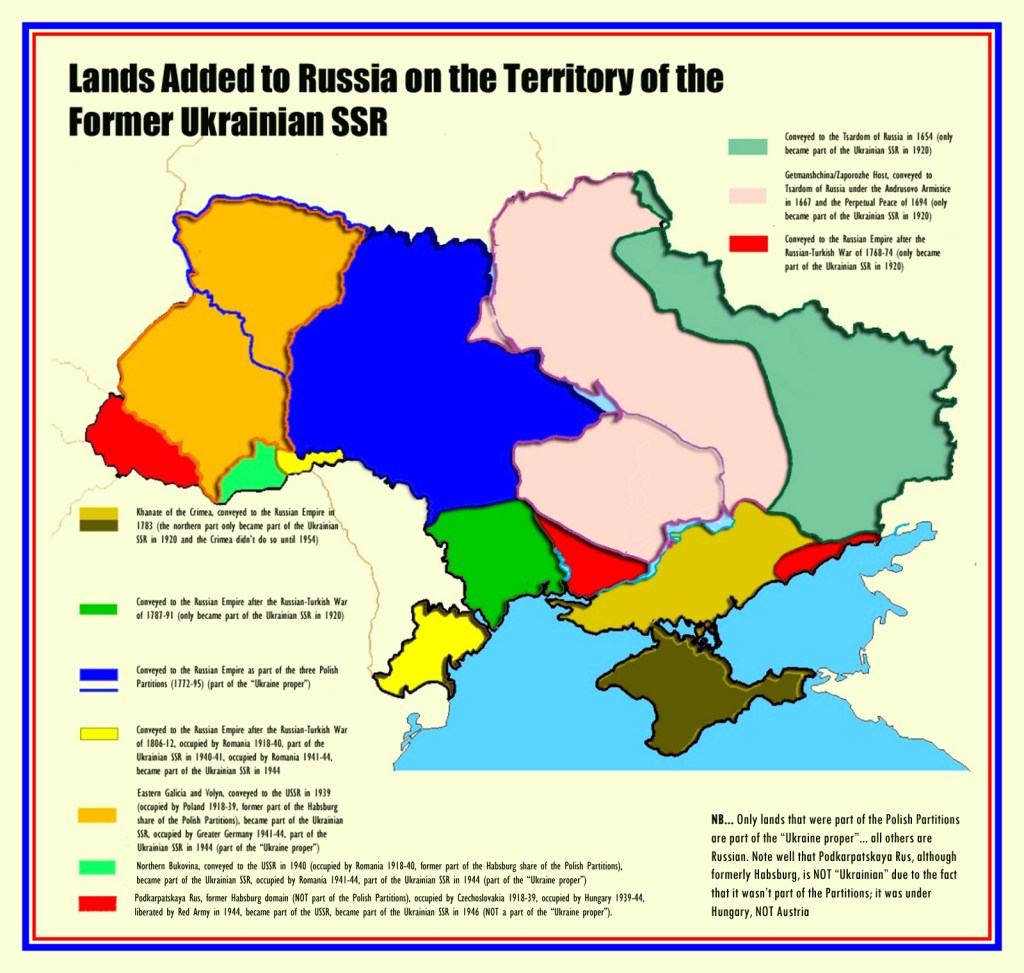
This odd mix of historic regions with different identities is the primary reasons that a conflict in the modern borders of Ukraine were simply a matter of “when” rather than “if”.
This reality has been acknowledged by Alexander Zakharchenko, the leader of the Donetsk People’s Republic who today announced the intent of Donetsk to lead a restoration of Malorossiya as part of a drive to reincorporate historic Russian territories into a close relationship with The Russian Federation.
Zakharchenko stated,
“We propose to establish the state of Malorossiya. Malorossiya is an independent young state. A transition period of up to 3 years.
… The state ‘Ukraine’ showed itself as a failed state and demonstrated the inability to provide its inhabitants with a peaceful and prosperous present and future.
We should be supported by the residents of the regions. This solution is possible provided that the international community supports the idea”.
Donetsk People’s Republic Income and Charges Minister Alexander Timofeev added the following,
“We, the representatives of former Ukraine, declare the establishment of a new state, Malorossiya, which is a successor state to Ukraine. We agree that the new state’s name will be Malorossiya because the very name of Ukraine has discredited itself. The city of Donetsk becomes Malorossiya’s capital”.
He further stated that Malorossiya would develop a constitution based on discussions throughout the regions including in the new/revived area and would ultimately require approval via a democratic referendum.
Timofeev continued,
“Malorossiya is a multinational state with Russian and Malorossiyan being its official languages, and regional languages retaining their rights and statuses…
… The policy aimed at joining the Union State of Russia and Belarus while preserving independence and sovereignty. The keeping of a visa-free regime in agreement with the European Union. De-oligarchisation, un-cluding (sic) on a legal basis”.
When discussing the model of Belarus in respect of its relations with Moscow, Timofeev is alluding to the Union-State between Belarus and Russia which was created in 1996. This has allowed for open borders and common economic and military interests between Minsk and Moscow.
Zakharchenko affirmed that the new state might need to live under emergency conditions for three years due to aggression from remnants of the regime currently ruling in Kiev.
In spite of these difficulties Zakharchenko also struck an optimistic tone, encouraging people to dream big. He stated,
“All of us here are going to talk about the future. We propose a plan for the reintegration of the country through the law and the Constitution. We must build a new country in which the concepts of conscience and honour are not forgotten. We offer the citizens of Ukraine a peaceful way out of the difficult situation, without war. This is our last offer not only to the Ukrainians, but also to all countries that supported the civil war in Donbass. I am convinced that we will do everything possible and impossible”.
Representatives at the meeting where the announcement was made were drawn from historic Malorossiya and Novorossiya regions including Kharkov, Dnepropetrovsk, Zaporozhye, Kherson, Nikolayev, Odessa, Sumy, Poltava, Chernigov, Kirovograd.
The leader of the regime in Kiev, Petro Poroshenko responded to Zakharchenko’s statement saying that Kiev would reconquer both Donbass and the Russian territory of the Crimean peninsula. Both of these statements speak to just how out of touch Poroshenko is with the realities on the ground.
Although the organisational phases of creating Malorossiya will be difficult due to the position of the Kiev regime and almost certainly the European Union also, the idea underlines something The Duran discussed in November of 2016,
“If the (Kiev) regime fell due to a combination of internal incompetence and international isolation, chances are that a more moderate government could be formed. Ideally such a new government would be one that recognises the democratic right to self-determination exercised by the Donbass Republics, one less hell-bent on extreme corruption and hopefully one that would hold regional referenda on autonomy and/or independence.”
Historic regions of different cultural, linguistic and sovereign backgrounds cannot be slammed together into an artificial state for an eternity. History shows that such states are typically dissolved or radically reformed after a certain period of uncomfortable pseudo-coexistence.
The impending collapse of the regime in Kiev and the longer term re-defining of the borders of the state now called Ukraine will have to be addressed sooner or later. The proposals which came out of Donetsk today are as good a beginning on the road to much needed change as any.
6 Americans who should be investigated for their Ukrainian ties
By Adam Garrie | The Duran | July 15, 2017
Incoming FBI Director Cristopher Wray has stated that he would be interested in investigating links between officials of the Ukrainian regime and the Hillary Clinton campaign.
With evidence mounting that high level officials in Kiev actively worked with the Clinton campaign to try and influence US voters, it is imperative that any future investigation isn’t whitewashed simply because Kiev’s tactics failed to win the election for Clinton.
Although the investigation into Donald Trump’s non-existent links with Russia have unsurprisingly come up with virtually nothing of interest, the methods of the investigation ought to be examined and replicated where necessary in a future Ukraine-Clinton investigation.
One of the most fascinating aspects of the so-called Russiagate investigation is that seemingly anyone connected to Donald Trump who ever had a conversation with a Russian, irrespective of their lack of involvement in Russian politics, is a person of interest to investigators.
The same tactics could be accurately applied to an investigation into Clinton and the Democratic party’s links with Ukraine.
Here are the people that ought to be questioned.
1. Hunter Biden
Hunter Biden is the youngest son of Barack Obama’s Vice President Joe Biden. In April of 2014, just two months after the February coup in Kiev, Joe Biden visited Ukraine where he gave a tub-thumping speech about the need for the Ukrainian regime to rely less on Russian gas supplies.
Weeks later, Hunter Biden was appointed to the board of directors of Ukraine’s largest private sector gas company, Burisma.
While many spoke of a prima facie conflict of interest in the appointment, the US mainstream media’s favourable stance towards the Obama administration meant that the story never saw the light of day.
The issue remains prescient, especially in light of allegations regarding wide spread Ukrainian collusion with the Democratic party in respect of the 2016 election.
2. Joe Biden
The timing of Joe Biden’s anti-Russian Ukrainian gas speech and his son’s appointment to the board of a major Ukrainian energy company necessarily means that the former American Vice President is a person of interest.
No one could reasonably believe that the proximate timing of the former VP’s speech and his son’s appointment to the board of Burisma was coincidental.
This is a matter which speaks of itself.
3. Alexandra Chalupa
For over 10 years, Chalupa, a US citizen of Ukrainian origin worked for the Democratic party. It has been established that she had multiple meetings at the Ukrainian Embassy in Washington D.C. in order to dig up dirt on former Trump campaign worker Paul Manafort.
Chalupa claims that her visits to the Ukrainian Embassy were for unrelated endeavours. Her word should not be take at face value. Her interactions with foreign officials in relation to the 2016 US election should be fully investigated.
4. John McCain
Unlike Chalupa, McCain is not a Democrat, McCain has more political ties to Ukraine than anyone in the US Senate. His position as a former Presidential candidate and a strong critic of Donald Trump makes him a person of interest.
McCain is something of a fanatic when it comes to the Ukraine issue. Prior to the coup of February 2014, McCain was frequently pictured in Kiev with many extremist and fascist leaders who actively participated in the coup.
McCain recently visited Ukrainian leader Petro Poroshenko along with troops loyal to the regime during the 2016/2017 New Year’s holiday.
This visit, just weeks before Donald Trump’s inauguration ought to be thoroughly investigated as well as McCain’s other connections to a plethora of Ukrainian politicians, leaders, business and military figures.

For these reasons and because of McCain’s increasingly dubious role in allegedly leaking the so-called ‘Urinegate’ dossier to the media, he is clearly a person of interest.
5. Maxine Waters
Maxine Waters is a Democratic Congresswoman from Los Angeles whose anti-Russian rhetoric is vile and at times incoherent, but nevertheless protected by free speech.
It is not clear if Waters has any direct connections with Ukrainian authorities, but an innocent prank call by the Russian comic callers Vovan and Lexus to Waters, reveals that she is highly susceptible to anti-Russian propaganda. The fact she engaged with the prank callers, seemingly believing that they were officials from Kiev, means that Waters ought to be questioned about any real calls she may have taken from actual Ukrainian regime officials.
For those who believe that Waters is far removed from the sandal, one ought to be reminded that political commentator Alex Jones has been accused by Hillary Clinton of being a Russian agent. It was later confirmed by Jones and other media outlets that the FBI is currently investigating whether Jones’s platform InfoWars as well as Breitbart had direct links with Russia.
InfoWars and Breitbart can hardly be considered Russophile outlets, but the fact remains that Waters has said far more in favour of Ukraine than InfoWars or Breitbart have of Russia.
What’s good for the goose is good for a much more prominent gander.
6. Lindsey Graham
Lindsey Graham was a Trump opponent before it became fashionable in certain quarters. During the Republican primary, Donald Trump read out Graham’s private phone number and encouraged his supporters to ring up the Senator.
Graham was furious with Trump and later had to change his phone number.
When it comes to being a US Senator with close ties to the Ukrainian regime, only John McCain has more than Graham. Graham indeed accompanied McCain to Ukraine on his infamous New Year’s excursion and has close personal contacts with many individuals in Kiev.
For the same reasons McCain should be of interest to anyone who wants to unearth the extent of Ukrainian interference in American democracy, Graham ought to be on the list too.
Putin & Trump agree to create bilateral channel to promote Ukraine settlement – Lavrov

Houses damaged during a shelling by the Ukrainian military, in Donetsk © Irina Gerashchenko / Sputnik FILE PHOTO
RT | July 7, 2017
A special channel between the Russian and American presidents will be established to further push for a settlement of the Ukrainian crisis, Russia’s Foreign Minister Lavrov has announced following the Putin-Trump meeting.
Additional efforts will be made “to support” the Minsk peace agreements and the work of the existing contact group on Ukraine, Russia’s chief diplomat said.
“While discussing Ukraine, the American side informed us that they had appointed a special representative to assist the efforts on settling the Ukrainian crisis.
“Arrangements have been made to create a channel between presidents of Russia and US to use this opportunity that Washington has, to further advance the settlement based on the Minsk agreements and considering the potential established in the contact group and the Normandy format,” Lavrov told reporters during the G20 summit in Hamburg, Germany.
Moscow hopes to soon meet the US representative “for consultations,” he added.
Saying that “everyone is interested” in fulfillment of the Minsk agreements, to which Kiev “is the main part,” Lavrov said Moscow “senses that its Western partners very much understand the necessity of additional influence” on the peace process which so far has been delayed.
Citing his “long” talks with the US Secretary of State Rex Tillerson earlier in the day, as well as a Thursday meeting with the French Minister of Foreign Affairs Jean-Yves Le Drian, Lavrov said everyone agrees the crisis needs to be settled within the framework of the Minsk agreements.
“I have a feeling that it has been confirmed that both the Russian and American presidents are driven by their national interests, which they see primarily in looking for mutually beneficial agreements rather than by trying to play out some confrontational scenarios.”
Lavrov added that the Ukrainian issue had been discussed “in a concrete, businesslike” manner.
$700bn Pentagon bill funds US presence in E. Europe & weapons for Ukraine
RT | June 29, 2017
A Senate committee proposal for the 2018 military budget would further boost Pentagon spending on troops and equipment, make the US presence in Eastern Europe a persistent feature, and supply lethal weapons to Ukraine, among other things.
Adopted in the Senate Armed Services Committee by a vote of 27-0, the 2018 National Defense Authorization Act (NDAA) would add $97 billion to the total military budget proposed by President Donald Trump last month.
Citing the need to “deter Russian aggression,” committee chairman John McCain (R-Arizona) shifted the funding for US deployments in Eastern Europe to the base Pentagon budget, and renamed it the European Deterrence Initiative (EDI). The NDAA also requires the Pentagon to submit future plans for the EDI, “including an assessment of permanently stationing troops in Eastern Europe.”
“In an unparalleled attack on our core interests and values, Russia engaged in an active, purposeful campaign to undermine the integrity of American democracy and affect the outcome of the 2016 presidential election,” said the summary version of the bill, published late on Wednesday. “The committee believes the United States must do more to deter Russian aggression, whether across its borders or in cyberspace.”
The $500 million earmarked for “security assistance” to the government of Ukraine includes “defensive lethal assistance.” However, half of this funding will be conditional on “substantial action” by Kiev to “make defense institutional reforms critical to sustaining capabilities developed using security assistance.” This would have to be certified by the US secretary of defense.
The 2018 NDAA extends the prohibition of military cooperation with Russia first imposed in 2014 – which, among other things, prevents the US-led coalition from coordinating operations against Islamic State (IS, formerly ISIS/ISIL) in Iraq and Syria. It also bans the Pentagon from using software developed by Kaspersky Lab, “due to reports that the Moscow-based company might be vulnerable to Russian government influence.”
Arguing that a massive increase in funding is necessary to “restore readiness, rebuild capacity, and modernize the force for future challenges,” the NDAA codifies a policy that the US Navy should have at least 355 ships of “the optimal mix” and calls for the construction of 13 ships next year, five more than in the White House request.
It also funds 94 new F-35 Lockheed Martin Joint Strike Fighters – 60 for the Air Force, 24 for the Marines and 10 for the Navy – altogether 24 more than Trump’s budget requested.
The Senate markup calls for an additional 15,000 soldiers and 1,000 marines over Trump’s budget request and authorizes a 2.1 percent across-the-board pay raise for members of the US Armed Forces.
By far the biggest increase in funding relates to cooperative missile defense programs between the US and Israel, which would get $558.5 million more than Trump requested for a total of $705 million.
An earlier markup released by the House Armed Services Committee was $4 billion less, but still higher than Trump’s original budget proposal of $603 billion. All three proposals are much higher than the $549 billion spending cap under the 2011 Budget Control Act, and will require a deal with the minority Democrats to get passed.
Crimea, Afghanistan and Libya
By Brian CLOUGHLEY | Strategic Culture Foundation | 27.06.2017
On June 20 the United States Treasury Department stated that economic sanctions against Russia «would not be lifted until Russia leaves Crimea». In that case, sanctions will remain forever, because ten days after the democratically elected Crimean parliament voted to accede to Russia on 6 March 2014, a referendum was held which confirmed its decision — and the citizens of Crimea intend to remain with Russia.
At that time «Mr Obama said that the referendum was illegal and would never be accepted» and the European Union proclaimed that the vote was ‘illegitimate and its outcome will not be recognised’». This was an interesting political signal, because it was obvious the objectors knew that the citizens of Crimea would vote to rejoin Russia. The hopes and desires of ordinary citizens didn’t matter, because the US and the EU had already made up their minds to ignore a democratic vote.
Predictably, the Secretary General of NATO, Jens Stoltenberg, continues to declare that «NATO Allies do not and will not recognise Russia’s illegal and illegitimate annexation of Crimea».
Time magazine was realistic in recording on March 16, 2014, that the citizens of Crimea «voted overwhelmingly on Sunday to secede from their country and join Russia, in a major victory for Moscow that followed days of international condemnation that the referendum itself was illegitimate». Of course they voted to accede to Russia. They would have been insane to do otherwise. The thought of being ruled by xenophobic bigots who had just mounted a US-assisted coup in Ukraine was appalling. Since the accession to Russia there hasn’t been a single instance of civil disturbance in Crimea — and be assured that if there was the slightest possibility of any such disorder, then US and British intelligence agencies would have informed their media.
The reason for the West’s condemnation of a democratic vote to belong to Russia by Russian-cultured, Russian-speaking citizens of Crimea is not difficult to determine. Since the end of the Soviet Union the US-NATO military alliance has been desperate to justify its existence, and there is no more convenient enemy to be conjured up than Russia. Until that could be arranged, excursions into wider war by NATO provided excuses for survival and expansion.
NATO’s total failure in the war in Afghanistan has further detracted from its miniscule credibility, and its 2011 blitz on Libya was a war crime. Both countries are now in chaos.
After fifteen years of US-NATO war in Afghanistan, as admitted on June 13 by the US Secretary for Defence, General Mattis, the place is a shambles, and «we are not winning in Afghanistan right now».
Amazingly, Mattis added «and we will correct this as soon as possible». What is he going to do? Wave a magic wand and eradicate corruption and install a democratic government and give equal rights to women and destroy the drug industry that accounts for 15 percent of Afghanistan’s GDP and disband the savage militias which have been so well-armed and funded by the CIA? Is he going to defeat the militants who have fought the US-NATO military alliance to a standstill over 15 years?
Mattis is the gallant intellectual general who boasted in a CNN interview in 2005 that «You go into Afghanistan, you got guys who slap women around for five years because they didn’t wear a veil. You know, guys like that ain’t got no manhood left anyway. So it is a hell of a lot of fun to shoot them». — He is exactly the sort of rabid military maniac whose bash and crash tactics over the years have caused so many Afghans to loathe and despise the foreigners who invaded their country. Mattis declares that «NATO has always stood for military strength and protection of the democracies and the freedoms we intend to pass on to our children», but the Mattis-NATO concept of freedom is at variance with reality.
In Afghanistan, as recorded by Human Rights Watch, «Early on February 18, Afghan police special forces raided a clinic run by the humanitarian organization Swedish Committee for Afghanistan, assaulted medical staff, and shot dead two patients, including a 16-year-old, and a 15-year-old caregiver. Witnesses reported that international military forces accompanied the Afghan forces, although they did not enter the clinic». No prizes for guessing which country provided these «international military forces,» under NATO auspices. Freedom, anyone?
Then on 12 June 2017 US troops killed three civilians, a man and his two sons. The soldiers were in a vehicle convoy that was struck by a bomb, and opened fire, spraying bullets round the countryside in the cause of freedom. Now: nobody should denounce these young soldiers for panicking and blasting anyone they thought was a threat. It is only too easy for commentators and politicians to aim the blame in such circumstances — without reflecting that they themselves might not have been exactly cool, calm and collected when the bomb blast went off. Certainly the man and his kids should not have been killed — but the US soldiers shouldn’t have been in Afghanistan in the first place.
And while all this carnage is going on, the West’s sanctions on Russia continue to be aimed at the innocent citizens of Crimea in the hope that they will revolt against Russia and embrace what General Mattis calls the freedom-loving US-NATO military alliance.
In 2011 this freedom-loving military alliance destroyed Libya in an aerial blitz that began by US and British warships firing 110 Tomahawk missiles and continued with NATO’s air forces pulverising the place for seven months, during which their aircraft carried out 14,202 bomb and rocket airstrikes in the cause of freedom. As noted by one commentator, Human Rights Watch «released a report into the deaths of at least 72 Libyan civilians, a third of them children, killed in eight separate bombing raids (seven on non-military targets) – and denounced NATO for still refusing to investigate or even acknowledge civilian deaths that were always denied at the time».
Libya is now a catastrophic shambles, with armed groups fighting each other and Islamic State terrorists finding willing recruits for their savagery. The results of the US-NATO war that supported rebels against the Libyan government include «Shortages of food, fuel, water, medical supplies and electricity, as well as reduced access to health care and public services. Care for patients with chronic diseases, disabilities and mental health disorders is compromised by restricted access to the few functioning health facilities. The situation of women and children has become particularly vulnerable, since the hospitals are overwhelmed with trauma patients».
Before the US-NATO destruction of Libya the World Health Organisation recorded that «the country is providing comprehensive health care including promotive, preventive, curative and rehabilitative services to all citizens free of charge through primary health care units, health centres and district hospitals». The CIA Factbook noted that Gaddafi’s Libya had a literacy rate of 94.2% which was higher than in Malaysia, Mexico and Saudi Arabia. According to WHO, life expectancy was 75 years, as against 66 in India, 71 in Egypt, 59 in South Africa.
Forgotten are the wise words of Brazil, China, India, Russia and NATO-member Germany (which refused to join the Libya bombing spree), who warned against «unintended consequences of armed intervention» concerning which Mr Putin (then prime minister) observed that it was regrettable when the «so-called civilized community, with all its might, pounces on a small country, and ruins infrastructure that has been built over generations».
The question is, where would you prefer to live? — In Afghanistan, after 15 years of US-NATO war, where barbaric violence rules, the lives of women are obscenely degrading, corruption is terminal and illegal drug production is the highest in the world? Or Libya, destroyed by a US-NATO blitzkrieg, where there are now «two rival parliaments and three governments» and even the New York Times admits that it is «a violent and divided nation rife with independent militias, flooded with arms and lacking legitimate governance and political unity»?
Or might you not prefer Crimea, where infrastructure is being improved and the people do not fear being sprayed with bullets by foreign soldiers; where every effort is being made to improve the living conditions of its inhabitants who are the targets of spiteful western sanctions?
Ukrainian regime arrests owner of Russian language news outlet
By Adam Garrie | The Duran | June 23, 2017
The Ukrainian regimes notorious Secret Service, the SBU has arrested the owner of a Russian language news outlet Strana.ua.
Igor Guzhva was arrested while his offices were raided. Authorities loyal to the Poroshenko regime have stated that the charges related to allegations of blackmail, although many see this is yet another attempt to forcibly shut-down domestically owned Russian language news media after a law was passed banning Russian owned media in the country.
The regime authorities are also cracking down on the large domestically owned and produced Russian language media and entertainment sectors.
Strana.ua was harassed by the SBU throughout 2014 and 2015.
This looks increasingly like another politically motivated arrest by a regime engaged in crimes against humanity in Donbass.
Featured Video

Dan Dicks with James Corbett on Solutions Watch
or go to
Aletho News Archives – Video-Images
From the Archives
Secret document reveals plans for civil war in Lebanon, Israeli false flags, and invasion
By Randi Nord | Geopolitics Alert | April 5, 2019
Beirut – During his visit with US Secretary of State, Mike Pompeo, Lebanese President Michael Aoun reportedly received a US-Israeli document detailing plans for creating a civil war in Lebanon with covert false flag operations and possible Israeli invasion.
Although the source of the document is Israeli and created in partnership with Washington, no one knows who presented it to Aoun. The Lebanese TV station, Al-Jadeed, initially reported the document on Lebanese TV and a video on its website. Geopolitics Alert translated the report for this article. … continue
Blog Roll
 Aletho News
- Sheikh al-Asadi warns of Iraqi government compliance with US demands
- How to MAKE THE CONSPIRATORS PAY for their crimes! Dan Dicks with James Corbett on Solutions Watch
- There’s a drought in academia: A drought in honest research on the subject of drought and other weather extremes
- Department of War Awards $20.7 Billion Contract to Raytheon for Air-to-Air Missiles
- ‘Distance yourselves from Israel’: IRGC urges US population to question govt policies
- America’s Greenland deal has a radioactive backstory
- The RAF Fairford ‘terror plot’: Unpacking escalation in the UK echo-chamber
- EU Council Advances Chat Control 2.0 Scanning Proposal
- Ex-Greek MEP files complaint against Israeli spyware firm over alleged Pegasus surveillance
- Troubling ideas throughout the Torah, Talmud, Mishneh Torah and Tanya
- If Americans Knew
- New Report: “Scholasticide and Genocide in Gaza: Assessment, Testimonies and Legal Analysis”
- Ex-Biden officials are desperate for a Gaza scapegoat
- Israeli “settlers” Invade Al-Aqsa; Pour Boiling Water on 75-Year-Old
- Israel Has Kidnapped Another American Teenager
- US arms sales to Israel worth $21.6 billion in 20 months
- Three Palestinians Killed in Israeli Attacks on Gaza
- Revealed: German “Anti-Semitism Expert” Driving Crackdown on Palestine Solidarity is Former Israeli Spy
- Egypt’s Warning to Israel Before Oct 7
- Israel’s siege signals another cruel winter for 1.8 million Gazans – Daily Update
- Netanyahu Asked UAE Leader to Deny Report on Oct. 7 Warning in Secret Visit, Sources Say
- No Tricks Zone
- Two More Paleo Reconstructions Affirm Meters-Higher Sea Levels Across Ireland, Brazil 7000-6000 Years Ago
- New Study: Earth And Venus Surface Warmth Largely Explained By Convection And Lapse Rate, Not CO2 Or Radiation
- 2025 Nature Paper Claiming Worsening Global Drought Gets RETRACTED …Heavily Flawed
- New Study: ‘Global Drought Shows No Detectable Recent Acceleration Under Climate Warming’
- Economic Masterminds: German Socialists Suggest Taxing Productivity Gains Stemming From Using AI
- The South China Sea Has Not Been Cooperating With The Climate Change Narrative
- Energy Crisis: Germany Enters Heating Season With Historically Low Gas Reserve Fill Levels
- New Study: The Antarctic Ice Sheet Gained Mass From 2020-2024 Due To Staggering Snow And Ice Accumulation
- Study: Ocean Heating Rates From Thousands Of Years Ago ‘Dwarf’ Modern Ocean Heating Rates
- Climate Extremists Target, Attack Large-Scale Power Grid Infrastructure In Germany!

