Ukraine Leader’s Remarks on Minsk Pact Contradictory – Lavrov
Sputnik – 23.01.2017
Ukrainian President Petro Poroshenko’s recent remarks concerning the pace of the Minsk agreements’ implementation and security issues contradict the agreements themselves and highlight Kiev’s efforts to evade them, Russian Foreign Minister Sergey Lavrov said Monday.
On Sunday, Poroshenko gave a speech during Ukrainian Unity Day celebrations, stating that the government will not proceed in implementing the Minsk agreements and amending the Ukrainian constitution until security issues are settled in war-torn eastern Ukraine. The latter includes restoring Ukrainian army control over the country’s border with Russia, which is currently controlled by the Donbas militias.
“We hope that these EU countries that act as guarantors of the Minsk agreements… in Paris and Berlin would pay attention to this inappropriate statement by President Poroshenko, who is trying to wriggle out of his commitments,” Lavrov said.
The Russian side had voiced its concern with Poroshenko’s remarks on Ukraine halting the implementation of political reforms needed to settle the east Ukrainian conflict, he added, stressing that such a position is in direct contradiction with the terms of the Minsk accords which state that control over the Russian-Ukrainian border can only be restored after Kiev gives a special status to the Donbas region.
In 2014, Kiev authorities launched a military operation against militias in the Donbas region. In 2015, the two sides reached a ceasefire deal brokered by the leaders of the Normandy quartet including Russia, France, Germany and Ukraine in Minsk. Throughout 2016, the Normandy Four and the Organization for Security and Co-operation in Europe (OSCE) have been stressing the need to implement Minsk provisions but Kiev has stalled in giving a special status to Donbas as specified in the agreement. Ceasefire violations have continued.
About 7,500 Foreign Soldiers to Take Part in 2017 Drills in Ukraine
Sputnik – 20.01.2017
KIEV – Around 7,500 foreign servicemen and about 12,500 Ukrainian soldiers will participate in military drills in Ukraine this year, spokesperson of the Ukrainian Defense Ministry Dmytro Hutsulyak said on Friday.
“We are going to involve about 12,500 Ukrainian servicemen. Our partners are expected to send around 7,500 soldiers,” Hutsulyak said at a press conference.
He added that about 1,500 Ukrainian servicemen would take part in various drills abroad in 2017.
On Thursday, the Ukrainian parliament adopted a law allowing foreign troops to be present in the country in 2017 to participate in multinational drills.
The bill outlines the admission in the framework of multi-national drills of the US and other NATO member states’ military, as well as of the countries participating in the Partnership for Peace program, totaling up to 3,000 personnel, for up to 365 days in January-December 2017.
The document is yet to be signed by the president.
Marine Le Pen: Crimea Was Never Ukrainian, I Will Recognize Crimea as Part of Russia

American Herald Tribune | January 18, 2017
The French presidential candidate Marine Le Pen has reiterated her support for Russia’s claim on Crimea in a newspaper interview in which she made another decisive tilt towards Moscow.
With three months before France goes to the polls, the Front National leader said she recognised Crimea as being part of Russia and if elected, she would push for a dropping of sanctions against Russia which France had backed simply because it was following German orders.
She told the Russian newspaper, Izvestia, that the referendum in the peninsula in 2014 to become part of Russia showed the “agreement of the people to join Russia”.
“Ukraine’s ownership of Crimea was just an administrative issue from Soviet times, the peninsula was never Ukrainian,” she said.
“I regret that the referendum, organised as a demonstration of the will of the people of the peninsula, was not recognised by the international community and the UN.”
Le Pen had made the comments about Crimea on French television earlier in January after which the Ukrainian security service SBU proposed banning her from entering the country for five years.
She described sanctions against Russia as “senseless” and “a pretty stupid method of diplomacy” and that “all countries should show respect for each other, to negotiate on equal terms and to accept a compromise solution acceptable to all”.
“We don’t have to have a situation whereby the major powers impose their policies on other states, behaving like stubborn children,” she told the paper.
( Image Credit: European Parliament/ flickr).
Trump’s Remaking of US Foreign Policy
By Gilbert Doctorow | Consortium News | January 16, 2017
Over the weekend, President-elect Trump received two journalists from mainstream European print media — The Times of London and the German magazine Bild — for a joint interview in New York City’s Trump Tower. The event was videotaped and we are seeing some remarkable sound bites, particularly those of interest to the British and German publics.
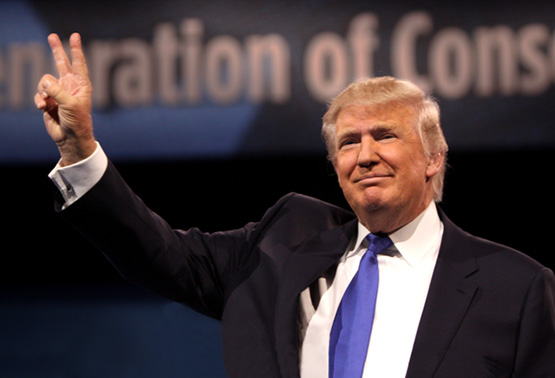
President-elect Donald J. Trump donaldjtrump.com
For the government of British Prime Minister Theresa May, nothing could have sounded sweeter than Donald Trump’s statement that she would be invited for talks in the White House shortly after he is sworn in on Jan. 20 and that he seeks very quickly to reach agreement on a bilateral free trade pact. The effect of the pledge itself, even ahead of its successful implementation, assures the British that the sting of severing ties with the European Union will be greatly offset by new commercial possibilities in the world’s biggest economy; in this way, it strengthens May’s hand enormously as she enters into talks with the E.U. leadership over the detailed terms of what will apparently be a “Hard Brexit.”
Further adding to her leverage with the E.U. were Trump’s remarks suggesting that the E.U. will face stern trade pressure, beginning with Germany and its automobile industry, to do more to manufacture in the U.S. That precisely raises the relative importance of the U.K. market, which the E.U. will otherwise lose if it imposes severe penalties on Britain in negotiations over Brexit.
For the general public’s consumption, Donald Trump used the interview to explain his special affection for Britain, speaking about his Scottish mother’s delight in the Queen and her watching every royal event on television for its unequaled pageantry. But we may expect that Prime Minister May will find there is a bill to pay for the “special relationship” with the U.S. under President Trump.
Rather than the British media’s early speculation that Prime Minister May would be the one to set the misguided Trump straight about the nefarious Vladimir Putin, she may now have to become a leading European advocate for détente with Russia at Trump’s behest. In this connection, British Foreign Minister Boris Johnson’s advice to Congress during his visit to Washington last week that Official Washington “stop demonizing Putin” may well have been a straw in the wind.
For the Germans, Trump also offered a bit of flattery, saying how much he respected their Chancellor Angela Merkel. However, as he went on, he virtually flattened the Iron Lady’s reputation by calling her open-door policy of admitting migrants into Germany and the E.U. a catastrophe. He noted that Merkel’s controversial position had swayed the election results in Britain on Brexit and may lead to the departure of other countries from the E.U. Given his staff’s consultation with Marine Le Pen, a visiting French candidate for the presidency from the right-wing Front National, Trump’s list surely includes France.
Finally, among the sound bites that will be featured in media coverage of the interview, we hear Donald Trump describe NATO as an outdated organization that needs overhaul. However, apart from his reiterated insistence that Member States must pay their fair share, which he claims only Britain and four others from the 28 Member States are currently doing, the interview offers no specifics on what kind structural change, if any, he seeks for NATO. We only hear that NATO has not been prepared to deal with the threat of international terrorism.
Views on Russia
But it was in another area, Trump’s remarks on Russia and the terms he named for possibly lifting sanctions, that we find convincing proof that the President-elect’s approach to foreign affairs is not just the sum of isolated tactical considerations but a complete reinvention of the guiding principles of U.S. foreign policy. What we are witnessing is a shift to a new strategic, geopolitical paradigm.
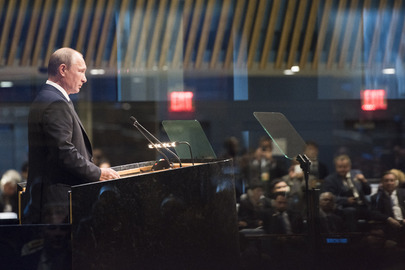
Russian President Vladimir Putin (UN Photo)
In the past couple of decades, going back to the second term of President Bill Clinton, the ideology of neoconservatism with its stress on “democracy promotion” as being the whole of national interest, dictated policy decisions that amounted to the tail wagging the dog. The Baltic States were admitted into NATO in its 2004 enlargement because they wanted it. The decision to station U.S., German and other NATO brigades in Poland and other states along the Russian border taken last July in Warsaw and implemented, in the case of Poland, by U.S. forces in the past several days, was justified by the anxiety of these countries over the possibility of Russian aggression, even though NATO’s action has been highly provocative vis-à-vis Russia and brought the major nuclear powers ever closer to direct confrontation.
In the interview, Trump changed entirely the metrics by which sanctions on Russia would be lifted. Instead of fulfillment of the Minsk Accords over Ukraine’s ethnic Russian Donbas region – which nationalist hardliners in Kiev had the power to block – Trump conditioned the relaxation of sanctions on progress in curbing the nuclear arms race and moving toward significant nuclear disarmament, issues that are fully within the power of the Kremlin to implement.
To be sure, these issues today are more complex than they were in the heyday of disarmament talks. The recent obstacles include the U.S. anti-ballistic missile installations in Poland and Romania, the forward stationing of NATO human and materiel resources in the former Warsaw Pact countries, and the standing invitations to Ukraine and Georgia to enter NATO. So any negotiations between Washington and Moscow will be very complex.
But Trump’s statement shows that he is focused on the big picture, on the triangular relationship between Washington, Moscow and Beijing that he believes to be of vital importance in keeping the peace globally, rather than on some amorphous reliance on expanding democracy globally on the unproven assumption that democracies among themselves are peace-loving.
These elements in Donald Trump’s thinking, quite unexpected in a businessman, bring him very close to the Realism of Richard Nixon and Henry Kissinger, while his setting nuclear disarmament as a key goal, aligns him with Ronald Reagan and — strange to say — with Barack Obama at the very start of his presidency.
If Donald Trump can stave off the jackals from the Western mainstream media and the U.S. foreign policy establishment – a combination that has formed a snarling circle around him even before he takes office – he may have a chance to make historic changes in international relations toward a more peaceful world.
Gilbert Doctorow is the European Coordinator of The American Committee for East West Accord Ltd. His latest book, Does Russia Have a Future? was published in August 2015.
Obama extends national emergency on Iran
Press TV – January 14, 2017
US President Barack Obama has declared the continuation of his country’s national emergency against Iran, claiming that despite full commitment to its nuclear deal with the six world powers, the Islamic Republic still poses “an unusual and extraordinary threat” to America.
The outgoing president informed Congress of his decision in a letter on Friday, saying that the national emergency, which was declared on March 15, 1995, “is to continue in effect beyond March 15, 2017.”
The National Emergencies Act requires the president to extend a national emergency within 90 days of its anniversary date, before it is automatically terminated.
Obama admitted in his letter that Iran had delivered on its commitments pursuant to the Joint Comprehensive Plan of Action (JCPOA), a landmark nuclear deal that was struck between Iran and the P5+1 group of countries — the US, the UK, France, China, Russia, and Germany — on July 14, 2015.
Under the landmark deal, which entered into force on January 16 last year, Iran undertook to put restrictions on its nuclear program in exchange for the removal of nuclear-related sanctions imposed against the country.
“Since Implementation Day, the IAEA (International Atomic Energy Agency) has repeatedly verified, and the Secretary of State [John Kerry] has confirmed, that Iran continues to meet its nuclear commitments pursuant to the JCPOA,” Obama said in his notice.
“However, irrespective of the JCPOA, which continues to ensure that Iran’s nuclear program is and remains exclusively peaceful, certain actions and policies of the Government of Iran continue to pose an unusual and extraordinary threat to the national security, foreign policy, and economy of the United States,” the outgoing president added.
In November, Obama extended a separate national emergency against Iran, which was originally declared by former US President Jimmy Carter on November 14, 1979.
He also extended the state of emergency with respect to Libya, Ukraine, Zimbabwe, Cuba and Venezuela.
A state of emergency gives the US president special powers, including the ability to seize property, summon the National Guard and hire and fire military officers at will.
The state of emergency also forms the basis for most US sanctions against other countries.
Transnistria and Donbass: Historical Parallels and Possible Similar Scenarios for the Future
By Halyna Mokrushyna | CounterPunch | January 13, 2017
On January 4, President Igor Dodon of Moldova met with Vadim Krasnoselskiy, the head of the unrecognized Pridnestrovian Moldavian Republic (Transnistria). The meeting took place in Bendery, on the right bank of Dniester river, on the territory of the Transnistria. It was initiated by the president of Moldova.
Igor Dodon was elected Moldovan president on November 13 on a platform advocating improved relations with Russia.
During the meeting, both sides established a good contact and expressed openness and willingness to compromise. Concrete decisions have been taken to improve relations between Moldova and Transnistria. “Citizens on both sides of the Dniester River (which runs through the territory of Moldova and the right (eastern) border of Transnistria) should see the concrete results during 2017,” stated President of Moldova Igor Dodon .
The president of Transnistria Vadim Krasnoselskiy stressed the importance of compromise with Moldova for people living on both sides. “We must create the conditions so that people are not held hostage to politics, so that decisions taken by politicians are for the benefit of the people. We must respect the people of Moldova and Transnistria and find a compromise in any case”, stated Vadim Krasnoselskiy.
During the meeting, the first in eight years, the presidents of Moldova and Trasnistria discussed a whole range of practical issues that have accumulated in recent years, including problems in education, registration of vehicles, communication, movement of citizens, rail transport, recognition of diplomas and car plates.
At the same time, political issues were not discussed. Recognition of the independence of the Pridnestrovian Moldavian Republic (PMR) by Chisinau remains the main bone of contention between the two republics. Chisinau designates PMR as the Transnistria autonomous territorial unit with special legal status. PMR is not recognized by any country, member of the UN, while the UN itself considers PMR to be part of Moldova.
PMR emerged as a reaction of the mostly Slavic population of this territory to the rise of pro-Romanian nationalism among ethnic Moldovans in the late 1980s, the period of Gorbachev’s perestroika and glasnost in Russia. The most prominent movement formed at that time, the Popular Front of Moldova, formulated three main demands: that Moldovan be declared the only state language, that the Moldovan language switch to use of the Latin alphabet instead of the Cyrillic one, and that Moldovan ethnic identity be recognized as identical to Romanian one. The radical factions of the Popular Front called for minority populations, particularly the Slavs (mainly Russians and Ukrainians) and Gagauz, to leave or be expelled from Moldova.
The Supreme Council of the Moldavian Soviet Socialist Republic followed through on main three demands: on August 31, 1989 it adopted Moldovan as the only official language, while retaining Russian for secondary purposes; it introduced the Latin alphabet; and it declared a shared Moldovan-Romanian linguistic identity. The publicly stated intentions of the Moldovan authorities to bring the country closer to Romania, as well as the ethnocentric rhetoric of the Popular Front, provoked serious concerns of ethnic minorities in the country. Transnistria’s population was predominantly Slav – 60% were Ukrainians and Russians, while less than 40% were ethnic Moldovans. The overall majority of the population, including some ethnic Moldovans, spoke Russian as their mother tongue.
The nationalist Popular Front won the first free parliamentary elections in the Moldavian SSR in the spring of 1990. On 2 September 1990, the Second Congress of the Peoples’ Representatives of Transnistria proclaimed the creation of the Pridnestrovian Moldavian Soviet Socialist Republic. Violence escalated when in October 1990, the Popular Front called for volunteers to form armed militias to stop an autonomy referendum in Gagauzia. In response, volunteer militias were formed in Transnistria.
Limited armed clashes between Transnistrian militia and Moldova started in November of 1990. Volunteers from Russia came to support Transnistrians. In early 1992, the fighting intensified. The former Soviet 14th Guards Army, stationed in Transnistiria, which remained neutral throughout the fighting, entered the conflict in its final stage, swearing allegiance to Transnistrian authorities and opening fire against Moldovan forces. A ceasefire agreement was signed on 21 July 1992 and has held to the present day.
The history of the emergence of the Pridnestrovian Moldavian Republic holds several striking similarities with the current conflict in Ukraine. There, the people of the Donetsk and Lugansk oblasts in eastern Ukraine rebelled against the nationalist rhetoric of the Euromaidan movement and the government brought to power through a coup d’état on February 21-22, 2014. One of the first steps of that government was to abolish the existing law on languages in Ukraine granting Russian a special status in Russian-speaking regions of Ukraine. Ukrainian is the only official language in Ukraine. Changes to the language law in 2013 granted Russian a special status in areas of majority or large minority Russian speakers, but the law was bitterly opposed by Ukrainian nationalists.
Another similarity is the linguistic profiles of Ukraine and Moldova. Like Transnistria, where the majority of population speaks Russian, Donetsk and Lugansk regions are the only regions of Ukraine, where Russian language is spoken by the large majority of the population. Population of these regions of Ukraine has always been close to Russia culturally, as with the population of Transnistria. Russian volunteers poured into Transnistria to help locals to defend their rights against Moldovan nationalism; in the same way 20 years later, Donetsk and Lugansk received the support of volunteers from Russia in their fight against Ukrainian nationalism and against a forceful integration into the European Union by the coup government that came to power in 2014. They wanted closer ties with Russia. However, Russia has not officially recognized the Donetsk and Lugansk People’s Republics, as it has not recognized the Pridnestrovian Moldavian Republic. Russia does provide extensive humanitarian assistance to both entities and maintains extensive economic and cultural relations.
Moldova has not officially recognized Transnistria. But at least it stopped waging war against against the breakaway republic, and it has settled into an uneasy coexistence. The relations between Moldova and Transnistria are often characterized as a “frozen conflict”. All attempts to find a formula for political settlement of the unrecognized status of the PMR between the PMR and Moldova have not produced any result.
Since independence in 1991, Moldova, like Ukraine some 20 years later, set out on a course of economic integration into the European Union. Even the so-called ‘pro-Russian’ Moldovan presidents over the years, such as Vladimir Voronin (2001-2009), followed this course very closely. For example, in 2003, Voronin refused to sign a memorandum proposed by the Russian Federation outlining plans for a unification of Moldova and the PMR into a federal state of Moldova. Voronin stated that since Moldova plans to join European Union, such a plan needed the approval of ‘European structures’, beginning with the Organization for Security and Cooperation in Europe’, and therefore he could not endorse it.
In the current conflict between Kyiv and Donetsk and Lugansk republics, Russian officials have stated on many occasions that the two republics (comprising the historic industrial region called ‘Donbass’) should be granted a large autonomy within a unitary Ukraine, in spite of the evident desire of the populations of the two breakaway republics to desire to integrate into the Russian Federation.
The ceasefire and political-settlement agreement signed in Minsk, Belarus on Feb 12, 2015 (termed ‘Minsk-2’, text here) with the endorsement of France, Germany, and Russia, outline beginning principles of this autonomy, but Kyiv has been stubbornly sabotaging the agreement.
The new president of Moldova, Igor Dodon, is proving himself a wiser and more mature politician compared to Ukrainian leaders, as shown by his visit to the Pridnestrovian Moldovan Republic. He declared that Moldova under his presidency will remain a neutral country, not choosing between European Union or Russia. The population of Moldova, like the population of Ukraine, has always been split in its political and cultural sympathies towards Europe and Russia. Most Moldovans and probably a majority of Ukrainians believe the best way to keep their country safe and whole is by preserving a neutral status between the EU and the Russia-dominated Eurasian Economic Union to the east. Dodon has demonstrated a practical approach of compromise and negotiation in the interests of the population of both Moldova and the PMR.
Kyiv should follow Dodon’s example because it is the only path to peace in Ukraine. Unfortunately, the current political regime in Kyiv is unlikely to do that. The news of Dodon’s meeting with the president of the PMR was not even reported by mainstream Ukrainian media.
The recent call of one of the richest Ukrainian oligarchs, Viktor Pinchuk, to make painful compromises with Russia and implement Minsk-2 and return to a neutral status for Ukraine to reach peace in Donbass, has been repudiated by Poroshenko’s administration. Konstantin Eliseev, the deputy head of the Presidential Administration, stated that Ukraine will never turn away from integration into the European Union and NATO . (See my Dec 31, 2016 article ‘ Prominent member of Ukraine’s elite issues call for peace in Donbass’.)
But to the ongoing consternation of officials of the Kyiv government, full membership of Ukraine in the European Union has always been treated cautiously and even reluctantly by European Union officials. They have used the idea to foment conflict between Ukraine and Russia, which is not the same as supporting and facilitation it, as Ukrainians are today learning.
Ukrainians blindly mistook a loose economic association with Europe as being a step toward an inevitable, full integration into the European Union. They naively hoped that the European Union will solve the economic disaster that the country became following independence in 1991, particularly following the failed ‘Orange Revolution’ of 2005 in which competing interests among the country’s economic elite fought for domination amidst a backdrop of deep, social protest by ordinary Ukrainians.
This blind, naïve hope has brought further economic disaster and civil war in Ukraine. The official Ukrainian propaganda blames Russia for all of the troubles beginning in 2013 and it refuses to recognize Kyiv’s fault in its unleashing of a so-called Anti-Terrorist Operation (complete with its own, catchy acronym—the ‘ATO’) against its own people. Kyiv relied heavily on U.S. support in the conflict with Russia. Now, that support may dwindle if President-elect Donald Trump carries through his various, offhand statements that he is interested in seeking improved relations with Russia.
Kyiv should review its categorical refusal to accommodate Donetsk and Lugansk if it wants to keep Donbass within Ukraine. Otherwise the Donetsk and Lugansk People’s Republics will follow the path of the Pridnestrovian Moldovan Republic in exercising a permanent autonomy. It is a very plausible scenario, given the fact that the conflict in Donbass has been frozen for more than two years and Ukraine continues to punish the two republics with unceasing artillery fire and a punishing economic blockade.
Halyna Mokrushyna is currently enrolled in the PhD program in Sociology at the University of Ottawa and a part-time professor. She holds a doctorate in linguistics and MA degree in communication. Her academic interests include: transitional justice; collective memory; ethnic studies; dissent movement in Ukraine; history of Ukraine; sociological thought. Her doctoral project deals with the memory of Stalinist purges in Ukraine. In the summer of 2013 she travelled to Lviv, Kyiv, Kharkiv and Donetsk to conduct her field research. She is currently working on completing her thesis. She can be reached at halouwins@gmail.com.
Europe’s Mixed Feelings About Trump
By Andrew Spannaus | Consortium News | January 9, 2017
Few in Europe expected Donald Trump to win the U.S. Presidential elections last November. The picture painted by the media and political class was convincing: despite the pent-up anger being expressed through protest candidates, Hillary Clinton was headed towards a decisive victory, as the majority of Americans couldn’t stomach someone as outrageous and unconventional as the reality TV star turned politician.
That’s not what happened, of course, as Trump earned an Electoral College victory by winning enough votes in key Midwestern states that have suffered from a loss of manufacturing jobs in recent decades. His victory has shaken the Western world to its core, making it clear that business as usual is no longer possible in terms of both economic and foreign policy.
In Europe the signs of the anti-establishment sentiment that dominated the U.S. election campaign have been present for some time. The most obvious example was the Brexit vote in June 2016, in which the population of the United Kingdom voted to leave the European Union. But protest movements have actually been on the rise for several years now, driven by the same basic issues as in the United States: a sense of economic and social insecurity – accompanied by a rise in anti-immigrant sentiment – driven by an economic policy that has made life harder for the middle class while enriching those at the top.
The growing anger against the institutions of the European Union, considered the main culprit for the failed economic policies, has made the élites desperate for some sense of stability, to help them weather the storm. As a result, a potential Clinton victory was openly welcomed by most political leaders.
After Trump’s victory, there were numerous press reports of worries among European governments regarding the incoming Administration’s foreign policy. Trump is understandably seen as unpredictable, but the key point revolves around his attitude towards Russia, the same issue that is currently dominating the institutional fight in the United States right now.
Just after the election The New York Times ran a story entitled “For Europe, Trump’s Election is a Terrifying Disaster,” suggesting that under the new President, the United States may embrace authoritarianism and no longer defend democracy. It was a theme that other mainstream news outlets also pushed.
On Nov. 17, The Associated Press wrote: “NATO members and other European countries are worried that under Trump, the U.S. will stop trying to police Russia’s behavior the way it has under Obama. Most concerning to U.S. allies are Trump’s effusive comments about Russian President Vladimir Putin, one of the first world leaders he spoke to after winning the election.”
Seeing Benefits
While it is true that former Soviet bloc countries such as Poland and Latvia would prefer to maintain the current hardline position towards Russia, the reality is that the largest E.U. members – France, Italy and Germany – actually stand to benefit from the diplomatic approach promised by President-elect Trump.
This doesn’t mean they supported his candidacy, though. First of all, they were told that he couldn’t win; and second, a Trump victory would seem to encourage the anti-establishment movements already on the rise in Europe, which threaten both the E.U.’s status quo and the jobs of key leaders, including German Chancellor Angela Merkel.
Hillary Clinton was seen as representing continuity, and for the many politicians who seek to curry favor with the transatlantic elites, it was best to show their Clinton bona fides in view of the upcoming change in power. For example, Italian Prime Minister Matteo Renzi – now out of office due to a stinging anti-establishment vote in a referendum on proposed constitutional reforms – repeatedly broke diplomatic protocol and publicly criticized Trump during the election campaign.
However, over the course of 2016 it became clear that Clinton’s foreign policy was far more aggressive than Barack Obama’s, as the President had actually been seeking collaboration with Russia for several years on issues, such as constraining Iran’s nuclear program and negotiating an end to the Syrian conflict, despite heavy opposition from within his own administration.
Indeed Trump’s openness towards Vladimir Putin seems even more heretical now because most have chosen to forget that Obama himself had sought close cooperation with Putin on several key issues. For instance, Secretary of State John Kerry’s diplomacy last year on Syria almost succeeded in implementing intelligence sharing and joint airstrikes by the two powers, before being effectively thwarted by the Pentagon and other U.S. institutional opposition in September 2016.
Now Obama seems to have forgotten his former position, and decided to fully toe the anti-Russian line, apparently convinced that he must do his part in the campaign to weaken Trump and prevent him from being an effective president, even in areas where their positions are not far apart.
It is possible that Trump will accelerate the timid attempts of his predecessor to abandon the “regime change” policies that have led to numerous disasters in the Middle East, and heightened tensions with Russia. The President-elect seems determined to pursue this path more openly than Obama, who worked slowly towards this goal while seeking to placate his critics with more bellicose language in his public statements.
Doubts About the U.S. Hardline
Although European nations have been heavily involved in recent regime change adventures (the U.K. in Iraq and France in Libya, for example), there is a widespread preference in Western Europe for avoiding further conflict with Russia. The U.S. position on the events in Ukraine, for example, is often seen as one-sided, and the notion of NATO expansion to Russia’s borders seems like an unnecessary and dangerous provocation that can only makes things worse.
Western sanctions against Russia, and Russia’s retaliatory sanctions on food imports, have cost European economies over $100 billion in trade, according to some estimates, hitting the agricultural sector especially hard. In addition, Russia has been concluding more economic agreements with countries such as China, leading to fears of permanent consequences for Europe.
For this reason, France, Italy and Germany have all repeatedly stated their desire to reduce or remove the sanctions altogether. The hope is that an agreement can be reached to defuse tensions in Ukraine, based on support for the Kiev government but broad autonomy for the ethnic Russian areas in eastern Ukraine.
Despite this desire to head off further conflict, European governments are usually careful not to openly break with U.S. policy; they are key members of NATO and have no desire to distance themselves from the leader of the alliance. However, if Donald Trump follows through on his stated goal of working “together with Russia,” the countries of Western Europe in particular may welcome the opportunity to advance their own economic interests and avoid finding themselves in the middle of a new Cold War.
Andrew Spannaus is a freelance journalist and strategic analyst based in Milan, Italy. He is the founder of Transatlantico.info, that provides news, analysis and consulting to Italian institutions and businesses. His book on the U.S. elections Perchè vince Trump (Why Trump is Winning) was published in June 2016.
The Utter Stupidity of the New Cold War
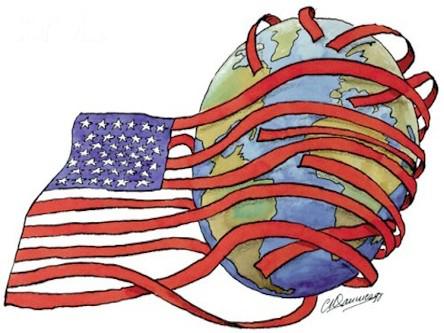
By Gary Leupp | Dissident Voice | January 7, 2017
It seems so strange, twenty-seven years after the fall of the Berlin Wall, to be living through a new Cold War with (as it happens, capitalist) Russia.
The Russian president is attacked by the U.S. political class and media as they never attacked Soviet leaders; he is personally vilified as a corrupt, venal dictator, who arrests or assassinates political opponents and dissident journalists, and is hell-bent on the restoration of the USSR.
(The latter claim rests largely on Vladimir Putin’s comment that the dissolution of the Soviet Union was a “catastrophe” and “tragedy” — which in many respects it was. The press chooses to ignore his comment that “Anyone who does not miss the Soviet Union has no heart, while anyone who wants to restore it has no brain.” It conflicts with the simple talking-point that Putin misses the imperial Russia of the tsars if not the commissars and, burning with resentment over the west’s triumph in the Cold War, plans to exact revenge through wars of aggression and territorial expansion.)
The U.S. media following its State Department script depicts Russia as an expansionist power. That it can do so, so successfully, such that even rather progressive people — such as those appalled by Trump’s victory who feel inclined to blame it on an external force — believe it, is testimony to the lingering power and utility of the Cold War mindset.
The military brass keep reminding us: We are up against an existential threat! One wants to say that this — obviously — makes no sense! Russia is twice the size of the U.S. with half its population. Its foreign bases can be counted on two hands. The U.S. has 800 or so bases abroad.
Russia’s military budget is 14% of the U.S. figure. It does not claim to be the exceptional nation appointed by God to preserve “security” on its terms anywhere on the globe. Since the dissolution of the USSR in 1991, the U.S. has waged war (sometimes creating new client-states) in Bosnia (1994-5), Serbia (1999), Afghanistan (2001- ), Iraq (2003- ), Libya (2011), and Syria (2014- ), while raining down drone strikes from Pakistan to Yemen to North Africa. These wars-based-on-lies have produced hundreds of thousands of civilian deaths, millions of refugees, and general ongoing catastrophe throughout the “Greater Middle East.” There is no understating their evil.
The U.S. heads an expanding military alliance formed in 1949 to confront the Soviet Union and global communism in general. Its raison d’être has been dead for many years. Yet it has expanded from 16 to 28 members since 1999, and new members Estonia and Latvia share borders with Russia.
(Imagine the Warsaw Pact expanding to include Mexico. But no, the Warsaw Pact of the USSR and six European allies was dissolved 26 years ago in the idealistic expectation that NATO would follow in a new era of cooperation and peace.)
And this NATO alliance, in theory designed to defend the North Atlantic, was only first deployed after the long (and peaceful) first Cold War, in what had been neutral Yugoslavia (never a member of either the Warsaw Pact nor NATO), Afghanistan (over 3000 miles from the North Atlantic), and the North African country of Libya. Last summer NATO held its most massive military drills since the collapse of the Soviet Union, involving 31,000 troops in Poland, rehearsing war with Russia. (The German foreign minister Frank-Walter Steinmeier actually criticized this exercise as “warmongering.”)
Alliance officials expressed outrage when Russia responded to the warmongering by placing a new S-400 surface-to-air missiles and nuclear-capable Iskander system on its territory of Kaliningrad between Poland and Lithuania on the Baltic coast. But Russia has, in fact, been comparatively passive in a military sense during this period.
In 1999, as NATO was about to occupy the Serbian province of Kosovo (soon to be proclaimed an independent country, in violation of international law), nearby Russian peacekeepers raced to the airport in Pristina, Kosovo, to secure it and ensure a Russian role in the Serbian province’s future. It was a bold move that could have provoked a NATO-Russian clash. But the British officer on the ground wisely refused an order from Gen. Wesley Clark to block the Russian move, declaring he would not start World War III for Gen. Clark.
This, recall, was after Bill Clinton’s secretary of state, Madeleine Albright (remember, the Hillary shill who said there’s a special place in hell reserved for women who don’t vote for women) presented to the Russian and Serbian negotiators at Rambouillet a plan for NATO occupation of not just Kosovo but all Serbia. It was a ridiculous demand, rejected by the Serbs and Russians, but depicted by unofficial State Department spokesperson and warmonger Christiane Amanpour as the “will of the international community.” As though Russia was not a member of the international community!
This Pristina airport operation was largely a symbolic challenge to U.S. hegemony over the former Yugoslavia, a statement of protest that should have been taken seriously at the time.
In any case, the new Russian leader Putin was gracious after the 9/11 attacks in 2001, even offering NATO a military transport corridor through Russia to Afghanistan (closed in 2015). He was thanked by George W. Bush with the expansion of NATO by seven more members in 2004. (The U.S. press made light of this extraordinary geopolitical development; it saw and continues to see the expansion of NATO as no more problematic than the expansion of the UN or the European Union.) Then in April 2008 NATO announced that Georgia would be among the next members accepted into the alliance.
Soon the crazy Georgian president Mikhail Saakashvili, emboldened by the promise of near-term membership, provoked a war with the breakaway republic of South Ossetia, which had never accepted inclusion of the new Georgian state established upon the dissolution of the Georgian Soviet Socialist Republic in 1991. The Ossetians, fearing resurgent Georgian nationalism, had sought union with the Russian Federation. So had the people of Abkhazia.
The two “frozen conflicts,” between the Georgian state and these peoples, had been frozen due to the deployment of Russian and Georgian peacekeepers. Russia had not recognized these regions as independent states nor agreed to their inclusion in the Russian Federation. But when Russian soldiers died in the Georgian attack in August, Russia responded with a brief punishing invasion. It then recognized the two new states of South Ossetia and Abkhazia (breakaway states in what had been the Georgian SSR) six months after the U.S. recognized Kosovo.
(Saakashvili, in case you’re interested, was voted out of power, disgraced, accused of economic crimes, and deprived of his Georgian citizenship. After a brief stint at the Fletcher School of International Law and Diplomacy at Tufts University — of which I as a Tufts faculty member feel deeply ashamed — he was appointed as governor of Odessa in Ukraine by the pro-NATO regime empowered by the U.S.-backed coup of February 22, 2014.)
Sen. John McCain proclaimed in 2008: “We are all Georgians now,” and advocated U.S. military aid to the Georgian regime. An advocate of war as a rule, McCain then became a big proponent of regime change in Ukraine to allow for that country’s entry into NATO. Neocons in the State Department including most importantly McCain buddy Victoria Nuland, boasted of spending $5 billion in support of “the Ukrainian people’s European aspirations” (meaning: the desire of many Ukrainians in the western part of the country to join the European Union — risking, although they perhaps do not realize it, a reduction in their standard of living under a Greek-style austerity program — to be followed by NATO membership, tightening the military noose around Russia).
The Ukrainian president opted out in favor of a generous Russian aid package. That decision — to deny these “European aspirations” — was used to justify the coup.
But look at it from a Russian point of view. Just look at this map, of the expanding NATO alliance, and imagine it spreading to include that vast country (the largest in Europe, actually) between Russia to the east and Poland to the west, bordering the Black Sea to the south. The NATO countries at present are shown in dark blue, Ukraine and Georgia in green. Imagine those countries’ inclusion.
And imagine NATO demanding that Russia vacate its Sevastopol naval facilities, which have been Russian since 1783, turning them over to the (to repeat: anti-Russian) alliance. How can anyone understand the situation in Ukraine without grasping this basic history?
The Russians denounced the coup against President Viktor Yanukovych (democratically elected — if it matters — in 2010), which was abetted by neo-fascists and marked from the outset by an ugly Russophobic character encouraged by the U.S. State Department. The majority population in the east of the country, inhabited by Russian-speaking ethnic Russians and not even part of Ukraine until 1917, also denounced the coup and refused to accept the unconstitutional regime that assumed power after February 22.
When such people rejected the new government, and declared their autonomy, the Ukrainian army was sent in to repress them but failed, embarrassingly, when the troops confronted by angry babushkas turned back. The regime since has relied on the neo-fascist Azov Battalion to harass secessionists in what has become a new “frozen conflict.”
Russia has no doubt assisted the secessionists while refusing to annex Ukrainian territory, urging a federal system for the country to be negotiated by the parties. Russian families straddle the Russian-Ukrainian border. There are many Afghan War veterans in both countries. The Soviet munitions industry integrated Russian and Ukrainian elements. One must assume there are more than enough Russians angry about such atrocities as the May 2014 killing of 42 ethnic Russian government opponents in Odessa to bolster the Donbas volunteers.
But there is little evidence (apart from a handful of reports about convoys of dozens of “unmarked military vehicles” from Russia in late 2014) for a Russian “invasion” of Ukraine. And the annexation of Crimea (meaning, its restoration to its 1954 status as Russian territory) following a credible referendum did not require any “invasion” since there were already 38,000 Russian troops stationed there. All they had to do was to secure government buildings, and give Ukrainian soldiers the option of leaving or joining the Russian military. (A lot of Ukrainian soldiers opted to stay and accept Russian citizenship.)
Still, these two incidents — the brief 2008 war in Georgia, and Moscow’s (measured) response to the Ukrainian coup since 2014 — have been presented as evidence of a general project to disrupt the world order by military expansion, requiring a firm U.S. response. The entirety of the cable news anchor class embraces this narrative.
But they are blind fools. Who has in this young century disrupted world order more than the U.S., wrecking whole countries, slaughtering hundreds of thousands of innocents, provoking more outrage through grotesquely documented torture, generating new terror groups, and flooding Europe with refugees who include some determined to sow chaos and terror in European cities? How can any rational person with any awareness of history since 1991 conclude that Russia is the aggressive party?
And yet, this is the conventional wisdom. I doubt you can get a TV anchor job if you question it. The teleprompter will refer routinely to Putin’s aggression and Russian expansion and the need for any mature presidential candidate to respect the time-honored tradition of supporting NATO no matter what. And now the anchor is expected to repeat that all 17 U.S. intelligence services have concluded that Vladimir Putin interfered in the U.S. presidential election.
Since there is zero evidence for this, one must conclude that the Democratic losers dipped into the reliable grab bag of scapegoats and posited that Russia and Putin in particular must have hacked the DNC in order to — through the revelation of primary sources of unquestionable validity, revealing the DNC’s determination to make Clinton president, while sabotaging Sanders and promoting (through their media surrogates) Donald Trump as the Republican candidate — undermine Clinton’s legitimacy.
All kinds of liberals, including Sanders’ best surrogates like Nina Turner, are totally on board the Putin vilification campaign. It is sad and disturbing that so many progressive people are so willing to jump on the new Cold War bandwagon. It is as though they have learned nothing from history but are positively eager, in their fear and rage, to relive the McCarthy era.
But the bottom line is: U.S. Russophobia does not rest on reason, judgment, knowledge of recent history and the ability to make rational comparisons. It rests on religious-like assumptions of “American exceptionalism” and in particular the right of the U.S. to expand militarily at Russia’s expense — as an obvious good in itself, rather than a distinct, obvious evil threatening World War III.
The hawks in Congress — bipartisan, amoral, ignorant, knee-jerk Israel apologists, opportunist scum — are determined to dissuade the president-elect (bile rises in my throat as I use that term, but it’s true that he’s that, technically) from any significant rapprochement with Russia. (Heavens, they must be horrified at the possibility that Trump follows Kissinger’s reported advice and recognizes the Russian annexation of Crimea!) They want to so embarrass him with the charge of being (as Hillary accused him of being during the campaign) Putin’s “puppet” that he backs off from his vague promise to “get along” with Russia.
They don’t want to get along with Russia. They want more NATO expansion, more confrontation. They are furious with Russian-Syrian victories over U.S-backed, al-Qaeda-led forces in Syria, especially the liberation of Aleppo that the U.S. media (1) does not cover having no reporters on the ground, and little interest since events in Syria so powerfully challenge the State Department’s talking points that shape U.S. reporting, (2) misreports systematically, as the tragic triumph of the evil, Assad’s victory over an imaginary heroic opposition, and (3) sees the strengthening of the position of the Syrian stats as an indication of Russia’s reemergence as a superpower. (This they they cannot accept, as virtually a matter of religious conviction; the U.S. in official doctrine must maintain “full spectrum dominance” over the world and prohibit the emergence of any possible competitor, forever.)
*****
The first Cold War was based on the western capitalists’ fear of socialist expansion. It was based on the understanding that the USSR had defeated the Nazis, had extraordinary prestige in the world, and was the center for a time of the expanding global communist movement. It was based on the fear that more and more countries would achieve independence from western imperialism, denying investors their rights to dominate world markets. It had an ideological content. This one does not. Russia and the U.S. are equally committed to capitalism and neoliberal ideology. Their conflict is of the same nature as the U.S. conflict with Germany in the early 20th century. The Kaiser’s Germany was at least as “democratic” as the U.S.; the system was not the issue. It was just jockeying for power, and as it happened, the U.S. intervening in World War I belatedly, after everybody else was exhausted, cleaned up. In World War II in Europe, the U.S. having hesitated to invade the continent despite repeated Soviet appeals to do so, responded to the fall of Berlin to Soviet forces by rushing token forces to the city to claim joint credit.
And then it wound up, after the war, establishing its hegemony over most of Europe — much, much more of Europe than became the Soviet-dominated zone, which has since with the Warsaw Pact evaporated. Russia is a truncated, weakened version of its former self. It is not threatening the U.S. in any of the ways the U.S. is threatening itself. It is not expanding a military alliance. It is not holding huge military exercises on the U.S. border. It is not destroying the Middle East through regime-change efforts justified to the American people by sheer misinformation. In September 2015 Putin asked the U.S., at the United Nations: “Do you realize what you’ve done?”
Unfortunately the people of this country are not educated, by their schools, press or even their favorite websites to realize what has been done, how truly horrible it is, and how based it all is on lies. Fake news is the order of the day.
Up is down, black is white, Russia is the aggressor, the U.S. is the victim. The new president must be a team-player, and for God’s sake, understand that Putin is today’s Hitler, and if Trump wants to get along with him, he will have to become a team-player embracing this most basic of political truths in this particular imperialist country: Russia (with its nukes, which are equally matched with the U.S. stockpile) is the enemy, whose every action must be skewed to inflame anti-Russian feeling, as the normative default sentiment towards this NATO-encircled, sanction-ridden, non-threatening nation, under what seems by comparison a cautious, rational leadership?
*****
CNN’s horrible “chief national correspondent” John King (former husband of equally horrid Dana Bash, CNN’s “chief political correspondent”) just posed the question, with an air of aggressive irritation: “Who does Donald Trump respect more, the U.S. intelligence agencies, or the guy who started Wikileaks [Assange]?”
It’s a demand for the Trump camp to buy the Russian blame game, or get smeared as a fellow-traveler with international whistle-blowers keen on exposing the multiple crimes of U.S. imperialism.
So the real question is: Will Trump play ball, and credit the “intelligence community” that generates “intelligence products” on demand, or brush aside the war hawks’ drive for a showdown with Putin’s Russia? Will the second Cold War peter out coolly, or culminate in the conflagration that “Mutually Assured Destruction” (MAD) was supposed to render impossible?
The latter would be utterly stupid. But stupid people — or wise people, cynically exploiting others’ stupidity — are shaping opinion every day, and have been since the first Cold War, based like this one on innumerable lies.
Gary Leupp is a Professor of History at Tufts University, and author of numerous works on Japanese history. He can be reached at: gleupp@granite.tufts.edu.
NATO Ramps Up Ukraine War After Defeat in Syria
By Finian Cunningham – Sputnik – December 21, 2016
A surge in military attacks this week by NATO-backed Kiev regime forces on the breakaway eastern Ukraine regions is no mere coincidence.
Hundreds of ceasefire breaches by troops belonging to the Ukraine Armed Forces (UAF) are being reported in the self-declared republics of Donetsk and Luhansk. Over the past few days, several towns and villages have come under intense shelling from artillery, rockets and mortars in stark violation of the Minsk agreement.
That agreement was brokered by Russia, Germany and France during 2014 and 2015 and was meant to facilitate a political settlement between the Western-backed Kiev regime, which came to power in a coup d’état in February 2014, and the breakaway provinces of Donetsk and Luhansk, which refused to recognize the legitimacy of the usurper Kiev cabal.
Houses, schools and water treatment plants have been hit as the UAF and associated neo-Nazi militias move heavy weaponry close to the so-called contact lines. All indications suggest that the NATO-backed Kiev regime is mobilizing for a renewed offensive on the mainly ethnic Russian Donbas region comprising the Donetsk and Luhansk People’s Republics.
So far, the militia of the DPR and LPR have repelled the offensive, with dozens of casualties reportedly suffered by the Kiev regime’s military.
The timing of the large-scale attacks on Donbas comes just as the US and its NATO allies incur a strategic setback in their covert war for regime change in Syria. The liberation of the battleground city of Aleppo last week by the Syrian army, supported by Russian, Iranian and Lebanese allies, portends the end of the nearly six-year conflict in Syria. The routing of jihadist militants from Aleppo, who had been backed covertly by the US and certain NATO powers, including Britain and France, has signaled the end of the regime-change project in Syria to oust the government of President Bashar al-Assad.
NATO member Turkey had played a key role in the US-led dirty war on Syria, serving as a conduit for fighters and arms to the proxy jihadist militants trying to overthrow Assad – a longtime ally of both Russia and Iran.
But now Turkey seems to be aligning with Russia and Iran to bring an end to the war in neighboring Syria. This week, foreign and defense ministers from Russia, Iran and Turkey met in Moscow to declare their commitment to end the Syrian conflict. The New York Times reported: “Russia, Iran and Turkey meet for Syria talks, excluding the US”.
Pointedly, the Times added: “The new alignment and absence of any Western powers at the table all but guarantee that President Bashar al-Assad will continue to rule Syria under any resulting agreement.” In other words, it’s “game over” for Washington and its criminal enterprise to subvert Syria.
The setback for American imperialist scheming in the Middle East cannot be overstated. For decades, US rulers have seen it as their God-given exceptional right to roll over any foreign government deemed unfit for their geopolitical interests. Syria was among target countries on the American hit-list, which came into action back in March 2011 when the US and its NATO partners and regional client regime unleashed hell with terror proxies.
US ambitions of conquest in the oil-rich region have now been dealt a stunning blow after Russian President Vladimir Putin ordered military operation at the end of 2015 to support the Syrian state, along with Iran and the Lebanese resistance movement Hezbollah. Despite a massive propaganda campaign orchestrated by the Western media and Washington puppets at the United Nations, the Syrian army and its allies have won a historic victory in retaking Aleppo from NATO-backed jihadists.
Not only is this a bitter military defeat for Washington. It is a political and moral triumph over Western lies as told through major media corporations. The latter were saturated with claims of atrocities and crimes against humanity committed by Syrian and Russian forces. Those reckless claims have now been exposed as blatant fabrications, as the people of Aleppo openly celebrate liberation from Western-backed jihadists who had imposed a reign of terror on large parts of the city for nearly four years.
It seems significant that only days after the liberation of Aleppo, Russian ambassador Andrey Karlov was brutally assassinated in Turkey’s capital Ankara, when a gunman shot him in the back as he addressed a cultural event. The murder was evidently aimed at derailing the political talks underway between Turkey, Russia and Iran.
Who would benefit from such an atrocity? Obviously, the US-led NATO powers. If NATO military intelligence did not specifically order the assassination of Karlov, we can at least say that Washington and its Western allies certainly created the climate of hatred and demonization that made the Russian diplomat a “legitimate target”.
A further significant development is the renewed offensive by the NATO-backed Kiev regime against the ethnic Russian people of east Ukraine. Again, this provocative move comes only days after the spectacular military victory by Russia and its allies against NATO’s jihadist proxies in Aleppo, and possibly now for the whole of Syria.
Make no mistake, the reactionary junta that seized power in Kiev is a surrogate for NATO’s long-held offensive designs on Russia. Citing unsubstantiated “fears” of Russian aggression, NATO has given itself a license to escalate troops and missiles on Russia’s border. Washington and its European lackeys have financed, armed and trained the Kiev regime.
This week, British defense minister Michael Fallon announced more British army training for Kiev’s forces, claiming that it was to counter Russian aggression. Fallon had the cheek to spout this nonsense in the same week that the assaults on eastern Ukraine have surged.
At a NATO-Russia summit in Brussels earlier this week, the US-led military alliance had the gall to call on Moscow to influence “Russian separatists” in Donbas to “honor the Minsk ceasefire”.
Russian delegate to NATO Alexander Grushko reportedly introduced some reality to the meeting by pointing out the hundreds of violations being committed in recent days by the Kiev regime. Such violations are par for the course, since the NATO-backed junta first launched its offensive on the region back in 2014, and which has resulted in up to 10,000 deaths.
As with the Syrian war, Washington and its NATO allies, aided and abetted by the Western news (sic) media, play with semantics and illusions, and insult common intelligence. In Ukraine, NATO is waging a covert war every bit as it was in Syria where as many as 400,000 people have been killed and from which Europe is struggling with its greatest refugee crisis since the Second World War, including the threat of terror attacks as seen in France and Germany this week.
Shamelessly, Washington and its Western subordinates accuse Russia of hybrid warfare and aggression. The reaction to defeat in Syria through ramping up conflict in Ukraine shows that it is the US-led NATO alliance that is the real culprit of hybrid war and aggression.
Hypocrisy Behind the Russian-Election Frenzy
By Robert Parry | Consortium News | December 13, 2016
As Democrats, the Obama administration and some neocon Republicans slide deeper into conspiracy theories about how Russia somehow handed the presidency to Donald Trump, they are behaving as they accused Trump of planning to behave if he had lost, questioning the legitimacy of the electoral process and sowing doubts about American democracy.
US President-elect Donald J. Trump
The thinking then was that if Trump had lost, he would have cited suspicions of voter fraud – possibly claiming that illegal Mexican immigrants had snuck into the polls to tip the election to Hillary Clinton – and Trump was widely condemned for even discussing the possibility of challenging the election’s outcome.
His refusal to commit to accepting the results was front-page news for days with leading editorialists declaring that his failure to announce that he would abide by the outcome disqualified him from the presidency.
But now the defeated Democrats and some anti-Trump neoconservatives in the Republican Party are jumping up and down about how Russia supposedly tainted the election by revealing information about the Democrats and the Clinton campaign.
Though there appears to be no hard evidence that the Russians did any such thing, the Obama administration’s CIA has thrown its weight behind the suspicions, basing its conclusions on “circumstantial evidence,” according to a report in The New York Times.
The Times reported: “The C.I.A.’s conclusion does not appear to be the product of specific new intelligence obtained since the election, several American officials, including some who had read the agency’s briefing, said on Sunday. Rather, it was an analysis of what many believe is overwhelming circumstantial evidence — evidence that others feel does not support firm judgments — that the Russians put a thumb on the scale for Mr. Trump, and got their desired outcome.”
In other words, the CIA apparently lacks direct reporting from a source inside the Kremlin or an electronic intercept in which Russian President Vladimir Putin or another senior official orders Russian operatives to tilt the U.S. election in favor of Trump.
More ‘Group Thinking’?
The absence of such hard evidence opens the door to what is called “confirmation bias” or analytical “group think” in which the CIA’s institutional animosity toward Russia and Trump could influence how analysts read otherwise innocent developments.
For instance, Russian news agencies RT or Sputnik reported critically at times about Democratic nominee Hillary Clinton, a complaint that has been raised repeatedly in U.S. press accounts arguing that Russia interfered in the U.S. election. But that charge assumes two things: that Clinton did not deserve critical coverage and that Americans – in any significant numbers – watch Russian networks.
Similarly, the yet-unproven charge that Russia organized the hacking of Democratic National Committee emails and the private email account of Clinton’s campaign chairman John Podesta assumes that the Russian government was responsible and that it then selectively leaked the material to WikiLeaks while withholding damaging information from hacked Republican accounts.
Here the suspicions also seem to extend far beyond what the CIA actually knows. First, the Republican National Committee denies that its email accounts were hacked, and even if they were hacked, there’s no evidence that they contained any information that was particularly newsworthy. Nor is there any evidence that – if the GOP accounts were hacked – they were hacked by the same group that hacked the Democratic Party emails, i.e., that the two hacks were part of the same operation.
That suspicion assumes a tightly controlled operation at the highest levels of the Russian government, but the CIA – with its intensive electronic surveillance of the Russian government and human sources inside the Kremlin – appears to lack any evidence of such a top-down operation.
Second, WikiLeaks editor Julian Assange directly denies that he received the Democratic leaked emails from the Russian government and one of his associates, former British Ambassador Craig Murray, told the U.K. Guardian that he knows who “leaked” the Democratic emails and that there never was a “hack,” i.e. an outside electronic penetration of an email account.
Murray said, “I’ve met the person who leaked them, and they are certainly not Russian and it’s an insider. It’s a leak, not a hack; the two are different things.”
‘Real News’
But even if Assange did get the data from the Russians, it’s important to remember that nothing in the material has been identified as false. It all appears to be truthful and none of it represented an egregious violation of privacy with some salacious or sensational angle.
The only reason the emails were newsworthy at all was that the documents revealed information that the DNC and the Clinton campaign were trying to keep secret from the American voters.
For instance, some emails confirmed Sen. Bernie Sanders’s suspicions that the DNC was improperly tilting the nomination race in favor of Clinton. The DNC was lying when it denied having an institutional thumb on the scales for Clinton. Thus, even if the Russians did uncover this evidence and did leak it to WikiLeaks, they would only have been informing the American people about the DNC’s abuse of the democratic process, something Democratic voters in particular had a right to know.
And, regarding Podesta’s emails, their most important revelation related to the partial transcripts of Clinton’s paid speeches to Wall Street banks, the contents of which Clinton had chosen to hide from the American people. So, again, if the Russians were involved in the leak, they would only have been giving to the voters information that Clinton should have released on her own. In other words, these disclosures are clearly not “fake news” – the other hysteria now sweeping Official Washington.
In the mainstream news media, there has been a clumsy effort to conflate these parallel frenzies, the leak of “real news” and the invention of “fake news.” But investigations of so-called “fake news” have revealed that these operations were run mostly by young entrepreneurs in places like Macedonia or Georgia who realized they could make advertising dollars by creating outlandish “click bait” stories that Trump partisans were particularly eager to read.
According to a New York Times investigation into one of the “fake news” sites, a college student in Tbilisi, Georgia, first tried to create a pro-Clinton “click bait” Web site but found that a pro-Trump operation was vastly more lucrative. This and other investigations did not trace the “fake news” sites back to Russia or any other government.
So, what’s perhaps most telling about the information that the CIA has accused Russia of sharing with the American people is that it was all “real news” about newsworthy topics.
What Threat to Democracy?
So, how does giving the American people truthful and relevant information undermine American democracy, which is the claim that is reverberating throughout the mainstream media and across Official Washington?
“Corruption” allegations against Yanukovych – pushed by OCCRP – were integral to the U.S.-supported effort to organize a violent putsch that drove Yanukovych from office on Feb. 22, 2014, touching off the Ukrainian civil war and – on a global scale – the New Cold War with Russia.
Yet, in the case of the “Panama Papers” or other leaks about “corruption” in governments targeted by U.S. officials for “regime change,” there are no frenzied investigations into where the information originated. Regarding the “Panama Papers,” there was simply back-slapping for the organizations that invested time and money in analyzing the volumes of material. And there were cheers when implicated officials were punished or forced to step down.
So, why are some leaks “good” and others “bad”? Why do we hail the “Panama Papers” or OCCRP’s “corruption evidence” that damaged Yanukovych – and ask no questions about where the material came from and how it was selectively used – yet we condemn the Democratic email leaks and undertake investigations into the source of the information?
In both the “Panama Papers” case and the “Democratic Party leaks,” the material appeared to be real. There was no evidence of disinformation or “black propaganda.” But, apparently, it’s okay to disrupt the politics of Iceland, Ukraine, Russia and other countries, but it is called a potential “act of war” – by neocon Sen. John McCain, R-Arizona – to reveal evidence of wrongdoing or excessive secrecy on the part of the Democratic Party in the United States.
Shoe on the Other Foot
Russian President Putin, while denying any Russian government attempt to tilt the election to Trump, recently commented on the American hypocrisy about interfering in other nations’ elections while complaining about alleged interference in its own or those of its allies. He described a conversation with an unnamed Western “colleague.”
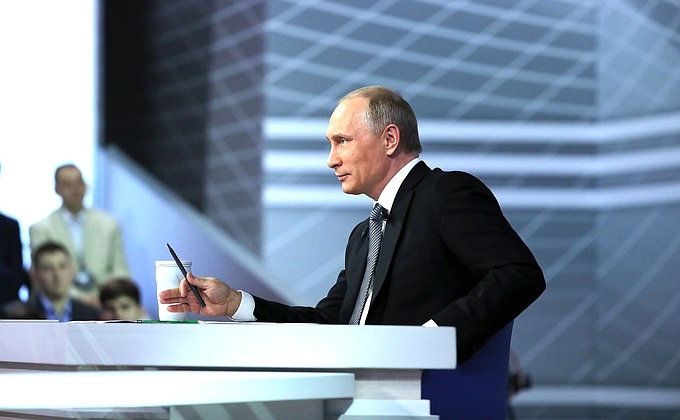
Russian President Vladimir Putin
Putin said, “I recently had a conversation with one of my colleagues. We touched upon our [Russian] alleged influence on some political processes abroad. I told him: ‘And what are you doing? You have been constantly interfering in our political life.’ And he replied: ‘It’s not us, it’s the NGOs’. I said: ‘Oh? But you pay them and write instructions for them.’ He said: ‘What kind of instructions?’ I said: ‘I have been reading them.’”
Whatever one thinks of Putin, he is not wrong in describing how various U.S.-funded NGOs, in the name of “democracy promotion,” seek to undermine governments that have ended up on Official Washington’s target list.
And another aspect of the hypocrisy permeating Official Washington’s belligerent rhetoric directed toward Russia: Aren’t the Democrats doing exactly what they accused Trump of planning to do if he had lost the Nov. 8 election, i.e., question the legitimacy of the results and thus undermine the faith of the American people in their democratic system?
For days, Trump’s unwillingness to accept, presumptively, the results of the election earned him front-page denunciations from many of the same mainstream newspapers and TV networks that are now trumpeting the unproven claims by the CIA that the Russians somehow influenced the election’s outcome by presenting some Democratic hidden facts to the American people.
Yet, this anti-Russian accusation not only undermines the American people’s faith in the election’s outcome but also represents a reckless last-ditch gamble to block Trump’s inauguration – or at least discredit him before he takes office – while using belligerent rhetoric that could push Russia and the United States closer to nuclear war.
Wouldn’t it be a good idea for the CIA to at least have hard evidence before the spy agency precipitated such a crisis?
Investigative reporter Robert Parry broke many of the Iran-Contra stories for The Associated Press and Newsweek in the 1980s.
2017 NDAA ups aid to Ukraine, gives arms to Syrian rebels & lets Trump sanction the world
RT | December 8, 2016
Congress has authorized $618.7 billion for the 2017 military budget. The bill ups aid to Ukraine by $50 million and allows the transfer of missiles to Syrian rebels. However, it omits controversial provisions about drafting women or religious exemptions for contractors.
The 2017 National Defense Authorization Act (NDAA) passed in the Senate on Thursday with 92 votes in favor and seven opposing. It already cleared the House last Friday in a 375-34 vote. With the annexes, appendices and the conference report harmonizing the two chambers’ versions, the final document is 3,076 pages long.
Absent from the NDAA is the proposal to allow female Americans to register for the Selective Service system, which replaced the Vietnam War-era draft but currently only applies to men aged 18-25. That proposal was sent to the Government Accountability Office for further study.
Lawmakers also abandoned the so-called Russell Amendment, which would have created a religious freedom exemption from the Obama administration executive order mandating nondiscrimination from federal contractors. Obama threatened to veto the bill with this amendment.
Buried in the bill, in Section 1224, was the provision to allow Man-Portable Air Defense Systems (MANPADS) to Syrian rebels appropriately vetted by US intelligence. The law requires the Pentagon and the State Department to file extensive documentation with Congress, including details of the weaponry provided, the recipient’s location and the intelligence assessment, including “a description of the alignment of such element within the broader conflict in Syria.” The report would need to include a justification for supplying the MANPADs, “including an explanation of the purpose and expected employment of such systems.”
“We appreciate the bicameral and bipartisan support in the US Congress for Ukraine in our fight against the ongoing Russian aggression,” Ukraine’s embassy in Washington said on Thursday, commenting on the fact that the NDAA increased military aid to the government in Kiev to $350 million, $50 million more than in 2016.
What could potentially have the biggest long-term impact is the provision allowing the application of the 2012 “Magnitsky Act” to anyone in the world, rather than just the Russian Federation and Moldova.
Sections 1261-65 authorize the US president to sanction anyone responsible for “extrajudicial killings, torture, or other gross violations of internationally recognized human rights committed against individuals in any foreign country” who seek to expose illegal activity carried out by government officials” or to “obtain, exercise, defend, or promote internationally recognized human rights and freedoms.”
Authorized sanctions include denying entry to the US or revoking an existing US visa; seizure of any property and interests that are located in the US “or come within the possession or control of a United States person.” The provision would sunset six years after the NDAA’s enactment.
Of further interest are the provisions allowing the establishment of the US Cyber Command as a fully separate combat command (Section 923), capping the size of the National Security Council staff at 200 – down from 400 or so it currently employs (Section 1085).
The NDAA maintained the prohibition of using any funds to close the detention camp at Guantanamo Bay, Cuba, or transfer any of the remaining 59 detainees onto US soil.
‘Poroshenko fuels war & corruption with IMF money’ – fugitive Ukrainian MP to RT
RT | December 6, 2016
Petro Poroshenko holds sway in Ukraine by channeling western financial aid into war and bribery, while making big money with a close circle of loyal oligarchs, fugitive Ukrainian MP Aleksandr Onishchenko told RT in an exclusive interview.
Aleksandr Onishchenko, a former MP in Ukraine’s parliament, a billionaire oligarch and professional Olympic showjumper, fled the country this summer a week before being stripped of parliamentary immunity due to an investigation into an alleged gas fraud scheme.
He said that the case against him is a setup and the Ukrainian government tried to frame him to cover up a large-scale bribery scheme linked directly to President Poroshenko.
Onishchenko, who said he was a key figure in the complex scheme for two years, vowed to show western sponsors of the Ukrainian government where their money is actually going. He told RT that most IMF aid money is being used by President Poroshenko and his accomplices to fuel the ongoing civil conflict in the east of Ukraine.
“Most of the money they use for the war. I think that Poroshenko is very interested to keep the war,” Onishchenko said. An overgrown military not only allows Poroshenko to reap profits from “war-time” contracts but also suppress political opponents, the fugitive Ukrainian MP alleged.
“All the contracts for this war, even the smaller [ones], like weapons, or some stuff for the army, they [are going through] the companies which are close to [Poroshenko]. They are just [laundering] money … for them the war is like business.”
Ukraine’s president and his accomplices have a stake in all the major businesses in the country now and it’s impossible for someone outside the inner circle to make money in Ukraine, according to Onishchenko, who claims Poroshenko and his team are scared that someone could potentially fund the opposition in the wake of upcoming elections
“Poroshenko is in control now [of] all the state’s companies. It’s the biggest business they’re doing. It’s a chemical factory in Odessa, a lot of state energy companies,” said Onishchenko. Only people close to the president have been put in charge of these companies, he said.
Read more
Ukrainian President Petro Poroshenko © Valentyn Ogirenko Fugitive Ukrainian MP says he handed proof of Poroshenko ‘buying votes’ to US Justice Dept
“They use this money for political [advantage] for voting, for supporting … they use this money to make Poroshenko stronger,” Onishchenko added.
A scandal surrounding impressive income declarations, recently filed by Ukrainian politicians, brought to attention the scale of Ukrainian corruption, Onishchenko told RT.
He hopes the recent revelations about the scale of corruption in the Ukrainian government will result in the end of financial aid to the country.
“All Europe was shocked after the declaration of the people from the parliament of Ukraine. If you saw, all the people’s deputies, they declared so much cash. It was crazy, like millions and millions. How did they make that cash?” Onishchenko said.
“Poroshenko corrupts them … pays them money for… voting. That’s why they have so much money now. They’re buying … big houses, they are buying yachts and a lot of stuff. They must explain where the money is from. That’s why they put the money in these declarations. After these declarations from the government of Ukraine and this corruption scandal, even what I said to the press, I don’t see that western Europe will support [them] anymore, I mean, financially, Ukraine. Because they see they just use money for corruption and they’ll never accept this.”
Featured Video
Dan Dicks with James Corbett on Solutions Watch
or go to
Aletho News Archives – Video-Images
From the Archives
Secret document reveals plans for civil war in Lebanon, Israeli false flags, and invasion
By Randi Nord | Geopolitics Alert | April 5, 2019
Beirut – During his visit with US Secretary of State, Mike Pompeo, Lebanese President Michael Aoun reportedly received a US-Israeli document detailing plans for creating a civil war in Lebanon with covert false flag operations and possible Israeli invasion.
Although the source of the document is Israeli and created in partnership with Washington, no one knows who presented it to Aoun. The Lebanese TV station, Al-Jadeed, initially reported the document on Lebanese TV and a video on its website. Geopolitics Alert translated the report for this article. … continue
Blog Roll
 Aletho News
- Sheikh al-Asadi warns of Iraqi government compliance with US demands
- How to MAKE THE CONSPIRATORS PAY for their crimes! Dan Dicks with James Corbett on Solutions Watch
- There’s a drought in academia: A drought in honest research on the subject of drought and other weather extremes
- Department of War Awards $20.7 Billion Contract to Raytheon for Air-to-Air Missiles
- ‘Distance yourselves from Israel’: IRGC urges US population to question govt policies
- America’s Greenland deal has a radioactive backstory
- The RAF Fairford ‘terror plot’: Unpacking escalation in the UK echo-chamber
- EU Council Advances Chat Control 2.0 Scanning Proposal
- Ex-Greek MEP files complaint against Israeli spyware firm over alleged Pegasus surveillance
- Troubling ideas throughout the Torah, Talmud, Mishneh Torah and Tanya
- If Americans Knew
- New Report: “Scholasticide and Genocide in Gaza: Assessment, Testimonies and Legal Analysis”
- Ex-Biden officials are desperate for a Gaza scapegoat
- Israeli “settlers” Invade Al-Aqsa; Pour Boiling Water on 75-Year-Old
- Israel Has Kidnapped Another American Teenager
- US arms sales to Israel worth $21.6 billion in 20 months
- Three Palestinians Killed in Israeli Attacks on Gaza
- Revealed: German “Anti-Semitism Expert” Driving Crackdown on Palestine Solidarity is Former Israeli Spy
- Egypt’s Warning to Israel Before Oct 7
- Israel’s siege signals another cruel winter for 1.8 million Gazans – Daily Update
- Netanyahu Asked UAE Leader to Deny Report on Oct. 7 Warning in Secret Visit, Sources Say
- No Tricks Zone
- Two More Paleo Reconstructions Affirm Meters-Higher Sea Levels Across Ireland, Brazil 7000-6000 Years Ago
- New Study: Earth And Venus Surface Warmth Largely Explained By Convection And Lapse Rate, Not CO2 Or Radiation
- 2025 Nature Paper Claiming Worsening Global Drought Gets RETRACTED …Heavily Flawed
- New Study: ‘Global Drought Shows No Detectable Recent Acceleration Under Climate Warming’
- Economic Masterminds: German Socialists Suggest Taxing Productivity Gains Stemming From Using AI
- The South China Sea Has Not Been Cooperating With The Climate Change Narrative
- Energy Crisis: Germany Enters Heating Season With Historically Low Gas Reserve Fill Levels
- New Study: The Antarctic Ice Sheet Gained Mass From 2020-2024 Due To Staggering Snow And Ice Accumulation
- Study: Ocean Heating Rates From Thousands Of Years Ago ‘Dwarf’ Modern Ocean Heating Rates
- Climate Extremists Target, Attack Large-Scale Power Grid Infrastructure In Germany!


