EU panel slams Kiev’s probe into Odessa 2014 tragedy for lack of independence
RT | November 4, 2015
An EU panel on Ukraine has slammed Kiev’s investigation into the May 2014 violence in Ukraine’s southern city of Odessa, saying it lacks independence. It also added there’s evidence that police were complicit in the disorder.
The Council of Europe’s International Advisory Panel said in a statement on Wednesday the probe failed to comply with the requirements of the European Human Rights Convention.
On May 2, 2014, Ukrainian ultra-right football fans attacked an anti-Kiev protesters’ camp outside the Trade Unions Building in central Odessa. Football hooligans were soon joined by Maidan activists – supporters of the pro-EU February protests in Kiev – and members of the Right Sector group. Violent clashes and a fire in the Trade Union Building led to 48 deaths and several hundred people were injured.
The Council of Europe’s International Advisory Panel found that the investigations lacked independence, pointing toward police complicity in the violence.
“Given the evidence indicative of police complicity in the mass disorder of 2 May 2014 and the hierarchical relationship between the SES [State Emergency Service] and the Ministry of the Interior, the investigations as a whole should have been carried by an organ independent of the Ministry,” the report states.
The Panel stressed that this calls for “an independent and effective mechanism for the investigation of serious human rights violations committed by law enforcement officers and other public officials.”
The report pointed to inefficient division of investigative work and inadequately allocated resources. The investigation of the actions of the SES was allocated to the local Ministry of the Interior, which remained inactive during the crucial early stages of the investigation.
The panel also stressed the “deficient quality of the investigation,” saying there were no efforts made until December 2014 to investigate the unexplained delay of over 40 minutes in the arrival of firefighters at the Trade Union Building.
The Panel also found that Ukrainian authorities failed to provide sufficient public scrutiny of the events.
“In contrast to the Maidan investigations, the authorities did not take any coordinated measures directly and regularly to inform the victims and next-of-kin about the progress of the investigations.”
The International Advisory Panel was constituted by the Secretary General of the Council of Europe in April 2014, initially to oversee the Maidan violence investigations. In September 2014, the Panel’s mandate was extended to examine whether the Odessa investigations met all the requirements of the European Convention on Human Rights and the case-law of the European Court.
To conclude, the Panel “considers that the deficiencies identified in this Report have undermined the authorities’ ability to establish the circumstances of the Odessa-related crimes and to bring to justice those responsible.”
As for their initial analysis into Ukraine’s investigation of the Maidan demonstrations, the Panel called Ukraine’s Interior Ministry “uncooperative and obstructive” and the investigation not meeting the requirements of the European Convention on Human Rights
MH-17 Case: ‘Old’ Journalism vs. ‘New’
By Robert Parry | Consortium News | October 20, 2015
The first thing any thinking person learns about the Internet is not to trust everything you see there. While you can find much well-researched and reliable material, you’ll also encounter disinformation, spoofs, doctored photographs and crazy conspiracy theories. That would seem to be a basic rule of the Web – caveat emptor and be careful what you do with the information – unless you’re following a preferred neocon narrative. Then, nothing to worry about.
A devil-may-care approach to Internet-sourced material has been particularly striking when it comes to the case of the shoot-down of Malaysia Airlines Flight 17 over eastern Ukraine on July 17, 2014. It has now become de rigueur on the part of the West’s mainstream news outlets to tout the dubious work of a British Internet outlet called Bellingcat, which bases its research on photographs and other stuff pulled off the Internet.
Bellingcat’s founder Eliot Higgins also has made journalistic errors that would have ended the careers of many true professionals, yet he continues to be cited and hailed by the likes of The New York Times and The Washington Post, which have historically turned up their noses about Internet-based journalism.
The secret to Higgins’s success seems to be that he reinforces what the U.S. government’s propagandists want people to believe but lack the credibility to sell. It’s a great business model, marketing yourself as a hip “citizen journalist” who just happens to advance Official Washington’s “group thinks.”
We saw similar opportunism among many wannabe media stars in 2002-03 when U.S. commentators across the political spectrum expressed certitude about Iraq’s hidden stockpiles of WMD. Even the catastrophic consequences of that falsehood did little to dent the career advancements of the Iraq-WMD promoters. There was almost no accountability, proving that there truly is safety in numbers. [See Consortiumnews.com’s “Through the US Media Lens Darkly.”]
New Recruits
But there’s always room for new recruits. Blogger Higgins made his first splash by purporting to prove the accuracy of U.S. government claims about the Syrian government firing rockets carrying sarin gas that killed hundreds of civilians on Aug. 21, 2013, outside Damascus, an incident that came close to precipitating a major U.S. bombing campaign against the Syrian military.
Those of us who noted the startling lack of evidence in the Syria-sarin case – much as we had questioned the Iraq-WMD claims in 2002-03 – were brushed aside by Big Media which rushed to embrace Higgins who claimed to have proved the U.S. government’s charges. Even The New York Times clambered onboard the Higgins bandwagon.
Higgins and others mocked legendary investigative journalist Seymour Hersh when he cited intelligence sources indicating that the attack appeared to be a provocation staged by Sunni extremists to draw the U.S. military into the war, not an attack by the Syrian military.
Despite Hersh’s long record for breaking major stories – including the My Lai massacre from the Vietnam War, the “Family Jewels” secrets of the CIA in the 1970s, and the Abu Ghraib torture during the Iraq War – The New Yorker and The Washington Post refused to run his articles, forcing Hersh to publish in the London Review of Books.
Hersh was then treated like the crazy uncle in the attic, while Higgins – an unemployed British bureaucrat operating from his home in Leicester, England – was the new golden boy. While Higgins was applauded, Hersh was shunned.
But Hersh’s work was buttressed by the findings of top aeronautical scientists who studied the one rocket that carried sarin into the Damascus suburb of Ghouta and concluded that it could have traveled only about two kilometers, far less distance than was assumed by Official Washington’s “group think,” which had traced the firing position to about nine kilometers away at a Syrian military base near the presidential palace of Bashar al-Assad.
“It’s clear and unambiguous this munition could not have come from Syrian government-controlled areas as the White House claimed,” Theodore Postol, a professor in the Science, Technology, and Global Security Working Group at Massachusetts Institute of Technology, told MintPress News.
Postol published “Possible Implications of Faulty US Technical Intelligence in the Damascus Nerve Agent Attack of August 21st, 2013” in January 2014 along with Richard Lloyd, an analyst at the military contractor Tesla Laboratories who was a United Nations weapons inspector and has to his credit two books, 40 patents and more than 75 academic papers on weapons technology.
Postol added in the MintPress interview that Higgins “has done a very nice job collecting information on a website. As far as his analysis, it’s so lacking any analytical foundation it’s clear he has no idea what he’s talking about.”
In the wake of the Postol-Lloyd report, The New York Times ran what amounted to a grudging retraction of its earlier claims. Yet, to this day, the Obama administration has failed to withdraw its rush-to-judgment charges against the Syrian government or present any verifiable evidence to support them.
This unwillingness of the Obama administration to fess up has served Higgins well, in that there is still uncertainty regarding the facts of the case. After all, once a good propaganda club is forged for bludgeoning an adversary, it’s not something Official Washington lays down easily. [See Consortiumnews.com’s “The Collapsing Syria-Sarin Case.“]
The MH-17 Mystery
So, Higgins and Bellingcat moved on to the mystery surrounding MH-17, where again the Obama administration rushed to a judgment, pinning the blame on the Russians and ethnic Russian rebels in eastern Ukraine who were fighting the U.S.-backed regime in Kiev.
Though again hard evidence was lacking – at least publicly – Official Washington and its many minions around the world formed a new “group think” – Russia’s President Vladimir Putin was responsible for the 298 deaths.
On July 20, 2014, just three days after the MH-17 shoot-down in an article with the definitive title “U.S. official: Russia gave systems,” The Washington Post reported that an anonymous U.S. official said the U.S. government had “confirmed that Russia supplied sophisticated missile launchers to separatists in eastern Ukraine and that attempts were made to move them back across the Russian border.”
This official told the Post that there wasn’t just one Buk battery, but three. The supposed existence of these Buk systems in the rebels’ hands was central to the case blaming Putin, who indeed would have been highly irresponsible if he had delivered such powerful weapons – capable of hitting a commercial airliner flying at 33,000 feet as MH-17 was – to a ragtag rebel force of ethnic Russians in eastern Ukraine.
But there were problems with this version, including the fact that – as reflected in a “government assessment” from the Director of National Intelligence released on July 22, 2014, (or five days after the crash) – U.S. intelligence listed other weapons allegedly provided by the Russians to the ethnic Russian rebels but not a Buk anti-aircraft missile system.
In other words, two days after the Post cited a U.S. official claiming that the Russians had given the rebels the Buks, the DNI’s “government assessment” made no reference to a delivery of one, let alone three powerful Buk batteries.
And that absence of evidence came in the context of the DNI larding the report with every possible innuendo to implicate the Russians, including references to “social media” entries. But there was no mention of a Buk delivery.
The significance of this missing link is hard to overstate. At the time eastern Ukraine was the focus of extraordinary U.S. intelligence collection because of the potential for the crisis to spin out of control and start World War III. Plus, a Buk missile battery is large and difficult to conceal. The missiles themselves are 16-feet-long and are usually pulled around by truck.
U.S. spy satellites, which supposedly can let you read a license plate in Moscow, surely would have picked up these images. And, if – for some inexplicable reason – a Buk battery was missed before July 17, 2014, it would surely have been spotted on an after-action review of the satellite imagery. But the U.S. government has released nothing of the kind – not three, not two, not one.
Different Account
Instead, in the days after the MH-17 crash, I was told by a source that U.S. intelligence had spotted Buk systems in the area but they appeared to be under Ukrainian government control. The source who had been briefed by U.S. intelligence analysts said the likely missile battery that launched the fateful missile was manned by troops dressed in what looked like Ukrainian uniforms.
At that point in time, the source said CIA analysts were still not ruling out the possibility that the troops were actually eastern Ukrainian rebels in similar uniforms but the initial assessment was that the troops were Ukrainian soldiers. There also was the suggestion that the soldiers involved were undisciplined and possibly drunk, since the imagery showed what looked like beer bottles scattered around the site, the source said. [See Consortiumnews.com’s “What Did US Spy Satellites See in Ukraine?”]
Subsequently, the source said, these analysts reviewed other intelligence data, including recorded phone intercepts, and concluded that the shoot-down was carried out by a rogue element of the Ukrainian government, working with a rabidly anti-Russian oligarch, but that senior Ukrainian leaders, such as President Petro Poroshenko and Prime Minister Arseniy Yatsenyuk, were not implicated. However, I have not been able to determine if this assessment was a dissident opinion or a consensus within U.S. intelligence circles.
Another intelligence source told me that CIA analysts did brief Dutch authorities during the preparation of the Dutch Safety Board’s report but that the U.S. information remained classified and unavailable for public release. In the Dutch report, there is no reference to U.S.-supplied information although the report reflects sensitive details about Russian-made weapons systems, secrets declassified by Moscow for the investigation.
Into this propaganda-laced controversy stepped Eliot Higgins and Bellingcat with their “citizen journalism” and Internet-based investigation. The core of their project was to scour the Internet for images purportedly of a Buk missile system rumbling through the eastern Ukrainian countryside in the days before the MH-17 crash. After finding several such images, Bellingcat insistently linked the Buk missiles to the Russians and the rebels.
Supposedly, this investigative approach is better than what we traditional journalists do in such cases, which is to find sources with vetted intelligence information and get them to share it with us, while also testing it out against verifiable facts and the views of outside experts. Our approach is far from perfect – and often requires some gutsy whistle-blowing by honest officials – but it is how many important secrets have been revealed.
A central flaw in the Internet-based approach is that it is very easy for a skilled propagandist in a government dirty-tricks office or just some clever jerk with Photoshop software to manufacture realistic-looking images or documents and palm them off either directly to gullible people or through propaganda fronts that appear as non-governmental entities but are really bought-and-paid-for conduits of disinformation.
This idea of filtering propaganda through supposedly disinterested – and thus more credible – outlets has been part of the intelligence community’s playbook for many years. I was once told by Gen. Edward Lansdale, one of the pioneers of CIA psychological operations, that his preference always was to plant propaganda in news agencies that were perceived as objective, that way people were more believing.
Lost Credibility
After the Pentagon Papers and Watergate scandals of the 1970s, when the American people were suspicious of whatever they heard from the U.S. government, the Reagan administration in the 1980s organized inter-agency task forces to apply CIA-style techniques to manage the perceptions of the U.S. public about foreign events. The architect was the CIA’s top propaganda specialist, Walter Raymond Jr., who was transferred to the National Security Council staff to skirt legal prohibitions against the CIA manipulating Americans.
Raymond, who counseled his subordinates in the art of gluing black hats on U.S. adversaries and white hats on U.S. friends, recommended that U.S. propaganda be funneled through organizations that had “credibility in the political center.” Among his favorite outlets were Freedom House, a non-governmental “human rights” group that was discreetly funded by the U.S. government, and the Atlantic Council, a think tank led by former senior U.S. government officials and promoting strong NATO ties. [For more background, see “How Reagan’s Propaganda Succeeded.”]
The same process continues to this day with some of the same trusted outlets, such as Freedom House and Atlantic Council, but requiring some new fronts that have yet to be identified as propaganda conduits. Many receive discreet or backdoor funding from the U.S. government through the National Endowment for Democracy or other U.S. entities.
For instance, the U.S. Agency for International Development (along with billionaire George Soros’s Open Society Institute) funds the Organized Crime and Corruption Reporting Project, which targets governments that have fallen into U.S. disfavor and which are then undermined by reporting that hypes alleged ties to organized crime and corruption. The USAID/Soros-funded OCCRP also collaborates with Bellingcat.
Higgins has become a favorite, too, of the Atlantic Council, which has partnered with him for a report about Russian involvement in the Ukraine conflict, and he wins praise from the Soros-financed Human Rights Watch, which has lobbied for U.S. military intervention against the Assad government in Syria. (Like Higgins, Human Rights Watch pushed discredited theories about where Syrian sarin-gas attack originated.)
Yet, because Higgins’s claims dovetail so neatly with U.S. government propaganda and neoconservative narratives, he is treated like an oracle by credulous journalists, the Oracle of Leicester. For instance, Australia’s “60 Minutes” dispatched a crew to Higgins’s house to get the supposed coordinates for where the so-called “Buk getaway video” was filmed – another curious scene that appeared mysteriously on the Internet.
When “60 Minutes” got to the spot near Luhansk in eastern Ukraine where Higgins sent them, the location did not match up with the video. Although there were some billboards in the video and at the site in Luhansk, they were different shapes and all the other landmarks were off, too. Still, the Australian news crew pretended that it was at the right place, using some video sleight-of-hand to snooker the viewers.
However, when I published screen grabs of the getaway video and the Luhansk location, it was clear to anyone that the scenes didn’t match up.


Yet, instead of simply admitting that they were in error, the “60 Minutes” host did a follow-up insulting me, asserting that he had gone to the place identified by Higgins and claiming that there was a utility pole in the video that looked something like a utility pole in Luhansk.


At this point, the Australian program went from committing an embarrassing error to engaging in journalistic fraud. Beyond the fact that utility poles tend to look alike, nothing else matched up and, indeed, the landmarks around the utility poles were markedly different, too. A house next to the pole in the video didn’t appear in the scene filmed by the Australian crew. [For details, see Consortiumnews.com’s “A Reckless Stand-upper on MH-17.”]
An Enduring Aura
But Higgins’s aura was such that objective reality and logic no longer seemed to matter. That two utility poles looked somewhat alike when nothing else in a video matched up at all somehow proved you were at the right location simply because the Oracle of Leicester had sent you there.
I’ve known many excellent journalists who saw their careers ended because they were accused of minor slip-ups on difficult stories when they were clearly correct on the big picture. Think, for instance, of the harsh treatment meted out to Gary Webb on Nicaraguan Contra drug trafficking and Mary Mapes on George W. Bush’s shirking his National Guard duty. But different rules clearly apply if you make serious errors in line with U.S. propaganda. For example, think of virtually the entire mainstream news media buying into the false Iraq-WMD claims and facing almost no accountability at all.
The second set of rules apparently applies to Higgins and Bellingcat, who have the mainstream U.S. media on bended knee despite a record of journalistic misfeasance or malfeasance. In editorials about the Dutch Safety Board report last week , both The New York Times and The Washington Post hailed Bellingcat – as if they were recognizing that the old mainstream media had to rub shoulders with supposedly “new media” to have any credibility. It was a moment that would have made the CIA’s Lansdale and Raymond smile.
The Post’s neocon editorial writers, who have backed “regime change” in Iraq, Syria and other targeted countries, viewed the Dutch Safety Board report as vindicating the initial rush to judgment blaming the Russians and praised the work of Bellingcat – although the Dutch report pointedly did not say who was responsible or even where the fatal missile was launched.
“More forensic investigation will be necessary to identify precisely where the missile came from, but the safety board identified a 123-square-mile area mostly held by the separatists,” the Post wrote, although a different way of saying the same thing would be to note that the launch area identified by the report could suggest the firing by either Ukrainian forces or the rebels.
The Post did observe what has been one of my repeated complaints — that the Obama administration is withholding the U.S. intelligence evidence that Secretary of State John Kerry claimed three days after the shoot-down had identified the precise location of the launch.
Yet, the subsequent U.S. silence on that point has been the dog not barking. Why would the U.S. government, which has been trying to pin the shoot-down on the Russians, hide such crucial evidence – unless perhaps it doesn’t corroborate the desired anti-Putin propaganda theme?
Yet, the Post sought to turn this otherwise inexplicable U.S. silence into further condemnation of Putin, writing: “A Dutch criminal investigation is underway that may identify the individuals who ordered and carried out the shootdown. We hope the prosecutors will have access to precise data scooped up by U.S. technical means at the time of the shootdown, which made clear the responsibility of Russian-backed forces.”
So, the Post sees nothing suspicious about the U.S. government’s sudden reticence after its initial loud rush-to-judgment. Note also the Post’s lack of skepticism about what these “technical means” had scooped up. Though the U.S. government has refused to release this evidence – in effect, giving those responsible for the shoot-down a 15-month head start to get away and cover their tracks – the Post simply takes the official word that the Russians are responsible.
Then comes the praise for Bellingcat : “Already, outside investigations based on open sources and social media, such as by the citizen journalist group Bellingcat, have shown the Buk launcher was probably wheeled into Ukraine in June from the Russian 53rd Air Defense Brigade, based outside Kursk. The criminal probe should aim to determine whether Russian servicemen were operating the unit when it was fired or helping the separatists fire it.”
No Skepticism
Again, the Post shows little skepticism about this version of events, leaving only the question of whether Russian soldiers fired the missile themselves or helped the rebels fire it. But there are obvious problems with this narrative. If, indeed, the one, two or three Russian Buk batteries were rumbling around eastern Ukraine the month before the shoot-down, why did neither U.S. intelligence nor Ukrainian intelligence notice this?
And, we know from the Dutch report that the Ukrainians were insisting up until the shoot-down that the rebels had no surface-to-air missiles that could threaten commercial airliners at 33,000 feet. However, the Ukrainians did have Buk systems that they were positioning toward the east, presumably to defend against possible Russian air incursions.
On July 16, 2014, one day before MH-17 was hit, a Ukrainian Su-25 fighter-jet was shot down by what Ukrainian authorities said was an air-to-air missile, according to the Dutch report. Presumably the missile was fired by a Russian fighter patrolling the nearby border.
So, if the Ukrainians already believed that Russian warplanes were attacking along the border, it would make sense that Ukrainian air defense units would be on a hair-trigger about shooting down Russian jets entering or leaving Ukrainian airspace.
Even if you don’t want to believe what I was told about U.S. intelligence analysts suspecting that a rogue Ukrainian military operation targeted MH-17, doesn’t it make sense that an undisciplined Ukrainian anti-aircraft battery might have mistakenly identified MH-17 as a Russian military aircraft leaving Ukrainian airspace? The Ukrainians had the means and the opportunity and possibly a motive – after the shoot-down of the SU-25 just one day earlier.
The Dutch Safety Board report is silent, too, on the question raised by Russian officials as to why the Ukrainians had turned on their radar used to guide Buk missiles in the days before MH-17 was shot down. That allegation is neither confirmed nor denied.
Regarding Bellingcat’s reliance on Internet-based photos to support its theories, there is the additional problem of Der Spiegel’s report last October revealing that the German intelligence agency, the BND, challenged some of the images provided by the Ukrainian government as “manipulated.” According to Der Spiegel, the BND blamed the rebels for firing the fateful Buk but said the missile battery came not from the Russians but from Ukrainian government stockpiles. [See Consortiumnews.com’s “Germans Clear Russia in MH-17 Case.”]
However, a European source told me that the BND’s information was not as categorical as Der Spiegel reported. And, according to the Dutch report, the Ukrainian government reported that a Buk system that the rebels captured from a Ukrainian air base was not operational, a point where the rebels are in agreement. They also say they had no working Buks.
Yet, even without the BND’s warning, great caution should be shown when using evidence deposited often anonymously on the Internet. The idea of “crowd-sourcing” these investigations also raises the possibility that a skillful disinformationist could phony up a photograph and then direct an unwitting or collaborating reporter to the image.
Though I am no expert in the art of doctoring photographs, my journalism training has taught me to approach every possible flaw in the evidence skeptically. That’s especially true when some anonymous blogger directs you to an image or article whose bona fides cannot be established.
One of the strengths of old-fashioned journalism was that you could generally count on the professional integrity of the news agencies distributing photographs. Even then, however, there have been infamous cases of misrepresentations and hoaxes. Those possibilities multiply when images of dubious provenance pop up on the Internet.
In the case of MH-17, some photo analysts have raised specific questions about the authenticity of images used by Bellingcat and others among the “Russia-did-it” true-believers. We have already seen in the case of the “Buk-getaway video” how Higgins sent a reporting team from Australia’s “60 Minutes” halfway around the world to end up at the wrong spot (but then to use video fakery to deceive the viewers).
So, the chances of getting duped must be taken into account when dealing with unverifiable sources of information, a risk that rises exponentially when there’s also the possibility of clever intelligence operatives salting the Internet with disinformation. For the likes of psy-ops innovator Lansdale and propaganda specialist Raymond, the Internet would have been a devil’s playground.
Which is one more reason why President Barack Obama should release as much of the intelligence evidence as he can that pinpoints where the fateful MH-17 missile was fired and who fired it. [For more on this topic, see Consortiumnews.com’s “NYT Plays Games with MH-17 Tragedy.”]
Investigative reporter Robert Parry broke many of the Iran-Contra stories for The Associated Press and Newsweek in the 1980s. You can buy his latest book, America’s Stolen Narrative, either in print here or as an e-book (from Amazon and barnesandnoble.com).
NYT Plays Games with MH-17 Tragedy
By Robert Parry | Consortium News | October 15, 2015
In its single-minded propaganda campaign against Russia, The New York Times has no interest in irony, but if it had, it might note that some of the most important advances made by the Dutch Safety Board’s report on the shoot-down of Malaysia Airlines Flight 17 came because the Russian government declassified sensitive details about its anti-aircraft weaponry.
The irony is that the Obama administration has steadfastly refused to declassify its intelligence information on the tragedy, which presumably could answer some of the key remaining mysteries, such as where the missile was fired and who might have fired it. While merrily bashing the Russians, the Times has failed to join in demands for the U.S. government to make public what it knows about the tragedy that killed 298 people on July 17, 2014.
In other words, through its hypocritical approach to this atrocity, the Times has been aiding and abetting a cover-up of crucial evidence, all the better to score some propaganda points against the Russ-kies, the antithesis of what an honest news organization would do.
In its editorial on Thursday, The Times also continues to play on the assumed ignorance of its readers by hyping the fact that the likely weapon, a Buk surface-to-air missile, was “Russian-made,” which while true, is not probative of which side fired it. Ukraine, a former Soviet republic, is armed with Russian-made weapons, too.
But that obvious fact is skirted by the Times highlighting in its lead paragraph that the plane was shot down “by a Russian-made Buk surface-to-air missile,” adding: “Even Russia, which has spent much of those [past] 15 months generating all kinds of implausible theories that put the blame … on Ukraine, and doing its best to thwart investigations, has had to acknowledge that this is what happened.”
Though some misinformed Times’ readers might be duped into finding that sentence persuasive, the reality is that Russia has long considered it likely that a Buk or other anti-aircraft missile was involved in downing MH-17. That’s why Russia declassified so many details about its Buk systems for the Dutch investigation – something governments are loath to do – and the Russian manufacturer issued a report on the likely Buk role last June.
But the Times pretends that the Russians have now been cornered with the truth, writing that Russia “now argues that the fatal missile was an older model that the Russian armed forces no longer use, and that it was fired from territory controlled by the Ukrainian government.” Yet, much of that information was provided by the Russian missile manufacturer a long time ago and was the subject of a June press conference.
Blinded by Bias
If the Times editors weren’t blinded by their anti-Russian bias, they also might have noted that the Dutch Safety Board and the Russian manufacturer of the Buk anti-missile system are in substantial agreement over the older Buk model type that apparently brought down MH-17.
Almaz-Antey, the Russian Buk manufacturer, said last June that its analysis of the plane’s wreckage revealed that MH-17 had been attacked by a “9M38M1 of the Buk M1 system.” The company’s Chief Executive Officer Yan Novikov said the missile was last produced in 1999.
The Dutch report, released Tuesday, said: “The damage observed on the wreckage in amount of damage, type of damage, boundary and impact angles of damage, number and density of hits, size of penetrations and bowtie fragments found in the wreckage, is consistent with the damage caused by the 9N314M warhead used in the 9M38 and 9M38M1 BUK surface-to-air missile.”
Also on Tuesday, the manufacturer expanded on its findings saying that the warhead at issue had not been produced since 1982 and was long out of Russia’s military arsenal, but adding that as of 2005 there were 991 9M38M1 Buk missiles and 502 9M38 missiles in Ukraine’s inventory. Company executives said they knew this because of discussions regarding the possible life-extension of the missiles.
Based on other information regarding how the warhead apparently struck near the cockpit of MH-17, the manufacturer calculated the missile’s likely flight path and firing location, placing it in the eastern Ukrainian village of Zakharchenko, a few miles south of route H21 and about four miles southwest of the town of Shakhtars’k, a lightly populated rural part of Donetsk province that the Russians claim was then under Ukrainian government control.
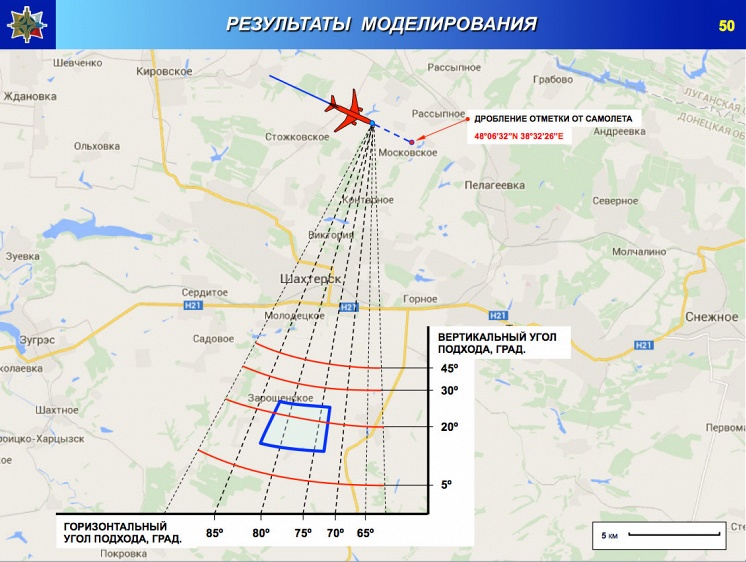
Calculation by the Buk manufacturer, Almaz-Antay, showing what it considered the likely area of the launch that took down Malaysia Airlines Flight 17.
The area is about three miles west of the 320-square-kilometer zone that the Dutch report established as the likely area from which the missile was fired. In July 2014, control of that area was being contested although most of the fighting was occurring about 100 kilometers to the north, meaning that the southern sector was more poorly defined and open to the possibility of a mobile system crossing from one side to the other.
Almaz-Antay CEO Novikov said the company’s calculations placed the missile site in Zakharchenko with “great accuracy,” a possible firing zone that “does not exceed three to four kilometers in length and four kilometers in width.” However, Ukrainian authorities said their calculations placed the firing location farther to the east, deeper into rebel-controlled territory.
Thus, the importance of the U.S. intelligence data that Secretary of State John Kerry claimed to possess just three days after the plane was shot down. Appearing on NBC’s “Meet the Press” on July 20, 2014, Kerry declared, “we picked up the imagery of this launch. We know the trajectory. We know where it came from. We know the timing. And it was exactly at the time that this aircraft disappeared from the radar.”
But the U.S. government has released none of its evidence on the shoot-down. A U.S. intelligence source told me that CIA analysts briefed the Dutch investigators but under conditions of tight secrecy. None of the U.S. information was included in the report and Dutch officials have refused to discuss any U.S. intelligence information on the grounds of national security.
In the weeks after the shoot-down, I was told by another source briefed by U.S. intelligence analysts that they had concluded that a rogue element of the Ukrainian government – tied to one of the oligarchs – was responsible for the attack, while absolving senior Ukrainian leaders including President Petro Poroshenko and Prime Minister Arseniy Yatsenyuk. But I wasn’t able to determine whether this U.S. analysis was a consensus or a dissident opinion.
Last October, Der Spiegel reported that German intelligence, the BND, concluded that the Russian government was not the source of the missile battery – that it had been captured from a Ukrainian military base – but the BND blamed the ethnic Russian rebels for firing it. However, a European source told me that the BND’s analysis was not as conclusive as Der Spiegel had described.
Prior to the MH-17 crash, ethnic Russian rebels in eastern Ukraine were reported to have captured a Buk system after overrunning a government air base, but Ukrainian authorities said the system was not operational, as recounted in the Dutch report. The rebels also denied possessing a functioning Buk system.
Who Has These Buks?
As for whether the 9M38 Buk system is still in the Ukrainian military arsenal, government officials in Kiev claimed to have sold their stockpile of older Buks to Georgia, but Ukraine appears to still possess the 9M38 Buk system, based on photographs of Ukrainian weapons displays. In other words, Ukrainian authorities appear to be lying about this crucial point.
It should be noted, too, that just because Russia no longer deploys the outmoded Buks doesn’t mean that it might not have some mothballed in warehouses that could be pulled out and distributed in a sub rosa fashion, although both the Ukrainian rebels and Russian officials deny this possibility. According to the Ukrainian government, the rebels were only known to have shoulder-fired “manpads” in July 2014 – and that weapon lacked the range to destroy a civilian airliner flying at 33,000 feet.
Yet, rather than delve into this important mystery, The New York Times’ editorial simply repeats the Western “group think” that took shape in the days after the MH-17 tragedy, that somehow the rebels shot down the plane with a Buk missile supplied by Russia. The other possibility that the missile was fired by some element of the Ukrainian security forces was given short-shrift despite the fact that Ukraine had moved some of its Buk batteries into eastern Ukraine presumably to shoot down possible Russian aircraft incursions.
As described in the Dutch report, this Ukrainian concern was quite real in the days before the MH-17 shoot-down. On July 16 – just one day before the tragedy – a Ukrainian SU-25 jet fighter was shot down by what Ukrainian authorities concluded was an air-to-air missile presumably fired by a Russian warplane patrolling the Russia-Ukraine border.
Thus, it would make sense that the Ukrainian air-defense forces would have moved their Buk batteries close to the border and would have been on the lookout for possible Russian intruders entering or leaving Ukrainian air space. So, one possibility is that a poorly organized Ukrainian air-defense force mistook MH-17 for a hostile Russian aircraft high-tailing it back to Russia and fired.
Another theory that I’m told U.S. intelligence analysts examined was the possibility that a rogue Ukrainian element – linked to a fiercely anti-Russian oligarch – may have hoped that President Vladimir Putin’s official plane was in Ukrainian air space en route home from a state visit to South America. Putin’s jet and MH-17 had very similar markings. But Putin used a different route and had already landed in Moscow.

A side-by-side comparison of the Russian presidential jetliner and the Malaysia Airlines plane.
A third possibility, which I’m told at least some U.S. analysts think makes the most sense, was that the attack on MH-17 was a premeditated provocation by a team working for a hard-line oligarch with the goal of getting Russia blamed and heightening Western animosity toward Putin.
Obama’s Secrets
But whatever your preferred scenario – whether you think the Russians or the Ukrainians did it – the solution to the mystery could clearly benefit from President Barack Obama doing what Putin has done: declassify relevant intelligence and defense information.
One might think that the Times’ editors would be at the forefront of demanding transparency from the U.S. government, especially since senior U.S. officials rushed out of the gate in the days after the tragedy to put the blame on the Russians. Yet, since five days after the shoot-down, the Obama administration has refused to update or refine its claims.
Earlier this year, a spokesperson for Director for National Intelligence James Clapper told me that the DNI would not provide additional information out of concern that it might influence the Dutch investigation, a claim that lacked credibility because the Dutch investigation began within a day of the MH-17 crash and the DNI issued a sketchy white paper on the case four days later.
In other words, the initial U.S. rush to judgment already had prejudiced the investigation by indicating which way the United States, a NATO ally of the Netherlands, wanted the inquiry to go: blame the Russians. Later, withholding more refined intelligence data also concealed whatever contrary analyses had evolved within the U.S. intelligence community after Kerry and the DNI had jumped to their hasty conclusions.
Yet, The New York Times took note of none of that, simply piling on the Russians again and hailing a dubious online publication called Bellingcat, which has consistently taken whatever the U.S. propaganda line is on international incidents and has systematically screwed up key facts.
In 2013, Bellingcat’s founder Eliot Higgins got the firing location wrong for the sarin gas attack outside Damascus, Syria. He foisted the blame on Bashar al-Assad’s forces in line with U.S. propaganda but it turned out that the missile’s range was way too short for his analysis to be correct. [See Consortiumnews.com’s “The Collapsing Syria-Sarin Case.”]
Then, earlier this year, Higgins fed Australia’s “60 Minutes” program wrong coordinates for the location of the so-called “Buk-getaway video” in eastern Ukraine. Though the program treated Higgins’s analysis as gospel, the images from the video and from the supposed location clearly didn’t match, leading the program to engage in a journalistic fraud to pretend otherwise. [See Consortiumnews.com’s “A Reckless Stand-upper on MH-17.”]
But the Times’ editorial board simply gushed all over Bellingcat, promoting the Web site as if it’s a credible source, writing that the Dutch report “is consistent with theories advanced by the United States and Ukraine as well as evidence collected by the independent investigative website Bellingcat.com, which hold that the fatal missile was fired from territory controlled by Russian-backed rebels in eastern Ukraine.”
The Times then distorted the findings of the Buk manufacturer to present them as somehow contradicted by the Dutch report, which substantially relied on the declassified information from the manufacturer to reach roughly the same conclusion, that the missile was an older-model Buk.
However, without irony, the Times writes, “This fact is not something Russians are likely to learn; Russian television has presented only the Kremlin’s disinformation of what is going on in Ukraine and, for that matter, Syria. … Creating an alternative reality has been a big reason for President Vladimir Putin’s boundless popularity among Russians. He sees no reason to come clean for the shooting down of the Boeing 777.”
Yet, the actual reality is that Russia has provided much more information and shown much greater transparency than President Obama and the U.S. government have. The Dutch report also ignored one of the key questions asked by Russian authorities in the days after the MH-17 shoot-down: why did Ukraine’s air defense turn on the radar used to guide Buk missiles?
But the Times remains wedded to its propaganda narrative and doesn’t want inconvenient facts to get in the way. Rather than demand that Obama “come clean” about what the U.S. intelligence agencies know about the MH-17 case, the newspaper of record chooses to mislead its readers about the facts.
Investigative reporter Robert Parry broke many of the Iran-Contra stories for The Associated Press and Newsweek in the 1980s. You can buy his latest book, America’s Stolen Narrative, either in print here or as an e-book (from Amazon and barnesandnoble.com).
Poroshenko Ready to Make English Ukraine’s Second Official Language
Sputnik – 15.10.2015
Ukrainian President Petro Poroshenko has proposed the establishment of two working languages in Ukraine: alongside Ukrainian, the second “should rightly be English.”
The perhaps not-so-surprising proposal was made at celebrations marking the National University of Kyiv-Mohyla Academy’s 400th anniversary, Ukrainian news agency UNIAN reported.
“Mohyla pioneered two working languages - Ukrainian and English,” Poroshenko said. “I think it would be very good if in Ukraine, and not just at Kyiv-Mohyla Academy, there appeared a second working language. And this language should rightly be English.”
In June Poroshenko announced that the mastery of English language should be priority for state politicians. As of October 1, knowledge of English became a prerequisite for employment in the administration of the president of Ukraine.
In his annual address to the Verkhovna Rada, Poroshenko also promised to announce 2016 as a year of learning English.
Guardian makes “error” reading MH17 report, accuses rebels of cover up
off-guardian | October 14, 2015
In a report compiled by Luke Harding, Shaun Walker and Julian Borger, entitled “MH17 report suggests efforts were made to cover up causes of disaster”, and published October 13, the Guardian claimed the Dutch report on the downing of MH17 alleged there was evidence of a “bungled autopsy” and attempt to “remove foreign objects” from the body of the first officer. The implication was that this had been done in order to conceal the cause of the crash, and the further implication was of course that Russia and the rebels had been involved.
The report by the Dutch safety board said that more than 120 objects, “mostly metal fragments”, were found in the body of the first officer, who had sustained “multiple fractures”.. When Dutch experts identified the captain’s body they found it had already “undergone an external and internal examination to remove foreign objects”.
Despite apparent attempts to remove shrapnel, “hundreds of metal objects were found”, the report said, as well as bone fractures and other injuries.
After this appeared a rebuttal was posted BTL, by the CiFer known as Pigswiggle, who showed conclusively the report made no such claim, or anything remotely like such a claim.
This is a really bizarre inference from the report.
[…]
The report is merely explaining that the Captain from Team A was not chosen by the public prosecutor as one of the bodies for further “detailed examination.” The Dutch authorities “found” that the Captain’s body “had already ‘undergone an external and internal examination to remove foreign objects,’” because it was part of the investigation procedure that all the bodies were subjected to (as described in the preceding paragraphs of the report). The Guardian is attempting to accuse Russia of a “cover up” based on the investigative actions of the Netherlands Forensic Institute. Indeed, according to the report, the persons responsible for having removed foreign objects from the Captain was a team of “120 forensic specialists from the National Forensic Investigations Team (LTFO) from the Netherlands and 80 forensic specialists from Australia, Belgium, Germany, the United Kingdom, Indonesia, Malaysia, and New Zealand.”
The Guardian needs to correct this story. It is highly embarrassing to it and its journalists.
[read full text of this comment here]
Following this, and other complaints, October 14 the Guardian issued what amounted to a retraction:

and reworded the offending part of the article to read:
The report by the Dutch safety board said that more than 120 objects, “mostly metal fragments”, were found in the body of the first officer, who had sustained “multiple fractures”. Dutch experts performed an “external and internal examination on the the captain’s body” and removed “hundreds of metal fragments”. They also observed bone fractures and other injuries.
Shaun Walker even tweeted the retraction:
We made a change to this story. There’s enough confusion/disinfo already so apologies for inadvertently adding to it
Some cynical commenters have pointed out this “error” has had the result of spreading a false and baseless rumour of Russian evidence-tampering around the web. A rumour that the foot-noted retraction will do little to quell – especially since they did not see fit to also change their grossly misleading headline, which as of 20:00 BST October 14 still reads thus:

Which means to all intents and purposes the lie is left to stand, “retraction” or no.
Is this ethical journalism?
Anyone who wants to register their opinion on this and/or ask for further correction can write to the Guardian here:
MH-17: The Dog Still Not Barking
By Robert Parry | Consortium News | October 13, 2015
The Dutch Safety Board report concludes that an older model Buk missile apparently shot down Malaysia Airline Flight 17 on July 17, 2014, but doesn’t say who possessed the missile and who fired it. Yet, what is perhaps most striking about the report is what’s not there – nothing from the U.S. intelligence data on the tragedy.
The dog still not barking is the absence of evidence from U.S. spy satellites and other intelligence sources that Secretary of State John Kerry insisted just three days after the shoot-down pinpointed where the missile was fired, an obviously important point in determining who fired it.
On July 20, 2014, Kerry declared on NBC’s “Meet the Press” that “we picked up the imagery of this launch. We know the trajectory. We know where it came from. We know the timing. And it was exactly at the time that this aircraft disappeared from the radar.”
But such U.S. government information is not mentioned in the 279-page Dutch report, which focused on the failure to close off the eastern Ukrainian war zone to commercial flights and the cause of the crash rather than who fired on MH-17. A Dutch criminal investigation is still underway with the goal of determining who was responsible but without any sign of an imminent conclusion.
I was told by a U.S. intelligence source earlier this year that CIA analysts had met with Dutch investigators to describe what the classified U.S. evidence showed but apparently with the caveat that it must remain secret.
Last year, another source briefed by U.S. intelligence analysts told me they had concluded that a rogue element of the Ukrainian government – tied to one of the oligarchs – was responsible for the shoot-down, while absolving senior Ukrainian leaders including President Petro Poroshenko and Prime Minister Arseniy Yatsenyuk. But I wasn’t able to determine if this U.S. analysis was a consensus or a dissident opinion.
Last October, Der Spiegel reported that German intelligence, the BND, concluded that the Russian government was not the source of the missile battery – that it had been captured from a Ukrainian military base – but the BND blamed the ethnic Russian rebels for firing it. However, a European source told me that the BND’s analysis was not as conclusive as Der Spiegel had described.
The Dutch report, released Tuesday, did little to clarify these conflicting accounts but did agree with an analysis by the Russian manufacturer of the Buk anti-aircraft missile systems that the shrapnel and pieces of the missile recovered from the MH-17 crash site came from the 9M38 series, representing an older, now discontinued Buk version.
The report said: “The damage observed on the wreckage in amount of damage, type of damage, boundary and impact angles of damage, number and density of hits, size of penetrations and bowtie fragments found in the wreckage, is consistent with the damage caused by the 9N314M warhead used in the 9M38 and 9M38M1 BUK surface-to-air missile.”
Last June, Almaz-Antey, the Russian manufacturer which also provided declassified information about the Buk systems to the Dutch, said its analysis of the plane’s wreckage revealed that MH-17 had been attacked by a “9M38M1 of the Buk M1 system.” The company’s Chief Executive Officer Yan Novikov said the missile was last produced in 1999.
Who Has This Missile?
The Russian government has insisted that it no longer uses the 9M38 version. According to the Russian news agency TASS, former deputy chief of the Russian army air defense Alexander Luzan said the suspect warhead was phased out of Russia’s arsenal 15 years ago when Russia began using the 9M317 model.
“The 9M38, 9M38M, 9M38M1 missiles are former modifications of the Buk system missiles, but they all have the same warhead. They are not in service with the Russian Armed Forces, but Ukraine has them,” Luzan said.
“Based on the modification and type of the used missile, as well as its location, this Buk belongs to the Armed Forces of Ukraine. By the way, Ukraine had three military districts — the Carpathian, Odessa and Kiev, and these three districts had more than five Buk anti-aircraft missile brigades of various modifications – Buk, Buk-M, Buk-M1, which means that there were more than 100 missile vehicles there.”
But Luzan’s account would not seem to rule out the possibility that some older Buk versions might have gone into storage in some Russian warehouse. It is common practice for intelligence services, including the CIA, to give older, surplus equipment to insurgents as a way to create more deniability if questions are ever raised about the source of the weapons.
For its part, the Ukrainian government claimed to have sold its stockpile of older Buks to Georgia, but Ukraine appears to still possess the 9M38 Buk system, based on photographs of Ukrainian weapons displays. Prior to the MH-17 crash, ethnic Russian rebels in eastern Ukraine were reported to have captured a Buk system after overrunning a government air base, but Ukrainian authorities said the system was not operational, as recounted in the Dutch report. The rebels also denied possessing a functioning Buk system.
As for the missile’s firing location, the Dutch report said the launch spot could have been anywhere within a 320-square-kilometer area in eastern Ukraine, making it hard to determine whether the firing location was controlled by the rebels or government forces. Given the fluidity of the frontlines in July 2014 – and the fact that heavy fighting was occurring to the north – it might even have been possible for a mobile missile launcher to slip from one side to the other along the southern front.
The Dutch report did seek to discredit one alternative theory raised by Russian officials in the days after the shoot-down – that MH-17 could have been the victim of an air-to-air attack. The Dutch dismissed Russian radar data that suggested a possible Ukrainian fighter plane in the area, relying instead of Ukrainian data which the Dutch found more complete.
But the report ignored other evidence cited by the Russians, including electronic data of the Ukrainian government allegedly turning on the radar that is used by Buk systems for targeting aircraft. Russian Lt. Gen. Andrey Kartopolov called on the Ukrainian government to explain the movements of its Buk systems to sites in eastern Ukraine in mid-July 2014 and why Kiev’s Kupol-M19S18 radars, which coordinate the flight of Buk missiles, showed increased activity leading up to the July 17 shoot-down.
The Dutch-led investigation was perhaps compromised by a central role given to the Ukrainian government which apparently had the power to veto what was included in the report. Yet, what may have spoken most loudly in the Dutch report was the silence about U.S. intelligence information. If – as Kerry claimed – the U.S. government knew almost immediately the site where the fateful missile was launched, why has that evidence been kept secret?
Given the importance of the conflict in eastern Ukraine to U.S. intelligence, it was a high-priority target in July 2014 with significant resources devoted to the area, including satellite surveillance, electronic eavesdropping and human assets. In his rush-to-judgment comments the weekend after the crash, Kerry admitted as much.
But the Obama administration has refused to make any of its intelligence information public. Only belatedly did CIA analysts brief the Dutch investigators, according to a U.S. government source, but that evidence apparently remained classified.
The second source told me that the reason for withholding the U.S. intelligence information was that it contradicted the initial declarations by Kerry and other U.S. officials pointing the finger of blame at the ethnic Russian rebels and indirectly at Russian President Vladimir Putin, who stood accused of giving a ragtag bunch of rebels a powerful weapon capable of shooting down commercial airliners.
Despite Russian denials, the worldwide revulsion over the shoot-down of MH-17, killing all 298 people onboard, gave powerful momentum to anti-Putin propaganda and convinced the European Union to consent to U.S. demands for tougher economic sanctions punishing Russia for its intervention in Ukraine. According to this source’s account, an admission that a rogue Ukrainian group was responsible would take away a powerful P.R. club wielded against Russia.
Among the organizations that have implored President Barack Obama to release the U.S. intelligence data on MH-17 is the Veteran Intelligence Professionals for Sanity, a group of mostly retired U.S. intelligence analysts.
As early as July 29, 2014, just 12 days after the shoot-down amid escalating Cold War-style rhetoric, VIPS wrote, “As intelligence professionals we are embarrassed by the unprofessional use of partial intelligence information. … As Americans, we find ourselves hoping that, if you indeed have more conclusive evidence, you will find a way to make it public without further delay. In charging Russia with being directly or indirectly responsible, Secretary of State John Kerry has been particularly definitive. Not so the evidence.”
But the release of the Dutch report – without any of that data – indicates that the U.S. government continues to hide what evidence it has. That missing evidence remains the dog not barking, like the key fact that Sherlock Holmes used to unlock the mystery of the “Silver Blaze” when the sleuth noted that the failure of the dog to bark suggested who the guilty party really was.
Investigative reporter Robert Parry broke many of the Iran-Contra stories for The Associated Press and Newsweek in the 1980s. You can buy his latest book, America’s Stolen Narrative, either in print here or as an e-book (from Amazon and barnesandnoble.com).
MH17: What we know on eve of Dutch Safety Board report
RT | October 12, 2015
On Tuesday, the Dutch Safety Board will release its final report on the fate of the crashed Malaysian Airlines MH17 flight. Ahead of the report’s publication we take a look at the key facts, theories and false trails surrounding the investigation.
The crash of Malaysian flight MH17 took place on July 17, 2014, in Eastern Ukraine, killing all 298 passengers and crew members onboard, among them 80 children.
The international probe launched immediately after the crash has taken 15 months to prepare.
Preliminary findings claimed that the plane broke up mid-air after being hit by high-energy objects. The final report of the Dutch Safety Board is expected to be delivered on Tuesday, October 13.
BLAME GAME
On July 23, 2014, it was confirmed that the MH17 black boxes were delivered by Dutch officials to a British laboratory for analysis, promising results “inside 24 hours.” That was nearly 15 months ago and the general public is still unfamiliar with this data. The mainstream media were quick to point the finger at Russia right from the start, claiming that Moscow was responsible for bringing down the plane.
Western media carried strong anti-Russian headlines, most of them blaming President Putin personally for the deaths of all the passengers and crew on board.
That was well before any investigators had even reached the crash site, and the allegations were based on snap judgments and little information. The day after the crash, Ukraine released what it called “intercepted phone conversations,” allegedly proving that anti-government fighters shot down MH17 by mistake. Kiev also alleged that the rebels obtained a BUK air defense missile system from Russia. Moscow dismissed the tapes that could not be verified independently as outright fakes.
INVESTIGATION
Actually, there are two separate international probes into the crash – the technical probe led by the Dutch Safety Board, which is due to present in conclusions on Tuesday, and a criminal probe, carried out by a Dutch-led Joint Investigation Team, which is still ongoing.
While the Dutch Safety Board is looking into what caused the accident, the criminal probe is supposed to reach a conclusion on who was responsible for the crash.
Russia has appealed to the head of the UN aviation agency to intervene in the investigation into the MH17 crash to prevent the Dutch Safety Board (DSB) from ignoring the findings of their Russian counterparts.
A letter from the Deputy Chief of Russia’s Federal Air Transport Agency to the International Civil Aviation Organization (ICAO) claims that the DSB ignored “comprehensive information” relating to the downing of the Boeing 777 over war-torn Eastern Ukraine on July 17, 2014, provided by the Russian side and violated the principle of “sequence of conclusions.”
There are two main theories as to what brought down the plane, and both imply use of weapons: either a surface-to-air missile, or an air-to-air missile.
Theory #1: ‘Russian BUK Missile’
The Dutch Safety Board delivered a preliminary report about a year ago, concluding that flight MH17 broke up in mid-air and came down after being hit by a large number of high-energy objects that penetrated the plane from the outside and ruptured the fuselage. The report did not mention where those high-energy objects came from.
The first theory maintains that the MH17 flight was downed by a surface-to-air anti-aircraft missile. It is considered by many as the most likely theory and one that’s been widely cited in the media. The only question is who did it.
The West and Ukraine claim the rebels shot the plane with a Russian BUK missile. In the framework of this theory, a YouTube video of a BUK weapons system with one rocket missing being transported somewhere in Ukraine just hours after the crash was presented as a smoking gun, claiming that the missile system was sneakily cleared out of Ukraine into Russia.
But some local bloggers identified the location as the Ukrainian town of Krasnoarmeysk, which was under control of the Kiev forces at the time.
The fact that the video emerged online suspiciously quickly, was followed by lots of so-called social media evidence, and is almost impossible to authenticate, only fueled suspicions.
Theory #2: ‘Ukrainian BUK missile’
At the same time Russia’s Defense Ministry made public satellite images of the area, taken several days prior to the crash. The satellite pictures showed Ukrainian army positions on three days before the crash, and a BUK missile launcher could be spotted there. But on the day of the crash, it had moved somewhere else. The question is why – and where it had gone?
In June 2015, Russian arms manufacturer Almaz-Antey presented the results of its own probe into the causes of the MH17 crash. Looking into the option of a surface-to-air missile downing the Boing-777, experts stressed that it could only have been caused by one of the missiles from an older modification of the BUK missile system, namely the Buk-M1 – the type of the weapon the Ukrainian army is equipped with. The Russian army uses modern and later BUK missile systems.
Theory #3: ‘Air-to-Air Missile’
Another theory is that Flight MH17 may have been shot down from the air.
Russia’s Investigative Committee (IC) has been conducting its own investigation into the crash. On June 3, the Committee identified the key witness to the MH17 crash as Evgeny Agapov, an aviation armaments mechanic in the Ukrainian Air Force. Agapov testified that on July 17, 2014 a Ukrainian Sukhoi SU-25 jet aircraft piloted by Captain Voloshin “set out for a military task” and returned without ammunition. Agapov implied that an air-to-air missile was missing and claimed he overheard Voloshin say to his colleagues that some plane was “in the wrong place at the wrong time.”
Also, in a video shot by Ukraine’s anti-government militia when they arrived at the crash site immediately after the catastrophe and released by an Australian broadcaster almost a year after the tragedy, one important part was largely ignored.
The video, shown by News Corp Australia, is a short, 5-minute clip made from an original video 17 minutes long, but the channel published online a full transcript of the original version.
The transcript cited the rebel commander as saying “the Sukhoi jet brought down the civilian plane and ours brought down the fighter jet.”
Later, the same person says once again that there were two planes shot down, and another voice in the background says, “They decided to do it this way, to look like we have brought down the plane.”
Those who oppose the theory say the Sukhoi Su-25 close support fighter jet spotted in the skies at the time of the incident cannot reach a height of 10,000 meters, where the Malaysian airliner was at cruising altitude. But a documentary crew making a film about the MH17 catastrophe has actually proven them wrong, staging an experiment and taking an Su-25 to a height of 11,880 meters – with a pilot wearing an oxygen mask.
The report coming out Tuesday will be technical in nature. Its goal is to specify how the plane was brought down, not to place blame on any side. This is the responsibility of the criminal probe, which is still ongoing.
READ MORE: Bogus photos of ‘Russian’ air-defense systems in Ukraine debunked by bloggers
Putin and the Press: The Demonology School of Journalism
By James Petras | October 11, 2015
The major influential western print media are engaged in a prolonged, large-scale effort to demonize Russian President Putin, his politics and persona. There is an article (or several articles) every day in which he is personally stigmatized as a dictator, authoritarian, czar, ‘former KGB operative’ and Soviet-style ruler; anything but the repeatedly elected President of Russia.
He is accused of hijacking Russia from the ‘road to democracy’, as pursued by his grotesquely corrupt predecessor Boris Yeltsin; of directing the bloody repression of the ‘freedom loving Chechens’; of jailing innocent, independent, and critical oligarchs and robber barons; of fomenting an uprising in the ‘democratic, newly pro-Western’ Ukraine and seizing control of Crimea; of backing a ‘bloody tyrant’ in Syria (elected President Bashar Assad) in a civil war against ISIS terrorists; of running the Russian economy into the ground; and of militarily threatening the Baltic and Eastern European NATO member countries.
In a word, the media have propagated an image of an ‘out-of-control autocrat’, who makes a mockery of ‘democratic’ norms and ‘Western values’, and who seeks to revive the ‘Soviet (aka Evil) Empire’.
The corollary is that ‘Western powers’, despite their peace-loving propensities and fraternal attempts to bring Russia into the democratic ‘fold’, have been ‘forced’ to now surround Russia with NATO military bases and missiles; to finance a violent coup in the Ukraine (on Russia’s frontier) and arm the Ukrainian putsch government and neo-fascist militias to ‘restore democracy’ and violently suppress ethnic Russian ‘separatists’ in Eastern Ukraine. We are told that US and EU sanctions against Russia were carefully crafted ‘diplomatic’ measures designed to punish the Moscow ‘aggressor’.
In reality, the Western media has relentlessly demonized Vladimir Putin in a campaign to further NATO military expansion and undermine the Russian economy and its national security. The goal is ultimately to force a ‘regime change’, restoring the neo-liberal elites who had pillaged Russia’s economy during the 1990s and whose brutal economic policies led to the premature death of over 6 million Russians due to deprivation and the collapse of the healthcare system.
Putin: Demon or Realist, Autocrat or Democrat, Vassal or Independent Leader?
The Western media has backed every oligarch, gangster, and fraudster who has gone on trial and been convicted during Putin’s term in office. The propagandists tell us the reason for this affinity between the Western media and the gangster-oligarchs is that these convicted felons, who claim to be ‘political dissidents’ and critics of Putin’s rule, have been dispossessed, and jailed for upholding ‘Western values’.
The Western media conveniently ignore the well-documented studies on the source of the gangster-oligarchs’ wealth: The violent and illegal seizure of multi-billion dollars-worth of natural resources (aluminum, oil and gas), banks, factories, pension funds and real estate. During the Yeltsin period the oligarchs controlled thousands of armed gangsters and engaged in internal warfare during which thousands were killed, including top government regulators, police officials and journalists who dared to oppose or expose their pillage and property grabs.
Putin’s prosecution of a mere fraction of the most notorious oligarch-gangsters has won the support of the vast majority of Russian citizens because it represents a return to law and order and the return of stolen public wealth.
Only the Western media has dared to refer to these convicted felons as ‘political victims and reformers’. They did so because the oligarchs had become the most loyal and submissive assets in the US and EU governments’ efforts to convert Russia into an irreversibly weak vassal state.
The Western media constantly refer to President Putin as the ‘authoritarian ruler’, despite the fact that he has been repeatedly elected by large majorities in competitive elections against Western backed and funded candidates. His popularity is attested to by opinion polls conducted by Western agencies.
In 2015, President Putin’s support soared to over 85%. The pro-Western Russian neo-liberal politicians scored in the low single digits according to the same independent polls.
Clearly the Russian public does not want to return to the poverty and chaos of the Western-backed gangster politics of the 1990s.
Whatever reservations working and middle class Russians have over President Putin’s style of decision-making, they clearly value his crackdown on gangster-controlled elections, Chechen terrorism, and his restoration of Russian military defense of its frontiers, including the annexation of Crimea, following the US-engineered coup in Ukraine.
Every day, the Western media recycle reports of the ‘decline and demise’ of the Russian economy, blaming ‘statist’ mismanagement of the economy by Putin. They claim ‘declining living standards’, the ‘negative growth’ of the economy and the ‘growing isolation’ of an ‘expansionist’ Russia in the face of Western sanctions.
These media claims are laughable. Readily available data demonstrate that living standards of the vast majority of Russian citizens have significantly increased under President Putin’s administration, especially after the utter collapse under the free marketers of the 1990s. Russian workers receive their pay, pensioners their pensions, enterprises their loans – on time. During the ‘free market’ days of Boris Yeltsin, workers went up to a year without pay, pensioners were selling their heirlooms in the street to survive and enterprises paid extortionate interest rates to oligarch-gangster controlled banks! Comparative data, easily obtained, are deliberately ignored by the mass media because it doesn’t fit the demonological narrative.
The mass media present the neo-liberal ‘opposition’ and ‘liberal critics’ as Russian democrats defending ‘Western values’. They forget to mention that these ‘liberal critics’ have been directly funded by Western foundations (National Endowment for Democracy, Soros Foundation, etc.) and Russian non-governmental organizations (NGO’s) with longstanding ties to US and EU governments, intelligence agencies and exiled Russian billionaires. The so-called ‘Russian’ democratic opposition revealed their abject servility to Western interests when they openly supported the Ukrainian coup and Kiev’s bloody assault on ethnic Russian-Ukrainians in the eastern ‘Donbas’ regions of Donetsk, Luhansk and Odessa. Whatever shreds of respectability and credibility the ‘democratic opposition’ retained with the Russian public, up to that point, was lost. They were seen for what they are: propaganda arms of Western imperialism and mouth-pieces for neo-fascists.
The Western mass media charge Putin’s government with the same crimes that their own governments commit. After the US State Department’s Victoria Nuland admitted to channeling $5 billion to fund the 2014 coup in Ukraine and after the Polish regime boasted of training far right street fighters, whose mob violence served as a pretext for the coup, and after neo-fascist coalition partners in Odessa of burned alive four dozen ethnic Russian-Ukrainian citizens opposed to the coup, the Western mass media accused Putin of ‘intervening’ in Ukraine. This was because Russia had convoked a referendum in Crimea, in which over 80% of the electorate voted to secede from the illegitimate Ukrainian coup regime and rejoin Russia.
In truth, the Putin government is a victim of the Western power grab in the Ukraine, with Russia having to absorb hundreds of thousands of ethnic Russian refugees driven out of the Donbas, yet the Western media portray Putin as the executioner. Meanwhile the Western coup-makers and their far-right allies are depicted as victims… forced to bomb and decimate the Donbas region.
The charade continued. The Western media portray the subsequent punitive, economic sanctions imposed by the expansionist US and EU on Russia as a result of Putin’s ‘aggression’, referring to Russia’s defense of Crimea’s self-determination and the rights of the millions of bilingual ethnic Russian citizens of Ukraine.
The absurdity and convoluted nature of Western demonological propaganda has reached new even more bizarre heights with their hysteria against Russia’s military support of the secular Syrian government against ISIS and other jihadi terrorists.
The Western mass media have launched a global campaign charging that the Russian air force bombs ‘non-ISIS military bases’, presumably the bases of Western-backed ‘friendly’ jihadi terrorists. This ridiculous ‘reportage’ and its accompanying ‘photos’ were published before the Russian air strikes even took place!!
Apparently timing doesn’t matter in Washington’s ‘alternative universe of lies’!
NATO passed its political line to the media that Russian support for the legitimate regime of President Assad must be discredited; that the Russian presence is ‘provocative’ and responsible for ‘creating tensions’ in the region – after years of Western-sponsored jihadi terrorism against Syria!
Obedient to its masters, the Western media breathlessly ‘reported’ that the Russians were ‘really’ engaged in Syria in order destroy the pro-Western ‘fighters’, leaving ISIS alone.
No credible evidence for this propaganda was ever presented. They trotted out aerial photos of wreckage, which had likely been lifted from previous US bombings.
The media’s clumsy execution of the Pentagon’s line managed to embarrass even the US Secretary of Defense, Ashton Carter, who backed off of such claims and called for an explanation from Russia. Even Secretary Kerry, who now seeks to secure Putin’s military support for the US against ISIS while withdrawing Russia’s political backing of President Assad, has cautioned the media to modify its line, now that the US favors ‘greater coordination’ with Russia — but under US leadership. The media has recently conformed to this line, although it has not managed to explain how Washington could now work with the demonic President Putin.
Conclusion
Western media is engaged in an intense long-term propaganda campaign to demonize President Putin. Its role is to convince world public opinion and world leaders to blindly follow the US and EU, as well as their ‘allies’ and vassal states, in a campaign to degrade and undermine Russia, and consolidate a unipolar empire under US tutelage.
The Western mass media is important; but it must be remembered that the media is an instrument of imperial state power. Its lies and fabrications, its demonization of leaders, like President Putin, are one part of a global military offensive to establish dominance and to destroy adversaries.
The more intense the imperial campaign, the riskier the power grab, the greater the need to demonize the victims.
This explains how the escalation of the rabid anti-Putin propaganda campaign coincides with the single biggest Western power grab — the Ukraine coup (‘regime change’) — since West Germany annexed East Germany, and NATO and the EU incorporated the Baltic States, Eastern Europe and the Balkans into the West’s strategic alliance. The West’s bloody break-up of the Yugoslav federation was part of this strategic program.
The problem with the Western demonization of adversaries, whether it is Russia, Iran and China today, or earlier Cuba, Libya and Yemen in the past, is that Washington and the EU face severe economic crises at home and military defeats abroad by armed Islamic and nationalist resistance movements.
The US had invested hundreds of billions of dollars to prop up a shaky puppet regime in US-occupied Iraq, yet the US-trained and supplied Iraqi Army fled as the Baathist-Islamist ‘ISIS’ quickly over-ran half the country.
US troops have occupied Afghanistan for fourteen years, losing tens of thousands of lives and limbs and yet the nationalist-Islamist Taliban can easily take over Afghanistan’s third largest city, Kunduz (population 300,000), and occupies three quarters of the rest of the countryside.
Libya and Somalia are a disaster. And still Washington allocates a half billion dollars to train pro-Western mercenaries to overthrow Syria’s President Assad – mercenaries who give up their arms or join ISIS the moment they cross the border from Jordan or Turkey. The US trained mercenaries have handed over untold millions of dollars worth of heavy and light weapons and armored carriers to ISIS and Al Qaeda. The EU and the US face the dismal reality that Libya, Somalia and Syria are over-run by anti-Western Islamic fighters.
In Asia, China is demonized in the Western media, portrayed as being on the verge of collapse, facing a hard landing, even as China grows at 7%. The Western media wring their collective hands over the crisis in China while Beijing finances two new international development banks for $100 billion, raises its contribution to the IMF and brings 50 countries, including most of the EU but minus the US and Japan, into a new infrastructure lending institution.
Two big questions face the US and EU:
Why do the Western media launch a campaign of demonization that doesn’t correspond to reality? What is the goal of such demonization, which objectively undermines the possibility of forming tactical alliances to end the US’ military losses, political defeats and diplomatic isolation? The US needs Russia to defeat ISIS.
For Moscow, the fight against ISIS is crucial to Russian national security: thousands of Chechen terrorists (some trained by the US) are fighting with ISIS and threaten to return to the Caucuses and terrorize Russia. Unlike the US public’s opposition to Washington’s role in forcing ‘regime change’ in Syria, the Russian public supports Moscow’s military support for the Syrian government because the Chechens’ campaign of terror within Russia, especially the 2004 massacre of hundreds of school children, teachers, and parents in Beslan, is seared into their memory – a fact conveniently ignored by Western media when it ‘sympathizes’ with Chechen ‘freedom fighters’.
In reality, Washington should have a common interest to ally with Russia in the fight against ISIS in Syria and Iraq. However Obama is committed to ousting Assad (Russia’s ally) to expand US dominance in the Middle East in partnership with Israel and Saudi Arabia. Clearly there are insurmountable contradictions between short-term military objectives (fighting ISIS) and strategic imperial political imperatives (consolidating US-Israeli hegemony over the Middle East and Iran).
Washington has moved to end its isolation in Latin America by re-establishing diplomatic relations with Cuba. Meanwhile, Washington retains the economic blockade of Cuba and its huge US military base in Guantanamo. Cuba is seen as a tactical political ally in ‘moderating’ the leftist government of Venezuela and pressuring the Colombian FARC to disarm, even as Washington deepens its military presence in the continent.
Obama signed off on a nuclear agreement with Iran (but the crippling sanctions and blockade remain in place) in order to secure Tehran’s support for the war against ISIS in Iraq and the Taliban in Afghanistan. Temporarily, the Western mass media has ‘toned-down’ its demonological reporting on Iran and Cuba, for tactical purposes.
The Obama regime has adopted a ‘good cop/bad cop’ (or schizophrenic) posture with Russia on Syria – Secretary of State John Kerry speaks of joint co-operation with Moscow while Secretary of Defense Ashton Carter proposes to militarily confront ‘Russian aggression’. The media hasn’t made the switch because they don’t know which orders to obey or which line to ‘parrot’.
In the meantime, the domestic economic crisis deepens, ISIS advances, the Taliban approaches Kabul, the Russians are arming and defending President Assad and millions of refugees, fleeing the war zones, have over- run Europe. European border wars are raging. And Obama wrings his hands in impotence. Demonology offers no allies, no solutions and no positive path to peace and co-existence.
Russians angered by Dutch probe
By Haris Hussain – New Straits Times – October 11, 2015
KUALA LUMPUR – JUST 48 hours before the release of the official report into the downing of Malaysia Airlines Flight MH17 on July 17, last year, it has emerged that the Russians are far from satisfied with the conduct of the investigations by the Dutch Safety Board (DSB).
In a scathing letter to the International Civil Aviation Organisation (ICAO), Oleg Storchevoy, Russia’s deputy director of the Federal Air Transport Agency and accredited representative in the international investigation team into the MH17 tragedy, accused the DSB of ignoring “comprehensive information” relating to the investigation provided by the Russian side.
The letter, addressed to ICAO president Dr Olumuyiwa Benard Aliu, was received by the agency on Sept 16. One of Russia’s biggest concerns centred on the DSB’s approach to the probe, which Storchevoy claimed violated one of the basic principles of air accident investigations, known as the principle of sequence of conclusions.
In the letter, Storchevoy said that instead of studying the nature of the damage to the aircraft’s front fuselage and then arriving at a logical and final conclusion, the DSB sets, from the get go, to prove that the aircraft was destroyed by a BUK missile, launched from a location given right after the incident.
“This is before any research into the characteristics of the warhead which brought down the plane was done. Basic data and methods of identifying where the missile was fired from were also not explained by the DSB.”
The letter also stated that during two separate meetings with the DSB, detailed information on the 9M38 and 9M38M1 surface-to-air missile systems was provided to the probe team by the designer and manufacturer of the BUK SA-11, JSC Almaz-Antey Corporation.
These included technical specs, flight and ballistics characteristics, launch parameters, algorithms governing the detonator and characteristics of the warhead.
The DSB was also given the results of a warhead detonation test under controlled conditions to determine shrapnel dispersal patterns and what fragments of the missile could have impacted the fuselage.
“All these detailed calculations were ignored by the DSB. As a result, the DSB arrived at conclusions that contradict common sense and are not consistent with the design of this weapons system,” Storchevoy wrote, adding that there were additional discrepancies with regards to the metallurgical properties of the missile and size of the warhead. “According to the (DSB) calculations, the weight of the warhead was no more than 33kg, and the main warhead was equipped with between 3,000 and 4,000 ‘pre-formed fragments’ (flechettes) that weighed around 3g each. These do not correspond with the BUK at all.”
He added that Russia’s insistence that the flechettes and shrapnel allegedly found at the impact site — their weight, shape, sizes and material type — be identified, tagged and bagged, was ignored.
“They were submitted half a year later, after the investigation began. As a result, a year after the accident, there is no proof to connect the pre-formed fragments with missiles of any type. “Taking the abovementioned into consideration, there is no proof that this aircraft was destroyed by the BUK rocket.”
The Dutch-led investigation is operated in accordance with the standards and recommended practices under ICAO’s Annex 13. The state of occurrence (Ukraine) delegated the investigation to the DSB.
In July, Russia vetoed a United Nations resolution to create an international tribunal to prosecute those who shot down MH17. The lone “no” vote was cast by Russian ambassador to the UN, Vitaly Churkin. Russia is one of five permanent UN Security Council members with veto powers.
Following the vote, Churkin accused other countries of politicising the vote and said Ukraine was blocking Moscow from being involved in the investigation. Ukraine and many Western countries had accused pro-Russian rebels in east Ukraine of shooting down the Boeing 777 with 298 passengers on board with a Russian-made BUK SA-11 missile.
Moscow vehemently denies the charges.
The resolution was drafted by Australia, Belgium, Malaysia, the Netherlands and Ukraine. Malaysia had pushed for an international tribunal to try those responsible for the atrocity.
Eleven of the 15 members of the council voted in favour; China, Venezuela and Angola abstained.
Just an hour before the Malaysia-backed resolution was put to a vote, Russian President Vladimir Putin said he opposed the plan. Russia had said that setting up a tribunal before the investigations were complete would risk further politicising the incident.
Putin also regretted that Russia’s own draft resolution, which demanded justice for the victims but does not establish a tribunal, did not win the UN Security Council’s backing.
Ukrainian Finance Minister: $40 Bln in Assistance Not Enough
Sputnik – 11.10.2015
Finance Minister Natalia Yaresko considers a $40 billion assistance program from the IMF not enough to guarantee Ukraine’s economic stability in the long-term.
In an interview with the Financial Times, Yaresko called for the United States, the EU and other loaners to double financial assistance to the conflict-torn state in 2016.
“Ukraine did everything possible to show its international partners that we do our best and that we are able to live up to our promises,” she explained. “I think it means that international partners should unanimously support us.”
Kiev’s government has won praise from the IMF and sponsors such as the US for making significant progress in implementing economic reforms, although the fund still expects the Ukrainian economy to contract 11 percent this year.
Still, Yaresko said the government needs more financial aid from the international community “to help finance infrastructure and other investment and demonstrate progress to its own citizens.”
Yaresko also announced that Kiev is not going to offer any special conditions to Russia over a $3 billion debt expected to be repaid by December 2015. The Finance Minister insisted on restructuring the debt under the terms of an agreement reached with other creditors in summer.
A four-year $17.5-billion assistance package to Ukraine was approved by the IMF on March 11 in an effort to put the country’s ailing economy on the path of recovery. The overall external financial aid package to Kiev amounts to about $40 billion, to be administered over the next four years and comprising loans from the International Monetary Fund, the United States and the European Union among others.
This year Ukraine already received $6,7 billion from 10 billion allocated for 2015.
US Tax Dollars and Ukraine’s Finance Minister
By Robert Parry | Consortium News | October 3, 2015
The U.S. government is missing – or withholding – audit documents about the finances and possible accounting irregularities at a $150 million U.S.-taxpayer-financed investment fund when it was run by Ukraine’s Finance Minister Natalie Jaresko, who has become the face of “reform” for the U.S.-backed regime in Kiev and who now oversees billions of dollars in Western financial aid.
Before taking Ukrainian citizenship and becoming Finance Minister in December 2014, Jaresko was a former U.S. diplomat who served as chief executive officer of the Western NIS Enterprise Fund (WNISEF), which was created by Congress in the 1990s with $150 million and placed under the U.S. Agency for International Development (USAID) to help jumpstart an investment economy in Ukraine.
After Jaresko’s appointment as Finance Minister — and her resignation from WNISEF — I reviewed WNISEF’s available public records and detected a pattern of insider dealings and enrichment benefiting Jaresko and various colleagues. That prompted me in February to file a Freedom of Information Act request for USAID’s audits of the investment fund.
Though the relevant records were identified by June, USAID dragged its feet on releasing the 34 pages to me until Aug. 28 when the agency claimed nothing was being withheld, saying “all 34 pages are releasable in their entirety.”
However, when I examined the documents, it became clear that a number of pages were missing from the financial records, including a total of three years of “expense analysis” – in three-, six- and nine-month gaps – since 2007. Perhaps even more significant was a missing paragraph that apparently would have addressed an accounting irregularity found by KPMG auditors.
KPMG’s “Independent Auditors’ Report” for 2013 and 2014 states that “except as discussed in the third paragraph below, we conducted our audits in accordance with auditing standards generally accepted in the United States of America,” accountant-speak that suggests that “the third paragraph below” would reveal some WNISEF activity that did not comply with generally accepted accounting principles (or GAAP).
But three paragraphs below was only white space and there was no next page in what USAID released.
Based on the one page that was released for 2013-14, this most recent audit also lacked the approval language used in previous audits, in which KPMG wrote: “In our opinion, the consolidated financial statements … present fairly, in all material respects, the consolidated financial position of Western NIS Enterprise Fund and subsidiaries.” That language was not in the 2013-14 analysis, as released by USAID.
The KPMG report for 2013-14 does note that “The [audit] procedures selected depend on the auditors’ judgment, including the assessment of the risks of material misstatement of the financial statements, whether due to fraud or error. … An audit also includes evaluating the appropriateness of accounting policies used and the reasonableness of significant accounting estimates made by management, as well as evaluating the overall presentation of the financial statements.”
That page then ends, “We believe that the audit evidence we have obtained is sufficient and appropriate to provide a basis for our audit opinion.” But the opinion is not there.
After I brought these discrepancies to the attention of USAID on Aug. 31, I was told on Sept. 15 that “we are in the process of locating documents to address your concern. We expect a response from the bureau and/or mission by Monday, September 28, 2015.”
After the Sept. 28 deadline passed, I contacted USAID again and was told on Oct. 2 that officials were “still working with the respective mission to obtain the missing documents.”
Yet, whether USAID’s failure to include the missing documents was just a bureaucratic foul-up or a willful attempt to shield Jaresko from criticism, the curious gaps add to the impression that the management of WNISEF fell short of the highest standards for efficiency and ethics.
A previous effort by Jaresko’s ex-husband Ihor Figlus to blow the whistle on what he considered improper business practices related to WNISEF was met by disinterest inside USAID, according to Figlus, and then led to Jaresko suing him in a Delaware court in 2012, using a confidentiality clause to silence Figlus and getting a court order to redact references to the abuses he was trying to expose.
Feeding at the Taxpayer Trough
Other public documents indicate that Jaresko and fellow WNISEF insiders enriched themselves through their association with the U.S.-taxpayer-financed investment fund. For instance, though Jaresko was limited to making $150,000 a year at WNISEF under the USAID grant agreement, she managed to earn more than that amount, reporting in 2004 that she was paid $383,259 along with $67,415 in expenses, according to WNISEF’s filing with the Internal Revenue Service.
Among the audit documents that I received under FOIA, the “Expense Analysis” for 2004 shows $1,282,782 being paid out as “Exit-based incentive expense-equity incentive plan” and another $478,195 being paid for “Exit-based incentive expense-financial participation rights.” That would suggest that Jaresko more than doubled her $150,000 salary by claiming bonuses from WNISEF’s investments (bought with U.S. taxpayers’ money) and sold during 2004.
Jaresko’s compensation for her work with WNISEF was removed from public disclosure altogether after she co-founded two related entities in 2006: Horizon Capital Associates (HCA) to manage WNISEF’s investments (and collect around $1 million a year in fees) and Emerging Europe Growth Fund (EEGF), a private entity to collaborate with WNISEF on investment deals.
Jaresko formed HCA and EEGF with two other WNISEF officers, Mark Iwashko and Lenna Koszarny. They also started a third firm, Horizon Capital Advisors, which “serves as a sub-advisor to the Investment Manager, HCA,” according to WNISEF’s IRS filing for 2006.
According to the FOIA-released expense analyses for 2004-06, the taxpayer-financed WNISEF spent $1,049,987 to establish EEGF as a privately owned investment fund for Jaresko and her colleagues. USAID apparently found nothing suspicious about these tangled business relationships despite the potential conflicts of interest involving Jaresko, the other WNISEF officers and their affiliated companies.
For instance, WNISEF’s 2012 annual report devoted two pages to “related party transactions,” including the management fees to Jaresko’s Horizon Capital ($1,037,603 in 2011 and $1,023,689 in 2012) and WNISEF’s co-investments in projects with the EEGF, where Jaresko was founding partner and chief executive officer. Jaresko’s Horizon Capital managed the investments of both WNISEF and EEGF.
From 2007 to 2011, WNISEF co-invested $4.25 million with EEGF in Kerameya LLC, a Ukrainian brick manufacturer, and WNISEF sold EEGF 15.63 percent of Moldova’s Fincombank for $5 million, the report said. It also listed extensive exchanges of personnel and equipment between WNISEF and Horizon Capital. But it’s difficult for an outsider to ascertain the relative merits of these insider deals — and the transactions apparently raised no red flags for USAID officials, nor during that time for KPMG auditors.
Bonuses, Bonuses
Regarding compensation, WNISEF’s 2013 filing with the IRS noted that the fund’s officers collected millions of dollars in more bonuses for closing out some investments at a profit even as the overall fund was losing money. According to the filing, WNISEF’s $150 million nest egg had shrunk by more than one-third to $94.5 million and likely has declined much more during the economic chaos that followed the U.S.-backed coup in February 2014.
But prior to the coup and the resulting civil war, Jaresko’s WNISEF was generously spreading money around to various insiders. For instance, the 2013 IRS filing reported that the taxpayer-financed fund paid out as “expenses” $7.7 million under a bonus program, including $4.6 million to “current officers,” without identifying who received the money although Jaresko was one of the “current officers.”
WNISEF’s filing made the point that the “long-term equity incentive plan” was “not compensation from Government Grant funds but a separately USAID-approved incentive plan funded from investment sales proceeds” – although those proceeds presumably would have gone into the depleted WNISEF pool if they had not been paid out as bonuses.
The filing also said the bonuses were paid regardless of whether the overall fund was making money, noting that this “compensation was not contingent on revenues or net earnings, but rather on a profitable exit of a portfolio company that exceeds the baseline value set by the board of directors and approved by USAID” – with Jaresko also serving as a director on the board responsible for setting those baseline values.
Another WNISEF director was Jeffrey C. Neal, former chairman of Merrill Lynch’s global investment banking and a co-founder of Horizon Capital, further suggesting how potentially incestuous these relationships may have become.
Though compensation for Jaresko and other officers was shifted outside public view after 2006 – as their pay was moved to the affiliated entities – the 2006 IRS filing says: “It should be noted that as long as HCA earns a management fee from WNISEF, HCA and HCAD [the two Horizon Capital entities] must ensure that a salary cap of $150,000 is adhered to for the proportion of salary attributable to WNISEF funds managed relative to aggregate funds under management.”
But that language would seem to permit compensation well above $150,000 if it could be tied to other managed funds, including EEGF, or come from the bonus incentive program. Such compensation for Jaresko and the other top officers was not reported on later IRS forms despite a line for earnings from “related organizations.” Apparently, Horizon Capital and EEGF were regarded as “unrelated organizations” for the purposes of reporting compensation.
The KPMG auditors also took a narrow view of compensation only confirming that no “salary” exceeded $150,000, apparently not looking at bonuses and other forms of compensation.
Neither AID officials nor Jaresko responded to specific questions about WNISEF’s possible conflicts of interest, how much money Jaresko made from her involvement with WNISEF and its connected companies, and whether she had fully complied with IRS reporting requirements.
Gagging an Ex-Husband
In 2012, when Jaresko’s ex-husband Figlus began talking about what he saw as improper loans that Jaresko had taken from Horizon Capital Associates to buy and expand her stake in EEGF, the privately held follow-on fund to WNISEF, Jaresko sent her lawyers to court to silence him and, according to his lawyer, bankrupt him.
The filings in Delaware’s Chancery Court are remarkable not only because Jaresko succeeded in getting the Court to gag her ex-husband through enforcement of a non-disclosure agreement but the Court agreed to redact nearly all the business details, even the confidentiality language at the center of the case.
Since Figlus had given some of his information to a Ukrainian journalist, Jaresko’s complaint also had the look of a leak investigation, tracking down Figlus’s contacts with the journalist and then using that evidence to secure the restraining order, which Figlus said not only prevented him from discussing business secrets but even talking about his more general concerns about Jaresko’s insider dealings.
The heavy redactions make it hard to fully understand Figlus’s concerns or to assess the size of Jaresko’s borrowing as she expanded her holdings in EEGF, but Figlus did assert that he saw his role as whistle-blowing about improper actions by Jaresko.
In a Oct. 31, 2012, filing, Figlus’s attorney wrote that “At all relevant times, Defendant [Figlus] acted in good faith and with justification, on matters of public interest, and particularly the inequitable conduct set forth herein where such inequitable conduct adversely affects … at least one other limited partner which is REDACTED, and specifically the inequitable conduct included, in addition to the other conduct cited herein, REDACTED.”
The defendant’s filing argued: “The Plaintiffs’ [Jaresko’s and her EEGF partners’] claims are barred, in whole or in part, by public policy, and particularly that a court in equity should not enjoin ‘whistle-blowing’ activities on matters of public interest, and particularly the inequitable conduct set forth herein.” But the details of that conduct were all redacted.
In a defense brief dated Dec. 17, 2012 [see Part One and Part Two], Figlus expanded on his argument that Jaresko’s attempts to have the court gag him amounted to a violation of his constitutional right of free speech:
“The obvious problem with the scope of their Motion is that Plaintiffs are asking the Court to enter an Order that prohibits Defendant Figlus from exercising his freedom of speech without even attempting to provide the Court with any Constitutional support or underpinning for such impairment of Figlus’ rights.
“Plaintiffs cannot do so, because such silencing of speech is Constitutionally impermissible, and would constitute a denial of basic principles of the Bill of Rights in both the United States and Delaware Constitutions. There can be no question that Plaintiffs are seeking a temporary injunction, which constitutes a prior restraint on speech. …
“The Court cannot, consistent with the Federal and State Constitutional guarantees of free speech, enjoin speech except in the most exceptional circumstances, and certainly not when Plaintiffs are seeking to prevent speech that is not even covered by the very contractual provision upon which they are relying. Moreover, the Court cannot prevent speech where the matter has at least some public interest REDACTED, except as limited to the very specific and exact language of the speaker’s contractual obligation.”
A Redacted Narrative
Figlus also provided a narrative of events as he saw them as a limited partner in EEGF, saying he initially “believed everything she [Jaresko] was doing, you know, was proper.” Later, however, Figlus “learned that Jaresko began borrowing money from HCA REDACTED, but again relied on his spouse, and did not pay attention to the actual financial transactions…
“In early 2010, after Jaresko separated from Figlus, she presented Figlus with, and requested that he execute, a ‘Security Agreement,’ pledging the couple’s partnership interest to the repayment of the loans from HCA. This was Figlus first realization of the amount of loans that Jaresko had taken, and that the partnership interest was being funded through this means. … By late 2011, Jaresko had borrowed approximately REDACTED from HCA to both fund the partnership interest REDACTED. The loans were collateralized only by the EEFG partnership interest. …
“Figlus became increasingly concerned about the partnership and the loans that had been and continued to be given to the insiders to pay for their partnership interests, while excluding other limited partners. Although Figlus was not sophisticated in these matters, he considered that it was inappropriate that HCA was giving loans to insiders to fund their partnership interests, but to no other partners. …
“He talked to an individual at U.S. Agency for International Development (USAID) in Washington D.C., because the agency was effectively involved as a limited partner because of the agency’s funding and supervision over WNISEF, but the agency employee did not appear interested in pursuing the question.”
In the court proceedings, Jaresko’s lawyers mocked Figlus’s claims that he was acting as a whistle-blower, claiming that he was actually motivated by a desire “to harm his ex-wife” and had violated the terms of his non-disclosure agreement, which the lawyers convinced the court to exclude from the public record.
The plaintiffs’ brief [see Part One and Part Two] traced Figlus’s contacts with the Ukrainian reporter whose name is also redacted: “Figlus, having previously received an audit from the General Partner, provided it to REDACTED [the Ukrainian reporter] with full knowledge that the audit was non-public. Also on or about October 2, 2012, REDACTED [the reporter] contacted multiple Limited Partners, informed them that he possessed ‘documented proof’ of alleged impropriety by the General Partner and requested interviews concerning that alleged impropriety.”
The filing noted that on Oct. 3, 2012, the reporter told Figlus that Jaresko “called two REDACTED [his newspaper’s] editors last night crying, not me, for some reason.” (The Ukrainian story was never published.)
After the competing filings, Jaresko’s lawyers successfully secured a restraining order against Figlus from the Delaware Chancery Court and continued to pursue the case against him though his lawyer has asserted that his client would make no further effort to expose these financial dealings and was essentially broke.
On May 14, 2014, Figlus filed a complaint with the court claiming that he was being denied distributions from his joint interest in EEGF and saying he was told that it was because the holding was pledged as security against the loans taken out by Jaresko. But, on the same day, Jaresko’s lawyer, Richard P. Rollo, contradicted that assertion, saying information about Figlus’s distributions was being withheld because EEGF and Horizon Capital “faced significant business interruptions and difficulties given the political crisis in Ukraine.”
The filing suggested that the interlocking investments between EEGF and the U.S.-taxpayer-funded WNISEF were experiencing further trouble from the political instability and civil war sweeping across Ukraine.
A Face of Reform
By December 2014, Jaresko had resigned from her WNISEF-related positions, taken Ukrainian citizenship and started her new job as Ukraine’s Finance Minister. In an article about Jaresko’s appointment, John Helmer, a longtime foreign correspondent in Russia, disclosed the outlines of the court dispute with Figlus and identified the Ukrainian reporter as Mark Rachkevych of the Kyiv Post.
“It hasn’t been rare for American spouses to go into the asset management business in the former Soviet Union, and make profits underwritten by the US Government with information supplied from their US Government positions or contacts,” Helmer wrote. “It is exceptional for them to fall out over the loot.”
When I contacted George Pazuniak, Figlus’s lawyer, about Jaresko’s aggressive enforcement of the non-disclosure agreement, he told me that “at this point, it’s very difficult for me to say very much without having a detrimental effect on my client.” Pazuniak did say, however, that all the redactions were demanded by Jaresko’s lawyers.
I also sent detailed questions to USAID and to Jaresko via several of her associates. Those questions included how much of the $150 million in U.S. taxpayers’ money remained, why Jaresko reported no compensation from “related organizations,” whether she received any of the $4.6 million to WNISEF’s officers in bonuses in 2013, how much money she made in total from her association with WNISEF, what AID officials did in response to Figlus’s whistle-blower complaint, and whether Jaresko’s legal campaign to silence her ex-husband was appropriate given her current position and Ukraine’s history of secretive financial dealings.
USAID press officer Annette Y. Aulton got back to me with a response that was unresponsive to my specific questions. Rather than answering about the performance of WNISEF and Jaresko’s compensation, the response commented on the relative success of 10 “Enterprise Funds” that AID has sponsored in Eastern Europe and added:
“There is a twenty year history of oversight of WNISEF operations. Enterprise funds must undergo an annual independent financial audit, submit annual reports to USAID and the IRS, and USAID staff conduct field visits and semi-annual reviews. At the time Horizon Capital assumed management of WNISEF, USAID received disclosures from Natalie Jaresko regarding the change in management structure and at the time USAID found no impropriety during its review.”
One Jaresko associate, Tanya Bega, Horizon Capital’s investor relations manager, said she forwarded my questions to Jaresko, but Jaresko did not respond.
Despite questions about whether Jaresko improperly enriched herself at the expense of U.S. taxpayers and then used a Delaware court to prevent disclosure of possible abuses, Jaresko has been hailed by the U.S. mainstream media as the face of reform in the U.S.-backed Ukrainian regime that seized power in February 2014 after a violent coup overthrew democratically elected President Viktor Yanukovych.
For instance, last January, New York Times columnist Thomas L. Friedman cited Jaresko as an exemplar of the new Ukrainian leaders who “share our values” and deserve unqualified American support. Friedman uncritically quoted Jaresko’s speech to international financial leaders at Davos, Switzerland, in which she castigated Russian President Vladimir Putin:
“Putin fears a Ukraine that demands to live and wants to live and insists on living on European values — with a robust civil society and freedom of speech and religion [and] with a system of values the Ukrainian people have chosen and laid down their lives for.”
However, from the opaqueness of the WNISEF records and the gagging of her ex-husband, Jaresko has shown little regard for transparency or other democratic values. Similarly, USAID seems more intent on protecting Jaresko and the image of the Kiev regime than in protecting America tax dollars and ensuring that WNISEF’s investments were dedicated to improving the lot of Ukrainian citizens.
Investigative reporter Robert Parry broke many of the Iran-Contra stories for The Associated Press and Newsweek in the 1980s. You can buy his latest book, America’s Stolen Narrative, either in print here or as an e-book (from Amazon and barnesandnoble.com).
Featured Video
Dan Dicks with James Corbett on Solutions Watch
or go to
Aletho News Archives – Video-Images
From the Archives
MMR (Measles, Mumps and Rubella) – Vaccine Risk Statement
MMR Vaccine (Measles, Mumps, and Rubella) Is It Safer Than Measles, Mumps and Rubella?
Physicians for Informed Consent | December 2024
… It has not been proven that the MMR vaccine is safer than measles, mumps, and rubella. The vaccine package insert raises questions about safety testing for cancer, genetic mutations, and impaired fertility. Although VAERS tracks some adverse events, it is too inaccurate to measure against the risk of measles, mumps, and rubella. Clinical trials do not have the ability to detect less common adverse reactions, and epidemiological studies are limited by the effects of chance and possible confounders. Safety studies of the MMR vaccine are particularly lacking in statistical power. A review of more than 60 MMR vaccine studies conducted for the Cochrane Library states, “The design and reporting of safety outcomes in MMR vaccine studies, both pre- and post-marketing, are largely inadequate.”19 Because permanent sequelae (aftereffects) from measles, mumps, and rubella are so rare (especially in children with normal levels of vitamin A and infected after birth),6,15-17 the level of accuracy of the research studies available is insufficient to rule out the possibility that the MMR vaccine causes greater death or permanent disability than measles, mumps, and rubella. – Read full article
Blog Roll
 Aletho News
- Moscow issues warning to NATO over Russian exclave
- Yes, the Iran war has destroyed Trump’s presidency
- The fallacy of US delusions about Iran’s economic collapse
- Hezbollah denies Syria cell link, warns of Israeli plan to sow discord
- The legacy of US sanctions, war, and occupation in Iraq
- Iraqi resistance group rejects disarmament, vows to maintain support for Lebanon
- Sheikh al-Asadi warns of Iraqi government compliance with US demands
- How to MAKE THE CONSPIRATORS PAY for their crimes! Dan Dicks with James Corbett on Solutions Watch
- There’s a drought in academia: A drought in honest research on the subject of drought and other weather extremes
- Department of War Awards $20.7 Billion Contract to Raytheon for Air-to-Air Missiles
- If Americans Knew
- Israeli Attacks Kill Ten Palestinians in Gaza
- Massacre at Minab: The School That Became a Grave
- Israeli media: The IDF Shows It Doesn’t Turn a Blind Eye; It Actively Emboldens Settler Havoc
- As settlers ravage West Bank, Israeli forces kill 10 in Gaza – Daily Update
- New Report: “Scholasticide and Genocide in Gaza: Assessment, Testimonies and Legal Analysis”
- Ex-Biden officials are desperate for a Gaza scapegoat
- Israeli “settlers” Invade Al-Aqsa; Pour Boiling Water on 75-Year-Old
- Israel Has Kidnapped Another American Teenager
- US arms sales to Israel worth $21.6 billion in 20 months
- Three Palestinians Killed in Israeli Attacks on Gaza
- No Tricks Zone
- Green Energy Debacle: German Expert Professor Fritz Vahrenholt Warns Of Severe Economic And Social Consequences
- Two More Paleo Reconstructions Affirm Meters-Higher Sea Levels Across Ireland, Brazil 7000-6000 Years Ago
- New Study: Earth And Venus Surface Warmth Largely Explained By Convection And Lapse Rate, Not CO2 Or Radiation
- 2025 Nature Paper Claiming Worsening Global Drought Gets RETRACTED …Heavily Flawed
- New Study: ‘Global Drought Shows No Detectable Recent Acceleration Under Climate Warming’
- Economic Masterminds: German Socialists Suggest Taxing Productivity Gains Stemming From Using AI
- The South China Sea Has Not Been Cooperating With The Climate Change Narrative
- Energy Crisis: Germany Enters Heating Season With Historically Low Gas Reserve Fill Levels
- New Study: The Antarctic Ice Sheet Gained Mass From 2020-2024 Due To Staggering Snow And Ice Accumulation
- Study: Ocean Heating Rates From Thousands Of Years Ago ‘Dwarf’ Modern Ocean Heating Rates

