At ‘socialist’ conference in UK, invited speaker makes pitch for U.S./NATO arms to Kyiv regime
Pro-NATO, pro-U.S. ‘socialist’ scholar invited to speak at ‘Socialist Resistance’ conference in London.
New Cold War | October 2, 2015
The political group ‘Socialist Resistance’ in England held an education conference in London on Sept 26, 2015 featuring a Ukrainian diaspora scholar, Marko Bojcun, who delivered a strong message that the rightist, neo-conservative regime in Kyiv should be supported and that the United States and NATO should be pressured to provide more and heavier arms to it. His talk was titled ‘Russian imperialism today‘. The conference theme was ‘Imperialism, globalisation and climate change’.
Bojcun is Director of the Ukraine Centre, London Metropolitan University. He is a PhD university graduate in Canada. In April 2015, he co-signed an open letter appealing to President Petro Poroshenko not to sign into law anti-communist, thought-control measures which had been approved by the Ukrainian Rada. Poroshenko approved the laws. The result has been a harsh crackdown on political, press and other forms of expression in Ukraine as well as the banning of political parties. Among the parties banned by the Ministry of Justice of Ukraine have been the large Communist Party of Ukraine and two smaller parties calling themselves communist.
In his speech to the conference, Bojcun reviewed the current situation in the countries bordering, or close to, Russia. He reported favorably on the efforts of the U.S. and EU to “aid” these countries in the face of alleged Russian economic ‘pressure’ and ‘aggression’ against them. At the 23′ mark, he reports on the efforts of Western powers to help Azerbaijan “break out” of its economic ties to Russia. (Those trade and other ties, actually, are an important lifeline for the people of that country heavily dependent on oil revenues. Many Azeris live and work in Russia and send home their earnings.)
Bojcun dismissed the argument that NATO is engaged in a military buildup in eastern Europe and a threatening stance against Russia and he argued that NATO should be supplying many more weapons and other military aid to Kyiv. Referring to the NATO summit meeting in August 2014, he lamented that “Poroshenko came away with absolutely nothing that he asked for. He was not going to be armed.
“I know there are American advisers in Ukraine and there are some who are training [Ukrainian] forces there. But neither the U.S. nor NATO are supplying Ukraine with lethal weapons. Some NATO countries, very small countries such as Lithuania, have promised to. But this is really not serious.”
“NATO is concerned, first of all, with securing its own member states. It doesn’t have the capacity to do that, to my way of thinking, should Russia decide to make a move northward [??] to the Baltic states. That is a cause of great concern.”
Bojcun then argued it is Russia which is engaged in a military buildup in eastern Europe. “Russia, on the other hand, has military bases in eight of the former Soviet republics. Eight of them. And it has been building them since 2003…
“So, the Russian capacity to strike in the neighbourhood of Ukraine is far superior than the NATO one, and it is growing. One needs to take that into account.
“Looking into this long argument that has been made about NATO expansion into east-central Europe, I agree, NATO made an expansion into east-central Europe. But, that happened. We are into a period since the 2008 financial crisis and the Russo-Georgian War [2008] where the U.S. is really a reactive force and is not [reacting] in kind to the Russian military buildup.”
Also speaking on Ukraine at the same conference was Catherine Samary, a pro-Maidan French intellectual and leader of the Nouveau Parti Anticapitaliste (NPA) of France. Her talk was titled ‘Socialists’ attitudes to Russian expansionism’.
Socialist Resistance calls itself “An ecosocialist organisation opposed to imperialist wars and capitalism.”
The recordings of the two speeches are posted to the website of the rather mis-named ‘Ukraine Solidarity Campaign’ based in the UK. There is no broadcast of discussion by conference participants following the speech by Bojcun to know what, if any, disagreement with the speech was expressed by conference participants or by his conference co-speaker.
Marko Bojcun spoke in London on May 27, 2014. The talk took place two days after the presidential election in Ukraine. In his speech, Bojcun welcomed the election of Petro Poroshenko. He shared the platform with Gabriel Levy (pseudonym), a pro-Maidan writer who publishes People and Nature.
Regime Change as American as Apple Pie
By Finian Cunningham – Sputnik – 29.09.2015
Clandestine American-led interventions have fuelled the explosion in terror networks across the Middle East, Central Asia and Africa. Yet amid this American legacy of international violence, Obama was charged with painting a rose-tinted view of the world that was breath-taking in its distortion and absurdity.
US President Barack Obama is someone to almost pity. For he has the unenviable task of standing before the nations of the world and smugly spouting endless falsehoods — as he did, yet again, during his address to the UN General Assembly.
By contrast, Russian President Vladimir Putin in his address to the UN may not have displayed the same oratorical flourishes as Obama, but far more importantly Putin spoke about some of the most pressing international problems with words that were the plain truth.
When Putin spoke about the UN and international law being undermined by “exceptional” unilateral actions of the United States, he was able to put his finger on the crux of why conflict, chaos and terrorism are raging in so many parts of the world.
And if we are trying to fix these problems, genuinely, then what the world needs is an accurate diagnosis. Putin delivered that, while Obama just added further layers of obfuscation and misinformation, making such problems ever-more insoluble.
As Putin clearly indicated, illegal US-led regime-change operations that subvert international law and the UN Charter are at the root of ongoing, widespread conflicts, from Afghanistan to Iraq, from Libya to Syria and to Ukraine.
These clandestine American-led interventions have also fuelled the explosion in terror networks across the Middle East, Central Asia and Africa. Putin provided the most logical, rational and credible explanation that allows for collective solutions. Supporting the sovereign government of Syria to defeat foreign-backed terrorism in that country is one such solution.
Yet amid this American legacy of international violence, Obama was charged with painting a rose-tinted view of the world that was breath-taking in its distortion and absurdity.
On Syria, the American president sought to ascribe the violence and growth of terrorism in that country as being due to “tyrannical”
Bashar al-Assad who “attacked peaceful protesters” back in 2011. This falsification by Obama flies in the face of admissions by Washington — in declassified documents — that it hatched secret plans for regime change in Syria as early as 2006.
The Pentagon has also admitted in declassified documents that it sponsored jihadist extremists like Islamic State to wage war against the Assad government for the “willful” objective of regime change. In both instances, the US government indicts itself of heinous crimes.
Nevertheless, Obama blithely regaled the UN with claims that his government is “supporting the steady emergence of strong democracies accountable to their people instead of any foreign power” — while, unbelievably, ignoring the long and execrable history of American-sponsored regime change in every corner of the globe.
This American criminal expertise in violating international law and democratic rights of nations spans at least a century. During the early 20th century decades, Major General Smedley Butler in his book, ‘War is a Racket’, described how the Pentagon’s military muscle was used to ransack Latin America and the Caribbean to install despotic regimes in order to make the hemisphere “safe” for Wall Street banks and US corporations.
Then following the Second World War, the US ruling class applied their regime-change dexterity in every continent over the subsequent seven decades up to the present day. From the early postwar European states of Greece, Italy and France where nationalist or socialist governments were thwarted or subverted, right up to the most recent cases of Libya, Syria and Ukraine.
In between, we have the notorious cases of US subversion and coups in Guatemala, Iran, Cuba, Brazil, Indonesia, Chile, Nicaragua, Honduras — to mention just a few. For a complete list of scores of American dirty operations across the world, see William Blum’s book ‘Killing Hope’.
Obama describes US involvement in Libya in 2011 as “helping to prevent a massacre”; and he claims Washington is helping to resolve conflict in Syria and supporting democracy in Ukraine. But in each case, as in countless other countries down through the decades, Washington’s finger-prints are all over the crime scenes and point to its illegal schemes for overthrowing governments and “deterring democracy”, as Noam Chomsky puts it.
But perhaps the ultimate regime change that American rulers engaged in was not against some far off African, Asian or Latin American land.
The most audacious act of criminality was against one of their own democratically elected governments.
In 1963, the brutal assassination of President John F Kennedy as he drove through Dallas in a motorcade was unmistakably a covert regime-change operation. The slaying of Kennedy happened only three weeks after US intelligence were implicated in the murder of Washington’s puppet-dictator in South Vietnam, Ngo Dinh Diem.
Kennedy, whose policies were viewed as being anti-war and amenable to mediation with the Soviet Union and revolutionary Cuba, had made powerful enemies within the Central Intelligence Agency and the Pentagon’s military-industrial complex. The sophistication and political context of Kennedy’s assassination, the vast official cover-up, including the murder of the alleged assassin, the patsy Lee Harvey Oswald, all point to a covert operation to get rid off the president.
American corporate-controlled news media to this day treat the subject of who really killed Kennedy as an off-limits “conspiracy theory”. But reading an array of investigative literature, such as James Douglass’ ‘JFK and the Unspeakable’, as well as testimony of attorney, the late Jim Garrison, it is scarcely disputable that President Kennedy was assassinated by powerful and secretive elements within the American ruling class.
The objective was to replace Kennedy with a president who would be more obedient to the strategic interests of the American military-industrial complex. Kennedy’s successor, Lyndon B Johnson, was such a figure, paving the way for the escalation of the Vietnam War in the mid-1960s and heightened hostilities towards the Soviet Union and Cuba, including numerous attempts to assassinate Fidel Castro.
Returning to the UN address delivered by Barack Obama this week, at one point he bragged: “I lead the strongest military that the world has ever known, and I will never hesitate to protect my country or our allies, unilaterally and by force where necessary.”
This is the kind of unquestioning militarism and use of unilateral military force that America’s ruling class expects from White House occupants. Breaking international law, violating the UN Charter and implementing regime change — no matter how murderous — and then spouting lies with squeaky clean rhetoric, these are the qualifications that an American president must demonstrate to the dark, ruling forces within his country.
Otherwise, the fate of an independent, democratic leader would be the same as that of JFK. For regime change, and all its attendant criminality, is as American as mama’s homemade apple pie.
Luhansk Leader Says Ready to Sign Donbas Weapons Pullout Agreement
Sputnik – 29.09.2015
Leader of the self-proclaimed Lugansk People’s Republic (LPR) Igor Plotnitsky said Tuesday he was ready to sign an agreement on weapons pullout in Donbass on September 30.
On Tuesday participants of the Contact Group on Ukraine initialed an agreement on the withdrawal of weaponry with caliber under 100-mm and tanks from a separation line between Kiev-led forces and Donbass militia in eastern Ukraine.
“This is a much-anticipated news for people who live along the contact line,” the Lugansk Information Center quoted Plotnitsky as saying.
“I hope that this document, which we will sign tomorrow, will open the way for further implementation of the Minsk agreements.”
Weapons Pullout in Donbass to Consist of Two Stages, Take 41 Days
The withdrawal of weaponry under 100-mm and tanks from a separation line between conflicting sides in eastern Ukraine will be carried out in two stages over 41 days, tanks will be pulled out first, OSCE envoy to Ukraine reconciliation talks Martin Sajdik said Tuesday.
Sadjik said that the agreement envisions the withdrawal of tanks, artillery of caliber under 100-mm and mortars with caliber under 120-mm to a distance of 15 kilometers (9.3 miles) from the separation line within a period of 41 days.
The diplomat added that the pullout would start on the territory of the self-proclaimed Lugansk People’s Republic two days after a full ceasefire regime had been established.
Tanks will be withdrawn first, followed by artillery and mortars, Sajdik explained.
Obama’s Self-Deceit
By Joe Lauria | Consortium News | September 29, 2015
There was stunned silence in the General Assembly Hall on Monday as U.S. President Barack Obama warned leaders against falling back to pre-United Nations days, in which strong nations imposed their will by force against the weak. There was apparent disbelief as he said it was Russia and China that wanted a “return to the rules that applied for most of human history and that pre-date this institution.”
These ancient rules included the “belief that power is a zero-sum game; that might makes right; that strong states must impose their will on weaker ones; that the rights of individuals don’t matter; and that in a time of rapid change, order must be imposed by force.”
The silence in the chamber came because everything Obama ascribed to others perfectly describes U.S. behavior from the end of the Second World War until today.
Since 1945, the U.S. has participated in dozens of documented invasions and overthrows of sovereign governments that resisted U.S. hegemony — the strongest nation imposing its will militarily on the weak. Among the best known are the 1953 and 1954 coups in Iran and Guatemala, and the invasions of Vietnam and Iraq. There were other democracies overthrown to install monarchies or dictatorships, such as Mobutu in Congo in 1961, Suharto in Indonesia in 1965 and Pinochet in Chile in 1973.
There was a setback to the American militarists with the loss in Vietnam, but a decade later Ronald Reagan was back at it, starting with a small invasion of Grenada. George H.W. Bush pounded Panama in 1989 and then devastated Iraqi forces in 1991 with an air and ground campaign, leading to his declaration that “we’ve kicked the Vietnam Syndrome once and for all.” Thirty years after the defeat in Vietnam, his son, George W. Bush, staged a full-scale 2003 invasion of Iraq, unleashing utter chaos that’s led to the most fearsome terrorist power in history.
Yet Obama on Monday was blaming Russia and China for the mess Washington has created, saying, “We see some major powers assert themselves in ways that contravene international law.” Obama cited Russia’s “annexation” of Crimea and “further aggression” in Eastern Ukraine.
He didn’t mention the documented U.S. orchestrated coup against a democratically-elected president in Kiev, which eastern Ukrainians have resisted. Russia has helped them but the U.S. with all its fancy surveillance that can find out almost any detail of your private life has yet to come up with a scrap of evidence of a Russian “invasion” of Ukraine.
At heart is either Obama’s willful ignorance of Ukraine, a clumsy attempt at disinformation, or as Vladimir Putin suggested in his U.N. speech a half hour later, a big measure of self-deception.
Obama said Ukrainians favor the West. That may be true of most western Ukrainians but not the whole country. Then, he said the U.S. has “few economic interests” in Ukraine. That’s woefully ignorant or a blatant lie. Monsanto has a big interest. Then there’s Joe Biden’s son, Hunter Biden, and a John Kerry family friend joining the board of Burisma Holdings, Ukraine’s largest private gas producer, just after the coup.
And the country’s finance minister is an American, Natalie Jaresko, who was given Ukrainian citizenship on the day she began the job. Why put an American government official in charge of the treasury of a foreign country?
Despite Russia’s “aggression,” Obama said he did not want a new Cold War — just U.S. bases encircling Russia, and China. In the South China Sea, the “U.S. makes no territorial claims,” Obama said, and only has an altruistic interest in protecting freedom of navigation and resolving disputes peacefully and not by “the law of force.” Yet, when the International Court of Justice ruled the U.S. mining of Nicaraguan harbors in the 1980s was illegal, the U.S. just ignored it.
On Syria, Obama (and his junior partners in Europe) insist that President Bashar al-Assad must leave office, as though that would make ISIS lay down its arms. “Realism … requires a managed transition away from Assad and to a new leader, and an inclusive government that recognizes there must be an end to this chaos so that the Syrian people can begin to rebuild,” the President said.
Obama’s position presupposes that the war would end as soon as a new Syrian leader calls off the fight. Instead ISIS is fighting not only to topple Assad, but to take Damascus from whoever may take Assad’s place. They want the capital. It doesn’t matter who is in charge.
Putin argues that Assad’s military is the most effective ground force (along with the Kurds) against the monstrous group and that all nations who want ISIS defeated should work with Assad. “Similar to the anti-Hitler coalition, it could unite a broad range of parties willing to stand firm against those who, just like the Nazis, sow evil and hatred of humankind,” Putin said.
While this is the most practical approach, it would be politically difficult for Western leaders, after three years of calling for Assad’s ouster, to reverse course. Instead the West blames Russian “ambition” in its military build-up in Syria rather than seeing it as a move to help Syria defeat this scourge that came about partly by the West playing around with terrorists who turned into a Frankenstein monster.
“The Islamic State itself did not come out of nowhere,” Putin told the Assembly. “It was initially developed as a weapon against undesirable secular regimes.” He added that it was irresponsible “to manipulate extremist groups and use them to achieve your political goals, hoping that later you’ll find a way to get rid of them or somehow eliminate them.”
Russia warned from three years ago that this could happen. “I’m urged to ask those who created this situation: do you at least realize now what you’ve done?” Putin asked. “But I’m afraid that this question will remain unanswered, because they have never abandoned their policy, which is based on arrogance, exceptionalism and impunity.”
Though Obama told the U.N. that he could essentially blow up the whole world if he wanted to, he’s decided to be a nice guy and seek diplomacy over confrontation with Russia and China. “I lead the strongest military that the world has ever known,” he boasted to the quiet hall, “and I will never hesitate to protect my country or our allies, unilaterally and by force where necessary.”
“I stand before you today believing in my core that we, the nations of the world, cannot return to the old ways of conflict and coercion,” Obama said. “We cannot look backwards.” Obama might try looking into a mirror instead.
Joe Lauria is a veteran foreign-affairs journalist based at the U.N. since 1990. He has written for the Boston Globe, the London Daily Telegraph, the Johannesburg Star, the Montreal Gazette, the Wall Street Journal and other newspapers. He can be reached atjoelauria@gmail.com and followed on Twitter at @unjoe.
Obama authorizes $20mn in ‘non-lethal’ military aid & training for Ukraine
RT | September 30, 2015
One day after Ukraine announced that US instructors would start training the country’s special forces, President Obama has authorized the provision of up to $20 million to Ukraine via the State Department to fund training and other similar activities.
“The authority… to direct the drawdown of up to $20 million in defense articles and services of the Department of Defense and military education and training to provide assistance for the Government of Ukraine,” the Presidential Memorandum says, specifying that another $1.5 million could be used to offer “nonlethal commodities and services.”
The announcement of additional funds allocated for the training of Ukrainian troops follows a statement by President Petro Poroshenko, who said that American instructors will start training Ukrainian special-operations troops this November.
“We have agreed that the best US instructors will finally start training the Ukrainian special forces, our special-operations troops, starting from November,” Poroshenko said in New York after meeting representatives of the Ukrainian diaspora living in the US.
The new US assistance will aid other foreign military instructors, including Americans, who are already training the Ukrainian National Guard.
“This is mutual exchange, mutual assistance. This is interesting not only to Ukrainians, to learn from American partners how to fight. This is interesting to Americans, to learn how to beat Russia,” Poroshenko said, according to Interfax.
Since the Ukrainian crisis began last year, the Obama administration has already provided Kiev authorities with more than $244 million in “non-lethal” military assistance, but despite repeated calls from Kiev, Washington has so far been reluctant to send “lethal” military aid
Contact Group on Ukraine Signs Donbass Weapons Pullout Agreement
Sputnik – 29.09.2015
Participants of the Contact Group on Ukraine signed on Tuesday an agreement on the withdrawal of tanks and weaponry with a caliber of under 100-mm from a separation line between Kiev-led forces and Donbass militia in eastern Ukraine.
A source close to the talks told RIA Novosti that the new arms pullout deal will be added to the package of Minsk peace accords, agreed on February 12 between Russian, Ukrainian, French and German leaders.
“An agreement on the pullout of weaponry with caliber under 100-mm and tanks from the contact line in Donbass has been initialed.”
The report was later confirmed by Donetsk envoy to Contact Group talks in Minsk Denis Pushilin.
Dariia Olifer, a spokeswoman for the Ukrainian government representative at the peace talks and ex-president Leonid Kuchma, posted to her Facebook page that the document was signed by Kuchma, OSCE Special Representative in Ukraine Martin Sajdik and Russian envoy to the talks Azamat Kulmukhametov.
Olifer added that the agreement had not yet been signed by leaders of the self-proclaimed Donetsk and Lugansk people’s republics, who would sign them “through OSCE channels” by Thursday.
War criminal Poroshenko not welcome in New York!

Protest!
Tuesday, September 29, 4:30 to 6:30 pm
116th St. & Broadway, Manhattan
Facebook event page
Columbia University has invited Ukrainian President Petro Poroshenko to speak. Who is he?
- Oligarch selected in fraudulent election
- Fascist collaborato
- Violator of Minsk 2 ceasefire agreement of Feb 12, 2015
- Enforcer of IMF austerity
- Jailer of journalists and oppositionists
Poroshenko is responsible for:
- 7,000-plus deaths in Donbass region
- More than 1.3 million refugees and displaced persons
- Thousands of political prisoners
In mid-September, the Pentagon announced that it will expand its training of active duty military forces in Ukraine, after a successful test run training the fascist Azov Battalion.
The head of NATO and U.S. Senator John McCain are presently in Ukraine, shoring up the regime and its integration into the NATO war machine. Police agencies like the Texas Rangers and CHP are training local security forces in how to put down resistance.
Some 90,000 Ukrainian troops are stationed on the border with Donetsk and Lugansk, in open violation of the Minsk-2 peace agreement. The biggest NATO war games EVER are starting in the Black Sea, an open provocation against Russia at this moment when tensions are high over Syria.
 But at the United Nations next week, all we will hear are lies about how Russia is the aggressor in Ukraine!
- Tell Obama and John McCain: Stop U.S.-NATO aid to genocidal regime in Ukraine!
- Stand with Donetsk and Lugansk People’s Republics and antifascists in Ukraine!
Called by Solidarity with Ukraine Antifascists Committee/International Action Center
Tactical retreat: NATO for the first time criticizes Ukraine’s government
German Economic News | 22.09.15
New sounds are being heard at NATO: for the first time, NATO criticizes not the arch-enemy Russia, but the Government in Kiev, which is funded by the EU, telling them to adhere to the Minsk agreements.
Whether Kiev can be trusted to adhere to anything, is another question: The country’s extreme right have imposed a blockade of Crimea [contrary to Minsk] — without the government obstructing them at all.
NATO Secretary General Jens Stoltenberg has called upon Ukraine to implement the peace plan for the war zone in Donbass. “It is extremely important that Ukraine continue to implement all aspects of the Minsk agreements,” he said on Tuesday in Kiev. No other solution to the conflict exists. Stoltenberg was attending a meeting of the Ukrainian Security Council, the first NATO chief to do so. He then signed an agreement on a planned NATO representative in Kiev.
Ukraine’s President Petro Poroshenko confirmed plans for a referendum on a possible NATO membership for the former Soviet republic. “De jure we are not a member of NATO, but de facto we are more than just partners,” stressed Poroshenko.
Since early September in eastern Ukraine, a ceasefire between government forces and the rebels is holding reasonably well. In fact, that is why the OSCE is concerned that the Donbass civilian population could be exposed to extreme cold during the winter, without being able to protect themselves. The water system has been destroyed virtually throughout the region, many areas are mined. The OSCE called on Ukraine a few days ago to withdraw their army, so that the residents in rebel-controlled areas with the worst damage can do at least makeshift repairs.
There is disagreement, however, over [two aspects of the Mink agreement] a desired weapons withdrawal from the front, as well as local elections according to Ukrainian law in the breakaway regions. The rebels showed a willingness to compromise, possibly to postpone their planned October 18 and November 1 elections till the end of February. In the Belarusian capital Minsk, the Ukraine Contact Group wanted to discuss on Tuesday the peace plan.
Already former Federal Foreign Minister Frank-Walter Steinmeier had shown himself to be unusually confident that the war in Ukraine can be contained for the time being. Americans and Russians seem to have reached initial agreement, to co-operate in Syria. And neither of the two great powers can win much right now in Ukraine. Furthermore, EU taxpayers have taken on the financing of Ukraine, providing breathing-room for the conflict there between the U.S. and Russia.
The NATO communication is a tactical measure, as shown, above all, by the announcement that a NATO Embassy will be established in Ukraine. Furthermore, the United States have just started the deployment of new nuclear weapons in Germany, which is regarded by the Russians as a provocation. The Bundestag had expressly rejected this development some time ago. But German Chancellor Angela Merkel considers it right — thus also needlessly complicating a possible mediating role for Germany in the Ukrainian conflict.
The biggest unknown, however, in the short term, is the unstable political situation within Ukraine. A few days ago a senior right-wing extremist was killed in an explosion. The right-wing extremists are plotting revenge. The civil war might shift to the Western Ukraine.
The regional power of the right-wing is also likely to escalate the conflict with Russia again: Right-wing extremists, whom the government of Ukraine allows to move freely even in the war-zone, refuse to comply with Ukrainian law, and have blocked the highways connecting Crimea to the East of Ukraine. This blockade, which is supported by anti-Crimean Tatars outside of Crimea, could cause supply problems before winter (see the video at the beginning of the article [It’s in English!]).
Translation by Eric Zuesse
Investigative historian Eric Zuesse is the author, most recently, of They’re Not Even Close: The Democratic vs. Republican Economic Records, 1910-2010, and of CHRIST’S VENTRILOQUISTS: The Event that Created Christianity.
The West Suppresses Report on Ukraine’s Suppression of Journalists
OSCE Squelches Ukrainian Commission on Human Rights Speaker
By Eric Zuesse | Aletho News | September 23, 2015
At a 21 September 2015 meeting of the OSCE (Organization for Security and Cooperation in Europe), which is run by the Western powers and which is the leading organization concerning security and cooperation in Europe, a courageous speech against Ukraine’s imprisonment and killing of independent journalists was made by Alexey Tarasov, the Chairman of the All-Ukrainian Commission on Human Rights. Nearly halfway through the prepared text of his intended 6-minute summary description of the main cases, his speech was terminated by the Chairperson. It was cut off at 2:31 in this video:
https://www.youtube.com/watch?v=malosUt-9jc
However, in this video of it, the termination is at 2:38:
https://www.youtube.com/watch?t=161&v=RxeCM_EBZdE
Here, then, is the complete printed text, as it was posted at Fort Russ on September 22. I have additionally placed a mark at the point where Tarasov’s speech was cut short:
Dear colleagues,
Please allow me to welcome this meeting.
Probably everyone knows that today’s Ukraine is the most problematic European country in terms of human rights and fundamental freedoms.
Especially where it concerns the tragic situation with the freedom of speech and freedom of expression, the situation of access to information, limitation of journalists’ activity and the mass media in general.
According to information by the Institute of Mass Media, since the beginning of 2015 in Ukraine, there has been recorded 224 violations of the rights of journalists. According to the Institute’s reports, almost every day journalists in Ukraine are beaten or intimidated.
The worst thing is the continuation of journalists’ murders. For example, last year the talented journalist Oles’ Buzina was killed right near the entrance of his house. He was a consistent supporter of the Ukraine’s unity, at the same time fundamentally opposing to the war in the Donbass, which contradicted the official doctrine. The suspects of the murder of Buzina were arrested. They are under investigation. Human rights defenders are very concerned with the political pressure on the investigation and law enforcement agencies. They are afraid that the real killers will escape punishment.
In Kiev this year, journalists Sergei Sukhobok and Margarita Valenko, were killed in Cherkassy region – Vasily Sergienko.
In Ukraine there is political pressure on opposition media, harassment, illegal criminal searches and arrests of journalists became a reality. There are varied forms of violence against dissent in the Ukrainian media.
State officials are trying to illegally shut the license of the popular opposition 112 TV channel and of the metropolitan newspaper Vesti. There were a great number of provocations, criminal searches, etc. Ukrainian authorities are forcibly trying to substitute owners of the mass media. Employees of the Odessa opposition website “Timer” for “prevention” were summoned for questioning at the office of the Ukrainian security service (SBU). There were some searches in journalists’ houses.
Ukrainian authorities always have standard charges on “separatism” with following arrests for those media professionals who are disagree with the state policy. The Chief Editor of the Internet newspaper “Vzapravdu” Artem Buzila, for the last five months has been imprisoned in Odessa on such fabricated accusations.
The Editor of the newspaper “Rabochiy class”, Alexander Bondarchuk has been illegally jailed for the last six months in the Kiev prison. And I can continue this list. There are dozens of journalists who are jailed or are in the wanted list of the SBU for their opposition publications.
Also, I want to draw your attention to the problem with the freedom of expression and regulation of the rights of conscientious objectors (COs) in Ukraine. They are individuals who have claimed their right to refuse to take military service, who have special ideological and moral convictions. …
[CUT SHORT HERE BY CHAIRMAN]
… This is a normal practice for the European countries to protect rights of conscientious objectors, but not for the Ukraine. Nowadays the position of Ukrainian COs, who are not members of any religious organization, violates the law of the country. Authorities criminally prosecute even those journalists who are COs.
A striking confirmation of this problem is the prosecution of journalist Ruslan Kotsaba, who is CO. For his public conscientious objection, Ruslan Kotsaba has been jailed and his case has been considered for several months by the Ivano-Frankivsk City Court. The authorities consider the open position of the honest journalist as “obstruction of the lawful activities of the Armed Forces of Ukraine and other military formations during the special period.” Such behavior of the authorities is difficult to imagine in a normal democratic society. Now, according to the information of Ukrainian prosecutors thousands of COs have been prosecuted, and hundreds of them have been jailed. Therefore, in our country there is a total process of transformation of ideological Ukrainian COs into real prisoners of conscience.
In addition, there is another issue. Between Ukraine and the European Union the Association Agreement was signed, which was simultaneously ratified in September 16, 2014 by the European Parliament and the Parliament of Ukraine. According to the Agreement, particular attention is paid to the observation of human rights. Article II (two) states: “Respect for democratic principles, human rights and fundamental freedoms, as defined in particular in the Final Act of the Conference on Security and Cooperation in Europe (1975) and the Charter of Paris for a New Europe (1990) …”.
This Agreement has not yet entered into force, and the Parliament of Ukraine on May 21, 2015 has adopted a resolution “On the withdrawal from certain obligations, certain International Covenant on Civil and Political Rights and the Convention on the Protection of Human Rights and Fundamental Freedoms.” This resolution also violates Helsinki Final Act obligations. Ukrainian Deputies motivated their decision to adopt the resolution by the tragic events in Donbass.
By the way, our Ukrainian Human Rights Commission issued a report “Undeclared war at the center of Europe”. It concerns the observance of human rights during the so called «anti-terrorist operation» in Donbass by Ukraine’s state officials. You can see and have it near the conference hall.
So, the Ukrainian state instead of focusing on the implementation of international humanitarian law and the protection of civilians during the armed conflict in Donbass, has substituted these concepts and instead withdrew itself from the obligations of the state to respect international human rights, to protect them, and the exercising of rights of millions of inhabitants of Donetsk and Lugansk regions.
By the adoption of such a decision, the Ukrainian state has applied to a part of its citizens discriminatory measures based on their residence, and has restricted their human rights and fundamental freedoms, including their right to liberty and security, freedom of residence and movement, the right to fair trial and effective means of legal protection, social protection etc.
There is a question to the EU countries, who ratified the Association Agreement between Ukraine and the EU, the main elements of which are based on international and European standards of human rights without any exceptions:
Will these countries suspend the entry into force of the Association Agreement between Ukraine and the EU before the termination of the violations of human rights and fundamental freedoms of millions of citizens in Ukraine? Or will they want to support Ukraine’s position of double standards, and not to extend the requirements of this Agreement to particular regions of Donetsk and Lugansk?
We hope that the international community will stop the ignorance of massive and systematic violations of human rights and fundamental freedoms in Ukraine, first of all, in matters of freedom of speech and the rights of journalists, and will put pressure on the Ukrainian authorities in order to force them into complying with their international obligations in the field of human rights.
Investigative historian Eric Zuesse is the author, most recently, of They’re Not Even Close: The Democratic vs. Republican Economic Records, 1910-2010, and of CHRIST’S VENTRILOQUISTS: The Event that Created Christianity.
UN Special Rapporteur On Torture Issues Sharply Critical Report On Ukraine
Introduction by New Cold War, September 21, 2015
Enclosed is the full report dated September 18, 2015 of Christof Heyns, who is the United Nations’ Special Rapporteur on Extrajudicial, Summary or Arbitrary Executions. His report is titled Ukraine: Lives lost in an accountability vacuum.

Christof Heyns, Special UN Rapporteur on Extrajudicial, Summary or Arbitrary Executions
Heyns conducted an official visit to Ukraine from September 8 to 18, 2015. He is a professor of human rights law in Pretoria, South Africa. In contrast to the most recent report of the United Nations Human Rights Monitoring Mission in Ukraine (HRMMU), released in early September, Heynes’ report provides the outline of a comprehensive overview of the human rights situation in Ukraine. The result is a rather damning portrait of the governing regime in Kyiv.
The HRMMU report earlier this month is a litany of ‘he said, she said’ anecdotal testimonials strung together in such a way as to leave the reader with the impression that human rights crimes are being perpetrated equally by both sides in the civil war in Ukraine. While Heyns borrows some of the same language, a reading of his report clearly shows that it is the Kyiv regime alone which is guilty of systematic and widespread human rights violations. The accusations cited by Heyns against the rebel regions of Donetsk and Lugansk may or may not be true, but they pale in numbers and scope compared to what Heyns documents on the Kyiv side.
Heyns says that the official investigations by Kyiv into the two large massacres which took place in Ukraine in 2014 are seriously failing. These are the investigations into the Sniper Massacres of Feb 18-20 at Maidan Square in Kyiv, which killed more than 100 police and protesters, and the arson attack in Odessa on May 2 in which at least 48 people perished.
Concerning the Snipers Massacre, there is no mention by Heyns of the video and other evidence being compiled and released by University of Ottawa researcher Ivan Katchanovski and others showing that sniper fire at Maidan Square was directed by extreme-right forces masquerading as part of the Maidan protest itself. But he does make a one-word reference acknowledging doubts about the official government line on events–that the Berkut police of the government overthrown several days later were responsible. That official line has been repeated near universally by Western governments and mainstream media. Heyns writes in his report, “I am concerned that more than 100 people were killed as a result of the firing, allegedly by Berkut and other law enforcement officers of live ammunition at participants. In addition, thirteen police officers were also reportedly killed.” The operative word here is “allegedly”.
Officials in the people’s republics of Donetsk and Lugansk did not meet with Heyns during his official visit. This is no doubt due to the biased record of the Office of the UN High Commissioner for Human Rights with which his office is associated. Concerning the Ukrainian side, Heyns concludes, “Many officials whom I met—particularly in the SBU [Security Service of Ukraine]—simply denied that there was any wrongdoing and pointed to the fact that there are laws in place that meet international standards. There is little hope for progress where this is the approach.”
Ukraine: Lives lost in an accountability vacuum
End of visit statement of the Special Rapporteur on Extrajudicial, Summary or Arbitrary Executions, Christof Heyns
Kyiv, Ukraine, 18 September 2015
- Introduction
- I have conducted an official country visit to Ukraine from 8-18 September 2015. I would like to thank the Government for extending the invitation to me to visit the country, as well as for the open and cooperative approach of the officials I met. I would also like to thank the United Nations Human Rights Monitoring Mission in Ukraine (HRMMU) for the invaluable support received in the preparations and conduct of my visit.
- The aim of the visit was to examine the level of protection of the right to life in Ukraine, as well as the efforts undertaken to prevent unlawful killings and ensure accountability justice and redress in such cases.
- During my visit, I had the opportunity to hold meetings here in Kyiv, as well as to travel to Zaporizhzhia, Mariupol, Donetsk, Kramatorsk, Kharkiv and Odessa.
- During the past two weeks I have held meetings with the Ministry of Foreign Affairs, the Ministry of Justice, the Ministry of Defence, the Ministry of Internal Affairs, the Office of the Military Prosecutor, the Security Service of Ukraine, the Headquarters of the Anti-Terrorism Operation, the National Security and Defence Council, the High Specialised Court on Civil and Criminal Cases, the Parliamentary Committee on Human Rights, and the Parliamentary Commissioner for Human Rights (Ombudsperson) including her National Preventive Mechanism (NPM). I met with regional administrations, and some regional departments or specialized units of relevant Ministries. I also met with the OSCE Special Monitoring Mission to Ukraine, the General Consulate of the Russian Federation in Odessa, and with other international and national monitors or non-governmental organisations, civil society, and families of victims.
- I also had the opportunity to cross the so-called “contact line” and travel to Donetsk, where I met with representatives of various monitoring missions, with representatives of the ‘Office of the commissioner for human rights’ (‘ombudsperson’) of the self-proclaimed ‘Donetsk people’s republic’ and with representatives of the ‘bar association’. I regret that, despite significant efforts on the part of the HRMMU to arrange meetings, no other officials of the self-proclaimed ‘Donetsk people’s republic’ would meet with me. I share HRMMU’s concern for the lack of accountability for the “grave human rights violations and abuses” that have reportedly taken place there since the beginning of the conflict, as I observed no progress in this regard during my stay. I was also able to visit some of the outskirts of the city of Donetsk, including the area surrounding the airport, and to see with my own eyes some of the extensive damage that has been caused, particularly to civilian infrastructure and domiciles, by heavy shelling.
- The armed violence that has been taking place in the eastern Donbas region of Ukraine since April of last year has taken a heavy toll on civilians and caused significant internal displacement. Like all other international observers I naturally welcome the renewed ceasefire commitment announced in late August and the fact that this has largely been observed since 1 September.
- I regret that I was unable to visit the Autonomous Republic of Crimea. I am aware of several allegations of serious violations of human rights in that territory, and I want to reiterate that in order to ensure the greater protection of all human rights, including the right to life, this area should be made accessible to international missions such as HRMMU. When I met with the consulate of the Russian Federation in Odessa I took the opportunity to underscore the need for such visits to take place.
- A detailed report on my findings and recommendations will be presented at the 32nd session of the United Nations Human Rights Council next year. The observations and recommendations presented today are preliminary and will be examined and developed further in the future report.
- Legal Framework
- The right to life is protected in Article 27 of the Constitution of Ukraine. Ukraine is a state party both to the International Covenant on Civil and Political Rights (ICCPR) and to the European Convention on Human Rights and Fundamental Freedoms (ECHR) which (in Articles 6 and 2 respectively) both protect the inalienable right to life. The ultimate responsibility for the protection of right to life in any country lies with its Government.
- Ukraine has many of the building blocks in place to secure the protection of human rights, including the right to life. At the same time the country is facing significant challenges: challenges which if not met in a comprehensive and incisive way threatens to place this goal out of reach.
- To a large extent the normative framework has been established: the laws are there, the treaties ratified. The problem lies with establishing a systematic and effective system and a culture of accountability for violations of those norms.
- In response to the violence in the East, the Government launched what it refers to as an “anti-terrorist operation” aimed at retaking control of the two regions. However, regardless of classification as anti-terrorism operation, the objective criteria of an armed conflict exist. Indeed, many of those officials I have spoken to have referred to the existence of a “war” in the eastern regions, and nobody in the Government disputes the fact that there is an armed conflict. There seem to be general consensus that both international humanitarian law and human rights law applies.
- Nonetheless, the framing of the conflict as an anti-terrorism operation has led to considerable confusion, both among observers and monitors and in some cases it seems among the participants themselves, about who within the Government is in control of this war? This may lead to uncertainty about responsibility.
- In addition, in June 2015 the Government of Ukraine informed the relevant institutions that it would derogate from certain State obligations under the ICCPR and the ECHR. The derogation is envisaged with respect to the right to liberty and security, fair trial, effective remedy, respect for private and family life and freedom of movement, and should be applied in certain districts of the Donetsk and Luhansk regions. The derogation thus includes certain rights (including effective remedy and procedural rights such as the supervision by judicial bodies of the lawfulness of detention) that the UN Human Rights Committee has interpreted as non-derogable. With respect to my mandate, I am particularly concerned that these elements of the derogation may create an environment in places of detention that may facilitate incommunicado or secret detention, torture, ill-treatment, executions and disappearances.
- I note that among the package of measures agreed in the Minsk Agreements is a proposal that there be a general amnesty by way of legislation forbidding prosecution or punishment of persons in relation to events that have taken place in the eastern Donbas region. While supportive of measures aimed at de-escalating tensions, I am concerned that such legislation could amount to fostering impunity for grave violations of human rights by all parties. Any amnesty devised should be interpreted in such a way as not to include immunity for at least international crimes, such as war crimes and crimes against humanity.
- Ukraine has committed to accepting the jurisdiction of the International Criminal Court, and signed the Rome Statute in 2000, but a technical constitutional impediment has delayed ratification. I understand that this impediment will be overcome in the proposed reform of the constitution, but in the meantime I welcome the fact that on 8 September the Government sent a declaration to the ICC Office of the Prosecutor under Article 12(3) of the Rome Statute, giving to the Court ad hoc jurisdiction “for the purpose of identifying, prosecuting and judging the perpetrators and accomplices of acts committed in the territory of Ukraine since 20 February 2014.” The Prosecutor of the ICC has confirmed that she will open a “preliminary examination” in order to establish whether the criteria for opening an investigation are met.
III. Securing the right to life in wider Ukraine
- In the context of assemblies
- A State’s conduct with respect to assemblies should flow from its responsibility to facilitate and to enable peaceful assemblies. It should be underlined that the right to life continues to apply during any assembly (whether peaceful or not) and that therefore there is no such thing as an unprotected assembly. There was agreement among those officials with whom I met that the principal role for the police within the context of assemblies was that of protecting citizens. In this connection it was pointed out that only in rare circumstances would police be sent carrying firearms to manage an assembly.
- I want briefly to elaborate on two examples where it appears that the State failed in its responsibilities with respect to large-scale assemblies, both emblematic cases within the current situation in Ukraine:
(i) Maidan Protest
- With respect to the use of force against protesters in the Maidan protest, most significantly between 18-20 February 2014, I am concerned that more than 100 people were killed as a result of the firing, allegedly by Berkut and other law enforcement officers of live ammunition at participants. In addition, thirteen police officers were also reportedly killed. As with any use of lethal force by police officers it is vital that there be a prompt, thorough, and impartial investigation into the events to establish that the use of force was both necessary and proportionate.
- In this connection, I am greatly concerned by the apparent shortcomings of the investigation into these events. While what process there is seems to be progressing very slowly, having reached court-level proceedings now in a very limited number of cases, there are more systemic failings. The escape of a principal suspect from house arrest, as well as the loss of a great deal of vital physical evidence are both issues that should themselves be independently investigated.
(ii) Events of 2 May in Odessa
- I have also had the opportunity to hear more about the events of 2 May 2014 in Odessa, where at least 48 people died as a result of clashes between rallies of opposing political opinion to which authorities appear to have reacted in an either deliberate, ill-prepared or negligent fashion. According to the accounts I received from people who were on the scene, the police held a low profile as the crisis was evolving and did not intervene to prevent or stop the violence at the Kulykove Pole square. The fire brigade, which is located very close to the Trade Unions building where many protestors burned to death, failed to respond for 45 minutes to urgent calls that they received. While both pro-unity and pro-federalism groups played a part in the escalation of violence on that day, the subsequent criminal prosecutions for hooliganism or public disorder appear to have been initiated against participants in a partial fashion.
- I am concerned by allegations of numerous failings in the official investigation into the events of that day. By allowing almost immediate access of the scene to ‘pro-unity’ protesters, members of the public or to municipal authorities, investigators lost a large proportion of potentially valuable forensic evidence. Meanwhile I am worried by indications that the Government has significantly reduced the size of the team investigating these events in the past year, before it has had an opportunity to report. The slow progress of the investigation and the lack of transparency with which it is being conducted have contributed to a great deal of public dissatisfaction and provided a fertile environment for rumour and misinformation. It is disconcerting that the Special Unit of the Ministry of Internal Affairs that investigates the 2 May events cancelled our appointment in Odessa at short notice, without any explanation.
- I am further concerned that administrative and personal impediments seem to have been imposed to prevent or at least discourage the families of those who died from obtaining the status of suffering or affected persons before the Courts. Meanwhile I am greatly alarmed by reports of the extent to which authorities are tolerating both verbal and physical intimidation both of families attending court proceedings and of the judges of those cases, not only outside the court building, but also inside it and in the court room itself.
- I welcome the support that the International Advisory Panel on Ukraine, established by the Secretary General of the Council of Europe, is providing to the Government in order to ensure that the investigations into both incidents are in line with the European Convention on Human Rights.
- In the context of detention
- Though issues concerning the treatment of detainees falls more squarely within the mandate of my colleague the Special Rapporteur on torture and cruel, inhuman or degrading treatment, violence or other threats to life within detention facilities can lead directly to deaths for which the State has a heightened responsibility. For this reason, wherever possible, I try also to visit places of detention on my country visits, so as to assess these threats firsthand.
- It seems that the Office of the Ombudsperson and the NPM created within it are relatively free to exercise their responsibilities to conduct unannounced visits both to pre-trial detention facilities (SIZO) and to penal colonies, and that this access provides an effective system of protection for the rights of those detained. Among the principle threats to life for detained persons in Ukraine are diseases such as TB and HIV. In the Donetsk region, for example, the rate of TB is allegedly 10 times higher in the prison population than in the general population. I welcome the partnership between the Penitentiary Service and the international NGO Médecins Sans Frontièrs which is aimed at providing specialised care to those detainees with TB.
- Detainees with whom I spoke had few complaints about conditions in the pre-trial detention facilities. However several made allegations of ill-treatment at earlier stages of their detention. There is a systematic pattern of complaints about ill-treatment at the hands of agents they identified to be members of the SBU, whom one interlocutor described as ‘untouchable’. I found it very difficult to establish from any officials the locations in which it is possible such abuses may have taken place, whether police temporary detention facilities (IVSs) or other sites. I could find no evidence of asystem of oversight that could effectively investigate any abuses that might (even infrequently) occur or protect detainees against them.
- Violence by armed militia groups
- While the majority of the “volunteer battalions” have from a military perspective now been incorporated into the formal structures of the Ukrainian Armed Forces, there remain a small number of potentially violent militia groups, such as the Right Sector, that act seemingly on their own authority, thanks to a high level of official tolerance, and with complete impunity.
- I am concerned by cases of bodily attacks on journalists or writers, including the cases of Oles Buzyna (who was killed in April 2015 in Kyiv) and that of Sergii Dolgov (who was arrested or disappeared in July 2014 in Mariupol by Azov Battalion).
- Some I met with expressed concerns that the lack of official mechanisms for combatants to be demobilised after fighting in the East may be contributing to this violent potential in wider Ukraine.
- Of particular concern is the extent to which these groups use violence or, more commonly, threats of violence, to exert pressure on persons holding dissenting views, the judicial system and on other mechanisms of accountability.
D Accountability for violations
- In many of the meetings I held with officials during my visit I tried to explore the mechanisms of accountability that exist in current or proposed legislation and how they should function. As noted above, I leave with the impression that in many instances the formal processes exist or will shortly exist, however I am concerned that—with the exception of the Office of the Ombudsperson and its NPM—these mechanisms are not being effectively used. Indeed, even the NPM, which appears to be achieving its objective as a preventive mechanism, cannot fully act as an accountability mechanism since it only make recommendations to the Office of the Prosecutor, which is not compelled to take up cases.
- Several practising lawyers with whom I met identified the reluctance of the Office of the Prosecutor, combined with the close relationship between the Prosecutor and the judicial authorities, as the principal impediment to pursuing allegations of ill-treatment on behalf of their clients.
- The right to life in eastern Donbas
- General observations on the conduct of hostilities
- As noted above, I welcome the fact that it seems that there have only been very limited violations of the ceasefire on either side of the “contact line” since 31 August. I hope that this ceasefire continues to hold and that it provides a space for more thorough-going de-escalation of the conflict.
- Over the past 18 months, however, the conflict has exacted a heavy human price. Last week the HRMMU released their latest report on the human rights situation in Ukraine, estimating that a total of nearly 8,000 have now been killed and more than 17,000 injured in the course of hostilities.
- The majority of these deaths have been caused by shelling, which it would appear on both sides has been taken place indiscriminately or with inadequate precautionary steps taken to protect civilians.
- I am also concerned by allegations that the conflict is being waged in part using inherently indiscriminate weapons such as cluster munitions and landmines, including anti-personnel mines. Ukraine is party to the Convention on the Prohibition of the Use, Stockpiling, Production and Transfer of Anti-Personnel Mines and on Their Destruction, which establishes an absolute prohibition to use anti-personnel mines “under any circumstances”. I also note with concern that Ukraine failed to fulfil its commitment to destruct all its stockpiled anti-personnel mines before 1 June 2010. According to its official reports, Ukraine still retains over 5 million anti-personnel mines.
- I am also concerned by the threat that unexploded ordnance (UXO) and other explosive remnants of war pose against civilian lives, particularly children. The HRMMU has already verified numerous civilian casualties as a result of UXO left in the battleground both in Government-controlled areas and in territories controlled by the armed groups. I would like to remind the Government of its obligations under the fifth Protocol to the Convention on Prohibitions or Restrictions on the Use of Certain Conventional Weapons, on Explosive Remnants of War. According to the Protocol, which Ukraine ratified in 2005, state parties have to mark and clear, remove or destroy, as soon as feasible, all explosive remnant of war in territories under their control. In case explosive ordnance used by Ukraine remains in territory outside of its control, the Government has the obligation to provide assistance and information to facilitate the marking, clearance removal or destruction of the ordnance by a third party. Throughout the hostilities, Ukrainian armed forces have the obligation to record and retain information on the use of explosive ordnance, in order to facilitate its clearance without delay after the cessation of hostilities.
- More generally I am worried by the extent to which reporting on the conflict is being instrumentalised by all parties using mechanisms which ought to be exercising an accountability function with respect to their own forces. Instead of responding to, investigating, or prosecuting cases of indiscriminate shelling by their own military forces, each side are dedicating their time to documenting in laudable detail the violations of the other side with a view to continuing their confrontation in the national or international courtroom.
- In areas controlled by the Government of Ukraine
(i) Indiscriminate shelling
- I am concerned that forces on the Government side are using weapons in the course of hostilities that are either inherently insufficiently precise to justify within the context of a highly urban and civilian-populated conflict zone, or that weapons with a known level of precision are being used outside or without regard to proper Standard Operating Procedures to guide targeting.
- Moreover I have not been convinced during my engagement with the relevant authorities that there is a proper investigation conducted when allegations of civilian casualties are brought to their attention. The answer that I got from some of the military authorities to the question when an investigation into allegations of excessive civilian casualties would be triggered, was that such a situation will never arise, because there was an order by the Minister of Defence that this should not happen. Such a denial that a problem could exist makes a solution veryvery difficult to achieve.
- While I understand the difficulties of conducting investigations in territory outside the control of the Government’s armed forces, such difficulties should not be understood, as suggested in many of the meetings I had, as a reason to reject any possibility to verify civilian casualties caused by shelling or to assess alleged violations of international humanitarian law. The conflict is currently being closely monitored by several international organizations, which publicly report the occurrence of civilian casualties on both sides of the “contact line”. Combined with Ukraine’s military records on the use of artillery, and the possibility to contact families of casualties, morgues, hospitals or other sources for verification, it would be possible for the Government to assess the damage caused by its use of artillery.
- Damage assessments conducted this way may not always amount to evidence solid enough to allow accountability for possible violations of international humanitarian law. However, credible estimations of civilian casualties would enable the armed forces to evaluate and strengthen precautionary measures taken to mitigate the impact of shelling among civilians.
(ii) Detention
- I have received several allegations of secret detention, in which individuals claim to have been detained for varying periods of time before being formally introduced to the penitentiary service. In some cases this initial detention takes place at the hands of officials thought to be of the SBU, in other cases such individuals have been apprehended by members of former volunteer battalions.
- One facility that is mentioned frequently in this regard is the military base at Mariupol airport. During my visit to Mariupol I attempted to conduct a pre-announced visit to this base, however I regret that, despite the advance notice, I was denied access to the facility. Other such detention facilities reportedly include the former detention facility (SIZO) of the SBU in Karkhiv, and the SBU office in Kramatorsk.
- The existence of unacknowledged, secret detention facilities almost completely undermines the effective work being conducted by the National Preventive Mechanism and the Office of the Ombudsperson. It is disappointing that judges and prosecutors, who are in many cases presented with quite clear prima facie cases of ill-treatment at the point that the detainee is presented formally to be remanded, do not respond more robustly to uphold the detainee’s rights. The impunity that exists for acts of violence in such conditions poses a clear and direct threat to the right to life.
(iii) Alleged summary killings
- I am concerned by reports of bodies discovered near Makiivka, in the Donetsk Region in September last year. While several of these bodies appear to be members of the armed groups who died in combat, some are reported to bear signs of having been executed after being detained by Government forces.
(iv) Integration of armed militias in command and control
- At the time of the start of the conflict, the Ukrainian Armed Forces were underprepared for the nature or scale of the challenge that would confront them. Not all of the regular forces, to say nothing of the volunteer battalions, had been properly trained in military warfare, let alone International Humanitarian Law standards that should regulate the conduct of hostilities.
- I want to underline questions concerning the responsibility for the actions of volunteer battalions, both now that the majority have been formally incorporated into the Ukrainian Armed Forces and during earlier stages of the conflict. Any extent to which the State is tolerating the existence of politically-motivated armed militias on its territory is a concern. The extent to which the State has been actively collaborating with those militias, in order to participate in joint military operations against a common enemy suggests that the State’s responsibility for the actions of the members of those groups may be even more direct.
- It seems that these “battalions” and groups operate in a climate of impunity, partly as a result of the pressure which they exercise on prosecutorial or judicial authorities if they attempt to pursue cases against members perceived by these groups of being “patriotic”.
(v) The impact of restrictions on movement on the right to life
- I am concerned by the potential (and in some cases realised) humanitarian impact of the limitations imposed by the government on free movement of people and goods in the Donbas region. The long queues which the resulting checkpoints inevitably entail have been the target of shelling. The extent to which the barriers impede the transfer of vital medical supplies to hospitals on the eastern side of the “contact line” also raises serious questions about its appropriateness.
- In areas not controlled by Ukrainian authorities
- As noted above, despite extensive efforts on the part of HRMMU, I was not able to meet with many representatives of the self-proclaimed ‘Donetsk people’s republic’ or self-proclaimed ‘Luhansk people’s republic’. This was extremely disappointing, given the number and gravity of allegations that have been made about the protection of human rights, including the right to life, in those territories.
(i) Indiscriminate shelling and the positioning of artillery in civilian areas
- Allegations have been made that the forces on the non-Government controlled side are deliberately positioning their artillery within close range of built-up civilian areas and occupying hospitals and schools, so as effectively to use civilians as a shield, or to entice government troops to cause civilian casualties and damage to civilian infrastructure, which can then be used for political purposes.
- The salience of this problem is demonstrated by the extent to which local populations have taken to the streets to protest it. For example, there are reports that protests were held to this effect in Donetsk on 15 and 16 June 2015. In situations where people are reportedly reluctant to express dissent, this speaks to the severity of the threat to life posed by the tactics of these armed groups.
(ii) Summary executions of detainees
- There are allegations of the killing of detainees held by fighters of the self-proclaimed Luhansk people’s republic in Sievierodonetsk, as they were retreating from the city in July 2014. While local police had remained in control of their headquarters on Partyzanski Avenue the fighters had taken over the police IVS next door. On the day of the retreat, police reported hearing shots fired from within the IVS at around 5a.m. Several hours later, after the Ukrainian forces had arrived, the police re-entered the IVS, and discovered and documented two corpses in separate cells, each shot either in the neck or in the head. The corpses also showed signs of beatings.
(iii) Allegations of quasi-judicial executions
- I have been alarmed by allegations of executions taking place in quasi-judicial circumstances. This has allegedly occurred both in the context of ‘military justice’ and in more civilian, ‘criminal justice’ context. For example, it is alleged that in May 2014 the ‘minister of defence’, Igor Strelkov (Ghirkin) sentenced to death by firing squad two local commanders for looting, armed robbery, kidnapping and desertion. It is not known whether they were executed.
- Summary executions may have been carried out under the pretext of criminal legal authority. In July 2014, when the Ukrainian Government regained control of Sloviansk, documents were found in the SBU building, which had been used as a detention facility by armed groups of the ‘Donetsk people´s republic’, that armed groups had given death sentences and carried out executions of at least three persons, reportedly based on legislation dating back to 1941.
- In August 2014, it was reported that the ‘Donetsk people’s republic’s’ de facto authorities had introduced a document that they referred to as the 1960 criminal code, which included provisions for imposing the death penalty for the ‘gravest crimes’. Lawyers I spoke with, however, stated that the ‘constitution’ of the DPR proclaimed the right to life and that the imposition of capital punishment as provided in the criminal code would thus be incompatible with it.
(iv) Threats against certain groups
- Amnesty International found strong signs of alleged drug dealers having been executed by forces of the self-proclaimed ‘Luhansk people’s republic’ in the area of Sievierodonetsk. Their commander Oleksii Mozhovyi had publicly threatened anyone involved in drug trafficking on 3 June. On 13 June, the police found three bodies of persons they identified as suspected drug dealers.
- In May and July 2014, there were reports of summary executions by self-proclaimed ‘Luhansk people´s republic’ forces in the area of Sievierodonetsk, Rubizhne and Lysychansk, in the Luhansk Region.
(vi) Targeting of those hors de combat
- As reported by the HRMMU, on 19 August, part of the town of Ilovaisk came under the control of Ukrainian armed forces. By 27 August, the Ukrainian troops in Ilovaisk were surrounded by the armed groups of the self-proclaimed ‘Donetsk people´s republic’. The same day, a safe corridor was negotiated for Ukrainian forces to leave Ilovaisk. However, at least one column of Ukrainian troops was heavily shelled while leaving Ilovaisk. Between 107 and more than 200 Ukrainian servicemen were killed, many of which were wounded soldiers being evacuated.
- In January 2015, following the shelling of a bus station in which several people were killed, Oleksandr Zakharchenko, leader of the self-proclaimed Donetsk people’s republic, made a statement on television announcing that his troops would give no quarter, and take no soldiers of the Ukrainian forces as prisoner. Making such a statement is a war crime. However, available evidence does not seem to indicate that this statement was implemented.
- Also in January, Ukrainian soldier Ihor Branovytskyi was allegedly summarily executed while in captivity of the armed groups of the ‘Donetsk people’s republic’. Branovytskyi was among a group of 12 soldiers captured and taken to the base used by the so-called ‘Sparta battalion’ and severely beaten. When Mr Branovytskyi collapsed and fainted he was reportedly executed by the battalion commander Arsenii Pavlov (‘Motorola’). During my meeting with the Office of the commissioner for human rights’ of the ‘Donetsk people’s republic’ the ‘deputy ombudsman’ agreed to investigate this case.
(vii) Downing of Malaysian Airlines flight MH17
- On 17 July 2014, the downing of Malaysian Airlines flight MH17 caused the death of 298 persons, becoming one of the most tragic events in the ongoing conflict. Despite initial difficulties to secure access to the site, international investigators now led by the Dutch Safety Board are expected to issue their final report in October. I welcome the progress achieved by the investigating team so far, and hope that the outcome of their work will serve as basis for accountability and provide relief to the families of victims.
- Conclusions
- The challenges faced by Ukrainian society are real. There are fundamental divisions about its geopolitical orientation which affect national identities. A brutal armed conflict with strong international dimensions is playing itself out on its territory. Twice during the last two years the country has seen massive demonstrations deteriorating into bloodshed on the streets. There is not an established tradition of accountability for violations of the right to life or other human rights on which to draw. The current conflict seems to have exacerbated structural weaknesses.
- Long term security will depend on the extent to which a fully functioning human rights protection system which guides the actions of all members of the society is established. The approach that I saw too often during my mission in Ukraine is that when asked about human rights protection one side immediately invokes the transgressions of the other. Human rights are treated as an instrument with which to assail the opponent; not as a shared system of accountability.
- The sad truth is that serious violations occur at one point or another in all societies. The Ukraine is no exception, and in some respects it faces unique challenges. The real question is how does one deal with the violations that occur. Many officials whom I met—particularly in the SBU—simply denied that there was any wrongdoing and pointed to the fact that there are laws in place that meet international standards. There is little hope for progress where this is the approach.
- I was however heartened by the admission of a senior official whom I met during the mission who commented: ‘Things do not always go as we want them to go’. Being realistic and open about the fact that there are violations is the first step towards addressing them. The second—and decisive—step is to create and utilise mechanisms of accountability to address those violations.
VII. Preliminary Recommendations
- Efforts by all parties to end the armed conflict in the Eastern part of the country should be renewed. The cease-fire should be observed and monitored. As long as hostilities continue, all parties must take concrete measures to reduce civilian casualties, and adhere strictly to the IHL requirements of distinction, proportionality and precaution in attack.
- Proper internal measures of reporting on exchanges of fire should be established. Targeting should follow international standards, and be adjusted based on regular assessments of its impact. Allegations of breaches of international humanitarian law must be investigated.
- It is of great importance to move the conflict out of built-up areas. All parties to the conflict should refrain from using weapons that do not allow sufficient precision in this context.
- The Government of Ukraine should take steps to ratify the 2008 Convention on Cluster Munitions. In their public statements on the use of such weapons by the opposing armed groups, the Government has added weight to the idea of an emerging norm against the use of cluster munitions under any circumstances. All parties to the conflict should immediately desist from the use of such weapons, which are inherently indiscriminate.
- All remaining volunteer militia groups must be disbanded and disarmed.
- The events at Ilovaisk in August 2014 must be investigated and any perpetrators be brought to justice.
- A system of independent overview of the conduct of all those who perform law enforcement functions must be established, focussing in particular on allegations of ill-treatment by the SBU. This mechanism should be empowered to conduct investigations into suspected informal detention facilities, including comprehensive power of search within military or SBU facilities.
- The investigations into the events at Maidan in February 2014 and the 2 May events of the same year at Odessa must be completed as a matter of priority and accountability for losses of life must be established. The systemic failures that contributed to the eventual losses of life—such as the low profile of the police and the delayed response of the fire brigade in Odessa—should also be investigated and where appropriate rectified.
- The difficult situation of the families of those who lost their lives should be acknowledged by the Government. Their safety, physical and psychological well-being, dignity and privacy must be protected, and they must be promptly informed of progress in the investigations. Public officials must treat them with respect at all times.
- The killing of Oles Buzyna and the disappearance of Sergii Dolgov must be investigated.
- The Government of Ukraine should consider inviting official country visits from the Special Rapporteur on torture and other cruel, inhuman and degrading treatment, the Special Rapporteur on the promotion and protection of human rights while countering terrorism, the Working Group on Arbitrary Detention, the Working Group on Enforced or Involuntary Disappearances, the Working Group on the use of mercenaries as a means of violating human rights and impeding the exercise of the right of peoples to self-determination, and the Special Rapporteur on the Independence of Judges and Lawyers.
- The reservations to the ICCPR and the ECHR must be reconsidered on a regular basis.
- The office of the Ombudsperson must be strengthened.
- The human rights situation in Crimea must remain under the scrutiny of inter alia international monitoring bodies. The governments who control access to the territory—Ukraine and the Russian Federation—must grant full access to such monitors. However, even without such access the monitoring must continue.
- Judges and other officers of the court must be protected against intimidation.
Ukraine and NATO sign agreements on strengthening defense and technical cooperation
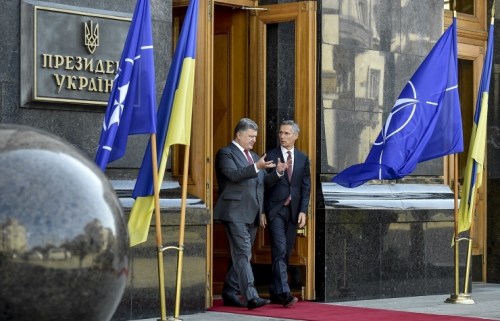
RT | September 22, 2015
Ukraine and NATO “are more than partners,” Ukraine’s president said after a number of agreements were signed with the alliance during a visit by NATO’s Secretary General. Moscow criticized the move, saying NATO’s advance on Russia’s border is unwelcome.
“De jure, we are not a NATO member, but de facto we are more than partners. Ukraine is an eastern outpost of Euro-Atlantic civilization,” Ukrainian president Petro Poroshenko wrote on his official Twitter account.
On Tuesday, Poroshenko announced that Ukraine and NATO had signed a joint declaration on strengthening defense and technical cooperation, as well as a roadmap for a partnership between Ukraine and NATO on strategic communications. The program is aimed at supporting Kiev in counteracting “Russian propaganda” and informing the society on what’s happening in Ukraine, Interfax reported.
The North-Atlantic alliance is also ready to discuss how it can boost Kiev’s military, particularly by potentially providing aid in restoring its naval forces, RIA Novosti reported, citing NATO’s Secretary General Jens Stoltenberg. The NATO official also said that the Alliance is providing advisors to Ukraine’s defense ministry and army general staff, according to TASS.
Having chosen its “path in to the EU and NATO,” Ukraine is ready to reform its military and law enforcement forces, the Secretary of Ukraine’s National Security and Defense Council, Aleksandr Turchinov, said after his meeting with NATO’s Secretary General. Meanwhile, Ukraine’s Foreign Minister, Pavel Klimkin, announced that he and Stoltenberg had signed a bilateral document on the creation of a NATO diplomatic mission in Ukraine. NATO’s two existing offices in Ukraine have been united, and their functions and powers extended.
Partnership with NATO will also provide Kiev with the opportunity to get essential weapons, Poroshenko said on Tuesday.
“We are now exchanging information. We are partners, and it gives us an opportunity to receive protective weapons – not offensive, but defensive weapons, such as drones and electronic equipment,” the Ukrainian leader said at a joint briefing with Stoltenberg.
The Kremlin has warned that NATO’s further advance towards Russia’s borders will entail counter measures.
“We must not forget that NATO is an organization that has been created during the time of confrontation and for confrontation, that’s why it cannot change its nature,” the Russian president’s spokesman, Dmitry Peskov, told reporters in Moscow, as cited by Sputnik.
“That is why any advancement by such an organization toward our borders will force us to take adequate counter-measures to safeguard own security, our national security,” Peskov said.
He added that Moscow regrets Kiev’s plans to pursue NATO membership.
When addressing Stoltenberg on Tuesday, Poroshenko claimed that more than 60 percent of Ukrainians support the plans to join NATO, while two years ago only 16 percent supported the move. A day earlier, at another joint meeting, the Ukrainian leader stated that his country was not ready to become a NATO member, nor was the Alliance ready to accept it. Ukraine would need to change in order to achieve its goal of NATO membership, Poroshenko noted, while promising more reforms.
Petro Poroshenko signed a decree changing Ukraine’s non-aligned status last year, saying that his country would make the decision on whether to join NATO in the next five or six years. He promised to put the question up for a national referendum. NATO’s previous secretary general, Anders Fogh Rasmussen, said the process of reaching the criteria required to become an alliance member could take Ukraine a long time. Countries with outstanding territorial disputes cannot become NATO members. However, Ukraine claims rights to Crimea, which became a part of Russia following a referendum on the peninsula in 2014.
UN Condemns Ukrainian Government Cover-Ups
By Eric Zuesse | Aletho News | September 21, 2015
On September 18th, the UN’s Office of the High Commissioner for Human Rights headlined “Statement of the Special Rapporteur on extrajudicial, summary or arbitrary executions, Christof Heyns Ukraine: Lives lost in an accountability vacuum,” and condemned there the current Ukrainian Government in strong language, regarding not only the coup which had brought them to power in February 2014, but regarding also the massacre of the people who on 2 May 2014 had been peacefully demonstrating in Odessa against the coup. Specifically, the ongoing cover-ups by the Ukrainian Government concerning both of these matters were condemned by him.
The High Commissioner, Christof Heyns, said:
By allowing almost immediate access of the scene to ‘pro-unity’ protesters, members of the public or to municipal authorities, investigators lost a large proportion of potentially valuable forensic evidence. Meanwhile I am worried by indications that the Government has significantly reduced the size of the team investigating these events in the past year, before it has had an opportunity to report. The slow progress of the investigation and the lack of transparency with which it is being conducted have contributed to a great deal of public dissatisfaction and provided a fertile environment for rumour and misinformation. It is disconcerting that the Special Unit of the Ministry of Internal Affairs that investigates the 2 May events cancelled our appointment in Odessa at short notice, without any explanation.
I am further concerned that administrative and personal impediments seem to have been imposed to prevent or at least discourage the families of those who died from obtaining the status of suffering or affected persons before the Courts. Meanwhile I am greatly alarmed by reports of the extent to which authorities are tolerating both verbal and physical intimidation both of families attending court proceedings and of the judges of those cases, not only outside the court building, but also inside it and in the court room itself.
Here is an excellent video of the coup.
Here is a brief video on the massacre, on 2 May 2014, in Odessa’s Trade Unions Building.
Also of interest might be the following articles:
“Ukraine’s President Poroshenko Admits Overthrow of Yanukovych Was a Coup”
The Obama Administration has a strong record of installing anti-Russian governments — not only in Ukraine. Obama enabled the 28 June 2009 coup that overthrew Honduras’s progressive democratically elected President Manuel Zelaya to succeed, and enabled the coup’s junta to stay in power though no other head-of-state supported it; and the great investigative journalist Wayne Madsen reports on 21 September 2015 that there is strong reason to believe that the Obama Administration was actually behind the recent coup in Burkino Faso. Furthermore, the Obama Administration has been involved in unsuccessful coup-plots in Venezuela and Ecuador, according to a 12 March 2015 study by the Council On Hemispheric Affairs. In addition, the Obama Administration bombed Libya and removed Muammar Gaddafi from power there, and is bombing Syria in order to remove Bashar al-Assad from power there. The Obama Administration also has continued the Bush Administration’s policy of “unsigning” to the legal authority of the International Criminal Court, but doesn’t use the same rabid rhetoric against the Court that Obama’s predecessor did. The Obama Administration has also taken a strong anti-Russian position on virtually everything at the United Nations, such as by voting against a Russian-supported resolution condemning fascism in all its forms (including Holocaust-denial), which resolution passed overwhelmingly and was opposed by only three governments: U.S., Ukraine, and Canada.
Obama is highly critical of Russia, and of its leader, Vladimir Putin. The U.S. White House in February issued its National Security Strategy 2015, and it used the pejorative term “aggression” 18 times, 17 of which referred to Russia.
So, the U.N. High Commissioner’s statement condemning the Ukrainian Government’s cover-ups might be viewed in Washington as simply the UN’s taking the pro-Russian side. Psychopaths could view it that way. But other people will (like the UN) oppose cover-ups — and oppose Obama’s international policies (such as those described). Indeed, the only U.S. President who has been as hostile toward the UN as Obama is, was his immediate predecessor, whose policies Obama publicly opposed when running for the U.S. Presidency in 2008. And, then, in his 2012 re-election campaign, Obama vocally criticized his opponent Mitt Romney’s statement that Russia “is without question our number one geopolitical foe.” But, now, Obama cites Russia 17 out of 18 times for “aggression.”
Geir Lundestad, who was the Director of the Nobel Institute, and Secretary of the Peace Prize Committee, at the time when Barack Obama won the Nobel Peace Prize in 2009, recently said that “giving Obama a helping hand” was the reason why the Committee awarded Obama the Prize, but that doing this “did not achieve what the committee had hoped for.” However, he denied “that it was a mistake to give Obama the Peace Prize.” Even all of those coups and massacres don’t mean it was a mistake. Maybe it wasn’t much different from “what the committee had hoped for.” After all: Norway, and its Nobel Institute, is a U.S. ally. Unlike the United Nations, it only pretends to represent the interests of all people everywhere.
Investigative historian Eric Zuesse is the author, most recently, of They’re Not Even Close: The Democratic vs. Republican Economic Records, 1910-2010, and of CHRIST’S VENTRILOQUISTS: The Event that Created Christianity.
Featured Video
Dan Dicks with James Corbett on Solutions Watch
or go to
Aletho News Archives – Video-Images
From the Archives
MMR (Measles, Mumps and Rubella) – Vaccine Risk Statement
MMR Vaccine (Measles, Mumps, and Rubella) Is It Safer Than Measles, Mumps and Rubella?
Physicians for Informed Consent | December 2024
… It has not been proven that the MMR vaccine is safer than measles, mumps, and rubella. The vaccine package insert raises questions about safety testing for cancer, genetic mutations, and impaired fertility. Although VAERS tracks some adverse events, it is too inaccurate to measure against the risk of measles, mumps, and rubella. Clinical trials do not have the ability to detect less common adverse reactions, and epidemiological studies are limited by the effects of chance and possible confounders. Safety studies of the MMR vaccine are particularly lacking in statistical power. A review of more than 60 MMR vaccine studies conducted for the Cochrane Library states, “The design and reporting of safety outcomes in MMR vaccine studies, both pre- and post-marketing, are largely inadequate.”19 Because permanent sequelae (aftereffects) from measles, mumps, and rubella are so rare (especially in children with normal levels of vitamin A and infected after birth),6,15-17 the level of accuracy of the research studies available is insufficient to rule out the possibility that the MMR vaccine causes greater death or permanent disability than measles, mumps, and rubella. – Read full article
Blog Roll
 Aletho News
- Moscow issues warning to NATO over Russian exclave
- Yes, the Iran war has destroyed Trump’s presidency
- The fallacy of US delusions about Iran’s economic collapse
- Hezbollah denies Syria cell link, warns of Israeli plan to sow discord
- The legacy of US sanctions, war, and occupation in Iraq
- Iraqi resistance group rejects disarmament, vows to maintain support for Lebanon
- Sheikh al-Asadi warns of Iraqi government compliance with US demands
- How to MAKE THE CONSPIRATORS PAY for their crimes! Dan Dicks with James Corbett on Solutions Watch
- There’s a drought in academia: A drought in honest research on the subject of drought and other weather extremes
- Department of War Awards $20.7 Billion Contract to Raytheon for Air-to-Air Missiles
- If Americans Knew
- An error has occurred; the feed is probably down. Try again later.
- No Tricks Zone
- Green Energy Debacle: German Expert Professor Fritz Vahrenholt Warns Of Severe Economic And Social Consequences
- Two More Paleo Reconstructions Affirm Meters-Higher Sea Levels Across Ireland, Brazil 7000-6000 Years Ago
- New Study: Earth And Venus Surface Warmth Largely Explained By Convection And Lapse Rate, Not CO2 Or Radiation
- 2025 Nature Paper Claiming Worsening Global Drought Gets RETRACTED …Heavily Flawed
- New Study: ‘Global Drought Shows No Detectable Recent Acceleration Under Climate Warming’
- Economic Masterminds: German Socialists Suggest Taxing Productivity Gains Stemming From Using AI
- The South China Sea Has Not Been Cooperating With The Climate Change Narrative
- Energy Crisis: Germany Enters Heating Season With Historically Low Gas Reserve Fill Levels
- New Study: The Antarctic Ice Sheet Gained Mass From 2020-2024 Due To Staggering Snow And Ice Accumulation
- Study: Ocean Heating Rates From Thousands Of Years Ago ‘Dwarf’ Modern Ocean Heating Rates

