Ukraine peace deal: Ceasefire starting February 15, removal of heavy weapons
RT | February 12, 2015
An agreement has been brokered in Minsk to stop hostilities in Ukraine from Sunday. The deal was reached after marathon talks between the leaders of France, Germany, Russia and Ukraine, and signed by the Ukrainian rebels.
“I believe we agreed on a big deal. We agreed to a ceasefire starting at 00:00 on February 15,” Russian President Vladimir Putin told the media after the talks were finished.
“The main thing achieved is that from Saturday into Sunday there should be declared – without any conditions at all – a general ceasefire,” Ukrainian President Petro Poroshenko told journalists in a separate statement.
Pullout compromise
A compromise decision was taken over the disengagement line, which was the biggest stumbling block in the negotiation. According to the document, Kiev’s troops would pull back heavy weapons from the current frontline. The rebels would pull back from the line as it existed in September, when the previous ceasefire agreement was signed.
The security zone separating the warring parties must be at least 50km wide for artillery over 100mm caliber, 70km for regular multiple rocket launchers and 100km for heavier weapons with a longer range, such as Tochka-U ballistic missiles, the document states.
The weapons pullout must start on Sunday and be completed in no longer than 14 days. The OSCE is charged with implementing the ceasefire on the ground and will use its drone fleet and monitors to verify that both parties are sticking to the deal.
The ceasefire deal provides for withdrawal of all “foreign troops, heavy weapons and mercenaries” from Ukraine under an OSCE monitoring. “Illegal armed groups” would be disarmed, but local authorities in the future would be allowed to have legal militia units.
The agreement involves exchange of all prisoners, which is to be completed within 19 days. A general amnesty for the rebels would be declared by Kiev.
The national government’s control over the borders between Donetsk and Lugansk Regions would be fully restored a day after municipal elections, which would be held in the regions as part of a profound constitutional reform.
Decentralization reform
The agreement requires a political reform in Ukraine to ensure decentralization and a special status for its rebel provinces. It requires Ukraine to adopt legislation which would provide permanent privileges to the Lugansk and Donetsk Regions, currently self-declared republics, by the end of 2015.
The legislation would include the right for language self-determination and trans-border ties with Russia, as well as the authority of the local governments to appoint local prosecutors and judges, the document states.
Humanitarian and economic issues are also mentioned in the deal. Kiev would restore economic ties and social payments, which it cut in rebel-held areas, the document says. An international monitoring mechanism may be established for these payments.
During the transition period an internationally-monitored mechanism for humanitarian aid to the regions affected by the war would be implemented, the document sates.
Direct talks needed
Putin said that Kiev’s unwillingness to hold direct talks with the self-proclaimed Donetsk and Lugansk People’s Republics was among the reasons it took so much time to reach an agreement.
“They may be unrecognized, but we have to deal with real life here, and if everyone wants to agree and have sustainable relations, direct contacts are needed,” Putin said.
He added that the ‘Normandy Four’ expect the parties involved in the conflict to show restraint even in the days before the ceasefire takes effect.
The terms of the ceasefire are spelled out in a document signed by members of the so-called contact group, which includes representatives from the rebel forces, Kiev, Moscow and the Organization for Cooperation and Security in Europe, Putin said.
The members of the ‘Normandy Four’ – Putin, Ukrainian President Petro Poroshenko, German Chancellor Angela Merkel and French President Francois Hollande – supported a joint declaration describing the results of their work.
The declaration was not meant to be signed by the leaders, Germany FM Frank-Walter Steinmeier said.
If broken, no new memorandum possible
Head of the Donetsk People’s Republic Aleksandr Zakharchenko, who signed the Minsk document, said it required additional consultation and warned that “if these terms are broken, there will be no new meetings or memoranda.”
He added that he and Igor Plotnitsky, the head of Lugansk People’s Republic, agreed to sign the document “due to guarantees from the president of Russia, chancellor of Germany and president of France,” with the hope that it would allow their people to “achieve peaceful development.”
The new Minsk accord gives hope for de-escalation of the Ukrainian conflict, although it would require a major effort to build trust between the parties involved. The previous deal collapsed as neither Kiev nor the rebels implemented it fully, which means the threat of renewed hostilities in Ukraine continue to loom.
READ MORE:
German sociologists on Crimea’s choice
By Konstantin KOSARETSKY | Oriental Review | February 10, 2015
A few days ago an interesting study, “The Socio-Political Sentiments in Crimea,” was released by the Ukrainian branch of GfK, the well-known German social research organization, as part of the Free Crimea initiative. Intriguingly, the primary objectives of this project, launched with the support of the governmental Canada Fund for Local Initiatives, were to “debunk aggressive Russian propaganda” and to “reintegrate Crimea into Ukraine.” Thus the researchers can hardly be suspected of being Russian sympathizers. So let’s take a look at the results.
The attitudes of Crimeans were studied in January 2015. This representative sample included 800 respondents living on the peninsula, from all age and social categories. The poll had an error margin of 3.5%.
In answer to the most important question: “Do you endorse Russia’s annexation of Crimea?” 82% of the respondents answered “yes, definitely,” and another 11% – “yes, for the most part.” Only 2% gave an unambiguously negative response, and another 2% offered a relatively negative assessment. Three percent did not specify their position.
We feel that this study fully validates the results of the referendum on reunification with Russia that was held on March 16, 2014. At that time 83% of Crimeans went to the polling stations and almost 97% expressed support for reunification.
Ukrainians continue to question whether this was a credible outcome, but it is now backed up by the data obtained by the Germans. The 82% of the respondents who expressed their full confidence in the results of the Russian election make up the core of the electorate who turned up at the ballot boxes on March 16, 2014.
These figures are also relevant in terms of another important question. The former chairman of the Mejlis of the Crimean Tatars, Mustafa Dzhemilev, has repeatedly stated that all Tatars on the peninsula are opposed to reunification with Russia. Dzhemilev’s statements have been widely quoted by the media, which present them as entirely authoritative and undisputed.
But let’s think about that – Crimean Tatars make up 12% of the Crimean population, yet only 4% of those polled conveyed disapproval of Crimea’s reunification with Russia. And that 4% very likely includes not only Tatars, but also Ukrainians and citizens of other ethnicities. There’s an inconsistency here. Of course further study is needed on this issue, but the results obtained by GFK cast doubt on whether Mustafa Dzhemilev or the entire Mejlis of the Crimean Tatars is an accurate barometer of the feelings of the Crimean Tatar community.
Those few respondents who disapproved reunification were then asked “Why do you fully or mostly disapprove annexation?” Only 20% of them (i.e., less than 1% of the total sample) claimed that they preferred to live in the state of Ukraine. The most common response, offered by 55% of those who opposed reunification, was “Annexations was not fully legitimate, it should be brought into accord with the international law.” Which means that, in theory, they do not object to the idea of living in Russia, but rather question the legitimacy of the transition.

No doubt it would be a good idea to hold such a referendum under the auspices of international legislation and in accordance with Ukrainian law. But would laws ever be passed that would grant Ukrainian regions the right to secede? Back in the totalitarian Soviet Union, Ukraine exercised its right to a referendum without a single shot being fired, while in “democratic Ukraine,” separatists are either burned alive as in Odessa, or are shot along with the elderly and children as is happening in the Donbass.
In answer to a question about their financial circumstances, 21% of Crimeans said that in the last year their position had “improved significantly,” while another 30% claimed it had “somewhat improved.” Only 13% of that population has experienced a setback, to a greater or lesser extent. This suggests that, despite EU sanctions on the peninsula’s economy, and despite Ukraine’s partial blockade on communication from Crimea, the reunification with Russia has provided most Crimeans with material gains. But even among those who have not reaped those sorts of benefits, there are few signs of nostalgia for their old Ukrainian citizenship: although 13% of citizens have seen their financial well-being decline, only 4% disapprove of the reunification with Russia. These figures suggest that economic sanctions are an ineffective means of persuading the residents of the Crimea to view Ukraine more favorably.
The results of the survey indicate that 28% of the residents of the peninsula regularly watch Ukrainian TV, and another 20% regularly consult Ukrainian news websites. This proves that no steps have been taken in Crimea to restrict access to Ukrainian sources of information, such as Ukraine has done in relation to Russian media.
And now the moment of truth: “What is your opinion of what is being written by the Ukrainian media about Crimea?” Who could be a more objective judge on this issue than the residents of the peninsula themselves? Who else but they – who have been fated to experience all the pros and cons of both Ukrainian and Russian citizenship – could better evaluate the accuracy of the information being published? Perhaps no one.
However, only 1% of those surveyed reported that the Ukrainian media “provides entirely truthful information” and 4% said it was “more often truthful than deceitful.” But 45% of respondents see “completely untrue information” on Ukrainian TV, and another 35% claim those broadcasts are “more often deceitful than truthful.” The rest either do not watch Ukrainian news programs or do not pay attention to information in those programs about Crimea.

This is the verdict on the contemporary Ukrainian press, as handed down by an impartial panel of eight hundred jurors.
But if those who shape the media coverage in Ukraine today are so biased in regard to Crimea, how can we expect them to report objectively on other critical problems associated with this country? Can we trust Kiev’s official stance on the tragedy of Malaysia Airlines Flight 17? Or on the causes of the humanitarian crisis in the Donbass? Or on the presence of Russian troops inside Ukraine? Or on the human fatalities in Odessa or the victims of the “Heavenly Hundred”?
GfK’s study demands a clear answer to these questions.
Konstantin Kosaretsky is the Ukrainian freelance journalist and writer.
Obama the War President
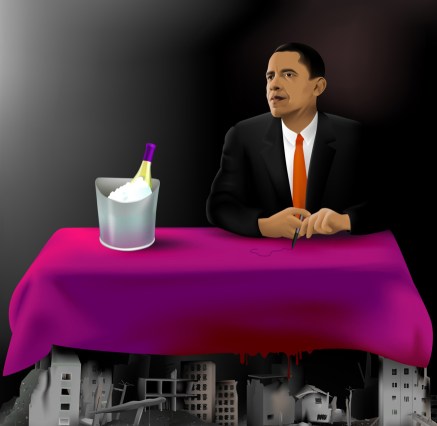
By Dave Lindorff | This Can’t Be Happening! | February 6, 2015
The Nobel Peace Laureate President Barack Obama, the guy who once campaigned claiming one US war — the one against Iraq — was a “bad” one, and the other — against Afghanistan — was a “good” one, turns out to be a man who, once anointed commander-in-chief, can’t seem to find a war he doesn’t consider to be a “good” idea.
Obama turned out, on taking office, to have a hard time saying good-bye to the occupation of Iraq, only leaving when he was forced out by an Iraqi government that refused to continue giving US forces legal immunity for killing Iraqi civilians. In Afghanistan, he decided to copy the same “surge” — a massive increase in targeted assassinations and violence — that he had once condemned in Iraq. Then he stepped up drone-launched rocket attacks and bombings in seven other countries.
More recently he has begun an air war against Syria (okay, he says it’s against the so-called Islamic State, but the whole world, with the exception of a lot of ill-informed US citizens, knows it’s ultimately against the Syrian government), and now his Secretary of Defense (sic) Ashton Carter and his Secretary of State John Kerry are pushing for sending heavy arms and, inevitably, US “advisors” to Ukraine to escalate US involvement in the civil war there. What makes that latest war particularly dangerous is that all the while, Peace Laureate Obama makes it clear that the “enemy” is Russian President Vladimir Putin and the Russian military.
Never mind that it is the US that originally orchestrated and encouraged the fascist coup that overthrew the elected government of Ukraine, setting in motion a huge pogrom against ethnic Russians in the east of that country and provoking the current armed conflict, and never mind that Russian concern about the Ukraine stems from a decades long history of the US pushing NATO ever closer to Russia’s western border, with Ukraine kind of the last straw.
Anyone looking objectively at the warmaking and war-promotion of this administration would have to conclude that President Obama is one of the most bellicose Chief Executives in the history of the United States.
If you don’t believe me, just look at the US military budget President Obama has proposed for FY2016. At $585.3 billion, it would if approved by Congress represent an increase in spending of $24.9 billion, or about 4%, over the 2015 budget, and that is despite a decline in what, since the Bush/Cheney years, has euphemistically been called Overseas Contingency Operations spending, or spending on actual wars. The proposed OCO budget for 2016 in this “peace” president’s budget is “just” $50.9 billion, down about $13.3 billion from 2015 thanks to what the president, in one whopper offered during his State of the Union address, called the “end of combat” in Afghanistan (that war is actually continuing, with some 12,000 US troops expected to remain stationed in that country indefinitely).
The thing about OCO funding is that it is really not predictive of anything. It could soar way beyond that $50.9-billion level, for example, in a flash if the US follows through and escalates the war in Ukraine — especially if Russian troops are drawn directly into that conflict and the US responds by upping its own involvement.
In fact, the OCO part of the budget has been used by the Pentagon and the administration over the last few years to get around the constraints of an ongoing Congressional “sequestration” requirement that cuts so-called discretionary spending, both military and non-military. Congress, ever mindful and solicitous of the country’s imperial ambitions, provided an exemption for ongoing military conflicts, and the Pentagon has since been deceptively slipping all kinds of other spending under the OCO heading now ever since the loophole was created.
But the Obama administration’s warmongering stance, in terms of the budget, isn’t told just by looking at the official Pentagon budget. There is much more spending that is really all about war. Not included in that $585.3 billion figure is $70.2 billion in discretionary spending for Veterans Affairs (that’s in addition to $90 billion in mandated spending). This is money to pay for the damages of the nation’s warmaking — the injured or ailing veterans who served or are now serving in the nation’s armed forces. Then there’s the intelligence agencies’ budgets — the CIA, the NSA, the FBI, the DIA, the DEA, the ATF and Homeland Security, etc. — most of which is really part of part of the war machine, thanks to the so-called “War on Terror,” which has re-defined the US itself as part of a global war zone. While much of that intelligence budget is concealed from the public on the spurious grounds of “national security,” it is known to exceed $100 billion a year. Add to that the $24-billion share of the Department of Energy budget that is weapons and war related, and you have a real military budget for 2016 of $707 billion. That’s out of a $1.2 trillion total discretionary spending budget (the rest of the $4 trillion proposed 2016 budget is called mandatory because it is debt repayment or spending on mandated things like Social Security and Medicare, which are funded by dedicated payroll taxes, not income taxes and other federal taxes, and which are promised to recipients like retirees and the sick.
What this means is that when you look closely, some 59% of the entire discretionary budget of the federal government – things that are funded each year by money that Congress has to appropriate — is being spent on the military. Given that the total amount of taxes collected by the federal government (income, corporate profits, exist, inheritance, etc.) also comes in at about $1.2 trillion, we’re saying that taxpayers this coming year will be pouring not just $707 billion, but 59 cents of every tax dollar in to war, planning for war, or paying for war. But it’s actually worse than that because actually the US government operates at a deficit, and doesn’t ever finance its wars on a pay-as-you-go basis. Instead, it borrows the money and then pays interest on that debt. Every year that interest comes to about $240 billion, and roughly half that is for borrowing to pay for past wars and past and current military spending. So add $120 billion to the $707 total and it become $827 billion.
In other words, it’s really 68.9% of every tax dollar you pay this April 15 that’s going to pay for America’s wars and its obsession with militarism.
No wonder our schools and universities, our parks, our roads, our once-vaunted global scientific leadership, our environment, our health and safety, our family budgets and even our life expectancy, have been going to hell! The only thing that’s really getting funded in this country is war.
By the way, the reason you may not have realized how much you are paying for war out of your taxes is that the government, and the corporate media, carefully avoid letting you know. They do this by sleight of hand. You see, they never really break out just the “discretionary” budget, or point out the parts of the budget that are outside the Pentagon but that are still really military-related, like spending on nuclear weapons and weapons development, nuclear research and cleanup, decommissioning of nuclear processing plants, and of course veterans affairs and benefits. They also do it by lumping the huge outlays for Social Security benefits and Medicare into the overall spending budget, though actually those benefits are funded not by income taxes but by a Trust fund of some $1.7 trillion that was created over the years by specially-dedicated payroll taxes separately paid by workers and their employers over the working life of each person. Adding those items into the national budget, while leaving out things like spending on veterans, nukes and war debt, appears to reduce military spending to a much less troubling 6.8% of the budget.
But it’s a fraud.
If we want to revitalize the US, the only way to do it is to end militarism and war, and to generously fund human needs.
To do that, we need a real peace president and a peace congress, not the Nobel Laureate warmonger we have now in the White House, and the bi-partisan war chorus we have in the Congress.
Le Pen says Washington attempting to start ‘war in Europe’
RT | February 9, 2015
The leader of France’s rightwing Front National (FN), Marine Le Pen, has called Brussels “American lackeys” over the EU’s Ukraine policy. She further accused Washington of attempting to start a “war in Europe” and expand NATO towards Russia’s borders.
“European capitals do not have the wisdom to refuse to be dependent on US positions on Ukraine,” Le Pen told French journalists on Sunday.
“Regarding Ukraine, we behave like American lackeys,” she said, before warning that “the aim of the Americans is to start a war in Europe to push NATO to the Russian border.”
She went on to accuse European leaders of turning a blind eye to the Ukrainian government’s “bombing of civilians,” adding that both those in Crimea and Eastern Ukraine believed the country should be federalized.
Le Pen has regularly criticized the EU for its policy on Ukraine and its alleged lack of independence from Washington.
In September, she told Le Monde that the ongoing crisis in Ukraine is “all the European Union’s fault,” saying Brussels had “blackmailed the country to choose between Europe and Russia.”
In June, she similarly told RT’s Sophie Shevardnadze that there were “no independent states left in Europe,” saying many of their foreign policy mistakes in recent times had been made “under Washington’s influence.”
Her words echoed statements by former French Prime minister Francois Fillon, who told the public broadcaster France 5 on Sunday that the United States was attempting to “unleash a war in Europe, which would end in catastrophe.” He added that once a war broke out, the US would attempt to distance itself from it.
“Total war caused [by the] Ukrainian conflict is absolutely unacceptable. And really there is no reason for it,” he said.
Fillon accused the US of suffering from “blindness” and an oversimplified approach to reality, which saw them constantly attempting to “solve all problems by force.”
He further said Washington was always attempting to force others to join its camp, a mistaken approach given that a country like Ukraine has ties to both Europe and Russia.
“The Americans have made one mistake after another and today they have simply been discredited,” said Fillon.
He added that attempting to punish Russia with sanctions was like trying to intimidate a bear with a pin prick. He further commended recent efforts by French President Francois Hollande and German Chancellor Angela Merkel to open a dialogue with Moscow.
“The West is trying to imagine today Russia as a threat to the whole world, while deliberately forgetting that Russia is a large and truly a great country, not to mention a nuclear power,” he said.
“Humiliating Russia is simply unacceptable.”
Also on Saturday, former French President Nicolas Sarkozy said that Europe was part of “a common civilization with Russia,” saying they needed to avoid conflict on the continent.
“The interests of the Americans with the Russians are not the interests of Europe and Russia,” he said, adding that “we do not want the revival of a Cold War between Europe and Russia.”
READ MORE:
Crisis in Ukraine is ‘all EU’s fault’ – France’s Marine Le Pen
EU lost its foreign policy sovereignty to US – Marine Le Pen to RT
EU lost billions over Russia bans: Spain
Press TV – February 9, 2015
Spain has warned that the European Union has lost billions of euros as a result of the sanctions the bloc has imposed against Russia over Moscow’s alleged role in Ukraine’s crisis.
“Sanctions have had a heavy cost for us all,” Spanish Foreign Minister Jose Manuel Garcia-Margallo said in Brussels on Monday.
Spain’s top diplomat added that “the EU has so far lost 21 billion euros ($23.7 billion). In Spain we have been badly hit in terms of agriculture and tourism.”
The figure represented the first account of the monetary loss caused to the EU due to the tough economic sanctions it has been progressively imposing on Russia since July 2014.
On Sunday, nearly 200 farmers went on strike in Spain and abandoned their products in the middle of a road in Catalonia to protest against Western-imposed sanctions against Russia. The farmers dumped their citrus fruits on the road to express their anger at the European Union for its ban on fruit exports to Russia.
The Western powers have been accusing Moscow of playing a role in the deadly crisis in eastern Ukraine, which erupted when Kiev launched military operations in April last year to silence pro-Russia protests. The Kremlin denies the accusation.
Russia has, in return, imposed a full year-long ban of European Union, US, Australian, Canadian, and Norwegian food exports to the country.
Amid fear on the part of some EU members for their trade ties with Moscow, the bloc has agreed to postpone new sanctions against Russia to give time to see if a four-way Ukraine peace summit on February 11 makes progress.
French Foreign Minister Laurent Fabius said, “The principle of the sanctions will be kept, but their implementation will depend on the situation on the ground.”
He was referring to a January 29 decision by the foreign ministers of the 28-nation union to add 19 people, including five Russians, to a list of those facing travel bans and asset freezes after an upsurge in fighting in eastern Ukraine.
“We will assess the situation again next Monday,” said the French top diplomat.
Huge explosion at Donetsk chemical plant, Kiev blames ‘dropped cigarette butt’
RT | February 9, 2015
Windows were shattered and homes shaken in Donetsk after a huge blast rocked the vicinity of a city chemical plant which was under rebel control. Kiev and the militants accuse each other of causing the blast.
The powerful explosion took place at 10:50pm local time on Sunday. Local militia reported that a military chemical plant DKZHI was the target of Kiev’s artillery shelling.
Witnesses saw the sky lit up by the explosion, some nearby living residents had their windows broken by the blast’s shockwave and many others felt the ground shake, RIA Novosti reported. Even those living in nearby towns said they felt the tremor.
“The center of the blast was near DKZHI,” co-chairman of the anti-Kiev People’s Front Konstantin Dolgov said on his Facebook page. The factory is known for producing chemical products used for industrial explosives, ammunition and equipment artillery bombs. This is not the first time the plant has been the target of a Kiev attack. It was also hit with artillery rockets in September and November.
The militia forces would not immediately confirm if there were casualties, either among militiamen or civilians. But they said the fire, which started after the explosion, poses no threat of a chemical spill, which is a cause of great concern at the plant, as it handles toxic compounds in producing explosives.
“The fire has been contained. There is not threat of chemical spill… Most likely it was a high-caliber artillery shell,” said an official from the Donetsk People’s Republic.
The spokesman for Kiev’s Anti-Terrorist Operation said that rebels were at fault for the accident.
“This was caused by a dropped cigarette butt,” Andrey Lysenko told the media on Monday.
“Accidents often happen in factories where no one is responsible for fire safety. Well, it’s chaos, and they are barbarians.”
Not all pro-Kiev officials agreed.
The Ukrainian military deployed a Smerch (the BM-30 Tornado) multiple rocket system to shell the area in the city, Boris Filatov, former deputy head of the industrial Dnepropetrovsk Region and a member of the Ukrainian parliament (Verkhovna Rada), said on his Facebook page.
According to Filatov, the men who fired the missiles “do not know what they hit because they were shooting based on coordinates.”
Earlier, Ukrainian far-right politician and paramilitary commander Dmitry Yarosh, who is involved in the Kiev military action in southeastern Ukraine, confirmed on his Facebook page that the explosion was caused by Ukrainian artillery. … Full article
Munich conference: Russia ‘hate fest’ or split between Western allies?
RT | February 8, 2015
World leaders gathered in Germany to discuss international security on Saturday, with the meeting somewhat descending into ‘Russia-bashing’. But the West showed itself to be more divided than ever on Ukraine, with the EU and US drifting further apart.
The Americans led the harsh anti-Russian rhetoric at the conference, and once again, they did not exclude the possibility of lethal arms deliveries to Ukraine in the future.
Speaking to reporters, NATO’s top commander in Europe, General Philip Breedlove, said that although no troops would be sent to Ukraine, providing Kiev with lethal weapons and equipment was on the cards.
NATO Secretary General Jens Stoltenberg, British Conservative politician and former foreign secretary Malcom Rifkind, and US senator Lindsey Graham notably took a pronounced anti-Russian stance, blaming the Kremlin for the violence in Ukraine.
Moscow hit back, with Russian Foreign Minister Sergey Lavrov stressing in his Munich speech that it is the US and its European allies who have played the key destabilizing role in Ukraine, from helping to overthrow the democratically elected government to failing to condemn the new Kiev government for shelling the civilian population in the east with cluster bombs.
“Through every step, as the crisis has developed, our American colleagues and the EU under their influence have tried to escalate the situation,” Lavrov said, adding that the West has always been urging world governments to enter into dialogue with opposition groups or figures, even when it came to extremist groups such as the Taliban. However, in Ukraine it has bluntly been supporting every one of Kiev’s actions.
Lavrov then spoke with US Secretary of State John Kerry, warning him that Washington’s plans to supply Kiev with military equipment might have “unpredictable consequences”, including “disrupting the efforts to resolve the crisis in southeastern Ukraine,” according to a Facebook statement by the Russian Foreign Ministry. He stressed that Russia and the US agree that the only basis for any solution is a comprehensive national dialogue on constitutional reform in Ukraine.
Russia will not sacrifice its national interest, but is ready to “engage constructively” with the US, Lavrov stressed.
At the press conference, the Russian top diplomat was pelted with questions implying that Moscow is responsible for the ongoing conflict in Ukraine.
“It felt like orchestrated hate fest. Obviously these people live in a surreal world. The US try to change the balance of forces in eastern Europe and the EU join the band wagon,” Srdja Trifkovic, foreign affairs editor of the Chronicles magazine told RT, adding that “whenever a major power wants to change the status-quo, the result is a crisis.”
Despite the recent efforts to try and to stop the violence and find a peaceful way out of the Ukrainian conflict, with French and German leaders having taken an initiative to discuss a peace plan with Russia’s President Putin and Ukraine’s President Poroshenko, the actions of the West are still “profoundly self-righteous,” critics say.
“What I saw today in the press conference is a total unwillingness from the European, Western side to even take into consideration the arguments of the other side…the questions they pose are so selective, so predetermined by their self-righteousness – that is not the way you try to get peace,” former security consultant at the OSCE Lode Vanoost told RT, adding that the West is hypocritical to a level “so profound that [its behavior] is not a serious way to try to get peace.”
However, despite the overwhelmingly anti-Russian rhetoric coming from the West, there are increasingly numbers of politicians who are softening their stance.
Following the Friday meeting of President Putin, German Chancellor Angela Merkel and French President Francois Hollande in Moscow, which was said to be “constructive,” the French leader revealed that the discussion included the creation of a larger demilitarized zone between the Kiev and militia-controlled territories. He also called for “quite strong” autonomy for Ukraine’s eastern regions.
Former French president Nicolas Sarkozy said on Saturday that Paris does not want a new Cold War, considering that Russia and France having a long history of common interests and values. The former state leader also said that it was Crimea that had chosen to join Russia and it “cannot be blamed” for its choice. Previously, former Czech president, Vaclav Klaus, said that Crimea has “always” been a part of Russia.
While the European leaders have largely been united in their support for the Kiev government, only a few have agreed with the United States on supplying weapons to Ukraine. Instead, the German leader stressed that the crisis “cannot be resolved militarily” and that sending more arms can only worsen the conflict.
The issue of military aid to Ukraine is now considered to be the main subject causing the divide in the West, with many in Europe realizing that the potential threat of an escalating conflict on its territory exists.

German Foreign Minister Frank-Walter Steinmeier and Russian Foreign Minister Sergey Lavrov at the 51st Munich Security Conference on February 7, 2015. (RIA Novosti/Flickr MFA Russia)
Political analysts agree that hidden from the public eye, “there is definitely a big divide between the US and the EU on the whole issue of Ukraine,” Vanoost told RT. “It’s very difficult to know how the game will finish, because it’s not an open game, it’s behind the scenes,” Bruno Drweski, an analyst specializing in eastern Europe, said.
Sanctions against Russia have economically hit the EU itself, but have not affected the US. The conflict is also happening on the European continent, not in America, with the EU generally not eager to further escalate it.
“First of all, the European Union is directly involved if the conflict escalates – which is not the case for the United States. Secondly, in the EU they are realistic enough to know that the government in Kiev is very unstable, that they don’t even have full control of all parts of their own military,” Vanoost explained, while speaking about the Western split in regard of the Ukrainian crisis.
However, toning down rhetoric puts some in the firing line, too.
After Merkel said that Europe wants security alongside with Russia, rather against it, and reiterated Berlin’s stance that the Ukrainian conflict must be resolved peacefully, US senator Graham lashed out at the German leader for her refusal to send arms to Ukraine.
“She can’t see how arming people who are willing to fight and die for their freedom makes things better,” the US politician said, adding that the West cannot “turn [its] back on the struggling democracy.”
In an effort to silence voices against harsher anti-Russian measures, US Vice President Joe Biden has labeled those questioning sanctions against Moscow “inappropriate and annoying,” Der Spiegel reported, quoting the participants of the Brussels meeting. The US official called on European countries to show unity when it comes to sanctions against Russia. Biden even reportedly added that critics of the policy should be aware that they also benefited from the current low price of oil.
“The Americans want to run this show, and they have no interest in stopping the crisis in Ukraine because it is really driving a wedge between the Europeans and Russia. And to their [the US’] mind, it is only pushing Europe ever so firmly back into the NATO fold,” Trifkovic told RT.
Meanwhile, Lavrov said Moscow is ready to guarantee agreements between the warring sides if a peaceful solution to the crisis is found, which would satisfy both Kiev and the eastern Ukrainian regions.
Quoting the “aggression” against the federal republic of Yugoslavia, the current crisis has been named “an ongoing assault against the Russian Federation” by the former deputy head of OSCE, Willy Wimmer. Calling for a hastier end to the conflict, which “is the best for all of us,” the ex official of the European security and cooperation organization said that “it’s better to have Polish apples in Russian stores than US tanks at the Russian border.”
READ MORE:
NATO top commander in Europe says ‘military option’ possible in Ukraine
Lavrov: US escalated Ukraine crisis at every stage, blamed Russia
Hopes for breakthrough: Moscow talks on Ukraine ‘constructive,’ joint doc ‘possible’
Hollande: If lasting Ukraine peace not found ‘scenario is war’
Sarkozy: Crimea cannot be blamed for joining Russia
Europe reticent about supplying Ukraine with weapons & money
Biden says Europeans questioning Russia sanctions ‘inappropriate, annoying’ – Spiegel
‘Official figures not credible’: German intel say Ukraine death toll 10 times higher
RT | February 8, 2015

Burnt military machinery in Uglegorsk. Background: a DPR bus column heading to Debaltsevo for evacuation of local residents from the combat zone. (RIA Novosti)
The German intelligence service estimates the real losses in the Ukrainian civil war at 50,000 dead (civilians and servicemen), which is nearly 10 times higher than reported by the Kiev authorities, German media report.
The information comes from a source in German intelligence, who spoke to the Frankfurter Allgemeine Sonntagszeitung (FAZ) newspaper.
“Germany’s special services estimate the probable number of deceased Ukrainian servicemen and civilians at up to 50,000 people. This figure is about 10 times higher than official data. Official figures are clearly too low and not credible,” the newspaper reported on Sunday, citing its source.
Just one day before the report was published, the Ukrainian president gave completely different numbers to the international community.
“The death toll for the Ukrainian soldiers defending land from the aggressor is now 1,432. Thousands of people, 5,638, have been killed since April [2014] and every single day the number of victims among the civilians is rising,” Petro Poroshenko said in his address to the 51st Munich Security Conference on Saturday.
The Ukrainian army is reported to be suffering its heaviest losses since the beginning of the conflict last spring. According to the Donetsk militia representative, Eduard Basurin, the Ukrainian army has lost 1,569 servicemen in just three weeks since restarting the offensive.
The situation on the battlefield is dire for the Ukrainian forces. Some 8,000 Ukrainian troops are believed to be surrounded near the village of Debaltsevo in Donbass. Militia units cut off the only road linking this pocket of land to Kiev-controlled territory.
Taking into account these heavy losses, Ukraine is set to call up as many military age Ukrainians as possible. The national military draft for 2015 is expected to see 100,000 people joining the army in three stages throughout the year.
The recruitment effort, coming amid intensified fighting in eastern Ukraine, is being met by a distinct lack of enthusiasm by potential soldiers.
READ MORE:
Potential conscripts evade draft, flee country amid escalation in E. Ukraine
Thousands of Ukrainian troops thought to be trapped in Donbass
The Corporate Takeover of Ukrainian Agriculture
By Frédéric Mousseau | IPS | January 27, 2015
OAKLAND, CA – At the same time as the United States, Canada and the European Union announced a set of new sanctions against Russia in mid-December last year, Ukraine received 350 million dollars in U.S. military aid, coming on top of a one billion dollar aid package approved by the U.S. Congress in March 2014.
Western governments’ further involvement in the Ukraine conflict signals their confidence in the cabinet appointed by the new government earlier in December 2014. This new government is unique given that three of its most important ministries were granted to foreign-born individuals who received Ukrainian citizenship just hours before their appointment.
The Ministry of Finance went to Natalie Jaresko, a U.S.-born and educated businesswoman who has been working in Ukraine since the mid-1990s, overseeing a private equity fund established by the U.S. government to invest in the country. Jaresko is also the CEO of Horizon Capital, an investment firm that administers various Western investments in the country.
As unusual as it may seem, this appointment is consistent with what looks more like a takeover of the Ukrainian economy by Western interests. In two reports – The Corporate Takeover of Ukrainian Agriculture and Walking on the West Side: The World Bank and the IMF in the Ukraine Conflict – the Oakland Institute has documented this takeover, particularly in the agricultural sector.
A major factor in the crisis that led to deadly protests and eventually to president Viktor Yanukovych’s removal from office in February 2014 was his rejection of a European Union (EU) Association agreement aimed at expanding trade and integrating Ukraine with the EU – an agreement that was tied to a 17 billion dollar loan from the International Monetary Fund (IMF).
After the president’s departure and the installation of a pro-Western government, the IMF initiated a reform programme that was a condition of its loan with the goal of increasing private investment in the country.
The package of measures includes reforming the public provision of water and energy, and, more important, attempts to address what the World Bank identified as the “structural roots” of the current economic crisis in Ukraine, notably the high cost of doing business in the country.
The Ukrainian agricultural sector has been a prime target for foreign private investment and is logically seen by the IMF and World Bank as a priority sector for reform. Both institutions praise the new government’s readiness to follow their advice.
For example, the foreign-driven agricultural reform roadmap provided to Ukraine includes facilitating the acquisition of agricultural land, cutting food and plant regulations and controls, and reducing corporate taxes and custom duties.
The stakes around Ukraine’s vast agricultural sector – the world’s third largest exporter of corn and fifth largest exporter of wheat – could not be higher. Ukraine is known for its ample fields of rich black soil, and the country boasts more than 32 million hectares of fertile, arable land – the equivalent of one-third of the entire arable land in the European Union.
The manoeuvring for control over the country’s agricultural system is a pivotal factor in the struggle that has been taking place over the last year in the greatest East-West confrontation since the Cold War.
The presence of foreign corporations in Ukrainian agriculture is growing quickly, with more than 1.6 million hectares signed over to foreign companies for agricultural purposes in recent years. While Monsanto, Cargill, and DuPont have been in Ukraine for quite some time, their investments in the country have grown significantly over the past few years.
Cargill is involved in the sale of pesticides, seeds and fertilisers and has recently expanded its agricultural investments to include grain storage, animal nutrition and a stake in UkrLandFarming, the largest agribusiness in the country.
Similarly, Monsanto has been in Ukraine for years but has doubled the size of its team over the last three years. In March 2014, just weeks after Yanukovych was deposed, the company invested 140 million dollars in building a new seed plant in Ukraine.
DuPont has also expanded its investments and announced in June 2013 that it too would be investing in a new seed plant in the country.
Western corporations have not just taken control of certain profitable agribusinesses and agricultural activities, they have now initiated a vertical integration of the agricultural sector and extended their grip on infrastructure and shipping.
For instance, Cargill now owns at least four grain elevators and two sunflower seed processing plants used for the production of sunflower oil. In December 2013, the company bought a “25% +1 share” in a grain terminal at the Black Sea port of Novorossiysk with a capacity of 3.5 million tons of grain per year.
All aspects of Ukraine’s agricultural supply chain – from the production of seeds and other agricultural inputs to the actual shipment of commodities out of the country – are thus increasingly controlled by Western firms.
European institutions and the U.S. government have actively promoted this expansion. It started with the push for a change of government at a time when president Yanukovych was seen as pro-Russian interests. This was further pushed, starting in February 2014, through the promotion of a “pro-business” reform agenda, as described by the U.S. Secretary of Commerce Penny Pritzker when she met with Prime Minister Arsenly Yatsenyuk in October 2014.
The European Union and the United States are working hand in hand in the takeover of Ukrainian agriculture. Although Ukraine does not allow the production of genetically modified (GM) crops, the Association Agreement between Ukraine and the European Union, which ignited the conflict that ousted Yanukovych, includes a clause (Article 404) that commits both parties to cooperate to “extend the use of biotechnologies” within the country.
This clause is surprising given that most European consumers reject GM crops. However, it creates an opening to bring GM products into Europe, an opportunity sought after by large agro-seed companies such as Monsanto.
Opening up Ukraine to the cultivation of GM crops would go against the will of European citizens, and it is unclear how the change would benefit Ukrainians.
It is similarly unclear how Ukrainians will benefit from this wave of foreign investment in their agriculture, and what impact these investments will have on the seven million local farmers.
Once they eventually look away from the conflict in the Eastern “pro-Russian” part of the country, Ukrainians may wonder what remains of their country’s ability to control its food supply and manage the economy to their own benefit.
As for U.S. and European citizens, will they eventually awaken from the headlines and grand rhetoric about Russian aggression and human rights abuses and question their governments’ involvement in the Ukraine conflict?
Frédéric Mousseau is the Policy Director at the Oakland Institute.
Featured Video
No Vote, No Representation, No State: Democracy, Israeli Style
or go to
Aletho News Archives – Video-Images
From the Archives
Sanctions, War and the Policy of Dual Containment
By SASAN FAYAZMANESH | March 17, 2008
It is now nearly three decades since the Unites States adopted the policy of dual containment of Iran and Iraq. While much has been written about the containment of Iraq, there has been very little in-depth analysis of this policy when it comes to Iran. In a book that is going to be released on March 31, 2008, entitled The United States and Iran: Sanctions, Wars and the Policy of Dual Containment (Routledge), I attempt to address this shortcoming by investigating when and why the US policy of containment of Iran came about, how it evolved, and where it stands today.[1] To the extent that Israel has been involved in US policy making, the study will also include the role that Israel has played in the containment of Iran. Also, since the fate of Iran has been inextricably linked to that of Iraq, occasionally the investigation will overlap with the containment of Iraq.
The policy of dual containment of Iran and Iraq originated during the Carter Administration, but it was not until the Clinton Administration that the expression “dual containment” became popular. … continue
Blog Roll
 Aletho News
- No Vote, No Representation, No State: Democracy, Israeli Style
- Zionist Bought Senate Blocks Information About American Citizens Killed By Israel
- While Gaza dominates the UN, these are the people keeping it alive
- New Report: “Scholasticide and Genocide in Gaza: Assessment, Testimonies and Legal Analysis”
- ‘THAAD Delusion’: Iran war exposes US missile shield limits – The Atlantic
- Moscow issues warning to NATO over Russian exclave
- Yes, the Iran war has destroyed Trump’s presidency
- The fallacy of US delusions about Iran’s economic collapse
- Hezbollah denies Syria cell link, warns of Israeli plan to sow discord
- The legacy of US sanctions, war, and occupation in Iraq
- If Americans Knew
- Mamdani releases plan to combat antisemitism and hate crimes in New York City
- Iran’s Revolutionary Guards Publish Letter to the American People
- DMFI launches $1 million ad campaign supporting Virginia’s Elaine Luria
- US Senate blocks resolution seeking report on Americans killed by Israel
- Israeli Attacks Kill Ten Palestinians in Gaza
- Massacre at Minab: The School That Became a Grave
- Israeli media: The IDF Shows It Doesn’t Turn a Blind Eye; It Actively Emboldens Settler Havoc
- As settlers ravage West Bank, Israeli forces kill 10 in Gaza – Daily Update
- New Report: “Scholasticide and Genocide in Gaza: Assessment, Testimonies and Legal Analysis”
- Ex-Biden officials are desperate for a Gaza scapegoat
- No Tricks Zone
- Green Energy Debacle: German Expert Professor Fritz Vahrenholt Warns Of Severe Economic And Social Consequences
- Two More Paleo Reconstructions Affirm Meters-Higher Sea Levels Across Ireland, Brazil 7000-6000 Years Ago
- New Study: Earth And Venus Surface Warmth Largely Explained By Convection And Lapse Rate, Not CO2 Or Radiation
- 2025 Nature Paper Claiming Worsening Global Drought Gets RETRACTED …Heavily Flawed
- New Study: ‘Global Drought Shows No Detectable Recent Acceleration Under Climate Warming’
- Economic Masterminds: German Socialists Suggest Taxing Productivity Gains Stemming From Using AI
- The South China Sea Has Not Been Cooperating With The Climate Change Narrative
- Energy Crisis: Germany Enters Heating Season With Historically Low Gas Reserve Fill Levels
- New Study: The Antarctic Ice Sheet Gained Mass From 2020-2024 Due To Staggering Snow And Ice Accumulation
- Study: Ocean Heating Rates From Thousands Of Years Ago ‘Dwarf’ Modern Ocean Heating Rates

