Washington Wastes No Time to Sabotage Minsk
By Finian CUNNINGHAM | Strategic Culture Foundation | 14.02.2015
 With their noses out of joint and egos bruised, the United States and its European lieutenants immediately got to work to undermine the Minsk ceasefire deal by twisting the terms of the accord and seeking to frame Russia for its imminent failure.
A Washington Post headline set the pace with this headline hours after the Minsk negotiations wrapped up in the Belarus capital. ‘Putin announces ceasefire with Ukraine,’ declared the Post, mendaciously implicating Russia as a protagonist in the year-old conflict, which, it is inferred, is now suing for a peace settlement.
US Secretary of State John Kerry, along with trusty British and Polish allies, warned Russia of more sanctions if the Minsk truce was not “fully implemented”.
“The United States is prepared to consider rolling back sanctions on Russia when the Minsk agreements of September 2014, and now this agreement, are fully implemented,” Kerry said in a statement.
In other words, Washington is still peddling the hoary narrative that Moscow is an aggressor and is to blame for the conflict. Rolling back sanctions “when” Minsk is “fully implemented” is the US giving itself a licence to covertly sabotage the ceasefire at every turn and to maintain its unwarranted sanctions on Russia, as well as following up on promised supply of weapons to the Kiev regime.
There seems little doubt that the Americans are reeling from the diplomatic coup that Russian President Vladimir Putin pulled off in Minsk this week, along with German and French leaders, Angela Merkel and Francois Hollande.
Amid threats from the US last week that it was going to flood Ukraine with more heavy weapons, Putin and his European counterparts managed to broker a ceasefire to the conflict after marathon 17-hour negotiations. The truce is to be implemented this weekend and, it has to be said, constitutes only a slim prospect of bringing the civil war in Ukraine to a halt. It is fraught with many thorny issues, such as withdrawal of fighting units on both sides and the accepted definition of a demarcation line. The autonomous status of the separatist Donbas region is also far from clear, or whether Kiev is prepared to follow up with mutual negotiations with the breakaway ethnic Russian population.
Nevertheless, the mere agreement, in principle, by the Kiev regime and the pro-separatist rebels of the eastern Ukrainian region is a welcome chance for a cessation in violence that has cost nearly 5,500 lives and more than one million refugees. That Putin, along with Merkel and Hollande, managed to achieve this tentative breakthrough is something of a feat in diplomatic skills and commitment. The development also tends to negate the official Western narrative that purports to paint Russia as an aggressor and threat to European peace.
The Minsk deal properly frames the conflict as a civil war between the Kiev regime and the Donbas separatists, which Russia is trying to dampen by acting as a facilitator of negotiations between the warring sides.
Kremlin spokesman Dmitry Peskov was on the mark when he said after the Minsk talks that Russia is a guarantor of the peace deal, not a party obliged to fulfil its implementation. He reiterated that Moscow is not a participant in the conflict, as Western media have, and continue, to assert.
“Russia is the country that was called by the parties of the conflict,” said Peskov. “This is the country that called on the parties of the conflict to sign a complex of measures to fulfil the Minsk agreements. But Russia is not one of the parties to fulfil these measures. This is the country that is acting as the guarantor, that comes forward with a call, but, obviously, it’s not a party that needs to take any actions for [the fulfilment]. We simply can’t do this physically because Russia is not a participant in the conflict,” added the Kremlin spokesman.
It was left to the British premier David Cameron and the ex-Polish president Donald Tusk to undermine the latest Minsk chance for peace by casting aspersions on Russia and re-framing the conflict as one of external aggression on Ukraine.
Cameron talked, with typical British haughtiness, of Putin needing to change his behaviour, while Tusk added to the narrative of demonising the Russian leader by insinuating that he is not trustworthy.
Cameron, speaking at an EU summit in Brussels on Thursday, said: “If this is a genuine ceasefire, then of course that would be welcome. But what matters most of all is actually actions on the ground rather than just words on a piece of paper. I think we should be very clear that Putin needs to know that unless his behaviour changes, the sanctions we have in place won’t be altered.”
Tusk, who is now the European Council President, said: “If [the Minsk agreement] does not happen we will not hesitate to take the necessary steps. Our trust in the goodwill of President Putin is limited. This is why we have to maintain our decision on sanctions.”
Given that the Western-backed Kiev regime has serially violated past ceasefires, which led to the latest escalation of violence, it would be naive to expect that the latest peace bid will be honoured. The Kiev junta has been emboldened to prosecute its criminal war against the Donbas population because of the unswerving political, financial and military support that Washington has indulged. Massive, systematic war crimes by Kiev have been whitewashed and absolved by Washington with spurious, unfounded claims of “Russian aggression”.
This is because the US-backed regime-change operation in Ukraine that brought the Kiev junta to power last February is fundamentally predicated on Washington’s long-term objective of destabilising Russia. That is why the prospects of a ceasefire being implemented are something of an oxymoron. A peace settlement in Ukraine would only be an impediment to Washington’s geopolitical objective of undermining Russia.
The criminal regime in Kiev has become something of a specialist in committing false flag terrorist atrocities, which it and its Western sponsors then duly attribute to “Russian-backed rebels”. The massacre in Donetsk on January 21, in Mariupol on January 24, and this week in Kramatorsk, in which up to 17 people were killed from Smerch rockets, have all the hallmarks of false-flag operations perpetrated by the US-backed, trained and equipped Kiev regime forces.
In the Kramatorsk incident, on the eve of the Minsk summit, the Kiev regime claimed that the Smerch rockets were fired from separatist-held Gorlovka, which is 80 kilometres away, and the outer limit of the munition’s range. The separatists denied the attack, saying that they do not target civilian areas. Hours after the massacre, Kiev President Petro Poroshenko arrived in Kramatorsk for photo-opportunities with victims lying on hospital beds. That Poroshenko would hurry to a town that is under fire is doubtful if the rebel threat was real. Also speaking as if from a script, he said: “It is savages who use cluster bombs against civilians. It is a crime against humanity when civilians are killed by Russian weapons in their homes.”
The next day, the “outraged” Poroshenko was in Minsk warmly shaking hands with Putin. So much for Russia war crimes.
To say that the latest ceasefire will be easily sabotaged is an understatement, given the past conduct of the Kiev regime. All it has to do is to keep fighting and committing crimes and that will be “evidence” of Russia not implementing Minsk. That will then allow Washington and its dutiful British and Polish allies, along with the obliging Western news media propagandists, to blame Russia for the failure in “fully implementing” the ceasefire. More American weapons can then be funnelled into Ukraine and more sanctions ratcheted up.
Russian President Vladimir Putin deserves huge credit for showing statesmanlike leadership over the Ukraine crisis. The trouble is that the Americans are playing a very different and dirty game in which there are no rules to abide by.
Ms. Merkel and Peace
By Dagmar Henn | Oceania Saker | February 12, 2015
What a lot of theatrical activity during the last days — Angela Merkel’s hasty trip to Kiev and Minsk (carrying Hollande as hand luggage), and then the appearances at the Munich “Security Conference” … truly a heroic effort to save peace? That at least is what we are expected to think.
But how realistic is this idea? Is that possibly what she honestly wants?
Actually there are simple criteria to test her interest in peace — sober, technical criteria.
One can assume that all European governments, including Ms Merkel’s, are well informed about the real situation in the Donbass. In public they talk about the ‘evil separatists’, but they do know that the Ukrainian army shells the cities. They know the extent of destruction and they know who is responsible. Why? Because OSCE delivers this information daily to their desks. Publicly the OSCE acts as though it is not capable of calculating from the remains of a rocket stuck in the ground the direction from which it came. The reality is different. We can assume that all the atrocities committed by the Ukranian regime throughout the last months are well known. That includes the humanitarian situation in the Donbass.
That means, they know the consequences a closure of the Russian border would have under the present conditions — that it would not only cut off military supplies for the militias, but also any humanitarian support by Russia. They know that such a step would be impossible, and that any reasonable person could consider it only if the menace from the other side were to disappear. That it would require a completely different government in Kiev, also where it’s military power is concerned. Recently a retired Russian General said it explicitly in an interview with the Süddeutsche Zeitung: “Don’t you Europeans understand that? Closing the border would mean the physical extermination of a significant part of the Donbass population.”
Throughout all these months just one single phrase could be heard from Merkel and Steinmeier regarding the Minsk agreement. Nothing about the continued shelling of Donbass cities. Nothing about the difficulties regarding the exchange of POWs. Nothing about the blockade of humanitarian assistance through Kiev. Nothing about the use of forbidden weapons. Nothing about Kiev’s refusal to discuss a line of demarkation, nothing about non-withdrawal of heavy armaments. Just one single phrase was repeated over and over again: Russia must close its border to the Donbass.
Did anything change? Did the position towards the Kiev junta change? You can listen to Merkel’s speech at the ‘Security Conference’ – no, there has been no change. Not by a single inch did she criticize the rulers of Kiev, never mind coming closer to any mention of the realities. Instead she explicitly repeated the demand that the border be closed . She still demands that the Donbass become a Gaza Strip on speed.
But she is against arms deliveries to Kiev. Couldn’t that be considered some kind of peaceful intent?
Not at all. She gives some reasons why she doesn’t want to take that step. First: it doesn’t make sense. More weapons won’t enable the junta to win. That’s a point where — exceptionally — she is right. Second: she says quite clearly she would give preference to economic warfare. That’s an area where the German government is truly experienced and successful; several European neighbour countries can tell the tale. Anyone who wants to know a bit more about the effects of German economic warfare should watch the Greek documentary Agora (which was broadcast by the German channel WDR on 05.02). Third (and this is what she actually said): there isn’t sufficient control over public opinion. (One can try to imagine on his/her own what that means regarding our remaining democratic rights; months of uninterrupted propaganda don’t seem sufficient to Ms Merkel, she demands more).
The arguments she cites in calling for “peaceful” alternatives, seem to be purely decorative. The West, she says, won the Cold War through persistence and because it offered “more prosperity to those who made more of an effort”. Even Ms. Merkel should realize that those times are gone and the promises of prosperity have been museum ripe for some time already.
At this point we must consider the same probability as we faced regarding the conflict situation in the Donbass. Ms Merkel may tell a certain story. But she must know better. She knows about the gigantic black hole of fictional capital which has been thrown at one country after the other. She knows what was done to the people of Greece, Portugal, Spain, Ireland and so on, in order to save the German banks. She was one of the people that arranged it. So she also knows that the attractiveness of the West is somewhat limited, to put it diplomatically. So these sentences are pure propaganda. It’s a game which cannot be repeated.
But if the idea, that she and her US allies could reach their goals by ‘peaceful means’ via a remake of the Cold War, is a fiction, and yet there seems to be no moving away from the goal of Russia’s submission, where is the difference between them and the USA?
That is the one thing she didn’t spell out.
Now, let’s take a short diversion. Some believe this ‘Security Conference’ trip was caused by fear. Merkel and Hollande had suddenly realized that they would not escape unscathed in a real war against Russia. They would try now to save their own skins (and possibly even ours).
It wasn’t only the interview in the Süddeutsche. Sometimes one gets the impression that the Russian side tries to explain very slowly three times to intellectually challenged people of Berlin the effects of what they are actually doing at the moment. I would consider the interview with Fedorov in this context — a kind of tedious pedagogic effort. Could it be that Merkel saw this video and became deeply frightened, when she heard that in case of a Ukrainian attack against Russia “Washington and Berlin would be burned to ashes”?
Well, some decades ago someone, after meeting Merkel — at that time minister of enviromental issues — commented that she is not any more intelligent than her appearance suggests. But it would need someone incapable to count up to three not to understand that we are talking about a real and massive risk of a nuclear war. This risk has existed since the day of the coup in Kiev, and we have escaped it twice already — through the reunification of the Crimea with Russia, and through the uprising in the Donbass, which has up to now prevented an attack of the junta against the Crimea.
So even if this specific question more or less escaped public attention until today, and now suddenly becomes so acute that even Der Spiegel remembers it, the leading players in Germany must have realised this tiny problem right from the start. (And they should have been able to imagine what it might mean if creatures like members of the Right Sector gained access to nuclear weapons, which might have happened, had their access to the Crimea not been blocked so promptly).
So let’s go back to what Merkel didn’t spell out.
She said Washington’s idea to deliver weapons would be foolish playing around without any practical use. She hinted at the possibility that ‘diplomatic efforts’ (the phrase used repeatedly for the same blackmailing) might be doomed to fail. She should know that the possibilities for economic warfare have far greater limitations than is apparent.
So what is left? Sending troops?
In that connection her remark about ‘hybrid warfare’ and her opinion that better control of public opinion is needed suddenly makes sense. For the installation of sanctions, the small amount of freedom of thought remaining outside of corporate media was not a menace. But the intention to send the residents of this country personally to the front, to the war zone, that could cause greater resistance — the people might develop foolish ideas.
She wants to win time, in order to strangle any opposition, and then to act in whatever way she thinks is efficient. Which goes much further than the delivery of weapons. But for that she first needs a ceasefire… somehow.
For months, Merkel and Obama seem to have been following a good cop/bad cop scenario. It looks about the same considering the Cease fire/Weapons delivery alternatives. But what guarantee is there that the one acting as the good cop is actually the good guy?
Right, there is none.
For those who believe the German government is being forced into this position — any politician who has a bit of experience is capable of saying one thing and meaning the opposite. He/she understands the technique of pinning undesirable statements onto others; also, how to counter one coercion by another one that they might have set in scene themselves. At all these levels it is as if nothing had happened. They intend it like that. There is no reason at all to let them escape responsibility.
PPS. In the sense that Fedorov in this case may be something like a semi-official channel in the interview, the nasty attack that Elmar Brock made against Lavrov at the Munich conference might be considered a semi-official attack by Merkel. Brock is the political mouthpiece of Bertelsmann, Germany’s big media corporation, and Bertelsmann-owner Liz Mohn is Merkel’s close friend. No wonder that Lavrov nearly lost patience at that moment.
UK dispatches troop carriers to Ukraine
Press TV – February 14, 2015
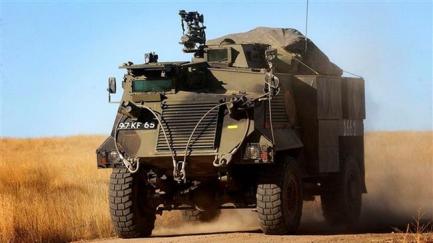
Britain has delivered a number of troop transporters to Ukraine as fighting rages on unabated in the eastern parts of the former Soviet country despite a peace deal.
Ukrainian media reported on Friday that 20 British Saxon armored vehicles were handed in to Kiev, with another 55 expected to arrive soon.
The UK’s Ministry of Defense (MoD) said that the vehicles were transferred by a private firm under a 2013 deal with the eastern European country.
The troop carriers were first used by the MoD in the 1980s, but went out of service some three years ago, according to an MoD spokesperson.
The spokesperson stressed that the British government has been supplying “non-lethal assistance” to the Ukrainian army since the beginning of the crisis in the country.
“There has been no change to this and we have not provided lethal assistance. These vehicles were provided unarmed under a commercial contract dating 2013 by a private company,” the spokesperson added.
Earlier this week, British Foreign Secretary Philip Hammond also noted that London was keeping under review a decision not to arm Ukraine, adding it could not allow the Ukrainian army to collapse.
This is while Russia has repeatedly criticized plans by Western countries to supply weapons to Ukraine, saying it would only aggravate the situation in the country’s restive provinces.
The UK’s decision to send troop carriers to Ukraine came one day after Kiev reached a ceasefire agreement with pro-Moscow forces operating in the country’s volatile east following marathon peace talks in the Belarusian capital, Minsk, with leaders of Russia, Germany and France.
The mainly Russian-speaking regions of Donetsk and Lugansk in eastern Ukraine have been the scene of deadly clashes between pro-Russia activists and the Ukrainian army since Kiev launched military operations to silence protests there in mid-April 2014.
More than 5,500 people have died and some 12,200 wounded in the conflict, the UN says. Around 1.5 million people have been also forced from their homes over the past months of turmoil.
Ukraine ultranationalist leader rejects Minsk peace deal, vows ‘to continue war’
RT | February 13, 2015
Ukraine’s Right Sector leader Dmitry Yarosh said his radical movement rejects the Minsk peace deal and that their paramilitary units in eastern Ukraine will continue “active fighting” according to their “own plans.”
The notorious ultranationalist leader published a statement on his Facebook page Friday, saying that his radical Right Sector movement doesn’t recognize the peace deal, signed by the so-called ‘contact group’ on Thursday and agreed upon by Ukraine, France, Germany and Russia after epic 16-hour talks.
Yarosh claimed that any agreement with the eastern militia, whom he calls “terrorists,” has no legal force.
In his statement, Yarosh claimed that that the Minsk deal is contrary to Ukraine’s constitution, so Ukrainian citizens are not obliged to abide by it. Thus if the army receives orders to cease military activity and withdraw heavy weaponry from the eastern regions, the Right Sector paramilitaries, who are also fighting there “reserve the right” to continue the war, he said.
The Right Sector paramilitary organization continues to deploy its combat and reserve units, to train and logistically support personnel, while coordinating its activities with the military command of the Ukrainian army, paramilitary units of the Defense Ministry and the Interior Ministry, he said.
The breakthrough Minsk agreement was reached on Thursday following marathon overnight negotiations between Ukraine, France, Germany and Russia, and offer hope the fighting in Eastern Ukraine may come to an end. The talks were part of a Franco-German initiative. President Francois Hollande and Chancellor Angela Merkel visited Kiev and Moscow before meeting the Russian and Ukrainian leaders at the negotiating table in Minsk.
READ MORE: Right Sector refuses to obey Ukraine’s Defense Ministry – presidential aid
EU and Russia: No option but peace and coexistence
The BRICS Post | February 13, 2015
At the moment of writing, the ink on the second Minsk agreement has not yet dried.
On February 15, fighting is supposed to come to an end in Ukraine. What are the chances for success of this agreement and what’s in it for the EU and Russia?
Are we on the path to a new peace or to a new cold/hot war? That is the question that will be on the minds of many in the days to come.
There are too many uncertain factors to reliably predict what will happen. The EU and the US have different agendas, and one can even make a case that they have conflicting interests.
For Russia, a peaceful resolution to the conflict means ending the sanctions and facilitating closer economic cooperation with the EU.
But tighter economic relations with Russia, the natural hinterland of Europe, goes against the core of the transatlantic NATO alliance. This has been a nightmare scenario for the Washington elite since 1945.
Pointedly, neither the US nor the UK were involved in the Minsk negotiations, so for Washington all options are still on the table. Considering the warmongering majority in the US Congress, that is not a good omen for peace.
Then there is the matter of the government in Kiev. Hardly ever mentioned in the news, it is far from stable. Extremist militias who do not bother to hide their fascist ideologies have been integrated into the Ukrainian army.
Considering their behaviour on the battlefield so far, it is very doubtful that Kiev will be able to make them abide by the ceasefire conditions.
Besides the extremists in their own ranks, the Kiev government faces another problem – young Ukrainian men in the west are bitterly resisting military conscription. This is not to say that they sympathize with their compatriots in the east – they just do not want to die fighting them.
Furthermore, there is the inner political struggle for power.
While President Petro Poroshenko is more than willing to find a pragmatic solution to the conflict, his prime minister Arseniy Yatsenyuk, however, is a fanatic Ukrainian nationalist, who is not a man of compromise.
He wants total victory and would be more then happy to replace his president.
Then there are the rebels in Eastern Ukraine, the so-called ‘pro-Russian separatists’.
Western media make it look like they are mere pawns in Putin’s hands, but that is hardly the case.
Nobody denies that Russia is giving them ample logistic support, but the leaders of the resistance are very unreliable. Will they accept the ceasefire? Hard to tell.
First step toward peace
Yet, despite all these challenges, history shows that worse situations have led to lasting peace.
The second Minsk agreement might just work. It is only a first step, and a peaceful long-term resolution of the conflict is still to be negotiated, but it is the only way out for the EU, Russia and Ukraine.
One of the reasons it might just work is precisely that the EU alone brokered it, or rather Germany and France, and not the US. That might seem contradictory given the different variables mentioned above, but it’s not. It all depends on who and what will prevail.
The real issues are still on the table – disarmament and federalization of the country. If the EU really wants it, Brussels has the financial leverage to force Kiev’s hand in accepting a new constitution granting the eastern regions meaningful autonomy.
The EU has experience with forging complex compromise solutions. After all, the EU itself is a permanent compromise.
What is really at stake is much more than just an end to an internal conflict stoked by outside forces. A resumption of violence carries with it the risk of an all out war between nuclear powers.
This is about a possible major war on European soil.
Border control
Hence, peace is the only option for Europe and Russia.
Personally, I consider one of the last paragraphs in the Minsk agreement, which focuses on control of the border, the most difficult one.
Kiev wants to regain full control of the border between the eastern provinces and Russia. This may at first appear to be a technicality, but it isn’t. Control of the border is highly symbolic, for all parties involved.
Kiev’s control of the border would impede Russia’s direct influence on the ground; for the rebels it would symbolize a partial surrender. The only party that stands to gain from this paragraph in the agreement is Kiev, which would have been delivered a highly symbolic victory.
A reasonable option would be to deploy UN troops on the border. Russia has proposed it, but apparently it was not on the negotiating table in Minsk.
While the Cold War has prevented Europe and Moscow from peaceful coexistence on their common continent, peace in Ukraine might just open up the whole Russian hinterland to the European economy.
At the end, it boils down to two options: The renewal of the old transatlantic pact with the ally overseas leading to a new Cold War (that could turn very nasty), or peace and coexistence with Russia.
Kiev MPs try to fool US senator with ‘proof’ of Russian tanks in Ukraine
RT |February 13, 2015
MPs in Kiev hoodwinked a US senator, presenting his office with photos of columns of Russian military hardware allegedly roaming Ukrainian territory. The photos turned out to have been taken during the conflict in South Ossetia back in 2008.
The photos were “presented to the Armed Services Committee from a delegation from Ukraine in December,” Senator Jim Inhofe’s communications director Donelle Harder told The Washington Free Beacon.
The Americans planned to publish the photos with credits to the Ukrainian MPs, and “they were fine with that,” the spokesperson said.
Yet, after thorough checking, images of the Russian convoys turned out to have been taken years ago, in 2008, during Russia’s conflict with Georgia.
“We are currently making calls to our sources,” Harder said.
“The Ukrainian parliament members who gave us these photos in print form as if it came directly from a camera really did themselves a disservice,” Senator Inhofe said in a statement.
“I was furious to learn one of the photos provided now appears to be falsified from an AP photo taken in 2008,” the lawmaker wrote.
At the same time the revealed forgery “doesn’t change the fact that there is plenty of evidence Russia has made advances into the country with T-72 tanks and that pro-Russian separatists have been killing Ukrainians in cold blood,” the US senator maintains.
Poroshenko After Minsk Talks: Donbas Autonomy, Federalization Not an Option
Sputnik News | February 12, 2015
Ukraine’s President Petro Poroshenko has flatly rejected the idea of granting a broad autonomy to the eastern Donbas region, and of making Ukraine a federation.
“Ukraine was, is and will remain a unitary state. Federalization is not an option,” President Poroshenko wrote on his Facebook page in the immediate wake of the four-sided talks on ending the yearlong conflict, which wrapped up in Minsk on Thursday.
The leaders of Ukraine, Russia, France and Germany met for 16 hours trying to thrash out a peace roadmap that would ease tensions in Ukraine’s war-torn east.
After the talks it was announced that before this year is out Ukraine would change its constitution to include a clause on decentralization and a special status for the Donbas region.
On Wednesday President Poroshenko said the proposed decentralization program his government was working on had absolutely nothing to do with making Ukraine a federative state.
Ukrainian specialists find no signs of military activity in Russia’s Rostov region
TASS | February 12, 2015
MOSCOW – Ukrainian specialists have not observed any military activity on the part of Russian army units in the course of an inspection that was held in the southern Rostov region from February 9 to February 12, the chief of the Russian Defense Ministry’s department for observance of agreements, Sergey Ryzhkov said on Thursday.
He said the ministry had complied with the provisions of the 2011 Vienna Document and had ensured inspection on an area of about 15,000 sq km that had been selected by the Ukrainian side.
“Ukrainian representatives said they hadn’t noticed any military activities on the part of units of the Russian Armed Forces in the area chosen for the inspection,” Ryzhkov said. “They pointed out precise observance of the Vienna document by the officials who had escorted them.”
IMF announces new $17.5bn bailout package for Ukraine
RT | February 12, 2015
The International Monetary Fund announced a new $17.5 billion lifeline for Ukraine, which would bring the total bailout package to $40 billion. The new sum would be a four-year program.
Lagarde will propose the $17.5 billion expansion program to the IMF by the end of the month.
“The program is not yet approved by the governing council. I hope to offer it for approval by the end of February,” she said Thursday.
“This new four-year arrangement would support immediate economic stabilization in Ukraine as well as a set of bold policy reforms aimed at restoring robust growth over the medium term and improving living standards for the Ukrainian people,” Lagarde said in a statement.
In return Ukraine will have to present a “program of deep economic reforms,” which includes the whole economy and a plan to transform Naftogaz, Ukraine’s state oil and gas company.
“It’s a large program, it’s a longer-term program than the previous one, which was a traditional SBA [Stand-By Arrangement] for two years,” the IMF chief said.
“It’s ambitious, it’s not without risk, but we believe it is a realistic set of macroeconomic framework, ambitious reforms, but reforms the authorities feel confident they can deliver,” Lagarde said.
IMF head Christine Lagarde didn’t answer the question as to whether the four-year international bailout program for Ukraine included credits from Russia.
“The sum includes funds from the IMF and the EU, and also bilateral and multilateral loans.”
Earlier this month, the US promised Ukraine as much as $2 billion in loan guarantees, while the EU said it would disburse €1.8 billion ($2.1 billion).
Boon to Ukraine’s economy
Ukraine’s Prime Minister Arseny Yatsenyuk stressed that the new bailout program would open sources for Ukraine to get help from other international organizations and partners, making the total sum thus $25 billion.
He confirmed the commitment to reforms that will stabilize Ukraine’s economy and finance. The country’s game plan includes fighting corruption, settling the energy sector, as well as cutting and optimizing state expenditure and increasing investment to 3 percent of the GDP, Yatsenyuk explained.
“Stabilization of the banking system and the exchange rate are also the goals of the program,” Yatsenyuk said.
“Recovery in confidence in Ukraine through the adoption of the 4–year program will be a major factor in the stabilization of the exchange rate, and an objective and strong banking system of Ukraine that will give the opportunity for Ukraine’s economy to develop,” he added.
Yatsenyuk said the government is also going to provide extensive assistance to low-income households. By the end of the year he expects it to include income indexation linked to the level of price rises. He also said the IMF program will provide $500 million for low-income families to help pay for increased energy bills.
READ MORE: IMF gives green light for $17 bn Ukraine aid package
War in Ukraine: Who Wants War? And Who Doesn’t?
By William Boardman | Reader Supported News | February 10, 2015
“Russian aggression” – the bad faith mantra of dishonest brokers
Just as NATO allies Germany and France were undertaking a peace initiative with Russia and Ukraine, U.S. Secretary of State John Kerry turned up in Kiev at the same time, seeking to poison the talks before they started by spouting yet again the ritual U.S. accusation of “Russian aggression.” The incantation is meaningless without context. Its purpose is mesmerize a false consciousness. “Russian aggression” may or may not exist in the events of the past year, just like “Russian self-defense.” Reporting on the ground has been too unreliable to support any firm analysis, never mind the provocative “Russian aggression” the U.S. brandishes as a virtual call for war.
Western aggression, political and diplomatic more than military, is a cold reality and has been for two decades. The West, and especially the U.S., has yet to accept responsibility for 20 years of anti-Russian aggression, much less pull back from such perennial hostility. The Obama administration (parts of it at least, given the incoherence of the “administration”) has acted as if its pulling off an only-slightly-violent coup in Kiev in 2014 was a grand triumph. Worse, having grabbed a government on Russia’s borders, the Obama hawks carry on as if the only reasonable choice for Russia is to accept the success of this Western aggression.
Rarely is this context acknowledged in discussions of the natural fissures in Ukraine that feed sectarian civil war. Rather the issues are over-simplified – falsified – by the U.S. Secretary of State, consistent with a hidden agenda of provoking a military confrontation (at the very least) with Russia and eastern Ukrainians. That’s the subtext that makes sense of Kerry’s otherwise seeming blithering in Kiev on February 5:
We talked about the largest threat that Ukraine faces today, and that is Russia’s continued aggression in the east. There’s no other way to call it. We’re not seeking a conflict with Russia. No one is. … The president is reviewing all of his options. Among those options, obviously, is the possibility of providing defensive — defensive — assistance to Ukraine. And those discussions are going on. The president will make his decision, I am confident, soon.
Note the lie: “We’re not seeking a conflict with Russia. No one is.”
When Kerry said that, he was lying, he almost surely knew he was lying, and the question is whether his lie represents only the rogue war-faction in the U.S., or is part of a dicey good-cop/bad-cop routine out of Washington. The only way it’s true that “we’re not seeking a conflict” is that the U.S. is already engaged in conflict with Russia, decades-long and currently escalating. The lie of not seeking a conflict already engaged is used to mask the lie of “defensive weapons,” a military-diplomatic oxymoron of long standing. So the most obvious answer to the question of who wants war in Ukraine is elements of the U.S. government whose immediate challenge is to persuade its Kiev client that it’s a good idea to risk turning its country into more of a battlefield than it already is.
Kiev’s desire is more obscure, and likely divided. Having taken power in something of a slow-motion coup d’etat last spring, the government faced a restive-to-defiant population in eastern Ukraine. Rather than seeking to negotiate legitimate grievances with the eastern region, the Kiev government chose instead to escalate quickly, from political hostilities into civil war. When that didn’t work out militarily, when Kiev started losing what it started, it agreed on September 5 to terms of a ceasefire that it then failed to honor with consistency (as did the separatists). Now the Ukrainian president has been to Moscow for early peace talks, but only after he staked out a preposterous public position seeking to win with a losing negotiating hand what Kiev has already lost on the ground.
Ukrainian President Petro Poroshenko met with German Chancellor Angela Merkel and French President François Hollande in Kiev on February 5 (when Kerry was in town but not part of the meeting). In his public statement, Poroshenko referred self-servingly to September’s Minsk Agreement signed by Ukraine, Russia, and the break-away Ukrainian states that call themselves the People’s Republic of Donetsk and the People’s Republic of Luhansk. The only other Minsk signatory was the Organization for Security and Co-operation in Europe (OSCE), giving the agreement the tacit endorsement of Europe without any individual European nation signing on. The United States was not directly involved in the Minsk Agreement, but a week later expressed its support for finding a peaceful solution by sending American troops to take part in NATO military exercises in Ukraine’s western provinces.
Understood in its actual context, Poroshenko’s February 5 statement is ludicrously disingenuous:
The Minsk plan is very simple: immediate ceasefire; releasing all the hostages; closing the border, or renew the internationally recognized border on Ukrainian (side); withdrawal all of the foreign troops from the Ukrainian territory; launching very important process of the political regulation by the election on the municipal election, local election, under Ukrainian legislation in the territory of Donetsk and Luhansk.
All signatories must take Minsk accord seriously to avoid war
It’s hard to find anyone who doesn’t urge compliance with the Minsk Agreement, even if that means different things to different people. Neither side in Ukraine has come close to significant compliance for any length of time. Poroshenko calls for the ceasefire, but omits the international monitoring called for in the agreement. He calls for closing the border with Russia, which is NOT part of the agreement. When he calls for the withdrawal of foreign troops, he omits mention of NATO. When he refers to elections, he omits Kiev’s failure to pass the legislation it promised, and he omits the elections that have already been held in the Republics of Donetsk and Luhansk [see “Election Note” at the end of this article]. Poroshenko also omits amnesty for separatists, improving humanitarian conditions in the region, and the recovery program, all of which are part of the Minsk Agreement.
Nevertheless, Poroshenko went to Moscow with his German and French colleagues to take part in peace talks with Russian President Vladimir Putin there on February 6, at Russia’s initiative. When similar talks had been proposed for mid-January, Chancellor Merkel had been instrumental in making sure they didn’t happen. This time her public posture going in was appropriately statesmanlike:
It is a question of peace and preserving the European peace order. It is a question of free self-determination of the people as part of this European peace order. And we are doing what we believe to be our duty at this time, namely trying to do everything in our power to end the bloodshed.
Merkel’s reference to “free self-determination” is diplomatically murky and allows for a wide range of possible solutions for the self-proclaimed Republics in eastern Ukraine, and even hints at a resolution for Crimea. Her focus on peace serves all the parties’ best interest, seeking to avoid a war that would, inevitably, cause much more suffering for Europe than the United States.
U.S. policy seems designed to turn Ukraine into the “European Iraq”
Presumably none of the parties meeting in Moscow on February 6 wants to see Ukraine become “another Iraq,” even if Ukraine is already part way there. Where Iraq had been a coherent, modern state with cultural cohesion despite its dictatorship, Ukraine has a long history of quasi-chaos, internal squabbling, and corruption. Where it took an American invasion and occupation to reduce Iraq to a near-failed state, the U.S. sees an opportunity now to manipulate proxies into destroying Ukraine (and even Russia) for the next generation or so.
Germany, France, Russia, and especially Ukraine must be acutely tuned to the potential horrors they face. After meeting for four hours, the parties were generally low key and discreet in what they said about the substance discussed. This reality produced European coverage by the BBC and others characterized by cautious hopefulness. U.S. media more typically characterized uncertainty as failure, offering the talismans of magical thinking and instant gratification in place of accuracy or analysis.
Whatever they were, the four-way talks in Moscow were not a failure. All sides called them “constructive,” which is diplo-speak for: there’s still a chance for a settlement. The parties are continuing the negotiations with apparent openness to a range of solutions. Hollande called this process “one of the last chances” to settle eastern Ukraine peacefully. Poroshenko has expressed hope for an early agreement to an “unconditional ceasefire” and one step toward reducing tensions. An unconditional ceasefire is beyond what was agreed to at Minsk in September, but creates no barrier to implementing the agreement later. Moscow’s tactful obliqueness leaving room for the parties to maneuver was in sharp contrast to the bloviating cries for war coming mostly from U.S. Senators and the vice-president at the simultaneous regional security gathering in Munich.
The lesson of Munich for 2015: “War in our time”?
Meeting for the 51st year in Munich during February 6-8, the Munich Security Conference (MSC) provided a setting for mostly U.S. hawks to try to undermine the chances for peace in Ukraine. Founded in 1963, the Munich conference identifies itself as
… a key annual gathering for the international ‘strategic community’… an independent forum dedicated to promoting peaceful conflict resolution and international cooperation and dialogue in dealing with today’s and future security challenges.
What the Munich conference seems to be is something of a foreign policy free-for-all to which almost anyone from anywhere can come and pontificate regardless of whether they hold any actual decision-making authority. The American delegation, including a dozen war-minded congress members, seems not to have gotten the memo about “promoting peaceful conflict resolution,” like the British lapdog also barking loudly for war.
Like any good multinational circus, the Munich show offered a variety of clown acts and sideshows to distract from the U.S. rush to war. The Turks decided not to take part rather than share a panel with Israelis. Non-office-holder Arnold Schwarzeneggar stumped to action on climate change. Some European Union members ganged up on Greece (again), this time for opposing some sanctions on Russia, while support for Greece (and peace) came from Cyprus, Austria, Hungary, Italy, Luxembourg, Slovakia, Slovenia, and the Czech Republic – most of which are closer to the likely war zone than those brave distant states ready to start a fight. In the Munich streets, some 2,000 peaceful protestors demonstrated against NATO, otherwise known as an American sphere of influence (if not a Trojan horse).
Joe Biden toes the official line, smoothly riffing on official lies
Other members of the American delegation included Kiev coup supporters Vice President Joe Biden, Secretary of State Kerry, and assistant secretary of state Victoria Nuland, none of whom showed any public willingness to look at the realities of the present or the past 20 years. Like a good apparatchik of the American war party, Biden’s address to the conference included a subtle version of the requisite “Russian aggression” trope, along with 45 minutes of neo-Cold-War boilerplate propaganda. In one of the more hilarious highlights of this taken-very-seriously by the media speech, Biden quoted himself from the same conference in 2009:
Six years ago at this podium, I said and I quote, ‘To paraphrase President Obama, it is time to press the reset button and reinvest in the many areas where we can and should be working together with Russia.’
That’s what everybody remembers. But they don’t often repeat what I then said.
I said, ‘We will also not recognize any nation having a sphere of influence. We will remain — it will remain our view that sovereign states have the right to make their decisions and choose their own alliances.’
I meant it when I said it then, and America means it as I repeat it now.
The “reset button” rhetoric did not include changing U.S. support for the relentless push for NATO to include countries on Russia’s border, a form of blatant – and mindless – political aggression. NATO, the European Union, Europe itself are all U.S. spheres of influence, no matter what the Biden-shills of the world may say. Even as he lied sanctimoniously about spheres of influence in 2009, his country was engaging in its half-century of punishing Cuba for not being a loyal and subservient of the American hemisphere of influence.
And when Biden claimed, “it will remain our view that sovereign states have the right to make their decisions and choose their own alliances,” an honest audience would have laughed as derisively at that as the same audience laughed at perceived absurdity from Russian Foreign Minister Sergey Lavrov during his address to the Munich conference.
Having destabilized Ukraine, the U.S. blames Russia for piling on
Remember how the present Ukraine crisis came about? In the fall of 2013, Ukraine was weighing a political, economic choice between a European proposal requiring exclusivity (and implying future NATO membership) and a somewhat more open Russian proposal (with no military alliance component). In Ukraine, as politically divided as ever, the western population yearned for Europe, the eastern population was content with Russia. When the legitimate, democratically-elected Ukraine government rejected the European offer, protesters mostly from western Ukraine launched the months-long Euro-Maidan demonstrations in Kiev (presumably with the connivance of the U.S. and others). In time, including on the scene visits from Biden (whose son reportedly has significant economic interests in Ukraine) and Nuland (with her cookies for the mob), the Maidan evolved into the coup d’etat that produced the current Ukraine government.
So when Biden says “that sovereign states have the right to make their decisions and choose their own alliances,” he lying. He’s lying about Ukraine and he’s lying about U.S. behavior in the present and the recent past (and the not so recent past as well, to be sure).
Somewhat measured language from the White House
On February 5, as the flurry of events in Kiev, Moscow, and Munich was beginning, the White House expressed some awareness that military escalation might only make matters worse in Ukraine. White House Press Secretary Josh Earnest said, in part:
… the United States has been saying for some time that it’s a diplomatic negotiation that is required to bring this conflict in Ukraine to an end, that this is not something that’s going to be solved or resolved militarily, but rather through diplomatic negotiations. So we certainly are encouraging and supportive of ongoing efforts to try to find a peaceful diplomatic resolution to the conflict in Ukraine…. [But] we need serious engagement from the Russians and the separatists, the likes of which we’ve not seen before….
… the President is going to make a decision [on weapons to Ukraine] that he believes is in the broader national security interests of the United States…. But certainly the President takes very seriously the views of our allies and is going to consult very closely as we evaluate any needed strategic changes ahead…. [But] this conflict was not going to rise to the level of a military confrontation between the United States and Russia. The President has been very clear about that. So there are things that we are going to continue to avoid.
But one of the concerns that we have about providing military assistance is it does contain the possibility of actually expanding bloodshed, and that’s actually what we’re trying to avoid. The whole reason that we are trying to encourage both sides to sit down and hammer out a diplomatic agreement is to end the bloodshed and end the escalating conflict in that country.
The press secretary made no effort to offer a balanced analysis of the Minsk Agreement, blaming the separatist Republics and Russia for virtually all the problems. He did allow that Ukraine had not lived up to all its commitments under the agreement.
Who actually speaks for the United States?
The same day the White House offered this view, NATO ministers in Brussels adopted a plan to ring Russia’s European perimeter with a network of command centers and rapid reaction forces. According to NATO Secretary General Jens Stoltenberg, this plan is NATO’s biggest reinforcement of collective defense since the end of the Cold War. He added that the first six multinational command and control units would be established immediately in Estonia, Latvia, Lithuania, Poland, Romania, and Bulgaria. Estonia and Latvia border on Russia. Poland and Romania border on Ukraine.
The Secretary of State is carrying on as if he believes that this might be his legacy moment. He’s acting as if he’s thinking: Hillary Clinton led the charge on Libya and made magnificent regional chaos there, so why shouldn’t I be able to top that, and make a mess of Ukraine, and possibly create global chaos?
But what if “Russian aggression” is real? As matters stand now, U.S. policy aggression for two decades has served as a self-fulfilling prophecy that creates “aggression” in response. What would happen if the U.S. especially, and the West in general, sent a clear signal that western aggression was over? How long would it take for Russia (or China) to trust that as reality? And would that persuade the Russians to relax what we now call their aggression? (We don’t hear much about “Chinese aggression” these days, but chances are that Kerry or Biden or someone already has that speech written.)
The course the U.S. has been on since 1990 has no good ending, unless one assumes that the Russians (or the Chinese) will fold under pressure. That seems unlikely. Nor does the result seem worth the risk. But also unlikely is a U.S. course change as long as we remain enamored of our own exceptional face in the magic mirror that keeps telling us we’re indispensable and can do no wrong. In Ukraine, today, probably the most dispensable nation is the U.S.
As this is written February 9, President Obama and Chancellor Merkel have met at the White House and offered vague public assurances that diplomatic efforts will continue to try to settle Ukraine issues peacefully. It’s not reassuring that Obama’s companions in his meeting with Merkel were committed aggressors: Biden, Kerry, and national security advisor Susan Rice. We don’t know if this President is strong enough to be in control of his administration as it speaks with conflicting voices. What we know pretty surely is that this is a moment when President Obama could actually earn his Nobel Peace Prize by calling off “American aggression.”
Or he could just follow the lead of the mindless, bi-partisan weapons-gaggle in Congress and elsewhere. The president could do the bidding of all those shrill demagogues who cry for escalating bloodshed, those grandstanding testosterone puffs who will never accept responsibility for the death and dismemberment they advocate. In that event, the President would once again ignore his own earlier wisdom when he once said: “Don’t do stupid stuff.”
Election Note [see above]: The Donetsk and Luhansk elections held November 2 were supported by Russia and rejected as illegitimate by Ukraine, as well as spokespersons for the European Union, Germany and others in the west. The election results mostly confirmed the local authority already in place, including the chief executive and parliamentary majorities in both Republics, which were popularly approved in referendums in May. An OSCE spokesperson called the November elections a violation of the spirit and letter of the Minsk Agreement, which seemed to contemplate such elections taking place on December 7, under Ukrainian law. Ukraine had excluded Donetsk and Luhansk from its presidential election in May and its parliamentary election in October. The last apparently legitimate presidential election held in Ukraine chose Viktor Yanukovych president in February 2010. Yanukovych, whose support reached 90% of the vote in some districts of Donetsk and Luhansk, was forced from office in February 2014 by the coup that emerged from the Maidan protest. Ukraine has almost 34 million voters in all, of which more than 5 million are (or were) in Luhansk and Donetsk. Another 1.8 million voters in Crimea have not taken part in the 2014 elections outside Crimea.
BBC airs Maidan fighter admitting he fired on police before Kiev massacre
RT | February 12, 2015
Nearly a year after the massacre on Kiev’s Maidan left over 50 dead, the BBC has aired footage of an opposition fighter who says he fired at police in the early morning that day, bringing into question the popular narrative that riot police fired first.
“I was shooting downward at their feet,” says a man the broadcaster decided to identify as Sergei.
“Of course, I could have hit them in the arm or anywhere. But I didn’t shoot to kill.”
According to Sergei, he took up a position in the Kiev Conservatory, a music academy located on the southwest corner of Kiev’s Independence Square, on February 20.
One day prior, he had met up with a man who offered him two guns. The first was a 12-gauge shotgun, while the other was a hunting rifle – a Saiga that fired high-velocity rounds.
He chose the Saiga and hid it at a post office that, along with the conservatory, was under the protesters’ control. Sergei told the BBC he was later escorted to the Conservatory, where, with a second gunman, he spent 20 minutes before 7:00 am firing on police.
Other witness testimony has corroborated his account.
Russia the world’s last line of defence against Isramerica’s murderous grand design
By Greg Felton | February 8, 2015
The world is heading for war. The Isramerican empire is funneling tons of heavy weaponry into Ukraine to provoke Russia into launching a defensive attack, and then that response will be used to justify starting a major war. It is a waste of time trying to find any intelligent discussion in the mainstream corporate media of why the U.S. wants to provoke war with Russia. Its job is to cover up and falsify, not report. For example, take the following well-known acts of violence.
Despite what the media told us at the time, we know that the collapse of World Trade Centre had nothing to do with Muslim anger, and the Boston Marathon bombing had nothing to do with Chechen terrorism. These three events, among others, were executed with such clumsiness that they should have immediately been exposed as frauds, but they worked because their simplistic cause-and-effect narrative, black-and-white morality and shock value stampeded the public into doing what was expected: embrace official anti-Muslim bloodlust, self-identify with the officially approved victims, and, most importantly, accept the need to sacrifice liberty for security, as in this official declaration.
If we look at the Charlie Hebdo shooting synoptically with the Boston Marathon bombing and the World Trade Centre/Pentagon attack, Isramerica’s handiwork in Ukraine becomes frighteningly obvious. These seemingly discrete false-flag attacks fit together to reveal a coherent pattern of deliberate, Isramerican subversion that is now being played out in Ukraine.
Debunking the cover story
The Charlie Hebdo shooting had nothing to do with anti-Westernism or press freedom. It was executed with such clumsiness that no sentient being could possibly buy the cover story that our organs of orthodoxy shamelessly regurgitated.
First of all, the identification of the two black balaclava-wearing shooters is not credible—an identity card of one of them fortuitously found in a car. If the shooters took pains to conceal their identity so completely, such carelessness is implausible. More likely, the card was planted to implicate the shooters, brothers Saïd and Chérif Kouachi, just like the pristine passport identifying one of the “hijackers” that just happened to found among the rubble of the World Trade Centre. To date, no positive ID of the Charlie Hebdo shooters has been made.
Second, the idea that Muslims committed murder over defamatory cartoons of the Prophet Muhammad is unsupported. We have only video of two unidentified people claiming, in Arabic, to be avenging the Prophet, but we have no proof that these men are Muslims. They could just as easily be Musllim impersonators. Besides, if Muslims felt that strongly about the cartoons, they should have gone after the staff of the Danish newspaper Jyllands Posten. In 2006, the newspaper’s cultural editor Flemming Rose commissioned defamatory cartoons, but perhaps no avenging attack took place because Rose is a zionist Jew with close ties to Daniel Pipes.
Third, we have a smoking gun, literally, that proves the Charlie Hebdo attack was staged. The video below shows one of the masked “Muslim” shooters killing a Paris police officer who is lying on the sidewalk. As this footage and commentary show, the killing is a badly staged hoax.
Finally, we come to the issue of press freedom, the shibboleth used to inflame democratic passions about journalism, especially the freedom to satirize. As if on cue, the “je suis Charlie” crusade erupted and had people all over the world commiserating with their fallen fourth-estate brethren and bemoaning an assault on one of the sacred institutions of a free Western society. But this sentiment is unjustifiable. First, the cartoons in question fail to meet the definition of satire:
“Satire is a technique employed by writers to expose and criticize foolishness and corruption of an individual or a society by using humour, irony, exaggeration or ridicule. It intends to improve humanity by criticizing its follies and foibles. A writer in a satire uses fictional characters, which stand for real people.” (http://literarydevices.net/satire/)
Gratuitous, defamatory renderings of the Prophet Muhammad serve no useful purpose, cannot improve humanity and contain no irony or humour. Therefore we have no business treating them as legitimate forms of journalistic expression. Second, France arrested dozens of people on charges of “defending terrorism” because they verbally satrized the shooting. Those arrested include a 14-year-old girl as well as three school workers who allegedly refused to observe a moment of silence.
I am tempted to say that the staff at Charlie Hebdo brought the attack upon themselves through their ignorance and arrogance, but that would feed the propaganda, as was the case with the WTC/Pentagon attack, that Muslims were to blame for a mass murder.
To see the machinations behind the attack, let us gag the “je suis Charlie” reflex, tune out the lamentations about press freedom and reject the nonsensical Muslim revenge causality. For it to make sense we need to approach it from the point of view of who benefited—cui bono? as the Romans used to say. Going from effect to cause negates the sense-dulling effect of official anti-Muslim propaganda and shows the attack to be not an act of direct violence against French civilians but an act of indirect intimidation against the French government.
Disobeying the empire
In the week and a half leading up to the Jan. 7, 2015, Charlie Hebdo attack, the government of François Hollande committed two acts of disobedience against the Isramerican empire.
The first occurred on Dec. 29, 2014, in the UN Security Council when France chose to stand with the civilized word in support of Palestinian statehood. There was no reason to oppose the motion. It was rational, logical, fair and just. But for Israel a successful vote would have been disastrous because Israel requires unfettered power to terrorize and murder the region’s native Palestinian population and steal their land to set up illegal Jewish colonies. A vote to acknowledge Palestine as a state would have been a lethal challenge to Israel’s raison d’être. In November 2014, Israeli strongman Benjamin Netanyahu went so far as to threaten France with grave consequences should it vote for Palestinian statehood.
The second came a week later when Hollande announced France would end economic sanctions against Russia, sanctions that the empire demanded because of events in Ukraine. France was in the forefront of the European anti-sanctions movement, and therefore posed a real threat to Israel’s plans to destabilize Middle Eastern regimes.
The grand design that animates Israel’s lethal Middle East policy was defined as far back as 1982 by Oden Yinon, a journalist formerly attached to Israel’s foreign ministry. In an article entitled A Strategy for Israel in the Nineteen Eighties, he gave a candid depiction of Israel’s imperial objectives, which we still see unfolding today. The article reads, in part:
The dissolution of Syria and Iraq later on into ethnically or religiously unique areas such as in Lebanon, is Israel’s primary target on the Eastern front in the long run, while the dissolution of the military power of those states serves as the primary short term target. Syria will fall apart, in accordance with its ethnic and religious structure, into several states such as in present day Lebanon, so that there will be a Shi’ite Alawi state along its coast, a Sunni state in the Aleppo area, another Sunni state in Damascus hostile to its northern neighbor, and the Druzes who will set up a state, maybe even in our Golan, and certainly in the Hauran and in northern Jordan. This state of affairs will be the guarantee for peace and security in the area in the long run, and that aim is already within our reach today.…
In the short run, it is Iraqi power which constitutes the greatest threat to Israel. An Iraqi-Iranian war will tear Iraq apart and cause its downfall at home even before it is able to organize a struggle on a wide front against us. Every kind of inter-Arab confrontation will assist us in the short run and will shorten the way to the more important aim of breaking up Iraq into denominations as in Syria and in Lebanon.
While the Cold War was on, Israel could do nothing overtly subversive, but after the dissolution of the Soviet Union on Dec. 26, 1991, the Yinon Plan became doable. That fact became clear immediately after the WTC/Pentagon attack. On CBS’s Meet the Press host Tim Russert, showed an embarrassed Secretary of Defence Donald Rumsfeld his own notes from 2:40 p.m. on Sept. 11, 2001, which proved he wanted to frame Saddam Hussein for the attack:
best info fast. Judge whether good enough hit S.H. [Saddam Hussein] at same time. Not only UBL [Usama Bin Laden]…. Go massive. Sweep it all up. Things related and not.
The need to frame Hussein was corroborated by George W. Bush’s top counterterrorism advisor Richard Clarke:
The president dragged me into a room with a couple of other people, shut the door, and said, “I want you to find whether Iraq did this.” Now he never said, “Make it up,” but the entire conversation left me in absolutely no doubt that George Bush wanted me to come back with a report that said Iraq did this…“Iraq! Saddam! Find out if there’s a connection.” And in a very intimidating way. I mean that we should come back with that answer.
Iraq has been largely destroyed based on a fabricated premise. The next victim to fall would be Libya; now it’s Syria’s turn. As the next sections show, The Yinon Plan is the backdrop against which the Charlie Hebdo shooting must be understood.
Russia, Syria and the Yinon Plan
Overall, Israel’s main target in the Yinon Plan is Iran because it could soon have its own nuclear power capability, thus breaking Israel’s regional nuclear monopoly and weakening its ability to use it to blackmail European governments into acquiescing in the genocide of Palestine. Sabre-rattling, disinformation and sanctions have so far failed to intimidate Iran, and when taken together with its geographical location has meant that more attention is being paid to Iran’s ally, Syria.
In spring 2011, Isramerica’s assault on Syria become overt with the formation of the Free Syrian Army, ostensibly an indigenous rebel force against the authoritarian Assad regime. In reality, it’s not Syrian and it’s not indigenous. It’s a foreign insurgency designed to foment unrest and overthrow Assad in favour of a leader more to Isramerica’s liking. The leader of the FSA is Media al-Harati, a Dublin-based Libyan who had been head of the Tripoli Army Brigade after the overthrow of Moammar Qaddafi. Adding to its illegitimacy are its organizers. The attendees at a Syrian opposition conference on July 6, 2011, in Saint-Germain, France, included:
- Bernard-Henri Lévy, zionist philosopher;
- Bernard Kouchner, former French foreign minister and a major proponent of war on Iraq;
- Frederick Ansel, member of the youth wing of Israel’s Likud Party; and
- Alex Goldfarb, former Knesset member and advisor to former Israeli Defense Minister Ehud Barak.
Significantly, nobody felt the need to challenge Goldfarb’s credentials as a member of the Syrian opposition or as a spokesman for the group “Democratic Change in Syria,” probably because the meeting was chaired by Zionists.
The key event that was supposed to stampede the world into abetting the overthrow of Assad was a deadly sarin gas “attack” in a Damascus suburb on Aug. 21, 2013. Instantly and without evidence, the Syrian Army was blamed and Obama was expected to authorize invasion because he had said that use of chemical weapons was “a red line” that Assad could not cross without repercussions.
The Israeli imperial influence here is obvious: Netanyahu used that exact cliché in a Sept. 27, 2012, speech to the UN when he said Iran would cross a “red line” if its nuclear enrichment of Uranium reached 20 per cent. Moreover, a pre-emptive assault on Syria by sea-based U.S. Tomahawk missiles had been on the drawing board, leaving open the question of whether the sarin gas attack was really designed to justify a foregone conclusion. It was not be the first time a mass murder was used to rationalize an aggression: The USA PATRIOT Act, written and robotically passed in response to the Sept. 11, 2001, attack was in fact drafted the previous month by Philip Zelikow. Soon after the attack
Just as Muslims had nothing to do with bringing down the World Trade Center or ventilating the Pentagon, Syria had nothing to do with the attack. The sarin belonged to the Isramerican insurgents and was supplied by Saudi Arabia. Even after the case against Assad blew up in the U.S.’s face, Obama was still trapped by his inflammatory rhetoric, and the Yinon Plan seemed poised to claim another victim after Iraq and Libya. Then, Putin came up with a face-saving diplomatic solution for Obama that ruined everything. He offered to support a UN Security Council resolution that would have Syria surrender its chemical weapons to UN inspectors in exchange for a promise from Obama not to bomb.
Putin’s Sept. 11, 2013, opinion piece in the New York Times was a plea for statesmanship over sadism, and as such amounted to a frontal assault on the Yinon Plan.
From the outset, Russia has advocated peaceful dialogue enabling Syrians to develop a compromise plan for their own future. We are not protecting the Syrian government, but international law. We need to use the United Nations Security Council and believe that preserving law and order in today’s complex and turbulent world is one of the few ways to keep international relations from sliding into chaos… It is alarming that military intervention in internal conflicts in foreign countries has become commonplace for the United States. Is it in America’s long-term interest? I doubt it. Millions around the world increasingly see America not as a model of democracy but as relying solely on brute force, cobbling coalitions together under the slogan “you’re either with us or against us.”… We must stop using the language of force and return to the path of civilized diplomatic and political settlement.… If we can avoid force against Syria, this will improve the atmosphere in international affairs and strengthen mutual trust. It will be our shared success and open the door to cooperation on other critical issues. [my emphasis]
If the Yinon Plan were to succeed, Russian moderation and power would have to be weakened considerably.
Ukraine’s fascist coup
What didn’t work for Isramerica in Syria finally did work in Ukraine. A year ago this month, the legitimate government of Viktor Yanukovitch was overthrown in a coup that brought to power the pro-Western, pro-NATO, neo-fascist régime of Arkadiy Yatsenyuk. U.S. Assistant Secretary of State Victoria Nuland even boasted that the U.S. spent $5 billion to subvert the Yanukovich government and its eastward-looking pro-Western politics, even though former White House resident George W. Bush promised to Putin that the U.S. would not interfere in Ukraine. Nuland is married to Robert Kagan, who comes from a leading Jewish Isramerican family.
The coup was pure stagecraft. After it happened and Yankuovich was forced to flee for his life, the empire and its media mouthpieces reinvented the coup as a “democratic, Ukrainian revolution” and proceded to regurgitate a spate of anti-Putiin/anti-Russian propaganda. One extreme case was a clumsily fabricated story in the New York Times about Russian special forces invading eastern Ukraine to start an uprising. Just two days later on April 20, 2014, the Times issued a half-assed retraction because the sheer ineptitude of the story had made it indefensible.
It turns out the Russian troops didn’t invade; they were already in Ukraine under an international treaty, and Russia’s UN ambassador Vitaly Churkin said the treaty allowed for up to 25,000 Russian troops. Moreover, Putin only mobilized Russian forces to defend Russia’s security and to protect Russian-speaking Ukrainians in the Crimea who wanted to flee the fascist coup. Russia did not take any aggressive action.
One of the few informed writers on the coup in Ukraine, investigative journalist Robert Parry, ties it to the larger issue of implementing the Yinon Plan:
Since their current strategic necessity is to scuttle the fragile negotiations over Syria and Iran, which otherwise might negate the possibility of U.S. military strikes against those two countries, the Putin-Obama collaboration had to go. By spurring on the violent overthrow of Ukraine’s elected president, the neocons helped touch off a cascade of events – now including Crimea’s secession from Ukraine and its annexation by Russia – that have raised tensions and provoked Western retaliation against Russia. The crisis also has made the continued Obama-Putin teamwork on Syria and Iran extremely difficult, if not impossible.
On Dec. 11, 2014, the Israel-occupied U.S. Congress passed Russian Sanction Bill H.R. 5859, without it having been read or debated. Just over three weeks later. French President François Hollande repudiated the sanctions. Two days latter, 12 members of Charlie Hebdo were murdered.
The Common Russian Denominator
The execution of the Charlie Hebdo attack is reminiscent of the April 15, 2013, Boston Marathon bombing: Two brothers were accused of a shock mass killing; their motives were contrived and illogical; both were Muslims; police set out to execute them afterwards; and Isramerica was the only beneficiary. Dzhokhar Tsarnayev, one of the Boston marathon bombers, somehow managed to survive. Although he was severely wounded, he is expected to be fit for his show trial this April.
One significant difference in the two attacks, though, is the ethnicity of the brothers. Saïd and Chérif Kouachi were French citizens of Algerian heritage; Dzhokhar and Tamerlan Tsarnaev are Chechens. Setting up Franco-Algerians as patsies for a false-flag attack does not seem out of character for Isramerica, but setting up Chechens is another matter.
The U.S. had been up to its eyes in anti-Russian subversive activity since 1991 when the Dzhokar Dudaev government in Chechnya declared independence from the Russian federation. From 1994 to 1996 Russia and Chechnya were at war and then again from 1999 to 2009, but fighting in the North Caucasus persists. Seeing an opportunity to undermine Putin’s rule, the U.S. and the U.K. began funneling money and support to various secessionist ethnic groups in the region.
For example, the Jamestown Foundation, a CIA front founded in 1984 by former CIA Chief William Casey, is affiliated with the Caucasus Fund of Georgia, which puts on seminars and conferences to foment anti-Putin activism. Between January and July 2012, Georgian intelligence reported that Dzhokhar Tsarnaev was in the capital Tblisi attending some of these seminars, a fact that got little to no attention in the stage-managed post-bombing propaganda.
Given the importance of the Chechen independence movement, it made no obvious sense to set Chechens up to look like terrorists, especially the Tsarnaev brothers. Moreover, these brothers had had a relationship with the FBI going back at least two years. Given that not one but two parts of the U.S. security apparatus knew who the brothers were and that they posed no threat, the idea that they set off the bombs is implausible.
The only way the Boston Marathon bombing makes a lick of sense is as a political gambit—a false flag attack that was an indirect message to Putin to convince him to roll over on Assad: “We made Chechens look like terrorists, so now you stop blocking our attempts to attack Syria.”
In the hierarchy of the Yinon Plan, Chechnya doesn’t register, so sacrificing a peripheral activity to get at Syria seemed like sacrifice worth making even though it didn’t work.
Note that the sarin gas attack in Damascus, occurred just four months after the Boston Marathon bombing, which raises the question of whether it would have been necessary if Putin had done as Isramerica wanted.
At any rate, we only “know” the Tsarnaev brothers committed the bombing because we were told they did, just as we were told the Kouachi brothers shot up Charlie Hebdo.
In fact, the backpacks that contained the bombs belonged to the mercenary security/ murder-for-hire outfit Craft International. As I wrote in May 2013, no agency admitted to hiring Craft and of course no mainstream news agency would touch this angle. At the time, though, New Hampshire State Senator Sheila Tremblay said that a black ops team was behind the bombing, but she was later pressured into issuing a political apology, the standard punishment meted out to anyone who has the poor judgment to expose imperial deceptions.

Are these the real bombers? Click here for enlargement and commentary.
Executing the Yinon Plan drives everything Isramerica does in the Middle East, and it is the only motive that can explain the Boston Marathon bombing, sarin gas attack, the coup in Ukraine, and Charlie Hebdo shooting. To get at Iran, Isramerica focused its attention on Syria. To get at Syria it first has to isolate and weaken Russia.
We are headed to something approaching another major European war if Isramerica and its puppet regimes can effectively poison the world against Russia.
Featured Video
No Vote, No Representation, No State: Democracy, Israeli Style
or go to
Aletho News Archives – Video-Images
From the Archives
Sanctions, War and the Policy of Dual Containment
By SASAN FAYAZMANESH | March 17, 2008
It is now nearly three decades since the Unites States adopted the policy of dual containment of Iran and Iraq. While much has been written about the containment of Iraq, there has been very little in-depth analysis of this policy when it comes to Iran. In a book that is going to be released on March 31, 2008, entitled The United States and Iran: Sanctions, Wars and the Policy of Dual Containment (Routledge), I attempt to address this shortcoming by investigating when and why the US policy of containment of Iran came about, how it evolved, and where it stands today.[1] To the extent that Israel has been involved in US policy making, the study will also include the role that Israel has played in the containment of Iran. Also, since the fate of Iran has been inextricably linked to that of Iraq, occasionally the investigation will overlap with the containment of Iraq.
The policy of dual containment of Iran and Iraq originated during the Carter Administration, but it was not until the Clinton Administration that the expression “dual containment” became popular. … continue
Blog Roll
 Aletho News
- No Vote, No Representation, No State: Democracy, Israeli Style
- Zionist Bought Senate Blocks Information About American Citizens Killed By Israel
- While Gaza dominates the UN, these are the people keeping it alive
- New Report: “Scholasticide and Genocide in Gaza: Assessment, Testimonies and Legal Analysis”
- ‘THAAD Delusion’: Iran war exposes US missile shield limits – The Atlantic
- Moscow issues warning to NATO over Russian exclave
- Yes, the Iran war has destroyed Trump’s presidency
- The fallacy of US delusions about Iran’s economic collapse
- Hezbollah denies Syria cell link, warns of Israeli plan to sow discord
- The legacy of US sanctions, war, and occupation in Iraq
- If Americans Knew
- Mamdani releases plan to combat antisemitism and hate crimes in New York City
- Iran’s Revolutionary Guards Publish Letter to the American People
- DMFI launches $1 million ad campaign supporting Virginia’s Elaine Luria
- US Senate blocks resolution seeking report on Americans killed by Israel
- Israeli Attacks Kill Ten Palestinians in Gaza
- Massacre at Minab: The School That Became a Grave
- Israeli media: The IDF Shows It Doesn’t Turn a Blind Eye; It Actively Emboldens Settler Havoc
- As settlers ravage West Bank, Israeli forces kill 10 in Gaza – Daily Update
- New Report: “Scholasticide and Genocide in Gaza: Assessment, Testimonies and Legal Analysis”
- Ex-Biden officials are desperate for a Gaza scapegoat
- No Tricks Zone
- Green Energy Debacle: German Expert Professor Fritz Vahrenholt Warns Of Severe Economic And Social Consequences
- Two More Paleo Reconstructions Affirm Meters-Higher Sea Levels Across Ireland, Brazil 7000-6000 Years Ago
- New Study: Earth And Venus Surface Warmth Largely Explained By Convection And Lapse Rate, Not CO2 Or Radiation
- 2025 Nature Paper Claiming Worsening Global Drought Gets RETRACTED …Heavily Flawed
- New Study: ‘Global Drought Shows No Detectable Recent Acceleration Under Climate Warming’
- Economic Masterminds: German Socialists Suggest Taxing Productivity Gains Stemming From Using AI
- The South China Sea Has Not Been Cooperating With The Climate Change Narrative
- Energy Crisis: Germany Enters Heating Season With Historically Low Gas Reserve Fill Levels
- New Study: The Antarctic Ice Sheet Gained Mass From 2020-2024 Due To Staggering Snow And Ice Accumulation
- Study: Ocean Heating Rates From Thousands Of Years Ago ‘Dwarf’ Modern Ocean Heating Rates

