Ron Paul: US ‘hiding truth’ on downed Malaysian Flight MH17
By Robert Bridge | RT | August 10, 2014
Former Congressman Ron Paul said the US knows ‘more than it is telling’ about the Malaysian aircraft that crashed in eastern Ukraine last month, killing 298 people on board and seriously damaging US-Russian relations in the process.
In an effort to inject some balance of opinion, not to mention pure sanity, into the ongoing debate over what happened to Malaysian Flight MH17, Ron Paul is convinced the US government is withholding information on the catastrophe.
“The US government has grown strangely quiet on the accusation that it was Russia or her allies that brought down the Malaysian airliner with a Buk anti-aircraft missile,” Paul said on his news website on Thursday.
Paul’s comments are in sharp contrast to the echo chamber of one-sided opinion inside Western mainstream media, which has almost unanimously blamed anti-Kiev militia for bringing down the commercial airline. Incredibly, in many cases Washington had nothing to show as evidence to incriminate Russian rebels aside from references to social media.
“We’ve seen that there were heavy weapons moved from Russia to Ukraine, that they have moved into the hands of separatist leaders,” said White House spokesman Josh Earnest. “And according to social media reports, those weapons include the SA-11 [Buk missile] system.”
In another instance, State Department spokeswoman Marie Harf told reporters “the Russians intend to deliver heavier and more powerful rocket launchers to the separatist forces in Ukraine, and have evidence that Russia is firing artillery from within Russia to attack Ukrainian military positions.” When veteran AP reporter Matthew Lee asked for proof, he was to be disappointed.
“I can’t get into the sources and methods behind it,” Harf responded. “I can’t tell you what the information is based on.” Lee said the allegations made by the State Department on Ukraine have fallen far short of “definitive proof.”
Just days after US intelligence officials admitted they had no conclusive evidence to prove Russia was behind the downing of the airliner, Kiev published satellite images as ‘proof’ it didn’t deploy anti-aircraft batteries around the MH17 crash site. However, these images have altered time-stamps and are from the days after the MH17 tragedy, the Russian Defense Ministry revealed, fully discrediting the Ukrainian claims.
In yet another yet-to-be explained event, Russian military detected a Ukrainian SU-25 fighter jet approaching the MH17 Boeing on the day of the catastrophe. No acceptable explanation has ever been given by Kiev as to why this fighter aircraft was so close to the doomed passenger jet moments before it was brought down.
“[We] would like to get an explanation as to why the military jet was flying along a civil aviation corridor at almost the same time and at the same level as a passenger plane,” Russian Lieutenant-General Andrey Kartopolov demanded days after the crash.
Paul has slammed the United States government for its failure to provide a single grain of evidence to solve the mystery of the Malaysian airliner despite its arsenal of surveillance technologies at its disposal.
“It’s hard to believe that the US, with all of its spy satellites available for monitoring everything in Ukraine, that precise proof of who did what and when is not available,” the two-time presidential candidate said.
“Too bad we can’t count on our government to just tell us the truth and show us the evidence,” Paul added. “I’m convinced that it knows a lot more than it’s telling us.”
Although no sufficient evidence has been presented to prove that the anti-Kiev militia was responsible for the downing of the international flight, such an inconvenient oversight has not stopped the United States and Europe from slapping economic sanctions and travel bans against Russia.
Moscow hit back, saying it would place a ban on agricultural imports from the United States and the European Union. Russia’s tit-for-tat ban will certainly be felt, as food and agricultural imports from the US amounted to $1.3 billion last year, according to the US Department of Agriculture. In 2013, meanwhile, the EU’s agricultural exports to Russia totaled 11.8 billion euros ($15.8 billion).
After the crash, Ron Paul was one of a few voices calling for calm as US officials were pointing fingers without a shred of evidence to support their claims. Paul has not been afraid to say the painfully obvious things the US media, for any number of reasons, cannot find the courage to articulate.
“They will not report that the crisis in Ukraine started late last year, when EU and US-supported protesters plotted the overthrow of the elected Ukrainian president, Viktor Yanukovych,” Paul said. “Without US-sponsored ‘regime change,’ it is unlikely that hundreds would have been killed in the unrest that followed. Nor would the Malaysian Airlines crash have happened.”
Paul also found it outrageous that Western media, parroting the government line, has reported that the Malaysian flight must have been downed by “Russian-backed separatists,” because the BUK missile that reportedly brought down the aircraft was Russian made.
“They will not report that the Ukrainian government also uses the exact same Russian-made weapons,” he emphasized.
Was Putin Targeted for Mid-Air Assassination?
By Robert Parry | Consortium News | August 8, 2014
U.S. intelligence analysts are weighing the possibility that the shoot-down of Malaysia Airlines Flight 17 was a botched attempt by extremists in the Ukrainian government to assassinate Russian President Vladimir Putin whose aircraft was returning from South America the same day, according to a source briefed on the U.S. investigation.
If true, the direction of the investigation into the July 17 crash has veered dramatically from initial U.S. government allegations that eastern Ukrainian rebels, using a Russian-supplied anti-aircraft battery, were responsible for bringing down the plane killing 298 people onboard.

The Obama administration used those claims to whip up an anti-Russian hysteria that prompted European countries to ratchet up economic sanctions against Moscow, starting what now looks like an incipient trade war.
But the U.S. analysts dismissed those original suspicions because they could find no evidence that such a missile battery had been supplied by the Russians or was in the possession of the rebels, prompting a shift in thinking toward a scenario in which Ukrainian hardliners working with elements of the air force may have tried to ambush Putin’s plane but instead hit the Malaysian airliner, said the source speaking on condition of anonymity.
Putin flies in a plane with similar red, white and blue markings as the Malaysian airliner and was known to be on his way home after a six-day visit to South America. But his plane took a different route and landed safely in Moscow.
After the crash, as U.S. intelligence analysts pored over phone intercepts and other intelligence data, they began to suspect that the motive for the shoot-down was the desire among some Ukrainian extremists to eliminate Putin whom they had been privately vowing to kill – words initially viewed as empty bluster but which were looked at differently in hindsight – the source said.
If some Ukrainian authorities were hoping to ambush Putin’s plane, they also would have had only a matter of minutes to detect the aircraft’s presence and make a decision to fire, so it could be plausible that the attackers made a hasty decision to hit Putin’s plane before they realized that they had made a tragic mistake.
Blaming Russia
After the crash, the Ukrainian government quickly assembled some pieces of information from “social media” to pin the blame on the eastern Ukrainian rebels and the Russian government for what would have been a reckless decision to supply such powerful weapons to a poorly trained force.
The rebels denied having a Buk anti-aircraft battery capable of reaching an aircraft flying at 33,000 feet and the Russians denied having supplied one, but those denials were brushed aside by the mainstream U.S. news media and were rejected as well by senior U.S. officials. Only three days after the crash, Secretary of State John Kerry made the rounds of five Sunday talk shows to embrace the Ukrainian government’s assertions although the official investigation into the crash had just begun.
The following Tuesday senior U.S. intelligence officials briefed mainstream reporters from several news outlets offering qualified support to the claims by Kiev and Kerry, but some journalists noted the lack of any real evidence and the briefing’s curious reliance on “social media” rather than aerial reconnaissance, phone intercepts or other official sources. The absence of this corroborating evidence suggested that the case against the rebels and Russia was weaker than the Obama administration was letting on.
Yet, because of the high-level endorsements of Russia’s presumed guilt, the U.S. intelligence analysts are moving cautiously in developing their alternative scenario, said the source, who added that another line of inquiry still being pursued is that the Ukrainian military brought down the passenger plane simply to create a provocation that could be turned against the rebels and Russia.
But the assassination motive would seem to make more sense given the intense hatred expressed by Ukrainian leaders toward Putin and how Ukrainian extremists would view the murder of Putin as a giant feather in their cap.
Still, the idea of assassinating the Russian president by shooting down his plane – even if the attack were carried out by hardliners without the approval of top officials – could have provoked a major international crisis. Nuclear-armed Russia would have almost surely retaliated against Ukraine, possibly with a full-scale invasion which could have escalated into a dangerous military confrontation with the United States.
This possibility of a cascading crisis beyond the control of rational policymakers has always been a risk since the U.S.-backed overthrow of elected Ukrainian President Viktor Yanukovych on Feb. 22, a putsch spearheaded by neo-Nazi militias though also supported by more moderate political figures. The U.S. State Department quickly embraced the coup regime as “legitimate,” but ethnic Russians in eastern Ukraine, which had been Yanukovych’s political base, resisted the new order.
Crimea, another stronghold of ethnic Russians, voted overwhelmingly to secede from Ukraine and rejoin Russia, a move endorsed by Putin and backed by Russian troops who were stationed in Crimea, the site of the Russian naval base at Sebastopol. The annexation of Crimea was heartily denounced by President Barack Obama and U.S. allies in Europe, who began applying sanctions on Russia.
Meanwhile, the new Ukrainian government, which gave the neo-Nazis several ministries in appreciation for their key role in the coup, began calling the ethnic Russian resistance “terrorists.” New National Guard units, formed from neo-Nazi militias, were dispatched to intimidate ethnic Russians in the southern city of Odessa, where scores were killed when a pro-Kiev mob set a trade union building ablaze.
A Worsening Crisis
As the crisis worsened, several eastern cities in the Donbass region also voted to secede and an armed resistance emerged against the Kiev regime, which responded by vowing to crush the rebellion with an “anti-terrorist operation” that has included artillery and aerial bombardments against towns and cities held by the rebels.
On Friday, a Ukrainian parliamentary group reported that more than 10,000 people have been killed in Kiev’s offensive since April, a number far higher than earlier estimates.
Angered by the mounting violence, the Russians lodged murder accusations against two Ukrainian officials, Interior Minister Arsen Avakov and Ihor Kolomoisky, a billionaire oligarch who was appointed by the coup regime to be governor of the southeastern Dnipropetrovsk Region.
Kolomoisky, known for his strong-arm business tactics including deploying paid thugs to intimidate rivals, is now using his fortune to finance paramilitary units, such as the Dnipro Battalion which is considered one of the most aggressive and brutal units in the “anti-terrorist operation” in eastern Ukraine.
Since the February coup, Kolomoisky also has engaged in a bitter war of words with Putin whom he publicly mocked as a “schizophrenic shorty.” But Kolomoisky’s fury toward Putin has intensified in the face of the Russian murder charge and other threats to the billionaire’s PrivatBank holdings. In private conversations, Kolomoisky has made angry threats against Putin, the source said.
Other Ukrainian officials have vowed to kill Putin. Ex-Prime Minister Yulia Tymoshenko, a onetime Kolomoisky ally, said in an intercepted phone: “It’s about time we grab our guns and kill, go kill those damn Russians together with their leader.”
Though U.S. intelligence was aware of such threatening anti-Putin rhetoric via American intercepts, the rants were not taken seriously, at least not until after the shoot-down of the Malaysian airliner, the source said. Now, they are reportedly being studied as a possible motive for the July 17 attack.
Another curious development was the sudden resignation on Thursday of Andriy Parubiy as chief of Ukraine’s national security. A longtime neo-Nazi leader, Parubiy had organized and directed the paramilitary forces that spearheaded the putsch on Feb. 22 forcing Yanukovych and his government officials to flee for their lives.
Parubiy refused to explain his reason for quitting but some analysts believe it may have a connection to the Malaysia Airlines shoot-down, the source said. The U.S. intelligence analysts specifically said their evidence does not implicate Ukraine’s current President Petro Poroshenko or Prime Minister Arseniy Yatsenyuk, but they did not extend that clearance to the more extreme elements of the government, the source said.
Russian Evidence
Based on technical evidence that Moscow has supplied to U.S. and other investigators, it appears that the Ukrainian military had several Russian-made Buk anti-aircraft missiles along the path of the Malaysia Airlines flight as well as two jetfighters in the air in the vicinity of the doomed plane.
Eyewitnesses also reported seeing one or two Ukrainian jetfighters near the airliner right before it was blown out of the sky. Two theories are that the jetfighters were trying to identify the plane or were responsible for finishing it off if the missile failed to do the job.
An independent analysis by an expert on the Buk systems, who has reviewed the Russian evidence, says it shows that one of the Ukrainian anti-aircraft batteries was in position to take down the Malaysian airliner by inflicting damage consistent with the wreckage that has so far been recovered from the plane.
As the pieces of this puzzle fill in, the image that emerges is of a possible Ukrainian ambush of a jetliner heading into Russian airspace that had markings very similar to President Putin’s official plane. As shocking as that picture may be, there is a grim logic to it, given the demonization of Putin who has been likened to Hitler and Stalin by pundits and politicians from Ukraine to the United States.
However, even if the U.S. intelligence analysts do assemble a strong case implicating an extremist faction within the Ukrainian government, there is still the political problem for the Obama administration of dealing with a conclusion so dramatically at odds with the original accusations aimed at the rebels and Russia.
Powerful people are notoriously unwilling to admit mistakes, especially when it could open them to charges that they rushed to judgment and behaved recklessly. There are similarities with the hasty U.S. conclusions a year ago when sarin gas killed hundreds outside Damascus on Aug. 21 – and the finger of blame was pointed immediately at the government of President Bashar al-Assad.
On Aug. 30, Secretary Kerry declared repeatedly that “we know” that the Assad regime was guilty, but some U.S. intelligence analysts were privately expressing their doubts and refused to endorse a “Government Assessment” which presented no verifiable evidence to support the accusations. The four-page white paper also suppressed the dissents of the analysts.
Over the ensuing months as much of Kerry’s case fell apart, some of these analysts came to believe that rebel extremists were likely responsible for the attack as a provocation to draw in the U.S. military into the civil war on their side. But the U.S. government has never retracted its allegations against the Syrian government. [For details, see Consortiumnews.com’s “The Collapsing Syria-Sarin Case.”]
Given how far senior U.S. officials have gone in heaping blame for the Malaysia Airlines shoot-down on the rebels and the Russians, it is hard to envision a walk-back of those accusations regardless of the actual evidence. To compel that would require true courage from U.S. analysts or from international investigators looking into the crash.
It is never easy to contradict important people, especially when they have leveled such serious accusations so confidently. That is one reason why Kerry and the mainstream U.S. news media should have held back on their conclusions until a thorough investigation had been done.
~
Investigative reporter Robert Parry broke many of the Iran-Contra stories for The Associated Press and Newsweek in the 1980s. You can buy his new book, America’s Stolen Narrative, either in print here or as an e-book (from Amazon and barnesandnoble.com).
US missile cruiser enters Black Sea again ‘to promote peace’
RT | August 7, 2014
US missile cruiser Vella Gulf has entered the Black Sea in what the American Navy described as a move to “to promote peace and stability in the region.” Moscow has considered any such acts as “offensive.”
The Ticonderoga-class guided-missile cruiser USS Vella Gulf (CG 72) entered the Black Sea on Wednesday as part of the effort to “strengthen the collective security of NATO allies and partners in the region,” according to a statement by the US 6th Fleet.
“The US Navy’s forward presence in Europe allows us to work with our allies and partners to develop and improve ready maritime forces capable of maintaining regional security,” the statement reads.
The multi-mission cruiser Vella Gulf is 173 meters long, carries up to 400 crewmembers aboard and can achieve a speed of over 30 knots. The vessel’s weapons include SM-2 surface-to-air missiles, Harpoon anti-ship missiles, Tomahawk cruise missiles, torpedoes, Phalanx Close-in Weapons Systems for self-defense against aircraft and missiles, and five-inch, rapid fire guns.
It’s not the first time this year that Vella Gulf is sent on a mission in the Black Sea. It was moored in the port of Constanta, Romania from late May till mid-June.
In July, the US missile cruiser spent a week in the Black Sea, joining six other vessels for NATO’s naval drills.
The vessel can’t stay in the area for long and has to come and go instead, as the Montreux Convention, a US-authorized treaty from 1936, bars outside countries from keeping warships in the Black Sea for more than 21 days.
Despite the limits set by the convention, NATO has managed to increase its presence in the region in the wake of the Ukrainian crisis by constantly rotating warships there. Moscow has never approved of what it sees as the military alliance’s muscle-flexing in its backyard.
Vladimir Putin has promised Russia will respond to NATO’s expansion towards its borders.
“No matter what our Western counterparts tell us, we can see what’s going on,” Putin said at an emergency Security Council meeting in late July. “As it stands, NATO is blatantly building up its forces in Eastern Europe, including the Black Sea and the Baltic Sea areas. Its operational and combat training activities are gaining in scale.”
Putin stated that NATO’s military build-up near Russia’s border is not just for defense, but is an “offensive weapon” and an “element of the US offensive system deployed outside the mainland.”
Earlier, Russia responded to NATO’s military drill in the Black sea by launching its own war games in the region on the same day.
As part of the NATO build-up at the Russian border, the alliances warships have also intensified patrols in the Baltic Sea, and jet fighters have likewise stepped up their air patrols.
Thousands of NATO troops held exercises in Latvia in June.
In July, NATO’s Europe commander General Philip Breedlove, reportedly, came up with the idea of stockpiling a base in Poland with enough weapons, ammunition and other supplies to support, if needed, a rapid deployment of thousands of troops against Russia.
OSCE: No Russian violations on Ukrainian border
RT | August 7, 2014
The OSCE monitoring mission on the Russian-Ukrainian border has registered no violations of international law by the Russian side during its week-long stay at the Gukovo and Donetsk checkpoints, mission head Paul Picard said.
During his press conference, Picard was asked to comment on Western claims that Russia is shelling Ukrainian territory and has starting deployment troops to the country.
“In these two border crossings we haven’t seen such happenings,” he replied.
The observers were assessing two checkpoints – Gukovo and Donetsk – on the border with Ukraine’s Lugansk Region, which are separated from each other by around 30km.
Gukovo checkpoint is currently closed from the Ukrainian side, but traffic at the Donetsk border crossing is “high,” Picard stressed.
“About 80 percent of traffic comes from Ukraine to Russia. We heard from people that there’s a queue of hundreds of car and a kilometer of people standing in line to the checkpoint,” he said.
According to Picard, the people – who are trying to cross the Russian border from Ukraine – have their children and huge bags with them, and don’t look remotely like tourists.
The observer also confirmed that several Ukrainian shells have landed on the Russian territory during the last week.
“There was fighting on Ukrainian side south of [Gukovo] border crossing point and… two shells fell on the territory of the border crossing and two fell in the field,” he said.
Picard thanked the Russian border guards for “providing required security measures” for the OSCE mission.
He said there are currently eight OSCE employees working at Gukovo and Donetsk, but the arrival of the rest of the group is expected on Friday.
In all, there’ll be 15 observers, a head observer and three administrative staff, which will allow the mission “to work 24/7,” Picard said.
Russia to ban all US agricultural products, EU fruit & vegetable imports – watchdog
RT | August 6, 2014
Moscow plans to ban all US agricultural products, including poultry, as well as EU fruit and vegetable imports in response to Western sanctions imposed on Russia over the Ukrainian crisis, according to the country’s agricultural watchdog.
All agricultural goods produced in the US and imported into Russia will be halted for one year, the assistant to the head of Rosselkhoznadzor, Aleksey Alekseenko, told RIA Novosti.
The list of banned products will be published on Thursday, he added.
Reports of Russia’s military build-up on Ukraine border groundless – Moscow
RT | August 6, 2014
Moscow slammed NATO and Pentagon claims that Russia is amassing military near the border with Ukraine calling them unsubstantiated, according to a statement made by a Ministry of Defense spokesman.
“In Russia’s Ministry of Defense such statements only raise sympathy for the speakers of the Pentagon, the US State Department and NATO. It seems the people are serious, but they have to constantly improvise during their speeches to somehow add seriousness to their statements,” said Igor Konashenkov, spokesman for the ministry Major General, on Wednesday.
Pentagon spokesman, Rear Admiral John Kirby, told reporters on Tuesday that Russia has at least 10,000 troops on Ukraine’s border.
Following this, on Wednesday, NATO spokeswoman Oana Lungescu stated that Russia has already amassed around 20,000 combat-ready troops on the border.
Konashenkov said that “we would like to explain to the Pentagon and NATO officials that it is impossible to perform such a manoeuver with thousands of soldiers with weapons and military equipment in such a short time, all the more to keep it secret from OSCE observers now in the region.”
In late July, the OSCE deployed sixteen observers to two border-crossings in Russia – Gukovo and Donetsk, following a request to the organization by the Russian government.
The regular “tales” of Russian troops amassing near the border with Ukraine are reminiscent “of an auction selling soap bubbles, where the main goal is to set the price higher before the bubble bursts.”
This is the reason Pentagon and NATO figures vary so much, he explained.
Russia has conducted a series of war games since the start of the crisis in Ukraine. The latest five-day military exercise started on Monday in Russia’s south at the Ashuluk test site near Astrakhan, more than 700 kilometers away from the Ukrainian conflict zone.
The tests were scheduled last year, according to Russia’s Ministry of Defense.
The Major General pointed out that the representatives of the US and NATO, which have been inspecting the border under the ‘Open Skies’ mission, “consistently cannot find” any evidence of a military build-up.
“At the same time, a grouping of 25,000 Ukrainian military forces leading military actions near the border with Russia, for some reason, does not cause any concern in Europe or the United States.”
Earlier, Russia’s Defense Ministry accused the US of releasing “fake” satellite images allegedly proving Russia had shelled Ukraine territory. The images were posted by the US ambassador Geoffrey Pyatt on his Twitter account on July 27. Moscow said that because of “extremely low resolution” and “due to the absence of any attribution to the exact area” the images’ “authenticity is impossible to prove.”
UN: ‘Scared of the way Kiev conducts military operation in E. Ukraine’
RT | August 6, 2014
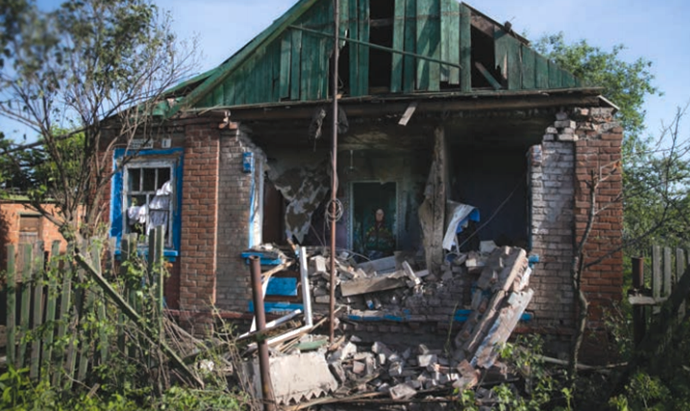
The UN has expressed its major concern over the plight of the eastern Ukrainian territories and their soaring numbers of refugees. There are 118,000 internally displaced people, and 740,000 have fled to Russia during the crisis.
“What we are scared about is the way the military operations are conducted. What will happen if we have intense fighting inside the big urban centers of Lugansk and Donetsk? Fighting in highly intensified urban areas could lead to massive exodus and massive destruction,” UN High Commissioner for Refugees Vincent Cochetel stated on Tuesday.
Almost 4 million people live in a region that has been the hardest-hit by violence, and “face imminent security threats from the fighting,” which has also led to massive damage to infrastructure and the interruption of power and water supplies, John Ging, the head of UN’s Office for Coordination of Humanitarian Affairs, stated.
Donetsk and Lugansk are home to 1.5 million people, and the water supply there has diminished to being only available for a few hours a day. Medical supplies also dangerously low.
Another major concern is that around 70 percent of medics have fled the area.
Currently, 118,000 internally displaced people are registered in Ukraine, with 87 percent of them having fled the east of the country, according to UN data. Over 1,000 people are reportedly leaving the conflict zone each day.
Those numbers can’t be viewed as comprehensive, as “many Ukrainians left their homes without officially registering with the Ukrainian authorities or not addressing them directly.”
740,000 refugees have arrived in Russia since the beginning of this year, according to Russian and UN estimates.
At least 1,367 people, civilians and military, have been killed and 4,087 people wounded by fighting in eastern Ukraine since mid-April.
Ging drew attention to the issue of civilian evacuation from areas affected by the military conflict.
Humanitarian corridors are “open for several hours each day, but these are regularly blocked by combatants, and the evacuation of people through these channels is impeded.”
The UN also demanded that Kiev stops taking customs fees from the humanitarian aid that arrives in the country, and also simplify UN employees’ access into Ukraine.
Moreover, “a unified system is necessary to register the internally displaced persons, a system that will allow to fully analyze and understand the people’s needs,” Ging stated.
“Humanitarian aid should be free of customs payments. Apart from that, it is necessary to accelerate the process of signing and ratifying the agreement between the UN and the government about the simplification of the entry to the country for humanitarian workers and the import of loads,” the official added.
The key component of UN plans to provide humanitarian aid is preparation for the winter when freezing temperatures will prevail.
“We need to assure that all the necessary efforts are taken to address the consequences of the coming winter – which is expected to be severe – for the forcibly displaced people,” Ging stressed.
Beware NYT’s Michael R. Gordon
Stop Him Before He Kills Again!
By John Walsh | CounterPunch | August 5, 2014
“There’s an old saying in Tennessee — I know it’s in Texas, probably in Tennessee — that says, fool me once, shame on — shame on you. Fool me — you can’t get fooled again.”
– George W. Bush
Those in the U.S. who are enthralled by relentless reports of the most demonic acts attributed to President Vladimir Putin and the rebel Eastern Ukrainian federalists a in the New York Times, NPR, ETC. would do well to look at the track record of the “reporters” dishing out this stuff. What they will find is a trail of deception that is piled with corpses of hundreds of thousands of innocents.
Principle among the purveyors of these bloodletting falsehoods is Michael R. Gordon, chief military correspondent for the NYT, serving over the decades as a trusty pipeline from the Pentagon to you. Although his name should be in profound disrepute, many opposed to war are unaware of his ignoble career or may have forgotten it. Most notoriously he is the co-author with Judith Miller of the front page NYT article planted by Dick Cheney’s minions, which claimed that Saddam Hussein had Weapons of Mass Destruction (WMD), relying on the idea that aluminum tubing being purchased by Iraq was to be used for purifying uranium.
Here is a quick reminder of that sorry episode so typical for the NYT. That article, entitled “Threats and Responses: The Iraqis; U.S. Says Hussein Intensifies Quest For A-Bomb Parts,” ran on page one of the NYT on Sunday, September 8, 2002. That same day, with the newsprint barely dry, Cheney popped up on Meet the Press citing the piece and claiming that Saddam Hussein was on his way to making nukes. Appearances on the other Sunday propaganda shows were made that same day by Colin Powell, Donald Rumsfeld, Richard Meyers (Chairman of the Joint Chiefs of Staff) and Condoleeza Rice who employed the infamous phrase used by Miller and Gordon, declaring with a straight face, “We don’t want the smoking gun to be a mushroom cloud.” On October 11, 2002, with an election staring it in the face, the Congress voted authorization for Bush to go to war. (That Constitutional requirement was unceremoniously dropped when Obama decided to make war on Libya. At least Bush took the time to lie to Congress.) As we know all too well now, the entire aluminum tube story was a lie, as was obvious at the time to anyone who read the article with the slightest care and as the Department of Energy and Department of State knew well at the time, as was later disclosed.
But unlike Judith Miller the well connected Gordon escaped punishment for these criminal fictions. And so he went on to peddle ever more lies on Iraq, being the first “journalist” to be embedded with U.S. forces of aggression and later championing the “surge” of his buddy, that great military strategist and legendary lover, David Petraeus. That bit of his career was documented in considerable detail in 2007 by the late Alex Cockburn. Cockburn summed it up thus:
“Gordon managed to dodge the fall-out from the WMD debacle he played a major part in contriving. For example, he co-wrote with Miller the infamous aluminum tubes-for-nukes story of September 8, 2002, that mightily assisted the administration in its push to war. In the latter part of 2006 he became the prime journalistic agitator for escalation in troop strength.
“On September 11, 2006, the Times ran a Gordon story under the headline, ‘Grim Outlook Seen in West Iraq Without More Troops and Aid’. Gordon cited a senior officer in Iraq saying more American troops were necessary to stabilize Anbar. A story on October 22 emphasized that “the sectarian violence [in Baghdad] would be far worse if not for the American efforts” There were of course plenty of Iraqis and some Americans Gordon could also have found, eager to say the exact opposite.”
The next year, 2007, Gordon went on to join the journalistic chorus in its effort to finger Iran as the source of new, more lethal roadside bombs used in Iraq which were called EFP’s (Explosively Formed Penetrators). This was another piece of Cheney propaganda designed to help satisfy his itch to launch a war on Iran. It was quickly exposed by another Cockburn, Andrew, Scott Horton and others. Fortunately this fiction thus exposed passed on quickly.
The point is that Gordon’s career has been not that of a reporter but a propagandist preparing us to accept the next moves of the U.S. Empire. So what is the intrepid Gordon up to these days? Unsurprisingly he is on the job covering the crisis in the Ukraine. He and the rest of the NYT are frantically peddling the wildest of lies about Ukraine, Russia and the ever evil Vlad. Here is a good example from the page one article by Gordon and others on July 18, entitled “U.S. Sees Evidence of Russian Links to Jet’s Downing.” It begins:
“The United States government has concluded that the passenger jet felled over Ukraine was shot down by a Russian-made surface-to-air missile launched from rebel-held territory and most likely provided by Russia to pro-Moscow separatists, officials said on Friday. While American officials are still investigating the chain of events leading to the destruction of Malaysia Airlines Flight 17 on Thursday, they pointed to a series of indicators of Russian involvement……” (Emphasis, jw)
Where is the evidence? The only evidence is that “officials said.” There is no indication of who the “officials” are or precisely what they said. Then there is the hedge phrase “most likely.” And finally Gordon and his co-authors tell us that the unnamed officials are “still investigating.” Finally although there is no conclusion, there are a “series of indicators.” (At the same time the Russian Ministry of Defense has released a lot of verifiable information on the incident, readily accessible on RT.com, whereas the U.S. has produced nothing other than some suspicious anecdotes on social media and a lot of speculation.) Not only should Gordon and his co-authors, Peter Baker and Mark Mazetti, the Judith Millers du jour, be summarily dismissed but also the “editors that let this trash appear as news rather than the unfounded propaganda that it is. (Mazetti and Baker should be leery of being Gordon’s accomplices. He may need a fall guy once again. Think Judith Miller, fellows.)
Let us turn to the notorious Miller and Gordon article of 2002 for comparison with Gordon’s piece on Ukraine. It begins:
“More than a decade after Saddam Hussein agreed to give up weapons of mass destruction, Iraq has stepped up its quest for nuclear weapons and has embarked on a worldwide hunt for materials to make an atomic bomb, Bush administration officials said today. In the last 14 months, Iraq has sought to buy thousands of specially designed aluminum tubes, which American officials believe were intended as components of centrifuges to enrich uranium. American officials said….” (Emphasis, jw)
Remarkable similarity! Cookie cutter prevarication, one might say. “American officials” are ever on the job and ever anonymous. And Michael R. Gordon is front and center on page one as their ever faithful, ever unquestioning transmission belt. No one can possibly think that Gordon is in the business of truth. We would be fools to believe a word he says. He fooled us once (in fact, many times). Shame on us if we let him fool us once again. His lies are laced with blood and death. We should avert our gaze from them.
John V. Walsh can be reached at John.Endwar@gmail.com.
Humanitarian catastrophe: Lugansk, E. Ukraine, left with no water, power
RT | August 5, 2014
The eastern Ukrainian city of Lugansk has declared a state of humanitarian catastrophe over a lack of medical supplies, electricity, lighting, mobile and internet communication. Some 250,000 civilians are unable to leave, the statement also says.
“As of August 5, Lugansk remains disconnected from electricity. The situation remains critical on the city’s territory. Lugansk has no energy, is in a state of humanitarian catastrophe. Since Sunday, part of the population in the region’s center have been without light or water, as well as mobile and internet communication,” the statement on the city council website read.
Due to high temperatures and the damage to most community services’ cars, rubbish collection “completely stopped,” which is why the city is basically “on the brink of an ecological catastrophe,” the administration said.
“Today 250,000 civilian Lugansk residents – mainly retirees and families with children who don’t have the money to leave the city and who have nowhere to go – have been the hostages to the situation: the people are forced to live in the conditions of armed clashes, with the lacking communications, the remaining nutrition disappearing from the counter of shops and supermarkets which are still working,” according to the statement.
An especially burning issue has become the lack of medical supplies.
“People can’t purchase the essential medical supplies, only a handful of drugstores are operating,” the statement added.
“Many people have left the town – I had almost no one left, only my sister. If you had gone out to your balcony in the evening, there would be a feeling that the city had died out,” a former resident of Lugansk, Olga, who recently moved to more peaceful Kharkov, told Ria Novosti.
Transport communication is no good in the embattled city these days, Olga said.
“The buses go to Kharkov, Starobelsk. <…> In the city, the buses are infrequent, they used to come every five minutes, now it’s half an hour. The drivers won’t keep to the route – it’s dangerous. Also, there is no petrol, and if there is, it’s very expensive. No trolleybuses or tramways are left.”
The shops work several hours a day, and Olga said the prices have increased, there are almost no cigarettes on sale, but it’s still possible to buy food.
In the evenings, people try not to go out. Attacks and clashes are an every-day occurrence.
The Ukrainian army has approached the outskirts of Donetsk and Lugansk, preparing to storm these cities, the speaker for the Council of National Security and Defense, Andrey Lysenko, declared, as quoted by Ria Novosti.
“The main forces of the anti-terrorist operation, including the territorial battalions have approached those areas. It doesn’t mean that the storming has already started, but preparation to free the cities is on,” he said.
The attack won’t be announced, only the seizing of the cities, Lysenko added.
Over 400 Ukrainian troops cross into Russia for refuge
RT | August 4, 2014
More than 400 Ukrainian troops have been allowed to cross into Russia after requesting sanctuary. It’s the largest, but not the first, case of desertion into Russia by Ukrainian soldiers involved in Kiev’s military crackdown in the east of the country.
According to the Rostov Region’s border guard spokesman Vasily Malaev, a total of 438 soldiers, including 164 Ukrainian border guards, have been allowed into Russia on Sunday night.
One of the Ukrainians was seriously injured on his arrival in Russia. He was taken to the hospital for surgery, the officials added.
The other Ukrainian soldiers have been housed in a tent camp deployed near the checkpoint via which they entered Russian territory. The Russian border guards are providing them with food and bedding.
Footage taken by the Russian media at the scene showed the Ukrainian soldiers being handed ration packs and resting in their temporary shelter. Those who agreed to speak on camera said they were relieved to be in safety for the first time in weeks.
“We were given an order to leave our positions and go to Russia trough a corridor. We were told it would be safe. Of course they, I would say, made us go fast from behind,” one of the soldiers, a BMP driver who would not reveal his name or even show his face on camera, said.
“It was so bad back there. Hot, and so many deaths and bad things,” another one, Dmitry, said. “Folks can rest here. They gave us a chance to wash, gave us new clothes. We are thankful.”
“We have been in those fields for more than six months and are very tired,” he added.
Another one, Yaroslav, said he wishes to go back to his family in Ukraine.
“I want to do something peaceful. My contract expired four months ago,” he explained.
On Sunday, the Ukrainian anti-government militia reported that it was in negotiations with a large contingent of Ukrainian troops they encircled in Lugansk region on a possible surrender. The negotiations were being hampered by the troops’ intention to destroy some 70 armored vehicles in their possession before laying down arms, which the militia wanted to capture intact.
The Gukovo border checkpoint, through which the Ukrainian troops crossed into the Russian territory, is located on Russia’s border with the Lugansk Region of Ukraine, indicating that these are the same troops that were negotiating with the militia. If so, it was not immediately clear whether the vehicles they had were really destroyed.
OSCE monitors and journos come under shelling from Ukraine at Russian border
The flow of deserters from the ranks of Ukrainian Army and National Guard seems to be increasing amid the escalating violence in Donets and Lugansk Regions, where Kiev is fighting against armed anti-government militias.
In late July 41 Ukrainian troops fled to Russia to escape fighting in eastern Ukraine. They are now being prosecuted in Ukraine for deserting in the heat of battle.
Several Ukrainian units have been reported to recently to be cut off from supply lines after attempted offensive operations, which brought them behind the militia-controlled territories and close to the Russian border.
The Ukrainian troops, while far superior to the militia in terms of heavy weapons, suffer from poor logistics. Many soldiers complain about lacking even basic supplies like food and water on the frontline. The situation is aggravated by cases of apparent negligence from the command, with units being supplied with faulty equipment, coming under friendly fire and simply left behind while retreating from militia counter-attacks.
A YouTube video allegedly shows a Ukrainian soldier explaining how he has to catch and cook snakes because his unit receives no rations.
Kiev’s National Guard unit mutiny: ‘We’ve been discarded like trash’
This causes serious morale problems in the army, with more critical voices saying the Ukraine de facto has no infantry troops and has no other way to fight but by leveling militia-held cities to the ground with artillery and air strikes.
There is a growing resistance to the military campaign among Ukrainian population, with several cases of mass protests against the latest mobilization drive, as mothers and wives of conscripts took to the streets to demand that their loved once not be drafted into the army.
NATO exerting pressure, not interested in MH17 investigation – Russia’s mission
RT | August 4, 2014
Without waiting for MH17 crash investigators’ conclusions, NATO chief Anders Fogh Rasmussen, is eager to blame anti-Kiev forces, thus “exerting pressure” on the international team while providing no evidence to back the claims, Russia’s mission to NATO said.
The Russian mission to NATO has said that the bloc’s Secretary General “decided not to wait until the end of #MH17 investigation” to blame the anti-Kiev forces for shooting down the plane, referring to Rasmussen’s comments in Sunday’s interview with the French Midi Libre.
The mission also wondered why “NATO is not interested in impartial MH17 investigation?” adding that “if the Alliance had evidence – why did it keep silent?”
In Sunday’s interview, Rasmussen stated that NATO has “a lot of information that indicate the separatists, supported by the Russians, are guilty [of MH17 tragedy]”, calling it a “war crime” the perpetrators of which “must be brought to justice as soon as possible.”
Although he admitted the necessity of a “full independent international inquiry to establish the facts,” Rasmussen did not seem to be willing to wait for the conclusions of the international investigation team working in Eastern Ukraine at the crash site.
NATO’s chief did not provide the French media with any evidence, and when RIA Novosti reached out for a comment, NATO replied that they “do not comment on the course of the investigation.” In fact, NATO told RIA earlier that the organization is not participating in the international investigation effort, indicating that secret “evidence” may never be shared even with the investigators.
The Russian Ministry of Defense on the contrary held a substantial press conference several days after the crash, presenting some of the data of recorded by radars and satellites, and urging all parties rightly committed to a thorough investigation to do the same. Kiev at the same time seized all the records from its air-control tower, and has still not released them, two weeks after the tragedy.
During the course of the interview, Rasmussen repeatedly accused anti-Kiev forces of not allowing the international investigation’s team to approach the crash site, calling it a “problem and a challenge.”
“Why do separatists not provide access to the crash site? There is something to hide,” he said, repeating that remark again when asked for any proof to back his claims.
However, the international team of over 100 Australian and Dutch experts, accompanied by OSCE monitors, were working at the crash site for a third consecutive day on Sunday. The OSCE highlighted earlier that the convoy “comprised 25 vehicles, including a bus and two mobile ambulances” went “smoothly and was well organized.”
The ceasefire around the disaster area, promised by Ukraine’s President Petro Poroshenko, has repeatedly been broken over the last two weeks, with Kiev forces shelling the areas immediately adjacent to the crash site. Meanwhile, Kiev official’s aspiration to “cleanse of the militias and take control of this territory,” Russia’s UN envoy Vitaly Churkin says, could indicate that it is Kiev who wants to destroy implicating evidence.
Instead of spreading unsubstantiated accusations and insinuations, the concerned parties should better share the objective observation data of the disaster area with the international organizations, the Russian diplomat added.
Besides social media reports and “common sense”, the only “proof” so far – produced by Kiev to back claims it didn’t deploy anti-aircraft batteries around the MH17 crash site – are the satellite images, which carry altered time-stamps and are from days after the MH17 tragedy, the Russian Defense Ministry has revealed. The images were apparently taken by a US spy satellite, which the Pentagon hesitates to release in its own name, the ministry added, since Ukraine has no such technical capabilities.
The ministry also criticized images published by Kiev to back its allegations that Russia smuggled heavy weapons over the border. The images lack proper time stamps and coordinates, while Kiev didn’t bother to explain why it believes that whatever vehicles are shown in them are Russian. And at least one picture released by the SBU in that set was an absolutely irrelevant old photo showing Ukraine’s own missile launcher changing position three months prior to the MH17 incident.
‘Defense plans to battle Russian aggression’
In the meantime, Rasmussen said that the alliance will soon come up with defense plans to confront “Russia’s aggression” against Ukraine.
“Russia’s aggression was a warning and created a new security situation in Europe,” he told the French publication. “We will strengthen military exercises and prepare new defense plans.”
NATO’s chief also called on member countries to increase their military budget to match the perceived threat from Moscow.
“I will encourage NATO countries to increase their defense investments. Over the past five years, Russia has increased its spending on defense by 50 percent, and NATO countries have reduced theirs by an average of 20 percent,” he added. “We must reverse the trend.”
In the meantime this week the European Union “quietly” agreed to lift restrictions supplying Kiev with military technology and equipment, while the Obama administration officially informed Congress on Friday of its plans to train and equip the Ukrainian National Guard.
Black boxes: ‘Nothing out of the ordinary so far’
Preliminary examination of flight MH17’s cockpit voice recorder (CVR) revealed “nothing out of the ordinary,” a source close to the international investigation told the New Sunday Times.
The data refers to the UK Air Accidents Investigation Branch downloaded communications between the Malaysia Airlines’ pilot and an unspecified person with an air traffic controller (ATC), the publication reports.
“So far, from what the team has heard, there was nothing unusual. The last voice heard was not the pilot’s. No, there was no indication that the pilots saw or sensed anything off,” the source said.
Asked about the Ukrainian government’s Monday statement that the airliner was brought down by “a massive explosive decompression,” the source said such conclusions, so far have been “unconfirmed.”
The Dutch Safety Board (DSB), which is heading the investigation into the crash, was puzzled by statements coming from Kiev. According to DSB spokeswoman Sara Vernooij, the “premature” release of details of MH17 black boxes is “not in the best interest of the investigation.”
The publication points out it remains unclear if the team had secured the recordings from the Ukrainian air traffic controllers to match the conversations between the ATC staff and the MH17 flight crew.
The plane’s two black boxes were given to Malaysian authorities last week and then sent to the UK for comprehensive analysis.
~
READ MORE: 10 more questions Russian military pose to Ukraine, US over MH17 crash
US intelligence: No direct link to Russia in Malaysia plane downing
MH17 disaster:Federal Air Transport Agency’s questions to Ukraine
Why Won’t Obama Just Leave Ukraine Alone?
By Ron Paul | August 3, 2014
President Obama announced last week that he was imposing yet another round of sanctions on Russia, this time targeting financial, arms, and energy sectors. The European Union, as it has done each time, quickly followed suit.
These sanctions will not produce the results Washington demands, but they will hurt the economies of the US and EU, as well as Russia.
These sanctions are, according to the Obama administration, punishment for what it claims is Russia’s role in the crash of Malaysia Airlines Flight 17, and for what the president claims is Russia’s continued arming of separatists in eastern Ukraine. Neither of these reasons makes much sense because neither case has been proven.
The administration began blaming Russia for the downing of the plane just hours after the crash, before an investigation had even begun. The administration claimed it had evidence of Russia’s involvement but refused to show it. Later, the Obama administration arranged a briefing by “senior intelligence officials” who told the media that “we don’t know a name, we don’t know a rank and we’re not even 100 percent sure of a nationality,” of who brought down the aircraft.
So Obama then claimed Russian culpability because Russia’s “support” for the separatists in east Ukraine “created the conditions” for the shoot-down of the aircraft. That is a dangerous measure of culpability considering US support for separatist groups in Syria and elsewhere.
Similarly, the US government claimed that Russia is providing weapons, including heavy weapons, to the rebels in Ukraine and shooting across the border into Ukrainian territory. It may be true, but again the US refuses to provide any evidence and the Russian government denies the charge. It’s like Iraq’s WMDs all over again.
Obama has argued that the Ukrainians should solve this problem themselves and therefore Russia should butt out.
I agree with the president on this. Outside countries should leave Ukraine to resolve the conflict itself. However, even as the US demands that the Russians de-escalate, the United States is busy escalating!
In June, Washington sent a team of military advisors to help Ukraine fight the separatists in the eastern part of the country. Such teams of “advisors” often include special forces and are usually a slippery slope to direct US military involvement.
On Friday, President Obama requested Congressional approval to send US troops into Ukraine to train and equip its national guard. This even though in March, the president promised no US boots on the ground in Ukraine. The deployment will be funded with $19 million from a fund designated to fight global terrorism, signaling that the US considers the secessionists in Ukraine to be “terrorists.”
Are US drone strikes against these “terrorists” and the “associated forces” who support them that far off?
The US has already provided the Ukrainian military with $23 million for defense security, $5 million in body armor, $8 million to help secure Ukraine’s borders, several hundred thousand ready-to-eat meals as well as an array of communications equipment. Congress is urging the president to send lethal military aid and the administration is reportedly considering sending real-time intelligence to help target rebel positions.
But let’s not forget that this whole crisis started with the US-sponsored coup against Ukraine’s elected president back in February. The US escalates while it demands that Russia de-escalate. How about all sides de-escalate?
Even when the goals are clear, sanctions have a lousy track record. Sanctions are acts of war. These sanctions will most definitely have a negative effect on the US economy as well as the Russian economy. Why is “winning” Ukraine so important to Washington? Why are they risking a major war with Russia to deny people in Ukraine the right to self-determination? Let’s just leave Ukraine alone!
Featured Video
No Vote, No Representation, No State: Democracy, Israeli Style
or go to
Aletho News Archives – Video-Images
From the Archives
Sanctions, War and the Policy of Dual Containment
By SASAN FAYAZMANESH | March 17, 2008
It is now nearly three decades since the Unites States adopted the policy of dual containment of Iran and Iraq. While much has been written about the containment of Iraq, there has been very little in-depth analysis of this policy when it comes to Iran. In a book that is going to be released on March 31, 2008, entitled The United States and Iran: Sanctions, Wars and the Policy of Dual Containment (Routledge), I attempt to address this shortcoming by investigating when and why the US policy of containment of Iran came about, how it evolved, and where it stands today.[1] To the extent that Israel has been involved in US policy making, the study will also include the role that Israel has played in the containment of Iran. Also, since the fate of Iran has been inextricably linked to that of Iraq, occasionally the investigation will overlap with the containment of Iraq.
The policy of dual containment of Iran and Iraq originated during the Carter Administration, but it was not until the Clinton Administration that the expression “dual containment” became popular. … continue
Blog Roll
 Aletho News
- No Vote, No Representation, No State: Democracy, Israeli Style
- Zionist Bought Senate Blocks Information About American Citizens Killed By Israel
- While Gaza dominates the UN, these are the people keeping it alive
- New Report: “Scholasticide and Genocide in Gaza: Assessment, Testimonies and Legal Analysis”
- ‘THAAD Delusion’: Iran war exposes US missile shield limits – The Atlantic
- Moscow issues warning to NATO over Russian exclave
- Yes, the Iran war has destroyed Trump’s presidency
- The fallacy of US delusions about Iran’s economic collapse
- Hezbollah denies Syria cell link, warns of Israeli plan to sow discord
- The legacy of US sanctions, war, and occupation in Iraq
- If Americans Knew
- Mamdani releases plan to combat antisemitism and hate crimes in New York City
- Iran’s Revolutionary Guards Publish Letter to the American People
- DMFI launches $1 million ad campaign supporting Virginia’s Elaine Luria
- US Senate blocks resolution seeking report on Americans killed by Israel
- Israeli Attacks Kill Ten Palestinians in Gaza
- Massacre at Minab: The School That Became a Grave
- Israeli media: The IDF Shows It Doesn’t Turn a Blind Eye; It Actively Emboldens Settler Havoc
- As settlers ravage West Bank, Israeli forces kill 10 in Gaza – Daily Update
- New Report: “Scholasticide and Genocide in Gaza: Assessment, Testimonies and Legal Analysis”
- Ex-Biden officials are desperate for a Gaza scapegoat
- No Tricks Zone
- Green Energy Debacle: German Expert Professor Fritz Vahrenholt Warns Of Severe Economic And Social Consequences
- Two More Paleo Reconstructions Affirm Meters-Higher Sea Levels Across Ireland, Brazil 7000-6000 Years Ago
- New Study: Earth And Venus Surface Warmth Largely Explained By Convection And Lapse Rate, Not CO2 Or Radiation
- 2025 Nature Paper Claiming Worsening Global Drought Gets RETRACTED …Heavily Flawed
- New Study: ‘Global Drought Shows No Detectable Recent Acceleration Under Climate Warming’
- Economic Masterminds: German Socialists Suggest Taxing Productivity Gains Stemming From Using AI
- The South China Sea Has Not Been Cooperating With The Climate Change Narrative
- Energy Crisis: Germany Enters Heating Season With Historically Low Gas Reserve Fill Levels
- New Study: The Antarctic Ice Sheet Gained Mass From 2020-2024 Due To Staggering Snow And Ice Accumulation
- Study: Ocean Heating Rates From Thousands Of Years Ago ‘Dwarf’ Modern Ocean Heating Rates

