West has more influence than Kiev on oligarchs’ armies in Ukraine – Lavrov
RT | August 18, 2014
Moscow believes the West has more influence on various paramilitary forces in Ukraine – sponsored by local oligarchs – than Kiev does, Russian FM Lavrov said citing the latest bickering between Right Sector and the Interior Ministry.
“The authorities in Kiev are not in control of the numerous paramilitary forces, including Right Sector, which, we estimate, comprises a large portion of the National Guard. The demarche of Right Sector towards the Ukrainian Interior Minister speaks for itself,” Sergey Lavrov said, adding that existence of armed groups sponsored by Ukrainian oligarchs, such as the Azov and Dnepr battalions, poses a great security threat.
“We work with our Western partners in Europe and the United States who can really influence those paramilitary units that don’t answer to the central government in Kiev. We know the West has such influence,” he added.
Lavrov was referring to the weekend ultimatum of the far-right group, which threatened to pull out its troops from eastern Ukraine and march on Kiev unless President Petro Poroshenko fires several police officials, including a deputy interior minister. The group later reduced its demands, saying that the release of its activists previously arrested by the police was sufficient.
The comments from the top Russian diplomat came as he reported on the progress achieved during the Sunday meeting with his counterparts from Ukraine, Germany and France. The roundtable produced no concrete agreements, but the parties involved said some progress was made on the issues of humanitarian aid and border control.
Speaking to journalists on Monday, Lavrov said Moscow would welcome the observer mission of the Organization for Security and Cooperation in Europe (OSCE) deploying drones to control the Russian-Ukrainian border from the Ukrainian side.
Lavrov said Russia is working with the OSCE on giving more transparency in the border region, which is important, considering how often Kiev voices false reports on alleged violation of the border from the Russian side. He cited the latest claim by Kiev on Friday, when the Ukrainian military said it had destroyed a column of Russian armor after an incursion into Ukraine.
“What really happened was a Ukrainian column moved in the Lugansk Region, obviously to intercept the route of a potential humanitarian aid delivery. That column was destroyed by the militia,” he said. “If such episodes are presented as glorious successes of the Ukrainian army, then please don’t accuse us of anything.”
Russia has sent a convoy of humanitarian aid meant for war-torn eastern Ukraine. The trucks have not been allowed entry by the Ukrainian side, which voiced suspicions about the nature of the cargo and demanded that the delivery be conducted by the International Committee of the Red Cross.
Lavrov noted that the media hype over the mission, which was apparent in the West in its early days, evaporated as soon as it became clear that the column actually carries humanitarian aid and is not some kind of a trick used by Russia to invade Ukraine, as Kiev initially claimed.
The minister also criticized Kiev’s request for NATO’s aid against the militia in eastern Ukraine, saying that it “goes against all the agreements we had reached on stopping the hostilities and initiating negotiations.”
“As long as the authorities in Kiev bet on the use of force and consider a military victory over their own people a necessary condition for keeping themselves in power, I don’t think any good will come from what we are trying to achieve,” he said.
Dangerous Western lies provoke wars
By Paul Craig Roberts | Press TV | August 18, 2014
The Western media have proved for all to see that the Western media comprises either a collection of ignorant and incompetent fools or a brothel that sells war for money.
The Western media fell in step with Washington and blamed the downed Malaysian airliner on Russia. No evidence was provided. In its place the media used constant repetition. Washington withheld the evidence that proved that Kiev was responsible. The media’s purpose was not to tell the truth, but to demonize Russia.
Now we have the media story of the armored Russian column that allegedly crossed into Ukraine and was destroyed by Ukraine’s rag-tag forces that ISIS would eliminate in a few minutes. British reporters fabricated this story or were handed it by a CIA operative working to build a war narrative. The disreputable BBC hyped the story without investigating.
The German media, including Die Welt, blared the story throughout Germany without concern at the absence of any evidence. Reuters news agency, also with no investigation, spread the story. Readers tell me that CNN has been broadcasting the fake story 24/7. Although I cannot stand to watch it, I suspect Fox “news” has also been riding this lame horse hard. Readers tell me that my former newspaper, The Wall Street Journal, which has fallen so low as to be unreadable, also spread the false story. I hope they are wrong. One hates to see the complete despoliation of one’s former habitat.
The media story is preposterous for a number of reasons that should be obvious to a normal person.
The first reason is that the Russian government has made it completely clear that its purpose is to de-escalate the situation. When other former Russian territories that are part of present day Ukraine followed Crimea, voted their independence and requested reunification with Russia, President Putin refused.
To underline his de-escalation, President Putin asked the Russian Duma to rescind his authority to intervene militarily in Ukraine in behalf of the former Russian provinces. As the Russian government, unlike Washington or EU governments, stresses legality and the rule of law, Russian military forces would not be sent into Ukraine prior to the Duma renewing Putin’s authority so to do.
The second reason the story is obviously false is that if the Russian government decides to invade Ukraine, Russia would not send in one small armored group unprotected by air cover or other forces. If Russia invades Ukraine, it will be with a force capable of rolling up the rag-tag Ukrainian forces, most of which are semi-private militias organized by nazis. The “war” would last a few hours, after which Ukraine would be in Russia’s hands where it resided for hundreds of years prior to the dissolution of the Soviet Union and Washington’s successful efforts in 1991 to take advantage of Russian weakness to break apart the constituent provinces of Russia herself.
The third reason that the story is obviously false is that not a single Western news organization hyping the story has presented a shred of evidence in its behalf.
What we witness in this fabricated story is the total lack of integrity in the entirety of the Western media.
A story totally devoid of any evidence to support it has been broadcast world wide. The White House has issued a statement saying that it cannot confirm the story, but nevertheless the White House continues to issue accusations against Russia for which the White House can supply no evidence. Consequently, Western repetition of bald-faced lies has become truth for huge numbers of peoples. As I have emphasized in my columns, these Western lies are dangerous, because they provoke war.
The same group in Washington and the same Western “media” are telling the same kind of lies that were used to justify Washington’s wars in Iraq (weapons of mass destruction), Afghanistan (Taliban = al-Qaeda), Syria (use of chemical weapons), Libya (an assortment of ridiculous charges), and the ongoing US military murders in Pakistan, Yemen, and Somalia.
The city upon the hill, the light unto the world, the home of the exceptional, indispensable people is the home of Satan’s lies where truth is prohibited and war is the end game.
No green light to Red Cross: Russian aid convoy stuck at Ukraine border waiting for Kiev’s nod
RT | August 16, 2014
The Red Cross has sent a formal request to Kiev to allow the Russian humanitarian aid to enter eastern Ukraine but has so far received no answer and the convoy has remained stuck on the border of the war-torn zone since August 14.
On Saturday, the head of the International Committee of the Red Cross (ICRC) delegation arrived in Russia’s southern Rostov region to help to iron out the difficulties of the delivery of the Russian humanitarian aid to eastern Ukraine.
Russia sent 280 trucks with medical supplies, food, including baby food, sleeping bags and other basic necessities to southeastern Ukraine on Tuesday. But the cargo still has not reached the residents of the regions badly hit by the conflict as the Kiev government has yet to formally approval for the convoy to cross into Ukraine.
The sides – including Russian and Ukrainian border guards and customs officials – spent several hours in talks trying to reach a compromise over the issue.
They “made quite some progress,” Red Cross official Pascal Cuttat told the media after the meeting.
For now the procedures of the cargo customs clearing and the inspection of all the trucks by the ICRC at the border have been agreed upon. It was also agreed that every Russian vehicle delivering the aid will be accompanied by a Red Cross employee once the convoy gets on Ukrainian soil.
However, it is not clear when exactly ICRC will be able to inspect the trucks.
“The ICRC has sent a paper to Kiev formally requesting that this convoy can be processed. We are waiting for the answer to this request,” the organization’s official said.
However, the key element for the convoy to proceed remains security on its way to the regions that have been at the epicenter of fierce fighting between the Ukrainian army and local self-defense troops.
“There remains one, of course, major challenge: we absolutely need security guarantees from all parties concerned before we can start moving,” Cuttat said.
That issue, he added, will have to be sorted once Kiev allows the delivery of the cargo.
Earlier on Friday, the Russian Foreign Ministry said Kiev is trying to review the agreements on Russian humanitarian aid.
“We categorically deny the ill-meaning manipulation of facts that has been recently done by representatives of some of Ukraine’s government bodies. In particular, according to media reports, the representatives of the Ukraine’s Security Council state that the Russian side refused to deliver the humanitarian aid via the border posts controlled by Ukraine. Wild guesses circulate that we allegedly didn’t provide the information on the contents of the humanitarian aid. Both allegations are contrary to the facts,” the ministry said in a statement.
Russia voices concern over increased US and NATO military activity near Russian border
In a telephone conversation with his U.S. colleague Chuck Hagel, Shoigu also called for an immediate ceasefire in eastern Ukraine
ITAR-TASS | August 15, 2014
MOSCOW – Russia’s Defence Minister Sergei Shoigu on Friday voiced serious concern over increased U.S. and NATO military activities near the Russian border.
In a telephone conversation with his U.S. colleague Chuck Hagel, Shoigu also called for an immediate ceasefire and safe corridors to deliver humanitarian aid and evacuate civilians from the combat area in eastern Ukraine.
He gave a detailed assessment of Ukrainian troops’ actions in the combat area. Shoigu said it was unacceptable to use combat aviation, heavy weapons, including rockets, artillery and missiles, against civilians and the region’s civilian infrastructure.
Shoigu described the situation in the area as “a humanitarian catastrophe”.
He also told Hagel about the efforts being taken to deliver humanitarian aid to eastern Ukraine and problems with the movement of the humanitarian convoy.
The Russian Defence Ministry described the conversation as “business-like and constructive” and said Shoigu and Hagel had agreed to continue contacts.
No Russian troops crossed into Ukraine – FSB
RT | August 15, 2014
Russia’s Defense Ministry has denied Kiev’s report that it “destroyed the Russian military column” which allegedly crossed into Ukraine, saying that no such column ever existed.
Earlier on Friday Russia’s Security Service (FSB) also denied the reports. Border guards have been deployed to provide security near the frontier, but they operate only on the Russian side, the FSB said.
The mobile military teams “operate strictly within the territory of the Russian Federation,” a spokesperson for the FSB Border Guard Service in Rostov region told RT on Friday.
Russia has stepped up security measures on its border with Ukraine as local residents are under constant threat because of “regular cross-border shelling” and an increased number of “mass border crossings” by the Ukrainian military, he explained. For that reason, FSB mobile border guards’ teams have been created.
“When residents report about cross-border shooting and fighting in the frontier zone, these teams are immediately deployed to such areas to provide the safety of the Russian state border and Russian citizens, and also to prevent armed people from crossing into the territory of the Russian Federation,” Sinitsyn said.
Earlier, several foreign news agencies caused quite a stir, reporting that a convoy of Russian military vehicles had crossed into Ukraine overnight.
The reports triggered criticism from NATO and some European states.
NATO chief Anders Fogh Rasmussen referred to the alleged incident as to “a Russian incursion” that they “saw.”
“Last night we saw a Russian incursion, a crossing of the Ukrainian border,” he said Friday, adding that “it is a clear demonstration of continued Russian involvement in the destabilization of eastern Ukraine.”
British Foreign Secretary Philip Hammond said he was “very alarmed by the reports.”
“Of course the humanitarian convoy itself is a separate issue, but if there any Russian military personnel or vehicles in eastern Ukraine they need to be withdrawn immediately or the consequences could be very serious,” he told reporters in Brussels, where European Union foreign ministers had gathered for an emergency meeting to discuss crises in Ukraine and Iraq.
In an article published by The Guardian, reporter Shaun Walker said he “saw a column of 23 armored personnel carriers, supported by fuel trucks and other logistics vehicles with official Russian military plates, traveling [toward] the border near the Russian town of Donetsk.” Late on Thursday the convoy “crossed into Ukrainian territory,” he said. However, no photographic or video evidence of the incident was presented either in his article or in his Twitter feed. The photograph published with the text was taken on Russian territory.
The Telegraph also reported that “at least 23” Russian vehicles had crossed into Ukraine. The report is accompanied by a video also filmed on Russian territory.
EU sanctions ‘shooting oneself in the foot’ – Hungary PM
RT | August 15, 2014
Hungarian Prime Minister Viktor Orban has urged a rethink of the European Union’s sanctions policy towards Russia, saying the measures are like “shooting oneself in the foot.”
“The sanctions policy pursued by the West, that is, ourselves, a necessary consequence of which, has been what the Russians are doing, causes more harm to us than to Russia,” Reuters quotes Orban talking on radio, he added “in politics, this is called shooting oneself in the foot.”
Russia is Hungary’s largest trade partner outside of the EU, with exports worth $3.4 billion in 2013. Also it is highly dependent on Russian energy. Earlier this year Hungary agreed a $13 billion deal with Russian power company Rosatom to expand the country’s only nuclear power plant.
“The EU should not only compensate producers somehow, be they Polish, Slovak, Hungarian or Greek, who now have to suffer losses, but the entire sanctions policy should be reconsidered,” the Hungarian Prime Minister said, saying he is already looking for support to force through changes.
Despite the negative sentiment on Tuesday, Hungary’s Agriculture Ministry stressed the Russian embargo won’t significantly affect the Hungarian economy as the banned products account for less than a third of Hungarian agricultural exports to Russia, being only one percent of total national farming exports.
Despite weak growth in the eastern countries of the EU, Hungary, together with Slovakia and Bulgaria have shown better than expected figures, with 0.8 percent quarterly expansion according to Thursday’s preliminary GDP estimates.
On Thursday, Matteo Salvini the leader of Italy’s Northern League party called on Brussels to immediately repeal the sanctions against Russia.
“Only fools, Brussels and Rome, could decide to impose economic sanctions against Russia, which now sends us back tons of Italian agricultural products worth more than €1 billion,” Salvini wrote on his Facebook page “Who will pay our farmers? Renzi? Merkel?”
The politician claims that in order to please US President Barack Obama and German Chancellor Angela Merkel, the Italian Prime Minister Matteo Renzi has “ruined the economy” of the country.
Ukraine’s Parliament adopts law allowing sanctions against Russia
RT | August 14, 2014
Ukraine’s parliament adopted Thursday legislation allowing more than 20 sanctions to be applied against Russia, including a halt to energy transit through the country.
The new law on international sanctions was supported by 244 members of parliament, with 226 votes needed for a majority.
The adoption of the legislation doesn’t mean the special economic restrictions will be applied automatically; it just creates the legal basis for applying them.
The law provides the option to introduce more than 25 types of sanctions on other countries, foreign legal entities and individuals, which according to Kiev are involved in financing terrorism and support the separation of Crimea from Ukraine.
The sanction options include blocking and freezing assets, a ban on business activity in Ukraine, barring participation in privatizations, halting the use of licenses and all transit through its territory. Special economic measures also involve a ban on financial transactions, as well as a ban on entry and movement across the country.
The legislation says sanctions could be applied if, “the activity of a foreign state, a foreign legal entity or individual, other entities that create real and potential threats to national interests, national security, sovereignty and territorial integrity of Ukraine, its economic independence and/or violate the rights and freedoms of its citizen, the interests of society and the state, leading to the occupation of the territory, expropriation or restriction of property rights, property damage, creating obstacles to sustainable economic development or the fulfillment by Ukrainian citizens of their rights and freedoms.”
According to the law, sanctions must be approved by the National Security Council and are introduced by presidential decree. This applies to all of them, except those sanctions related to international treaties. Those decisions will be made by the country’s parliament, the Rada.
On Tuesday the parliament adopted the first reading of sanctions against Russia as members disagreed on a number of issues and needed further debate.
Red Cross to help Russian aid convoy into Ukraine
The BRICS Post | August 14, 2014
A day after Ukraine’s government said it would not permit the Russian humanitarian aid convoy to enter its territory, the International Committee of the Red Cross (ICRC) said it would hold talks in Kiev and Moscow to help Russian aid reach residents trapped by the conflict in Eastern Ukraine.
Ukrainian Prime Minister, Arseniy Yatsenyuk, had said on Wednesday Ukraine would only accept humanitarian aid from the Red Cross.
A Reuters report quoted Anastasia Isyuk, an ICRC spokesperson on Thursday as saying a senior official will travel to Kiev and Moscow for talks.
Laurent Corbaz, head of ICRC Operations for Europe and Central Asia, who will leave Geneva today said “the delivery of aid should not be politicized”.
“The question of border crossing procedures and customs clearance (for the aid convoy) still have to be clarified between the two sides,” Isyuk said.
Kremlin aid Dmitry Peskov said on Wednesday that the Russian aid convoy with 280 trucks was continuing to move through Russia towards Ukrainian borders.
The Russian aid consisted of food items like cereals, sugar, infant food, medical drugs, sleeping bags and power generators and was meant for the Donetsk and Lugansk regions in eastern Ukraine.
The UN says more than 2000 people have been killed since Kiev launched its crackdown against pro-Russia rebels.
Meanwhile, a Deutsche Welle report said on Wednesday German Chancellor Angela Merkel intends to continue the talks on the settlement of the Ukrainian crisis with Russian President Vladimir Putin despite the sanctions imposed on Moscow.
Several rounds of US and EU sanctions have already targeted Russia’s defense, energy and banking sectors, punishing Moscow for its alleged support to rebels in eastern Ukraine.
Death toll in Ukraine conflict doubles in 2 weeks, reaches 2,086 – UN

People in Lugansk carry the bodies of those killed during an artillery attack on the city (RIA Novosti / Valery Melnikov)
RT | August 13, 2014
The number of killed and wounded in eastern Ukraine has doubled to 2,086 over the last two weeks, according to the UN’s “very conservative estimates”.
“This corresponds to a clear escalating trend,” UN human rights spokeswoman Cecile Pouilly told Reuters in response to a query.
Over 60 people have been killed or wounded every day, Pouilly added.
Almost 5,000 have been wounded.
The figures comprise Ukrainian military, self-defense forces, and civilians. However, those are “very conservative estimates,” Pouilly said.
The Ukraine crisis has been widely described as a humanitarian catastrophe. According to the UN’s latest estimates, over 110,000 people have been internally displaced in the conflict. Moscow has reported that 730,000 people have fled across the border into Russia.
In Donetsk alone, more than 1,000 people have been left homeless due to the fighting, according to the city administration. In Lugansk, another regional center, 250,000 people can’t leave the city and have been without water, electricity, and communications for over a week.
Kiev: Russia’s humanitarian convoy will not be allowed into Ukraine
RT | August 12, 2014
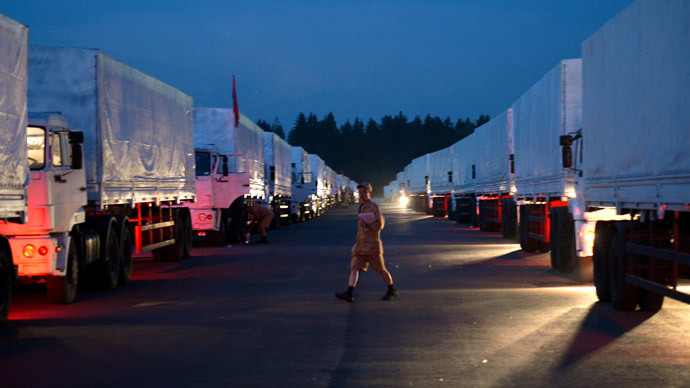
Kiev intends to hold up the internationally-supervised Russian humanitarian aid convoy meant for East Ukraine for at least a week, a spokesman for the Ukrainian military said.
Ukraine said the time is needed for the International Committee of the Red Cross (ICRC), which is contributing to the Moscow-initiated mission, to establish where the aid should go in the Ukrainian region engulfed by civil war.
The convoy of 280 trucks dispatched on Tuesday “did not pass the ICRC certification,” Andrey Lysenko said.
Presidential aide Valery Chaliy said Kiev wants the entire cargo to be unloaded on the border and transferred to Red Cross vehicles.
“We will not allow any escort of the Russian Emergencies Ministry or Russian military,” he said. “Ukraine will take responsibility for this procedure.”
Lysenko claimed that the convoy consists of repainted military trucks and is accompanied by an S-300 air defense system, according to the news agency Ukraine National News.
He didn’t elaborate on why Russia would need to send a system that is meant to protect key strategic positions from enemy aircraft and missiles, but is useless in guarding a convoy of vehicles on the move.
The ICRC said it was informed by Moscow that the convoy had been dispatched, but had yet to receive detailed shipping lists and distribution plans.
“The situation is changing by the hour and right now we are not in a position to provide further details now as to how this operation could take place,” ICRC spokesperson Anastasiya Isyuk told RT.
Earlier, Moscow said that the humanitarian mission had been agreed by all parties concerned.
Russia has sent some 2,000 tons of aid to Ukraine, including food, medicine, sleeping bags and power generators.
The cargo is meant for the Donetsk and Lugansk regions, which have seriously suffered in more than three months of warfare, as Ukrainian troops used heavy artillery, bomber aircraft and tanks to advance on cities controlled by the militias.
Kiev earlier accused Moscow of trying to conduct a stealth invasion of Ukraine under a guise of humanitarian aid, saying that Russian troops would be posing as guards of the convoy while actually tasked with starting an offensive.
The narrative was supported by some western countries, which said that any humanitarian mission not backed by Kiev would be considered an attack on Ukraine’s sovereignty.
Russia dismissed the accusations as nonsense.
In another media briefing on Monday evening, Lysenko stated that the humanitarian convoy to Ukraine was organized “under an agreement between [President] Petro Poroshenko and the Red Cross,” and that Russia “wants to present this mission as its own initiative” as a publicity stunt.
Background : On the brink of survival: No electricity, water, communications in besieged Lugansk, E. Ukraine
‘Ukraine committing economic suicide by thinking to stop gas transit’
RT | August 11, 2014
The Bulgarian government is under enormous pressure from the US to cancel the South Stream project, and so Bulgaria is the place to watch now, Daniel McAdams, executive director of the Ron Paul Institute for Peace and Prosperity think tank, told RT.
On August 8, Ukrainian Prime Minister Yatsenyuk announced that Kiev had prepared a list of 172 Russian citizens and 65 companies, predominantly Russian, to put under sanctions for “sponsoring terrorism, supporting the annexation of Crimea, and violating the territorial integrity of Ukraine.” Proposed sanctions include asset freezes, bans on certain enterprises, bans on privatizing state property, refusing to issue licenses, and a complete or partial ban on gas transit and air flights through its territory. Ukraine’s parliament will vote on the final measures on August 12.
RT: Kiev is expected to vote on the sanctions on August 12. Do you think they’ll go through?
Daniel McAdams: I think given the bellicose nature of Prime Minister Yatsenuk and the reckless manner in which he is governing I would certainly expect them to. What Ukraine is doing is committing economic suicide, and the US itself demanding that the EU applies its own sanctions is demanding that the Europeans commit economic suicide. So it makes no sens,e but I suspect it would probably go through in a short term. Remember that Ukraine is spending 6 million dollars a day on its war against the people in the east of that country. This money is borrowed money, the money it expects to make up for not allowing transfer of gas. They are also expecting the IMF, i.e. the American taxpayers, to pony up.
RT: Who do you think will be hardest hit, should Ukraine impose these sanctions?
DM: I find it ironic that the most bellicose of nations, and I’m thinking particularly of Poland and its Foreign Minister Radosław Sikorski… he is the one who is taking the most pleasure in sticking it to Russia, the average Pole is going to have an awfully bitter winter this year, thanks to Sikorski. Poland has around 90 percent of its gas from Russia, so they will be cut off. The Baltic States are also heavily dependent, they are also particularly bellicose against Russia, so they are cutting their own noses to spite their faces.
RT: Ukraine has already lost Russia’s gas. Is the threat to prevent Europe from getting supplies as well, an act of desperation or a carefully planned move?
DM: You have seen Ukraine escalating the situation continuously from the beginning of this government in Kiev and there has been no one to tell them to put the brakes on. However, what are you seeing now in West European media? I think the panic has started to set in. When Russia first announced sanctions on the food items, there was a panic. The Europeans said: “This is not fair, this is playing politics” just after the day they followed the US demand to apply sanctions. The publisher of the huge German economic journal, Handelsblatt, with a very powerful column, yesterday criticized the German government for its sanctions. You saw on Monday an article in the BBC highlighting all of the companies: Scottish fish exporters, Irish cheese makers who are going to take enormous economic hits in these tit-for-tat sanctions. Energy is not different, the only person that will do it well is ironically the US vice-president ‘s son, Joe Biden’s son, who you know is on the board of one of the largest Ukrainian energy companies, who are selling their line to the Ukrainians to make up for all of this by fracking and other alternative sources, which is just a joke.
RT: Do you think this move could speed up the construction of the currently-frozen South Stream?
DM: On one hand, it’s in its interest [Bulgaria] without question to continue with the South Stream and to have as good relations as it can because it gets almost all of its energy from Russia. However, I can imagine there is enormous pressure from the US. One can only imagine the pressure to cancel the South Stream project. So Bulgaria is the place to watch now.
Featured Video
No Vote, No Representation, No State: Democracy, Israeli Style
or go to
Aletho News Archives – Video-Images
From the Archives
Sanctions, War and the Policy of Dual Containment
By SASAN FAYAZMANESH | March 17, 2008
It is now nearly three decades since the Unites States adopted the policy of dual containment of Iran and Iraq. While much has been written about the containment of Iraq, there has been very little in-depth analysis of this policy when it comes to Iran. In a book that is going to be released on March 31, 2008, entitled The United States and Iran: Sanctions, Wars and the Policy of Dual Containment (Routledge), I attempt to address this shortcoming by investigating when and why the US policy of containment of Iran came about, how it evolved, and where it stands today.[1] To the extent that Israel has been involved in US policy making, the study will also include the role that Israel has played in the containment of Iran. Also, since the fate of Iran has been inextricably linked to that of Iraq, occasionally the investigation will overlap with the containment of Iraq.
The policy of dual containment of Iran and Iraq originated during the Carter Administration, but it was not until the Clinton Administration that the expression “dual containment” became popular. … continue
Blog Roll
 Aletho News
- No Vote, No Representation, No State: Democracy, Israeli Style
- Zionist Bought Senate Blocks Information About American Citizens Killed By Israel
- While Gaza dominates the UN, these are the people keeping it alive
- New Report: “Scholasticide and Genocide in Gaza: Assessment, Testimonies and Legal Analysis”
- ‘THAAD Delusion’: Iran war exposes US missile shield limits – The Atlantic
- Moscow issues warning to NATO over Russian exclave
- Yes, the Iran war has destroyed Trump’s presidency
- The fallacy of US delusions about Iran’s economic collapse
- Hezbollah denies Syria cell link, warns of Israeli plan to sow discord
- The legacy of US sanctions, war, and occupation in Iraq
- If Americans Knew
- An error has occurred; the feed is probably down. Try again later.
- No Tricks Zone
- Green Energy Debacle: German Expert Professor Fritz Vahrenholt Warns Of Severe Economic And Social Consequences
- Two More Paleo Reconstructions Affirm Meters-Higher Sea Levels Across Ireland, Brazil 7000-6000 Years Ago
- New Study: Earth And Venus Surface Warmth Largely Explained By Convection And Lapse Rate, Not CO2 Or Radiation
- 2025 Nature Paper Claiming Worsening Global Drought Gets RETRACTED …Heavily Flawed
- New Study: ‘Global Drought Shows No Detectable Recent Acceleration Under Climate Warming’
- Economic Masterminds: German Socialists Suggest Taxing Productivity Gains Stemming From Using AI
- The South China Sea Has Not Been Cooperating With The Climate Change Narrative
- Energy Crisis: Germany Enters Heating Season With Historically Low Gas Reserve Fill Levels
- New Study: The Antarctic Ice Sheet Gained Mass From 2020-2024 Due To Staggering Snow And Ice Accumulation
- Study: Ocean Heating Rates From Thousands Of Years Ago ‘Dwarf’ Modern Ocean Heating Rates

