Kiev accuses Russia of ‘bringing troops’ to Ukraine, no proof offered
RT | August 28, 2014
The chorus of allegations about a full-scale Russian invasion of Ukraine has President Poroshenko calling for an emergency meeting of the country’s security and defense council, while the Prime Minister Yatsenyuk is calling for a Russian asset freeze.
“I have made a decision to cancel my working visit to the Republic of Turkey due to sharp aggravation of the situation in Donetsk region, particularly in Amvrosiivka and Starobeshevo, as Russian troops were brought into Ukraine,”Petro Poroshenko said in a statement on his website.
The Russian representative to the OSCE Andrey Kelin has given a firm response to the allegations, saying that “We have said that no Russian involvement has been spotted, there are no soldiers or equipment.”
“Accusations relating to convoys of armored personnel carriers have been heard during the past week and the week before that,” he said. “All of them were proven false back then, and are being proven false again now.”
“There is no sense in these accusations,” he said.
Yet, Ukraine is going to call for a meeting of the UN Security Council, said Poroshenko.
“The world must provide assessment of sharp aggravation of the situation in Ukraine,” he added.
Poroshenko added that on Thursday there will be a meeting of Security and Defense Council to elaborate the plan for further action.
“The President must stay in Kyiv today,” he said.
As with previous allegations of smuggled troops, equipment and other underhanded tactics, no evidence has been offered.
Given the confusion arising out of the recent capture of alleged Russian paratroopers and the subsequent videos with interviews released by the Ukrainians, the government is going to the US, EU and the G7 to ask for a freeze on Russian assets.
Meanwhile, the OSCE has announced that it’s calling an emergency meeting in Vienna – for the second time in August – giving no further details.
Yet when the head of its Ukraine mission, Paul Picard, was asked if the monitoring team saw any evidence of Russia crossing the border with troops and tanks, the answer was “no.” He told journalists of round-the-clock surveillance by a team of 16 people. The team said “we are hearing shooting, but it’s difficult to tell just how far.”
This didn’t stop the Ukrainian government from alleging that the border town of Novoazovsky in the south-east has fallen under Russian control – a mix of troops and members of the eastern-Ukrainian uprising.
Russia will do whatever necessary to protect its legitimate interests – Lavrov
RT | August 25, 2014
Russia doesn’t want to escalate tit-for-tat sanctions with the West, but is ready to do whatever is necessary to protect its legitimate interests, including those of national security in all its dimensions, Russia’s FM told The Daily Telegraph.
Peace in Ukraine can only be attained through a broad national dialogue that includes all regions and its terms cannot simply be dictated by a “government of the winners,” Russian FM Sergey Lavrov said in an interview with The Daily Telegraph.
“The point is for Kiev to stop war games and to abandon the illusion that the deep crisis in Ukraine can be resolved by winning the war against your own people,” Lavrov said, reiterating that with support from US and EU, Kiev continues to ignore its numerous commitments to a “government of national unity.”
“Unfortunately, the logic of “the winner takes it all” remains the thrust of Kiev’s actions resulting in thousands of victims among civilians, hundreds of thousands of refugees and displaced persons, as well as almost totally destroyed social infrastructure in many cities and towns in Eastern Ukraine.”

A house in Donetsk destroyed by shelling. (RIA Novosti / Maks Vetrov)
Speaking further on the humanitarian catastrophe, Lavrov once again said it is “crucial to ensure immediate supply of humanitarian aid to the people of south-eastern Ukraine.”
The first convoy of Russian aid was ready to move as early as 17 August, but was delayed “primarily due to procrastination tactics employed by Kiev authorities,” he added, urging the Ukrainian government “to deliver on its promises and to facilitate safe and unhindered passage of future humanitarian assistance.”
Lavrov also spoke about the “meaningless tit-for-tat vicious circle” started by unilateral sanctions imposed on Russia, and called them “counterproductive” and “contradicting” the norms and principles of the international law.
“It is absolutely unacceptable to talk to Russia – and to anyone, for that matter – in the language of ultimatums and coercive measures,” the minister said, emphasizing that Russia’s response was balanced.
“It is not at all our choice, but there should be no doubt that we will do whatever is necessary to protect our legitimate interests, including the interests of national security in all its dimensions.”
Lavrov also touched on the topic of the dragging Malaysian MH17 airliner tragedy, reminding that a number of simple questions which could shed some light on the incident still remain unanswered.
“Unfortunately, from the very beginning we have been witnessing attempts to conceal evidence and to hinder the implementation” of the resolution adopted by the UN Security Council, the minister said. “Russia is the only country which officially presented to the international community the data related to the incident as received through our space monitoring capacity.”
“We hope to get answers to these and other questions both from the states which took the leading role in the international investigation and from those who made unsubstantiated public statements,” Lavrov said. “We must not allow the investigation of MH17 crash to be manipulated into oblivion like already happened to investigations of many Ukrainian tragedies, including the sniper assault against civilians in Kiev in February, massacres in Odessa and Mariupol in May and others.”
In the meantime, Lavrov once again rejected groundless speculation about Russian troops crossing into Ukrainian territory as obviously “part of an information war.”
“Unfortunately, the mass media continue to spread rumours, distorted information and even outright lies. Recently there were claims by Ukraine that its artillery destroyed an armoured column that had allegedly crossed from Russia into Ukraine,” he said. “No evidence, however, was presented, and even the US State Department could not confirm the incident.”
READ MORE: Malaysian Boeing disaster – Russia’s questions to Ukraine
Ukraine’s Right Sector ‘seizes’ Crimea reporter, AFP freelancer
RT | August 25, 2014
 Two Crimean journalists, including a photographer who works with AFP and RIA news agencies, say they have been detained by enforcers from Ukraine’s Right Sector movement, while covering the conflict in the east of the country.
Reporter Evgeniya Korolyova and photographer Maksim Vasylenko were returning on a bus from the war zone near Donetsk, which is besieged by government forces, when a Right Sector patrol made them disembark, before taking them prisoner.
The information was reported by the Crimean Telegraph newspaper, where both journalists are on the payroll, which says that it received a phone call from the detainees on Sunday night.
“Evgeniya was allowed one phone call, but it seemed that there were people watching her every word as she spoke, so she couldn’t say exactly where she was arrested. Asked if her life was in danger, she denied it, but specified that she was detained as a journalist, not an ordinary citizen,” wrote the Crimean Telegraph.
The newspaper said that the pair were not on an editorial assignment, while Russia’s RIA news and AFP’s bureau in Moscow confirmed that Vasylenko had been working for them as a freelance photographer.
Crimean Telegraph editor in chief Maria Volkonskaya said the newspaper would submit an official query about the whereabouts of the two, while journalists in the Crimean capital Simferopol have scheduled a demonstration demanding their release for Tuesday afternoon.
(Image from ktelegraf.com.ua)
NATO – New York Times Convoy Fabrications
By Renee Parsons | CounterPunch | August 25, 2014
On Saturday, the entire humanitarian convoy of 227 trucks crossed back into Russia without incident after having successfully delivered its contents to the Luhansk distribution center. The unwavering round trip project from Russia surmounted considerable bureaucratic delays and political obstacles including wild assertions that the convoy’s true purpose was to ‘smuggle weapons’ to the east Ukraine rebels.
Amidst a multitude of frenzied claims from the Kiev government and its western allies that the convoy was intent on fomenting violence and escalating the conflict as it constituted an ‘illegal incursion” and ‘violated the sovereignty of Ukraine,” the trucks peacefully avoided any confrontation with Ukraine military forces by taking advantage of back roads.
Given the very urgent need to provide immediate medical relief and other life necessities to Ukraine citizens, what has been especially noteworthy during the ten day period in which the Russian convoy was stalled at the border is the extent to which the Kiev government and its EU/US/NATO partners would go to impede a convoy carrying humanitarian supplies. […]
Perhaps the most egregious, the most obviously inexcusable misrepresentation of the facts, however, came from a conveniently-timed front page New York Times article entitled “Russians Open Fire in Ukraine NATO Reports.” whose job it is to be factually accurate and objectively represent all points of view.
With an irresponsible pen more committed to reiterating the Obama Administration’s public relations campaign than journalism, the New York Times again failed in its role as guardian of the truth allowing inaccurate exaggerations and entirely false anecdotes to masquerade as news.
While relying on the usual unnamed, unspecified vague “intelligence reports from several alliance members,” the Times categorically stated that “Russia … escalated tensions with Ukraine…, sending more than 200 trucks from a long-stalled aid convoy and, NATO said, conducting military operations on Ukrainian territory.”
Curiously, the Times article is a somewhat odd, overlapping mixture of reference to the humanitarian convoy interwoven in a story about an alleged Russian military incursion as if the existence of the convoy somehow confirms that a military intrusion has occurred while strangely suggesting that “200 trucks” had something to do with ‘conducting military operations’.
According to the Times “NATO officials said that the Russian military had moved artillery units inside Ukrainian territory in recent days and was using them to fire at Ukrainian forces” and yet the Times reporters did not cite any of NATO’s proof that such artillery movement had occurred or how NATO could confirm that the artillery was firing at Ukrainian forces. In other words, NATO could say that the Moon is made of blue cheese and the Times would run the news in their Food section.
The basis for the assertions were a series of quotes from their favorite prattler NATO Secretary General Rasmussen who insisted (despite a total lack of verification) that “There has been “a major escalation in Russian military involvement in eastern Ukraine since mid-August, including the use of Russian forces” and “Russian artillery support — both cross-border and from within Ukraine — being employed against the Ukrainian armed forces.” Again, the amazingly-incurious Times reporters dutifully wrote whatever they were told with no independent confirmation or analysis.
So as the Times not only included unsubstantiated, circumstantial quotes as fact but Mr. Rasmussen’s acknowledgment that he “did not say how many Russian artillery pieces had moved into Ukraine or where they were located, but one [unidentified] Western official said the number of Russian-operated artillery units was “substantial.”
Until finally, buried at the end of the lengthy article “There were no signs of Russian military vehicles or any other indications of an armed escort by Russian troops.”
Lavrov: Russia to send another humanitarian convoy to Ukraine
RT | August 25, 2014
Russian Foreign Minister Sergey Lavrov has announced plans for a second humanitarian convoy to be sent to eastern Ukraine, urging foreign actors and agencies to participate in continuing efforts at relieving the crisis.
Failure to do so would constitute a violation of international law, he warned.
“Anyone in need of aid shall receive it,” the FM said, stressing that it is important to learn from the mistakes of the first attempt and to look forward to closer cooperation with the Ukrainian authorities this time around.
He stressed that as the indiscriminate shelling of areas such as Lugansk continues, the humanitarian need for water and food grows. This has been acknowledged by humanitarian agencies and international actors at large.
The distribution of aid is currently underway, and is headed by the ICRC.
The FM also added that the shelling of schools, hospitals, kindergartens and other vulnerable institutions and structures can no longer be excused by claims of “wrongful shooting” or be written off as “accidental.”
Minister Lavrov emphasized that Russia is willing and ready to participate in full in any type of negotiations on ending hostilities in the east, and expressed hope that Tuesday’s meeting in Minsk will include a focus on the crisis in Ukraine.
“We certainly expect that tomorrow’s meeting in Minsk will feature a discussion on the humanitarian crisis,” Lavrov said. “We express hope that all participants will urge for the removal of any obstacles to smooth aid delivery to those who are most in need of it,” he added.
The upcoming gathering will be attended by the Customs Union, the Ukrainian authorities and members of the EU.
Sergey Lavrov was asked a wide range of questions on the situations in Ukraine, including the claims that Russian arms were crossing the border.
Allegations of Russian attempts to smuggle military equipment into Ukraine are false and are the latest in a string of bad information that has been circulating in recent days, the minister said. No one, including Ukraine’s special services, could confirm those suspicions.
Lavrov went on to stress that reports of Russian forces crossing into Ukraine have not been confirmed by the OSCE, which is evidenced in their report.
“We were ready at the August 17 meeting in Berlin to urge the provision of any support necessary – including drones – to the OSCE mission.”
He further mentioned OSCE concerns that indiscriminate arrests carried out by the militias are beginning to resemble a “witch hunt.”
The people migrating into the west are not being taken in, nor are their children being given places in schools, he stressed.
If this is the sort of national unity Klichko, Tyangibok and Yatsenyuk spoke of, they lied to their own people, he said, referring to national unity agenda promoted by the leaders of the opposition to former president Viktor Yanukovich.
The minister was dismayed at the ongoing investigation into the downing of flight MH17 over eastern Ukraine, which aroused much controversy and finger-pointing. He said that at this point it would appear that Russia “seems to be the only interested party in giving this serious issue any further attention.”
CIA Analysts Won’t Support White House Claims of Russian Culpability
By Dave Lindorff | This Can’t Be Happening! | August 22, 2014
With the US continuing to push its submissive European “allies” towards an ever more confrontational stance against Russia over the crisis in Ukraine (a crisis initially provoked by the US itself through CIA and State Department actions that led to the overthrow of Ukraine’s elected government), the world appears headed towards a dangerous renewed Cold War between the world’s two nuclear superpowers.
A central part of that campaign by Washington has been the effort to blame the downing of Malaysian Flight 17, which killed all 298 passengers and crew, on Russia, or failing that, on pro-Russian separatist rebels in eastern Ukraine. This campaign has used innuendo, falsified evidence and, weirdly, spurious and sometimes absurd “evidence” circulating in various social media — all of which people like Secretary of State John Kerry and president Obama himself have tried to say “prove” that Russia, or at least a Russian-provided high-altitude BUK anti-aircraft missile, was responsible for the downing.
But increasingly, critics, including analysts within the CIA, have been throwing cold water on that theory. Suspiciously, the US, which had a spy satellite located directly over the Malaysian plane at the very time of the shoot-down, and which certainly has detailed photographic images of exactly what happened, has offered no a single photo to prove its contention that a missile was fired from territory under rebel control.
Meanwhile, there are multiple claims that the CIA — and perhaps the National Security Agency too — have evidence that it was Ukrainian forces, not separatists, who shot down the plane, either using one of the several dozen BUK launchers that they are known to possess themselves, or by two Ukrainian attack fighters that were known to be tailing the Malaysian commercial jet shooting it down with machine gun fire and/or air-to-air missiles. Significantly, a Canadian investigator with the international team sent to collect and examine pieces of the crashed airliner, has said he saw holes that appeared caused by heavy 30 mm machine-gun fire –the type of ammunition used by the fighter jets — in a section of the front of the Boeing jet, as well as in both sides. Such holes in the nose and both sides of the doomed plane could not have all been caused by the projectiles released by a BUK missile, which would have all hit the plane from one direction — reportedly normally from a location beneath the plane.
A week ago, this reporter interviewed Ray McGovern, a former CIA analyst with 27 years of experience at the agency, about the Ukraine crisis, on ThisCantBeHappening!’s weekly radio show that airs each Wednesday at 5 pm Eastern Time on the Progressive Radio Network (PRN.fm). McGovern says on that program that sources he knows who are still at the CIA say that the agency has refused to back the US claim that separatists or Russia were behind the shoot-down of Flight 17.
To hear analyst McGovern’s interview, click here
What will Poroshenko hear from Putin in Minsk?
By Pyotr AKOPOV* | August 22, 2014
Vladimir Putin and Petro Poroshenko’s upcoming summit in Minsk will be the first in-depth meeting between the leaders of Russia and Ukraine in six months. During that period Ukraine has become embroiled in a civil war and teeters on the verge of an economic meltdown – but officials in Kiev continue to blame everything on Russia. Is there any point in holding a meeting with a hostile Poroshenko?
On August 26 Minsk will host a summit between the leaders of the Customs Union (soon to be known as the Eurasian Economic Union) and the president of Ukraine. Putin, Lukashenko, and Nazarbayev will meet with Petro Poroshenko, who will not arrive on his own, but will be accompanied by representatives of the European Union.
Instead of European Commission President Barroso, those representatives will consist of three European Commissioners, led by Baroness Ashton, the European diplomatic leader. The agenda has yet to be announced – but during a time of war (a hot one in Ukraine and a cold one between Russia and the West), it would obviously be ridiculous to limit the discussions to the purely economic issues stemming from the new association between Ukraine and the EU. Especially since this will literally be the first opportunity for Poroshenko and Putin to meet – that 15-minute quadrilateral meeting with Merkel and Hollande in Normandy can hardly be considered an in-depth encounter. Even if no separate bilateral meeting is held in Minsk, negotiations between the Eurasian troika and Poroshenko will make it possible for everyone to look one another right in the eye and state exactly what it is they really want. What will the presidents of Russia and Ukraine talk about? Will they be able to reach any kind of agreement? And if not – what is the point of such a meeting?
Ukraine considers itself to be in a state of war against Russia – if not legally, then in fact. “We are defending ourselves against Russian aggression” is the position of the Ukrainian government and a sentiment shared by a majority of the Ukrainian population. And Kiev is requesting help – financial, military, and also political – from the West, claiming that the aggression from Moscow was provoked by the European leanings of the Ukrainian people. Poroshenko is threatening Russia with sanctions from Ukraine and demanding that Western sanctions against Russia be beefed up in order to force Moscow to withhold support from the insurgents in eastern Ukraine. Kiev cannot eradicate the rebels on its own – after flexing its military muscle for over three months, the only result is that the civil war in Ukraine can now unequivocally and conclusively be labeled a protracted and bloody affair. But Kiev cannot abandon its military operation because the personal interests of the ruling elite, as well as the position of the United States, encourage attempts to resolve the issue by force. Poroshenko does not run the country single-handedly – but in some manner he seems to personify the entire nation.
It’s no use talking about Ukraine with the one entity – Washington – upon which the government in Kiev is truly dependent. The US will not acknowledge its own momentous influence on Poroshenko, and it is easy to see that America will not only make no move to dampen Kiev’s bellicose fervor, but, on the contrary, is diligently fanning it. Given this environment, Russia can only speak with two of Washington’s vassals – the EU and Kiev. But it would be wrong to refuse to engage in a conversation even of this nature. War is war and talks are talks. Besides, it’s worth it, if only to remind Kiev once again what awaits them in the near future.
What will Poroshenko hear from Putin in Minsk? That the Ukrainian state stands poised between life and death. By spurning peace talks with Novorossiya, Kiev is digging its own grave. By committing herself to an armed response, Ukraine will not only be unable to preserve the unity of the country, she is destroying the last chances for her nation to be resurrected in any guise. Continuing down her path toward integration with Europe, which the Ukrainian parliament should conclusively ratify in September, will deal a mortal blow to the Ukrainian economy that is collapsing as a result of the war and the decline in trade with Russia. Even before the war began, we warned you that if you signed this agreement we would defend our markets. Ukraine is threatening us with sanctions? Are you trying to put the kiss of death on your export trade to Russia? And where are you going to sell your products? You think help will come from overseas? No, they don’t have that kind of money (so claim the European Commissioners with utter dejection). You’re threatening to block the passage of our gas into Europe, while at the same time preparing to have it shipped to you via Slovakia? How will you feed your people this fall, President Poroshenko?
And this is just a small sample of what Putin might say to Poroshenko – and what if he brings up the thousands of dead residents of Donetsk and Luhansk? After all, there must ultimately be some reckoning for all those Ukrainian citizens who have died and for the civil war.
Obviously Putin will be treated to a response citing Crimea and a demand for the return of the former border, or else … However, Poroshenko will be perfectly well aware that his proclamations are absolutely meaningless even as he speaks them – he can only recite his lines perfunctorily, for in fact he has no answers to Putin’s questions. No money, no country, and no exit strategy from this crisis that has already turned into such a calamity. He has nothing – except the hope of victory in his “anti-terrorist operation.” But if that does not materialize – and if Poroshenko finally figures that out from the look on Putin’s face – what can he do? There is no backup plan to rescue the country. Unless one counts the hope that the US and EU will help Kiev out by coming up with one – after all, we (pro-European Ukrainians) go joining them, or to be more precise, they come and fetch us.
And what could the US do? Contacts with Russia have for all practical purposes been severed, new sanctions won’t help, and the attempt to isolate Russia has come to naught. Europe wants only one thing – to wrap up this Ukrainian misadventure as quickly as possible and arrange a ceasefire with the Russians. Poroshenko’s belligerence will soon become an irritant for Europe – and even though she will remain submissive to the United States, EU leaders in many countries will find it increasingly difficult to curb the discontent of their national elites and the general public. In addition, at some point even Berlin will realize that the situation at the front in Novorossia could rapidly change in an extremely dangerous way for Kiev. And Poroshenko has poorly timed the new elections – at that point no one will have any idea who is in charge in Kiev. Putin will just wait for Ukraine to disintegrate and then move in and snatch up everything – that’s the fear in Europe. And they’re right – and that means that they themselves will push Kiev into talks to reach an agreement on a ceasefire at least, if nothing else.
The main question is whether Kiev has already perceived the full extent of the threat or whether they will continue to place their hopes in the West. If Poroshenko has already grasped the whole picture and will not wait for a disaster on the eastern front in order to recognize the necessity of negotiating – that means Putin’s reminders could serve as the final straw that brings Kiev back to reality. If not – that means we should soon expect to see serious losses at the front, the further decline of the hryvna (Ukrainian currency), the meltdown of the economy, and coercion from Berlin. And there’s no chance that Moscow will just sit idly by and wait.
* Translation by Oriental Review
Source in Russian: VZ.RU
Demand Swells for Straight Answers on Plane in Ukraine
By David Swanson | War is a Crime | August 22, 2014
A long list of prominent individuals has signed, a number of organizations will be promoting next week, and you can be one of the first to sign right now, a petition titled “Call For Independent Inquiry of the Airplane Crash in Ukraine and its Catastrophic Aftermath.”
The petition is directed to “All the heads of states of NATO countries, and of Russia and the Ukraine, to Ban-ki Moon and the heads of states of countries on the UN Security Council.” And it will be delivered to each of them.
The petition reads:
“Set up an impartial international fact finding inquiry and a public report on the events in Ukraine to reveal the truth of what occurred.
“Why is this important?
“It’s important because there is so much misinformation and disinformation in the media that we are careening towards a new cold war with Russia over this.”
That’s not hyperbole. It’s the language of U.S. and Russian politicians and media.
Of course, there are undisputed facts that could change people’s understanding. Many Americans are unaware of NATO’s expansion or of what actions Russia views as aggressive and threatening. But when a particular incident appears to be set up as a proximate cause for war it is well worth our time to insist on an exposure of the facts. Doing so is not to concede that any outcome of the inquiry would justify a war. Rather it is to prevent the imposition of an unproven explanation that makes war more likely.
What if the Gulf of Tonkin had been investigated 50 years ago this month? What if the independent inquiry that Spain wanted into the USS Maine had been allowed? What if Congress hadn’t swallowed the one about the babies taken from incubators or that hilarious bit about the vast stockpiles of WMDs? Or, on the other hand, what if everyone had listened to John Kerry unskeptically on Syria last year?
When a Malaysian airplane went down in Ukraine, Kerry immediately blamed Vladimir Putin, but has yet to produce any evidence to back up the accusation. Meanwhile, we learn that the U.S. government is looking into the possibility that what happened was actually an attempt to assassinate Putin. Those two versions, the one initially announced with no apparent basis and the one reportedly now being investigated in secret, could hardly be more different. That the second one is under consideration makes it appear very likely that any serious proof of the former claim has not been found.
Here’s a longer version of the petition:
“At this very moment in history, when so many people and nations around the world are acknowledging the 100th Anniversary of our planet’s hapless stumble into World War I, great powers and their allies are ironically once again provoking new dangers where governments appear to be sleepwalking towards a restoration of old Cold War battles. A barrage of conflicting information is broadcast in the various national and nationalistic media with alternative versions of reality that provoke and stoke new enmities and rivalries across national borders.
“With the U.S. and Russia in possession of over 15,000 of the world’s 16,400 nuclear weapons, humanity can ill-afford to stand by and permit these conflicting views of history and opposing assessments of the facts on the ground to lead to a 21st Century military confrontation between the great powers and their allies. While sadly acknowledging the trauma suffered by the countries of Eastern Europe from years of Soviet occupation, and understanding their desire for the protection of the NATO military alliance, we the signers of this global call to action also note that the Russian people lost 20 million people during WWII to the Nazi onslaught and are understandably wary of NATO expansion to their borders in a hostile environment. Russia has lost the protection of the 1972 Anti-Ballistic Missile Treaty, which the US abandoned in 2001, and warily observes missile bases metastasizing ever closer to its borders in new NATO member states, while the US rejects repeated Russian efforts for negotiations on a treaty to ban weapons in space, or Russia’s prior application for membership in NATO.
“For these reasons, we the peoples, as members of Civil Society, Non-Governmental Organizations, and global citizens, committed to peace and nuclear disarmament, demand that an independent international inquiry be commissioned to review events in Ukraine leading up to the Malaysian jet crash and of the procedures being used to review the catastrophic aftermath. The inquiry should factually determine the cause of the accident and hold responsible parties accountable to the families of the victims and the citizens of the world who fervently desire peace and a peaceful settlement of any existing conflicts. It should include a fair and balanced presentation of what led to the deterioration of U.S. –Russian relations and the new hostile and polarized posture that the U.S. and Russia with their allies find themselves in today.
“The UN Security Council, with US and Russian agreement, has already passed Resolution 2166 addressing the Malaysian jet crash, demanding accountability, full access to the site and a halt to military activity which has been painfully disregarded at various times since the incident. One of the provisions of SC Res 2166 notes that the Council “[s]upports efforts to establish a full, thorough and independent international investigation into the incident in accordance with international civil aviation guidelines.” Further, the 1909 revised Convention on the Pacific Settlement of International Disputes adopted at the 1899 Hague International Peace Conference has been used successfully to resolve issues between states so that war was avoided in the past. Both Russia and Ukraine are parties to the Convention.
“Regardless of the forum where the evidence is gathered and fairly evaluated, we the undersigned urge that the facts be known as to how we got to this unfortunate state of affairs on our planet today and what might be the solutions. We urge Russia and Ukraine as well as their allies and partners to engage in diplomacy and negotiations, not war and hostile alienating actions. The world can little afford the trillions of dollars in military spending and trillions and trillions of brain cells wasted on war when our very Earth is under stress and needs the critical attention of our best minds and thinking and the abundance of resources mindlessly diverted to war to be made available for the challenge confronting us to create a livable future for life on earth.”
Here are initial signatories (organizations for identification only): (Add your name.)
First trucks with Russian aid reach Lugansk, E. Ukraine – reports
RT | August 22, 2014

Trucks of a Russian convoy carrying humanitarian aid for Ukraine, August, 22, 2014 (RIA Novosti / Maksim Blinov)
The first Russian trucks carrying humanitarian aid have reportedly reached the east Ukrainian city of Lugansk. Moscow ordered the convoy to proceed, without waiting for further permission from Kiev.
The first trucks in the Russian humanitarian convoy have arrived in Lugansk, leaders of the self-proclaimed People’s Republic of Lugansk confirmed to RIA Novosti.
Earlier, the LifeNews TV channel and Interfax agency also reported that several Russian vehicles carrying aid to the conflict zone made it to their final destination.
On Friday morning, several dozen Russian trucks crossed the Ukrainian border and started moving towards Lugansk, after Moscow ordered the convoy to proceed, without waiting for further permission from Kiev.
By 10:30 GMT on Friday, 145 vehicles from the 280-truck Russian aid convoy had crossed into Ukraine, reported RIA Novosti, citing the Ukrainian border guard service.
Moscow has accused Kiev of deliberately holding up the delivery of Russian humanitarian aid to the Donetsk and Lugansk regions in eastern Ukraine, according to the statement by the Russian Foreign Ministry.
“Our convoy with humanitarian aid is starting to move in the direction of Lugansk,” the Foreign Ministry’s statement reads. “We are of course ready for it to be accompanied by Red Cross representatives and for their participation in the aid’s distribution.”
The International Committee of the Red Cross (ICRC) is not escorting the convoy.
“That’s because of the problems with security,” Galina Balzamova of the ICRC told RT. “Lugansk was shelled all night long. We believe we did not get sufficient guarantees of safety from all the parties to the conflict to start escorting the convoy.”
The head of the Russian Red Cross, Raisa Lukutsova, has said the organization supported the decision to get the humanitarian convoy moving.
“The fact that the humanitarian mission has started – this has probably been the right decision,” Lukutsova said. “For how long do we have to put up with this mockery? They put forward one demand after another. All of them unrealistic.”
She added the Russian Red Cross is ready to escort the humanitarian convoy and has appealed to the ICRC for permission to do so.
ICRC, meanwhile, confirms that people in areas affected by the ongoing conflict in eastern Ukraine are in “urgent need for essentials like food and medical supplies.”
The crisis is particularly acute in Lugansk, where people have gone for weeks without water and electricity and have to queue every day for whatever scarce food supplies are brought to the city.
RT’s Maria Finoshina has spoken to Lugansk residents, who fear hunger is the reality they are about to face.
Ukraine’s intelligence (SBU) chief, Valentyn Nalivaychenko, has described the convoy crossing the Russian border as a “direct invasion.”
“We call it a direct invasion,” Nalivaichenko told journalists. “Under the cynical cover of the Red Cross these are military vehicles with documents to cover them up.”
The Ukrainian Border Service has said that by ordering the convoy to proceed Moscow has “ignored the agreements reached on registering the humanitarian load.”
“The trucks started moving through Ukraine, after a group of Ukrainian border customs’ officers had been blocked at the Russian check-point ‘Donetsk’,” a statement by the Ukrainian Border Service reads.
The Ukrainian Foreign Ministry has accused Moscow of “smuggling humanitarian aid to Ukraine” and said it had to allow the convoy to pass.
“To avoid provocations we have given all the necessary orders to let the convoy pass safely,” the ministry’s statement says.
The Russian Foreign Ministry said the “excuses” for delaying the aid from entering Ukraine have been “exhausted”.
Ukraine agreed to let the convoy pass during an August 20 phone call between the Russian and Ukrainian foreign ministers. That gave a start to customs procedures for checking and registering the contents of the trucks comprising the convoy.
The next day the process was stopped by Ukraine, citing intensified shelling of Lugansk.
“In other words Ukrainian authorities are bombing the place of the aid’s point of destination and cite this as a reason for banning delivery of the aid,” the Russian Foreign Ministry said in a statement.
A convoy of 280 Kamaz trucks carrying food, medicines and other essentials for Lugansk and Donetsk in eastern Ukraine left the Moscow region on August 12.
It has been stuck at the border with Ukraine for more than a week.
“There’s a feeling that the current Ukrainian authorities have been consciously putting the humanitarian aid delivery on hold to arrive at a situation where there’ll be just no one left to get it,” the Ministry’s statement reads.
See also: Russian Red Cross volunteers ready to escort aid convoy to Lugansk, E. Ukraine
Kosovo and Ukraine: Compare and contrast
By Neil Clark | RT | August 20, 2014
There have been at least two countries in Europe in recent history that undertook ‘anti-terrorist’ military operations against ‘separatists’, but got two very different reactions from the Western elite.
The government of European country A launches what it calls an ‘anti-terrorist’ military operation against ‘separatists’ in one part of the country. We see pictures on Western television of people’s homes being shelled and lots of people fleeing. The US and UK and other NATO powers fiercely condemn the actions of the government of country A and accuse it of carrying out ‘genocide’ and ’ethnic cleansing’ and say that there is an urgent ‘humanitarian crisis.’ Western politicians and establishment journalists tell us that ‘something must be done.’ And something is done: NATO launches a ‘humanitarian’ military intervention to stop the government of country A. Country A is bombed for 78 days and nights. The country’s leader (who is labeled ‘The New Hitler’) is indicted for war crimes – and is later arrested and sent in an RAF plane to stand trial for war crimes at The Hague, where he dies, un-convicted, in his prison cell.
The government of European country B launches what it calls an ‘anti-terrorist’ military operation against ‘separatists’ in one part of the country. Western television doesn’t show pictures or at least not many) of people’s homes being shelled and people fleeing, although other television stations do. But here the US, UK and other NATO powers do not condemn the government, or accuse it of committing ‘genocide’ or ‘ethnic cleansing.’ Western politicians and establishment journalists do not tell us that ‘something must be done’ to stop the government of country B killing people. On the contrary, the same powers who supported action against country A, support the military offensive of the government in country B. The leader of country B is not indicted for war crimes, nor is he labeled ‘The New Hitler’ despite the support the government has got from far-right, extreme nationalist groups, but in fact, receives generous amounts of aid.
Anyone defending the policies of the government in country A, or in any way challenging the dominant narrative in the West is labeled a “genocide denier” or an “apologist for mass murder.” But no such opprobrium awaits those defending the military offensive of the government in country B. It’s those who oppose its policies who are smeared.
What makes the double standards even worse, is that by any objective assessment, the behavior of the government in country B, has been far worse than that of country A and that more human suffering has been caused by their aggressive actions.
In case you haven’t guessed it yet – country A is Yugoslavia, country B is Ukraine.
Yugoslavia, a different case
In 1998/9 Yugoslavian authorities were faced with a campaign of violence against Yugoslav state officials by the pro-separatist and Western-backed Kosovan Liberation Army (KLA). The Yugoslav government responded by trying to defeat the KLA militarily, but their claims to be fighting against ’terrorism’ were haughtily dismissed by Western leaders. As the British Defence Secretary George Robertson and Foreign Secretary Robin Cook acknowledged in the period from 1998 to January 1999, the KLA had been responsible for more deaths in Kosovo than the Yugoslav authorities had been.
In the lead-up to the NATO action and during it, lurid claims were made about the numbers of people who had been killed or ‘disappeared’ by the Yugoslav forces. “Hysterical NATO and KLA estimates of the missing and presumably slaughtered Kosovan Albanians at times ran upwards of one hundred thousand, reaching 500, 000 in one State Department release. German officials leaked ‘intelligence’ about an alleged Serb plan called Operation Horseshoe to depopulate the province of its ethnic Albanians, and to resettle it with Serbs, which turned out to be an intelligence fabrication,” Edward Herman and David Peterson noted in their book The Politics of Genocide.
“We must act to save thousands of innocent men, women and children from humanitarian catastrophe – from death, barbarism and ethnic cleansing from a brutal dictatorship,” a solemn-faced Prime Minister Tony Blair told the British Parliament – just four years before an equally sombre Tony Blair told the British Parliament that we must act over the ‘threat’ posed by Saddam Hussein’s WMDs.
Taking their cue from Tony Blair and Co., the media played their part in hyping up what was going on in Kosovo. Herman and Peterson found that newspapers used the word ‘genocide’ to describe Yugoslav actions in Kosovo 323 times compared to just 13 times for the invasion/occupation of Iraq despite the death toll in the latter surpassing that of Kosovo by 250 times.
In the same way we were expected to forget about the claims from Western politicians and their media marionettes about Iraq possessing WMDs in the lead-up to the 2003 invasion, we are now expected to forget about the outlandish claims made about Kosovo in 1999.
But as the award winning investigative journalist and broadcaster John Pilger wrote in his article Reminders of Kosovo in 2004, “Lies as great as those told by Bush and Blair were deployed by Clinton and Blair in grooming of public opinion for an illegal, unprovoked attack on a European country.”
The overall death toll of the Kosovo conflict is thought to be between 3,000 and 4,000, but that figure includes Yugoslav army casualties, and Serbs and Roma and Kosovan Albanians killed by the KLA. In 2013, the International Committee of the Red Cross listed the names of 1,754 people from all communities in Kosovo who were reported missing by their families.
The number of people killed by Yugoslav military at the time NATO launched its ‘humanitarian’ bombing campaign, which itself killed between 400-600 people, is thought to be around 500, a tragic death toll but hardly “genocide.”
“Like Iraq’s fabled weapons of mass destruction, the figures used by the US and British governments and echoed by journalists were inventions- along with Serbian ‘rape camps’ and Clinton and Blair’s claims that NATO never deliberately bombed civilians,” says Pilger.
No matter what happens in Ukraine…
In Ukraine by contrast, the number of people killed by government forces and those supporting them has been deliberately played down, despite UN figures highlighting the terrible human cost of the Ukrainian government’s ‘anti-terrorist’ operation.
Last week, the UN’s Human Rights Office said that the death toll in the conflict in eastern Ukraine had doubled in the previous fortnight. Saying that they were “very conservative estimates,” the UN stated that 2,086 people (from all sides) had been killed and 5,000 injured. Regarding refugees, the UN says that around 1,000 people have been leaving the combat zone every day and that over 100,000 people have fled the region. Yet despite these very high figures, there have been no calls from leading Western politicians for ‘urgent action’ to stop the Ukrainian government’s military offensive. Articles from faux-left ‘humanitarian interventionists’ saying that ‘something must be done’ to end what is a clearly a genuine humanitarian crisis, have been noticeable by their absence.
There is, it seems, no “responsibility to protect” civilians being killed by government forces in the east of Ukraine, as there was in Kosovo, even though the situation in Ukraine, from a humanitarian angle, is worse than that in Kosovo in March 1999.
To add insult to injury, efforts have been made to prevent a Russian humanitarian aid convoy from entering Ukraine.
The convoy we are told is ‘controversial’ and could be part of a sinister plot by Russia to invade. This from the same people who supported a NATO bombing campaign on a sovereign state for “humanitarian” reasons fifteen years ago!
For these Western ‘humanitarians’ who cheer on the actions of the Ukrainian government, the citizens of eastern Ukraine are “non-people”: not only are they unworthy of our support or compassion, or indeed aid convoys, they are also blamed for their own predicament.
There are, of course, other conflicts which also highlight Western double standards towards ‘humanitarian intervention’. Israeli forces have killed over 2,000 Palestinians in their latest ruthless ‘anti-terrorist’ operation in Gaza, which is far more people than Yugoslav forces had killed in Kosovo by the time of the 1999 NATO ‘intervention’. But there are no calls at this time for a NATO bombing campaign against Israel.
In fact, neocons and faux-left Zionists who have defended and supported Israel’s “anti-terrorist” Operation Protective Edge, and Operation Cast Lead before it, were among the most enthusiastic supporters of the NATO bombing of Yugoslavia. Israel it seems is allowed to kill large numbers of people, including women and children, in its “anti-terrorist” campaigns, but Yugoslavia had no such “right” to fight an “anti-terrorist” campaign on its own soil.
In 2011, NATO went to war against Libya to prevent a “hypothetical” massacre in Benghazi, and to stop Gaddafi ‘killing his own people’; in 2014 Ukrainian government forces are killing their own people in large numbers, and there have been actual massacres like the appalling Odessa arson attack carried out by pro-government ‘radicals’, but the West hasn’t launched bombing raids on Kiev in response.
The very different approaches from the Western elite to ‘anti-terrorist’ operations in Kosovo and Ukraine (and indeed elsewhere) shows us that what matters most is not the numbers killed, or the amount of human suffering involved, but whether or not the government in question helps or hinders Western economic and military hegemonic aspirations.
In the eyes of the rapacious Western elites, the great ‘crime’ of the Yugoslav government in 1999 was that it was still operating, ten years after the fall of the Berlin Wall, an unreconstructed socialist economy, with very high levels of social ownership – as I highlighted here.
Yugoslavia under Milosevic was a country which maintained its financial and military independence. It had no wishes to join the EU or NATO, or surrender its sovereignty to anyone. For that refusal to play by the rules of the globalists and to show deference to the powerful Western financial elites, the country (and its leader) had to be destroyed. In the words of George Kenney, former Yugoslavia desk officer at the US State Department: “In post-cold war Europe no place remained for a large, independent-minded socialist state that resisted globalization.”
By contrast, the government of Ukraine, has been put in power by the West precisely in order to further its economic and military hegemonic aspirations. Poroshenko, unlike the much- demonized Milosevic, is an oligarch acting in the interests of Wall Street, the big banks and the Western military-industrial complex. He’s there to tie up Ukraine to IMF austerity programs, to hand over his country to Western capital and to lock Ukraine into ‘Euro-Atlantic’ structures- in other words to transform it into an EU/IMF/NATO colony- right on Russia’s doorstep.
This explains why an ‘anti-terrorist’ campaign waged by the Yugoslav government against ‘separatists’ in 1999 is ‘rewarded’ with fierce condemnation, a 78-day bombing campaign, and the indictment of its leader for war crimes, while a government waging an ‘anti-terrorist’ campaign against ‘separatists’ in Ukraine in 2014, is given carte blanche to carry on killing. In the end, it’s not about how many innocent people you kill, or how reprehensible your actions are, but about whose interests you serve.
No ammunition moved through Russia-Ukraine border – OSCE monitors
RT | August 19, 2014
OSCE observers stationed at two Russian border checkpoints, the Ukrainian counterparts of which are controlled by the Ukrainian military, have not witnessed any movements of weapons across the border.
The monitors did witness young people “dressed in military style” moving across the border into Ukraine, Paul Picard, acting chief observer of the OSCE Mission, told journalists. However, all of them were unarmed.
There were also no instances of military vehicles crossing the border in some two weeks which the observers spent at Gukovo and Donetsk checkpoints, he added.
He added that the OSCE did its part in assisting the international effort to check a Russian humanitarian aid convoy before it would be allowed into Ukraine, but said the organization has little impact here, because the progress with the convoy depends on Russian and Ukrainian authorities and the International Committee of the Red Cross.
The presence of the observers on the Russian side of the border was part of an agreement aimed at deescalating the conflict in eastern Ukraine. They were invited amid Kiev’s claims that Russia supplies arms and military vehicles to the armed militia fighting against the Ukrainian troops in Donetsk and Lugansk Regions.
The monitors were supposed to be deployed after a ceasefire by Kiev, but Moscow agreed to host them unconditionally as a gesture of goodwill.
Kiev must publish record of MH17 communications with traffic control – Russia
RT | August 19, 2014
Kiev should make public the records of communications between the Ukrainian air traffic control and the Malaysian Airlines flight 17 in the hours before it was shot down over Ukraine’s turbulent east, Russia’s UN envoy said.
The issue was among several Russia raised at a UN Security Council meeting, which was called by Russia to discuss the progress of the investigation into the tragic incident, which killed 298 people in July, Vitaly Churkin said. Moscow sees the shortage of proper evidence known to the public so far as wrong.
“As far as we know, [UN’s civil aviation watchdog] ICAO is being kept on the sidelines of the investigation, which has been conducted for some time,” Churkin said.
Churkin added that Jeffrey Feltman, UN Under-Secretary-General for Political Affairs, who is to visit Kiev soon, would ask the Ukrainian government about the communications records between air traffic controllers and the plane.
“We have agreed that he would vent this issue among others,” Churkin said. “How are the Ukrainians playing their part in the international investigation? What comes to mind: they must provide the records of communications of their air traffic controllers so that we could understand why they directed the Malaysian plane into the conflict zone.”
A preliminary report into the downing of MH17 is expected later this month. According to Britain’s envoy to the UN, Mark Lyall Grant, the report would not be classified. After its publication some two months would be given to all parties interested to make their comments on the document.
The investigation into the downing of the Malaysian Boeing-777 plane was hampered by continued hostilities in the area of the crash site, as Ukrainian troops and rebel forces failed to provide a lasting ceasefire there. Both sides blamed each other for this, with either side accusing the other of trying to cover-up the crime.
Featured Video
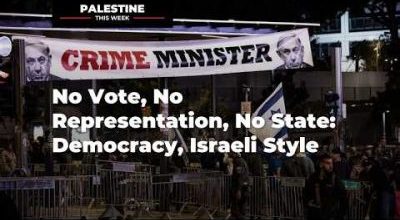
No Vote, No Representation, No State: Democracy, Israeli Style
or go to
Aletho News Archives – Video-Images
From the Archives
Sanctions, War and the Policy of Dual Containment
By SASAN FAYAZMANESH | March 17, 2008
It is now nearly three decades since the Unites States adopted the policy of dual containment of Iran and Iraq. While much has been written about the containment of Iraq, there has been very little in-depth analysis of this policy when it comes to Iran. In a book that is going to be released on March 31, 2008, entitled The United States and Iran: Sanctions, Wars and the Policy of Dual Containment (Routledge), I attempt to address this shortcoming by investigating when and why the US policy of containment of Iran came about, how it evolved, and where it stands today.[1] To the extent that Israel has been involved in US policy making, the study will also include the role that Israel has played in the containment of Iran. Also, since the fate of Iran has been inextricably linked to that of Iraq, occasionally the investigation will overlap with the containment of Iraq.
The policy of dual containment of Iran and Iraq originated during the Carter Administration, but it was not until the Clinton Administration that the expression “dual containment” became popular. … continue
Blog Roll
 Aletho News
- No Vote, No Representation, No State: Democracy, Israeli Style
- Zionist Bought Senate Blocks Information About American Citizens Killed By Israel
- While Gaza dominates the UN, these are the people keeping it alive
- New Report: “Scholasticide and Genocide in Gaza: Assessment, Testimonies and Legal Analysis”
- ‘THAAD Delusion’: Iran war exposes US missile shield limits – The Atlantic
- Moscow issues warning to NATO over Russian exclave
- Yes, the Iran war has destroyed Trump’s presidency
- The fallacy of US delusions about Iran’s economic collapse
- Hezbollah denies Syria cell link, warns of Israeli plan to sow discord
- The legacy of US sanctions, war, and occupation in Iraq
- If Americans Knew
- Mamdani releases plan to combat antisemitism and hate crimes in New York City
- Iran’s Revolutionary Guards Publish Letter to the American People
- DMFI launches $1 million ad campaign supporting Virginia’s Elaine Luria
- US Senate blocks resolution seeking report on Americans killed by Israel
- Israeli Attacks Kill Ten Palestinians in Gaza
- Massacre at Minab: The School That Became a Grave
- Israeli media: The IDF Shows It Doesn’t Turn a Blind Eye; It Actively Emboldens Settler Havoc
- As settlers ravage West Bank, Israeli forces kill 10 in Gaza – Daily Update
- New Report: “Scholasticide and Genocide in Gaza: Assessment, Testimonies and Legal Analysis”
- Ex-Biden officials are desperate for a Gaza scapegoat
- No Tricks Zone
- Green Energy Debacle: German Expert Professor Fritz Vahrenholt Warns Of Severe Economic And Social Consequences
- Two More Paleo Reconstructions Affirm Meters-Higher Sea Levels Across Ireland, Brazil 7000-6000 Years Ago
- New Study: Earth And Venus Surface Warmth Largely Explained By Convection And Lapse Rate, Not CO2 Or Radiation
- 2025 Nature Paper Claiming Worsening Global Drought Gets RETRACTED …Heavily Flawed
- New Study: ‘Global Drought Shows No Detectable Recent Acceleration Under Climate Warming’
- Economic Masterminds: German Socialists Suggest Taxing Productivity Gains Stemming From Using AI
- The South China Sea Has Not Been Cooperating With The Climate Change Narrative
- Energy Crisis: Germany Enters Heating Season With Historically Low Gas Reserve Fill Levels
- New Study: The Antarctic Ice Sheet Gained Mass From 2020-2024 Due To Staggering Snow And Ice Accumulation
- Study: Ocean Heating Rates From Thousands Of Years Ago ‘Dwarf’ Modern Ocean Heating Rates

